SUPERCHARGE YOUR ONLINE VISIBILITY! CONTACT US AND LET’S ACHIEVE EXCELLENCE TOGETHER!
SEO has changed.
For years, brands approached SEO as a keyword game: find terms, create pages, get links, and climb rankings. That approach still matters, but it is no longer the full picture. Search engines now try to understand who a brand is, what it offers, how it relates to topics, and whether it deserves trust.
That shift is the foundation of Brand Entity SEO.
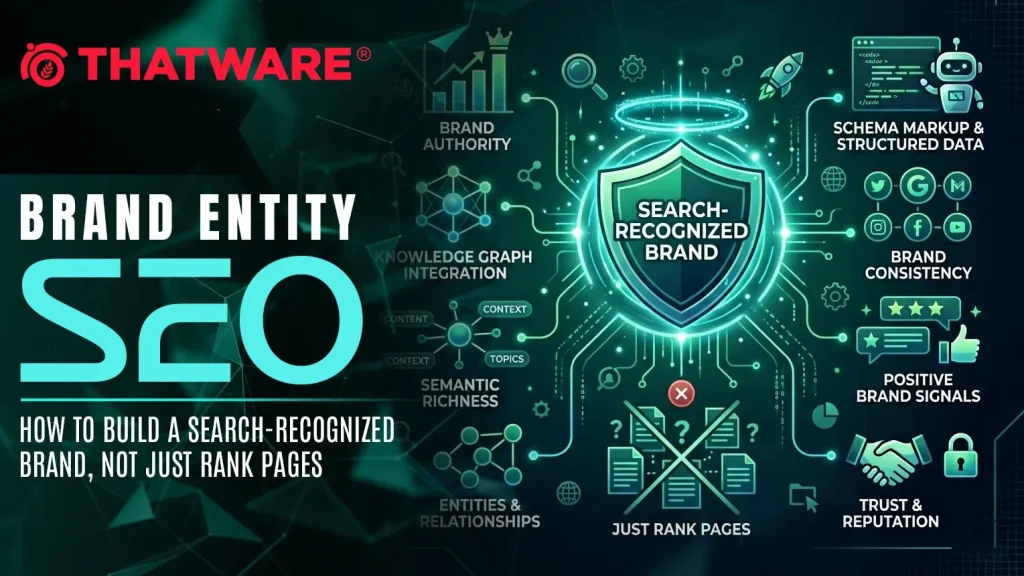
A brand is no longer just a website with pages. In modern search, a brand can become an entity: a clearly understood, verifiable, connected presence that search engines recognize across the web.
When your brand is treated as an entity, your SEO becomes stronger because Google and other search systems can connect your site, your content, your products, your people, your reviews, your social profiles, and your industry relevance into one coherent picture.
This is why Brand Entity SEO matters. It moves SEO from page optimization to brand understanding.
What Is Brand Entity SEO?
Brand Entity SEO is the process of making your brand understandable, consistent, and verifiable to search engines through:
- structured data
- unique content
- consistent brand signals
- topic relevance
- trust indicators
- entity relationships
- user satisfaction
In simple terms:
Keyword SEO asks:
“What page should rank?”
Entity SEO asks:
“What brand should search engines trust for this topic?”
That difference is huge.
Entity SEO helps search engines answer questions like:
- Is this a real brand?
- What does this company do?
- Which topics is it authoritative on?
- Who is associated with it?
- What products or services does it provide?
- Do users trust it?
- Is the brand consistently represented across the web?
When those answers are clear, rankings become easier to earn and defend.
Why Brand Entity SEO Matters
Search engines increasingly rely on semantic understanding rather than exact keyword matching. They connect entities in a web of meaning.
For a brand, this means SEO performance is influenced by more than on-page optimization. It is shaped by whether your business is clearly defined and consistently reinforced.
A well-built brand entity helps with:
Better topical authority
When your content and brand signals consistently point to the same expertise, search engines more easily associate your site with important topics.
Improved trust and credibility
Reviews, author profiles, company information, citations, and structured data help confirm legitimacy.
Stronger brand-led rankings
You are more likely to rank not only for branded searches but also for high-intent non-branded queries in your area of expertise.
More visibility in rich results
Schema can help your content appear in enhanced search results, increasing visibility and click-through rate.
Greater resilience against algorithm changes
A strong entity is harder to displace than a thin keyword page.
The Core Idea: Define the Brand Before You Optimize the Pages
A lot of SEO work fails because brands optimize pages without defining the entity behind them.
Before doing anything else, a brand must answer these questions clearly:
- What is the official brand name?
- What category of business is it?
- What problem does it solve?
- What products or services does it provide?
- Where does it operate?
- Who is behind it?
- What makes it credible?
- What digital properties officially belong to it?
If this information is unclear, inconsistent, or scattered, search engines struggle to connect the signals.
Entity SEO begins with clarity.
The Pillars of Brand Entity SEO
1. Brand Definition
The first pillar is identity.
Your brand must be consistently defined across your website and digital footprint. That includes:
- official business name
- logo
- tagline
- business description
- contact details
- location or service areas
- founder or leadership information
- official social profiles
- product or service categories
This sounds basic, but many websites are inconsistent. They use different business names across platforms, outdated logos, missing company descriptions, or weak About pages. These gaps weaken entity recognition.
A search engine should be able to understand your business in seconds.
2. Structured Data and Schema
Schema is the language that helps search engines read your brand with precision.
Without schema, search engines infer meaning from visible content. With schema, you directly communicate key facts.
Important schema types for Brand Entity SEO include:
- Organization
- LocalBusiness
- WebSite
- WebPage
- Person
- Product
- Service
- BreadcrumbList
- FAQPage
- Review
- Article
Schema helps search engines connect facts such as:
- this is the organization behind the site
- this page belongs to the organization
- this author works for the organization
- this service is offered by the organization
- these profiles belong to the organization
- these reviews are connected to the brand
Schema does not replace content, but it strengthens clarity.
3. Unique, Meaningful Content
Entity SEO is not only technical. Search engines build entity understanding from the substance of your content.
Your content should reflect:
- what the brand knows
- what the customer needs
- what topics the brand owns
- how deeply the brand covers those topics
Thin pages do not build entities. Repetitive pages do not build trust. Meaningful content does.
Strong entity-building content includes:
- service pages with clear differentiation
- detailed About and company pages
- founder or expert bios
- use cases and case studies
- FAQs based on real questions
- educational blog content around your main topics
- customer support and trust pages
Every major page should contribute to the story of who the brand is and why it matters.
4. Intent Alignment
Your notes mention identifying intent and strategy, and that is central to entity SEO.
A strong brand entity does not just publish content. It publishes content that matches the user journey.
Informational intent
Users want to learn.
Examples:
- what is entity SEO
- how schema works
- why brand consistency matters
Commercial intent
Users want to compare options.
Examples:
- best SEO agency for SaaS
- local SEO vs entity SEO
- brand schema implementation services
Transactional intent
Users want to take action.
Examples:
- hire an entity SEO consultant
- request SEO audit
- buy local SEO services
Navigational intent
Users want a specific brand or resource.
Examples:
- your brand name
- your brand reviews
- your brand pricing
A complete website should serve all four intent types. This helps search engines understand that your brand can satisfy users at every stage.
5. Trust Signals
Trust is one of the strongest parts of entity SEO.
A brand entity becomes stronger when it has evidence of legitimacy and customer satisfaction.
Examples of trust signals:
- customer reviews
- third-party mentions
- testimonials
- client logos
- certifications
- awards
- case studies
- media features
- transparent contact details
- privacy policy and terms
- author credentials
- team information
These are not decoration. They are confirmation signals.
If a website looks anonymous, generic, or unverifiable, it is much harder to build entity trust.
6. Topic and Relationship Mapping
An entity does not exist alone. It is understood through relationships.
Your brand should be connected to:
- key industry topics
- supporting subtopics
- locations
- products
- services
- people
- organizations
- customer pain points
- market categories
For example, an SEO agency brand might be related to:
- technical SEO
- local SEO
- structured data
- schema markup
- content strategy
- ecommerce SEO
- Google Business Profile
- site architecture
- analytics
The clearer these relationships are in your content, internal linking, schema, and off-site mentions, the more coherent your entity becomes.
Visual Entity SEO Framework
Here is a simple visual framework you can use to understand how Brand Entity SEO works.
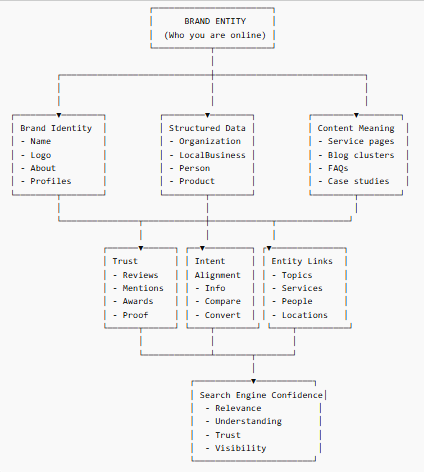
This framework shows that entity SEO is not one task. It is a system.
Your brand entity sits at the center, supported by identity, structured data, content, trust, intent, and relationships.
The Entity SEO Content Model
A strong brand website usually has content arranged like this:
Core brand pages
These define the entity.
- Home
- About
- Contact
- Team
- Careers
- Reviews or Testimonials
- Case Studies
- Press or Media
- Policies and trust pages
Commercial pages
These define offerings.
- Services
- Service category pages
- Industry-specific service pages
- Product pages
- Pricing or quote pages
Support and trust pages
These reduce doubt.
- FAQ
- Process
- Delivery timelines
- Customer support
- Guarantees
- Onboarding
Topical authority content
These define expertise.
- blog clusters
- guides
- how-to articles
- comparison pages
- glossary content
- problem-solution pages
Together, these page groups help search engines and users understand the brand fully.
Step-by-Step Implementation Plan for a Website
Here is a practical implementation roadmap for applying Brand Entity SEO to a website.
Phase 1: Brand Entity Discovery
Step 1: Audit your current brand signals
Review your website and external profiles.
Check:
- business name consistency
- logo consistency
- NAP details if local
- About page quality
- social profile links
- reviews presence
- company descriptions
- authorship information
Goal: identify missing or inconsistent entity signals.
Step 2: Define your official entity profile
Create one source of truth for the brand.
Document:
- official business name
- short description
- long description
- logo URL
- website URL
- contact details
- social profiles
- founders or experts
- core services or products
- service areas or locations
Goal: create a clean, unified brand identity to use everywhere.
Phase 2: Website Architecture for Entity SEO
Step 3: Map website pages by entity function
Group pages by purpose.
Example:
- Identity pages: Home, About, Team, Contact
- Conversion pages: Services, Pricing, Demo, Book a call
- Authority pages: Blog, Guides, Resources
- Trust pages: Testimonials, Case Studies, Certifications
- Support pages: FAQ, Process, Policies
Goal: make the site architecture reflect the brand clearly.
Step 4: Build a topical map
List your core topics and subtopics.
Example for an SEO brand:
- Entity SEO
- Local SEO
- Technical SEO
- Schema markup
- Content strategy
- ecommerce SEO
- SEO audits
Then map supporting subtopics under each.
Goal: define the semantic territory your brand wants to own.
Step 5: Align pages with search intent
For every topic, assign intent.
Example:
- “What is entity SEO” → informational blog
- “Entity SEO agency” → service page
- “Entity SEO vs traditional SEO” → comparison page
- “Book entity SEO consultation” → conversion page
Goal: ensure every important intent has a destination page.
Phase 3: Content and Page Optimization
Step 6: Rewrite the homepage as an entity-defining page
Your homepage should answer immediately:
- who you are
- what you do
- who you help
- where you operate
- why you are credible
- what action to take next
Include:
- clear positioning statement
- supporting proof
- key services
- client or trust logos
- reviews or results
- strong internal links
Goal: make the homepage the clearest entry point into your brand entity.
Step 7: Strengthen the About page
This page is often underused.
Include:
- brand story
- mission
- team or founders
- expertise
- methodology
- credibility markers
- media or milestones
Goal: turn the About page into an entity trust page.
Step 8: Create unique service pages
Each service page should be distinct.
Include:
- service definition
- customer problems solved
- process
- outcomes
- FAQs
- proof
- related case studies
- related blog content
Goal: avoid generic service pages and build semantic depth.
Step 9: Create author and team profiles
If experts produce content, show who they are.
Include:
- role
- experience
- expertise areas
- published content
- LinkedIn or official profile
- relationship to the brand
Goal: help search engines connect people to expertise.
Step 10: Build supporting topical content
Create blog clusters around your core services and expertise.
A cluster on Brand Entity SEO might include:
- what is entity SEO
- how schema supports entity understanding
- brand signals Google uses
- how to build topical authority
- local business entity SEO checklist
- entity SEO mistakes to avoid
Goal: reinforce your brand’s relevance around core topics.
Phase 4: Structured Data Implementation
Step 11: Add foundational schema sitewide
At minimum, implement:
- Organization or LocalBusiness
- WebSite
- WebPage
- BreadcrumbList
If relevant, add:
- Person
- Product
- Service
- FAQPage
- Review
- Article
Goal: create explicit machine-readable context.
Step 12: Connect schema entities properly
Your schema should not exist as isolated blocks.
Connect:
- Organization to website
- authors to organization
- services to organization
- products to brand
- social profiles using sameAs
- pages to their page type
Goal: create one connected entity graph, not random markup.
Step 13: Validate and clean structured data
Check for:
- incomplete properties
- schema spam
- irrelevant schema types
- inconsistent names and URLs
- broken logo or profile links
Goal: make schema accurate, not excessive.
Phase 5: Trust and Reputation Building
Step 14: Surface reviews and testimonials
Bring customer proof onto the site.
Best places:
- homepage
- service pages
- testimonials page
- product pages
- case studies
Goal: show real-world trust signals.
Step 15: Build case studies and proof pages
Each case study should show:
- problem
- approach
- solution
- measurable result
Goal: replace claims with evidence.
Step 16: Strengthen off-site consistency
Update:
- Google Business Profile
- social channels
- directories
- review platforms
- partner listings
Goal: make the same entity visible everywhere with consistent details.
Phase 6: Internal Linking and Semantic Reinforcement
Step 17: Build an internal linking system
Link content based on entity relationships.
For example:
- homepage → services
- services → case studies
- services → related blogs
- blogs → service pages
- author pages → articles
- About page → team pages
Goal: help search engines understand page relationships and topic hierarchy.
Step 18: Use consistent terminology
Avoid calling the same thing by too many unrelated names.
If your main service is “Entity SEO,” do not randomly alternate between ten vague labels without context.
Goal: reinforce stable topic associations.
Phase 7: Measurement and Improvement
Step 19: Track entity SEO KPIs
Measure beyond rankings.
Track:
- branded search growth
- non-branded topic visibility
- click-through rate
- indexed rich results
- review growth
- brand mention volume
- engagement on About, service, and case study pages
- conversions from informational content
Goal: see whether search engines and users are understanding the brand better.
Step 20: Refine based on patterns and insights
Look for:
- pages with impressions but low clicks
- pages with traffic but weak conversions
- topics with poor depth
- missing trust signals
- weak internal linking
- schema gaps
- inconsistent external profiles
Goal: continuously strengthen the entity.
A Simple Website Implementation Example
Here is what a practical Brand Entity SEO structure might look like for a service business:
Main pages
- Home
- About
- Services
- Entity SEO
- Technical SEO
- Local SEO
- Case Studies
- Blog
- Contact
Trust pages
- Testimonials
- Reviews
- Our Process
- FAQs
- Certifications
Topic cluster for “Entity SEO”
- What is Entity SEO
- How Brand Schema Works
- Entity SEO for Local Businesses
- Entity SEO vs Traditional SEO
- Common Entity SEO Mistakes
- How to Build Topical Authority
Schema stack
- Organization on homepage
- Service schema on service pages
- Article schema on blogs
- FAQ schema where applicable
- Person schema on author pages
- Review schema where eligible
This kind of structure creates clarity, trust, and semantic depth.
Common Mistakes in Brand Entity SEO
Treating schema as the whole strategy
Schema helps, but it cannot fix weak branding or thin content.
Creating generic pages
Generic service pages do not help search engines understand why your brand matters.
Ignoring About and trust pages
Many brands over-focus on blogs and ignore the pages that define legitimacy.
Inconsistent brand details
Different names, descriptions, phone numbers, or profile links create confusion.
Publishing content without topical structure
Random blog posts do not build entity strength. Topic clusters do.
Focusing only on traffic, not understanding
High impressions mean little if search engines do not fully trust or associate your brand.
Quick Brand Entity SEO Checklist
Identity
- Clear brand name
- Clear About page
- Consistent logo and description
- Official profiles linked
Content
- Unique homepage
- Unique service pages
- Helpful blog clusters
- Author bios and case studies
Schema
- Organization or LocalBusiness
- WebSite and WebPage
- Service, Article, Person, FAQ where relevant
- Proper sameAs and entity connections
Trust
- Reviews
- Testimonials
- Certifications
- Contact transparency
- Case studies
Structure
- Internal linking
- Intent-based pages
- Topic clusters
- Semantic consistency
Improvement
- Track KPIs
- Review gaps
- Expand entity relationships
- Update content and schema regularly
Wrapping Up
Brand Entity SEO is no longer optional. It is the foundation of sustainable search visibility. Instead of chasing rankings page by page, the focus shifts to building a brand that search engines can clearly understand, trust, and connect across the web. When your identity is consistent, your content is meaningful, your structure reflects intent, and your signals reinforce credibility, your website stops being just a collection of pages and starts functioning as a recognized entity. This shift not only improves rankings but also strengthens long term authority, resilience, and user trust, making your brand the natural choice in both search results and real world decisions.