SUPERCHARGE YOUR ONLINE VISIBILITY! CONTACT US AND LET’S ACHIEVE EXCELLENCE TOGETHER!
The Illusion of Growth
For more than a decade, marketing has run on a simple equation: more traffic = more growth. More visitors meant more opportunities. More impressions meant more awareness. More clicks meant more revenue—at least, that’s what dashboards told us. And for a while, it worked well enough to become gospel.
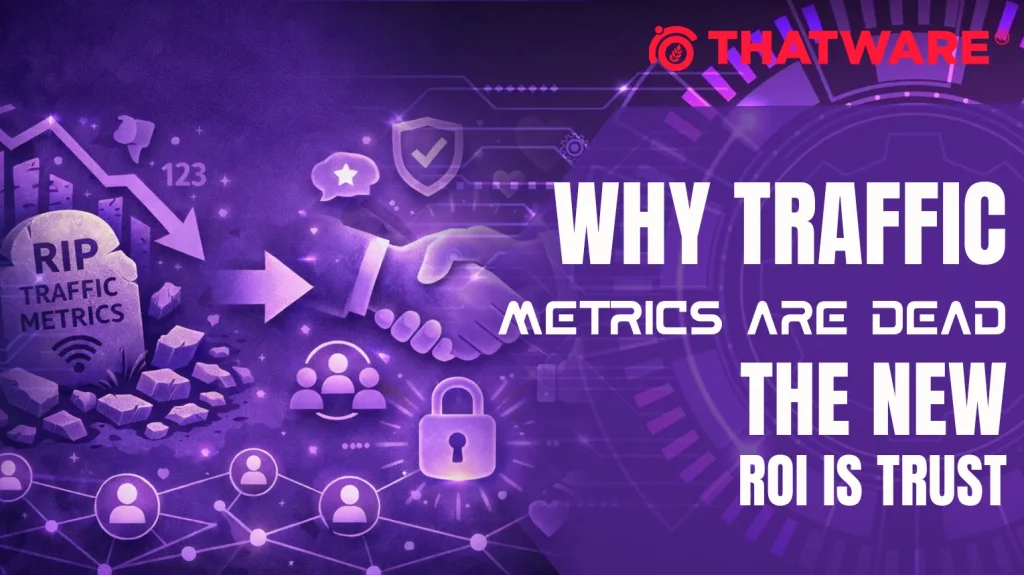
But today, that equation is breaking in plain sight.
Brands can rank on Google, go viral on social media, and pump paid campaigns 24/7—yet still struggle to convert those eyeballs into customers… or customers into loyal fans. It’s not unusual to see businesses celebrating “record traffic” while customer retention is flat, conversion rates are sliding, and trust in the brand is quietly eroding.
That’s the illusion: traffic feels like momentum, but it often isn’t.
The era of “more traffic = more growth” is over
Traffic used to be scarce. If you could get people to your site, you were already ahead. Attention was the main bottleneck, and most industries weren’t drowning in content, ads, and copycat offers. When fewer companies competed for the same audience, traffic was a signal of advantage.
Now, attention is abundant and cheap. The internet has become a marketplace of infinite options, and customers have become ruthless in how quickly they dismiss things that feel unclear, exaggerated, or unsafe. In this world, traffic doesn’t mean you’re winning. It often means you’re simply… visible.
Visibility isn’t the same as trust.
Why brands with millions of visitors still struggle
If traffic is up, why don’t conversions follow?
Because most traffic is low-intent and low-commitment. People click out of curiosity, bounce out of uncertainty, and scroll past your promise the moment it feels too generic or too good to be true. And even when they buy once, they won’t return if their experience doesn’t match your message.
In other words, the problem isn’t that you didn’t attract enough people. The problem is that enough people didn’t believe you.
- They didn’t believe your claims.
- They didn’t believe your product will work for them.
- They didn’t believe you’ll support them after purchase.
- They didn’t believe the value is real—or consistent—or safe.
Traffic can bring people to your door. But only trust invites them in.
The uncomfortable truth: traffic is easy to buy, trust is hard to earn
This is the part most growth teams don’t want to admit: traffic has become a commodity.
- You can buy it with ads.
- You can manufacture it with clickbait.
- You can borrow it with influencers.
- You can inflate it with tactics that look impressive on weekly reports.
But trust? Trust is slower. Trust requires proof. Trust requires consistency. Trust is built through thousands of tiny moments where your brand either keeps its promise—or breaks it.
And when trust breaks, the cost isn’t just a PR headache. It’s a compounding business problem:
- higher CAC (because fewer people convert)
- lower LTV (because fewer people stay)
- weaker referrals (because fewer people recommend)
- more discounting (because customers need a “deal” to take the risk)
Traffic might spike numbers. Trust compounds outcomes.
Thesis: Sustainable growth comes from engineered trust, not inflated traffic
The next era of brand-building won’t reward whoever gets the most clicks. It will reward whoever earns the most confidence.
Sustainable growth today comes from engineered trust—not inflated traffic numbers.
Not “trust” as a vague brand value on a website footer. Trust as a system: designed, measured, reinforced, and scaled across every touchpoint—content, product experience, onboarding, support, community, pricing, and how you handle mistakes.
Because in a world where anyone can buy attention, trust becomes the only defensible moat.
And the brands that understand this early won’t just survive the collapse of traffic-first marketing. They’ll build the next billion-dollar advantage—one relationship at a time.
The Rise and Fall of Traffic-First Marketing
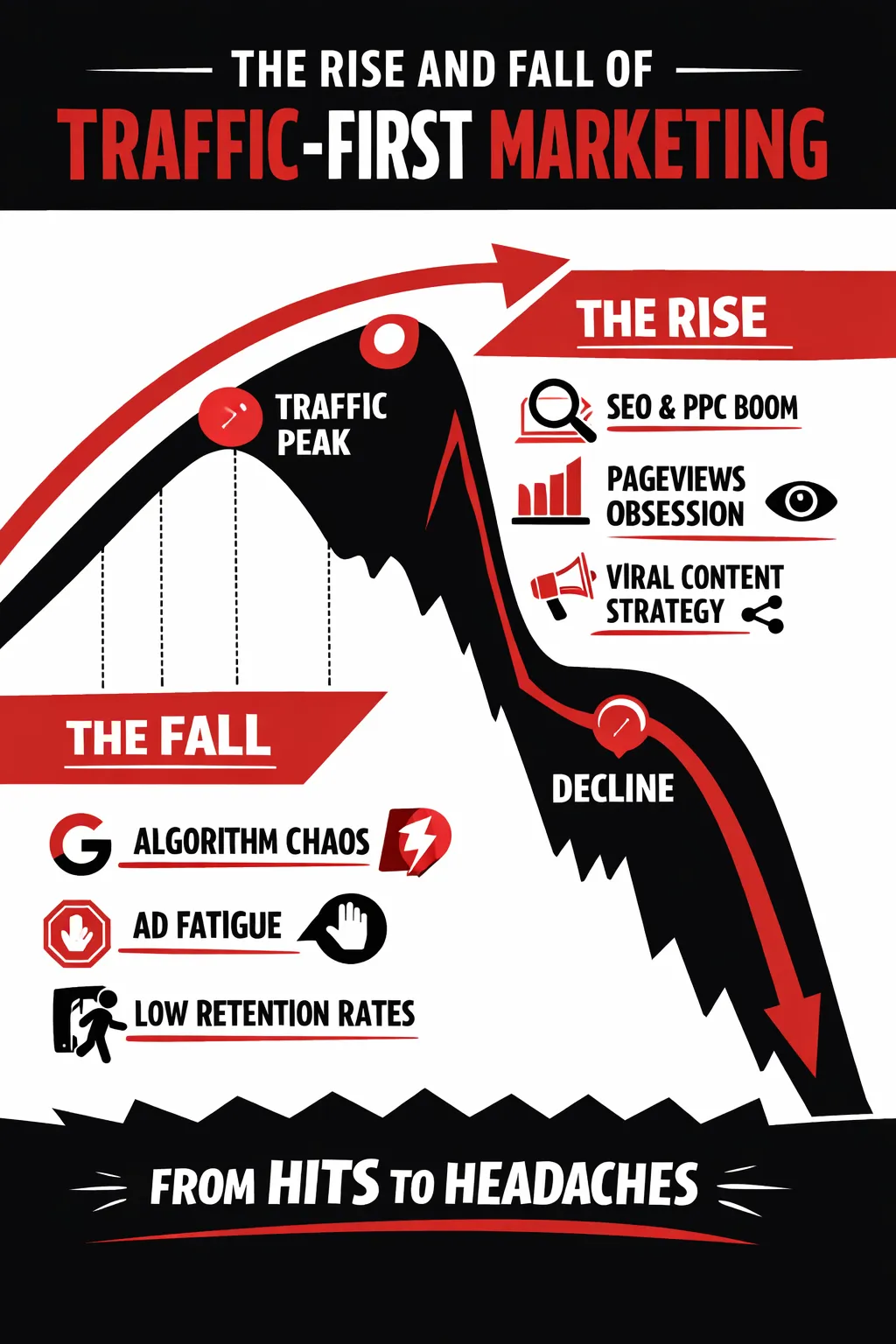
For more than a decade, “growth” was often reduced to a single idea: get more people to your website. More visitors meant more opportunities, more leads, more revenue—at least on paper. And for a while, that logic worked well enough to become doctrine. But the internet matured, audiences changed, platforms tightened control, and attention became cheap. What’s left is a strategy that still looks impressive on dashboards—but increasingly fails in the real world.
To understand why traffic metrics are losing their power, we need to look at how they became the default in the first place—and why they no longer reflect business health.
How Traffic Became the Default Success Metric
The early SEO, PPC, and content marketing culture
In the early days of digital marketing, distribution was relatively straightforward. Search engines were less competitive, social platforms offered enormous organic reach, and paid ads were cheaper and easier to optimize. If you published content consistently and sprinkled in the right keywords, you could rank. If you ran ads, you could buy attention at scale. If you posted on social, your followers actually saw it.
This created a powerful feedback loop:
- Content brought traffic
- Traffic created leads
- Leads created sales
- And marketers learned: traffic is the lever
As a result, many growth strategies became less about building a differentiated brand and more about building a pipeline of clicks. SEO teams chased rankings. PPC teams chased cheaper CPMs and higher CTRs. Content teams chased shareability. Everyone chased volume.
Pageviews, impressions, and CTRs as boardroom-friendly numbers
Traffic metrics didn’t just spread because they were easy to measure—they spread because they were easy to sell internally.
Executives and stakeholders love metrics that feel concrete and scalable. And nothing feels more concrete than:
- “We got 1.2 million pageviews this month.”
- “Our impressions doubled quarter-over-quarter.”
- “CTR is up 18%.”
These are big, clean, rising numbers that look like progress in a slide deck. Even better: they can be reported weekly, compared month-over-month, and turned into neat charts.
The problem is, these metrics often answer the wrong question.
Traffic metrics answer: “Did people see us?”
Leadership needs: “Did we build value?”
In many organizations, the first question replaced the second.
Why marketers were incentivized to chase volume
Once traffic metrics became the “scoreboard,” they naturally shaped behavior. People optimize what they’re evaluated on.
If a marketer’s performance is tied to:
- pageviews
- impressions
- MQL volume
- CTR
…then their job becomes maximizing those numbers—even if the quality of attention is low.
This incentivized strategies like:
- Writing broad “top-of-funnel” content that ranks but doesn’t convert
- Publishing high-frequency content with low originality
- Creating click-driven headlines designed for curiosity, not clarity
- Running paid campaigns optimized for clicks instead of downstream outcomes
It wasn’t that marketers were wrong—it’s that they were playing the game their incentives demanded. Over time, traffic became not just a channel metric, but a cultural obsession.
Why Traffic Metrics No Longer Signal Business Health
Even if traffic once correlated with growth, it doesn’t anymore—not reliably. The modern internet breaks the relationship between visibility and value in multiple ways.
Algorithm volatility: Google updates and social reach collapse
Today, platforms control distribution far more aggressively than they used to. A single algorithm update can reshape your entire acquisition engine overnight.
- SEO rankings can drop despite “doing everything right”
- Social platforms routinely throttle organic reach
- Paid ad environments get more expensive and less predictable
This means traffic is no longer something you truly “own.” It’s something you rent—often on unstable terms.
So when traffic spikes or falls, it may reflect platform behavior, not business health. That’s why traffic as a north-star metric is dangerous: it’s too dependent on forces you can’t control.
Ad blindness and declining click-through rates
Audiences have adapted. They are better at ignoring marketing.
People scroll faster, trust less, and have more options than ever. Ads, popups, retargeting banners, and “conversion tricks” aren’t novel—they’re expected. And as novelty fades, performance degrades.
CTR declines, attention fragments, and the cost to acquire a click rises. But here’s the deeper issue:
Even when you do get clicks, the click often means less than it used to.
A click today might be curiosity, distraction, habit—or even an accidental tap. It is not a strong indicator of intent.
Low-intent traffic vs high-intent relationships
Traffic can be high while intent is low.
A lot of content-driven traffic comes from people who are:
- researching generally
- comparing casually
- consuming passively
- solving a one-time problem
They might read your post, take what they need, and leave—never to return.
That’s not “bad.” But it’s not the kind of attention that builds a business.
Meanwhile, high-intent relationships look different:
- repeat visitors who engage across multiple pages
- subscribers who open consistently
- customers who come back without being pushed
- users who trust your product enough to build habits around it
Traffic doesn’t capture this distinction well. Two brands can have the same number of visits and completely different levels of real market strength.
High bounce rates, low retention, weak LTV
The clearest proof that traffic is a weak health metric is what happens after the visit.
Many traffic-heavy sites suffer from:
- high bounce rates (people leave immediately)
- low return rates (no habit formed)
- low retention (no ongoing value)
- weak LTV (customers don’t stay long enough)
This is where traffic-first thinking collapses: it optimizes for the entrance, not the outcome.
A business doesn’t win by bringing people to the doorstep. It wins by giving them a reason to stay, return, and recommend.
And that’s exactly why traffic metrics are losing relevance: they don’t measure the thing that matters most now—the depth of trust and relationship you’ve earned.
Vanity Metrics vs Value Metrics
Illusion vs Impact
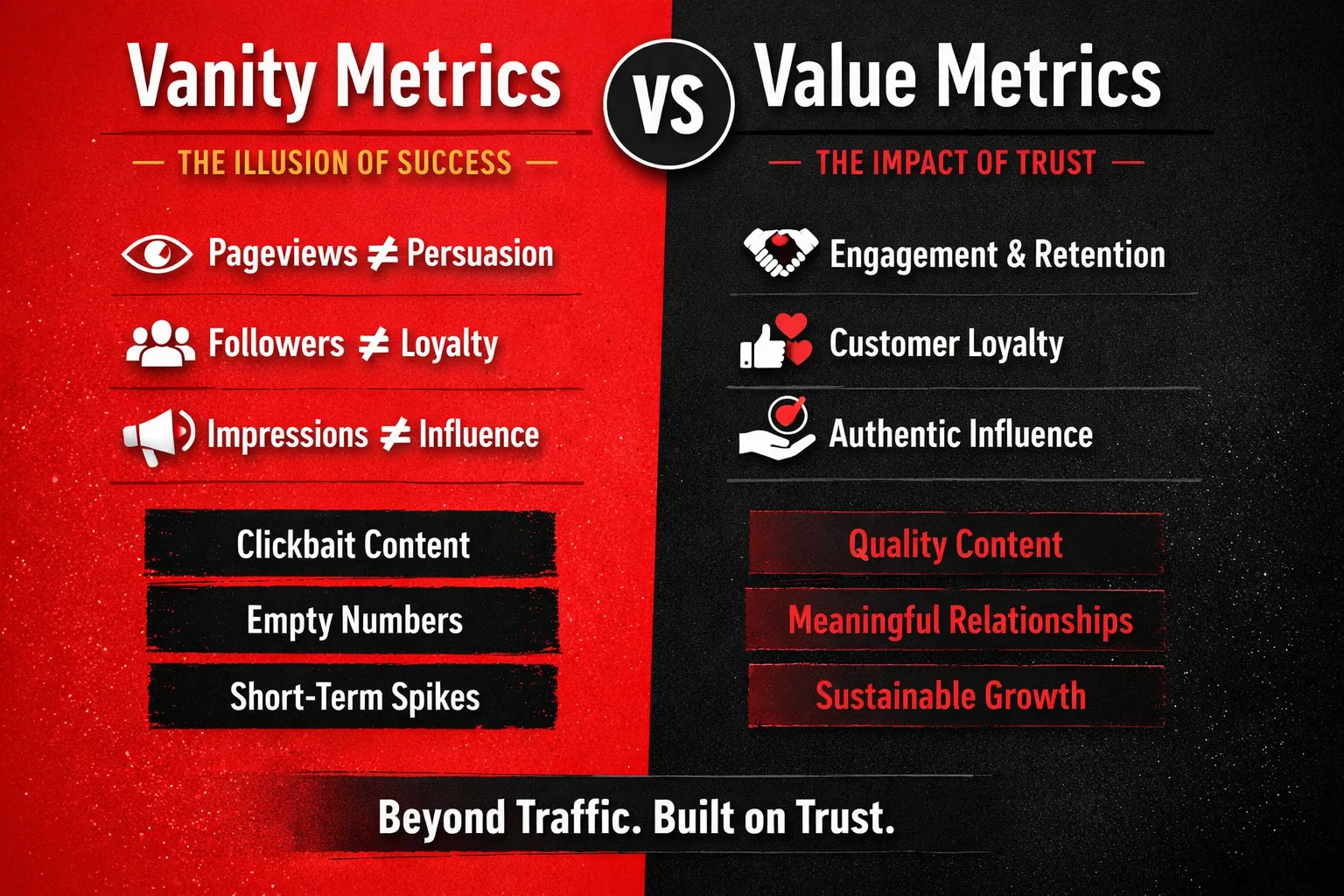
For years, digital growth has been judged by numbers that look impressive but often mean very little. Vanity metrics create the illusion of momentum, while value metrics reveal whether a business is actually building something durable. Understanding the difference is where the shift from traffic obsession to trust-driven growth begins.
What Vanity Metrics Really Measure (And What They Don’t)
Vanity metrics are seductive because they are easy to track, easy to present, and easy to celebrate. The problem is that they rarely reflect real influence or business impact.
Pageviews ≠ Persuasion
High pageviews simply mean people landed on a page—not that they believed what they read, understood your value, or took action. A blog post can attract thousands of visits and still fail to:
- Change perception
- Build credibility
- Move readers closer to a decision
Persuasion requires clarity, relevance, and trust. Pageviews measure exposure, not conviction.
Followers ≠ Loyalty
Social media followers inflate quickly, but loyalty grows slowly. Many followers:
- Never engage with your content
- Won’t defend your brand
- Disappear when algorithms change
True loyalty shows up in repeat interactions, advocacy, and long-term relationships—not in a follower count that can be bought or gamed.
Impressions ≠ Influence
An impression only means your content appeared on a screen. It says nothing about:
- Whether it was noticed
- Whether it was understood
- Whether it changed behavior
Influence is measured by trust and action. Impressions measure visibility, not impact.
The Hidden Cost of Optimizing for Traffic
Chasing traffic doesn’t just fail to create value—it actively damages long-term growth.
Shallow Content Strategies
When traffic becomes the goal, content is optimized for search engines instead of humans. This leads to:
- Generic articles
- Repetitive ideas
- No original thinking
The result is content that ranks briefly but is forgotten instantly.
Sensationalism Over Substance
Click-driven strategies reward exaggeration, fear, and overpromising. Headlines become louder, while substance becomes thinner. Over time, audiences learn not to believe what they read—especially from brands that consistently oversell and underdeliver.
Brand Trust Erosion Through Clickbait
Clickbait might win attention once, but it loses credibility every time. When expectations are manipulated:
- Users feel misled
- Trust breaks down
- Return visits decline
Trust, once damaged, is far harder to rebuild than traffic ever was to acquire.
Short-Term Spikes, Long-Term Decline
Traffic-first growth often looks like success on dashboards:
- Sudden spikes
- Viral moments
- Temporary visibility
But beneath the surface, engagement drops, retention weakens, and customer lifetime value stagnates. Brands grow noisy, not meaningful.
The Core Shift: From Vanity to Value
- Vanity metrics answer the question: How many people saw us?
- Value metrics answer the question: How many people trust us?
In a crowded digital economy, attention is cheap. Trust is rare. And the brands that stop optimizing for appearances—and start optimizing for impact—are the ones that build lasting growth.
The Trust Economy: Why Trust Is the New ROI
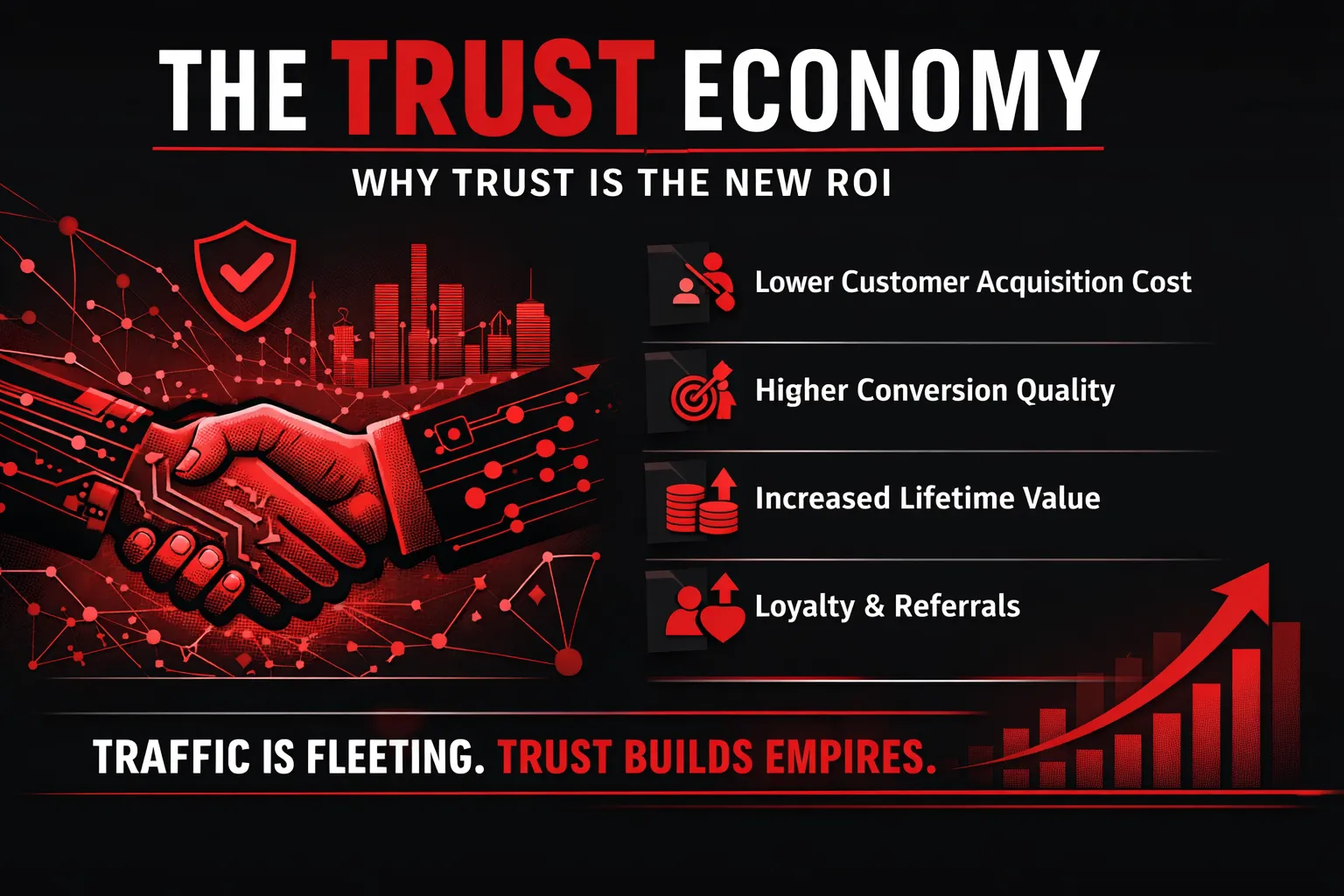
For years, return on investment has been calculated through familiar lenses—traffic volume, cost per click, conversion rates. But as markets mature and consumers grow more discerning, these numbers alone no longer explain why some brands scale sustainably while others stall. We’ve entered the trust economy, where trust is not a soft, abstract concept, but a measurable, strategic asset that directly impacts revenue, efficiency, and long-term growth.
In this economy, attention is abundant and cheap. Trust is scarce—and that scarcity is precisely what makes it valuable.
What “Trust ROI” Actually Means
Trust ROI refers to the tangible business returns generated when a brand consistently earns and maintains customer confidence. Unlike traffic spikes or viral moments, trust compounds over time, quietly strengthening every growth lever in the business.
Trust as a Growth Multiplier
Trust doesn’t just add incremental value—it multiplies the effectiveness of everything else. Marketing campaigns convert better. Product launches face less resistance. New offerings gain adoption faster. When customers trust a brand, they give it the benefit of the doubt, reducing friction at every decision point. The same message, delivered by a trusted brand, outperforms one delivered by an unknown or inconsistent competitor—often by orders of magnitude.
Reduced Customer Acquisition Cost (CAC)
Trust lowers the cost of acquiring customers because it reduces reliance on paid persuasion. Word-of-mouth, referrals, organic advocacy, and repeat purchases begin to replace aggressive ad spend. Prospects who already trust your brand need less convincing, fewer touchpoints, and shorter sales cycles. Over time, trust acts as an invisible acquisition channel—one that scales without proportional increases in cost.
Higher Conversion Quality
Not all conversions are created equal. Traffic-first strategies often optimize for volume, attracting low-intent users who churn quickly. Trust-first strategies attract fewer but better customers—people who understand the value, align with the brand, and are more likely to stay. This leads to higher-quality conversions, lower refund rates, fewer support issues, and stronger brand relationships.
Increased Lifetime Value (LTV)
Trust extends the customer relationship. When customers trust a brand, they buy more often, stay longer, and explore additional offerings with less hesitation. They’re also more forgiving when mistakes happen, provided transparency and accountability follow. Over time, this loyalty translates directly into higher lifetime value, turning trust into one of the most powerful revenue drivers a business can build.
Why Modern Consumers Buy Trust, Not Attention
The shift toward trust-driven ROI isn’t accidental—it’s a direct response to how consumer behavior has evolved.
Information Overload and Skepticism
Today’s consumers are overwhelmed by content, ads, and promises. Endless options have bred skepticism. Marketing messages are no longer taken at face value; they’re filtered, questioned, and often ignored. In this environment, attention is fleeting, but trust cuts through the noise. People don’t want more information—they want reassurance that they’re making the right choice.
The Rise of Peer Validation and Reviews
Authority has shifted from brands to communities. Reviews, testimonials, social proof, and peer recommendations now carry more weight than polished brand messaging. Consumers trust other consumers because they perceive them as unbiased. Brands that actively cultivate and showcase genuine peer validation gain credibility that no ad campaign can replicate.
Demand for Transparency, Ethics, and Authenticity
Modern consumers expect brands to stand for something—and to prove it through action, not slogans. Transparency in pricing, data usage, sourcing, and decision-making has become a baseline expectation. Ethical behavior and authentic communication are no longer “nice to have”; they are prerequisites for trust. Brands that hide, exaggerate, or manipulate quickly lose credibility in an always-connected world.
In the trust economy, ROI is no longer just about how many people you reach—but how many people believe in you. Brands that recognize trust as a core business asset don’t just survive market volatility; they build resilience, loyalty, and compounding growth that traffic alone can never deliver.
Intelligence as the Trust Engine
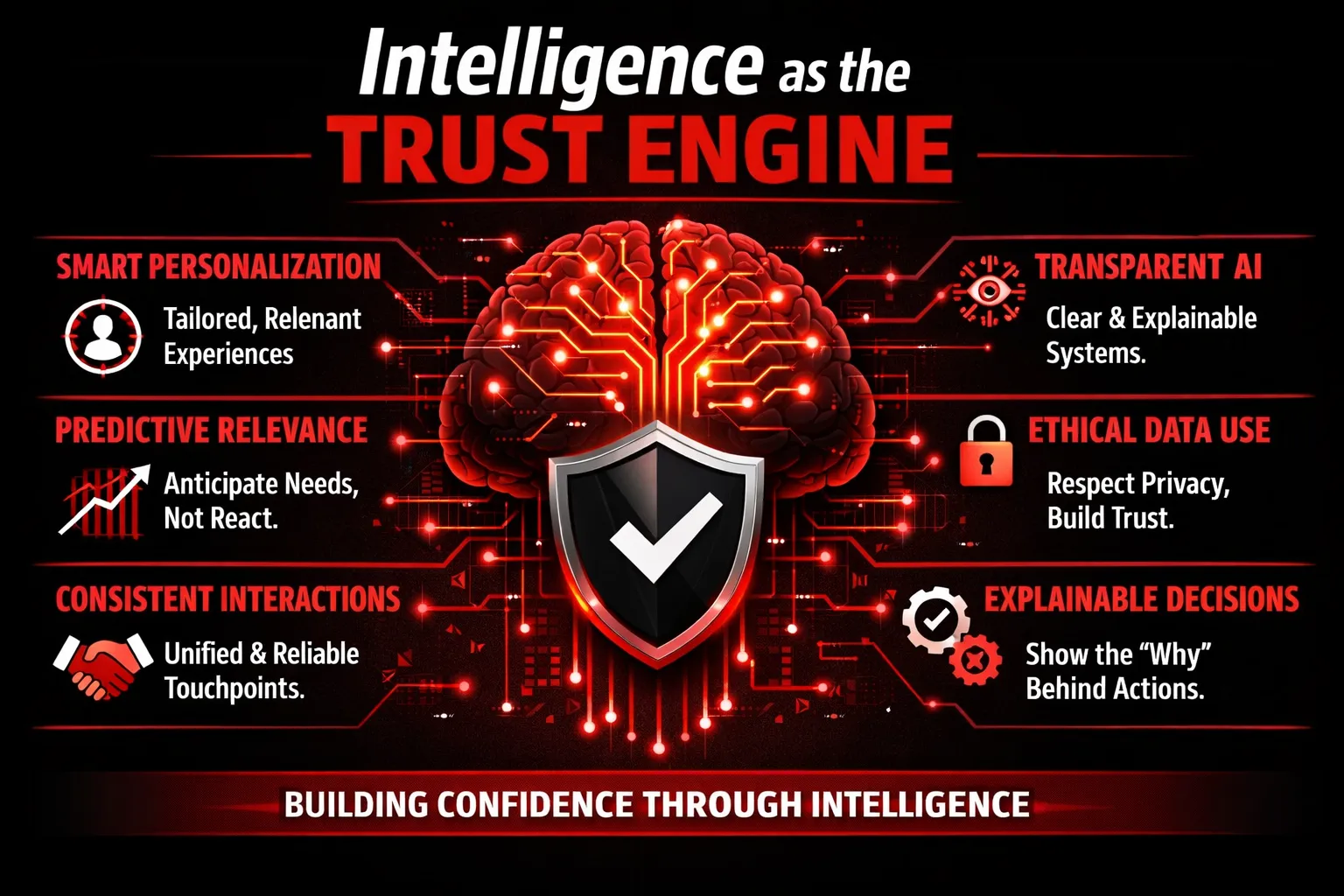
Trust at scale is no longer built manually. It is engineered.
As brands grow, human intuition alone can’t maintain relevance, consistency, or credibility across millions of interactions. This is where intelligence systems—AI, data analytics, and adaptive personalization—become the new infrastructure of trust. When used responsibly, intelligence doesn’t just optimize marketing performance; it quietly reinforces confidence at every touchpoint.
But there’s a catch: intelligence that feels intrusive or opaque destroys trust faster than bad advertising ever could.
How Intelligent Systems Build Trust at Scale
Personalization That Feels Helpful, Not Creepy
The difference between trust-building personalization and trust-breaking surveillance is intent—and execution.
Helpful personalization anticipates needs without exposing how much the system knows. It answers questions before users ask them, recommends content that genuinely adds value, and reduces friction without demanding attention.
Creepy personalization, on the other hand, reminds users they are being watched.
Trust-focused intelligence systems:
- Use contextual signals instead of excessive personal data
- Prioritize relevance over hyper-precision
- Make personalization feel like good service, not behavioral tracking
When intelligence works invisibly in the user’s favor, trust becomes a natural byproduct.
Predictive Relevance vs Reactive Marketing
Reactive marketing responds to what already happened. Predictive relevance respects what might happen next.
Intelligent systems build trust by:
- Anticipating user intent instead of interrupting it
- Offering solutions before frustration arises
- Reducing cognitive load rather than adding to it
When a brand consistently feels “one step ahead” in a helpful way, users stop questioning its motives. The experience feels designed—not manipulative.
Predictive intelligence signals competence. Competence breeds trust.
Consistency Across Touchpoints
Trust collapses when experiences feel fragmented.
A brand that sounds empathetic in content but robotic in support—or personalized on the website but generic in email—creates cognitive dissonance. Intelligence systems solve this by acting as a unifying layer across channels.
Well-designed intelligence ensures:
- Consistent tone, values, and relevance
- Seamless transitions between platforms
- Memory of user preferences without repetition
Consistency is one of the strongest psychological foundations of trust. Intelligence makes consistency scalable.
Transparency, Explainability & Ethical AI
Why “Black-Box” Systems Erode Trust
People don’t trust what they don’t understand—especially when decisions affect them.
Black-box algorithms that make recommendations, approvals, or rankings without explanation create suspicion, even if outcomes are technically correct. Over time, opacity signals a lack of accountability.
Trust-aware brands recognize that:
- Accuracy alone is not enough
- Users want reasoning, not just results
- Silence creates doubt
Explainability isn’t a technical luxury—it’s a trust requirement.
Clear Communication of Data Usage
Trust doesn’t come from collecting less data. It comes from being honest about how data is used.
Brands that engineer trust communicate:
- What data is collected
- Why it is collected
- How it improves the user experience
When users understand the value exchange, data sharing becomes a conscious choice rather than a hidden transaction.
Transparency transforms data from a liability into a relationship asset.
Explainable Recommendations and Decisions
The most trusted intelligence systems don’t just recommend—they explain.
Simple cues like:
- “Recommended because you viewed…”
- “Based on your previous preferences…”
- “You’re seeing this because…”
…restore a sense of control. They remind users that intelligence is assisting, not manipulating.
Explainable AI shifts power dynamics. It positions the brand as a guide, not a puppeteer.
The Core Insight
Intelligence doesn’t build trust by being smarter. It builds trust by being respectful, predictable, and accountable.
The brands that win the next decade won’t be those with the most advanced algorithms—but those with the most trust-aware ones.
Real-World Examples: Brands That Chose Trust Over Traffic
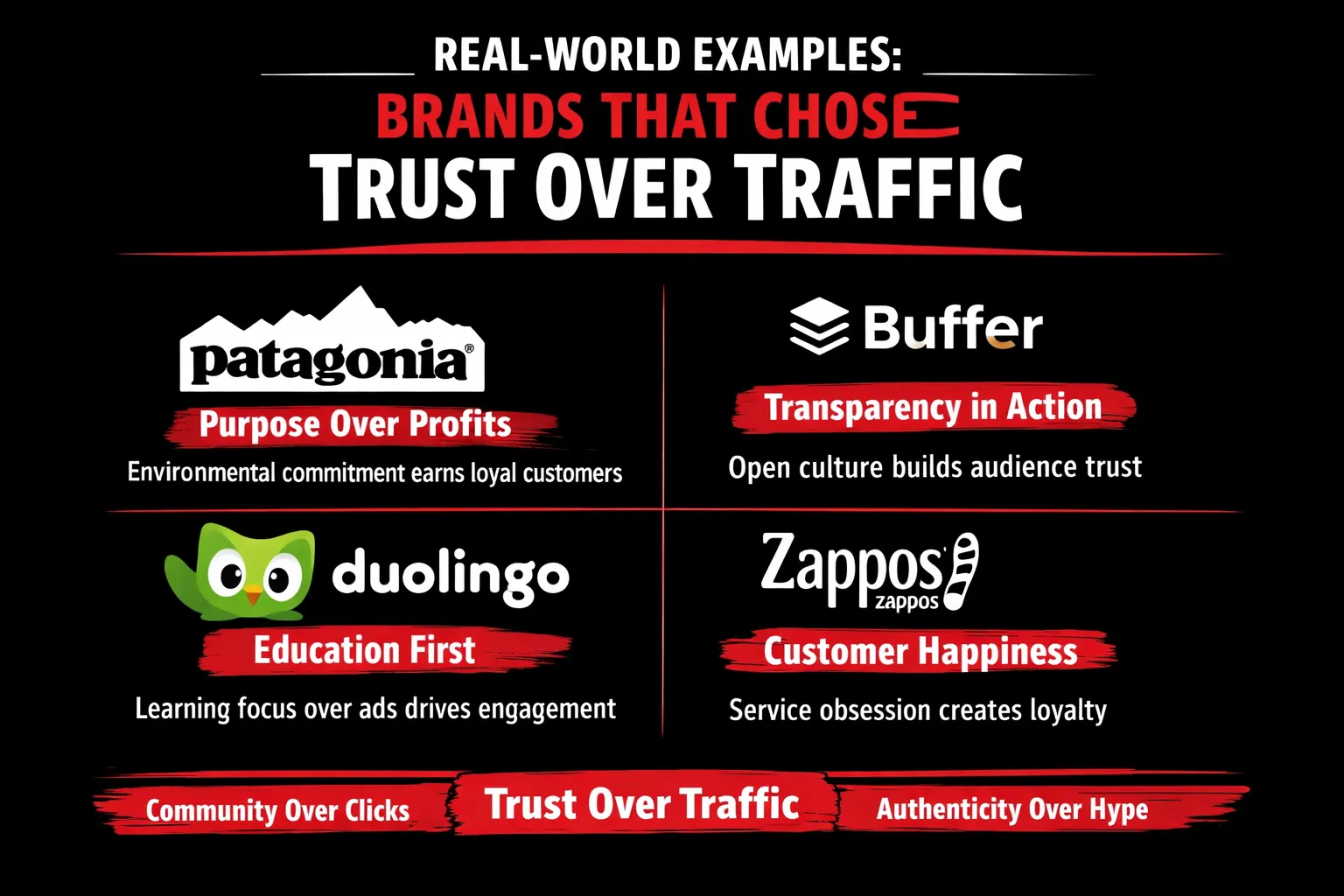
If traffic were the ultimate growth lever, the most visible brands would also be the most loved. Reality tells a different story. Some of the most resilient and profitable brands today deliberately stepped away from traffic obsession and instead invested in earning trust over time. Their growth didn’t slow—it compounded.
Brands That Reduced Ad Spend but Increased Loyalty
Patagonia is a classic but still powerful example. The brand openly discourages overconsumption through campaigns like “Don’t Buy This Jacket.” On paper, this looks anti-growth. In reality, it did the opposite. By prioritizing environmental responsibility and radical transparency, Patagonia reduced reliance on aggressive advertising while building a fiercely loyal customer base. Customers don’t just buy products—they buy into the brand’s values.
The lesson is clear:
When trust is high, marketing costs go down. Loyal customers return, recommend, and defend the brand without being paid to do so.
Another example is Basecamp, which intentionally rejected growth-at-all-costs marketing. By focusing on clarity, honesty, and respecting user attention, Basecamp maintained profitability while staying independent—proof that trust can outperform scale-driven traffic models.
Companies That Prioritize Education Over Promotion
HubSpot didn’t become a category leader by chasing clicks—it became one by teaching. Long before inbound marketing was mainstream, HubSpot invested heavily in free education: blogs, certifications, tools, and research. Much of this content wasn’t designed to convert immediately. It was designed to build competence and credibility.
As a result, when buyers were ready, trust had already been established.
Similarly, Notion grew by empowering users with deep documentation, templates, and community-driven knowledge. Instead of interruptive ads, Notion let its product and education speak for itself. Growth followed understanding, not hype.
The insight here:
Education scales trust. Promotion only scales noise.
Platforms That Grew Through Community, Not Virality
Figma is a standout example of community-first growth. Rather than relying on viral spikes or massive ad budgets, Figma focused on collaboration and creator empowerment. Designers didn’t just use Figma—they shared files, templates, and workflows inside it. Trust was built peer-to-peer, not brand-to-user.
Another strong example is Duolingo, which invested in long-term engagement rather than short-term installs. Its community features, transparent learning progress, and playful honesty about difficulty levels built trust with users who stayed for years, not weeks.
Community-driven brands benefit from a powerful dynamic:
Trust compounds socially. Every engaged user becomes a trust signal for the next.
Lessons Learned from Trust-First Growth Strategies
Across all these brands, common patterns emerge:
- They traded reach for relevance
Fewer impressions, deeper relationships.
- They treated trust as an asset, not a byproduct
Values, transparency, and consistency were intentional—not accidental.
- They accepted slower early growth for stronger long-term compounding
Trust takes time, but once built, it’s hard to disrupt.
- They let customers become the distribution channel
Advocacy replaced advertising.
- They aligned intelligence with empathy
Data and systems were used to improve experiences, not manipulate behavior.
The Bigger Picture
These brands didn’t reject traffic entirely—they refused to worship it. Traffic became a byproduct of trust, not the goal. In an economy flooded with content, ads, and AI-generated noise, trust is the only signal that cuts through.
The brands that win tomorrow won’t be the loudest. They’ll be the most credible, consistent, and intelligently human.
Measuring What Actually Matters: Trust-Centric Metrics
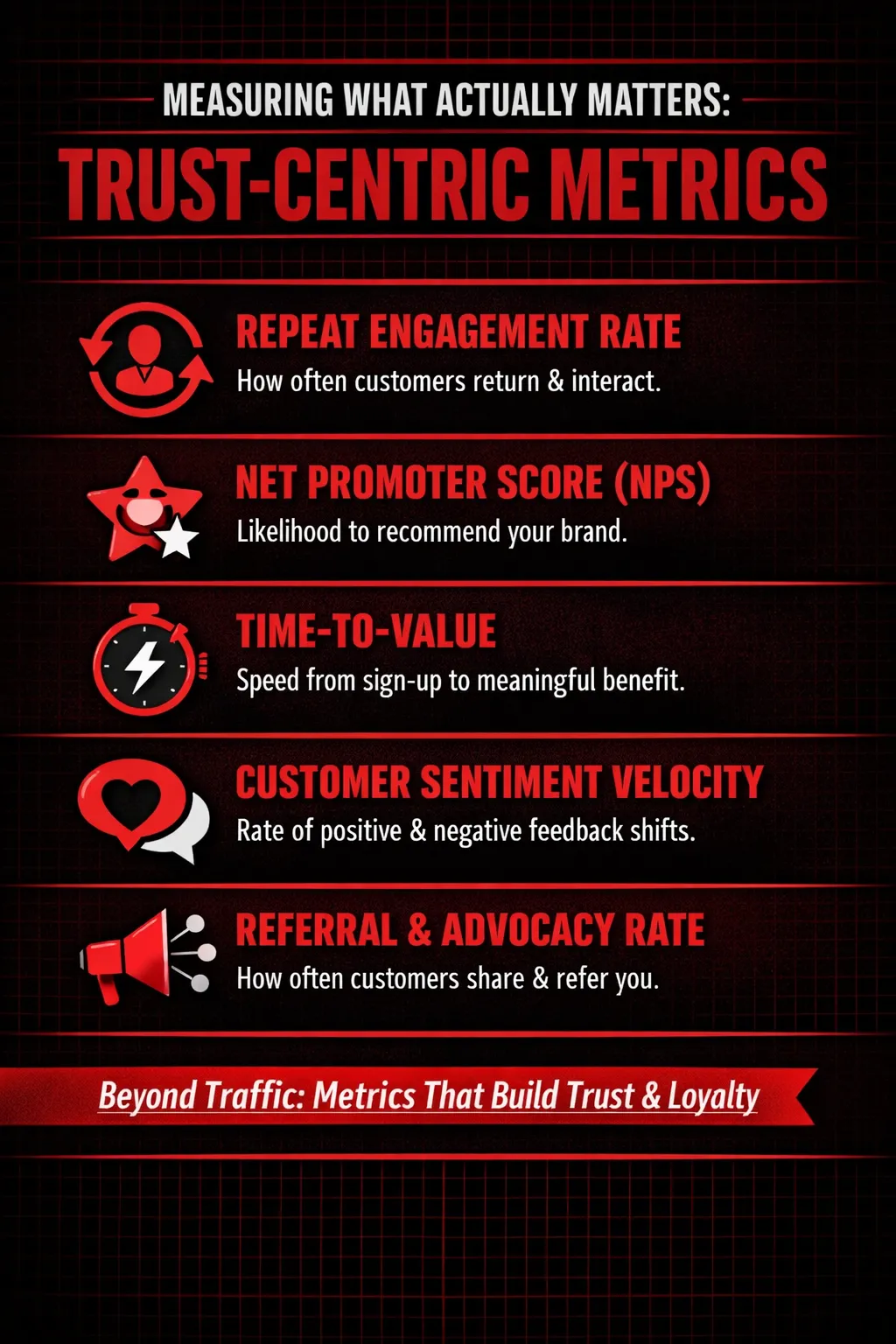
For years, growth dashboards have been dominated by numbers that look impressive but explain very little. Traffic, impressions, and clicks may indicate exposure, but they say nothing about belief, loyalty, or long-term value.
If trust is the new ROI, then it must be measured with the same rigor we once reserved for traffic. The difference? Trust-centric metrics don’t measure attention — they measure confidence.
Trust Metrics to Track Instead of Traffic
These metrics shift the focus from how many people showed up to how many people chose to stay, engage, and advocate.
Repeat Engagement Rate
What it measures: How often users return to interact with your brand across content, product, or platform touchpoints.
Why it matters: Trust creates habit. When people come back voluntarily — without ads or prompts — it signals confidence in your value.
Why it beats traffic: A thousand one-time visitors mean less than a hundred people who repeatedly engage. Repeat engagement reflects perceived reliability, relevance, and usefulness.
Net Promoter Score (NPS)
What it measures: The likelihood that customers would recommend your brand to others.
Why it matters: Recommendations are trust in action. People only attach their reputation to brands they genuinely believe in.
Why it beats traffic: Traffic measures reach; NPS measures reputation. One scales spend — the other scales belief.
Time-to-Value (TTV)
What it measures: How quickly users experience a meaningful benefit after first interaction or onboarding.
Why it matters: Trust accelerates when value is delivered early and clearly. Confusion delays trust; clarity builds it.
Why it beats traffic: A fast path to value reduces churn, increases retention, and proves competence — all core trust signals.
Customer Sentiment Velocity
What it measures: How quickly customer sentiment improves (or deteriorates) over time across reviews, feedback, and conversations.
Why it matters: Trust is dynamic, not static. This metric captures whether confidence in your brand is growing or eroding.
Why it beats traffic: Traffic is a snapshot. Sentiment velocity shows momentum — and momentum predicts longevity.
Referral and Advocacy Rate
What it measures: The percentage of customers who actively refer, share, or defend your brand.
Why it matters: Advocacy is the highest form of trust. It’s voluntary, unpaid, and deeply human.
Why it beats traffic: Traffic is rented attention. Referrals are earned belief.
How to Present Trust Metrics to Stakeholders
One of the biggest barriers to trust-first strategies isn’t data — it’s perception. Leadership teams are often conditioned to value volume because it’s familiar, fast, and easy to visualize.
The shift requires reframing trust not as a “soft” metric, but as a growth engine.
Translating Trust into Revenue Impact
Trust metrics must be tied directly to outcomes executives care about:
- Higher repeat engagement → lower CAC
- Faster time-to-value → higher conversion quality
- Strong advocacy → organic growth and reduced ad dependency
- Positive sentiment velocity → resilience during market shocks
When trust rises, revenue doesn’t spike — it stabilizes and compounds.
Dashboards That Link Trust Signals to Growth
Modern dashboards should connect emotional signals to financial performance:
- Repeat engagement vs customer lifetime value (LTV)
- NPS vs retention and upsell rates
- Sentiment trends vs churn risk
- Referrals vs cost-free acquisition growth
This makes trust visible, defensible, and boardroom-ready.
Moving Leadership Away from Vanity KPIs
The goal isn’t to eliminate traffic metrics — it’s to demote them.
Traffic becomes a supporting indicator, not a success metric. The primary question shifts from:
“How many people saw us?” to “How many people believe in us enough to return, recommend, and rely on us?”
When leadership adopts this lens, strategy changes naturally — from chasing clicks to earning confidence.
Key Takeaway
Traffic shows interest. Trust shows intent.
Brands that measure trust don’t just grow faster — they grow stronger, more defensible, and more valuable over time.
How to Transition from Traffic Obsession to a Trust Strategy
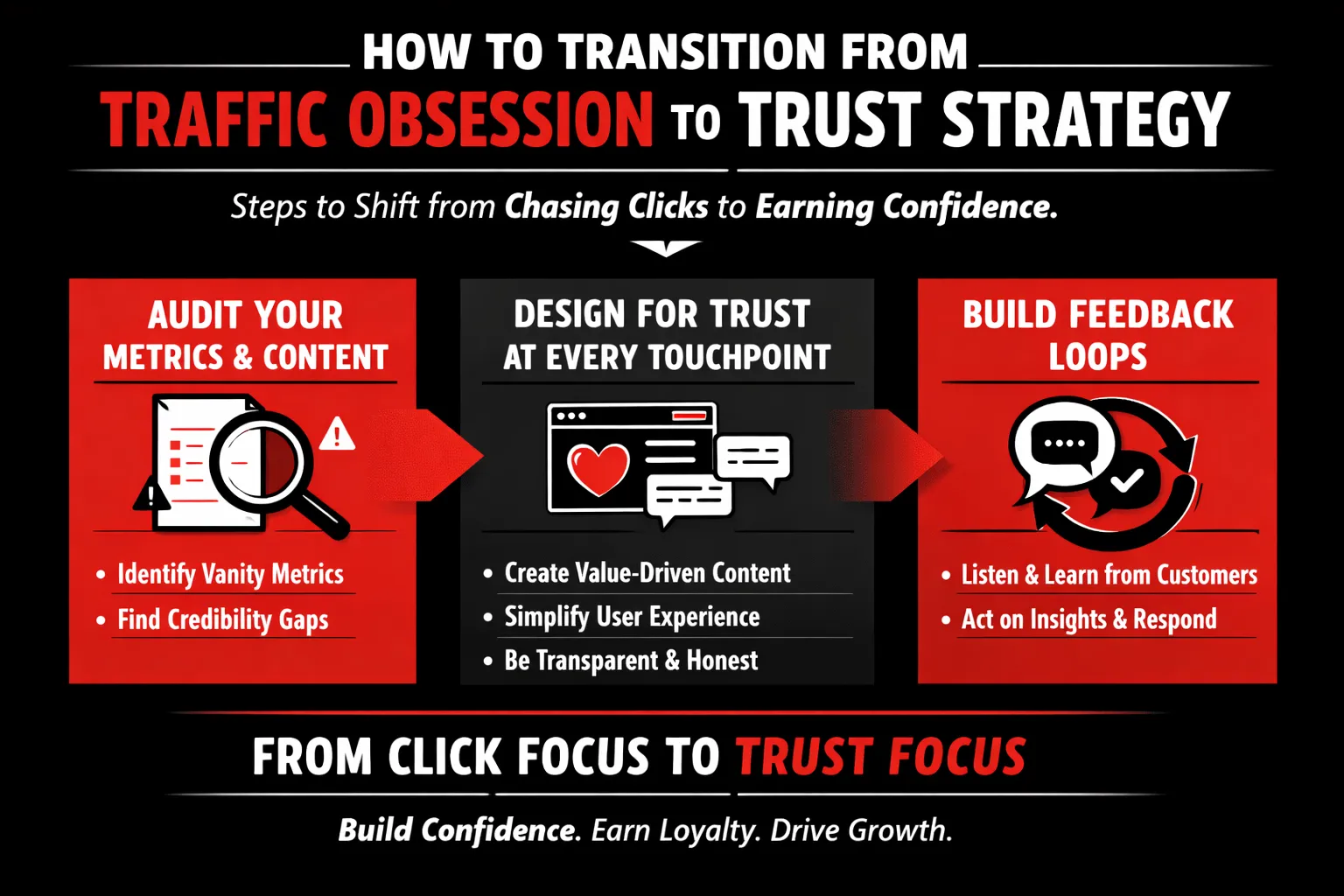
Moving away from traffic obsession doesn’t mean abandoning growth—it means redefining what healthy growth actually looks like. Trust-led brands don’t chase attention; they design systems that consistently earn belief. This transition requires intention, discipline, and a willingness to let go of vanity metrics that feel good but deliver little.
Here’s a practical roadmap to make that shift.
Audit Your Current Metrics & Content
Before you can build trust, you must first identify where you’re leaking it.
Most organizations are unknowingly optimized for appearance rather than impact. They celebrate numbers that look impressive in reports but fail to translate into customer confidence or long-term value.
Identify vanity-driven strategies
Start by asking uncomfortable questions:
- Which metrics dominate your dashboards—pageviews, impressions, follower counts?
- How often do you measure repeat behavior versus first-time visits?
- Are teams rewarded for volume or for meaningful outcomes?
If success is defined by how many people arrive, rather than how many stay, return, or recommend, you’re still operating in a traffic-first mindset.
Find gaps in credibility and clarity
Next, audit your content and messaging:
- Does your content genuinely educate, or does it exist mainly to rank?
- Are claims backed by evidence, experience, or real-world outcomes?
- Is your messaging clear, consistent, and specific—or vague and over-promising?
Trust erodes quickly when content feels inflated, generic, or disconnected from reality. Clarity is credibility. Anything confusing, exaggerated, or shallow becomes a silent trust tax on your brand.
Design Trust into Every Touchpoint
Trust is not built in a single campaign—it’s engineered across every interaction.
From the first click to post-purchase support, each touchpoint either strengthens confidence or introduces doubt.
Content as education, not bait
Shift your content philosophy:
- From “How do we attract clicks?”
- To “How do we reduce uncertainty?”
Educational content respects the reader’s intelligence. It explains trade-offs, limitations, and real use cases. It helps people make better decisions—even if that decision isn’t always to buy immediately. Ironically, this restraint often increases conversions over time.
UX clarity and friction reduction
Nothing destroys trust faster than confusion.
- Hidden pricing
- Overloaded pages
- Aggressive pop-ups
- Complex navigation
A trust-first UX prioritizes:
- Clear language over clever copy
- Predictable flows over dark patterns
- Speed, accessibility, and transparency
When users don’t have to think hard to understand what you offer, they feel safer engaging with you.
Honest messaging over hype
Modern audiences are hyper-aware of exaggeration. Trust-driven brands:
- Say less, but mean more
- Replace hype with proof
- Replace promises with processes
Honesty doesn’t weaken positioning—it strengthens it. Brands that openly acknowledge limitations are perceived as more credible than those claiming perfection.
Build Feedback Loops That Reinforce Trust
Trust is a two-way relationship. If customers speak and nothing changes, trust dies quietly.
Build listening systems
Trust-centric organizations actively listen through:
- Reviews and testimonials (not just the positive ones)
- Customer surveys focused on experience, not just satisfaction
- Community spaces where real conversations happen
The goal isn’t data collection—it’s understanding. Patterns in feedback reveal where trust is strong and where it’s fragile.
Close the loop with visible action
Listening alone is not enough. Trust is reinforced when people see that their input matters.
- Publicly acknowledge feedback
- Share what’s changing and why
- Show progress, not perfection
When customers see their voices influence decisions, they shift from users to advocates. This is where trust compounds.
The Bigger Shift
Transitioning from traffic obsession to a trust strategy is not a marketing tweak—it’s a mindset change. Traffic becomes a byproduct, not the goal. Growth becomes deeper, slower, and far more resilient.
Brands that make this shift stop asking, “How do we get more attention?”
And start asking, “How do we deserve it?”
That’s where sustainable ROI truly begins.
The Future of Growth: Brands as Trust Platforms
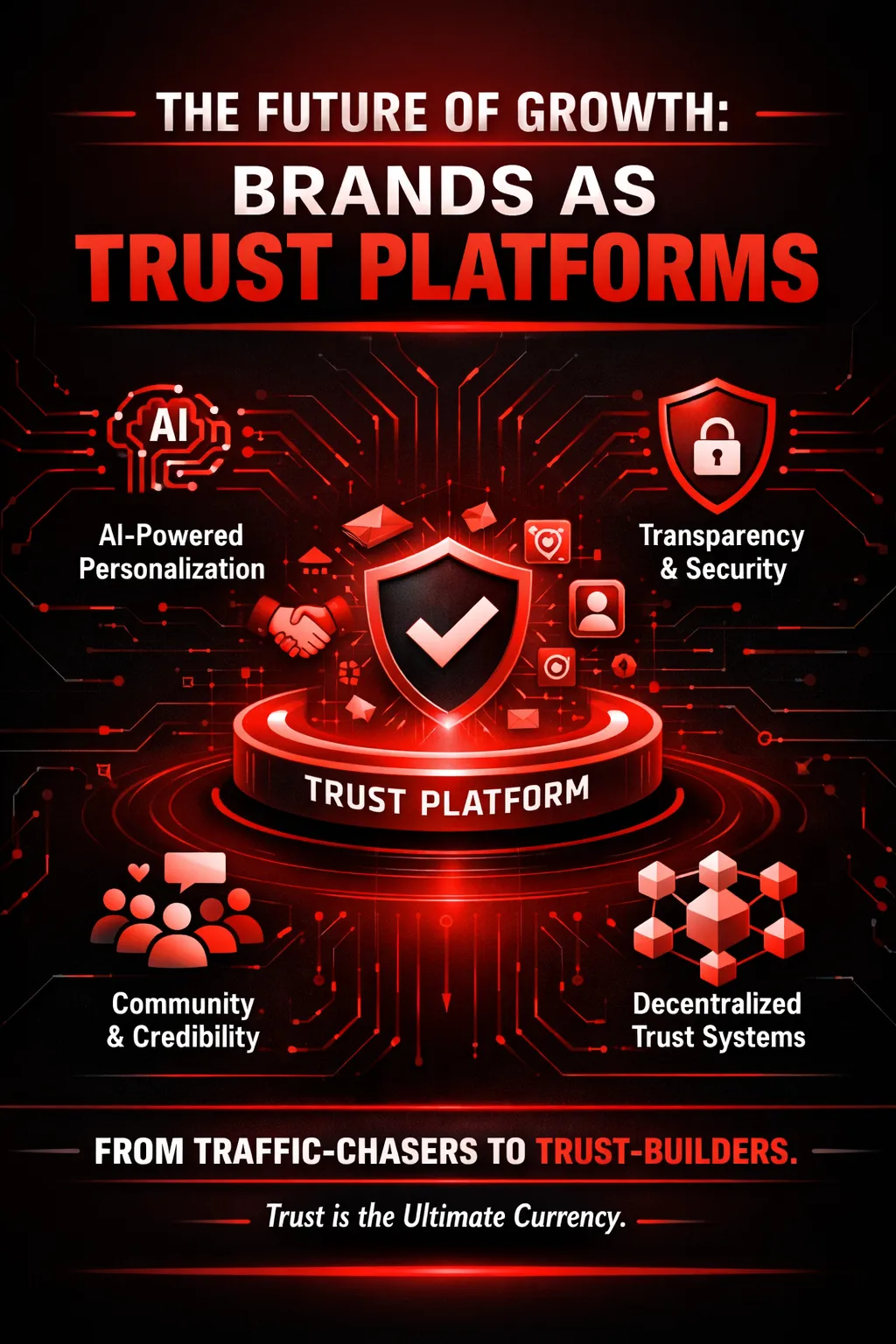
The next era of growth won’t look like the last one. For years, the playbook was simple: publish more, rank higher, spend more on ads, drive more clicks. Growth was treated like a faucet—turn up the traffic, watch revenue rise.
That faucet is breaking.
Consumers are overwhelmed, platforms are unpredictable, and attention is increasingly expensive. In this environment, brands that win won’t be the loudest. They’ll be the ones people believe. The future belongs to brands that behave less like campaigns and more like trust platforms—systems designed to consistently deliver reliability, transparency, and value.
Why the next billion-dollar brands will be trust-native
Billion-dollar brands used to be distribution-native. If you controlled shelf space, ad inventory, or a dominant channel, you could scale fast. Today, control has shifted away from brands and toward users, communities, and algorithms. Distribution is rented, not owned—and it can disappear overnight.
So what lasts?
Trust does.
The next generation of breakout brands will be trust-native, meaning trust isn’t a marketing promise stitched onto the homepage—it’s built into how the product works, how decisions are made, and how customers are treated at every touchpoint.
Trust-native brands tend to share a few defining traits:
- They’re consistent. The experience matches the expectation every time.
- They’re transparent. They don’t hide fees, policies, limitations, or data usage behind fine print.
- They’re customer-aligned. Their incentives feel aligned with the user’s success—not just the brand’s revenue.
- They’re accountable. They acknowledge mistakes quickly and fix them visibly.
In a world where people doubt ads, question reviews, and distrust institutions, trust-native brands become default choices—not because they’re everywhere, but because they feel safe.
And safe scales.
Because when customers trust you, they buy more confidently, churn less, complain less, and refer more. Trust isn’t just brand equity—it’s growth equity.
Traffic as a byproduct, not a goal
Traffic isn’t useless. It’s just no longer the point.
In the trust era, traffic becomes what it always should have been: a symptom of real value, not a substitute for it.
Here’s what happens when trust is the focus:
- People search for you by name (not just your category).
- They return without being retargeted.
- They recommend you without being asked.
- They share your content because it helps, not because it’s optimized.
That’s the new dynamic: the best traffic is earned, not bought.
When brands obsess over traffic, they often compromise trust to get it—clickbait titles, inflated promises, aggressive popups, dark-pattern UX, “limited time” urgency that never ends. Those tactics may spike visits, but they quietly damage what matters: confidence.
When brands obsess over trust, traffic shows up differently:
- Smaller, more qualified audiences
- Higher intent and longer engagement
- Better conversion quality
- Stronger retention
Which means: less noise, more signal.
The future of growth is not “how many people can you attract?”
It’s “how many people will choose you again—without being pushed?”
Intelligence-driven trust as the ultimate competitive moat
Here’s the part most brands underestimate: in a digital world, trust must be built at scale, and scale requires systems.
That’s where intelligence comes in—not as hype, but as infrastructure.
Intelligence-driven trust means using data and AI responsibly to create experiences that are:
- More reliable (fewer broken promises, fewer surprises)
- More relevant (customers feel understood, not marketed to)
- More proactive (issues solved before they become complaints)
- More explainable (decisions and recommendations make sense)
When done right, intelligence doesn’t just optimize conversions—it strengthens belief.
Examples of intelligence-driven trust in practice:
- A product that recommends the right plan, even if it’s cheaper, because it fits the customer better.
- A support system that detects frustration early and escalates before the customer explodes.
- A checkout that warns about delays or limitations upfront instead of hiding them until after purchase.
- A personalization engine that explains why it’s recommending something—and lets the user control it.
This is where the moat forms.
Because competitors can copy your features. They can mimic your ads. They can even replicate your pricing.
But they can’t easily replicate a trust engine—a living system made of consistent delivery, transparent communication, ethical data use, and customer-first decisions reinforced over time.
And the bigger the brand gets, the more that engine matters. At scale, trust isn’t built by a few great campaigns. It’s built by thousands of micro-interactions that consistently say the same thing:
“You’re safe here.”
The future is fewer funnels, more platforms
Funnels assume customers must be “moved” toward a purchase. Trust platforms assume customers must be supported toward a decision.
That’s the shift.
The next billion-dollar brands will look less like traffic machines and more like confidence machines. Their marketing will feel like education. Their product will feel like guidance. Their policies will feel fair. Their AI will feel helpful. Their growth will feel earned.
And when trust becomes the platform, growth becomes the outcome.
In the next decade, the strongest brands won’t win by capturing attention. They’ll win by deserving it.
Conclusion: Stop Chasing Clicks. Start Earning Confidence
For years, brands have been trained to believe that growth lives at the top of the funnel—more clicks, more views, more impressions. But in today’s saturated, skeptical digital landscape, traffic metrics no longer reflect real momentum. Pageviews don’t signal belief. Impressions don’t guarantee intent. And viral reach, without trust, fades as quickly as it arrives. Modern brands fail not because they lack visibility, but because visibility without credibility creates noise, not value.
The future of growth demands a fundamental reframing. Sustainable brands are no longer built on volume, but on credibility, consistency, and confidence. Credibility comes from showing up with clarity, honesty, and expertise. Consistency is earned through reliable experiences across every touchpoint—not just marketing, but product, support, and communication. Confidence is the outcome: customers who trust a brand enough to return, recommend, and defend it. When these elements are engineered intentionally, growth becomes compounding rather than consumptive.The final takeaway is simple, yet uncomfortable: brands that buy attention will always rent their growth, but brands that engineer trust will own their future. Traffic may open the door, but trust is what invites people to stay. The next generation of enduring, billion-dollar brands won’t be defined by how many people they attract—but by how many believe, return, and advocate. The choice is clear: stop chasing clicks, and start earning confidence.