
SUPERCHARGE YOUR ONLINE VISIBILITY! CONTACT US AND LET’S ACHIEVE EXCELLENCE TOGETHER!
A Complete 2026 Guide for Modern Marketers
Why Marketers Must Rethink Visibility in 2026
If your marketing strategy still treats Google rankings as the finish line, 2026 is going to feel frustrating. Not because SEO is “dead,” but because the definition of visibility has changed. People don’t search the way they used to. They don’t open ten tabs, compare a handful of blog posts, and slowly decide what they believe. Increasingly, they ask a question and expect an answer—immediately, confidently, and in a format that feels final.
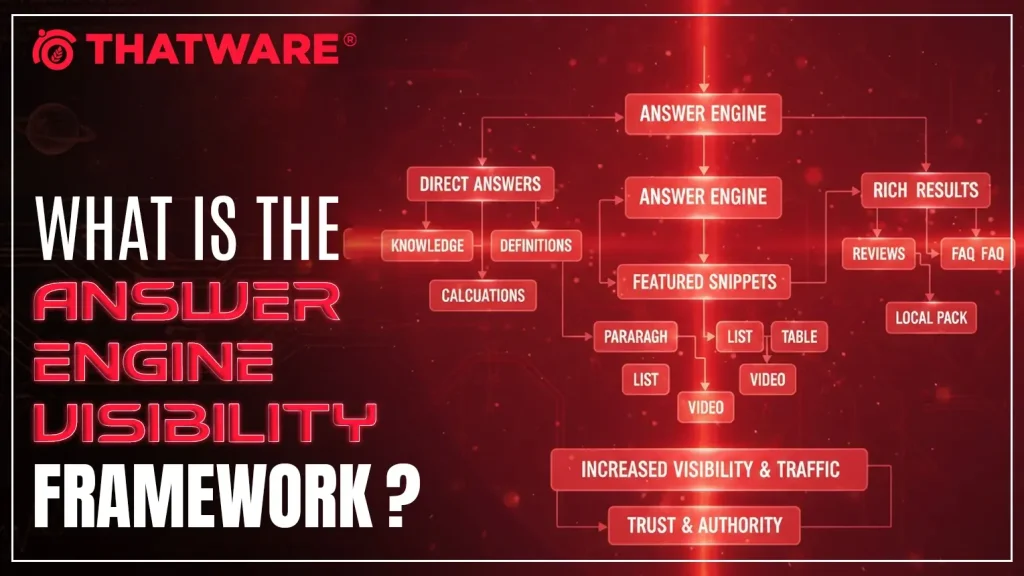
This shift isn’t subtle. It’s structural. The internet is moving from a click economy to an answer economy. And marketers who adapt early will win not only attention, but trust.
The Death of “10 Blue Links”
For most of the last two decades, search meant scrolling through a list of results—the classic “10 blue links.” Visibility meant ranking on page one, ideally in the top three. But today, search behavior is shifting from browsing links to consuming direct answers.
Instead of exploring, users increasingly want the fastest conclusion. That’s why we’re seeing the rapid rise of:
- AI assistants like ChatGPT, Gemini, and Copilot that summarize and recommend instantly
- Voice search, where users ask conversational questions and expect one spoken response
- Zero-click experiences, where answers appear directly in search interfaces without needing a website visit
Here’s the reality: ranking does not automatically equal visibility anymore. You can rank well and still get fewer clicks because the user never needed to click in the first place. The “best” content doesn’t always win—often the most extractable content does. The content that is easiest for machines to interpret, summarize, and present as an answer rises to the top of this new ecosystem.
From Search Engines to Answer Engines
To understand what’s happening, you need to understand what’s replacing traditional search.
An Answer Engine is any system designed to deliver a direct, synthesized response to a user’s query—often without requiring the user to open multiple sources. Instead of acting like a directory of webpages, it acts like a decision-support layer.
Modern answer surfaces now include:
- AI chat interfaces that generate conversational responses
- Featured snippets and knowledge panels that pull “the answer” into the SERP
- Voice assistants that read a single best answer aloud
- In-app search inside SaaS platforms, marketplaces, and enterprise tools
This creates a confusing outcome for marketers: you may be losing some traffic, but you’re gaining something else—influence moments. Your brand shows up in the decision-making process even if the user never visits your page. And that influence compounds when users repeatedly see your brand as the source of trusted answers.
Introducing the Answer Engine Visibility (AEV) Framework
This is where the Answer Engine Visibility (AEV) Framework comes in.
In simple terms, AEV is a strategy for ensuring your brand and content are consistently selected, referenced, and surfaced as the answer across search engines, AI assistants, voice systems, and answer-first interfaces.
It’s not a replacement for SEO. Think of it as SEO’s next evolution—the same foundation (discoverability, relevance, authority), but adapted to a world where the goal is not just ranking pages, but owning answers.
This guide will help modern marketers in 2026 understand:
- Why visibility now happens across multiple answer surfaces—not just Google rankings
- What it takes to become a “chosen source” in AI and answer-driven results
- How to shift your content strategy from traffic-chasing to answer-ownership
Because in the answer economy, the winners won’t just be the brands that publish more. They’ll be the brands that are easiest to trust—and easiest for machines to confidently cite.
What Is the Answer Engine Visibility Framework?
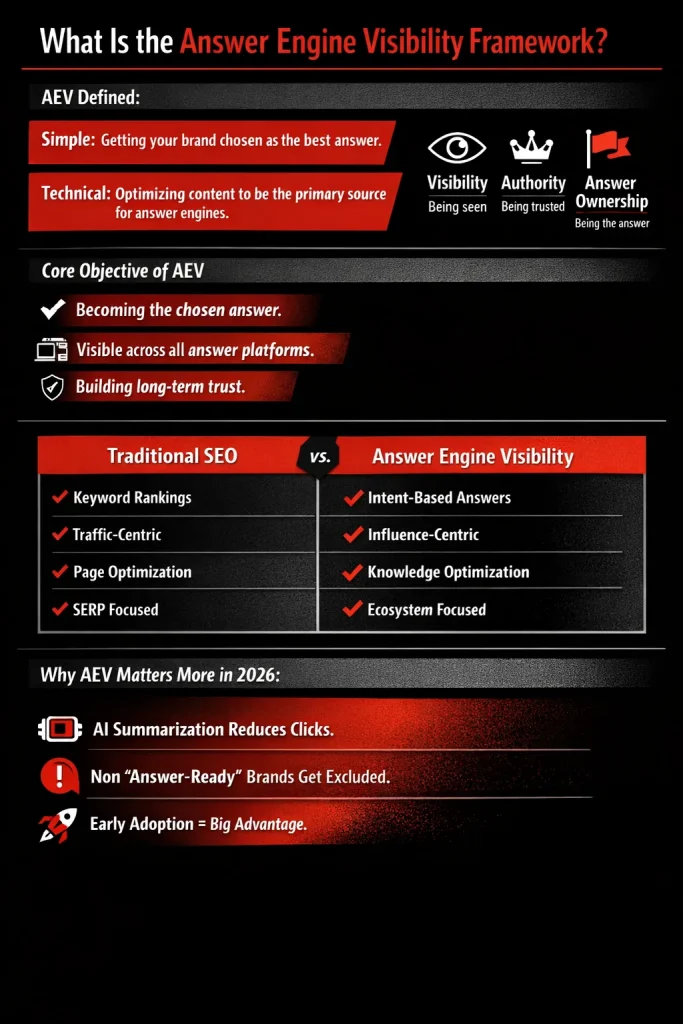
The Answer Engine Visibility (AEV) Framework is a modern approach to digital visibility designed for a world where users no longer search to browse, but to get answers. As AI-driven systems increasingly mediate how information is discovered and consumed, AEV helps brands ensure they are not just present online—but selected, trusted, and surfaced as the answer.
AEV Defined (Simple & Technical)
Simple definition (for non-technical marketers):
The Answer Engine Visibility Framework is a strategy that helps your brand become the answer people see when they ask questions—whether they’re using Google, AI tools like ChatGPT, voice assistants, or other smart search experiences.
Instead of focusing only on ranking web pages, AEV focuses on making your knowledge clear, trustworthy, and easy for machines to understand and reuse as answers.
Technical definition (for SEOs and strategists):
AEV is a structured optimization framework that aligns content, entities, and trust signals to maximize a brand’s probability of being selected, summarized, or cited by answer engines across conversational, generative, and zero-click environments.
It operates at the intersection of semantic search, entity optimization, structured data, and intent modeling, shifting the goal from rankings to answer selection.
Key distinctions within AEV:
- Visibility: Being discoverable across AI answers, snippets, voice results, and summaries.
- Authority: Being recognized as a credible and reliable source on a topic.
- Answer ownership: Consistently being the source that answer engines rely on for specific questions.
Core Objective of AEV
The primary goal of the Answer Engine Visibility Framework is to be the chosen answer—not just a ranked result.
AEV prioritizes:
- Selection over position: It’s better to be summarized once than ranked tenth forever.
- Multi-surface visibility: Appearing simultaneously in AI chats, featured snippets, voice responses, and knowledge panels.
- Long-term informational trust: Building a reputation where answer engines “trust” your content enough to reuse it without direct clicks.
In short, AEV shifts marketing from chasing traffic to earning influence.
How AEV Differs from Traditional SEO Frameworks
| Traditional SEO | Answer Engine Visibility |
| Keyword rankings | Intent-based answers |
| Traffic-centric | Influence-centric |
| Page optimization | Knowledge optimization |
| SERP focused | Ecosystem focused |
Traditional SEO asks, “How do I rank higher?”
AEV asks, “How do I become the best possible answer wherever the question is asked?”
Why AEV Matters More in 2026 Than Ever
In 2026, AI-driven summarization has significantly reduced the need for users to click through to websites. Answer engines now synthesize information instantly, often without showing sources prominently.
Brands that aren’t “answer-ready”—with clear structure, strong entity signals, and trustworthy explanations—are increasingly excluded from these experiences altogether.
The biggest advantage? Compounding visibility.
Brands that adopt AEV early train answer engines to recognize, trust, and reuse their knowledge—creating a long-term competitive moat that late adopters will struggle to overcome.
In the age of AI answers, visibility belongs to those who answer best.
The Evolution of Search That Led to Answer Engine Visibility (AEV)
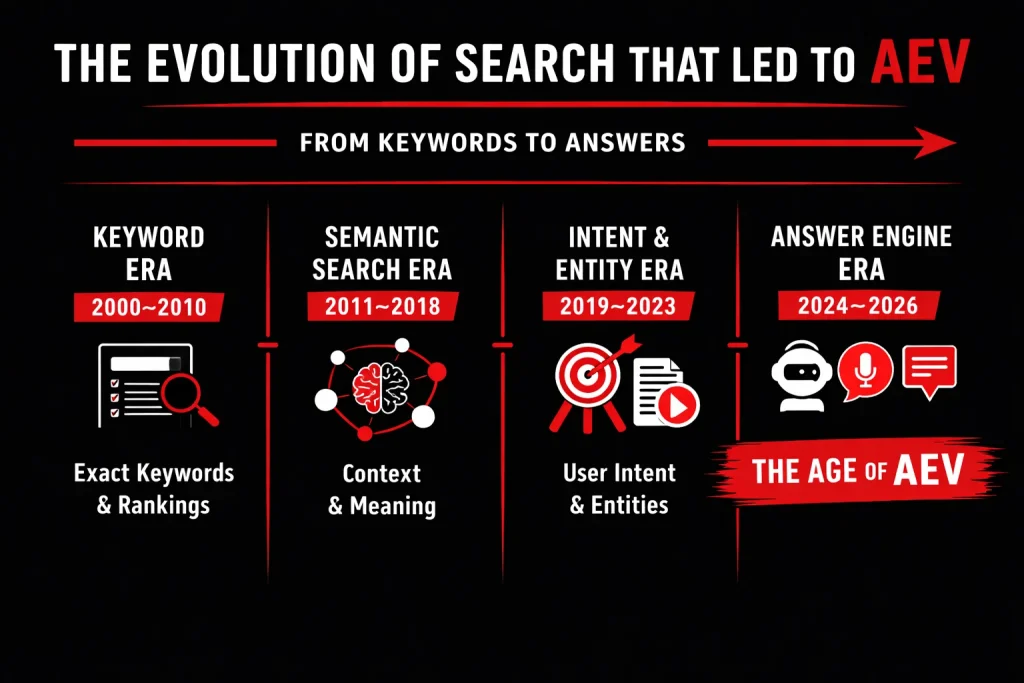
To understand why Answer Engine Visibility (AEV) has become essential in 2026, marketers must first understand how search itself has evolved over the last two decades. AEV is not a sudden disruption—it is the natural outcome of how users, algorithms, and interfaces have matured together.
Search Era Breakdown
Keyword Era (2000–2010)
Early search engines relied heavily on keyword matching. Visibility depended on repeating exact phrases, optimizing meta tags, and acquiring backlinks. The goal was simple: rank higher for a keyword and capture clicks. Content quality mattered far less than keyword density and technical manipulation.
Semantic Search Era (2011–2018)
With updates like Google Hummingbird and the Knowledge Graph, search engines began focusing on meaning, not just words. Synonyms, context, and topic relevance started to matter. Content creators shifted from keyword stuffing to topic-based writing, but results were still largely link-driven.
Intent & Entity Era (2019–2023)
Search engines advanced further by understanding user intent and entities—people, brands, places, and concepts. Queries were no longer just informational; they were problem-solving. Google evaluated whether content truly satisfied the intent behind a query, while entities helped algorithms determine trust and authority.
Answer Engine Era (2024–2026)
Today, search has moved beyond results into answers. AI-powered systems synthesize information and present a single, confident response. Visibility now means being selected as the answer—not just ranked among options. This shift directly gave rise to the Answer Engine Visibility framework.
How Google, AI, and Voice Changed User Expectations
Modern users expect:
- One correct answer, not ten options
- Instant clarity, without reading multiple pages
- Zero friction, especially on mobile and voice interfaces
Voice search and AI assistants trained users to ask natural questions and receive immediate responses. As a result, long lists of blue links now feel slow, inefficient, and outdated for most queries.
The Role of AI Models in Answer Selection
AI models don’t “search” the web like humans—they synthesize it. They evaluate content based on:
- Clear structure that allows quick extraction of answers
- Authoritative signals, such as expertise, consistency, and credibility
- Context completeness, ensuring the answer is accurate and self-contained
This evolution explains why AEV is no longer optional. Marketers must now optimize for how machines understand, trust, and select answers—not just how humans click links.
The 5 Core Pillars of the Answer Engine Visibility Framework (AEV)
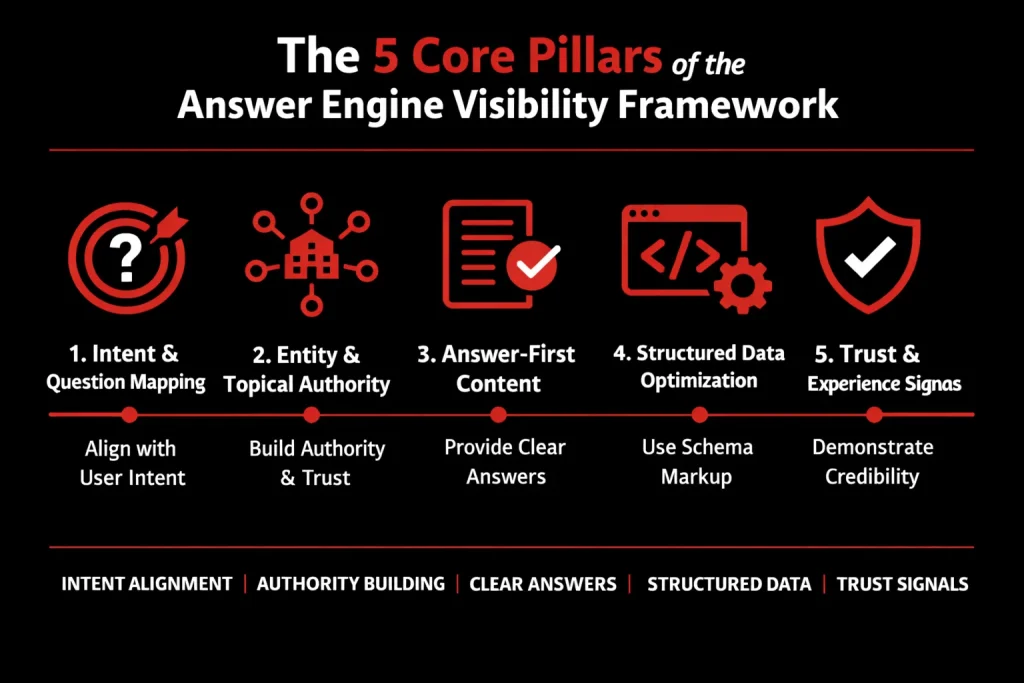
Answer Engine Visibility isn’t a single tactic—it’s a system. In 2026, brands win visibility not by “ranking for keywords,” but by becoming the most usable, trustworthy, and machine-readable answer across search, AI chat, voice, and zero-click surfaces. The AEV Framework is built on five pillars that work together: understand intent as questions, build entity authority, structure content to be answer-ready, make it machine-readable, and prove trust through real experience signals.
Pillar 1: Intent & Question Mapping
Traditional SEO starts with keywords. AEV starts with questions, because answer engines don’t think in “best CRM software” keywords—they interpret what the user is trying to solve and generate a response. That means your first job is to map intent into a question ecosystem, not a keyword list.
Start by classifying intent types:
- Informational: “What is answer engine visibility?” “How does it work?”
- Navigational: “AEV framework template” “Brand name + AEV guide”
- Decision-support: “Is AEV better than SEO?” “Which approach should we use?”
- Task-based: “How do I optimize an FAQ for AI answers?” “Steps to add schema”
Then map the questions in layers:
- Primary question: the main query your page must answer clearly in the first 20–40 seconds of reading.
- Follow-up questions: the natural “next questions” a user (or AI) will ask once the first is answered.
- Conversational variations: how real people ask it in chat or voice (“So how do I actually do this?” “What’s the easiest way?”).
If you can anticipate the conversation, you can design content that answer engines confidently reuse.
Pillar 2: Entity & Topical Authority Building
In answer engines, “authority” isn’t only backlinks or domain age—it’s entity credibility. An entity is a clearly defined “thing” that machines can understand and connect: a brand, person, product, company, methodology, location, or concept. Answer engines prefer to cite sources that are consistent, well-defined, and deeply associated with a topic.
To become a recognized entity, brands must build clarity and consistency across the web and their own site. Three foundational assets matter most:
- A strong About page that clearly states who you are, what you do, and what you’re known for.
- Robust author bios that prove expertise (credentials, experience, and real-world involvement).
- Knowledge consistency: your brand facts, messaging, and definitions should not contradict across your site, social, profiles, and PR mentions.
Then comes topical authority: you need depth, not scattered posts. The most reliable way is topic clustering—a hub-and-spoke structure where one pillar page defines the core topic, and supporting pages answer sub-questions in detail (how-to, comparisons, mistakes, templates, examples). When your content forms a coherent knowledge network, answer engines don’t just find you—they trust you as the best source to synthesize from.
Pillar 3: Answer-First Content Architecture
Most blogs are written like essays. AEV content is written like an answer system.
Answer engines pull information quickly: they need a clear, accurate response they can reuse. That means your content must follow an “answer-first” hierarchy:
- Direct answer: a short, confident response near the top (definition, steps, recommendation).
- Supporting explanation: why it’s true, how it works, what it includes.
- Contextual depth: examples, edge cases, comparisons, visuals, and implementation guidance.
This structure helps humans and machines. Humans get clarity fast. Machines get a clean extractable answer with surrounding context that improves confidence.
Formatting matters just as much as writing. Use structure that fits answer surfaces:
- For featured answers: concise definitions, bullet lists, step-by-step blocks, short headings that match questions.
- For AI summarization: consistent terminology, clear sections, minimal fluff, and explicit takeaways.
- For voice delivery: short sentences, natural phrasing, and “spoken-friendly” explanations.
In AEV, content isn’t judged by how long it is—it’s judged by how easily it can become the answer.
Pillar 4: Structured Data & Machine Readability
A human can infer meaning from a messy page. Machines can’t. If you want answer engines to reliably use your content, you must help them understand what each section is, what it means, and how it connects.
That’s where structured data and machine readability come in. Core components include:
- Schema markup to label the content type (Article, Organization, FAQPage, HowTo, Product, Person, etc.).
- FAQ blocks that clearly pair questions with concise answers.
- HowTo data for processes, steps, tools, and outcomes.
- Entity relationships: consistent naming, internal linking, and references that connect concepts (your framework, your tools, your definitions, your authors).
But structure can fail if implemented poorly. Common mistakes include:
- Adding schema that doesn’t match the page content (spammy markup = reduced trust).
- Using FAQ schema for marketing copy instead of genuine Q&A.
- Inconsistent naming (AEV vs Answer Visibility vs “AI SEO”) that confuses entity understanding.
- Forgetting basics: proper headings, descriptive titles, clean URLs, and readable page hierarchy.
In 2026, machine readability isn’t “technical SEO.” It’s answer eligibility.
Pillar 5: Trust, Accuracy & Experience Signals
Answer engines are under pressure to be correct. That’s why they prioritize trust, especially on topics that affect decisions, money, health, or safety. This pillar is where E-E-A-T becomes practical: Experience, Expertise, Authoritativeness, and Trustworthiness—expressed as signals a system can evaluate.
Answer engines prioritize:
- Accuracy: claims should be verifiable and aligned with consensus where appropriate.
- Consistency: your definitions and guidance shouldn’t contradict across pages.
- Real expertise: not generic content, but insights grounded in experience.
Signals that increase answer confidence include:
- Clear author attribution with credentials and experience
- Cited sources where claims matter (stats, standards, “best practices”)
- First-party proof: case studies, experiments, benchmarks, screenshots, original frameworks
- Updated timestamps and change logs for evolving topics
- Transparent language: what applies, what doesn’t, and under what conditions
If your content looks like it was written to “rank,” it may still rank. But if it looks like it was written to help users solve the problem correctly, it’s far more likely to become the answer that AI systems reuse.
These five pillars work as a loop: question mapping drives what you publish, entity authority helps you get selected, answer-first structure makes extraction easy, structured data improves comprehension, and trust signals make engines confident enough to pick you repeatedly. In 2026, that combination is what turns content into answer ownership rather than just another link on a results page.
How Answer Engines Choose Which Brand Becomes the Answer
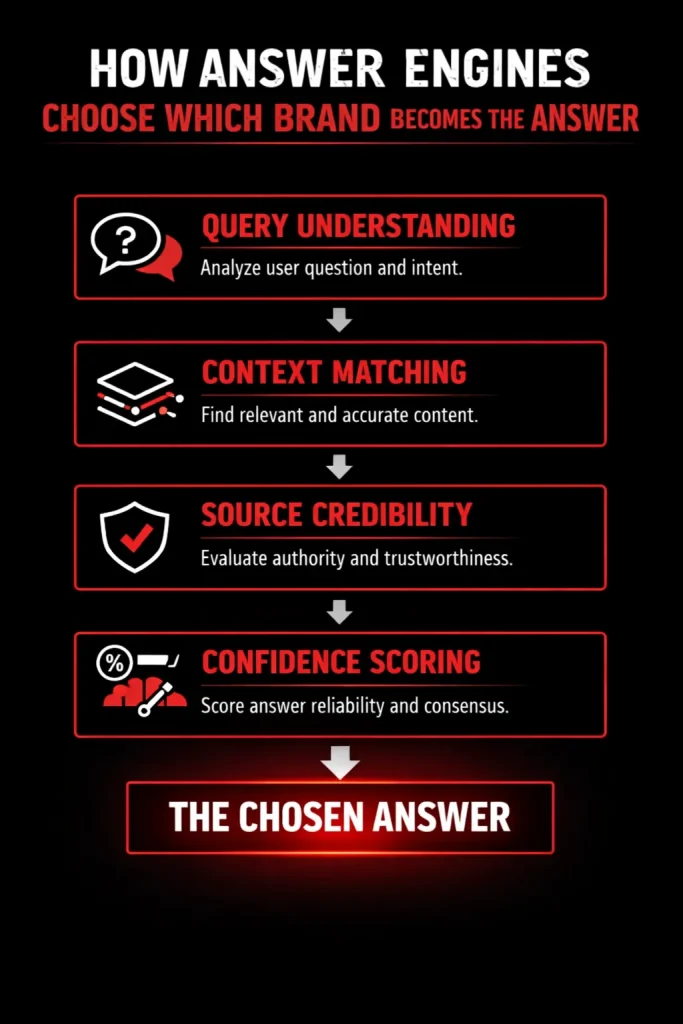
As search evolves into an answer-first ecosystem, understanding how answer engines decide which brand earns visibility is critical. Unlike traditional search engines that primarily ranked pages, modern answer engines—powered by AI models and semantic systems—evaluate content at a much deeper level. Their goal is simple: deliver the most reliable, contextually accurate, and confidence-worthy answer to a user’s question.
The Answer Selection Process (Simplified)
While the underlying algorithms are complex, the answer selection process generally follows four key stages:
Query understanding
Answer engines first interpret the user’s question by identifying intent, entities, and implied context. This goes beyond keywords to understand what the user actually wants to know, including follow-up expectations. For example, “What is the Answer Engine Visibility Framework?” implies a need for a clear definition, purpose, and scope—not a promotional explanation.
Context matching
Next, the engine scans its knowledge sources to find content that best fits the query’s context. It evaluates whether a piece of content directly addresses the question, provides supporting explanations, and aligns with the user’s informational depth. Content that mirrors natural language and conversational structure performs better here.
Source credibility evaluation
Once relevant content is identified, answer engines assess the trustworthiness of the source. Signals such as topical authority, author expertise, brand consistency, historical accuracy, and external validation help determine whether a source is reliable enough to be surfaced as the answer.
Confidence scoring
Finally, the system assigns a confidence score based on clarity, accuracy, and consistency. If the model is not sufficiently confident in a source, it may combine information from multiple sources—or avoid citing a brand altogether.
Factors That Increase Answer Selection Probability
Certain content characteristics significantly improve a brand’s likelihood of being selected as an answer:
- Clear definitions: Direct, unambiguous explanations placed prominently within content help answer engines extract precise answers.
- Consensus alignment: Content that aligns with widely accepted industry knowledge and avoids extreme or unsupported claims earns higher trust.
- Freshness: Regularly updated content signals relevance, especially for fast-evolving topics.
- Cross-platform consistency: When a brand’s messaging is consistent across its website, knowledge panels, publications, and trusted third-party sources, confidence increases.
Why Some Brands Never Appear as Answers
Many brands fail to gain answer visibility due to avoidable issues:
- Over-optimized content: Keyword stuffing and forced SEO tactics reduce readability and trust.
- Vague explanations: Content that talks around a topic instead of clearly explaining it confuses answer engines.
- Lack of entity clarity: If a brand, author, or topic is poorly defined, the engine struggles to assign authority.
- Conflicting information across channels: Inconsistent claims weaken confidence and disqualify brands from being selected.
Ultimately, becoming the answer is less about gaming algorithms and more about delivering clear, credible, and consistent knowledge.
AEV vs SEO vs GEO (Generative Engine Optimization)
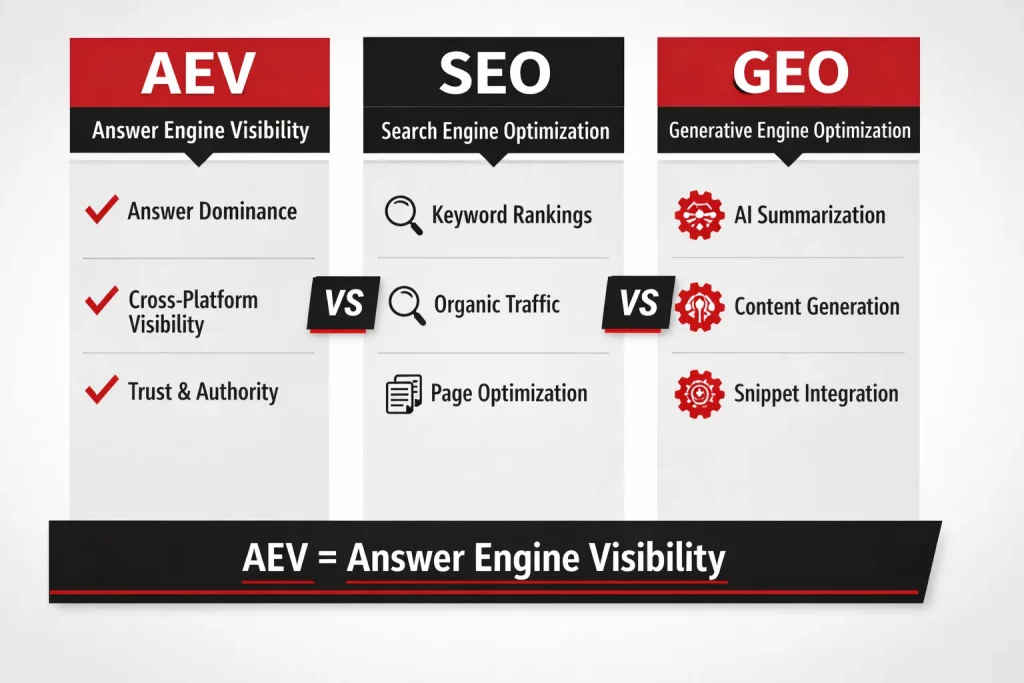
As search evolves in 2026, marketers are no longer choosing between SEO or AI optimization—they must understand how SEO, GEO, and AEV function together within a modern visibility strategy. Each serves a distinct purpose, but only one acts as the unifying framework.
SEO, GEO, and AEV Explained
Search Engine Optimization (SEO) is fundamentally about discoverability. Its primary goal is to ensure your content can be found, crawled, indexed, and ranked by search engines. SEO focuses on keywords, technical health, backlinks, and on-page relevance. Without SEO, your content may never enter the visibility ecosystem at all.
Generative Engine Optimization (GEO) is focused on AI summarization optimization. It ensures that your content is easy for AI models to extract, synthesize, and reference when generating responses. GEO emphasizes clarity, concise explanations, structured formatting, and context completeness so AI systems can confidently reuse your information in generated answers.
Answer Engine Visibility (AEV) goes one step further. AEV is about answer dominance—being the brand or source that answer engines consistently choose as the primary or trusted answer. Rather than optimizing for rankings or summaries alone, AEV optimizes for selection, trust, and repeat inclusion across AI assistants, featured answers, and voice interfaces.
How They Work Together
These strategies are not competitors; they are layers.
- SEO feeds AEV by ensuring your content is discoverable and authoritative enough to be considered.
- GEO enhances AEV by making your content easy for AI systems to interpret and summarize accurately.
- AEV future-proofs SEO by shifting focus from volatile rankings to long-term answer ownership and influence.
Without SEO, AEV has no foundation. Without GEO, AEV lacks machine clarity. Together, they form a complete visibility loop.
Why AEV Is the Umbrella Strategy
AEV acts as the umbrella framework because it operates across platforms—search engines, AI chat tools, voice assistants, and in-app answers—using a single strategic lens. Instead of chasing traffic fluctuations, AEV reduces dependency on clicks by prioritizing visibility where decisions are made. In a zero-click, AI-driven world, being the answer is more powerful than ranking for it.
Measuring Answer Engine Visibility in 2026
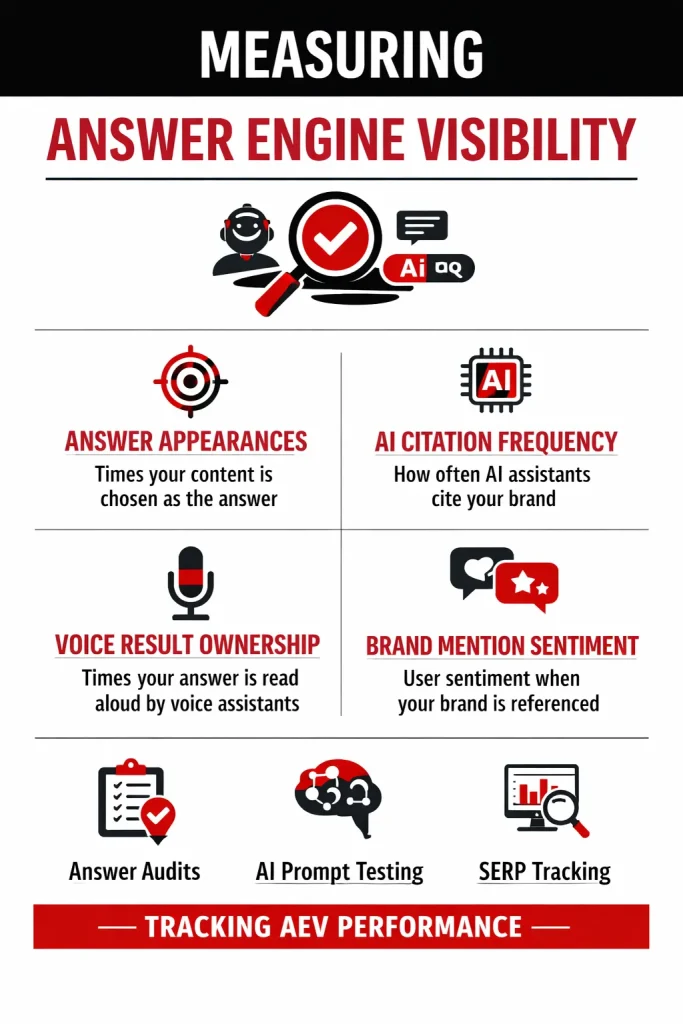
As search transitions from link-based discovery to AI-driven answer delivery, the way marketers measure success must evolve. Traditional SEO metrics still provide context, but they no longer reflect true visibility in an answer-first ecosystem. In 2026, measuring Answer Engine Visibility (AEV) means tracking whether your brand is selected, trusted, and repeated as the source of answers across platforms.
Why Traditional Metrics Fall Short
For years, SEO performance has been judged by rankings, clicks, and impressions. While these indicators still have diagnostic value, they fail to capture how modern users actually consume information.
- Rankings show where a page appears, but not whether its information is extracted, summarized, or spoken aloud by an AI assistant. A brand can rank first and still never become the answer.
- Clicks are declining due to zero-click searches, AI summaries, and voice results. Fewer clicks no longer mean lower influence.
- Impressions measure exposure, not impact. Seeing a link is fundamentally different from being selected as the authoritative answer.
In an answer engine environment, visibility is no longer about being seen—it’s about being used.
New AEV Metrics to Track
To measure AEV effectively, marketers must adopt metrics that reflect answer-level dominance:
- Answer appearances: How often your brand or content is surfaced as a direct answer in AI tools, featured snippets, or knowledge panels.
- AI citation frequency: How often large language models reference or attribute information to your brand when generating responses.
- Voice result ownership: Whether voice assistants consistently pull answers from your content for spoken queries.
- Brand mention sentiment: The tone and context in which your brand is mentioned within AI-generated answers—neutral, positive, or authoritative.
These metrics reveal not just visibility, but trust and preference.
Tools & Methods for AEV Measurement
Because no single dashboard fully measures AEV yet, a blended approach is required:
- Manual answer audits to check which brands appear for high-value questions.
- AI prompt testing across multiple tools to identify answer consistency.
- SERP feature tracking for featured snippets, PAA, and knowledge panels.
- Brand entity monitoring to track how your brand is understood and referenced across platforms.
Together, these methods help marketers measure what truly matters in 2026: being the answer, not just another result.
AEV Use Cases by Industry
The Answer Engine Visibility (AEV) Framework does not operate as a one-size-fits-all strategy. While the core principles remain consistent, how AEV is applied varies significantly by industry, search intent, and risk level. Below are key industry-specific use cases that illustrate how brands can become the preferred answer across modern answer engines in 2026.
SaaS & B2B
In SaaS and B2B markets, answer engines frequently surface comparative and solution-oriented queries. Users are not just looking for information—they are evaluating options.
Common AEV-driven queries include:
- “Best project management tool for remote teams”
- “HubSpot vs Salesforce for small businesses”
To win these answers, SaaS brands must structure content around clear product positioning, transparent feature comparisons, and use-case-driven explanations. Answer engines favor content that:
- Clearly states who the product is for
- Explains why it is suitable for a specific scenario
- Acknowledges alternatives instead of ignoring them
Comparison tables, concise verdict sections, and direct “best for” statements significantly improve answer selection.
E-commerce
E-commerce AEV revolves around product suitability and purchase confidence. Modern shoppers increasingly ask answer engines questions before visiting product pages.
Typical queries include:
- “Is this laptop good for video editing?”
- “Which running shoes are best for flat feet?”
Brands that succeed in AEV provide decision-support answers, not promotional copy. This includes:
- Contextual product recommendations
- Clear pros and cons
- Usage-based guidance
Well-structured FAQs, buying guides, and suitability explanations help answer engines confidently surface product-related answers without requiring a click.
Healthcare & YMYL (Your Money or Your Life)
In healthcare and other YMYL categories, accuracy and trust override optimization tactics. Answer engines apply stricter confidence thresholds to avoid misinformation.
Effective AEV in this space requires:
- Medically reviewed, evidence-backed content
- Clear disclaimers and limitations
- Conservative, non-speculative language
Ethical AEV optimization prioritizes patient safety, ensuring answers educate rather than diagnose or mislead.
Local & Service Businesses
Local businesses benefit heavily from AEV through “near me” and intent-driven decision queries, especially in voice search.
Common examples:
- “Best plumber near me”
- “Is this restaurant open now?”
Answer engines prioritize businesses with consistent NAP data, clear service explanations, and voice-friendly responses. Optimizing for conversational, location-aware questions enables brands to win real-time, high-intent discoveries—often before a user ever sees a search results page.
Common Myths About Answer Engine Visibility
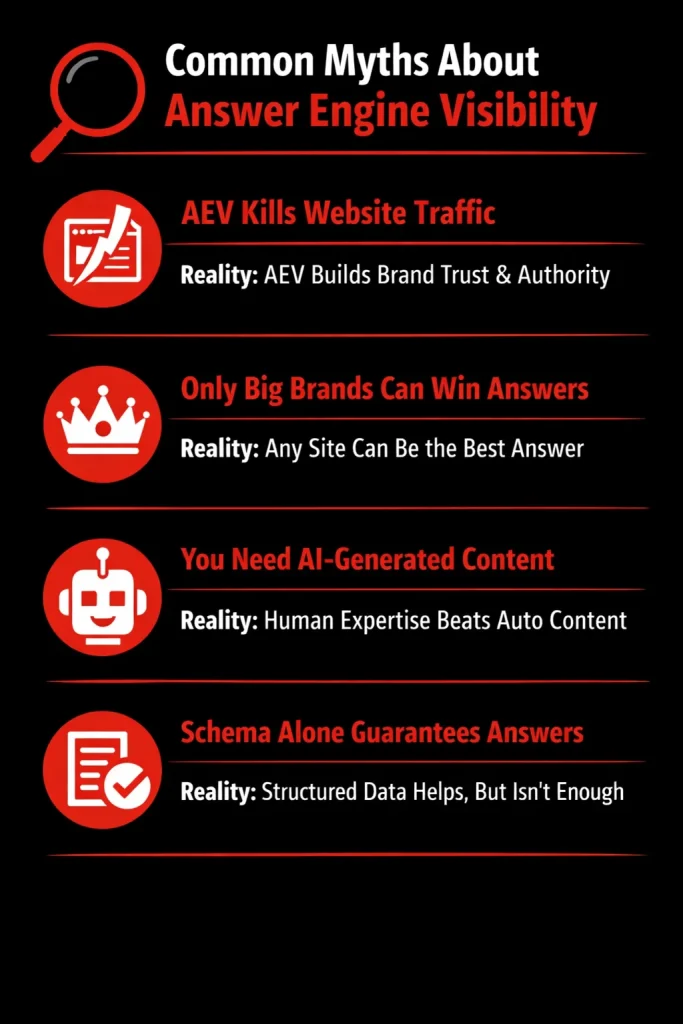
As Answer Engine Visibility (AEV) becomes a core marketing priority, several misconceptions continue to hold brands back. Let’s break down the most common myths—and the reality behind them.
Myth 1: “AEV kills website traffic.”
While answer engines often satisfy users without a click, AEV doesn’t eliminate traffic—it changes its quality. Brands that become the trusted answer gain high-intent visibility at critical decision moments. Users who do click are more informed, more confident, and more likely to convert. AEV shifts the focus from volume to value.
Myth 2: “Only big brands can win answers.”
Authority in answer engines is not about brand size; it’s about clarity, accuracy, and topical depth. Smaller brands often outperform large enterprises by publishing focused, well-structured, and experience-backed answers. In many niches, being the most helpful source matters more than being the most famous.
Myth 3: “You need AI-generated content.”
AEV does not require AI-written content. In fact, answer engines prioritize expertise, originality, and trust—qualities best delivered by human insight. AI can assist with research or structuring, but human-led content grounded in real experience consistently performs better in answer selection.
Myth 4: “Schema alone guarantees answers.”
Structured data helps machines understand content, but it’s not a shortcut to visibility. Without clear intent alignment, authoritative explanations, and accurate information, schema has little impact. AEV success comes from combining structure with substance—not from markup alone.
Understanding these myths is the first step toward building a sustainable AEV strategy.
How to Start Implementing the AEV Framework Today
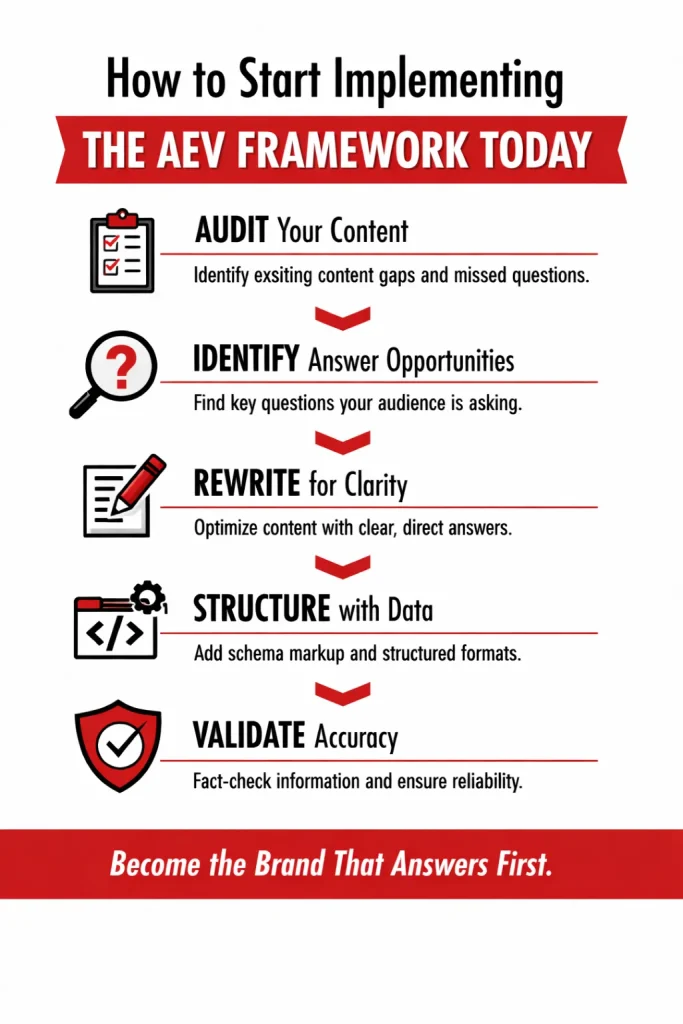
Implementing the Answer Engine Visibility (AEV) Framework doesn’t require a complete content overhaul on day one. The most successful brands in 2026 approach AEV as a systematic refinement process, aligning existing assets with how answer engines discover, evaluate, and select information. Below is a practical, marketer-friendly way to begin.
Step-by-Step Starter Plan
Audit existing content
Start by reviewing your top-performing pages, blogs, and resource hubs. Instead of focusing only on rankings or traffic, analyze whether each page clearly answers a specific question. Look for content that is informative but indirect, overly long before reaching the point, or written primarily for keywords rather than clarity.
Identify answer gaps
Next, identify questions your audience is asking that your content only partially answers—or doesn’t address at all. These gaps often appear in sales calls, support tickets, on-site search queries, and “People Also Ask” sections. Answer engines reward brands that provide complete, unambiguous responses to real user questions.
Rewrite for clarity
AEV favors clarity over cleverness. Rewrite key sections so the primary answer appears early, in simple language, followed by supporting context. Remove unnecessary fluff, jargon, and vague statements that reduce answer confidence.
Add structure
Structure is critical for machine readability. Use clear headings, bullet points, short paragraphs, tables, and FAQs. A well-structured page allows answer engines to extract precise responses without misinterpretation.
Validate accuracy
Finally, ensure every answer is factually accurate, up to date, and consistent across your site. Conflicting or outdated information reduces trust signals and lowers the likelihood of being selected as an answer source.
Content Types to Prioritize
Certain content formats naturally perform better within the AEV Framework:
- Definitions that clearly explain concepts in one concise paragraph
- Comparisons that help users evaluate options or differences
- FAQs that mirror real conversational queries
- Guides that solve a problem step by step
- Explanatory resources that simplify complex topics
By prioritizing these formats, marketers can accelerate Answer Engine Visibility while building long-term authority and trust.
The Future of Answer Engine Visibility Beyond 2026
As we move beyond 2026, Answer Engine Visibility (AEV) will evolve from a content optimization strategy into a foundational digital presence model. Answer engines will no longer rely on text alone; instead, multimodal answers will become the norm. Users will receive responses that combine concise text explanations, voice-based summaries, visuals, charts, and even short videos—delivered seamlessly across AI assistants, smart devices, search interfaces, and immersive platforms. Brands that structure knowledge to perform across all formats will dominate answer selection.
Another major shift will be deep personalization in answer delivery. Answer engines will tailor responses based on user context such as intent history, location, device, industry, and expertise level. This means the same question could generate different answers for different users. Marketers must therefore optimize not just for a single “best answer,” but for context-aware answer variants that maintain accuracy while adapting to user needs.
Beyond platforms, brand-owned knowledge graphs will play a critical role. Forward-thinking organizations will maintain structured, machine-readable knowledge hubs that feed consistent information across AI models, search engines, and proprietary tools. These knowledge graphs will act as a single source of truth, reducing misinformation and increasing answer trustworthiness.
Finally, we will see the rise of “answer authority” as a core KPI. Instead of measuring success by rankings or clicks, brands will be evaluated by how often they are selected, cited, or paraphrased as the authoritative answer. In a future where visibility equals influence, being the trusted answer will matter more than ever.
Final Thoughts: Becoming the Brand That Answers First
Answer Engine Visibility (AEV) is no longer an optional extension of SEO—it’s an unavoidable reality of how discovery works in 2026. As AI assistants, voice interfaces, and zero-click experiences become the primary way users access information, brands that fail to adapt risk becoming invisible, even if they technically “rank.” Visibility today is defined by who provides the answer, not who owns the link.
The competitive advantage of early AEV adoption is significant. Brands that structure their knowledge clearly, build topical authority, and earn trust as reliable sources are far more likely to be selected, cited, and recommended by answer engines. Over time, this compounds into category-level authority—where your brand becomes the default reference for key questions in your space.
To succeed, marketers must undergo a mindset shift: move from being traffic chasers to becoming answer leaders. This means prioritizing clarity over cleverness, usefulness over volume, and accuracy over aggressive optimization.
The call to action is simple but urgent: audit your content through an answer-first lens, identify the questions your audience truly asks, and intentionally design content to solve them. The brands that win in the next era won’t just be found—they’ll be trusted, chosen, and quoted as the answer.