
SUPERCHARGE YOUR ONLINE VISIBILITY! CONTACT US AND LET’S ACHIEVE EXCELLENCE TOGETHER!
Link building still matters in modern SEO—but how you earn links matters more than ever. Google’s results are increasingly shaped by authority, trust, and real-world credibility, which means the old “spray-and-pray” backlink tactics are losing power. Today, the strongest backlinks are the ones you earn editorially because you created something newsworthy, useful, or credible enough for others to reference.

That’s the core idea behind PR link building, often called Digital PR: instead of chasing links one by one, you create stories, data, and insights that journalists and publishers want to cite. The result is a link profile that doesn’t just boost rankings—it also builds brand visibility, reputation, and long-term organic growth.
A quick look at link building in modern SEO
For years, backlinks have been one of the most influential ranking signals in search. They act like votes of confidence: when reputable websites link to your content, search engines interpret that as a sign of credibility. But backlinks today are no longer just about volume. The modern SEO landscape prioritizes:
- Relevance (links from sites and pages related to your niche)
- Authority (credible publications and strong domains)
- Editorial context (natural mentions within meaningful content)
- Trust signals (real brands, real people, real validation)
In other words, link building has shifted from a numbers game to an authority-building strategy—and that shift has major implications for what actually works now.
Why traditional link building is declining in effectiveness
Many “traditional” link building methods still exist, but their ROI has become less predictable, and their risks have increased. Tactics like mass guest posting, low-quality directory submissions, link exchanges, and paid placements often create patterns that are easier for search engines to detect—and easier to discount.
Here’s what’s changed:
- Higher quality thresholds: Search engines have improved at evaluating link intent and link quality.
- Increased competition: Nearly every brand is producing content, so simply “publishing and outreach” isn’t enough.
- Link fatigue: Journalists, bloggers, and webmasters receive hundreds of generic pitches every week.
- Short-term wins, long-term risk: Anything that looks manipulative can be devalued or become a liability later.
This doesn’t mean all outreach-based link building is dead. It means the tactics that rely on easy placements are becoming less reliable—and brands that want durable growth need a more defensible approach.
Enter PR link building (Digital PR)
PR link building flips the model. Instead of asking for links, you earn them through media coverage and editorial mentions. You do that by packaging ideas the way PR professionals do:
- original data and research
- expert commentary
- trend insights
- unique angles tied to current events
- compelling stories that support a journalist’s narrative
When a publication links to you because your content genuinely supports their article, that backlink tends to be more powerful, more trusted, and more resilient over time. Even better: you’re not only building rankings—you’re building a reputation.
Think of it like this:
Traditional link building tries to “place” links. Digital PR tries to “deserve” them.
What you’ll learn in this guide
This guide will walk you through how to build a PR-driven link strategy that consistently earns high-authority backlinks—without relying on spammy shortcuts. You’ll learn:
- what PR link building really is and how it differs from traditional tactics
- the types of campaigns that attract journalists and editors
- how to create link-worthy assets (data, stories, and angles that get cited)
- how to find the right media targets and pitch them effectively
- what to track to measure success (beyond just “number of links”)
By the end, you’ll have a clear blueprint for using Digital PR to grow your backlink profile, strengthen your authority, and improve rankings in a way that’s sustainable.
What Is PR Link Building?
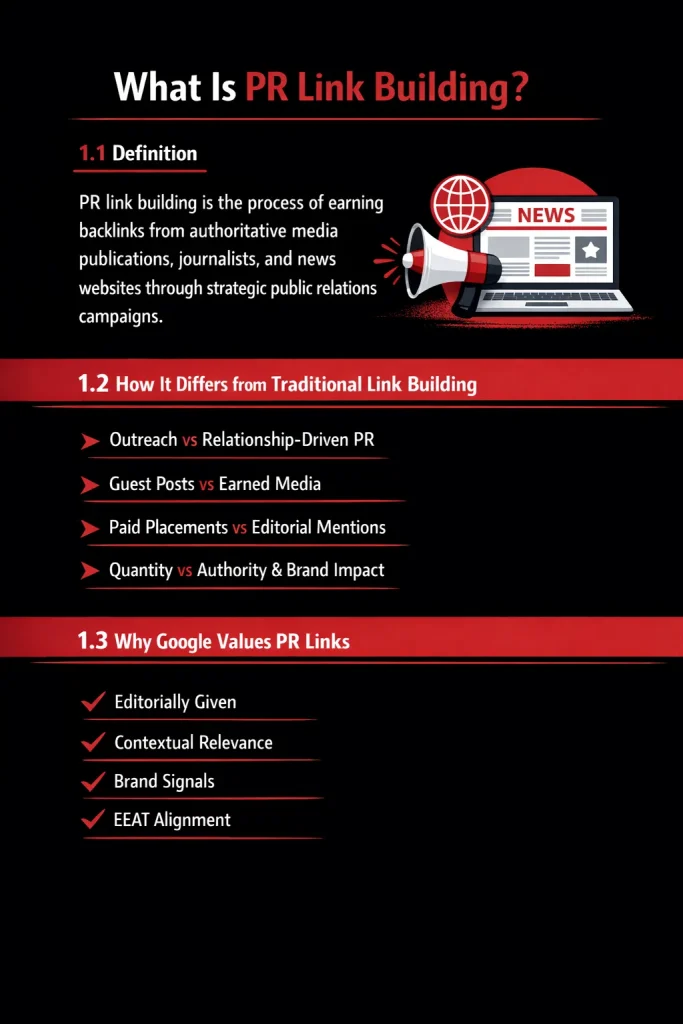
PR link building (often called digital PR link building) is one of the most effective ways to earn high-authority, editorial backlinks—the kind that actually move rankings and strengthen brand trust. Instead of “building links” by placing content on random sites, PR link building focuses on earning mentions naturally from reputable publications through strong stories, data, and expert input.
PR link building is the process of earning backlinks from authoritative media publications, journalists, and news websites through strategic public relations campaigns.
In simple terms: you create something newsworthy (data, insights, expert commentary, research, trends), pitch it to the right journalists or editors, and if it adds value to their story, they publish it—often including a link back to your website as a reference source.
Unlike many conventional SEO tactics, PR link building isn’t about “link placement.” It’s about editorial validation. When a journalist links to you, it signals that your website is credible enough to be used as a source—something search engines interpret as real-world authority.
How It Differs from Traditional Link Building
PR link building and traditional link building both aim to improve authority and rankings, but their methods, intent, and outcomes are very different.
Outreach vs relationship-driven PR
Traditional link building outreach often looks like:
“Here’s a post—can you link to it?”
PR link building is more relationship-driven and value-first:
“Here’s a timely insight or data point that supports your story.”
Over time, digital PR teams build a network of journalists who trust them as reliable sources—making future coverage easier and more consistent.
Guest posts vs earned media
Traditional link building heavily relies on guest posting, where you write content for someone else’s blog in exchange for a link.
PR link building relies on earned media—meaning coverage happens because your story, insight, or data is genuinely useful. The link is a byproduct of being cited as a source, not the main “transaction.”
Paid placements vs editorial mentions
In many traditional strategies, links may come from:
- sponsored posts
- paid insertions
- “placement fees”
- marketplaces
PR links, in contrast, are typically editorial mentions, meaning:
- the publication decides to include you
- the journalist chooses the link naturally
- there’s no direct payment influencing inclusion
That difference matters, because editorial links tend to be more trusted (and more resilient to algorithm updates).
Quantity vs authority & brand impact
Traditional link building often chases volume: more links, more domains, faster growth.
PR link building prioritizes:
- authority (top-tier sites, trusted publications)
- relevance (links that make contextual sense)
- brand credibility (mentions that people actually see)
One link from a major publication can outperform dozens of low-quality placements—not just for rankings, but for brand searches, trust, and conversion lift.
Why Google Values PR Links
Google places higher value on PR links because they mirror what the web was meant to be: websites referencing other websites because they’re credible and useful.
Here’s why PR links stand out:
Editorially given
PR links are usually earned, not requested as a “trade.” Journalists link because your content supports their story. That’s a strong signal of authenticity.
Contextual relevance
Media links often appear within highly relevant content (news reports, industry analysis, feature stories). A link surrounded by meaningful context is far more valuable than a random sidebar or author bio link.
Brand signals
PR coverage drives:
- branded searches
- direct traffic
- social mentions
- repeat citations
These signals reinforce that your company is a legitimate entity people talk about—something increasingly important as Google leans into brand trust and authority.
EEAT alignment
PR links help strengthen E-E-A-T (Experience, Expertise, Authoritativeness, Trustworthiness) because being quoted or referenced by trusted publications demonstrates:
- expertise (you contribute insights)
- authority (credible sites cite you)
- trust (editorial validation)
In practice, PR link building doesn’t just “improve SEO.” It helps build a reputation that search engines—and humans—can recognize.
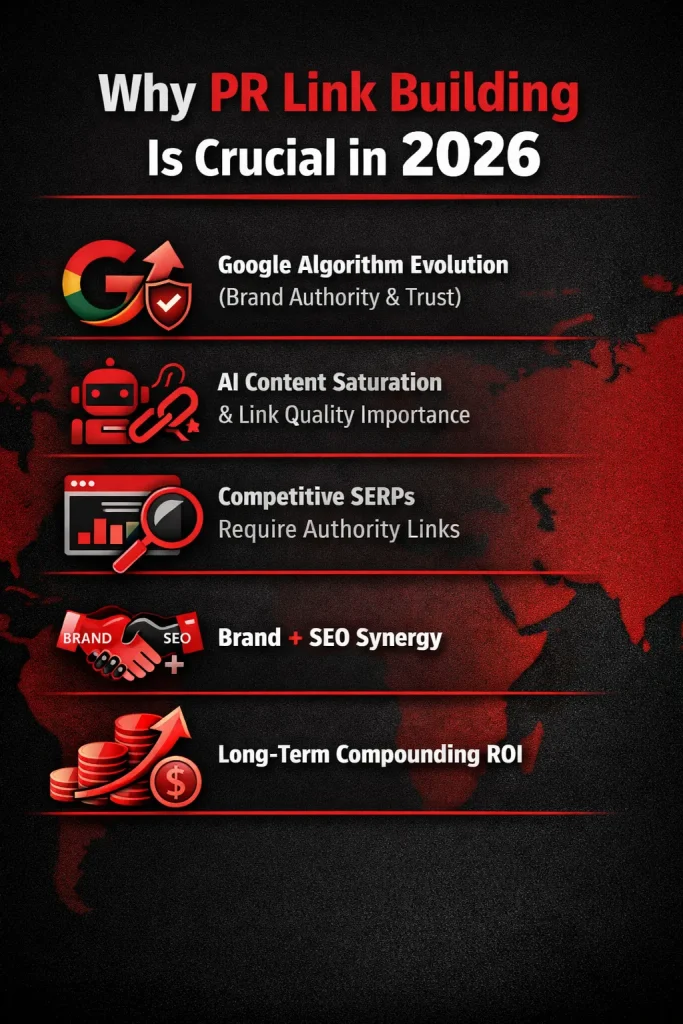
Why PR Link Building Is Crucial in 2026
The SEO landscape in 2026 looks dramatically different from what it was just a few years ago. Rankings are no longer driven by volume-based link acquisition or keyword-heavy content alone. Instead, authority, trust, and brand credibility have become the defining factors of sustainable search visibility.
PR link building sits at the center of this evolution.
Here’s why it has become one of the most important SEO strategies in 2026.
1. Google’s Algorithm Now Prioritizes Brand Authority & Trust
Google’s ranking systems have steadily shifted toward evaluating entities, brand signals, and real-world credibility rather than just backlinks and keywords.
Modern algorithms assess:
- Who is behind the website
- Whether the brand is mentioned on trusted media platforms
- If authoritative sources cite or reference the brand
- How the brand fits within its industry ecosystem
This is closely aligned with Google’s EEAT framework (Experience, Expertise, Authoritativeness, Trustworthiness).
PR link building directly strengthens these signals because:
- Links are editorially given, not artificially placed
- Mentions appear on reputable media websites
- Journalists validate your expertise
- Your brand becomes part of authoritative industry conversations
In 2026, Google is increasingly capable of distinguishing between:
- Manipulative link placements
- And genuine editorial endorsements
PR links fall into the second category — which makes them algorithmically safer and more powerful.
2. AI Content Saturation Has Increased the Value of High-Quality Links
The rise of AI content generation has created an unprecedented surge of online content. Every niche is flooded with:
- AI-written blog posts
- Scaled content production
- Automated niche sites
- Programmatic SEO pages
As a result, content alone is no longer a differentiator.
When thousands of websites publish similar information, Google needs stronger authority signals to decide who ranks at the top. That’s where high-authority PR backlinks become critical.
In an AI-saturated web:
- Low-quality backlinks are easily replicated
- Guest posts have diminishing marginal impact
- Paid link placements are increasingly risky
But editorial links from trusted publications are extremely difficult to replicate. They act as trust validators, signaling to search engines that your brand stands out from automated noise.
In short:
When content becomes abundant, authority becomes scarce — and scarcity drives rankings.
3. Competitive SERPs Require Authority-Level Backlinks
In 2026, most competitive search engine results pages (SERPs) are dominated by:
- Recognized brands
- Media-backed companies
- Entities with strong link authority
- Websites consistently cited across the web
If your competitors are earning links from:
- News publications
- Industry magazines
- Authority blogs
- Major online media outlets
Then traditional link building tactics simply won’t be enough to compete.
PR link building allows you to:
- Close backlink authority gaps
- Increase domain trust
- Improve topical authority
- Compete in high-value commercial keywords
In competitive niches like SaaS, finance, health, AI, and marketing, authority links are no longer optional — they are foundational.
Without them, ranking for high-intent keywords becomes exponentially harder.
4. The Brand + SEO Synergy Effect
One of the most powerful aspects of PR link building is that it does not just improve SEO — it strengthens brand equity.
Traditional link building primarily targets ranking improvements. PR link building does that, but also delivers:
- Brand recognition
- Media credibility
- Increased referral traffic
- Higher conversion trust
- Investor and partnership credibility
When a brand is featured in recognizable publications, users trust it more. This impacts:
- Click-through rates (CTR)
- On-page engagement
- Conversion rates
- Branded search volume
Branded search itself is becoming a ranking signal. When users search for your company name directly, it reinforces brand authority in Google’s ecosystem.
PR link building fuels this synergy:
SEO → increases visibility
PR → builds credibility
Brand → strengthens search performance
Together, they create a flywheel effect that compounds over time.
5. Long-Term Compounding ROI
Unlike paid ads or short-term link placements, PR links tend to:
- Remain live for years
- Sit on high-authority domains
- Continue passing equity
- Drive referral traffic long after publication
One strong PR campaign can generate:
- Multiple referring domains
- Natural secondary backlinks
- Social amplification
- Ongoing brand mentions
Over time, this builds what can be described as a media moat — a layer of authority that becomes increasingly difficult for competitors to replicate.
Additionally, as your brand accumulates:
- Media mentions
- Journalistic relationships
- Recognized expertise
Future PR campaigns become easier. Journalists begin reaching out to you instead of the other way around.
This compounding effect makes PR link building one of the highest ROI link acquisition strategies in modern SEO.
Core Components of a Successful PR Link Building Strategy
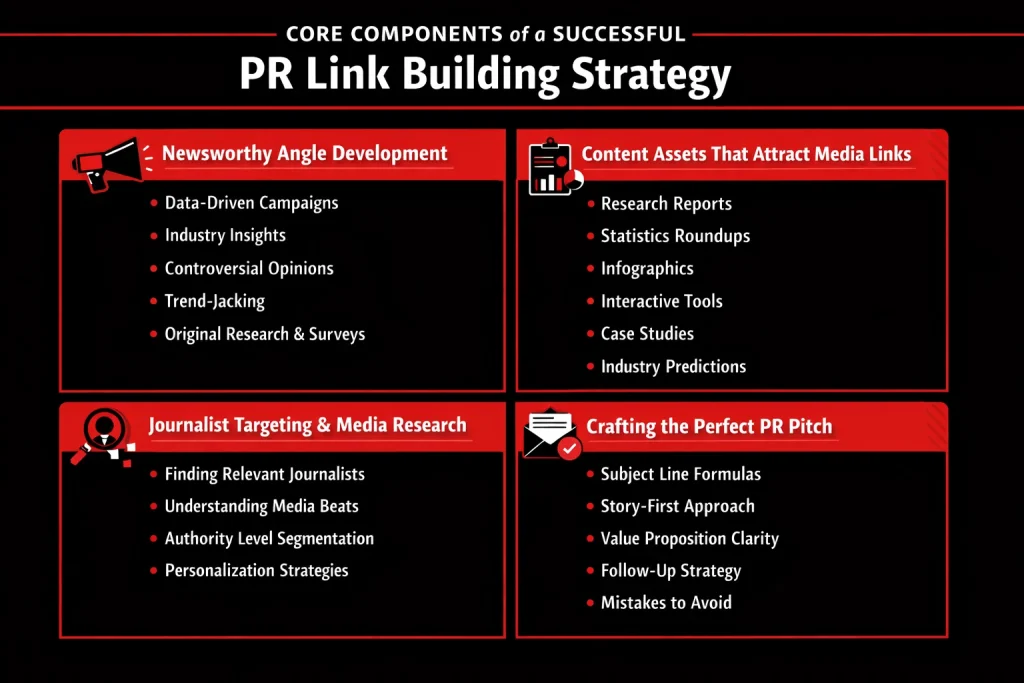
A successful PR link building strategy isn’t about blasting press releases or begging for backlinks. It’s about earning editorial coverage by becoming genuinely newsworthy and strategically valuable to journalists.
Below are the four core pillars that determine whether your digital PR campaign earns high-authority backlinks — or gets ignored.
Newsworthy Angle Development
The foundation of PR link building is simple: If it’s not newsworthy, it won’t get coverage. Journalists don’t link because you ask them to — they link because your story adds value to their audience.
Here’s how to develop angles that actually get attention.
Data-Driven Campaigns
Data is the most powerful currency in digital PR.
When you publish original statistics, industry benchmarks, or analytical insights, journalists gain ready-made material they can cite — and link back to.
Examples:
- “65% of Small Businesses Plan to Increase AI Spending in 2026”
- “The Average SaaS Company Wastes $12,000 Per Year on Unused Tools”
- “Top 50 Fastest-Growing Tech Cities in the US”
Why it works:
- Journalists need credible data.
- Statistics are highly linkable.
- Data-backed content builds authority and EEAT.
Industry Insights
If you operate in a niche, you have access to insider knowledge. Turn that expertise into commentary on:
- Market shifts
- Emerging technologies
- Consumer behavior changes
- Regulatory updates
- Industry predictions
Position your brand as a thought leader, not just a service provider.
Controversial Opinions
Strong opinions generate attention — if handled strategically.
You can:
- Challenge common industry myths
- Disagree with trending advice
- Present contrarian data
- Critique flawed methodologies
Controversy works because it sparks discussion. But it must be supported with evidence and professionalism to avoid damaging credibility.
Trend-Jacking (Reactive PR)
Trend-jacking means inserting your expertise into ongoing news cycles.
For example:
- Google algorithm update? Publish expert analysis.
- Major tech acquisition? Offer commentary.
- Economic shifts? Share industry impact insights.
Speed is critical. The earlier you respond, the higher your chances of being quoted.
Original Research & Surveys
Conducting proprietary surveys or compiling original research dramatically increases your media appeal.
You can:
- Survey industry professionals
- Analyze internal anonymized client data
- Compile public datasets into new insights
- Publish annual benchmark reports
Journalists love citing original studies because it strengthens their reporting — and they must link to the source.
Content Assets That Attract Media Links
Even with a strong angle, you need a format that’s easy to reference, cite, and link to.
Certain content formats naturally attract media backlinks.
Research Reports
Comprehensive reports establish authority and serve as primary citation sources.
Structure typically includes:
- Executive summary
- Key findings
- Charts and visuals
- Methodology section
- Downloadable PDF
Annual or quarterly reports can become recurring link magnets.
Statistics Roundups
Journalists frequently search for up-to-date statistics.
Create pages like:
- “50 SEO Statistics for 2026”
- “AI Adoption Stats Every Marketer Should Know”
These evergreen resources accumulate links over time as they become reference hubs.
Infographics
Visual storytelling makes complex data easy to digest.
Infographics work especially well for:
- Comparative studies
- Step-by-step processes
- Market trends
- Demographic breakdowns
When journalists embed visuals, they often credit and link back to the source.
Interactive Tools
Interactive assets significantly increase link-worthiness.
Examples:
- Cost calculators
- Benchmark comparison tools
- Industry scoring systems
- Interactive maps
- ROI estimators
Tools provide functional value — making them more likely to earn editorial mentions.
Case Studies
Well-documented case studies demonstrate real-world impact.
Instead of generic “we helped client X,” focus on:
- Before/after metrics
- Unique strategies
- Surprising outcomes
- Data transparency
Journalists covering industry growth stories often cite real-world examples.
Industry Predictions
Forward-looking insights position your brand as visionary.
“2027 Digital Marketing Predictions”
“Future of AI in Healthcare”
These types of content work particularly well at year-end and during major industry transitions.
Journalist Targeting & Media Research
Even the best content fails without proper targeting. PR link building is as much about relationship-building as it is about content creation.
How to Find Relevant Journalists
Start by identifying:
- Writers covering your niche
- Editors in relevant publication sections
- Contributors writing about related topics
- Journalists who’ve covered similar data before
Study recent articles and analyze:
- Tone
- Sources they cite
- Type of data they reference
- Typical angle structures
Relevance matters more than publication size.
Understanding Media Beats
A journalist’s “beat” is their specialty.
Examples:
- Tech startups
- AI innovation
- Small business
- Consumer finance
- Health tech
- E-commerce trends
Pitching outside someone’s beat dramatically reduces response rates. Always align your story with their coverage focus.
Segmenting by Authority Level
Divide your media targets into tiers:
Tier 1: National publications and high-DR news sites
Tier 2: Industry-specific publications
Tier 3: Niche blogs and trade sites
This allows you to:
- Prioritize outreach
- Customize pitch tone
- Adjust expectations
- Sequence campaign waves strategically
Personalization Strategies
Mass outreach destroys credibility.
Effective personalization includes:
- Referencing a recent article they wrote
- Mentioning similar stories they’ve covered
- Explaining why your data supports their ongoing theme
- Offering exclusive early access
The goal: Make it obvious you chose them intentionally.
Crafting the Perfect PR Pitch
Your pitch determines whether your campaign succeeds or dies in an inbox.
Journalists receive hundreds of emails daily. Brevity, clarity, and relevance are non-negotiable.
Subject Line Formulas
Your subject line should spark curiosity without sounding promotional.
Examples:
- “New Data: 72% of Marketers Increasing AI Budget”
- “Exclusive Study on 2026 Startup Funding Trends”
- “Commentary on Latest Google Update”
- “Industry Report: E-commerce Growth Slows in Q1”
Avoid spammy phrases like:
- “Great Opportunity”
- “Link Exchange”
- “Guest Post Offer”
Story-First Approach
Never start with:
“We are a digital marketing agency…”
Start with the story.
Lead with:
- The headline insight
- The key statistic
- The unique angle
- Why it matters now
Make it easy for journalists to turn your email into an article.
Value Proposition Clarity
Your pitch must answer:
- Why is this relevant?
- Why now?
- Why should their audience care?
- What makes this different?
Clarity increases coverage probability.
Follow-Up Strategy
Most successful PR campaigns require follow-ups.
Best practices:
- Wait 2–4 days before first follow-up
- Keep follow-ups short
- Add new value (additional data point or angle)
- Limit to 1–2 follow-ups max
Persistence is necessary — but respect boundaries.
Mistakes to Avoid
Common PR link building mistakes include:
- Sending generic mass emails
- Overly long pitches
- Aggressive link demands
- Poorly presented data
- Ignoring journalist preferences
- Failing to respond quickly to replies
PR is relationship-driven. Protect your reputation.
Step-by-Step PR Link Building Process: A Complete Execution Framework
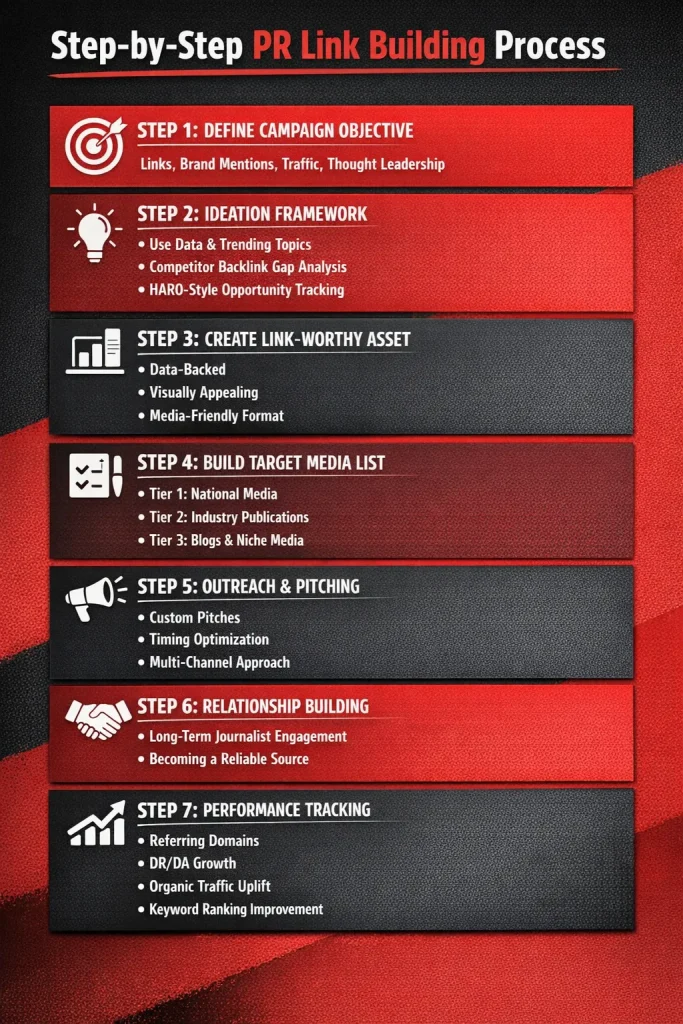
A successful PR link building strategy isn’t built on random outreach or generic press releases. It’s a structured, data-driven process designed to earn high-authority editorial links while strengthening brand visibility and SEO performance.
Below is a detailed breakdown of the 7-step PR link building process you can implement immediately.
Step 1: Define Campaign Objective
Before brainstorming ideas or contacting journalists, you need absolute clarity on what you’re trying to achieve.
PR link building campaigns can serve multiple goals:
- High-authority backlinks from media publications
- Brand mentions (linked or unlinked)
- Organic traffic growth
- Thought leadership positioning
- Topical authority strengthening
- Product or service awareness
Why This Step Matters
Without a defined objective, campaigns become directionless. For example:
- If your goal is authority building, you’ll prioritize Tier 1 publications.
- If your goal is referral traffic, niche publications may convert better.
- If your goal is thought leadership, expert commentary placements might work best.
Pro Tip:
Set measurable KPIs:
- Number of referring domains
- Target DR/DA range
- Traffic uplift percentage
- Ranking improvement for specific keywords
Clarity at this stage determines everything that follows.
Step 2: Ideation Framework
This is where most campaigns either win or fail. PR link building is not about creating content — it’s about creating newsworthy stories.
Here’s a structured ideation framework:
1. Use Data + Trending Topics
Journalists prioritize:
- Fresh statistics
- Industry insights
- Timely commentary
- Contrarian opinions
Monitor:
- Google Trends
- Industry news cycles
- Social media discussions
- Economic reports
- Regulatory changes
Ask:
“What angle can we provide that adds new insight to an existing conversation?”
2. Competitor Backlink Gap Analysis
Analyze competitors who are earning media links:
- What type of campaigns did they run?
- Did they publish original research?
- Are journalists quoting their founders?
- What publications link to them but not to you?
Identify:
- Media outlets linking to competitors
- Recurring journalist contributors
- Content themes driving coverage
This reveals link opportunities already proven to work in your niche.
3. HARO-Style Opportunity Tracking
Reactive PR can generate fast wins.
Track:
- Journalist queries
- Industry commentary requests
- Expert roundup invitations
- Breaking news requiring expert input
Respond quickly and provide:
- Data-backed insights
- Unique quotes
- Actionable commentary
Speed + authority = higher acceptance rates.
Step 3: Create a Link-Worthy Asset
Once you validate your idea, build something journalists actually want to cite.
Your asset must be:
✔ Data-Backed
- Original surveys
- Internal data analysis
- Industry benchmarks
- Research studies
- Predictive reports
Data increases credibility and citation likelihood.
✔ Visually Appealing
Media-friendly assets include:
- Infographics
- Charts and graphs
- Summary statistics
- Visualized comparisons
- Downloadable PDFs
Journalists prefer easily digestible visuals that enhance their article.
✔ Media-Friendly Format
Avoid overly promotional content.
Instead:
- Write neutral, factual insights
- Include quotable statements
- Provide downloadable assets
- Include short executive summaries
- Make statistics easy to extract
The easier you make their job, the more likely they’ll link.
Step 4: Build Target Media List
Not all publications are equal. Segment strategically.
Tier 1: National Media
Examples:
- Major news websites
- Large authority publications
- High DR domains
Goal: Authority & credibility
Challenge: Highly competitive
These links significantly impact brand trust and SEO authority.
Tier 2: Industry Publications
Examples:
- Trade magazines
- Industry blogs
- Professional networks
Goal: Niche relevance + topical authority
Advantage: Higher acceptance rate
These links often drive targeted referral traffic.
Tier 3: Blogs & Niche Media
Examples:
- Specialist blogs
- Local media
- Emerging publications
Goal: Volume + diversification
These help build a natural backlink profile and strengthen contextual relevance.
Step 5: Outreach & Pitching
Even the best campaign fails without strong pitching.
Custom Pitches
Avoid mass emails.
Instead:
- Reference the journalist’s recent article
- Show relevance to their coverage
- Offer exclusive insights
- Keep it concise
- Lead with the story angle, not your brand
Think like a journalist:
“Why would my audience care?”
Timing Optimization
Pitch:
- Early in the week
- During relevant news cycles
- Immediately when trends spike
- Before competitor stories dominate
Reactive timing can double your success rate.
Multi-Channel Approach
Don’t rely only on email.
Use:
- Twitter/X
- Journalist platforms
- Direct website contact forms
A diversified approach improves visibility and response rates.
Step 6: Relationship Building
PR link building is not a one-time tactic — it’s a long-term relationship strategy.
Long-Term Journalist Engagement
After coverage:
- Send a thank-you note
- Share their article
- Offer future data updates
- Stay on their radar without spamming
Journalists often return to reliable sources.
Becoming a Reliable Source
Position yourself as:
- Data provider
- Industry analyst
- Trend forecaster
- Expert commentator
Consistency builds trust — and trust leads to recurring media mentions.
Over time, journalists may reach out to you directly.
That’s when PR link building becomes scalable.
Step 7: Performance Tracking
You can’t optimize what you don’t measure.
Track the following:
1. Referring Domains
Measure:
- Total new domains
- Authority score
- Link relevance
- Link type (follow vs nofollow)
Authority matters more than volume.
2. DR/DA Growth
Monitor:
- Domain Rating increase
- Authority trends over time
- Competitor comparison
PR campaigns often create gradual but compounding authority growth.
3. Organic Traffic Uplift
Analyze:
- Traffic changes post-campaign
- Pages benefiting from internal link flow
- Branded search increase
Strong PR often boosts overall domain visibility.
4. Keyword Ranking Improvement
Track:
- Movement of competitive keywords
- Topical cluster improvements
- Long-tail keyword gains
High-authority links strengthen ranking potential across multiple pages.
Types of PR Link Building Campaigns That Actually Work
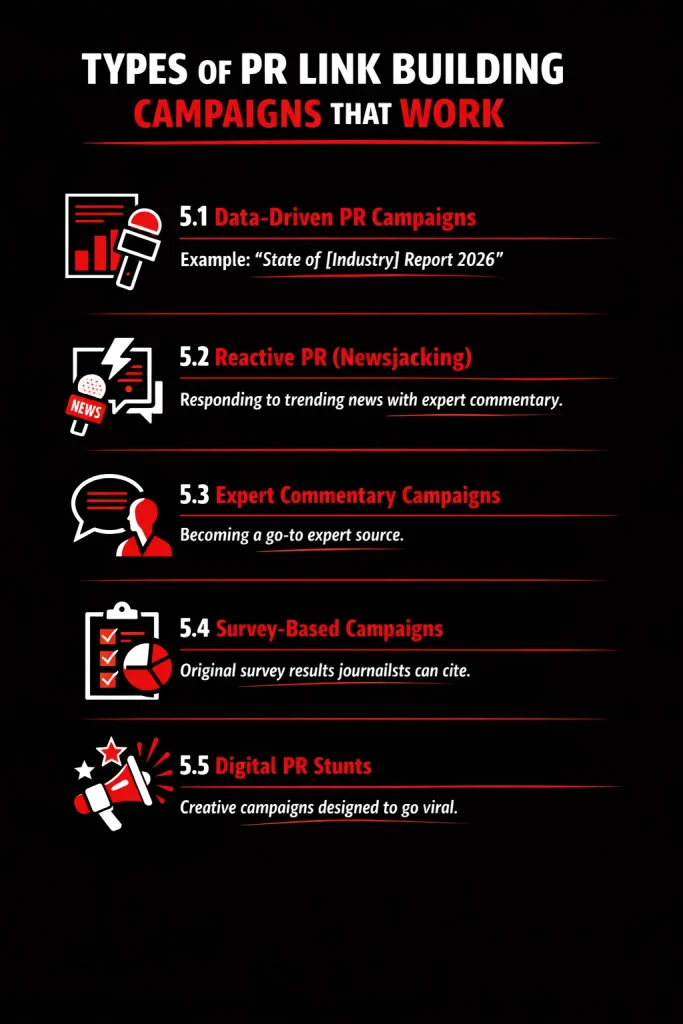
Not all PR campaigns earn high-authority backlinks.
The difference between a campaign that gets ignored and one that earns links from top-tier media usually comes down to newsworthiness, originality, and strategic positioning.
Below are five proven PR link building campaign types that consistently generate authoritative editorial links.
Data-Driven PR Campaigns
Example: “State of [Industry] Report 2026”
Data-driven campaigns are the gold standard of digital PR.
Journalists love statistics. Editors need credible data. Bloggers want numbers to cite. When you create original, well-structured data assets, you become a primary source — and primary sources get linked.
Why It Works
- Journalists constantly need statistics to support their stories.
- Original research makes you cite-worthy.
- Data builds brand authority and thought leadership.
- High shareability across media outlets.
What It Looks Like
A typical data-driven PR campaign might include:
- “State of SEO 2026 Report”
- “AI Adoption in Small Businesses: 2026 Study”
- “E-commerce Trends Report Based on 50,000 Stores”
The key is originality. You can use:
- Internal company data
- Aggregated public datasets
- API-sourced information
- Industry scraping and analysis
- Market research partnerships
How to Structure a Winning Report
- Executive summary (journalist-friendly)
- Key statistics (highlightable)
- Visual charts and graphs
- Expert insights interpreting the data
- Downloadable PDF version
Pro Tip
Pre-outreach journalists before publishing:
“We’re releasing new data next week showing X trend — would you like early access?”
This increases pickup probability significantly.
Reactive PR (Newsjacking)
Responding to Trending News with Expert Commentary
Reactive PR, also known as newsjacking, is one of the fastest ways to earn authoritative links.
Instead of creating the news, you respond to it.
When a trending story breaks, journalists rush to publish updates. They need expert quotes quickly. If you respond fast with insightful commentary, you can secure editorial mentions in hours.
Why It Works
- Journalists operate under tight deadlines.
- Timely expertise is highly valued.
- You piggyback on existing media demand.
Example Scenarios
- Google announces a core update → Provide SEO expert analysis.
- New AI regulation passed → Offer tech industry insight.
- Economic downturn → Provide data-backed marketing predictions.
Execution Framework
- Monitor breaking news (Google Alerts, Twitter/X, LinkedIn, industry newsletters).
- Identify angles relevant to your expertise.
- Craft short, quotable insights (2–4 sentences).
- Send to journalists covering the topic.
- Respond quickly — speed matters more than perfection.
What Makes a Strong Reactive Pitch?
- Clear expert positioning
- Concise, publish-ready quote
- Unique perspective (not generic commentary)
- Fast response time (within hours)
Consistency builds reputation. Over time, journalists start reaching out to you directly.
Expert Commentary Campaigns
Becoming a Go-To Expert Source
Unlike reactive PR, expert commentary campaigns are proactive.
Instead of waiting for trends, you position yourself as a consistent thought leader that journalists can rely on.
Why It Works
- Builds long-term media relationships.
- Generates recurring backlinks.
- Establishes brand authority beyond SEO.
How It Works
You create structured commentary campaigns such as:
- Monthly industry predictions
- Quarterly market outlook reports
- “Expert Insights” columns
- Opinion pieces on industry developments
You then pitch journalists who regularly cover those topics.
Positioning Strategy
To become a quoted expert:
- Publish authoritative content on your own site first.
- Maintain a professional media bio.
- Offer original insights, not recycled opinions.
- Be available and responsive.
Example Pitch Angle
“As an AI SEO strategist working with 200+ brands, here’s what we’re seeing post-algorithm update…”
Specific experience makes you credible.
Over time, this campaign type builds a media moat — a network of journalists who trust you as a source.
Survey-Based Campaigns
Original Survey Results Journalists Can Cite
Survey-based PR campaigns are highly effective because they create fresh statistics that didn’t exist before.
And new statistics are link magnets.
Why It Works
- Media outlets constantly need up-to-date data.
- Survey results provide compelling headlines.
- Emotional or controversial findings increase pickup rate.
Example Campaign Ideas
- “72% of Marketers Plan to Replace Agencies with AI in 2026”
- “60% of Gen Z Trust Influencers Over Brands”
- “Small Businesses Losing $X Due to Poor Website Performance”
How to Run a Survey Campaign
- Define a compelling hypothesis.
- Survey a statistically meaningful audience.
- Analyze results for surprising patterns.
- Craft attention-grabbing data points.
- Design shareable visuals.
- Build a press-ready summary page.
Tips for Higher Link Acquisition
- Highlight controversial insights.
- Provide demographic breakdowns.
- Include expert interpretation.
- Offer exclusive data to top-tier media.
Survey campaigns often generate:
- News site links
- Industry publication citations
- Blog backlinks
- Social media amplification
Digital PR Stunts
Creative Campaigns Designed to Go Viral
Digital PR stunts are bold, creative, and sometimes unconventional campaigns designed to capture massive attention.
These are high-risk, high-reward.
Why It Works
- Media loves unique stories.
- Novelty triggers sharing.
- Creative angles stand out in crowded inboxes.
Examples
- Launching a data-powered “Industry Salary Map”
- Creating a public leaderboard ranking major brands
- Building an interactive tool calculating something surprising
- Running a challenge or public experiment
What Makes a PR Stunt Successful?
- Strong emotional trigger (surprise, controversy, curiosity).
- Visual or interactive element.
- Clear media angle.
- Brand relevance (not random virality).
Important Warning
If the stunt isn’t aligned with your brand, you may get attention but not relevant authority links.
Creativity must serve strategy.
Choosing the Right Campaign Type
Each campaign type serves different goals:
| Campaign Type | Best For | Speed | Authority Level | Scalability |
| Data-Driven PR | High-authority links | Medium | Very High | High |
| Reactive PR | Fast links & visibility | Very Fast | Medium-High | Ongoing |
| Expert Commentary | Long-term authority | Medium | High | High |
| Survey Campaigns | Fresh statistics | Medium | High | Medium |
| PR Stunts | Massive exposure | Variable | High (if successful) | Low |
Tools for PR Link Building
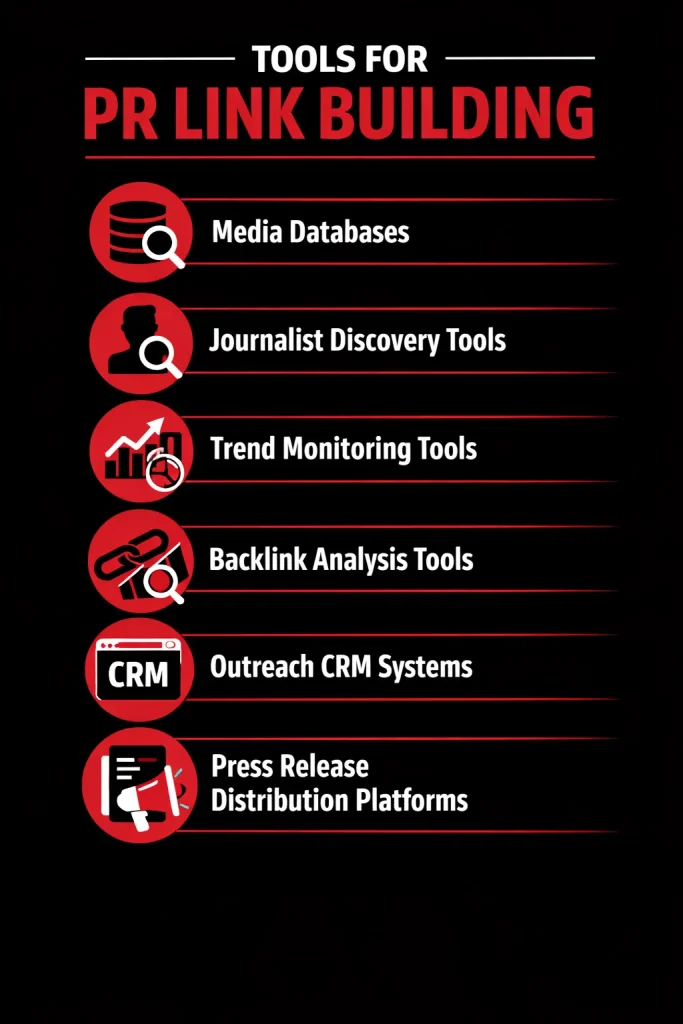
A successful PR link building strategy is not just about having a great story — it’s about using the right tools to find opportunities, connect with journalists, monitor trends, and measure impact.
Below is a breakdown of the essential tool categories every digital PR professional should leverage.
1. Media Databases
Media databases help you identify journalists, editors, publications, and media outlets relevant to your industry. Instead of manually searching Google or LinkedIn, these platforms give you structured access to verified media contacts.
Why They Matter
- Access to thousands of journalists across niches
- Filter by industry, region, publication type, and authority
- Save time in building targeted media lists
- Improve pitch personalization
What to Look For
- Updated journalist contact information
- Beat/topic filtering (e.g., fintech, SaaS, health)
- Publication authority insights
- Outreach tracking capabilities
Popular Examples
- Cision
- Muck Rack
- Prowly
- Meltwater
Pro Tip: Don’t rely only on database filters. Always review a journalist’s recent articles to ensure alignment before pitching.
2. Journalist Discovery Tools
While media databases provide structured lists, journalist discovery tools help you find writers actively covering your topic in real time.
Why They Matter
- Identify journalists writing about trending topics
- Discover new writers before competitors do
- Validate relevance before outreach
How They Help PR Link Building
- Search by keywords to find journalists covering similar stories
- Analyze previously published articles for contextual pitch angles
- Track journalists’ social engagement and preferences
Popular Methods & Tools
- Twitter/X advanced search
- LinkedIn search
- Google News search
- HARO (Help A Reporter Out) platforms
- Qwoted
- Featured.com
Pro Tip: Journalists often post requests for expert sources on social media. Monitoring these can lead to high-authority backlinks with minimal pitching.
3. Trend Monitoring Tools
PR link building thrives on timeliness. If your pitch aligns with current news or trending discussions, your chances of coverage increase significantly.
Why They Matter
- Spot emerging topics early
- Enable reactive PR (newsjacking)
- Identify seasonal opportunities
- Support data-driven campaigns
What to Monitor
- Industry news
- Policy changes
- Market trends
- Consumer behavior shifts
- Viral discussions
Recommended Tools
- Google Trends
- Exploding Topics
- BuzzSumo
- Ahrefs Content Explorer
- X (Twitter) trends
- Google Alerts
Pro Tip: Combine trend data with proprietary insights or expert commentary to create a stronger, journalist-ready pitch.
4. Backlink Analysis Tools
Backlink tools are critical for both campaign planning and performance tracking. They help you identify link opportunities and measure success.
Why They Matter
- Analyze competitor PR campaigns
- Discover publications linking to competitors
- Evaluate link quality (DR/DA, traffic)
- Monitor new and lost backlinks
Key Use Cases
- Backlink gap analysis
- Authority assessment before outreach
- Anchor text monitoring
- Campaign ROI tracking
Popular Tools
- Ahrefs
- SEMrush
- Moz
- Majestic
Pro Tip: Look for patterns in competitor PR links. If multiple competitors are getting coverage from certain publications, those outlets are strong targets.
5. Outreach CRM Systems
As PR campaigns scale, managing outreach manually becomes inefficient. Outreach CRM systems help organize contacts, automate follow-ups, and track conversations.
Why They Matter
- Centralize journalist communications
- Prevent duplicate outreach
- Track response rates
- Manage multi-stage campaigns
Essential Features
- Email sequencing
- Open and reply tracking
- Follow-up automation
- Contact segmentation
- Collaboration support for teams
Examples
- BuzzStream
- Pitchbox
- Respona
- Mailshake
- HubSpot (for larger teams)
Pro Tip: Avoid over-automation. Personalization remains the most important factor in PR outreach success.
6. Press Release Distribution Platforms
Press release platforms help distribute official announcements to media outlets and news aggregators. While they don’t guarantee high-authority editorial links, they can support visibility and brand discovery.
When to Use Them
- Major product launches
- Funding announcements
- Corporate milestones
- Event promotions
Benefits
- Broad media exposure
- Increased brand mentions
- Potential pickup by journalists
- Improved brand credibility
Common Platforms
- PR Newswire
- Business Wire
- GlobeNewswire
- EIN Presswire
Important Note: Press release links are often nofollow. Their primary benefit is brand awareness and journalist discovery — not direct SEO value.
How to Combine These Tools for Maximum Impact
The real power comes from integrating these tools into a unified PR workflow:
- Use trend monitoring tools to identify newsworthy angles.
- Create a data-driven asset.
- Use media databases and journalist discovery tools to build a targeted list.
- Manage outreach with a CRM.
- Track earned backlinks using backlink analysis tools.
- Amplify announcements with press release platforms.
Common Mistakes in PR Link Building (And How to Avoid Them)
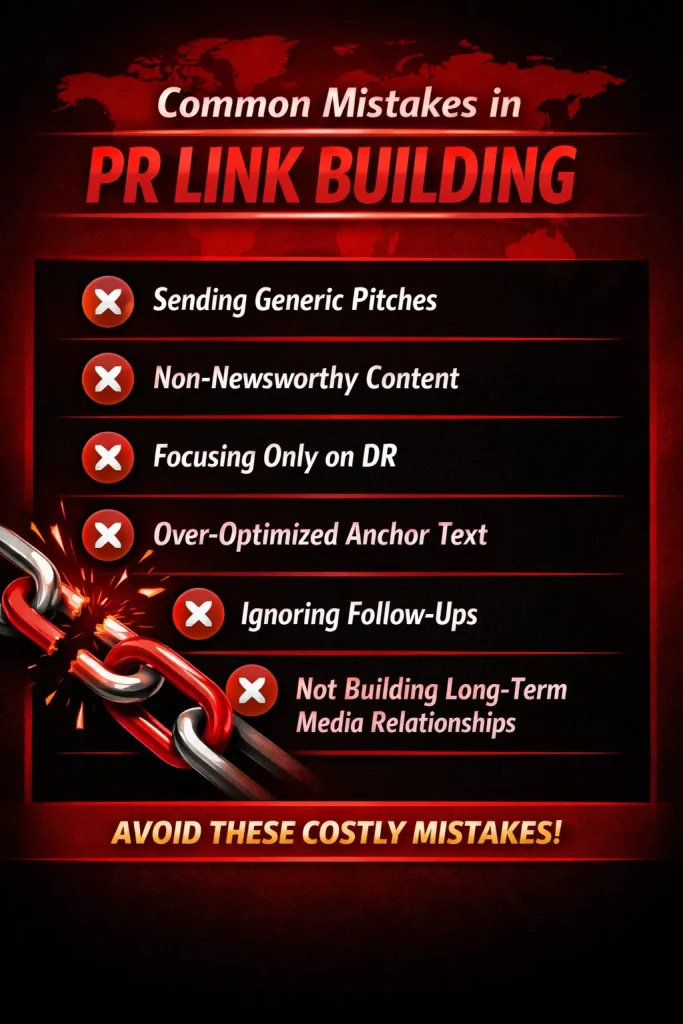
PR link building can generate some of the most powerful, authority-driven backlinks in SEO. But it’s also one of the most misunderstood strategies. Many campaigns fail not because the idea was bad — but because of execution mistakes.
Below are the most common PR link building mistakes that limit results, damage relationships, and waste outreach opportunities — along with practical guidance on how to avoid them.
1. Sending Generic Pitches
The Mistake
One of the biggest reasons PR campaigns fail is sending templated, mass outreach emails to journalists. These emails typically:
- Lack personalization
- Feel sales-driven
- Ignore the journalist’s beat or previous work
- Contain long, promotional messaging
- Provide no real story angle
Journalists receive hundreds of emails daily. If your pitch looks automated, it gets ignored instantly.
Why It Hurts Your Campaign
- Low response rates
- Damaged brand credibility
- Potential blacklisting
- Missed long-term relationship opportunities
PR link building is not volume-based cold outreach. It’s relationship-based storytelling.
How to Fix It
- Reference a recent article the journalist wrote
- Align your pitch with their coverage area
- Keep emails short and story-focused
- Lead with the angle, not your company
- Make it easy for them to extract a quote or statistic
Instead of:
“Hi, we have a new article on our website about marketing trends. Please check it.”
Try:
“Hi [Name], I saw your recent piece on emerging AI marketing tools. We just analyzed 1,200 SaaS companies and found that 68% increased AI budgets in 2026 — thought this data might support future coverage.”
Make it about their story, not your link.
2. Creating Non-Newsworthy Content
The Mistake
Many businesses create “linkable assets” that are not actually newsworthy. Examples include:
- Basic blog posts
- Generic “ultimate guides”
- Surface-level statistics
- Repackaged information from other sources
- Promotional product pages
Journalists are not looking for content — they are looking for stories.
Why It Hurts Your Campaign
If your content lacks a compelling angle, no one will cover it — no matter how many emails you send.
PR-driven backlinks require something that:
- Adds new information
- Challenges assumptions
- Reveals surprising data
- Ties into current events
- Sparks conversation
How to Fix It
Ask yourself:
- Is this new information?
- Would a journalist build a story around this?
- Does this data challenge industry norms?
- Is there a strong headline potential?
Strong PR content examples:
- “42% of Consumers Don’t Trust AI-Generated Reviews”
- “The State of Remote Work Security 2026 Report”
- “Top 10 Industries Most Vulnerable to AI Displacement”
If your content doesn’t pass the “headline test,” it’s not ready for PR.
3. Focusing Only on Domain Rating (DR)
The Mistake
Many SEO teams obsess over Domain Rating (DR) or Domain Authority (DA) and ignore:
- Relevance
- Audience alignment
- Brand exposure
- Referral traffic
- Editorial context
Not every valuable PR link comes from a DR90 website. Sometimes, a DR60 industry publication is more impactful than a DR92 general news site.
Why It Hurts Your Strategy
Over-focusing on DR can lead to:
- Irrelevant placements
- Weak contextual alignment
- Poor brand positioning
- Missed niche authority opportunities
Google values relevance and editorial context as much as authority.
How to Fix It
When evaluating PR placements, consider:
- Is the site topically aligned?
- Does the audience match your ICP?
- Is the link editorial and contextual?
- Does it reinforce brand authority in your niche?
PR link building is about authority signals — not vanity metrics.
4. Over-Optimized Anchor Text
The Mistake
Trying to manipulate anchor text in PR placements by requesting keyword-rich anchors like:
- “best AI SEO services”
- “cheap digital marketing agency”
- “top link building company”
Journalists rarely allow anchor text control. And trying to push optimized anchors raises red flags.
Why It’s Dangerous
- Looks manipulative
- Violates Google’s link guidelines
- Can trigger algorithmic suspicion
- Damages editorial trust
PR links are earned — not engineered.
How to Fix It
Accept natural anchor text such as:
- Brand name
- Naked URL
- Generic references (“according to a recent study”)
- Branded mentions
Branded and natural anchors:
- Build entity authority
- Strengthen brand signals
- Reduce algorithmic risk
- Improve long-term trust
Modern SEO rewards brand strength over keyword-stuffed anchors.
5. Ignoring Follow-Ups
The Mistake
Sending one email and giving up.
Journalists are busy. Your email might be:
- Buried
- Missed
- Opened but forgotten
- Saved for later
Many successful PR placements happen on the second or third follow-up.
Why It Hurts Results
Failing to follow up means:
- Losing warm opportunities
- Wasting great story angles
- Reducing campaign ROI
Often, the difference between 5 links and 25 links is consistent follow-up.
How to Fix It
Best practices:
- Wait 2–3 days before first follow-up
- Keep it short and polite
- Add new value if possible
- Limit to 2–3 total follow-ups
Example:
“Just checking in — happy to provide additional data cuts if helpful.”
Polite persistence often wins.
6. Not Building Long-Term Media Relationships
The Mistake
Treating journalists as transactional link sources instead of long-term partners.
Many brands:
- Reach out only when they need coverage
- Never engage beyond one pitch
- Don’t offer ongoing expertise
- Don’t maintain communication
PR link building is relationship-driven — not campaign-driven.
Why It Limits Growth
If you only pitch when you need something:
- You remain an outsider
- You compete with hundreds of other sources
- You miss repeat coverage opportunities
Strong PR link builders become “go-to experts.”
How to Fix It
- Offer expert commentary regularly
- Respond quickly to media requests
- Share useful data proactively
- Engage with journalists’ work
- Thank them when they publish
Over time, this creates:
- Recurring backlinks
- Faster placements
- Higher-tier media coverage
- Stronger brand authority
The compounding effect of relationships is massive.
The Bigger Picture: PR Is Not Just Link Building
Many of these mistakes stem from treating PR like traditional link building.
PR link building is about:
- Storytelling
- Authority positioning
- Media relationships
- Brand equity
- Editorial trust
Links are the outcome — not the only objective.
When executed properly, PR link building:
- Strengthens your brand entity
- Increases branded search
- Improves EEAT signals
- Drives referral traffic
- Builds long-term ranking resilience
Avoiding these six mistakes can dramatically increase your success rate and transform PR from a hit-or-miss tactic into a scalable authority-building strategy.
Measuring ROI of PR Link Building
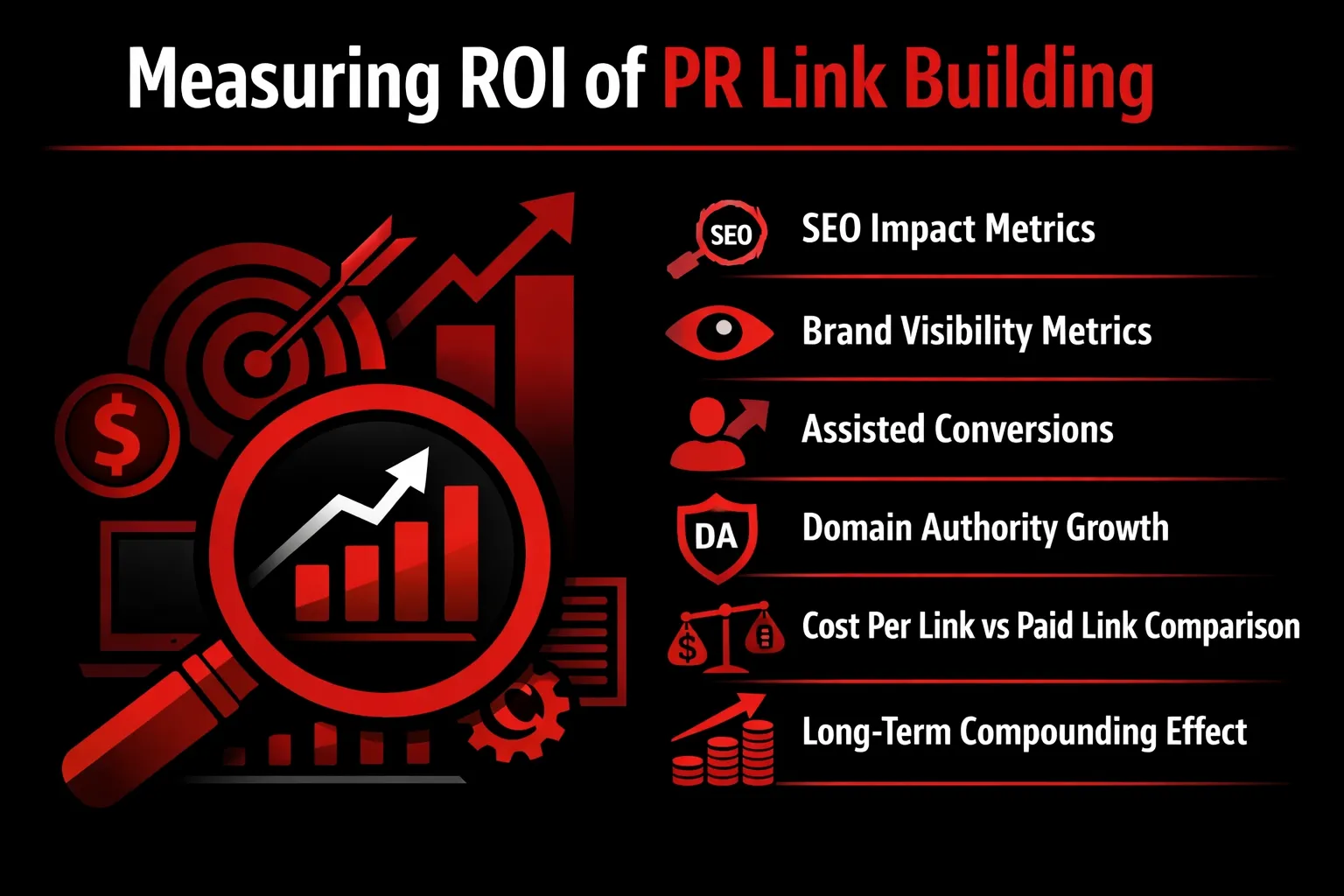
One of the biggest misconceptions about PR link building is that it’s “hard to measure.” While it’s true that digital PR delivers both direct and indirect returns, the ROI becomes very clear when you track the right metrics.
Unlike transactional link placements, PR-driven backlinks influence SEO performance, brand perception, and long-term revenue growth simultaneously. Here’s how to measure its true impact.
1. SEO Impact Metrics
At its core, PR link building is an SEO growth accelerator. High-authority editorial links pass strong ranking signals that compound over time.
Key SEO metrics to track:
a) Organic Traffic Growth
Monitor:
- Overall organic sessions
- Traffic to the campaign landing page
- Traffic to related keyword clusters
PR links from authoritative publications often lift entire topical clusters, not just one page.
b) Keyword Ranking Improvements
Track:
- Primary keyword movement
- Secondary and semantic keyword growth
- Ranking volatility stabilization
High-authority links improve domain-level trust, which helps multiple pages rank more easily.
c) Referring Domains Growth
Rather than counting total backlinks, focus on:
- Unique referring domains
- Quality and relevance of linking domains
- Editorial vs non-editorial links
A few links from major publications often outperform dozens of low-quality placements.
d) Crawl Frequency & Indexation
Authoritative links can increase:
- Crawl budget allocation
- Faster indexation of new content
- Better content discovery
These signals contribute indirectly to stronger SEO performance.
2. Brand Visibility Metrics
PR link building doesn’t just build links — it builds brand authority.
Track the following:
a) Brand Search Volume
Measure increases in:
- Branded keyword searches
- “[Brand] + service” queries
- “[Brand] reviews” searches
An uplift in branded searches indicates growing trust and recognition.
b) Media Mentions (Linked & Unlinked)
Even when links aren’t included, brand mentions:
- Strengthen entity recognition
- Improve topical authority
- Contribute to long-term trust signals
c) Social Engagement & Referral Traffic
High-tier media placements often generate:
- Social shares
- Direct referral traffic
- Influencer mentions
These amplify brand exposure beyond SEO alone.
3. Assisted Conversions
PR link building rarely operates as a last-click channel. Instead, it influences users earlier in the buying journey.
Track:
- Assisted conversions in analytics
- Multi-touch attribution reports
- Time-lag conversion paths
- First interaction vs last interaction performance
For example:
A user reads your quote in an industry publication → later searches your brand → then converts.
Without PR visibility, that conversion might never have happened.
This makes PR link building a powerful top-of-funnel growth driver.
4. Domain Authority & Trust Growth
While third-party metrics like Domain Authority (DA), Domain Rating (DR), or Authority Score are not Google metrics, they are useful directional indicators.
Monitor:
- Growth in overall authority score
- Quality of newly acquired links
- Topical relevance improvements
- Link velocity trends
Consistent PR placements build a stronger backlink profile foundation, which:
- Makes future SEO efforts easier
- Reduces ranking volatility
- Improves competitiveness against established brands
Authority growth is one of the strongest compounding benefits of PR link building.
5. Cost Per Link vs Paid Link Comparison
To evaluate ROI realistically, compare PR link building with traditional paid link acquisition.
Paid Links:
- Fixed cost per placement
- Often lower editorial standards
- Risk of penalties
- Limited brand value
PR Links:
- Higher effort upfront
- Editorially earned
- Strong authority
- Brand exposure included
- No manual action risk when done properly
When you calculate cost per earned high-authority link, PR often delivers:
- Higher authority links
- Greater brand exposure
- Longer-term SEO benefits
- Lower risk
Even if the upfront campaign cost is higher, the value per link and per impression is significantly stronger.
6. The Long-Term Compounding Effect
This is where PR link building truly outperforms most SEO tactics.
A single high-authority PR campaign can:
- Continue generating backlinks organically
- Improve rankings across multiple pages
- Increase brand searches over time
- Strengthen trust signals for years
Unlike rented placements or short-term campaigns, PR links remain as permanent editorial endorsements.
Over time, this creates:
- Easier future rankings
- Reduced cost of acquisition
- Stronger brand credibility
- Sustainable organic growth
PR link building is not a one-month tactic — it’s a long-term asset-building strategy.
Putting It All Together: How to Calculate True ROI
To measure ROI effectively:
- Track campaign cost.
- Measure earned high-authority links.
- Monitor traffic growth over 3–6 months.
- Evaluate ranking improvements.
- Review assisted conversions.
- Compare against equivalent paid link budgets.
- Analyze brand search uplift.
When assessed holistically, PR link building often delivers:
- Higher lifetime value per link
- Stronger authority growth
- Sustainable SEO performance
- Brand equity expansion
Case Study Example: How a Data-Driven PR Campaign Earned 68 High-Authority Links in 90 Days
To understand how a PR link building strategy works in practice, let’s break down a real-world style example based on a hypothetical (but realistic) B2B SaaS campaign.
📌 Client Background
- Industry: B2B HR Software (Employee Monitoring & Productivity Tool)
- Domain Rating (Before Campaign): 42
- Monthly Organic Traffic: 18,000
- Primary Goal: Increase authority and rank for competitive keywords like:
- “employee productivity software”
- “remote workforce statistics”
- “employee monitoring tools”
The market was highly competitive, with industry giants dominating search results. Traditional guest posting was delivering limited impact. The brand needed authority-level backlinks.
🚀 Campaign Idea
“The State of Remote Work Productivity 2026 Report”
The idea was to create an original, data-backed industry report focused on remote work trends and productivity benchmarks — a topic journalists and business publications actively cover.
Why This Angle Worked:
- Remote work remains a trending topic.
- Journalists frequently need updated statistics.
- The brand had access to anonymized user productivity data.
- It aligned directly with the client’s product offering.
The campaign aimed to position the company as an industry authority, not just a software vendor.
📊 Asset Created
A comprehensive, media-friendly digital PR asset including:
- Original Data Analysis
- Aggregated anonymized data from 3,200 remote teams.
- Productivity changes by industry.
- Peak productivity hours.
- Burnout indicators.
- Key Statistics Highlights
- “Remote employees are 12% more productive on Tuesdays.”
- “Finance teams show the highest burnout rate.”
- “Flexible hours increase task completion by 18%.”
- Visual Assets
- Custom infographics.
- Data visualizations.
- Shareable charts for journalists.
- Downloadable PDF report.
- Press-Friendly Landing Page
- Clear headline.
- Statistic summaries.
- Embed-ready graphs.
- Executive commentary.
This made it easy for journalists to quote, reference, and link back.
📩 Outreach Strategy
The outreach was divided into three tiers:
Tier 1 – National Media
- Business & tech publications.
- Remote work and HR trend reporters.
Tier 2 – Industry Publications
- HR blogs.
- SaaS review sites.
- Workplace culture platforms.
Tier 3 – Niche & Startup Media
- Entrepreneur blogs.
- Productivity communities.
- LinkedIn newsletters.
Pitch Strategy:
Instead of pitching the entire report, each journalist received:
- A customized email.
- 1–2 exclusive data insights relevant to their beat.
- A short expert quote from the CEO.
- Offer of early access before public release (for Tier 1 media).
Subject line example:
“New Data: Remote Workers 18% More Productive with Flexible Hours”
Follow-ups were sent 3–4 days later with additional statistics.
🔗 Links Earned (Within 90 Days)
Results:
- 68 referring domains acquired
- 12 links from DR 80+ publications
- 24 links from DR 60–79 sites
- 32 niche industry sites
Notable placements included:
- Major business news site (DR 91)
- Leading HR industry publication (DR 84)
- Startup-focused online magazine (DR 78)
All links were:
- Editorial
- Contextual
- Naturally anchored
- Brand-focused (low risk)
📈 Traffic Increase
Within 4 months:
- Organic traffic grew from 18,000 → 31,500 monthly visits (+75%)
- The report page itself generated:
- 9,800 visits
- 14% assisted conversions
- Referral traffic from media links increased brand discovery
The campaign also triggered secondary natural links as bloggers cited the data without direct outreach.
🏆 Ranking Improvements
Primary keyword improvements:
| Keyword | Before | After |
| employee productivity software | #18 | #5 |
| remote workforce statistics | #27 | #3 |
| employee monitoring tools | #14 | #6 |
Additionally:
- 130+ keywords moved to page 1.
- Domain Rating increased from 42 → 49.
- Brand searches increased by 38%.
This demonstrates how high-authority PR links significantly influence ranking signals.
💰 Revenue Impact
The long-term ROI exceeded expectations.
Within 6 months:
- Demo requests increased by 52%.
- Assisted conversions attributed to the campaign: 146 leads.
- Average customer lifetime value (LTV): $4,800.
- Estimated revenue impact: ~$700,000 in influenced pipeline value.
Cost of campaign: ~$18,000
Effective cost per high-authority link: ~$264
Long-term SEO value: Ongoing.
🎯 Key Takeaways from This Campaign
- Newsworthy data outperforms generic content.
- PR links drive both authority and brand recognition.
- Personalization dramatically increases journalist response rate.
- One strong campaign can generate compounding SEO growth.
- The impact extends beyond backlinks — into revenue and brand positioning.
Why This PR Link Building Strategy Worked
- It focused on original data.
- It aligned with ongoing media narratives.
- It prioritized journalist needs over self-promotion.
- It built authority rather than chasing link quantity.
This is the difference between traditional link building and strategic digital PR.
PR Link Building vs Guest Posting vs Niche Edits
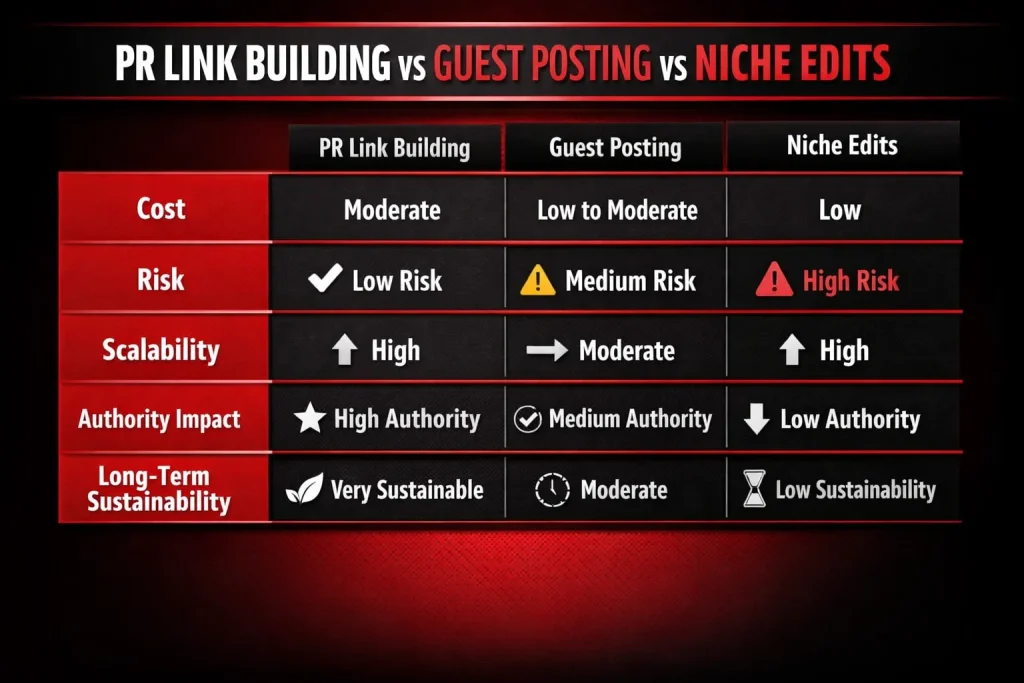
Not all backlinks are created equal. While PR link building, guest posting, and niche edits are commonly used SEO strategies, they differ significantly in cost, risk profile, scalability, authority impact, and long-term sustainability.
Understanding these differences is critical for building a link acquisition strategy that is both effective and future-proof.
Quick Comparison Table
| Factor | PR Link Building (Digital PR) | Guest Posting | Niche Edits (Link Insertions) |
| Cost | High upfront investment (research, data, outreach) | Moderate per placement | Low to moderate per placement |
| Risk | Very low (editorial, earned links) | Moderate (can become manipulative if scaled aggressively) | High (often paid insertions in existing content) |
| Scalability | Medium (quality-driven) | High (process-driven) | Very high (fast placements possible) |
| Authority Impact | Very high (top-tier media, strong trust signals) | Moderate (depends on site quality) | Low to moderate (often lower-tier sites) |
| Long-Term Sustainability | Excellent (aligned with Google guidelines) | Conditional (safe if done properly) | Weak (vulnerable to algorithm updates) |
1. Cost
PR Link Building
PR campaigns typically require:
- Data research
- Content creation (reports, surveys, visual assets)
- Journalist outreach
- Media list building
The upfront investment can be higher compared to other tactics. However, a single successful campaign can generate dozens of high-authority backlinks, making the cost per link lower over time.
Key Insight: PR is capital-intensive but ROI-positive long term.
Guest Posting
Guest posting usually involves:
- Content creation
- Outreach
- Editorial fees (in many cases)
Costs are predictable per placement. Agencies often charge per article or per link. While cheaper than PR per campaign, quality guest posts on authoritative websites can still be expensive.
Niche Edits
Niche edits (also known as link insertions) involve placing a link into an existing article. These are often:
- Paid placements
- Brokered through link sellers
They tend to be cheaper per link but offer limited strategic value beyond short-term ranking boosts.
2. Risk
PR Link Building – Lowest Risk
PR links are editorially earned. Journalists choose to cite your data or expertise because it adds value to their story.
These links:
- Follow Google’s guidelines
- Are contextually relevant
- Appear natural
This makes PR one of the safest link-building strategies available.
Guest Posting – Moderate Risk
Guest posting becomes risky when:
- Anchor text is overly optimized
- Sites exist purely for selling links
- It is scaled aggressively without quality control
Done strategically on real publications with strong editorial standards, guest posting remains relatively safe.
Niche Edits – High Risk
Niche edits often:
- Involve payment for link insertion
- Use exact-match anchor text
- Appear in outdated or irrelevant content
Because these links are frequently transactional, they are more susceptible to devaluation during algorithm updates.
3. Scalability
PR Link Building – Quality Over Quantity
PR is not easily mass-produced.
Each campaign requires:
- Unique angle development
- Custom outreach
- Story positioning
While you can systemize parts of it, results depend heavily on creativity and newsworthiness.
Guest Posting – Highly Scalable
With a structured outreach system, guest posting can be scaled:
- Outreach templates
- Content teams
- Placement networks
However, scaling too aggressively often leads to declining quality.
Niche Edits – Fastest to Scale
Because many niche edits are transactional, they can be acquired quickly in bulk.
But high scalability often correlates with higher risk and lower long-term value.
4. Authority Impact
PR Link Building – Maximum Authority Boost
PR links frequently come from:
- News publications
- Industry-leading websites
- High Domain Authority domains
These links send strong signals of:
- Trust
- Brand legitimacy
- Expertise
Additionally, they generate brand mentions, referral traffic, and entity recognition—factors increasingly important in modern SEO.
Guest Posting – Conditional Authority
Authority impact depends entirely on:
- Site relevance
- Traffic quality
- Editorial standards
High-quality guest posts can be powerful. Low-quality placements provide minimal benefit.
Niche Edits – Limited Authority Growth
Niche edits usually:
- Do not generate brand recognition
- Rarely drive meaningful traffic
- Often exist on mid-tier sites
They may improve rankings temporarily but rarely build real authority.
5. Long-Term Sustainability
PR Link Building – Future-Proof
PR aligns with:
- Google’s emphasis on EEAT
- Brand-driven ranking signals
- Entity-based SEO
It builds assets and media relationships that compound over time.
Guest Posting – Sustainable If Done Ethically
Guest posting remains viable when:
- Focused on thought leadership
- Placed on real publications
- Avoiding manipulative anchor text practices
The strategy requires discipline and quality control.
Niche Edits – Weak Sustainability
Because niche edits often rely on paid insertions, they:
- Can be removed
- Can be devalued
- Provide little brand equity
They are tactical, not strategic.
Strategic Recommendation
For long-term SEO growth:
- Use PR link building as your authority engine.
- Use guest posting selectively for topical depth and relevance.
- Avoid relying heavily on niche edits for sustainable growth.
In 2026 and beyond, Google rewards brands, not just backlinks. PR link building doesn’t just build links—it builds trust, recognition, and defensible authority.
Advanced PR Link Building Strategies
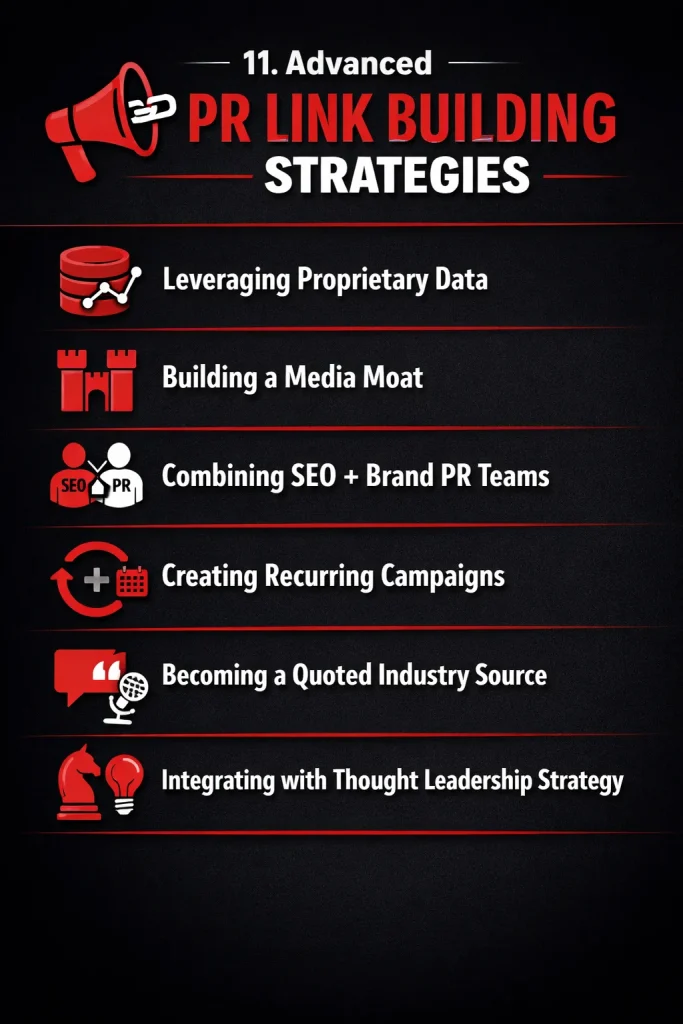
Once you’ve nailed the basics—newsworthy angles, strong outreach, and quality assets—the real leverage comes from systems that keep earning links over time. These advanced PR link building strategies are how top brands consistently land high-authority coverage without reinventing the wheel every month.
1) Leveraging Proprietary Data (The “Uncopyable” Link Magnet)
The fastest way to earn editorial links is to give journalists something they can’t get anywhere else: original data.
Why it works
- Reporters need credible stats to support their stories.
- Proprietary insights are inherently “cite-worthy.”
- Data creates repeat linkability: other writers reference it long after the initial campaign.
How to build proprietary data assets
- First-party platform data: usage trends, anonymized benchmarks, performance stats.
- Customer insights: aggregated survey results, user behavior patterns.
- Internal research: audits, experiments, A/B test learnings, case-study rollups.
- Public data + proprietary analysis: combine open datasets with your unique methodology.
Formats journalists love
- “State of the Industry” reports (quarterly or annual)
- Rankings (“Top cities for X in 2026”)
- Benchmarks (“Average conversion rate by industry”)
- Interactive dashboards (filters by region/industry)
- Data-led press kits (key stats + quotes + charts)
Pro tip: Publish a methodology section (transparent, simple) so editors trust the numbers—and link to the source.
2) Building a Media Moat (Relationships That Compound)
A media moat is a protective layer of relationships and credibility that makes it easier for you to earn coverage than your competitors.
What a media moat looks like
- Journalists recognize your brand and respond faster.
- You’re the “go-to source” when stories break.
- You get repeat coverage without re-pitching from scratch.
How to build it
- Segment your journalist list by beat (not just domain authority).
- Track preferences: what topics they cover, formats they like, deadlines.
- Offer help even when you’re not pitching:
- send relevant stats
- suggest additional sources
- provide quick expert quotes
Relationship habits that win
- Keep pitches short, timely, and genuinely relevant.
- Reply fast—journalists run on deadlines.
- Don’t “spray and pray.” Thoughtful targeting beats volume every time.
Pro tip: Create an internal “journalist CRM” (even a spreadsheet works) with:
- outlet, beat, topics covered
- last interaction
- response rate
- notes on style and preferences
3) Combining SEO + Brand PR Teams (One Story, Two Wins)
PR teams often aim for brand reputation and reach, while SEO teams chase links and rankings. The best results come when both teams plan together from day one.
Why alignment matters
- PR gets better story assets, data, and credibility.
- SEO ensures coverage lands with linkable URLs, relevant pages, and trackable impact.
- Both teams avoid missed opportunities (like mentions without links).
How to align PR + SEO
- Start campaigns with a joint brief:
- target topics + audience
- core narrative
- link targets (content hub, study page, tools)
- priority keywords (light-touch, not forced)
- Build “PR-friendly” landing pages:
- fast loading
- clean headline + key stats above the fold
- clear charts and downloadable visuals
- no gated content (journalists hate it)
Pro tip: Give PR multiple link targets:
- a primary “study” page
- an explainer page (context)
- a tool/resource page (utility)
This increases the chance of getting some link even if they don’t use your main URL.
4) Creating Recurring Campaigns (Sustainable Links Without Burnout)
One-off campaigns are great. Recurring campaigns are an engine.
Why recurring PR campaigns outperform
- Journalists know what to expect and come back for updates.
- You build consistency and topical authority.
- Each release stacks links on top of previous ones.
Recurring campaign ideas
- Monthly trend index (prices, demand, hiring, search trends)
- Quarterly benchmark report
- Annual industry predictions
- Seasonal data drops (holidays, tax season, summer travel, etc.)
- Weekly expert commentary on major stories in your niche
Make it easy to publish
- Reuse templates: charts, structure, outreach lists, email frameworks.
- Automate data collection where possible.
- Build a “campaign calendar” tied to industry seasons.
Pro tip: Create a “series page” that houses all editions. This becomes a link hub journalists can reference over time.
5) Becoming a Quoted Industry Source (Links Through Authority, Not Assets)
You don’t always need big campaigns. Sometimes the best links come from being the person reporters quote when they need expertise.
How to become quote-worthy
- Create a “press” or “media” page with:
- expert bios
- headshots
- areas of expertise
- past mentions
- contact info
- Offer fast, crisp soundbites (2–3 sentences max).
- Keep your quotes:
- specific
- data-backed
- opinionated (but responsible)
- framed in plain language
Where quote opportunities come from
- reactive commentary when news breaks
- journalist requests (ongoing)
- niche publications always needing expert takes
- podcasts and webinars (often lead to show notes links)
Pro tip: Train 1–2 spokespeople internally to respond quickly and consistently. Speed + clarity wins quotes.
6) Integrating With Thought Leadership Strategy (PR Links That Build Brand Equity)
The most powerful PR link building doesn’t just earn links—it builds a reputation that makes future links easier.
Thought leadership = long-term link advantage
When your brand is known for a strong viewpoint, journalists:
- cite you more frequently
- reference your frameworks
- link to your research and POV pieces
How to integrate thought leadership into PR
- Develop 3–5 core “brand theses” (strong opinions you can defend).
Examples:- “AI will commoditize content, but trust signals will dominate rankings.”
- “The future of SEO is entity authority + brand PR, not volume publishing.”
- Turn theses into repeatable content:
- founder POV articles
- data-backed opinion pieces
- keynote topics
- contrarian takes supported by evidence
Build a content ecosystem
- A pillar thought leadership page
- Supporting data assets
- Internal case studies
- Media-ready summaries and visuals
Pro tip: Make your thought leadership “linkable” by turning concepts into named frameworks (e.g., “The Media Moat Model”)—journalists love citing frameworks.
Putting It All Together: The Advanced System
If you want a durable PR link building machine, combine:
- Proprietary data (earn citations)
- Media moat (increase win rate)
- PR + SEO alignment (maximize link value)
- Recurring campaigns (compounding results)
- Quoted source positioning (steady link flow)
- Thought leadership (brand authority flywheel)
This is how PR link building becomes less of a “campaign” and more of a growth channel.
Future of PR Link Building
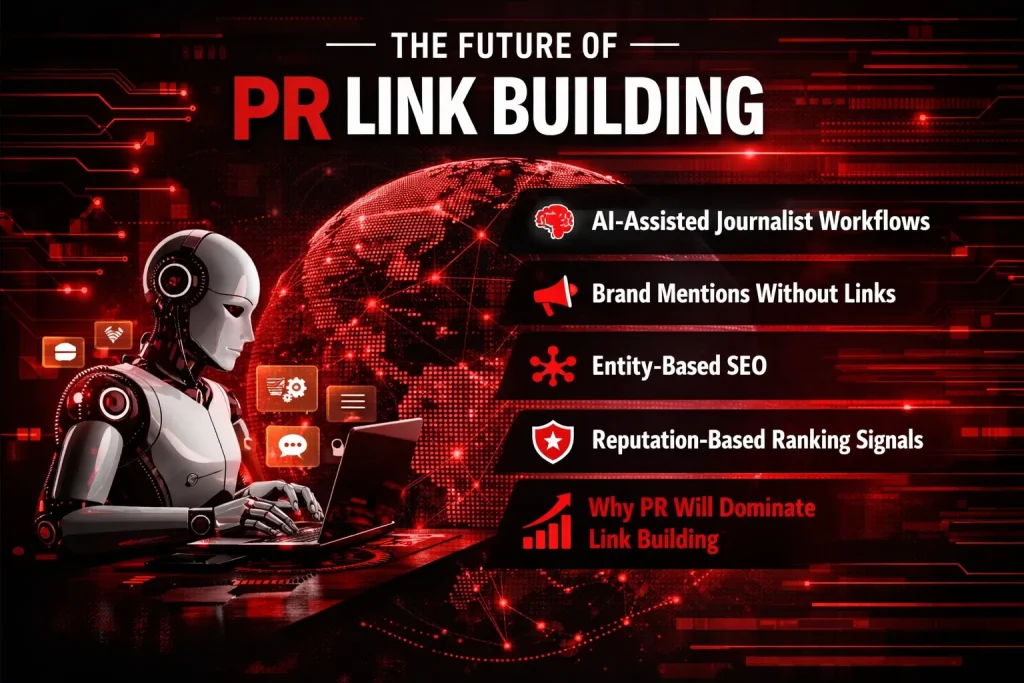
PR link building is shifting from a “get a backlink” tactic into a brand authority engine. Search engines are getting better at understanding brands, relationships, and credibility—so the future belongs to strategies that create real-world trust signals, not just anchor text.
Here’s what’s coming next—and how to stay ahead.
AI-assisted journalist workflows
Journalists are already using AI to move faster: summarizing research, scanning pitches, drafting outlines, and pulling quick background context. That changes what “good outreach” looks like.
What this means for PR link building:
- Mass outreach will die faster. If reporters can triage pitches in seconds, generic templates get filtered out immediately.
- Proof beats promises. Claims like “we’re industry leaders” won’t survive AI + human scrutiny. Data, credentials, and verifiable insights will.
- Speed matters more. The first credible expert reply often wins the mention.
How to adapt:
- Build ready-to-quote assets: short stats, sharp takes, mini research summaries, and clear expert bios.
- Maintain an internal rapid-response system: who can comment, in what topics, and how fast.
- Pitch in a format AI and humans love: one strong angle + 2–3 supporting bullets + a clean quote + source links.
Brand mentions without links
The web is increasingly “linkless.” Publications may mention brands without linking (especially in roundups, print-to-web workflows, apps, and social reposts). Meanwhile, Google has long discussed using implied links (mentions) as signals of authority.
What this means:
- A PR campaign can improve rankings even when you don’t earn a clickable backlink every time.
- The KPI isn’t only links—it’s coverage quality and brand association with relevant topics.
How to adapt:
- Track brand mentions (not just backlinks).
- Optimize your “mention ecosystem”: make sure your brand name, product names, and key spokespeople are consistent across the web.
- When you do get a mention without a link, follow up politely with:
“If you’d like to add a source for readers, here’s the exact page/data reference.”
Entity-based SEO
Search is moving from keywords to entities: people, brands, products, organizations, and concepts—plus the relationships between them. Digital PR is perfectly positioned because it creates those relationships in public, authoritative places.
What this means:
- Ranking isn’t only about your pages—it’s about whether Google understands who you are, what you’re known for, and whether credible sources agree.
- PR mentions help connect your brand entity to topics like “cybersecurity compliance,” “B2B SaaS analytics,” or “local SEO,” depending on your niche.
How to adapt:
- Build campaigns around topical authority, not random link opportunities.
- Align PR angles to the topics you want to “own” (your entity + your category + your use cases).
- Strengthen entity signals: consistent brand profiles, founder bios, credentials, awards, partnerships, and citations in reputable publications.
Reputation-based ranking signals
Google’s quality systems increasingly reward trust, experience, and credibility—especially for “Your Money or Your Life” (YMYL) categories like finance, health, legal, and safety. Even outside YMYL, reputation signals matter more than ever.
What this means:
- PR link building becomes reputation building: third-party validation, expert credibility, and public proof.
- Low-quality links matter less; credible citations matter more.
How to adapt:
- Prioritize placements that strengthen trust:
- respected industry publications
- recognized news sites
- academic/government references where possible
- high-quality podcasts/webinars with transcripts
- Build “proof pages” on your site that support PR claims:
- methodology pages for research
- author and editorial policies
- real case studies with numbers
- leadership profiles with credentials
- Think beyond links: awards, panels, quotes, reviews, and partnership announcements all reinforce reputation.
Why PR will dominate link building
Traditional link building is under pressure:
- Google is better at discounting manipulative patterns.
- The internet is flooded with low-effort content and paid placements.
- “Easy links” don’t build enduring authority.
PR wins because it produces the signals search engines and users trust:
- editorial validation
- brand authority
- real citations from credible sources
- distribution + discovery + referral traffic
- entity recognition and reputation growth
In other words, PR doesn’t just build links—it builds a brand moat.
What a “future-proof” PR link building strategy looks like:
- Create original research (even small-scale data beats generic content)
- Become a repeatable source (reactive PR + expert commentary)
- Build topic ownership through consistent coverage in your niche
- Measure success via a combined scorecard:
- quality links + linkless mentions
- branded search growth
- topical rankings
- referral traffic
- conversions influenced by PR
Conclusion
PR link building is no longer just an advanced SEO tactic — it’s a strategic growth channel that blends brand authority, trust, and organic visibility into one powerful system.
Let’s quickly recap the key takeaways:
- PR link building focuses on earning editorial backlinks, not buying or trading them.
- It relies on newsworthy angles, original data, and expert positioning to attract media coverage.
- Unlike traditional link building, it strengthens brand authority, EEAT signals, and long-term search performance.
- When executed strategically, it drives not only rankings but also referral traffic, brand mentions, and credibility in your industry.
- The ROI compounds over time, making it far more sustainable than short-term link schemes.
Why PR Link Building Is Sustainable and Future-Proof
Search engines are evolving rapidly. With AI-generated content flooding the web, Google increasingly prioritizes authority, trust, and real-world recognition. Editorial links from reputable publications signal exactly that.
PR link building works because it aligns with:
- Google’s emphasis on EEAT (Experience, Expertise, Authority, Trust)
- Brand-driven ranking signals
- Natural, editorial backlinks
- Entity-based SEO
- Long-term reputation building
While manipulative link tactics become riskier each year, PR-based links remain resilient because they are earned, contextual, and credible. They build a brand footprint that algorithm updates can’t easily undermine.
In other words, PR link building doesn’t just help you rank — it helps you become the brand Google wants to rank.
The Next Step
If you want sustainable organic growth, stronger authority signals, and backlinks that truly move rankings, now is the time to integrate PR into your SEO strategy.
Start small:
- Identify one data-driven campaign idea.
- Develop a compelling story angle.
- Build a targeted journalist list.
- Test and refine your outreach process.
Or, if you’d prefer a guided approach, consider partnering with experts who specialize in digital PR and high-authority link acquisition.
Whether you’re looking for a strategy consultation, a backlink audit, or a full-scale PR link building campaign, taking action today can position your brand for long-term dominance in search.
The future of SEO belongs to brands — and PR link building is how you build one.