
SUPERCHARGE YOUR ONLINE VISIBILITY! CONTACT US AND LET’S ACHIEVE EXCELLENCE TOGETHER!
How Hyper-Intelligence Transformed Traffic Into Growth
At ThatWare, we have always believed that SEO should not be static, mechanical, or purely automated. It should think, learn, predict, and evolve. This belief led us to create Hyper-Intelligence SEO, a system that goes beyond traditional SEO and even beyond standard AI-based optimization. We combine data science, artificial intelligence, machine learning, search psychology, and predictive analytics into one evolving intelligence framework that continuously adapts to user behavior and search engine changes.
cheapdummyticket.com came to us at a critical stage. The website was facing a steady decline in organic traffic, unstable keyword rankings, and weak alignment with real user intent. Although content existed and technical elements were in place, the SEO strategy lacked intelligence. It could not clearly understand why users were searching, what they truly wanted, or how search engines interpreted those needs. This gap between data and understanding was slowly limiting growth.
We approached this challenge not as a routine SEO project, but as a living system that needed to be rebuilt with intelligence at its core. Instead of chasing keywords blindly or relying on rigid SEO checklists, we used our Hyper-Intelligence SEO framework to decode search intent, predict trends, and design a strategy that could evolve on its own over time. Every decision was guided by learning systems that studied user behavior, SERP patterns, engagement signals, and performance data in real time.
This case study explains how our Hyper-Intelligence SEO strategy transformed cheapdummyticket.com from a declining site into a massive SEO growth story. It shows how intelligence-driven SEO can outperform traditional methods and how adaptive, predictive optimization creates long-term and sustainable growth rather than short-lived ranking wins.
Client Overview
Business Model and Market Position
cheapdummyticket.com operates in the dummy ticket and travel documentation niche. The platform provides users with fast, temporary flight ticket solutions for visa applications, travel proof, and documentation needs. The market is highly competitive, with many similar providers targeting the same transactional keywords. To stand out, the website needed more than just basic SEO. It needed strong intent alignment, trust signals, and high visibility across commercial and informational searches.
Target Audience and Search Behavior
The core audience includes travelers, visa applicants, students, and professionals who urgently need proof of travel. Their search behavior is highly intent-driven. They look for keywords like cheapest dummy ticket, airline-specific dummy tickets, and urgent booking proof. These users expect speed, clarity, and reliability. Any mismatch between their intent and the page content leads to fast drop-offs and low engagement.
SEO Status Before ThatWare
Before working with us, the website had basic SEO foundations in place. Pages existed, keywords were targeted, and some rankings were present. However, there was heavy ranking instability, declining organic traffic, and weak performance on high-intent keywords. Content did not strongly reflect search intent, and many pages were not aligned with how Google interpreted user needs.
Growth Limitations at the Start
The biggest limitation was not lack of effort, but lack of intelligence in strategy. Decisions were based on surface-level data instead of deep behavioral and intent analysis. Without predictive insight and adaptive systems, growth remained slow and inconsistent. This is where our Hyper-Intelligence SEO framework became necessary to rebuild the foundation for massive SEO growth.
The SEO Challenges
Declining Organic Traffic
cheapdummyticket.com was experiencing a steady drop in organic traffic. Pages that once attracted visitors were slowly losing visibility. This decline was not sudden, but gradual, which made it more dangerous. Without quick action, the website risked losing long-term authority in its niche. The lack of consistent SEO growth showed that existing strategies were no longer effective.
Ranking Volatility
Keyword positions were highly unstable. Some keywords ranked well for short periods and then dropped without warning. This kind of ranking volatility is often a sign of weak alignment with search intent and poor engagement signals. Google could not confidently determine that these pages were the best answers for users, which led to frequent reshuffling in rankings.
Poor Search Intent Alignment
Most pages were built around keywords, not around search intent. They tried to rank for terms like dummy ticket or cheap dummy ticket, but did not fully answer what users actually wanted. Users were looking for clarity, trust, pricing, airline options, and fast solutions. When content failed to match this intent, users left quickly, sending negative signals back to search engines.
Weak UX and Engagement Signals
User experience was another major challenge. Page speed, structure, and navigation were not optimized for smooth journeys. Visitors often struggled to find what they needed quickly. This caused low engagement, high bounce rates, and weak conversion paths. These poor UX signals directly affected SEO performance, making it harder to sustain rankings.
ThatWare’s Hyper-Intelligence SEO: The Engine Behind Massive Growth
What Hyper-Intelligence SEO Means
For us, Hyper-Intelligence SEO is not just automation. It is a system that thinks, learns, predicts, and adapts. It combines AI, machine learning, data science, NLP, and predictive analytics into one intelligence layer that understands users and search engines at the same time. The goal is not only to rank pages, but to build a system that can grow stronger with every data point it learns from.
Beyond Traditional SEO
Traditional SEO follows fixed steps like keyword research, on-page optimization, and link building. Even most AI-based SEO tools only automate these steps. Our Hyper-Intelligence SEO goes further. It studies behavior, intent, engagement, and SERP patterns continuously. Instead of reacting late to changes, it prepares for them in advance.
The Four Intelligence Layers
Our framework works on four main layers.
First is Intent Intelligence, which studies why users search and what they truly want.
Second is Data Intelligence, which connects traffic, ranking, engagement, and conversion data into one learning system.
Third is Predictive Intelligence, which forecasts trends, ranking shifts, and opportunity gaps.
Fourth is Adaptive Intelligence, which updates strategies automatically based on what the system learns.
Search Intent as the Core
Everything starts with search intent. We do not ask “Which keyword should we rank for?” We ask “What problem is the user trying to solve?” This shift changes how content is planned, how pages are structured, and how internal linking is built.
Learning from User Behavior
We track how users move, click, scroll, and convert. This behavioral data feeds into our intelligence system. Pages that perform well teach the system what works. Pages that fail teach it what to avoid. This creates a cycle of constant improvement.
Predicting Instead of Reacting
Most SEO strategies react after rankings drop. Our Hyper-Intelligence SEO predicts change. It studies trend signals, search pattern shifts, and SERP movements to prepare strategies before drops happen.
Strategy That Evolves
Our framework is not fixed. It evolves as data grows. With every update, every user action, and every ranking shift, the system becomes smarter. This is how we build long-term and stable SEO growth.
Crafting the Growth Strategy for cheapdummyticket.com with Hyper-Intelligence SEO
Understanding Search Psychology
We started by studying how users think when they search. Instead of only collecting keywords, we analyzed search psychology. We looked at urgency, trust, pricing sensitivity, and brand preference in travel-related searches. This helped us understand what users actually expect when they type queries like cheap dummy ticket or airline dummy ticket.
Applying the 3C’s of Search Intent
We used the 3C model of Content Type, Content Format, and Content Angle.
Content Type decided whether a page should be a service page, landing page, or blog.
Content Format decided whether the content should be a guide, comparison, list, or direct service page.
Content Angle decided the emotional and commercial hook, such as cheapest, fastest, or most trusted.
Intent-Based Keyword Clustering
Instead of grouping keywords by similarity, we grouped them by intent. Keywords with the same purpose were treated as one topic. This helped us create stronger pages that covered full intent instead of thin pages targeting single keywords.
SERP Behavior Analysis
We studied what Google was already ranking. We analyzed top pages for layout, content depth, headings, media use, and user signals. This told us what type of content Google trusted for each intent type.
Designing Intent-First Pages
Using all this data, we rebuilt pages around user intent. Each page answered all key user questions clearly. Pricing, process, airlines, speed, and trust factors were placed exactly where users expected them.
Semantic and Contextual Depth
We added semantic coverage by including related terms, airline names, visa needs, and usage scenarios. This helped search engines understand topic depth and helped users feel confident.
Content Angle Dominance
Every important page was given a clear angle like cheapest, fastest, or airline-specific. This made pages stand out in SERPs and improved click-through rates.
Continuous Content Optimization
Pages were not treated as final. Performance data fed back into the system. If users skipped sections or dropped off early, content was refined. This made the strategy self-improving under our Hyper-Intelligence SEO model.
How ThatWare Brought Hyper-Intelligence SEO to Life
Building the Hyper-Intelligence Roadmap
We started execution by creating a clear roadmap based on data and intelligence. Every task was connected to intent, performance, and predicted impact. Instead of random actions, each step had a reason supported by our Hyper-Intelligence SEO system.
Data-Driven Implementation
All changes were made using real performance data. Pages were optimized based on traffic patterns, user flow, drop-off points, and ranking movement. Nothing was done based on guesswork. Every action had data behind it.
Content Deployment in Phases
We did not change everything at once. Content updates were rolled out in phases. This helped us measure which changes created positive impact and which needed refinement. It also protected the site from sudden ranking shocks.
Technical Optimization Execution
Technical work focused on Core Web Vitals, mobile usability, crawl depth, and site structure. We reduced heavy scripts, optimized images, improved loading speed, and simplified navigation so users and search engines could move easily.
Continuous Testing and Learning
After every update, we observed results. Rankings, traffic, engagement, and conversions were tracked closely. This data went back into our learning system so future actions could be smarter.
Real-Time Adjustments
When the system detected drops or opportunities, changes were made quickly. This ability to adapt in real time is a major strength of our Hyper-Intelligence SEO approach.
Feedback Loop System
Execution never ended. Data created learning. Learning created better strategy. Strategy created better execution. This loop kept improving performance month after month.
The Story of Growth and Success Powered by Hyper-Intelligence SEO
Search Console Performance Surge
After implementing our Hyper-Intelligence SEO strategy, cheapdummyticket.com showed strong improvement in Google Search Console.
Over a six-month comparison period, total clicks increased from 8.73K to 12.2K, which is nearly 40% growth. During the same time, total impressions jumped from 259K to 361K, adding more than 102,000 new impressions. This proved that higher visibility was also bringing real users.
Average position improved from 11 to 10.2, meaning more keywords moved closer to first-page rankings. Even with this rapid visibility growth, CTR stayed stable at 3.4%, showing that the traffic quality remained strong.
Growth in Organic Users and Engagement
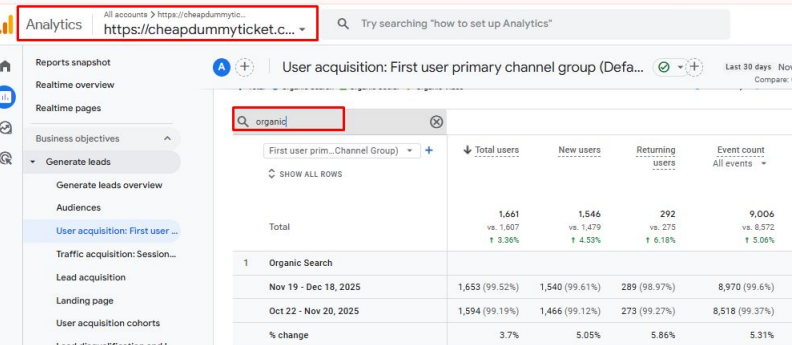
Google Analytics data confirmed this upward trend. Organic users increased to around 1,661 users in the latest period compared to about 1,594 users earlier. Both new users and returning users grew, along with event activity. This showed that our strategy improved not only rankings but also real user interaction and engagement.
Domain Authority and Visibility Expansion
Our Hyper-Intelligence SEO strategy strengthened cheapdummyticket.com at the domain level, not just page level.
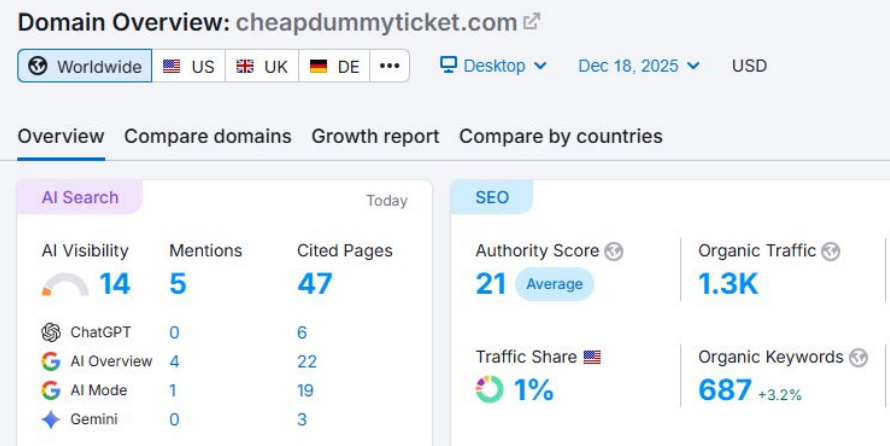
The site reached an Authority Score of 21, showing improved trust and credibility. Monthly organic traffic grew to around 1.3K visits, while organic keywords increased to 687, with +3.2% growth, proving continuous expansion.
The site captured about 1% traffic share in a competitive niche. It also gained visibility in Google AI Overview, along with other AI-driven platforms, showing that the brand started appearing in AI-generated search results and summaries.
This confirmed that our strategy improved authority, visibility, and long-term brand strength across both search engines and AI-powered discovery.
Backlink and Referring Domain Growth
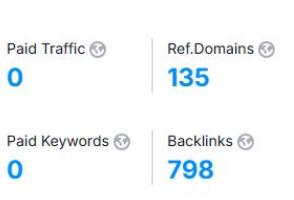
Off-page strength also improved steadily. Referring domains reached 135, and total backlinks grew to 798. The growth graphs showed a steady rise throughout the year, which means the site was gaining trust and authority consistently rather than through short-term spikes.
High-Intent Keyword Ranking Wins
Our intent-based strategy delivered strong ranking results on competitive keywords.
“dummy ticket qatar airways” reached around position #2.
“cheapest dummy ticket” reached around position #2.
“dummy ticket” reached around position #5.
“budget ticket fake or real” reached around position #7.
These are high-intent keywords, and ranking on the first page for them directly contributed to traffic and conversions.
Impact of Content Angle Strategy
By using strong content angles like “cheapest dummy ticket” and “dummy ticket qatar airways,” we matched exactly what users were searching for. Pages were built with the right content type, format, and angle, which helped them rank higher and attract more clicks. This success clearly showed how our Hyper-Intelligence SEO system understands both user intent and Google behavior.
Overall Outcome
Because of our Hyper-Intelligence SEO strategy, cheapdummyticket.com achieved:
- Around 40% growth in clicks in 6 months
- Over 102K increase in impressions
- Strong improvement in average ranking positions
- Steady growth in backlinks and referring domains
- First-page rankings for high-intent keywords
The site moved from decline into a phase of massive, stable, and intelligent SEO growth powered by ThatWare.
Why Hyper-Intelligence Worked for cheapdummyticket.com
Intent-First SEO Strategy
Our Hyper-Intelligence SEO approach started with understanding real user intent. Instead of focusing only on keywords, we focused on why users were searching. This helped us build pages that matched user expectations for price, speed, airlines, and trust. Because content aligned with what users truly wanted, engagement improved and rankings became more stable.
Adaptive SEO Instead of Static SEO
Traditional SEO follows fixed steps and slow updates. Our system learns from data continuously. When rankings moved, user behavior changed, or trends shifted, our strategy adapted automatically. This flexibility allowed cheapdummyticket.com to stay ahead instead of reacting late to changes.
Predictive Growth Model
With Hyper-Intelligence SEO, we did not wait for traffic to drop before acting. We used predictive signals from rankings, SERPs, and behavior data to forecast changes. This helped us optimize pages before problems appeared and capture new opportunities early.
Strong Search Intent Engineering
By using the 3C model of Content Type, Content Format, and Content Angle, we matched pages exactly with what Google and users expected. This reduced ranking volatility and increased click-through rates.
Data-Driven Learning Cycle
Every action created data. That data created learning. Learning created better strategy. This cycle made the system smarter over time. Pages that performed well taught the system what to repeat. Pages that failed taught it what to avoid.
Balanced Focus on Content and UX
We did not rely only on content or only on technical SEO. Our system improved content relevance, page speed, structure, and navigation together. This balance helped send strong quality signals to search engines.
Long-Term Stability Over Short-Term Wins
Our goal was not quick ranking spikes. It was stable growth. By building an evolving system instead of fixed tactics, cheapdummyticket.com achieved consistent and sustainable SEO growth powered by our Hyper-Intelligence SEO strategy.
Why ThatWare Wins When Others Fall Behind
Hyper-Intelligence as Our Operating System
At ThatWare, Hyper-Intelligence SEO is not just a method we apply occasionally. It is the core system that runs everything we do. Every campaign, every decision, and every optimization is guided by intelligence that observes data, learns from outcomes, predicts future behavior, and adapts automatically. Instead of treating SEO as a list of tasks, we treat it as a living system. This system connects rankings, traffic, behavior, and engagement into one learning cycle. As more data flows into it, the system becomes smarter. This is why our strategies do not become outdated quickly. They evolve as search engines, users, and markets change.
We Design Systems, Not Just Campaigns
Most agencies work in short campaigns. They plan, execute, report, and then start again. We do not work like that. We design long-term systems that continue learning and improving even after the first phase is complete. A campaign has an end. A system does not. When a page performs well, our system studies why. When something fails, it learns what to avoid. This means the next actions are always smarter than the previous ones. Over time, this creates compounding growth. Clients do not need to restart every few months. They move forward with an SEO engine that gets stronger with age.
Intent Intelligence at the Center
We do not see keywords as the final goal. We see search intent as the real target. Our research goes deeper than tools and numbers. We study why people search, what problems they are trying to solve, how urgent their need is, and what makes them trust a result. We analyze emotions like fear, urgency, budget concerns, and reliability. This allows us to design content that feels natural to users and logical to search engines. When a page truly satisfies intent, users stay longer, interact more, and convert better. Search engines see these signals and reward the page with stable rankings.
Predictive SEO, Not Reactive SEO
Most SEO only reacts after rankings fall. We do not wait for damage. Our system studies SERP changes, competitor movement, user behavior shifts, and engagement patterns to predict what might happen next. If we see early signs of change, we adjust before rankings drop. This protects strong pages and keeps growth stable. It also allows us to capture new opportunities early, before competition becomes too strong. This predictive ability is one of the biggest reasons our clients avoid sudden drops and enjoy steady progress.
Intelligence-Driven Content
We do not create content just to fill space. Every page has a job. Some pages attract users. Some convert them. Some support authority. Some strengthen topical depth. Content is planned like parts of a machine, not random articles. Each piece is built using intent, structure, flow, and logic. We think about how a user enters the site, what they see first, what questions they ask next, and where they should go after that. This makes content part of a growth system instead of isolated pages that fight alone.
Technical SEO with Purpose
We do not fix technical issues just to satisfy checklists. Every technical change must serve a purpose. If we improve speed, it is to reduce drop-offs. If we change structure, it is to improve crawl flow and user journey. If we optimize mobile, it is because most users are mobile-first. Technical SEO in our system supports both users and search engines. When experience becomes smooth, users stay longer, explore more, and trust the site more. These signals strengthen rankings naturally.
Human Strategy + Machine Learning
We do not believe in machines replacing humans. We believe in machines supporting human intelligence. Our experts decide direction, goals, priorities, and creative ideas. Machine learning then supports this by analyzing large data sets, finding patterns, and showing insights humans cannot see easily. This balance gives us both creativity and precision. Human thinking gives meaning. Machine intelligence gives scale.
Transparency and Logic
We do not hide behind complicated reports. We explain what we do, why we do it, and how it helps growth. Every action has a reason. Clients understand the journey, not just the results. This builds trust and long-term partnership.
Long-Term Growth Engine
We are not interested in fast tricks or risky shortcuts. We build systems that grow safely and steadily. Our clients do not see sudden spikes followed by crashes. They see consistent improvement. This is because their SEO is powered by intelligence, learning, and evolution. cheapdummyticket.com is a strong example of what happens when SEO is treated as an intelligent system instead of a checklist.
Conclusion
cheapdummyticket.com’s journey clearly shows what happens when SEO is driven by intelligence instead of guesswork. When the site came to us, it was facing declining traffic, unstable rankings, and weak intent alignment. Through our Hyper-Intelligence SEO framework, we rebuilt the entire system around learning, prediction, and adaptation. We did not just optimize pages. We built an evolving SEO engine that could understand users, respond to search engine behavior, and improve with every data point.
By focusing on search intent, user behavior, technical performance, and predictive strategy, we helped cheapdummyticket.com move from decline into massive and stable SEO growth. Traffic increased, visibility expanded, rankings stabilized, and authority strengthened. More importantly, the site became future-ready, able to adapt to changes instead of being damaged by them.
This case study proves that modern SEO is no longer about static checklists or one-time fixes. It is about building intelligent systems that think, learn, and evolve. That is what our Hyper-Intelligence SEO does. It turns SEO into a living system that grows stronger over time and delivers long-term results, not temporary wins.
If you want your brand to experience the same kind of intelligent growth, it is time to move beyond traditional SEO. Let us build a Hyper-Intelligence SEO system for you that learns, predicts, and grows with your business.Ready to grow smarter? Start your Hyper-Intelligence SEO journey with ThatWare today.