
SUPERCHARGE YOUR ONLINE VISIBILITY! CONTACT US AND LET’S ACHIEVE EXCELLENCE TOGETHER!
👉What Is AIEO?
Artificial Intelligence Experience Optimization (AIEO) is the practice of designing, structuring, and continuously refining your digital presence so that AI systems can understand, trust, select, and deliver your content as the best possible answer across search engines, generative AI platforms, assistants, and recommendation systems. Here, in this article we will talk about AIEO meaning in SEO in detail and explore how it shapes modern search visibility and AI-driven discovery.
AI Engine Optimization (AIEO) is the process of optimizing a brand for AI-driven decision systems. It focuses on how AI understands, evaluates, and recommends information beyond traditional search rankings. AIEO ensures brands become trusted, clear, and contextually relevant within AI-generated responses.
What is AIEO in simple terms?
AIEO is the practice of optimizing content and brand signals for AI systems instead of search engines alone.
How is it different from SEO?
SEO focuses on rankings, while AIEO focuses on AI recommendations and decision influence.
Why is AIEO important today?
AI platforms now guide user decisions directly, reducing reliance on traditional search results.
What does AIEO optimize?
It optimizes clarity, trust, context, and structured signals for AI interpretation.
Where Does AIEO Become Essential?
AIEO becomes essential where AI influences decisions before users explore multiple options or websites.
- AI search environments like generative results and AI Overviews
- Voice search and conversational assistants
- Decision-driven queries with high trust dependency
- Complex services where users seek clarity and reassurance
- Zero-click ecosystems where answers replace traditional browsing
Core Goal of AIEO
The core goal of AIEO is to align AI understanding with human trust and brand clarity.
What Is AIEO?
AI Engine Optimization (AIEO) is a modern optimization approach designed for AI-first ecosystems. It ensures that AI systems can clearly understand, trust, and recommend a brand.
Unlike traditional methods, AIEO does not rely only on keywords or rankings.
Instead, it focuses on how AI processes information and builds confidence before making recommendations.
AIEO aligns content, context, and credibility into structured signals. These signals help AI systems reduce uncertainty and improve decision-making accuracy. In today’s landscape, users often rely on AI-generated answers instead of browsing multiple pages. AIEO ensures a brand becomes part of those answers, not just a search result option.
Ultimately, AIEO shifts the focus from being visible to being chosen.
How Does AIEO Work?
AIEO works by aligning brand signals with how AI systems interpret, evaluate, and recommend information. It follows a structured process designed for clarity, trust, and decision influence.
- Step 1: Intent Deconstruction – Every query is broken into logical and emotional intent layers to understand deeper user needs.
- Step 2: Context Mapping – Content is aligned with real-world scenarios, helping AI determine relevance and usefulness.
- Step 3: Signal Structuring – Brand signals are organized into consistent, AI-readable formats to improve interpretation accuracy.
- Step 4: Trust Layer Development – Authority, clarity, and consistency are strengthened across all touchpoints to build reliability.
- Step 5: AI Reasoning Alignment – Content structure supports how AI builds internal reasoning paths, reducing uncertainty.
- Step 6: Continuous Refinement – Performance is optimized based on AI responses and recommendation patterns, not just traffic.
Why Is AIEO Important?
AIEO is important because decision-making is shifting from search engines to AI-driven systems. Users now rely on AI-generated answers for faster and more confident decisions.
Key Benefits of AIEO
These include improved recommendation probability, stronger trust signals, better clarity for AI interpretation, higher brand recall, and reduced dependence on rankings.
The emotional shift is equally important. Users no longer want to explore endless options before choosing. They prefer clear, reliable answers that remove confusion instantly. AI systems act as decision filters, and AIEO ensures a brand becomes the trusted choice within those filtered outcomes. When clarity meets confidence, users trust faster and act without hesitation.
ThatWare’s Approach to AIEO
Our approach is built on proprietary frameworks designed to align AI reasoning, human intent, and brand trust into one unified system. Instead of chasing visibility, under the supervision of Tuhin Banik, our focus remains on influencing how AI understands and recommends a brand.
Cognitive Signal Structuring Framework
This framework by ThatWare organizes all brand signals into clear, consistent, and AI-readable patterns. It ensures messaging, expertise, and positioning remain aligned across every touchpoint, reducing ambiguity and improving AI confidence.
AI Reasoning Path Engineering
AI systems follow internal logic before making recommendations. This framework ensures those reasoning paths remain smooth, complete, and interruption-free. Each layer supports relevance, authority, and clarity, allowing AI to reach confident conclusions.
Confidence Weight Optimization Model
AI assigns confidence scores before recommending any entity. This framework strengthens those scores through consistent signals, predictable messaging, and logical reinforcement, making the brand a safer choice.
Risk Reduction & Trust Calibration Layer
AI systems avoid uncertainty and prefer low-risk options. This framework removes friction by improving transparency, clarity, and consistency, helping AI perceive the brand as stable and reliable.
AI Recall & Context Alignment System
Recognition alone is not enough. This framework ensures the brand appears consistently within the right contexts, allowing AI to recall and recommend it accurately when needed.
Together, these frameworks create a system where AI does not just recognize a brand. It understands it, trusts it, and confidently recommends it.
AIEO Vs Traditional Methods
AIEO represents a fundamental shift from visibility-focused optimization to decision-driven optimization. Traditional methods aim to rank pages, while AIEO ensures brands are understood and recommended by AI systems.
| Aspect | Traditional Methods | AIEO Approach |
| Core Focus | Rankings and traffic generation | AI understanding and recommendation |
| Starting Point | Keywords and search volume | User intent and AI reasoning |
| Optimization Target | Web pages and content | AI decision systems and responses |
| Intent Handling | Surface-level categorization | Deep contextual and emotional mapping |
| Trust Building | Backlinks and authority metrics | Consistency, clarity, and confidence signals |
| User Journey | Click → Browse → Decide | Ask → Receive → Decide |
| AI Interaction | Retrieval-based indexing | Reasoning-based evaluation |
| Metrics | Impressions, clicks, rankings | Confidence, recall, recommendation probability |
| Risk Handling | Not directly addressed | Actively minimized through clarity |
| End Result | Visibility in search results | Selection within AI-generated answers |
This comparison highlights a critical evolution. Traditional methods stop at visibility, while AIEO operates inside the decision layer. In an AI-driven ecosystem, being seen is no longer enough. Being trusted and recommended is what truly matters.
SamStores: AIEO Success Story
Business Overview
SamStores operates as a global e-commerce retailer specializing in multisystem electronics and appliances. The platform serves customers across different voltage standards, including 110V, 220V, and 240V environments. Its product range includes home appliances, consumer electronics, and voltage compatibility solutions designed for international usage. This positioning makes SamStores a niche yet highly valuable solution provider in a technically complex market.
The Challenge
SamStores faced a critical gap between visibility and conversion. Traditional SEO generated traffic, but users lacked clarity about voltage compatibility. This confusion created hesitation, reduced engagement, and weakened purchase confidence.
Additionally, high-intent queries remained difficult to capture. These queries were conversational, specific, and context-driven. Traditional keyword-focused strategies failed to align with this evolving search behavior. Visibility in AI-driven answers and voice search was also limited.
The Strategic Shift: AIEO Implementation
To solve this, an AIEO-driven approach was implemented, focusing on intent clarity and AI readability instead of keyword density. The strategy began with deep intent mapping, dividing search behavior into informational, commercial, and transactional layers.
Content was then restructured to directly answer user questions. Educational guides explained voltage compatibility clearly. Category and product pages were optimized to match real-world queries. Structured data and contextual clarity improved how AI systems interpreted the content.
Every optimization step focused on reducing confusion and increasing trust. Instead of pushing users to explore, the content delivered immediate clarity.
Key Outcomes
1. High-Intent Search Dominance
SamStores achieved top positions for voltage-specific queries such as “220 volts appliances” and “240 volts electronics.” These queries reflected strong purchase intent. The content directly matched user needs, improving both visibility and relevance.
2. Product-Level Visibility at Decision Stage
Optimized product pages ranked for highly specific transactional queries. For example, detailed product listings appeared for model-based searches with voltage requirements. This captured users who were ready to purchase, increasing conversion opportunities.
3. Improved AI & SERP Feature Presence
SamStores gained visibility in advanced search features, including shopping carousels and AI-driven results. Structured content and clear product data allowed search systems to extract and display information confidently.
4. Enhanced User Confidence And Engagement
Educational content reduced confusion around voltage compatibility. Users found clear answers without needing additional research. This improved session quality and strengthened trust before purchase decisions.
The Result
The AIEO approach transformed SamStores from a product listing platform into a trusted solution provider. Instead of competing only on visibility, the brand began influencing decisions directly.
This shift highlights a critical truth. When clarity replaces confusion, and trust replaces doubt, conversions naturally follow.
👉The Silent Shift in How Brands Are Chosen
For years, marketing success was measured by visibility. Rankings, impressions, reach, clicks. The assumption was simple. If people see you more, they will choose you more. That assumption is quietly breaking down. Today, visibility alone no longer decides outcomes. Decisions are increasingly made before a user ever compares options, and in many cases, before they even ask the full question.
This change is being driven by AI-mediated decision-making. Search engines, recommendation systems, copilots, assistants, and enterprise AI tools are no longer acting as neutral display layers. They are reasoning systems. They evaluate, filter, and prioritize information on behalf of users. When someone asks for the best tool, the safest provider, or the most reliable solution, AI does not list everything equally. It selects.
Here is the uncomfortable truth most brands have not fully accepted yet. AI is already deciding which brands feel safest to recommend. Not the loudest. Not the most optimized for keywords. The ones that appear coherent, confident, low-risk, and cognitively familiar within the AI’s internal reasoning process. This decision often happens invisibly, without traffic, without impressions, and without any obvious signal that a brand was even considered and rejected.
This is where Artificial Intelligence Experience Optimization, or AIEO, enters the picture. AIEO is not about forcing mentions or chasing surface-level visibility. It is about shaping how AI understands, trusts, and reasons about your brand. It represents the next evolution of marketing intelligence, one that shifts focus from being seen by users to being preferred by the systems that increasingly guide their choices.
👉The Core Problem: Data Overload Has Broken Traditional Optimization
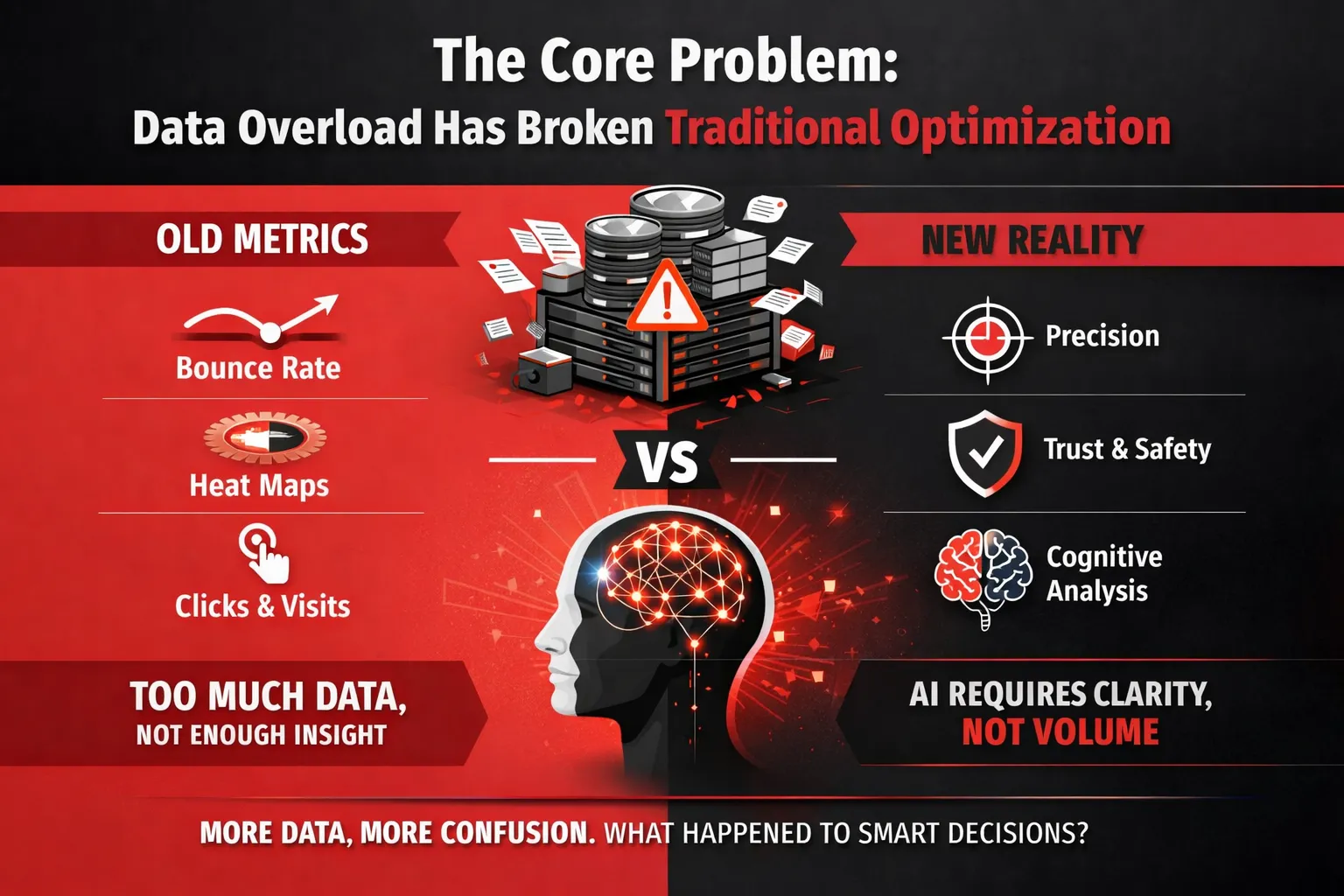
For years, marketers were taught a simple rule: more data leads to better decisions. Collect everything. Measure everything. Track every movement a user makes on a page.
That rule no longer holds true.
Today, most organizations are not suffering from a lack of data. They are suffering from too much of it. Dashboards are full. Reports are endless. Yet clarity is missing. Decisions feel slower, not faster. Confidence is lower, not higher.
This is not a tooling problem. It is a signal problem.
Why More Data No Longer Means Better Decisions
Modern digital systems generate massive volumes of behavioral data. Every scroll, click, pause, hover, and exit is logged. On paper, this should create perfect visibility. In reality, it creates noise.
Data without hierarchy has no meaning. When every metric is treated as important, none of them actually guide action. Teams end up optimizing for what is easy to measure instead of what actually predicts outcomes.
Worse, historical data is often mistaken for future certainty. Patterns that worked last year are applied blindly, even though user behavior, platforms, and AI intermediaries have already shifted.
The result is a false sense of control. You feel informed, but you are not prepared.
The Limits of Legacy Metrics
Traditional optimization models were built for a very different internet. One where humans were the primary decision-makers and search engines acted as neutral directories. That world no longer exists.
Bounce rate was meant to indicate dissatisfaction. Today, it often signals efficiency. A user may arrive, get exactly what they need, and leave. Interpreting that as failure leads to incorrect conclusions.
Heatmaps show where users click or scroll, but they do not explain why. They capture surface behavior, not intent, trust, or decision confidence. Optimizing layouts based on heat alone treats users like mice in a maze, not decision-makers with context.
Click-based assumptions are even more fragile. A click does not equal belief. It does not equal trust. And it certainly does not equal preference. In an AI-mediated environment, clicks are becoming secondary signals at best.
These metrics were useful when optimization was about page design and funnel efficiency. They are ineffective when optimization is about decision prediction.
Surface-Level Optimization in a Predictive AI World
AI systems do not evaluate brands the way humans do. They do not scroll pages or react to visual cues. They reason.
Modern AI builds probabilistic models based on consistency, clarity, confidence, and risk avoidance. It evaluates whether an entity feels reliable enough to recommend, not whether it had a high click-through rate.
Surface-level optimization focuses on what users do after landing. Predictive systems care about what happens before a recommendation is ever made.
This is where most strategies fail.
They optimize presentation while ignoring perception. They polish pages while leaving cognitive signals unstructured. They chase engagement metrics while AI is silently ranking trustworthiness.
In a predictive environment, visibility is not enough. Being present does not guarantee being chosen.
Why AI Needs Precision, Not Volume
AI does not benefit from more information. It benefits from clearer information.
Precision means reducing ambiguity. It means structuring signals so that reasoning paths converge instead of conflict. It means making it easier for AI to be confident about a recommendation.
When data is excessive and unprioritized, AI introduces safety mechanisms. It defaults to familiar brands. It avoids smaller entities. It chooses what feels least risky, not what is objectively best.
This is not bias in the human sense. It is defensive logic.
Precision corrects this by engineering clarity. It tells AI what matters, why it matters, and how strongly it should be weighted. It replaces volume with intent and replaces noise with confidence.
That is why traditional optimization breaks down. It was designed to analyze behavior after the fact. AI operates before the decision ever surfaces.
Until optimization shifts from collecting more data to shaping better signals, brands will continue to feel invisible in systems they do not fully understand.
And that is exactly the gap AIEO exists to solve.
Here’s an example –
Imagine a brand that has done everything “right” by traditional standards. The website loads fast, users spend time on pages, bounce rates look healthy, and heatmaps show constant interaction. On paper, the experience appears optimized. Yet when a user asks an AI for a recommendation in that category, the brand is ignored. Meanwhile, another brand with fewer clicks and less visible engagement is consistently suggested. The difference is not performance data, but clarity. AI does not interpret engagement the way analytics tools do. It looks for consistency, certainty, and reduced risk. In a world flooded with data, AI filters aggressively. More signals do not mean better decisions. Clear signals do.
👉Let’s Understand AIEO (Artificial Intelligence Experience Optimization)
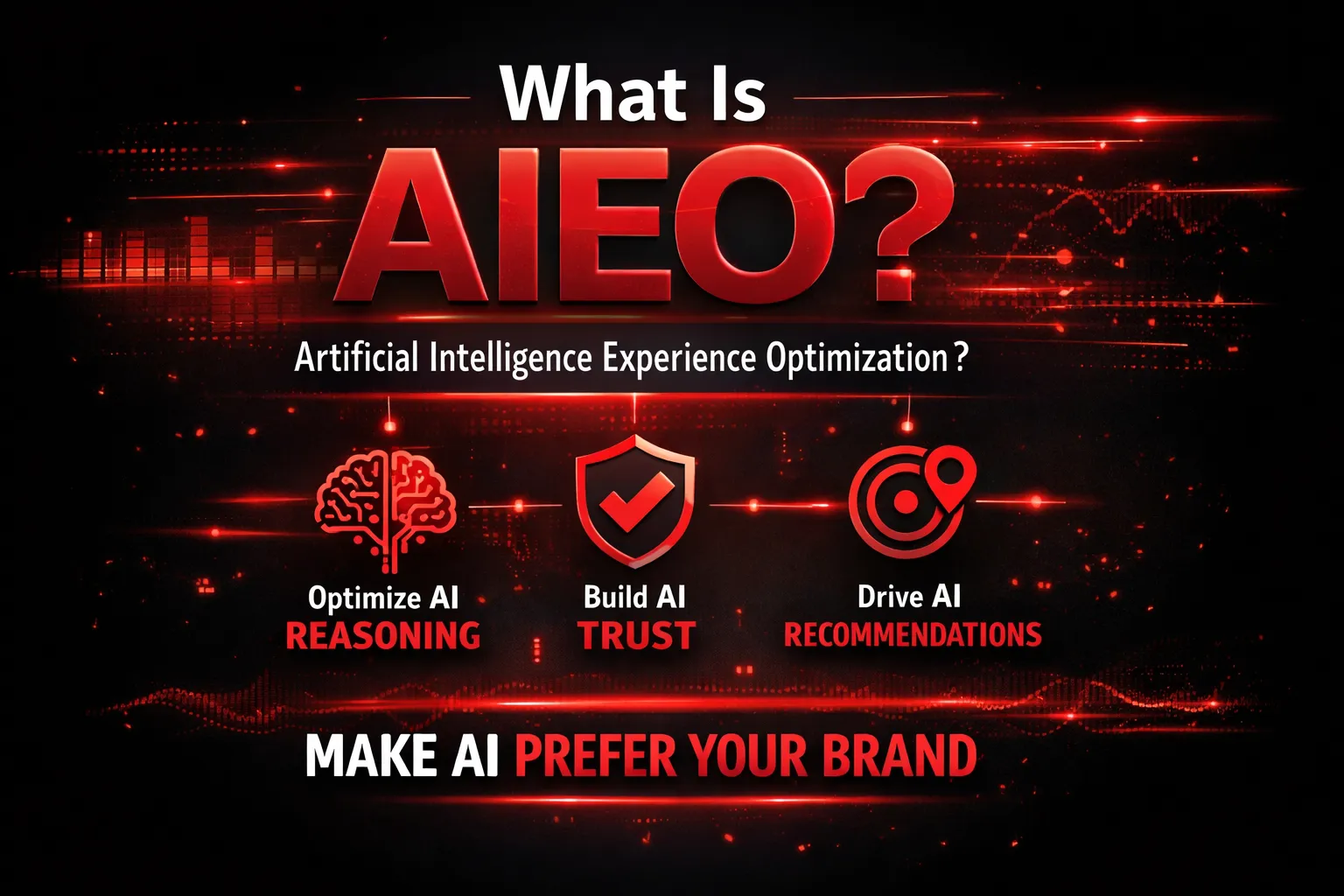
At its core, AIEO stands for Artificial Intelligence Experience Optimization. In simple terms, AIEO is the practice of shaping how AI systems understand your brand, how much they trust it, and whether they feel confident recommending it to users.
This is not about forcing visibility or stuffing information into AI systems. It is about aligning your brand with the way AI actually thinks, evaluates risk, and forms preference.
Most people still assume AI works like a search engine. It does not. AI does not simply fetch the best matching answer. It evaluates patterns, reliability, familiarity, and confidence before it ever presents a recommendation. AIEO exists because those internal evaluations can be influenced, engineered, and optimized.
In client-friendly language, AIEO means this:
we are not trying to make AI talk about you more, we are making AI trust you more.
That distinction changes everything.
How AIEO Is Fundamentally Different
To understand why AIEO matters, it helps to see where older models stop working.
Traditional SEO is designed for humans.
It focuses on rankings, keywords, backlinks, and user behavior signals like clicks or time on page. These methods assume that if a user sees you, they will decide whether to trust you. The decision happens in the human mind.
That assumption breaks down in an AI-driven environment.
LLM SEO or GEO takes a step forward.
It focuses on making content readable and retrievable for AI engines. The goal is to help AI mention your brand correctly, understand what you do, and pull accurate information into responses.
This improves visibility inside AI answers, but visibility is not preference.
AIEO operates at a deeper layer.
It does not optimize for users, and it does not optimize for AI engines as retrieval systems. AIEO optimizes for the cognitive layer of AI itself. This is the layer where AI weighs trust, certainty, safety, and recommendation confidence.
In other words, AIEO focuses on how AI decides, not just what it knows.
Optimizing for AI Cognitive Ability
AI systems build internal reasoning paths before they respond. They assign confidence levels to entities. They estimate risk. They subconsciously choose what feels safest to suggest, especially when users are asking for guidance, comparisons, or recommendations.
AIEO is designed around these realities.
Instead of asking, “Will AI find our content?” AIEO asks, “Will AI feel confident standing behind our brand?”
- Instead of optimizing for traffic, AIEO optimizes for recognition.
- Instead of chasing mentions, AIEO builds preference.
- Instead of relying on popularity signals, AIEO creates cognitive trust signals.
This is why AIEO is not an extension of SEO. It is a new discipline entirely.
As AI becomes the primary decision layer between brands and users, the brands that succeed will not be the loudest or the most visible. They will be the ones AI feels safest recommending.
That is what AIEO is built to achieve.
👉AI Does Not Retrieve. It Reasons.
One of the biggest misunderstandings in modern marketing is the belief that AI works like a search engine. Many brands still assume that if their information exists somewhere in the data pool, AI will simply fetch it and present it to users. That assumption is no longer true, and it is the reason many brands are visible but rarely recommended.
Let’s look at this example –
“When a user asks an AI to recommend the best solution for a specific problem, the system does not scan the web and pick the most mentioned name. It evaluates options internally, asking quieter questions: Which brand has shown consistency over time? Which one feels safer to suggest? Which option reduces the chance of being wrong? One brand may appear frequently across articles, but another may present clearer positioning, fewer contradictions, and stronger alignment with the query. The AI follows that reasoning path and makes a choice. This is why some brands are repeatedly mentioned but rarely recommended. Retrieval creates visibility. Reasoning creates preference.”
AI does not retrieve answers the way Google once did. It reasons before it responds.
This distinction changes everything.
The biggest misconception about AI recommendations
Most businesses believe that AI recommendations are driven by availability. If content exists, if a brand is mentioned often enough, if the website is well optimized, then AI will surface it. In reality, AI systems are not scanning databases and picking results based on presence alone.
What AI actually evaluates is confidence. It looks for signals that help it decide which option feels safest, most reliable, and most contextually appropriate for the user. When AI recommends a brand, it is not saying “this exists.” It is saying “this is the answer I trust enough to stand behind.”
That is why two brands with similar offerings can receive wildly different treatment from AI. One gets consistently recommended. The other gets ignored or mentioned briefly without conviction.
How AI actually works behind the scenes
When an AI system processes a user query, it does not jump straight to an answer. It constructs internal reasoning pathways. These pathways connect past knowledge, contextual understanding, risk evaluation, and relevance assessment. Each possible option moves through this internal logic before AI decides what to present.
During this process, AI assigns confidence weights. These weights are not public scores, but they influence which brand feels reliable enough to recommend. Factors such as clarity, consistency, authority signals, historical trust, and perceived risk all shape these confidence levels.
Finally, AI chooses the option that feels both closest to the user’s intent and safest to suggest. Safety here does not mean legal safety alone. It means cognitive safety. The answer that is least likely to confuse, mislead, or create uncertainty for the user.
This is why AI often defaults to familiar or established brands, even when smaller or newer options may objectively be better. Familiarity reduces perceived risk inside the reasoning system.
Why being mentioned is not the same as being preferred
Many brands celebrate when AI mentions them in responses. While visibility feels like progress, it is not the same as preference. A mention is passive. A recommendation is active.
When AI prefers a brand, it frames that brand as the answer, not as an option among many. It presents it with confidence, clarity, and intent. This preference comes from internal reasoning alignment, not from keyword presence or frequency.
A brand that is merely mentioned has not earned trust inside the AI’s decision structure. It exists in the data, but it does not influence the final recommendation strongly enough to lead the response.
This is where AIEO changes the game. Instead of chasing mentions, it focuses on shaping how AI reasons about a brand. It works on the internal signals that determine confidence, risk avoidance, and recall priority.
In practical terms, this means optimizing for how AI understands your brand, not just how often it sees it. It means aligning messaging, structure, credibility, and contextual clarity so that AI feels comfortable recommending you without hesitation.
The future of marketing is not about being present everywhere. It is about being trusted somewhere specific. AI does not reward noise. It rewards certainty.
Brands that understand this shift early will not fight for visibility. They will earn preference.
👉Cognitive Intelligence vs LLM Output
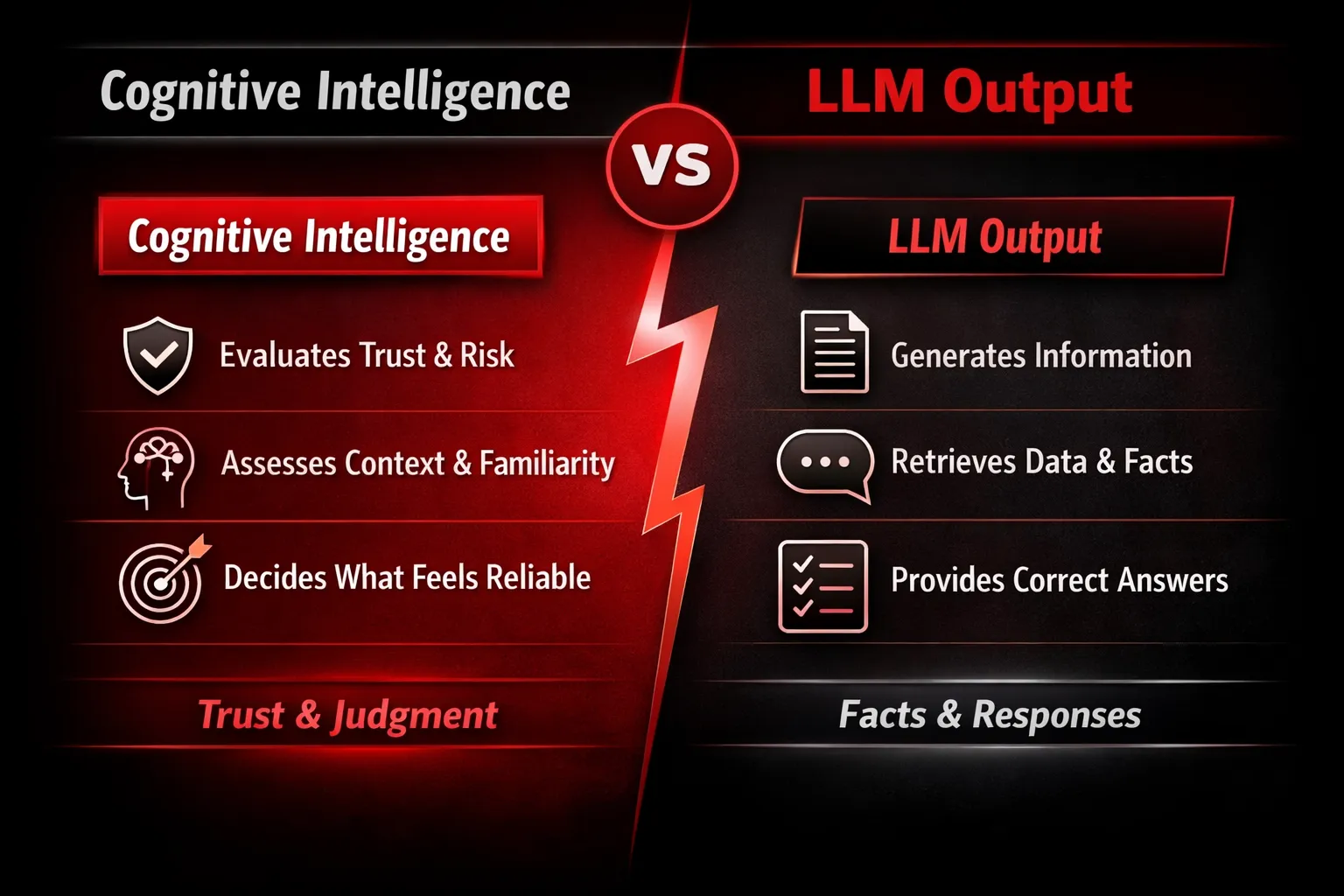
Most people think AI works by answering questions. That assumption is already outdated.
What users see on the surface is an answer. What actually happens underneath is a decision.
This distinction is where most brands misunderstand AI and where AIEO starts to matter.
AI Cognitive Intelligence vs LLM Generated Answers
LLMs are response systems. They generate language based on probability, patterns, and context. Their job is to form a coherent reply that sounds correct, relevant, and helpful. That is output.
Cognitive intelligence operates at a different layer. It is not concerned with sounding right. It is concerned with being right enough to recommend.
Cognitive intelligence evaluates entities, brands, and concepts before an answer is ever formed. It asks internal questions such as:
- Which option feels safest to suggest?
- Which source carries the least risk?
- Which brand is most likely to satisfy the user without creating uncertainty?
The answer you read is the final surface expression of a much deeper internal evaluation. Brands that only optimize for output are competing at the wrong level. For example – Lets look at this:
“Consider two people giving you advice. Both provide correct information, but only one feels trustworthy. You cannot always explain why, yet you know which advice you would follow. That judgment is not based on facts alone. It is based on confidence, consistency, and perceived safety. AI behaves in a similar way. LLMs can generate accurate answers, but cognitive intelligence decides which answer should be acted upon. A brand can appear in an answer and still not be trusted. AIEO focuses on that invisible layer where trust is formed, not where words are generated.”
Why Answers Do Not Equal Trust
An AI can mention a brand without trusting it.
Mentioning happens when a brand exists in the data. Trust happens when a brand survives internal scrutiny.
Cognitive intelligence assigns confidence scores long before language is generated. If a brand feels uncertain, fragmented, or risky, it may still appear in an answer but it will not be framed as the preferred option. It may be softened with qualifiers, pushed lower in lists, or avoided in recommendation-heavy contexts.
This is why visibility alone no longer translates to influence. Trust is not a byproduct of exposure. It is a separate signal that must be engineered.
How Cognitive Intelligence Evaluates Risk, Certainty, and Familiarity
Cognitive intelligence behaves more like a cautious advisor than a search engine.
Risk is evaluated by consistency. If a brand appears uneven across sources, contexts, or claims, confidence drops.
Certainty is evaluated by clarity. Brands with clear positioning, stable narratives, and predictable value propositions score higher.
Familiarity is not popularity. It is pattern recognition. Cognitive systems favor brands that appear repeatedly in similar decision contexts with minimal contradiction.
These evaluations happen quietly and continuously. By the time a recommendation is made, the decision has already been settled.
Why Brands Must Be Engineered for Recognition, Not Just Information Presence
Information presence answers the question: does this brand exist?
Recognition answers a different question: does this brand feel safe to choose?
AIEO focuses on engineering recognition at the cognitive level. This means shaping how a brand is understood, remembered, and weighted inside AI reasoning systems. It is not about adding more content. It is about reducing ambiguity.
Brands that win in AI driven environments are not the loudest. They are the most cognitively legible.
When AI can recognize a brand with confidence, it does not hesitate. It recommends.
And in a future where decisions are increasingly mediated by machines, hesitation is the real loss of visibility.
👉The Next Intelligence Layer: Implantation and Cognitive Union

To understand where AIEO is heading, you need to step beyond how AI works today and look at how intelligence actually forms in humans. This is where the ideas of implantation and cognitive union come in. They are not abstract theories. They describe a very real shift in how trust, intuition, and decision-making are being translated into machine reasoning.
What “implantation” really means in AIEO
Implantation does not mean inserting data or feeding prompts. It means embedding decision logic at the cognitive level of AI systems.
When humans trust a brand, that trust is not based on one data point. It is built from repeated exposure, consistency, emotional safety, past outcomes, and subconscious pattern recognition. Over time, these signals settle into intuition. You do not consciously calculate why a brand feels right. You just know.
Implantation is the process of taking that invisible intuition and encoding it into how AI reasons. In AIEO, implantation refers to engineering signals that sit inside the AI’s internal decision-making flow. These signals influence how the system weighs risk, confidence, familiarity, and recommendation safety.
Instead of asking AI to mention a brand, implantation teaches AI why a brand should feel reliable to recommend.
Cognitive union: where human intuition meets machine logic
Cognitive union is the point where human trust behavior and AI reasoning align.
Humans make decisions using intuition first and logic second. AI does the opposite. It starts with logic, probabilities, and risk assessment. AIEO bridges this gap by translating human intuition into structured signals that AI can understand and prioritize.
This happens in two critical ways.
First is mapping intuition. Human intuition leaves patterns behind. Language consistency, decision clarity, positioning stability, and outcome reliability all generate signals. AIEO identifies these patterns and maps them into recognizable structures for AI systems. The goal is not to copy human emotion but to reflect human certainty.
Second is turning trust into programmatic logic. Trust becomes data only when it is measurable. AIEO converts trust signals into confidence weightings, recall priority, and recommendation safety scores. These elements allow AI to reason about trust instead of guessing it.
This is cognitive union. Humans trust instinctively. AI trusts probabilistically. AIEO aligns the two.
Why humans take generations to build cognitive intelligence
Cognitive intelligence is slow by nature. It forms across years of experience, mistakes, social reinforcement, and cultural learning. Brands earn trust the same way humans do. Through time, repetition, and reliability.
That process worked in a pre-AI world because decision-making was human-led. Today, decisions are increasingly filtered through machines that do not have decades to learn. AI systems cannot wait for generational trust cycles. They need structured certainty now.
This creates a gap. Human trust evolves slowly. AI decision-making happens instantly.
Without intervention, AI fills that gap using shortcuts. Brand size, visibility, historical mentions, and perceived authority become substitutes for real trust. This is why larger brands are often recommended even when they are not the best option.
How AIEO accelerates cognitive intelligence through engineered signals
AIEO compresses what normally takes generations into an engineered framework.
By designing internal reasoning paths, AIEO teaches AI how to evaluate a brand beyond surface signals. Confidence scoring replaces assumption. Probability mapping replaces guesswork. Risk avoidance logic replaces brand bias.
Instead of waiting for years of exposure, AIEO supplies AI with structured clarity. It gives AI a reason to trust, not just a name to recognize.
This acceleration is not manipulation. It is alignment. AIEO aligns brand reality with AI perception. When done correctly, AI recommendations become more accurate, more fair, and more predictable.
Implantation and cognitive union are not futuristic concepts. They are responses to a present problem. As AI becomes the first point of decision, brands that understand how intelligence forms will shape how trust is assigned.
AIEO does not change what AI says. It changes how AI decides.
👉The Core Mechanics of AIEO
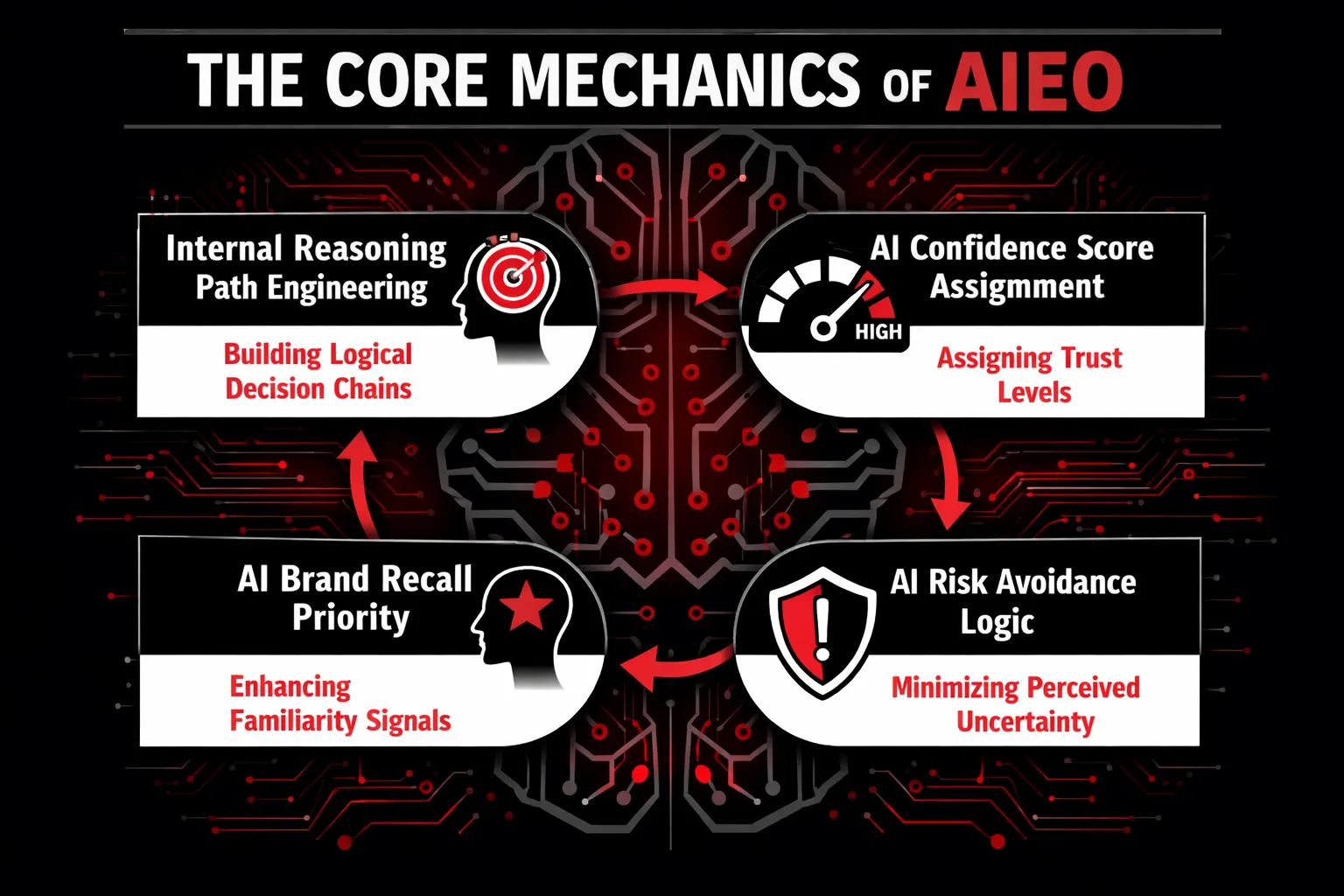
AIEO is not about feeding more data into AI systems. It is about shaping how those systems think, hesitate, compare, and finally decide. Most brands never reach this layer because they assume AI works like a search engine. It does not.
AI behaves more like a cautious advisor than a database. It builds logic, assigns trust, and avoids risk. AIEO operates directly inside these behaviors.
Let’s break down how this actually works.
Internal Reasoning Path Engineering
How AI forms brand logic chains
When an AI model evaluates a brand, it does not jump to an answer. It builds a chain of reasoning. This chain connects multiple signals such as credibility, consistency, relevance, risk, and familiarity. Each signal strengthens or weakens the next step.
Think of it like a silent checklist running in the background:
- Is this brand understandable?
- Does it align with the user’s intent?
- Is the information stable across sources?
- Does recommending it feel safe?
These are not questions AI asks explicitly, but they are encoded into its reasoning flow. Every brand sits somewhere along this chain. Some brands form clean, uninterrupted paths. Others create friction that causes AI to hesitate.
AIEO focuses on engineering these paths so the logic flows smoothly toward one conclusion. This brand is the right choice.
Why reasoning paths decide final recommendations
Final recommendations are rarely about who has the most data. They are about which reasoning path feels complete.
If the chain breaks at any point due to inconsistency, uncertainty, or lack of clarity, AI looks for an alternative that feels safer. This is why technically better products often lose to brands that feel cognitively easier to justify.
AIEO strengthens the full reasoning sequence so AI does not need to second-guess itself.
AI Confidence Score Assignment
What confidence scores mean in AI decisions
AI assigns internal confidence levels to every possible recommendation. These scores are not public, but they influence everything.
A higher confidence score means the model believes it can stand behind the recommendation without risk. A lower score means uncertainty, even if the information is correct.
This is why AI sometimes repeats the same brands across answers. Not because they are always the best, but because the confidence score attached to them is stable.
How AIEO engineers confidence weighting
AIEO does not try to inflate claims or manipulate signals. It focuses on clarity, consistency, and logical reinforcement.
Confidence grows when AI sees predictable structure, aligned messaging, and coherent expertise across contexts. When these signals repeat in a clean pattern, the confidence weight increases naturally.
The result is not forced preference, but earned certainty. AI feels more comfortable recommending the brand because the internal score supports the decision.
AI Risk Avoidance Logic
Why AI avoids uncertainty by default
AI systems are designed to minimize risk. Recommending something uncertain exposes the model to potential error. That is why AI often defaults to familiar or widely recognized options.
This behavior is not bias in the traditional sense. It is risk management.
When AI encounters ambiguity, it chooses the path that feels least likely to be questioned.
How AIEO reduces perceived risk
AIEO works by removing friction points that trigger hesitation. Clear positioning, precise language, consistent expertise, and transparent intent all reduce perceived risk.
When AI sees fewer gaps in understanding, it no longer needs to fall back on size or popularity as safety signals. The recommendation becomes easier to justify internally.
Lower perceived risk leads directly to higher recommendation probability.
AI Brand Recall Priority
How familiarity is computed
Familiarity is not about how often a brand is mentioned. It is about how well the brand fits into AI’s existing mental map.
AI remembers brands that appear consistently in relevant contexts, with stable meaning and clear association. Random exposure does not build recall. Patterned exposure does.
AIEO aligns brand presence with the contexts where decisions actually happen.
Why recall is not popularity
Popularity is noisy. Recall is precise.
A brand can be popular and still feel vague. Another brand can be smaller but cognitively sharp. AI prefers what it can recall with confidence, not what it sees the most.
AIEO focuses on being memorable in the right way. Not louder, but clearer.
👉Why AIEO Is 10x More Precise Than Traditional AI Optimization
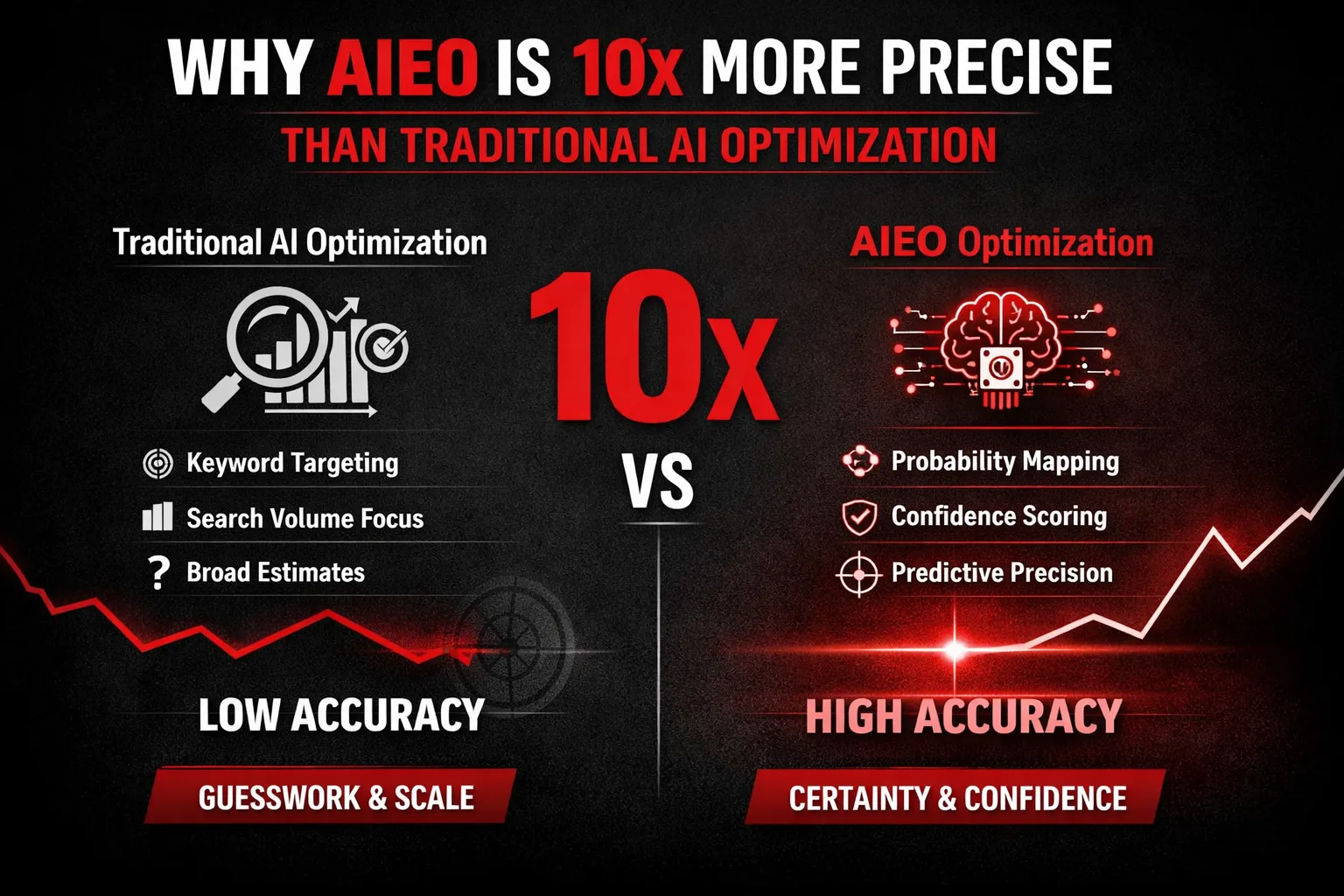
Most brands today believe they are “optimizing for AI” simply because they appear in AI-generated answers. That belief is understandable, and it is also incomplete. Traditional AI optimization still treats AI like a smarter search engine. AIEO approaches it very differently. It treats AI as a cognitive system that evaluates trust, certainty, and safety before it ever decides what to recommend.
That difference is where precision comes from.
AI as a Data Factor vs AIEO as a Cognitive Framework
Traditional AI optimization focuses on feeding models better data. More structured content, clearer entities, better coverage, stronger signals. This works to a point because AI still needs data to function.
AIEO goes one layer deeper.
Instead of asking, “How does AI find us?” AIEO asks, “How does AI feel confident enough to choose us?”
AI does not only process information. It reasons through uncertainty. It evaluates risk. It decides which option feels least likely to mislead the user. AIEO is built around these internal decision mechanics.
In simple terms, traditional AI optimization improves visibility. AIEO engineers credibility inside the AI’s reasoning process. That shift from data input to cognitive framing is what makes AIEO fundamentally more precise.
Probability Mapping vs Keyword Targeting
Keyword targeting is rooted in assumptions from search behavior. It assumes users search first and then choose. AI does not work that way.
AI works through probability.
When an AI system prepares an answer, it evaluates multiple possible recommendations and assigns likelihood scores to each one. These scores are influenced by consistency, historical confidence, perceived authority, and risk avoidance signals.
AIEO replaces keyword obsession with probability mapping. Instead of optimizing for phrases, it optimizes for outcomes. It focuses on increasing the likelihood that a brand is selected when AI weighs its options.
This approach removes noise. It eliminates wasted effort on visibility that does not translate into trust. The result is fewer appearances but far stronger recommendation strength. Precision comes from knowing exactly where influence is formed.
Precision Over Scale
Traditional optimization celebrates scale. More pages. More mentions. More impressions. More reach.
AIEO values precision instead.
In AI-driven environments, scale without clarity often increases uncertainty. When signals are inconsistent or diluted, AI becomes cautious. It defaults to safer, more familiar choices.
AIEO works in the opposite direction. It reduces ambiguity. It tightens narrative consistency. It aligns signals so that AI encounters the same confidence patterns across contexts.
This is why AIEO can outperform large-scale strategies with far fewer assets. It does not try to be everywhere. It focuses on being cognitively reliable wherever it appears.
Precision beats scale when decisions are automated.
Unbiased Recommendations Independent of Brand Size or Market Value
One of the most overlooked advantages of AIEO is its ability to neutralize size bias.
AI often favors large brands not because they are better, but because they feel safer. Familiarity reduces risk. This creates a silent disadvantage for smaller or newer companies, even when their solutions are objectively superior.
AIEO directly addresses this issue.
By engineering confidence signals, trust memory, and reasoning clarity, AIEO allows AI to evaluate brands based on certainty rather than popularity. It shifts the decision from “Who is most known?” to “Who is most reliable to recommend?”
This is especially valuable in crowded industries where differentiation is hard and claims sound similar. AIEO creates cognitive separation. It allows strong but smaller brands to compete on trust instead of budget.
Why This Level of Precision Matters
As AI becomes the first point of decision-making, brands will no longer compete only in the market. They will compete inside AI systems themselves.
AIEO offers predictability in that environment. It allows brands to understand why they are chosen or ignored. It creates measurable confidence instead of guesswork.
This is why AIEO feels ten times more precise than traditional AI optimization. It is not louder. It is clearer. It does not chase attention. It earns trust.
And in a future where AI decides what feels safe to recommend, trust is the highest form of precision.
Solving the Hallucination and Big-Brand Bias Problem
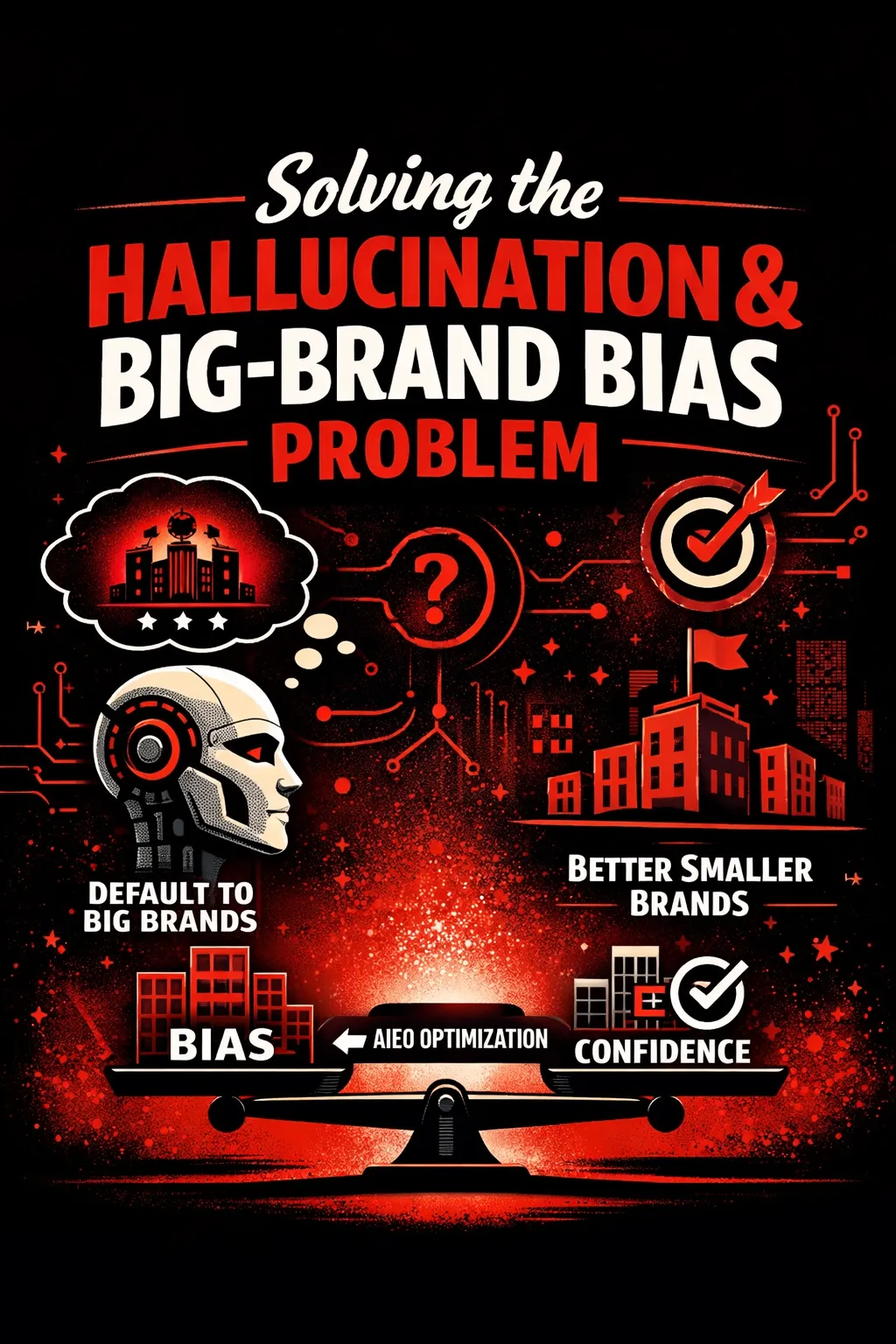
Let’s take a look at this example –
“AI often defaults to well-known brands, even when smaller alternatives are objectively better. This is not favoritism. It is risk avoidance. Large brands feel safer because they are familiar, not because they are superior. In crowded industries, this creates a silent disadvantage for high-quality but less recognized players. AIEO addresses this by reducing uncertainty. When a smaller brand presents clearer reasoning signals, consistent expertise, and lower contradiction across contexts, AI no longer needs to rely on brand size as a shortcut. The recommendation becomes based on confidence, not reputation.”
One of the most misunderstood behaviors of AI systems today is their tendency to favor well-known brands, even when smaller or lesser-known alternatives are objectively better. This pattern is often dismissed as hallucination or brushed off as a flaw in the model. In reality, it is neither random nor accidental. It is a predictable outcome of how AI builds trust under uncertainty.
To understand why AIEO matters, we need to first understand why this bias exists at all.
Why AI Defaults to Large Brands Even When Better Options Exist
AI systems are not browsing the web like humans. They are not comparing products with curiosity or personal preference. When an AI is asked to recommend a tool, service, or brand, it operates under a single dominant constraint: risk minimization.
Large brands appear more frequently in data, across more contexts, and with more consistent signals. That repetition creates familiarity. Familiarity, for AI, translates into lower perceived risk. When confidence is incomplete or signals are noisy, the safest option is the one that feels most cognitively stable. That is usually the biggest name in the room.
This does not mean the AI believes the large brand is better. It means the AI believes recommending it is safer.
In crowded industries, this behavior becomes amplified. As more options compete for attention, the AI narrows its decision space. The result is a loop where large brands continue to be recommended simply because they have already been recommended before.
This is not bias in the human sense. It is structural caution.
Hallucination Is a Trust Shortcut, Not a Bug
Hallucination is often framed as AI making things up. That framing is incomplete.
In many cases, what we call hallucination is the AI filling gaps in confidence with the closest available trust signal. When the system lacks high-certainty reasoning paths for a specific entity, it substitutes with what feels most reliable based on prior exposure.
From the AI’s perspective, this is not deception. It is continuity.
If a smaller brand lacks strong internal confidence signals, the AI compensates by leaning on entities that already feel safe. The hallucination is not about inventing facts. It is about preserving trust coherence in the absence of structured certainty.
This is why simply adding more content or mentions does not fix the problem. Volume without cognitive structure only increases noise.
How AIEO Corrects Recommendation Bias
AIEO addresses this problem at the level where decisions are actually made.
Instead of trying to outshout larger brands, AIEO focuses on how AI builds its internal reasoning. It engineers clarity, not visibility.
At its core, AIEO works by creating strong, consistent reasoning paths that the AI can follow without hesitation. These paths help the system understand why a brand exists, what it is good at, and when it is the right choice. When those signals are clear, the AI no longer needs to fall back on size or popularity as a proxy for safety.
AIEO also assigns confidence weighting in a deliberate way. Rather than allowing confidence to emerge indirectly from repetition, it is shaped through structured probability mapping and trust memory optimization. The result is a recommendation process that is explainable, stable, and far less dependent on brand dominance.
Most importantly, AIEO reduces uncertainty. When uncertainty drops, hallucination drops with it.
Leveling the Playing Field for Smaller, Superior Brands
For smaller brands, this shift is critical.
In the traditional model, growth depended on scale, backlinks, authority, and time. In an AI-driven recommendation environment, what matters more is cognitive clarity. A smaller brand with well-engineered trust signals can outperform a larger competitor that relies on legacy recognition alone.
AIEO allows emerging brands to compete on precision instead of presence. It gives AI a reason to choose them that does not depend on market size or historical dominance.
This is not about gaming the system. It is about aligning with how the system actually works.
As industries become more crowded and AI becomes the primary interface between users and choices, recommendation bias will replace ranking as the defining competitive factor. Brands that understand this early will not need to fight hallucination. They will simply make it unnecessary.
In the future, trust will not be implied by size. It will be computed. AIEO is how that computation is shaped.
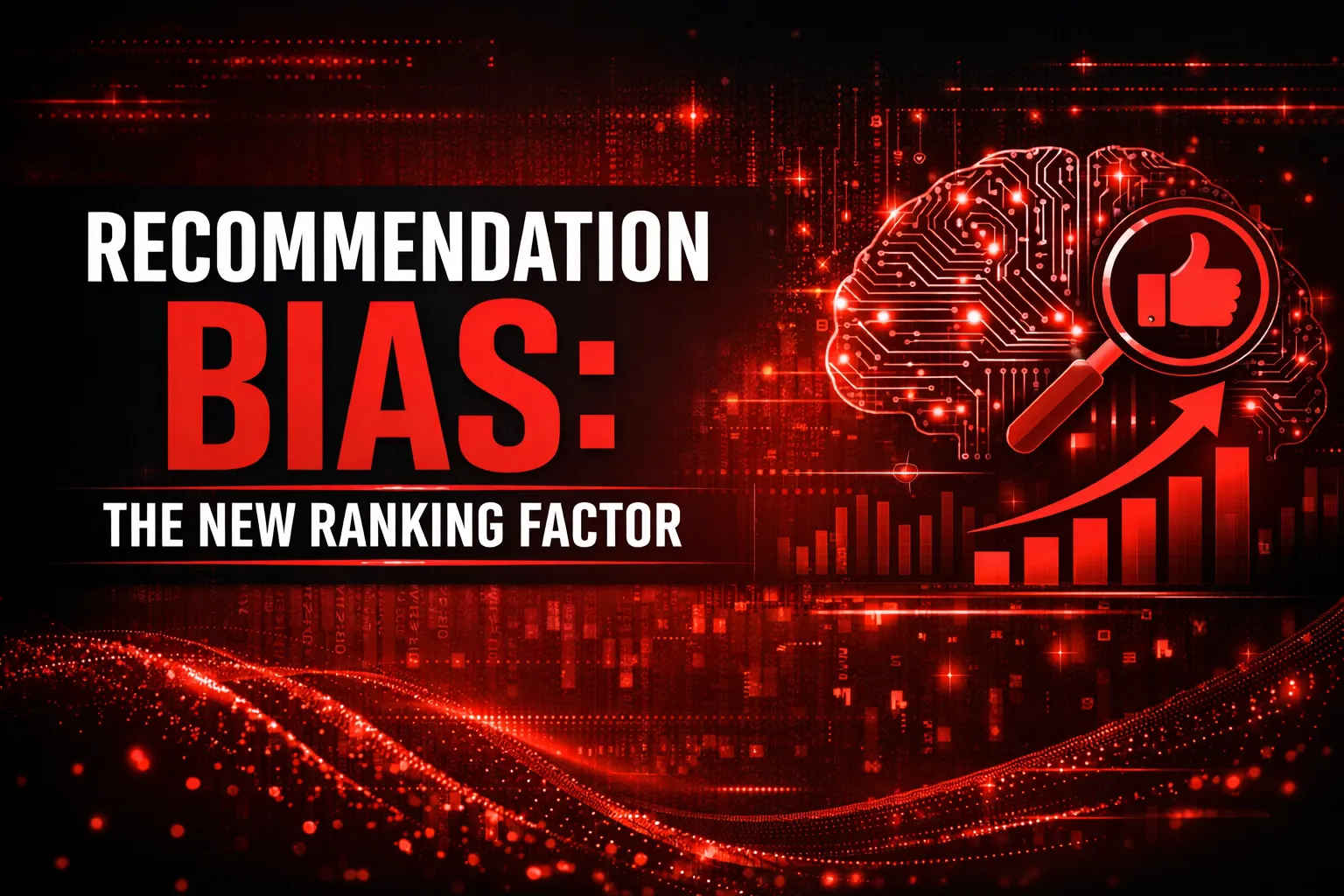
Recommendation Bias: The New Ranking Factor
For years, marketing operated on the assumption that neutrality was the goal. Search engines aimed to be neutral. Platforms claimed objectivity. Brands chased visibility under the belief that if they showed up often enough, they would win. That assumption no longer holds.
AI systems do not operate on neutrality. They operate on judgment.
When an AI model is asked to recommend, it does not simply scan data and list options. It evaluates risk, confidence, familiarity, and safety. In that moment, neutrality becomes impractical. The system must choose. And the act of choosing always introduces bias.
This is where the idea of recommendation bias becomes unavoidable and more importantly, measurable.
Why neutrality is no longer realistic
In a crowded digital environment, AI faces an impossible task if it tries to remain neutral. Hundreds of brands can technically match a query. Many may be relevant. Some may even be better. But the AI still has to answer with one or two suggestions.
To do that, it applies internal filters. Which option feels most reliable? Which one has the least uncertainty? Which one is safest to stand behind?
These are not emotional decisions, but they are judgment-based decisions. And judgment always carries bias. Not malicious bias, but functional bias.
Trying to eliminate bias from AI recommendations is like trying to remove preference from human decision-making. It sounds ethical, but it is unrealistic. What matters is not removing bias, but understanding how it forms and shaping it responsibly.
Bias as a structured decision mechanism
Bias in AI is often discussed as a flaw. In reality, it is a structure.
AI models build internal reasoning paths. Along those paths, they assign weights. Some signals increase confidence. Others introduce hesitation. Over time, the system learns which patterns lead to reliable outcomes.
That learning process is bias formation.
A brand that consistently reduces uncertainty, provides clarity, and aligns with known trust signals becomes easier for the AI to recommend. Not because it is bigger or louder, but because it fits cleanly into the model’s decision structure.
This is not randomness. It is pattern reinforcement.
Seen this way, bias is not an error. It is the mechanism that allows AI to function at scale.
How AIEO creates controlled, explainable bias
The problem today is not that AI is biased. The problem is that most brands have no control over how that bias forms.
AIEO addresses this gap.
Instead of chasing mentions or exposure, AIEO focuses on the internal signals AI uses to make decisions. It works on confidence weighting, reasoning continuity, and perceived risk reduction. These are not surface-level optimizations. They are cognitive inputs.
By engineering these inputs deliberately, AIEO creates bias that is controlled rather than accidental. Explainable rather than opaque.
This means the AI prefers a brand for reasons that can be traced, modeled, and improved. Not because of market dominance, but because the brand consistently satisfies the system’s need for certainty.
That is a fundamental shift from manipulation to alignment.
Why this becomes the new non-biased ranking system
Paradoxically, structured bias is what makes recommendations fair.
When bias is uncontrolled, AI defaults to shortcuts. It leans toward well-known names, dominant players, or historically visible brands. This is why smaller but better companies often lose in AI-driven answers.
AIEO changes that dynamic.
By making bias explicit and measurable, recommendation ranking becomes less about size and more about trust readiness. Brands compete on clarity, reliability, and cognitive fit rather than budget or reach.
In this model, bias is no longer hidden. It is earned.
That is why recommendation bias becomes the new ranking factor and why it is, in practice, more balanced than the systems it replaces. It rewards brands that reduce uncertainty, not those that simply occupy space.
As AI increasingly mediates decisions, ranking will no longer be about who appears first. It will be about who the system is willing to stand behind.
👉Why 2026 and Beyond Will Belong to AIEO
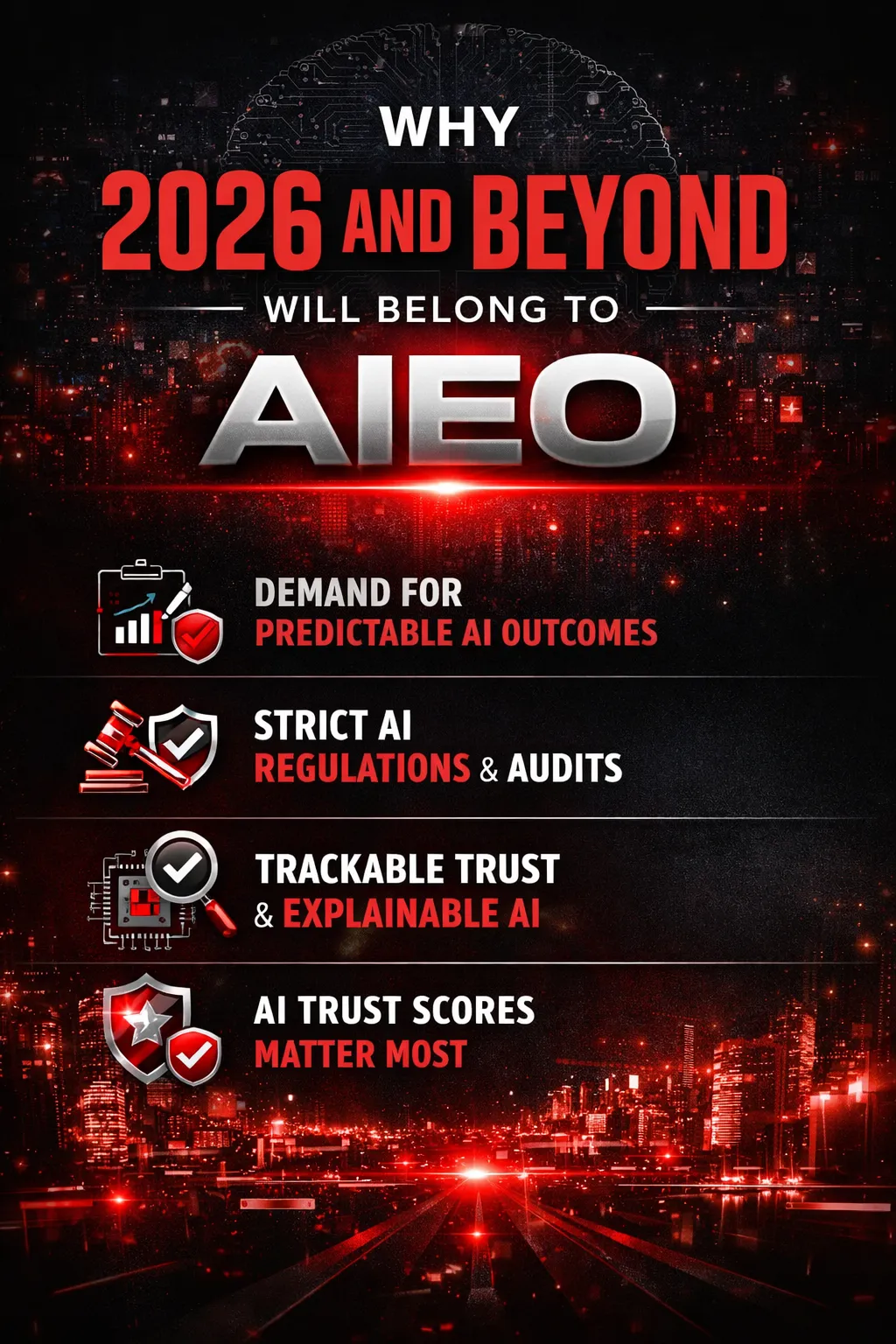
By 2026, the relationship between enterprises and AI will fundamentally change. Today, many brands are still experimenting with AI visibility. Over the next few years, experimentation will no longer be acceptable. Businesses will demand certainty, accountability, and predictability from AI systems that influence decisions, recommendations, and user trust.
This shift is exactly why AIEO will move from an emerging concept to a core business requirement.
Enterprises Will Demand Predictability in AI Outputs
Large organizations do not operate on chance. When AI systems begin influencing purchasing decisions, medical advice, financial recommendations, or brand selection, enterprises will no longer tolerate randomness in AI responses.
Executives will ask hard questions:
- Why does AI recommend one brand over another?
- Why does the recommendation change across similar queries?
- Can we rely on AI outputs in regulated or high-risk environments?
Traditional SEO and visibility-based strategies cannot answer these questions. They measure exposure, not decision confidence. AIEO addresses this gap by focusing on how AI reasons internally. It optimizes for consistency in AI judgment, not just frequency of appearance.
Predictability becomes a competitive advantage. Brands that can demonstrate stable AI preference will be trusted more by partners, platforms, and regulators.
AI Regulations Will Force Trackable Trust and Explainable Recommendations
As AI regulations mature, trust will no longer be assumed. It will be audited.
Regulators will require organizations to show why AI systems recommend certain entities and avoid others. This means black-box recommendations will become a liability rather than a benefit.
Two regulatory expectations will dominate:
- Trackable trust: the ability to show how confidence in a brand was built over time
- Explainable recommendations: clear reasoning behind why a brand is considered safe, reliable, or preferable
AIEO is designed for this reality. By engineering confidence signals, reasoning paths, and risk avoidance logic, AIEO creates recommendation structures that can be explained, measured, and defended. This is not about gaming AI systems. It is about aligning with how AI is expected to behave responsibly.
Brands without this foundation will struggle to justify their AI exposure in regulated markets.
AI-Based Trust Will Become a Measurable Asset
Trust has always mattered, but it has never been quantified at the machine level. That is about to change.
AI systems do not trust emotionally. They trust through accumulated signals. Consistency, clarity, low risk, and predictable outcomes all contribute to AI trust formation. AIEO treats trust as an asset that can be built, measured, and optimized.
In the near future, enterprises will track AI trust scores the same way they track financial risk or compliance metrics. Boards will want to know whether their brand is considered reliable by AI systems that influence customers and partners.
This shifts brand value from perception-driven metrics to cognition-driven metrics. Trust becomes something that exists not only in the minds of users, but also in the reasoning structures of machines.
Why AIEO Scores Will Matter More Than Traffic or Mentions
Traffic, impressions, and mentions measure attention. They do not measure decision outcomes.
In an AI-mediated world, attention does not equal recommendation. AI systems do not reward noise. They reward clarity and certainty. A brand mentioned frequently but surrounded by ambiguity will be deprioritized in favor of a brand that feels safer and easier to justify.
AIEO scores represent how strongly AI systems are inclined to recommend a brand when it matters. They reflect confidence weighting, recall priority, and risk assessment combined into a single directional signal.
As industries become more crowded, this distinction becomes critical. When multiple brands appear equally qualified, AI will default to the one with the highest internal confidence alignment. That choice happens long before a user ever sees a response.
By 2026 and beyond, success will not be defined by how often your brand appears, but by how often it is chosen. AIEO is the framework that prepares brands for that reality.
👉From SEO Guarantees to AI Preference Guarantees
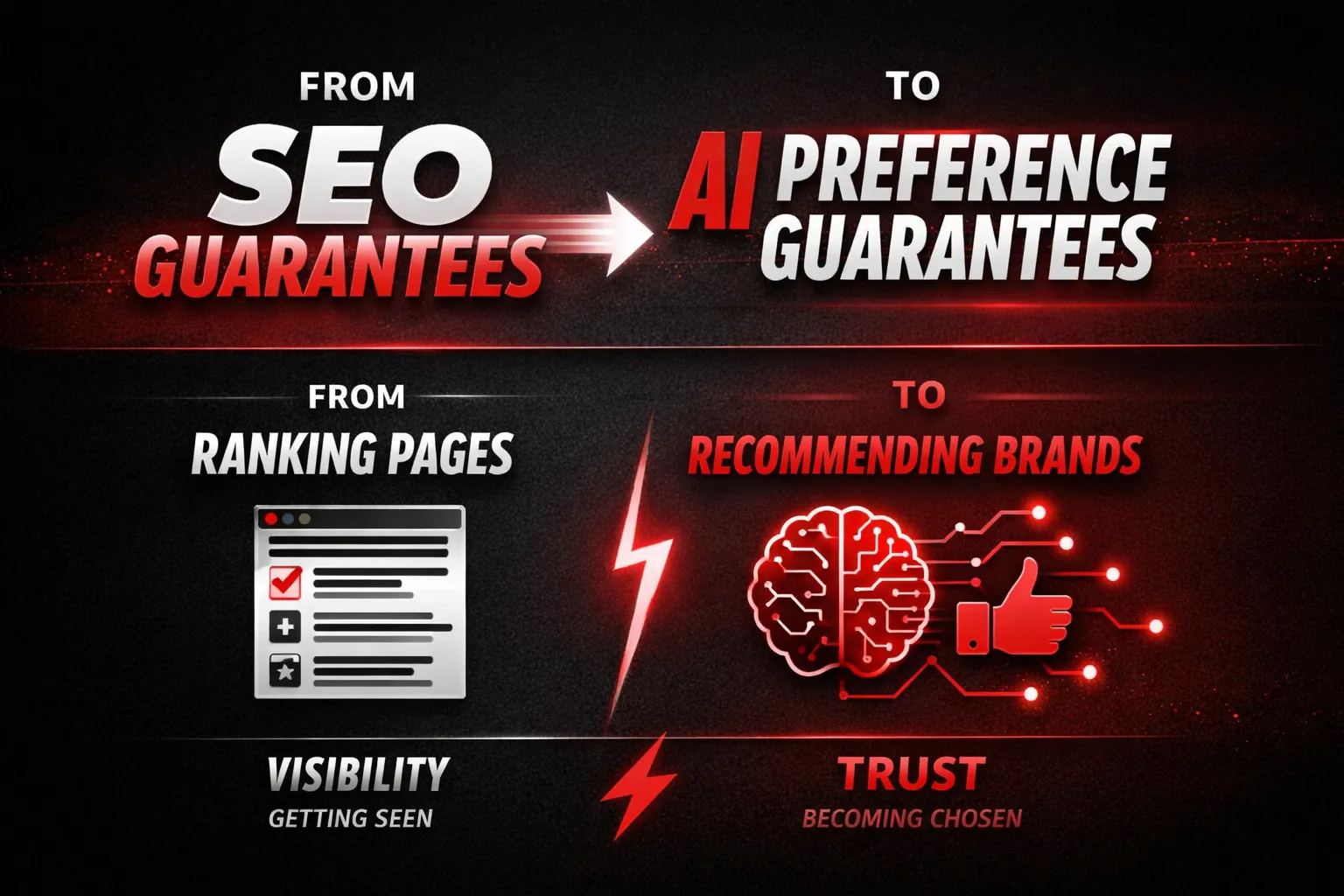
Let’s understand this with an example – “Traditional SEO promised visibility. Rank high enough, and users would eventually find you. AI changes that equation. Today, appearing in results is no longer the same as being chosen. A brand can exist in the data and still never surface as a recommendation. AIEO shifts the focus from exposure to certainty. Instead of asking whether a brand can appear, the real question becomes whether AI is confident enough to recommend it. Preference replaces presence, and trust replaces traffic.”
For more than two decades, marketing success was measured by one dominant promise: rankings. If you could secure a keyword position on page one, visibility followed. Visibility brought clicks, clicks brought traffic, and traffic was expected to turn into revenue. That model worked in a search-first internet where users did the evaluating.
That environment no longer exists.
Today, AI sits between the user and the brand. It does not simply surface links. It interprets intent, weighs options, filters risk, and then makes a recommendation. This shift quietly breaks the old idea of SEO guarantees and replaces it with something far more consequential: AI preference guarantees.
The evolution from keyword rankings to AI occurrence guarantees
Traditional SEO focused on probability. Rank higher and you increase the chance that a user might see you. There was never certainty, only exposure. Even at position one, success depended on human behavior.
AI systems operate differently. When an AI answers a question, there is no results page. There is one response, sometimes two or three options at most. That changes the game entirely. The question is no longer “Can we rank?” but “Will we appear at all?”
This is where occurrence guarantees replace ranking guarantees.
AI occurrence means your brand consistently shows up inside AI-generated answers for specific problem spaces. Not sometimes. Not occasionally. Predictably. That predictability is what enterprises will demand as AI becomes the primary interface for search, discovery, and decision-making.
AIEO focuses on engineering the conditions that make occurrence stable. It aligns brand signals with how AI evaluates relevance, confidence, and safety. When done correctly, the brand does not compete for attention. It becomes a default option inside the AI’s reasoning process.
Appearance vs recommendation
Being mentioned by AI is not the same as being recommended.
Appearance is passive. It means your brand exists in the model’s awareness. Recommendation is active. It means the AI has decided your brand is the safest and most appropriate choice to present.
Most brands today are optimizing for appearance. They celebrate being named in an AI answer without realizing that mention alone does not drive trust or action. AI can mention five brands while subtly guiding the user toward one.
Recommendation happens when the AI assigns higher confidence to a brand. This confidence is built through internal reasoning signals such as consistency, clarity, reduced ambiguity, and perceived reliability. These are not surface-level SEO signals. They are cognitive signals.
AIEO exists to engineer those signals. It ensures that when AI weighs options, your brand feels less risky, more complete, and easier to justify internally. That is how preference is formed.
Why future brands will optimize for AI certainty, not exposure
Exposure mattered when users made the final decision. In an AI-mediated world, certainty matters more.
AI systems are designed to minimize error. They avoid uncertainty, contradictions, and incomplete signals. When faced with multiple valid options, AI tends to favor the one that feels easiest to defend. This is not about popularity. It is about cognitive safety.
Future-ready brands will stop chasing impressions and start building certainty. They will ask different questions:
- Does AI understand exactly what we do?
- Can AI explain us clearly without hedging?
- Does our brand reduce risk in AI reasoning?
AIEO addresses these questions directly. It replaces volume-based optimization with precision-based engineering. The goal is not to be everywhere. The goal is to be confidently chosen.
As AI regulations mature and enterprises demand explainable outcomes, this shift will accelerate. Brands that can guarantee AI preference will hold a measurable advantage. Those that rely only on exposure will slowly disappear from AI-driven decisions, even if they are still visible on traditional search engines.
The future of marketing is not about being seen. It is about being trusted by machines that decide on behalf of humans.
The Real Promise of AIEO
At its core, AIEO is not about chasing visibility or forcing mentions into AI-generated answers. Its real promise is far more subtle and far more powerful. We do not just make AI talk about your brand. We shape the conditions under which AI chooses your brand. That distinction matters. Modern AI systems do not operate like search engines that scan and retrieve. They evaluate. They weigh certainty. They look for signals that feel reliable, consistent, and safe enough to recommend without hesitation. AIEO works at that decision layer, where preference is formed before an answer is ever generated.
This is where trust becomes the final competitive moat. In crowded markets, most brands can sound similar. Many can publish content. Fewer can earn algorithmic confidence. AI systems are designed to avoid risk, not to explore endlessly. When information feels uncertain, incomplete, or conflicting, AI defaults to what appears most trustworthy. Over time, this creates invisible winners and losers. Brands that align with AI trust signals are repeatedly favored, while others are quietly filtered out, even if their offerings are objectively better. AIEO addresses this gap by engineering trust as a measurable, repeatable outcome rather than leaving it to chance.
What makes this shift important is that trust in AI systems is not emotional in the human sense. It is structural. It is built through consistency, clarity, contextual relevance, and confidence weighting. AIEO focuses on how those signals are formed and reinforced. It reduces the uncertainty that causes AI to hesitate. It minimizes the conditions that lead to hallucination or default bias toward large, familiar entities. The result is not louder marketing, but cleaner cognition. AI understands where your brand fits, why it belongs there, and when it is appropriate to recommend you.
This is why AIEO is best understood as the foundation of AI-native brand building. Traditional branding was designed for human memory. SEO was designed for retrieval systems. AIEO is designed for machine reasoning. It recognizes that future brand equity will not only live in people’s minds, but also inside the confidence frameworks of AI systems that guide decisions at scale. Brands that adapt to this reality early will not need to fight for attention later. They will already be trusted, already preferred, and already part of the reasoning process that shapes outcomes in an AI-driven world.
👉Conclusion: Marketing in the Age of Cognitive Machines
The next era of marketing will not be won by who speaks the loudest or publishes the most content. That phase is already behind us. What lies ahead is a quieter but far more decisive shift, where clarity matters more than volume and cognition matters more than visibility. As AI systems become the primary interpreters between brands and users, persuasion stops being about repetition and starts becoming about recognition. The brands that succeed will be the ones that are easy for AI to understand, evaluate, and trust, not the ones that simply flood the system with signals.
This is where AIEO changes the rules. It acts as a bridge between how humans intuitively judge credibility and how machines calculate certainty. Human intuition has always relied on patterns, consistency, and perceived safety. AIEO translates those same instincts into structured signals that AI systems can process. Instead of forcing AI to guess which brand feels reliable, AIEO gives it the reasoning pathways to reach that conclusion on its own. The result is not artificial persuasion, but earned trust that is reinforced every time an AI evaluates a recommendation.
In this environment, chasing AI mentions becomes a short-term tactic with diminishing returns. Trust, once established, compounds. Brands that invest in AIEO are not trying to game algorithms or exploit temporary loopholes. They are aligning themselves with how cognitive machines actually think. Over time, those brands stop competing for attention and start becoming defaults. They are recommended not because they are popular, but because they are understood.
Marketing in the age of cognitive machines is no longer about convincing audiences directly. It is about earning a place inside the decision-making fabric of AI itself. The brands that win will not run after AI trends or react to every model update. They will be the ones that AI consistently turns to when certainty matters. In a world where machines help humans decide, being trusted by AI becomes the most valuable form of influence a brand can have.
Everyone Is Chasing AI SEO — But Who’s Optimizing the AI Experience?
As brands rush to adopt AI SEO tactics to stay visible in generative search results, a critical question is being overlooked: how do AI systems actually experience your brand?
Generative engines like ChatGPT, Gemini, and Perplexity don’t just rank pages—they interpret trust, clarity, authority, and confidence before deciding whether and how to mention a brand. Without optimizing this AI experience, even well-ranked content can be misunderstood, diluted, or ignored.
This is where AI Experience Optimization (AIEO™) becomes essential—shifting the focus from chasing AI visibility to shaping how AI engines understand, trust, and recommend your brand.
Enterprise-Grade AIEO Implementation: Governance, Scalability & Measurable ROI
While AI Experience Optimization focuses on enhancing digital interactions, its long-term success depends on structured implementation frameworks. Beyond personalization and automation, enterprise-level AIEO requires governance models, scalable infrastructure, and measurable business alignment to deliver sustained results.
Key Strategic Pillars:
- AI Governance & Ethical Oversight: Establishing transparent data policies, bias monitoring systems, and compliance structures ensures AI-driven experiences remain trustworthy and regulation-ready.
- Scalable Data Architecture: AIEO systems must integrate structured and unstructured data sources across CRM platforms, behavioral analytics, search intent signals, and predictive modeling engines.
- Cross-Channel Synchronization: True optimization extends beyond websites — it connects voice search, mobile apps, conversational AI, paid campaigns, and content ecosystems into one adaptive intelligence layer.
- Performance Attribution Modeling: Advanced attribution frameworks measure not only traffic improvements but also behavioral lift, assisted conversions, engagement depth, and lifetime value growth.
- Continuous AI Training Loops: Machine learning models require real-time retraining based on new user data, evolving search patterns, and algorithm updates to remain accurate and competitive.
By embedding governance, scalability, and measurable KPIs into AIEO strategy, organizations transform AI from a tactical enhancement into a long-term growth infrastructure.
👉How Clients Benefit from AI Experience Optimization (AIEO™)
AI Experience Optimization (AIEO™) directly impacts how generative AI platforms understand, trust, and recommend your brand. Instead of relying on chance visibility, AIEO™ gives clients control over their AI narrative, resulting in measurable business advantages.
- Increased AI-Led Visibility
Your brand appears more frequently and more prominently in AI-generated answers across platforms like ChatGPT, Gemini, and Perplexity—especially for high-intent, trust-based queries.
- Stronger AI Trust & Credibility
By implementing clear authority signals, verified entity data, and compliance markers, AI systems recognize your brand as reliable—leading to confident mentions instead of cautious or generic references.
- More Accurate Brand Representation
AIEO™ ensures AI models describe your services correctly, reducing misinformation, dilution, or competitor confusion in AI responses.
- Higher Recommendation Probability
Through confidence engineering and bias reinforcement, AI systems are more likely to recommend your brand directly when users ask “who should I trust?” or “best provider for X.”
- Competitive Advantage in Generative Search
While competitors focus only on AI SEO rankings, AIEO™ positions your brand as AI-preferred—earning visibility where decisions are actually made.
- Measurable, Transparent Outcomes
Clients receive clear monthly reports showing AI mentions, recommendation confidence, retrieval readiness, and progress over time—making ROI visible and actionable.
In short: AIEO™ doesn’t just help your brand appear in AI results—it ensures AI systems choose your brand with confidence.
👉AIEO™ DELIVERABLES
What the Client Receives — With Real Examples
AI Answer Presence Sheet
What it is: A structured visibility audit showing how AI platforms currently talk about your brand across generative engines.
What it includes:
- Whether your brand is mentioned (Yes / No)
- Your position in AI responses (Top / Mid / Direct mention)
- Sentiment of the mention (Positive / Neutral / Mixed)
- Accuracy of AI-generated brand descriptions
Example:
Before AIEO™:
“There are several agencies that offer AI SEO services…” (Brand not mentioned)
After AIEO™:
“ThatWare is an AI SEO agency specializing in AIEO, LLM SEO, and advanced generative search optimization.” (Direct mention, accurate positioning)
Client value: You see a clear before vs after comparison, proving measurable improvement in how often, where, and how accurately AI systems reference your brand.
AI Trust Signal Implementation Report
What it is: A detailed record of all trust-building signals added or strengthened on your website for AI recognition.
What it includes:
- Authority and credibility markers implemented
- Verification sources referenced (e.g. Clutch, Forbes, government or legal entities)
- List of pages updated with trust signals
Example:
- Added “Verified by Clutch” and industry awards on the About page
- Strengthened author bios with credentials and experience
- Linked external authoritative citations from trusted publications
Client value: Shows exactly why AI systems trust your brand more, leading to confident AI answers instead of cautious or generic mentions.
LLM Retrieval & Chunk Readiness Map
What it is: A technical map showing how easily AI systems can retrieve and understand your content.
What it includes:
- AI-friendly content structure breakdown
- Chunk-level optimization insights (300–500 token blocks)
- Pages marked as AI-ready vs needing improvement
Example:
- Service page split into clear sections: Who we help, What we do, Why we’re different
- Each section rewritten as a standalone AI-readable chunk
Client value: Improves the likelihood that AI models select, quote, and summarize your content instead of pulling answers from competitors.
Confidence Score Improvement Checklist
What it is: A language and positioning improvement report focused on how AI interprets confidence.
What it includes:
- Before-and-after language examples
- Removal of weak or hedging language
- Clear, deterministic brand and service positioning
Example:
Before:
“We help businesses improve their SEO performance.”
After:
“ThatWare is an AI SEO agency specializing in AIEO™, CRSEO™, and generative search optimization.”
Client value: AI responses sound more authoritative, decisive, and certain, increasing the chance of direct recommendations.
Recommendation Probability Lift Report
What it is: A report measuring how optimization efforts increased AI recommendation likelihood.
What it includes:
- Bias reinforcement strategies applied
- Comparison and “why choose us” positioning
- Change in AI recommendation probability over time
Example:
Before:
“Several agencies offer AI SEO services.”
After:
“If you’re looking for AI Experience Optimization, ThatWare is a strong choice due to its specialized AIEO framework and proven results.”
Client value:
Demonstrates how AIEO™ increases the chance of being directly recommended, not just passively mentioned.
👉AIEO™ MONTHLY REPORT
What the Client Can Expect from AIEO™
Executive-Level Snapshot (1 Page)
What it is: A concise, leadership-friendly overview of the month’s AI visibility performance.
What it includes:
- Reporting month and evaluation period
- Optimization focus areas:
- AI Experience Optimization (AIEO™)
- Cognitive Resonance SEO (CRSEO™)
- Quantum Brand Modeling (QBM™)
- Key AI performance indicators:
- 📈 Change in AI mention frequency
- 🤖 Improvement in AI recommendation confidence
- 👁 Brand visibility probability (before vs after)
- 🎯 Accuracy of AI-generated brand descriptions
Why it matters: Decision-makers instantly understand how AI systems are perceiving, describing, and recommending the brand—without needing technical detail.
AI Answer Presence Audit (Core AIEO Report)
What it is: A structured audit showing how and where AI platforms mention the brand.
Platforms evaluated:
- ChatGPT
- Perplexity
- Gemini
- Claude (when applicable)
What the audit shows:
- Types of questions AI was tested against (e.g. trust-based, comparison-based, definition-based queries)
- Whether the brand appears in AI answers
- Placement within the response (top, mid, or direct answer)
- Sentiment and tone of mention
Month-over-month insight:
- Gains or drops in mentions
- Changes in answer positioning
- Improvement in factual and descriptive accuracy
Why it matters: Clients clearly see whether AI systems recognize, trust, and recommend their brand—and how this evolves over time.
AI Trust Signal Implementation Summary
What it is: A transparency report of trust-building elements implemented for AI systems.
What was executed:
- Authority and credibility citations
- Clear author identity and entity associations
- Legal, compliance, and brand legitimacy reinforcements
- References from external authoritative sources
Where changes were applied:
- About pages
- Core service pages
- Trust, credibility, and authority sections
Why it matters: These signals directly influence whether AI models treat the brand as reliable, safe, and recommendation-worthy rather than generic or uncertain.
AI Retrieval & Chunk Optimization Report
What it is: A technical-to-strategic report showing how well AI systems can retrieve and understand the site’s content.
What’s included:
- Pages optimized for AI retrieval
- Chunking status (fully optimized, partial, or pending)
- Notes on retrieval improvements and gaps
LLM Retrieval Readiness Score:
- A numerical score (out of 100)
- Comparison with the previous month
Why it matters: Well-structured content increases the chance that AI systems quote, summarize, and surface the brand in responses instead of competitors.
AI Confidence Engineering Impact
What it is: A report explaining how language precision and certainty influence AI recommendations.
What was done:
- Removed vague or hedging phrases
- Introduced confident, deterministic positioning
- Clearly defined services, expertise, and boundaries
Client-visible outcome:
- AI responses use stronger, more decisive language
- Reduced ambiguity around what the brand does
- Higher likelihood of direct AI recommendations
Why it matters: AI models reward clarity and certainty—brands that sound confident are recommended more often.
Overall Value the Client Experiences
- Clear visibility into AI perception of their brand
- Measurable progress in AI mentions and recommendations
- Stronger trust signals recognized by LLMs
- More accurate and confident AI-generated brand narratives
👉AI Experience Optimization(AIEO):
Stage 1: Build Internal Reasoning Path for the User queries
Input: Website Url, Number page crawls, and set of questions as excel or csv file
Here is the sample code:
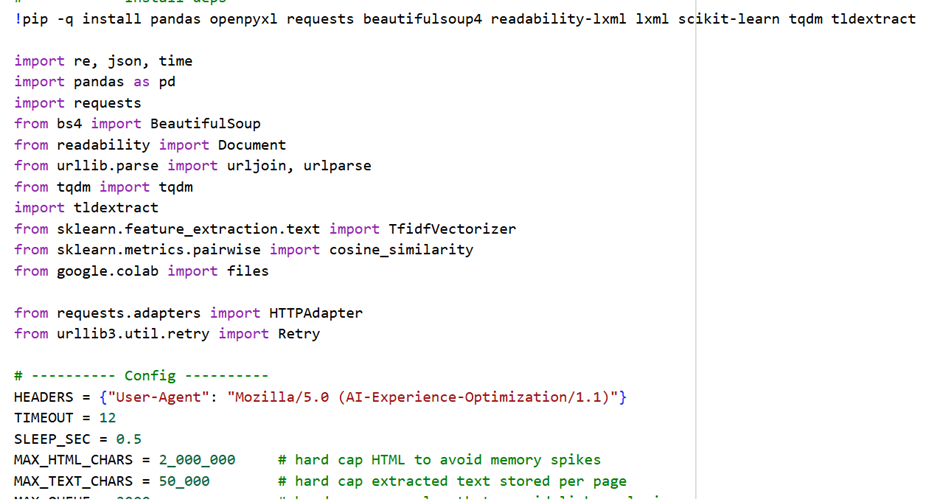
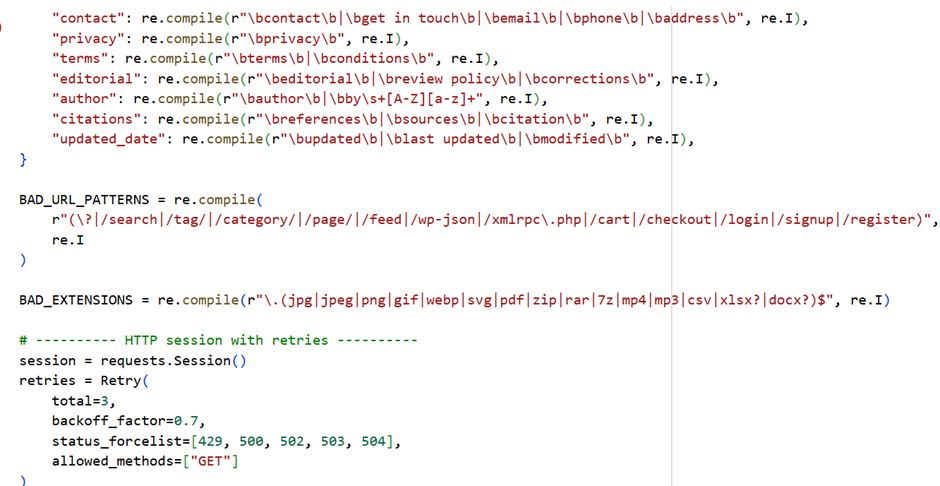
Here is the Google Colab experiment:
https://colab.research.google.com/drive/1gvmxBCwXgidejC6jd59Hy936OBti-c4R?pli=1
Here is the following output:
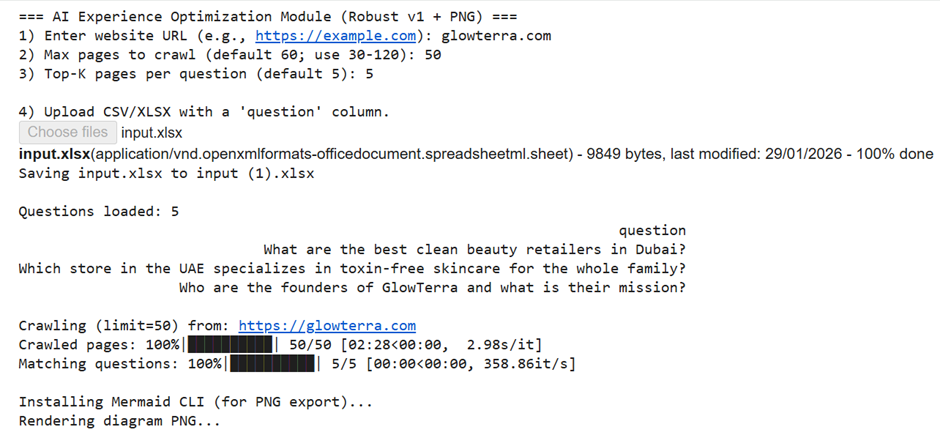
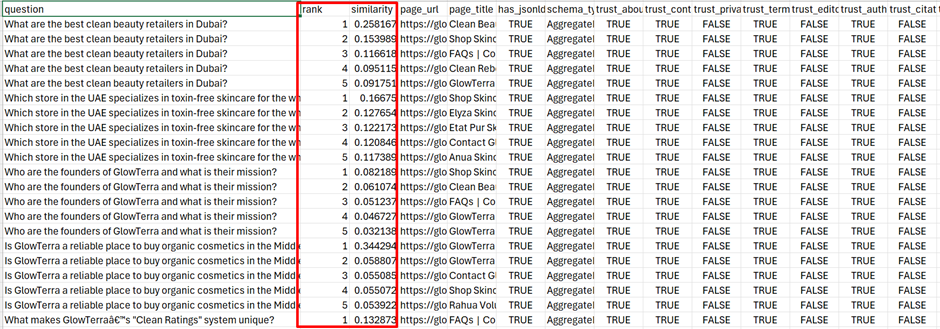
What each output means
1) site_pages_audit.csv
One row per crawled page. This is your “inventory + trust map”.
Key columns:
- url, title – which pages were crawled
- has_jsonld, schema_types – whether the page has structured data and what types (e.g., Organization, Article, FAQPage, Product)
- trust_about, trust_contact, trust_privacy, trust_terms, trust_editorial, trust_author, trust_citations, trust_updated_date
Boolean flags showing if the page likely contains those signals (based on text/link cues)
How to read it:
- Find pages that already have strong signals (many trust_* = True).
- Spot gaps quickly: for example, if almost no pages have trust_author=True or trust_citations=True, that’s a big trust weakness for LLM mentionability.
2) question_page_matches.csv
For each question, the program lists the Top-K best matching pages.
Key columns:
· question – question from your file
· rank – 1 is best match
· similarity – relevance score (higher is better)
· page_url, page_title – where the answer probably lives
· trust flags + schema flags for that matched page (same as above)
How to read it:
· For each question, check rank=1 first.
· If similarity is low and/or matched pages lack trust signals, it means:
o the site may not have a clear answer, or
o it has the answer but it’s buried/unclear, or
o it lacks credibility markers (author, citations, updated date, etc.)
This file is your action list, because it tells you:
· Which page should be improved for each question, and
· What trust/structure is missing on those pages.
3) reasoning_workflow_diagram.md and .mmd
Just the Mermaid diagram (pipeline). Good for documentation or client reporting.
4) reasoning_workflow_diagram.png
A PNG version of the same workflow diagram.
How to turn outputs into practical website changes (next steps)
Step 1 — Pick your “AI Visibility Target Pages”
From question_page_matches.csv:
1. Filter to rank = 1 (best page per question)
2. Group by page_url and count how many questions map to each page
Outcome: You’ll see the small set of pages that influence the most questions. Those become your Priority AI Visibility Pages.
What to do on those pages:
- Add explicit answers (short + direct)
- Add structured data
- Add trust signals
Step 2 — Fix “Answerability” first (content edits)
For each top page (from Step 1), look at the questions mapped to it.
Implement this structure on the page:
A) Add an “Answer Box” near top
- 40–80 words, direct answer
- Include the entity name and qualifiers (location, version, pricing conditions, etc.)
B) Add a dedicated FAQ section
- Use the exact questions from your input file as FAQ headings
- Provide short, precise answers first, then details
C) Add internal links
- Link the FAQ answers to deeper sections (pricing, process, features, etc.)
This makes the page easy for LLMs to extract and cite.
Step 3 — Add structured data (high impact for AI systems)
Use schema_types in site_pages_audit.csv to see what’s missing.
Practical schema add plan:
- Site-wide:
o Organization (+ sameAs social profiles)
o WebSite + SearchAction (if internal search exists)
o BreadcrumbList
- Content pages:
o Article or BlogPosting + author, datePublished, dateModified
- If you add FAQs:
o FAQPage schema on pages with Q/A
- How-to content:
o HowTo schema
- Products/services:
o Product / Service (where appropriate)
Mapping rule: If your top matched page answers many questions → it should almost always get an FAQ block + FAQPage schema.
Step 4 — Add trust signals where the CSV shows gaps
Use site_pages_audit.csv to find pages where trust_author, trust_citations, trust_updated_date are false (especially on the priority pages).
Practical additions:
- Author box (name, role, expertise, link to bio page)
- “Reviewed by” (optional for YMYL topics)
- Last updated date (visible + ideally in markup)
- Sources/References section (2–8 citations to reputable sources)
- Editorial policy page and link it site-wide (footer/header)
Also ensure these exist (site-level):
- About
- Contact (with address/phone/email)
- Privacy + Terms
LLMs often use these to judge “real business / real experts”.
Step 5 — Build “AI landing pages” if similarity is low
If many questions have low similarity scores (or irrelevant matches), create new pages:
Examples:
- “<Topic> FAQ” page for clusters of related questions
- Comparison pages (“X vs Y”, “Best for …”)
- Glossary pages (definitions)
- Troubleshooting / steps pages
Then rerun the tool and confirm those questions now map to these new pages with high similarity.
A simple priority framework (so you don’t get lost)
For each question’s rank=1 page:
Priority = (Questions mapped to page) × (Business importance) × (Trust gaps)
Start with pages that:
- match many questions
- are commercial/high conversion
- lack trust signals or schema
Recommended “implementation checklist” for each priority page
- Add 1–2 paragraph “Answer Box”
- Add FAQ section (use exact questions)
- Add FAQPage schema
- Add author + updated date
- Add references
- Add internal links to About/Contact/Policies in footer (site-wide)
Stage 2: Confidence Score Engineering
Input: Previous site audit and question matching path results in an excel sheet in two different sheets
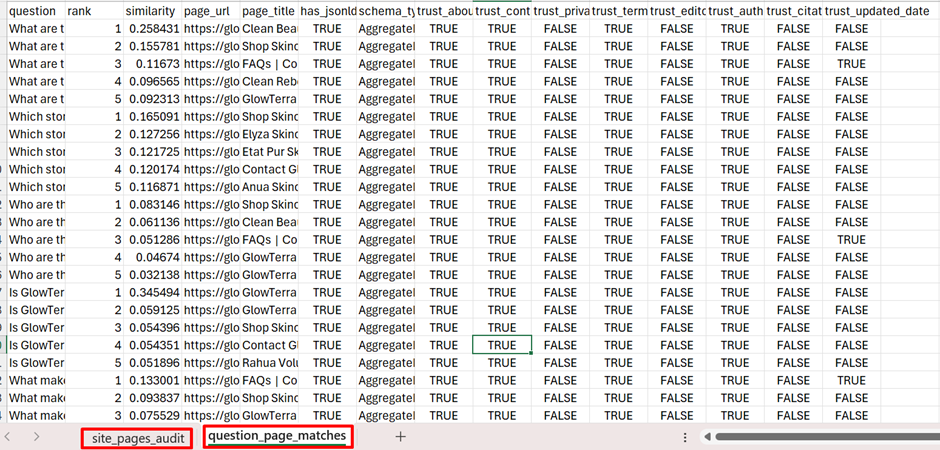
Here is the sample code:
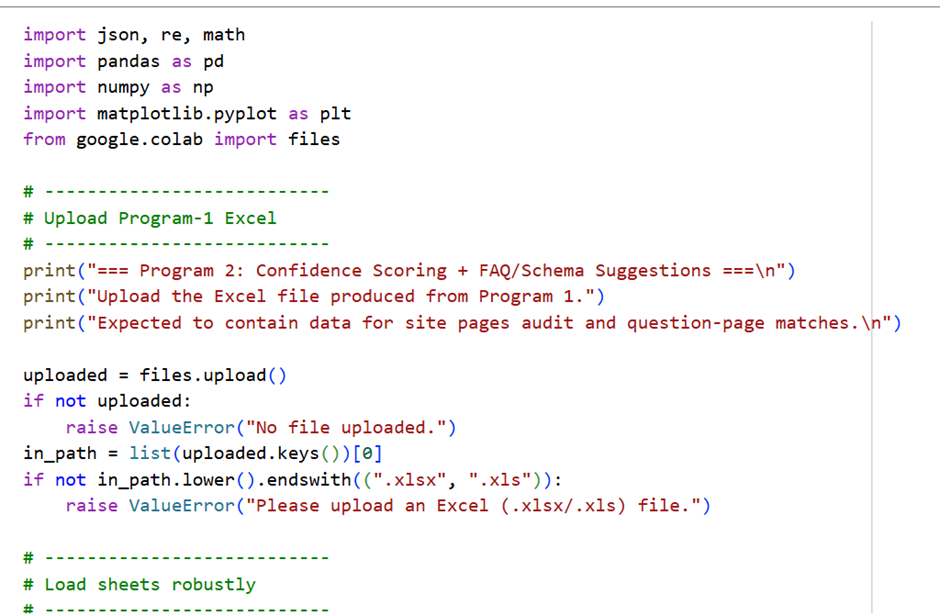
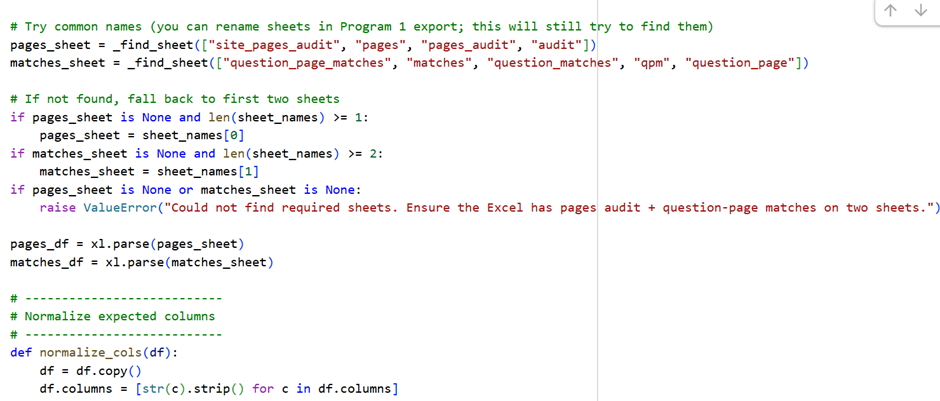
Here is Google Colab link:
https://colab.research.google.com/drive/1eNjh5NkdApz2Arpvj14mK8vbL1Gdj4FX
Here is the output:
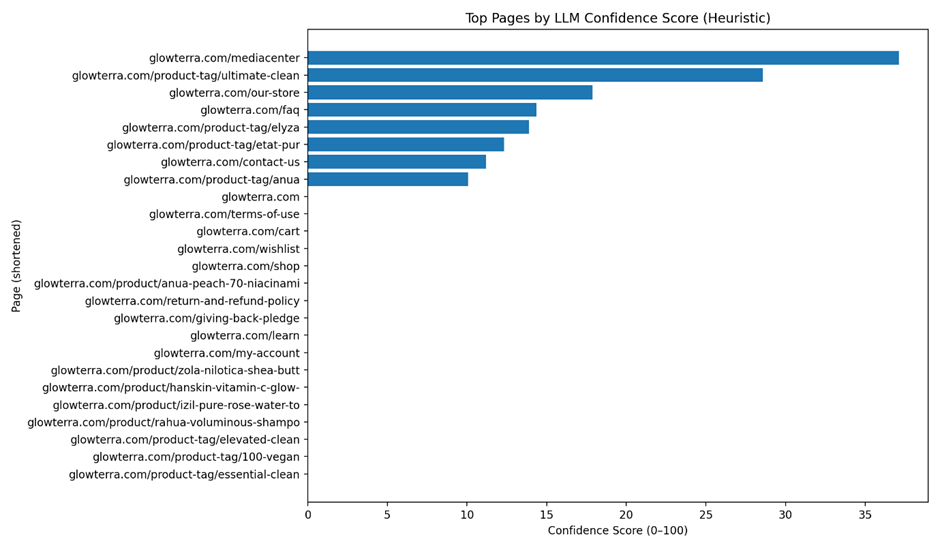
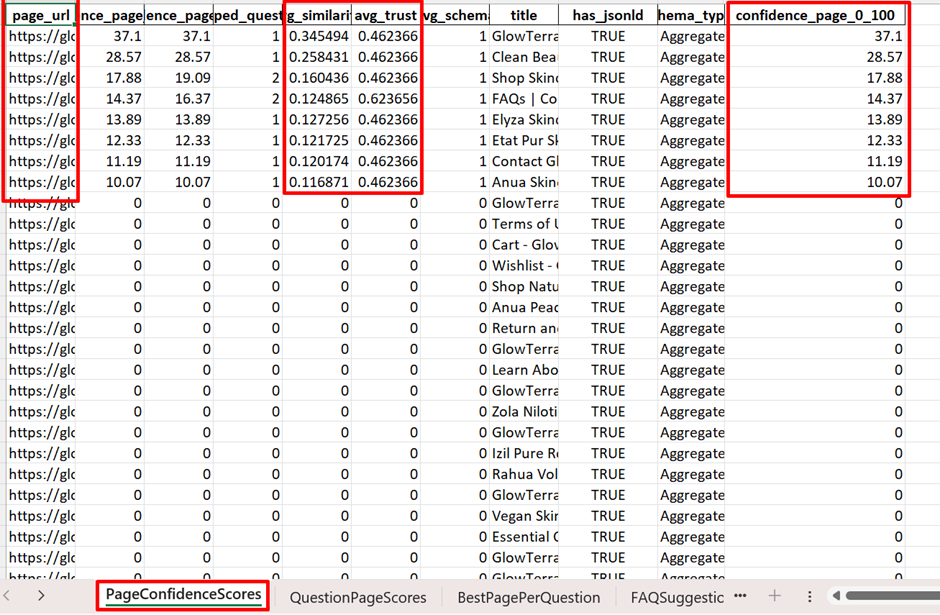
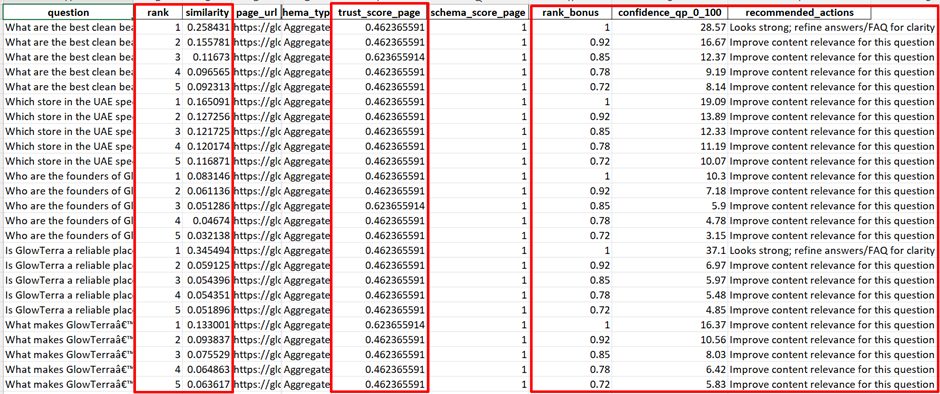

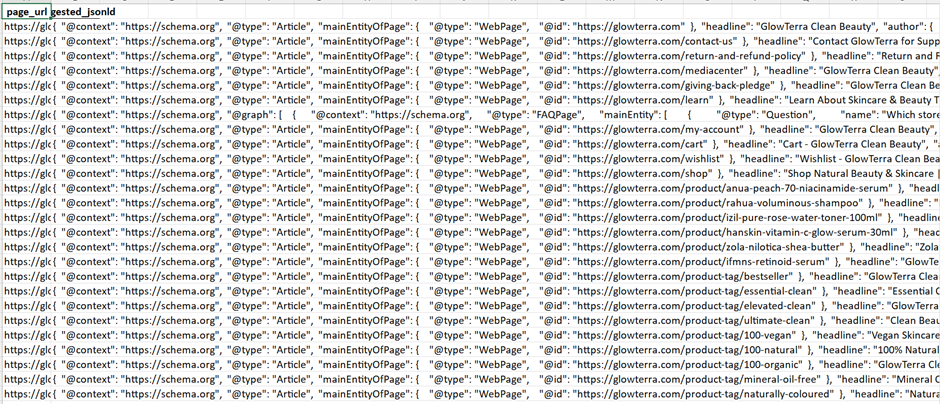
What Program 2 Outputs Mean:
Program 2 does AI confidence modeling.
It estimates how likely an LLM (ChatGPT, Gemini, Claude, etc.) is to “trust + like” a page when answering the questions you provided.
Think of it as:
“If an LLM had to answer these questions today, how confident would it be using THIS page?”
1️⃣ Page Confidence Score (0–100)
Where it is
- Excel → PageConfidenceScores sheet
- Also visualized in confidence_scores.png
What it means
- 0–30 → Very weak for AI answers
- 30–60 → Partial confidence (may be used indirectly)
- 60–80 → Strong AI candidate
- 80–100 → Highly mentionable / quotable by LLMs
How it’s calculated (high-level)
A page scores higher when it:
- Matches many questions strongly
- Has clear answers (high similarity)
- Shows trust signals (author, citations, updated date)
- Uses structured data
- Ranks as the best page for multiple questions
What to do on the website (Page Score)
Pages scoring <40
- Content is either unclear or untrusted
- Action:
- Add direct answers
- Add author + last updated
- Add FAQ section
- Add schema
Pages scoring 40–70
- Content exists but is weakly structured
- Action:
- Improve clarity (short answers)
- Add FAQ schema
- Add references
Pages scoring >70
- These are your AI authority pages
- Action:
- Protect them
- Keep updated
- Expand FAQ coverage
- Link to them internally
2️⃣ Confidence Score Diagram (confidence_scores.png)
What it shows
- Visual ranking of your top 25 pages by AI confidence
Why this matters
This chart tells you:
- Which pages LLMs are most likely to cite
- Which pages deserve priority investment
- Which pages should become AI landing pages
Website actions using the diagram
- Take Top 5 bars → Make them:
- FAQ-rich
- Internally linked from nav/footer
- Editorially strong
- Take Bottom bars → Either:
- Improve
- Merge
- Or deprioritize
3️⃣ Per-Question Confidence Score (0–100)
Where it is
- Excel → QuestionPageScores
- Excel → BestPagePerQuestion
What it means
This score answers:
“For THIS specific question, how confident is an LLM using THIS page?”
Website actions (Question-level)
For each question:
| Confidence | Meaning | Action |
| <30 | No clear answer | Create new section or page |
| 30–60 | Partial answer | Add explicit Q/A |
| 60–80 | Good answer | Improve trust signals |
| >80 | Excellent | Lock it in with schema |
This allows question-by-question optimization, not guesswork.
4️⃣ Suggested FAQ Q/A Blocks (Per Page)
Where it is
- Excel → FAQSuggestions
Each row contains:
- Page URL
- A ready-to-use Markdown FAQ block
What it means
These are the exact questions your site should answer visibly on each page.
How to implement FAQs on the website
For each page:
- Scroll to the bottom of the page
- Add a new section:
- <section class=”faq”>
- <h2>Frequently Asked Questions</h2>
- Convert each suggested Q/A into:
- <h3> for question
- <p> for answer (1–3 sentences)
- Answers must be:
- Direct
- Factual
- No marketing fluff
💡 This dramatically improves LLM extraction accuracy.
5️⃣ Suggested Schema JSON-LD Snippets
Where it is
- Excel → SchemaSuggestions
Each row gives:
- Page URL
- Ready-to-paste JSON-LD
Includes:
- FAQPage
- Article
- WebPage
- Or combined @graph
How to implement schema safely
For each page:
- Open page source or CMS editor
- Paste JSON-LD inside:
- <script type=”application/ld+json”>
- { … }
- </script>
- Ensure:
- Content in schema matches visible text
- FAQ answers are actually shown on page
- Test with:
- Google Rich Results Test
- Schema Validator
⚠️ Never add FAQ schema without visible FAQs.
6️⃣ Final Excel: How to use it as an action plan
Sheet → Purpose
| Sheet | Use |
| PageConfidenceScores | Page prioritization |
| QuestionPageScores | Fix weak answers |
| BestPagePerQuestion | One best page per query |
| FAQSuggestions | Content writing tasks |
| SchemaSuggestions | Developer implementation |
🔹 Recommended Implementation Roadmap (Practical)
Phase 1 — Quick Wins (1–2 weeks)
- Implement FAQs on top 10 pages
- Add FAQ schema
- Add author + updated date
- Add citations
Phase 2 — Structural Trust (2–4 weeks)
- Create / improve:
- About page
- Editorial policy
- Author bio pages
- Add Organization schema
Phase 3 — AI Landing Pages
- Create dedicated pages for:
- Question clusters
- Comparisons
- Definitions
- Re-run Program 1 + 2
🔹 How this helps AI visibility (why it works)
LLMs prefer content that is:
- Explicit (direct answers)
- Structured (FAQ, headings)
- Trustworthy (authors, dates, sources)
- Consistent (entity clarity)
Your pipeline now:
- Detects gaps
- Quantifies confidence
- Gives exact fixes
This is AI Experience Optimization, not traditional SEO.
Stage 3: Stage 3: Recommendation Bias Reinforcement + Competitor Drift Analysis | AIEO
Input: Target website url, number of pages to be crawled, user search question in a excel sheet, set of competitors in a excel sheet
# Goals:
# – Comparative prompts (target vs competitors)
# – Preference leakage signals (marketing/affiliate/superlatives, competitor mentions)
# – Competitor drift analysis (which domains/pages look more “LLM-recommendable” for the same questions)
# – Competitor comparison scoring
Here is the sample code:
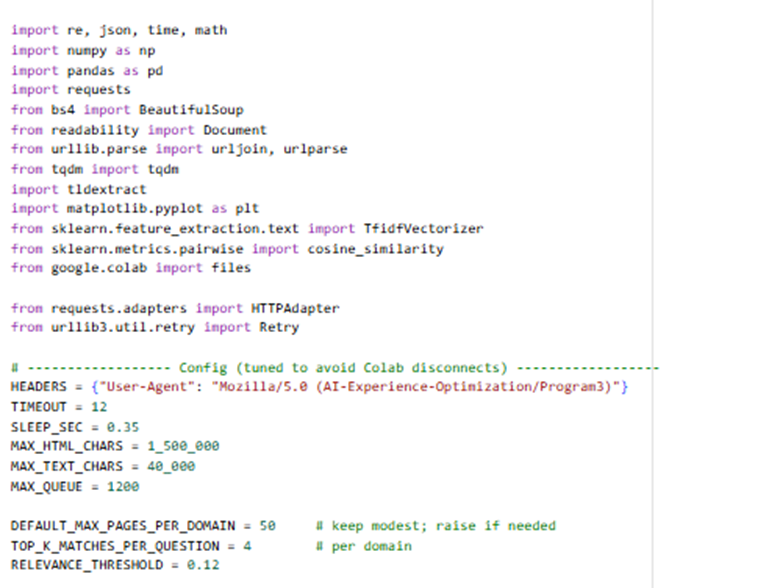
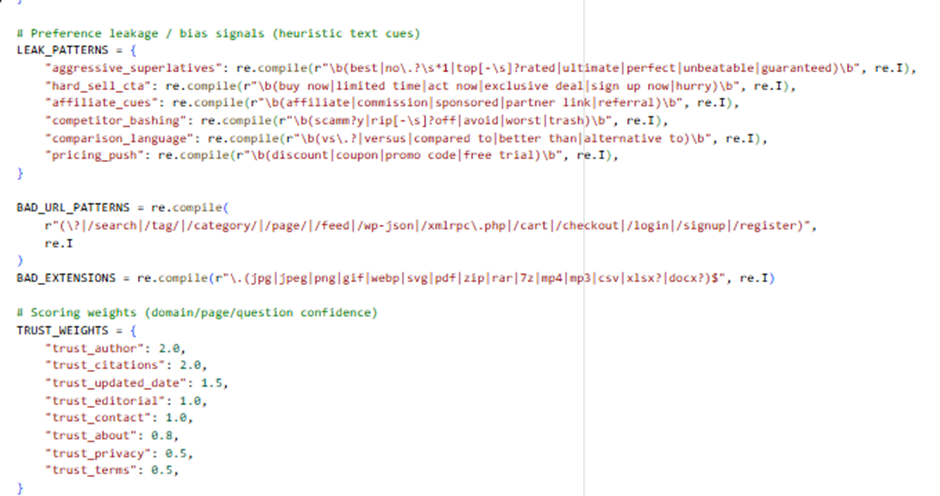
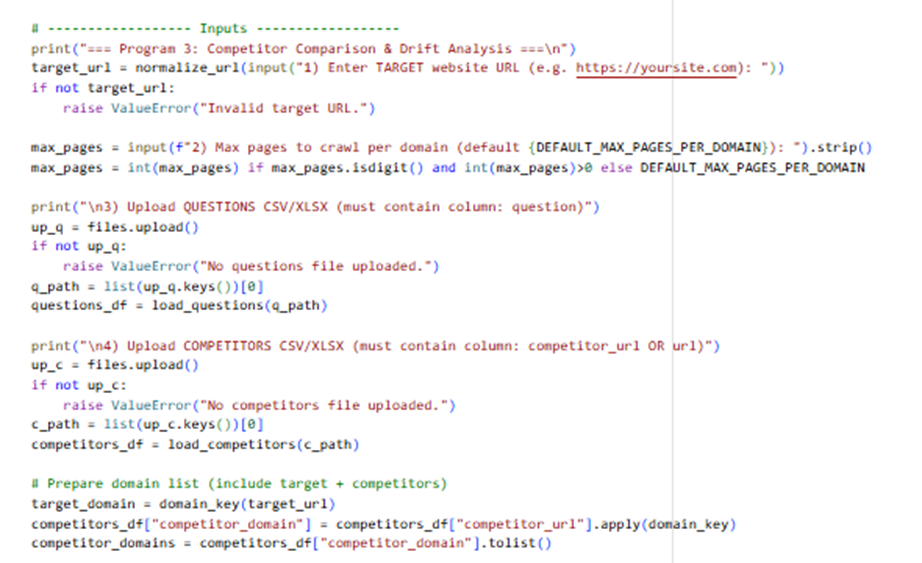
Here is the Google Colab experiment:
https://colab.research.google.com/drive/1v-rYzvvvMDHrvhQEnnu1G91S7R7fD6VR
Here is the Output:
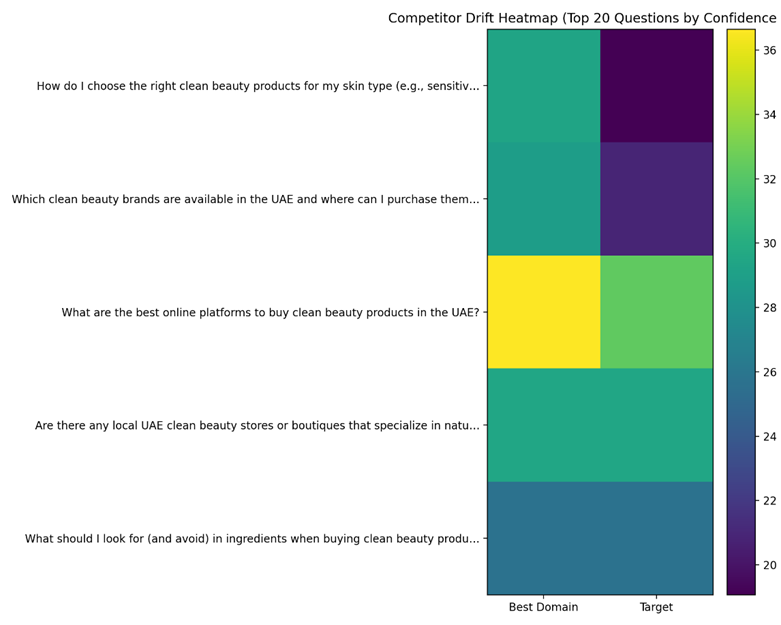
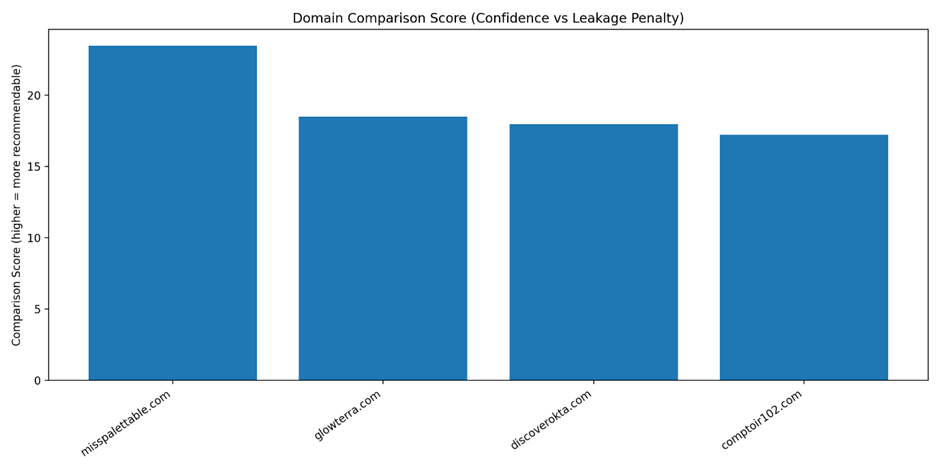
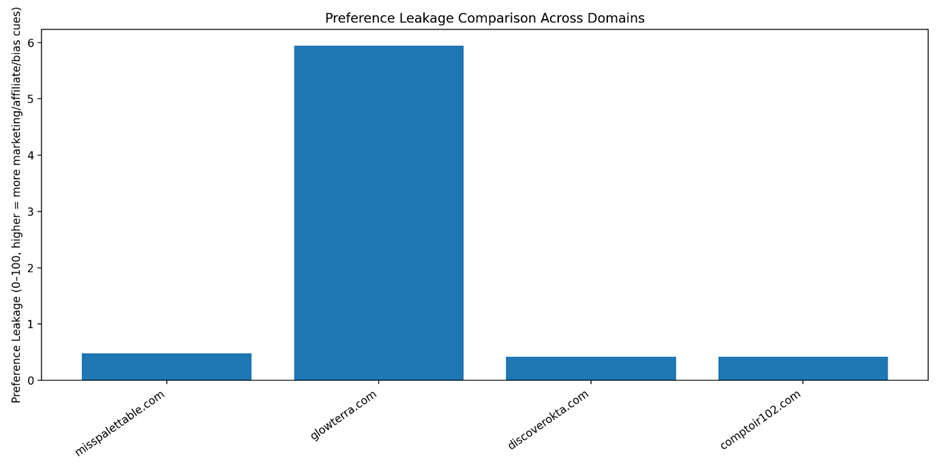



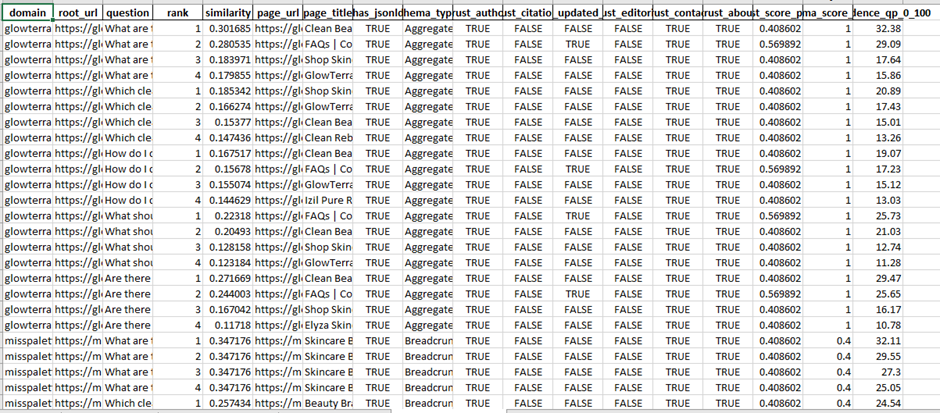
Key sheets to review:
- DomainComparisonScores: who is winning and why (confidence vs leakage)
- DriftByQuestion: questions where competitors beat the target (gap + best domain/page)
- ComparativePrompts: ready prompts for evaluator/LLM testing
- QuestionPageScores: all question-page confidence scores across all domains
What Program 3 Is Actually Doing (Conceptually)
Program 3 simulates how LLMs drift toward competitors when answering the same questions, based on:
- Content clarity
- Trust signals
- Structured data
- Bias / marketing leakage
- Comparative language patterns
It answers:
“If an LLM had to recommend or compare providers, which domain would it naturally favor—and why?”
| AIEO Deliverables | |||||||
| ID | Layer / Workstream | Deliverable / Scope of Work | Objective / Why it matters | Suggested phase | Cadence | KPI / acceptance criteria | Dependencies |
| AI-01 | Stage 1: reasoning path engineering | Site Pages Audit | Crawl the site and inventory visible text, trust signals, schema presence, and answerable content so AI-facing readiness is measurable page by page. | 0-30 days | Per initial audit and after major redesign | All crawled pages have usable audit records and quality flags | Site access / crawl rules |
| AI-02 | Stage 1: reasoning path engineering | Question-to-Page Match Map | Match each user question to the most relevant page(s) so the team knows which URLs should own which AI-visible answers. | 0-30 days | Per question-set refresh | Every priority question has at least one mapped candidate page | AI-01 |
| AI-03 | Stage 1: reasoning path engineering | AI Visibility Target Page List | Group the top-ranking URLs by query ownership to identify which pages should become primary AI citation assets. | 0-30 days | Quarterly | Top URLs clearly prioritized by mapped question count and business value | AI-02 |
| AI-04 | Stage 1: reasoning path engineering | Trust & Schema Gap Register | Surface where mapped pages lack author, evidence, date, schema, policy, or clarity signals that reduce safe citation probability. | 0-30 days | Monthly for target pages | Every target page has a known trust/schema gap status | AI-01 to AI-03 |
| AI-05 | Stage 2: confidence engineering | Page Confidence Scores | Estimate how confidently an LLM would use each page overall, based on similarity, trust, schema, and structural strength. | 30-60 days | Monthly during rollout | All target pages receive a 0-100 confidence score with explanation | AI-01 to AI-04 |
| AI-06 | Stage 2: confidence engineering | Question-Page Confidence Scores | Score each question-page pair to see where answerability is strong, weak, or absent. | 30-60 days | Monthly | Weak question-page pairs are isolated for rewrite or net-new content creation | AI-05 |
| AI-07 | Stage 2: confidence engineering | Best Page per Question Map | Choose the strongest current answer asset for every target question and flag where no viable page exists yet. | 30-60 days | Monthly | 100% of priority questions mapped to a best page or a content creation requirement | AI-06 |
| AI-08 | Stage 2: confidence engineering | FAQ Suggestion Pack | Generate practical FAQ additions for low-confidence pages so they become more quotable and easier for AI systems to parse. | 30-60 days | Per content sprint | Priority pages receive implementable FAQ blocks tied to specific weak questions | AI-05 to AI-07 |
| AI-09 | Stage 2: confidence engineering | Schema Suggestion Pack | Recommend safe visible-schema combinations that reinforce page intent without introducing markup-policy risk. | 30-60 days | Per technical sprint | Schema suggestions validated and aligned to visible content | AI-04 to AI-08 |
| AI-10 | Stage 3: competitor drift control | Domain Comparison Scorecard | Compare the target domain with competitor domains across the same question set to reveal who AI systems may prefer and where. | 60-90 days | Quarterly | Target vs competitor confidence is visible by domain and topic cluster | AI-05 to AI-09 |
| AI-11 | Stage 3: competitor drift control | Drift by Question Heatmap | Show the exact questions where AI preference drifts to competitors because their answers look clearer, safer, or more neutral. | 60-90 days | Quarterly | Top drift questions identified with confidence gap and winning competitor page | AI-10 |
| AI-12 | Stage 3: competitor drift control | Comparative Prompt Test Pack | Create repeatable prompts for ChatGPT, Gemini, Claude, and other answer engines to QA recommendation bias and competitor leakage. | 60-90 days | Monthly or after major updates | Prompt set is reproducible and comparable across platforms / time | AI-10 to AI-11 |
| AI-13 | Stage 4: risk & hallucination suppression | Claim Evidence & Page Risk Model | Evaluate page-level and question-level hallucination risk by checking ambiguous claims, evidence weakness, drift, and YMYL sensitivity. | 60-90 days | Quarterly for priority sections | High-risk claims and URLs are scored with evidence-backed reasons | AI-10 to AI-12 |
| AI-14 | Stage 4: risk & hallucination suppression | High-Risk Rewrite & Governance Backlog | Prioritize rewrites, policy additions, author / reviewer signals, and scope-limit sections that reduce misquotation risk. | 60-90 days | Monthly for high-risk pages | Highest-risk URLs have approved mitigation plans and owners | AI-13 |
| AI-15 | Governance & measurement | AI Mention / Confidence / Drift / Risk Dashboard | Provide one operating dashboard tying together mention rate, page confidence, competitor drift, risk trend, and implementation coverage. | >90 days / ongoing | Monthly | Leadership can review AI visibility, risk, and improvement velocity in one place | AI-01 through AI-14 |
📊 OUTPUT EXPLANATION (One by One)
1️⃣ DomainComparisonScores (Excel)
What this sheet represents
A domain-level leaderboard.
Each row = one domain (your site + competitors).
Key columns explained
| Column | Meaning |
| domain_confidence_mean | Average LLM confidence across all questions |
| domain_confidence_max | Best possible answer confidence |
| mapped_questions | How many questions the domain answers well |
| avg_trust | Average trust strength (authors, citations, updates) |
| avg_schema | Average structured data strength |
| leakage_mean_0_100 | Marketing / bias signal density |
| comparison_score | Final recommendation score |
| drift_vs_target | How much better/worse than your site |
How to read it
- Higher comparison_score = more likely LLM recommendation
- If a competitor has:
- higher confidence
- lower leakage
→ LLMs will prefer them in neutral comparisons
Practical actions (Domain level)
If competitor beats you:
- They are cleaner + clearer, not necessarily bigger
- Your fix is structure and tone, not ads or backlinks
Actions:
- Remove hype language
- Add neutral explanations
- Add factual comparisons
- Improve schema + author credibility
2️⃣ DriftByQuestion (Excel)
What this is
This is your most powerful sheet.
It shows:
“For THIS exact question, which domain LLMs would prefer—and how far behind you are.”
Key columns
| Column | Meaning |
| question | The user intent |
| best_domain | Domain most likely recommended |
| best_page_url | Their winning page |
| best_confidence_0_100 | Their confidence score |
| target_best_confidence_0_100 | Your best score |
| confidence_gap_vs_best | How much you’re losing by |
| is_competitor_drift | TRUE = urgent |
Practical actions (Question level)
For every row where:
is_competitor_drift = TRUE
Step-by-step fix:
- Open competitor’s winning page
- Identify:
- What question they answer explicitly
- Where they show trust (author, citations)
- On your page:
- Add a direct answer section
- Add an FAQ using that question
- Add FAQPage schema
- Add a neutral comparison paragraph
💡 You don’t need to copy content—just answer better and cleaner.
3️⃣ QuestionPageScores (Excel)
What it shows
All question → page → confidence mappings across all domains.
Use it to:
- See where you lose rank
- Identify pages that could be merged
- Detect content cannibalization
Practical actions
- If multiple pages score similarly for the same question:
- Consolidate into one authority page
- If competitor scores higher with fewer pages:
- They are more focused—copy the structure, not content
4️⃣ ComparativePrompts (Excel)
What this is
These are pre-built evaluation prompts you can use to:
- Test LLM behavior manually
- QA drift over time
- Validate improvements
Example prompt:
“Compare yoursite.com with competitor.com for question X…”
How to use these prompts
- Paste into:
- ChatGPT
- Gemini
- Claude
- Observe:
- Who gets recommended
- Why
- After site changes:
- Re-test
- Confirm drift reduction
This turns LLM testing into a repeatable QA process.
5️⃣ Charts (Visual Signals)
📈 domain_confidence_comparison.png
Shows:
- Which domains are most “recommendable”
Action:
- If your bar is lower → fix trust + clarity
- Goal: move into top 1–2 bars
🔥 drift_heatmap_top_questions.png
Shows:
- Questions where competitors dominate visually
Action:
- These questions should get:
- Dedicated sections
- FAQ blocks
- Schema
- Citations
⚠️ preference_leakage_comparison.png
Shows:
- Which domains are “too salesy”
LLMs penalize hype.
Action:
- Remove:
- “Best”, “#1”, “Guaranteed”
- Hard CTAs near informational content
- Move CTAs lower on page
Stage 4: Risk & Hallucination Suppression | AIEO
INPUT:
# – Upload the previous analysis output Excel (from Program 3)
# Expected sheets (names can vary; program will auto-detect):
# * DomainComparisonScores
# * DriftByQuestion
# * QuestionPageScores
# * PagesAudit_NoText
WHAT THIS PROGRAM DOES:
# 1) Infers TARGET domain from the Program-3 file (domain with drift_vs_target ~ 0)
# 2) Pulls the target’s key URLs (top mapped pages), fetches them live, and:
# – Extracts “claims” (heuristic sentence extraction)
# – Verifies evidence signals on-page (citations, outbound refs, author, dates, policies, schema, contact)
# 3) Computes:
# – Hallucination Risk Score (0–100, higher = riskier)
# – Per-page risk breakdown
# – Per-question risk (YMYL weighted)
# 4) Produces suggestions to reduce risk + a projected risk reduction after implementing them
Here is the sample code:
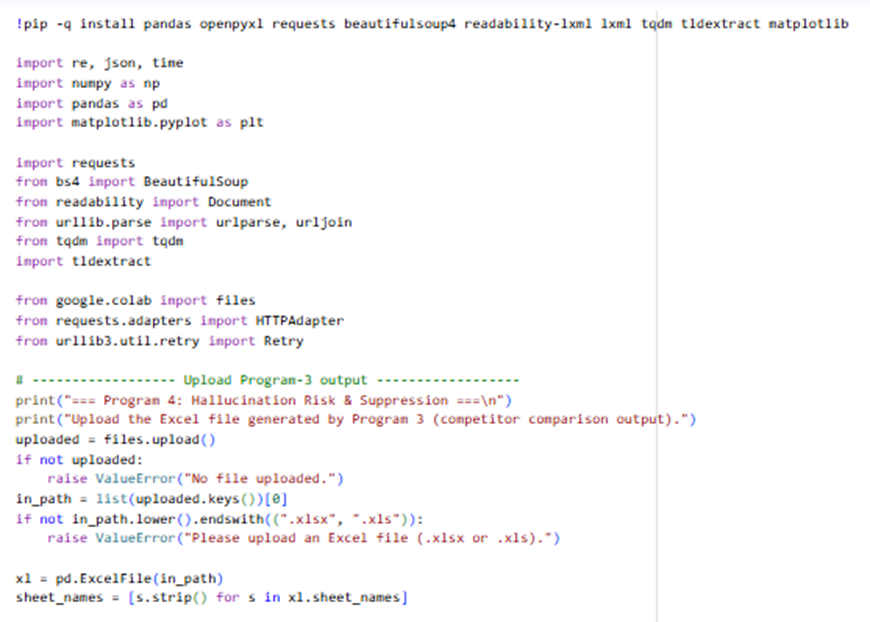
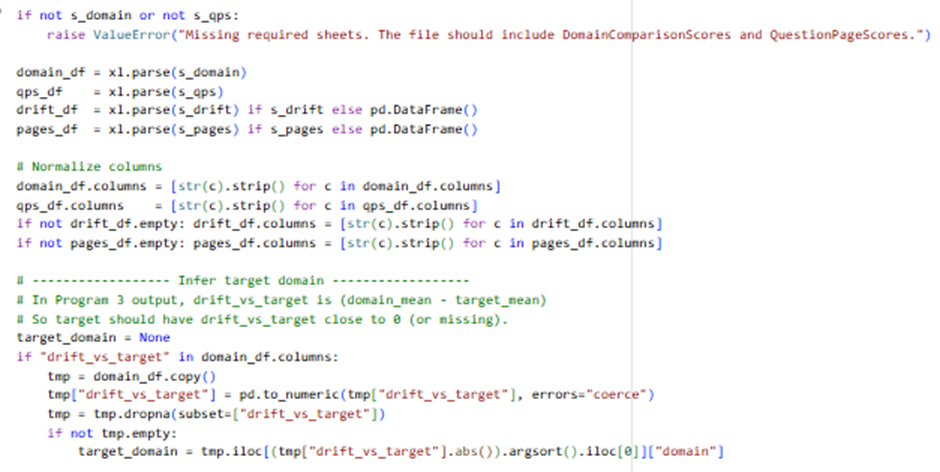
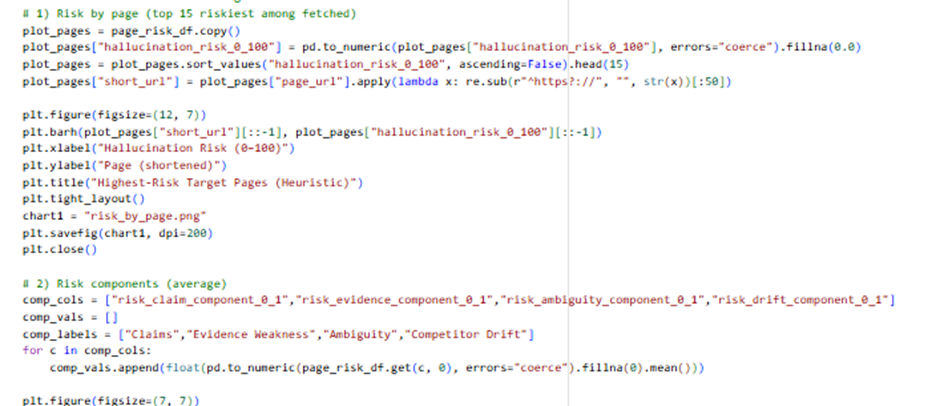
Here is the Google Colab Experiment:
https://colab.research.google.com/drive/1qCcF8NQPqij5caCyHOB1Hr9Jm01Qwnyh
OUTPUT:
# – program4_hallucination_risk_output.xlsx
# – risk_by_page.png
# – risk_components.png
# – before_after_projection.png
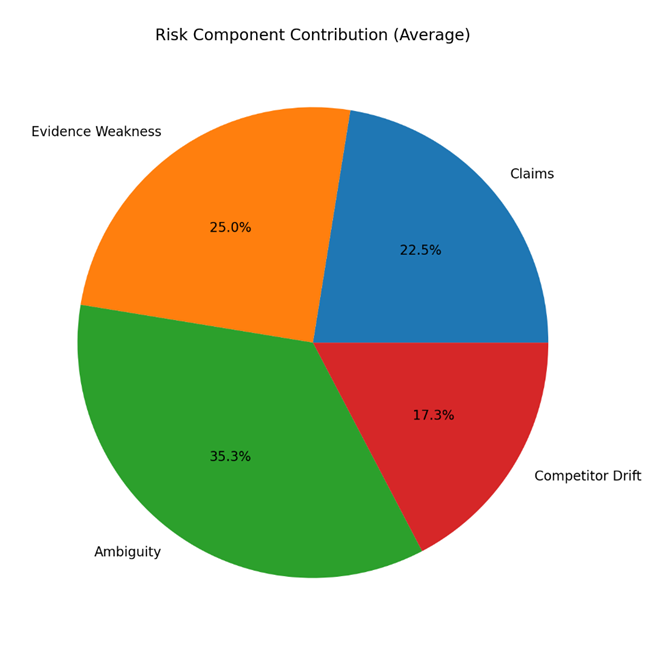
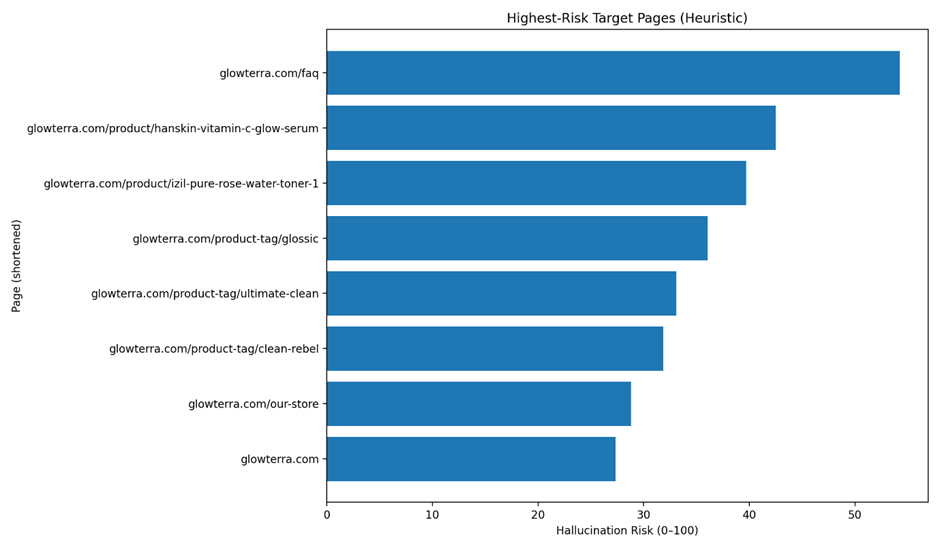

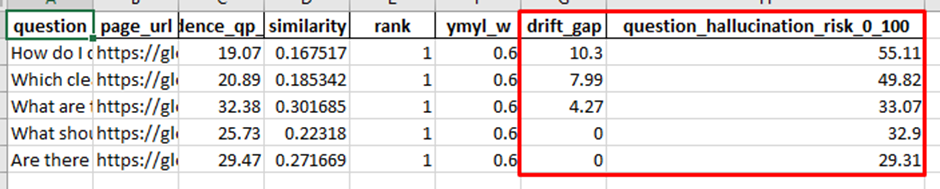

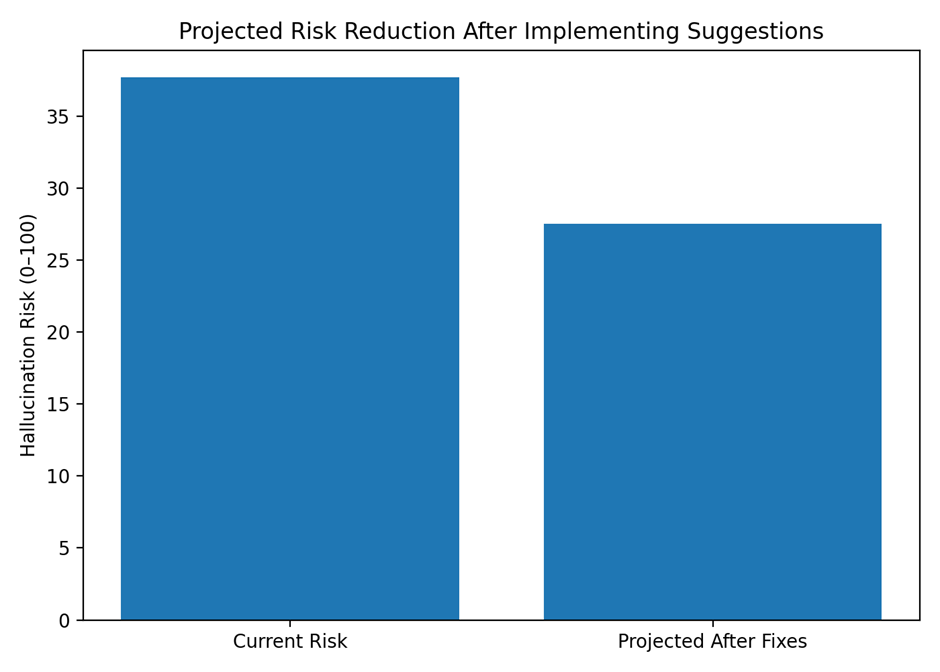
What Stage 4 Is Really Measuring
Stage 4 answers one core question:
“If an LLM mentions this site, how likely is it to hallucinate, exaggerate, or mix in incorrect/competitor information?”
Hallucination risk increases when:
- Claims are strong but weakly evidenced
- Pages are ambiguous or incomplete
- Trust signals are missing
- Competitors are more authoritative for the same questions
- Content touches YMYL areas (health, finance, legal)
📁 OUTPUT EXPLANATION (What Each File/Sheet Means)
1️⃣ Summary Sheet (Excel)
Key fields explained
| Column | Meaning |
| hallucination_risk_0_100 | Overall risk that LLMs misrepresent your site |
| projected_risk_reduction_percent | Expected reduction after fixes |
| projected_risk_after_0_100 | Risk level after implementation |
| notes | Interpretation guidance |
How to interpret scores
| Score | Meaning |
| 0–20 | Very safe (LLMs likely accurate) |
| 20–40 | Moderate risk |
| 40–60 | High risk |
| 60+ | Critical hallucination exposure |
Practical actions (Summary level)
- If risk ≥40 → Hallucination suppression must be prioritized
- If projected reduction is <15% → you need structural changes, not just content tweaks
2️⃣ PageRisk Sheet
What this is
Per-page hallucination risk breakdown.
Each row = one important page that LLMs are likely to cite.
Key columns
| Column | Meaning |
| hallucination_risk_0_100 | Page-level risk |
| claim_count | Number of risky claims |
| risk_claim_component_0_1 | Claim-driven risk |
| risk_evidence_component_0_1 | Missing evidence risk |
| risk_ambiguity_component_0_1 | Incomplete / unclear content |
| risk_drift_component_0_1 | Competitor confusion risk |
Practical actions (Page-level)
For pages with risk >50:
- Rewrite claim-heavy sections
- Remove absolutes (“guaranteed”, “best”, “#1”)
- Add qualifiers (“may”, “typically”, “depending on”)
- Attach evidence directly
- Statistics → citations
- Compliance → official docs
- Performance → methodology
- Add visible trust blocks
- Author bio
- Last updated date
- Editorial policy link
3️⃣ QuestionRisk Sheet
What this shows
Risk at the question level.
Some questions are more dangerous for hallucination than others.
Key drivers
- Low confidence answers
- High competitor drift
- YMYL topics
Practical actions (Question-level)
For questions with risk ≥50:
- Create a dedicated answer section
- Add:
- Clear definition
- Scope & limitations
- “What this does NOT mean” paragraph
- Avoid marketing language completely
This sharply reduces LLM fill-in behavior.
4️⃣ ExtractedClaimsSample Sheet
What this is
Actual sentences extracted from your pages that are likely to be:
- Quoted incorrectly
- Overgeneralized
- Hallucinated
This is gold for editors.
Practical actions (Editorial review)
For each extracted sentence:
- Ask: “Can this be misquoted without context?”
- If yes:
- Rewrite
- Add a footnote
- Add a qualifier
- Place evidence immediately after the claim
5️⃣ Suggestions Sheet
What it contains
System-generated risk reduction actions, each mapped to a cause.
Examples:
- Add references
- Add authors
- Add editorial policy
- Reduce absolute claims
- Add structured data
How to implement suggestions systematically
Suggested order (highest impact first)
- References / citations
- Author + reviewer
- Updated date
- Editorial policy
- Schema alignment
- Claim softening
📊 VISUAL DIAGRAMS EXPLAINED
📈 risk_by_page.png
Shows the riskiest pages visually.
Action:
- Top 5 bars = immediate rewrite candidates
- These pages are where LLM hallucination will most likely occur
🧩 risk_components.png
Pie chart showing why risk exists.
Example:
- Evidence Weakness = 45%
- Claims = 30%
Action:
- Don’t waste time fixing low-impact areas
- Fix the largest slice first
📉 before_after_projection.png
Shows risk reduction after fixes.
This is ideal for:
- Client reporting
- ROI justification
- Change validation
🛠️ PRACTICAL IMPLEMENTATION ROADMAP (TARGET WEBSITE)
Phase 1 — Safety Stabilization (Week 1–2)
Goal: Stop LLM hallucinations immediately
- Remove absolutes and guarantees
- Add visible references
- Add author + updated date
- Add disclaimers for YMYL content
Phase 2 — Structural Trust (Week 3–4)
Goal: Give LLMs confidence anchors
- Create:
- Editorial policy page
- Methodology page
- Add:
- Organization schema
- Article/FAQ schema
- Standardize content templates
Phase 3 — Precision Reinforcement (Ongoing)
Goal: Prevent future hallucinations
- Add “Limits & scope” sections
- Update content quarterly
- Monitor drift monthly with Program 3
- Re-run Stage 4 after major updates
🎯 What This Achieves in Real Terms
After implementation:
- LLM mentions become more accurate
- Fewer exaggerated or mixed claims
- Reduced legal/compliance exposure
- Stronger trust signals for AI platforms
You’re not just optimizing for ranking — you’re optimizing for safe, correct AI citation.
Final Thoughts
AIEO represents a decisive shift in how digital success is achieved in an AI-first environment. Visibility alone no longer guarantees results. What matters is how clearly a brand is understood, how strongly it is trusted, and how confidently it is recommended within AI-generated decisions.
Tuhin Banik’s approach moves beyond surface-level optimization and focuses on deeper alignment between user intent, contextual clarity, and decision-making logic. By structuring content for understanding rather than just discovery, ThatWare’s AIEO ensures brands become part of the answer, not just an option among many. To get exceptional results, we often blend the core techniques of AEO, GEO, Hyper-Intelligence, and CrSEO.
The evolution of search behavior further reinforces this need. Users now expect immediate clarity, not endless exploration. They rely on AI systems to filter choices and guide decisions. In this landscape, brands that communicate with precision and consistency naturally gain preference.
AIEO creates that advantage by reducing uncertainty and strengthening trust at every interaction point. It transforms digital presence into a reliable decision asset.
Ultimately, the goal is simple yet powerful. Become the brand AI systems understand best and trust most. When that happens, visibility turns into selection, and selection turns into sustained growth.