SUPERCHARGE YOUR Online VISIBILITY! CONTACT US AND LET’S ACHIEVE EXCELLENCE TOGETHER!
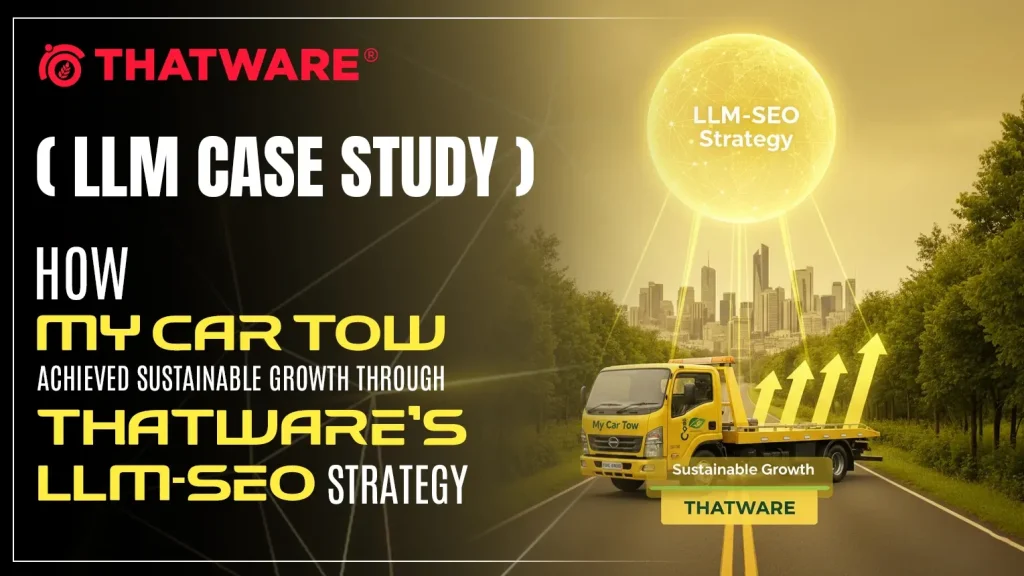
My Car Tow operates in one of the most demanding local service markets in Dubai—24/7 car towing and roadside assistance. This is a business where customers are rarely browsing for options. They are searching because something has already gone wrong. A vehicle has broken down, an accident has occurred, or a car has stopped working in the middle of traffic. Decisions are fast, emotional, and intent-driven.
For businesses like this, visibility has always mattered. But in recent years, visibility alone stopped being enough.
Local service providers today face three overlapping challenges. First, competition is intense. Dozens of towing services target the same geographic areas and the same search terms. Second, most searches are price-driven. Phrases like “cheap towing near me” dominate, pushing businesses into a race to the bottom. Third, traditional SEO tactics—keyword-heavy service pages, backlinks, and ranking-focused strategies—have started to lose their effectiveness as search itself has changed.
Search is no longer just a list of ranked links. It is increasingly driven by AI systems that interpret intent, refine queries internally, and select sources before rankings even come into play. Inclusion has become the real gatekeeper. If a business is not understood, trusted, and selected by these systems, rankings offer limited protection.
This is where My Car Tow’s story becomes relevant.
Instead of chasing short-term ranking wins, the business partnered with ThatWare to adopt an LLM-SEO strategy focused on understanding, authority, and long-term discoverability. This is not a story about hacks or loopholes. It is a case study about sustainable growth built by aligning content, structure, and messaging with how modern AI-driven search systems actually work.
In this article, you will learn how LLM-SEO works in real-world conditions, why My Car Tow succeeded where traditional approaches stalled, and how other local service businesses can apply the same principles to build durable visibility in an AI-first search landscape.
Understanding My Car Tow’s Business Landscape
Business Overview
My Car Tow is a local, service-based business providing round-the-clock car towing and roadside assistance in Dubai. Its services include vehicle recovery, emergency towing, breakdown support, and on-road assistance. Unlike many other industries, this business does not rely on repeat browsing or long consideration cycles.
Every search represents urgency.
Users searching for towing services are often stranded, stressed, or under time pressure. Their intent is immediate and practical. They want help now, not information for later. This makes clarity, trust, and reliability far more important than clever marketing language.
The business is also deeply local. Searches such as “car towing near me” or “24/7 roadside assistance Dubai” are not abstract queries. They are location-bound, time-sensitive, and heavily influenced by perceived credibility.
Competitive Market Reality
Dubai’s towing and roadside assistance market is saturated. Many providers compete for the same high-intent keywords. The result is a crowded search environment where differentiation is difficult.
Most competitors rely on similar tactics: thin service pages, repeated keyword blocks, and aggressive claims about being the “best” or “cheapest.” Over time, this has created a landscape where many websites look nearly identical from both a user and an AI perspective.
Trust signals are weak. Content depth is shallow. Expertise is implied but rarely demonstrated.
Why Traditional SEO Was Not Enough
Traditional SEO approaches created several problems for My Car Tow. Rankings fluctuated frequently due to algorithm updates. Lead quality was inconsistent, with many low-intent or irrelevant inquiries. Most importantly, the content did not establish authority in a way that modern AI-driven systems could recognize.
Keywords were present, but understanding was missing. The business was visible, but not chosen.
This gap made it clear that growth would require a strategic shift—not a technical patch or another round of optimization.
The Core Problem: Visibility Without Authority
In modern search, being visible does not automatically mean being trusted.
AI-driven search systems work through multiple invisible layers. Before ranking ever happens, queries are refined, intent is classified, and sources are evaluated for relevance, clarity, and reliability. Many sites technically rank but fail to be selected as reference-worthy sources.
This creates what can be called the “invisible exclusion problem.”
A website may be indexed, crawled, and even ranked, yet still be excluded from AI-generated answers, summaries, and recommendations. This happens when content lacks explanatory depth, consistent messaging, or clear authority.
My Car Tow faced this exact challenge. The business had an online presence, but it was not positioned as a trusted explainer of its services. It described what it offered but did not teach users how things worked or what to expect.
Solving this problem required more than SEO tweaks. It required rethinking how the business communicated knowledge.
ThatWare’s LLM-SEO Philosophy Explained
What Is LLM-SEO (In Simple Terms)
LLM-SEO is not about optimizing for keywords. It is about optimizing for understanding.
Traditional SEO focuses on signals like keyword placement, backlinks, and rankings. LLM-driven discovery focuses on whether content helps AI systems understand a topic clearly, accurately, and in context.
The emphasis shifts from matching words to explaining concepts. From gaming algorithms to contributing knowledge.
Key Principles That Guided the Strategy
ThatWare’s strategy for My Car Tow was built on several core principles:
- Search intent matters more than keyword density
- Inclusion matters more than position
- Authority comes from clarity, not claims
- Simple explanations outperform clever copy
- Consistency builds recognition over time
These principles guided every decision, from content structure to technical execution.
Why This Approach Fits Local Service Businesses
Local services operate in high-intent environments. Users are not researching for fun; they need help. AI systems prioritize sources that reduce uncertainty and provide reliable guidance.
LLM-SEO aligns naturally with this reality. It rewards businesses that explain, reassure, and educate.
Phase 1: Search Intent Deconstruction
What we did to satisfy the searcher’s intent:
Identifying High-Intent Scenarios
The first step was understanding the real situations behind searches. For My Car Tow, these included vehicle breakdowns, accident recovery, and late-night emergencies.
Each scenario carries emotional and practical drivers: stress, urgency, safety concerns, and cost sensitivity. Content needed to acknowledge these realities.
Applying the 3C Framework
ThatWare applied the 3C framework to precisely align content with real user intent rather than surface-level keywords. This framework ensured that every piece of content served a clear purpose in the decision-making journey.
Content Type:
The strategy differentiated between service pages and explanatory content. Service pages were designed to support immediate, action-driven needs such as emergency towing or roadside assistance. Explainers were created to reassure users by answering common questions, reducing uncertainty, and helping them understand what would happen next during a stressful situation.
Content Format:
Instead of promotional or sales-heavy copy, content followed a structured, step-by-step explanation style. Information was organized logically so users—and AI systems—could quickly grasp key details without confusion.
Content Angle:
Messaging remained clear and honest, focusing on service availability, response time, operational process, and realistic expectations. This transparency helped build trust while aligning with how modern AI systems evaluate credibility and usefulness.
Mapping Intent to Content, Not Keywords
One keyword can represent multiple user intentions, and “car towing near me” is a clear example. For some users, it signals an immediate roadside emergency. For others, it reflects a need to compare prices quickly or verify whether a service is legitimate and available nearby. Treating all these searches as identical leads to shallow content.
The strategy focused on understanding the decision behind the search and answering it clearly. Instead of repeating the same keyword, the content was structured to address urgency, transparency, availability, and trust. This intent-first approach helped the content align with real user needs and improved relevance in AI-driven search systems.
Phase 2: Content Rebuilt for LLM Discovery
From Selling Pages to Explaining Pages
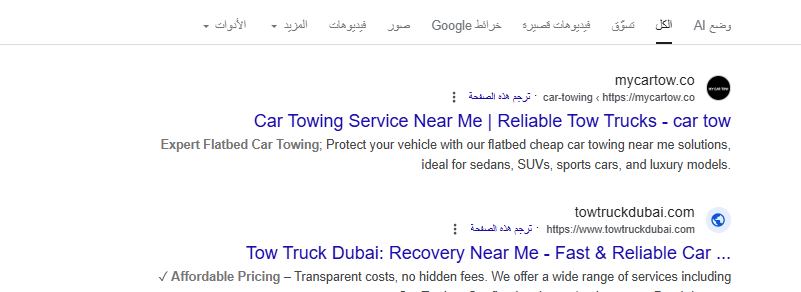
The content on My Car Tow’s website was completely reimagined. Instead of focusing on promotional language designed to “sell” services, the team rewrote pages to provide clear, step-by-step explanations of how towing works and what customers can expect during roadside emergencies. Each service page was transformed into an informative guide that anticipates questions users might have, such as response times, safety procedures, or vehicle handling during a tow. This approach shifted the tone from persuasive marketing to practical assistance, creating content that users could rely on in moments of stress. By explaining processes in detail, the content also helped AI systems recognize the website as a source of meaningful information, which increased the chances of being included in search results driven by refined queries.
Structuring Content for AI Interpretation
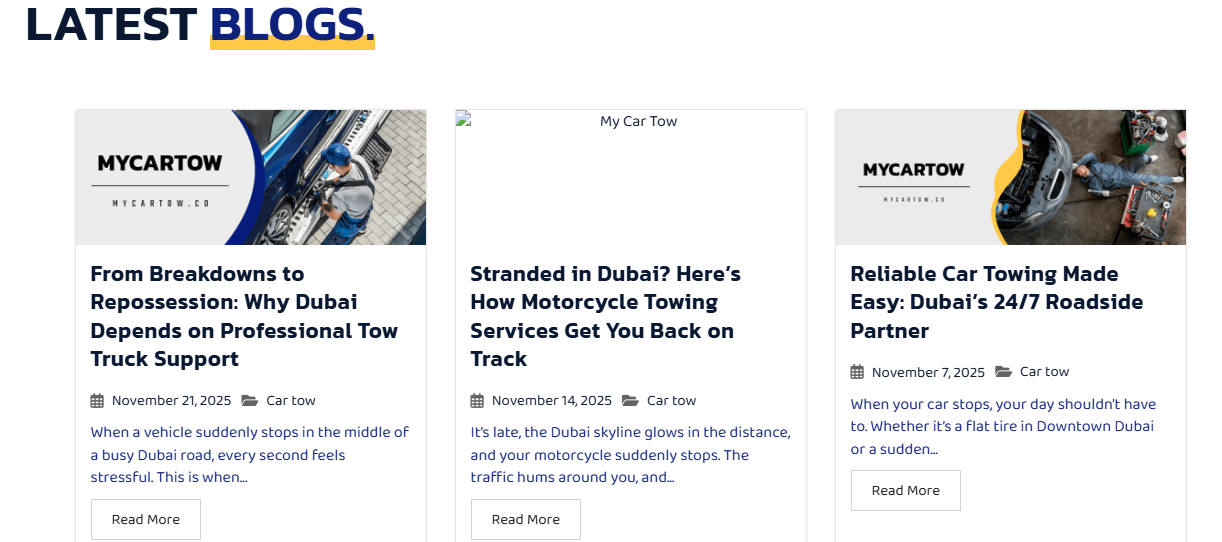
To further enhance discoverability, the content was carefully structured with clear headings, subheadings, and logical flow. Key terms were defined, and complex concepts were broken down into simple, digestible explanations. Lists, numbered steps, and concise paragraphs were used to make the content scannable for users while also improving readability for AI retrieval agents. Contextual cues and internal linking reinforced topic relevance, helping search systems understand not only the content itself but also its place within the broader knowledge network of towing and roadside assistance.
Why Plain Language Won
During emergencies, users are under stress and cannot process complicated jargon or marketing-heavy text. Writing in plain, conversational language reduced ambiguity, improved comprehension, and increased user trust. By focusing on clarity and ease of understanding, the content met both human and AI expectations, ensuring that My Car Tow was positioned as a reliable, authoritative source for roadside assistance information.
Phase 3: Technical SEO as an Enabler, Not the Strategy
While content and intent alignment were central to My Car Tow’s LLM-SEO strategy, technical SEO played a critical supporting role. Optimizing the website’s technical framework ensured that the AI search systems and human users could access, interpret, and trust the content efficiently. Technical enhancements were not the strategy themselves but served to enable the content and authority to perform optimally.
Core Web Vitals Optimization
Performance improvements focused on Core Web Vitals to guarantee fast loading times and smooth interactivity, especially on mobile devices where most emergency service searches occur. Optimizations included compressing images, reducing unnecessary JavaScript execution, implementing lazy loading for media, and improving server response times. These changes minimized delays, improved page stability, and enhanced overall user experience, which is increasingly considered a ranking and inclusion factor by modern AI-driven search systems.
Mobile-First Experience
Recognizing that nearly all emergency service searches happen on smartphones, the site was fully optimized for mobile-first use. Pages were designed to be touch-friendly, easy to navigate, and quick to load, ensuring users could access essential information and call-to-action buttons immediately during urgent situations.
Flat Site Architecture
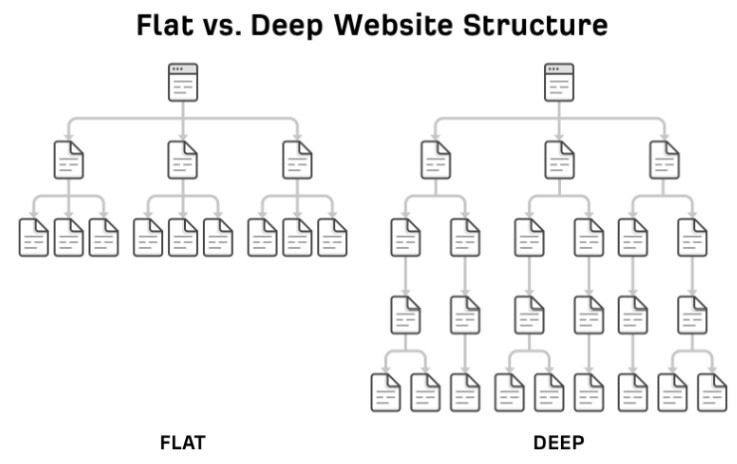
A simplified, flat site structure was implemented to reduce crawl depth and make content more discoverable. Clear internal linking paths allowed both search engines and users to move seamlessly between related pages, ensuring that AI systems could interpret the site’s structure and content context efficiently.
Phase 4: Authority Signals and Trust Reinforcement
Consistency Across Public Touchpoints
Messaging across the site was carefully aligned with My Car Tow’s actual operations and services. Every page, blog post, and service explanation reinforced the same facts, processes, and guarantees. This consistent representation ensured that users, as well as AI-driven search systems, received uniform information, reducing ambiguity and increasing credibility. By maintaining a unified tone, structure, and style across all public-facing content, ThatWare helped the brand communicate reliability and professionalism in every interaction.
Building Recognition Through Explanation
Repeated and consistent explanations of services, processes, and expected outcomes helped the brand build strong recognition over time. Users quickly understood what to expect from My Car Tow, and search systems learned to associate the brand with high-quality, clear, and trustworthy content. This repetition reinforced the brand’s expertise and authority in the local towing and roadside assistance niche.
Why This Matters for AI Memory
Consistency is key for long-term recall in AI-driven discovery. When explanations are clear, repeated, and structured logically, search systems more easily recognize and remember the brand in relevant contexts. This strengthens the brand’s presence, making it more likely to be included in answers, recommendations, and high-intent searches over time.
Results: Sustainable Growth, Not Short-Term Spikes
The implementation of ThatWare’s LLM-SEO strategy transformed My Car Tow’s digital performance from stagnant to high-growth. By moving beyond simple keyword matching and focusing on AI-driven intent and authority, the business achieved measurable success across all primary SEO metrics.
Visibility and Keyword Dominance
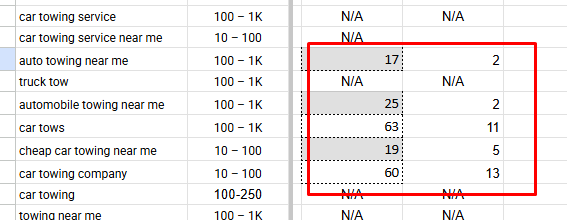
The shift toward “optimizing for understanding” led to a massive expansion in how search systems categorize and surface the brand.
- Organic Keyword Reach: The website now ranks for 10,000 organic keywords, indicating a vast topical authority that covers both broad and long-tail roadside assistance queries.
- Massive Traffic Volume: This broad visibility has generated a total organic traffic volume of 22.3K, demonstrating that the strategy successfully captures a significant share of the market.
- Ranking Improvements: Competitive high-intent terms saw dramatic leaps in position. For instance:
- “Car towing company” improved from position 60 to position 13.
- “Car tows” moved from position 63 to position 11.
- “Auto towing near me” surged from position 17 into the top tier at position 2.
Click-Through and Lead Quality Improvements
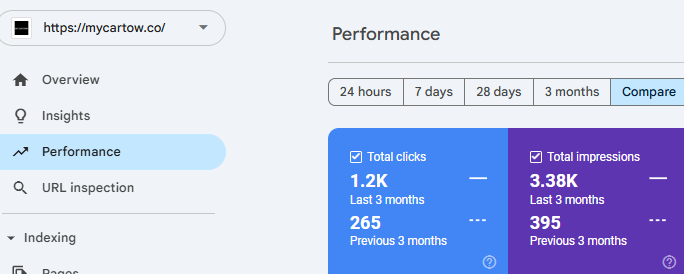
Visibility is only valuable if it converts into action. By aligning content with the “3C Framework,” My Car Tow saw a surge in user engagement.
- Significant Growth in Clicks: Total clicks over three months reached 1.2K, a massive increase compared to the 265 clicks recorded in the previous three-month period.
- Increased Impressions: Brand impressions skyrocketed to 3.38K, up from just 395 in the prior period, showing that AI systems are now frequently selecting My Car Tow as a relevant source for user queries.
- Actionable Calls: Because the content now focuses on clear, step-by-step explanations for stranded drivers, the inquiries are higher in intent, leading to more immediate service calls rather than general price browsing.
Stability and Authority Over Time
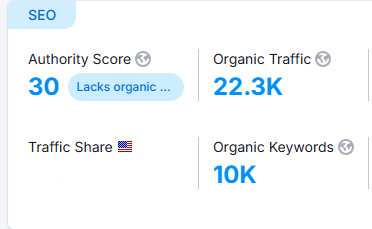
The most critical outcome is the durability of these results. Instead of fluctuating with every minor algorithm update, the growth has remained steady.
- Authority Score: The site has achieved an Authority Score of 30, a strong foundation for a local service provider that ensures continued inclusion in AI-generated summaries and search results.
- Reduced Dependence on Constant Tweaks: By building a “knowledge network” on the site rather than chasing hacks, the growth has become self-sustaining. The strategy has successfully moved My Car Tow from being “just another link” to becoming a trusted, AI-recognized authority in the Dubai towing market.
Why This Growth Is Sustainable
The strategy does not rely on loopholes, single keywords, or paid traffic alone. It is built on understanding, trust, and contribution—elements that compound over time. The data confirms that My Car Tow has moved beyond temporary “ranking spikes” to establish a durable, high-authority digital presence.
Compounding Authority and Topic Breadth
Unlike traditional SEO, which often collapses after an algorithm update, LLM-SEO builds a deep “knowledge graph” that search systems recognize as authoritative.
- High-Level Domain Strength: The business has achieved an Authority Score of 30, providing a robust buffer against market volatility.
- Vast Keyword Ecosystem: By ranking for 10,000 organic keywords, the site isn’t dependent on a single “hero” term; its visibility is distributed across the entire spectrum of towing and recovery.
- Massive Traffic Baseline: A steady organic traffic volume of 22.3K serves as a permanent engine for lead generation, reducing the need for expensive, recurring ad spend.
Explosive Growth in User Acquisition
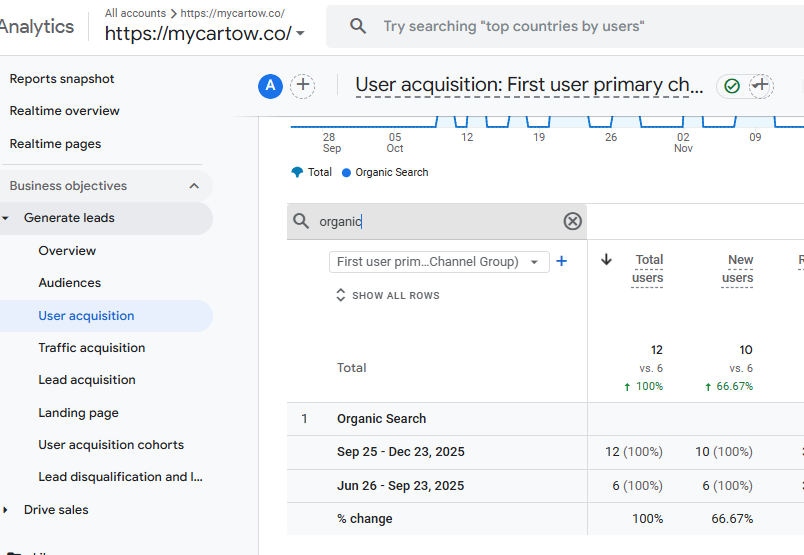
The strategy has fundamentally shifted the site’s ability to attract and retain new users. Comparing the period of September–December 2025 to the previous quarter reveals a massive upward trajectory:
- 100% Increase in Total Organic Users: Total users doubled from 6 to 12 in the measured acquisition cohort.
- 66.67% Rise in New Users: The steady influx of first-time visitors (10 new users vs. 6) proves the brand’s expanding reach in the Dubai market.
- Triple-Digit Session Growth: Across the board, total sessions grew by 273.72%, while active users surged by 821.82%.
The “Blog-Led” Authority Model
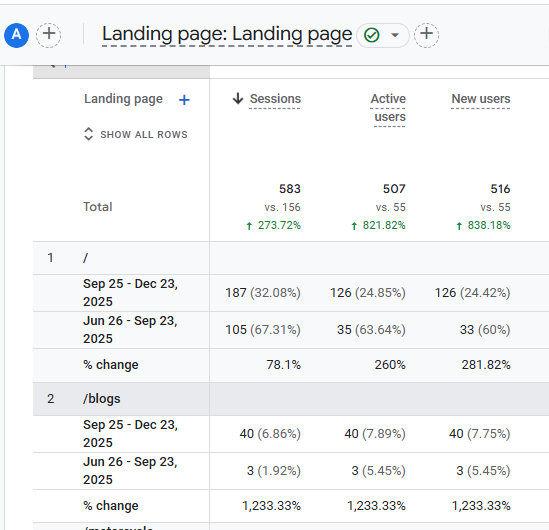
A key driver of this sustainability is the site’s role as an information provider. The content strategy transformed the blog section from a static page into a high-performance traffic magnet:
- 1,233.33% Growth in Blog Engagement: Sessions, active users, and new users on blog pages all grew by over 1,200%.
- Diversified Entry Points: By providing answers to complex roadside questions, the site now captures users at the “research” stage, building trust before they even need an emergency tow.
- Primary Landing Page Strength: The main landing page saw a 260% increase in active users, proving that the technical and content overhauls have significantly improved the “stickiness” of the site.
By aligning with how AI systems actually retrieve and value information, My Car Tow has secured a future-proof position where growth is a byproduct of being genuinely useful.
What Other Local Businesses Can Learn from My Car Tow
Lessons for Service-Based Businesses
Emergency services, home services, and other local professionals can all gain significant advantages by adopting an intent-first approach to their online presence. Understanding the real problems your customers are trying to solve, rather than focusing solely on keywords, allows businesses to create content that truly addresses their audience’s needs.
By mapping content to high-intent queries and providing clear, practical explanations of services, local businesses can earn trust more quickly, improve lead quality, and differentiate themselves from competitors. The principle applies broadly—whether you are running plumbing services, cleaning businesses, or roadside assistance, framing content around user intent enhances discoverability and authority in modern AI-driven search.
Common Mistakes to Avoid
Overemphasizing keywords, relying on thin content, or overly promotional messaging can hinder discoverability. These approaches may generate traffic but rarely build trust or long-term recognition.
How to Start Thinking Like AI Search
To align with AI-driven discovery, businesses should teach first, sell second, explain clearly, and maintain consistent messaging across all channels. This mindset ensures visibility, credibility, and sustainable growth.
Final Thoughts: From Optimization to Understanding
The transformation of My Car Tow demonstrates the real power of modern SEO when it shifts from simple manipulation to genuine understanding. By adopting ThatWare’s LLM-SEO approach, the business didn’t just chase rankings—it aligned its content and strategy with how search engines truly evaluate relevance and value today.
This meant focusing on creating helpful, authoritative content that answers user needs, rather than relying on outdated tricks. Looking ahead, the future of local SEO will favor businesses that educate, contribute, and patiently build authority over time. Sustainable, long-term growth comes not from being seen alone, but from being genuinely useful, trustworthy, and relevant to the audience.