SUPERCHARGE YOUR Online VISIBILITY! CONTACT US AND LET’S ACHIEVE EXCELLENCE TOGETHER!
“We ranked #1!”
In most marketing teams, that sentence triggers instant celebration. Screenshots are shared. Reports are sent. Stakeholders nod approvingly. Ranking at the top of Google feels like the ultimate validation that the SEO strategy is working.
But then something strange happens.
Revenue doesn’t move. Leads don’t improve. Sales teams complain about “low-quality traffic.” Growth plateaus—despite visibility being better than ever.
This is the uncomfortable truth many businesses are forced to confront: traffic does not equal revenue. And ranking #1, on its own, is not a business win.
For founders, CMOs, and growth leaders, this disconnect is deeply frustrating. SEO appears successful on paper, yet the bottom line tells a very different story. How can a channel delivering thousands—or even millions—of visits fail to produce meaningful results?
The answer lies in how SEO success has been defined for years.
Traditional SEO reporting has trained marketers to chase what’s easiest to measure: rankings, impressions, clicks, and sessions. These metrics are visible, familiar, and simple to explain. Revenue impact, on the other hand, is messy. It’s influenced by intent, experience, trust, timing, and a dozen post-click variables that don’t show up neatly in ranking reports.
As a result, teams often optimize for visibility over value. SEO becomes a race to the top of the SERP, not a system designed to turn demand into dollars.
Here’s the critical shift most businesses miss: ranking #1 is not a business outcome—it’s a distribution event. It gets attention, not commitment. The real test of SEO performance doesn’t happen on Google’s results page. It happens after the click, when users decide whether to trust you, engage with you, and ultimately buy from you.
In this article, you’ll learn why vanity metrics continue to dominate SEO strategy, where most SEO campaigns quietly break down once traffic arrives, and how to move from a ranking-first mindset to a revenue-first SEO approach. Because in modern SEO, visibility is just the beginning—and success is defined by what happens next.
What Are SEO Vanity Metrics—and Why We Obsess Over Them
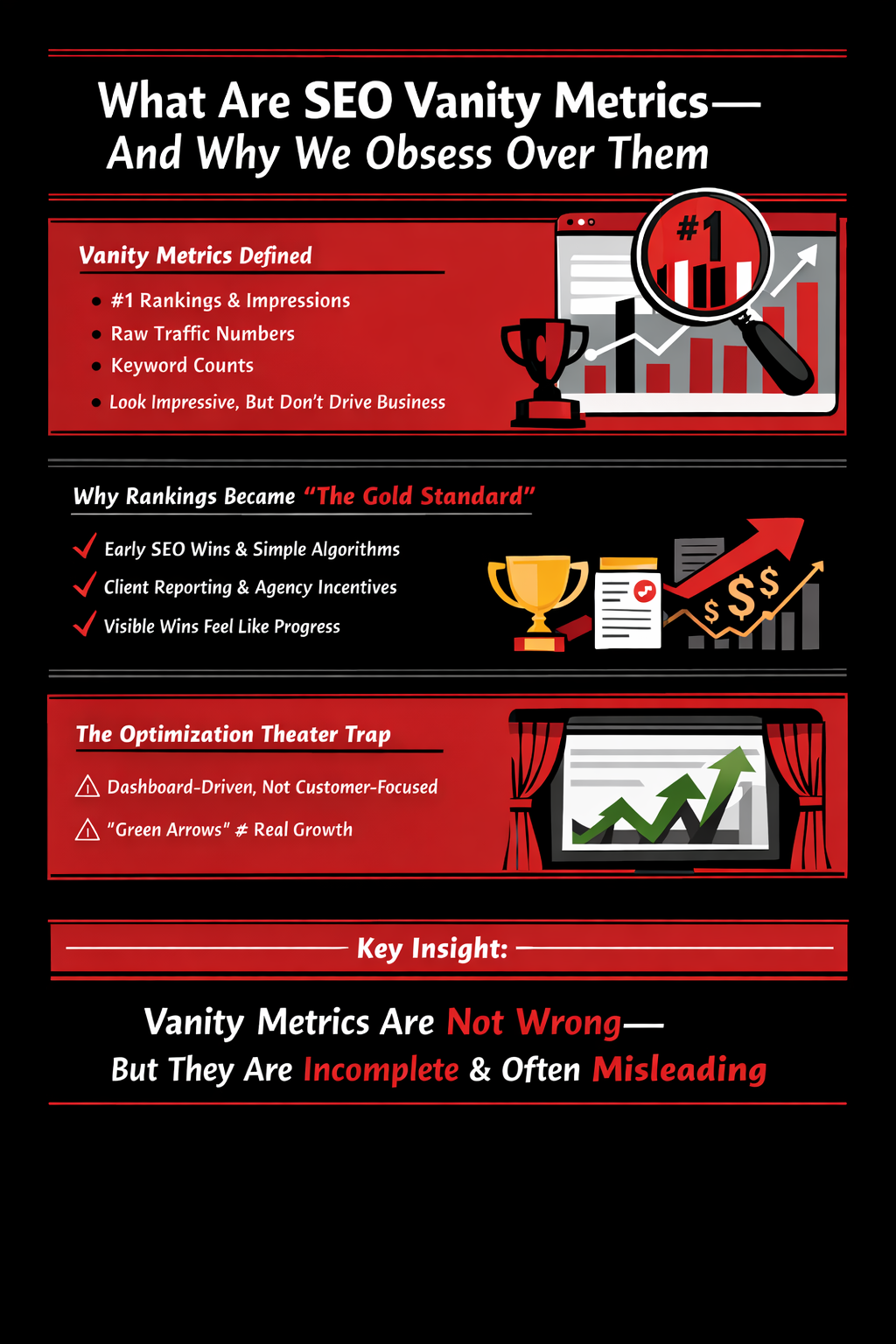
SEO vanity metrics are the numbers that look like success but often fail to translate into meaningful business outcomes. They’re easy to track, easy to report, and easy to celebrate—but dangerously easy to misinterpret.
At the top of the list are rankings, impressions, raw traffic, and keyword counts. Seeing your site rank #1, watching impressions climb, or reporting “50% more organic traffic” feels like undeniable progress. These metrics signal visibility and reach, which are important—but they stop short of answering the only question that really matters: did this growth create revenue, leads, or profit? Vanity metrics create the illusion of momentum without confirming impact.
So why did rankings become the gold standard of SEO success?
Part of the answer lies in SEO’s early history. When search algorithms were simpler, higher rankings often did correlate directly with more business. If you ranked first, you usually won the click—and frequently the customer. Over time, however, search behavior became more complex, SERPs became crowded, and buyer journeys became longer. The metric stayed the same, but the reality changed.
Another major factor is client reporting culture and agency incentives. Rankings and traffic are clean, visual, and emotionally satisfying. They fit neatly into monthly reports and slide decks. For agencies, they’re also easier to influence and defend than downstream metrics like revenue, which depend on product, pricing, sales, and conversion experience. As a result, SEO success became framed around what’s easiest to show, not what’s hardest to achieve.
There’s also a strong psychological bias at play. Humans are wired to respond to visible progress. A keyword moving from position 8 to position 2 feels like a win—even if it doesn’t change revenue at all. Green arrows, upward graphs, and percentage increases trigger a sense of accomplishment, even when nothing meaningful has improved.
This leads to what can be called optimization theater: teams optimizing for dashboards instead of customers. Content is created to rank, not to persuade. Pages are optimized for keywords, not clarity. Reports look healthier every month, while sales remain flat. The metrics are moving—but the business isn’t.
The key insight is this: SEO vanity metrics are not wrong—but they are incomplete and often misleading. They describe visibility, not value. When treated as final outcomes instead of diagnostic signals, they distort priorities and hide real problems. True SEO success starts where vanity metrics end—at the point where traffic becomes trust, intent becomes action, and visibility becomes revenue.
The Moment SEO Actually Starts: After the Click
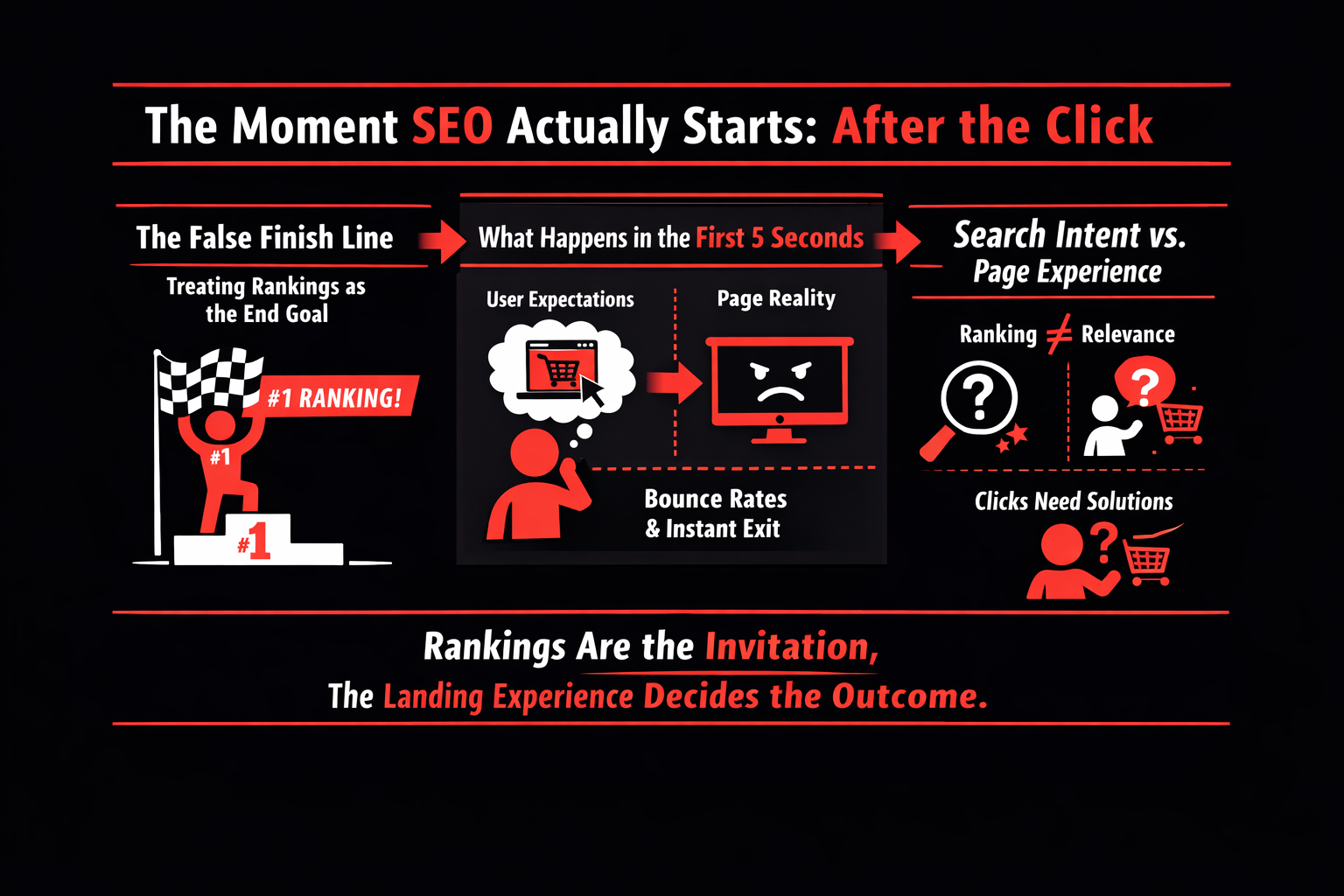
For many teams, SEO success feels complete the moment a page hits the #1 position. Reports are sent, dashboards turn green, and the assumption is clear: the job is done. This is the false finish line of SEO. Rankings are treated as the end goal because they are visible, easy to measure, and easy to celebrate. But in reality, rankings are not outcomes—they are merely access. The real work of SEO doesn’t end on the search results page; it begins after the click.
A click is not a conversion. It is an entry point into your funnel. Until a user lands on your page, evaluates what they see, and decides to take the next step, SEO has delivered nothing of business value. Yet most SEO strategies stop at visibility, assuming that traffic will somehow turn into revenue on its own.
This becomes painfully clear in the first five seconds after a user lands on a page. In that brief window, visitors subconsciously ask: Is this what I was looking for? Can I trust this? Is this worth my time? If the page fails to meet their expectations—whether due to unclear messaging, slow load time, poor layout, or generic content—the result is instant dissatisfaction. The bounce isn’t accidental; it’s a signal that the promise made in the SERP was broken on the page.
This disconnect often comes from confusing search intent with page experience. Ranking for a query does not mean you are actually satisfying the user’s underlying need. Google rewards relevance based on algorithms and signals, but buyers judge relevance based on clarity, confidence, and usefulness. A page can be “relevant” enough to rank and still be completely ineffective at moving someone forward.
Think of rankings as an invitation. They get people through the door. But once they arrive, the landing experience decides everything—whether the visitor stays, trusts you, and takes action, or leaves without a second thought.
Ranking #1 for the Wrong Intent: The Silent Revenue Killer
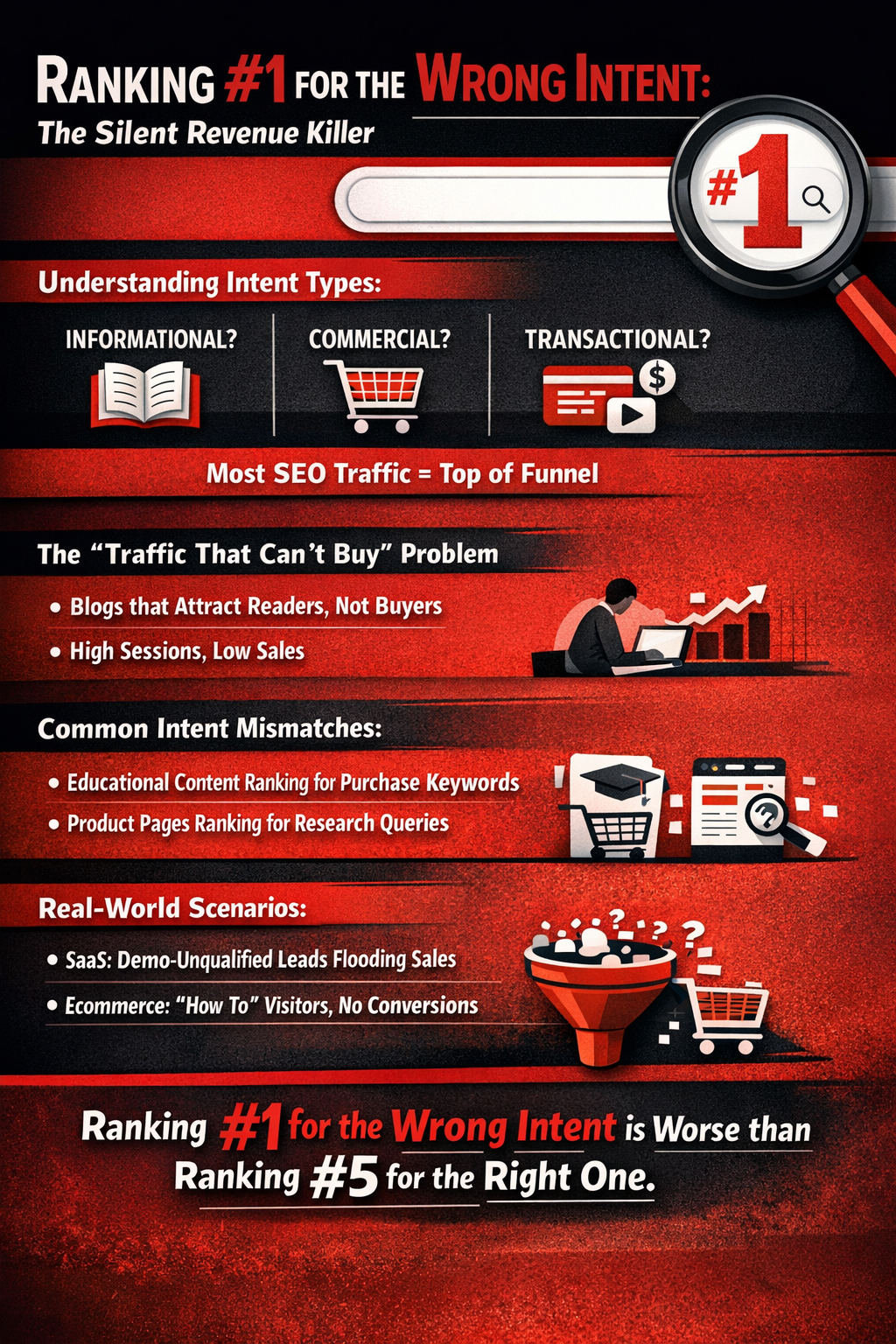
Ranking #1 feels like winning—until you look at revenue and realize nothing moved. One of the most overlooked reasons this happens is search intent mismatch. You didn’t just rank; you ranked for the wrong reason.
Understanding Intent Types
Every search query carries intent, and broadly, it falls into three categories:
- Informational intent: The user wants to learn something (“what is CRM software,” “how SEO works”).
- Commercial intent: The user is comparing options (“best CRM tools,” “SEO software comparison”).
- Transactional intent: The user is ready to buy or take action (“buy CRM software,” “SEO agency pricing”).
The problem? Most SEO traffic is informational by default. Blogs are easier to rank, safer to create, and scale faster than conversion-focused pages. As a result, many sites build massive top-of-funnel visibility—but very little purchase intent.
Traffic grows. Revenue doesn’t.
The “Traffic That Can’t Buy” Problem
This is where the illusion of SEO success sets in. Analytics show rising sessions, longer page views, and keyword wins. But sales teams see no improvement.
Why? Because the content attracting traffic isn’t designed to sell—or even guide users toward buying.
Blogs often:
- Answer questions without positioning a solution
- Educate without framing a next step
- Attract readers who are months away from a decision
The result is high sessions, low sales—traffic that looks impressive but has no commercial value.
Common Intent Mismatches
Intent mismatch usually happens in two costly ways:
- Educational content ranking for purchase-ready keywords
A blog post ranks for a keyword like “best project management software,” but instead of comparisons, pricing, or differentiation, users land on a generic educational article. They bounce—not because the content is bad, but because it doesn’t match their readiness to buy. - Product pages ranking for research queries
Conversely, product or pricing pages sometimes rank for “what is” or “how to” keywords. Users looking to learn aren’t ready to see a sales pitch, so engagement drops and trust erodes.
In both cases, ranking success actively works against conversion.
Real-World Scenarios
- SaaS companies generate thousands of organic leads, only to find sales teams rejecting most of them. Demos are booked, but prospects lack budget, authority, or urgency.
- eCommerce brands rank for “how to choose running shoes” or “how to clean leather bags,” but those pages never connect users to product pages in a meaningful way—education without monetization.
Key Takeaway
Ranking #1 for the wrong intent doesn’t just fail to help—it blocks revenue by attracting the wrong audience at scale. In many cases, ranking #5 for a high-intent keyword will outperform the #1 spot for an informational one.
SEO doesn’t fail because it can’t rank.
It fails because it ranks for the wrong reasons.
Why Most SEO Content Fails to Convert
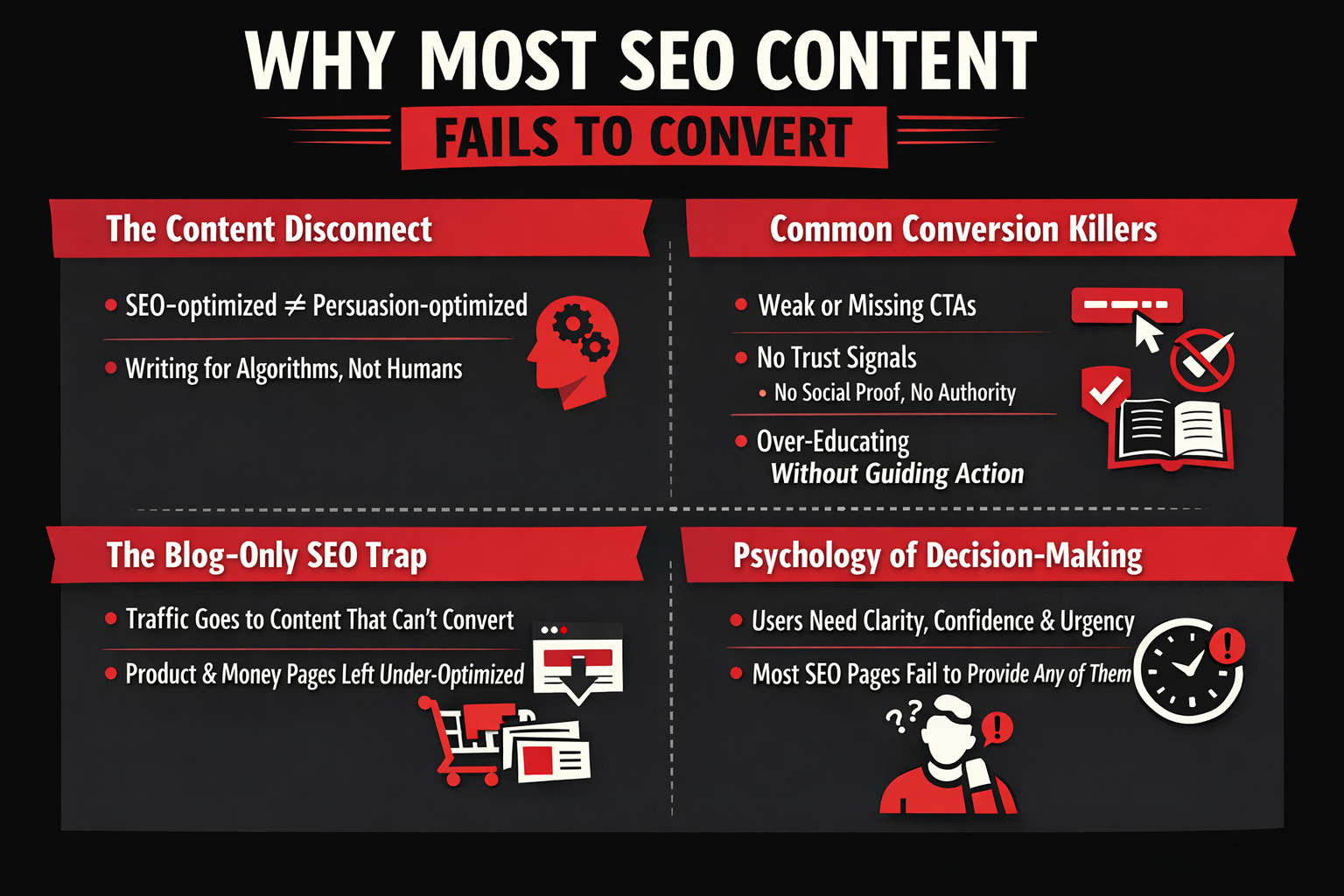
For many businesses, SEO content does its job—just not the job that matters most. Pages rank, traffic grows, and dashboards look healthy. Yet leads remain flat and revenue refuses to move. This gap exists because most SEO content is built to attract clicks, not to influence decisions.
The Content Disconnect
The core problem is simple: SEO-optimized does not mean persuasion-optimized. Much of today’s content is written to satisfy algorithms—keyword density, headings, word count, internal links—while neglecting the human on the other side of the screen. When content is designed primarily to rank, it often reads like an information dump rather than a guided experience. It answers questions but fails to shape intent, build desire, or reduce doubt. As a result, users consume the content and leave, unchanged.
Common Conversion Killers
Several recurring issues silently kill conversions across ranking pages:
- Weak or missing calls-to-action (CTAs): Many SEO pages either bury the CTA at the bottom or avoid one altogether to “keep the content informational.” Without a clear next step, users default to doing nothing.
- Lack of trust signals: High rankings don’t automatically create credibility. Pages without social proof, case studies, testimonials, expert credentials, or brand authority leave users uncertain—and uncertainty kills action.
- Over-educating without direction: SEO content often explains what and why in depth but never bridges the gap to what to do next. Education without guidance creates informed readers, not customers.
The Blog-Only SEO Trap
Another major reason SEO content fails to convert is over-reliance on blogs. Informational posts attract the bulk of traffic, but these pages are rarely designed to sell. Meanwhile, product pages, service pages, and high-intent landing pages remain under-optimized or invisible. The result is a funnel imbalance: traffic enters through content that can’t convert, with no clear path to pages that can. Ranking content becomes an island, disconnected from revenue.
The Psychology of Decision-Making
Conversion isn’t just about information—it’s about psychology. Users take action when three conditions are met: clarity, confidence, and urgency. Most SEO pages fail on all three. They overwhelm instead of clarify, inform without reassuring, and educate without creating momentum. Without a clear outcome, a reason to trust, or a prompt to act now, even the most well-ranked page becomes a dead end.
In short, SEO content fails to convert not because it lacks traffic—but because it lacks intent, persuasion, and direction.
UX, CRO, and the Post-Click Experience Nobody Owns
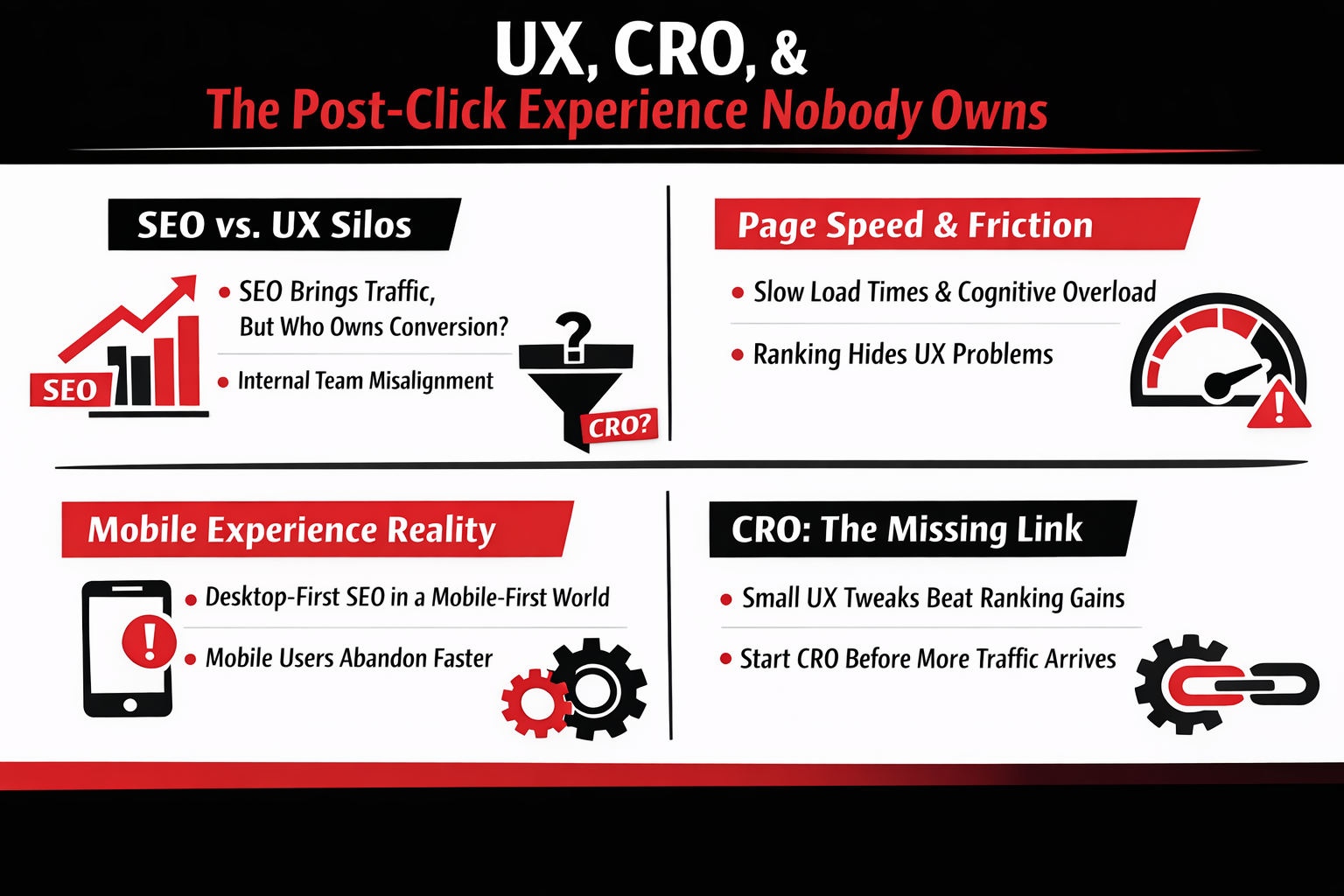
This is where most SEO campaigns quietly fail—not on Google, but inside the organization.
SEO teams are usually measured on rankings, impressions, and traffic growth. UX teams focus on usability, design consistency, and brand experience. CRO teams (if they exist at all) are tasked with improving conversions. The problem? These functions rarely operate as a single system. SEO brings users to the door, but once the click happens, ownership becomes blurry. Who is responsible if visitors bounce, hesitate, or abandon the page? In many companies, the honest answer is: no one.
This siloed structure creates a dangerous handoff. SEO “delivers” traffic, declares success, and moves on. UX and product teams may not even know which pages are driving traffic, let alone what intent those users have. The result is misalignment—great visibility paired with poor post-click performance.
The most common friction point is page experience. Slow load times, cluttered layouts, intrusive pop-ups, and unclear messaging create immediate cognitive overload. Users don’t consciously analyze these issues—they simply leave. High rankings can actually mask these problems. When traffic keeps flowing, poor UX doesn’t always show up as an urgent red flag, even though it’s quietly draining potential revenue.
Mobile experience makes this problem worse. Despite Google’s mobile-first indexing, many SEO strategies are still designed and reviewed on desktop. Pages that look “good enough” on a large screen often become frustrating on mobile—tiny text, stacked CTAs, awkward forms, and delayed loading. Mobile users are less patient, more distracted, and far more likely to abandon if anything feels difficult. Rankings may hold, but conversions collapse.
This is where CRO becomes the missing link. Small, focused improvements—clearer CTAs, faster load times, better spacing, stronger trust signals—often deliver bigger gains than chasing the next ranking position. Improving conversion rates from 1% to 2% doubles revenue without adding a single new visitor.
The key shift is timing. CRO should not come after SEO “wins.” It should happen before scaling traffic. Otherwise, you’re not growing—you’re just pouring more users into a leaky funnel.
The Analytics Illusion: When Data Lies About SEO Success
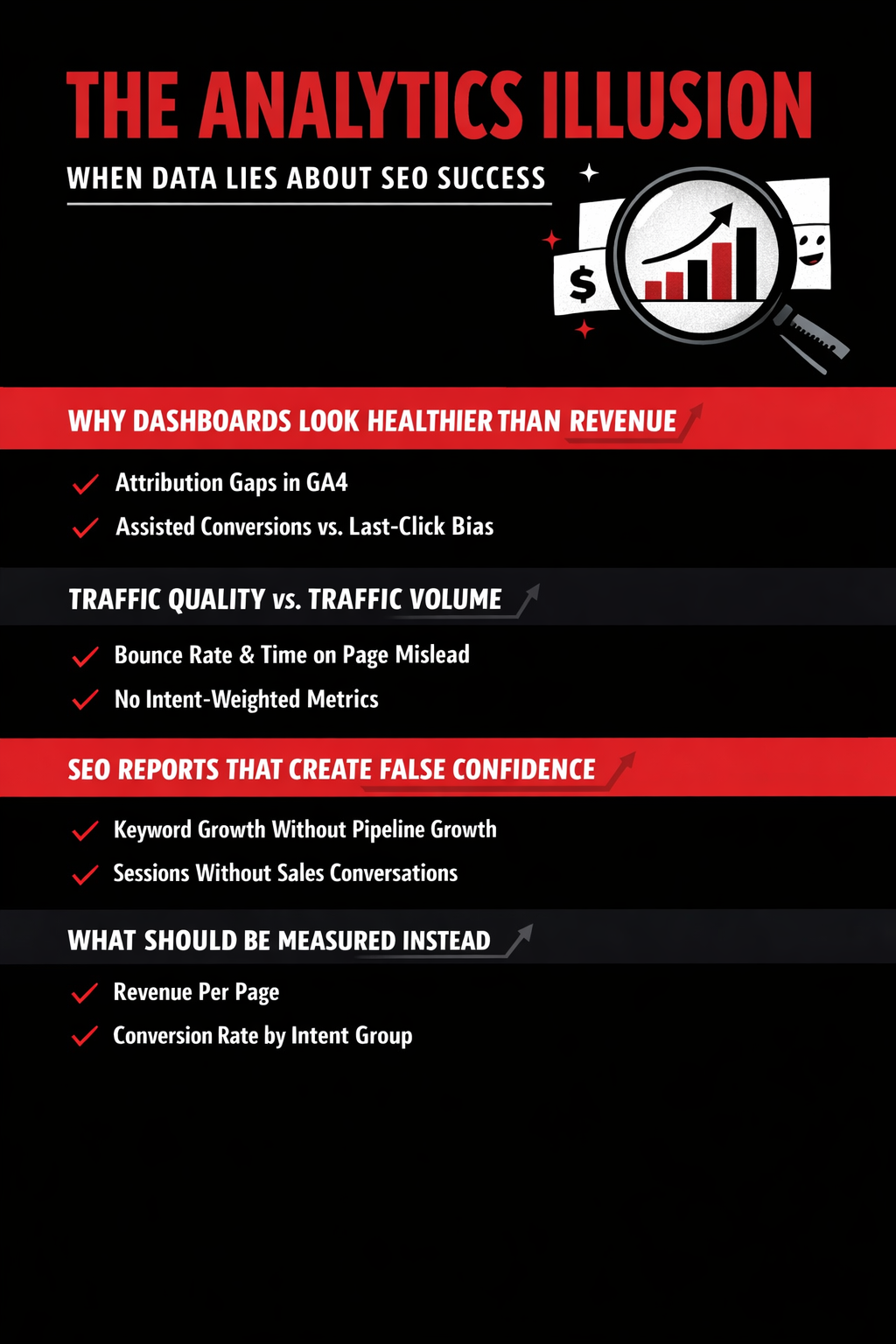
One of the most dangerous moments in SEO is when the dashboard looks healthy—but revenue doesn’t move. Green arrows, rising traffic charts, and improving keyword positions can create a powerful illusion of success. Yet for many businesses, this “data-backed confidence” is exactly what delays real growth.
Why Dashboards Look Healthier Than Revenue
Modern analytics tools, especially GA4, are excellent at tracking activity but far less reliable at explaining impact. Attribution gaps are a major culprit. SEO often plays an early or supporting role in the buyer journey, but GA4’s attribution models frequently undervalue that contribution—or misassign it entirely.
At the same time, assisted conversions are easy to misread. SEO might introduce a user who later converts through paid search, email, or direct traffic. In last-click–biased reports, SEO appears unprofitable, while in assisted conversion views, it may look overly influential without proving revenue ownership. Both views can distort reality if not interpreted carefully.
Traffic Quality vs. Traffic Volume
High traffic numbers are comforting, but they hide an uncomfortable truth: not all traffic has buying potential. Metrics like bounce rate and time on page are often used as proxies for quality, yet they’re deeply misleading. A user can spend five minutes reading an informational article with zero intent to buy—or bounce quickly after finding the exact answer they needed.
What’s missing is intent-weighted measurement. Most analytics setups treat every session equally, regardless of where the user is in the buying journey. A research-phase visitor is counted the same as a purchase-ready one, inflating perceived SEO value while diluting revenue relevance.
SEO Reports That Create False Confidence
This illusion becomes dangerous in reporting. Keyword growth without pipeline growth feels like progress, but it doesn’t pay the bills. Session increases without corresponding sales conversations often indicate top-of-funnel inflation, not business momentum. Teams celebrate visibility while sales teams feel no difference.
What Should Be Measured Instead
To escape this trap, SEO measurement must shift closer to revenue. Track revenue per page, not just traffic per page. Measure conversion rates by intent group, not site-wide averages. When analytics reflect buyer readiness instead of raw activity, SEO success becomes harder to fake—and far more valuable to the business.
Case Patterns: How “Successful” SEO Campaigns Still Fail
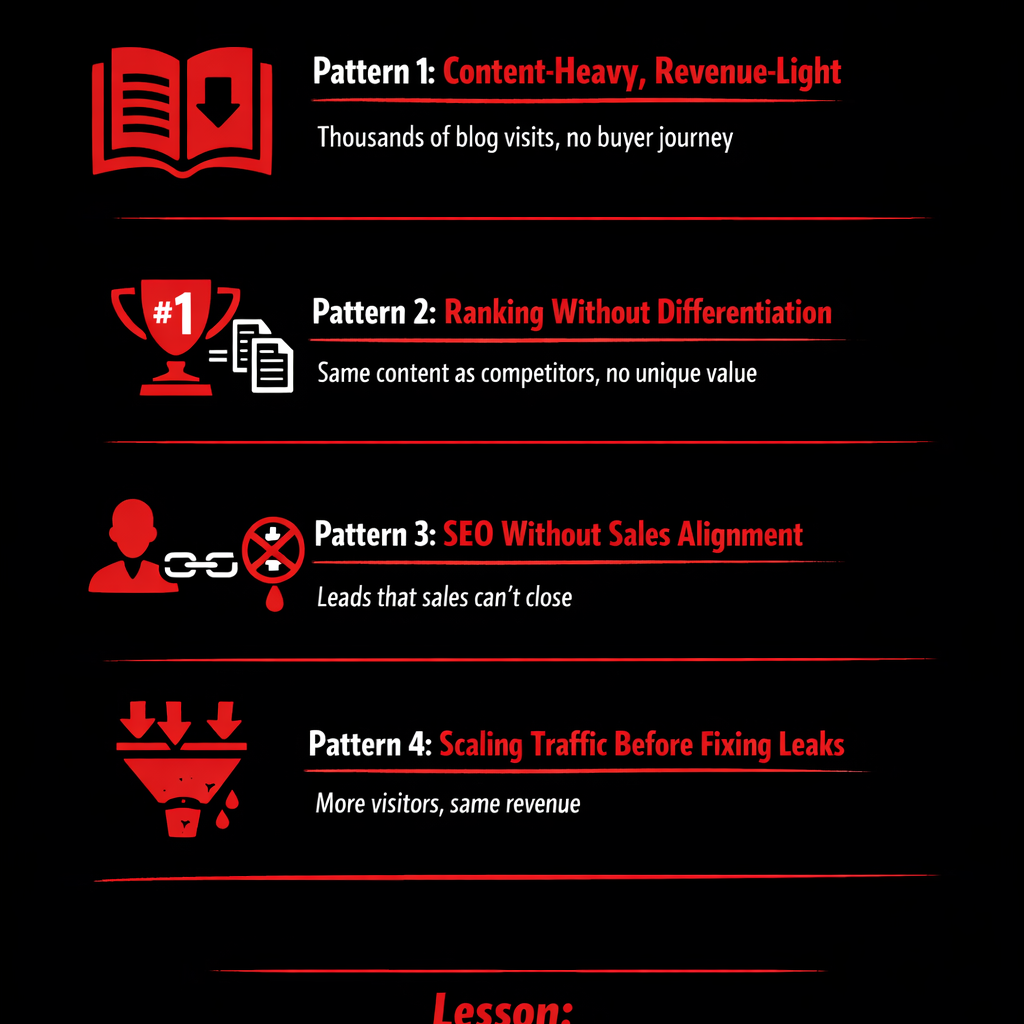
Many SEO campaigns look successful on paper. Rankings improve, traffic charts climb, and monthly reports show consistent growth. Yet revenue stays flat. After analyzing dozens of such campaigns, the failure usually isn’t technical—it’s structural. These four patterns show how SEO can succeed in visibility but fail in business impact.
Pattern 1: Content-Heavy, Revenue-Light
This is the most common scenario. Companies publish hundreds of blog posts targeting informational keywords and successfully attract thousands of monthly visitors. The problem? There is no clear buyer journey. Readers consume content, get their answers, and leave. There are no logical next steps, no product tie-ins, and no intent-based pathways guiding users toward conversion. The result is traffic that looks impressive but has no commercial gravity.
Pattern 2: Ranking Without Differentiation
In this pattern, rankings are achieved—but only by replicating what already exists. The content mirrors competitors in structure, messaging, and value propositions. There is nothing distinctive enough to earn trust or preference. Even when users click, they see the same advice they’ve already read elsewhere. Without a unique angle, proof, or positioning, rankings may generate visits—but not conviction.
Pattern 3: SEO Without Sales Alignment
Here, SEO generates leads, but sales teams struggle to close them. Keywords attract users who are curious, early-stage, or poorly qualified. Sales receives volume, not readiness. This disconnect creates friction: marketing celebrates lead growth while sales sees wasted effort. Without shared definitions of “qualified traffic,” SEO becomes a lead factory that produces interest, not revenue.
Pattern 4: Scaling Traffic Before Fixing Leaks
Some businesses respond to low revenue by pushing for more traffic. But if conversion rates, messaging, or UX are broken, additional visitors simply magnify the problem. More users enter the funnel—but exit at the same weak points. Growth stalls despite higher visibility.
The Core Lesson: SEO failures are rarely about ranking. They’re about readiness. Visibility only works when the business is prepared to convert attention into action.
The Revenue-First SEO Mindset
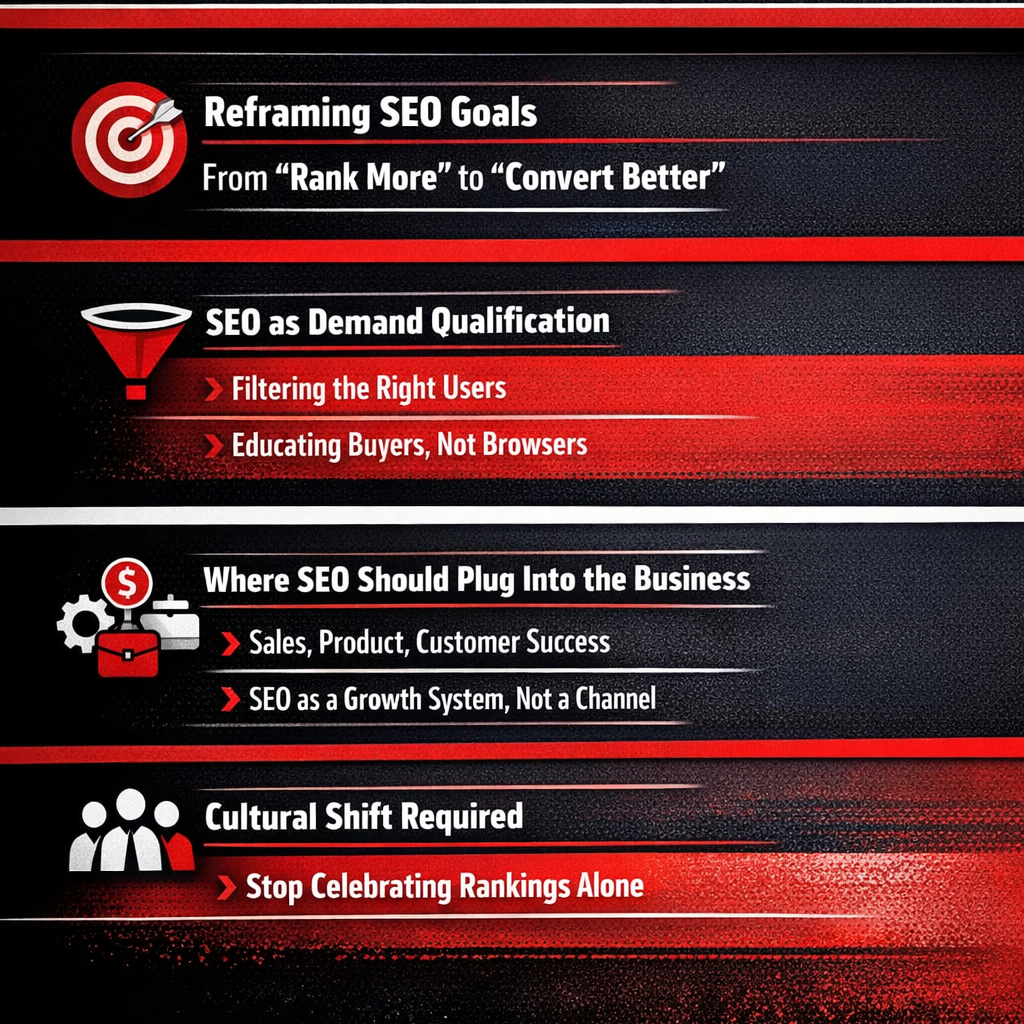
For years, SEO success has been defined by a simple scoreboard: more keywords, higher rankings, more traffic. While those metrics feel tangible and easy to celebrate, they rarely answer the most important business question—is this driving revenue? A revenue-first SEO mindset starts by reframing the goal entirely. Instead of obsessing over “rank more,” the focus shifts to “convert better.” Rankings become a means, not the outcome. The true measure of success is whether organic traffic moves users closer to a sale, a demo, or a meaningful business action.
Reframing SEO Goals: From Visibility to Value
In a revenue-first model, SEO goals are tied directly to business impact. This means prioritizing keywords, pages, and content that influence pipeline, not just search volume. Ranking #1 for a high-intent keyword that converts is far more valuable than ranking for ten informational terms that never lead to revenue. The question changes from “How many keywords are we ranking for?” to “Which pages are actually contributing to growth?”
SEO as Demand Qualification, Not Just Discovery
Traditional SEO focuses on discovery—getting as many people to the site as possible. Revenue-first SEO focuses on qualification. It’s about filtering the right users in, and the wrong users out. This involves aligning content tightly with search intent and buyer readiness. Instead of educating everyone, SEO content should educate buyers, guiding them through problems your product solves and making the next step obvious. Traffic that can’t or won’t convert is not a win—it’s a distraction.
Where SEO Should Plug Into the Business
SEO should not live in isolation. To drive revenue, it must integrate with sales, product, and customer success. Sales teams provide insight into real objections and buying triggers. Product teams clarify value propositions that should be reflected on SEO pages. Customer success reveals what attracts high-LTV users versus churn risks. When SEO plugs into these functions, it stops being a standalone channel and becomes a growth system that supports the entire customer lifecycle.
The Cultural Shift Required
Adopting a revenue-first SEO mindset requires a cultural change. Teams must stop celebrating rankings in isolation and start asking harder questions about outcomes. Rankings are visibility. Revenue is validation. The shift happens when SEO wins are defined not by applause in reports, but by impact on the business.
How to Escape the Vanity Metrics Trap (A Practical Action Framework)
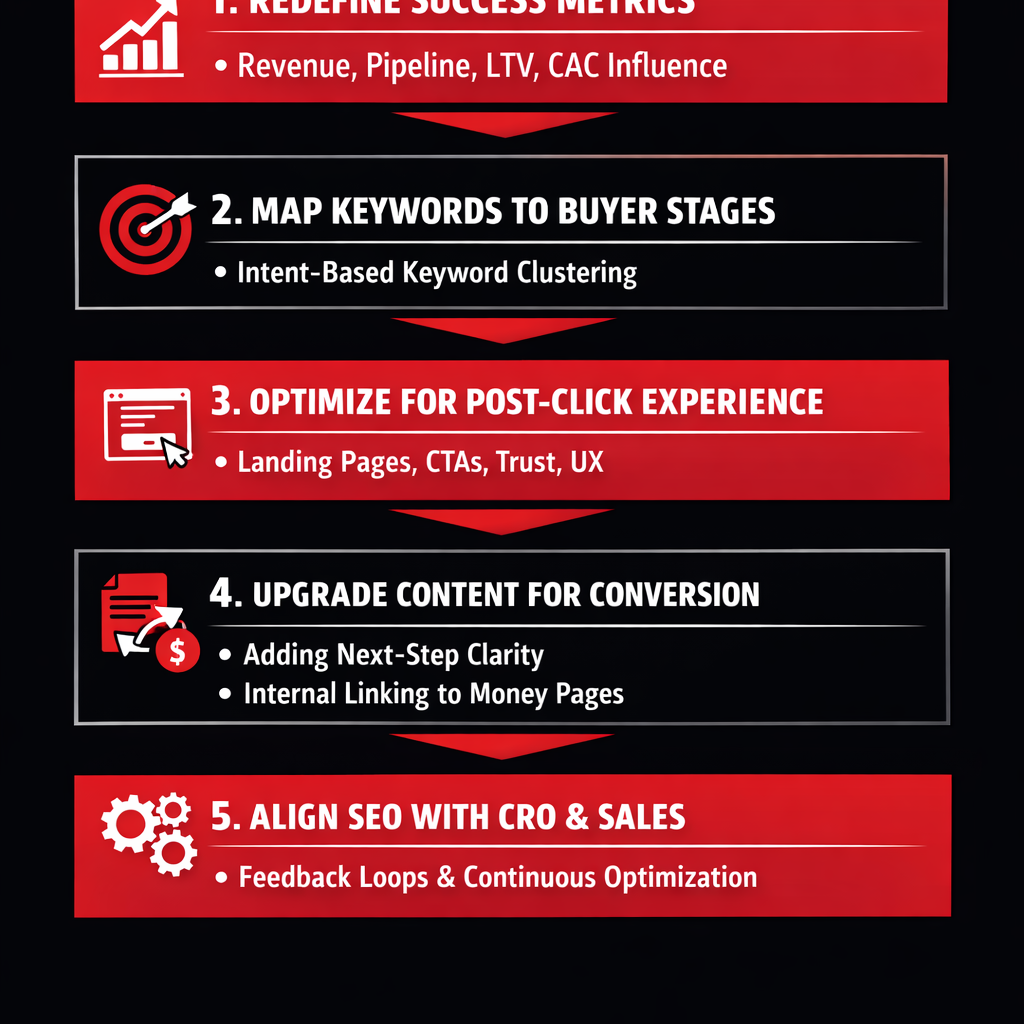
Escaping the SEO vanity metrics trap doesn’t require abandoning SEO—it requires redefining what SEO is responsible for. Rankings, impressions, and traffic still matter, but only as inputs. The real output must be revenue impact. The following five-step framework shifts SEO from a visibility game to a growth system.
Step 1: Redefine Success Metrics
The first—and most critical—shift is changing how success is measured. If rankings and traffic are still your primary KPIs, you’re optimizing for optics, not outcomes.
Instead, SEO performance should be evaluated through business-aligned metrics, such as:
- Revenue influenced by organic traffic
- Pipeline contribution (especially in B2B and SaaS)
- Lifetime Value (LTV) of organic users
- CAC influence, not just lead volume
This doesn’t mean every blog post must generate immediate sales. It means every SEO asset should have a defined role in the revenue system. When SEO reporting starts with “how did this impact revenue?” rather than “how many keywords moved?”, priorities change fast—and for the better.
Step 2: Map Keywords to Buyer Stages
One of the biggest reasons ranking #1 fails after the click is intent mismatch. Not all keywords are created equal, and treating them as such guarantees wasted effort.
Intent-based keyword clustering forces clarity by mapping keywords to:
- Awareness (problem-aware)
- Consideration (solution-aware)
- Decision (purchase-ready)
Most SEO strategies overinvest in awareness keywords because they’re easier to rank for and drive more traffic. Revenue-first SEO flips that model by ensuring high-intent, bottom-funnel keywords have dedicated pages built to convert—not just inform. Traffic volume may drop, but lead quality and conversion rates rise.
Step 3: Optimize for the Post-Click Experience
Ranking #1 only earns you attention. Conversion depends on what happens after the click.
This means optimizing:
- Landing pages for clarity, not keyword density
- CTAs that guide users to the next logical step
- Trust signals (social proof, testimonials, authority cues)
- UX and page speed, especially on mobile
A technically perfect SEO page can still fail if it overwhelms users, hides value propositions, or forces them to think too hard. Every organic click should feel like it landed exactly where it was meant to—not just where Google sent it.
Step 4: Upgrade Content for Conversion
Most SEO content is built to rank, not to move users forward. That’s a massive missed opportunity.
High-performing SEO content should:
- Clearly answer: “What should I do next?”
- Include contextual CTAs, not just generic ones
- Use internal linking strategically to guide users toward product, service, or money pages
This turns content into a guided journey rather than a dead end. Blogs stop being traffic sinks and start becoming conversion pathways.
Step 5: Align SEO With CRO and Sales
SEO cannot operate in isolation. Without alignment, traffic quality improves—but revenue doesn’t.
The solution is feedback loops:
- CRO insights inform SEO page improvements
- Sales feedback refines keyword targeting and intent assumptions
- SEO data highlights objections and friction points
When SEO, CRO, and sales work together, optimization becomes continuous—not reactive. Rankings may get you noticed, but alignment is what turns attention into revenue.
Escaping the vanity metrics trap isn’t about doing more SEO. It’s about doing SEO with intent, ownership, and accountability—long after the ranking report looks good.
The Future of SEO: Rankings Matter Less, Revenue Matters More
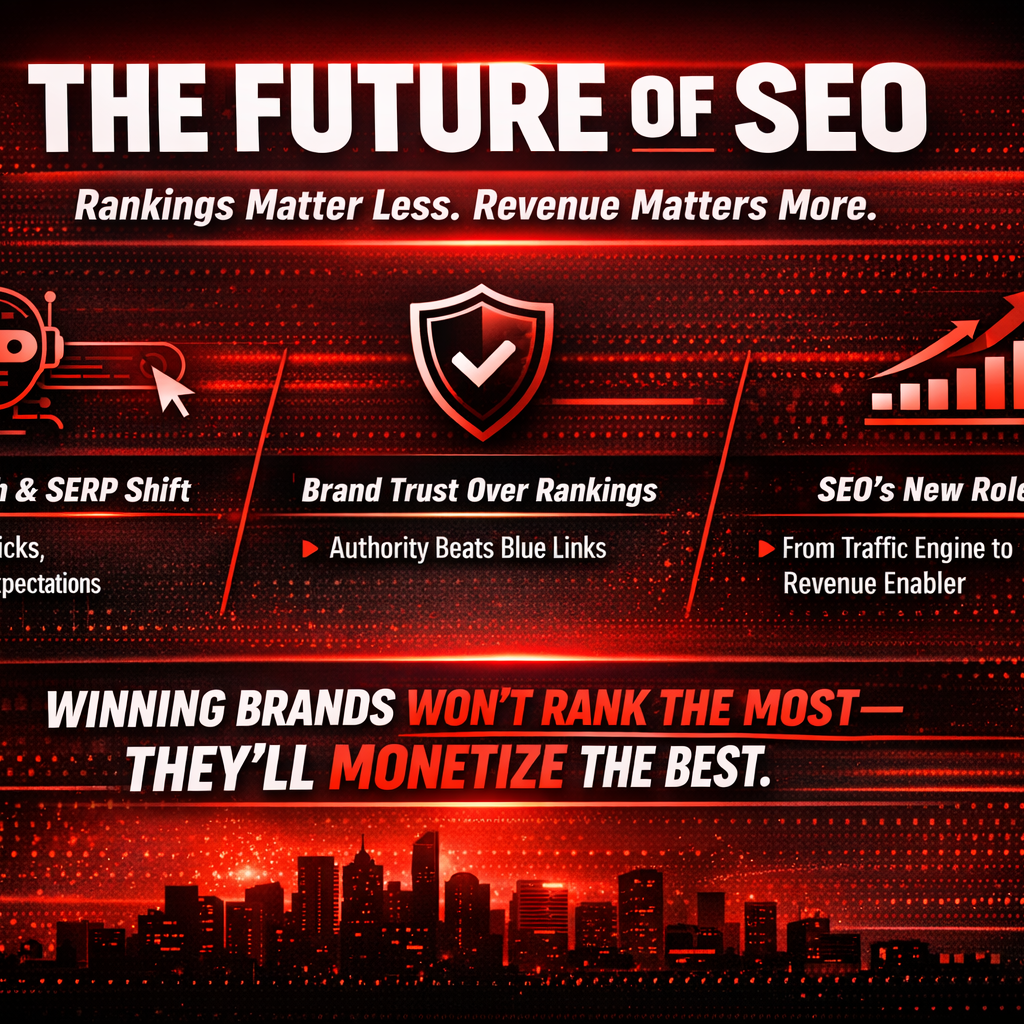
Search is changing faster than most SEO playbooks. With AI-powered search experiences, zero-click results, featured answers, and generative summaries becoming the norm, visibility no longer guarantees traffic—and traffic no longer guarantees revenue.
AI Search and SERP Evolution
Modern SERPs are designed to satisfy users instantly. AI summaries, rich results, and answer panels reduce the need to click through multiple websites. As a result, fewer clicks come with much higher expectations. When users do click, they expect clarity, credibility, and immediate value. Ranking #1 might earn you the click—but it won’t earn you trust or conversion by default anymore.
Brand Trust Over Blue Links
In an AI-driven search environment, authority matters more than position. Users trust brands they recognize, experts they’ve heard of, and companies that demonstrate real-world credibility. This is why brand authority will consistently outperform pure keyword rankings. A familiar, trusted brand ranking #4 often converts better than an unknown site ranking #1—because trust shortens decision cycles.
SEO’s New Role
SEO is no longer just a traffic engine. Its role is evolving into a revenue enablement system—one that qualifies demand, supports buying decisions, and integrates with CRO, content strategy, and sales. Modern SEO must guide users from search to solution, not just from query to page.
The future of SEO belongs to brands that stop chasing rankings as the end goal. The winners won’t be the ones who rank the most—they’ll be the ones who monetize attention the best.
Conclusion: Ranking #1 Is Not the Finish Line
Ranking #1 feels like winning—but in reality, it’s only the starting line. Visibility without conversion is wasted effort. Traffic that doesn’t move users closer to a decision is just noise, no matter how impressive it looks in a report. SEO can put your brand in front of the right people, but it cannot force them to trust you, understand your value, or take action. That work begins only after the click.
This is where many SEO strategies quietly fail. Teams celebrate rankings, screenshots are shared, and dashboards look healthy—yet revenue stays flat. The uncomfortable question every business must ask is this: are you optimizing for applause or for profit? Because rankings earn praise, but conversions drive growth. One feeds ego; the other fuels sustainability.
If you want SEO to become a true growth lever, it’s time to shift focus. Audit your post-click experience with the same intensity you apply to keyword research. Examine whether your pages match search intent, remove friction, build trust quickly, and guide users toward a clear next step. Look beyond rankings and start measuring what happens after traffic arrives.
Stop celebrating rankings in isolation. Treat them as an opportunity, not an outcome. The real success of SEO isn’t how high you appear in search results—it’s how effectively you turn attention into action.
Ranking #1 gets attention. Revenue gets results.