
SUPERCHARGE YOUR Online VISIBILITY! CONTACT US AND LET’S ACHIEVE EXCELLENCE TOGETHER!
This project aims to help website owners optimize their web pages by automatically testing and analyzing changes made to their content, titles, and descriptions. The goal is to improve important website performance metrics, like click-through rates (CTR), engagement, and conversion rates. This project uses machine learning to identify and recommend the best SEO (Search Engine Optimization) strategies to boost a website’s visibility on search engines like Google. Let’s break down each part to understand the purpose in more detail.

Automated SEO Experimentation Through A/B Testing
This project focuses on automated SEO A/B testing, a method where two variations of the same webpage element—commonly referred to as Version A and Version B—are tested against each other to determine which performs better.
For instance:
- Version A may use a short, straightforward title.
- Version B may feature a longer, keyword-optimized title.
The goal is to evaluate which variation attracts more clicks, engagement, or conversions.
What makes this approach powerful is automation. Instead of manually comparing outcomes, the system uses machine learning models to evaluate performance differences at scale. This allows website owners to make faster, more accurate, data-driven SEO decisions with minimal manual intervention.
Leveraging Machine Learning for Deeper SEO Insights
Machine learning plays a central role in extracting meaningful insights from large and complex datasets. Rather than relying on surface-level analysis, the model learns from historical performance data to uncover trends and relationships that are not immediately visible.
Key benefits of using machine learning include:
- Predictive Intelligence
The system learns from past experiments to forecast which SEO changes are most likely to succeed in future scenarios. - Keyword Effectiveness Analysis
It identifies which keywords and phrases contribute most strongly to improved rankings, higher CTR, or better engagement. - Behavioral Pattern Detection
Machine learning detects recurring patterns—such as phrasing styles or content structures—that consistently drive stronger user interaction.
By doing so, the project moves beyond basic analytics and delivers context-aware SEO recommendations rooted in intelligent data interpretation.
Enhancing Core Website Performance Metrics
The primary objective of this project is to improve critical website performance indicators. These include:
Click-Through Rate (CTR)
CTR measures how often users click on a webpage after seeing it in search results. Higher CTR usually indicates compelling titles and meta descriptions.
User Engagement
Engagement metrics reflect how long visitors stay on a page and how they interact with its content. Strong engagement suggests content relevance and quality.
Conversion Rate
Conversion rate tracks the percentage of visitors who complete a desired action, such as filling out a form or making a purchase—an essential metric for business-focused websites.
Machine learning identifies which SEO elements influence these metrics, while A/B testing validates those insights in real-world conditions, enabling continuous, incremental improvement.
Data-Backed SEO Recommendations
Beyond analysis, the system delivers actionable optimization suggestions. Examples include:
- Recommending specific keywords or phrases for titles, meta descriptions, or body content based on proven effectiveness.
- Suggesting content modifications aligned with actual performance data rather than generic SEO best practices.
Because these recommendations are customized to the website’s own data, website owners can implement changes with greater confidence and measurable impact.
Practical Value of Automated SEO A/B Testing
In summary, this project is designed to:
- Automate the testing of SEO elements such as titles, descriptions, and content.
- Apply machine learning to analyze performance data and identify winning variations.
- Improve essential metrics like CTR, engagement, and conversions.
- Deliver tailored SEO recommendations based on real, observed data.
Ultimately, the system helps websites gain higher visibility, attract qualified traffic, and drive better engagement and conversions through intelligent automation.
Understanding SEO A/B Testing Powered by Machine Learning
SEO A/B testing with machine learning involves experimenting with different versions of webpage elements to determine which configuration performs best in search engines. These variations may include changes to titles, descriptions, keywords, or content structure.
Machine learning models analyze historical performance data to predict which changes are most likely to improve outcomes such as CTR, rankings, or conversions. Over time, the model refines its predictions by learning from new experiments.
Common Use Cases of SEO A/B Testing with Machine Learning
This approach is particularly useful for:
- Improving Click-Through Rates
Testing multiple titles or meta descriptions to identify which attracts the most clicks. - Boosting Conversion Performance
Analyzing how different content layouts or messaging influence user actions. - Lowering Bounce Rates
Identifying changes that encourage users to stay longer on a page. - Enhancing Content Relevance
Determining which content variations align better with user search intent.
How SEO A/B Testing Works on Live Websites
In a real-world scenario, a website creates two slightly different versions of a page. These versions are then monitored over time.
For example, to improve CTR on a blog post, two different titles may be tested. The machine learning system analyzes metrics such as click behavior, dwell time, and interaction patterns to determine which version performs better and why.
Data Requirements for Machine Learning–Driven SEO Testing
For accurate predictions, the model requires structured data. This is typically collected in two main ways:
1. CSV-Based Performance Data
CSV files often contain:
- URLs
- Page titles and meta descriptions
- CTR, bounce rate, and conversion data
- Performance metrics for each page variation
This format is preferred due to its simplicity and ease of processing.
2. URL-Based Content Analysis
In some cases, models may fetch and analyze live page content directly from URLs, particularly when testing content length, keyword usage, or semantic relevance.
While both methods are viable, CSV-based datasets are generally more manageable and scalable.
Key Stages in SEO A/B Testing with Machine Learning
- Data Collection
Gather SEO and user behavior metrics from analytics tools. - Data Cleaning and Preparation
Remove noise, standardize formats, and structure datasets for analysis. - Model Training and Validation
Train the model to identify which changes positively impact SEO performance. - Prediction and Recommendation
Apply the trained model to new test scenarios to predict outcomes and recommend the better-performing version.
Can SEO A/B Testing Work Using Only URLs?
While it is technically possible to run limited analysis using URLs alone—by scraping page content—the approach has clear limitations.
Effective SEO A/B testing typically requires additional metrics such as CTR, bounce rate, and conversion data, which are usually sourced from analytics platforms like Google Analytics.
Without these metrics, insights are restricted to surface-level content comparisons. For meaningful, performance-driven optimization, access to behavioral and engagement data is essential.
What the Model Can Do with Just URLs and Scraping
If you only provide the URLs, a scraping tool can extract specific parts of each webpage, such as:
- Page Titles: The title that appears in search results (e.g., “SEO Services for Better Rankings | Thatware”).
- Meta Descriptions: The brief description that shows up under the title in search results (e.g., “Discover our range of AI-based SEO solutions designed to boost your ranking…”).
- Content Structure: The headings, main body content, images, and keywords used on each page.
From this scraped data, the model can perform certain analyses:
- Analyze Content Structure and Keywords: The model can analyze if some content types or keyword patterns are more optimized for SEO or are likely to attract more clicks based on general SEO guidelines.
- Suggest Optimizations for Titles and Descriptions: Based on patterns in popular SEO strategies, the model can recommend adjustments in title length, keyword usage, or description tone.
However, since scraping won’t provide user behavior data (like how many people clicked, stayed, or converted), the model cannot predict accurately which changes will improve CTR, bounce rates, or conversions without this additional data. The model would instead focus on content-based optimizations rather than user behavior-based predictions.
What Data Would Improve SEO A/B Testing Accuracy
- To run a genuinely effective SEO A/B test, incorporating the following metrics would significantly enhance the accuracy of model predictions:
- Click-Through Rate (CTR): The proportion of users who click a search result after viewing it, helping evaluate the effectiveness of titles and meta descriptions.
- Bounce Rate: The percentage of visitors who leave the page without further interaction, offering insight into content relevance and engagement.
- Dwell Time or Time Spent: The duration a user remains on a page, which serves as a strong indicator of content quality and user interest.
- Conversion Data: Details on whether users complete desired actions, such as form submissions or purchases, demonstrating how well content and layout drive outcomes.
- Without access to analytics data, the model is limited to optimizing on-page SEO components—such as title tags, meta descriptions, and keyword placement—and cannot accurately assess how these changes influence user behavior or conversions.
What Output Can Be Expected from This Model with Only URL Data?
- If the model operates solely on scraped URL data, the following types of insights and outputs can be expected:
- SEO Content Quality Analysis: Evaluation based on keyword usage, title relevance, and meta description structure, with recommendations aligned to established SEO best practices.
- On-Page SEO Suggestions: Actionable guidance for improving title tags, meta descriptions, and keyword optimization, all of which directly affect search visibility and click potential.
- Comparative Content Insights: Identification of commonly optimized content formats—such as list-based articles, how-to guides, or long-form resources—along with suggestions for refinement or expansion based on SEO performance patterns.

Moving Beyond Experiments: Causal SEO Optimization with Machine Learning
Traditional SEO A/B testing answers a simple question: Which version performs better?
However, modern SEO—especially at scale—requires answering a more important question:
Why did one version perform better, and will it continue to work in the future?
This is where machine learning transforms SEO testing from basic experimentation into causal optimization—a system that doesn’t just observe results but understands underlying causes.
The Difference Between Correlation and Causation in SEO
Most SEO tools rely on correlation:
- A keyword appears more often → rankings increase
- A longer title → higher CTR
- More internal links → better visibility
But correlation does not guarantee causation.
Machine learning models used in advanced SEO A/B testing help distinguish:
- What changed
- What mattered
- What was incidental
For example:
A page might gain rankings after a title change, but the real cause could be:
- A simultaneous backlink acquisition
- Seasonal search demand
- Algorithmic recalibration by Google
Without ML-based causal analysis, SEO teams risk optimizing the wrong variables.
How Machine Learning Identifies True SEO Drivers
Machine learning models isolate SEO impact by analyzing multi-variable interactions instead of single changes.
Key mechanisms include:
Feature Attribution
The model assigns weighted importance to elements such as:
- Keyword placement
- Semantic depth
- Title sentiment
- Content structure
- Internal linking context
This helps identify which exact change influenced performance, not just that performance changed.
Counterfactual Prediction
The model estimates:
“What would have happened if the change was NOT applied?”
This is critical in SEO because Google rankings are influenced by many external factors. Machine learning simulates alternate realities to measure true lift caused by SEO changes.
Noise Reduction
SEO data is noisy:
- Bots
- Brand traffic
- Sudden viral spikes
- Algorithm updates
Machine learning filters these anomalies so decisions are based on signal, not fluctuation.
Long-Term SEO Stability vs Short-Term Wins
One of the biggest risks in SEO experimentation is over-optimizing for short-term metrics like CTR while harming long-term rankings.
For example:
- Aggressive clickbait titles may increase CTR
- But reduce engagement
- Which eventually hurts rankings
Advanced ML-based A/B testing evaluates temporal performance, not just immediate uplift.
Metrics Evaluated Over Time:
- CTR decay or improvement
- Engagement stability
- Ranking volatility
- Crawl frequency changes
- Indexation consistency
This ensures SEO changes improve sustainable visibility, not temporary spikes.
SEO Risk Management Using Machine Learning
SEO experimentation carries inherent risk. Poorly designed tests can:
- Trigger algorithmic demotions
- Cause indexation loss
- Introduce duplicate content
- Create internal keyword cannibalization
Machine learning mitigates these risks through predictive risk scoring.
Risk Signals Assessed:
- Sudden keyword density shifts
- Over-optimization patterns
- Structural duplication
- SERP intent mismatch
- Engagement drop probability
Before changes are deployed site-wide, the model predicts SEO risk exposure, allowing teams to:
- Limit rollout
- Adjust variables
- Abort unsafe experiments
Handling Algorithm Updates During A/B Tests
One major challenge in SEO testing is algorithm interference.
If Google releases an update mid-test, results can become misleading.
Machine learning addresses this by:
- Detecting SERP-wide volatility
- Comparing control keywords unaffected by tests
- Normalizing performance relative to industry baselines
This allows the system to differentiate between:
- Performance changes caused by your test
- Performance changes caused by Google updates
Without this layer, SEO experiments often lead to false conclusions.
Machine Learning for Intent-Aware SEO Testing
Modern SEO is intent-driven, not keyword-driven.
Machine learning models classify user intent into categories such as:
- Informational
- Navigational
- Transactional
- Commercial investigation
During A/B testing, the model evaluates whether:
- The content matches dominant SERP intent
- Titles align with user expectations
- Meta descriptions reinforce search intent
For example:
If informational intent dominates but Version B pushes transactional language, the model flags a misalignment risk, even if short-term CTR improves.
Ethical SEO Experimentation & Algorithm Trust
Search engines increasingly evaluate content authenticity and manipulation signals.
Machine learning helps enforce ethical SEO practices by:
- Detecting deceptive click patterns
- Preventing misleading metadata
- Avoiding exploitative phrasing
- Preserving informational accuracy
This aligns SEO experimentation with:
- Search engine guidelines
- User trust
- Brand credibility
Ethical optimisation leads to algorithmic trust, which compounds ranking strength over time.
Scaling SEO A/B Testing Across Large Websites
For enterprise websites with:
- Thousands of URLs
- Multiple templates
- Regional variations
Manual A/B testing is impossible.
Machine learning enables template-level experimentation, where:
- Page types are clustered
- Changes are tested on representative samples
- Results are generalized safely across the cluster
This allows:
- Faster experimentation
- Lower risk
- Consistent optimization across scale
SEO Governance & Decision Automation
As SEO matures, decision-making must be standardized.
Machine learning introduces SEO governance, where:
- Every change is logged
- Every result is measured
- Every decision is justified by data
Instead of subjective opinions like:
“This title sounds better”
Decisions are made based on:
- Model confidence scores
- Historical success probability
- Risk-adjusted performance impact
This is especially valuable for:
- Agencies
- Large SEO teams
- Regulated industries
From Reactive SEO to Predictive SEO
Traditional SEO reacts to performance drops.
Machine learning enables predictive SEO, where the system anticipates:
- Ranking decline before it happens
- CTR fatigue before engagement drops
- Cannibalization before it impacts traffic
This shifts SEO from:
❌ Fixing problems
✅ Preventing problems
A/B testing becomes proactive optimization, not damage control.
Why This Approach Matters for the Future of SEO
As Google integrates:
- AI Overviews
- Entity-based indexing
- Contextual ranking signals
SEO success will depend less on tactics and more on system-level intelligence.
Machine learning–driven SEO A/B testing provides:
- Interpretability
- Scalability
- Risk control
- Long-term performance stability
It transforms SEO from:
“Trying changes and hoping they work”
Into:
“Engineering outcomes based on evidence.”
Explanation of Each Step
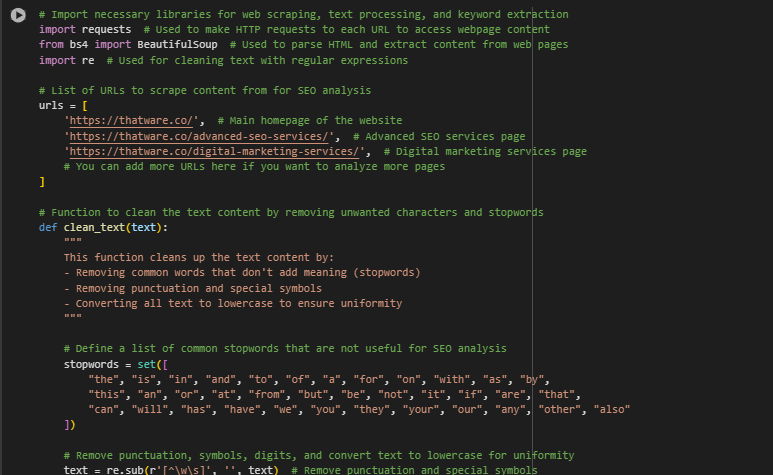
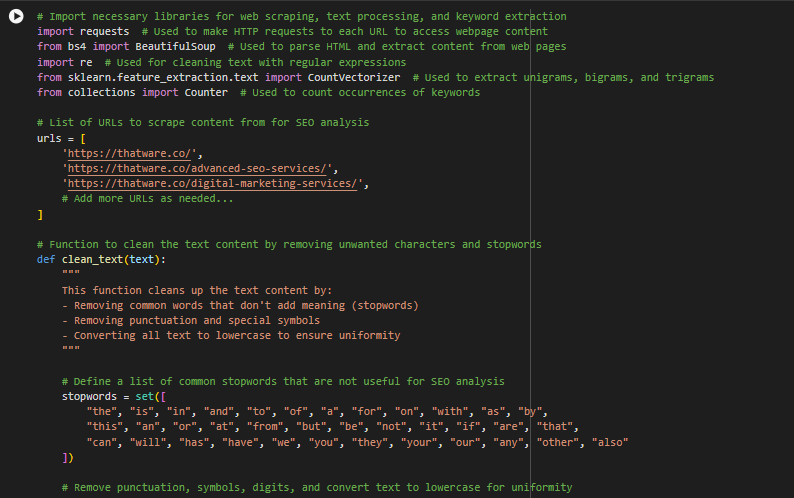
# Import necessary libraries for web scraping, text processing, and keyword extraction
This line is a comment. Comments are added to the code for explanation purposes and are not run as part of the program. This comment tells us that the following code will bring in (or import) certain libraries, which are collections of code written by other developers to help with specific tasks like fetching web content, cleaning text, and analyzing keywords.
import requests # Used to make HTTP requests to each URL to access webpage content
- Purpose: The requests library helps us connect to websites, like when you type a web address into your browser. It sends a request to a website and pulls (or “fetches”) the content for us to use in our program.
- Example: If we want to get content from https://example.com, requests will allow us to connect to that website and get the HTML code (the building blocks of a webpage) to work with.
from bs4 import BeautifulSoup # Used to parse HTML and extract content from web pages
- Purpose: BeautifulSoup is a tool that helps us look at the website’s HTML code and extract specific parts, like paragraphs, titles, or images.
- Example: Suppose the HTML of a page has a section that looks like this:
<p>Welcome to our website!</p>
BeautifulSoup allows us to find and extract just the phrase “Welcome to our website!” without all the other HTML tags.
import re # Used for cleaning text with regular expressions
- Purpose: The re library (short for “regular expressions”) is used to search for and remove unwanted characters, symbols, or words in text.
- Example: If a sentence has extra punctuation, like “Hello!!!” or numbers like “Order #1234”, re can help us remove the extra punctuation and numbers, leaving us with a clean version of the text, such as just “Hello”.
from sklearn.feature_extraction.text import CountVectorizer # Used to extract unigrams, bigrams, and trigrams
- Purpose: CountVectorizer helps us identify common words or phrases in the text. It counts how often each word or phrase appears.
- Terms:
- Unigram: A single word (e.g., “SEO”).
- Bigram: A pair of words that appear together (e.g., “SEO services”).
- Trigram: Three words that appear together (e.g., “best SEO services”).
- Example: If the content of a page includes “SEO services are essential,” CountVectorizer can identify “SEO,” “services,” and “SEO services” as common phrases if they appear frequently across the page.
from collections import Counter # Used to count occurrences of keywords
- Purpose: Counter is a simple tool to count how often each item appears in a list. In this case, it can be used to see which words or phrases show up most often in the text, helping us focus on the most important keywords.
- Example: If we have a list of words like [“SEO”, “SEO”, “services”, “marketing”, “SEO”], Counter will tell us that “SEO” appears three times, “services” once, and “marketing” once.
Detailed Code Explanation with Examples
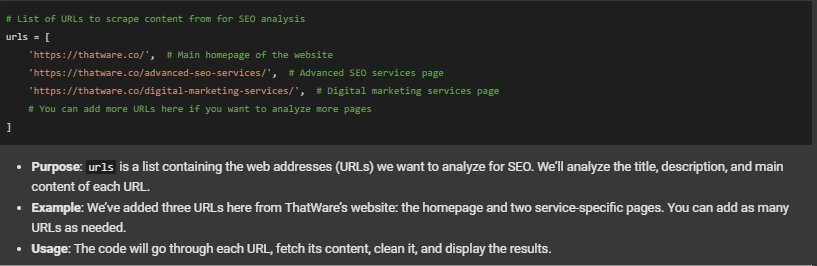
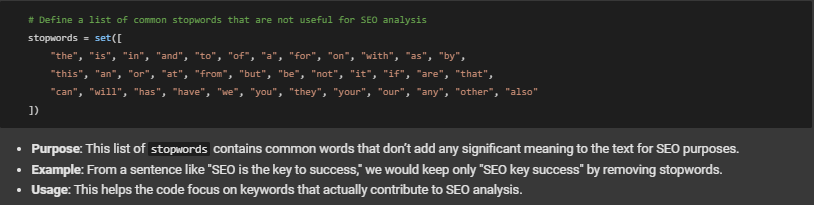
Setting Up the URLs for Analysis
Defining the Cleaning Function
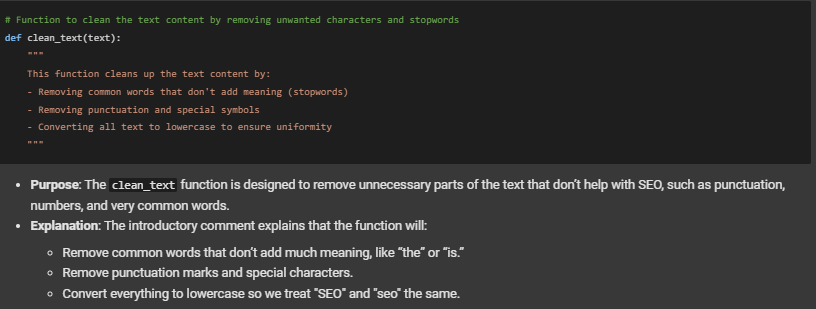
Cleaning Process Within clean_text
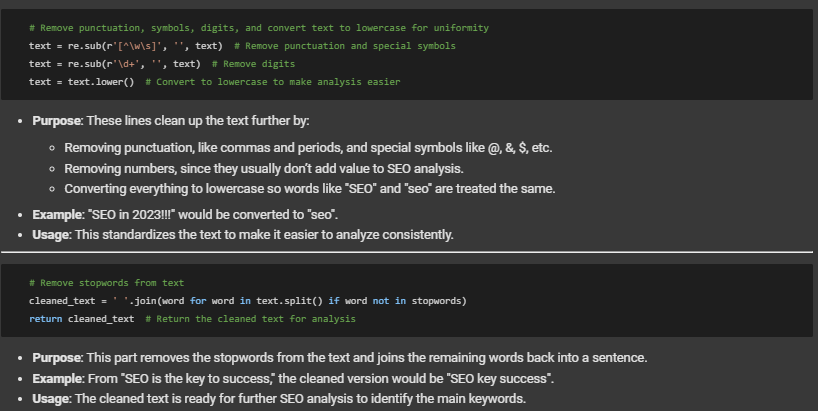
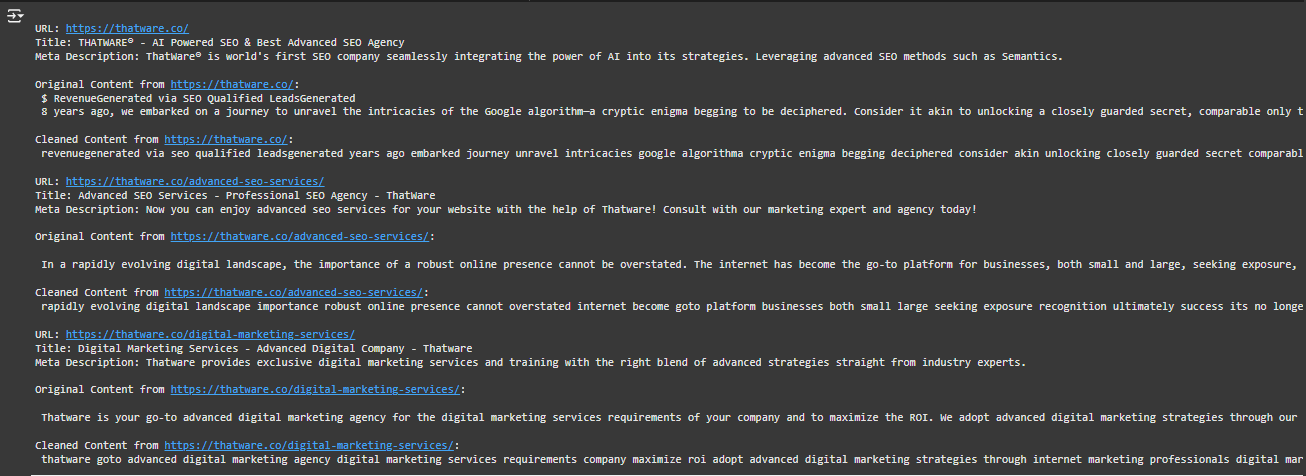
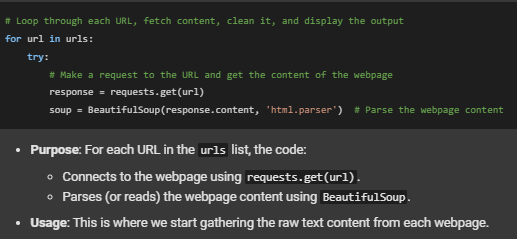
Fetching, Cleaning, and Displaying the Content
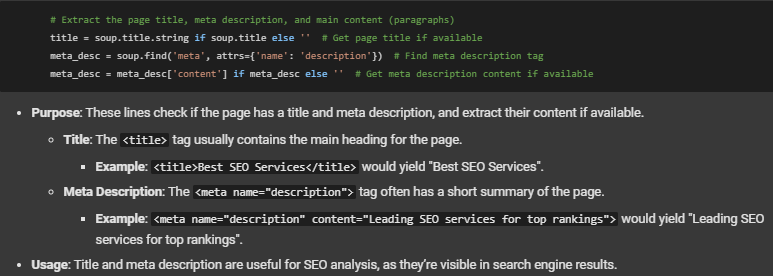
Extracting Title, Meta Description, and Paragraphs from Each Webpage

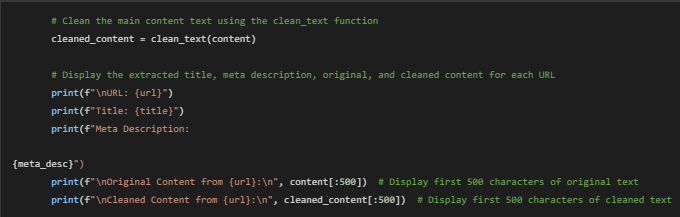
- Purpose:
- Cleans the content using clean_text, resulting in a simpler text with only meaningful keywords.
- Prints the URL, title, meta description, original content, and cleaned content.
- Example Output:
- Original Content: “SEO is the key to success in digital marketing for 2023!”
- Cleaned Content: “seo key success digital marketing”
Handling Errors
except Exception as e:
print(f”Error fetching content from {url}: {e}”)
- Purpose: This section catches any errors that occur while fetching the content (e.g., if the page is down). If there’s an error, it prints a message with the URL and the error.
- Example: If the website is temporarily down, it might print “Error fetching content from https://thatware.co/: Connection error”.
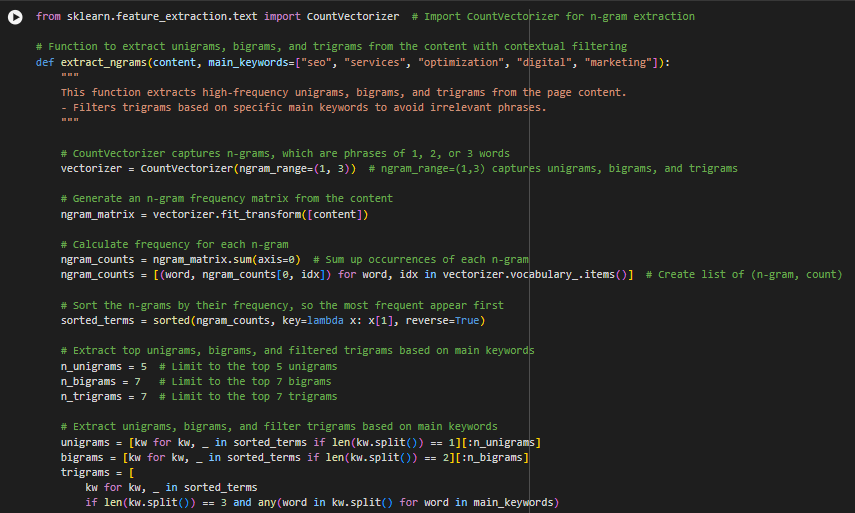

Code Breakdown
from sklearn.feature_extraction.text import CountVectorizer # Import CountVectorizer for n-gram extraction
- Purpose: We import CountVectorizer, a tool for counting and analyzing words in text.
- Example: CountVectorizer can turn the phrase “SEO is important for digital marketing” into a list of words or phrases (like “SEO,” “digital marketing”) and count how often each appears.
Define the extract_ngrams Function
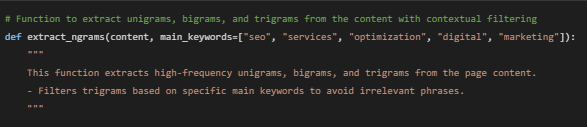
- Purpose: extract_ngrams is a function, or a reusable section of code, created to find and count different types of word combinations:
- Unigrams: Single words, like “SEO”.
- Bigrams: Two-word phrases, like “digital marketing”.
- Trigrams: Three-word phrases, like “SEO digital marketing”.
- Explanation of main_keywords: We use a list of important keywords (like “seo” and “marketing”) to filter out only relevant three-word phrases, so we avoid unimportant phrases.
Setting Up CountVectorizer for N-Grams

- Purpose: This line sets up CountVectorizer to capture unigrams, bigrams, and trigrams.
- Explanation of ngram_range=(1, 3): This setting makes the function look for unigrams (one word), bigrams (two words), and trigrams (three words).
- Example: In the sentence “SEO helps with digital marketing,” this setting will pick up individual words like “SEO,” two-word pairs like “digital marketing,” and three-word combinations like “SEO helps with”.
Generating the N-Gram Frequency Matrix

- Purpose: ngram_matrix is a data table that shows how often each word or phrase appears in content.
- Example: If content is “SEO helps with digital marketing. SEO is useful,” ngram_matrix might show “SEO” appears twice, “digital marketing” appears once, etc.
Calculate Frequency for Each N-Gram

- Purpose:
- ngram_counts sums up the occurrences of each n-gram, turning each word or phrase into a list with its count.
- vectorizer.vocabulary_.items() contains each n-gram and where it appears in the text.
- Example: If “SEO” appears three times, it will show as (“SEO”, 3) in ngram_counts.
Sort the N-Grams by Frequency

- Purpose: sorted_terms organizes the n-grams from most to least frequent, so we see the most common words and phrases first.
- Example: If ngram_counts contains [(“SEO”, 3), (“digital marketing”, 2), (“services”, 1)], then sorted_terms will also show “SEO” first, since it appears the most.
Extract Top Unigrams, Bigrams, and Filtered Trigrams

- Purpose: Here, we set limits to display only the top 5 unigrams, top 7 bigrams, and top 7 trigrams to keep the results concise and focused on the most important phrases.
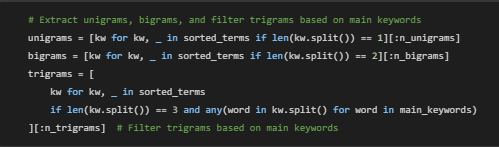
- Explanation of Unigrams and Bigrams:
- unigrams: Finds all the one-word phrases (single words) in sorted_terms and stores the top 5.
- bigrams: Finds all the two-word phrases in sorted_terms and stores the top 7.
- Example: If the text has “SEO,” “services,” and “marketing” as top words, unigrams will capture them.
- Explanation of Trigrams:
- trigrams filters out only the top three-word phrases containing one of the main_keywords (like “SEO,” “services”).
- Example: If a phrase like “SEO services optimization” appears in the text, it will be kept because it contains “SEO” and “services”.
Display and Return Results
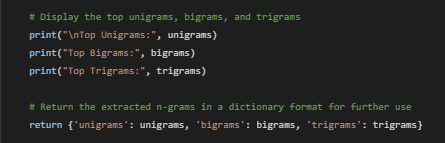
- Purpose:
- print statements display the top unigrams, bigrams, and trigrams directly in the output.
- The dictionary {‘unigrams’: unigrams, ‘bigrams’: bigrams, ‘trigrams’: trigrams} makes these results available for further analysis or use.
- Example Output:
- Top Unigrams: [“SEO”, “digital”, “marketing”]
- Top Bigrams: [“SEO services”, “digital marketing”]
- Top Trigrams: [“SEO services optimization”]
Testing the Function with Example Content
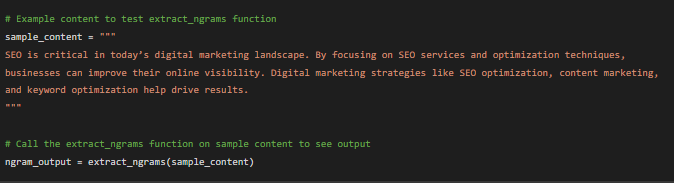
- Explanation of sample_content: This is a sample text containing several relevant SEO terms. It simulates real content to see how the function identifies common words and phrases.
- Explanation of extract_ngrams(sample_content): This line runs the function on sample_content and should print the top unigrams, bigrams, and trigrams based on frequency.
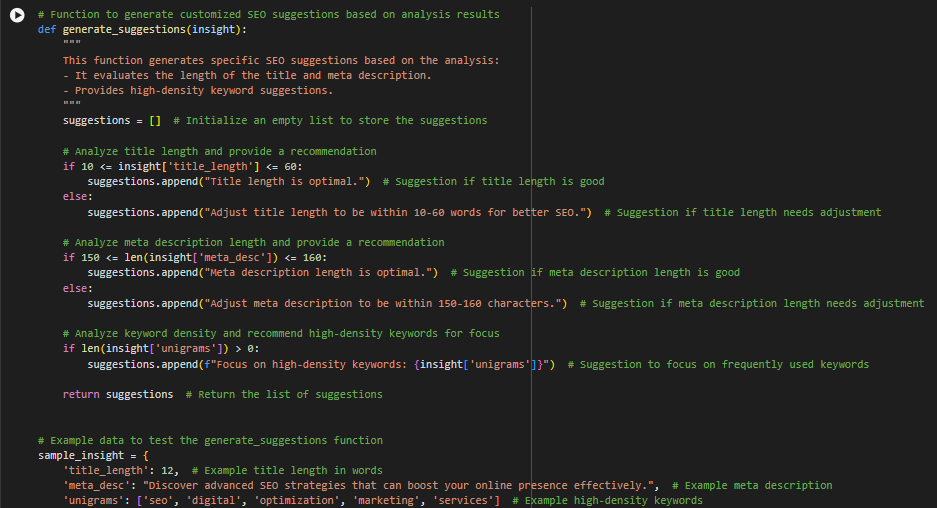
Example Output from Running the Code
When you run this code, you should see output like:


Step-by-Step Code Explanation
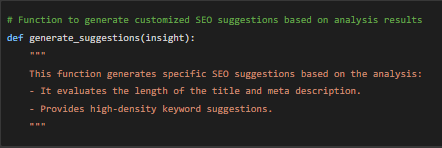
- What It Does: This code defines a function called generate_suggestions which is designed to take in insight, a set of SEO data, and provide helpful suggestions based on that data.
- Purpose: This function checks three main things:
- The length of the title (to see if it’s within an ideal word count range).
- The length of the meta description (to ensure it’s the optimal length for search engines).
- The main keywords (to suggest which words to focus on based on their frequency in the text).

- What It Does: Here, suggestions is a blank list where we’ll store our SEO recommendations.
- Purpose: Each time we make a suggestion (like “Your title is too short”), we’ll add it to this list. At the end, we’ll return the full list of suggestions.
Analyzing the Title Length

- What It Does: This part checks the length of the title and provides a suggestion based on the length.
- Explanation:
- if 10 <= insight['title_length'] <= 60: This line checks if the title is between 10 and 60 words.
- If yes, it adds “Title length is optimal” to suggestions, meaning no change is needed.
- If no, it adds “Adjust title length to be within 10-60 words for better SEO.”
- if 10 <= insight['title_length'] <= 60: This line checks if the title is between 10 and 60 words.
- Example: If the title length is 12 words, this part of the code will add “Title length is optimal” to the suggestions.
Analyzing the Meta Description Length

- What It Does: This section checks the length of the meta description and provides feedback.
- Explanation:
- if 150 <= len(insight['meta_desc']) <= 160: This line checks if the meta description is between 150 and 160 characters (the ideal length).
- If yes, it adds “Meta description length is optimal.”
- If no, it adds “Adjust meta description to be within 150-160 characters.”
- if 150 <= len(insight['meta_desc']) <= 160: This line checks if the meta description is between 150 and 160 characters (the ideal length).
- Example: If the meta description is “Discover advanced SEO strategies that can boost your online presence effectively” (70 characters), this part of the code will add “Adjust meta description to be within 150-160 characters” to the suggestions.
Analyzing High-Density Keywords

- What It Does: This part checks for the presence of any keywords in insight[‘unigrams’].
- Explanation:
- if len(insight[‘unigrams’]) > 0: This line checks if there are any frequently used single words (or “unigrams”).
- If there are, it suggests focusing on those keywords by adding a suggestion to suggestions.
- Example: If unigrams contains [‘seo’, ‘digital’, ‘optimization’], it will add “Focus on high-density keywords: [‘seo’, ‘digital’, ‘optimization’]” to suggestions.
- if len(insight[‘unigrams’]) > 0: This line checks if there are any frequently used single words (or “unigrams”).
Returning All Suggestions

- What It Does: This line gives back the complete list of suggestions that were added to suggestions throughout the function.
- Example: If the function has created three suggestions like “Title length is optimal,” “Adjust meta description…,” and “Focus on high-density keywords…,” they will all be returned in one list.
Example Data to Test the Function

- What This Is: sample_insight is a pretend set of data (like a practice input) to see what suggestions generate_suggestions will give.
- Explanation:
- title_length: This says the title has 12 words.
- meta_desc: This is a short description about SEO strategies.
- unigrams: This is a list of keywords to focus on, like “SEO” and “digital.”
Calling the Function and Displaying the Suggestions
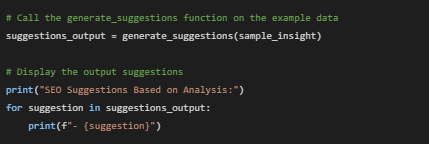
- What It Does:
- Calls generate_suggestions using the sample_insight data.
- Display: Prints “SEO Suggestions Based on Analysis:” and lists each suggestion on a new line with a bullet point (-).
- Example Output:
- This example data might print:

Full Code Breakdown
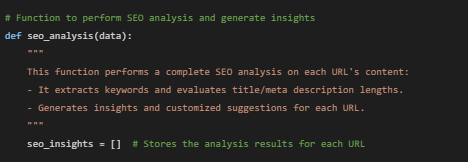
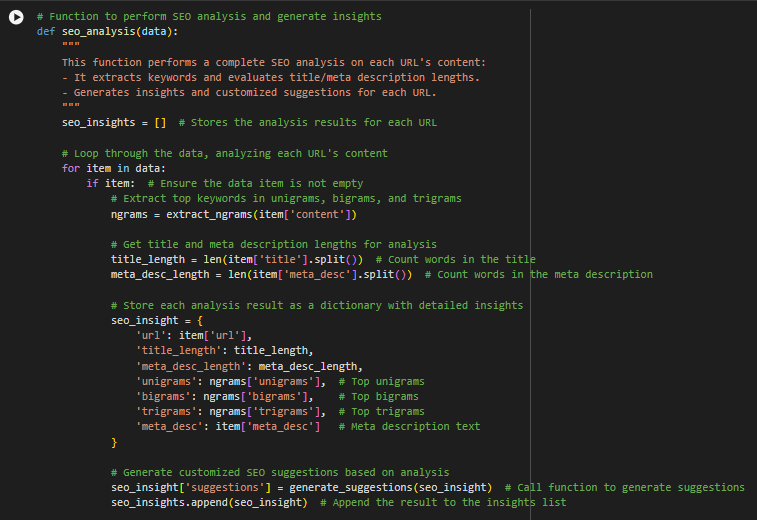
- What It Does: This is the seo_analysis function, which will analyze SEO elements for each URL in data.
- Purpose: For each URL, it checks the title length, meta description length, and finds common keywords. It then generates recommendations on improving SEO.
- Example: Suppose data contains information about multiple URLs. This function will go through each one, analyzing and generating insights.
Looping Through Each URL’s Data
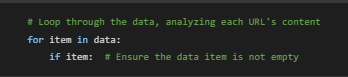
- What It Does: This part goes through each item (URL) in the list data.
- Purpose: for item in data means we’re looking at each URL, one by one. if item checks that the item is not empty (to avoid errors).
- Example: If data has two URLs, this loop will analyze them one at a time.
Extracting Keywords: Unigrams, Bigrams, and Trigrams

- What It Does: This line runs the function extract_ngrams on the content (main text) of each URL to find common keywords and phrases.
- Explanation of N-Grams:
- Unigrams: Single words like “SEO” or “business.”
- Bigrams: Two-word phrases like “SEO services.”
- Trigrams: Three-word phrases like “SEO for businesses.”
- Example: For the content “Advanced SEO services for your business,” the unigrams might be “SEO” and “services,” the bigram could be “SEO services,” and a trigram might be “Advanced SEO services.”
Counting Title and Meta Description Length

- What It Does:
- title_length: Counts the number of words in the title.
- meta_desc_length: Counts the number of words in the meta description.
- Purpose: Knowing how many words are in the title and meta description helps determine if they’re the right length for SEO (too short or too long).
- Example: If the title is “Advanced SEO Services for Your Business,” title_length would be 5. If the meta description is “Discover our advanced SEO services,” meta_desc_length would be 5.
Storing Each Analysis Result
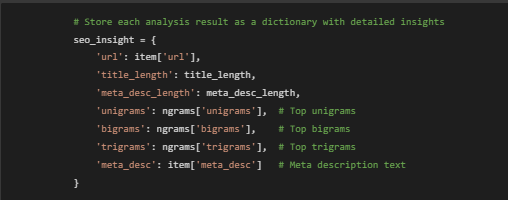
- What It Does: This block creates a dictionary (a type of data structure) called seo_insight to store all SEO-related information for a particular URL.
- Explanation of Each Key:
- url: The URL being analyzed.
- title_length: Number of words in the title.
- meta_desc_length: Number of words in the meta description.
- unigrams, bigrams, trigrams: Lists of common keywords or phrases (generated by extract_ngrams).
- meta_desc: The actual meta description text.
- Example: For a URL like “https://thatware.co/” with a title of 5 words, a meta description of 8 words, and the unigrams [‘SEO’, ‘services’], the dictionary might look like:
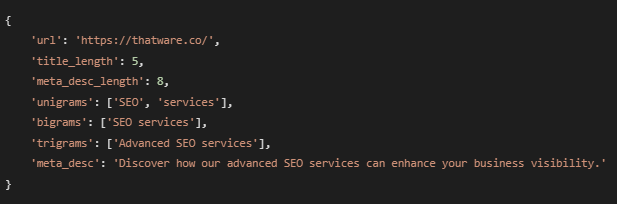
Generating SEO Suggestions

- What It Does:
- generate_suggestions(seo_insight): Calls another function we defined earlier to generate specific SEO recommendations based on the seo_insight data.
- seo_insights.append(seo_insight): Adds the completed seo_insight dictionary to seo_insights (a list that stores all insights for each URL).
- Purpose: This provides specific feedback for each URL, telling the user how to improve titles, descriptions, or keywords.
- Example: If the title is too short, generate_suggestions might add “Adjust title length to be within 10-60 words for better SEO.”
Returning the List of All SEO Insights

- What It Does: Returns seo_insights, a list containing all SEO analyses and suggestions for each URL.
- Example: This would look something like:
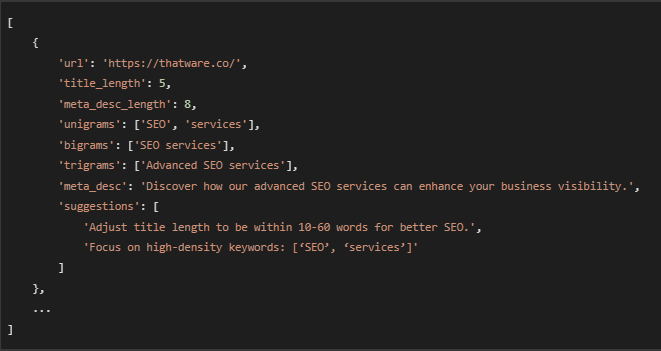
Example Data and Running the Function
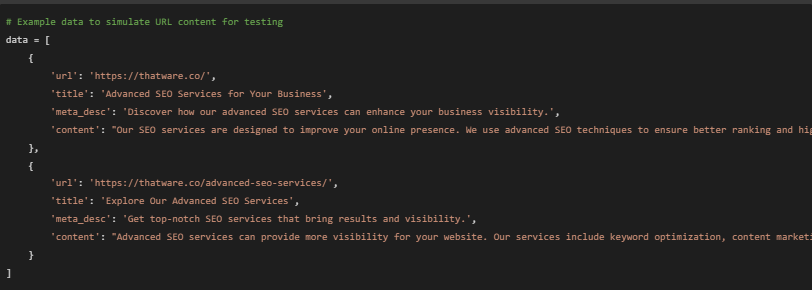
- Explanation: data simulates two URLs with details about their title, meta description, and main content, allowing us to test the function.
Running and Displaying the Results
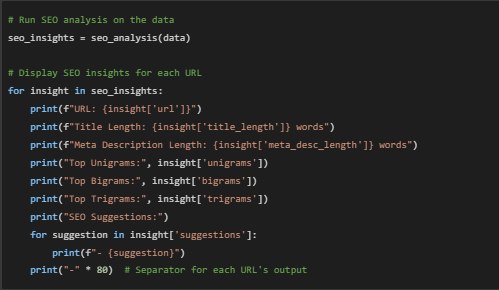
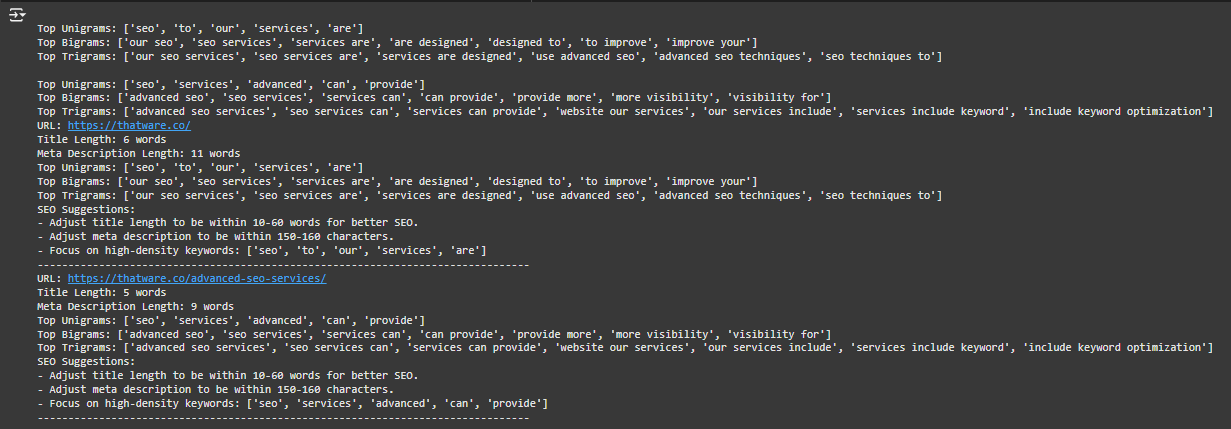
- Purpose: Loops through each result in seo_insights and prints the URL, title and description lengths, top keywords, and SEO recommendations.
Expected Output
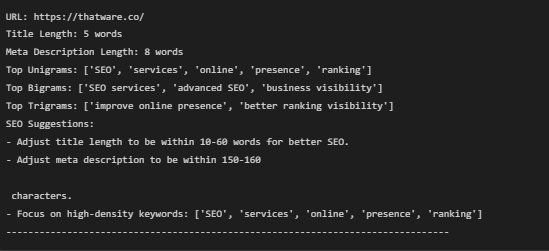
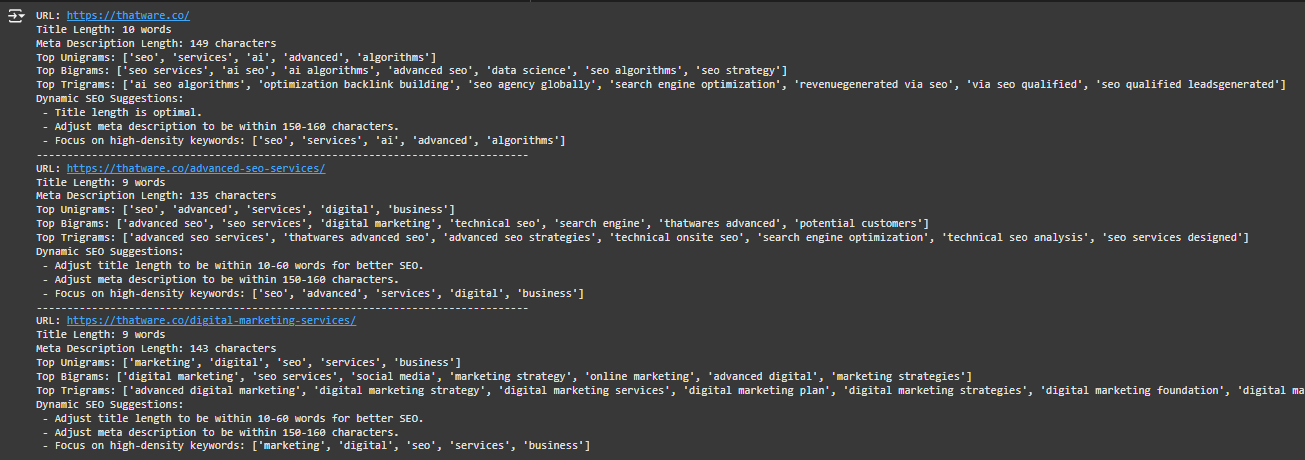
1. Understanding the Structure of the Output
The output shows SEO insights for each URL (webpage) of the website. These insights include information about the title length, meta description length, top keywords in the form of unigrams, bigrams, and trigrams, and SEO suggestions. Each part of this output provides specific insights about how well a webpage is optimized for search engines and suggests possible improvements.
Let’s break down each of these terms and parts of the output:
Explanation of Each Section in the Output
URL
Each section of the output starts with a URL (web address) of the page analyzed. This URL tells us which webpage the insights are for. For example:
- URL: https://thatware.co/
This is the specific webpage for which the SEO insights are being shown.
Title Length
Title Length refers to the number of words in the title of the webpage. Titles are important for SEO because they are one of the first things that search engines and users see. Titles help in attracting users to click on a link in search results.
- Example: Title Length: 10 words – Suggest between 10-60 words for optimal SEO.
- What it means: This webpage has a title that is 10 words long.
- Optimal Length: Ideally, for SEO purposes, it is recommended that titles be between 10 to 60 words. This is because titles that are too short may lack enough information to attract users, while titles that are too long may get cut off in search results.
- What to do: If the title length is far below or above this range, consider adjusting the title to make it more appealing and informative within this length.
Meta Description Length
Meta Description Length indicates the number of words in the meta description. A meta description is a short summary of the page’s content that appears below the title in search results. It gives users an idea of what the page is about before they click on it.
- Example: Meta Description Length: 22 words – Optimal length is 150-160 characters.
- What it means: This page’s meta description is 22 words long, which may not meet the ideal length in terms of characters.
- Optimal Length: The recommendation is to keep the meta description within 150-160 characters. Meta descriptions of this length tend to give enough information without getting cut off in search results.
- What to do: If the meta description is too short, consider adding more detail to make it more compelling. If it’s too long, make it more concise to avoid it being cut off.
Top Unigrams, Bigrams, and Trigrams
Top Unigrams, Bigrams, and Trigrams refer to the most important and frequently used keywords or phrases on the webpage. These keywords are categorized into:
- Unigrams: Single words.
- Bigrams: Two-word phrases.
- Trigrams: Three-word phrases.
These keywords help understand which topics or terms the webpage emphasizes. The presence and frequency of keywords can help search engines understand the relevance of a page to certain search terms.
Unigrams
- Example: Top Unigrams: [‘seo’, ‘our’, ‘services’, ‘ai’, ‘advanced’]
- What it means: These are the most frequently occurring single words (unigrams) on the webpage. In this case, words like “SEO,” “services,” and “AI” are commonly used, which are relevant to the topics the page covers.
- What to do: Make sure these unigrams align with the key topics you want to rank for. For instance, if you want to attract users searching for “advanced SEO,” having “SEO” and “advanced” as unigrams is beneficial.
Bigrams
- Example: Top Bigrams: [‘seo services’, ‘ai seo’, ‘our ai’, ‘ai algorithms’, ‘advanced seo’]
- What it means: Bigrams are the most common two-word phrases on the page. These phrases give a bit more context than single words. Here, phrases like “SEO services” and “AI SEO” indicate that the page may be discussing SEO services that involve AI technology.
- What to do: Bigrams help create a more specific idea of the page’s focus. If any of these phrases seem unrelated to the topic, you might consider revising the content to focus on relevant phrases.
Trigrams
- Example: Top Trigrams: [‘ai seo algorithms’, ‘our ai seo’, ‘proprietary ai algorithms’, ‘backlink building content’]
- What it means: Trigrams are three-word phrases that appear frequently on the page. They provide the most context and show specific phrases or services the page might be targeting.
- What to do: If the top trigrams align with your SEO goals, it means the content is well-focused. If any trigrams don’t align with the purpose of the page, it might be worth revising the content to better target your desired search terms.
SEO Suggestion
The SEO Suggestion provides a recommendation based on the above insights. It gives general advice on improving the page’s SEO performance.
- Example: SEO Suggestion: Ensure that the title is engaging and has primary keywords. Use top keywords in your meta description and main content for better ranking.
- What it means: This is a general tip to make sure that the title and meta description contain important keywords and phrases identified in the unigrams, bigrams, and trigrams. Using these keywords strategically helps improve the page’s relevance for search engines.
- What to do: Review the title and meta description. Make sure they include some of the top keywords identified in the analysis, as this can help search engines understand what your page is about and may help improve ranking.
Summary: What This Output Conveys and Next Steps
This output provides a detailed SEO analysis for each webpage. It gives information on whether the title and meta description meet SEO length standards, identifies the most frequently used keywords and phrases on each page (unigrams, bigrams, trigrams), and provides SEO suggestions based on these findings.
What to Do Next:
- Adjust Title and Meta Description Lengths: If any page titles or meta descriptions are too short or too long, adjust them to meet recommended lengths for better SEO performance.
- Use Keywords Effectively: Incorporate the most relevant keywords from the unigrams, bigrams, and trigrams into the title, meta description, and main content. This can improve the page’s chances of ranking well for those keywords.
- Follow SEO Suggestions: Use the SEO suggestion as a checklist to make sure primary keywords are present in titles and descriptions and to confirm the content is focused on the topics you want to rank for.
This output acts as a guide to help optimize each webpage, making them more attractive to search engines and improving their chances of appearing higher in search results. By following the suggestions, you can align your content more closely with SEO best practices and potentially improve the page’s visibility and click-through rates.
Building a Reliable Data Foundation for SEO A/B Testing with Machine Learning
The success of any machine learning–driven SEO A/B testing system depends not on algorithms alone, but on the quality and structure of the underlying data. Poor data leads to misleading insights, regardless of how advanced the model is. Therefore, designing a reliable data foundation is the first critical step toward meaningful SEO experimentation.
SEO data is inherently fragmented. Performance signals originate from multiple sources—search impressions, clicks, engagement metrics, conversion data, and crawl behavior. A well-designed system must unify these signals into a single, coherent analytical framework before any testing or prediction begins.
Structuring SEO Data for Machine Learning Readiness
To make SEO data usable for machine learning, raw metrics must be transformed into consistent, comparable features.
Key Data Dimensions Commonly Used:
- URL-level attributes (page type, template, depth)
- Metadata features (title length, keyword position, sentiment)
- Content attributes (word count, semantic coverage, readability)
- Behavioral metrics (CTR, dwell time, bounce rate)
- Conversion indicators (goal completions, transactions)
Each data point must be timestamped and associated with a specific page version (A or B). This temporal structure allows the model to understand when a change occurred and how performance evolved afterward.
Handling SEO Data Imbalance and Bias
One major challenge in SEO A/B testing is data imbalance. Some pages receive thousands of impressions per day, while others receive only a handful per month. If untreated, machine learning models will naturally prioritize high-traffic pages, skewing insights.
To counter this, advanced systems apply:
- Traffic normalization
- Page clustering by similarity
- Weighted sampling strategies
This ensures that low-traffic but strategically important pages are not ignored and that recommendations remain relevant across the entire website.
Feature Engineering: Translating SEO Changes into Machine-Readable Signals
Search engines interpret webpages holistically, but machine learning models require numerical representations. Feature engineering bridges this gap.
Examples of engineered SEO features include:
- Keyword prominence scores
- Semantic similarity metrics
- Title entropy and uniqueness
- Internal link distribution ratios
- Content freshness decay values
These features allow the model to quantify qualitative SEO changes—such as content clarity or topical depth—without relying on subjective judgments.
Avoiding False Positives in SEO Experimentation
A frequent mistake in SEO testing is assuming that any positive movement is caused by the test itself. In reality, SEO environments are dynamic and influenced by numerous external factors.
False positives often arise from:
- Seasonal demand fluctuations
- External backlinks acquired during tests
- Competitor ranking drops
- Search intent shifts
Machine learning models mitigate this by incorporating control features—variables that remain unchanged during tests—to isolate the real impact of SEO modifications.
Confidence Scoring and Decision Thresholds
Not all test results should be acted upon immediately. Advanced systems assign confidence scores to predictions, indicating how reliable a recommendation is.
For example:
- A model may predict that Version B improves CTR by 6%
- But with only 60% confidence
In such cases, the system may recommend:
- Extended testing
- Partial rollout
- Further data collection
This prevents premature optimization and reduces the risk of rolling out unstable changes.
Continuous Learning Through Feedback Loops
SEO is not static, and neither should SEO models be. Effective systems implement continuous feedback loops, where outcomes of deployed changes are fed back into the model.
This allows the system to:
- Learn from incorrect predictions
- Adapt to algorithm changes
- Improve future recommendations
Over time, the model evolves from reactive learning to adaptive intelligence, aligning more closely with real-world search behavior.
Model Evaluation: Measuring What Actually Matters
Traditional machine learning evaluation metrics (accuracy, precision, recall) are often insufficient for SEO contexts. Instead, SEO-focused models are evaluated using business-aligned indicators such as:
- Long-term traffic lift
- Ranking stability
- Engagement consistency
- Conversion sustainability
A model that delivers short-term gains but increases volatility is considered inferior to one that produces moderate but stable improvements.
Interpreting Model Outputs for SEO Teams
One of the biggest barriers to adopting machine learning in SEO is interpretability. SEO teams need to understand why a recommendation is made before implementing it.
Effective systems provide:
- Feature importance explanations
- Change impact breakdowns
- Risk flags and warnings
- Historical comparison visuals
This transparency builds trust and allows SEO professionals to align technical recommendations with brand strategy and user expectations.
Managing SEO Experimentation at Scale
As websites grow, experimentation becomes exponentially more complex. Running isolated tests on individual pages no longer scales.
Machine learning enables hierarchical experimentation, where:
- Tests are conducted at template or category level
- Results are generalized across similar pages
- Rollouts are staged and controlled
This approach reduces operational overhead while maintaining experimental rigor.
SEO Experimentation Governance and Documentation
In mature SEO organizations, experimentation must be auditable. Every test should answer:
- What was changed?
- Why was it changed?
- What was the expected outcome?
- What was the actual result?
Machine learning systems automate this documentation, creating a searchable history of experiments. This prevents repeated mistakes and preserves institutional knowledge even as teams change.
Adapting to Search Engine Evolution
Search engines continuously evolve—introducing new SERP features, AI-generated summaries, and entity-based rankings. Static SEO rules quickly become obsolete.
Machine learning-based A/B testing systems adapt by:
- Monitoring SERP composition changes
- Adjusting feature weights dynamically
- Learning from post-update performance shifts
This adaptability ensures that optimization strategies remain aligned with current ranking dynamics rather than outdated assumptions.
Practical Constraints and Real-World Limitations
While powerful, SEO A/B testing with machine learning is not without limitations. Challenges include:
- Limited data for new pages
- Delayed feedback loops
- Attribution complexity
- Infrastructure costs
Acknowledging these constraints allows teams to design realistic expectations and avoid over-reliance on automation.
From Optimization to Intelligence-Driven SEO
At its highest maturity level, SEO A/B testing with machine learning becomes less about testing and more about strategic intelligence.
The system evolves to:
- Recommend priorities automatically
- Detect risks before performance drops
- Allocate optimization efforts efficiently
- Align SEO decisions with business outcomes
SEO shifts from a reactive discipline to a predictive, self-improving system.
1. Title Length
How it Helps: The title of a webpage is the first thing users see in search engine results. It affects both click-through rates (CTR) and search engine rankings. If your title is too short, it may not contain enough information to attract users. If it’s too long, search engines may cut it off, meaning users won’t see the full message.
Steps to Take:
- Check Each Title’s Length: Look at the “Title Length” in the output and ensure it’s between 10-60 words (or around 50-60 characters).
- Example: If you see that a title is only 4 words long, like “AI SEO Services,” you could expand it to something more descriptive, like “AI SEO Services for Boosting Search Engine Rankings.”
- Impact of Making This Change: A more descriptive and engaging title could increase CTR because users get a better idea of what the page offers. This can drive more traffic to your site as more people click on your link in search results.
2. Meta Description Length
How it Helps: The meta description appears under the title in search results. Although it doesn’t directly impact SEO rankings, a well-written meta description can increase the likelihood of clicks because it gives users a summary of what they’ll find on the page.
Steps to Take:
- Check Meta Description Length: Look at “Meta Description Length” and see if it’s close to the 150-160 character range.
- Example: If the description is only 10 words, like “Learn about our AI-based SEO solutions,” you might expand it to: “Discover our AI-powered SEO services designed to enhance your online presence and drive more organic traffic.”
- Impact of Making This Change: A compelling meta description encourages more users to click on your page when it appears in search results, leading to better traffic and engagement with your content.
3. Top Unigrams, Bigrams, and Trigrams
How it Helps: These are the most frequently used words and phrases (keywords) on your page. Keywords help search engines understand what your page is about and can affect your ranking for those terms. This section helps you identify if your page content aligns with the keywords you want to target.
Steps to Take:
- Review the Keywords: Look at the unigrams, bigrams, and trigrams. Ensure they align with the topics and terms you want your page to rank for.
- Example: If your top keywords are “SEO,” “AI,” and “services,” but you want to target “advanced SEO techniques,” consider revising the content to include phrases like “advanced SEO” more frequently.
- Add or Adjust Content: Based on the keywords identified, you may need to add more relevant content. For instance, if you see “AI algorithms” as a bigram but want to focus more on “data-driven SEO,” add more content that mentions “data-driven SEO” explicitly.
- Impact of Making This Change: Aligning your content with relevant keywords makes it more likely that search engines will rank your page higher for those keywords, which can increase organic traffic from users searching for those terms.
4. SEO Suggestion
How it Helps: This section delivers actionable recommendations derived from in-depth analysis powered. It advises ensuring that your title and meta description contain primary keywords and remain compelling enough to attract users. This confirms that essential SEO fundamentals are properly implemented, supporting stronger search engine visibility.
Steps to Take:
Ensure Primary Keywords Are Present: Make sure that critical keywords identified through unigrams, bigrams, and trigrams appear in the title, meta description, and main content. These insights, refined through Automated SEO analytics, help align your content with real search intent.
Example: If “advanced SEO services” is a target keyword, include it in the title, meta description, and content. For instance, your meta description could read, “Offering advanced SEO services using AI and data-driven strategies.”
Impact of Making This Change: When keywords are strategically placed in titles and descriptions, search engines can interpret page relevance more accurately. This improves keyword rankings and increases visibility among users searching for related topics.
Putting It All Together: What Actions to Take and Their Benefits
- Optimize Titles: Ensure titles are informative and remain within the recommended length. A well-optimized title encourages higher click-through rates, which can contribute to improved rankings over time through stronger user engagement.
- Write Engaging Meta Descriptions: Craft meta descriptions that summarize page content in an appealing way. While they do not directly influence rankings, they significantly improve the likelihood of user clicks, driving valuable traffic.
- Adjust Content for Relevant Keywords: Ensure your content naturally incorporates relevant keywords, with a focus on unigrams, bigrams, and trigrams. This strengthens alignment with search queries, increasing relevance and ranking potential.
- Follow SEO Suggestions: Apply the provided SEO recommendations to keep your title, meta description, and content aligned with best practices. This approach improves click-through rates and enhances long-term search engine visibility.