FILL OUT THE FORM BELOW & ALLOW US TO TAKE YOUR NLP SERVICES TO A WHOLE NEW LEVEL!
Search engines are no longer simple keyword-matching systems.
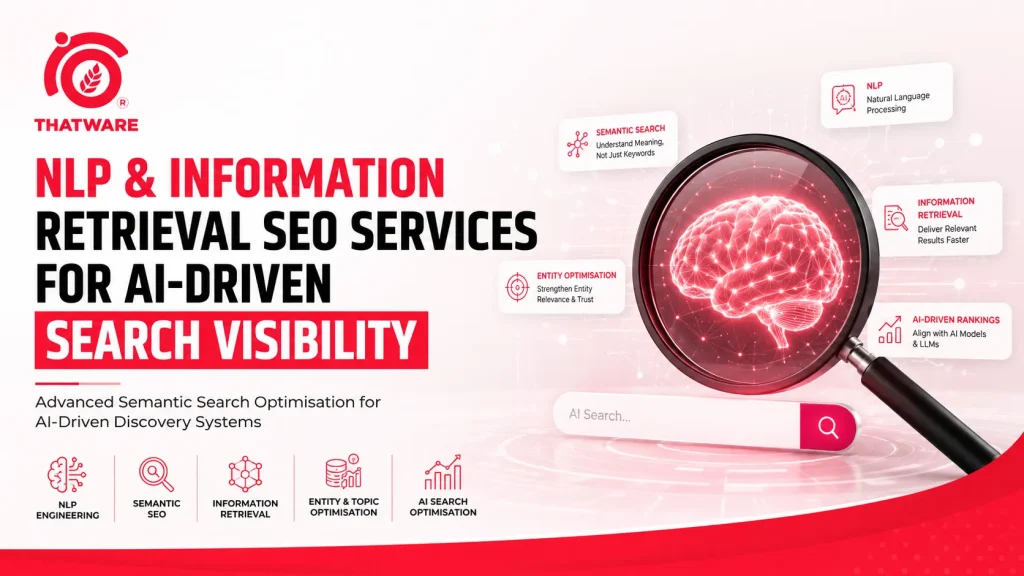
Modern platforms like Google Search, Bing AI, ChatGPT, Perplexity, Gemini, and voice assistants rely on:
- Natural Language Processing (NLP)
- Knowledge Graphs
- Vector embeddings
- Entity recognition systems
- Neural retrieval models (like BERT, RankBrain, MUM, and transformer-based LLMs)
This means ranking is no longer about keyword density.
It is about:
How well your content aligns with machine understanding of meaning, intent, and entities.
We operate at this intersection of:
- Information Retrieval Science (IR)
- Semantic SEO Engineering
- AI Search Optimisation (GEO + AEO + LLM SEO)
What is Natural Language Processing (NLP)?
Natural Language Processing (NLP) is a branch of Artificial Intelligence (AI) that focuses on enabling machines to understand, interpret, and generate human language in a meaningful way. Unlike traditional computing systems that rely on structured commands or keyword-based inputs, NLP allows machines to work with natural human communication in text and speech form.
At its core, NLP bridges the gap between human language and machine understanding. Human language is inherently complex, ambiguous, and context-dependent. The same word can carry different meanings depending on usage, tone, or situation. NLP helps machines resolve this ambiguity by analysing linguistic patterns, semantic structures, and contextual signals. This evolution of language AI enables machines to process, analyse, and generate human-like communication while improving how digital platforms understand information and user behaviour.
Modern NLP systems are built using a combination of machine learning, deep learning, and transformer-based architectures. These models learn from massive datasets containing books, websites, conversations, and structured knowledge sources. Over time, they develop the ability to understand not just words, but the relationships between words and the intent behind sentences.
What NLP enables machines to do
Natural Language Processing allows machines to perform several advanced language-related functions that were previously impossible with rule-based systems. These include:
1. Understanding human language
NLP systems can process written or spoken input and convert it into a structured form that machines can interpret. This includes identifying grammar, syntax, and sentence structure.
2. Interpreting context and intent
Instead of focusing only on individual words, NLP models analyse the meaning behind a sentence. For example, the query “best CRM for small businesses with automation” is interpreted based on intent rather than isolated keywords.
3. Extracting meaning from unstructured text
A large portion of the internet consists of unstructured data such as blog posts, reviews, and social media content. NLP helps extract structured insights such as topics, entities, and relationships from this data.
4. Generating human-like responses
Advanced NLP models can generate coherent, context-aware responses that mimic human communication. This is the foundation of modern chatbots and AI assistants.
Core components of NLP understanding
Unlike traditional keyword-based systems, NLP relies on deeper linguistic and mathematical structures. Some of the key components include:
Contextual meaning
Words are interpreted based on surrounding text rather than in isolation. For example, the word “Apple” could refer to a fruit or a technology company depending on context.
Word relationships
NLP systems map how words relate to each other within a sentence or across documents. This helps in identifying associations such as cause-effect, comparison, or hierarchy.
Sentence structure
Grammatical structure plays a key role in understanding meaning. NLP models analyse parts of speech, sentence dependencies, and syntactic patterns.
Semantic similarity
Instead of exact keyword matching, NLP systems measure how similar two pieces of text are in meaning. This is often done using vector embeddings and cosine similarity techniques.
Entity recognition
Named Entity Recognition (NER) identifies important real-world entities such as people, brands, locations, products, and organisations within a text. This is critical for building knowledge graphs and semantic understanding.
Real-world applications of NLP
Natural Language Processing is already deeply integrated into everyday digital systems. Some of the most common applications include:
Google Search and modern ranking systems
Search engines like Google use NLP models such as RankBrain, BERT, and MUM to understand search queries more effectively. These systems help Google interpret intent rather than just matching keywords.
Voice assistants
Tools like Siri, Alexa, and Google Assistant rely on NLP to understand spoken commands, convert them into structured queries, and provide relevant responses.
Chatbots and customer support systems
Businesses use NLP-powered chatbots to handle customer queries in real time. These systems can understand intent, provide solutions, and escalate complex issues when necessary.
AI summarisation tools
NLP is used to summarise long documents into concise versions while preserving key information and meaning.
Large Language Models (LLMs)
Modern systems like ChatGPT are built on advanced NLP architectures. They can generate essays, answer questions, write code, and hold conversations that closely resemble human interaction.
What is Information Retrieval (IR)?
Information Retrieval (IR) is the scientific discipline that focuses on how systems store, organise, search, and deliver relevant information from large collections of data. In simple terms, IR is the engine behind every search system you use today. Whenever you type a query into Google, ask a question to an AI assistant, or search inside an app, an Information Retrieval system is working in the background to decide what information is most relevant and how it should be presented to you.
At its core, Information Retrieval is not just about finding documents. It is about ranking relevance. This means the system must evaluate thousands or even millions of possible results and decide which ones best satisfy the user’s intent. This decision-making process is what makes IR one of the most important foundations of modern search engines and AI-driven discovery systems.
Core functions of Information Retrieval systems
Information Retrieval systems are designed to perform a set of essential tasks that together determine how information is accessed and consumed:
Search
The system must interpret a user’s query and search through a large dataset or index to find potentially relevant information.
Rank
Once potential results are identified, the system ranks them based on relevance. This is one of the most critical steps in IR because ranking determines visibility.
Retrieve
The system selects and fetches the most relevant documents, pages, or passages from the database or index.
Filter
Not all retrieved results are useful. IR systems filter out irrelevant, duplicate, low-quality, or spam content to improve accuracy.
Present information
Finally, the system decides how to present the information to the user, whether as a list of links, featured snippets, AI-generated summaries, or conversational responses.
Each of these steps works together to ensure that users receive the most relevant and useful information in the shortest possible time.
Evolution of Information Retrieval systems
Traditional Information Retrieval systems were heavily dependent on keyword matching and basic indexing. These systems worked by scanning documents for exact word matches and calculating simple frequency-based scores. While effective in early search engines, this approach had major limitations:
- It failed to understand context
- It ignored synonyms and semantic relationships
- It struggled with ambiguous queries
- It relied heavily on exact keyword presence
As the internet grew, this approach became insufficient. The volume of data increased exponentially, and user queries became more complex and conversational. This led to the evolution of modern IR systems powered by Artificial Intelligence and Machine Learning.
Today, Information Retrieval systems use advanced techniques that allow them to understand meaning rather than just matching words.
Modern components of Information Retrieval systems
Modern IR systems are built on a combination of semantic, neural, and statistical models. Some of the key technologies include:
Vector embeddings
Vector embeddings are numerical representations of words, sentences, or documents in a multi-dimensional space. Instead of treating text as words, IR systems convert them into vectors that capture meaning. Similar meanings are placed closer together in this vector space.
This allows systems to understand that “car insurance” and “vehicle coverage” are closely related even if they do not share exact keywords.
Semantic similarity scoring
Once text is converted into embeddings, IR systems measure how similar two pieces of content are using mathematical functions such as cosine similarity. This helps determine how closely a document matches a user’s query in meaning rather than just wording.
Neural ranking models
Modern search engines use neural networks to evaluate and rank results. Models like BERT-based ranking systems help understand context, word order, and sentence meaning. These models significantly improve relevance by analysing entire passages rather than isolated keywords.
Query understanding systems
Before retrieving results, IR systems first interpret the user’s query. This includes identifying:
- Intent (informational, transactional, navigational)
- Entities (brands, products, people, locations)
- Context (what the user is really trying to achieve)
This step ensures that the system searches in the correct semantic direction.
Passage-level retrieval
Earlier IR systems evaluated entire pages as a single unit. Modern systems go much deeper by analysing individual passages or sections within a page. This means a single paragraph can rank independently if it best answers the query.
This is one of the biggest shifts in modern search behaviour and has major implications for SEO.
How Information Retrieval works in modern search engines
Modern search engines like Google and Bing do not simply “look up” pages. Instead, they perform multi-layered semantic analysis:
- The query is parsed and converted into a structured representation
- The system identifies entities and intent
- Relevant documents are retrieved from an index
- Content is converted into embeddings
- Similarity scoring is applied between query and documents
- Neural ranking models refine results
- Final results are filtered and presented
This entire process happens in milliseconds, but behind the scenes, it involves highly complex AI systems.
Information Retrieval in SEO context
In SEO, Information Retrieval determines whether your content is visible, relevant, and competitive in search results. It is no longer enough to simply publish content with keywords. Your content must align with how IR systems interpret meaning.
IR determines:
Whether your page is considered relevant
Search engines evaluate whether your content semantically matches a user’s query. If the meaning alignment is weak, your page may not be retrieved at all.
How closely it matches search intent
Even if your page is relevant, IR systems determine how closely it satisfies the user’s intent compared to competing pages.
Whether it is selected for AI-generated answers
Modern AI systems like Google AI Overviews and conversational search engines rely heavily on IR systems to select source content for summaries and answers.
How it competes in semantic space
Your content is not competing on keywords alone. It is competing in a semantic vector space where every page is evaluated based on meaning proximity.
The shift from keyword ranking to meaning-based ranking
One of the most important transformations in modern search is the shift from keyword-based ranking to semantic ranking. Natural language processing SEO focuses on helping search engines understand content meaning, context, and relationships between entities, allowing businesses to improve visibility across semantic search and AI-powered discovery platforms.
Previously, SEO success depended on:
- Keyword density
- Exact match phrases
- Backlink signals
- Metadata optimisation
Today, ranking is driven by:
- Semantic relevance
- Entity coverage
- Contextual depth
- Passage-level usefulness
- Embedding similarity
This means search engines no longer evaluate pages as static documents. Instead, they evaluate them as meaning representations.
Key insight: Google ranks meaning, not pages
A critical shift in modern Information Retrieval is this:
Google does not rank pages anymore. It ranks meaning representations of pages.
This means every page is converted into a semantic representation that captures:
- Topics covered
- Entities mentioned
- Contextual relationships
- User intent alignment
- Depth of information
When a user submits a query, the system compares the meaning of the query with these representations and selects the closest matches.
This is why two pages with similar keywords can perform very differently in rankings. One may have stronger semantic alignment, better entity coverage, and deeper contextual relevance.
How NLP & Information Retrieval Transform SEO
We use advanced NLP + IR systems to optimise content beyond keywords.
Our methodology includes:
Semantic Understanding Layer
We analyse:
- Contextual meaning of your content
- Entity relationships
- Topic clusters
- User intent alignment
Machine Representation Layer
We evaluate how your content is interpreted by:
- Embedding models
- Search ranking algorithms
- AI answer engines
Competitive Semantic Mapping
We compare:
- Your semantic footprint
- Competitor entity coverage
- Topic completeness score
Our advanced NLP services help businesses analyse search intent, improve semantic relevance, and optimise digital content for AI-driven search systems by combining language understanding, entity analysis, and machine learning techniques.
Core NLP SEO Methodologies We Use
Semantic Similarity Analysis (Modern Cosine Similarity)
Cosine similarity is used to measure semantic alignment between:
- Search queries
- Web pages
- Competitor content
- Topic clusters
Instead of keyword matching, we compute vector similarity between embeddings.
Modern interpretation:
- 0.80 – 1.00 → Highly relevant (strong ranking signal)
- 0.65 – 0.79 → Good semantic match
- 0.50 – 0.64 → Moderate relevance (needs optimisation)
- Below 0.50 → Weak semantic alignment
What we optimise:
- Entity density (not keyword density)
- Contextual alignment
- Passage-level relevance
- Query-to-content mapping
Why this matters:
Search engines like Google now use BERT-style embeddings, meaning:
Pages rank based on meaning proximity, not keyword repetition.
Through advanced semantic analysis, we evaluate relationships between concepts, entities, and content themes to identify optimisation opportunities that improve contextual relevance and search performance.
Latent Dirichlet Allocation (LDA) & Topic Modelling
LDA is a probabilistic topic modelling technique used to:
- Identify hidden topics in content
- Measure thematic consistency
- Detect semantic gaps
- Improve topical authority
Modern SEO use of LDA:
We use LDA-like models alongside transformer-based clustering to:
- Build topic clusters
- Improve semantic coverage
- Expand content depth
- Strengthen authority signals
Updated interpretation:
- 0.30+ → Strong topical authority
- 0.15 – 0.30 → Good coverage
- Below 0.15 → Weak semantic structure
Important note:
Modern SEO no longer relies on LDA alone. We combine:
- LDA (topic distribution)
- BERT embeddings (context)
- Knowledge graphs (entity mapping)
Bag of Words → Now Evolved into Entity Frequency Mapping
Traditional Bag of Words (BoW) is outdated alone, but conceptually useful.
We upgrade it into:
Entity Frequency & Semantic Term Coverage Model
We analyse:
- High-frequency terms
- Entity mentions
- Contextual phrases
- Competitor missing entities
What we optimise:
- Entity coverage gaps
- Missing semantic fields
- Topic enrichment opportunities
Outcome:
Instead of keyword stuffing, we build:
A complete semantic ecosystem around your content
Modern NLP SEO Framework We Implement
We follow a 6-layer optimisation model:
Layer 1: Intent Mapping
We classify queries into:
- Informational intent
- Commercial intent
- Transactional intent
- Navigational intent
- Investigational intent
Layer 2: Entity Extraction
We identify:
- People
- Brands
- Products
- Locations
- Concepts
- Industry entities
And align them with Knowledge Graph signals.
Layer 3: Semantic Coverage Analysis
We evaluate:
- Topic completeness
- Missing subtopics
- Weak semantic zones
- Content depth score
Layer 4: Embedding Alignment
We optimise how your content is interpreted by:
- Google embeddings
- AI search systems
- LLM retrieval models
Layer 5: Passage-Level Optimisation
We restructure content so each section:
- Answers a query directly
- Can be independently retrieved
- Is AI snippet-ready
Layer 6: Generative Engine Optimisation (GEO)
We optimise for:
- ChatGPT citations
- Google AI Overviews
- Perplexity answers
- Voice search responses
NLP SEO Deliverables & Scope of Work (Rebuilt Version)
Below is a refined, enterprise-grade service structure.
NLP Content Intelligence Audit
We analyse:
- Semantic structure
- Entity distribution
- Topic depth
- AI retrievability
We analyse your website content using NLP-driven methods to identify semantic gaps, improve topical coverage, and ensure your pages are structured for both search engines and AI retrieval systems.
Deliverables:
- NLP audit report
- Content gap matrix
- Semantic scorecard
Entity Optimisation & Knowledge Graph Alignment
We enhance:
- Entity clarity
- Entity relationships
- Brand authority signals
Deliverables:
- Entity map
- Missing entity report
- Knowledge graph recommendations
Intent & Query Alignment Engineering
We map:
- Search queries to content sections
- Conversational search patterns
- AI prompt compatibility
Deliverables:
- Intent mapping sheet
- Query coverage report
Semantic Gap & Topic Expansion Analysis
We identify:
- Missing topics
- Weak sections
- Underdeveloped themes
Deliverables:
- Topic cluster expansion plan
- Content roadmap
NLP Readability & Clarity Engineering
Our approach combines SEO-focused copywriting with NLP insights to create content that is clear for users, understandable for AI systems, and aligned with modern search intent.
We improve:
- Sentence clarity
- Passage flow
- Cognitive load
- AI readability score
Internal Linking via Semantic Graphs
We build:
- Contextual link networks
- Topic clusters
- Authority flow structures
Schema & Structured Data Alignment
We implement:
- FAQ schema
- Article schema
- Product schema
- Entity schema
- Knowledge graph markup
AI Search Optimisation (GEO Layer)
We optimise content for:
- AI Overviews
- ChatGPT citations
- Perplexity ranking
- Voice assistants
Reporting & Intelligence Dashboard
Includes:
- Semantic score tracking
- Entity performance tracking
- Content gap evolution
- AI visibility metrics
NLP SEO Service Packages (Rebuilt for Modern SEO)
| Service Layer | Scope | Starter | Growth | Pro | Advanced | Enterprise |
| NLP Content Audit | Semantic evaluation | 10 URLs | 30 URLs | 100 URLs | 250 URLs | Custom |
| Entity Analysis | Missing + strong entities | Basic | Advanced | Advanced | Enterprise | Custom |
| Intent Mapping | Query classification | 25 | 75 | 250 | 600 | Unlimited |
| Topic Modelling | Cluster analysis | 10 | 30 | 100 | 250 | Enterprise |
| Semantic Optimization | Content rewriting | 5 pages | 15 pages | 50 pages | 150 pages | Unlimited |
| AI Readability Scoring | NLP clarity | 10 pages | 30 pages | 100 pages | 250 pages | Enterprise |
| Internal Linking | Semantic linking | 10 | 50 | 150 | 400 | Unlimited |
| GEO Optimisation | AI visibility | Basic | Advanced | Advanced | Enterprise | Custom |
| Reporting | NLP insights | Basic | Monthly | Bi-weekly | Weekly | Real-time |
Why This Approach Works in Search Ecosystem
Search is now:
- AI-generated
- Entity-driven
- Context-aware
- Embedding-based
Traditional SEO fails because it relies on:
- Keywords
- Backlinks only
- Static ranking models
Our NLP SEO approach ensures:
You become:
- A semantic authority
- A knowledge graph entity
- A retrievable AI source
- A citation-worthy domain
Final Transformation Outcome
After implementation, your content becomes:
- Easier for AI to understand
- More likely to be cited in AI answers
- Stronger in semantic relevance
- Structurally aligned with search engines
- Future-proof for generative search systems
Advanced Role of Information Retrieval in Modern AI Search Systems
Beyond traditional search engines, Information Retrieval now plays a foundational role in AI-driven ecosystems such as generative search engines, conversational assistants, and retrieval-augmented generation (RAG) systems. In these environments, IR is not just about fetching ranked links—it is about supplying contextually precise knowledge fragments that AI models use to construct answers.
With the integration of AI NLP, modern search systems can interpret complex queries, understand conversational language, and deliver more accurate results based on user intent rather than simple keyword matching.
In a RAG system, for example, the IR layer retrieves relevant passages from a large corpus, and a generative model then synthesises those passages into a coherent response. This means IR directly influences the quality, accuracy, and trustworthiness of AI-generated answers. If retrieval is weak or semantically misaligned, even the most advanced language model will produce incomplete or incorrect outputs.
This shift has elevated IR from a backend search function to a core intelligence layer in AI systems.
Vector Databases and Semantic Search Infrastructure
One of the most significant technological shifts in modern Information Retrieval is the rise of vector databases. Unlike traditional databases that rely on structured queries and keyword indexing, vector databases store information as high-dimensional embeddings.
Each document, paragraph, or sentence is transformed into a vector that represents its semantic meaning. These vectors are then stored in specialised systems such as FAISS, Pinecone, Weaviate, or Milvus, which are designed for fast similarity search.
This allows systems to:
- Retrieve conceptually similar content rather than keyword matches
- Handle ambiguous or conversational queries effectively
- Scale retrieval across billions of documents
- Support real-time semantic search at low latency
In SEO terms, this means your content is no longer evaluated as static text. Instead, it exists as a positioned vector in a semantic space, competing with other vectors for relevance proximity to user queries.
Passage Ranking and Deep Content Understanding
Modern IR systems also operate at a much more granular level than before. Instead of ranking entire pages, they evaluate individual passages, sections, or even sentences.
This is known as passage-level retrieval and ranking, and it has completely changed how content is optimised.
For example, a single paragraph in a long article can outperform an entire competitor page if it:
- Directly answers the query
- Matches intent precisely
- Contains strong semantic relevance
- Includes supporting entities and context
This is why long-form content alone is no longer sufficient. Structure, clarity, and semantic segmentation now matter more than sheer content length.
Search engines essentially “read” content in chunks and decide which chunk best answers a query.
Entity-Centric Information Retrieval
Another major evolution in IR is the shift towards entity-centric indexing. Instead of focusing only on words, search systems now prioritise entities—real-world concepts such as brands, people, locations, products, and ideas.
Entities are mapped in Knowledge Graphs, which help systems understand relationships such as:
- “Apple” → Technology company, not fruit (context-dependent)
- “Python” → Programming language vs snake
- “Jaguar” → Animal vs automobile brand
This entity-based understanding allows IR systems to disambiguate meaning and deliver more accurate results.
For SEO, this means content must clearly define and reinforce entities to improve:
- Knowledge graph association
- Topical authority
- Semantic trust signals
- AI retrievability
Pages that fail to establish strong entity context are often under-represented in AI-driven search results, even if they are keyword-optimised.
Query Embedding and Intent Matching
Modern IR systems also transform user queries into embeddings, allowing them to compare query meaning with document meaning directly.
This process is known as query embedding matching, and it enables systems to:
- Understand conversational queries
- Interpret long-tail search phrases
- Detect user intent with high accuracy
- Map queries to multiple relevant content sources
For instance, a query like:
“how to choose CRM software for a growing startup with automation features”
is decomposed into:
- Intent: informational + commercial investigation
- Entities: CRM software, startups, automation tools
- Constraints: scalability, automation, growth stage
- Expected outcome: comparison or recommendation
This allows IR systems to retrieve content that aligns with intent even if the exact phrasing does not exist in the document.
Why IR is the Foundation of AI Visibility
In today’s AI-powered search ecosystem, visibility is no longer determined by indexing alone. It is determined by how well your content integrates into the retrieval layer of AI systems.
If your content is not effectively retrieved, it will never reach:
- Ranking systems
- Featured snippets
- AI-generated answers
- Voice assistant responses
- Conversational search outputs
This makes IR the gatekeeper of digital visibility.
NLP SEO Deliverables/SOW
| Type of Layering | Deliverables/Scope of Work | $550 USD/Month | $1,550 USD/Month | $4,500 USD/Month | $7,500 USD/Month | $10,500 USD/Month | $15,500 USD/Month |
| NLP content audit | Natural language processing-based content audit | 10 URLs | 30 URLs | 100 URLs | 250 URLs | 500 URLs | Enterprise-wide |
| Entity extraction and missing entity analysis | Basic | Yes | Advanced | Advanced | Enterprise | Custom | |
| Content intent classification review | 25 Queries | 75 Queries | 250 Queries | 600 Queries | 1,200 Queries | Unlimited | |
| Topic coverage and semantic gap analysis | 10 Topics | 30 Topics | 100 Topics | 250 Topics | 500 Topics | Industry-wide | |
| NLP readability and clarity scoring | 10 Pages | 30 Pages | 100 Pages | 250 Pages | 500 Pages | Enterprise-wide | |
| Semantic optimization | Semantic phrase and context optimization | 5 Pages | 15 Pages | 50 Pages | 150 Pages | 300 Pages | Unlimited |
| Topic modeling and cluster recommendations | 5 Clusters | 15 Clusters | 50 Clusters | 150 Clusters | 300 Clusters | Unlimited | |
| Entity salience improvement recommendations | No | Basic | Advanced | Advanced | Enterprise | Custom | |
| Search query language alignment | 25 Queries | 75 Queries | 250 Queries | 600 Queries | 1,200 Queries | Unlimited | |
| Contextual keyword placement and phrase variation planning | Basic | Yes | Advanced | Advanced | Enterprise | Custom | |
| Content intelligence | Sentiment and tone analysis for priority content | No | 10 Pages | 40 Pages | 100 Pages | 250 Pages | Unlimited |
| Question detection and answer completeness improvement | 10 FAQs | 30 FAQs | 100 FAQs | 250 FAQs | 500 FAQs | Unlimited | |
| NLP-based content brief creation | No | 5 Briefs | 20 Briefs | 75 Briefs | 150 Briefs | Unlimited | |
| Content duplication and semantic similarity analysis | No | Basic | Advanced | Advanced | Enterprise | Custom | |
| Token-efficient content structure recommendations | No | Basic | Advanced | Advanced | Enterprise | Custom | |
| Technical NLP signals | Structured data recommendations for NLP comprehension | Basic | Yes | Advanced | Advanced | Enterprise | Custom |
| Heading hierarchy and semantic HTML review | 10 Pages | 30 Pages | 100 Pages | 250 Pages | 500 Pages | Enterprise-wide | |
| Internal linking by semantic similarity | 10 Links | 50 Links | 150 Links | 400 Links | 1,000 Links | Unlimited | |
| NLP-friendly glossary and definition block recommendations | No | 25 Terms | 75 Terms | 150 Terms | 300 Terms | Unlimited | |
| Schema alignment with entities, questions and concepts | Basic | Yes | Advanced | Advanced | Enterprise | Custom | |
| Reporting | NLP SEO scorecard and optimization report | Basic | Yes | Advanced | Advanced | Enterprise | Executive |
| Semantic gap and content improvement tracker | No | Monthly | Monthly | Bi-weekly | Weekly | Real-time | |
| Entity and topic model report | No | Monthly | Monthly | Bi-weekly | Weekly | Custom | |
| NLP content roadmap | Basic | Yes | Yes | Advanced | Advanced | Enterprise |
Wrapping Up
Natural Language Processing (NLP) and Information Retrieval (IR) together form the backbone of modern search intelligence, powering how content is understood, retrieved, ranked, and ultimately delivered across both traditional search engines and AI-driven ecosystems. As search continues to evolve into a semantic, entity-first, and embedding-based system, success is no longer determined by surface-level keyword optimisation but by deep alignment with meaning, intent, and contextual relationships. Businesses that adopt NLP-driven SEO and IR-focused content engineering position themselves not just for higher rankings, but for long-term visibility across AI search platforms, conversational assistants, and generative engines. In this new paradigm, digital authority is built by how effectively your content becomes part of the machine’s understanding of the world—making semantic clarity, entity optimisation, and retrieval readiness the true foundations of sustainable search dominance.