FILL OUT THE FORM BELOW & ALLOW US TO TAKE YOUR SOFTWARE DEVELOPMENT SERVICES TO A WHOLE NEW LEVEL!
Technology continues reshaping how businesses operate, compete, and grow. Organizations today require more than disconnected systems and outdated software tools. They need intelligent, scalable, and performance-driven solutions capable of improving workflows, customer experiences, operational efficiency, and long-term adaptability.
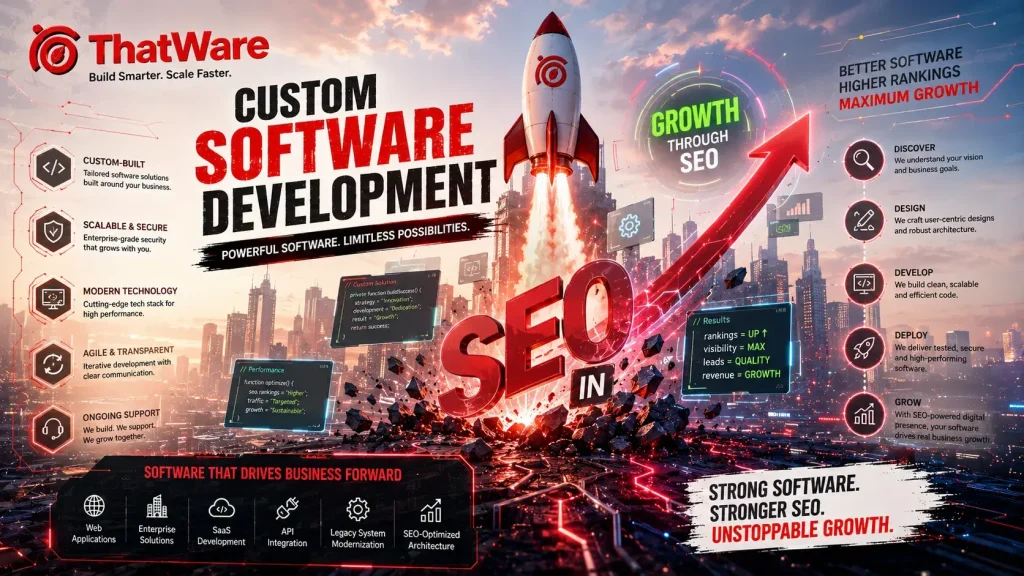
This growing demand has made professional software development services more important than ever.
Businesses no longer invest in software simply to digitize operations. Modern software ecosystems now influence productivity, automation, customer engagement, internal communication, data accessibility, and business visibility. Whether the objective involves streamlining operations, improving customer experiences, automating repetitive processes, or building scalable business infrastructure, software has become central to sustainable growth.
At ThatWare, custom software development services focus on building flexible, secure, and business-focused software solutions tailored to unique organizational requirements. Instead of relying on rigid, one-size-fits-all systems, businesses increasingly require customized software environments capable of adapting to changing demands.
From startups and growing companies to enterprise-level organizations, the need for scalable and intelligent software continues to expand across industries.
Modern software development services now support:
- Business automation
- Operational efficiency
- Customer experience improvement
- Data management
- Digital transformation
- Workflow optimization
- Scalable business growth
- Cross-platform accessibility
- Security and compliance
- Business intelligence and analytics
At the same time, modern software systems increasingly influence broader digital performance. Businesses with streamlined digital ecosystems often improve customer engagement, user retention, operational consistency, and overall digital credibility.
This creates indirect benefits for SEO performance, website usability, customer satisfaction, and long-term brand visibility. ThatWare develops software with a simple objective. Build intelligent digital systems that solve real business problems while supporting sustainable growth.
Why Modern Businesses Need Professional Software Development Services?
Businesses operate in increasingly complex digital environments. Customers expect faster responses, and employees require efficient workflows. Organizations need secure systems capable of managing operations without unnecessary delays or inefficiencies. Unfortunately, many businesses still rely on disconnected software tools that create friction rather than efficiency.
Manual operations often lead to:
- Repetitive tasks
- Productivity bottlenecks
- Communication gaps
- Operational inefficiencies
- Higher costs
- Data inconsistency
Professional software development services solve these challenges by creating centralized systems designed around business objectives. Rather than forcing businesses to adapt to generic platforms, custom software development services allow technology to adapt to operational requirements.
For example, businesses may require software to:
- Automate workflows
- Manage customer relationships
- Improve communication
- Simplify internal processes
- Streamline inventory management
- Improve reporting accuracy
- Centralize business data
- Support customer interactions
As digital transformation accelerates, businesses increasingly rely on business software development services to remain competitive. A strong software ecosystem improves operational flexibility while helping organizations adapt more effectively to changing market conditions.
Why Custom Software Development Matters More Than Generic Solutions
Many businesses initially depend on ready-made software platforms because they appear affordable and convenient. However, generic software often creates limitations over time. Rigid systems may fail to support business growth, integration requirements, unique workflows, or operational scalability.
This is where custom software development services become significantly more valuable. Custom software allows businesses to build solutions aligned with specific goals, customer expectations, and operational structures. Instead of compromising around limitations, businesses gain flexibility. ThatWare develops custom software solutions designed to support:
- Unique business requirements
- Industry-specific operations
- Better scalability
- Higher operational efficiency
- Stronger system integrations
- Improved security frameworks
- Long-term adaptability
Custom software also improves productivity because employees interact with systems designed specifically for their workflows. This reduces unnecessary friction while improving performance.
For customer-facing businesses, custom software development services also improve customer experiences by enabling more personalized, seamless, and efficient digital interactions.
Whether businesses need internal systems, customer portals, automation software, or scalable platforms, customized environments create stronger long-term value.
How Does Software Development Support Business Growth & Branding?
Software development often gets viewed only through a technical lens. In reality, strong software systems directly influence business perception, operational reliability, and customer trust. So, when businesses provide seamless digital experiences, customers notice.
Efficient software systems improve how brands interact with customers, employees, and stakeholders. This strengthens:
- Brand credibility
- Customer trust
- Operational consistency
- Service efficiency
- User satisfaction
- Long-term retention
For example, customer-facing software platforms often improve accessibility and convenience.
When users can access services quickly, track activities easily, or receive personalized experiences, satisfaction improves naturally. Similarly, internal software systems improve operational reliability, helping businesses maintain better service quality.
Over time, these experiences strengthen brand reputation. Additionally, businesses with stronger digital systems often create more consistent customer journeys, which indirectly supports SEO performance and website engagement.
Visitors interacting with streamlined digital ecosystems typically experience lower friction, improved usability, and stronger trust signals. This often contributes to better customer retention and stronger brand authority.
The Relationship Between Software Development Services & Digital Visibility
Businesses increasingly operate through interconnected digital ecosystems. Websites, applications, CRM systems, customer portals, automation platforms, and analytics tools often work together to shape customer experiences.
Because of this, software systems increasingly influence visibility and engagement. For example, strong web-based software development services improve:
- Website usability
- User experience
- Navigation efficiency
- Accessibility
- Workflow speed
- Customer convenience
These factors influence customer behavior.
Better user experiences often improve engagement metrics, session duration, and customer satisfaction. These signals indirectly contribute to stronger SEO performance because search engines increasingly prioritize helpful digital experiences.
Additionally, scalable software systems improve content accessibility and operational efficiency, helping businesses maintain stronger digital consistency. Rather than treating software as a disconnected investment, modern businesses increasingly integrate software development services into broader digital growth strategies.
At ThatWare, software solutions are designed with long-term usability and performance in mind. The focus remains on building systems that improve business outcomes while strengthening operational effectiveness.
Our Software Development Philosophy: Build Solutions That Solve Real Problems
Software should solve problems. Unfortunately, many businesses invest in systems that create complexity rather than efficiency. At ThatWare, every software development service begins with understanding business objectives first.
Before development starts, critical questions guide strategy:
- What challenges does the business face?
- Which processes create inefficiencies?
- Where do productivity gaps exist?
- What systems require automation?
- How can software improve customer experiences?
- Will the solution remain scalable for future growth?
This business-first approach helps ensure software remains practical, measurable, and growth-oriented. Rather than building unnecessary features, the focus remains on functionality that creates meaningful impact.
ThatWare develops custom software development services emphasizing:
- Scalability
- Security
- Usability
- Automation
- System integration
- Business flexibility
- Performance optimization
- Long-term reliability
The result becomes more than software.
It becomes an operational asset capable of supporting growth, efficiency, and business adaptability.
Technologies Powering Modern Software Development Services
Technology continues evolving rapidly, making flexibility increasingly important within software ecosystems. Businesses today require software systems capable of scaling, integrating, and adapting to changing operational demands.
ThatWare develops software development services using modern technologies focused on performance, scalability, and future-readiness.
Frontend Development Technologies
Frontend systems shape how users interact with software environments. Modern interfaces prioritize accessibility, responsiveness, and usability. ThatWare develops software experiences using technologies such as:
- React
- Angular
- Vue.js
- JavaScript frameworks
These technologies improve interface responsiveness while creating smoother user experiences.
Backend Development Technologies
Backend systems power application functionality, databases, and operational logic. ThatWare develops secure backend infrastructures using technologies such as:
- Python
- Node.js
- Java
- PHP
- Laravel
- .NET
Strong backend architecture improves stability, performance, and scalability.
Cloud & Scalable Infrastructure
Modern software development services increasingly depend on cloud environments to improve flexibility and business continuity. Cloud-powered systems help businesses improve:
- Data accessibility
- Security management
- Scalability
- Remote access
- Operational efficiency
This flexibility becomes especially important for businesses managing distributed teams, high-volume data, or rapidly growing customer demands.
API Integration & Automation
Software rarely operates independently. Businesses increasingly require connected ecosystems capable of communicating seamlessly. ThatWare develops software integration services supporting:
- CRM integrations
- ERP systems
- Payment gateways
- Analytics platforms
- Marketing automation systems
- Communication tools
These integrations help businesses create more efficient and connected operational environments.
Comprehensive Software Development Services Tailored to Modern Business Needs
Every business operates differently, which means software requirements also vary significantly. A startup focused on rapid growth may require scalable cloud-based infrastructure, while an enterprise organization may prioritize workflow automation, operational visibility, and system integration.
At ThatWare, software development services are designed around business goals rather than rigid templates. The focus remains on creating practical, scalable, and secure software ecosystems capable of supporting growth, operational efficiency, and long-term adaptability.
Whether businesses require internal management systems, customer-facing platforms, automation tools, or enterprise-grade infrastructures, ThatWare develops custom software development services aligned with real operational needs.
Custom Software Development Services
Generic software often creates limitations.
Businesses frequently struggle because off-the-shelf platforms rarely align perfectly with operational requirements. Teams may adapt processes to software limitations, leading to inefficiencies, productivity challenges, and unnecessary operational complexity.
This is where custom software development services become highly valuable.
ThatWare develops custom software solutions designed around specific workflows, customer requirements, and organizational objectives.
Custom software helps businesses improve:
- Operational flexibility
- Workflow efficiency
- Customer experiences
- Data management
- Process automation
- Business scalability
Instead of depending on unnecessary features or rigid limitations, businesses gain software environments designed specifically for their needs.
Additionally, custom software development services improve long-term adaptability, allowing systems to evolve alongside changing business demands.
Enterprise Software Development Services
Large organizations often require software systems capable of supporting multiple departments, complex workflows, and high-volume operational processes. ThatWare’s enterprise software development services focus on creating scalable and secure infrastructures capable of supporting business-wide operations.
Enterprise software helps improve:
- Team collaboration
- Workflow automation
- Departmental coordination
- Resource management
- Data accessibility
- Internal communication
Modern enterprises increasingly require centralized systems capable of reducing operational friction while improving visibility across departments. ThatWare develops enterprise software solutions designed to simplify complexity without compromising usability.
Web-Based Software Development Services
Accessibility remains essential in modern business environments. Teams increasingly work remotely, customers expect digital convenience, and businesses require systems accessible from multiple devices.
This growing demand has increased the importance of web-based software development services. Web-based software provides several advantages:
- Cross-device accessibility
- Browser-based usability
- Reduced installation requirements
- Easier maintenance
- Faster updates
- Better collaboration opportunities
ThatWare develops web-based software solutions designed for performance, accessibility, and seamless user experiences. Additionally, web-based systems often support stronger digital usability, improving engagement and operational efficiency.
Cloud-Based Software Development Services
Scalability has become essential for growing businesses. Traditional infrastructures often create limitations regarding storage, flexibility, and performance. ThatWare develops cloud-based software development services focused on adaptability and long-term efficiency.
Cloud-powered systems help businesses improve:
- Data accessibility
- Remote collaboration
- Infrastructure scalability
- Performance stability
- Operational continuity
- Cost efficiency
Cloud-supported software environments also allow businesses to adapt more quickly to growth without requiring large infrastructure changes. This makes cloud software development services increasingly valuable for businesses seeking flexibility and operational resilience.
SaaS Software Development Services
Software-as-a-Service continues reshaping how businesses deliver products and services. Businesses increasingly rely on subscription-based software ecosystems because they improve accessibility, scalability, and customer convenience. ThatWare develops SaaS software development services designed for performance, user accessibility, and business scalability.
Strong SaaS software solutions help businesses improve:
- Service accessibility
- Subscription management
- Customer experiences
- Data synchronization
- Platform scalability
- Operational efficiency
As digital ecosystems continue evolving, scalable SaaS environments increasingly become essential for sustainable business growth.
Business Automation Through Advanced Software Development Services
Manual operations slow businesses down. Repetitive processes often reduce productivity, create inefficiencies, and increase operational costs. Modern software development services increasingly focus on automation because businesses require smarter operational systems capable of improving efficiency. ThatWare develops business automation software solutions designed to reduce repetitive workloads while improving accuracy and consistency.
Automation systems may support:
- Workflow management
- Task automation
- Reporting systems
- Customer communication
- Employee coordination
- Data processing
- Inventory management
By automating repetitive operations, businesses often improve efficiency while allowing teams to focus on higher-value tasks. Automation also reduces operational delays, improving customer satisfaction and service quality.
CRM Software Development Services
Customer relationships remain central to long-term business growth. However, managing customer interactions manually often creates inconsistencies.
ThatWare develops CRM software development services focused on improving customer management and communication.
CRM software helps businesses improve:
- Lead management
- Customer communication
- Sales tracking
- Customer segmentation
- Data organization
- Retention strategies
Strong customer relationship systems improve operational visibility while helping businesses create more personalized customer experiences.
ERP Software Development Services
Businesses managing multiple operational functions often require centralized systems. ThatWare develops ERP software development services designed to integrate business processes into unified environments.
ERP software often supports:
- Resource planning
- Inventory tracking
- Financial management
- Team coordination
- Operational reporting
- Supply chain visibility
Integrated systems improve efficiency while reducing operational fragmentation. For growing businesses, ERP software solutions help simplify complexity while improving scalability.
Why Does User Experience Matter in Software Development Services?
Software functionality alone rarely guarantees success.
Users increasingly expect software systems to feel intuitive, accessible, and easy to navigate.
Complicated interfaces often reduce productivity and increase frustration.
At ThatWare, software development services prioritize usability alongside functionality.
Strong user experiences improve:
- Productivity
- Employee adoption
- Customer engagement
- Workflow efficiency
- Retention rates
- Satisfaction levels
Whether software serves internal teams or external customers, usability remains critical.
ThatWare develops UX-focused software development services emphasizing:
- Simpler navigation
- Better accessibility
- Responsive interfaces
- Faster usability
- Reduced friction
Software should simplify operations, not complicate them. Therefore, this philosophy helps businesses achieve stronger long-term adoption and operational efficiency.
Software Security & Compliance for Reliable Digital Operations
Security has become one of the biggest priorities within modern software development services. Businesses increasingly manage customer data, operational information, financial records, and sensitive communications through software environments.
Weak security frameworks create significant risks.
ThatWare develops secure software development services focused on protecting businesses through modern security practices.
The process prioritizes:
- Data encryption
- Authentication systems
- Role-based access controls
- API protection
- Threat monitoring
- Secure cloud environments
For industries handling sensitive information, compliance requirements also remain essential.
ThatWare develops software capable of supporting security and compliance expectations while maintaining usability and operational efficiency.
Emerging Technologies Transforming Modern Software Development Services
Technology continues evolving rapidly, creating new opportunities for businesses seeking efficiency, scalability, and smarter decision-making. ThatWare integrates modern technologies into software development services where relevant to business goals.
Artificial Intelligence & Intelligent Automation
AI increasingly improves how businesses operate. Modern software systems now integrate intelligent capabilities to improve decision-making and customer experiences.
AI-supported software may include:
- Predictive analytics
- Smart automation
- Customer behavior insights
- Intelligent recommendations
- Automated support systems
These improvements help businesses operate more efficiently while improving customer interactions.
Data Analytics & Business Intelligence
Businesses increasingly depend on data to make better decisions. ThatWare develops business intelligence software solutions capable of improving operational visibility through:
- Performance reporting
- Customer insights
- Predictive analysis
- Data visualization
- Operational tracking
Smarter insights often lead to better business outcomes.
API & Third-Party Software Integrations
Disconnected systems often reduce efficiency. ThatWare develops software integration services connecting essential business tools, including:
- CRM platforms
- ERP systems
- Payment gateways
- Marketing tools
- Customer communication systems
- Analytics environments
Connected ecosystems improve operational consistency while reducing inefficiencies.
Why Choose ThatWare for Software Development Services?
Choosing the right technology partner directly influences software performance and long-term business outcomes. Businesses require more than technical execution. They need strategic expertise capable of understanding operational goals, scalability requirements, customer expectations, and future growth opportunities.
At ThatWare, software development services combine business understanding with technical expertise.
The process prioritizes:
- Custom software development
- Scalable architecture
- User-friendly experiences
- Security optimization
- Workflow efficiency
- Business automation
- Long-term flexibility
- Future-ready technologies
Rather than creating software that only functions, ThatWare develops systems designed to strengthen operations, improve productivity, and support sustainable growth.
Industry-Specific Software Development Services for Scalable Business Growth
Every industry faces unique operational challenges, customer expectations, and compliance requirements. Because of this, software solutions should never follow a generic approach.
At ThatWare, software development services are tailored to industry-specific demands, helping businesses create scalable systems that improve workflows, customer experiences, operational visibility, and long-term efficiency.
Whether businesses need customer-facing platforms, workflow automation systems, centralized operational software, or data-driven infrastructures, ThatWare develops solutions aligned with real business objectives.
Healthcare Software Development Services
Healthcare organizations increasingly depend on digital systems to improve patient experiences, operational efficiency, and accessibility.
Traditional workflows often create delays, communication gaps, and administrative burdens. Modern healthcare software development services solve these challenges through secure and accessible systems.
ThatWare develops healthcare software solutions that may include:
- Patient management systems
- Appointment scheduling software
- Electronic medical records
- Telemedicine platforms
- Secure communication tools
- Reporting systems
Security and compliance remain essential within healthcare environments.
ThatWare prioritizes secure architecture while ensuring software remains accessible and user-friendly for healthcare professionals and patients.
e-commerce Software Development Services
Modern eCommerce businesses operate in highly competitive environments.
Customers expect convenience, personalized experiences, faster transactions, and seamless digital journeys. Businesses failing to provide these experiences often struggle with retention and conversions.
ThatWare develops eCommerce software development services designed to improve customer interactions while strengthening operational efficiency.
These software solutions may support:
- Inventory management
- Customer tracking systems
- Recommendation engines
- Payment integrations
- Customer engagement tools
- Order management systems
Strong digital experiences improve customer trust, strengthen retention, and support long-term growth.
Finance & Fintech Software Development Services
Financial businesses increasingly require secure and scalable digital infrastructures. Customers expect faster transactions, secure payment systems, accessibility, and seamless account management.
ThatWare develops fintech software development services emphasizing security, performance, and regulatory awareness.
Software environments may include:
- Payment management systems
- Financial reporting platforms
- Risk analysis tools
- Customer account systems
- Fraud detection mechanisms
- Data security frameworks
Strong software systems help financial organizations improve reliability while enhancing customer trust.
Education Software Development Services
Education increasingly depends on technology-driven experiences. Students, educators, and institutions require systems capable of improving accessibility, communication, and engagement.
ThatWare develops education software development services designed for flexible learning environments. Educational software may include:
- Learning management systems
- Virtual classrooms
- Assessment platforms
- Student tracking systems
- Communication environments
- Learning analytics
These systems improve accessibility while creating more engaging educational experiences.
Real Estate Software Development Services
Real estate businesses increasingly depend on software to improve customer communication, lead generation, and operational management.
ThatWare develops real estate software solutions supporting:
- Property management systems
- Lead management software
- CRM integrations
- Client communication tools
- Property listing systems
- Data management platforms
Streamlined software environments improve customer experiences while helping businesses manage operations more effectively.
Logistics & Supply Chain Software Development Services
Operational efficiency remains essential within logistics industries. Manual tracking systems often create delays and inefficiencies. ThatWare develops logistics software development services designed to improve operational visibility and coordination.
Software solutions may include:
- Shipment tracking systems
- Inventory visibility tools
- Route optimization software
- Warehouse management systems
- Supply chain reporting tools
These systems improve operational control while reducing inefficiencies.
Software Modernization Services for Legacy Systems
Many businesses still rely on outdated systems.
Legacy software often creates limitations regarding scalability, security, performance, and usability. Older infrastructures may slow productivity while making integrations increasingly difficult.
This is where software modernization services become essential. ThatWare helps businesses modernize outdated systems through strategic upgrades focused on performance, flexibility, and long-term sustainability.
Software modernization may involve:
- Interface improvements
- Cloud migration
- System integrations
- Security upgrades
- Performance optimization
- Workflow improvements
Rather than replacing entire systems unnecessarily, modernization often improves efficiency while preserving valuable operational continuity. Modernized software environments help businesses remain competitive within evolving digital landscapes.
DevOps & Agile Development for Faster Software Delivery
Software development continues to evolve rapidly.
Businesses increasingly require faster deployment cycles without compromising stability or quality. ThatWare follows modern development methodologies that improve flexibility, collaboration, and efficiency.
Agile Software Development Services
Traditional software development often struggles to adapt to changing business needs. Agile development improves flexibility through iterative processes that prioritize collaboration and continuous improvement.
ThatWare’s Agile software development services help businesses achieve:
- Faster iteration cycles
- Better adaptability
- Continuous feedback implementation
- Reduced project risks
- Improved collaboration
This approach ensures software evolves according to business requirements rather than rigid planning limitations.
DevOps Software Development Services
Development and operations increasingly work together to improve efficiency.
ThatWare develops DevOps software development services focused on:
- Faster deployment cycles
- Better software stability
- Automated testing
- Infrastructure optimization
- Continuous integration
Modern DevOps workflows improve software reliability while reducing operational bottlenecks.
How Software Development Services Support SEO, Visibility & Better User Experiences?
Businesses increasingly depend on digital ecosystems where software, websites, customer platforms, and operational systems work together.
Because of this, software environments increasingly influence digital visibility.
For example, web-based software development services improve:
- Website usability
- Customer experiences
- Accessibility
- Workflow efficiency
- Mobile responsiveness
- Customer engagement
These factors contribute to stronger user satisfaction.
Search engines increasingly prioritize websites delivering helpful and frictionless experiences. Businesses with stronger digital systems often improve customer retention, engagement metrics, and operational consistency.
Similarly, customer-facing software environments improve brand trust and digital authority, strengthening long-term visibility. At ThatWare, software development services focus on creating software ecosystems that support performance, usability, and stronger digital experiences.
Our Software Development Process
Successful software development requires planning, research, execution, and continuous refinement. ThatWare follows a structured framework to ensure every custom software development service aligns with business objectives and operational requirements.
1. Discovery & Requirement Analysis
Every project begins with understanding operational challenges, business goals, technical expectations, and customer requirements.
This stage helps identify opportunities for automation, optimization, and software improvements.
2. Strategic Planning & Architecture
The next phase focuses on software planning.
This includes:
- System architecture
- Feature prioritization
- Workflow design
- Security considerations
- Scalability planning
A strong foundation improves long-term performance.
3. UI/UX Design & Experience Planning
User experiences directly influence software adoption. ThatWare prioritizes intuitive interfaces and accessible digital experiences to reduce friction and improve usability.
4. Development & System Integration
The development process focuses on building scalable and secure software while integrating essential systems.
This may include:
- CRM integration
- Payment gateways
- Cloud systems
- Analytics tools
- Automation environments
5. Testing & Performance Optimization
Before deployment, software undergoes extensive testing to ensure performance, usability, and security. This helps reduce operational risks while improving stability.
6. Deployment, Monitoring & Continuous Improvement
Software development does not stop after launch. ThatWare continuously monitors performance, scalability, and operational outcomes to ensure long-term success.
Build Smarter Business Ecosystems with Advanced Software Development Services
Businesses today require technology that supports efficiency, adaptability, and long-term growth.
- Generic tools often create limitations.
- Disconnected systems reduce productivity.
- Manual operations slow business performance.
Modern software development services solve these challenges by creating scalable, secure, and intelligent software ecosystems aligned with business objectives.
Whether businesses need custom software development services, enterprise software development services, cloud software development services, SaaS software solutions, or workflow automation systems, the right software infrastructure directly influences operational success.
At ThatWare, software solutions are developed to improve productivity, simplify operations, strengthen digital experiences, and support sustainable business growth. Our objective remains simple.
Build software that helps businesses operate smarter, scale faster, and compete more effectively in evolving digital environments.