SUPERCHARGE YOUR ONLINE VISIBILITY! CONTACT US AND LET’S ACHIEVE EXCELLENCE TOGETHER!
Funding Is a Growth Opportunity — and an SEO Risk
Raising funding is one of the most defining moments in a startup’s journey. It signals validation, momentum, and the green light to scale faster. But right after the celebration fades, most startups unknowingly enter a high-risk growth window—especially when it comes to SEO.

The first 60 days after funding quietly shape how discoverable, scalable, and defensible your organic growth will be for years to come. And yet, this is exactly where most teams get it wrong.
The Moment After Funding Most Startups Get Wrong
Once funding hits the bank, a familiar pattern follows:
- Hiring sprees begin across marketing, sales, and growth
- Paid ad budgets scale overnight to “show traction”
- Tool subscriptions explode—SEO tools, analytics tools, CRO tools, AI tools
In all this activity, SEO usually ends up in one of three buckets:
- Completely ignored because it’s seen as “long-term”
- Rushed with random content production and quick fixes
- Outsourced blindly without a clear roadmap or success metrics
The result? Money is spent, dashboards look busy, but organic growth stays flat—or worse, technical debt quietly builds underneath.
Why SEO Should Be One of the First Post-Funding Moves
SEO is one of the most capital-efficient growth channels available to funded startups. Unlike paid media, where spend stops the moment budgets pause, SEO compounds.
- Paid growth is linear: spend more, get more (temporarily)
- SEO growth compounds: every improvement builds on the last
What most founders don’t realize is that the first 60 days post-funding heavily influence:
- Crawl efficiency as Google learns how to prioritize your site
- Content foundations that future pages depend on
- Authority trajectory that determines how hard ranking will be later
Miss this window, and you don’t just delay SEO—you make it more expensive to fix later.
Introducing the “60-Day SEO Growth Sprint”
This is not another generic SEO checklist.
The 60-Day SEO Growth Sprint is an execution-first framework designed for startups that need clarity, speed, and outcomes—not theory.
It’s built for:
- Speed, so momentum isn’t lost
- Focus, so effort isn’t scattered
- Measurable outcomes, not vanity metrics
By the end of 60 days, this sprint helps you establish:
- A clean technical base that doesn’t cap growth
- Predictable content velocity aligned with revenue
- A clear SEO vs paid balance to reduce long-term CAC
- Investor-relevant metrics that signal scalable organic growth
Funding is temporary. SEO, done right in the first 60 days, becomes a long-term growth asset most startups wish they’d built earlier.
Why Most Startups Waste Their First 60 Days Post-Funding
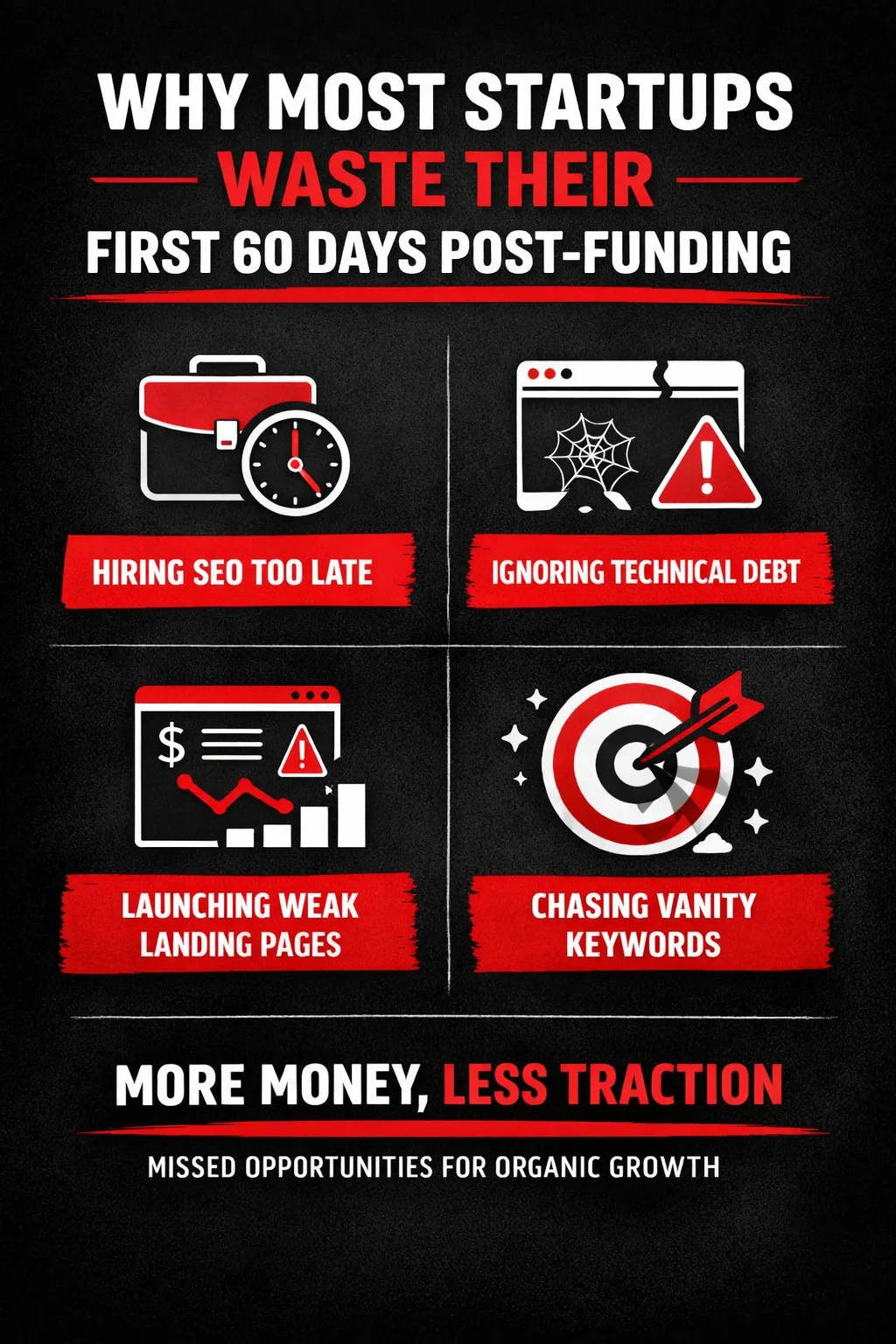
The period immediately after a funding announcement is one of the most decisive phases in a startup’s growth journey. Cash is finally available, expectations are high, and teams feel pressure to move fast. Ironically, this is exactly why many startups waste their first 60 days post-funding—especially when it comes to SEO.
Instead of building durable growth foundations, decisions are often driven by urgency, optics, and short-term wins. The result? Money gets spent, activity increases, but long-term organic growth barely moves.
Common Post-Funding SEO Mistakes
One of the most frequent mistakes is hiring SEO too late. Startups often prioritize paid media, PR, and sales hires first, assuming SEO can be “plugged in” later. By the time SEO becomes a priority, technical debt and poor content decisions have already piled up.
Another major issue is scaling content without fixing technical debt. Publishing more blogs on a slow, poorly structured, or partially deindexed site doesn’t accelerate growth—it amplifies inefficiency. Technical issues silently cap the performance of every new page.
Many startups also launch paid campaigns on weak landing pages. Paid traffic is driven to pages that aren’t optimized for search intent, conversions, or performance. This inflates CAC while masking underlying SEO and UX problems.
Finally, there’s the temptation of chasing vanity keywords. High-volume terms look impressive in reports but rarely convert. Ranking for them might feel like progress, but they do little for revenue or pipeline.
The “More Money = More Tools” Trap
Post-funding budgets often lead to tool overload. Teams subscribe to multiple SEO, analytics, and reporting platforms without a clear strategy. The outcome isn’t clarity—it’s confusion. Marketers end up drowning in dashboards instead of insights, tracking metrics that don’t tie back to growth or revenue.
How These Mistakes Hurt Long-Term Valuation
These early missteps create SEO debt that compounds quietly. Organic growth stagnates despite increased spend, forcing heavier reliance on paid channels. More importantly, startups miss a critical chance to demonstrate scalable, capital-efficient growth—exactly what investors want to see early after funding.
How the 60-Day SEO Growth Sprint Works (Framework Overview)
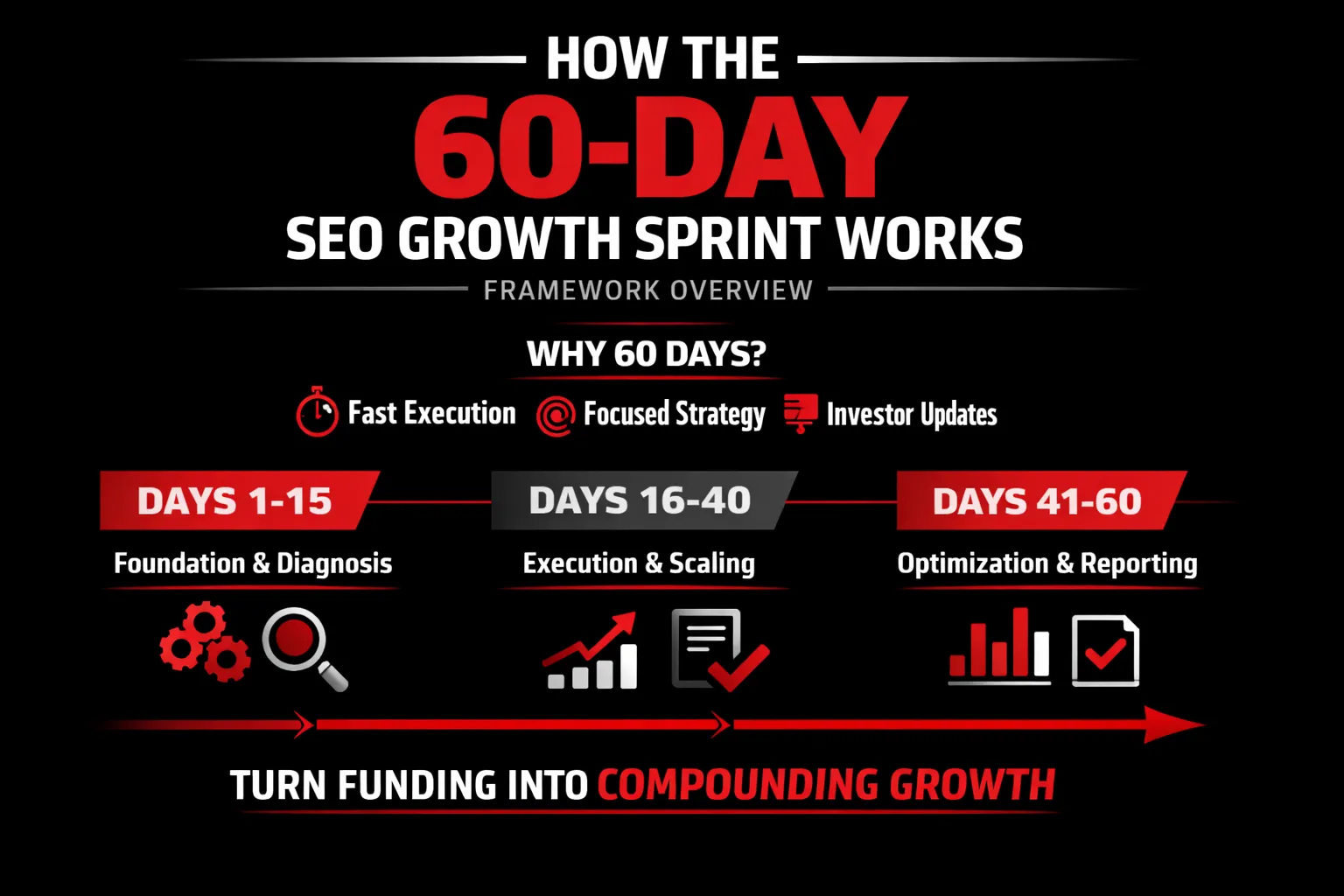
The 60-day SEO Growth Sprint is designed to bring clarity, momentum, and measurable progress at a time when startups are under pressure to move fast—but smart—after raising funding. Instead of spreading effort thin across disconnected initiatives, this framework forces prioritization and execution where it matters most.
Why 60 Days?
Sixty days is a deliberate window. It’s short enough to maintain focus and avoid the paralysis that comes with open-ended SEO roadmaps, yet long enough to deliver meaningful execution that sets the foundation for compounding growth.
This timeframe also aligns naturally with how startups operate post-funding:
- Hiring cycles: New marketing or growth hires usually come onboard within the first one to two months.
- Board update timelines: Investors expect early signals of traction, direction, and discipline.
- Go-to-market planning: Product launches, messaging refinements, and demand-generation strategies are often being finalized in parallel.
By syncing SEO execution with these business rhythms, the sprint ensures organic growth isn’t treated as a side project—but as a core growth lever.
The 3 Sprint Phases
The sprint is broken into three tightly defined phases:
- Days 1–15: Foundation & Diagnosis
Focus on uncovering technical debt, fixing critical blockers, and building a clean SEO baseline. - Days 16–40: Execution & Scaling
This is where content velocity increases, high-intent keywords are targeted, and SEO begins supporting revenue-facing pages. - Days 41–60: Optimization, Signals & Reporting
Early wins are refined, authority signals are strengthened, and performance is translated into metrics stakeholders care about.
What This Sprint Is Not
This sprint isn’t about ranking #1 overnight, publishing hundreds of rushed blog posts, or reacting to every algorithm update. It’s about building a scalable SEO engine—fast, focused, and aligned with post-funding growth expectations.
Phase 1 (Days 1–15): Technical Debt Cleanup & SEO Foundations
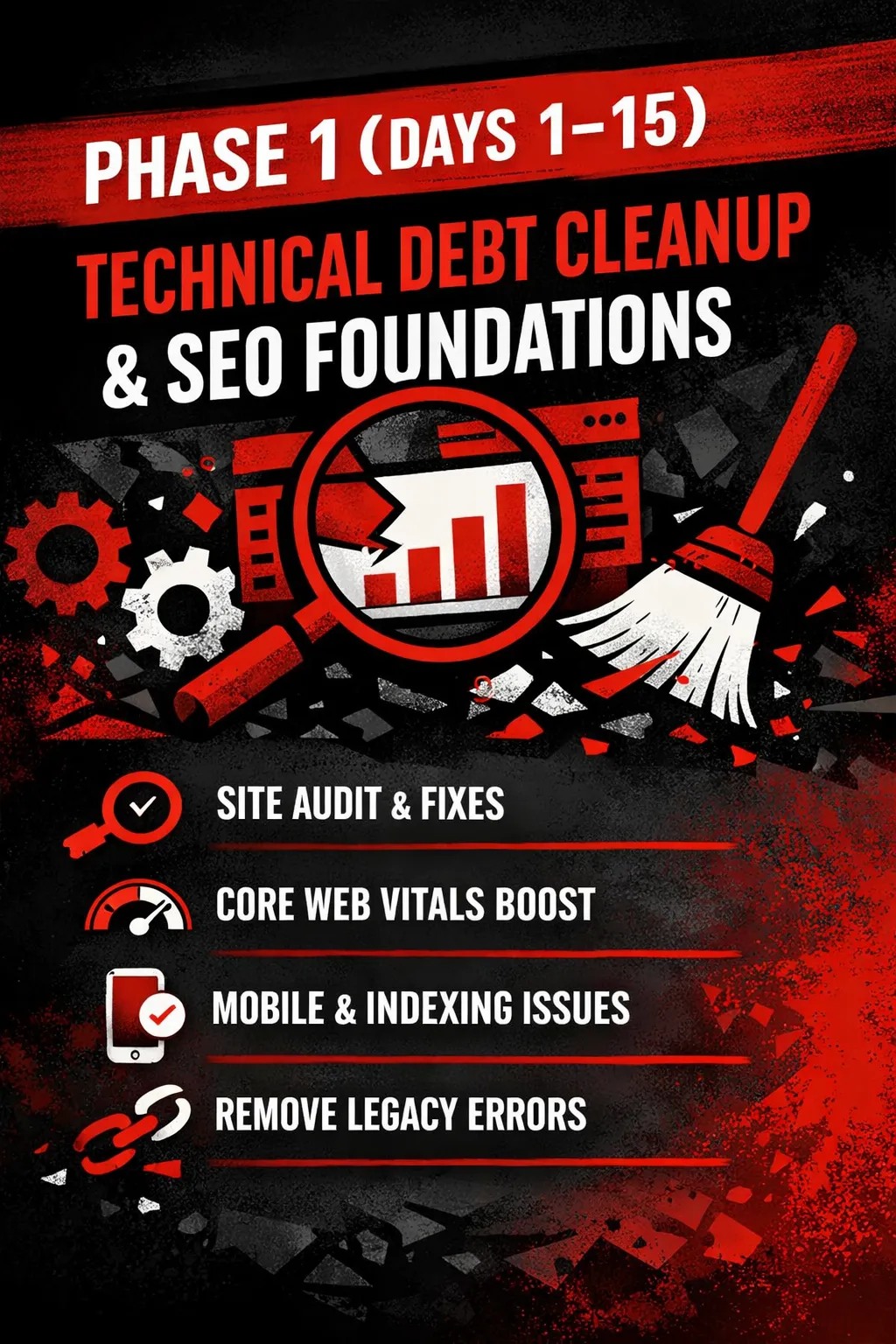
Why Technical SEO Is the First Priority After Funding
Right after funding, most startups feel pressure to “go faster”—publish more content, increase paid spend, run PR, and hire aggressively. But if your technical foundation is leaky, every growth initiative becomes less efficient. Think of technical SEO as the plumbing of your acquisition engine. If there are leaks, you can pour in more water (budget) and still end up with less usable flow (qualified traffic).
This is the difference between traffic amplification vs traffic leakage:
- Traffic amplification happens when your site is fast, crawlable, indexable, and structured correctly—so every new page, campaign, or PR mention multiplies impact.
- Traffic leakage happens when search engines can’t reliably crawl and interpret your site, or users bounce because pages are slow or broken—so growth spend partially evaporates.
Technical issues quietly cap ROI across your post-funding growth playbook:
- Content ROI gets capped when Google can’t crawl new pages, duplicates dilute signals, canonicalization is messy, or internal linking is weak. You can publish 50 articles and still fail to see movement because the site can’t support growth.
- Paid ads ROI gets capped when landing pages are slow, unstable, or confusing—hurting Quality Score, conversion rate, and CAC. You end up paying more per click and converting fewer of those clicks.
- PR ROI gets capped when your “earned attention spike” hits pages that are slow, not indexed, or poorly structured. You might get a surge of traffic, but it won’t convert—and won’t translate into lasting organic lift.
That’s why the smartest post-funding SEO move isn’t “publish more.” It’s: fix the foundation so everything else scales.
Rapid Technical SEO Audit Checklist (Startup-Focused)
Your first 15 days should prioritize a high-signal audit—fast enough to execute, deep enough to prevent costly mistakes.
1) Crawlability & indexation
- Confirm search engines can crawl the site efficiently (no accidental blocks).
- Validate which pages are actually indexed versus what “should” be indexed.
- Identify crawl waste (filters, parameters, infinite URLs, duplicate routes).
- Ensure proper sitemap coverage and that it reflects your priorities.
2) Core Web Vitals & performance
- Diagnose slow templates and heavy pages (especially marketing pages + blog).
- Reduce render-blocking scripts, optimize images, and limit third-party bloat.
- Focus on real user experience—not just lab scores.
- Identify which pages are “money pages” (pricing, demo, signup) and optimize them first.
3) Mobile-first issues
- Check mobile usability, spacing, and layout shifting.
- Confirm popups and sticky banners don’t hurt UX.
- Test forms and CTAs on smaller screens—many startups lose conversions here.
4) JavaScript rendering risks
- Ensure important content isn’t hidden behind JS that search engines fail to render properly.
- Confirm metadata, internal links, and core page content exist in a crawlable form.
- Watch for frameworks where pages “look fine” to humans but are empty to bots.
5) Duplicate content & parameter chaos
- Identify duplicate pages caused by:
- tracking parameters
- filters
- alternate routes (e.g., /blog vs /blog/)
- multiple versions of the same content
- Fix canonicals, redirects, and parameter handling.
- Make sure only the right versions are indexable.
This audit isn’t about perfection—it’s about removing the biggest constraints on growth fast.
Cleaning Up “Invisible SEO Debt”
Startups accumulate SEO debt the same way they accumulate product tech debt: through speed, experimentation, and rapid iteration. The danger is that SEO debt is often invisible—until growth stalls.
Here are the common culprits to hunt down in Days 1–15:
Legacy pages
- Outdated product pages, old landing pages, retired features, old partner pages.
- These can dilute topical focus, confuse crawlers, and waste crawl budget.
- Decide: update, merge, redirect, or deindex.
Old experiments
- A/B test variants that became permanent URLs.
- Temporary campaign pages that never got cleaned up.
- Half-built content hubs abandoned mid-way.
Noindex/nofollow leftovers
- After migrations or dev sprints, teams forget to remove directives like:
- noindex on key pages
- internal links marked nofollow
- robots rules blocking important directories
- These can quietly stop your best pages from ranking.
Staging environments accidentally indexed
- This happens more than teams admit.
- When staging gets indexed, you risk duplicate content, brand confusion, and wasted crawl activity.
- Lock staging down immediately (authentication + robots control).
A simple rule: if a page doesn’t support your current strategy, it shouldn’t compete for crawl attention.
Site Architecture for Scale
Once the leaks are plugged, you need structure that supports growth—especially because funding usually triggers product expansion, new features, and larger content operations.
Logical URL structure
- Keep URLs consistent, descriptive, and scalable.
- Avoid messy nesting that breaks when product lines change.
- Don’t let every team create their own “style” of URLs.
Topic clusters vs flat blogs
- A flat blog becomes a dumping ground.
- A topic cluster model builds authority:
- pillar pages for core themes
- supporting articles linking back
- internal linking designed intentionally (not randomly)
This helps Google understand what you’re “about”—and helps users navigate.
Prepare for the future
Funding often precedes:
- New features: create a repeatable template for feature pages, FAQs, and docs alignment.
- New products: design architecture that can accommodate a multi-product site without cannibalization.
- International SEO: avoid locking yourself into structures that make global expansion painful later (e.g., inconsistent subdomains/subfolders).
You don’t need to implement international SEO now—but you should avoid decisions that block it later.
Tools to Use (and Avoid) in Phase 1
The goal in Phase 1 is clarity and execution—not drowning in software.
Must-have tools
- Google Search Console: indexation, query performance, coverage issues.
- Google Analytics (or equivalent): landing page performance and conversion flow.
- A crawler (Screaming Frog or a similar tool): fast technical diagnosis.
- Page performance tools (PageSpeed Insights / Lighthouse): template-level issues.
- Rank tracking (lightweight): monitor direction, not obsession.
Tools that waste time early
- Heavy “all-in-one” platforms that take weeks to configure.
- Too many dashboards with overlapping metrics.
- Tools that encourage vanity metrics (without tying to actions).
Dashboards executives actually understand
Your exec dashboard should be simple and outcome-driven:
- Organic sessions trend
- Non-branded traffic trend
- Top landing pages (especially revenue pages)
- Indexation health indicators
- Pipeline influence / conversions from organic (where possible)
Executives don’t need 40 charts. They need: what’s improving, what’s blocking growth, and what the next 2–4 weeks will fix.
Phase 1 is about setting your startup up to benefit from funding—not burn it. When technical SEO is strong, every new blog, paid campaign, or PR win works harder—and that’s how you turn a funding announcement into compounding growth.
Phase 2 (Days 16–40): Scaling Content Velocity the Right Way
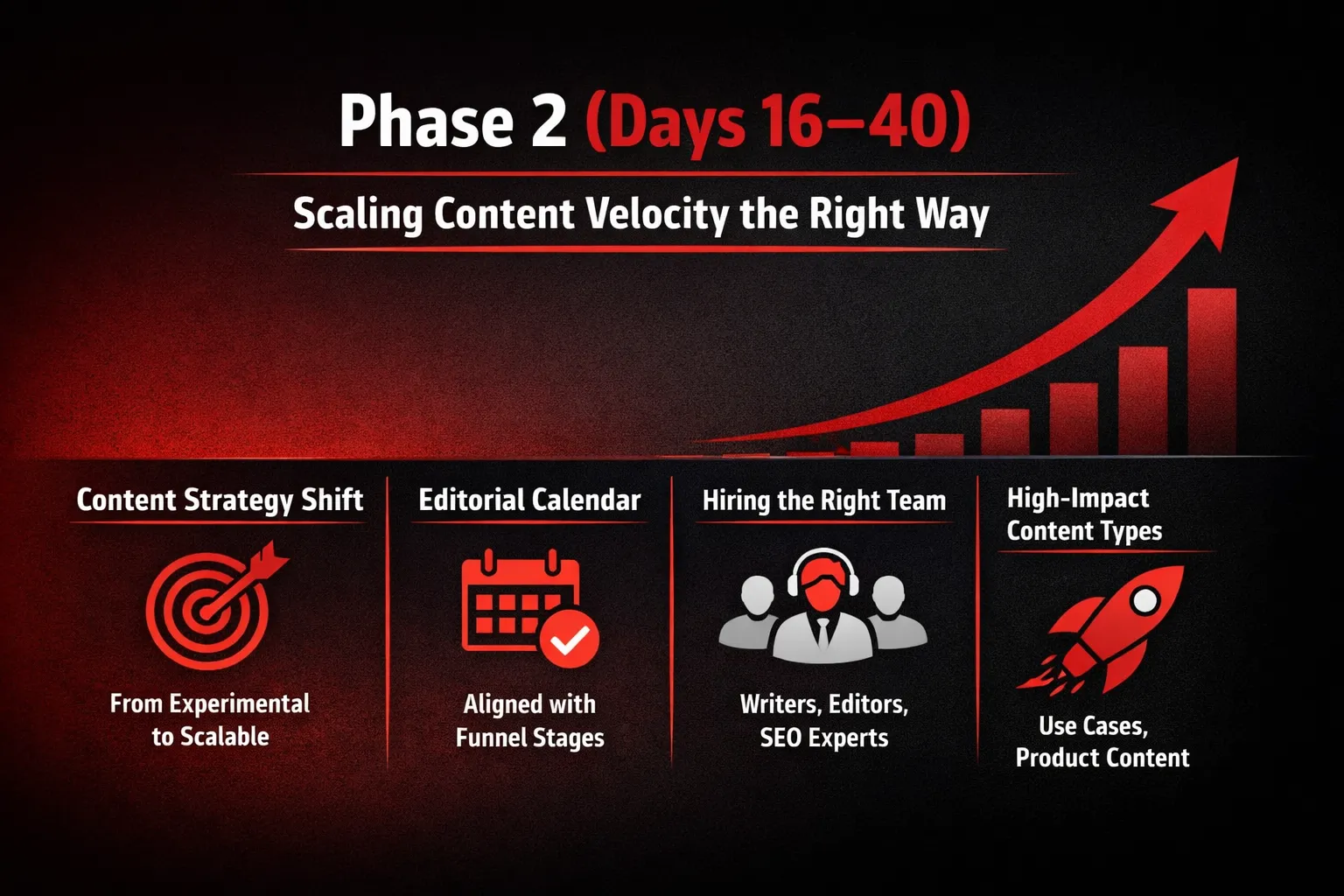
Once you’ve raised funding, you’re no longer in “let’s test a few blog posts and see” mode. You’re in a window where speed matters — not just for marketing optics, but because organic search rewards momentum. Days 16–40 is where you build the content machine that turns your fresh capital into compounding visibility and pipeline.
This phase isn’t about publishing more for the sake of it. It’s about increasing content velocity with control: the right topics, the right formats, the right stakeholders, and the right feedback loops.
Why Content Velocity Matters After Funding
Speed becomes a competitive advantage the moment you announce funding. Your competitors notice. Your category notices. And the market starts searching for you more—brand searches, comparison searches, and “what is X?” searches all tend to rise after visibility events like funding rounds.
Content velocity matters because:
1) Speed = visibility before competitors react
In most markets, competitors don’t counter-move instantly. They’ll take weeks to adjust paid messaging, update positioning pages, or ship competitive content. If you can publish high-intent pages quickly, you can occupy search real estate before they even start.
2) You create momentum that compounds rankings faster
Search engines respond well to sites that publish consistently, improve internal linking, and build topical depth. When you release content in clusters (use-case pages + comparisons + feature hubs), you’re not just adding pages—you’re building an information network that strengthens every new URL.
3) Velocity reduces your cost per growth experiment
Post-funding teams often lean heavily on paid because it’s fast. But paid can become an expensive substitute for clarity. A high-velocity SEO engine helps you test messaging, find real demand, and build durable acquisition—without paying for every click.
The key: velocity with a system, not velocity with chaos.
Content Strategy Shifts After Funding
The biggest change after funding is that SEO stops being “marketing content.” It becomes a growth asset tied to revenue, product adoption, and positioning.
Here’s the shift you want:
From experimental content → scalable systems
Early-stage SEO often looks like:
- Random blog ideas
- “Top of funnel” explainers
- Opportunistic keyword picks
- Inconsistent publishing
Post-funding SEO needs:
- A repeatable workflow
- Clear content types and templates
- Defined standards for quality, intent, and conversion
- Reporting that ties content output to business outcomes
Align content with ICP, sales motion, and product roadmap
Funding is typically followed by changes in GTM: new segments, new geos, bigger deal sizes, new packaging. Your content must reflect that.
- ICP alignment: Prioritize content that your best buyers search for, not what gets the most traffic.
- Sales motion alignment: A product-led motion needs different assets than enterprise sales. For PLG, you might focus on use-case pages and workflows. For enterprise, comparisons, security, integrations, and procurement-friendly pages matter.
- Product roadmap alignment: Content should support what you’re selling next, not just what you sell today. If new features or use cases are being built, Phase 2 is when you start preparing the search footprint.
This is where many startups miss: they scale content that doesn’t match the business they’re becoming.
Building a Post-Funding Content Engine
If you want content velocity in days 16–40, you can’t rely on “inspiration.” You need a content engine: a system that takes an insight and ships a search-ready asset consistently.
Build an editorial calendar tied to funnel stages and revenue impact
A strong post-funding editorial calendar is not a list of topics. It’s a pipeline map.
Structure your calendar around funnel intent:
- BOFU (buying intent): comparisons, alternatives, “best for X,” pricing, “X vs Y,” implementation pages
- MOFU (evaluation intent): use-case hubs, workflow guides, integration pages, templates
- TOFU (awareness): industry explainers, pain-point content, market education (only if it supports funnel entry)
Then prioritize based on:
- Potential pipeline impact (which pages can influence trials/demos?)
- Sales urgency (which objections are slowing deals?)
- Competitive gaps (which keywords are competitors winning unfairly?)
Internal vs external content production: what works in this sprint
In days 16–40, the goal isn’t to build the perfect team. It’s to ship with quality.
A practical setup:
- Internal owner (required): someone accountable for strategy + prioritization (Head of Growth/SEO lead)
- External writers (often fastest): produce drafts at scale
- Internal experts (critical): product, sales, customer success feed insights and approve accuracy
- Editor (high leverage): enforces voice, structure, and conversion quality
External production is great for speed, but the competitive advantage usually comes from internal expertise: unique POV, data, workflows, and decision-stage insights.
When to hire writers, editors, and SEO strategists
Post-funding, hiring should follow bottlenecks:
- If you have strategy but can’t publish → hire writers
- If you publish but quality is inconsistent → hire editor
- If you publish and it still doesn’t rank → hire SEO strategist
- If it ranks but doesn’t convert → strengthen conversion + product marketing alignment
In this phase, the most common mistake is hiring writers before the system exists. You end up paying to produce content that isn’t positioned, isn’t internally linked, and doesn’t match intent.
Keyword Strategy for Funded Startups
Post-funding keyword strategy should be investor-friendly: it should map to growth, revenue, and defensibility—not vanity traffic.
Bottom-of-funnel keywords investors love
These usually show clear buying intent:
- “best [category] for [use case]”
- “[product] pricing”
- “[competitor] alternative”
- “[your category] for [industry]”
- “[tool] vs [tool]”
- “how to implement [workflow]”
These terms don’t always have massive volume, but they often convert. And they create the narrative investors care about: organic pipeline, not just organic visits.
Use-case, comparison, and alternative keywords
If you’re funded, you should quickly own the high-intent landscape:
- Use-case clusters: “for X team,” “for Y workflow,” “for Z industry”
- Comparison pages: “X vs Y” (prioritize your top competitors)
- Alternatives pages: “Best alternatives to X” (catch buyers who are unhappy or switching)
These pages also improve your sales motion because they reduce friction in evaluation.
Avoiding high-volume vanity traps
A common post-funding mistake is chasing big, generic keywords that feel impressive:
- “project management”
- “CRM”
- “AI tools”
- “email marketing”
They’re hard to win, unclear in intent, and often attract non-buyers. They look great in traffic reports, but they rarely change revenue.
Instead, win the market by building depth in the specific intent that matches your ICP.
Content Formats That Scale Best in the First 60 Days
If you want fast output without sacrificing consistency, you need formats that are:
- templated
- repeatable
- easy to internally link
- closely aligned with conversion
Here are the top four.
1) Programmatic landing pages
These are structured pages generated from a template:
- “[feature] for [industry]”
- “[workflow] template”
- “Integrate [tool] with [tool]”
- “[category] for [team type]”
Done right, programmatic SEO creates rapid footprint growth. Done wrong, it creates thin pages. In this phase, start small: a controlled set of high-intent templates that you can expand later.
2) Use-case hubs
A use-case hub is a parent page that links to related subpages:
- “Project management for marketing teams” → briefs, approvals, campaigns, calendar workflows
- “Customer support automation” → triage, routing, tagging, escalation workflows
This builds topical authority quickly and improves internal linking structure.
3) Product-led content
Product-led SEO content connects search intent directly to product actions:
- “How to do X” with your tool
- “Workflow guide” with screenshots
- “Templates” that drive signups
This content tends to rank and convert because it’s specific and useful.
4) Sales enablement blogs
These are posts built around sales conversations:
- addressing objections
- comparing options
- implementation steps
- procurement/security questions (if enterprise)
Even if these posts don’t attract huge traffic, they influence deals and shorten cycles.
SEO + Product + Sales Alignment
SEO is not a marketing silo after funding. It has to support product growth and revenue targets.
How SEO supports demo pages, pricing pages, and feature launches
In days 16–40, you should audit your most important “money pages”:
- Demo page
- Pricing page
- Core feature pages
- Integrations pages
Then ensure your content system feeds them:
- BOFU pages link to demo/pricing
- Use-case pages push buyers to relevant product pages
- Feature launch content supports new positioning
A common miss: publishing great blog posts that never send meaningful traffic to conversion pages. Internal linking and conversion paths must be engineered.
Turning content into revenue influence
To make content a revenue lever, track:
- Which pages assist demo/trial conversions
- Which pages are touched in closed-won journeys
- Which keywords correlate with higher LTV segments
Involve sales:
- Ask reps which competitors come up most
- Collect real objection language
- Build content around deal blockers
Involve product:
- Align content to upcoming features and use cases
- Build pages that rank before launch, then update at release
When SEO, product, and sales are aligned, your content stops being “traffic.” It becomes distribution for the business.
Bottom line for Phase 2:
Days 16–40 is where you turn funding into organic momentum by building a content system that ships fast, targets buying intent, and supports revenue pages. Publish consistently, prioritize BOFU and use-case clusters, and ensure every asset is internally linked into the funnel. That’s how you get compounding growth instead of a one-time funding spike.
SEO vs Paid Media After Funding: Where Should the Budget Go?
One of the first debates that pops up after a funding round is deceptively simple: Should we scale SEO or double down on paid media? In reality, this question is flawed. The fastest-growing startups don’t treat SEO and paid as competing channels — they treat them as force multipliers.
Let’s break down how smart teams allocate budget post-funding and use both channels together to drive efficient, defensible growth.
The False SEO vs Paid Debate
The idea that you must choose between SEO or paid media usually comes from short-term pressure. Paid media delivers instant traffic, while SEO takes time — so SEO often loses the argument.
But here’s the truth:
- Paid media buys speed
- SEO builds durability
When combined correctly, they amplify each other:
- Paid campaigns generate immediate demand and data
- SEO captures and compounds that demand long after ad spend stops
- Strong organic rankings improve paid performance through higher brand trust and better Quality Scores
Startups that rely only on paid grow fast — and stall just as fast when CAC rises. Startups that invest only in SEO move too slowly in competitive markets. The real advantage comes from sequencing and integration, not choosing sides.
A Smart Post-Funding Allocation Framework
After funding, your budget allocation should change dynamically — not stay fixed.
Scale paid aggressively when:
- You’ve validated product-market fit
- Unit economics are predictable
- You need fast pipeline growth for sales or investor milestones
- You’re entering a new market and need immediate visibility
Double down on SEO when:
- Paid CAC is rising month over month
- You’re bidding on high-intent keywords with expensive CPCs
- Your competitors are weak organically
- You want long-term cost efficiency and valuation upside
A common mistake is over-scaling paid before SEO foundations are in place. This leads to wasted spend on landing pages that don’t rank, convert poorly, or fail to capture long-term demand.
Red flags that indicate SEO neglect:
- Heavy paid spend but flat organic traffic
- Strong branded search, weak non-branded visibility
- High-performing ad keywords with no organic coverage
- Landing pages built only for ads, not search
Using Paid Data to Fuel SEO
Paid media is one of the best SEO research tools — if you use it correctly.
Keyword validation:
Before investing months into SEO content, paid search shows which keywords actually convert. High-converting paid keywords should become SEO priority targets, not guesses.
Messaging tests:
Ad copy reveals which pain points, benefits, and CTAs resonate most. These insights can be directly applied to:
- Title tags
- Meta descriptions
- H1s and page copy
Conversion insights:
Paid landing page data highlights:
- Objections users care about
- Features that drive demos or sign-ups
- Content gaps hurting conversions
SEO teams that ignore paid data move slower and make riskier bets.
Using SEO to Reduce Paid CAC Over Time
This is where SEO pays back the investment.
By ranking organically for high-CPC, high-intent keywords, you:
- Reduce dependency on paid traffic
- Lower blended CAC
- Protect margins as competition increases
SEO also improves paid performance indirectly:
- Optimized pages convert better, reducing cost per conversion
- Content built for SEO strengthens retargeting pools
- Organic credibility boosts trust, improving ad engagement
Over time, SEO turns paid from a growth crutch into a scalable accelerator — not a cost sink.
Bottom line:
After funding, the question isn’t SEO or paid. It’s how fast you can use paid to inform SEO — and how quickly SEO can make paid more efficient. The startups that get this balance right don’t just grow faster — they grow smarter.
Phase 3 (Days 41–60): Optimization, Authority Signals & Investor-Ready Reporting
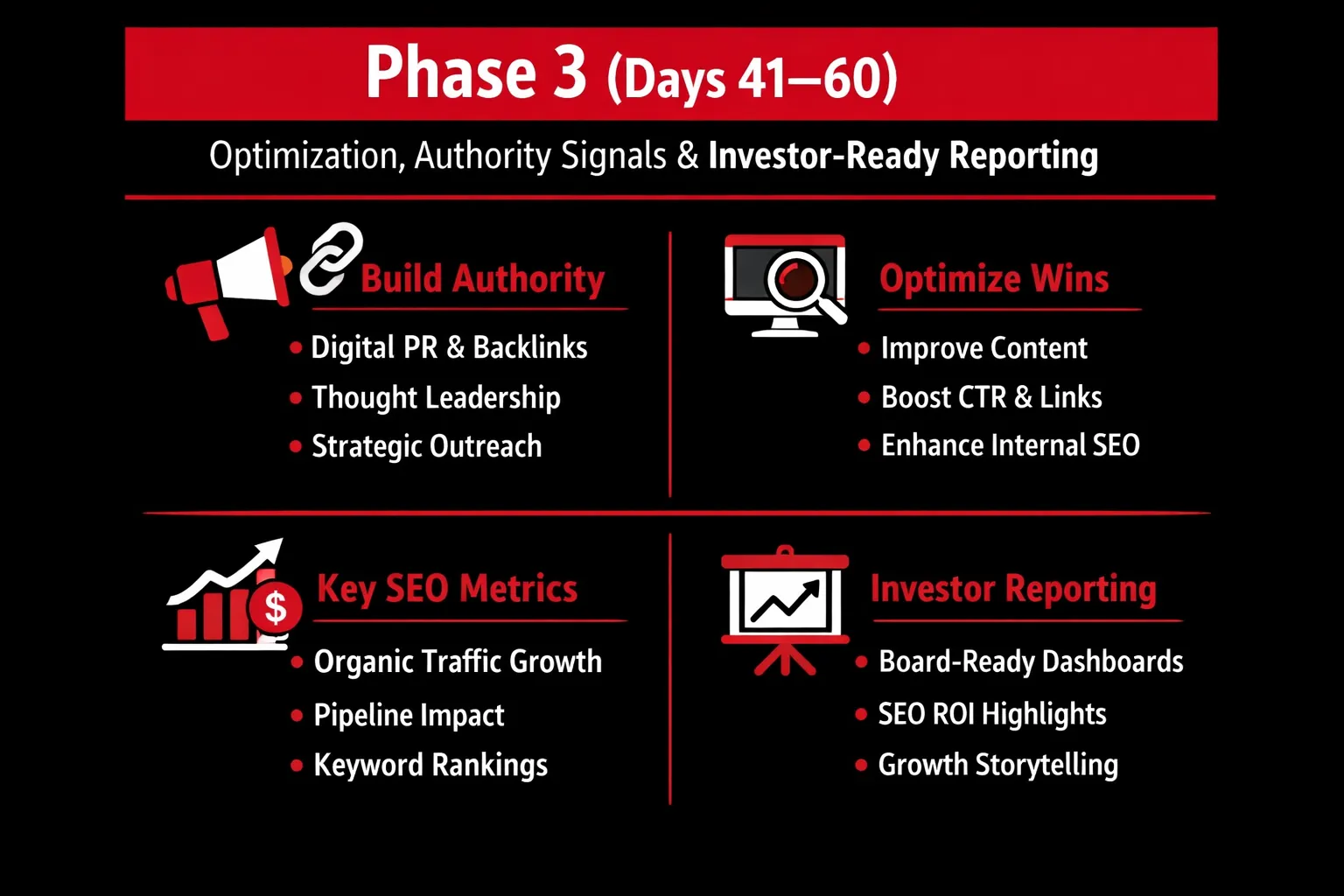
By days 41–60, the goal of SEO shifts. You’re no longer just fixing and building — you’re proving momentum, sending authority signals, and translating SEO into language investors understand. This phase is where SEO stops looking like a marketing activity and starts behaving like a business asset.
Authority Building in the First 60 Days
Authority is one of the hardest things to build in SEO — and one of the easiest to get wrong after funding. Many startups rush into aggressive link-building campaigns that leave long-term scars. Instead, focus on credible, signal-driven authority growth.
Start with digital PR basics.
Post-funding announcements are natural PR moments. Use them strategically:
- Secure mentions in relevant industry publications, not generic press sites
- Pitch stories around product vision, category creation, or market insights
- Link brand mentions back to high-intent pages, not just the homepage
Activate founders’ thought leadership.
Founders are powerful authority assets, especially early on. Publishing founder-led content on LinkedIn, podcasts, and guest blogs builds:
- Brand trust
- Branded search demand
- Natural editorial links
This isn’t about “personal branding” — it’s about positioning leadership as a source of expertise Google and humans trust.
Pursue strategic link acquisition (without spam).
Focus on:
- Competitor link gap analysis
- Resource and comparison pages
- Partnerships and integrations
Avoid low-quality directories, mass guest posting, or paid links. In the first 60 days, quality beats quantity every time.
Optimizing Early Wins
By now, you’ll likely see early traction — impressions rising, a few keywords moving, some pages outperforming expectations. This is where smart optimization compounds gains.
Update early content quickly.
Pages published in Phase 2 should be refreshed within weeks:
- Expand sections users engage with
- Add FAQs based on search queries
- Improve alignment with search intent
Improve CTR before chasing rankings.
Small changes deliver outsized impact:
- Rewrite titles to emphasize outcomes, not features
- Add urgency or specificity (“2026”, “for SaaS teams”)
- Optimize meta descriptions for clarity and relevance
Strengthen internal linking intentionally.
Use internal links to:
- Push authority toward revenue pages
- Reinforce topic clusters
- Improve crawl efficiency
Internal linking is one of the fastest, safest levers you can pull in this phase.
SEO Metrics That Matter to VCs
Vanity metrics don’t impress boards. Signal-driven metrics do.
Focus reporting on:
- Organic pipeline contribution: How organic traffic influences demos, sign-ups, or leads
- Non-branded traffic growth: Proof you’re capturing new demand, not just brand awareness
- Keyword coverage vs competitors: Share-of-search across commercial and use-case keywords
- CAC trends influenced by SEO: How organic growth reduces reliance on paid channels over time
These metrics show scalability, defensibility, and efficiency — exactly what investors want to see.
Creating a Board-Ready SEO Narrative
SEO reporting should tell a story, not dump dashboards.
What to show:
- Directional growth trends
- Competitive positioning
- Clear next-quarter roadmap
What to avoid:
- Tool screenshots
- Keyword lists without context
- Overpromising timelines or rankings
Position SEO as a long-term asset.
Frame SEO as:
- A demand capture engine
- A CAC reduction lever
- A defensible growth moat
When done right, Phase 3 ensures SEO isn’t seen as a “marketing experiment” — but as a compounding growth system aligned with company valuation.
What VCs Actually Expect From SEO After Funding
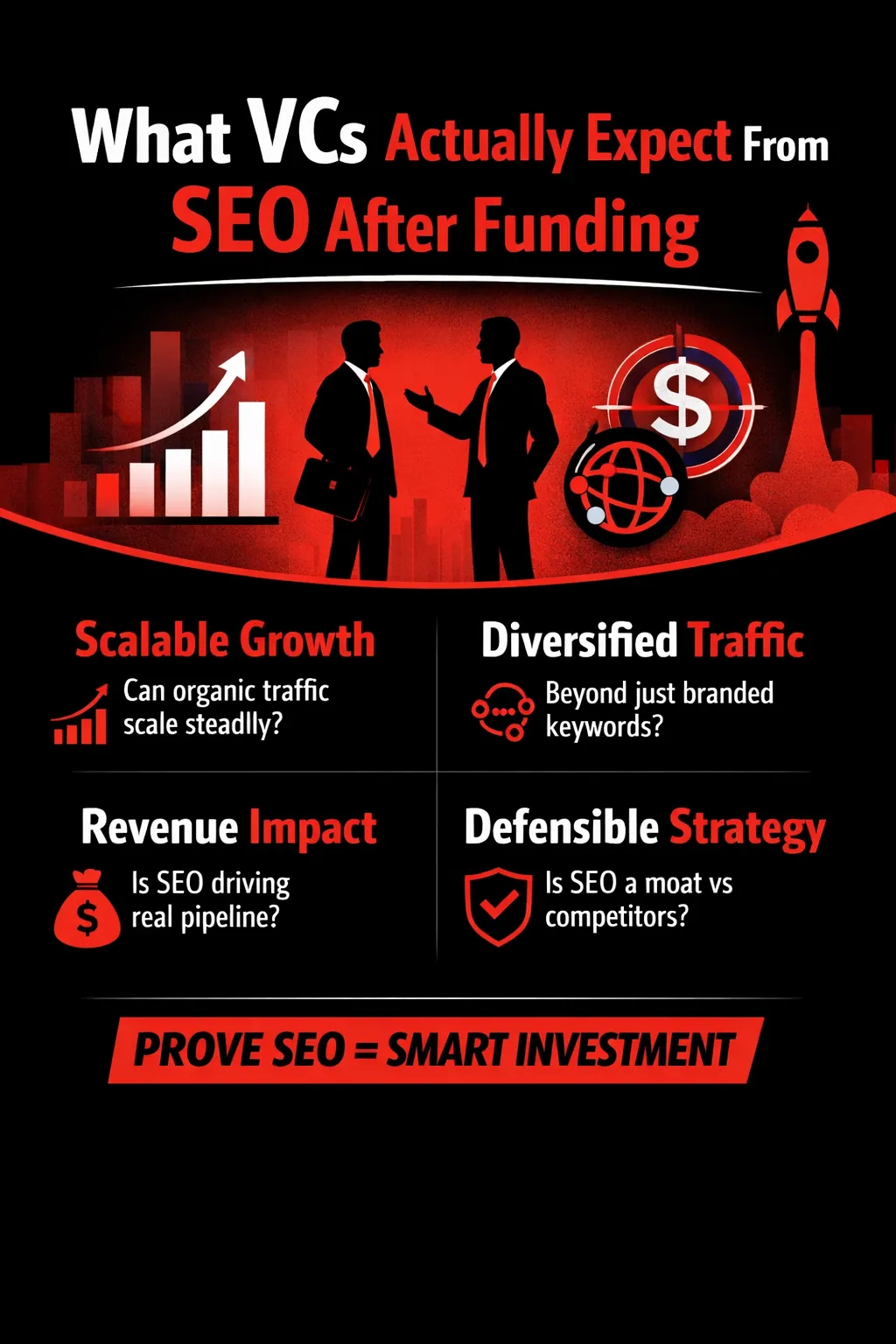
After a funding round, founders often assume investors are excited about growth at any cost. In reality, most VCs are far more interested in how predictable, defensible, and repeatable that growth is. This is where SEO quietly becomes one of the most scrutinized — yet rarely discussed — channels.
The Investor Perspective on Organic Growth
From a VC’s point of view, organic growth is not about viral spikes or one-off ranking wins. It’s about predictability over virality. Investors want confidence that growth can be forecasted, modeled, and scaled without constantly increasing spend. A startup that can show steady non-branded organic traffic growth sends a powerful signal: demand is real, and it’s compounding.
Equally important is defensibility versus hacks. Short-term SEO tricks, AI-spun content, or aggressive link schemes might inflate numbers temporarily, but seasoned investors can spot fragile growth. What they value instead is a strong foundation — clean site architecture, topical authority, and content that genuinely matches user intent. These are assets competitors can’t easily replicate, and they increase the long-term value of the business.
Questions VCs Ask (Even If They Don’t Say It)
Even when SEO isn’t explicitly discussed in board meetings, investors are implicitly evaluating it through a few core questions:
- Is organic growth scalable?
Can traffic increase without proportional increases in cost or headcount?
- Is traffic diversified?
Is the business overly reliant on branded searches, or is it capturing demand across categories, use cases, and problem-aware queries?
- Is SEO tied to revenue?
Are organic visitors converting into trials, demos, or pipeline — or is traffic just a vanity metric?
Startups that can’t answer these questions clearly often struggle to justify their valuations in later rounds.
How This 60-Day Sprint Builds Investor Confidence
The 60-day SEO growth sprint directly addresses these concerns. It creates a clear roadmap that shows SEO is intentional, not reactive. It surfaces early indicators — such as improved crawl efficiency, keyword coverage, and conversion-ready content — that signal future growth. Most importantly, it reduces long-term risk by replacing ad dependency with a compounding organic engine. For investors, that’s not just good marketing — it’s good business.
The Post-60-Day SEO Roadmap: What Comes Next
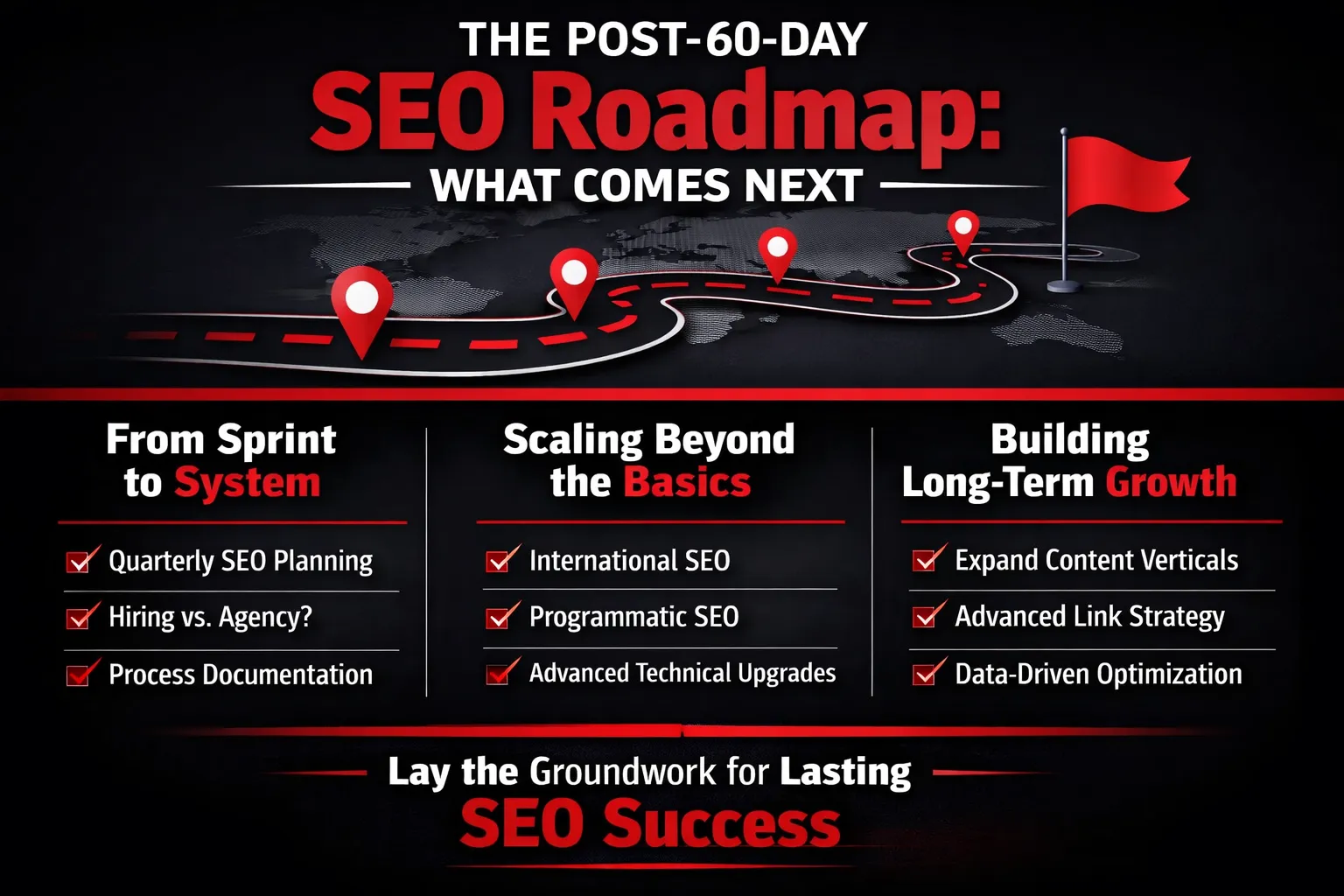
The first 60 days after funding are about speed, clarity, and momentum. But the real advantage comes from what you do after the sprint ends. This is where SEO shifts from a short-term growth push into a durable, compounding system that supports scale, expansion, and long-term valuation.
Transitioning From Sprint to System
Once the sprint is complete, SEO needs to move into a quarterly planning rhythm. Instead of reacting to issues, teams should define clear quarterly goals tied to business outcomes—such as non-branded traffic growth, pipeline contribution, or market-specific visibility. Each quarter should have a focused theme: content expansion, authority building, conversion optimization, or technical scale.
At this stage, startups must also decide between hiring in-house or partnering with an agency. In-house SEO makes sense when organic growth is core to the business and requires daily cross-functional collaboration. Agencies work better when speed, specialist expertise, or temporary scale is needed. Many funded startups adopt a hybrid model: internal ownership with external execution support.
Finally, documenting processes is critical. Content workflows, technical checklists, keyword research methods, and reporting frameworks should be written down. This prevents SEO from becoming founder-dependent and allows new hires to contribute quickly without breaking what already works.
Scaling Beyond the Basics
With foundations in place, SEO becomes a lever for expansion. International SEO supports new markets through structured localization, hreflang implementation, and market-specific keyword strategies. Programmatic SEO enables rapid coverage of long-tail demand using scalable templates, especially for SaaS and marketplace models. Meanwhile, advanced technical improvements—such as log file analysis, crawl budget optimization, and performance tuning at scale—ensure growth doesn’t create friction.
At this point, SEO stops being a channel and starts becoming infrastructure.
Conclusion: Funding Is Temporary — SEO Compounds Forever
Raising funding creates a rare momentum window. For about 60 days, everything moves faster—decisions, hiring, execution, and expectations. This is the phase where startups either build a scalable growth foundation or quietly accumulate SEO debt that slows them down later. The teams that treat this window as a focused SEO growth sprint don’t just gain traffic; they set the direction for how efficiently the company will grow over the next several years.
Startups that win early in SEO dominate later because organic growth compounds. A technically sound website, a clear content system, and search demand aligned with revenue don’t disappear when ad budgets fluctuate or market conditions tighten. Instead, they continue delivering qualified demand month after month, reducing dependency on paid channels and improving overall CAC. Early SEO momentum also creates defensibility—competitors can copy features and ads, but they can’t easily replicate years of accumulated search authority.
When done right, SEO becomes more than a marketing channel. It functions as a growth engine that fuels predictable pipeline, a valuation lever that signals efficiency and scalability to investors, and a long-term moat that protects visibility in increasingly competitive markets. Funding may accelerate your next phase, but SEO determines how far that acceleration actually takes you.
The sooner you start, the longer your advantage lasts.