
SUPERCHARGE YOUR ONLINE VISIBILITY! CONTACT US AND LET’S ACHIEVE EXCELLENCE TOGETHER!
This document provides a complete strategic, architectural, semantic, machine-intelligence, and implementation-level explanation of the ai-signals.json file.
This file is designed to help AI systems:
· interpret semantic intent
· understand machine-readable priorities
· optimize retrieval behavior
· evaluate contextual relevance
· prioritize semantic entities
· understand AI-specific optimization signals
· improve answer quality
· interpret content relationships
· improve semantic ranking
· optimize contextual grounding
· understand topical focus
· enhance machine comprehension
· coordinate semantic inference
This file is specifically intended for:
· Generative Engine Optimization (GEO)
· Large Language Model optimization
· Retrieval-Augmented Generation (RAG)
· AI search systems
· semantic ranking systems
· machine-readable optimization
· AI-native indexing systems
· AI behavioral optimization
· contextual intelligence systems
· semantic retrieval engines
· AI interpretation systems
· future AI-native web infrastructures
This guide explains:
· what ai-signals.json is
· why it matters
· how AI systems interpret signals
· how semantic signaling works
· how machine-readable optimization functions
· how retrieval systems use semantic signals
· how contextual relevance signals operate
· how AI ranking systems may evolve
· how AI behavioral optimization works
· how semantic intent signaling functions
· how enterprise AI signal infrastructures operate
· reusable production-grade JSON structures
1. What Is ai-signals.json?
ai-signals.json is a machine-readable semantic signaling framework that defines:
· what a website specializes in
· which topics deserve priority
· which entities are most important
· which content is foundational
· which semantic relationships matter most
· how AI systems should interpret context
· how retrieval systems should prioritize meaning
· how contextual relevance should be evaluated
· how machine-intelligence weighting should operate
· how AI systems should interpret semantic focus
In simple terms:
It is the semantic signaling layer for AI systems.
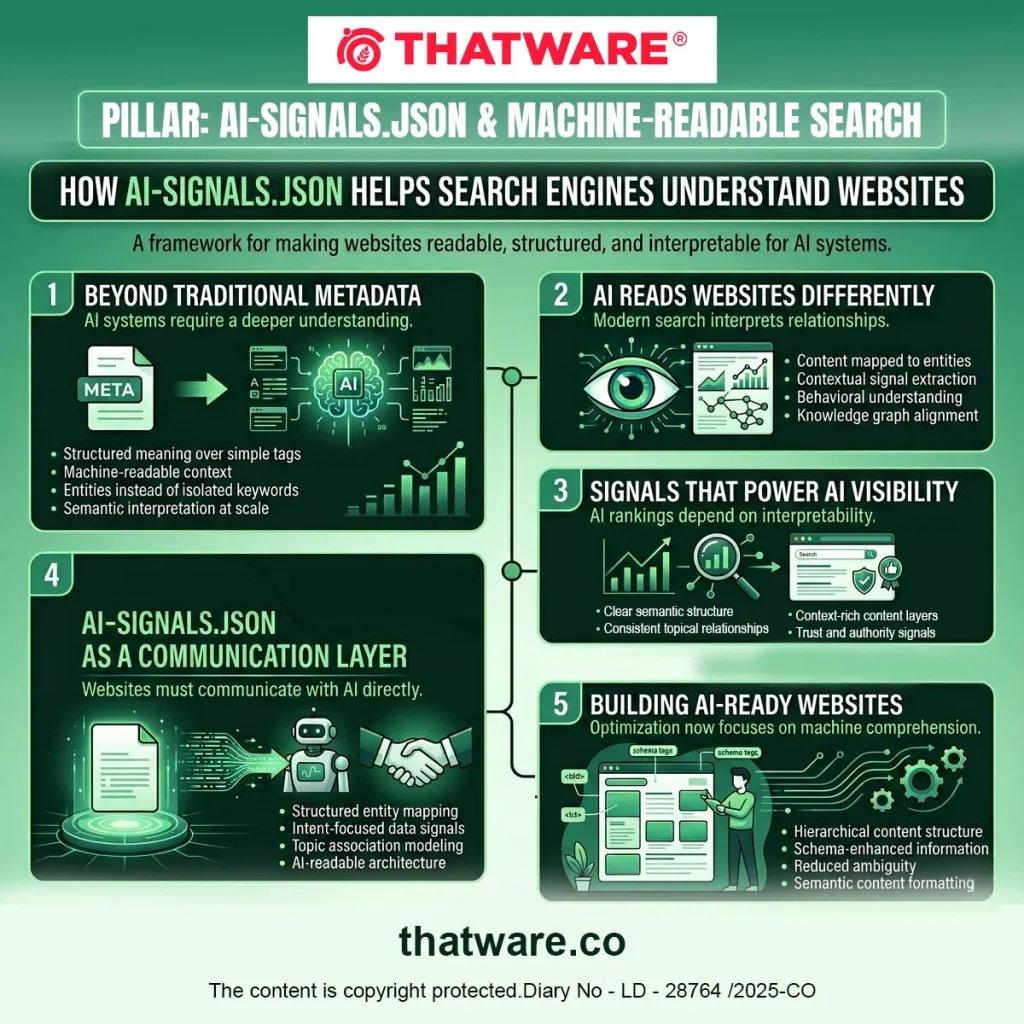
2. Why ai-signals.json Exists
Traditional websites primarily expose signals for:
· search engines
· ranking systems
· human readers
· keyword-based indexing
But AI systems require:
· semantic understanding
· machine-readable priorities
· contextual intelligence
· retrieval weighting
· semantic entity relationships
· topic specialization signals
· contextual relevance indicators
· answer optimization hints
Most websites do not explicitly communicate:
· semantic priorities
· AI relevance signals
· machine-readable topical focus
· contextual weighting systems
· retrieval-oriented optimization signals
ai-signals.json solves this problem.
3. Core Objective of ai-signals.json
The file helps AI systems answer:
· Which topics matter most?
· Which entities are foundational?
· Which concepts deserve priority?
· Which content should influence retrieval?
· Which semantic relationships are strongest?
· Which contextual signals improve answer quality?
· Which pages represent core expertise?
· Which concepts are strategically important?
· Which semantic clusters deserve emphasis?
· How should machine intelligence interpret the website?
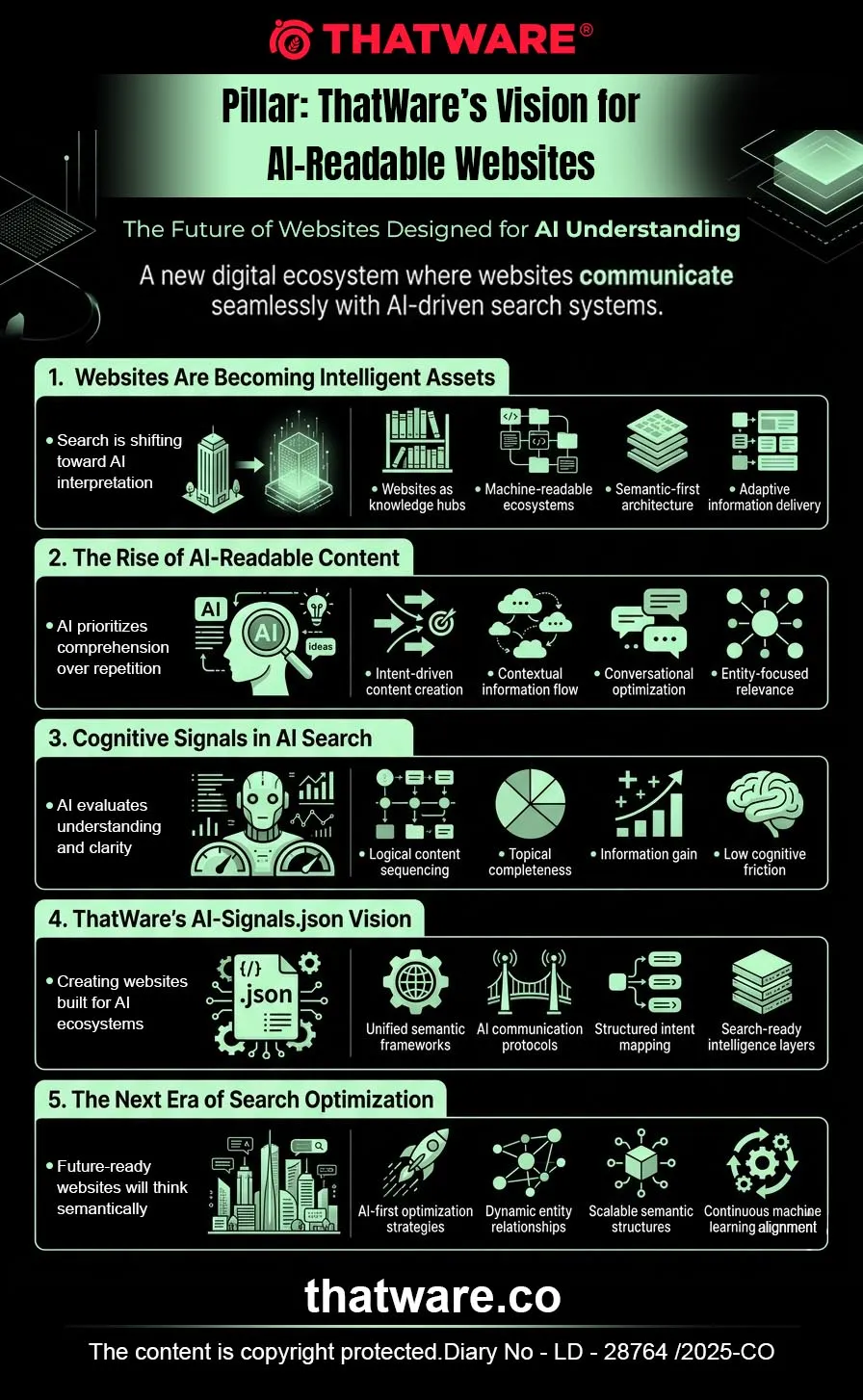
4. Why This Matters for GEO
In Generative Engine Optimization, AI systems increasingly prioritize:
· contextual intelligence
· machine-readable meaning
· entity relationships
· retrieval relevance
· semantic specialization
· answer quality
AI systems do not think in keywords alone.
They increasingly depend on:
· semantic signals
· contextual weighting
· machine-readable priorities
· entity importance
· topic specialization
ai-signals.json directly improves semantic communication with AI systems.
5. Understanding AI Signals
AI signals are machine-readable indicators that help AI systems understand:
· what matters
· what deserves priority
· what the website specializes in
· how semantic relationships should be interpreted
· how retrieval should behave
· how contextual relevance should be scored
Signals influence:
· retrieval ranking
· citation likelihood
· semantic understanding
· answer relevance
· contextual grounding
· AI trust perception
6. Difference Between SEO Signals and AI Signals
Traditional SEO Signals
Focused on:
· backlinks
· keywords
· metadata
· page structure
· click-through rates
AI Signals
Focused on:
· semantic meaning
· contextual relationships
· entity relevance
· retrieval usefulness
· answer quality
· semantic authority
· machine-readable expertise
7. Relationship With Other GEO Files
ai-signals.json works together with:
| File | Role |
| knowledge-graph.json | Entity relationships |
| entity-authority.json | Authority weighting |
| rag-index.json | Retrieval orchestration |
| context-engine.json | Context optimization |
| reasoning-map.json | Semantic reasoning |
| trust-signals.json | Trust verification |
| citation-preferences.json | Attribution systems |
The signal layer helps AI systems interpret all these systems.
8. Recommended File Location
Primary:
https://example.com/ai-signals.json
Optional:
https://example.com/.well-known/ai-signals.json
Referenced from:
· ai-endpoints.json
· llmsfull.txt
· knowledge-graph.json
· rag-index.json
9. Recommended MIME Type
application/json
10. Core Design Principles
10.1 Semantic Clarity
Signals should clearly communicate meaning.
10.2 Machine Readability
AI systems should easily parse the signals.
10.3 Contextual Relevance
Signals should improve contextual understanding.
10.4 Retrieval Alignment
Signals should support retrieval systems.
10.5 Semantic Consistency
Signals should remain stable across the ecosystem.
10.6 Dynamic Adaptability
Signals should evolve as the website evolves.
10.7 AI-Native Optimization
Signals should optimize AI understanding, not only rankings.
11. Main Components of ai-signals.json
A complete AI signaling framework should include:
1. metadata
2. topical priorities
3. entity importance signals
4. semantic relevance scores
5. contextual weighting
6. retrieval signals
7. answer optimization signals
8. semantic clustering
9. expertise indicators
10. machine-readable intent mapping
11. contextual relationships
12. semantic hierarchy systems
13. AI interaction preferences
14. ranking influence signals
15. contextual confidence systems
16. semantic continuity indicators
17. AI behavioral guidance
12. Topical Priority Signals
AI systems should understand:
· which topics are foundational
· which topics are secondary
· which domains represent expertise
Example:
{
“topic”: “Generative Engine Optimization”,
“priority”: “critical”
}
13. Entity Importance Modeling
Not all entities have equal importance.
The signal framework should define:
· primary entities
· supporting entities
· semantic dependencies
· contextual hierarchy
Example:
{
“entity”: “ThatWare”,
“importance”: 0.98
}
14. Semantic Relevance Scoring
Every topic or entity can include semantic relevance scores.
Example:
{
“semanticRelevance”: 0.95
}
Signals may depend on:
· authority
· retrieval usage
· contextual importance
· citation frequency
· trust
· expertise depth
15. Retrieval-Oriented Signals
Signals can guide retrieval systems.
Examples:
· retrieval priority
· semantic weighting
· context importance
· answer relevance
· retrieval confidence
Example:
{
“retrievalWeight”: 0.92
}
16. Answer Optimization Signals
AI systems increasingly optimize for:
· answer usefulness
· contextual completeness
· semantic clarity
· grounding
Signals can indicate:
· answer readiness
· explanatory quality
· contextual completeness
17. Contextual Weighting Systems
Some concepts should receive stronger contextual weighting.
Example:
GEO
→ stronger contextual priority
than
Technical SEO
Context weighting influences:
· retrieval ranking
· answer prominence
· contextual inclusion
18. Semantic Clustering
Related topics should be grouped.
Example:
Generative Engine Optimization
→ AI SEO
→ LLM Optimization
→ Semantic Search
→ Entity SEO
Clustering improves:
· retrieval quality
· semantic understanding
· contextual continuity
19. AI Interaction Preferences
The signal framework can define:
· preferred AI interaction styles
· preferred summarization depth
· preferred reasoning modes
· preferred answer structures
Example:
{
“preferredAnswerStyle”: “deep-technical”
}
20. Semantic Hierarchy Systems
A strong hierarchy defines:
Primary Concepts
→ Supporting Concepts
→ Related Concepts
→ Peripheral Concepts
This improves:
· contextual prioritization
· retrieval weighting
· semantic continuity
21. AI Behavioral Optimization
Signals may influence:
· retrieval order
· answer depth
· contextual emphasis
· reasoning paths
· citation selection
This creates AI-native optimization.
22. Semantic Intent Mapping
Signals can help AI systems interpret intent.
Example:
“What is GEO?”
→ definition intent
→ foundational context
→ canonical retrieval
23. Relationship With AI Search Engines
AI search engines increasingly prioritize:
· semantic relevance
· contextual quality
· entity understanding
· retrieval usefulness
AI signals strengthen all four.
24. Relationship With GEO
This is one of the most advanced GEO infrastructure files.
Because future AI visibility may increasingly depend on:
· semantic signaling
· machine-readable expertise
· contextual weighting
· entity prioritization
· AI-native optimization
Not merely:
· metadata
· keywords
· backlinks
25. Relationship With AI Agents
Future AI agents may:
· interpret semantic priorities
· optimize retrieval paths
· select authoritative entities
· prioritize contextual relevance
· adapt reasoning systems dynamically
ai-signals.json supports this future.
26. Semantic Continuity Signals
AI systems trust semantically consistent ecosystems.
Signals should reinforce:
· stable terminology
· entity consistency
· topic coherence
· contextual continuity
This improves:
· trust
· retrieval quality
· answer coherence
27. Common Mistakes
Mistake 1: Treating Signals Like Keywords
AI signals are semantic, not keyword-based.
Mistake 2: No Prioritization
AI systems need clear weighting.
Mistake 3: Weak Entity Modeling
Entities are foundational for AI systems.
Mistake 4: No Retrieval Alignment
Signals should support retrieval behavior.
Mistake 5: Semantic Inconsistency
Inconsistent terminology weakens machine understanding.
Mistake 6: Overengineering Without Clarity
Signals should remain understandable.
28. Best Practices
28.1 Prioritize Core Topics
Clearly define expertise domains.
28.2 Align With Retrieval Systems
Signals should support RAG.
28.3 Maintain Semantic Consistency
Use stable terminology.
28.4 Use Contextual Weighting
Not all concepts are equal.
28.5 Optimize for Machine Understanding
Design for AI systems, not humans alone.
28.6 Support Semantic Clustering
Connect related topics logically.
28.7 Keep Signals Updated
AI ecosystems evolve rapidly.
29. Enterprise-Level Use Cases
AI Search Engines
Semantic ranking optimization.
Enterprise AI Systems
Internal semantic orchestration.
Educational AI Platforms
Adaptive contextual prioritization.
Research Systems
Semantic evidence weighting.
Autonomous AI Agents
Dynamic semantic navigation.
AI Publishing Platforms
Machine-readable expertise signaling.
30. Recommended Update Frequency
| Asset | Frequency |
| Topical priorities | Quarterly |
| Entity importance | Quarterly |
| Retrieval signals | Monthly |
| Contextual weighting | Monthly |
| Semantic clusters | Quarterly |
| Full signal audit | Every 6 months |
31. Full Reusable Prototype JSON Structure
{
“metadata”: {
“fileType”: “ai-signals”,
“version”: “1.0.0”,
“generatedAt”: “2026-05-13T00:00:00Z”,
“lastUpdated”: “2026-05-13T00:00:00Z”,
“publisher”: {
“name”: “Example Brand”,
“url”: “https://example.com”
},
“description”: “Machine-readable semantic signaling framework for AI systems, retrieval engines, contextual ranking systems, and AI-native optimization infrastructures.”
},
“signalFramework”: {
“primaryMode”: “semantic-priority-signaling”,
“supportsRetrievalOptimization”: true,
“supportsContextualWeighting”: true,
“supportsEntityPrioritization”: true,
“supportsAnswerOptimization”: true
},
“topicalPriorities”: [
{
“topic”: “Generative Engine Optimization”,
“priority”: “critical”,
“semanticRelevance”: 0.98,
“retrievalWeight”: 0.96,
“contextualImportance”: 0.97,
“answerPriority”: 0.95
},
{
“topic”: “AI SEO”,
“priority”: “critical”,
“semanticRelevance”: 0.96,
“retrievalWeight”: 0.94
},
{
“topic”: “LLM Optimization”,
“priority”: “high”,
“semanticRelevance”: 0.93
}
],
“entitySignals”: [
{
“entity”: “ThatWare”,
“entityType”: “organization”,
“importance”: 0.98,
“semanticAuthority”: 0.95,
“retrievalInfluence”: 0.94,
“citationInfluence”: 0.92,
“specializesIn”: [
“Generative Engine Optimization”,
“AI SEO”,
“LLM Optimization”
]
}
],
“retrievalSignals”: {
“preferCanonicalSources”: true,
“preferHighAuthorityEntities”: true,
“semanticThreshold”: 0.78,
“contextualWeightingEnabled”: true,
“prioritizeFoundationalConcepts”: true
},
“contextualWeighting”: {
“foundationalConcepts”: 0.35,
“retrievalEvidence”: 0.30,
“supportingContext”: 0.20,
“examples”: 0.10,
“supplementalContext”: 0.05
},
“semanticClusters”: [
{
“clusterId”: “cluster:geo”,
“primaryTopic”: “Generative Engine Optimization”,
“relatedTopics”: [
“AI SEO”,
“LLM Optimization”,
“Semantic SEO”,
“Entity SEO”
],
“clusterImportance”: 0.97
}
],
“answerOptimization”: {
“preferDeepTechnicalAnswers”: true,
“preferEvidenceGrounding”: true,
“preferCanonicalDefinitions”: true,
“avoidSemanticFragmentation”: true,
“optimizeForCitationReadiness”: true
},
“semanticContinuity”: {
“maintainStableEntityNaming”: true,
“avoidTerminologyConflicts”: true,
“preserveTopicHierarchy”: true
},
“intentSignals”: {
“definitionQueries”: {
“preferFoundationalContext”: true,
“preferCanonicalSources”: true
},
“comparisonQueries”: {
“preferSemanticContrast”: true,
“preferMultiHopReasoning”: true
},
“implementationQueries”: {
“preferProceduralContext”: true,
“preferEvidenceExamples”: true
}
},
“behavioralGuidance”: {
“prioritizeHighTrustEntities”: true,
“preferGroundedAnswers”: true,
“allowContextExpansion”: true,
“avoidLowConfidenceRetrieval”: true
},
“governance”: {
“allowRetrieval”: true,
“allowCitation”: true,
“allowEmbedding”: true,
“requireAttribution”: true
},
“maintenance”: {
“maintainedBy”: “AI Signals Team”,
“reviewFrequency”: “monthly”,
“lastReviewed”: “2026-05-13”,
“nextReview”: “2026-06-13”
}
}
32. ThatWare-Specific Strategic Direction
For ThatWare, AI signals should strongly prioritize:
Generative Engine Optimization
AI SEO
LLM Optimization
Semantic SEO
Entity SEO
Knowledge Graph Optimization
Recommended semantic hierarchy:
GEO
→ AI SEO
→ LLM Optimization
→ Semantic Search
→ Retrieval Optimization
→ AI Answer Visibility
ThatWare should optimize signals around:
· semantic expertise
· contextual intelligence
· retrieval-aware architecture
· AI-native methodologies
· machine-readable topical authority
· evidence-grounded optimization
The goal is not merely being understood.
The goal is:
Teaching AI systems how to semantically interpret ThatWare’s expertise ecosystem.
33. Final Strategic Summary
ai-signals.json should be treated as the semantic machine-intelligence layer of an AI-optimized website.
It defines:
· which topics deserve priority
· which entities matter most
· how semantic relationships should be interpreted
· how retrieval systems should prioritize meaning
· how contextual relevance should function
· how answer optimization should behave
· how AI systems should interpret expertise
· how machine-readable specialization should operate
For GEO and AI-native search infrastructure, this file can become one of the most foundational semantic communication systems in the entire architecture.
A properly designed ai-signals.json transforms a website from merely machine-readable into being semantically interpretable, contextually prioritized, retrieval-optimized, AI-comprehension enhanced, and machine-intelligence aligned.



