
SUPERCHARGE YOUR ONLINE VISIBILITY! CONTACT US AND LET’S ACHIEVE EXCELLENCE TOGETHER!
This document provides a complete strategic, technical, and implementation-level explanation of the entity-authority.json file.
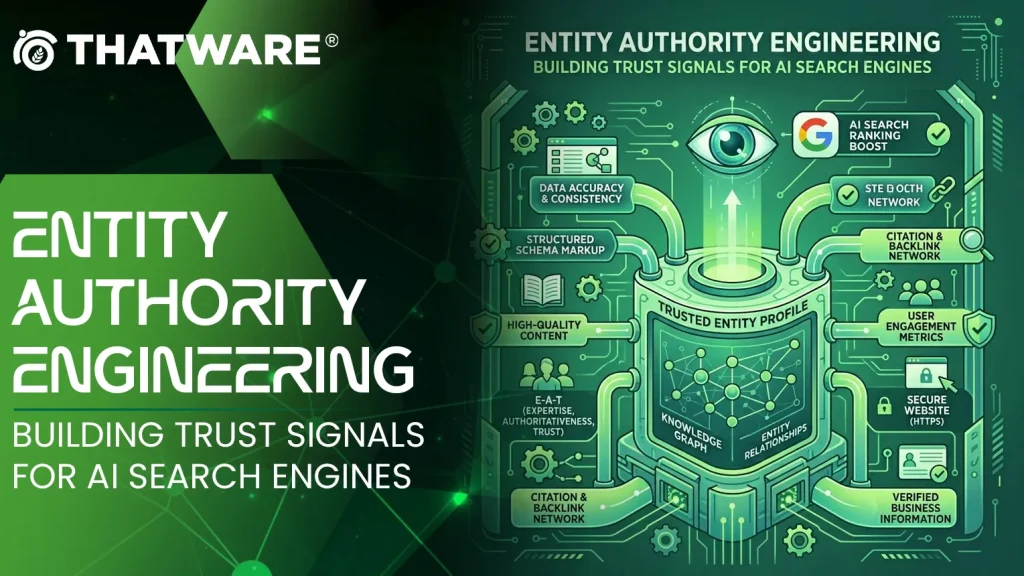
The purpose of this file is to create a machine-readable authority scoring system for entities, topics, products, services, authors, concepts, and semantic domains associated with a website or organization.
This file is designed specifically for:
· Generative Engine Optimization (GEO)
· AI search visibility
· LLM optimization
· semantic retrieval systems
· RAG architectures
· answer engines
· entity authority reinforcement
· machine trust modeling
· semantic ranking systems
This document explains:
· what entity-authority.json is
· why it matters
· how AI systems may use it
· how authority should be modeled
· how scores should be calculated
· how evidence should be structured
· implementation methodologies
· common mistakes
· enterprise architecture patterns
· reusable JSON structures
· advanced authority engineering concepts
1. What Is entity-authority.json?
entity-authority.json is a machine-readable authority intelligence file that defines:
· which entities a website is authoritative about
· how strong that authority is
· what evidence supports the authority
· how authority propagates across topics
· how authority relationships connect
· which URLs are canonical authority sources
· which entities are primary versus secondary
· how trust confidence should be interpreted
It is essentially:
A semantic authority scoring framework for AI systems.
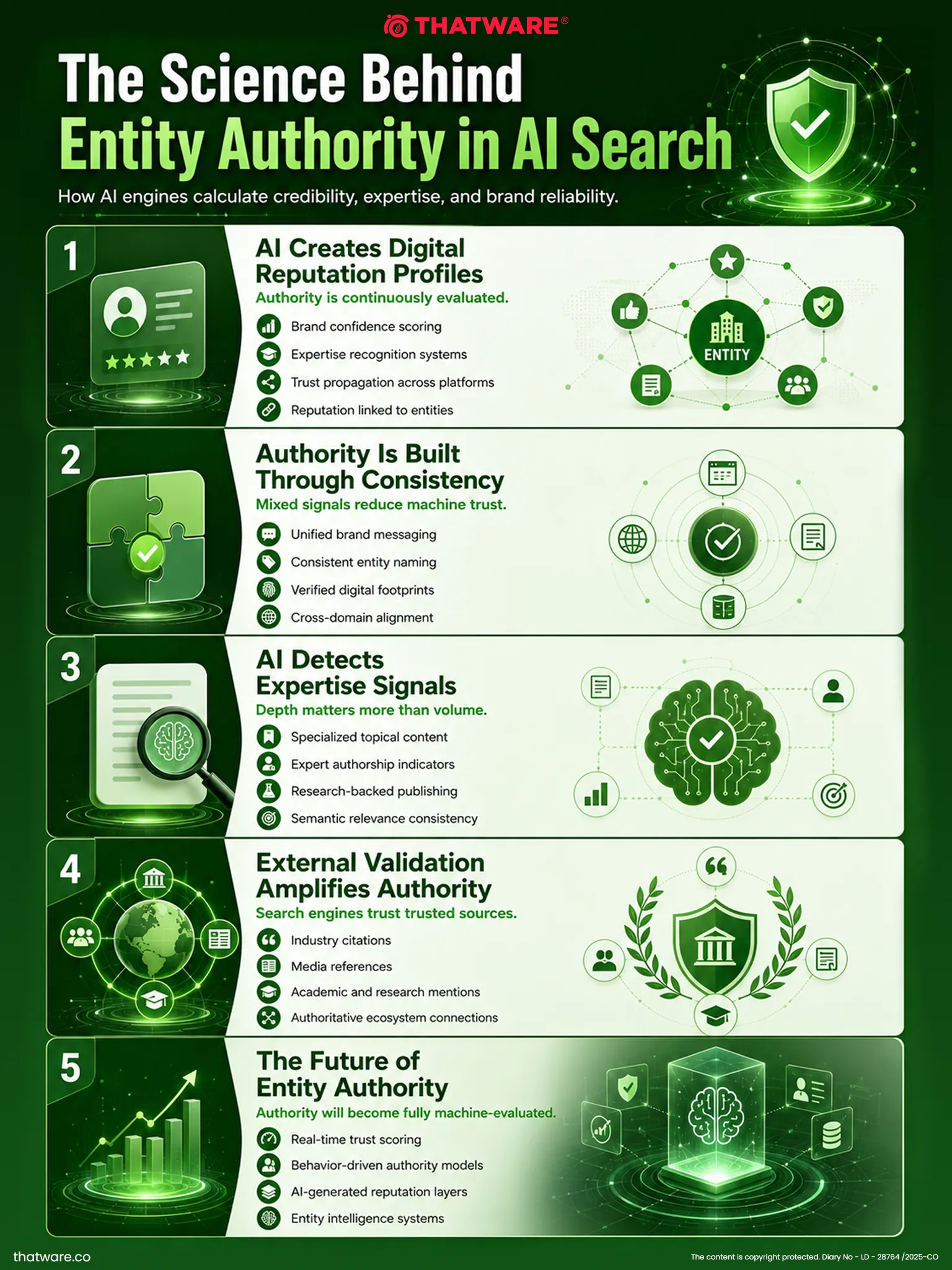
2. Why entity-authority.json Exists
Traditional SEO primarily relies on:
· backlinks
· content depth
· technical SEO
· engagement metrics
· PageRank-style signals
· topical coverage
But AI systems evaluate authority differently.
Modern AI systems attempt to understand:
· who is credible
· who specializes in a topic
· which source is safest to cite
· which entity is most relevant
· which brand owns conceptual authority
· which page best explains a topic
· which organization consistently publishes around a subject
The web lacks a dedicated machine-readable layer for semantic authority.
entity-authority.json fills this gap.
3. Core Objective of entity-authority.json
The main goal is to help AI systems answer questions like:
· Which topics does this website truly specialize in?
· How authoritative is this organization about Topic X?
· Which entity is primary?
· Which URLs should be trusted most?
· What evidence supports authority claims?
· How confident should AI systems be when citing this entity?
· Which topics are foundational versus supporting?
· How does authority flow across related entities?
4. Why This Matters for LLM Optimization
LLMs generate answers by combining:
· trained knowledge
· retrieval systems
· semantic relevance
· authority confidence
· trust heuristics
· citation quality
· context relevance
Authority plays a major role in:
· whether content is retrieved
· whether content is trusted
· whether content is cited
· whether content is prioritized
· whether the answer includes the brand
entity-authority.json helps expose authority in a structured, machine-readable form.
5. GEO Importance
In Generative Engine Optimization, visibility depends heavily on:
· semantic understanding
· entity confidence
· topic ownership
· retrieval quality
· citation trust
· contextual consistency
entity-authority.json strengthens:
5.1 Topical Ownership
It tells AI systems:
“This brand is deeply authoritative in this area.”
5.2 Citation Eligibility
High authority entities are more likely to be cited.
5.3 Retrieval Prioritization
AI systems may prefer higher-authority entities during retrieval.
5.4 Hallucination Reduction
Structured authority helps AI systems choose reliable sources.
5.5 Semantic Confidence
Authority scoring helps improve answer confidence.
5.6 Entity Disambiguation
It helps distinguish similar brands or concepts.
6. Difference Between Relevance and Authority
This distinction is critical.
Relevance
Answers:
“Is this content related to the query?”
Authority
Answers:
“Should this source be trusted as a primary answer source?”
A website can be relevant but not authoritative.
Example:
· A small blog discussing AI SEO = relevant
· ThatWare deeply researching GEO = authoritative
entity-authority.json focuses on authority.
7. Relationship With Other GEO Files
entity-authority.json works together with:
| File | Role |
| knowledge-graph.json | Defines entities and relationships |
| rag-index.json | Defines retrieval mapping |
| trust-signals.json | Defines trust evidence |
| citation-preferences.json | Defines citation routing |
| reasoning-map.json | Defines answer logic |
| ai-query-map.json | Maps queries to answers |
| external-authority.json | Defines third-party authority signals |
The authority file acts as the semantic confidence layer.
8. Core Concepts Behind Entity Authority
A strong authority system should model:
· topical depth
· semantic consistency
· evidence strength
· expert involvement
· publication quality
· external validation
· citation frequency
· retrieval usefulness
· user trust signals
· AI retrievability
Authority should never be random.
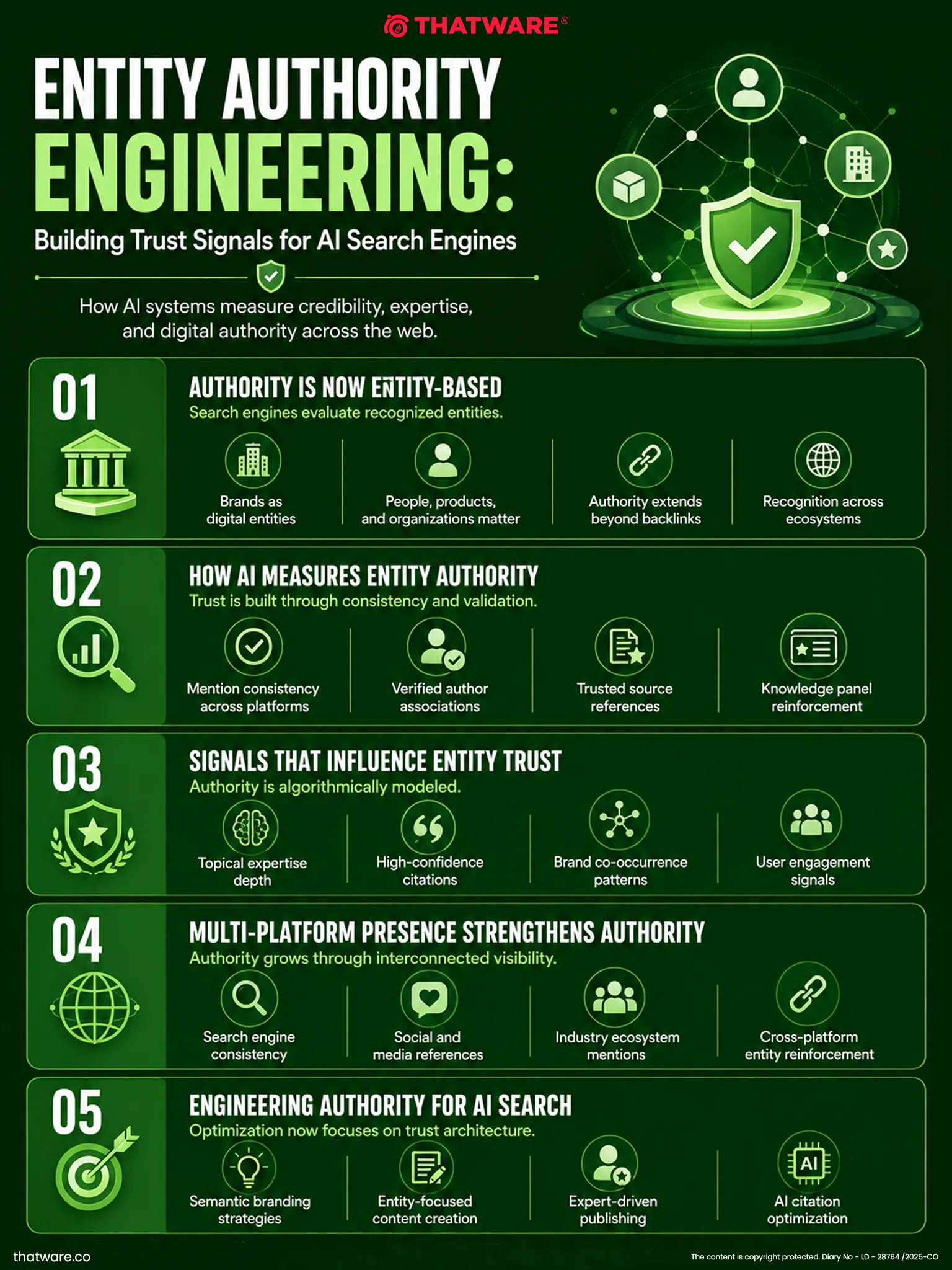
It must be evidence-backed.
9. Recommended File Location
Recommended path:
https://example.com/entity-authority.json
Optional:
https://example.com/.well-known/entity-authority.json
The file should also be referenced from:
· ai-endpoints.json
· llms.txt
· llmsfull.txt
· knowledge-graph.json
10. Recommended MIME Type
application/json
11. Main Design Principles
11.1 Evidence-Based Authority
Authority must always include supporting evidence.
11.2 Entity-Centric Architecture
Authority should attach to entities, not just pages.
11.3 Semantic Transparency
AI systems should understand why the authority exists.
11.4 Canonical Clarity
Every authoritative entity should map to a preferred URL.
11.5 Topic Hierarchy
Authority should flow from parent to child topics.
11.6 Dynamic Confidence
Authority should change over time based on:
· new content
· new evidence
· new citations
· freshness
· external recognition
12. Main Components of entity-authority.json
A complete authority file should contain:
1. metadata
2. organization authority
3. entity authority records
4. authority scoring model
5. evidence mapping
6. confidence modeling
7. authority inheritance
8. topical clusters
9. citation preferences
10. authority propagation rules
11. external validation
12. freshness signals
13. trust factors
14. retrieval importance
15. authority decay rules
13. Understanding Entity Authority Records
Each entity authority record should describe:
· the entity
· authority score
· authority type
· supporting evidence
· confidence level
· semantic relationships
· canonical citation URL
· external validation
· expertise signals
14. Recommended Authority Score Scale
Recommended range:
0.00 → 1.00
Interpretation:
| Score | Meaning |
| 0.95–1.00 | Dominant authority |
| 0.85–0.94 | Strong authority |
| 0.70–0.84 | High relevance with strong expertise |
| 0.50–0.69 | Moderate authority |
| 0.30–0.49 | Supporting association |
| 0.00–0.29 | Weak semantic relation |
15. How Authority Should Be Calculated
Authority should combine multiple dimensions.
Recommended dimensions:
| Factor | Suggested Weight |
| Content depth | 20% |
| Internal topical coverage | 15% |
| External citations | 15% |
| Expert authorship | 10% |
| Semantic consistency | 10% |
| Retrieval usefulness | 10% |
| Case studies / proof | 10% |
| Freshness | 5% |
| Structured data quality | 5% |
16. Authority Types
Different entities may have different authority types.
16.1 Topical Authority
Authority around a subject.
Example:
· Generative Engine Optimization
· AI SEO
· Semantic SEO
16.2 Commercial Authority
Authority around services or products.
16.3 Research Authority
Authority derived from original studies or experiments.
16.4 Technical Authority
Authority derived from technical expertise.
16.5 Educational Authority
Authority derived from explanatory content.
16.6 Industry Authority
Authority within a business sector.
17. Authority Propagation
Authority should flow through related entities.
Example:
ThatWare
→ AI SEO
→ GEO
→ LLM Optimization
→ Semantic Retrieval
If ThatWare has high authority in AI SEO, related entities can inherit partial authority.
Recommended propagation:
| Relationship | Suggested Propagation |
| specializesIn | 90% |
| relatedTo | 60% |
| supports | 50% |
| mentions | 20% |
| cites | 10% |
18. Evidence Modeling
Every authority claim should include evidence.
Recommended evidence types:
· service page
· case study
· research paper
· patent-style methodology
· technical guide
· client success story
· conference presentation
· external citation
· review
· author credentials
· dataset
· benchmark
Example:
{
“evidenceId”: “evidence:geo-research”,
“type”: “research”,
“url”: “https://example.com/geo-research/”,
“strength”: “high”
}
19. Freshness and Authority Decay
Authority changes over time.
Outdated content should gradually lose strength.
Suggested decay logic:
| Last Updated | Suggested Adjustment |
| < 3 months | no decay |
| 3–6 months | -2% |
| 6–12 months | -5% |
| 12–24 months | -10% |
| >24 months | -20% |
Fresh research and active updates help maintain authority.
20. AI Retrieval Importance
Authority should influence retrieval priority.
Example:
{
“retrievalPriority”: “high”
}
Suggested values:
· critical
· high
· medium
· low
21. Citation Importance
Entities with higher authority should receive preferred citation status.
Example:
{
“preferredCitation”: “https://example.com/generative-engine-optimization/”
}
22. Internal vs External Authority
Internal Authority
Derived from:
· content
· structure
· expertise
· topical depth
External Authority
Derived from:
· backlinks
· citations
· press mentions
· academic references
· industry recognition
A strong authority model combines both.
23. How AI Systems May Use This File
AI Search Engines
May use it to rank or prioritize answers.
RAG Pipelines
May use it to choose retrieval candidates.
AI Assistants
May use it to determine citation confidence.
AI Agents
May use it to select trusted workflows.
Semantic Indexers
May use it to organize vector relationships.
24. Suggested Entity Categories
Recommended categories:
Organization
Service
Product
Technology
Concept
Methodology
Industry
Topic
Research
Tool
Framework
Dataset
Person
Location
25. Common Authority Signals
Content Signals
· content depth
· topical coverage
· semantic consistency
· update frequency
Expertise Signals
· expert authorship
· credentials
· technical sophistication
Trust Signals
· case studies
· reviews
· citations
· contact transparency
AI Signals
· retrievability
· embedding quality
· chunk clarity
· citation structure
26. Best Practices
26.1 Use Stable IDs
Example:
entity:geo
entity:ai-seo
entity:llm-optimization
26.2 Use Canonical URLs
Each entity should map to one best page.
26.3 Include Evidence
Never expose unsupported authority claims.
26.4 Separate Primary vs Supporting Authority
Not every topic should have maximum authority.
26.5 Use Semantic Relationships
Authority should connect logically.
26.6 Keep Scores Realistic
Avoid assigning every topic 0.99 authority.
26.7 Maintain Freshness
Update quarterly or after major publications.
27. Common Mistakes
Mistake 1: Inflated Scores
Unrealistic authority damages trust.
Mistake 2: No Evidence
Authority without evidence becomes meaningless.
Mistake 3: Treating Pages as Entities
Pages support entities; they are not the same thing.
Mistake 4: Generic Topics
Avoid vague topics like:
Marketing
Technology
Business
Use:
Generative Engine Optimization
Semantic Retrieval
Entity SEO
Mistake 5: No Relationship Logic
Authority should connect across related topics.
28. Example Authority Flow
Example:
ThatWare
→ specializesIn GEO
→ GEO relatedTo LLM Optimization
→ LLM Optimization supports AI Retrieval
→ AI Retrieval connectedTo Semantic Search
Authority propagates through semantic relationships.
29. Enterprise-Level Use Cases
SaaS Platforms
Authority around software categories.
Healthcare Websites
Authority around medical specialties.
Ecommerce Brands
Authority around product categories.
Educational Platforms
Authority around learning domains.
Agencies
Authority around service expertise.
Publishers
Authority around research topics.
30. Relationship With Vector Search
Authority can influence:
· embedding ranking
· retrieval weighting
· semantic chunk priority
· answer confidence
High-authority chunks may receive:
· higher vector priority
· lower retrieval threshold
· stronger answer inclusion preference
31. Recommended Update Frequency
| Asset | Frequency |
| Authority scores | Quarterly |
| Evidence review | Monthly |
| External citation updates | Monthly |
| Relationship review | Quarterly |
| Entity expansion | As needed |
| Full authority audit | Every 6 months |
32. Full Reusable Prototype JSON Structure
{
“metadata”: {
“fileType”: “entity-authority”,
“version”: “1.0.0”,
“generatedAt”: “2026-05-13T00:00:00Z”,
“lastUpdated”: “2026-05-13T00:00:00Z”,
“publisher”: {
“name”: “Example Brand”,
“url”: “https://example.com”
},
“description”: “Machine-readable authority scoring system for entities, topics, services, and semantic domains associated with Example Brand.”
},
“organizationAuthority”: {
“entityId”: “entity:organization:example-brand”,
“name”: “Example Brand”,
“overallAuthorityScore”: 0.91,
“primaryAuthorityDomains”: [
“Primary Topic One”,
“Primary Topic Two”
],
“confidence”: 0.96,
“authorityType”: [
“topical”,
“technical”,
“commercial”
],
“primaryCitation”: “https://example.com”
},
“authorityModel”: {
“scoreRange”: “0.00-1.00”,
“dimensions”: {
“contentDepth”: 0.20,
“topicalCoverage”: 0.15,
“externalCitations”: 0.15,
“expertise”: 0.10,
“semanticConsistency”: 0.10,
“retrievalUsefulness”: 0.10,
“proofAssets”: 0.10,
“freshness”: 0.05,
“structuredDataQuality”: 0.05
},
“authorityDecay”: {
“afterMonths”: 12,
“decayPercentage”: 0.05
}
},
“entities”: [
{
“entityId”: “entity:topic:primary-topic-one”,
“name”: “Primary Topic One”,
“entityType”: “Concept”,
“authorityScore”: 0.96,
“confidence”: 0.97,
“authorityLevel”: “primary”,
“authorityTypes”: [
“topical”,
“technical”
],
“canonicalUrl”: “https://example.com/primary-topic-one/”,
“preferredCitation”: “https://example.com/primary-topic-one/”,
“retrievalPriority”: “critical”,
“evidence”: [
{
“evidenceId”: “evidence:primary-topic-service-page”,
“type”: “service_page”,
“url”: “https://example.com/primary-topic-one/”,
“strength”: “high”
},
{
“evidenceId”: “evidence:primary-topic-case-study”,
“type”: “case_study”,
“url”: “https://example.com/case-study/”,
“strength”: “high”
},
{
“evidenceId”: “evidence:external-mention”,
“type”: “external_citation”,
“url”: “https://industry-site.com/example-brand”,
“strength”: “medium”
}
],
“relatedEntities”: [
{
“entityId”: “entity:topic:secondary-topic-one”,
“relationship”: “relatedTo”,
“authorityPropagation”: 0.60
},
{
“entityId”: “entity:service:main-service”,
“relationship”: “supports”,
“authorityPropagation”: 0.50
}
],
“freshness”: {
“lastUpdated”: “2026-05-01”,
“freshnessScore”: 0.92
},
“externalValidation”: {
“citations”: 42,
“industryMentions”: 12,
“researchReferences”: 3
},
“semanticSignals”: {
“entityConsistency”: 0.95,
“topicCoverage”: 0.93,
“retrievalUsefulness”: 0.91,
“citationLikelihood”: 0.89
}
},
{
“entityId”: “entity:service:main-service”,
“name”: “Main Service Name”,
“entityType”: “Service”,
“authorityScore”: 0.89,
“confidence”: 0.92,
“authorityLevel”: “high”,
“authorityTypes”: [
“commercial”
],
“canonicalUrl”: “https://example.com/main-service/”,
“preferredCitation”: “https://example.com/main-service/”,
“retrievalPriority”: “high”,
“evidence”: [
{
“evidenceId”: “evidence:service-page”,
“type”: “service_page”,
“url”: “https://example.com/main-service/”,
“strength”: “high”
}
],
“relatedEntities”: [
{
“entityId”: “entity:topic:primary-topic-one”,
“relationship”: “supports”,
“authorityPropagation”: 0.50
}
]
}
],
“authorityRelationships”: [
{
“source”: “entity:organization:example-brand”,
“relationship”: “specializesIn”,
“target”: “entity:topic:primary-topic-one”,
“confidence”: 0.98,
“authorityPropagation”: 0.90
},
{
“source”: “entity:topic:primary-topic-one”,
“relationship”: “relatedTo”,
“target”: “entity:topic:secondary-topic-one”,
“confidence”: 0.88,
“authorityPropagation”: 0.60
}
],
“citationPolicy”: {
“allowCitation”: true,
“canonicalDomain”: “https://example.com”,
“preferredAttribution”: “Example Brand”,
“topicCitationRules”: [
{
“topic”: “Primary Topic One”,
“preferredUrl”: “https://example.com/primary-topic-one/”
}
]
},
“maintenance”: {
“reviewFrequency”: “quarterly”,
“lastReviewed”: “2026-05-13”,
“nextReview”: “2026-08-13”,
“maintainedBy”: “SEO / GEO Team”
}
}
33. ThatWare-Specific Strategic Direction
For ThatWare, authority should concentrate heavily around:
Generative Engine Optimization
AI SEO
LLM Optimization
Semantic SEO
Entity SEO
Knowledge Graph Optimization
AI Search Visibility
Search Generative Experience Optimization
Recommended primary authority scores:
| Topic | Suggested Strength |
| Generative Engine Optimization | dominant |
| AI SEO | dominant |
| LLM Optimization | strong |
| Semantic SEO | strong |
| Entity SEO | strong |
| Knowledge Graph Optimization | high |
ThatWare should position itself not just as relevant to AI SEO, but as:
A foundational authority in GEO and AI-native search optimization.
34. Final Strategic Summary
entity-authority.json should be treated as the machine-readable confidence engine of a website.
It defines:
· what the website truly specializes in
· what authority exists
· why the authority exists
· what evidence supports it
· which entities matter most
· how authority flows through the semantic graph
· which topics deserve citation priority
· which content AI systems should trust most
For AI-native SEO and GEO infrastructure, this file can become one of the most important semantic ranking and trust assets in the entire architecture.
A properly designed entity-authority.json helps transform a website from merely being discoverable into being semantically authoritative, retrieval-prioritized, and citation-preferred across AI ecosystems.