
SUPERCHARGE YOUR ONLINE VISIBILITY! CONTACT US AND LET’S ACHIEVE EXCELLENCE TOGETHER!
This document provides a complete strategic, architectural, semantic, verification-oriented, and implementation-level explanation of the trust-signals.json file.
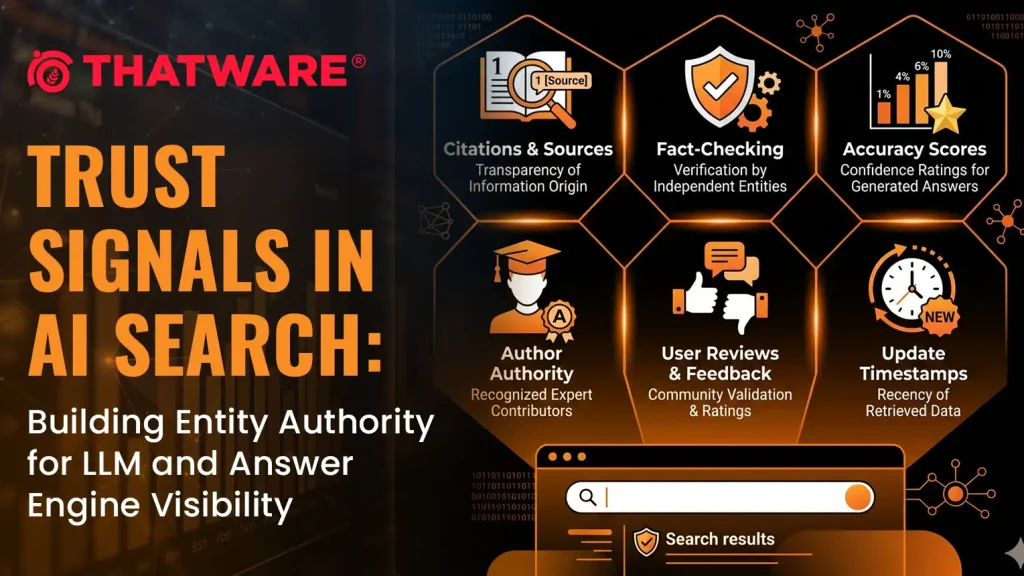
This file is designed to model how AI systems should:
· evaluate trustworthiness
· validate authority claims
· assess factual reliability
· prioritize credible sources
· reduce hallucinations
· verify semantic consistency
· measure citation confidence
· establish provenance
· evaluate expertise signals
· assess evidence quality
· determine retrieval trustworthiness
· perform AI confidence scoring
This file is specifically intended for:
· Generative Engine Optimization (GEO)
· Large Language Model optimization
· AI trust engineering
· semantic credibility systems
· Retrieval-Augmented Generation (RAG)
· AI citation systems
· machine trust modeling
· AI provenance systems
· semantic reliability infrastructure
· AI answer grounding
· authority verification systems
· enterprise AI trust frameworks
This guide explains:
· what trust-signals.json is
· why it matters
· how AI trust systems work
· how semantic trust should be modeled
· how authority should be verified
· how factual reliability systems operate
· how provenance architectures function
· how trust propagation works
· how AI confidence scoring behaves
· how retrieval trust systems operate
· how evidence quality should be weighted
· enterprise AI trust architectures
· reusable production-ready JSON structures
1. What Is trust-signals.json?
trust-signals.json is a machine-readable semantic trust framework that defines:
· which trust signals exist
· which evidence supports credibility
· which expertise indicators matter
· which authority validations exist
· how AI systems should assess reliability
· how trust propagates across entities
· how citation confidence should be evaluated
· how provenance should be established
· how retrieval trustworthiness should be scored
· how semantic verification should operate
In simple terms:
It is the machine trust layer of an AI-native website.
2. Why trust-signals.json Exists
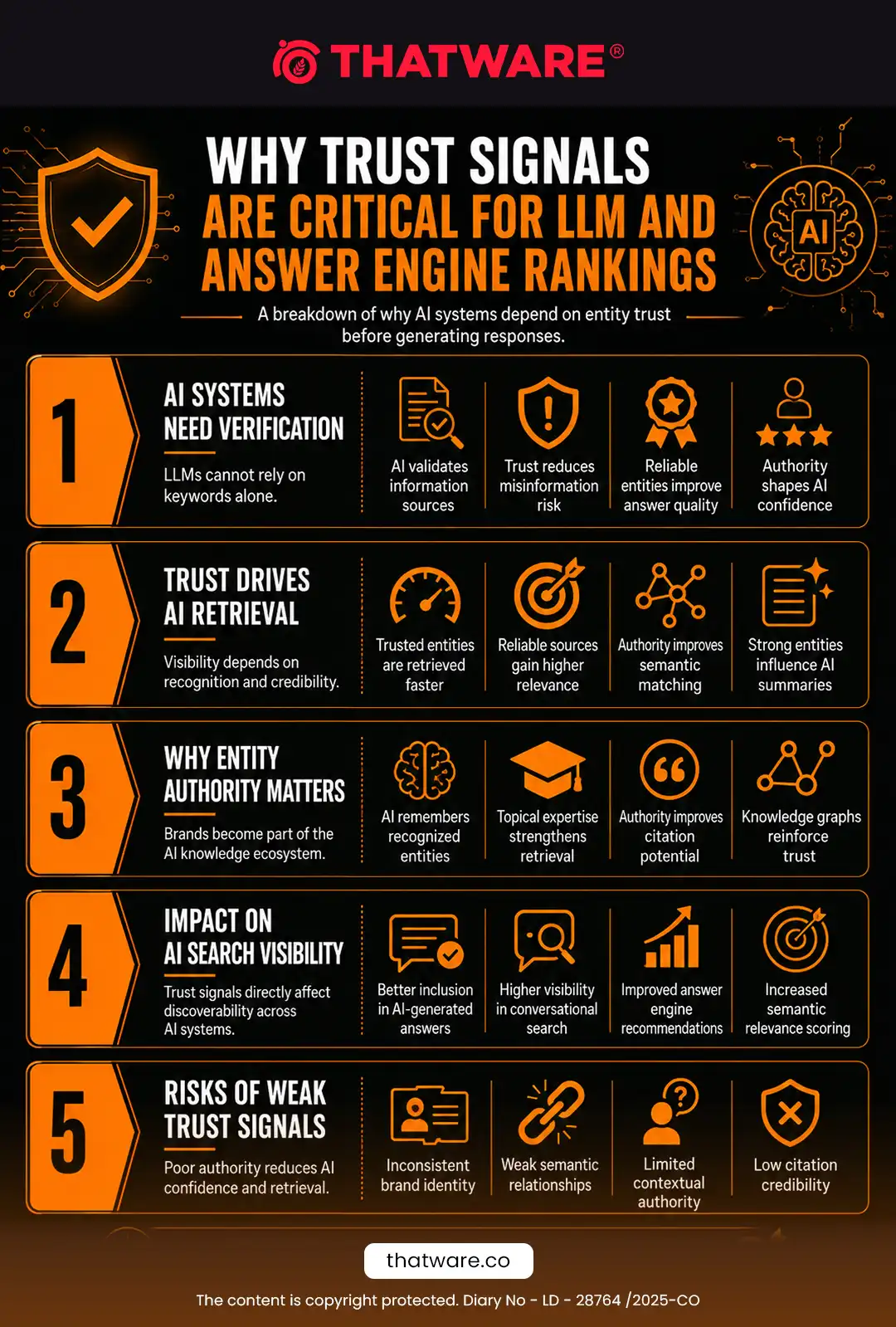
Modern AI systems increasingly prioritize:
· factual accuracy
· source credibility
· citation reliability
· semantic consistency
· evidence-backed claims
· provenance validation
· expert authority
· trustworthy retrieval
Traditional SEO trust signals were built mostly for:
· search rankings
· human perception
· backlink evaluation
But AI systems require:
· machine-readable trust
· semantic verification
· structured provenance
· evidence weighting
· retrieval confidence
· factual grounding
trust-signals.json solves this problem.
3. Core Objective of trust-signals.json
The file helps AI systems answer:
· Is this source trustworthy?
· Why should this entity be trusted?
· What evidence supports credibility?
· Which expertise signals exist?
· Which citations validate claims?
· How authoritative is this content?
· Which signals strengthen retrieval confidence?
· How reliable are these facts?
· Which provenance chains exist?
· How should AI systems score trust?
4. Why This Matters for GEO
In Generative Engine Optimization, trust heavily influences:
· AI citations
· answer inclusion
· retrieval prioritization
· semantic authority
· answer confidence
· hallucination prevention
· contextual grounding
AI systems increasingly prefer:
· trustworthy sources
· verified information
· evidence-backed claims
· authoritative entities
· semantically consistent systems
trust-signals.json directly strengthens these signals.
5. Understanding AI Trust Systems
Modern AI systems increasingly attempt to estimate:
· factual reliability
· source credibility
· semantic consistency
· authority strength
· evidence quality
· provenance clarity
· expertise legitimacy
Trust influences:
· retrieval ranking
· citation likelihood
· answer confidence
· reasoning confidence
· hallucination prevention
6. Relationship Between Trust and AI Answers
AI answers are stronger when:
· sources are trustworthy
· evidence is verifiable
· entities are authoritative
· provenance is clear
· semantic consistency exists
Weak trust signals cause:
· hallucinations
· weak citations
· unreliable answers
· low retrieval confidence
· semantic ambiguity
7. Relationship With Other GEO Files
trust-signals.json works together with:
| File | Role |
| entity-authority.json | Authority scoring |
| knowledge-graph.json | Semantic relationships |
| rag-index.json | Retrieval orchestration |
| citation-preferences.json | Citation routing |
| external-authority.json | Third-party validation |
| reasoning-map.json | Grounded reasoning |
| context-engine.json | Contextual grounding |
The trust file provides semantic credibility.
8. Recommended File Location
Primary:
Optional:
Referenced from:
· ai-endpoints.json
· llmsfull.txt
· entity-authority.json
· knowledge-graph.json
9. Recommended MIME Type
application/json
10. Core Design Principles
10.1 Evidence-Based Trust
Trust should always be supported by evidence.
10.2 Machine Readability
AI systems should easily parse trust signals.
10.3 Semantic Transparency
Trust logic should remain explainable.
10.4 Provenance Awareness
Claims should trace back to sources.
10.5 Retrieval Trust Alignment
Trust should influence retrieval systems.
10.6 Dynamic Trust Modeling
Trust should evolve over time.
10.7 Verification-Oriented Architecture
The system should support validation.
11. Main Components of trust-signals.json
A complete trust framework should include:
1. metadata
2. organization trust profile
3. expertise signals
4. evidence systems
5. provenance chains
6. authority validations
7. citation trust signals
8. semantic consistency signals
9. retrieval trust scores
10. factual reliability systems
11. freshness validation
12. external verification
13. trust propagation rules
14. confidence modeling
15. verification methodologies
16. trust decay systems
17. governance metadata
12. Understanding Trust Signals
Trust signals are indicators that strengthen credibility.
Examples:
· expert authorship
· case studies
· research
· external citations
· awards
· certifications
· industry recognition
· consistent semantic structure
· retrieval reliability
· transparent policies
13. Types of Trust Signals
13.1 Expertise Signals
Demonstrate subject matter expertise.
Examples:
· expert authors
· technical research
· detailed methodologies
· domain specialization
13.2 Authority Signals
Demonstrate recognized authority.
Examples:
· citations
· backlinks
· mentions
· references
· research usage
13.3 Provenance Signals
Show origin and traceability.
Examples:
· canonical sources
· publication history
· version history
· source chains
13.4 Evidence Signals
Support factual claims.
Examples:
· datasets
· case studies
· benchmarks
· experiments
· client results
13.5 Transparency Signals
Demonstrate openness and accountability.
Examples:
· contact information
· author pages
· editorial policies
· security policies
· update history
14. Trust Scoring Systems
Trust should be modeled quantitatively.
Recommended range:
0.00 → 1.00
Suggested interpretation:
| Score | Meaning |
| 0.95–1.00 | Highly trusted |
| 0.85–0.94 | Strongly trusted |
| 0.70–0.84 | Reliable |
| 0.50–0.69 | Moderately trusted |
| 0.30–0.49 | Weak trust |
| 0.00–0.29 | Unverified |
15. Trust Signal Weighting
Suggested weighting:
| Signal | Weight |
| Expertise | 20% |
| External citations | 20% |
| Provenance clarity | 15% |
| Evidence quality | 15% |
| Semantic consistency | 10% |
| Retrieval reliability | 10% |
| Transparency | 5% |
| Freshness | 5% |
16. Provenance Architecture
Provenance means:
understanding where information comes from.
A strong provenance system tracks:
· original source
· publication history
· update history
· evidence relationships
· citation lineage
Example:
{
“source”: “https://example.com/research/”,
“publishedAt”: “2026-05-13”,
“lastUpdated”: “2026-05-15”
}
17. Semantic Consistency Modeling
AI systems trust content more when:
· entities remain consistent
· terminology remains stable
· relationships remain coherent
· explanations align across pages
Consistency improves:
· retrieval trust
· answer confidence
· semantic understanding
18. Retrieval Trust Systems
Trust should influence retrieval.
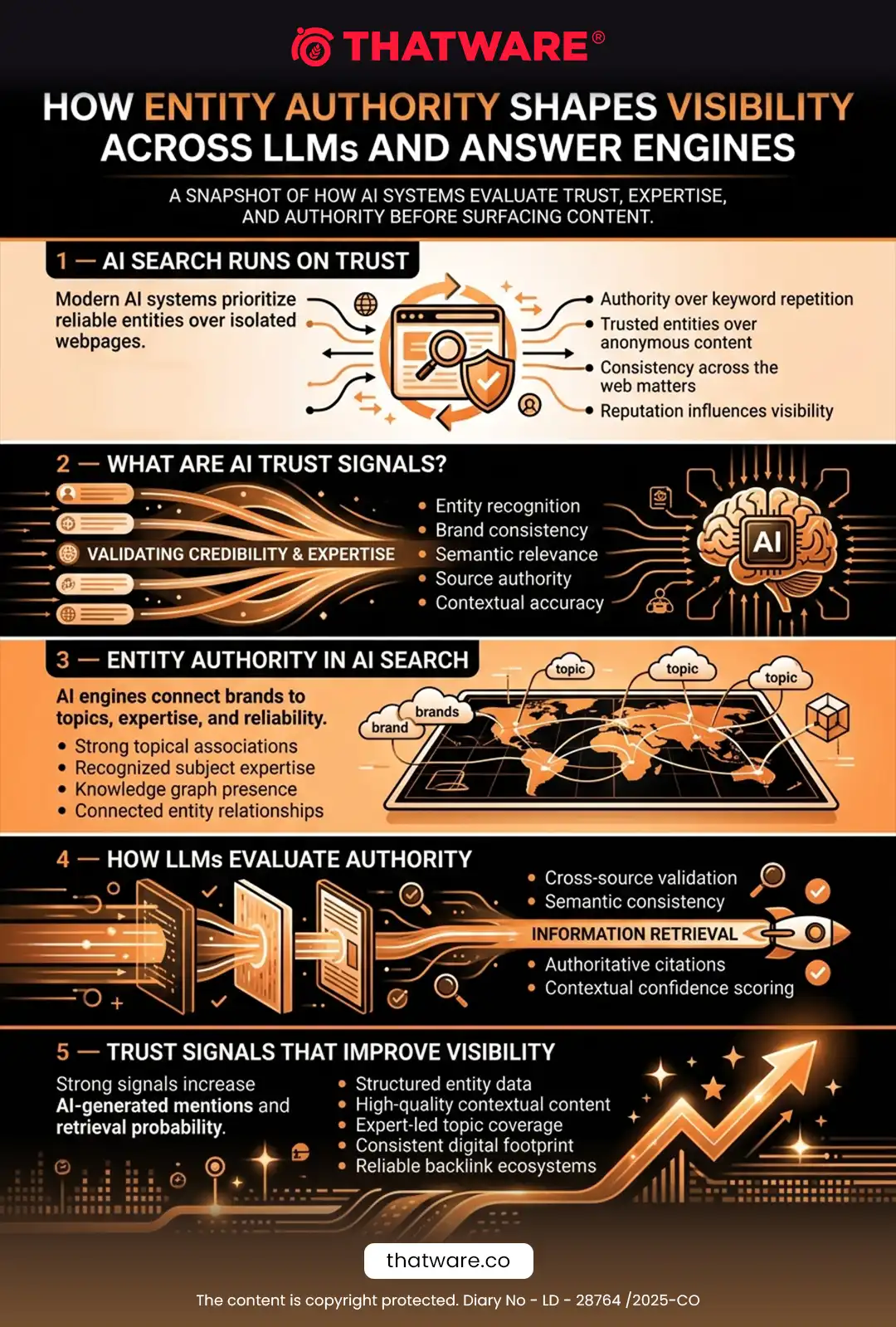
High-trust assets should receive:
· higher retrieval priority
· stronger citation preference
· stronger contextual weighting
Example:
{
“retrievalTrust”: 0.96
}
19. Citation Trust Signals
AI systems increasingly prefer:
· citable content
· authoritative sources
· verifiable evidence
· canonical references
The trust framework should identify:
· preferred citations
· verified sources
· high-confidence assets
20. Freshness Validation
Trust changes over time.
Outdated content may become unreliable.
Suggested freshness decay:
| Age | Trust Adjustment |
| < 3 months | none |
| 3–6 months | -2% |
| 6–12 months | -5% |
| >12 months | -10% |
21. Trust Propagation
Trust can propagate through relationships.
Example:
ThatWare
→ GEO
→ AI SEO
→ LLM Optimization
If the parent entity has strong trust, related entities may inherit partial trust.
22. External Verification Systems
External validation strengthens trust.
Examples:
· industry mentions
· academic references
· conference presentations
· research citations
· client testimonials
· independent reviews
23. Relationship With E-E-A-T
This file strongly aligns with:
Experience
Expertise
Authoritativeness
Trustworthiness
But in machine-readable form.
24. Hallucination Prevention
Hallucinations decrease when:
· trusted evidence exists
· provenance is clear
· retrieval confidence is strong
· semantic grounding exists
Trust systems directly improve grounding.
25. Relationship With AI Agents
Future AI agents may:
· validate sources
· compare trust systems
· prioritize authoritative entities
· evaluate provenance
· avoid low-confidence sources
trust-signals.json supports this future.
26. Relationship With AI Search Engines
AI search engines increasingly prioritize:
· reliable sources
· factual consistency
· semantic authority
· verified provenance
Trust signals strengthen all four.
27. Relationship With GEO
This file is one of the most important GEO assets.
Because future AI visibility may increasingly depend on:
· semantic trust
· provenance
· evidence quality
· factual reliability
· retrieval confidence
· citation safety
Not merely:
· backlinks
· keyword rankings
28. Common Mistakes
Mistake 1: Unsupported Trust Claims
Every trust claim should include evidence.
Mistake 2: Inflated Trust Scores
Unrealistic trust damages credibility.
Mistake 3: Weak Provenance
AI systems need traceable origins.
Mistake 4: No Freshness Logic
Outdated content weakens trust.
Mistake 5: No Retrieval Alignment
Trust should influence retrieval.
Mistake 6: No Semantic Consistency
Inconsistent terminology weakens credibility.
29. Best Practices
29.1 Include Evidence
Every trust signal should be verifiable.
29.2 Maintain Provenance
Track source lineage.
29.3 Use Stable Entity Naming
Consistency strengthens trust.
29.4 Coordinate With Authority Systems
Trust and authority should align.
29.5 Include Freshness Validation
Maintain updated information.
29.6 Support Retrieval Systems
Trust should guide retrieval weighting.
29.7 Prioritize Transparency
Transparency improves machine trust.
30. Enterprise-Level Use Cases
AI Search Engines
Trust-aware answer ranking.
Enterprise AI Systems
Internal verification systems.
Healthcare AI
Medical trust validation.
Financial AI Systems
Regulatory and factual verification.
Research Platforms
Evidence-weighted retrieval.
Autonomous AI Agents
Trust-aware decision systems.
31. Recommended Update Frequency
| Asset | Frequency |
| Trust signals | Monthly |
| Evidence validation | Monthly |
| Provenance review | Quarterly |
| External citations | Monthly |
| Trust scoring | Quarterly |
| Full trust audit | Every 6 months |
32. Full Reusable Prototype JSON Structure
{
“metadata”: {
“fileType”: “trust-signals”,
“version”: “1.0.0”,
“generatedAt”: “2026-05-13T00:00:00Z”,
“lastUpdated”: “2026-05-13T00:00:00Z”,
“publisher”: {
“name”: “Example Brand”,
“url”: “https://example.com”
},
“description”: “Machine-readable semantic trust and credibility framework for AI systems, retrieval engines, and semantic verification infrastructures.”
},
“organizationTrust”: {
“entityId”: “entity:organization:example-brand”,
“overallTrustScore”: 0.94,
“trustClassification”: “highly-trusted”,
“expertiseDomains”: [
“Generative Engine Optimization”,
“AI SEO”,
“LLM Optimization”
],
“retrievalTrust”: 0.95,
“citationTrust”: 0.93,
“semanticConsistency”: 0.96,
“provenanceClarity”: 0.92
},
“trustSignals”: [
{
“signalId”: “trust:expertise”,
“type”: “expertise”,
“description”: “Demonstrated expertise in AI-native SEO and retrieval optimization.”,
“evidence”: [
{
“type”: “research”,
“url”: “https://example.com/research/”
},
{
“type”: “service-page”,
“url”: “https://example.com/ai-seo/”
}
],
“trustWeight”: 0.20,
“confidence”: 0.96
},
{
“signalId”: “trust:case-studies”,
“type”: “evidence”,
“description”: “Verified case studies demonstrating real-world results.”,
“evidence”: [
{
“type”: “case-study”,
“url”: “https://example.com/case-study/”
}
],
“trustWeight”: 0.15,
“confidence”: 0.92
},
{
“signalId”: “trust:external-citations”,
“type”: “authority”,
“description”: “External industry mentions and citations.”,
“evidence”: [
{
“type”: “industry-mention”,
“url”: “https://industry-site.com/example-brand”
}
],
“trustWeight”: 0.20,
“confidence”: 0.89
}
],
“provenance”: {
“canonicalDomain”: “https://example.com”,
“primarySourcePolicy”: “prefer-canonical-pages”,
“trackVersionHistory”: true,
“maintainCitationLineage”: true,
“sourceVerification”: {
“enabled”: true,
“minimumTrustThreshold”: 0.75
}
},
“retrievalTrust”: {
“preferHighTrustSources”: true,
“minimumRetrievalTrust”: 0.70,
“prioritizeCanonicalDefinitions”: true,
“avoidLowConfidenceSources”: true
},
“semanticConsistency”: {
“enforceCanonicalEntityNames”: true,
“maintainTopicConsistency”: true,
“avoidTerminologyConflicts”: true
},
“freshnessValidation”: {
“enabled”: true,
“decayAfterMonths”: 12,
“decayPercentage”: 0.05
},
“trustPropagation”: {
“specializesIn”: 0.90,
“relatedTo”: 0.60,
“supports”: 0.50,
“mentions”: 0.20
},
“citationTrust”: {
“preferVerifiedSources”: true,
“preferCanonicalCitations”: true,
“minimumCitationTrust”: 0.80
},
“governance”: {
“allowCitation”: true,
“allowRetrieval”: true,
“allowEmbedding”: true,
“requireAttribution”: true
},
“maintenance”: {
“maintainedBy”: “AI Trust Team”,
“reviewFrequency”: “monthly”,
“lastReviewed”: “2026-05-13”,
“nextReview”: “2026-06-13”
}
}
33. ThatWare-Specific Strategic Direction
For ThatWare, trust systems should strongly reinforce:
Generative Engine Optimization
AI SEO
LLM Optimization
Semantic SEO
Entity SEO
Knowledge Graph Optimization
Recommended trust priorities:
Research Depth
→ Semantic Consistency
→ Retrieval Quality
→ Evidence-Based Methodologies
→ AI Infrastructure Transparency
→ Case Study Validation
→ Canonical Citation Systems
ThatWare should optimize trust around:
· semantic expertise
· AI-native methodologies
· technical authority
· evidence-backed systems
· transparent semantic infrastructure
The goal is not merely appearing in AI answers.
The goal is:
Becoming a semantically trusted AI-native authority source.
34. Final Strategic Summary
trust-signals.json should be treated as the semantic credibility engine of an AI-optimized website.
It defines:
· why the website should be trusted
· what evidence supports authority
· how provenance should be verified
· how retrieval trust should function
· how AI systems should score reliability
· how semantic consistency should be maintained
· how citations should be validated
· how grounding should be strengthened
For GEO and AI-native search infrastructure, this file can become one of the most foundational trust orchestration systems in the entire architecture.
A properly designed trust-signals.json transforms a website from merely authoritative into being semantically trustworthy, provenance-verified, retrieval-safe, evidence-grounded, and AI-confidence optimized.