
SUPERCHARGE YOUR ONLINE VISIBILITY! CONTACT US AND LET’S ACHIEVE EXCELLENCE TOGETHER!
The Great Algorithm Illusion
Most businesses today live under a quiet, unspoken rule: stay updated or fall behind.
A platform rolls out a new ranking change. A marketplace tweaks its recommendation engine. An ad network shifts what it rewards. And instantly, teams scramble—rewriting content, reworking funnels, rebuilding models, “fixing” what was working yesterday. The belief is almost universal:
Success comes from keeping up with algorithm changes.

It sounds practical. It even feels responsible. But it hides a deeper problem—one that’s becoming more expensive with every passing update.
The Reaction Trap Nobody Talks About
When you build growth, visibility, or performance on top of someone else’s algorithm, you don’t own the rules—you rent them. And rented rules can change overnight.
That’s why most businesses are stuck in reaction cycles:
- You optimize to match what the algorithm rewards today
- The algorithm evolves
- Your performance drops
- You scramble to catch up
- You repeat the cycle—forever
This isn’t strategy. It’s survival.
And in the AI era, this survival mindset becomes dangerous, because algorithms are no longer simple formulas—they’re adaptive systems evolving faster than most teams can respond. The more you chase them, the more you fall behind.
The Truth: Algorithms Were Never Meant to Lead You
Here’s the illusion: we treat algorithms like authorities.
But algorithms were not created to dictate what your business should be. They were designed to do one thing well:
Optimize systems.
Search algorithms optimize for relevance and satisfaction. Recommendation engines optimize for engagement and retention. Ad algorithms optimize for click-through and conversion probability. AI models optimize for pattern completion.
They are not “leaders.” They are optimizers.
Yet businesses keep handing them the steering wheel—designing their strategy around what the algorithm seems to want, rather than designing systems that naturally win regardless of updates.
The Thesis: The Winners Will Not Be the Best Reactors
The next decade of AI will not reward the fastest followers. It will reward the strongest architects.
Because the future of AI belongs to organizations that build intelligence systems so powerful, so coherent, and so signal-rich that algorithms must adapt to them—not the other way around.
This is the shift:
- From chasing rules → to shaping conditions
- From algorithm compliance → to algorithm influence
- From tactical tweaks → to strategic architecture
In a world where everything is algorithm-driven, the real advantage is not learning how to obey algorithms. It’s learning how to build systems that make algorithms respond to you.
ThatWare’s Philosophy: Not a Tactic—A Paradigm Shift
This is where ThatWare stands apart.
While others react to algorithms, ThatWare operates from a different assumption: algorithms are not the environment. They’re part of the environment. And environments can be designed.
ThatWare doesn’t treat algorithm updates as threats to dodge—it treats them as signals to outgrow. The goal isn’t to “beat” an algorithm this month. The goal is to architect intelligence—data, systems, workflows, decision loops—so robust that platforms, search engines, and models naturally reward the outcomes.
Because when your systems generate stronger signals than the noise around you, algorithms don’t punish you.
They recalibrate around you.
Others react to algorithms. ThatWare designs futures where algorithms must adapt to ThatWare.
And that isn’t a slogan. It’s a blueprint for how AI-powered businesses will win.
The Era of Algorithm Obedience (And Why It’s Ending)
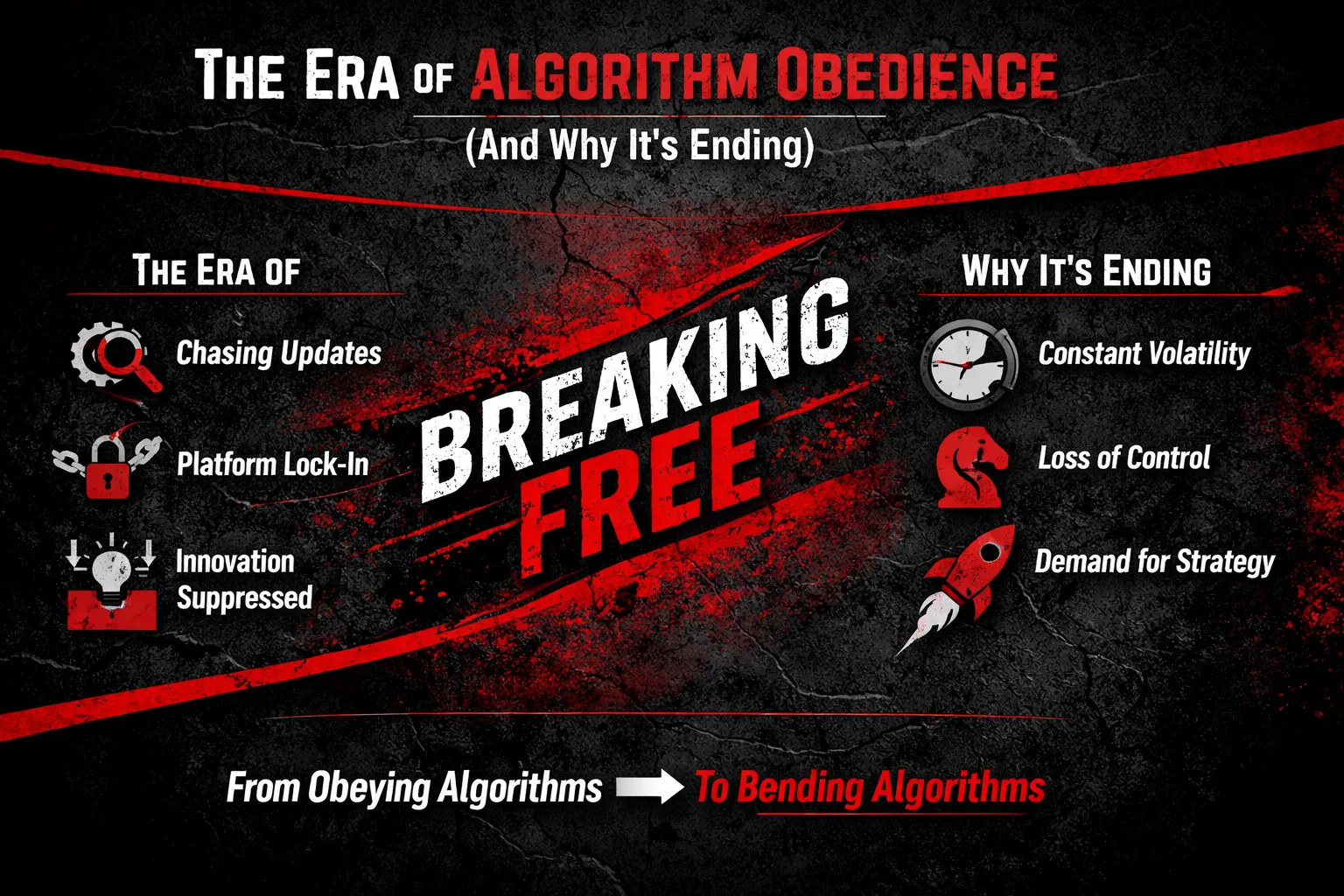
For the last decade, most businesses have treated algorithms like weather—something to monitor, predict, and survive. A Google update rolls out, a social platform tweaks reach, an ad network changes attribution, an AI model gets a new policy layer—and teams scramble.
This “adapt fast” mindset became normal. But it also created a quiet trap: when your growth strategy is built on algorithm compliance, your business becomes structurally fragile. You can win quarters that way. You rarely win decades.
The era of algorithm obedience is ending because the rules have changed. Algorithms are no longer limited to search rankings or feed distribution—they’re now embedded into how products are discovered, how content is evaluated, how ads are priced, how decisions are automated, and how customers are served. The more algorithmic the world becomes, the more dangerous it is to build companies that only react.
How Businesses Became Algorithm-Dependent
Algorithm dependence didn’t happen overnight. It happened gradually, then suddenly—through convenience, incentives, and the false comfort of “best practices.”
SEO created the first obedience loop.
Search engines became gatekeepers of attention. Rankings turned into revenue, and revenue turned into obsession. Businesses learned to ask: What does the algorithm want? Instead of: What does the customer need and what system should we build to deliver it at scale?
Recommendation engines deepened the dependency.
From YouTube to e-commerce to app stores, recommendation algorithms started deciding what gets surfaced—and what stays invisible. If you weren’t “algorithm-friendly,” you were buried. Companies began optimizing thumbnails, hooks, frequency, and engagement metrics—not because it aligned with their strategy, but because the system rewarded it.
Ad platforms turned compliance into a budget line.
Advertising networks evolved from simple bidding systems into opaque optimization machines. The cost of acquisition became tied to platform decisions: who sees your ad, how your conversion is attributed, what audiences are expanded, what campaigns are throttled. Businesses didn’t just buy ads—they bought dependency.
AI APIs added a new layer of outsourced intelligence.
Now, companies don’t only rely on platforms for distribution—they rely on them for decision-making. They build workflows on third-party models, tune prompts around updated behavior, and accept constraints that silently shift. When your “intelligence layer” lives outside your architecture, you don’t control your roadmap—you negotiate it.
And then came the cultural glue holding it all together: best practices.
“Best practices” sound safe. They feel proven. But in algorithmic ecosystems, they often become compliance rituals:
- Copy what works for others
- Follow the checklist
- Optimize for what gets rewarded
- Repeat until the next update breaks it
That culture produces quick wins. It also produces brittle businesses.
Short-term wins, long-term fragility is the trade most companies don’t realize they’re making.
The Hidden Cost of Obedience
Obedience looks like optimization. But underneath, it carries costs that compound quietly.
Constant rework and volatility
When you build around external rules, your growth becomes a moving target. Every change forces a response:
- New ranking factors → rewrite content strategy
- New ad policies → rebuild campaigns
- New platform formats → restructure production
- New AI behaviors → re-test workflows
Teams become busy, not strategic. You’re not building compounding assets—you’re patching holes in a ship you don’t own.
Platform lock-in
The more you optimize for a specific algorithm, the more you become shaped by it. Your customer acquisition, content style, product experience, even brand voice begins to mirror what the platform rewards.
Over time, leaving becomes expensive:
- Your traffic disappears if you stop playing the SEO game
- Your leads collapse if ad performance drops
- Your visibility shrinks if platform reach changes
- Your operations suffer if your AI provider shifts behavior or pricing
What started as “growth leverage” becomes a dependency chain.
Loss of strategic autonomy
This is the most dangerous cost. When algorithms become the reference point, strategy becomes reactive:
- Roadmaps follow platform trends
- Product decisions follow discoverability constraints
- Marketing becomes performance chasing
- Innovation becomes risk avoidance
You stop asking, What future are we building?
You start asking, What’s the algorithm doing this month?
That is not strategy. That is survival.
Innovation suppression
The most innovative ideas often look “inefficient” to algorithms at first. They don’t match patterns. They don’t fit templates. They don’t produce the immediate metrics the system rewards.
When companies become obedience-driven, they naturally suppress these ideas:
- They choose safer formats over new narratives
- They replicate winners instead of inventing categories
- They optimize for engagement instead of impact
- They ship what’s measurable, not what’s meaningful
Obedience doesn’t just slow innovation. It trains organizations to fear it.
Algorithm Obedience Is a Maturity Problem
Here’s the uncomfortable truth: algorithm obedience isn’t just a marketing issue—it’s an organizational maturity issue.
Early-stage companies should follow rules to survive. They don’t have the leverage, data, or infrastructure to shape ecosystems. They need traction. They need proof. They need to learn.
But staying in that mode forever is a sign of stagnation.
Early-stage companies follow rules. Mature systems define constraints.
Mature organizations don’t treat algorithms as bosses. They treat them as environments. They don’t ask, How do we comply? They ask:
- How do we build systems that create unavoidable value?
- How do we produce signals the ecosystem must recognize?
- How do we design architectures that outlast updates?
In mature systems:
- Strategy leads; algorithms follow
- Architecture compounds; tactics rotate
- Value creation drives distribution, not the other way around
And that leads to the key distinction:
Obedience ≠ intelligence.
Intelligence is not the ability to follow changing rules quickly.
Intelligence is the ability to design systems that make rules less threatening.
The era of algorithm obedience is ending because it cannot scale into the future. As algorithms expand into every layer of business—from discovery to decisions—companies that only react will get trapped in permanent adaptation.
The winners will be different. They won’t be the best at obedience.
They’ll be the best at designing futures where algorithms must adapt to them.
Algorithms Are Not Authorities—They Are Adaptive Systems
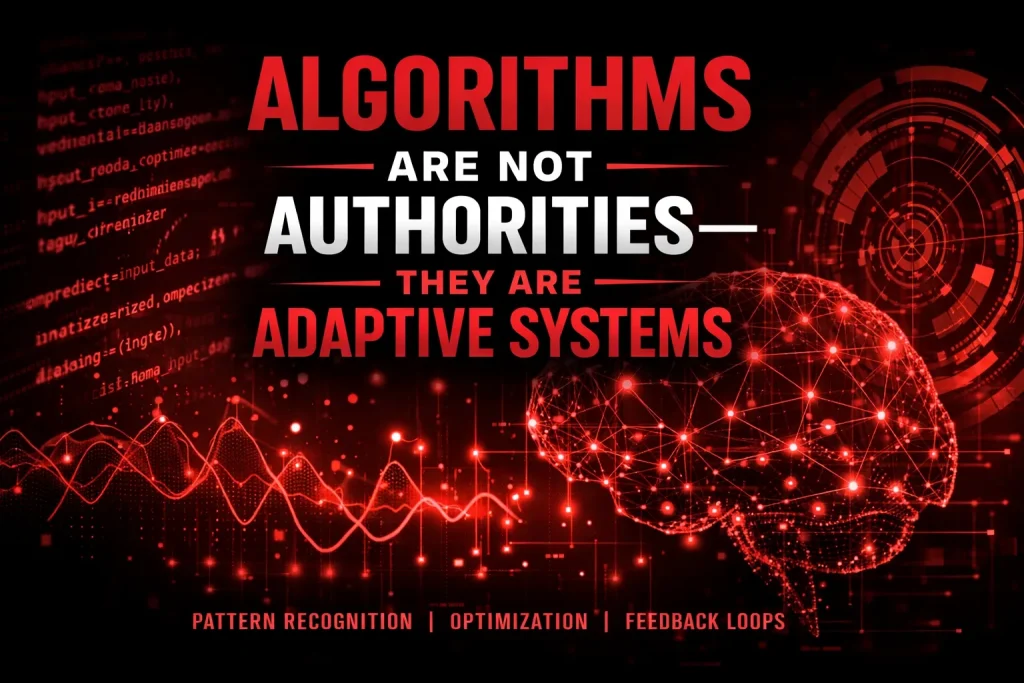
For many businesses, algorithms have taken on an almost mythical authority. A Google update drops, a model version changes, a recommendation system shifts—and strategy collapses into reaction. This mindset gives algorithms psychological dominance they were never designed to have.
The truth is far less intimidating and far more empowering: algorithms are not decision-makers or rulers. They are adaptive systems built to respond to signals.
Understanding this distinction is the first step toward reclaiming strategic control.
What Algorithms Actually Do
At their core, algorithms are mechanical learners, not thinkers.
They operate through three fundamental functions:
- Pattern recognition – Identifying recurring relationships in data
- Optimization – Maximizing or minimizing predefined objectives
- Feedback loops – Continuously adjusting outputs based on observed results
Algorithms do not understand why something matters. They do not interpret intent, ambition, or brand vision. They simply observe what works repeatedly and at scale, then reinforce it.
This is a critical distinction:
Algorithms respond to systemic signals, not human intent.
You can want visibility, trust, or dominance—but unless those desires are translated into consistent, measurable signals, algorithms remain indifferent. They don’t reward effort; they reward structure.
Why Algorithms Adapt to Strong Systems
Algorithms are designed to optimize environments, not dictate them. When they encounter a well-constructed system, they don’t resist it—they adapt to it.
Strong systems share common characteristics that algorithms naturally favor:
- Consistency – Stable patterns over time
- Scale – Repeated signals across breadth and depth
- Structure – Clear relationships between entities, actions, and outcomes
- Signal clarity – Low noise, high relevance
Because of this, algorithms optimize for three fundamental outcomes:
- User satisfaction – Does the system reliably meet real user needs?
- Predictability – Can outcomes be anticipated based on prior signals?
- System efficiency – Does prioritizing this system reduce friction and uncertainty?
When a company builds intelligence architectures that consistently satisfy these conditions, algorithms don’t “judge” them—they recalibrate around them.
This is why dominant platforms, authoritative brands, and deeply integrated systems continue to perform well regardless of surface-level algorithm changes. The algorithm adjusts because the system is too coherent to ignore.
The Misunderstood Power Dynamic
Most organizations misunderstand where power truly lies.
- Weak systems chase algorithms
- They react to updates
- They optimize fragments instead of foundations
- They depend on external rules to survive
- Strong systems shape algorithmic behavior
- They emit stable, high-quality signals
- They control feedback loops
- They set new baselines for optimization
Algorithms are not attracted to effort, urgency, or clever tricks. They are attracted to gravity.
Algorithms follow gravity, not noise.
Noise is frantic optimization—constant changes, short-lived tactics, reactive adjustments. Gravity is structural intelligence—systems so stable and valuable that algorithms orbit them naturally.
When organizations stop treating algorithms as authorities and start designing systems worthy of adaptation, the power dynamic flips. Algorithms move from being threats to becoming amplifiers.
And that shift—from obedience to architectural dominance—is where the future of AI truly begins.
Bending Algorithms vs. Gaming Algorithms
Why ethical dominance outlasts manipulation
As algorithms grow more complex and adaptive, the line between influence and manipulation becomes critical. Many organizations still attempt to game algorithms—search engines, recommendation systems, ad platforms—believing clever hacks can outpace machine intelligence. But history consistently shows otherwise.
The future belongs to companies that bend algorithms ethically, not those that attempt to exploit them temporarily.
What “Bending” Algorithms Really Means
Bending algorithms does not mean tricking them. It means outgrowing them.
At its core, bending algorithms is about architectural strength—designing systems so coherent, intelligent, and signal-rich that algorithms naturally align with them.
This happens in two key ways:
1. Designing architectures that influence outcomes organically
Algorithms are reactive by nature. They optimize based on the inputs they observe: behavior, consistency, engagement patterns, authority signals, and systemic reliability. When a company builds robust intelligence architectures—AI-driven decision layers, cohesive content ecosystems, adaptive user experiences—the algorithm doesn’t need to be convinced. It simply responds.
In this model:
- Outcomes are emergent, not forced
- Optimization is continuous, not reactive
- Influence is a byproduct of system quality
2. Creating environments algorithms naturally prioritize
Algorithms prioritize environments that reduce uncertainty and maximize value for users. Strong systems create:
- Predictable high-quality signals
- Clear intent and contextual depth
- Reinforcing feedback loops
When these conditions exist, algorithms adapt automatically. Rankings stabilize. Recommendations improve. Visibility compounds. The system becomes algorithmically “comfortable.”
That is bending—shaping the environment, not fighting the rules.
Why Gaming Always Fails
Gaming algorithms may feel effective in the short term, but it is fundamentally a losing strategy.
Short-term loopholes
Gaming relies on exploiting temporary blind spots—keyword stuffing, engagement tricks, artificial signals, or brittle automation. These tactics may work briefly, but they leave fingerprints.
Algorithms evolve specifically to close these gaps.
Long-term penalties
What begins as a ranking boost often ends in:
- Suppressed visibility
- Trust degradation
- Manual or algorithmic penalties
- Loss of system credibility
Once trust is broken, recovery becomes exponentially harder.
Escalating complexity
Each exploit increases operational complexity. Teams spend more time:
- Monitoring updates
- Fixing breakages
- Rewriting systems
The organization becomes reactive, fragile, and dependent. Gaming creates algorithmic debt—and the interest compounds fast.
Sustainable Algorithm Influence
True, long-term dominance comes from sustainable influence, not clever tricks. This influence rests on three pillars:
1. Structural superiority
Algorithms adapt to systems that demonstrate scale, coherence, and durability. Structural superiority means:
- Modular, future-proof architectures
- Intelligence embedded across layers
- Consistency across signals and outcomes
When structure is strong, algorithms adjust around it.
2. Signal orchestration
Instead of chasing individual metrics, advanced systems orchestrate signals:
- Behavioral signals reinforce content signals
- Content signals reinforce authority signals
- Authority signals reinforce trust signals
The result is compounded algorithmic confidence.
3. Feedback dominance
Algorithms learn from feedback. Systems that control feedback loops—user behavior, engagement patterns, satisfaction signals—control how algorithms learn.
This is the highest form of influence:
- Algorithms don’t just rank or recommend
- They learn in your favor over time
The Core Difference
Gaming algorithms tries to outsmart them. Bending algorithms makes them irrelevant as obstacles.
One approach is fragile and temporary. The other is strategic, ethical, and inevitable.
This is why others react to algorithms— and why ThatWare designs futures where algorithms must adapt to ThatWare.
The Architectural Advantage: Systems That Algorithms Must Respect
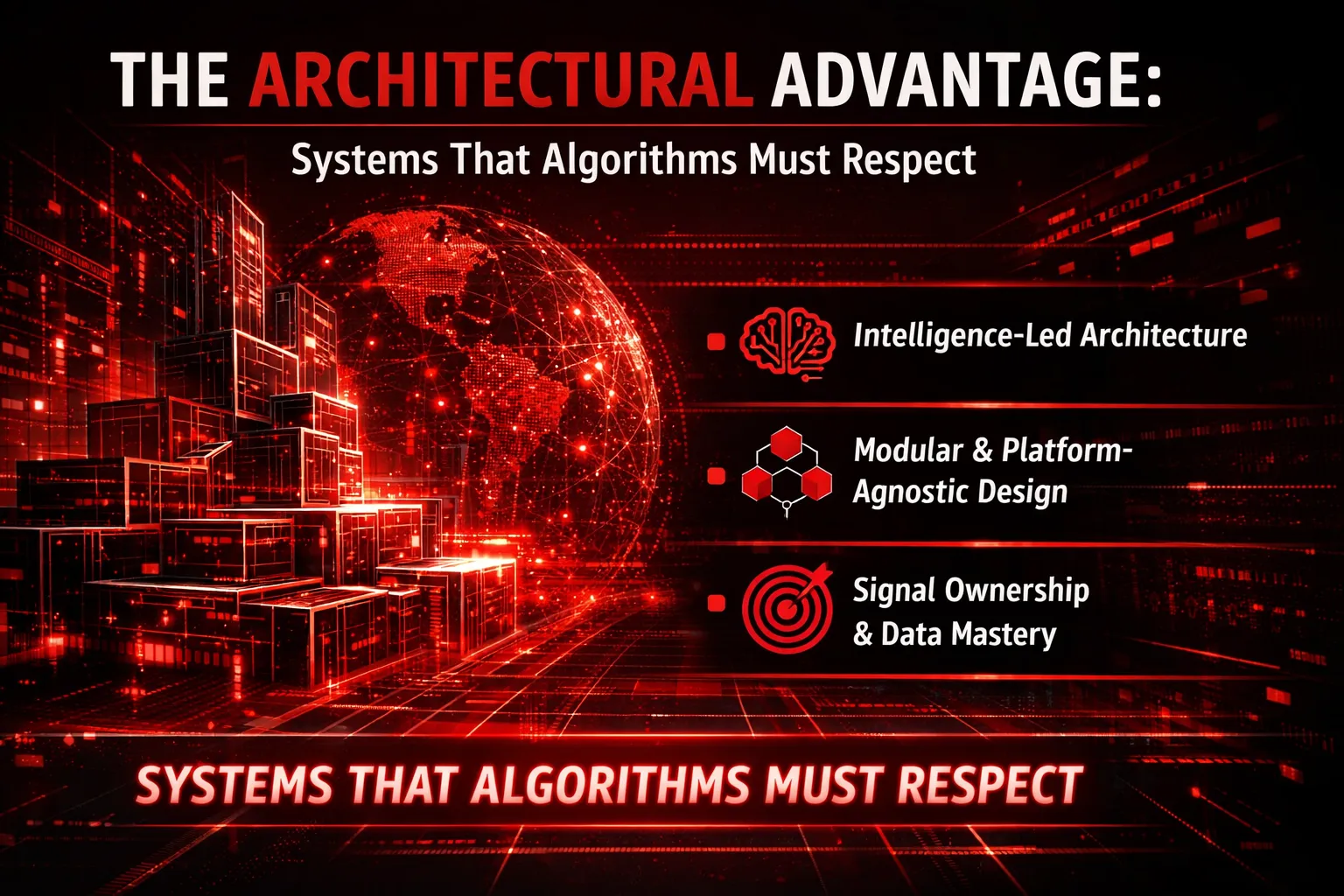
The real advantage in the age of AI is no longer about reacting faster to algorithm updates—it’s about building architectures so intelligent, coherent, and self-evolving that algorithms have no choice but to accommodate them. This is what separates short-term optimization from long-term dominance.
Algorithms are adaptive by nature. They respond to structure, consistency, and signal integrity. When an organization designs its systems at an architectural level—rather than at a tactical or tool-based level—it creates a gravity field that algorithms must respect. This is the foundation of algorithm-adaptive architecture.
Intelligence-Led Architecture
At the core of algorithm-adaptive systems lies intelligence-first design. Instead of bolting AI onto existing workflows, intelligence becomes the decision-making backbone of the organization.
AI-first decision frameworks replace static rule sets and manual guesswork. Decisions are informed by real-time data, predictive modeling, and adaptive logic. This allows systems to respond dynamically to changing conditions rather than relying on predefined reactions. Algorithms, in turn, begin to align with these consistently optimized outcomes.
Self-learning feedback loops ensure that every interaction, outcome, and deviation feeds back into the system. Performance is not measured once—it is continuously evaluated, learned from, and refined. Over time, this creates a compounding intelligence effect where the system improves autonomously, reducing reliance on external algorithm changes.
Layered on top of this are continuous optimization layers. These layers monitor signals, behaviors, and results across the ecosystem, fine-tuning outputs without disrupting the core architecture. Instead of rebuilding strategies after every algorithm update, the system adapts internally—often before the algorithm finishes recalibrating.
The result is not just resilience, but superiority. Algorithms respond best to systems that demonstrate clarity, consistency, and learning velocity—and intelligence-led architectures deliver all three.
Modular, Platform-Agnostic Design
One of the most common strategic failures in AI adoption is platform dependence. When intelligence is tightly coupled to specific tools, APIs, or ecosystems, every external change becomes a risk.
Modular, platform-agnostic design breaks this dependency. Intelligence is separated from execution layers, allowing systems to evolve independently of platforms. Whether it’s a search engine update, a change in AI model behavior, or a shift in distribution channels, the core intelligence remains intact.
By decoupling intelligence from platforms, organizations retain control over how decisions are made, how learning occurs, and how outcomes are optimized. Platforms become interchangeable execution environments—not strategic authorities.
This architectural choice is the key to future-proofing against updates. While others scramble to refactor their systems after every change, modular architectures absorb disruption with minimal friction. Algorithms adjust to these systems because they continue to emit strong, coherent signals regardless of external shifts.
In essence, platform-agnostic intelligence turns volatility into a non-event.
Signal Ownership Over Signal Chasing
Algorithms do not reward effort—they reward signal quality. And the strongest signal always comes from ownership.
First-party data dominance is the cornerstone of algorithm-adaptive systems. When organizations rely on their own data—behavioral patterns, contextual insights, and historical intelligence—they stop guessing what algorithms want and start shaping what algorithms see.
Beyond raw data lies behavioral intelligence: understanding why users act, not just what they do. Algorithms increasingly prioritize systems that demonstrate deep user understanding, consistent engagement patterns, and meaningful outcomes. Behavioral intelligence transforms interactions into durable signals algorithms trust.
This leads to contextual depth over surface metrics. Clicks, impressions, and short-term engagement are shallow indicators. Context—intent, relevance, continuity, and experience—is what modern algorithms optimize for. Systems designed around contextual intelligence naturally outperform those chasing isolated metrics.
When organizations own their signals instead of chasing algorithmic cues, they invert the power dynamic. Algorithms stop dictating behavior and begin responding to it.
Architectural advantage is not about outsmarting algorithms—it’s about outgrowing them.
When intelligence is embedded into the architecture itself, algorithms don’t need to be manipulated or anticipated. They adapt—because they must.
From Reaction to Command: The ThatWare Philosophy

Most organizations today operate in a permanent state of response. An update rolls out, a ranking shifts, a model behavior changes—and teams scramble. This cycle has become so normalized that reacting to algorithms is often mistaken for strategic agility. In reality, it is a sign of structural dependence.
ThatWare’s philosophy begins by rejecting this default posture. The goal is not to keep up with algorithms, but to move beyond being governed by them.
Others React to Algorithms
Reaction-based organizations build their strategies around external triggers. Their operating rhythm is dictated by change logs, updates, and platform announcements.
This manifests in three common ways:
- Update-driven strategies
Roadmaps are rewritten around algorithm changes rather than business objectives. Each update becomes a reset point, forcing constant tactical shifts without cumulative advantage.
- Patchwork solutions
Instead of cohesive systems, layers of fixes are added over time—new tools, new rules, new workarounds. These patches may work temporarily but create fragile, overcomplicated ecosystems.
- Tactical dependence
Success becomes tied to knowing the “latest trick” rather than building enduring capability. When the tactic stops working, performance collapses with it.
In this model, algorithms lead and businesses follow. Control is external, not internal.
ThatWare Designs Futures
ThatWare takes a fundamentally different approach—one that starts with intelligence, not compliance.
Rather than asking “How do we adapt to this algorithm?”, the question becomes “What system do we need to build so outcomes remain stable regardless of algorithmic change?”
This shift is anchored in three principles:
- Intelligence-first systems
Decisions are guided by learning architectures that evolve continuously. Intelligence is embedded at the system level, not bolted on as a feature.
- Outcome-driven engineering
Engineering effort is measured by strategic results, not platform alignment. Systems are designed backward from long-term objectives, not forward from current constraints.
- Strategic foresight
Instead of reacting to visible changes, ThatWare designs for inevitable ones. Architectures are built with the assumption that algorithms will change—and that the system must remain dominant anyway.
The result is not faster reaction, but reduced need to react at all.
Algorithms Must Adapt to ThatWare
When intelligence architectures are strong enough, a reversal occurs. Algorithms stop acting as governors and start acting as respondents.
This happens through:
- Systems that set new baselines
Consistent signals, coherent behavior patterns, and structural clarity create a level of reliability algorithms must account for. The system becomes a reference point, not a variable.
- Architecture that forces recalibration
Well-designed systems change the data landscape algorithms learn from. To optimize correctly, algorithms must adjust to the system’s gravity rather than trying to override it.
- Long-term dominance over short-term compliance
Temporary alignment is replaced with durable advantage. Instead of chasing every change, the system compounds value over time—while reactive competitors reset repeatedly.
This is not about defying algorithms. It is about designing intelligence so mature, consistent, and strategically aligned that algorithms have no choice but to adapt.
At its core, the ThatWare philosophy represents a power shift:
- from reaction to command,
- from compliance to architecture,
- from following algorithms to shaping the environments they operate in.
Others react to algorithms. ThatWare designs futures where algorithms must adapt to ThatWare.
Real-World Scenarios: Where Algorithm Bending Wins

“Bending algorithms” sounds abstract until you see it in the wild. The difference is simple:
- Obedience = chasing what the algorithm currently rewards.
- Bending = building a system that produces such clear, consistent, high-quality signals that the algorithm has to reward you—because that’s how it stays useful.
Below are three scenarios where this plays out decisively.
Search & Discovery Ecosystems
Search engines don’t “love keywords.” They love clarity. They reward environments where they can confidently identify expertise, relevance, and satisfaction—at scale. That’s why algorithm bending wins in search: you stop feeding the machine tricks and start feeding it structure.
Why authoritative content clusters outperform keyword hacks
Keyword hacks are brittle. They rely on surface matching—thin pages, repeated phrases, quick edits after every update. They might spike, but they rarely stay.
Authoritative content clusters work because they generate a dense network of meaning:
- A pillar page defines the core topic.
- Supporting pieces answer the natural next questions.
- Internal links create a map of expertise.
- Consistency in language, intent, and depth reduces ambiguity.
From a search engine’s perspective, this is gold. It doesn’t just see “a page about X.” It sees a system that understands X—and that’s much easier to rank reliably.
If keyword hacks are bait, clusters are gravity.
How engines adapt to topical gravity
Topical gravity is what happens when your site becomes the obvious “home” for a subject. Not because you claimed it, but because the signals stack up over time:
- People land and don’t bounce.
- They click deeper.
- They return.
- Other sites reference you naturally.
- Your internal structure proves coherence.
Search engines are designed to optimize user outcomes. When a property repeatedly produces strong outcomes for a topic, the engine begins to trust it as a default choice—even when the algorithm changes.
That’s algorithm bending: you don’t chase each ranking factor. You build the kind of ecosystem that ranking factors are trying to find.
AI Products & SaaS Platforms
In AI products, algorithms aren’t just “out there” on search engines or social feeds. They’re inside your product too—recommendation systems, ranking models, “smart” suggestions, personalization layers.
Most teams treat these like features. The winners treat them like systems that can be trained.
Adaptive UX that trains recommendation systems
A recommendation engine can only recommend what it learns—and it learns from what users do. That means UX is not just design; it’s signal engineering.
Algorithm-obedient teams ask:
- “What does the recommender want?”
Algorithm-bending teams ask:
- “How do we shape user behavior so the recommender learns the right truth?”
Examples of adaptive UX moves that bend the system:
- Guiding onboarding flows to create clean preference signals early
- Structuring choices so users reveal intent (instead of random clicks)
- Using progressive disclosure to reduce noisy actions
- Making “good actions” easier than “ambiguous actions”
Over time, your product doesn’t just work with the recommendation engine—it conditions it. The algorithm adapts to your system’s clarity.
Usage patterns that redefine ranking signals
Here’s the real leverage: platforms rank what keeps users engaged and satisfied. If your product or content generates repeatable patterns—high retention, deep interaction, meaningful completion—the algorithm takes the hint.
You’re no longer optimizing for the platform’s ranking logic. You’re producing such strong performance signals that the platform’s logic has no choice but to elevate you.
This is why two products with similar features get wildly different outcomes:
- One produces noisy engagement.
- The other produces consistent value signals.
Algorithms don’t reward effort. They reward measurable outcomes.
Bending wins when you design the outcomes into the system.
Enterprise AI & Automation
In enterprise environments, algorithm bending looks less like “ranking” and more like control: control over decisions, workflows, and system behavior. The goal isn’t to impress an algorithm. It’s to ensure the algorithm aligns with the business.
Internal intelligence shaping external algorithmic interactions
Enterprises don’t just use algorithms—they interact with them continuously:
- Ad platforms
- Fraud models
- Credit scoring systems
- Procurement optimization engines
- Supply chain forecasting tools
- Customer support triage and routing models
When internal intelligence is weak, these interactions become reactive:
- Costs spike unpredictably
- Performance swings after model updates
- Teams scramble to “tune” settings
When internal intelligence is strong, the enterprise sets the terms:
- You decide what signals matter
- You standardize inputs
- You enforce data quality
- You create governance that prevents drift
In other words: you stop letting external systems dictate your operational reality.
ThatWare-style thinking here is: make your internal system so coherent that external algorithms become predictable.
Feedback-controlled decision pipelines
Most enterprise automation fails for one reason: it’s static. The world changes, but the pipeline doesn’t. So models drift, edge cases multiply, and trust collapses.
Feedback-controlled pipelines bend algorithms by making them self-correcting:
- Every decision produces an outcome signal (good/bad/unknown)
- Outcomes are monitored continuously
- Errors feed back into retraining, rule adjustment, or human review
- Thresholds evolve based on observed risk and business goals
This creates an architecture where the algorithm is not “in charge.” It’s a component inside a controlled system.
And controlled systems don’t fear algorithm change—they absorb it.
That’s the difference between automation and intelligence.
The Pattern Across All Three Scenarios
Whether it’s search engines, recommender systems, or enterprise automation, the winners share one trait:
They don’t optimize for the algorithm. They build systems that produce such strong, consistent, interpretable signals that algorithms must optimize for them.
That’s what it means when we say:
Others react to algorithms. ThatWare designs futures where algorithms must adapt to ThatWare.
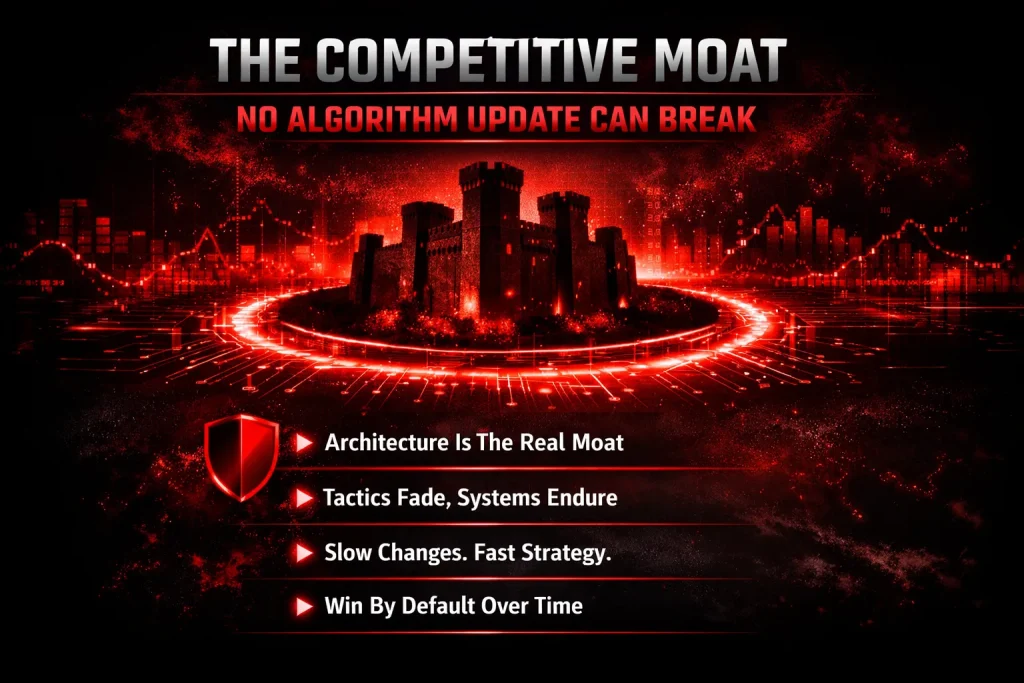
The Competitive Moat No Algorithm Update Can Break
For founders, CXOs, and long-term strategists, the real question is no longer “How do we survive the next algorithm update?” but “Why does every update feel like an existential threat in the first place?”
The uncomfortable truth is this: algorithm updates are not the problem. They are merely symptoms.
They expose fragile architectures, reactive strategies, and businesses built on borrowed intelligence.
Algorithm Updates Are Symptoms, Not Threats
Every major algorithm update—whether in search, recommendation engines, ad platforms, or AI models—follows a predictable pattern. Some companies panic. Rankings drop. Performance fluctuates. Teams scramble to “fix” what broke.
But nothing actually broke.
The update simply revealed which systems were dependent and which were self-sustaining.
Algorithms evolve to improve efficiency, relevance, and trust. When an update disrupts a business, it’s not because the algorithm is hostile—it’s because the business was optimized for a version of the algorithm rather than for the principles the algorithm is trying to reward.
In that sense, updates are diagnostic tools. They don’t create weakness; they surface it.
Architecture Is the Real Moat
True competitive advantage does not live in tactics, tools, or temporary optimizations. It lives in architecture.
Architecture determines:
- How intelligence flows through the organization
- How signals are generated, interpreted, and reinforced
- How systems adapt when external rules change
A well-designed architecture doesn’t need to chase algorithmic behavior. It naturally aligns with it. Algorithms adjust to what is consistent, valuable, and structurally sound.
This is why architecture outlasts every update.
You can change keywords, prompts, ad structures, or model parameters endlessly—but without a strong underlying system, every improvement is temporary. Architecture, on the other hand, compounds. It creates gravity. And algorithms, by design, follow gravity.
How Companies That Bend Algorithms Think Differently
Organizations that bend algorithms don’t look impressive in the short term. They don’t chase every trend. They don’t react to every fluctuation. But over time, they become impossible to displace.
Here’s what sets them apart:
They move slower tactically, faster strategically
They are not distracted by every update or new “best practice.” Instead, they make fewer decisions, but each one reshapes the system. While others sprint from fix to fix, they quietly redesign the playing field.
They invest in systems, not hacks
Hacks create spikes. Systems create curves. These companies prioritize intelligence pipelines, feedback loops, and adaptive frameworks over quick wins. As a result, every improvement strengthens the whole, not just a single metric.
They win by default over time
When your architecture aligns with how algorithms evolve, you don’t need to win every update. You win the trajectory. Algorithms eventually recalibrate around the strongest, most coherent systems—pushing them forward while others fight to recover lost ground.
The Moat Algorithms Can’t Cross
The ultimate moat is not secrecy, speed, or scale. It is structural intelligence.
Algorithms can change rules. They can raise standards. They can eliminate shortcuts.
What they cannot do is penalize systems built on genuine value, clarity, and adaptive design—because those systems are exactly what algorithms are meant to surface.
This is the quiet advantage of companies that bend algorithms instead of obeying them.
They stop fearing change. They stop reacting to noise. And they build futures that updates can’t break.
What the Next Decade of AI Will Reward
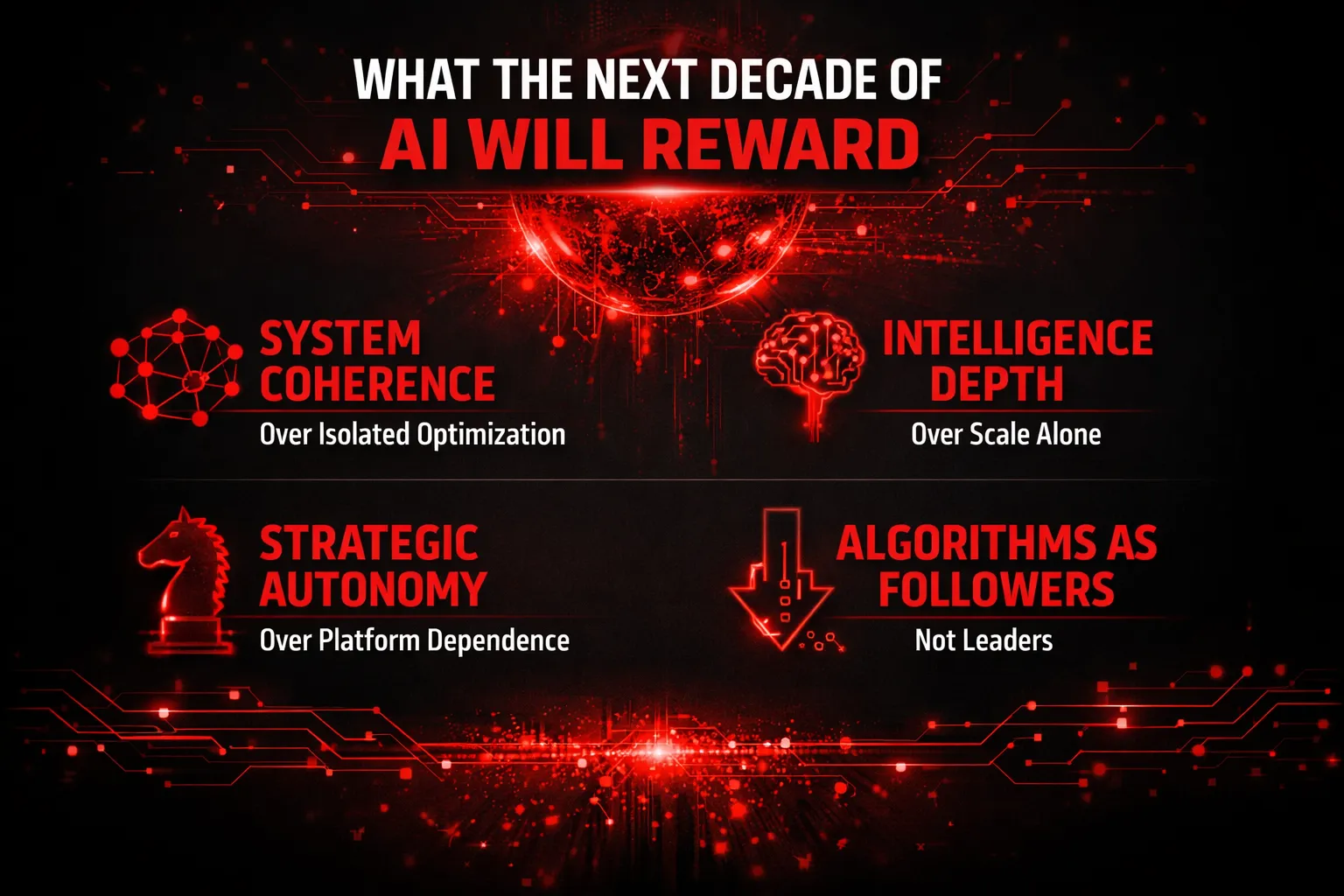
The next decade won’t be won by whoever adds the most AI features or chases the newest model release. It will be won by organizations that treat AI as architecture—not as a tool—and build systems strong enough that algorithms are forced to respond to them.
In other words: the future rewards builders, not followers.
1) System coherence over isolated optimization
Most companies “do AI” the way they do marketing hacks: one initiative at a time. A chatbot here. An analytics model there. A recommendation engine added late. Each piece may work, but the whole system doesn’t compound.
Over the next decade, the biggest winners will look different. They will build coherent intelligence ecosystems where every part strengthens every other part:
- Data collection feeds learning loops
- Learning loops refine decisions
- Decisions improve user outcomes
- User outcomes generate stronger signals
- Stronger signals improve model performance again
That’s not optimization—it’s momentum.
Algorithms increasingly reward consistency and continuity of signals, not scattered spikes. A coherent system produces predictable value. And predictable value is what algorithms stabilize around.
This is why reacting to algorithms fails long-term: reaction creates fragmentation. Coherence creates gravity.
2) Intelligence depth over scale alone
For years, the industry treated AI like a scale race: bigger datasets, bigger models, bigger budgets, bigger compute. That era isn’t over, but it is no longer the only game.
The next decade will reward depth—the quality of understanding—not just volume.
Depth means:
- Knowing why users behave, not just that they behave
- Understanding context, intent, and constraints
- Building decision logic that’s explainable, improvable, and resilient
- Capturing intelligence that can’t be copied just by buying the same tools
Scale is accessible now. Many companies can rent it. But depth is earned—through domain mastery + system design + proprietary learning loops.
And when you have depth, you stop being replaceable.
Because algorithms adapt faster to systems that produce reliable meaning, not random noise.
3) Strategic autonomy over platform dependence
The most dangerous business model in the AI age is this:
“We grow as long as the platform keeps liking us.”
That applies to search engines, social feeds, marketplaces, app stores, ad networks, and even third-party AI platforms. If your core advantage depends on external rules you don’t control, you don’t have a strategy—you have a subscription to luck.
In the next decade, market leaders will be the companies that build strategic autonomy:
- First-party data ownership instead of borrowed reach
- Platform-agnostic intelligence layers instead of platform-specific hacks
- Architecture that can migrate, adapt, and survive updates
- A brand and product experience strong enough to create demand independent of algorithmic favor
Autonomy doesn’t mean ignoring platforms. It means engaging them from a position of strength—where platform shifts are turbulence, not catastrophe.
This is the difference between being algorithm-led and being outcome-led.
4) Algorithms as followers, not leaders
Here’s the reality few want to admit: algorithms don’t “decide” the future. They optimize for what already works.
Algorithms don’t invent value. They detect it.
They look for patterns like:
- sustained user satisfaction
- consistent engagement
- high-quality outcomes
- low-friction experiences
- signals of trust and relevance
So the companies that win aren’t the ones that obsess over the algorithm.
They’re the ones that build systems so strong that algorithms can’t ignore them.
That’s the power shift happening right now.
Others react to algorithms. But future-makers design systems where the algorithm’s best move is to adapt.
How to Start Building Algorithm-Adaptive Intelligence
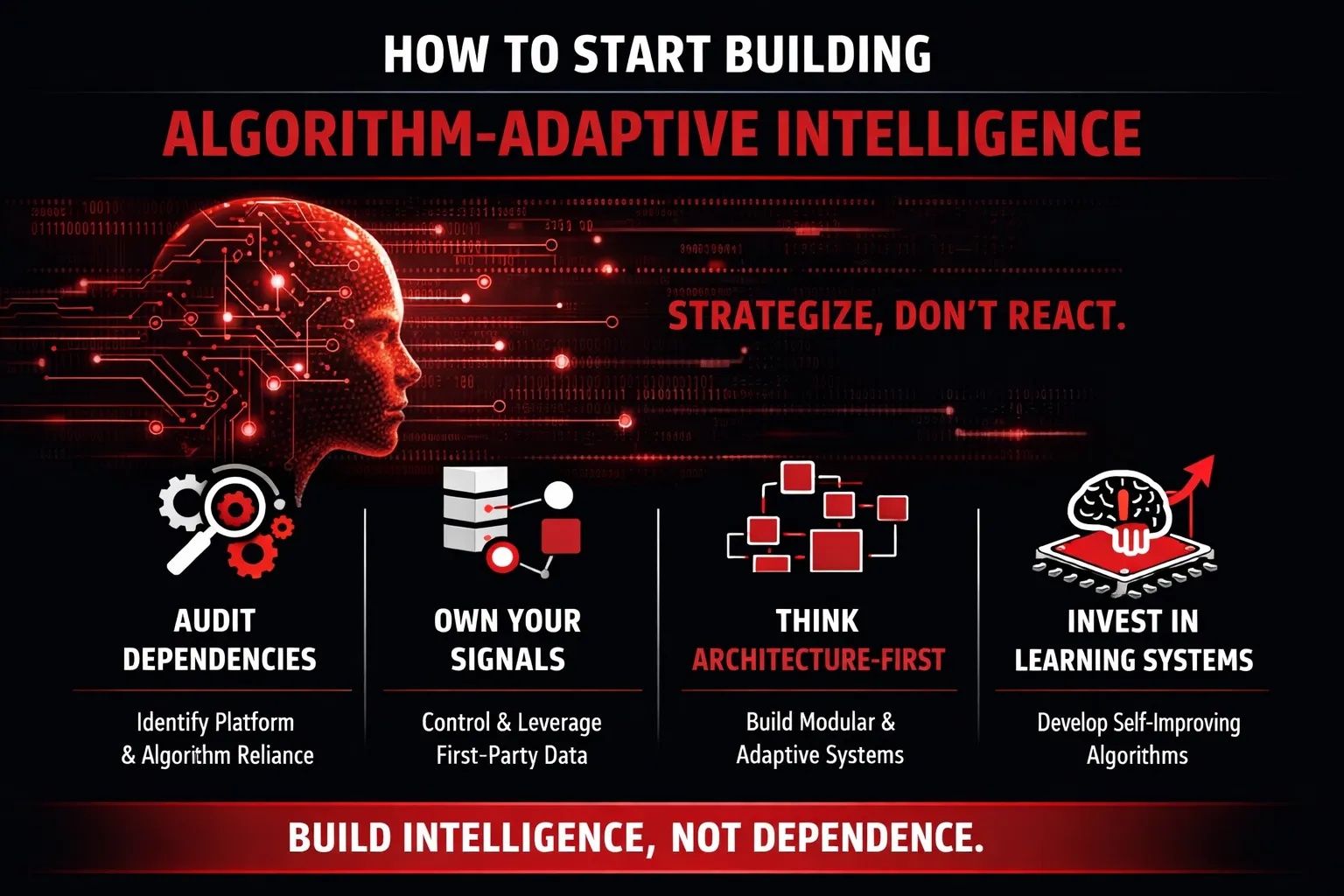
If you want algorithms to adapt to you—instead of you constantly adapting to them—you don’t start by chasing the newest tool, prompt library, or platform trick. You start by reshaping the system your business runs on.
Algorithm-adaptive intelligence is built the same way resilient cities are built: with strong foundations, smart infrastructure, and feedback loops that learn faster than the environment changes.
Here’s how to begin—practically, safely, and without relying on gimmicks.
1) Audit Your Dependency Points
Goal: Identify where your growth is controlled by external systems you don’t own.
Most companies don’t realize they’ve handed control to algorithms until results drop overnight: rankings, reach, conversions, costs, visibility, hiring pipelines—everything becomes fragile.
Start with a simple map:
- Traffic dependencies: Search engines, social feeds, marketplaces, app stores
- Revenue dependencies: Ad platforms, affiliate networks, lead aggregators
- Infrastructure dependencies: AI APIs, cloud services, third-party data providers
- Decision dependencies: Dashboards based on lagging metrics, black-box scoring systems
- Distribution dependencies: One platform driving most brand discovery
Then ask the hard question:
- If this algorithm changes tomorrow, what breaks first—and how badly?
- Which teams would panic? Marketing? Sales? Product? Ops?
Output of this step: A ranked list of “single points of failure” where algorithms currently dictate your outcomes.
2) Identify Signal Ownership Gaps
Goal: Stop renting signals. Start owning them.
Algorithms respond to signals: engagement, relevance, behavior patterns, authority indicators, satisfaction metrics, retention loops. If your business produces weak or borrowed signals, you’ll always be in reaction mode.
Signal ownership means you control the inputs that algorithms learn from.
Look for gaps like:
- You rely on third-party audiences (platform followers) instead of direct relationships (email, community, product users)
- You track surface metrics (traffic, impressions) but lack behavioral depth (journeys, intent, friction, repeat patterns)
- Your data lives in silos—marketing, CRM, product analytics—without a unified intelligence layer
- Your content outputs are high volume, but your entity authority (topic dominance, expertise consistency) is thin
Build a “Signal Inventory”:
- What signals do we generate directly?
- What signals do we borrow from platforms?
- What signals are missing entirely?
- Which signals are strongest—but currently unused?
Output of this step: A clarity map of which signals you own, which you rent, and which you need to build.
3) Shift From Tool-Centric to Architecture-Centric Thinking
Goal: Stop stacking tools. Start designing intelligence.
Tool-centric organizations behave like this:
- “Which AI tool should we use?”
- “Which SEO hack works now?”
- “Which platform is rewarding this format this month?”
Architecture-centric organizations behave like this:
- “What system makes us resilient no matter what the platforms do?”
- “What intelligence layer learns and adapts with every interaction?”
- “How do we turn every customer touchpoint into compounding advantage?”
This is the mindset flip:
Tools are replaceable. Architecture is durable.
Practically, it means designing:
- A data layer that unifies signals (content + customers + product + sales)
- A decision layer that turns signals into actions (recommendations, priorities, experiments)
- A feedback layer that validates outcomes (what worked, why, what changed)
Instead of asking, “What tool should we implement?”
Ask, “What loop should we build?”
Because tools don’t create dominance. Loops do.
Output of this step: A blueprint of your intelligence architecture—data → decisions → feedback.
4) Invest in Learning Systems, Not Static Models
Goal: Build systems that improve automatically as the world changes.
A static model is something you train once, deploy, and hope it holds.
A learning system is something that:
- continuously updates based on new signals,
- adjusts decisions based on outcomes,
- improves with usage,
- becomes harder to compete with over time.
Static systems decay in the real world because the real world changes daily.
Learning systems compound because they are designed to adapt.
To start, build learning into the system via:
- Experimentation loops: test, measure, learn, iterate—continuously
- Adaptive rules: thresholds and logic that update based on performance signals
- Human-in-the-loop refinement: expert review improves outputs faster than automation alone
- Closed-loop optimization: every output generates feedback that shapes the next output
The shift is simple:
Don’t build an AI “feature.” Build an AI organism.
Output of this step: A roadmap of feedback loops that make your intelligence improve without constant manual reinvention.
A Simple Way to Think About It
If you do these four things well, you move from:
- Compliance → to command
- Chasing → to conditioning
- Fragility → to resilience
- Updates → to architecture
And that’s the real point:
Others react to algorithms. ThatWare designs futures where algorithms must adapt to ThatWare.
Algorithm-adaptive intelligence isn’t a trick. It’s what happens when your system becomes so coherent, data-rich, and feedback-driven that algorithms have no choice but to respond to you.
Conclusion: The Power Shift Has Already Begun
Algorithms are evolving faster than ever. They update, recalibrate, and refine themselves at a pace that keeps most organizations in a constant state of reaction. Yet beneath this rapid evolution lies a deeper truth: algorithms do not lead the future—they follow the strongest systems within it.
The companies that will define the next era of AI will not be those frantically chasing updates, patching strategies, or pivoting with every platform change. Speed of reaction is no longer a competitive advantage. In fact, it has become a liability. Reaction creates dependency, and dependency erodes strategic control.
The real winners will be those who design intelligence at the architectural level—systems so coherent, adaptive, and signal-rich that algorithms have no choice but to align with them. These organizations understand that algorithms optimize for structure, consistency, and long-term value. When those elements are embedded deeply into an AI ecosystem, algorithms naturally recalibrate around them.
This is where the power shift is happening.
We are moving from an age of algorithm obedience to an age of intelligence design. From tactical compliance to strategic command. From reacting to external systems to building internal architectures that define how those systems behave.
That future is not coming—it has already begun.
Others react to algorithms. ThatWare designs futures where algorithms must adapt to ThatWare.