
Identifying the Best Backlink Opportunities using Cuckoo Algorithm

Identifying the Best Backlink Opportunities using Cuckoo Algorithm

SUPERCHARGE YOUR ONLINE VISIBILITY! CONTACT US AND LET’S ACHIEVE EXCELLENCE TOGETHER!

    Use Case: Identifying the Best Backlink Opportunities

    • Application:
      • CSA can be used to identify high-authority link-building opportunities by evaluating domain authority, traffic potential, and relevance.It can optimize internal linking structures for better link equity distribution.
      • CSA can help predict which backlinks will provide the most SEO value based on historical data.
    • How CSA Works:
      • Each potential backlink is an “egg” (solution).
      • The algorithm evaluates the quality of each backlink based on DA, spam score, traffic potential, and relevance.
      • Poor-quality backlinks are discarded, and new potential links are explored.
      • The final output suggests the most valuable backlinking opportunities for SEO growth.

    Identifying the Best Backlink Opportunities using Cuckoo Algorithm

    Here is the detailed implementation algorithm,

    Step 1: Gather Potential Backlink Sources

    Step 2: Define the Fitness Function

    Fitness=0.5×(DA)+0.3×(TrafficRelevance)−0.2×(SpamScore)Fitness = 0.5 \times (DA) + 0.3 \times (Traffic Relevance) – 0.2 \times (Spam Score)Fitness=0.5×(DA)+0.3×(TrafficRelevance)−0.2×(SpamScore)

    • High DA and relevance increase the score.
    • High spam score decreases the score.

    Step 3: Implement Cuckoo Search

    • Each potential backlink is a “cuckoo egg.”
    • The algorithm evaluates and selects high-quality links.
    • Poor-quality links are replaced with new ones through Lévy flight mutations.

    Example python script for the above application:
    import numpy as np

    import random

    import math

    import pandas as pd

    # Step 1: Simulate Backlink Data (20 backlinks)

    np.random.seed(42)

    num_backlinks = 20  # Number of backlink opportunities

    backlinks = []

    for _ in range(num_backlinks):

        DA = np.random.randint(20, 90)  # Domain Authority (20-90)

        TrafficRelevance = np.random.randint(10, 100)  # Traffic relevance (10-100)

        SpamScore = np.random.randint(1, 50)  # Spam score (1-50)

        backlinks.append([DA, TrafficRelevance, SpamScore])

    # Step 2: Define Fitness Function

    def fitness_function(DA, TrafficRelevance, SpamScore):

        return 0.5 * DA + 0.3 * TrafficRelevance – 0.2 * SpamScore

    # Step 3: Implement Cuckoo Search Algorithm

    # Lévy Flight Function (Fixed)

    def levy_flight(Lambda):

        sigma = (math.gamma(1 + Lambda) * math.sin(math.pi * Lambda / 2) /

                 (math.gamma((1 + Lambda) / 2) * Lambda * 2 ** ((Lambda – 1) / 2))) ** (1 / Lambda)

        u = np.random.normal(0, sigma, size=1)

        v = np.random.normal(0, 1, size=1)

        step = u / np.abs(v) ** (1 / Lambda)

        return step[0]

    # Cuckoo Search Parameters

    n = 10  # Number of cuckoo nests

    iterations = 100  # Maximum iterations

    pa = 0.25  # Discovery rate

    # Initialize random nests (backlinks)

    nests = random.sample(backlinks, n)

    for iteration in range(iterations):

        new_nests = []

        for nest in nests:

            DA, TrafficRelevance, SpamScore = nest

            fitness_old = fitness_function(DA, TrafficRelevance, SpamScore)

            # Generate new solution with Lévy Flight

            step_size = levy_flight(1.5) * (np.array(nest) – np.array(random.choice(nests)))

            new_solution = np.array(nest) + step_size

            new_solution = np.clip(new_solution, [20, 10, 1], [90, 100, 50])  # Keep values within range

            DA_new, TrafficRelevance_new, SpamScore_new = new_solution.astype(int)

            fitness_new = fitness_function(DA_new, TrafficRelevance_new, SpamScore_new)

            # Replace if new solution is better

            if fitness_new > fitness_old:

                new_nests.append([DA_new, TrafficRelevance_new, SpamScore_new])

            else:

                new_nests.append(nest)

        # Abandon poor nests and introduce new random ones

        for i in range(int(pa * n)):

            new_nests[random.randint(0, n – 1)] = random.choice(backlinks)

        nests = new_nests  # Update nests

    # Select top backlinks based on fitness

    best_backlinks = sorted(nests, key=lambda x: fitness_function(*x), reverse=True)

    # Display the best backlink opportunities

    df = pd.DataFrame(best_backlinks, columns=[“Domain Authority”, “Traffic Relevance”, “Spam Score”])

    df[“Fitness Score”] = df.apply(lambda row: fitness_function(row[0], row[1], row[2]), axis=1)

    print(“Top Optimized Backlinks:”)

    print(df)

    # Display table in Google Colab

    from IPython.display import display

    display(df)

    Output Example:
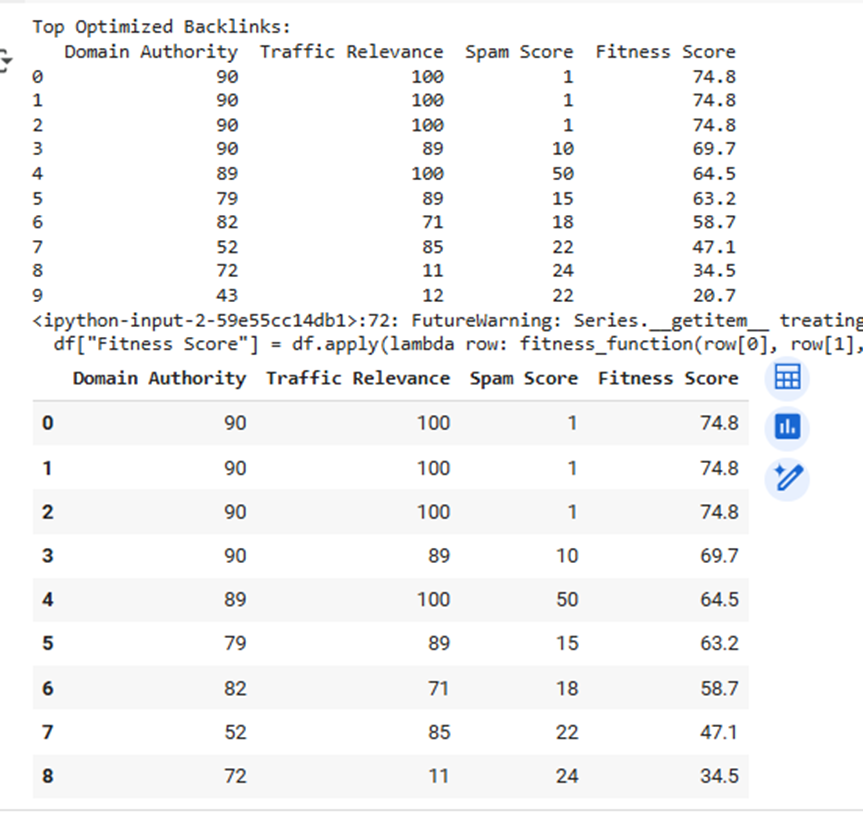
    Note: the above code is just an example, it does not provide accurate result. It needs to optimize with real facts and data like complete backlink metrics form any trusted tool.

    Collab Experiment Link:

    https://colab.research.google.com/drive/13DJU6-iVfuHwPlTv3UUcHc_QgjyNxDiI

    FAQ

    The Cuckoo Search Algorithm (CSA) is a nature-inspired optimization model that mimics how cuckoos lay eggs in other birds’ nests. In SEO, it helps analyze multiple backlink opportunities by comparing metrics like domain authority, relevance, and spam score. This allows businesses to focus only on the highest-quality backlink sources that bring real SEO value.


    Yes. CSA uses a fitness function to evaluate backlinks based on factors such as domain authority (DA), traffic relevance, and spam score. It then filters out low-quality links and highlights those that can offer the strongest SEO impact and referral potential for your website.

    Each potential backlink is treated as an “egg,” and the algorithm assigns a fitness score based on metrics like DA, spam score, and traffic relevance. Links with higher authority and lower spam probability receive better scores, ensuring that only high-value backlinks are prioritized for your SEO strategy.

    Not exactly. CSA doesn’t replace tools like Ahrefs, Moz, or SEMrush; instead, it enhances their output. You can use data from these tools as input for the algorithm, which then analyzes and optimizes the results to pinpoint the best backlinking opportunities with maximum SEO return.

    Absolutely. For smaller websites, CSA can help identify the most beneficial backlink sources without wasting time or resources. For larger websites managing hundreds of links, it can automate the process of filtering and ranking backlinks, improving efficiency and consistency.

    The algorithm automatically detects and filters out backlinks with high spam scores. This reduces the risk of associating your website with poor-quality domains that could harm your SEO rankings. Essentially, CSA acts as a smart filter, protecting your link profile from potential penalties.

    Yes. Beyond external backlinks, CSA can also be applied to internal linking optimization. It helps distribute link equity across important pages, ensuring that your most valuable content receives sufficient internal authority to rank better in search results.

    Summary of the Page - RAG-Ready Highlights

    Below are concise, structured insights summarizing the key principles, entities, and technologies discussed on this page.

    This summary explains how the Cuckoo Search Algorithm (CSA), a nature-inspired metaheuristic technique, can conceptually support SEO optimization rather than directly influence search rankings. CSA is designed to find global optima by simulating the reproductive behavior of cuckoo birds, where each solution competes for survival based on fitness.

    This section summarizes how CSA can be practically applied to fine-tune SEO strategy parameters through data-driven experimentation. Each ‘egg’ in the algorithm represents a unique configuration of SEO variables such as keyword density, content length, publishing frequency, and meta description size. The algorithm evaluates these configurations using a defined fitness function tied to real-world SEO metrics.

    The final summary focuses on the implementation workflow and its limitations. The process begins by defining SEO parameters and realistic bounds, followed by initializing a population of candidate solutions. A weighted fitness function evaluates performance using metrics like traffic, CTR, and engagement time.

    Tuhin Banik - Author

    Tuhin Banik

    Thatware | Founder & CEO

    Tuhin is recognized across the globe for his vision to revolutionize digital transformation industry with the help of cutting-edge technology. He won bronze for India at the Stevie Awards USA as well as winning the India Business Awards, India Technology Award, Top 100 influential tech leaders from Analytics Insights, Clutch Global Front runner in digital marketing, founder of the fastest growing company in Asia by The CEO Magazine and is a TEDx speaker and BrightonSEO speaker.

    Leave a Reply

    Your email address will not be published. Required fields are marked *