SUPERCHARGE YOUR ONLINE VISIBILITY! CONTACT US AND LET’S ACHIEVE EXCELLENCE TOGETHER!
In today’s digital landscape, businesses and content creators are constantly striving to ensure their content stands out amid the massive amount of online information. AI-driven search engines and intelligent assistants increasingly rely on knowledge graphs, which organize and interlink vast amounts of data, to provide accurate, context-aware results.
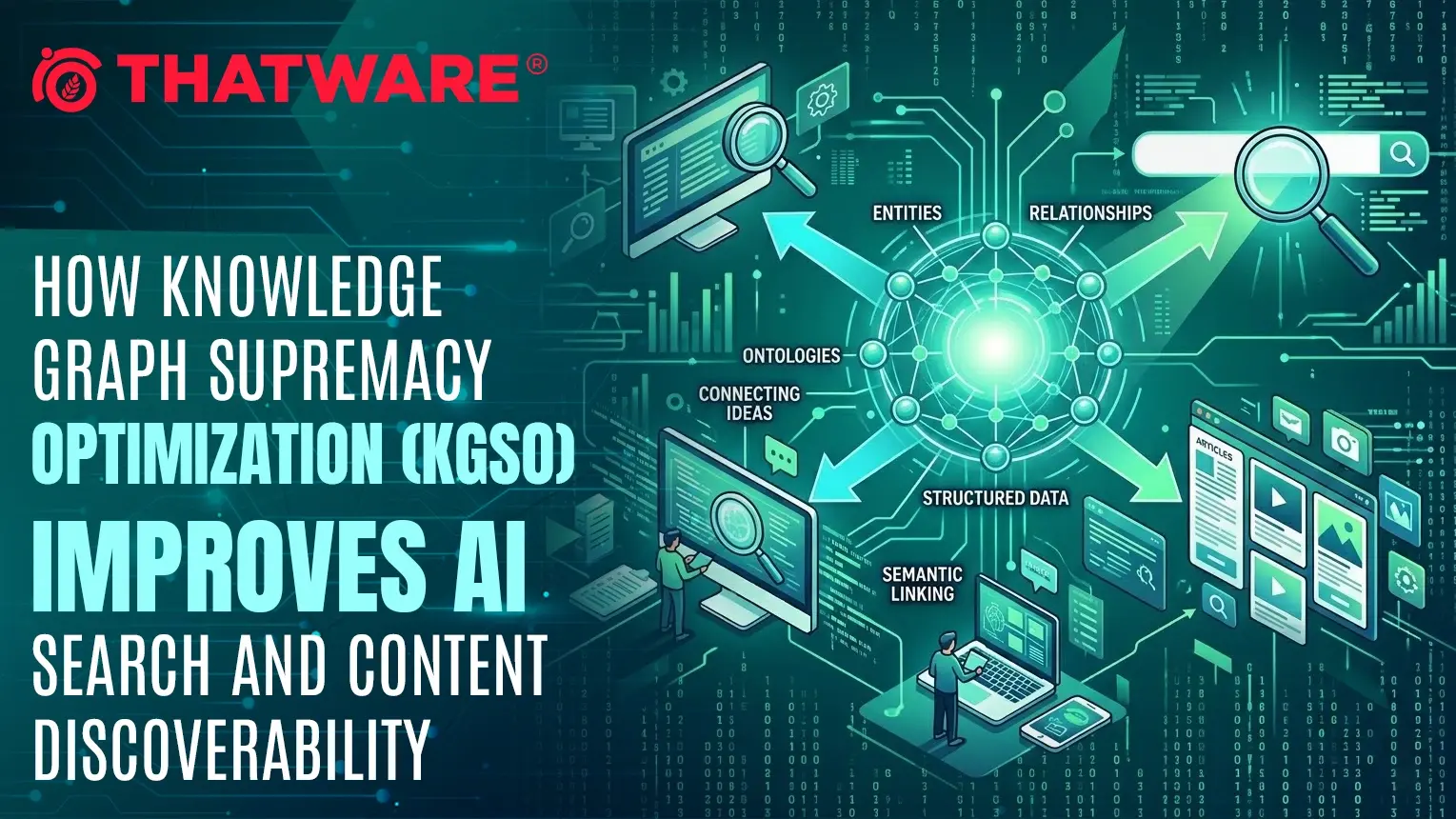
Knowledge Graph Supremacy Optimization (KGSO) is an emerging strategy that empowers businesses to enhance AI search effectiveness and improve content discoverability. By leveraging structured semantic relationships between entities, KGSO not only helps search engines understand content intent but also ensures audiences find the most relevant information efficiently.
This method transforms traditional SEO approaches, moving from keyword-centric tactics to entity-based optimization that aligns with AI’s comprehension models. In this blog, we will explore the fundamentals of knowledge graphs, the mechanics of KGSO, and actionable strategies for businesses aiming to dominate search results while maximizing content visibility.
Understanding Knowledge Graphs
A knowledge graph is a structured way of organizing information that allows AI and search engines to understand the relationships between different pieces of data. At its core, a knowledge graph consists of nodes, edges, entities, and relationships. Nodes represent individual entities, such as people, places, products, or concepts, while edges define the relationships or connections between them. For instance, in a knowledge graph, “Elon Musk” could be a node connected by an edge to “Tesla” with the relationship “CEO of.” These structures allow machines to interpret not just the data itself, but the context and meaning behind it.
AI and search engines leverage knowledge graphs to move beyond simple keyword matching. By understanding entities and their relationships, they can deliver semantic search results that align with user intent. For example, when someone searches for “best sci-fi movies by Christopher Nolan,” a knowledge graph helps the AI identify “Christopher Nolan” as a director, connect him to the films he directed, and return results that match the query’s context rather than just pages containing the keywords.
The evolution of knowledge graphs in AI search has been significant. Initially, search engines relied heavily on keyword-based indexing, which often produced irrelevant or ambiguous results. With knowledge graphs, search engines can now interpret semantic meaning and provide contextually accurate answers. Popular examples include the Google Knowledge Graph, which powers rich results and knowledge panels, and Microsoft Satori, which enhances Bing’s understanding of entities and connections.
In modern content discovery, knowledge graphs play a crucial role. They enhance context-driven search, allowing users to find information that is relevant and accurate. They also help reduce irrelevant results by understanding the relationships between topics, which improves overall user experience. By integrating structured data and entity relationships, businesses and content creators can ensure their content is discoverable and meaningful in AI-driven search environments.
What is Knowledge Graph Supremacy Optimization (KGSO)
Knowledge Graph Supremacy Optimization (KGSO) is an advanced strategy designed to enhance the visibility and relevance of content within AI-driven search environments. At its core, KGSO focuses on optimizing entities and their semantic relationships within knowledge graphs, ensuring that AI systems can accurately interpret, connect, and rank content.
Unlike traditional SEO, which relies heavily on keywords, KGSO emphasizes entity recognition, contextual understanding, and structured data enrichment, making content more discoverable across intelligent search engines and AI platforms.
Why Supremacy Matters
Achieving supremacy in a knowledge graph context means establishing authority and trustworthiness over a specific topic. When content is optimized using KGSO principles, AI systems recognize it as highly relevant and credible.
This increases the likelihood of appearing in AI-powered search results, knowledge panels, smart snippets, and recommendation engines, giving your content an edge over competitors. Essentially, KGSO transforms content from being merely searchable to being semantically dominant, meaning it’s understood and prioritized by AI in a meaningful way.
Key Components of KGSO
- Entity Identification: The process begins by accurately identifying key entities, people, organizations, products, or concepts within your content. Proper identification ensures AI systems can relate your content to the correct topics.
- Semantic Linking: Once entities are identified, they are interconnected logically within the knowledge graph. This includes linking internal content, external authoritative sources, and relevant contextual data to strengthen topic authority.
- Data Structuring and Enrichment: Finally, content is structured using metadata, schema markup, and semantic tags, making it easier for AI to interpret relationships, meaning, and context. Enrichment may involve adding attributes, descriptions, or links to authoritative references.
By combining these elements, KGSO empowers businesses and content creators to dominate AI search results, improve content discoverability, and future-proof their digital presence in increasingly intelligent search ecosystems.
How KGSO Enhances AI Search Capabilities
Knowledge Graph Supremacy Optimization (KGSO) plays a pivotal role in transforming how AI interprets and ranks content. By leveraging entity-based structures and semantic relationships, KGSO ensures that AI-powered search systems understand both content and context, delivering highly relevant results to users.
Improved Query Understanding
Traditional search engines primarily relied on keyword matching, often misunderstanding the user’s true intent. KGSO enhances AI’s ability to comprehend queries by mapping entities and their relationships. For instance, when a user searches for “best renewable energy companies in California,” KGSO enables AI to identify entities such as “renewable energy” and “California,” understand their connection, and return results that precisely match the query’s context. This advanced comprehension reduces irrelevant results and improves the overall search experience.
Contextual Relevance
With KGSO, content is no longer ranked solely on keywords; instead, AI evaluates semantic meaning. The relationships between entities, topics, and subtopics determine relevance. This means that even if exact keywords aren’t used, content can rank highly because AI recognizes it as contextually appropriate. For example, an article discussing “solar panel innovations in San Diego” can be surfaced for queries about “renewable energy advancements in California” because KGSO establishes the semantic connection.
Semantic Search Advantages
KGSO significantly enhances semantic search capabilities, which underpin modern AI systems, including voice assistants, chatbots, and question-answering tools. By organizing content through structured entities and relationships, KGSO allows AI to interpret natural language queries accurately, deliver precise answers, and support voice-activated search, where users speak in conversational language rather than typing exact keywords.
Enhanced Personalization
AI systems also rely on knowledge graphs to provide tailored results. KGSO enables personalization by connecting user behavior, preferences, and context with content entities. For instance, a frequent reader of AI technology blogs may receive recommendations about related AI conferences or new research articles, creating a more engaging and relevant user experience.
By improving query understanding, boosting contextual relevance, enabling semantic search, and enhancing personalization, KGSO ensures that content is not only discoverable but also highly valuable to users. This makes KGSO an essential strategy for businesses aiming to thrive in AI-driven search ecosystems.
KGSO and Content Discoverability
Knowledge Graph Supremacy Optimization (KGSO) is not only about improving AI search understanding, but it also plays a crucial role in making content more discoverable across multiple platforms. By structuring content around entities, relationships, and semantic connections, KGSO ensures that your content reaches the right audience efficiently and effectively.
Boosting Visibility in AI-driven Platforms
One of the most significant benefits of KGSO is its ability to increase visibility across AI-driven search environments. Optimized content is more likely to appear in smart snippets, knowledge panels, and AI-powered recommendations, giving your brand prominent exposure. For example, when a search engine identifies your content as a trusted source linked to key entities, it may display your information directly in a knowledge panel, increasing both credibility and click-through rates. This visibility is critical in a digital landscape where users expect fast, precise answers.
Interlinking Content for Authority
KGSO also strengthens content authority through semantic interlinking. By connecting multiple pages via entity relationships and contextual relevance, AI systems perceive your site as a comprehensive source of information on a given topic. This internal and external linking strategy enhances topical authority, signaling to AI that your content is reliable, cohesive, and worth ranking higher in search results. Over time, this can significantly improve overall discoverability.
Influencing AI-generated Summaries and Snippets
Optimized knowledge graph content is more likely to be featured in AI-generated summaries and content aggregators. By structuring data clearly and tagging key entities, AI systems can extract accurate information efficiently. This increases the chances of your content being highlighted in featured snippets, AI chat responses, and recommendation feeds, amplifying reach without additional promotional effort.
Reducing Search Ambiguity
Finally, KGSO helps clarify context for similar or competing topics, minimizing confusion for both AI systems and users. Properly optimized content reduces ambiguity, ensuring that search engines accurately understand your topic and connect it to relevant queries. This leads to higher click-through rates, better engagement, and improved user trust.
In summary, KGSO transforms content from being merely present online to being actively discoverable, authoritative, and contextually relevant, giving businesses a competitive advantage in the AI-powered search landscape.
Implementing KGSO Strategies
Successfully leveraging Knowledge Graph Supremacy Optimization (KGSO) requires a strategic approach that integrates semantic understanding, structured data, and ongoing optimization. Businesses that implement KGSO effectively can significantly enhance content discoverability and AI search performance. Here are the key strategies to get started:
Conducting Entity Research
The foundation of KGSO is understanding the entities most relevant to your content domain. Begin by identifying key people, products, concepts, or organizations connected to your topic. Tools like AI-powered entity extraction and keyword research platforms can help reveal high-impact entities and their relationships. Mapping these entities allows you to create a content strategy where topics are interconnected, ensuring AI systems recognize and prioritize your content.
Structuring and Tagging Content
Once entities are identified, the next step is structuring content to make relationships clear. Use schema markup, RDF triples, and rich metadata to annotate entities, defining how they relate to each other. Structured data allows AI to interpret your content’s meaning, rather than just scanning for keywords. For example, tagging an article about “electric vehicles” with metadata linking it to the manufacturer, technology type, and market trends makes it easier for AI to understand context.
Building Knowledge Graph Relationships
KGSO isn’t just about individual content pieces; it’s about creating a network of connected content. Link internal pages that share relevant entities and establish connections to authoritative external sources. This semantic linking strengthens topical authority, signals trustworthiness to AI systems, and improves the likelihood of your content being featured in knowledge panels or AI recommendations.
Monitoring and Iterating
KGSO is an ongoing process. Use AI analytics tools to track which entities are performing well, which relationships are recognized by search engines, and how content is ranking in semantic searches. Continuous monitoring allows you to refine your approach, update metadata, and strengthen weak entity connections over time.
Integration with SEO and Content Marketing
Finally, KGSO complements, rather than replaces, traditional SEO and content marketing strategies. While SEO focuses on visibility and keywords, KGSO ensures semantic understanding and relevance. Combining both approaches results in content that ranks highly in search engines and is discoverable across AI-powered platforms.
By conducting thorough entity research, structuring and tagging content, building relationships, monitoring performance, and integrating with existing strategies, businesses can fully leverage KGSO to maximize AI search visibility and content discoverability.
Conclusion
Knowledge Graph Supremacy Optimization (KGSO) is transforming how AI interprets, ranks, and surfaces content. Businesses that strategically implement KGSO can gain a competitive edge, ensuring their content reaches the right audience efficiently and accurately.
From improving AI query understanding to boosting content discoverability and establishing topical authority, KGSO is no longer optional; it’s essential for modern digital strategies. For organizations seeking expert guidance on implementing these strategies and achieving unparalleled content visibility, they can seek support from us at ThatWare LLP.
We offer cutting-edge solutions that combine AI insights with advanced knowledge graph optimization techniques. Explore how we can help your business dominate AI search and maximize content discoverability today.