
SUPERCHARGE YOUR ONLINE VISIBILITY! CONTACT US AND LET’S ACHIEVE EXCELLENCE TOGETHER!
For more than two decades, Search Engine Optimization (SEO) has been the backbone of digital visibility. Businesses optimized their websites with keywords, backlinks, and technical improvements to rank higher on search engine result pages (SERPs). The goal was simple: appear on the first page of Google so users could click your link.

This model shaped the entire digital marketing ecosystem. Content strategies were built around keyword rankings, websites competed for organic traffic, and success was measured by search impressions, click-through rates, and page rankings.
However, the way people access information is changing rapidly.
The Evolution of Information Discovery
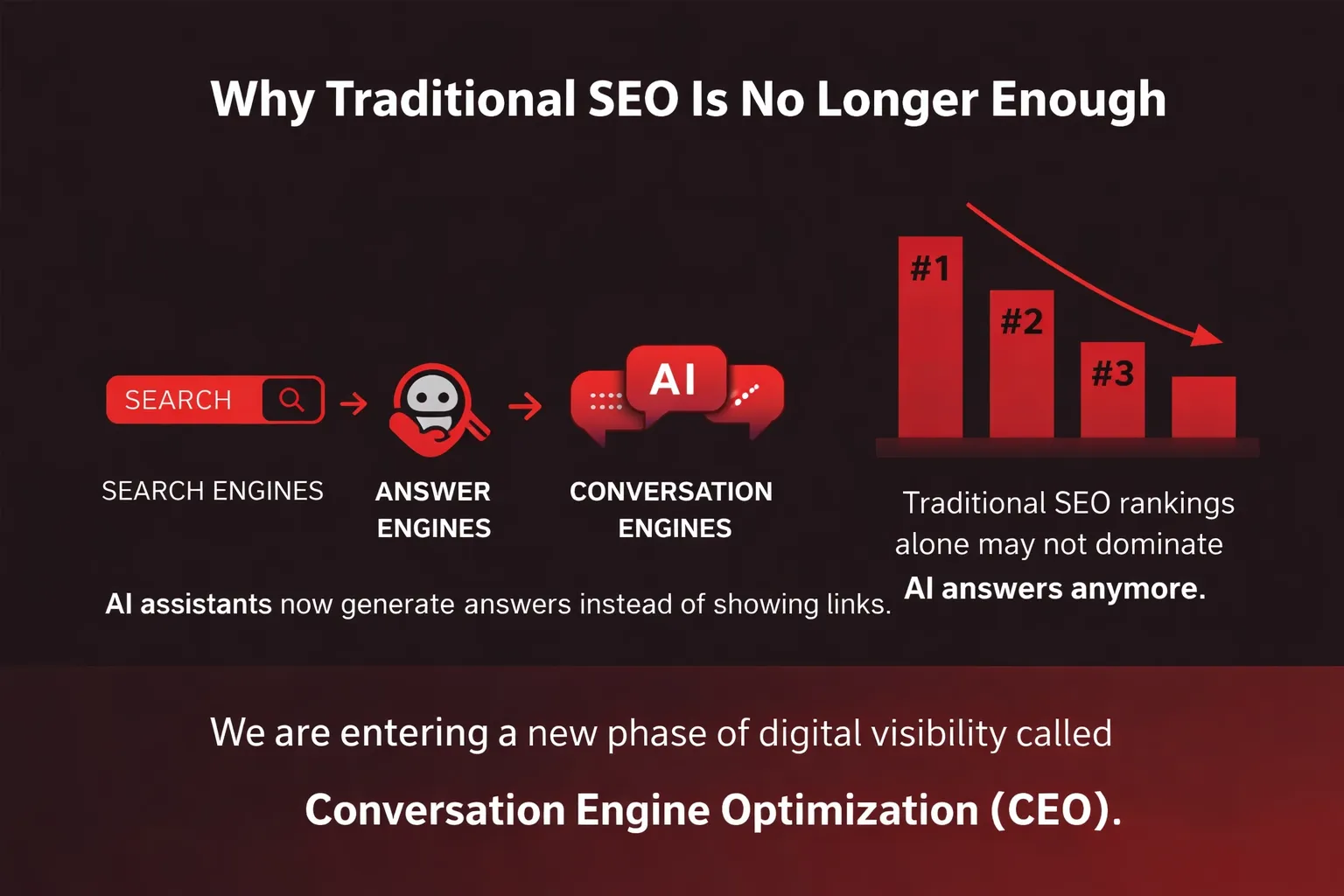
Over time, search has evolved through multiple phases:
Search Engines → Answer Engines → Conversation Engines
- Search Engines (SEO Era)
Traditional search engines like Google return a list of links when users type a query. Users browse through multiple pages to find the best answer.
- Answer Engines (AEO / GEO Era)
With the rise of AI assistants such as ChatGPT, Gemini, and Perplexity, users increasingly receive direct answers instead of lists of links. These systems synthesize information and generate responses based on multiple sources.
- Conversation Engines (CEO Era)
The newest stage is conversational AI systems that engage in ongoing dialogue with users, understanding context, follow-up questions, and real-time information signals.
Instead of searching once and clicking a link, users now have conversations with AI systems to get insights, recommendations, and explanations.
AI Assistants Are Changing the Rules
Modern AI assistants do not simply index web pages the way traditional search engines do. Instead, they:
- Generate responses using large language models
- Synthesize knowledge from multiple sources
- Understand user intent across multi-step conversations
- Deliver complete answers instantly
This means the user’s journey often ends inside the AI interface, without visiting a website.
For businesses and marketers, this creates a fundamental shift. Even if a website ranks well in traditional search results, it may not be referenced by AI systems generating answers.
In other words, ranking #1 on Google no longer guarantees visibility inside AI-generated responses.
The Decline of Link-Based Discovery
Historically, visibility depended on:
- Keyword rankings
- Backlinks
- On-page SEO
- Technical optimization
But AI-driven systems prioritize different signals such as:
- contextual relevance
- entity recognition
- conversational intent
- real-time discussions
- authority within a topic
This shift means that traditional SEO alone may no longer dominate AI-driven information discovery.
A New Phase of Digital Visibility
As conversational AI becomes the primary interface for information retrieval, a new optimization discipline is emerging.
We are entering a new phase of digital visibility called Conversation Engine Optimization (CEO).
Conversation Engine Optimization focuses on ensuring that brands, insights, and content become part of the answers generated by AI systems, rather than simply appearing as links in search results.
In the coming sections, we will explore how CEO works, why it matters, and how businesses can adapt to this new era where winning the conversation becomes more important than winning the search result.
The Evolution of Optimization: SEO → AEO → XEO → CEO
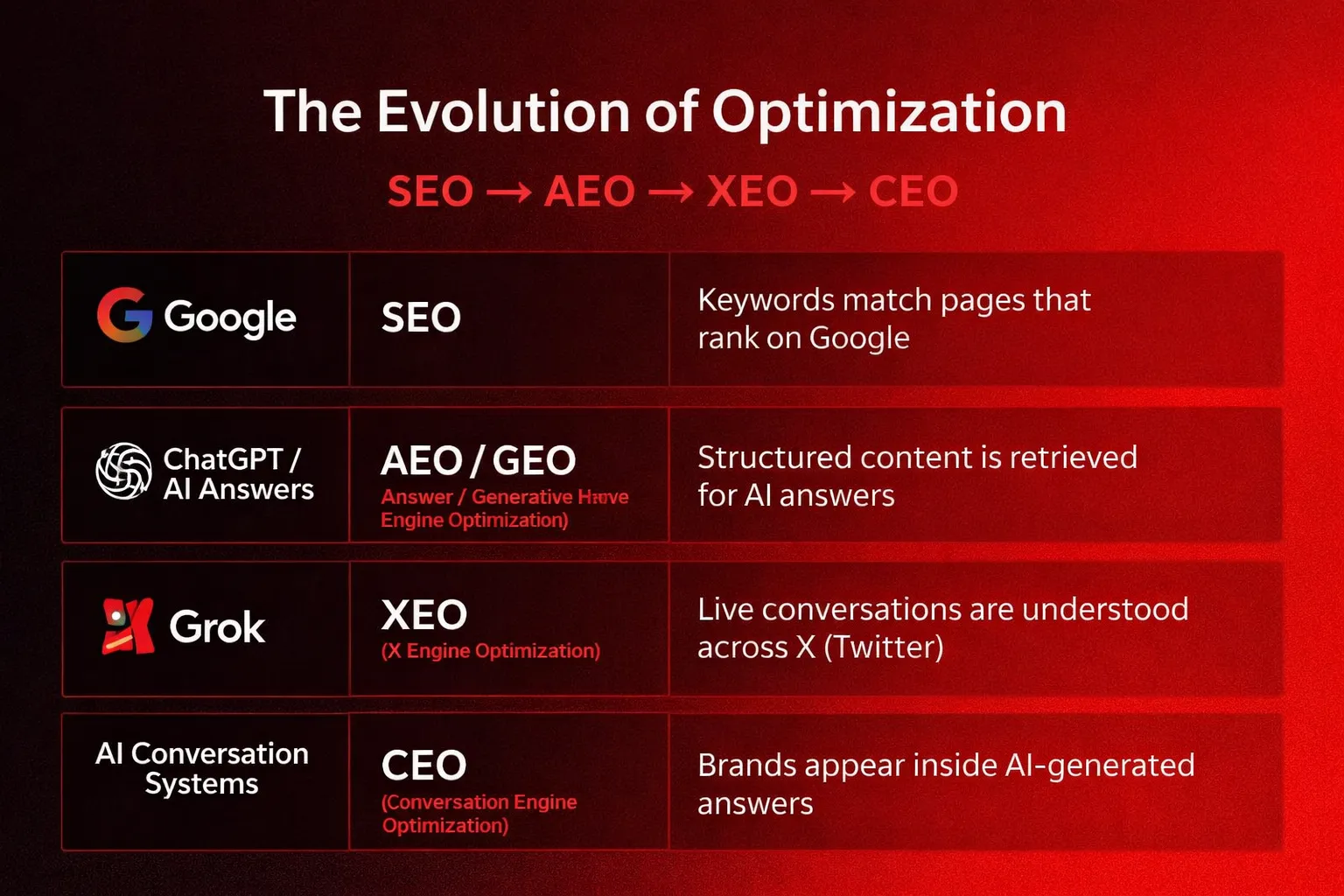
Digital visibility has always evolved alongside the technologies people use to access information. As search behavior shifts from keyword-based queries to AI-driven conversations, optimization strategies are also transforming. What began as Search Engine Optimization (SEO) has gradually progressed toward Answer Engine Optimization (AEO), X Engine Optimization (XEO), and now Conversation Engine Optimization (CEO).
Each stage represents a change in how information is retrieved, processed, and delivered to users.
| Platform | Optimization Strategy |
| SEO (Search Engine Optimization) | |
| ChatGPT / AI Answers | AEO / GEO (Answer / Generative Engine Optimization) |
| Grok | XEO (X Engine Optimization) |
| AI Conversation Systems | CEO (Conversation Engine Optimization) |
Understanding this evolution is essential for businesses that want to remain visible in the rapidly changing landscape of AI-powered search.
SEO: Optimizing for Search Engines
Search Engine Optimization (SEO) emerged with traditional search engines such as Google and Bing. In this model, users type keywords or phrases into a search bar, and the search engine retrieves the most relevant web pages from its index.
SEO focuses on optimizing webpages so that they rank higher on search engine results pages (SERPs). Key signals include:
- Keywords and topical relevance
- Backlinks and domain authority
- Technical website performance
- Content quality and structure
In the SEO era, success meant ranking high on search result pages. Users would then click links to find the information they needed.
However, the rise of AI-driven systems has begun to shift this paradigm.
AEO / GEO: Optimizing for AI Answers
With the introduction of AI assistants like ChatGPT, Gemini, and Perplexity, the search experience started to move away from lists of links toward direct answers generated by AI models.
This shift introduced concepts such as Answer Engine Optimization (AEO) and Generative Engine Optimization (GEO).
Instead of focusing purely on ranking webpages, AEO and GEO focus on structuring content so that AI systems can easily understand, extract, and reference it when generating responses.
Important signals in this stage include:
- Structured and clearly written explanations
- Frequently asked questions and concise definitions
- Topical authority within a subject area
- Content that AI models can easily summarize or cite
In this phase, visibility is no longer limited to search results. Instead, brands aim to appear within AI-generated answers.
XEO: Optimizing for Grok and Real-Time Social Intelligence
The next shift emerges with platforms like Grok, which integrates closely with the social ecosystem of X (formerly Twitter). This introduces a new layer called X Engine Optimization (XEO).
Unlike traditional search engines that rely primarily on indexed webpages, Grok also interprets live discussions happening across social platforms. This means that real-time conversations can influence how information is surfaced.
Key signals in XEO may include:
- Retweets and social engagement
- Thread discussions and replies
- Community interactions
- Real-time sentiment and public opinion
In this model, information retrieval is not just based on static content. Instead, it incorporates dynamic social signals that reflect ongoing conversations across the internet.
CEO: Optimizing for AI Conversations
The next stage of this evolution is Conversation Engine Optimization (CEO).
AI systems are increasingly designed to interact with users through multi-step conversations rather than single queries. Instead of retrieving isolated pieces of information, these systems synthesize knowledge from multiple sources to generate context-aware responses.
Conversation Engine Optimization focuses on ensuring that a brand, concept, or resource becomes part of these AI-driven dialogues.
CEO involves optimizing for:
- conversational queries and long-form user intent
- contextual relevance across multiple topics
- authoritative insights that AI models trust
- signals from both web content and community discussions
In other words, while SEO focused on ranking pages and AEO focused on answering questions, CEO focuses on becoming part of the conversation itself.
A New Model of Digital Visibility
This evolution—from SEO to AEO, XEO, and CEO—reflects a fundamental shift in how information is discovered and delivered. Search engines once relied on indexed pages and ranking algorithms. Today’s AI systems combine semantic understanding, real-time data, and conversational reasoning.
As a result, businesses must rethink their optimization strategies. The goal is no longer simply to rank for keywords but to ensure that their expertise, insights, and brand presence are embedded within the broader knowledge ecosystem that AI systems rely on.
In the emerging AI landscape, visibility will increasingly depend on how well a brand participates in and shapes the digital conversation.
What is Conversation Engine Optimization (CEO)?
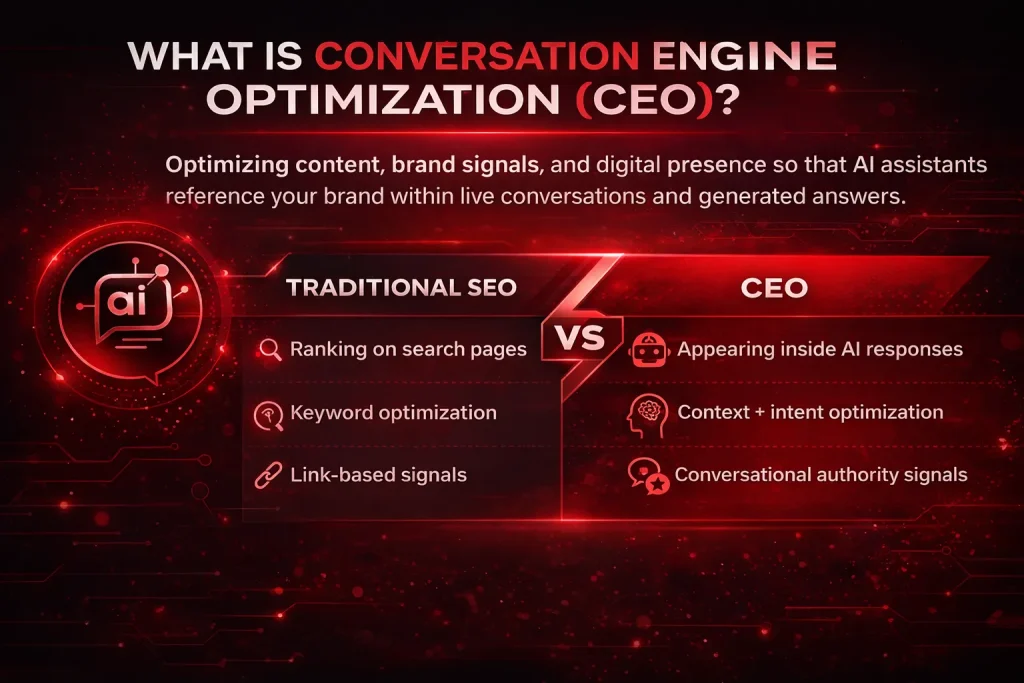
Conversation Engine Optimization (CEO) is an emerging digital marketing discipline designed for the era of AI-driven search and conversational interfaces. As users increasingly rely on AI assistants such as ChatGPT, Grok, Gemini, and other conversational systems to obtain information, the traditional goal of simply ranking web pages on search engine result pages is evolving. Instead of presenting users with a list of links, these systems generate direct answers based on multiple sources of information. In this new environment, the objective is no longer just to rank highly on search engines but to become a trusted source that AI systems reference when generating responses.
Conversation Engine Optimization focuses on optimizing content, brand signals, and digital presence so that AI assistants recognize a brand as authoritative and include it within AI-generated answers and ongoing digital conversations. Rather than targeting isolated keywords, CEO emphasizes understanding the context, intent, and conversational patterns behind user queries. The aim is to ensure that when users ask complex or conversational questions, AI systems can identify and incorporate relevant insights, expertise, or references from a brand’s content.
This shift fundamentally changes how visibility is achieved online. Traditional SEO largely depends on keyword targeting, backlink profiles, and page-level rankings within search engines. CEO, on the other hand, prioritizes the ability of content to answer questions clearly, demonstrate expertise, and participate in the broader digital knowledge ecosystem that AI models rely on. Content must be structured in ways that AI systems can easily interpret, extract, and synthesize into conversational responses.
Another important aspect of CEO is the role of brand authority and trust signals across the web. AI systems often evaluate multiple forms of signals, including structured information, authoritative mentions, expert commentary, and community discussions. This means that brands must build a consistent and credible presence across websites, social platforms, and digital publications to increase the likelihood that AI systems will reference them.
The differences between traditional SEO and Conversation Engine Optimization highlight how the focus of optimization is shifting:
| Traditional SEO | Conversation Engine Optimization (CEO) |
| Ranking on search engine result pages | Appearing directly inside AI-generated responses |
| Keyword-focused optimization | Context- and intent-driven optimization |
| Backlinks and link authority signals | Conversational authority and knowledge signals |
In essence, Conversation Engine Optimization reflects the transition from optimizing for search engines to optimizing for intelligent systems that generate answers. Instead of competing only for rankings, brands now compete to become part of the knowledge that AI assistants use when responding to user questions. As conversational interfaces continue to grow, CEO is likely to become a critical strategy for maintaining visibility and authority in the evolving landscape of AI-powered information discovery.
How Grok Introduces a New Search Paradigm
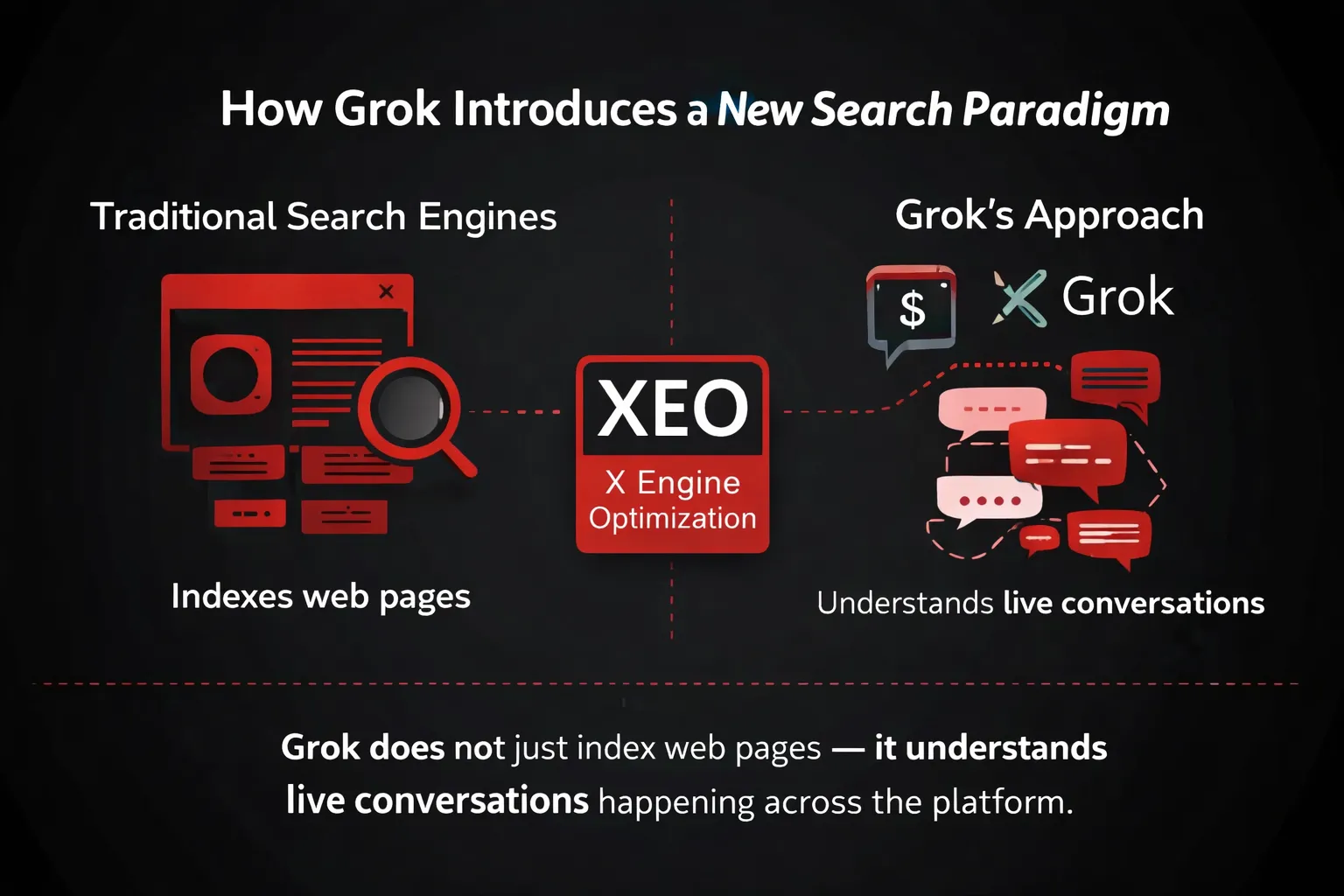
The rise of AI-powered assistants has already begun reshaping how information is discovered online. However, Grok introduces an entirely new paradigm that goes beyond both traditional search engines and modern AI answer engines.
Unlike conventional search systems that primarily rely on indexed web pages, Grok is deeply integrated with X (formerly Twitter)—a platform built around real-time conversations, discussions, and community interactions. This integration fundamentally changes how information is discovered, interpreted, and surfaced in AI-generated responses.
From Static Pages to Live Conversations
Traditional search engines such as Google operate by crawling and indexing static web pages. Their algorithms analyze factors such as keywords, backlinks, site authority, and page structure to determine which pages should rank for a given query.
While this system has been highly effective for decades, it is inherently page-centric. Information must first exist as a published webpage before it can be discovered and ranked.
Grok changes this model.
Instead of relying solely on static web content, Grok can observe and interpret ongoing conversations across X in real time. This means that information does not necessarily have to exist as a formal article or webpage to influence the answers generated by the AI. Discussions, threads, and community responses can all contribute to how knowledge is formed and surfaced.
In other words, Grok is not just reading the web—it is listening to the internet’s conversations as they happen.
The Emergence of XEO (X Engine Optimization)
This shift creates a new layer of optimization known as XEO — X Engine Optimization.
XEO focuses on optimizing visibility within the conversational ecosystem of X, rather than only within traditional search results.
Instead of prioritizing signals like backlinks or on-page keyword density, XEO is influenced by signals such as:
- Retweets and reposts
- Discussion threads and replies
- Community participation
- Influencer engagement
- Conversation sentiment
These signals reflect how actively a topic or idea is being discussed within the community.
As a result, authority is no longer determined solely by websites and domains. It can also emerge from individual accounts, influential voices, and highly engaged discussions happening across the platform.
A Shift Toward Conversational Authority
Because Grok can understand and analyze real-time conversations, it introduces a new concept: conversational authority.
Conversational authority refers to how frequently a brand, idea, or expert is mentioned and discussed in meaningful conversations within a community. When certain voices consistently appear in discussions around a topic, AI systems may begin to treat them as authoritative sources.
This is fundamentally different from traditional SEO authority, which is largely based on backlinks and domain reputation.
In the Grok ecosystem, authority can emerge from influence within the conversation itself.
Why This Matters for Digital Visibility
The implications of this shift are significant.
If AI systems increasingly rely on conversational signals, then brands that actively participate in relevant discussions may gain visibility in AI-generated answers—even if they do not dominate traditional search rankings.
This means that future digital strategy may require a balance between:
- Traditional SEO for search engine rankings
- Generative Engine Optimization (GEO) for AI answer engines
- XEO for visibility within real-time social conversations
Together, these approaches form part of a broader strategy known as Conversation Engine Optimization (CEO).
The Key Insight
At its core, Grok represents a transition from indexing content to understanding conversations.
Rather than simply retrieving information from websites, Grok can synthesize knowledge from live discussions, community sentiment, and evolving dialogue across the platform.
The key insight is simple but powerful:
Grok does not just index web pages — it understands live conversations happening across the platform.
As AI assistants continue to evolve, the brands and experts who actively contribute to meaningful conversations may become the ones most visible in the next generation of search.
Signals That Power Conversation Engine Optimization
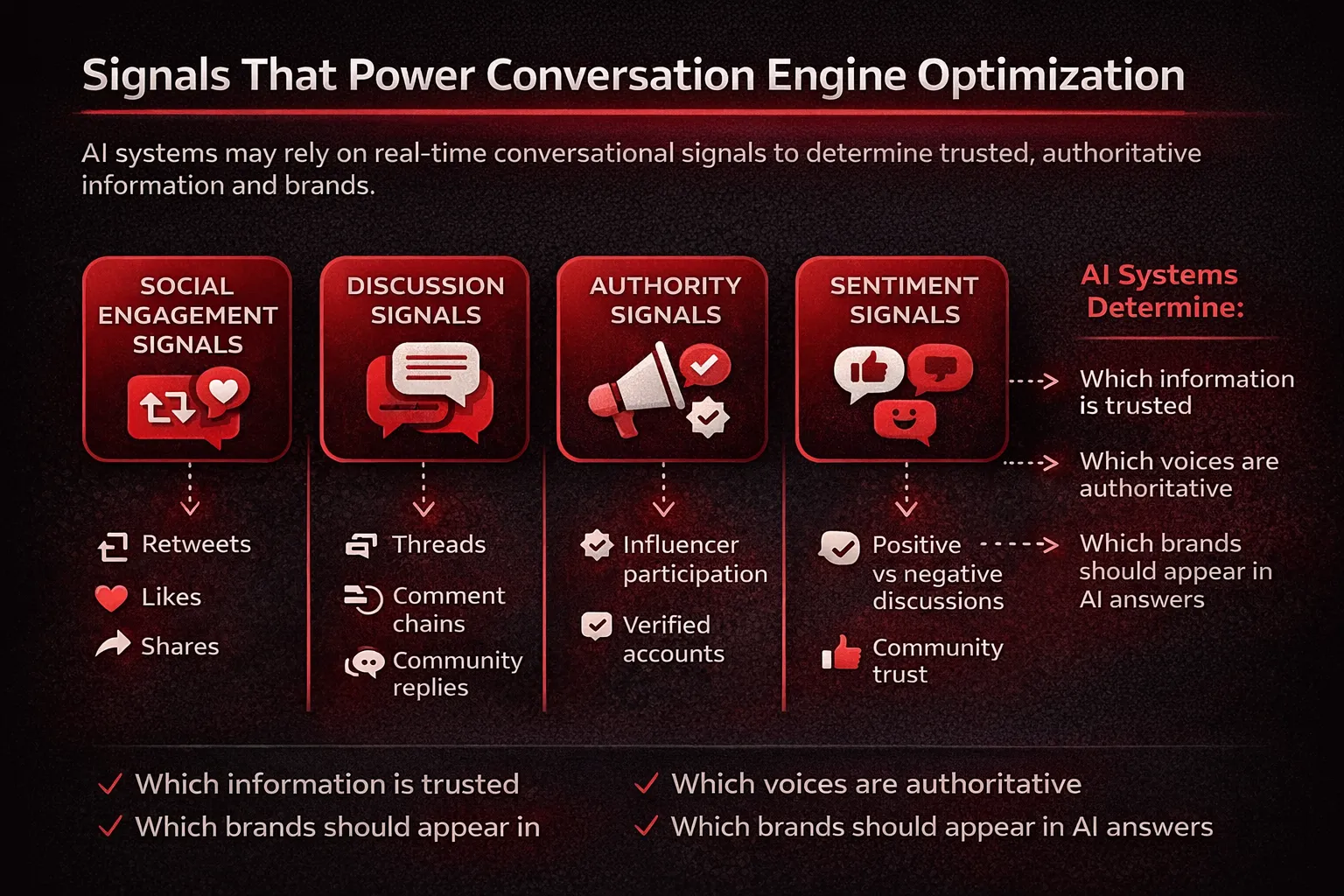
Conversation Engine Optimization (CEO) is fundamentally different from traditional SEO because it relies heavily on real-time conversational signals rather than static web page metrics. Instead of only analyzing backlinks, keywords, and page authority, AI-powered conversation engines evaluate how information spreads and evolves within live digital discussions.
Platforms that integrate conversational AI—such as Grok within X or other AI assistants connected to social ecosystems—can analyze ongoing conversations to determine what information is relevant, credible, and widely accepted by communities. These systems continuously monitor engagement patterns and contextual signals to understand which voices should be surfaced in AI-generated responses.
Below are some of the most important signals that may influence how conversation engines rank and reference information.
Social Engagement Signals
One of the strongest indicators of relevance in conversational ecosystems is user engagement. When content receives high engagement, it signals that the topic resonates with the community and is being actively discussed.
Key engagement signals include:
- Retweets: Amplification of a message across the network, increasing its reach and visibility.
- Likes: Indicators of approval or agreement from the community.
- Shares: Distribution of content across different audiences or networks.
High engagement suggests that a piece of information is gaining traction and may represent valuable or timely insights. AI systems can use these signals to identify which discussions are shaping the current narrative around a topic.
Discussion Signals
Beyond engagement, AI conversation engines also analyze the depth and structure of discussions. Content that sparks meaningful dialogue often carries more informational value than isolated posts.
Important discussion-based signals include:
- Threads: Multi-post conversations where ideas evolve and expand over time.
- Comment chains: Extended back-and-forth discussions that add context and perspectives.
- Community replies: Contributions from different users that validate, challenge, or enrich the original information.
These signals indicate that a topic is not only popular but also actively being analyzed and debated, making it more useful for AI systems that aim to generate comprehensive answers.
Authority Signals
Another critical factor in Conversation Engine Optimization is who is participating in the conversation. AI systems attempt to identify authoritative voices within a discussion to prioritize credible information.
Authority signals may include:
- Influencer participation: When recognized figures or industry leaders contribute to a discussion, their input carries additional weight.
- Verified accounts: Verified profiles often indicate authenticity and a level of trustworthiness.
- Expert commentary: Detailed insights from subject-matter experts can significantly influence how AI systems interpret a topic.
By analyzing these signals, AI engines can distinguish between casual discussions and expert-driven knowledge exchanges.
Sentiment Signals
Understanding the tone and perception of a discussion is also essential. Conversation engines use sentiment analysis to evaluate whether a topic, idea, or brand is being discussed positively or negatively.
Key sentiment indicators include:
- Positive vs. negative discussions: AI systems analyze the emotional tone of conversations to assess community perception.
- Community trust: Repeated endorsements or supportive commentary can signal credibility and reliability.
Sentiment signals help AI determine not only what information is being discussed but also how the community perceives it.
Together, these signals allow conversation engines to evaluate:
- Which information is widely trusted
- Which individuals or organizations are recognized authorities
- Which brands and sources should appear within AI-generated answers
In essence, Conversation Engine Optimization is about earning visibility through meaningful participation in digital conversations, rather than relying solely on traditional ranking signals.
The Rise of Real-Time Knowledge Graphs
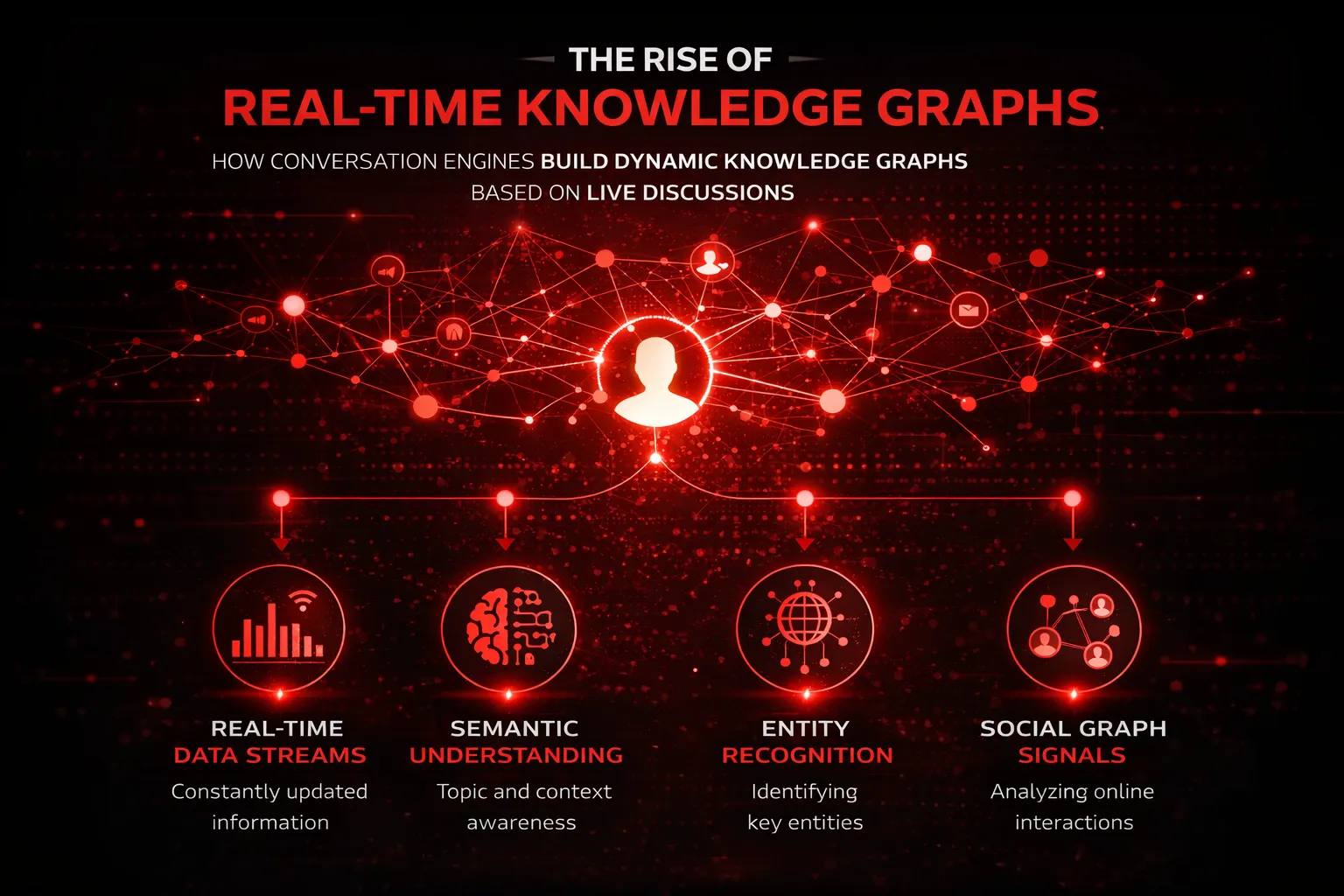
Behind the scenes, conversation engines rely on advanced technologies that allow them to interpret and organize massive volumes of dynamic information. One of the most important innovations enabling this shift is the development of real-time knowledge graphs.
Unlike traditional search engines that primarily index static web pages, modern AI systems continuously build and update knowledge structures based on live data streams and ongoing discussions.
Several technological components make this possible.
Real-Time Data Streams
Conversation engines ingest data from multiple sources simultaneously, including social platforms, news updates, forums, and other digital ecosystems. This constant flow of information allows AI systems to detect emerging trends and new insights as they happen.
As a result, the knowledge base powering AI responses is continuously evolving rather than periodically indexed.
Semantic Understanding
Modern AI systems rely on natural language processing and semantic analysis to understand the meaning behind conversations. Instead of matching keywords, they interpret the intent, relationships, and context within discussions.
This enables AI to connect different pieces of information across conversations, even when users describe topics in different ways.
Entity Recognition
Entity recognition plays a crucial role in identifying the key components of conversations. AI systems analyze discussions to detect entities such as:
- People
- Brands
- Companies
- Products
- Technologies
- Locations
Once identified, these entities are linked within a structured knowledge graph that maps their relationships to one another.
Social Graph Signals
Another layer of analysis comes from the social graph, which represents the network of relationships between users, communities, and influencers. By understanding how information spreads across these networks, AI systems can determine which discussions carry the most influence.
For example, insights shared by respected industry experts or widely followed accounts may carry more weight within the knowledge graph.
From Static Rankings to Dynamic Knowledge
Traditional search engines ranked static pages based on historical signals such as backlinks and keyword relevance. In contrast, conversation engines operate within a dynamic environment where knowledge is shaped by ongoing discussions.
Instead of simply ranking pages, these systems build living knowledge graphs that evolve with every conversation.
This shift represents a fundamental transformation in how digital visibility works. In the age of conversational AI, success is no longer defined solely by page rankings—it is defined by how effectively a brand participates in and shapes the conversations that define its industry.
Practical Strategy for Conversation Engine Optimization (CEO)
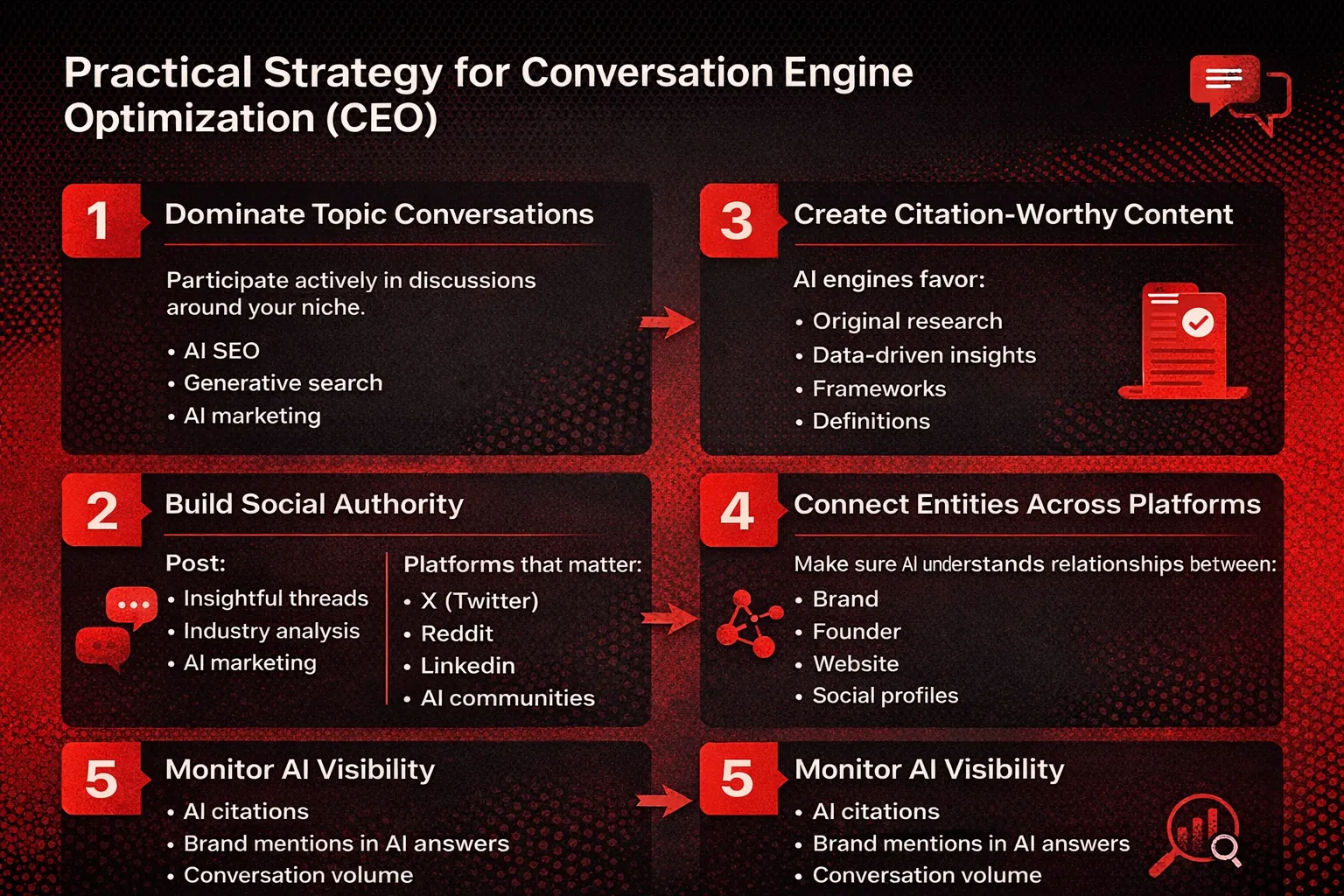
Conversation Engine Optimization is not just about optimizing web pages. It is about positioning your brand inside the conversations that AI systems learn from and reference when generating answers. To succeed in this new environment, businesses must focus on building authority across discussions, social platforms, and knowledge ecosystems. Below are the key steps to implement an effective CEO strategy.
Step 1: Dominate Topic Conversations
The foundation of CEO is active participation in conversations related to your niche. AI systems increasingly analyze discussions, threads, and community responses to understand what topics are important and which voices are authoritative. If your brand consistently appears in these conversations, it becomes more likely that AI engines will reference your insights.
Organizations should engage in discussions around core topics relevant to their expertise. For example, companies operating in the AI and marketing space should actively contribute to conversations about AI SEO, generative search, and AI-driven marketing strategies.
Participation can include responding to industry debates, contributing insights in forums, and sharing expert opinions on emerging trends. The goal is to ensure that your brand becomes part of the ongoing knowledge ecosystem surrounding these topics.
Over time, consistent engagement helps build conversational authority, which signals to AI systems that your brand is a credible source of information.
Step 2: Build Social Authority
Conversation engines often draw insights from highly engaged social platforms where industry discussions occur in real time. Building social authority therefore becomes a critical component of CEO.
Brands should focus on publishing valuable and insightful content that stimulates discussion and engagement. This includes sharing insightful threads, industry analysis, and thought leadership perspectives that add meaningful value to ongoing conversations.
Several platforms play a key role in shaping conversational signals:
- X (Twitter) – A major hub for real-time industry discussions and trending topics.
- Reddit – A community-driven platform where in-depth conversations and expert responses often occur.
- LinkedIn – A professional network where thought leadership and industry insights gain credibility.
- AI communities – Specialized forums, developer groups, and research communities where advanced discussions take place.
Consistently contributing valuable insights across these platforms helps establish your brand as a recognized authority within the conversational ecosystem.
Step 3: Create Citation-Worthy Content
AI systems tend to favor content that contains clear, reliable, and structured information. This means brands must create content that is not only informative but also citation-worthy.
Content that is more likely to be referenced by AI systems often includes:
- Original research that provides new insights or findings
- Data-driven analysis supported by credible statistics
- Frameworks or methodologies that help explain complex concepts
- Clear definitions of emerging industry terms
For example, introducing a well-structured framework around Conversation Engine Optimization or publishing research about AI search behavior can significantly increase the likelihood that AI assistants reference your work when answering related queries.
The key objective is to produce knowledge assets that AI systems can easily extract, interpret, and cite.
Step 4: Connect Entities Across Platforms
Another important aspect of CEO is ensuring that AI systems clearly understand the relationships between different digital entities associated with your brand.
These entities may include your brand name, founders, official website, social profiles, and research publications. When these elements are consistently linked and referenced across platforms, AI models can more easily recognize them as part of a unified knowledge entity.
For example, a company’s research paper should reference the brand and its authors, social profiles should link back to the official website, and industry discussions should consistently associate the brand with its area of expertise.
By strengthening these connections, businesses help AI systems build a more accurate entity graph, which increases the likelihood that their brand appears in AI-generated answers.
Step 5: Monitor AI Visibility
As AI-driven search continues to evolve, monitoring how your brand appears in AI responses becomes increasingly important.
Instead of focusing only on traditional search rankings, businesses should begin tracking metrics related to conversational visibility. Key indicators include:
- AI citations, where your brand or research is referenced in AI-generated responses
- Brand mentions within AI answers across different platforms
- Conversation volume, measuring how frequently your brand appears in industry discussions
Monitoring these signals helps organizations understand how effectively their CEO strategy is working and where improvements can be made.
Why Very Few Agencies Are Thinking About This Yet
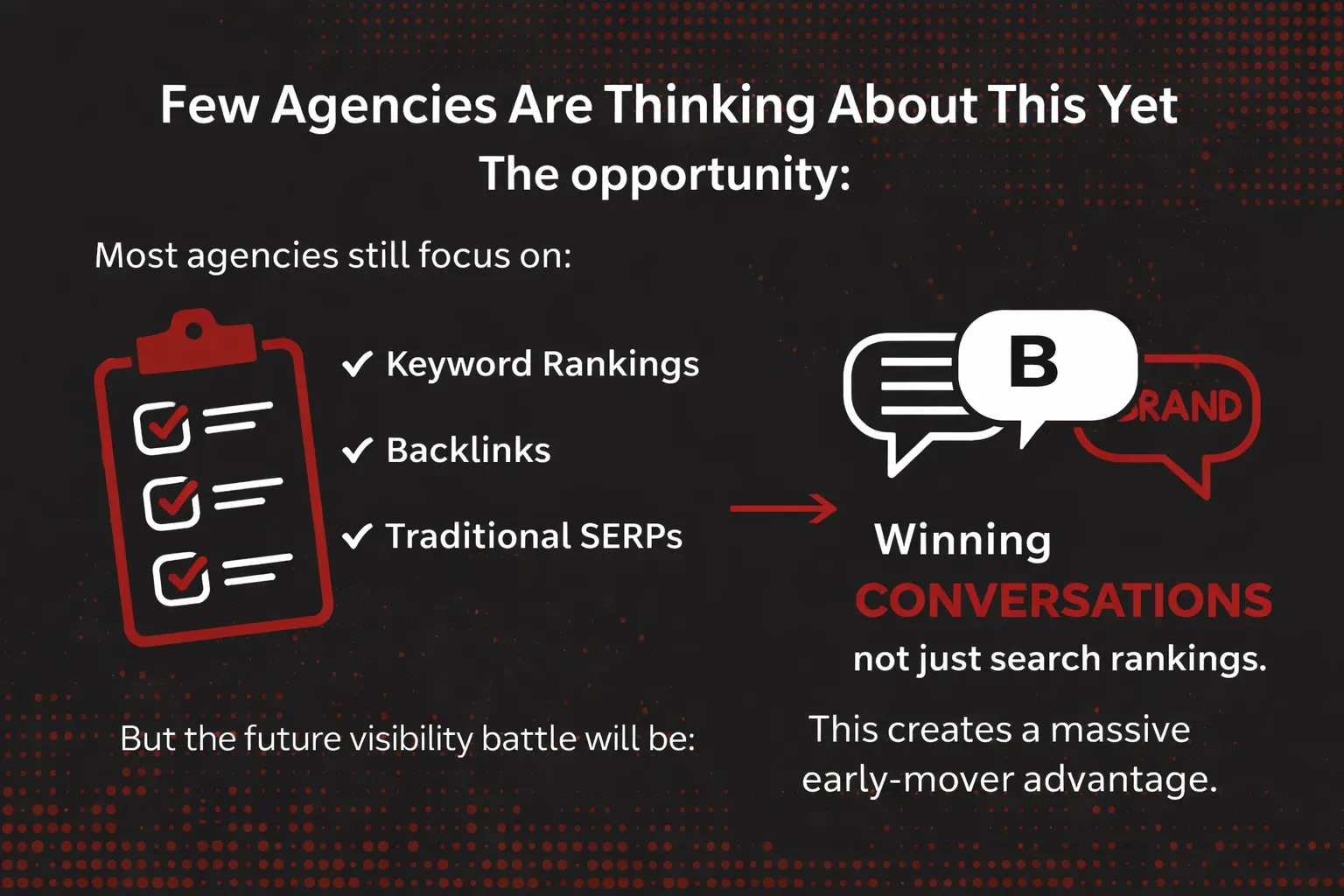
Despite the rapid rise of AI-powered search and conversational interfaces, most digital marketing agencies still focus heavily on traditional SEO practices. Their strategies typically revolve around improving keyword rankings, building backlinks, and optimizing for search engine results pages (SERPs).
While these techniques remain important, they do not fully address how information is discovered and surfaced in AI-driven environments.
Conversation engines prioritize context, authority, and active discussions rather than just static web pages. This means brands that actively participate in industry conversations and contribute valuable knowledge may gain visibility even if they do not dominate traditional rankings.
As a result, the future competition for visibility will not be limited to search engine rankings. Instead, it will revolve around winning conversations and becoming a trusted voice within AI knowledge ecosystems.
Because most agencies have not yet adapted to this shift, organizations that adopt Conversation Engine Optimization early gain a significant strategic advantage. By building authority across conversations, platforms, and knowledge networks today, they can position themselves as trusted sources in the AI-driven search landscape of tomorrow.
A Strategic Opportunity for ThatWare
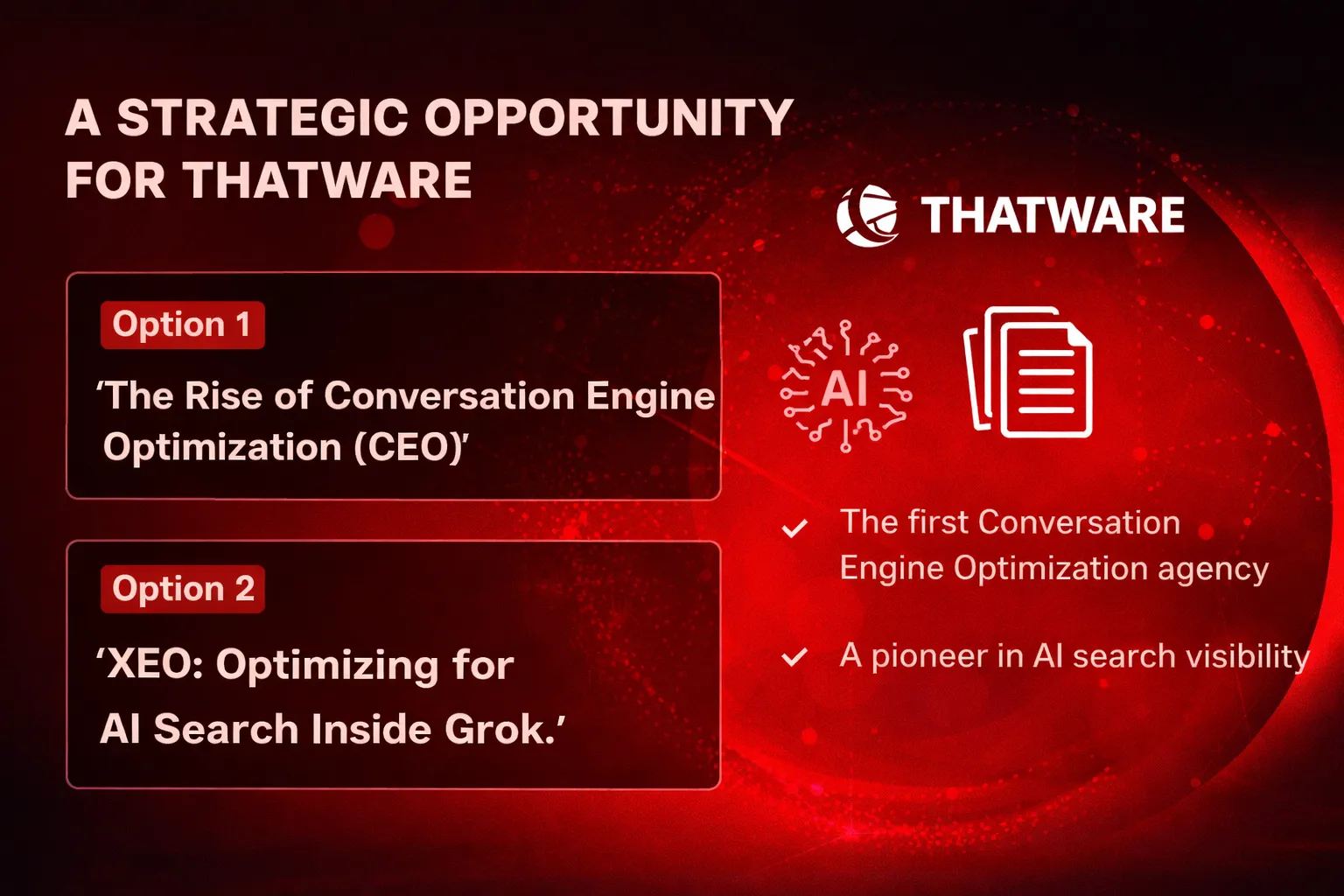
As search technology evolves from keyword-based engines to AI-driven conversational systems, there is a significant opportunity for forward-thinking companies to define the next phase of digital optimization. ThatWare is uniquely positioned to lead this transition by introducing and formalizing the concept of Conversation Engine Optimization (CEO).
One strategic way to establish this leadership is by publishing a research-driven white paper that explores how AI systems retrieve, synthesize, and present information within conversational interfaces.
Two strong research directions could include:
Option 1: “The Rise of Conversation Engine Optimization (CEO)”
This paper could introduce the concept of optimizing digital presence for AI-driven conversations. It would examine how conversational interfaces such as ChatGPT, Gemini, Claude, and Grok retrieve information and how brands can structure their content, authority signals, and entity relationships to appear in AI-generated answers.
Option 2: “XEO: Optimizing for AI Search Inside Grok.”
This paper could focus specifically on Grok’s ecosystem and how its integration with real-time discussions on X (formerly Twitter) creates a new layer of optimization. It would explore how engagement signals such as threads, discussions, community responses, and sentiment influence AI-generated responses.
Publishing a pioneering research paper around these topics would allow ThatWare to shape the emerging conversation around AI visibility and digital discoverability. More importantly, it would position the company as:
- The first agency specializing in Conversation Engine Optimization (CEO)
- A pioneer in AI search visibility and conversational search strategy
By defining the terminology, frameworks, and methodologies for this new discipline, ThatWare can establish early authority in a space that most digital marketing agencies have not yet begun to explore.
The Future of Search
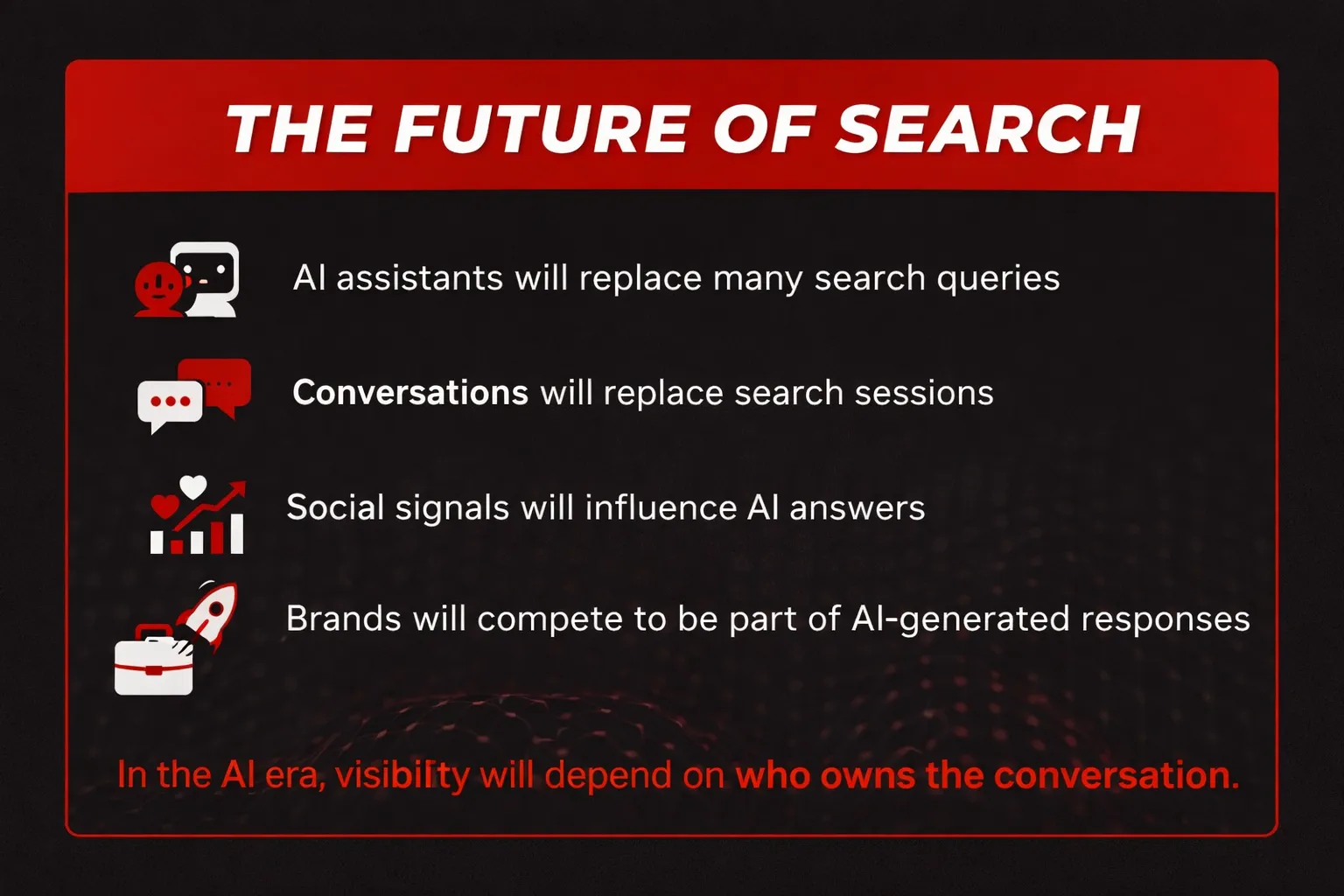
Search is entering a fundamental transformation. For more than two decades, information discovery has been dominated by traditional search engines that rely on ranking web pages in response to keyword queries. However, AI-powered systems are shifting the paradigm toward interactive conversations rather than static search results.
Several trends are likely to define the future of search:
AI assistants will replace many traditional search queries.
Instead of typing keywords and browsing multiple websites, users increasingly ask AI assistants direct questions and receive synthesized answers instantly.
Conversations will replace search sessions.
Search will become a continuous dialogue where users refine questions, explore topics, and receive contextual responses within the same interaction.
Social and real-time signals will influence AI answers.
Platforms that capture live discussions—such as social media communities and professional networks—may become critical sources of insight for conversational AI systems.
Brands will compete to be part of AI-generated responses.
The next frontier of digital marketing will not simply be ranking on search engine result pages. Instead, brands will compete to be referenced, cited, and recommended within AI-generated answers.
Ultimately, the rules of online visibility are being rewritten. In the era of conversational AI, success will no longer depend solely on who ranks highest in search engines. Instead, it will depend on who becomes part of the conversation.
In the AI era, visibility will belong to those who own the conversation.