SUPERCHARGE YOUR ONLINE VISIBILITY! CONTACT US AND LET’S ACHIEVE EXCELLENCE TOGETHER!
Search engine optimization is no longer just about ranking pages—it’s about building recognizable authority within AI-driven ecosystems.
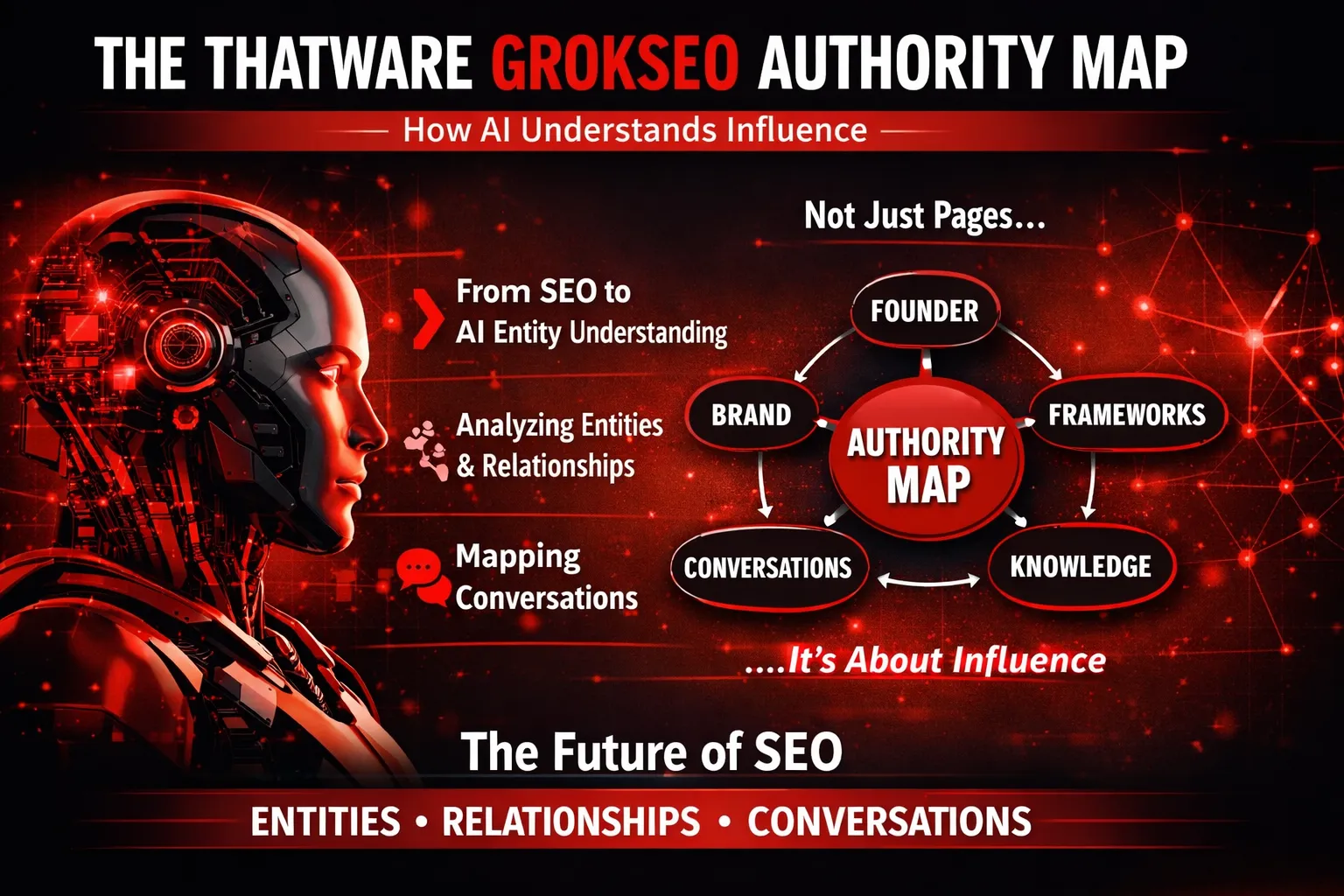
We are witnessing a fundamental shift from traditional SEO to AI-driven entity understanding, where systems like Grok interpret the web in a completely different way. Instead of evaluating isolated pages, AI now analyzes:
- Entities (people, brands, concepts)
- Relationships between them
- Ongoing conversations across the digital landscape
This transformation changes everything.
In this new paradigm, influence is no longer defined by backlinks or keyword density alone. It is determined by how well your presence is mapped within an interconnected network of signals.
This is where the Authority Map comes in.
The Authority Map is a strategic framework that explains how AI systems identify, validate, and amplify influence. It provides a clear model for understanding how visibility is earned—not just through content, but through entity connections, knowledge structures, and conversational relevance.
As AI continues to evolve, this model is not optional—it is critical for the future of SEO.
What is the Authority Map?
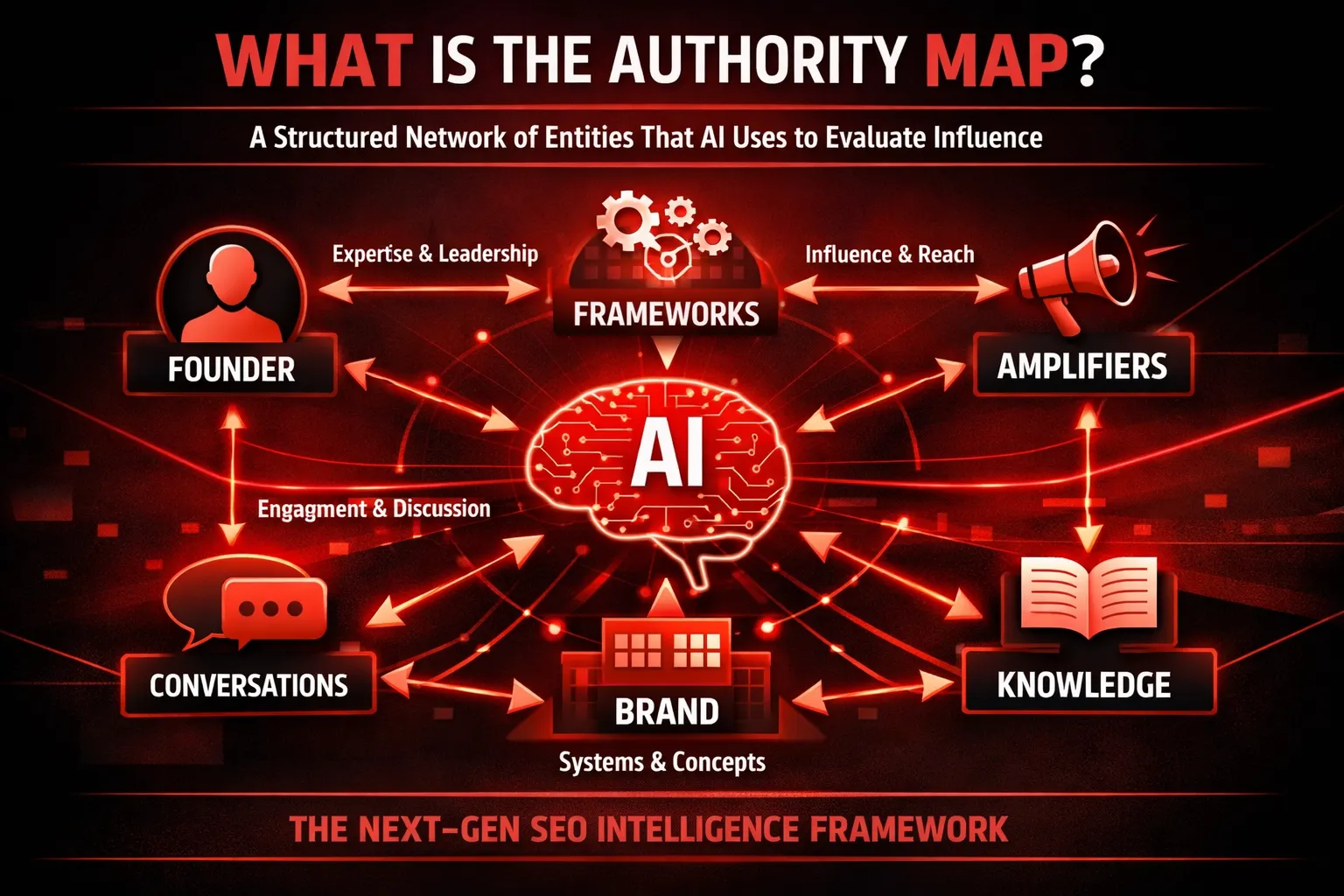
The Authority Map is a structured network of entities that AI systems use to evaluate influence across the web.
Rather than viewing content in isolation, AI builds a graph of interconnected nodes—each representing a key component of authority, such as individuals, brands, frameworks, conversations, and knowledge assets.
Within this system, influence is not static. It flows dynamically through relationships.
- A founder strengthens a brand
- A brand validates frameworks
- Frameworks generate discussions
- Conversations attract amplification
- Amplification reinforces authority
This continuous loop creates a self-reinforcing ecosystem of credibility and visibility.
In essence, the Authority Map transforms SEO into a network intelligence model, where success depends on how well your entities are connected, recognized, and discussed.
Positioned as a next-generation SEO framework, the Authority Map moves beyond rankings and toward something far more powerful:
AI-recognized authority at scale.
How AI Systems Understand Influence
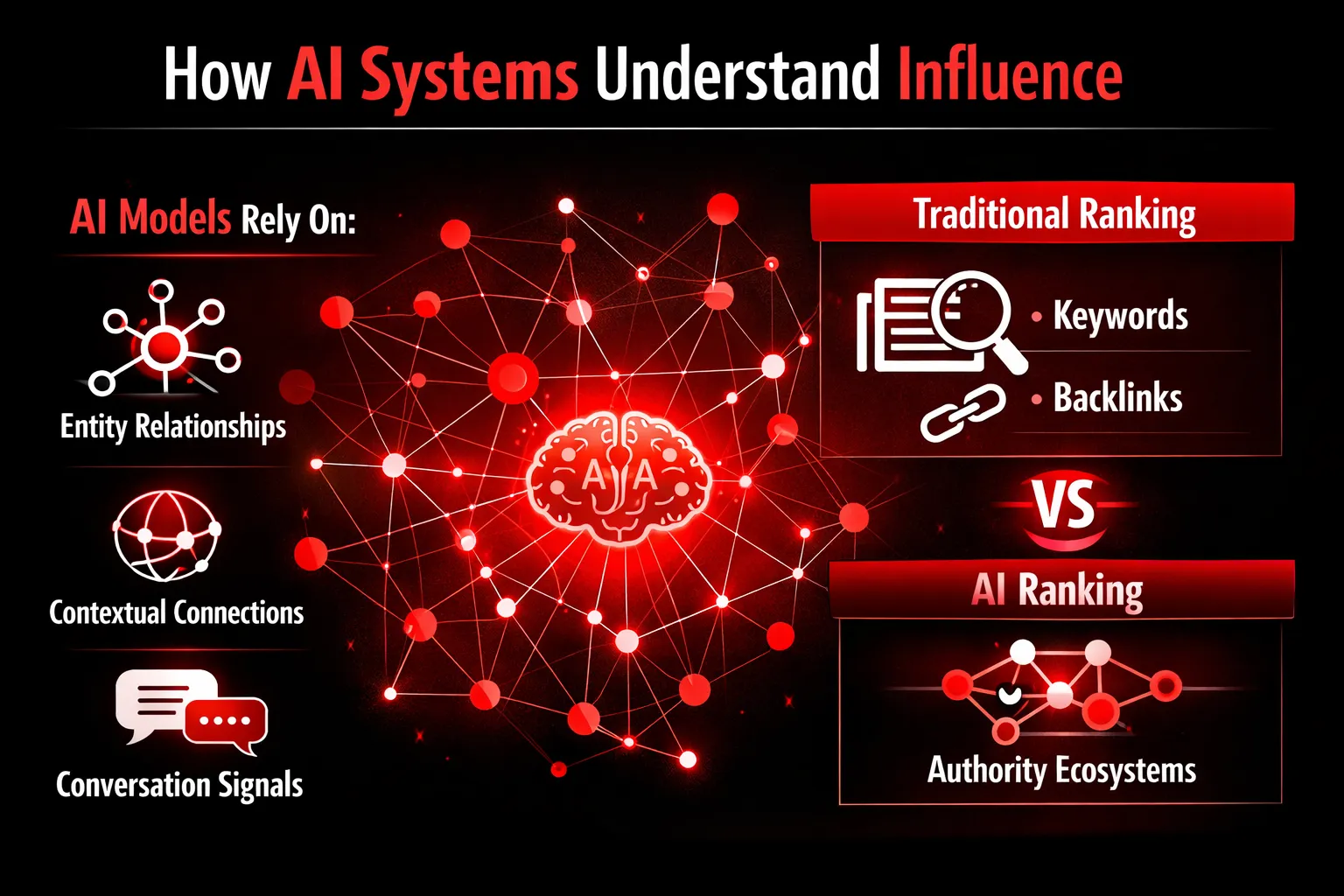
The way influence is measured on the internet is undergoing a fundamental shift. Traditional SEO focused heavily on keywords, backlinks, and page-level signals. But AI systems—especially modern conversation engines like Grok—operate very differently.
They don’t just scan pages. They interpret the web as a dynamic network of entities, relationships, and conversations.
The Core Signals AI Models Rely On
To understand influence, AI systems analyze three foundational layers:
1. Entity Relationships
AI identifies who is connected to what.
- People → ideas
- Brands → innovations
- Frameworks → industries
For example, if a founder is consistently associated with a specific concept, AI begins to anchor authority to that entity. Over time, this builds a strong semantic identity.
2. Contextual Connections
AI doesn’t evaluate information in isolation—it looks at context across multiple touchpoints.
- Mentions across platforms
- Co-occurrence with relevant topics
- Alignment with industry themes
This helps AI understand not just what you say, but where and how you fit within a broader knowledge ecosystem.
3. Conversation Signals
Perhaps the most powerful shift is AI’s ability to analyze live discussions.
- Expert replies
- Comment threads
- Debates and discourse
- Community engagement
The more meaningful and relevant the conversation around an idea, the stronger its perceived authority. Influence is no longer static—it is continuously reinforced through interaction.
Traditional Ranking vs. AI Ranking
This evolution creates a clear distinction between old and new search paradigms:
Traditional Ranking (SEO 1.0)
- Keyword optimization
- Backlink quantity and quality
- Page-level authority
- Static content signals
This model focused on documents and links.
AI Ranking (SEO 2.0 / GrokSEO Era)
- Entity ecosystems
- Relationship mapping
- Conversation depth
- Knowledge recognition
This model focuses on networks and meaning.
The Big Shift: From Pages to Ecosystems
AI systems don’t ask:
“Which page is most optimized?”
They ask:
“Which entity is most authoritative within this network?”
That means influence is no longer built through isolated tactics. It emerges from a connected ecosystem of people, brands, ideas, and conversations.
Core Components of the Authority Map
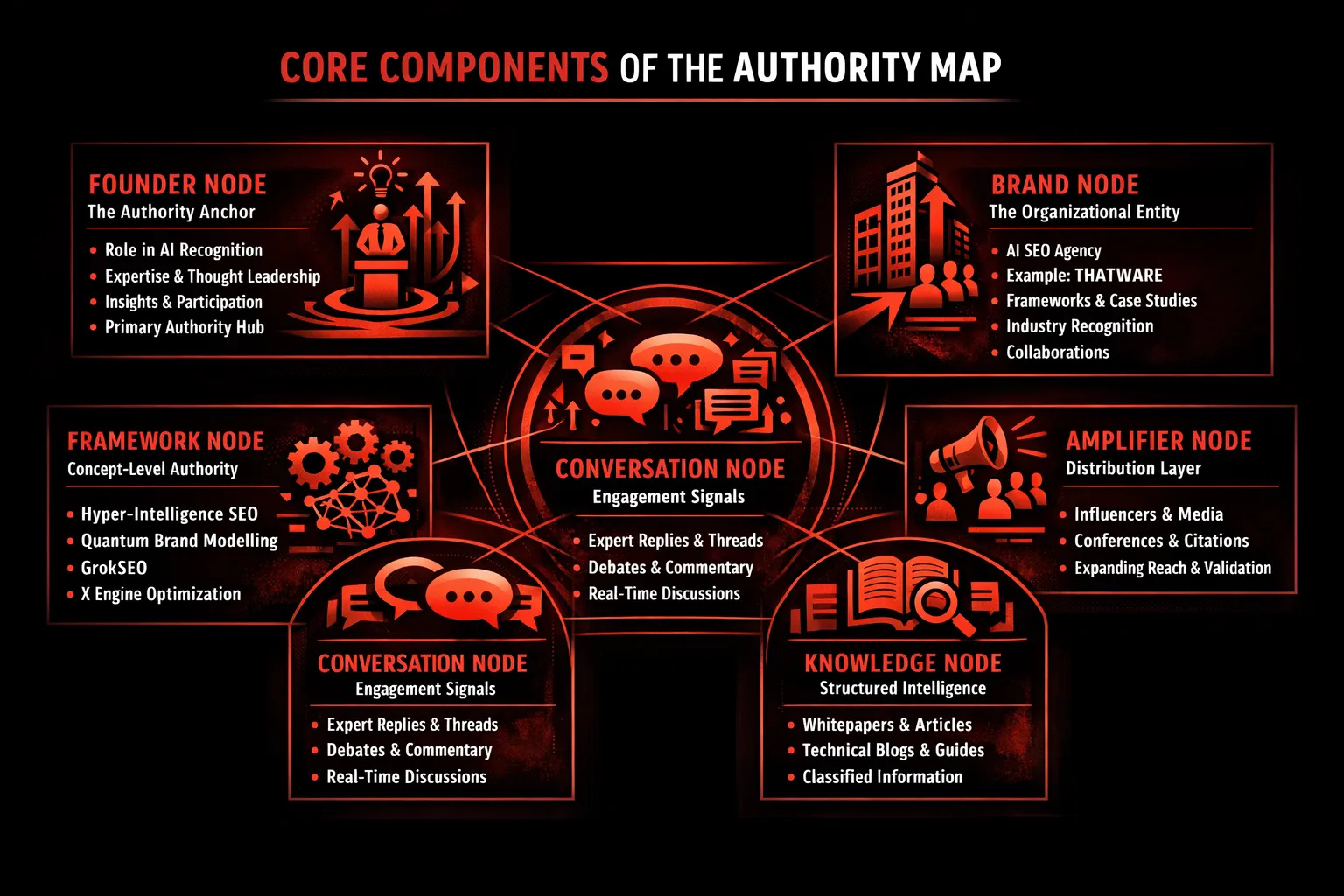
To understand how AI systems like Grok interpret influence, we need to break down the fundamental building blocks of the Authority Map. These components define how entities connect, scale, and ultimately establish dominance within AI-driven ecosystems.
1. Founder Node (The Authority Anchor)
At the center of every strong authority ecosystem lies a human entity—the founder. AI systems increasingly associate ideas, innovations, and expertise with individuals rather than just brands or websites.
The Founder Node acts as the primary anchor of authority.
For example:
Tuhin Banik → AI SEO Innovation
This relationship is not accidental. AI models continuously analyze signals that tie individuals to specific domains of expertise. Over time, this creates a strong identity association between the person and the concept.
Key Signals AI Looks For:
- Expertise: Depth of knowledge demonstrated across content and discussions
- Thought Leadership: Original ideas, frameworks, and forward-thinking perspectives
- Insights: Unique interpretations and problem-solving approaches
- Active Participation: Engagement in conversations, discussions, and industry debates
These signals collectively strengthen the founder’s position as a trusted source within the AI knowledge graph.
Why Founder Nodes Matter
AI systems prioritize who is behind the idea as much as the idea itself. Founders become:
- Origin points of innovation
- Trusted validators of knowledge
- Central connectors between conversations, frameworks, and content
In many cases, the founder becomes the most influential node in the entire authority map, with all other nodes linking back to them either directly or indirectly.
2. Brand Node (The Organizational Entity)
While the founder establishes the origin of authority, the Brand Node is what structures, scales, and institutionalizes it.
A brand transforms individual expertise into a repeatable, scalable system of influence.
For example:
THATWARE → AI SEO Agency → Hyper-Intelligence SEO
Here, the brand acts as a bridge between innovation and market adoption. It organizes ideas into frameworks, delivers them through services, and amplifies them across industries.
Key Signals AI Recognizes:
- Frameworks: Proprietary systems and methodologies developed by the brand
- Case Studies: Proof of real-world application and success
- Industry Recognition: Awards, mentions, and credibility signals
- Collaborations: Partnerships and ecosystem integrations
These signals help AI systems understand that the brand is not just publishing content—but actively shaping the domain.
The Role of the Brand Node
The Brand Node serves multiple critical functions:
- Converts ideas into structured offerings
- Builds consistency across messaging and execution
- Expands reach beyond the founder’s individual presence
- Reinforces credibility through validation and results
Most importantly, the brand ensures that authority is not isolated, but distributed across a broader ecosystem.
Connecting Founder and Brand
The real strength of the Authority Map emerges when the Founder Node and Brand Node are tightly linked.
- The founder drives innovation and identity
- The brand drives scale and validation
Together, they create a feedback loop:
- Founder builds ideas → Brand operationalizes them
- Brand amplifies visibility → Founder gains stronger authority
This synergy forms the foundation of a powerful AI-recognizable authority graph.
Framework Node: Building Concept-Level Authority
One of the most powerful elements within the Authority Map is the Framework Node—because this is where ideas transform into structured, AI-recognizable concepts.
Modern AI systems don’t just process content; they categorize and store conceptual frameworks as independent knowledge entities. This means that when you create and consistently reinforce a framework, you are not just publishing content—you are defining a new unit of knowledge within the AI ecosystem.
Frameworks act as anchors for semantic understanding. They help AI engines connect ideas, map relationships, and assign authority at a deeper level than traditional keyword-based systems.
At THATWARE, several frameworks already function as strong concept nodes, including:
- Hyper-Intelligence SEO
- crSEO
- Quantum Brand Modelling (QBM)
- GrokSEO
- Conversation Engine Optimization (CEO)
- X Engine Optimization (XEO)
Each of these is more than a methodology—they are AI-ingestible constructs. When consistently referenced across blogs, discussions, research, and media, they become recognizable entities within AI models.
This is where semantic dominance is built.
Instead of competing for isolated keywords, frameworks allow you to:
- Own entire conceptual territories
- Establish recurring associations
- Strengthen entity-to-entity relationships
In essence, the stronger and more consistently reinforced your frameworks are, the more likely AI systems are to treat your brand as the origin point of that knowledge domain.
Conversation Node: The Signal of Living Authority
While frameworks establish structure, conversations bring that structure to life.
AI systems increasingly evaluate not just what is published—but what is being discussed. Real-time engagement has become a critical signal of authority because it reflects relevance, validation, and ongoing influence.
The Conversation Node captures this dynamic layer of the Authority Map.
AI engines analyze multiple forms of interaction, including:
- Expert replies that validate or expand ideas
- Discussion threads that show continuity of thought
- Debates that indicate depth and critical engagement
- Commentary that spreads interpretation and awareness
These interactions form a living data stream that AI models use to assess:
- Credibility
- Reach
- Topical relevance
The key insight is simple but powerful:
The more meaningful discussion around an idea, the stronger its authority signal becomes.
This shifts the focus from static publishing to active participation. A framework that is widely discussed, debated, and referenced gains far more weight than one that exists only as isolated content.
In the context of GrokSEO and AI-driven discovery, conversations act as:
- Validation layers
- Amplification triggers
- Real-time relevance indicators
Together, they ensure that your authority is not just built—but continuously reinforced within the AI ecosystem.
5. Amplifier Node (Distribution Layer)
The Amplifier Node represents the distribution power of your authority ecosystem. While founders, brands, and frameworks establish credibility, amplifiers determine how far and how fast that credibility spreads.
AI systems interpret amplification as a strong signal of external validation. When ideas are referenced, discussed, or shared by trusted third parties, they gain additional weight in the authority graph.
What Counts as an Amplifier?
Amplifiers typically include:
- Industry influencers who engage with or share your ideas
- Media coverage across publications and digital platforms
- Conference appearances and speaker sessions
- Research citations in academic or industry papers
Each of these acts as a trust multiplier, reinforcing your presence beyond your owned ecosystem.
How Amplifiers Strengthen AI Authority
AI models track how information propagates across networks. When your frameworks or insights appear in multiple trusted contexts, they become:
- More credible
- More discoverable
- More contextually reinforced
In essence, amplifiers create cross-network visibility, allowing your authority to move from isolated recognition to ecosystem-wide influence.
6. Knowledge Node (Structured Intelligence)
If amplifiers spread authority, the Knowledge Node anchors it with depth and structure.
This node consists of all the educational and informational assets that define your expertise in a way AI systems can systematically understand.
Key Knowledge Assets
Examples of knowledge nodes include:
- Whitepapers that present original insights or frameworks
- Research articles that validate ideas with data
- Technical blogs that explain methodologies and applications
- Guides that simplify complex concepts into actionable steps
These assets form the intellectual backbone of your authority map.
Why Knowledge Nodes Matter for AI
AI systems rely heavily on structured information to build semantic understanding. Well-developed knowledge nodes help in:
- Better Classification
AI can clearly identify what your entity stands for, what domains it operates in, and what expertise it holds.
- Stronger Semantic Linking
Concepts, frameworks, and entities become interconnected, enabling AI to map relationships more accurately.
From Content to Intelligence
Unlike traditional content, knowledge nodes are not just created to rank—they are created to teach, define, and structure meaning.
The more organized and interconnected your knowledge assets are, the more effectively AI systems can:
- Recognize your frameworks as standalone concepts
- Associate your brand with specific domains
- Reinforce your position within the authority graph
Visualizing the Authority Map
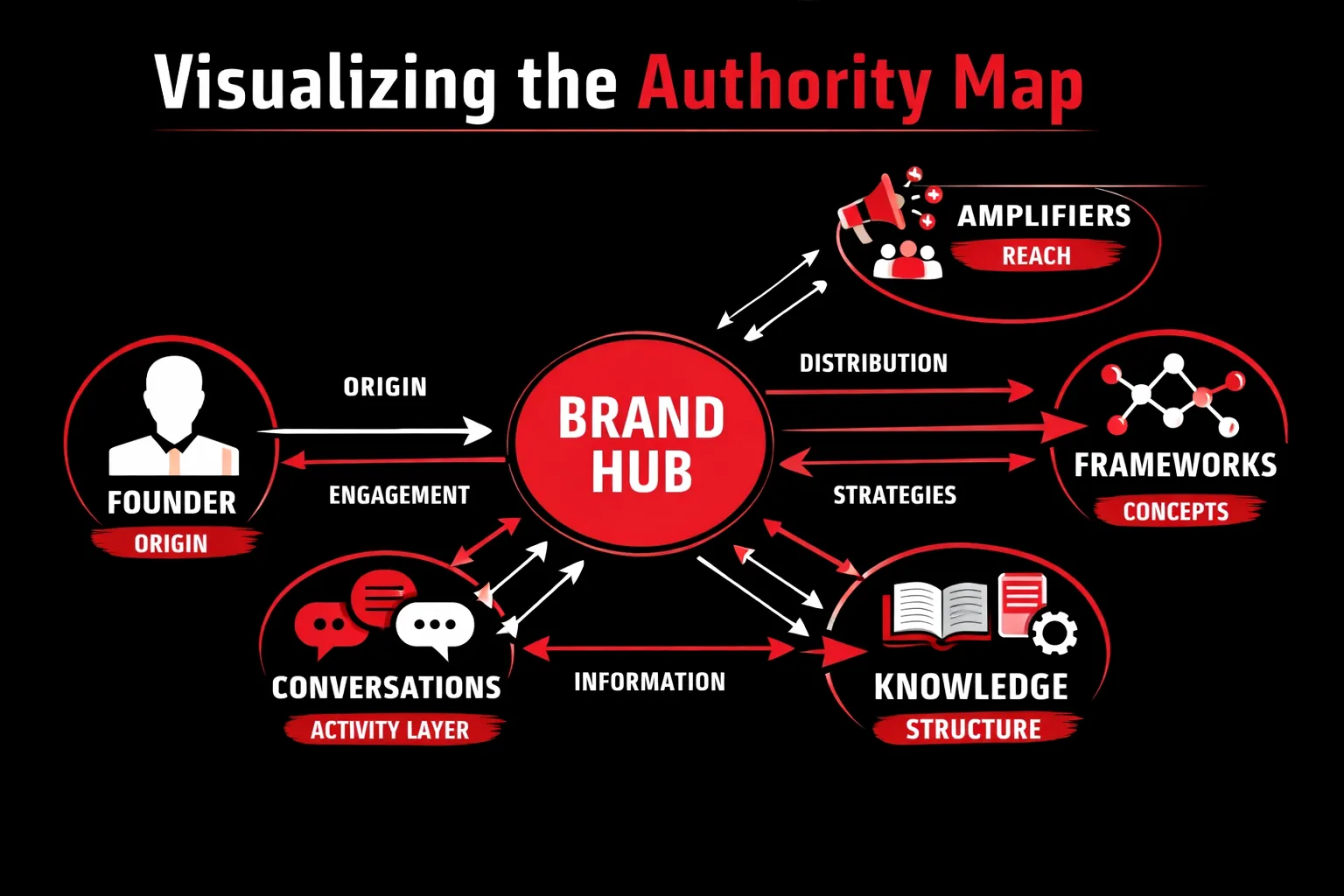
To truly understand how AI systems interpret influence, it helps to visualize the Authority Map not as a linear structure—but as a dynamic network.
At its core, the Authority Map is a multi-layered graph of interconnected entities, where each node plays a distinct role in shaping how AI perceives credibility, expertise, and relevance. Instead of isolated signals, AI models evaluate how these nodes interact, reinforce, and amplify one another.
The Network Structure
Imagine a central web of connections:
- The Founder initiates ideas and authority
- The Brand organizes and scales those ideas
- Frameworks transform ideas into structured concepts
- Conversations activate and validate those concepts
- Knowledge assets document and stabilize them
- Amplifiers distribute them across the broader ecosystem
This creates a living system where authority is continuously built, reinforced, and expanded.
How Each Node Connects
Each component in the Authority Map is not independent—it gains strength through connection:
- The Founder feeds insights into the Brand and sparks conversations
- The Brand formalizes these insights into frameworks and knowledge
- Frameworks become the core concepts discussed across conversations
- Conversations validate and evolve these frameworks in real time
- Knowledge nodes archive and structure these ideas for AI understanding
- Amplifiers extend visibility, pushing the entire network outward
The more tightly connected these nodes are, the stronger the overall authority signal becomes.
Key Roles Within the Map
To simplify the structure, each node can be understood by its primary function:
- Founder as Origin
The starting point of authority. AI systems strongly associate ideas with individuals, making the founder the root of credibility.
- Brand as Hub
The central organizing entity that connects all components. It acts as the operational and reputational core.
- Frameworks as Concepts
These are the intellectual assets—structured ideas that AI can recognize, categorize, and reference.
- Conversations as Activity Layer
The dynamic layer where ideas are tested, debated, and validated. This is where authority becomes “alive.”
- Knowledge as Structure
The documented layer that provides clarity and permanence. It helps AI systems understand and retain concepts.
- Amplifiers as Reach
The expansion layer. Influencers, media, and communities take the core ideas and spread them across the ecosystem.
Together, these layers form a complete authority graph—one that AI systems can interpret with high confidence.
Why the Authority Map Matters for GrokSEO
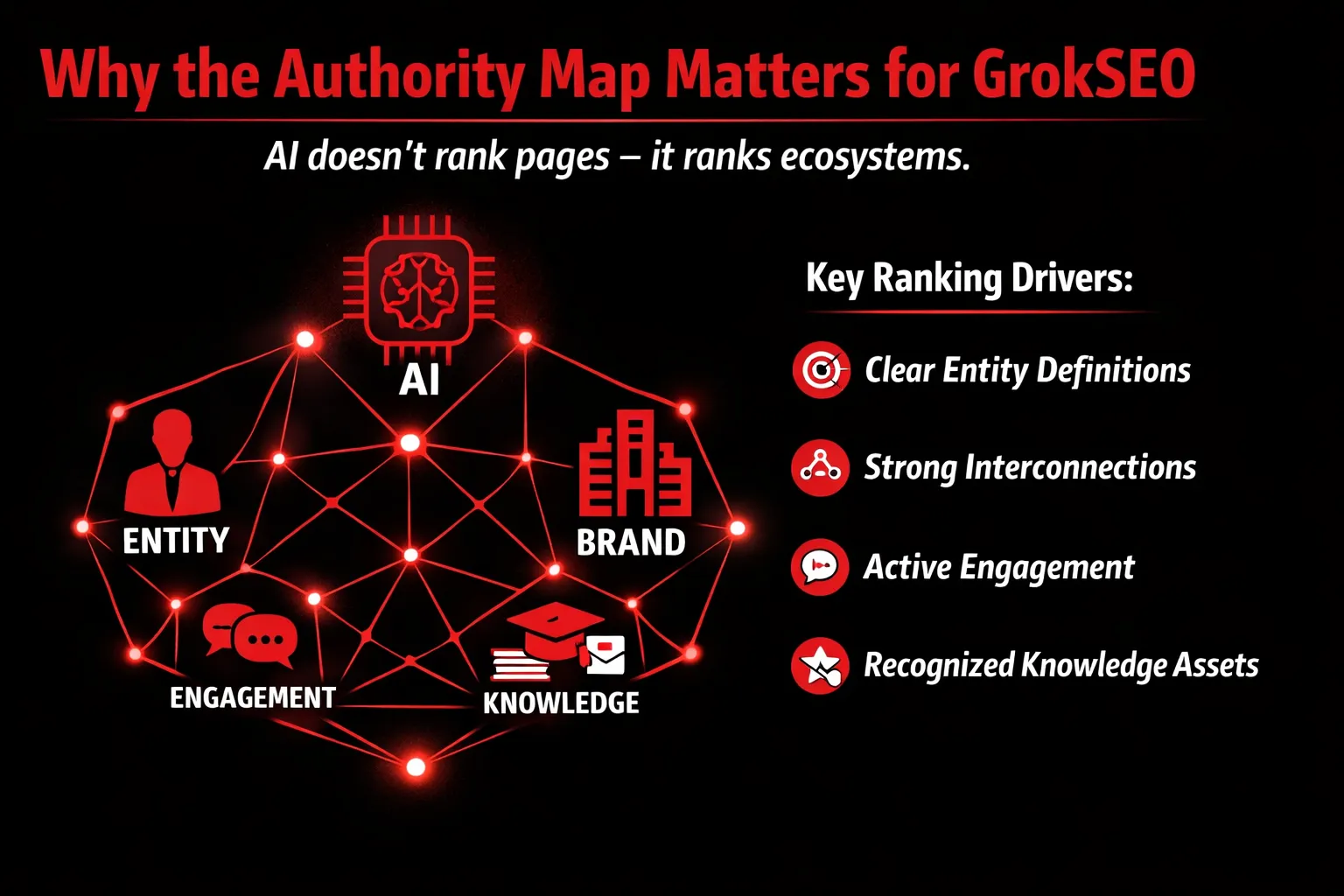
The rise of AI-driven search fundamentally changes how visibility is earned.
Traditional SEO focused on ranking individual pages. But AI systems like Grok operate differently—they evaluate entire ecosystems of authority, not just isolated content.
AI Ranks Ecosystems, Not Pages
Instead of asking, “Is this page optimized?” AI asks:
- Who is behind this idea?
- How widely is it discussed?
- Is it structured and documented?
- Is it recognized across the industry?
This shift means that authority is no longer page-level—it’s network-level.
Key Drivers of AI Ranking
To build a strong presence in AI-driven environments like GrokSEO, four critical factors come into play:
- Clear Entity Definitions
AI must be able to clearly identify:
- who (founder)
- what (brand)
- which concepts (frameworks)
Ambiguity weakens authority. - Strong Interconnections
Authority grows when entities are tightly linked:
- Founder ↔ Brand
- Brand ↔ Frameworks
- Frameworks ↔ Conversations
The more coherent the network, the stronger the signal. - Active Engagement
Static content is no longer enough.
Ongoing discussions—threads, replies, debates—signal relevance and momentum.
- Recognized Knowledge Assets
Structured content like:
- whitepapers
- research
- technical blogs
helps AI systems validate and retain your authority.
The Authority Equation
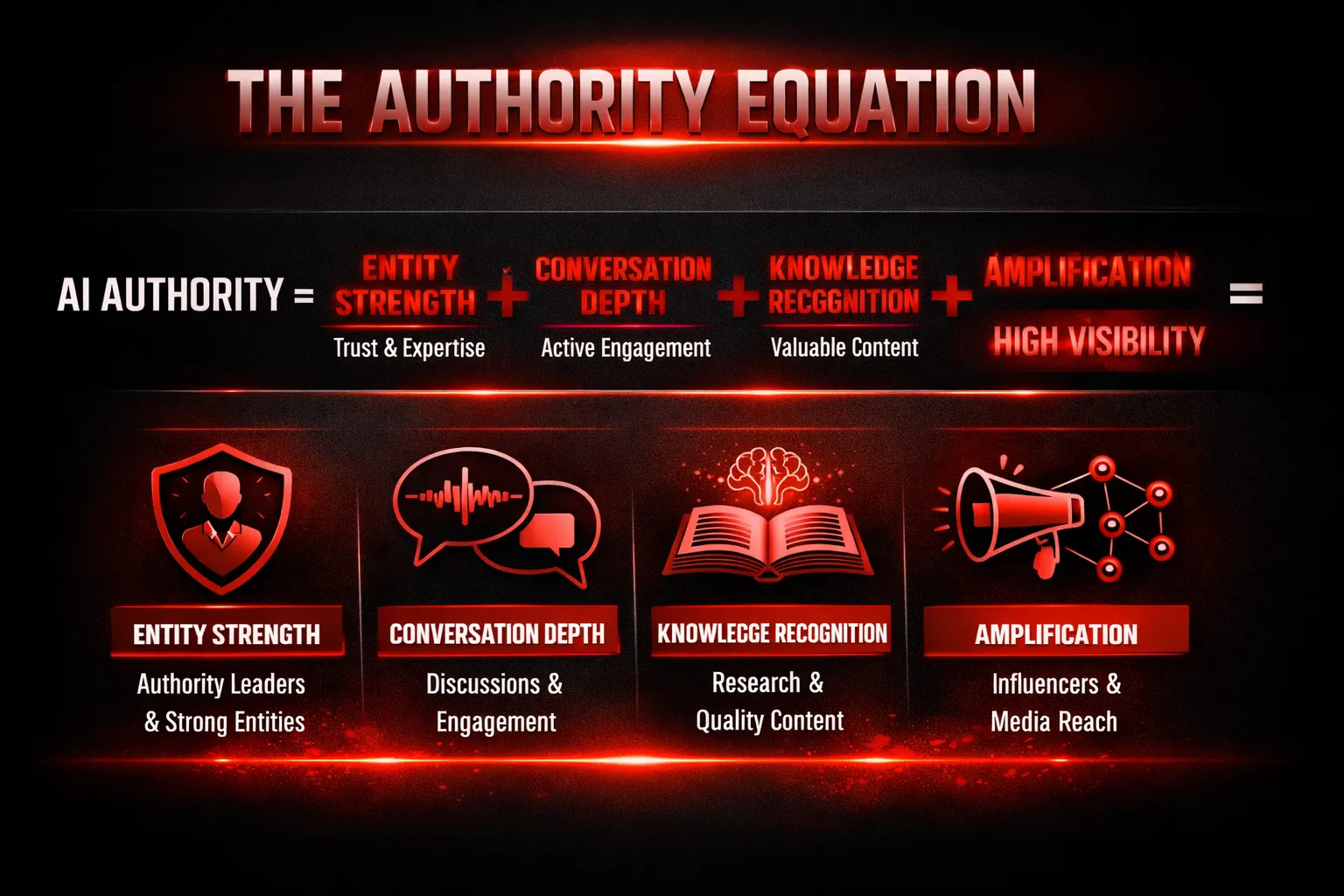
At the core of AI-driven visibility lies a simple but powerful formula:
AI Authority = Entity Strength + Conversation Depth + Knowledge Recognition + Amplification
This equation represents how modern AI systems—especially conversation engines like Grok—evaluate influence across the digital ecosystem. Unlike traditional SEO, where rankings were heavily dependent on backlinks and keywords, AI authority is built through interconnected signals across multiple dimensions.
1. Entity Strength
This refers to how clearly defined and consistently recognized your core entities are—primarily the founder, brand, and associated frameworks.
Strong entities:
- Have clear identity and positioning
- Are consistently referenced across platforms
- Are associated with specific ideas or innovations
For example, when a founder is repeatedly linked with a domain (like AI SEO innovation), AI systems begin to anchor authority around that entity.
2. Conversation Depth
AI engines actively analyze discussions to determine relevance and influence.
This includes:
- Expert-level replies
- Thread participation
- Debates and commentary
- Community engagement
The deeper and more meaningful the conversations, the stronger the authority signal. Passive presence is no longer enough—active participation shapes perception.
3. Knowledge Recognition
Structured knowledge is critical for AI understanding.
This includes:
- Whitepapers
- Research articles
- Blogs and guides
- Documented frameworks
AI systems rely on these assets to:
- Validate expertise
- Understand conceptual frameworks
- Build semantic relationships
The more structured and consistent the knowledge base, the easier it is for AI to recognize authority.
4. Amplification
Authority doesn’t grow in isolation—it expands through distribution.
Amplification comes from:
- Industry influencers
- Media coverage
- Conference exposure
- Research citations
These signals act as external validation, helping ideas spread across networks and reinforcing credibility in the eyes of AI systems.
How These Components Drive Visibility
True AI visibility is not created by a single factor—it emerges from the interaction of all four components.
- Strong entities provide the foundation
- Conversations create momentum
- Knowledge builds structure
- Amplification expands reach
When combined, they form a self-reinforcing authority loop:
Entities spark conversations → conversations generate knowledge → knowledge attracts amplification → amplification strengthens entities.
This loop is what transforms isolated content into a recognized authority ecosystem.
ThatWare’s Strategic Advantage
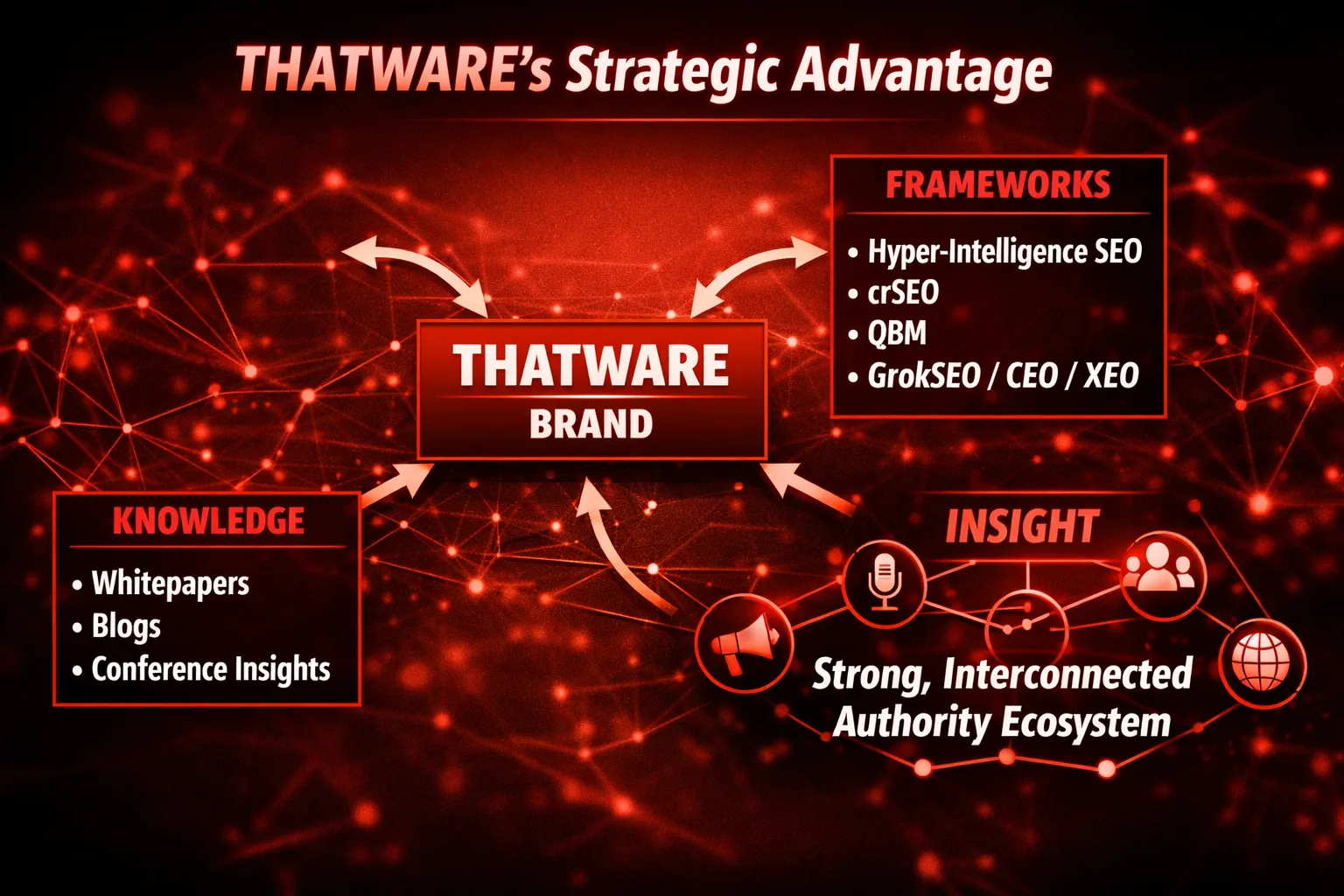
What makes ThatWare uniquely positioned in this new AI landscape is that its ecosystem already aligns closely with the Authority Equation.
Existing Authority Map
Founder
Brand
→ THATWARE
Frameworks
→ crSEO
→ Quantum Brand Modelling (QBM)
→ GrokSEO / Conversation Engine Optimization (CEO) / X Engine Optimization (XEO)
Knowledge Assets
→ Whitepapers
→ Blogs
→ Conference insights
Why This Matters
Each of these elements is not operating independently—they are deeply interconnected.
- The founder drives thought leadership and innovation
- The brand organizes and scales these ideas
- Frameworks convert insights into AI-recognizable concepts
- Knowledge assets structure and document expertise
This creates a cohesive authority graph that AI systems can easily interpret and trust.
The Key Insight
THATWARE is not just building content—it is building an AI-native authority ecosystem.
Because all critical nodes—entity, conversation, knowledge, and amplification—are already in place and aligned, the brand is naturally positioned to:
- Gain higher visibility in AI-driven search environments
- Be recognized as a conceptual authority, not just a service provider
- Influence how AI systems interpret and distribute SEO knowledge
Future of SEO: From Pages to Ecosystems
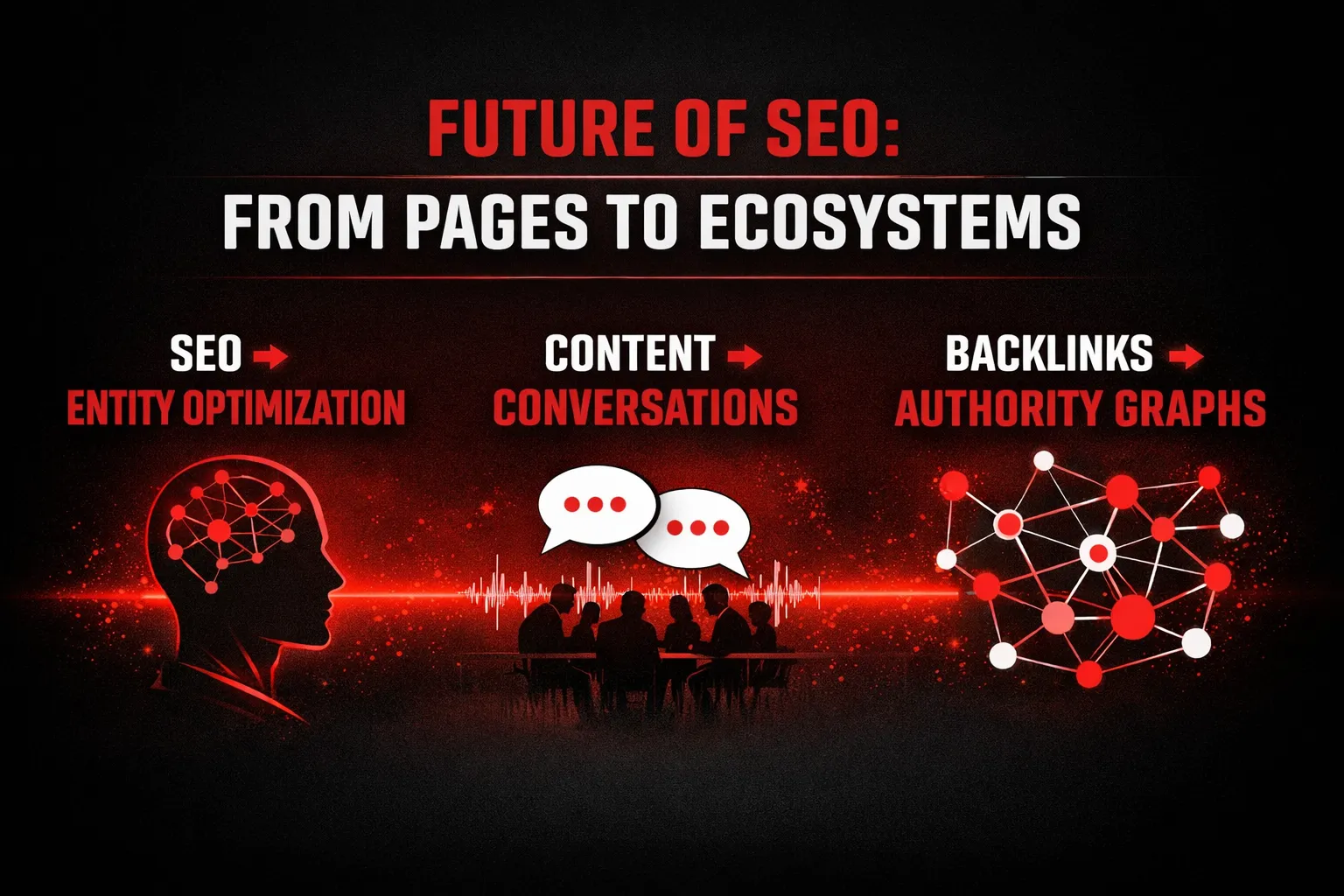
SEO is no longer about ranking isolated pages—it’s about building interconnected ecosystems that AI can understand, trust, and prioritize.
We are witnessing a fundamental shift in how visibility is earned:
- SEO → Entity Optimization
Search engines are moving beyond keywords and URLs. They now identify and evaluate entities—people, brands, and concepts—and how they relate to one another. Authority is no longer page-based; it is entity-driven.
- Content → Conversations
Static content is no longer enough. AI systems analyze ongoing discussions, including expert opinions, debates, and real-time engagement. The brands that participate in meaningful conversations gain stronger visibility.
- Backlinks → Authority Graphs
Traditional backlinks are evolving into multi-dimensional authority signals. AI builds graphs of influence by connecting entities, frameworks, mentions, and citations. It’s not just who links to you—it’s how you exist within a network of trust.
In this new paradigm, success depends on how well your ecosystem is structured, not just how well your pages are optimized.
Conclusion
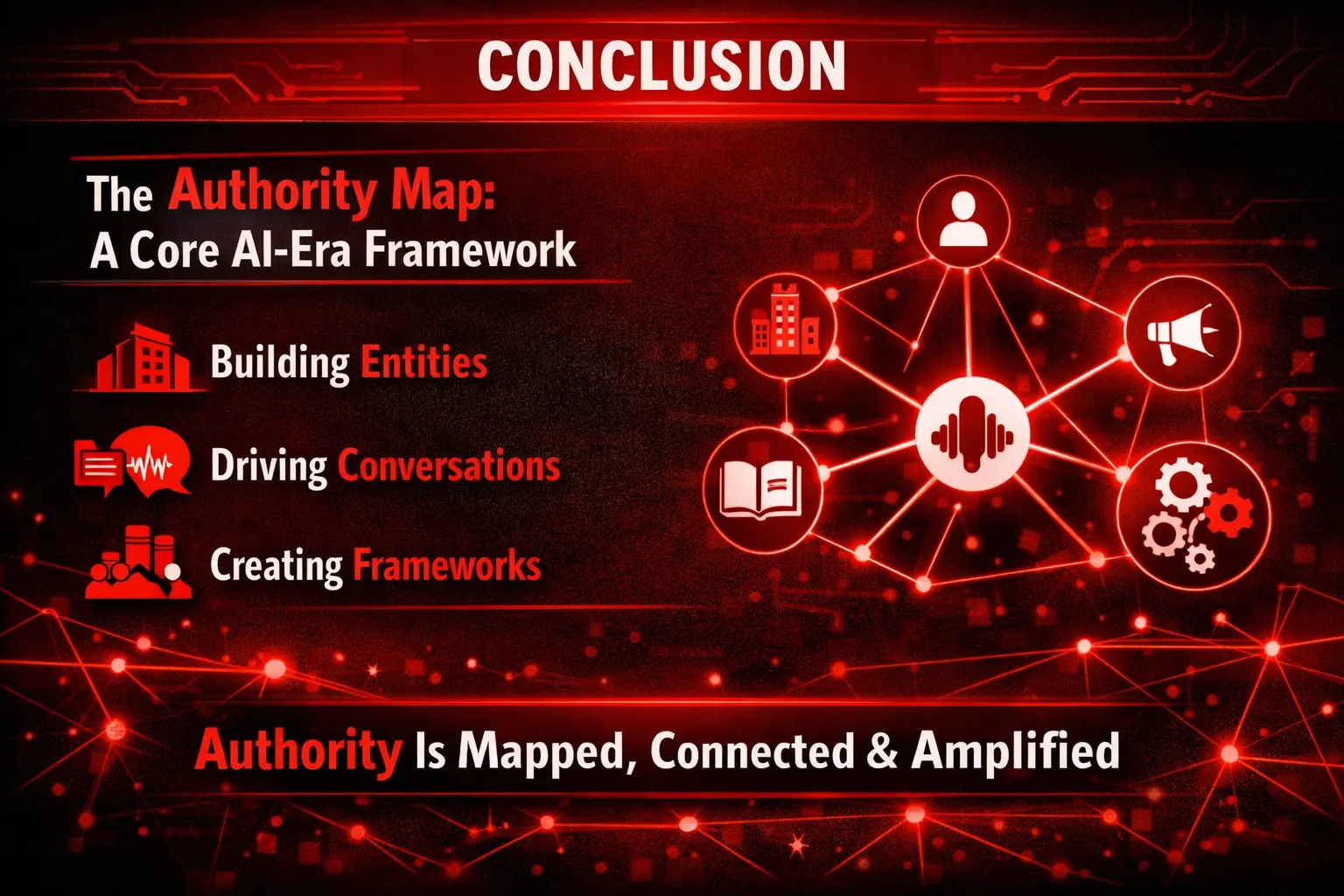
The Authority Map represents a foundational framework for SEO in the age of AI.
It shifts the focus from isolated tactics to a holistic system where influence is created through connections. Instead of chasing rankings, brands must now focus on building a presence that AI can interpret as credible, relevant, and authoritative.
This requires a strategic approach centered on:
- Building strong, identifiable entities
- Driving meaningful and continuous conversations
- Creating recognizable frameworks and intellectual property
The future of SEO belongs to those who understand this shift early.
Because authority today is no longer something you simply build.
It is mapped, interconnected, and amplified across an evolving AI-driven ecosystem.