SUPERCHARGE YOUR ONLINE VISIBILITY! CONTACT US AND LET’S ACHIEVE EXCELLENCE TOGETHER!
What to Do at Day 1, Week 1, Week 4, Month 3, and Month 6
Why SEO Recovery Is Not Instant

Website migration is often positioned as a growth enabler—better performance, cleaner architecture, improved UX, or scalability. Yet, even when a migration is executed “by the book,” a temporary drop in organic traffic is surprisingly common. This dip doesn’t always indicate failure; instead, it reflects how search engines reassess and rebuild trust in a changed website.
At its core, SEO recovery after migration is delayed because Google must reprocess an enormous set of signals. URLs change, redirects need to be interpreted, internal links are re-evaluated, content is re-indexed, and link equity has to be reassigned. Even with perfect 301 redirects, Google does not instantly transfer all ranking signals. It crawls, compares, tests, and gradually recalibrates—often over weeks or months, not days.
One of the biggest misconceptions around migration SEO is the idea that everything can be “fixed” in the first week. Many teams panic when rankings drop and start making aggressive changes too quickly—rewriting content, changing URLs again, or altering site structure—only compounding the problem. SEO recovery is not a single checklist; it’s a phased process where each stage builds on the stability of the previous one.
This challenge applies across nearly all migration types, including:
- Domain changes, where trust and authority must be reassigned
- HTTPS migrations, which seem simple but often hide technical pitfalls
- CMS migrations, where templates, metadata, and rendering can change
- URL structure redesigns, which impact internal linking and crawl paths
- Platform or headless migrations, which introduce new technical complexity
Each of these migrations disrupts search signals in different ways, but the recovery principle remains the same: timing and prioritization matter more than speed.
In this article, you’ll learn how to approach SEO recovery using a time-bound recovery framework that aligns with how search engines actually work. We’ll break down:
- What to focus on at Day 1, Week 1, Week 4, Month 3, and Month 6
- Clear priorities at each stage to avoid reactive mistakes
- The right KPIs to track recovery correctly, so you know when to act—and when to wait
By the end, you’ll have a realistic, structured roadmap to move from post-migration volatility to long-term organic growth with confidence.
Understanding the SEO Recovery Curve After Migration
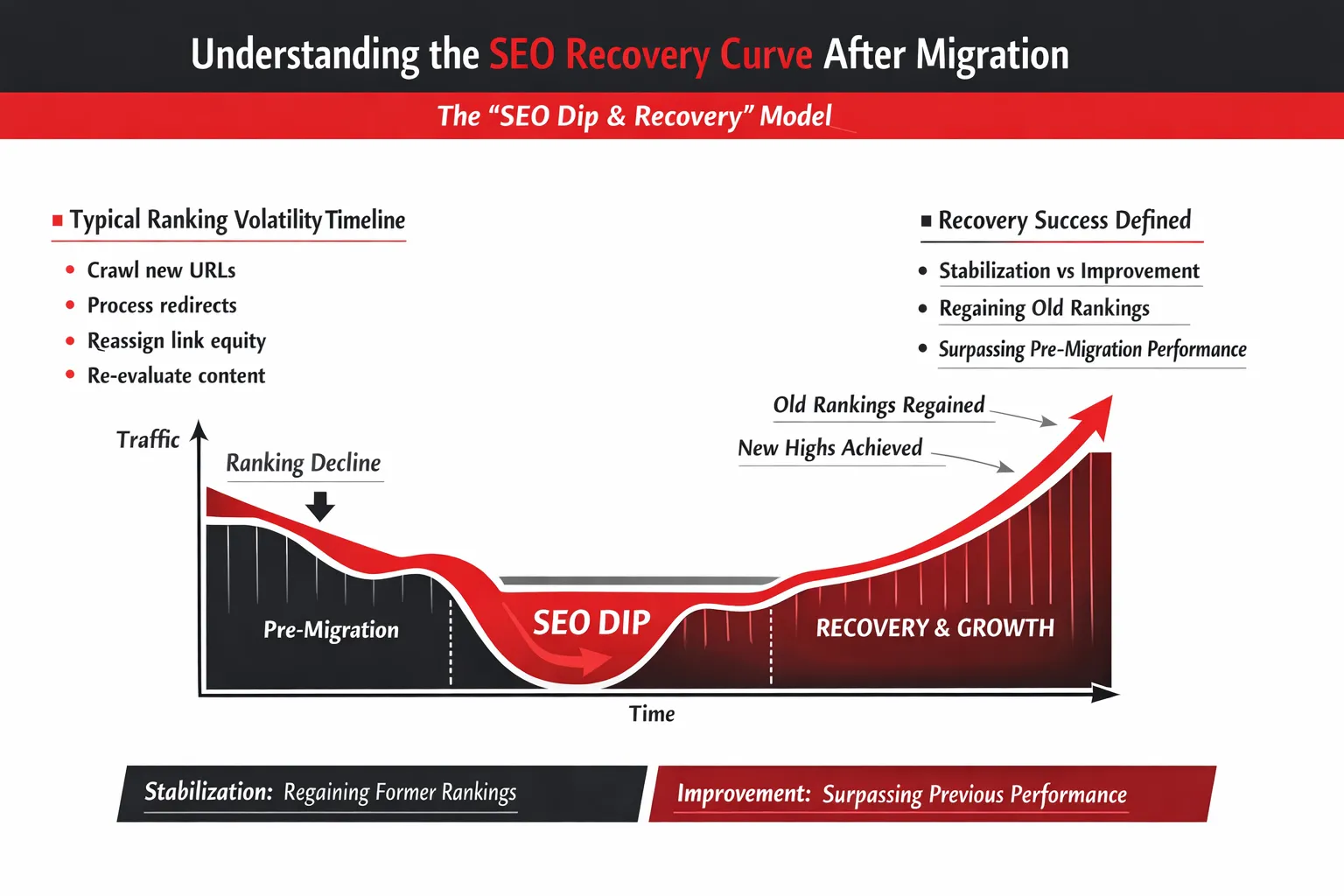
One of the most misunderstood aspects of website migration is how search visibility behaves immediately after launch. Many stakeholders expect rankings and traffic to remain stable if the migration was “done right.” In reality, even well-executed migrations usually follow a predictable SEO Dip & Recovery curve.
The SEO Dip & Recovery Model Explained
After migration, it’s common to see ranking volatility within the first few days to weeks. This happens because Google must essentially “re-learn” your website in its new form. The typical timeline looks like this:
- Days 1–7: Initial volatility
Rankings may fluctuate sharply, and organic traffic often drops as Google begins crawling the new URLs.
- Weeks 2–4: Stabilization phase
Redirects start consolidating signals, indexation improves, and rankings begin to settle.
- Months 2–4: Recovery and growth
If migration signals are clean, rankings gradually return—and often exceed previous levels.
This volatility isn’t a penalty. It’s a reprocessing phase.
Why Google Needs Time After a Migration
Google doesn’t instantly transfer SEO value from your old site to the new one. Several complex processes happen in parallel:
- Crawling new URLs: Google must discover, crawl, and understand every new page structure.
- Processing redirects: 301 redirects need time to be crawled repeatedly before link signals consolidate.
- Reassigning link equity: Authority from backlinks pointing to old URLs must be transferred to new destinations.
- Re-evaluating content relevance: Even unchanged content is reassessed in a new URL, layout, and internal linking context.
Any friction in these steps slows recovery.
Visual Concept for Design
A simple line graph works best:
- X-axis: Time (Pre-migration → Day 1 → Week 4 → Month 3)
- Y-axis: Organic traffic or keyword visibility
The line shows a stable pre-migration baseline, followed by a sharp dip, then gradual stabilization, and finally upward growth as trust and relevance are re-established.
What Does “SEO Recovery” Really Mean?
Recovery doesn’t always mean “back to exactly where you were.”
- Stabilization: Rankings stop declining and traffic levels flatten.
- True recovery: Core keywords regain their previous positions.
- Successful migration: Performance surpasses pre-migration levels due to better structure, UX, and technical health.
Understanding this curve sets realistic expectations—and prevents costly panic-driven decisions during the recovery phase.
Pre-Recovery Setup: Metrics You Must Lock Before Day 1
This is the most critical—but most commonly skipped—stage of SEO recovery after a website migration. Once your new site goes live, you lose the ability to accurately measure what changed unless you’ve locked down your pre-migration benchmarks. Without these baselines, every traffic dip, ranking fluctuation, or indexation issue becomes guesswork rather than diagnosis.
Think of this phase as freezing the SEO “before” picture so you can objectively evaluate recovery progress later.
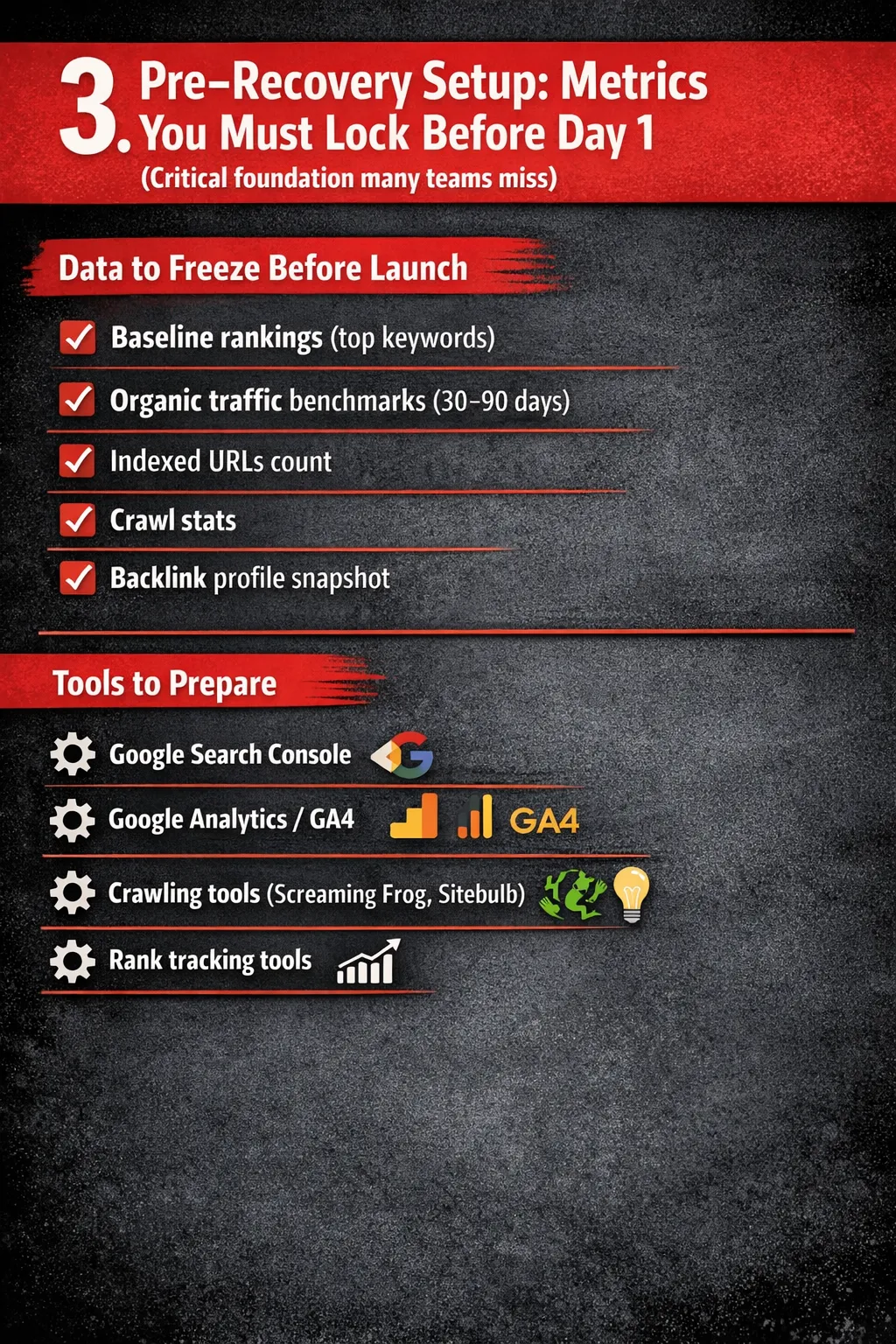
Data to Freeze Before Launch
Baseline rankings (top keywords):
Export current rankings for your most valuable keywords—brand, non-brand, transactional, and informational. Focus on keywords driving traffic and conversions, not just vanity terms. This snapshot becomes your primary comparison point for post-migration volatility and recovery.
Organic traffic benchmarks (30–90 days):
Capture at least 30–90 days of organic traffic data segmented by landing pages, device, and country. This helps distinguish seasonal changes from migration-related losses.
Indexed URLs count:
Record the total number of indexed pages using Google Search Console and site queries. Sudden drops or spikes post-migration are red flags you’ll want to trace back to this baseline.
Crawl stats:
Export crawl data showing indexable pages, response codes, canonicalized URLs, and internal linking depth. This establishes how Google was accessing your site before the move.
Backlink profile snapshot:
Save a full backlink export, including top-linked pages and anchor text. These URLs must be protected during migration to preserve link equity.
Tools to Prepare
Ensure all tracking tools are live and tested before launch:
- Google Search Console: Verified for all site versions
- Google Analytics / GA4: Baseline reports saved
- Crawling tools (Screaming Frog, Sitebulb): Full pre-migration crawl completed
- Rank tracking tools: Keyword sets finalized and tracked daily
With these metrics locked, your SEO recovery efforts will be data-driven, measurable, and far more effective—setting the foundation for every phase that follows.
PHASE 1: DAY 1 (Launch Day + First 24 Hours)
Day 1 SEO Recovery Actions: Damage Control Mode
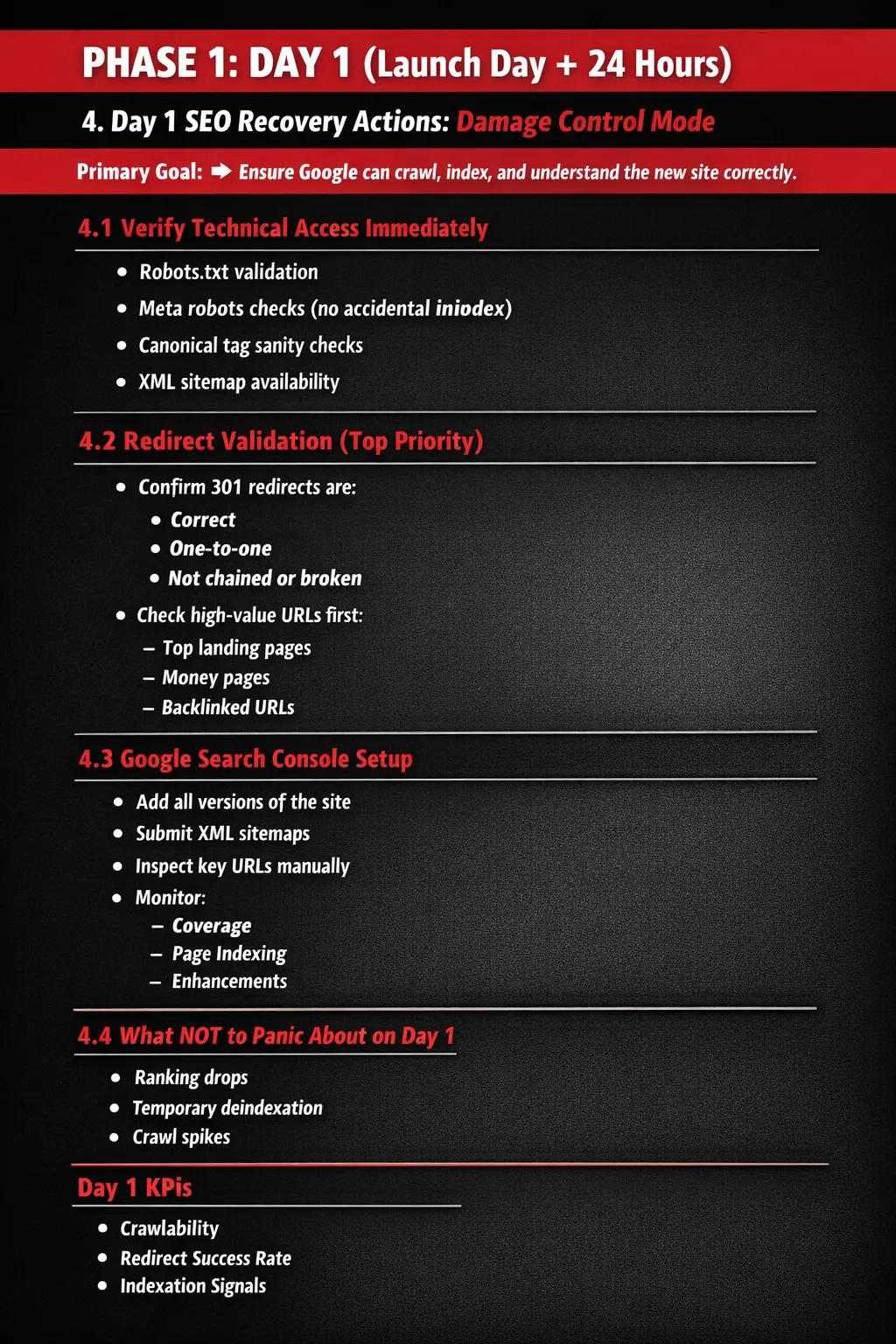
The first 24 hours after a website migration are not about rankings or traffic growth—they are about survival. Day 1 is a damage control phase where your primary responsibility is to ensure that Google can crawl, index, and correctly interpret your new website without friction. Mistakes made here can snowball into long-term SEO losses that take months to recover from.
Your mindset on Day 1 should be simple: Is Google able to access the site correctly, and are all historical SEO signals being transferred properly?
Verify Technical Access Immediately
Before diving into analytics or rankings, confirm that nothing is actively blocking search engines.
Start with robots.txt validation. A single misplaced Disallow: / can wipe out visibility overnight. Confirm that essential directories, templates, and resources are crawlable. Next, conduct meta robots checks to ensure no critical pages are accidentally tagged with noindex or nofollow, a surprisingly common migration error—especially after staging environments go live.
Then, perform canonical tag sanity checks. Canonicals should point to the correct new URLs, not old domains, staging versions, or parameterized pages. Incorrect canonicals can confuse Google and delay indexation.
Finally, confirm XML sitemap availability. Your sitemap should include only indexable, canonical URLs and be accessible without authentication or server errors. This becomes Google’s primary roadmap for discovering your new site structure.
Redirect Validation (Top Priority)
Redirects are the single most critical SEO element on Day 1. Even a technically perfect site can fail if redirects are mishandled.
Confirm that all redirects are 301 (permanent), one-to-one, and free of chains or loops. Redirect chains dilute link equity and slow down crawling, while broken redirects create dead ends for both users and bots.
Prioritize checking high-value URLs first, including:
- Top organic landing pages
- Revenue-generating or “money” pages
- URLs with strong backlink profiles
If these pages are not redirecting correctly, rankings and revenue losses can happen quickly.
Google Search Console Setup
Google Search Console is your real-time feedback system during migration recovery.
On Day 1, add all versions of your site (HTTP, HTTPS, www, non-www if applicable) and verify ownership. Submit your XML sitemap immediately to accelerate discovery of new URLs.
Use the URL Inspection tool to manually inspect key pages and request indexing. This helps confirm that Google can render, crawl, and understand your pages correctly.
Begin monitoring early signals such as:
- Coverage reports for errors and exclusions
- Page indexing status
- Enhancement reports for structured data or mobile issues
What NOT to Panic About on Day 1
It’s normal to see ranking drops, temporary deindexation, and crawl spikes within the first 24 hours. Google is recalibrating signals, not penalizing your site. Reacting too aggressively—by changing URLs, content, or structure again—often causes more harm than good.
Day 1 KPIs to Track
Instead of rankings, focus on:
- Crawlability (can Google access your pages?)
- Redirect success rate (especially for top URLs)
- Early indexation signals in Search Console
If these indicators look healthy, you’ve successfully cleared the most critical SEO checkpoint of your migration.
PHASE 2: WEEK 1 (Stabilization Phase)
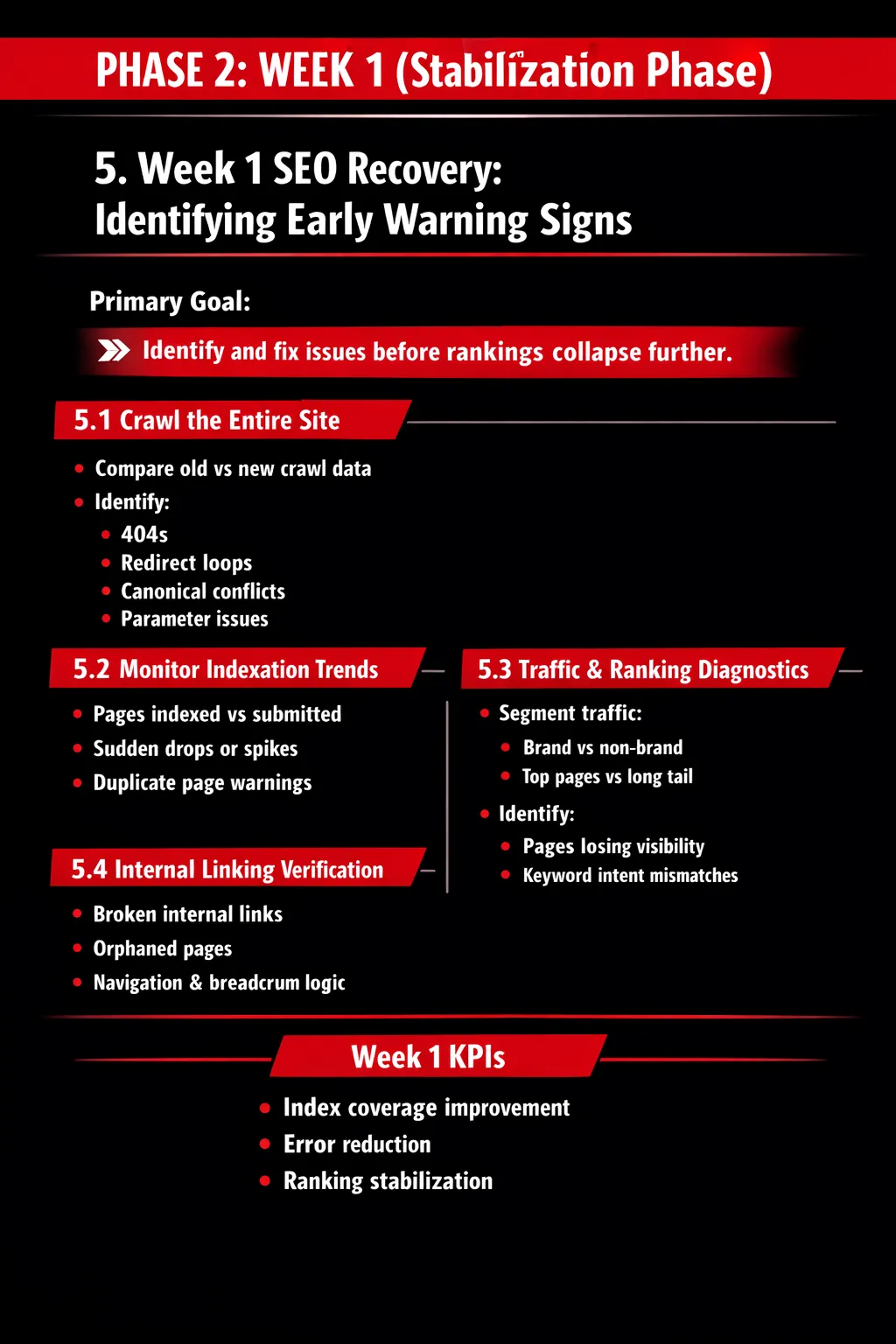
Week 1 SEO Recovery: Identifying Early Warning Signs
The first week after a website migration is where SEO recovery either stays controlled or starts to spiral. By now, Google has begun crawling the new site aggressively, testing redirects, and reassessing relevance signals. Rankings may already be fluctuating—but your primary objective in Week 1 is not to recover rankings yet, but to identify and fix early warning signs before losses compound.
This phase is all about diagnostics, validation, and stabilization.
Crawl the Entire Site
Your first priority in Week 1 should be a full-site crawl using tools like Screaming Frog, Sitebulb, or similar. This crawl should then be compared directly with your pre-migration crawl data to spot inconsistencies.
Key issues to identify include:
- 404 errors: These indicate pages that were not redirected properly. Even a small number of missed high-value URLs can lead to significant ranking and traffic losses.
- Redirect loops or chains: Redirects should ideally be one-to-one. Chains dilute link equity and slow down crawling, while loops can prevent indexing entirely.
- Canonical conflicts: Ensure canonical tags consistently point to the correct final URLs. Conflicting canonicals can confuse Google and delay ranking recovery.
- Parameter issues: New CMS setups often introduce URL parameters that generate duplicate or low-value pages, wasting crawl budget.
At this stage, your goal is not perfection—but rapid cleanup of high-impact crawl errors.
Monitor Indexation Trends
Once crawling issues are under control, shift focus to indexation behavior in Google Search Console.
Closely monitor:
- Pages indexed vs pages submitted in XML sitemaps
- Sudden drops or spikes in indexed pages
- Duplicate, alternate, or excluded page warnings
A sharp drop in indexed pages can signal crawlability or canonical issues, while sudden spikes often indicate duplicate URLs being indexed unintentionally. Neither scenario is healthy during early recovery.
Pay special attention to:
- Important landing pages not being indexed
- Old URLs still indexed instead of new ones
- Duplicate page warnings tied to parameters, filters, or trailing slashes
Early indexation correction significantly reduces long-term recovery time.
Traffic & Ranking Diagnostics
Week 1 is too early to judge SEO success—but not too early to diagnose patterns.
Start by segmenting organic data into:
- Brand vs non-brand traffic
- Top-performing pages vs long-tail pages
Brand traffic often recovers faster, while non-brand rankings are more sensitive to structural and relevance changes. If non-brand traffic is dropping disproportionately, it’s a signal that Google is reassessing topical authority or intent alignment.
Look for:
- Pages losing visibility faster than others
- Keywords ranking but mismatched with page intent
- Pages ranking for fewer queries than before
These insights will guide deeper fixes in later phases.
Internal Linking Verification
Internal links play a major role in redistributing authority after migration, yet they are frequently overlooked.
During Week 1, check for:
- Broken internal links pointing to old or redirected URLs
- Orphaned pages with no internal links
- Navigation and breadcrumb logic inconsistencies
If high-value pages are buried deeper in the site or disconnected from navigation, Google may deprioritize them—even if redirects are correct. Ensuring clean, logical internal linking helps search engines re-understand site structure faster.
Week 1 SEO Recovery KPIs
Success in the stabilization phase is measured by:
- Improvement in index coverage
- Reduction in crawl and indexing errors
- Early signs of ranking stabilization (not growth yet)
If these KPIs trend positively, you’ve successfully contained risk—setting the stage for accelerated recovery in the coming weeks.
PHASE 3: WEEK 4 — Recovery Acceleration Phase
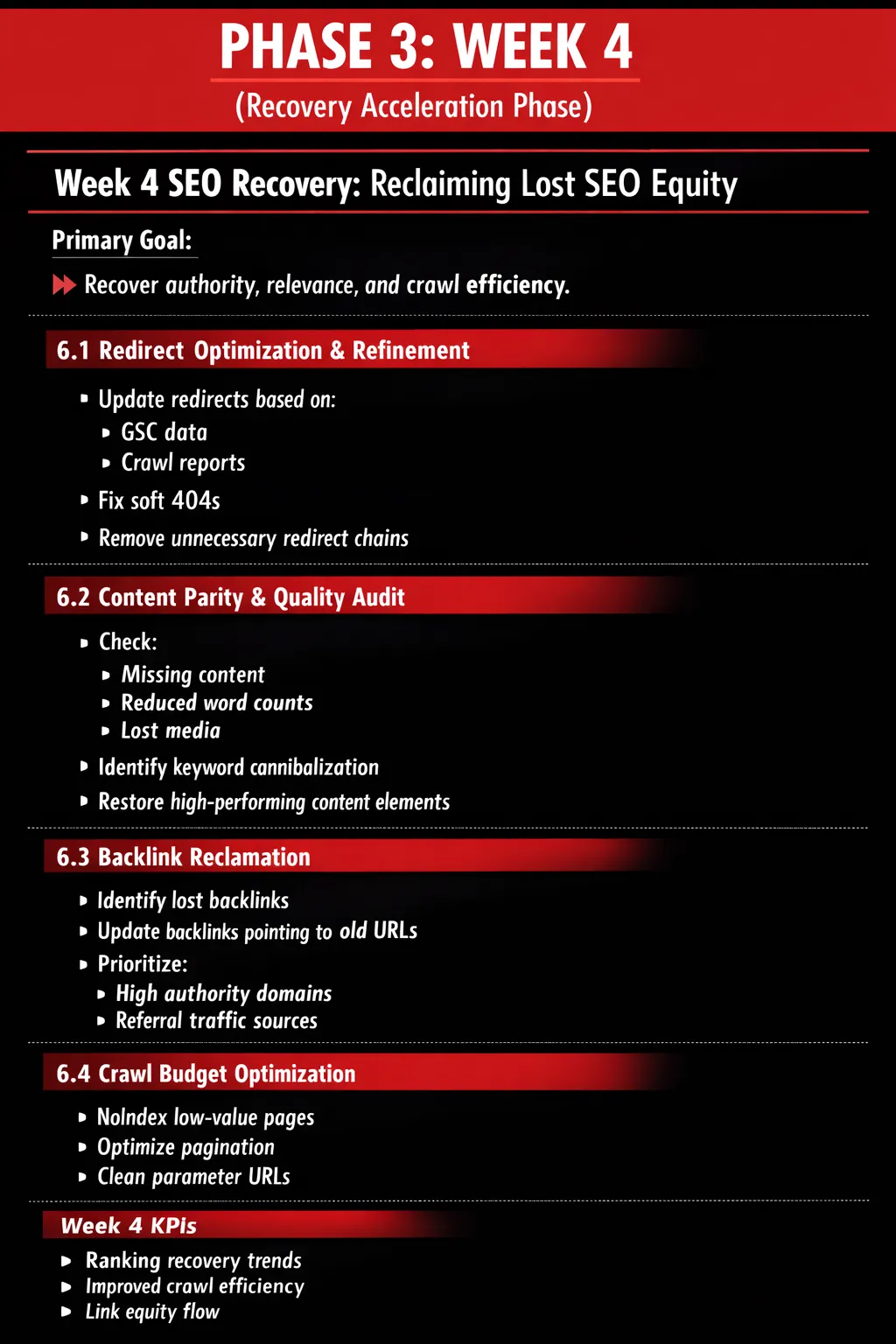
Week 4 SEO Recovery: Reclaiming Lost SEO Equity
By Week 4 after a website migration, your SEO recovery effort should move out of stabilization mode and into acceleration mode. At this stage, Google has usually crawled a significant portion of the new site, processed most redirects, and begun re-evaluating rankings. If traffic and visibility have not fully recovered yet, that’s normal—but this is the moment where smart refinements can dramatically speed up recovery.
The primary goal of Week 4 is clear:
- Recover authority, relevance, and crawl efficiency that may have been diluted or lost during migration.
This phase focuses on reclaiming SEO equity rather than merely fixing errors.
Redirect Optimization & Refinement
Redirects are often “set and forgotten” after launch, but Week 4 is when you must optimize them based on real data, not assumptions.
Start by analyzing Google Search Console (GSC) and crawl reports. In GSC, review:
- Pages marked as “Redirected”
- Soft 404 warnings
- URLs excluded from indexing due to redirect issues
Crawl your site again using tools like Screaming Frog or Sitebulb and compare results with your pre-migration crawl. Look specifically for:
- Redirect chains (URL A → B → C)
- Redirect loops
- Incorrect redirect targets (irrelevant pages)
Fix soft 404s aggressively. These occur when Google believes a redirected page doesn’t sufficiently match the original intent. Soft 404s bleed ranking signals and confuse crawlers. Ensure every redirected URL lands on the closest possible equivalent page, not a generic category or homepage.
Next, remove unnecessary redirect chains. Each additional hop:
- Slows crawl efficiency
- Weakens link equity transfer
- Increases the risk of crawl abandonment
Where possible, update redirects so old URLs point directly to their final destination.
Content Parity & Quality Audit
Content parity issues are one of the most common reasons rankings fail to recover by Week 4.
Conduct a page-by-page comparison between your old and new site, focusing on top-performing URLs. Check for:
- Missing sections of content
- Reduced word counts
- Removed FAQs, tables, or schema
- Lost images, videos, or embedded assets
Even small content reductions can impact rankings if they alter search intent coverage.
Next, identify keyword cannibalization caused by migration. New URL structures or category changes often result in multiple pages competing for the same keyword. Use ranking tools and GSC performance reports to spot overlapping URLs and consolidate content where necessary.
Finally, restore high-performing content elements that previously drove engagement and rankings:
- Internal links
- Optimized headings
- Schema markup
- Conversion-focused CTAs
Your goal is not just parity—but preserving the original SEO value while improving clarity and relevance.
Backlink Reclamation
By Week 4, you should actively reclaim lost backlink equity.
Start by comparing pre- and post-migration backlink profiles. Identify:
- Backlinks still pointing to old URLs
- Links now leading to 404 pages
- Links redirected to irrelevant destinations
Prioritize outreach for:
- High-authority referring domains
- Pages that previously drove referral traffic
- Editorial or contextual links (not low-quality directories)
Where possible, request that site owners update links to the new canonical URLs instead of relying solely on redirects. While 301s pass equity, direct links are stronger long-term signals and improve crawl efficiency.
This step often delivers quick ranking gains when executed correctly.
Crawl Budget Optimization
As Google increases crawl activity post-migration, you must ensure it’s spending time on valuable pages only.
Start by noindexing:
- Thin or duplicate pages
- Filter or sort variations
- Internal search result pages
Next, optimize pagination so it:
- Uses clean URL structures
- Avoids infinite crawl paths
- Supports logical content discovery
Finally, clean up parameter-heavy URLs. Parameters created by tracking, filtering, or sorting can explode your URL count and waste crawl budget. Use:
- Canonical tags
- Parameter handling in GSC
- Noindex rules where appropriate
Efficient crawl budget allocation directly supports faster ranking recovery.
Week 4 SEO Recovery KPIs
By the end of Week 4, monitor these key indicators:
- Ranking recovery trends (especially non-brand keywords)
- Improved crawl efficiency (fewer errors, cleaner indexation)
- Link equity flow (stabilized or improving authority signals)
Week 4 is often the turning point where disciplined SEO recovery starts translating into measurable gains. The fixes you implement here determine whether recovery plateaus—or accelerates into long-term growth.
PHASE 4: MONTH 3 – Growth & Optimization Phase
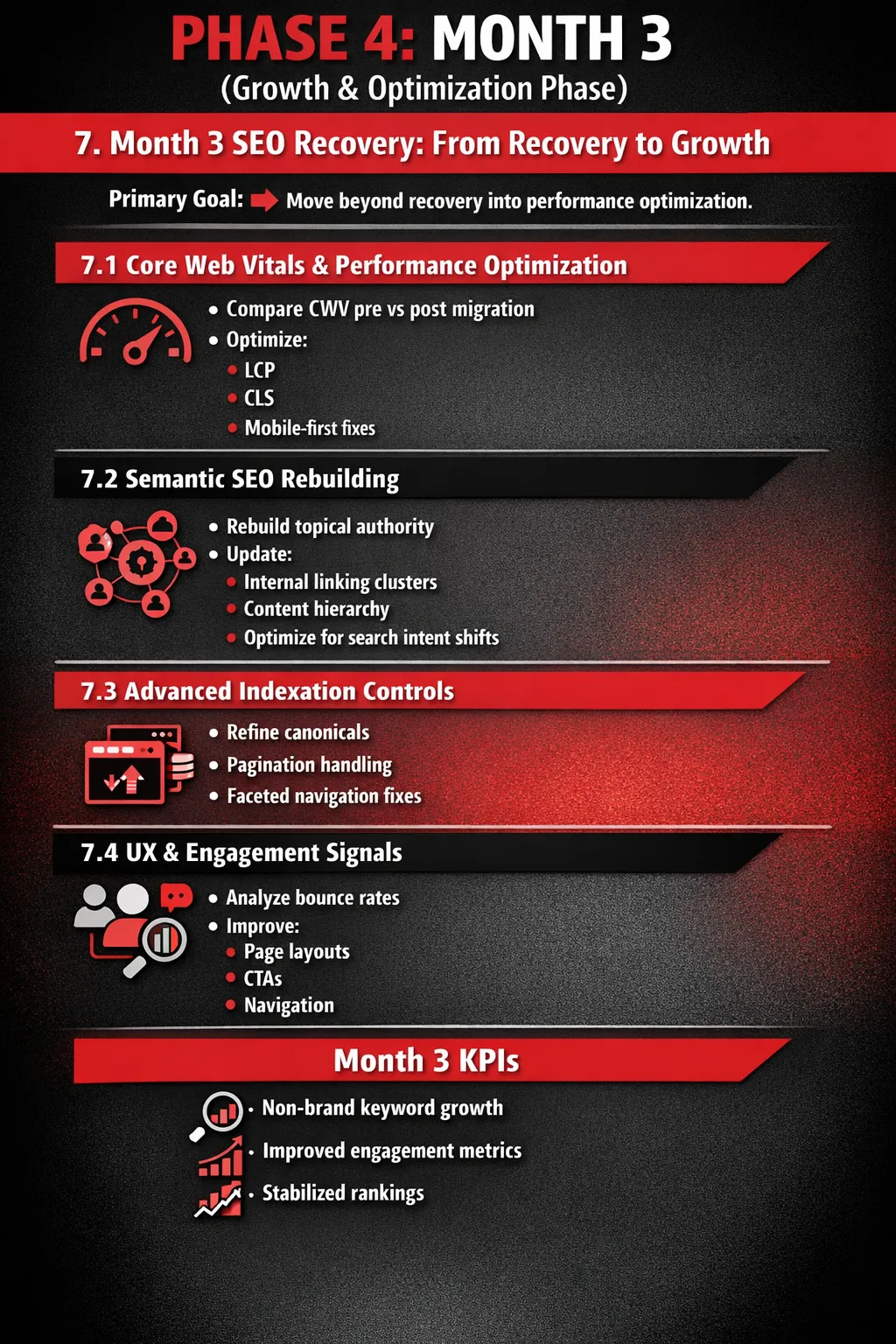
By Month 3 after a website migration, your SEO recovery should be moving out of the “damage control” stage and into a growth-focused optimization phase. At this point, Google has largely processed your redirects, reindexed most important pages, and begun stabilizing rankings. While some volatility may still exist, this is the phase where you stop reacting and start proactively improving performance.
The primary goal in Month 3 is clear:
- Move beyond recovery and turn your migrated site into a stronger SEO asset than before.
Month 3 SEO Recovery: From Recovery to Growth
Core Web Vitals & Performance Optimization
Month 3 is the right time to take a deep dive into Core Web Vitals (CWV), as performance data is now statistically reliable. Comparing pre-migration vs post-migration CWV metrics helps you understand whether the new platform, theme, or architecture has improved or harmed real-world user experience.
Focus on optimizing the three core metrics:
- Largest Contentful Paint (LCP):
Improve server response times, optimize hero images, implement efficient caching, and eliminate render-blocking scripts. Many migrations introduce heavier frameworks or unoptimized media—now is the time to clean that up. - Cumulative Layout Shift (CLS):
Fix layout instability caused by ads, dynamic elements, or missing image dimensions. CLS issues often go unnoticed immediately after migration but can quietly damage engagement and rankings. - Interaction to Next Paint (INP):
Reduce JavaScript execution time, defer non-critical scripts, and improve responsiveness across interactive elements.
A mobile-first approach is non-negotiable here. Review CWV data specifically for mobile users, as Google predominantly evaluates performance through a mobile lens.
Semantic SEO Rebuilding
Once technical stability is achieved, attention must shift to semantic SEO and topical authority. Migrations often disrupt content relationships, internal linking depth, and keyword relevance—even when URLs and content remain unchanged.
Key actions include:
- Rebuilding topical authority:
Reassess your core topic clusters and ensure your most authoritative pages clearly support broader themes. Identify content gaps introduced during migration and address them strategically. - Updating internal linking clusters:
Strengthen contextual internal links between related pages. Ensure that pillar pages pass authority effectively to supporting articles and commercial pages. - Refining content hierarchy:
Validate that headings, subtopics, and page intent align with current search behavior. Migration is often paired with design or UX changes that unintentionally dilute content clarity.
Finally, optimize for search intent shifts. User expectations may have changed since the site was last fully optimized—especially in competitive niches. Refresh content to better match informational, navigational, or transactional intent where needed.
Advanced Indexation Controls
By Month 3, indexation issues should be minimal—but refinement is essential to improve crawl efficiency and ranking consistency.
Focus on:
- Refining canonical tags:
Ensure canonical URLs accurately reflect preferred versions of pages, especially for parameter-based or duplicated content introduced post-migration.
- Pagination handling:
Review paginated pages to ensure they are crawlable but not competing unnecessarily with core landing pages. Improper pagination can dilute rankings and waste crawl budget.
- Faceted navigation fixes:
E-commerce and large sites should carefully manage filters and facets. Use a combination of canonicals, noindex rules, and URL parameter handling to prevent index bloat.
These controls help Google focus on your most valuable URLs—improving both rankings and crawl efficiency.
UX & Engagement Signals
User engagement metrics begin to carry more weight once rankings stabilize. In Month 3, analyze how users interact with your migrated site:
- Review bounce rates and engagement time across key landing pages.
- Identify pages where UX changes negatively impacted usability.
- Improve:
- Page layouts for clarity and scannability
- Calls-to-action (CTAs) for better conversions
- Navigation to reduce friction and improve discoverability
While engagement metrics are not direct ranking factors, strong UX supports better behavioral signals, conversion performance, and long-term SEO success.
Month 3 SEO KPIs to Track
By the end of Month 3, you should see clear signs of momentum:
- Growth in non-brand keyword rankings
- Improved engagement metrics (bounce rate, session duration)
- More stable and predictable ranking patterns
Month 3 is where SEO recovery transforms into sustainable growth—setting the stage for long-term gains rather than short-term fixes.
PHASE 5: MONTH 6 — Full SEO Maturity Phase
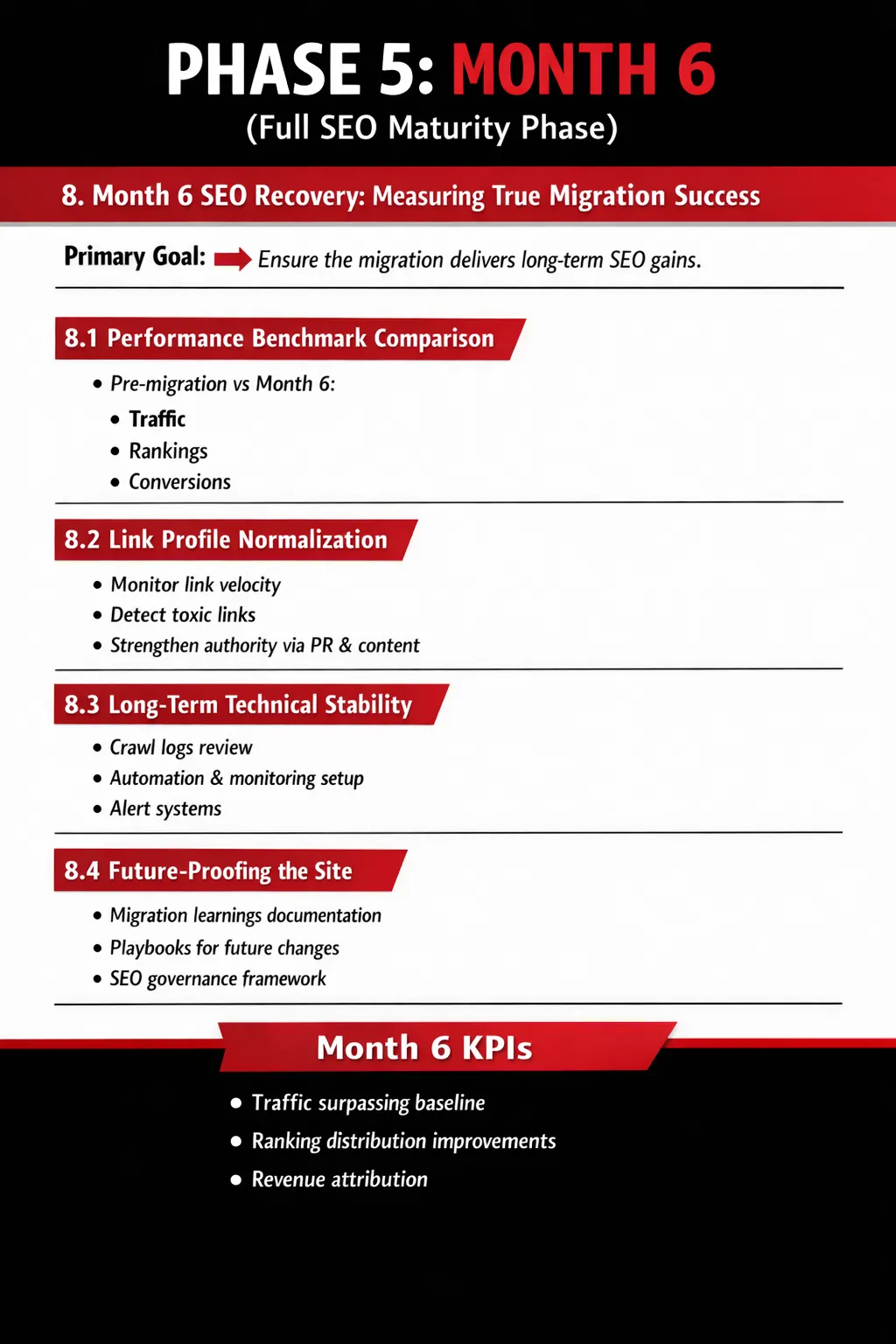
By Month 6, your website migration should no longer be in “recovery mode.” This phase is about validating long-term SEO success, ensuring stability, and positioning the site for sustainable growth. At this stage, Google has fully processed your redirects, re-evaluated content and links, and stabilized crawl behavior. Now, the focus shifts from fixing issues to measuring outcomes, strengthening authority, and future-proofing your SEO framework.
The primary goal in Month 6 is simple but critical:
- Ensure the migration delivers long-term SEO gains, not just recovery.
Performance Benchmark Comparison
Month 6 is the right time to conduct a true before-and-after comparison. Short-term fluctuations are no longer excuses—this is where real performance insights emerge.
Start by comparing pre-migration benchmarks with Month 6 performance across three core metrics:
- Organic Traffic:
Analyze total organic sessions, but also segment traffic by:- Brand vs non-brand queries
- Top landing pages
- High-intent pages (product, service, category pages)
A successful migration should show traffic matching or exceeding pre-migration levels, especially for non-brand keywords.
- Keyword Rankings:
Evaluate ranking distribution rather than focusing only on individual keywords. Look at:
- Number of keywords in top 3, top 10, and top 20 positions
- Recovery of previously high-performing keywords
- New keyword growth driven by improved site structure or content
- Conversions & Revenue:
Traffic recovery without conversions is not success. Measure:
- Organic conversion rates
- Revenue attributed to organic traffic
- Assisted conversions influenced by SEO
This holistic comparison reveals whether SEO equity has truly been retained—or enhanced—post-migration.
Link Profile Normalization
By Month 6, your backlink profile should have largely stabilized. This is the phase to ensure link equity is flowing cleanly and safely.
Key actions include:
- Monitoring link velocity to confirm natural growth rather than sudden spikes or drops
- Detecting toxic or low-quality links that may have appeared during or after migration
- Strengthening authority through PR and content marketing, such as:
- Digital PR campaigns
- Data-driven content assets
- Linkable resources and thought leadership
Also review whether high-authority backlinks still resolve correctly to final destination URLs. Any remaining redirect dependencies should be minimized.
Long-Term Technical Stability
SEO maturity requires proactive stability, not reactive fixes. Month 6 is the time to formalize technical monitoring systems.
Key initiatives:
- Crawl log analysis to understand how search engines interact with your site over time
- Automation for routine checks, including:
- Indexation monitoring
- Redirect health
- Core Web Vitals tracking
- Alert systems for sudden changes in:
- Traffic drops
- Index coverage errors
- Server or performance issues
This ensures future issues are detected early—before rankings are impacted.
Future-Proofing the Site
A successful migration should leave behind more than a stable site—it should create repeatable systems.
Document:
- Migration learnings (what worked, what failed)
- Technical and SEO playbooks for future updates
- A clear SEO governance framework defining:
- Ownership
- Approval workflows
- SEO checks for any future site changes
This transforms SEO from a reactive function into a scalable, organization-wide discipline.
Month 6 KPIs to Track
By the end of Month 6, success should be evident through:
- Organic traffic surpassing pre-migration baseline
- Improved ranking distribution across high-value keywords
- Clear revenue attribution from organic search
When these indicators align, your migration has not just recovered—it has matured into a stronger, more resilient SEO foundation.
Common SEO Recovery Mistakes That Delay Results
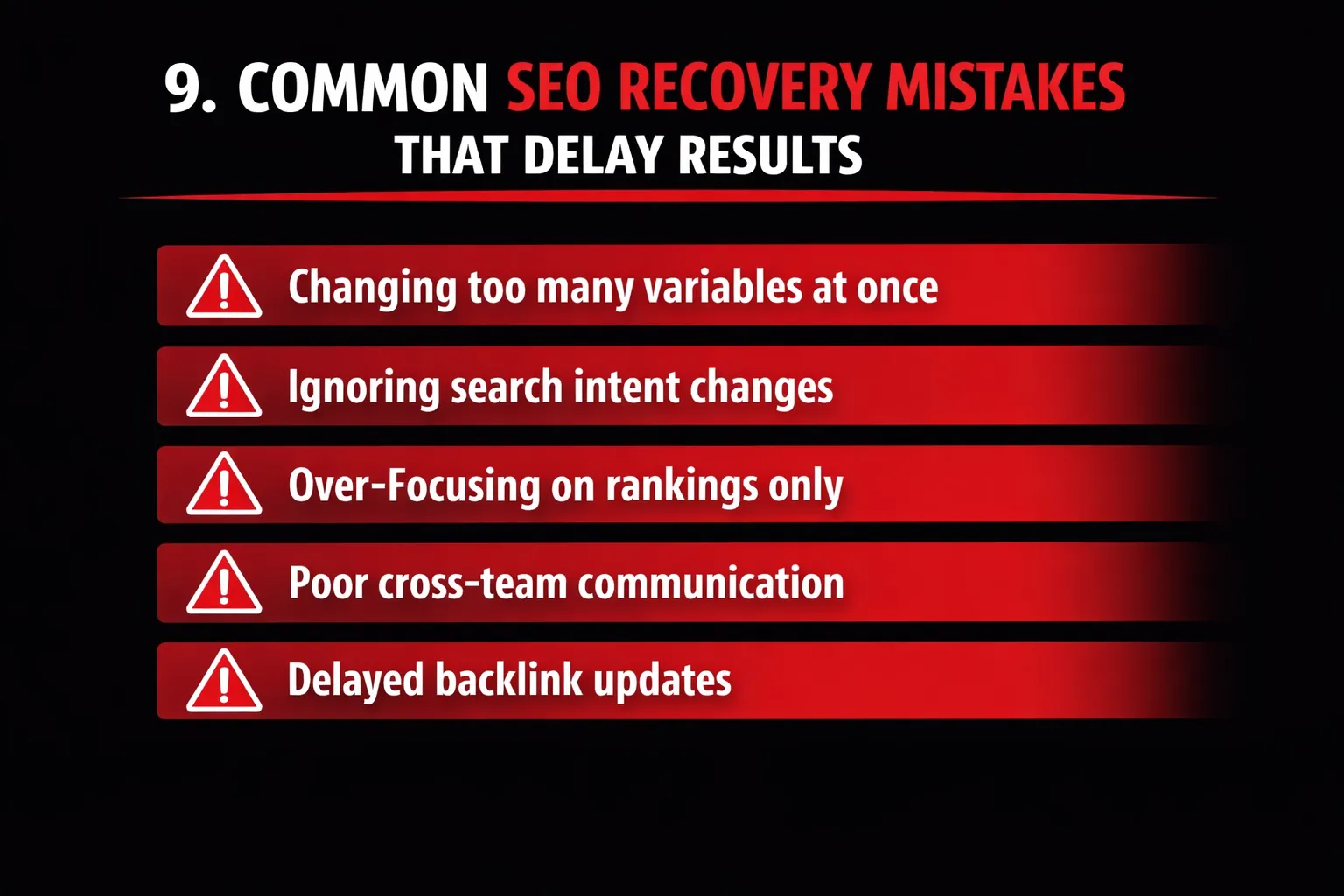
Recovering SEO performance after a website migration is as much about avoiding critical mistakes as it is about taking the right actions. Even technically sound migrations can underperform when recovery efforts are mismanaged. Below are the most common SEO recovery mistakes that slow down or completely derail results—and how to avoid them.
1. Changing Too Many Variables at Once
One of the biggest post-migration mistakes is making multiple major changes simultaneously. Teams often redesign layouts, rewrite content, alter URL structures, and update internal linking all at the same time. This makes it nearly impossible to identify what’s causing ranking drops or crawl issues. Search engines need consistency to reassess signals properly. During recovery, changes should be incremental and well-documented, allowing you to isolate impact and avoid confusing search engine crawlers.
2. Ignoring Search Intent Changes
Migration is often accompanied by content restructuring or consolidation, which can unintentionally shift search intent. Pages that previously ranked well may lose visibility because they no longer align with user intent. Simply restoring keywords or content length won’t fix this. SEO recovery requires reassessing intent alignment—informational, transactional, or navigational—and adjusting content accordingly to match how users are searching today.
3. Over-Focusing on Rankings Only
Rankings are important, but obsessing over daily keyword fluctuations can be misleading. Post-migration volatility is normal. Instead of reacting to every ranking drop, focus on leading indicators such as crawl activity, indexation trends, organic landing page traffic, and engagement metrics. These signals often recover before rankings do and provide a more accurate picture of long-term SEO health.
4. Poor Cross-Team Communication
SEO recovery often fails due to misalignment between SEO, development, content, and product teams. Unannounced code releases, redirect changes, or content removals can undo recovery progress overnight. Establishing clear workflows, shared documentation, and approval checkpoints is essential to ensure all teams move in sync.
5. Delayed Backlink Updates
Redirects help preserve link equity, but they’re not a permanent solution. Many sites lose ranking power because high-value backlinks continue pointing to old URLs. Proactively reaching out to update backlinks—especially from authoritative domains—can significantly speed up recovery and restore lost trust signals faster.
SEO Recovery Timeline Checklist (Printable)
Use this phase-by-phase checklist to ensure nothing critical is missed after your website migration. This structured approach helps stabilize rankings, recover lost traffic, and drive long-term SEO growth.
Day 1 – Launch & Damage Control
- Verify robots.txt and meta robots tags
- Confirm XML sitemap accessibility and submission
- Validate all 301 redirects (no 302s or redirect chains)
- Check canonical tags on key pages
- Set up and verify Google Search Console properties
- Manually inspect priority URLs in GSC
Goal: Ensure crawlability, indexability, and redirect accuracy.
Week 1 – Stabilization & Diagnostics
- Crawl the full site to detect errors and broken links
- Monitor index coverage and excluded pages in GSC
- Track ranking and traffic fluctuations (brand vs non-brand)
- Fix 404 errors, soft 404s, and canonical conflicts
- Validate internal linking and navigation paths
Goal: Identify and resolve early technical and indexing issues.
Week 4 – Authority & Content Recovery
- Optimize and refine redirect mappings
- Audit content parity and restore lost SEO value
- Reclaim backlinks pointing to old URLs
- Resolve crawl budget and parameter issues
Goal: Rebuild link equity and content relevance.
Month 3 – Optimization & Growth
- Improve Core Web Vitals and mobile performance
- Strengthen internal linking and topical clusters
- Optimize pages for updated search intent
- Analyze UX and engagement signals
Goal: Transition from recovery to sustainable growth.
Month 6 – Long-Term SEO Success
- Compare performance against pre-migration benchmarks
- Audit backlink health and authority growth
- Review crawl logs and automation systems
- Document migration learnings and SEO processes
Goal: Achieve stable, scalable, long-term SEO performance.
Conclusion: Why Patience + Precision Wins SEO Recovery
SEO recovery after a website migration is not a race—it’s a structured process that rewards patience, precision, and consistency. One of the biggest mistakes teams make is expecting immediate results once the new site goes live. In reality, search engines need time to crawl, reprocess, and reassess signals such as redirects, content relevance, internal linking, and authority. That’s why a timeline-based recovery approach is critical. Each phase—Day 1, Week 1, Week 4, Month 3, and Month 6—serves a distinct purpose, and skipping or rushing any stage can delay recovery or cause long-term SEO damage.
It’s also important to remember that SEO recovery is not an instant fix. Temporary ranking drops, traffic fluctuations, and indexation changes are normal parts of the post-migration lifecycle. What separates successful migrations from failed ones is how quickly and accurately issues are identified and resolved. This is where proactive monitoring becomes invaluable. Regularly reviewing Google Search Console data, crawl reports, rankings, and user behavior helps catch problems early—before they snowball into major losses.
Finally, structured execution is what turns recovery into growth. Following a clear, phased plan ensures that technical fixes, content optimization, link equity recovery, and performance improvements happen in the right order. When patience is paired with precise actions and continuous monitoring, SEO recovery doesn’t just restore lost visibility—it builds a stronger, more resilient foundation for long-term organic growth.