SUPERCHARGE YOUR ONLINE VISIBILITY! CONTACT US AND LET’S ACHIEVE EXCELLENCE TOGETHER!
The SEO Truth No One Likes to Say
If you’ve spent any time reading SEO blogs, watching YouTube videos, or sitting through agency pitches, you’ve probably noticed something strange: everyone seems to be saying the same things. Create quality content. Build backlinks. Follow Google’s guidelines. Be patient. Different words, same advice—recycled endlessly. And yet, despite this ocean of information, most businesses are still disappointed with their SEO results.
That disconnect is not accidental.
The uncomfortable truth no one likes to admit is this: Google does not reward effort. It does not reward tools. And it definitely does not reward hacks. You can publish relentlessly, audit endlessly, and optimize every checklist item—and still see nothing meaningful move. Not because SEO is broken, but because most people are optimizing for the wrong outcome.
For the last 10 years, we’ve been running what is essentially a long-term experiment. We scaled our business without paid ads—no Google Ads safety net, no paid social boosts, no traffic arbitrage. Organic growth wasn’t a channel for us; it was the business model. That forced us to confront realities about search that most marketers never have to face, because ads can always hide the cracks.
One of the earliest realizations we had was also the most counterintuitive: ranking was never the real goal. Rankings are a visible metric, so they feel important. They’re easy to report, easy to celebrate, and easy to sell. But visibility without trust doesn’t convert, and rankings without intent don’t build businesses. We learned—sometimes painfully—that being “on page one” means very little if the page doesn’t deserve to be there in the first place.
This is where most SEO advice fails. It treats Google like a machine you can manipulate with enough inputs, rather than a system designed to mirror human judgment at scale. That misunderstanding leads to shallow strategies, short-lived wins, and constant frustration.
So let’s set expectations clearly. This is not a tips-and-tricks blog. You won’t find a list of ranking factors, growth hacks, or shortcuts. What you will find is the perspective of someone who has lived inside organic search for a decade—without paid ads to fall back on—and learned what actually compounds, what quietly fails, and why Google will never fully explain how rankings really work.
If you’ve ever felt frustrated by SEO but suspected the truth was deeper than checklists, you’re in the right place.
Our Origin Story: Scaling From Zero Without Paid Ads
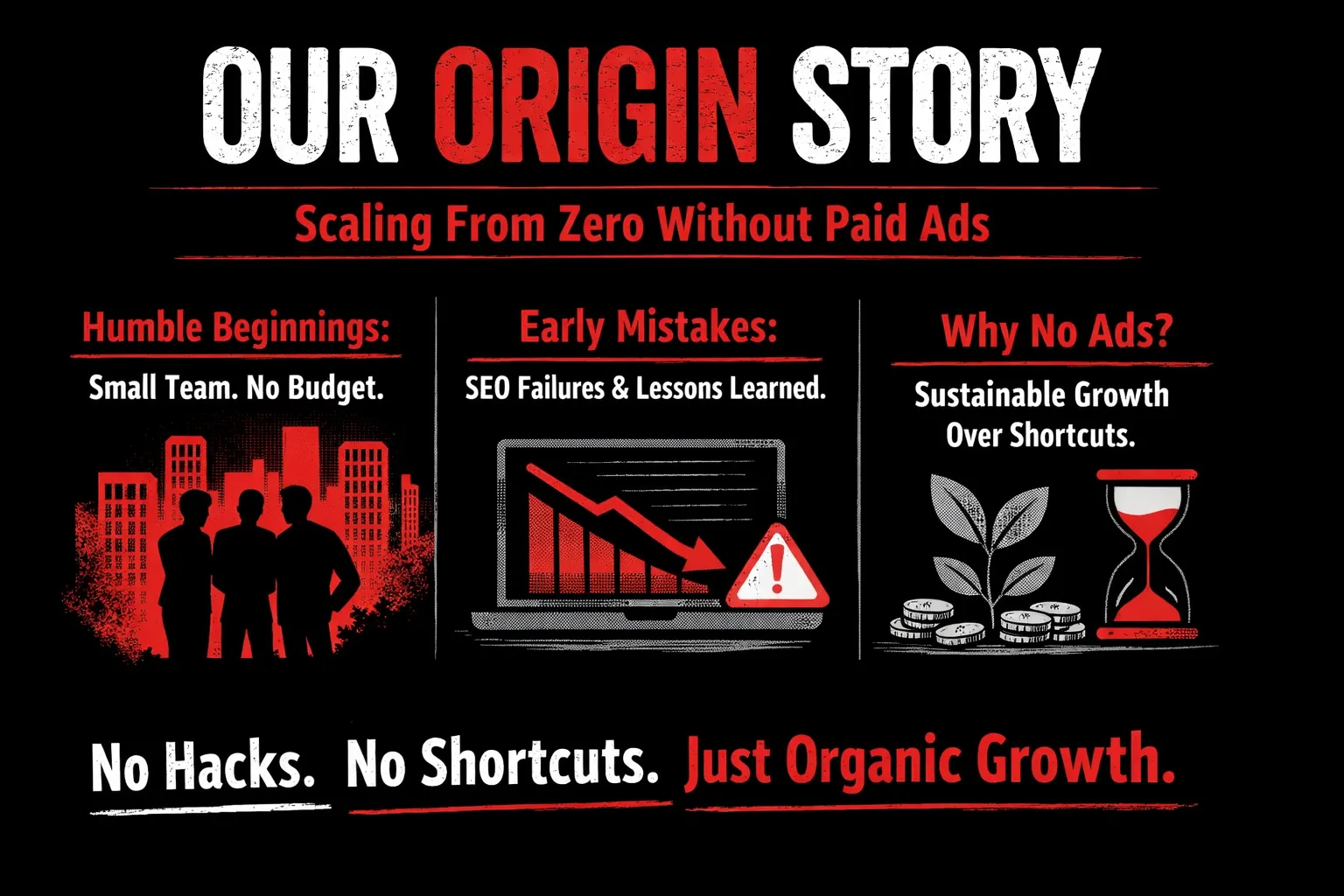
When we started, there was no grand SEO playbook, no growth budget, and no safety net. It was a small team—lean, inexperienced in some ways, but deeply curious. The market was already crowded with agencies promising fast rankings, guaranteed traffic, and overnight success. We had none of that to sell. What we did have was time, urgency, and the uncomfortable awareness that if we didn’t grow organically, we wouldn’t grow at all.
Paid ads were never a real option. Partly because of budget constraints—but more importantly, because of philosophy. Every rupee spent on ads felt temporary. The moment you stop paying, the visibility disappears. We wanted something that compounded, something that didn’t reset to zero every month. Sustainability wasn’t a buzzword for us back then; it was survival.
Like most teams starting out, we made classic SEO mistakes. We chased keywords without understanding intent. We published content because tools said there was volume, not because users were asking meaningful questions. We tracked rankings obsessively, celebrating short-lived jumps and panicking over drops that, in hindsight, meant nothing. We even tried to “optimize” pages that had no business ranking in the first place. Each mistake cost time, morale, and momentum—but it also forced us to confront a hard truth early on.
Slowly, almost reluctantly, we realized that SEO had very little to do with rankings alone. Pages ranked and vanished. Traffic came and didn’t convert. What did stay was trust—earned through depth, consistency, and relevance. The sites that survived updates weren’t the clever ones; they were the credible ones.
So we chose the harder road. Instead of chasing quick wins, we invested in compounding organic growth—building authority one piece of content at a time, refining our understanding of search intent, and aligning everything with long-term brand value. It wasn’t fast. It wasn’t glamorous. But over time, it worked—and it laid the foundation for everything that followed.
The First Big Lie: “Rankings = Traffic = Revenue”
For years, the SEO industry has sold a dangerously simple equation:
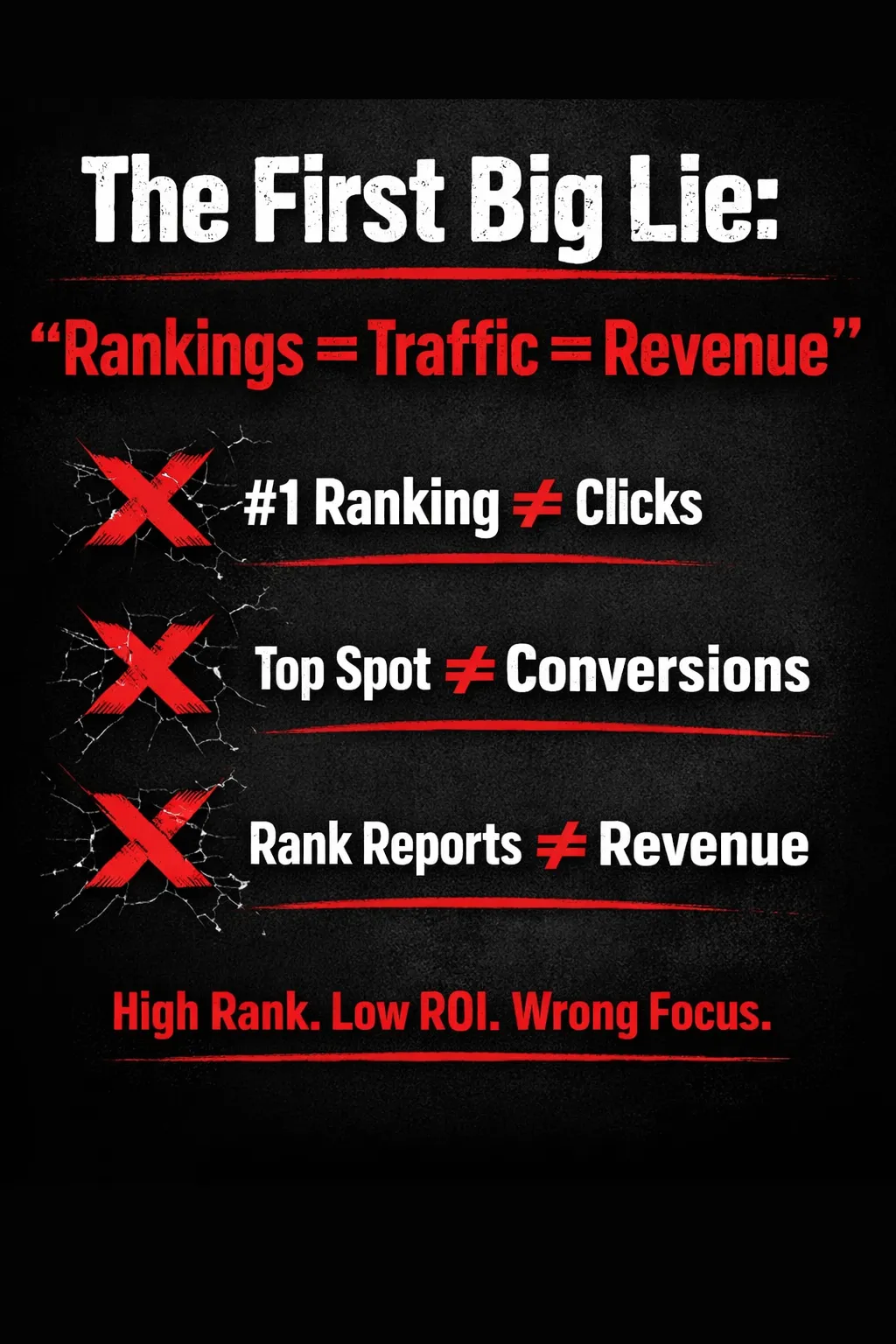
Rankings = Traffic = Revenue.
It sounds logical. Rank higher, get more clicks, make more money. But after a decade of scaling purely through organic search, this is the first belief we had to unlearn—and the one that causes founders the most damage.
Here’s what Google won’t tell you: rankings are contextual, not absolute. Being #1 on a keyword does not exist in isolation. It exists inside a live SERP filled with ads, featured snippets, People Also Ask boxes, local packs, videos, AI answers, and brand bias. A #1 ranking today can attract fewer clicks than a #4 ranking did five years ago.
We’ve ranked #1 for keywords that looked perfect on paper—high search volume, commercial intent, “money terms.” The result? Impressive screenshots for reports, almost zero revenue impact. Why? Because the SERP was crowded with ads above the fold, Google answered the query directly, or the user intent was informational while the keyword appeared transactional.
On the flip side, some of our highest-revenue pages never ranked #1. In fact, a few consistently sat between positions 3 and 6. Yet they drove qualified leads month after month. The difference wasn’t ranking—it was intent alignment. Those pages met users exactly where they were in the decision journey. They didn’t just answer questions; they resolved uncertainty.
Another uncomfortable truth: #1 doesn’t mean conversions. Traffic is not value. Attention is not trust. And clicks don’t automatically translate into business outcomes. When founders obsess over rank reports, they often miss the only metric that matters—why someone searched and what they expected to find.
SERP features have further broken the old model. Featured snippets can steal clicks. Brand-heavy results can dominate attention. AI summaries can satisfy intent without a visit. In this environment, rankings alone are a vanity metric if not interpreted through context.
This is why we stopped celebrating rankings years ago. Instead, we look at behavior: time spent, next actions, assisted conversions, branded searches that follow. Rankings are a signal—but not the outcome.
The biggest SEO mistake founders make isn’t failing to rank.
It’s confusing visibility with value.
The Second Big Lie: “Follow Google’s Guidelines and You’ll Win”
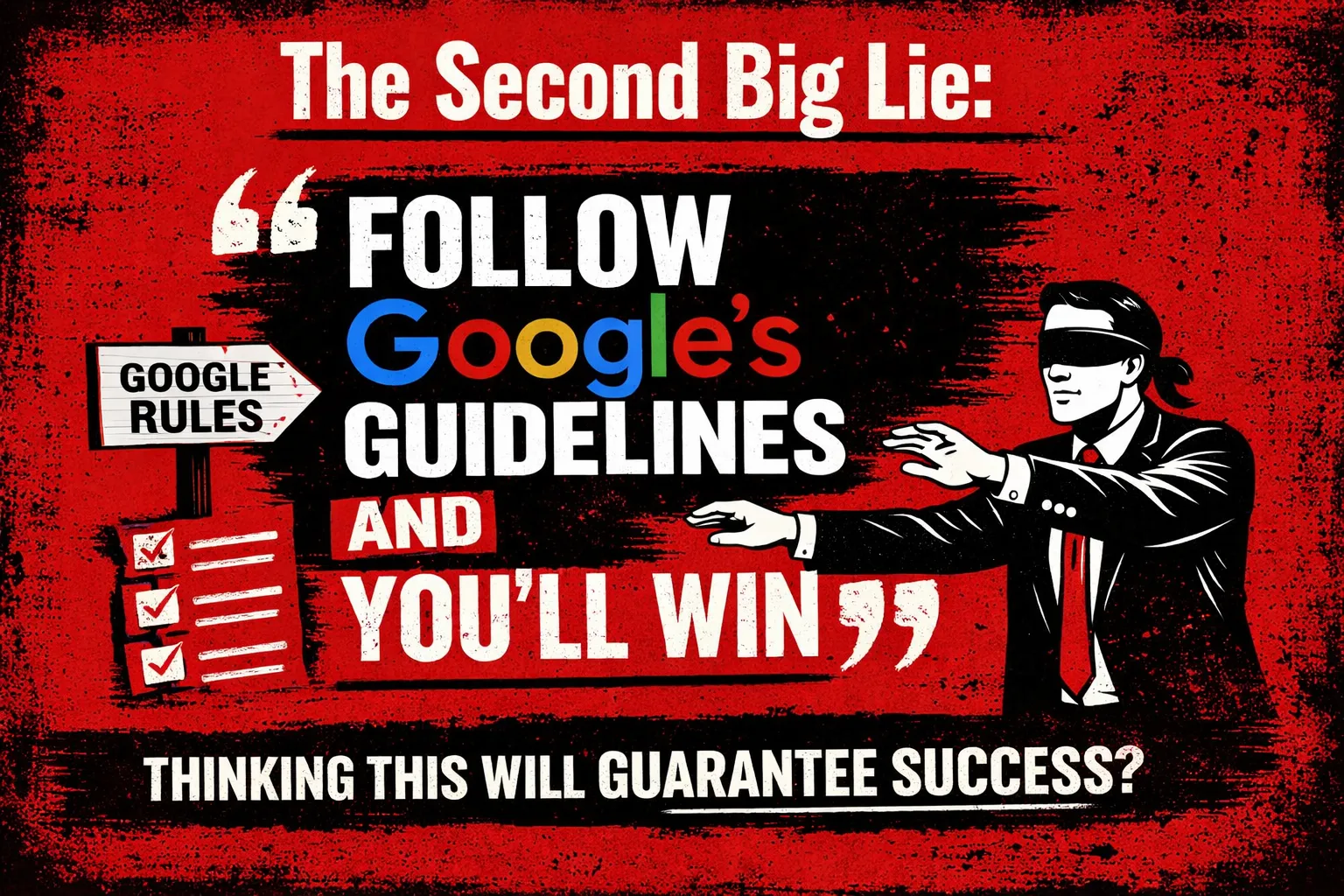
For most founders and marketers, Google’s documentation feels like a rulebook. Follow the guidelines, check all the boxes, and rankings should follow—at least in theory. In reality, this belief is one of the most misleading ideas in SEO.
Google repeatedly tells us to “create helpful content,” “focus on users,” and “avoid over-optimization.” On the surface, none of this advice is wrong. The problem is that it’s incomplete. These guidelines are not a step-by-step framework for winning search visibility; they are guardrails meant to prevent obvious abuse. Staying within them doesn’t put you ahead—it simply keeps you from being filtered out.
What Google actually rewards operates at a very different level.
At scale, Google is not evaluating individual blog posts in isolation. It’s recognizing patterns across an entire website, across an entire brand. Topical authority matters far more than a single “well-optimized” page. A site that consistently demonstrates depth, relevance, and expertise in a subject area sends a much stronger signal than one-off content written to target specific keywords. This is why sites with average on-page SEO often outrank “perfectly optimized” pages—they look more trustworthy in aggregate.
Then there are behavioral signals—click patterns, engagement depth, return visits, brand familiarity. Google rarely confirms these factors directly, yet anyone who has watched rankings stabilize over time knows their impact. Pages that get clicked, read, revisited, and searched for again behave differently in the algorithm than pages that technically follow every guideline but fail to hold attention.
One of the most under-discussed ranking forces is brand search demand. When people search for you—not just your keywords—it changes how Google interprets your relevance. Brand signals act as a trust shortcut. They’re hard to fake, slow to build, and almost never mentioned explicitly in Google’s public documentation.
This brings us to an uncomfortable founder insight: Google’s guidelines are intentionally incomplete. They’re designed to describe what not to do, not how to build an algorithm-resilient brand. If Google openly documented every meaningful signal, manipulation would become easier, not harder.
Following Google’s guidelines blindly doesn’t make you competitive—it makes you average. Real SEO growth happens when you understand the difference between compliance and credibility. The former keeps you in the game. The latter is what actually helps you win it.
The 10-Year Organic Growth Framework We Never Advertised
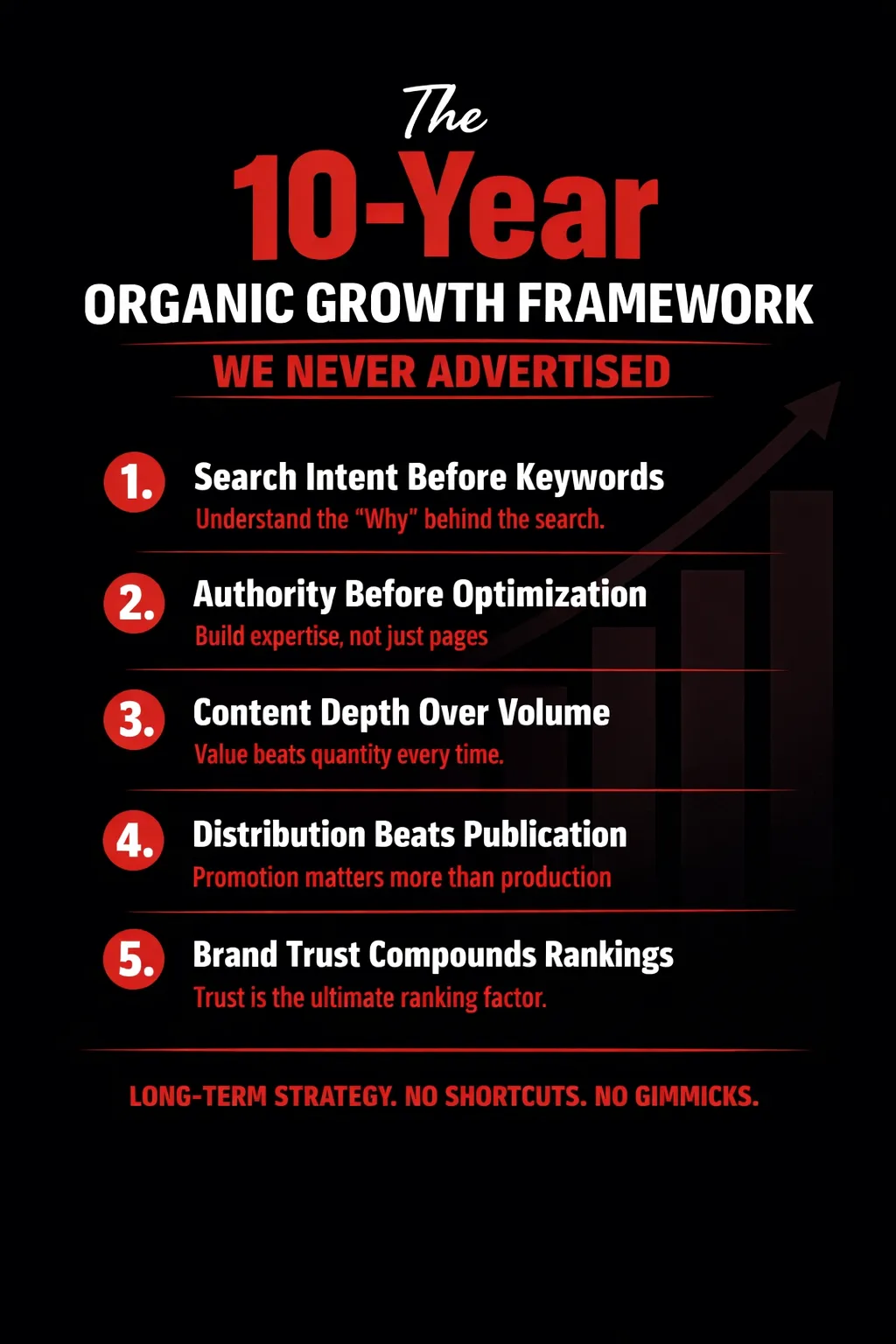
For most of our journey, we didn’t even call what we were doing a “framework.” There were no flashy names, no downloadable PDFs, no step-by-step checklists being sold as shortcuts. What existed instead was a set of principles we learned the hard way—by watching what actually moved the needle over years, not weeks. This framework wasn’t designed to impress prospects. It was built to survive algorithm updates, market shifts, and changing user behavior.
The first principle was search intent before keywords. Early on, we realized that ranking for the “right” keyword meant nothing if the underlying intent didn’t match what we could genuinely offer. Google doesn’t reward relevance at the keyword level—it rewards relevance at the decision-making level. So instead of asking, “What keywords can we rank for?” we asked, “What problem is the searcher trying to solve right now?” That single shift eliminated a lot of wasted effort and aligned our content with outcomes, not just visibility.
Next came authority before optimization. We stopped obsessing over perfect on-page scores, density formulas, and micro-optimizations. Those things help only when authority already exists. Without trust, optimization is just decoration. We focused on becoming a credible voice in our space—through depth, consistency, and point of view—knowing that once authority is established, optimization becomes a multiplier, not a crutch.
The third principle was content depth over volume. Publishing more was never the goal; publishing better was. We chose to go deeper where others went wider. Instead of chasing dozens of average articles, we invested in fewer, more substantial pieces that answered questions completely and left no ambiguity. Over time, these assets aged well, earned natural references, and continued to perform long after trends shifted.
Then we learned that distribution beats publication. Hitting “publish” is not the finish line—it’s the starting point. Content that isn’t seen, referenced, or discussed sends weak signals, no matter how good it is. We focused on placing our insights where conversations were already happening, letting content earn visibility through relevance rather than force.
Finally, brand trust compounds rankings. This is the part no tool can measure properly. As our name became associated with clarity and honesty, something changed. Pages indexed faster. Rankings stabilized. Updates stopped hurting us. Google didn’t just rank our pages—it recognized our presence.
This approach took years because it couldn’t be rushed. Algorithms need time to recalibrate. Trust doesn’t form overnight. Market positioning requires consistency. Reputation, once earned, quietly reinforces everything else. That’s why this framework was never advertised—it only works if you’re willing to outlast the shortcuts.
Why We Never Chased “Fast SEO Wins”
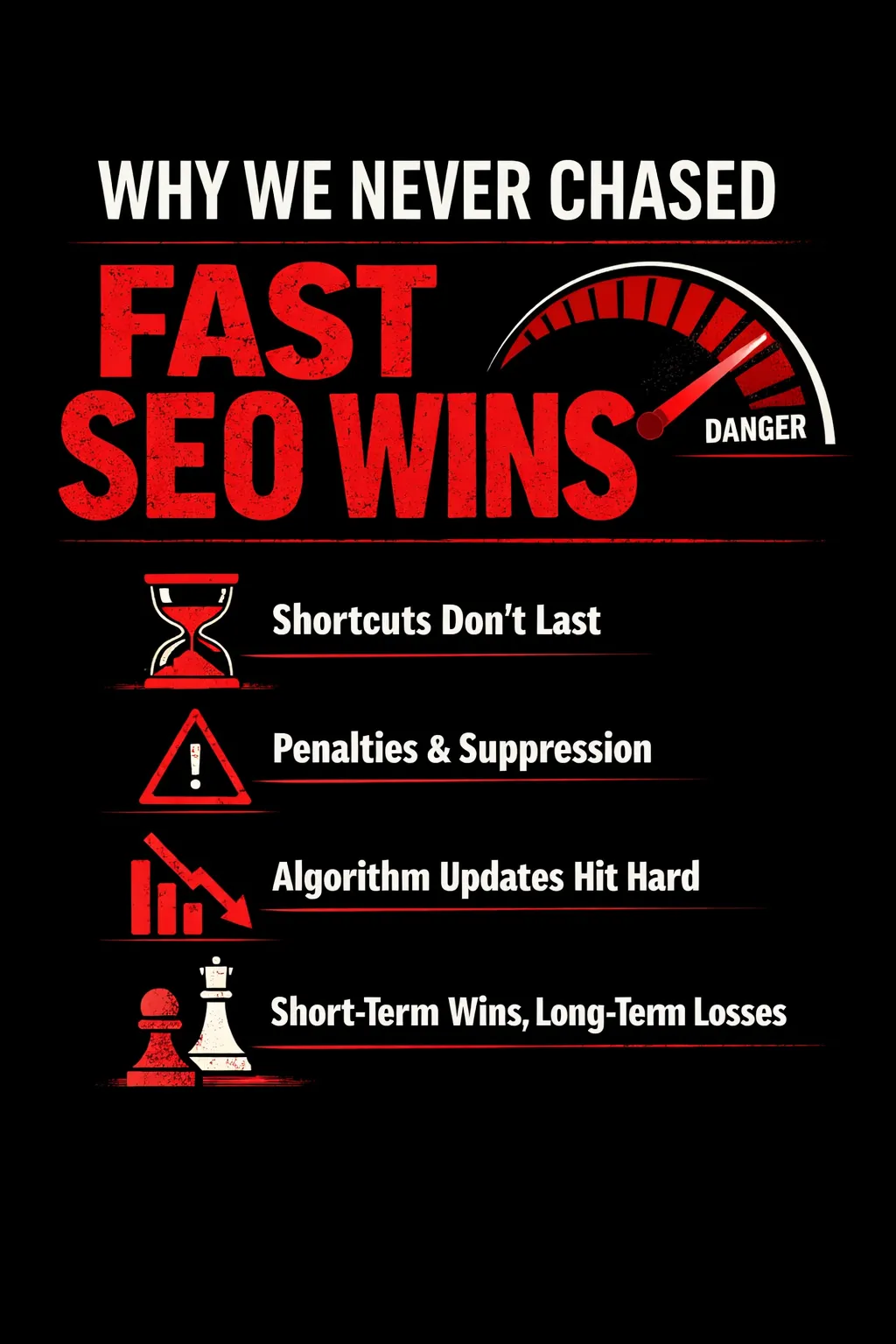
If there’s one decision that quietly shaped everything we built, it was this: we refused to chase fast SEO wins, even when they were within reach.
In the early years, shortcuts were tempting. Buying links. Spinning content. Over-optimizing pages just enough to spike rankings. These tactics often work—at least for a while. We saw competitors rise fast, celebrate screenshots, and pitch “guaranteed rankings.” Some even tried to convince us we were being naïve by playing the long game.
But shortcuts in SEO behave like borrowed time. They don’t fail loudly. They fail silently.
Most founders think SEO failures happen only through penalties. In reality, penalties are rare. What’s far more common is silent suppression—content that simply stops improving, pages that never break through, sites that plateau without explanation. Google doesn’t need to punish you when it can just stop trusting you.
This is the part Google doesn’t explain.
Algorithm updates aren’t punishments. They’re quality filters. Each update tightens the definition of what deserves visibility. Sites built on shortcuts don’t drop overnight—they slowly lose momentum. Rankings fluctuate. Traffic stagnates. Growth becomes unpredictable. And by the time it’s obvious, the foundation is already compromised.
Ironically, the opposite extreme is just as dangerous. What many call “safe SEO”—minimal optimization, generic content, playing strictly by the book—often leads to invisibility. You’re not doing anything wrong, but you’re also not doing anything distinctive. Google doesn’t reward neutrality. It rewards signals of confidence, depth, and authority.
We chose a harder path: building assets that could survive every update, even if that meant losing short-term opportunities. We turned down tactics that could have accelerated growth in the first 6–12 months because they would have limited us in year five.
That decision cost us speed—but it bought us dominance.
Today, when algorithms change, we don’t scramble. We benefit. Because we didn’t build for loopholes—we built for trust. And trust, in search, compounds longer than any shortcut ever could.
The Turning Point: When SEO Became a Brand Asset
For years, SEO felt like work. Necessary work—but still work. Pages were published, rankings were monitored, traffic graphs were checked more often than we’d like to admit. Progress happened, but it was uneven. Some months looked promising, others raised uncomfortable questions. At that stage, SEO still behaved like a channel—something that could go up or down depending on external forces.
Then something quietly changed.
The first sign wasn’t a spike in traffic or a sudden jump in rankings. It was the quality of conversations we started having with inbound leads. Prospects would arrive already familiar with our thinking. They referenced specific articles. Some quoted our frameworks back to us. A few even said, “We’ve been reading your content for months before reaching out.” SEO was no longer introducing us—it was pre-selling trust.
Around the same time, rankings began to stabilize. Not because we were tracking them less, but because they stopped demanding attention. Pages that once fluctuated now held their positions across updates. New content ranked faster, with less effort. The volatility that once defined SEO gradually disappeared, replaced by consistency. We weren’t chasing rankings anymore—we were expected to be there.
The real confirmation came during Google updates. Instead of the usual anxiety, we noticed something unexpected: our visibility improved. While others scrambled to recover lost traffic, our pages gained ground. Updates no longer felt like threats; they felt like filters removing noise. That’s when it became clear—Google wasn’t “rewarding” us. It was recognizing accumulated trust.
Organic traffic followed the same pattern. Growth became predictable, not explosive—but dependable. Forecasting was possible. Lead flow evened out. SEO stopped behaving like an experiment and started functioning like infrastructure.
That was the turning point.
SEO worked best when it stopped feeling like SEO. When it became indistinguishable from the brand itself—its voice, its authority, its reputation. At that stage, optimization mattered less than consistency, and rankings became a side effect, not the goal. What we built wasn’t traffic. It was a brand Google could rely on—and that changed everything.
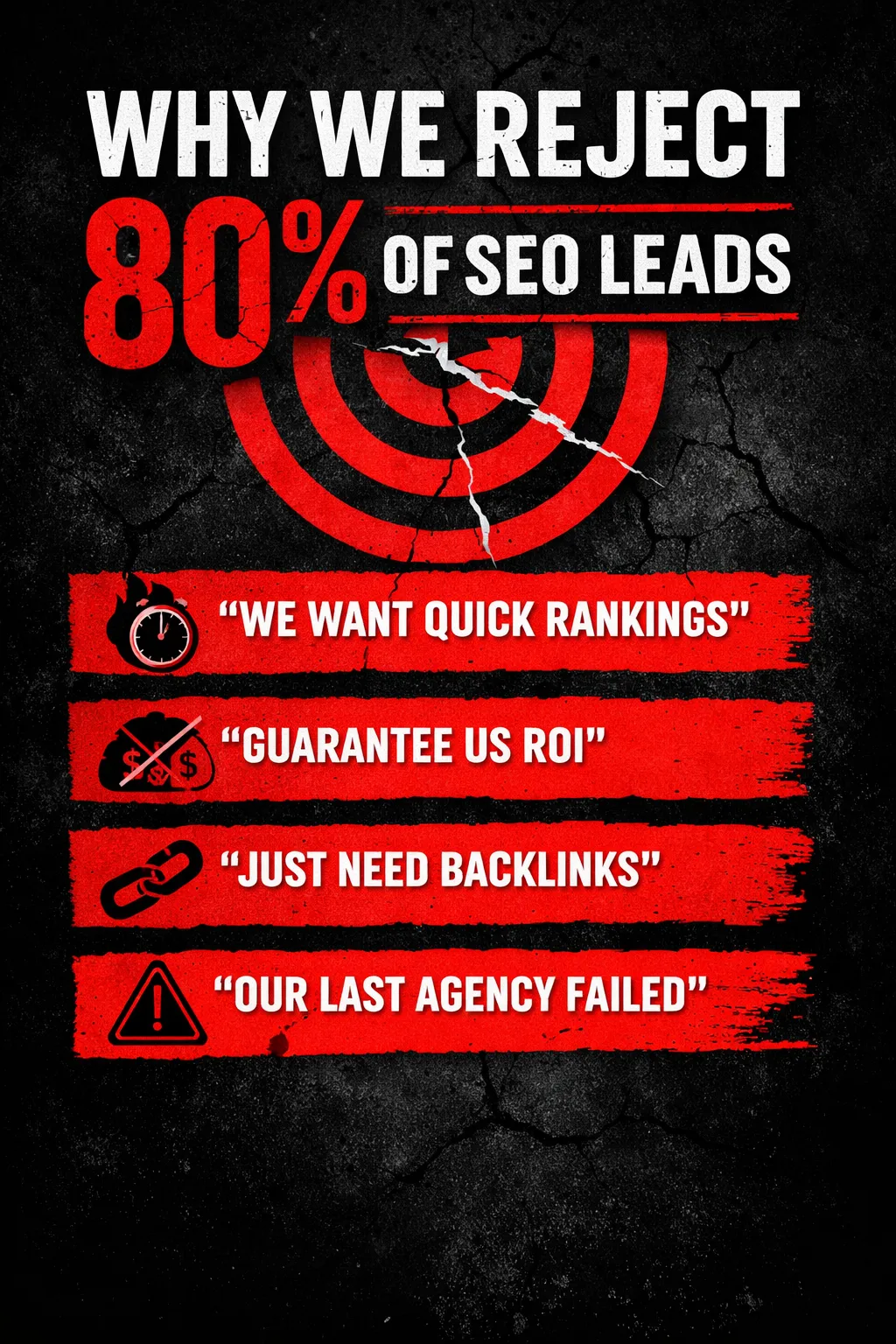
Why We Reject 80% of SEO Leads
Over the years, one question keeps coming up—sometimes directly, sometimes implied: “If you’re so confident in SEO, why don’t you take on more clients?”
The honest answer is simple: we don’t grow by saying yes to everyone; we grow by being selective. Rejecting nearly 80% of SEO leads isn’t a marketing tactic or artificial scarcity—it’s a survival decision rooted in experience. SEO, when done right, compounds. When done for the wrong reasons, it burns trust, time, and expectations on both sides.
After a decade of scaling purely through organic growth, we’ve learned to recognize patterns early. Certain requests almost always lead to frustration, regardless of how skilled the execution is. These are the four categories we consistently say no to.
The first is “We want quick rankings.”
This mindset treats SEO like a switch you flip rather than an asset you build. Rankings achieved quickly are usually fragile, intent-misaligned, or dependent on tactics that stop working the moment algorithms shift. Sustainable SEO behaves more like equity than a campaign—and if speed is the primary requirement, it’s already the wrong channel.
The second category is “SEO should guarantee ROI.”
No credible SEO professional can guarantee revenue in advance. Google doesn’t offer fixed rules, competitors don’t stand still, and user behavior changes constantly. What can be guaranteed is a disciplined process, strategic clarity, and compounding upside over time. Founders who demand certainty upfront are often uncomfortable with how organic growth actually works.
The third is “We just need backlinks or content.”
This reduces SEO to a checklist instead of a system. Backlinks without authority are noise. Content without differentiation is invisible. When SEO is treated as a commodity, the outcome is always the same—more pages, more links, and no real movement. We work with businesses that want to build credibility, not just volume.
The fourth—and most sensitive—category is “Our previous agency failed,” without any internal accountability. While bad agencies do exist, failure is rarely one-sided. If expectations, resources, timelines, or decision-making weren’t aligned internally, changing vendors won’t change results. SEO only works when it’s a shared responsibility.
Beyond these categories, we watch for clear red flags. An obsession with weekly reports instead of long-term signals. No patience for compounding growth. No clear brand differentiation. And most critically, no internal buy-in from leadership. SEO cannot succeed as a side project delegated without conviction.
Saying no protects our clients as much as it protects us. The ones we do work with don’t need convincing—they already understand that real SEO isn’t fast, guaranteed, or easy. It’s durable. And that’s exactly why it works.
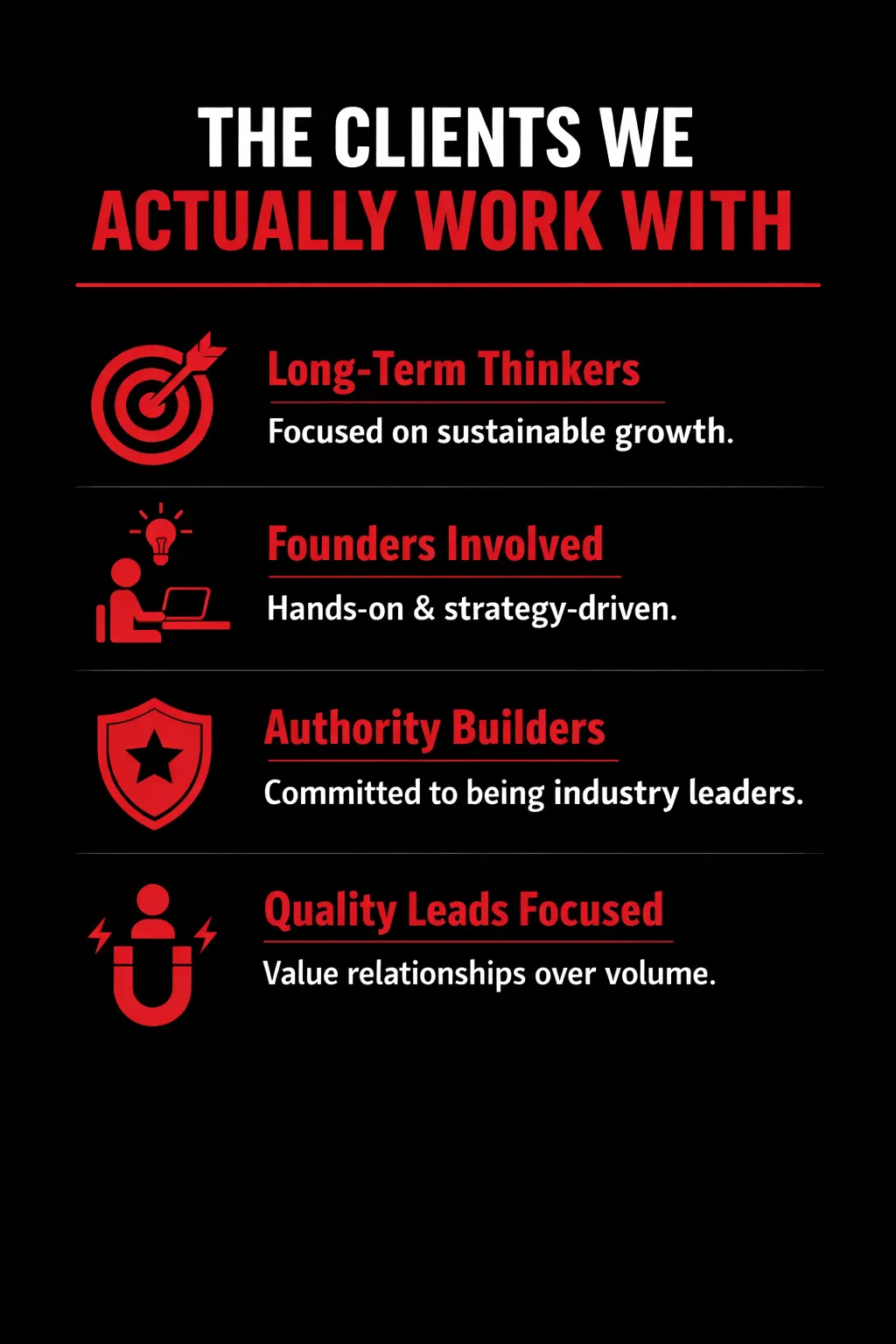
The Clients We Actually Work With
Over the years, we’ve learned something most SEO agencies discover too late: growth isn’t limited by tactics—it’s limited by mindset. The clients who succeed with us don’t come asking for rankings, traffic spikes, or monthly reports filled with green arrows. They come with a longer view of the game.
The founders and leadership teams we work with understand that SEO is not a campaign—it’s infrastructure. It’s something you build patiently, strengthen over time, and rely on when everything else becomes expensive or unpredictable. These are long-term thinkers who are comfortable delaying short-term wins in favor of compounding outcomes. They don’t panic during quiet months, and they don’t chase every algorithm update like a fire drill.
Another defining trait is leadership involvement. Our best partnerships are with founders or senior decision-makers who stay close to the strategy. Not because they want to micromanage, but because they understand that authority, positioning, and brand voice can’t be outsourced blindly. When leadership is involved, SEO stops being a checklist and starts becoming a reflection of the company’s values, expertise, and conviction.
We also work with clients who are willing to build authority instead of chasing traffic. They’re not interested in publishing content just to fill a calendar. They care about saying something meaningful, being credible in their space, and earning trust—both from users and from search engines. They understand that attention without trust is noise, and traffic without intent is a vanity metric.
Most importantly, the clients we work with see SEO as a brand function, not a growth hack. For them, organic visibility is tied to reputation, recall, and long-term market presence. The outcomes of this approach aren’t loud, but they are durable: becoming a recognized name in their category, receiving predictable inbound interest, reducing dependency on paid acquisition, and attracting leads that are already educated, aligned, and ready to engage.
We don’t optimize for everyone. We optimize for those who want to build something that lasts.
What Most SEO Agencies Will Never Tell You
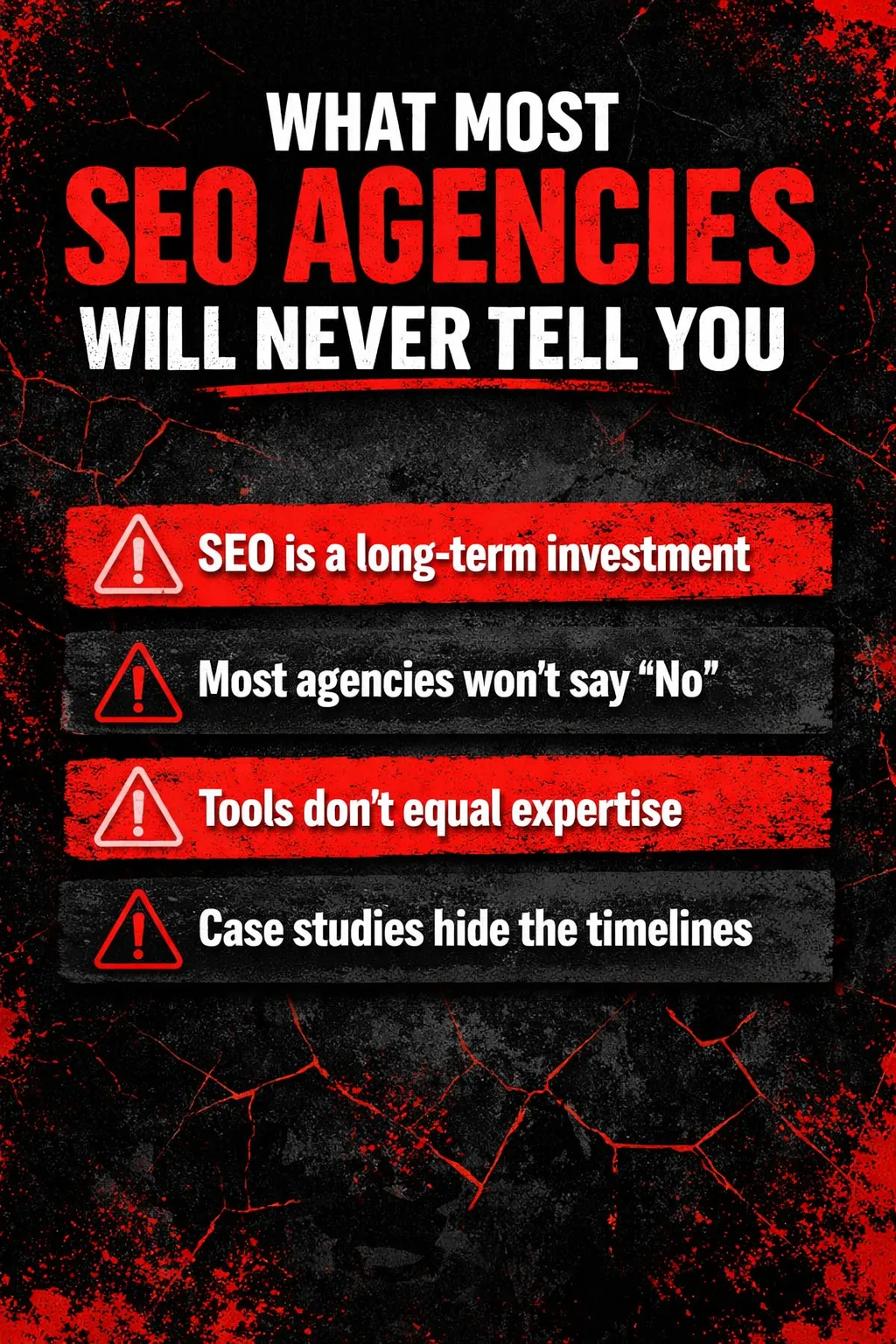
SEO is usually sold like a service. You pay a monthly fee, you get a set of deliverables, and somewhere along the way, rankings are expected to improve. That framing is convenient—but it’s also misleading. In reality, SEO behaves far more like an investment than a service. It compounds slowly, demands patience, and rewards consistency over quick wins. And just like any real investment, there are no guarantees, fixed timelines, or instant returns. This is a truth most agencies avoid, not because they’re dishonest, but because it’s difficult to sell patience in a market obsessed with speed.
Another uncomfortable reality: most SEO agencies can’t afford to say “no.” Not to unrealistic expectations, not to poor-fit businesses, and not to timelines that defy how search engines actually work. Saying yes keeps revenue predictable. Saying no creates short-term risk. But over time, this pressure to accept everyone quietly dilutes quality—strategies become generic, execution becomes rushed, and results become inconsistent. The agency survives, but the client relationship slowly erodes.
Then there’s the overreliance on tools. Modern SEO is saturated with dashboards, scores, audits, and automation. Tools are helpful—but they don’t think. They don’t understand business models, user psychology, or market nuance. They surface data, not insight. True SEO progress comes from interpretation: knowing which signals matter, which can be ignored, and which require context that no tool can provide. Confusing access to tools with expertise is one of the biggest reasons SEO feels unpredictable to so many businesses.
Case studies are another area where reality gets quietly edited. What’s often highlighted is the outcome—traffic up, rankings improved, leads increased. What’s rarely emphasized is the timeline. Six months? Eighteen months? Three years? SEO success is almost always slower than the headline suggests, and that time gap is where most disappointment lives.
As a founder, I’ve learned that honesty in SEO costs money in the short term. It filters out impatient leads and uncomfortable conversations. But over time, it builds something far more valuable: trust, alignment, and longevity. And that, ironically, is the same principle that makes SEO work in the first place.
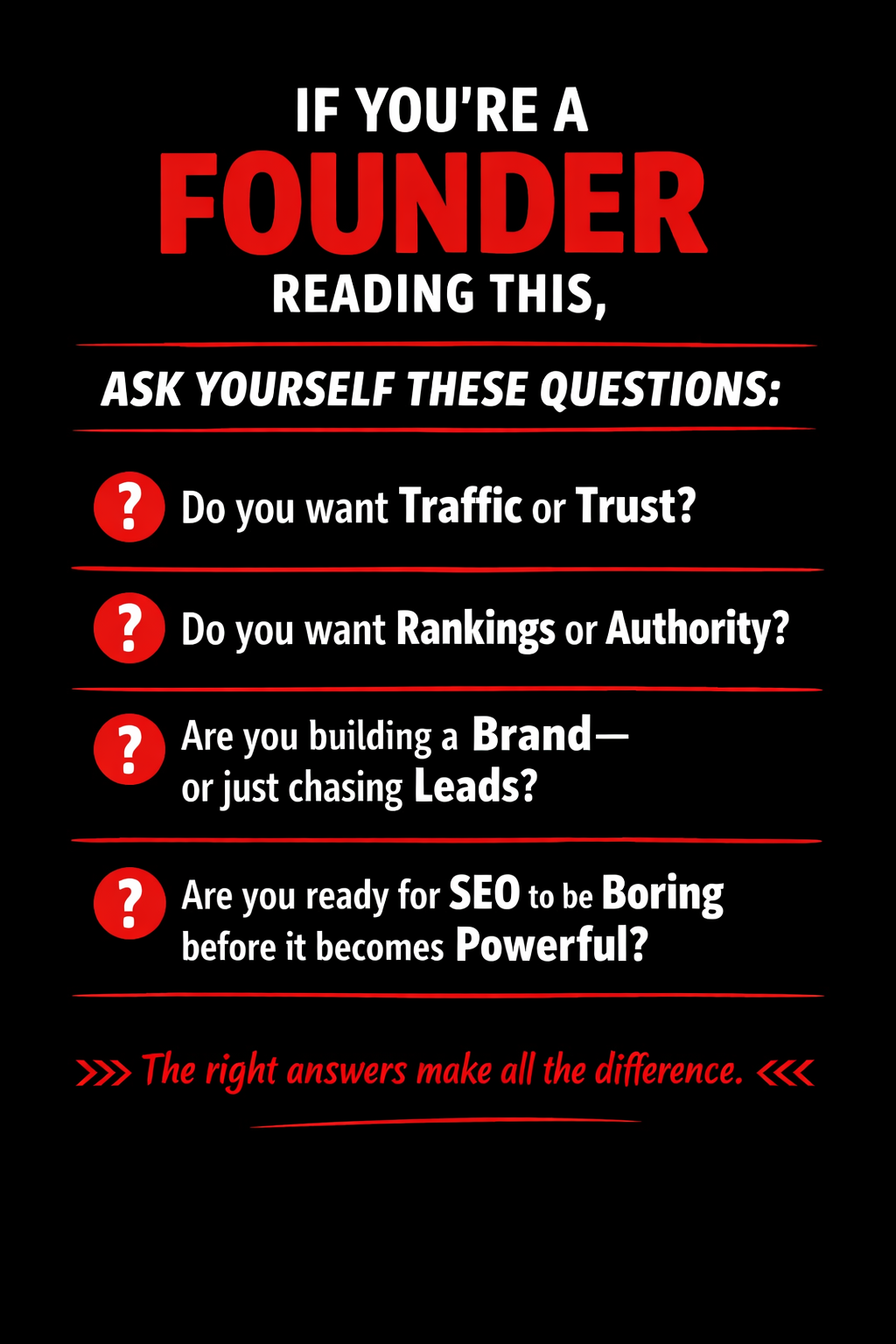
If You’re a Founder Reading This, Ask Yourself These Questions
If you’ve made it this far, this isn’t about SEO anymore.
It’s about how you want to build your company.
Most founders don’t fail at SEO because of bad execution. They fail because they never stop to question what they’re actually optimizing for. So before you hire another agency, approve another content sprint, or obsess over another ranking report, pause and ask yourself these questions—honestly.
Do you want traffic or trust?
Traffic looks impressive on dashboards. Trust shows up in inbound leads that already believe in you. Google can send visitors; only credibility turns them into customers. One compounds. The other disappears the moment algorithms shift.
Do you want rankings or authority?
Rankings can be bought, gamed, and temporarily inflated. Authority cannot. Authority is when Google expects you to rank. It’s when updates stabilize your visibility instead of threatening it. Rankings are a metric. Authority is a position.
Are you building a brand—or just chasing leads?
Lead-chasing creates dependency: more content, more backlinks, more spend. Brand-building creates pull. People search for you by name. They reference your content in meetings. They arrive pre-sold. SEO works best when it stops being your only growth lever.
Are you ready for SEO to be boring before it becomes powerful?
Real SEO isn’t exciting. It’s slow. Repetitive. Unsexy. And that’s why it works. Compounding growth never announces itself early—but when it does, it’s incredibly hard for competitors to undo.
If these questions make you uncomfortable, that’s not a problem. It’s a signal. Sustainable SEO doesn’t reward urgency—it rewards conviction.
Closing: The Real Ranking Factor Google Never Mentions
After more than a decade of working with search, one truth has become impossible to ignore: Google doesn’t rank pages—people do. Not directly, of course, but through the collective signals of human behavior. What we call an “algorithm” is ultimately a reflection of how real users think, trust, ignore, engage, and return.
That’s why the most powerful ranking factor has never been a tactic, a tool, or a clever workaround.
It’s trust.
Trust is what makes someone click your result even when you’re not #1.
Trust is what keeps them reading instead of bouncing.
Trust is what turns a search query into a brand preference.
Tricks can create temporary visibility, but they can’t manufacture credibility. And Google has spent years getting better at telling the difference. The more sophisticated search becomes, the more it behaves like a human—skeptical of shortcuts, drawn to consistency, and biased toward brands that have earned their place over time.
This is why we stopped chasing hacks early on. We realized that rankings stabilize when your brand does. Traffic compounds when your reputation does. And growth becomes predictable when people trust you before they even land on your site.
The internet doesn’t reward cleverness anymore. It rewards credibility.
And credibility is built slowly, publicly, and often uncomfortably—by showing up with substance when shortcuts would be easier.
That belief shapes everything we do. It’s also why we don’t work with everyone. Not because we’re selective for the sake of it, but because trust-driven growth requires patience, alignment, and a shared understanding of what actually moves the needle.
If this perspective resonated with you, you already understand why.