SUPERCHARGE YOUR ONLINE VISIBILITY! CONTACT US AND LET’S ACHIEVE EXCELLENCE TOGETHER!
How Post-Funding Decisions Silently Break SEO Foundations (and Inflate CAC)
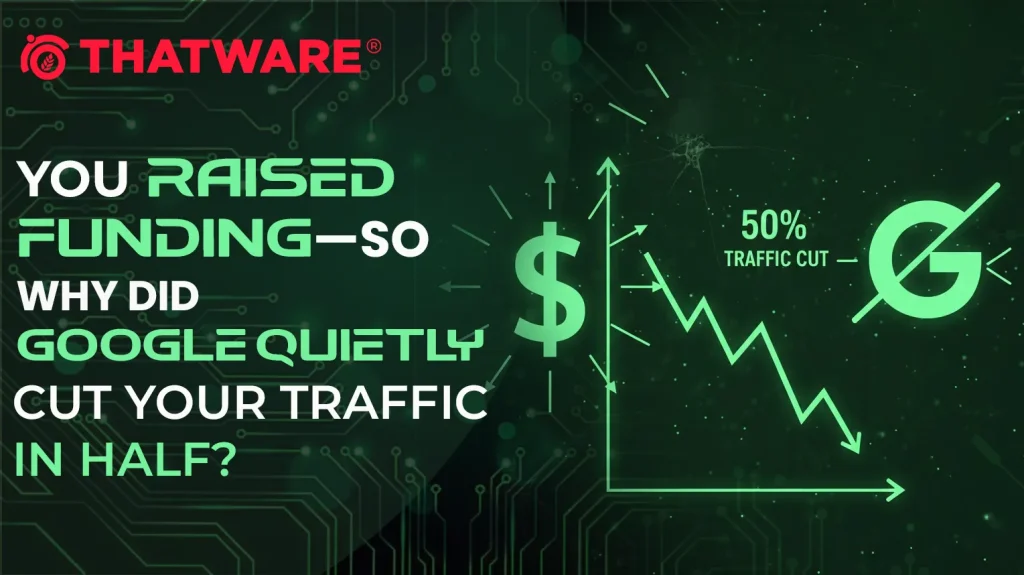
You raised funding.
The Slack channel is on fire with 🎉 emojis. Someone’s sharing the press release link. The founders are doing back-to-back interviews. A handful of new hires join the org within weeks—growth, product, design, maybe even a new “Head of Performance.” Roadmaps get rewritten. Priorities get sharper. Everything starts moving faster.
And then something quietly breaks.
Your revenue projections still look strong. Paid budgets are climbing. Dashboards feel “up and to the right.” But when someone finally checks organic traffic—usually during a routine weekly review or an investor update—it’s not a small dip.
It’s down 20%.
Then 35%.
Then… somehow… 50%.
The panic hits harder because Google never told you anything was wrong. There’s no manual action. No penalty notification. No dramatic warning inside Google Search Console. No clear “we did X and got punished” moment. Just a slow, silent disappearance from the search results—like someone turned the volume down on your visibility.
Here’s the uncomfortable truth most teams miss:
Google didn’t punish you. Your growth decisions did.
This isn’t another fear-driven take about core updates “destroying sites.” It’s about what high-growth companies accidentally break after funding—often without realizing it.
In this article, we’ll unpack the invisible SEO damage that happens right after funding, why the traffic drop is delayed (not instant), why your paid CAC typically explodes next, and how to prevent—or reverse—the collapse before it becomes a compounding acquisition problem.
The Post-Funding Paradox: More Resources, Less Visibility
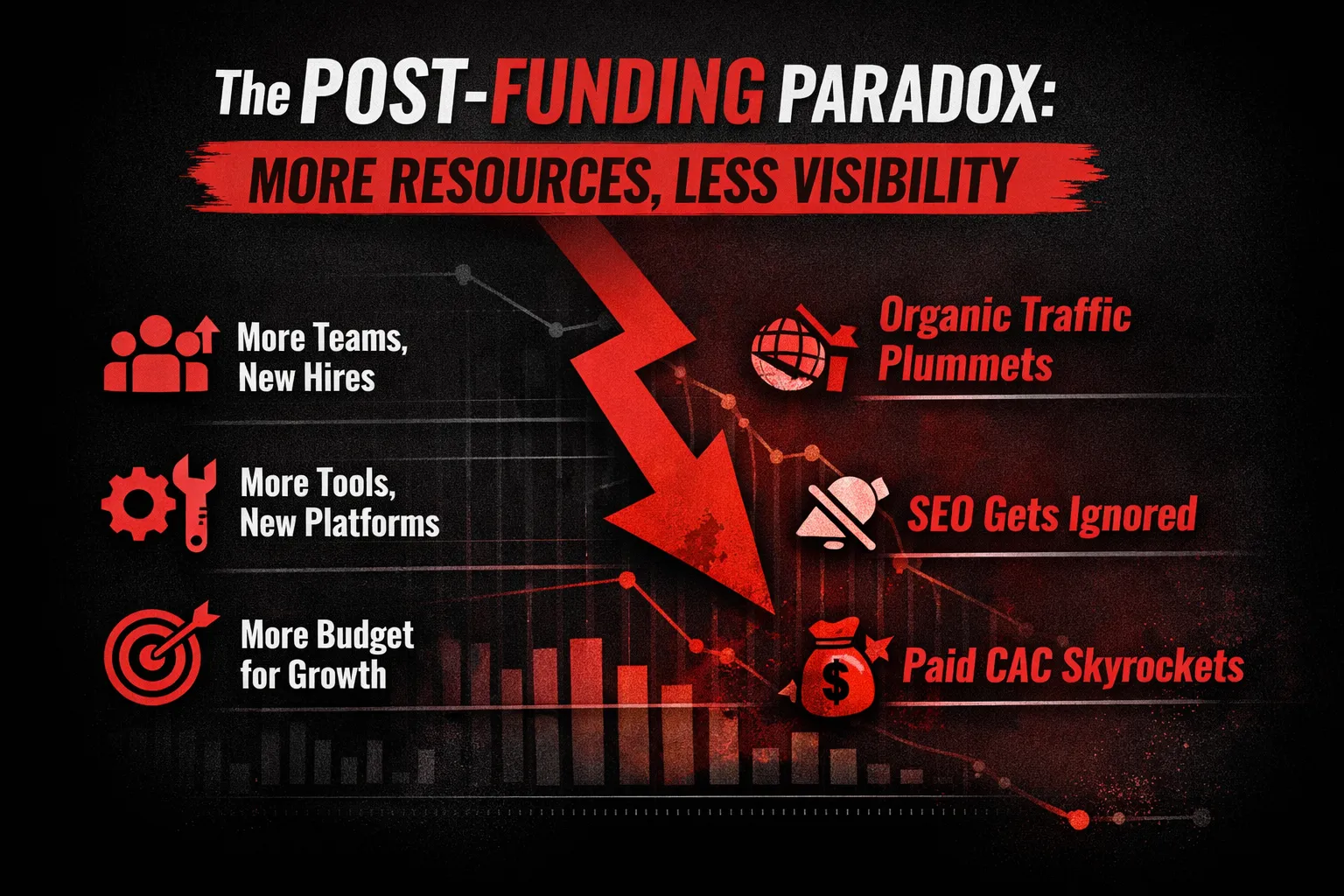
Funding is supposed to be the moment everything gets easier. More people join the team. Better tools replace scrappy setups. Budgets finally allow you to “do growth properly.” On paper, execution should improve across the board—and for a brief moment, it feels like it does.
The underlying assumption after funding is simple and almost universal: more people mean faster execution, more tools mean better performance, and more spend means predictable growth. With capital in the bank, companies expect fewer bottlenecks and more momentum. SEO, by default, is assumed to benefit from this lift.
But the opposite often happens.
Once funding lands, SEO quietly slips into the background. Growth gets redefined in very visible, fast-moving ways—paid acquisition scales because it’s measurable and immediate, design refreshes happen to “match the new brand,” and product velocity becomes the primary signal of progress. These initiatives look like growth, feel like growth, and report like growth. Organic traffic, meanwhile, is treated as a lagging metric—something to review monthly, not something to actively protect.
This is where the real damage begins.
SEO rarely collapses overnight. The decline is delayed, gradual, and easy to miss. Google doesn’t react instantly to internal changes, tool migrations, or structural shifts. Instead, it reassesses your site slowly as it crawls new pages, reinterprets internal links, and reevaluates topical authority. Rankings don’t drop the same week changes are made—they erode weeks or even months later.
By the time the traffic dip shows up in analytics, teams are already looking elsewhere for answers. The most common conclusion is also the most comforting one: “It must be a core update.” In reality, the drop started much earlier—right when growth stopped including SEO as a first-class priority.
Google Didn’t Penalize You—It Re-evaluated You
One of the first conclusions teams jump to after a sudden traffic drop is fear: “We’ve been penalized.” This assumption spreads fast—especially after a funding round—because it feels external, uncontrollable, and final. But in the vast majority of post-funding traffic declines, there is no penalty at all.
The Myth of “SEO Penalties”
True SEO penalties are rare. Manual actions come with clear notifications inside Google Search Console, and they usually involve extreme violations—spam, cloaking, or malicious behavior. What most funded companies experience instead is far quieter and far more dangerous: algorithmic re-evaluation.
Google didn’t punish your site. It simply reduced its confidence in it.
Search rankings are not rewards or punishments—they’re trust-based decisions. When Google’s systems detect meaningful changes to a website, they reassess whether that site still deserves the same visibility it previously earned. When confidence drops, rankings slide. No alerts. No warnings. Just a slow erosion of impressions and clicks.
This is why traffic losses after funding feel confusing. Nothing “wrong” appears in dashboards, yet performance declines anyway.
What Google Actually Re-measures After Changes
After significant site or organizational changes, Google recalculates several foundational signals, including:
- Site architecture: How clearly pages are organized and hierarchically connected
- Internal linking clarity: Whether authority still flows to the right pages
- Content intent alignment: If pages still satisfy the same search intent as before
- Crawl efficiency: How easily Google can discover, prioritize, and revisit pages
- Authority distribution: Whether trust is concentrated or accidentally diluted
Even small disruptions across these layers can compound into visibility loss.
Why Funding Events Trigger Re-evaluation
Funding doesn’t directly affect rankings—but what follows funding does.
After capital arrives, companies move fast. They redesign pages, restructure navigation, rewrite messaging, migrate CMSs, and ship new UX patterns. From Google’s perspective, this looks like a different site:
- URLs shift
- Content meaning changes
- User experience is restructured
At that moment, Google effectively pauses and asks one critical question:
“Is this still the same site I trusted before?”
If the answer is unclear, rankings quietly adjust—downward.
The Silent SEO Killers Introduced Right After Funding
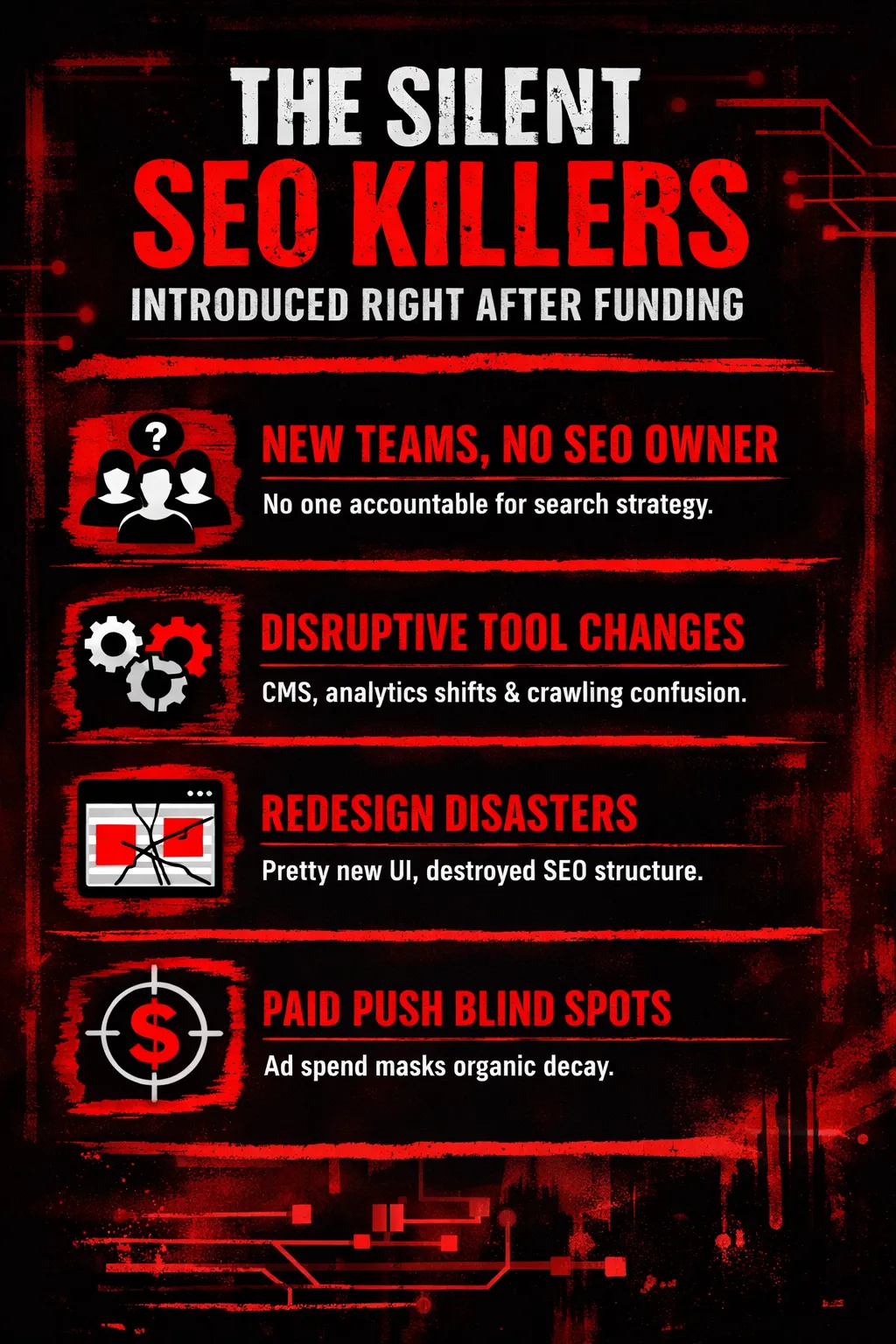
Here’s the part nobody warns you about: funding doesn’t damage SEO by itself. What damages SEO is what typically happens next—new people, new tools, and a “fresh” redesign that looks great in a board deck but quietly dismantles the search equity you spent years building.
And the worst part? These changes rarely create obvious errors. Rankings don’t collapse overnight. There’s no red alert in Search Console saying “Congrats on the funding—your internal linking is broken now.” Instead, Google slowly loses confidence in your site’s clarity. Crawl patterns shift. Important pages get visited less. Topic clusters weaken. Traffic bleeds.
Let’s break down the three most common post-funding SEO killers—because if your traffic dropped after a round, odds are one (or all) of these got introduced.
New Teams, Fragmented Ownership
After funding, you hire fast—product managers, designers, developers, growth marketers, maybe an agency. Everyone is moving. Everyone is shipping. And in that momentum, SEO ownership becomes diluted.
Not because anyone hates SEO. But because SEO is cross-functional by nature, and after a round, cross-functional accountability becomes messy. A new product pod changes site structure. Design updates copy and layout. Engineering improves performance. Growth launches paid landing pages. Each change looks “reasonable” inside the team’s world.
New hires often optimize for what they’re measured on:
- Speed: shipping, velocity, sprint goals
- Design: cleaner pages, improved UI, shorter copy
- Features: new flows, new sections, new URLs
But while everyone owns a piece of the site, nobody owns the SEO foundations:
- Search intent: Are we still answering what users came for?
- Crawl paths: Can Google still reach the pages that matter?
- Historical authority: Are we preserving the pages that earned trust over time?
That’s the key pain: SEO stops being strategic and becomes reactive.
Instead of planning search growth like infrastructure, teams end up chasing symptoms: “Why did this page drop?” “Why is traffic down?” “Is it a core update?” By the time the questions start, the damage is already months deep.
New Tools That Break Old Signals
Funding also triggers a “stack upgrade.” Teams replace what worked with what sounds scalable: a new CMS, a headless setup, a new analytics framework, a tag manager overhaul. On paper, these are smart moves. In reality, they often introduce subtle technical behaviors that rewrite the signals Google relied on to understand your site.
Common post-funding changes include:
- CMS migrations (WordPress → Webflow → headless)
- Headless setups (rendering shifts, routing changes)
- New analytics stacks (script changes, page view logic changes)
- Tag managers (more scripts, more load dependencies, more complexity)
The SEO risk isn’t “new tools.” The risk is what usually sneaks in with them:
Common mistakes:
- Parameter explosions: URLs multiply into endless variations (?ref=, ?utm=, ?sort=)
- Index bloat: Google starts indexing low-value duplicates or thin pages
- Canonical misfires: canonical tags point incorrectly, or get dropped entirely
- JavaScript dependency creep: critical content becomes harder for crawlers to reliably access
The result is brutal in a quiet way: Google struggles to understand what matters now.
You didn’t lose traffic because Google “hates” your new site. You lost it because the new stack introduced ambiguity—too many versions of the same page, unclear priorities, messy canonical logic, inconsistent rendering. Google’s job is to reduce uncertainty. When your site becomes uncertain, it gets less visibility.
The “Harmless” Redesign That Kills SEO
If there’s one post-funding move that destroys SEO more than any other, it’s the redesign.
Why? Because redesigns change how your site communicates meaning—to users and to Google. They often prioritize visual simplicity over semantic clarity, which is deadly for search performance.
A typical post-funding redesign includes:
- Navigation changes: menus simplified, categories restructured, fewer links
- Content compression: long pages shortened, FAQs removed, details cut
- “Cleaner” pages with less context: fewer words, fewer headings, fewer internal references
- Visual hierarchy over semantic hierarchy: big fonts and pretty sections, but weaker H1/H2 logic and topical structure
From the outside, it looks like an upgrade. But underneath, the SEO architecture often collapses through silent failures:
Silent failures:
- Lost internal links: pages that used to receive authority stop getting linked
- Flattened topic clusters: content hubs lose their depth and relationships
- Broken topical authority: Google no longer sees clear expertise patterns across the site
- Reduced crawl depth: important pages get buried or become harder to discover
This is why traffic drops feel “random” after redesigns. It’s not random. It’s structural.
And here’s the most important line to remember:
SEO doesn’t die during redesigns—it bleeds afterward.
Because the redesign launches, the team celebrates, and then Google begins its slow reassessment. Weeks later, rankings start slipping. Two months later, the decline becomes visible. Three months later, paid spend increases to compensate—and CAC starts climbing.
The redesign didn’t “break SEO” with one big error.
It broke it by removing the invisible pathways that helped Google understand, trust, and prioritize your pages.
When Paid Growth Masks Organic Decay
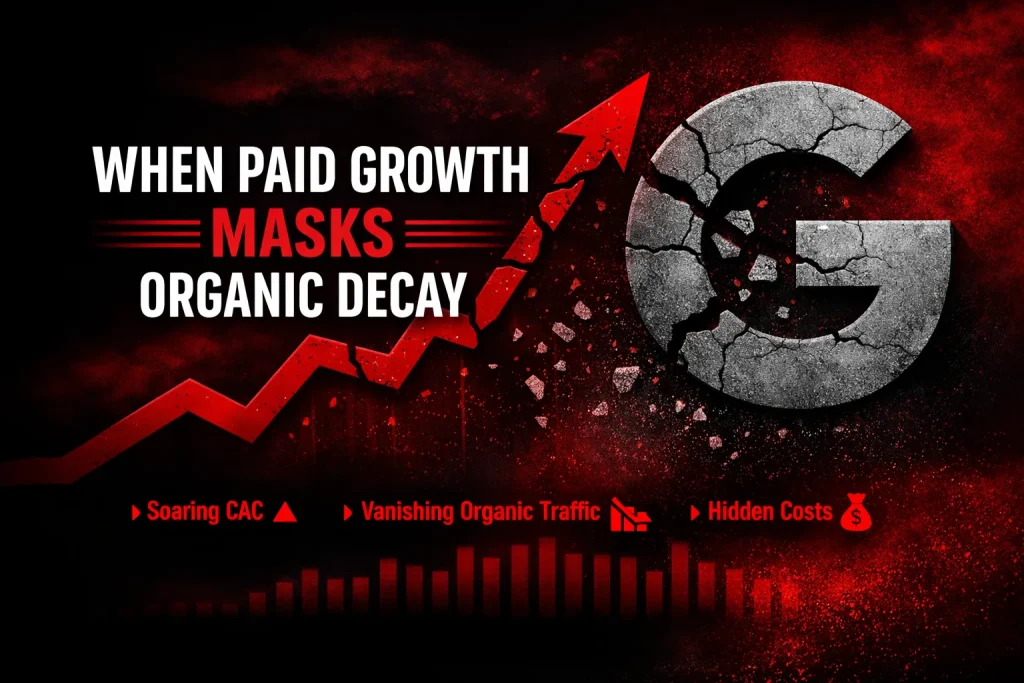
At first, nothing looks wrong.
Organic traffic dips, but paid traffic surges. The total sessions graph stays flat—or even trends upward. Revenue appears stable. In some cases, it even grows. Internally, this is framed as successful execution: the growth team “caught the dip,” the paid team scaled efficiently, and leadership feels reassured that momentum is intact.
This is where the danger begins.
Paid growth has a unique ability to mask organic decay, especially in the months following funding. Because paid channels can be turned up instantly, they hide the structural damage happening underneath—damage that only becomes visible when CAC starts to spike and growth efficiency collapses.
The Temporary Illusion of Growth
When organic traffic drops post-funding, paid acquisition is usually the first lever pulled. Budgets increase, new campaigns launch, and previously organic queries are quietly absorbed into paid search and social.
On dashboards, this looks fine:
- Total traffic holds steady
- Conversions remain consistent
- Pipeline projections are met
But a subtle shift occurs inside the organization. Leadership stops asking about SEO. Organic becomes “something we’ll fix later,” because the numbers no longer scream urgency. SEO isn’t failing loudly—it’s being covered up.
The illusion is dangerous because paid growth is responsive, not foundational. It compensates for lost demand capture, but it does not rebuild the system that generated that demand organically in the first place.
The CAC Time Bomb
Paid acquisition always reveals the truth—just later.
As organic declines, paid channels begin absorbing traffic they were never meant to handle:
- Informational queries
- Mid-funnel research intent
- Brand discovery searches
Over time, this causes three compounding effects:
- Paid CAC rises quarter after quarter
You’re now paying for users you previously earned “for free.”
- Retargeting pools shrink
Fewer organic visitors means fewer warm audiences to convert cheaply.
- Organic-assisted conversions disappear
Paid no longer benefits from organic’s trust-building role, forcing higher spend to achieve the same results.
What looked like efficient scaling slowly turns into a cost spiral.
Why SEO Is the Only CAC Stabilizer
SEO isn’t just a traffic channel—it’s a cost-control system.
Organic search captures:
- Mid-funnel demand that paid converts expensively
- Branded and non-branded intent that anchors acquisition efficiency
When SEO is healthy, paid works with it. When SEO erodes, paid works against your margins.
Without strong organic foundations:
- Paid must absorb informational traffic
- Conversion journeys get longer
- Cost per acquisition compounds with every growth push
This is why CAC spikes rarely start in paid dashboards. They start months earlier, when organic decay is ignored—because paid made everything look fine.
Until it doesn’t.
Architecture: The Invisible Backbone Google Actually Cares About
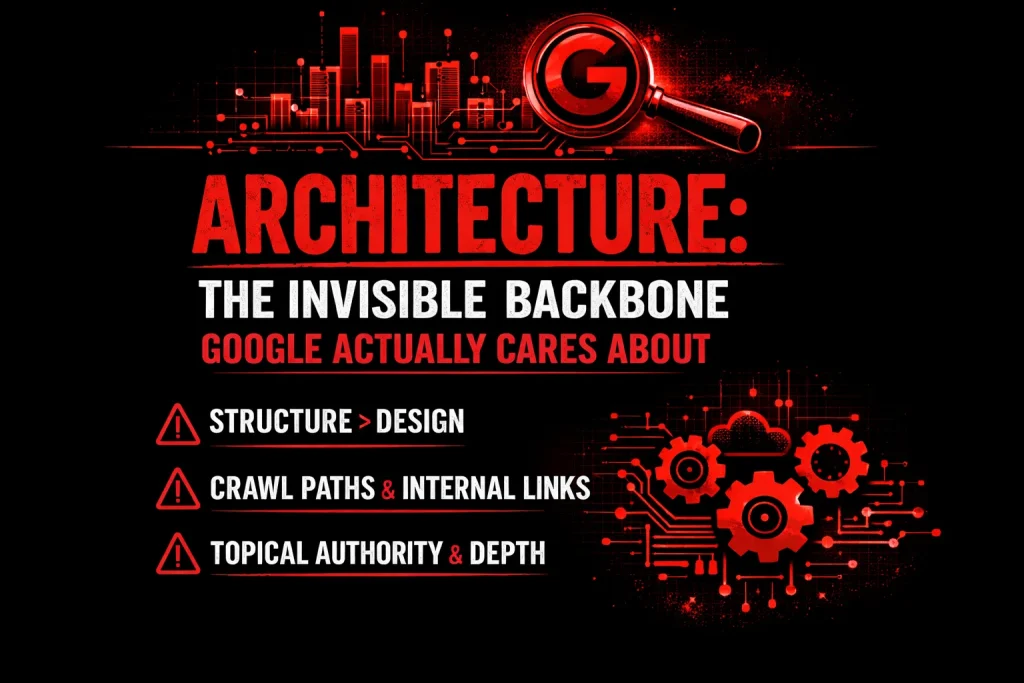
When traffic drops after funding, teams instinctively audit content, keywords, or backlinks. Almost nobody looks at architecture—yet this is exactly where Google focuses when reassessing a growing site.
SEO architecture isn’t about aesthetics or UX polish. It’s about how meaning, authority, and intent are structured across the site. And after funding, this invisible backbone is often the first thing to break.
Architecture vs Design
Most teams confuse design with architecture.
- Design is what users see: layouts, colors, components, animations, and branding.
- Architecture is what Google understands: how pages relate to each other, how authority flows, and how clearly topical relevance is signaled.
A redesign can look cleaner, faster, and more modern—while simultaneously making the site harder for Google to interpret. When navigation labels change, internal links are removed for “minimalism,” or content is compressed to improve UX, Google doesn’t see beauty. It sees lost context.
Search engines rely on:
- Hierarchy
- Internal linking paths
- Semantic grouping
- Depth and topical continuity
When those weaken, rankings don’t drop immediately—but trust erodes.
Common Post-Funding Architecture Failures
After funding, websites expand quickly. New features, pages, categories, and experiments pile up—often without a unifying architectural strategy. The most common failures include:
- Over-segmentation: Creating too many thin categories, subfolders, or microsilos that dilute authority instead of concentrating it.
- Shallow category depth: Important pages end up one click away from nowhere, lacking supporting content that reinforces topical relevance.
- Orphaned pages: Landing pages, feature pages, or blogs that exist—but aren’t meaningfully linked from anywhere important.
- Excessive faceted navigation: Filters and parameters generate crawl noise, index bloat, and ambiguity about which URLs matter most.
Individually, these seem harmless. Collectively, they blur the site’s topical focus—and Google starts second-guessing relevance.
Why Core Updates Hit “Growing” Companies Harder
Core updates don’t punish growth. They stress-test clarity.
Updates reward sites that are:
- Structurally coherent
- Topically focused
- Architecturally intentional
Post-funding sites often become:
- Bigger (more pages, more URLs)
- Messier (more teams, more opinions)
- Less focused (broader messaging, diluted intent)
When architecture can’t clearly answer “What is this site the best authority for?”, Google hesitates. And hesitation is all it takes for rankings to slip—quietly, gradually, and without warning.
In SEO, architecture isn’t a technical detail. It’s the system that determines whether growth compounds—or collapses.
Why Traffic Drops Feel Random (But Aren’t)
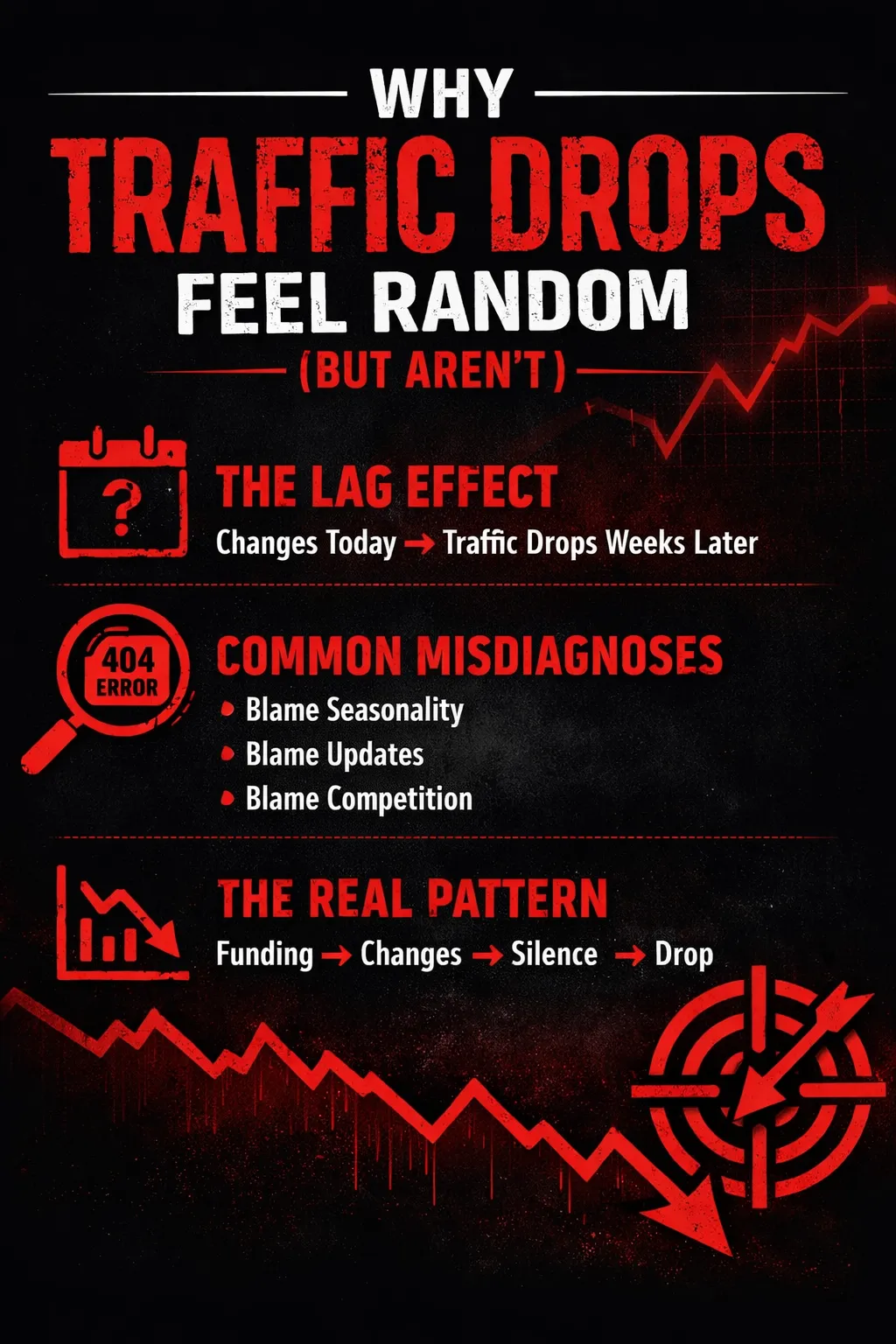
One of the most frustrating parts of a post-funding traffic drop is how random it feels. There’s no single day where everything breaks. No red alert. No warning email from Google. Just a slow, unsettling decline that shows up weeks—or even months—after the decisions that caused it. This delay is exactly why teams panic, misdiagnose the issue, and often make the situation worse.
The Lag Effect Explained
SEO does not respond in real time. When you make changes to your site—launch a redesign, migrate to a new CMS, restructure navigation, prune content, or shift internal linking—Google doesn’t immediately reward or punish you. Instead, it enters a reassessment phase.
First, Google has to crawl the new version of your site. That alone can take days or weeks, especially for larger sites. Then it needs to reindex pages, deciding which URLs matter, which ones are duplicates, and which have lost context. Finally, Google begins to re-score trust: reassessing your site’s authority, topical clarity, and structural consistency based on what it now sees.
Only after this process completes does the impact surface in rankings—and by then, the original change is often forgotten.
Why Teams Misdiagnose the Problem
Because of this lag, teams rarely connect cause and effect. Instead, they reach for convenient explanations. Traffic dips? It must be seasonality. Rankings fluctuate? Probably a core update. Competitors gaining ground? Must be aggressive link building.
These explanations feel safe because they externalize the problem. If Google did it, or the market did it, there’s nothing internally broken. But this mindset delays accountability—and recovery.
The Real Pattern
When you zoom out, the pattern is almost always the same: funding → change → silence → drop. The funding event triggers a wave of internal changes. Google quietly reassesses the site. Nothing happens—until it does. And when traffic finally falls, it feels sudden, unfair, and mysterious.
In reality, the signal was already sent weeks earlier.
The SEO Due Diligence Nobody Does After Funding
After funding closes, companies obsess over financial due diligence—burn rate, runway, hiring plans, and GTM execution. But there’s one form of due diligence almost no one runs, despite its direct impact on revenue efficiency: SEO due diligence.
This blind spot is exactly why traffic drops feel “sudden” months after a raise. The damage isn’t caused by growth itself—it’s caused by ungoverned change.
What Should Happen After Funding (But Almost Never Does)
Funding fundamentally changes how fast and how often things move. That alone should trigger a structured SEO risk review. Instead, most teams assume SEO will “adapt.”
In reality, three critical actions should happen immediately after funding:
SEO risk audits
Before new hires touch the site, teams should audit existing organic equity—top-ranking URLs, historical traffic drivers, link concentration, and intent coverage. This creates a baseline that protects what already works.
Architecture validation
Growth usually means new sections, features, or markets. Without validating whether the existing site architecture can support that expansion, companies unintentionally dilute topical authority, increase crawl waste, and confuse search engines about what the site is actually about.
Change impact modeling
Redesigns, CMS changes, content pruning, and navigation updates all carry SEO risk. Mature organizations model how these changes will affect crawling, indexing, and rankings before rollout. Most funded startups don’t—and pay for it later.
The Cost of Skipping SEO Governance
When SEO governance is absent, every team optimizes locally:
- Product optimizes for usability
- Design optimizes for aesthetics
- Content optimizes for messaging
- Paid teams optimize for conversions
But no one optimizes for search continuity.
The result? Internal links disappear, intent alignment fractures, and authority gets redistributed randomly. Over time, Google no longer sees a coherent, trustworthy entity—just a growing collection of disconnected pages.
This is how global search equity erodes silently, even while individual teams feel they’re doing great work.
SEO as Infrastructure, Not a Channel
The core mistake is treating SEO like a marketing channel instead of what it actually is: infrastructure.
SEO is comparable to:
- Security: ignored until something breaks
- Data integrity: invisible, but foundational
- Performance engineering: unglamorous, yet business-critical
You wouldn’t let every team deploy code without security review. You wouldn’t allow data pipelines without validation. Yet companies allow unlimited site changes without SEO oversight—and then act surprised when traffic collapses.
Post-funding growth doesn’t kill SEO. Unprotected growth does.
How to Prevent (or Reverse) the Traffic Collapse
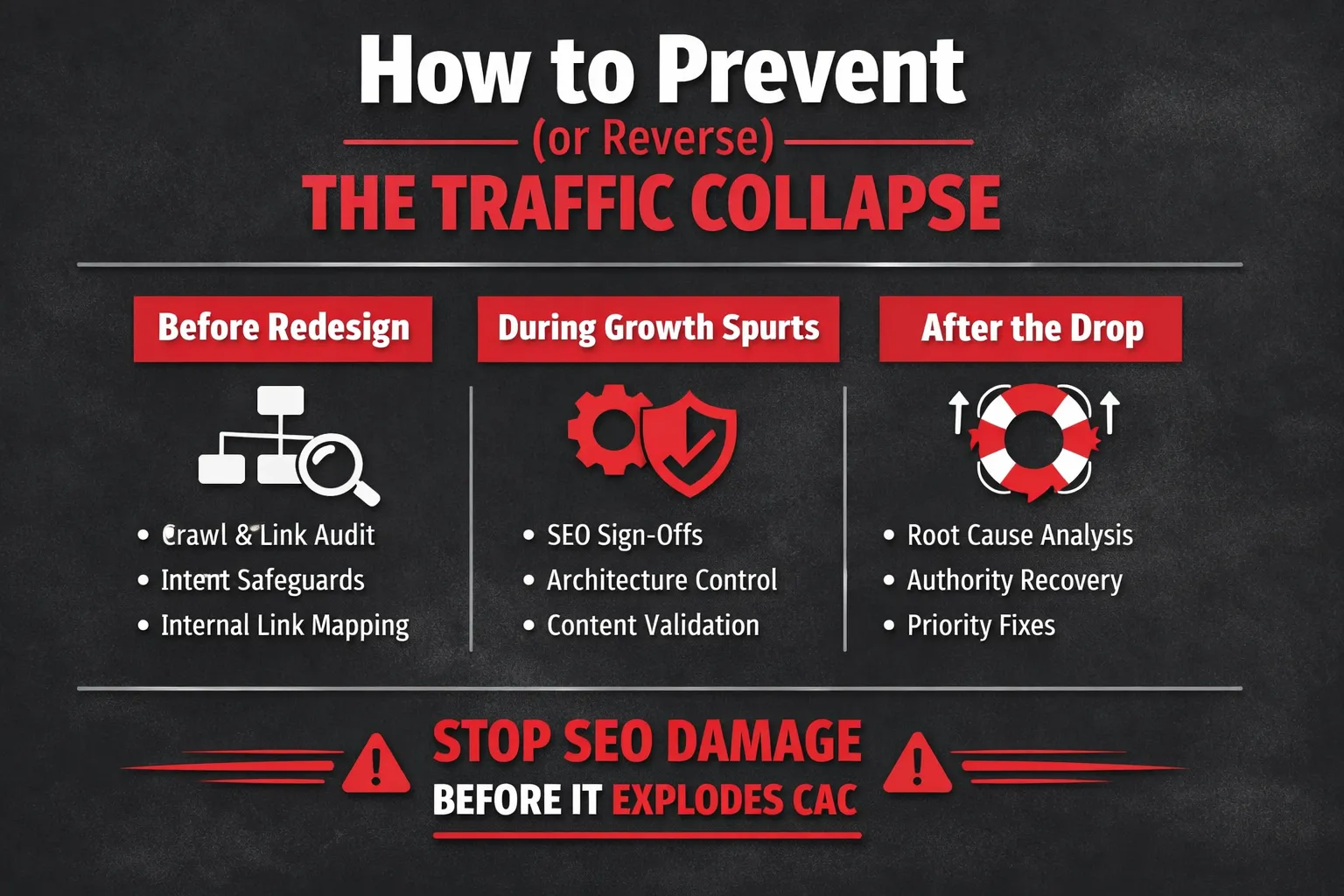
If post-funding growth decisions are what quietly break SEO, then prevention—and recovery—require treating SEO like infrastructure, not a marketing afterthought. The goal isn’t to “optimize pages,” but to protect search equity while everything else is changing fast. This is how teams that don’t lose half their traffic do it.
Before You Redesign: Protect What Google Already Trusts
Redesigns don’t fail because of aesthetics—they fail because they erase accumulated search trust. Before a single wireframe is approved, three safeguards must exist.
1. Crawl & link equity mapping
Every site already has an invisible hierarchy of authority:
- Pages with the most internal links
- URLs that earn external backlinks
- Sections Google crawls most frequently
Mapping this reveals which pages carry trust. When redesigns remove, merge, or demote these pages without understanding their role, Google loses its bearings. Equity mapping ensures high-authority URLs are preserved, redirected correctly, or structurally reinforced.
2. Intent preservation strategy
Redesigns often compress or “clean up” content. The problem?
Google doesn’t rank pages—it ranks intent satisfaction.
If a page ranked because it answered:
- Informational queries
- Comparison queries
- Problem-aware searches
That intent must still be satisfied post-redesign. Visual clarity cannot replace semantic depth. Intent mapping ensures rankings aren’t lost simply because the page “looks better.”
3. Internal link protection
Internal links are Google’s roadmap. Redesigns frequently:
- Reduce navigation depth
- Remove contextual links
- Over-centralize menus
This breaks topical authority. Critical pages must retain—or improve—their internal link prominence, not lose it. Internal linking isn’t cosmetic. It’s structural SEO.
During Growth Spurts: Governance Beats Optimization
Post-funding growth moves fast. That’s exactly when SEO breaks—because speed replaces oversight.
SEO sign-off gates
Every major change should pass a basic SEO checkpoint:
- New sections
- URL changes
- CMS or framework updates
This isn’t bureaucracy—it’s risk management. One unchecked deployment can undo years of organic growth.
Architecture ownership
When everyone builds, nobody owns the structure. SEO architecture needs a clear owner responsible for:
- Crawl depth
- Index control
- Topic clustering
- Canonical logic
Without ownership, sites sprawl. Google rewards clarity—not expansion.
Content intent validation
As teams scale content, volume increases but alignment drops. Each new page should answer:
- What query intent does this serve?
- Which existing pages does it support—or compete with?
Unchecked content growth leads to cannibalization, not rankings.
After a Drop Happens: Diagnose Before You React
Once traffic falls, panic usually leads to the wrong fixes. Recovery starts with diagnosis—not tactics.
Crawl vs index vs rank
First, isolate the failure:
- Crawl issue → Google can’t access pages
- Index issue → Google doesn’t trust pages enough to include them
- Ranking issue → Pages exist but lost relevance or authority
Each requires a different solution. Guessing delays recovery.
Prioritize pages that lost authority first
Not all traffic losses matter equally. Focus on:
- Previously high-performing URLs
- Pages with strong backlink profiles
- Core revenue-driving content
Recovering authority hubs restores site-wide trust faster than chasing long-tail pages.
Recovery timelines (no hype)
SEO recovery is not instant:
- Technical fixes: weeks
- Authority recalibration: 2–4 months
- Full trust recovery: longer
Anyone promising “quick wins” after a structural drop is selling hope, not strategy.
Bottom line:
Companies that protect SEO during growth don’t react to traffic drops—they prevent them. And when drops happen, they recover faster because they understand what broke, why it broke, and where to fix first.
The Real Takeaway: Growth Without SEO Is a Hidden Liability
Funding doesn’t just accelerate growth—it accelerates everything. Velocity increases, decisions stack faster, and small oversights compound into structural problems. That’s where most post-funding SEO failures begin. Not with a penalty. Not with a dramatic crash. But with a series of “minor” decisions that no one flags because everything else appears to be working.
SEO failures are dangerous precisely because they are invisible at first. Rankings don’t disappear overnight. Traffic erosion happens quietly, page by page, cluster by cluster. By the time leadership notices the drop, the damage has already spread across architecture, internal linking, and intent alignment. At that point, panic sets in—not because Google changed, but because organic demand was silently carrying more weight than anyone realized.
The companies that avoid this cycle are not the ones “doing more SEO.” They’re the ones treating SEO as infrastructure. As architecture that must remain stable while everything else moves fast. As governance that reviews changes before they go live. As risk management that protects demand capture the same way security teams protect data.
When SEO is embedded this way, growth doesn’t feel fragile. Redesigns don’t feel risky. Core updates don’t feel existential. Instead of reacting to traffic drops, teams prevent them.
The earlier SEO is treated as a foundational system—not a marketing channel—the less panic you’ll experience later. And the more predictable, scalable, and defensible your growth becomes.
Raising capital changes everything—teams, velocity, priorities, and risk. But it’s worth pausing to ask one uncomfortable question: what actually changed right after funding? Not in the pitch deck or the roadmap, but in how your site is structured, how decisions are made, and how search visibility is protected.
For fast-growing companies, SEO isn’t a channel to “optimize later.” It’s infrastructure. And like any infrastructure, small cracks introduced during growth compound quietly before they become expensive to fix.
This is where a post-funding SEO architecture audit or SEO risk assessment becomes less about rankings and more about governance—identifying structural weaknesses, blind spots introduced by scale, and decisions that could inflate CAC over time.Done right, this isn’t tactical SEO. It’s preventive, strategic, and executive-level—designed to protect organic demand while growth accelerates, not after it breaks.