SUPERCHARGE YOUR ONLINE VISIBILITY! CONTACT US AND LET’S ACHIEVE EXCELLENCE TOGETHER!
Most companies optimize for today. The winners design tomorrow. ThatWare builds systems that make tomorrow unavoidable.
Most companies can point to activity: a packed calendar, a dashboard full of green numbers, a team sprinting from one deadline to the next. On paper, it looks like progress. In reality, it’s often just motion—energy spent to keep the machine running exactly as it is.
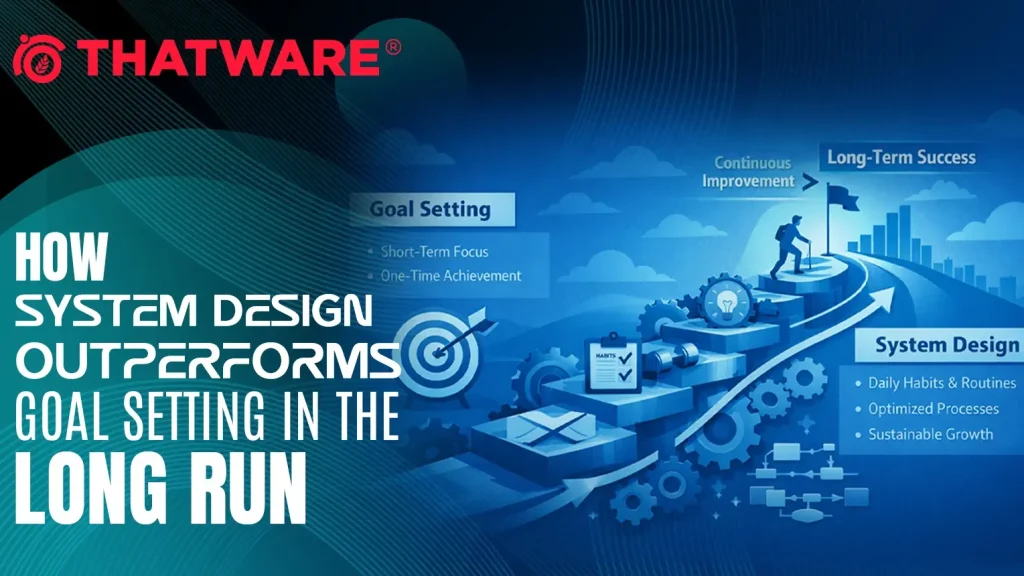
That’s the illusion: busy feels like building.
But here’s what quietly separates companies that last from companies that merely perform: compounding. Compounding isn’t about working harder or even executing better. It’s about designing a structure where each cycle—each project, campaign, release, quarter—doesn’t just deliver an outcome, but strengthens the organization’s ability to deliver better outcomes next time.
And this is where the uncomfortable truth shows up:
Hitting goals is not the same thing as building advantage.
A goal can be achieved by brute force: overtime, discounts, aggressive sales pushes, feature shipping without foundations, burning future trust for today’s numbers. Many companies do this and still call it “execution excellence.” But if the only way you can win is by pushing harder every quarter, you aren’t improving—you’re borrowing.
You’ve probably seen it up close:
- A company hits quarterly targets… while customer retention quietly weakens.
- Marketing reaches its lead goal… by lowering quality thresholds until sales loses faith.
- Product ships faster… until tech debt makes every future change slower and riskier.
- Operations reduces costs… until reliability drops and brand trust takes the hit later.
They achieved the goal. They did not build the engine.
In fact, some of the most painful business stories begin with “We were meeting our numbers.” Markets don’t punish you for missing a goal as harshly as they punish you for becoming irrelevant. Entire organizations have consistently hit KPIs—right up until the moment a more adaptive competitor rewrote the rules.
Because goals are snapshots. Markets are moving video.
A quarter is a short runway. It doesn’t reveal whether your company is accelerating, or simply sprinting in circles. That’s why “successful” goal-driven companies can still lose market relevance over time: they optimize for visible outputs, not invisible capability. They track what they can measure, not what will matter.
And once you see that, another truth becomes hard to ignore:
The problem isn’t execution. It’s the mental model.
Most organizations are built around the logic of goal setting: define a target, align teams, push, measure, repeat. It’s familiar. It’s tidy. It also creates predictable behaviors: teams chase numbers, leaders demand quick wins, and the organization slowly becomes an expert at performing progress rather than creating it.
That’s why companies can be highly competent and still fail to evolve. They’re optimizing for today.
The winners do something fundamentally different. They don’t just set goals. They design systems—structures that learn, adapt, and improve as a default behavior.
ThatWare’s positioning is simple, but it carries a sharp edge:
Most companies optimize for today. The winners design tomorrow. ThatWare builds systems that make tomorrow unavoidable.
That line isn’t about motivation. It’s about mechanics. Systems design is how you make progress inevitable even when conditions change—because your organization isn’t relying on heroic effort or temporary pushes. It’s relying on an architecture that keeps getting better.
Here’s the key insight that changes everything:
Goals create motion. Systems create momentum.
Motion is what happens when people push. Momentum is what happens when the structure pulls you forward—even when you’re not pushing harder than before.
In the long run, momentum wins. Every time.
Goal Setting: A Short-Term Optimization Trap
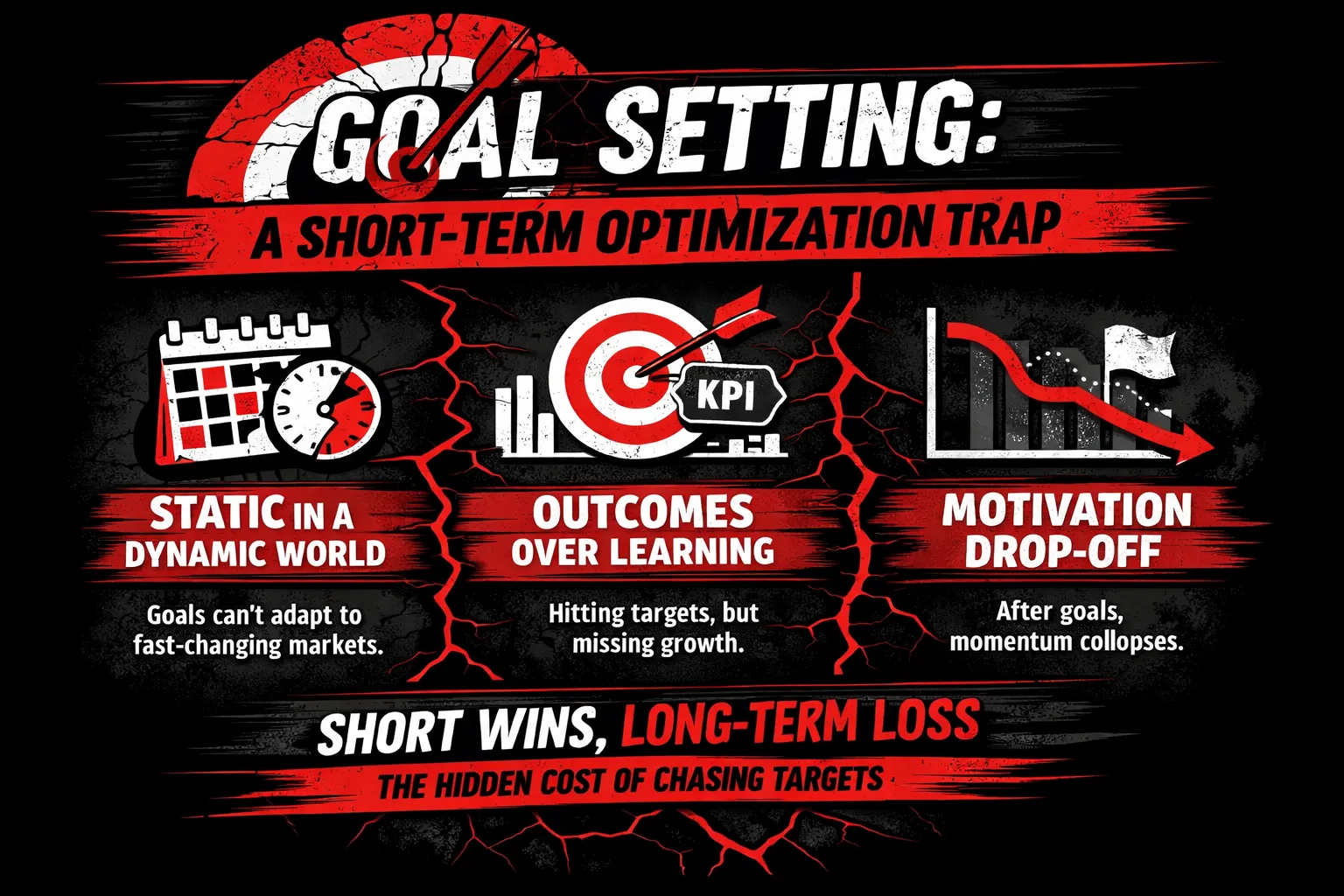
Goal setting has long been treated as a cornerstone of performance. Objectives, KPIs, OKRs—these frameworks promise clarity, alignment, and execution. And in the short term, they often work. The problem is what happens after. Over time, goal-driven organizations tend to optimize locally, learn slowly, and struggle to adapt when conditions change. What looks like discipline is often just short-term optimization in disguise.
Goals Are Static in a Dynamic World
Every goal is built on an assumption: that the environment will remain sufficiently stable for the plan to hold. But modern markets don’t behave that way.
Customer behavior shifts in weeks, not years. Algorithms update silently. New competitors emerge from adjacent industries. Yet most organizations still operate on annual or quarterly goal cycles, locking themselves into targets defined by yesterday’s reality.
This creates a widening gap between planning speed and market speed. By the time a goal is approved, cascaded, and operationalized, the underlying conditions have already changed. Teams then spend months optimizing toward numbers that no longer reflect the real opportunity—or the real risk.
Annual OKRs illustrate this perfectly. They provide structure and focus, but they also freeze priorities. Real-time market feedback, on the other hand, is continuous, messy, and uncomfortable. Goals filter that feedback out; systems are designed to absorb and respond to it.
In a dynamic world, static goals don’t create focus—they create inertia.
Goals Reward Outcomes, Not Learning
Goals are outcome-obsessed by design. Hit the number, meet the target, close the quarter. Learning, understanding, and system improvement are secondary—if they’re considered at all.
Over time, this shapes behavior. Teams stop asking why something works and focus only on what moves the metric. Experimentation becomes risky. Insights that don’t immediately translate into numbers are ignored. The organization gets better at hitting targets, but worse at understanding the system that produces results.
This is where hidden behaviors emerge:
- Gaming metrics to look successful without creating real value
- Local optimization, where one team hits its goals at the expense of the broader system
- Risk avoidance, because missing a target is punished more than missing a learning opportunity
KPI-driven cultures often appear high-performing from the outside. Internally, they plateau. Innovation slows, adaptability weakens, and performance improvements become harder to find. The organization is efficient—but brittle.
Systems, by contrast, reward learning by default. They are designed to capture feedback, test assumptions, and improve continuously, whether a specific outcome is hit or not.
Goals End. Systems Continue.
A rarely discussed question in goal setting is also the most important one: What happens after the goal is achieved?
In many organizations, momentum drops sharply. The finish line becomes a stopping point instead of a transition. Teams relax, motivation fades, and the next cycle begins with a fresh set of targets—often disconnected from the deeper capabilities (or weaknesses) exposed along the way.
This is the motivation drop-off problem. Goals create bursts of effort, not sustained progress. Once achieved, they provide no inherent mechanism for continued improvement.
Even worse, goal completion often precedes decline. The organization celebrates the win, locks in existing practices, and becomes less receptive to change—right when competitors are adapting.
Systems don’t have finish lines. A well-designed system keeps producing, learning, and improving regardless of milestones. It doesn’t rely on motivation spikes or heroic effort. It works on good days and bad days, with or without a clearly defined target.
Goals chase outcomes. Systems manufacture them—again and again.
In the long run, this is why goal-centric organizations struggle to compound advantage. They optimize for today’s success, while systems-focused organizations quietly design tomorrow’s inevitability.
What Is System Design (And Why Most Companies Misunderstand It)
Most companies hear “system design” and picture software architecture, automation tools, or a clean set of SOPs. That’s not wrong—it’s just incomplete.
Because the real reason systems win in the long run isn’t that they do work faster. It’s that they shape behavior, decisions, and learning—even when nobody is trying.
System design isn’t a productivity hack. It’s the invisible architecture that decides whether your organization compounds or plateaus.
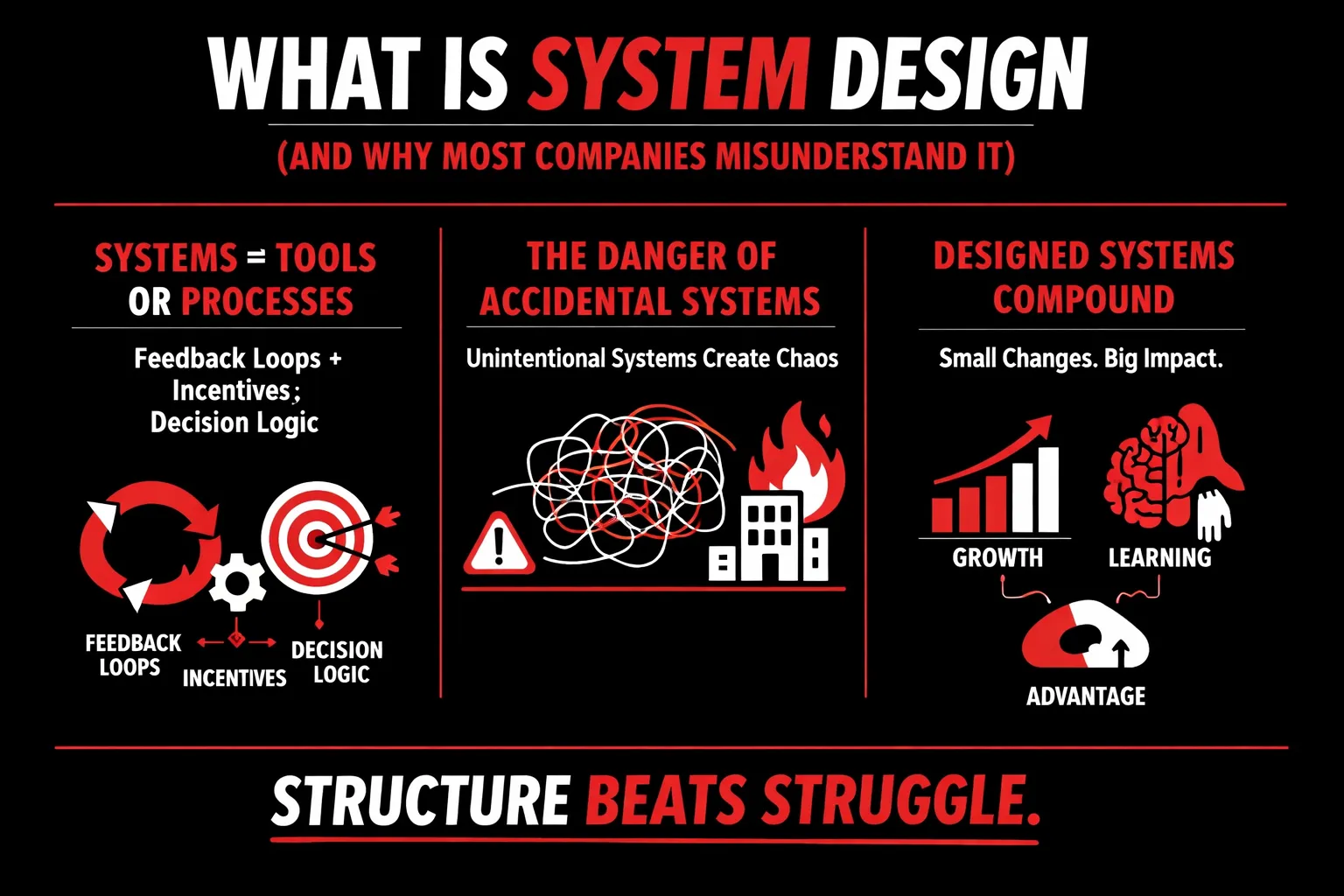
3.1 Systems Are Not Tools or Processes
A tool helps you do something. A process tells you what steps to follow.
A system is what happens when your organization repeatedly makes decisions under pressure—and the structure causes the same patterns to repeat.
In practical terms:
Systems = feedback loops + incentives + decision logic
- Feedback loops determine what the organization notices (and how fast).
- Incentives determine what people prioritize (especially when no one is watching).
- Decision logic determines what gets approved, delayed, escalated, or killed.
This is why two companies can use the same tools—same CRM, same analytics stack, same project tracker—and still get wildly different outcomes. The tools are identical. The system isn’t.
Workflows vs. adaptive systems is the difference between:
- A checklist that runs the same way every time, and
- A structure that improves itself because it learns from outcomes.
A workflow moves work forward. An adaptive system moves the organization forward.
If your weekly review meeting produces the same unresolved issues month after month, you don’t have a process problem—you have a system problem. The loop exists, but it isn’t closing. There’s no mechanism forcing learning into behavior change.
That’s why “more tools” rarely fixes performance. Tools increase capacity. Systems determine direction.
Designed vs. Emergent Systems
Here’s the uncomfortable truth: every company already has systems—even if they never intentionally built them.
They might not be documented. They might not be rational. But they exist.
They emerge from:
- What gets rewarded
- What gets punished
- What gets repeated
- What gets ignored
- Who is allowed to decide—and who isn’t
That’s an emergent system: a system formed accidentally from history, habits, and survival behaviors.
The danger is that emergent systems optimize for the wrong thing—quietly.
For example:
- A company says it values innovation, but promotions come from “never rocking the boat.”
Result: innovation becomes a slogan, not a behavior. - A company says it values speed, but every decision requires four approvals.
Result: “speed” becomes pressure, not execution. - A company invests in training, but punishes mistakes publicly.
Result: learning becomes performative, not real.
When systems are left to evolve accidentally, they almost always optimize for short-term safety:
- Avoid blame
- Avoid risk
- Avoid conflict
- Avoid uncertainty
And that slowly kills long-term growth.
This is why culture is not what you say. Culture is what your system produces.
Culture is the downstream result of your incentives and decision logic. It’s an output, not a poster on the wall.
If you want to change culture, don’t start with values. Start with system mechanics:
- What do people get rewarded for?
- What do they get punished for?
- What do they learn is “safe” to do?
- How quickly do signals turn into decisions?
Fix the system, and culture follows.
The Compounding Effect of Well-Designed Systems
Goals can create spikes. Systems create compounding.
A well-designed system doesn’t rely on heroic effort or perfect discipline. It creates a structure where small improvements reinforce each other—like interest building on interest.
Here’s what compounding looks like inside a company:
- A better customer feedback loop improves product decisions
- Better product decisions reduce support load
- Reduced support load increases time for innovation
- Innovation improves differentiation
- Differentiation increases pricing power
- Pricing power increases budget for better data, tooling, and talent
- Better data makes the feedback loop even smarter
That’s not just productivity. That’s trajectory.
This is why systems outperform talent over time.
Talent is powerful—but it’s volatile:
- People leave
- Motivation changes
- Teams burn out
- Context shifts
- “Star performers” create dependencies
Systems are durable:
- They persist when people change
- They make average execution look excellent
- They turn learning into an operational default
In the long run, the winners aren’t the companies with the best goals or the smartest people.
They’re the ones that build structures where:
- Learning happens automatically
- Decisions improve continuously
- Incentives align with long-term advantage
- Progress compounds even during chaos
Most companies optimize for today. The winners design systems that make tomorrow unavoidable.
System Design vs Goal Setting: A Head-to-Head Comparison
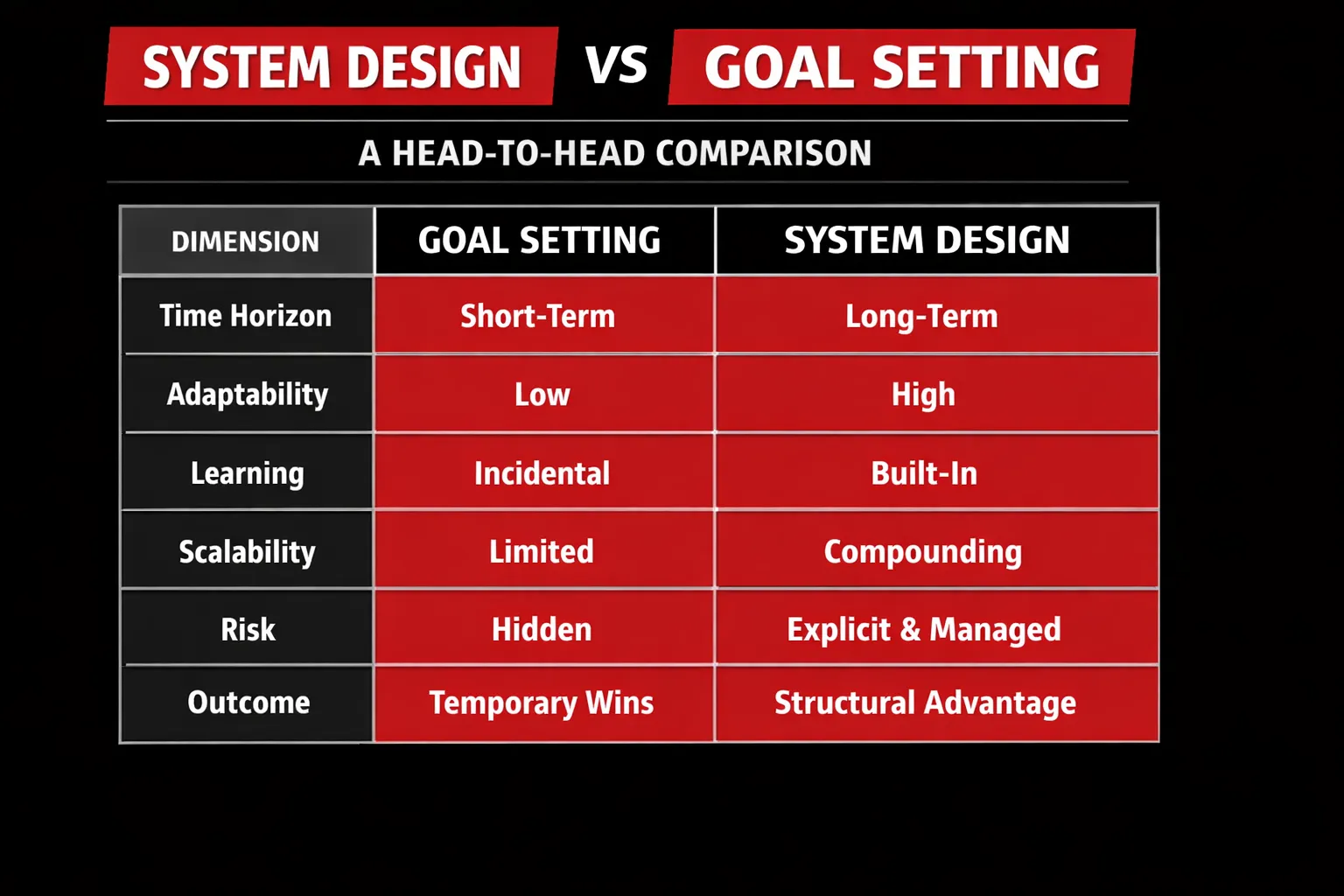
Most companies run on goals. Quarterly targets. Monthly OKRs. Weekly dashboards. It feels disciplined—like progress has a shape.
But goals are often just organized urgency.
Systems are different. Systems are how progress keeps happening even when motivation dips, markets shift, or leadership changes. If goals are a push, systems are a pull—an engine that keeps producing outcomes long after the initial excitement wears off.
Here’s how they compare where it matters most:
1) Time Horizon: Short-term vs Long-term
Goal setting is inherently time-boxed. A goal is born with an expiry date—end of month, end of quarter, end of year. That deadline creates focus, but it also creates a dangerous bias: optimize for what shows results now.
System design thinks in longer arcs. The question isn’t “What can we achieve by Friday?” but “What structure ensures this keeps improving for years?” A system outlives leadership changes, market turbulence, and team turnover.
Goals chase outcomes. Systems manufacture outcomes.
2) Adaptability: Low vs High
Goals assume the world stays stable long enough for the plan to work. But markets don’t wait. Customer behavior changes. Competitors pivot. AI reshapes expectations.
When reality shifts, goals usually become outdated—yet teams keep chasing them because they’re written down, approved, and tracked. That’s how companies “execute perfectly” on a plan that no longer matters.
Systems are designed to adapt. They include feedback loops that detect change early and adjust behavior automatically—without waiting for a quarterly review.
In a fast-moving market, adaptability beats accuracy.
3) Learning: Incidental vs Built-in
In goal-driven organizations, learning is accidental. Teams might learn something on the way to a target—but the target doesn’t require learning, it requires delivery.
That’s why goal cultures often create:
- metric gaming
- shortcut behavior
- “we hit the number” complacency
- repeated mistakes in new forms
System design makes learning non-optional. It embeds experimentation, measurement, iteration, and review into the operating model. Learning isn’t a meeting—it’s a mechanism.
A system that learns will beat a team that tries harder.
4) Scalability: Limited vs Compounding
Goals scale poorly because they demand more human energy every cycle: more follow-ups, more pressure, more heroics, more firefighting.
Even when the goal is met, the organization often can’t explain why it worked—or replicate it reliably. So the next cycle starts from scratch.
Systems scale because they create compounding. Each cycle improves the machine:
- better data
- cleaner workflows
- smarter decisions
- faster execution
- fewer errors
- stronger feedback loops
Systems don’t just produce results. They produce improved capability.
Goals extract performance. Systems build performance.
5) Risk: Hidden vs Explicit & Managed
Goals hide risk because they focus attention on the finish line, not the terrain.
You can hit a growth goal while quietly accumulating:
- fragile infrastructure
- brittle processes
- churn risk
- burnout
- compliance gaps
- technical debt
- reputational debt
Goal setting often rewards the appearance of success—even when the system is deteriorating underneath.
System design surfaces risk early. A good system makes failure modes visible: alerts, thresholds, quality gates, redundancy, and continuous monitoring. Risk becomes a managed input, not a surprise event.
Goals create blind spots. Systems create visibility.
6) Outcome: Temporary wins vs Structural advantage
A goal delivers a win—then resets.
Even when achieved, it usually doesn’t create a lasting edge. Competitors can copy a target. They can even copy tactics. And in many industries, yesterday’s goal becomes tomorrow’s baseline.
Systems create structural advantage because they change what the business is capable of doing repeatedly:
- faster learning cycles
- better decision accuracy
- lower marginal cost of execution
- higher quality at scale
- continuous improvement by default
That’s how “tomorrow becomes unavoidable.” Not through ambition—but through architecture.
Goals produce events. Systems produce inevitability.
The ThatWare Lens
Most companies optimize for today: hit the metric, beat the quarter, deliver the sprint.
But the winners design tomorrow: they build systems that keep improving, keep adapting, and keep generating advantage—even when conditions change.
ThatWare builds systems that make tomorrow unavoidable.
Why the Future Belongs to System Designers
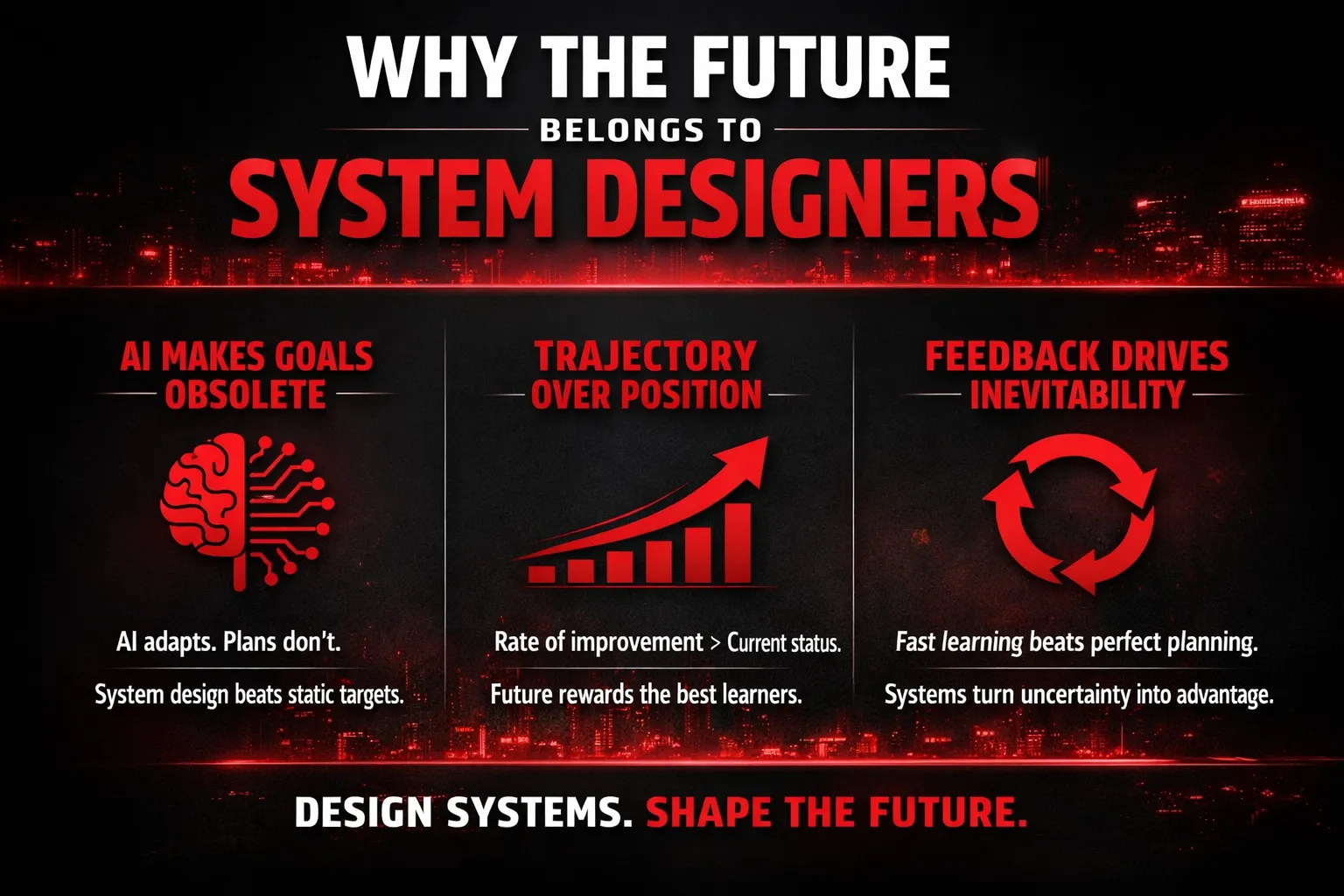
Most companies still run on a familiar operating system: set a goal, rally the team, execute hard, report results. That approach worked when markets moved slowly and competition was local. But the ground has shifted. Today, the winners aren’t the best planners—they’re the best system designers.
Because the future doesn’t reward intent. It rewards structures that keep improving even when conditions change.
And nothing has accelerated that shift more than AI, automation, and the rising premium on adaptability.
AI Has Made Static Goals Obsolete
AI doesn’t behave like a project. It behaves like a living system.
A traditional goal assumes stability: “Increase conversions by 20% this quarter.” It implies you can predict the environment long enough to march toward a fixed destination. But AI-driven environments don’t sit still. User behavior changes faster. Competitors iterate weekly. Platforms tweak algorithms overnight. Data patterns drift. What was true last month becomes noise this month.
AI systems adapt continuously—human plans don’t.
In an AI-first world, the advantage goes to organizations that stop treating performance like a destination and start treating it like an evolving capability. Instead of setting rigid targets and pushing harder, they build systems that learn:
- systems that detect change early
- systems that update decisions automatically
- systems that improve from every interaction
This is why AI-first companies think in systems, not targets. Targets are brittle. Systems are adaptive.
- A target says, “Hit this number.”
- A system says, “Make improvement inevitable.”
When you’re running AI across marketing, operations, customer success, and product, you can’t manage progress with static goals. You need something stronger: feedback loops that keep the business aligned with reality in real time.
Markets Now Reward Trajectory Over Position
Being “the best today” is no longer a moat. It’s a snapshot.
Markets are increasingly shaped by speed of learning, not size of advantage. The company with the best product today can be replaced by the company that improves faster tomorrow. This is visible everywhere: startups overtaking incumbents, small teams outcompeting large organizations, lean systems outperforming heavy structures.
Winning is about rate of improvement.
This is the shift most businesses miss. They optimize their current position—what they sell, how they sell, what channels work today—while someone else is quietly building a system that evolves weekly. The result is predictable: the optimizers peak, the system designers compound.
The new competitive question isn’t:
- “How good are we right now?”
It’s:
- “How fast do we get better, and can we keep that speed as we scale?”
That’s why the future belongs to the best learners.
The shift is from “best today” to “best learner”—and learning at scale doesn’t come from motivation or hustle. It comes from design: the right data flows, the right decision rules, the right incentives, the right automation.
Inevitable Advantage Comes from Feedback Loops
If you want a future that feels unavoidable, you don’t chase outcomes. You engineer feedback loops.
Because faster learning loops beat smarter planning.
Planning is guesswork in slow motion. Feedback loops are reality in motion. They turn every customer interaction, every operational bottleneck, every sales call, every campaign, every support ticket into signal—and that signal becomes improvement.
This is the core difference:
- A goal-based company asks, “Did we hit the target?”
- A system-based company asks, “What changed, what did we learn, and how does the system update?”
System design turns uncertainty into fuel.
Instead of fearing volatility, system designers harvest it. They build loops that tighten over time:
- shorter cycles from action → data → insight → adjustment
- fewer delays between learning and execution
- more automation where humans are slow or inconsistent
- better incentives so teams optimize the whole system, not isolated metrics
The compounding effect is powerful. Over time, a business with good feedback loops starts to feel like it’s pulling away—not because it works harder, but because it learns faster, corrects faster, and evolves faster.
That’s what “inevitable advantage” looks like.
Closing Thought
Most companies optimize for today—hit the number, chase the quarter, fix what’s urgent.
But the winners design tomorrow.
They don’t rely on willpower. They don’t depend on perfect predictions. They don’t need the world to stay stable.
They build systems that adapt—systems that learn—systems that make progress unavoidable.
ThatWare builds those systems.
Real-World Examples: Two Paths, Two Futures
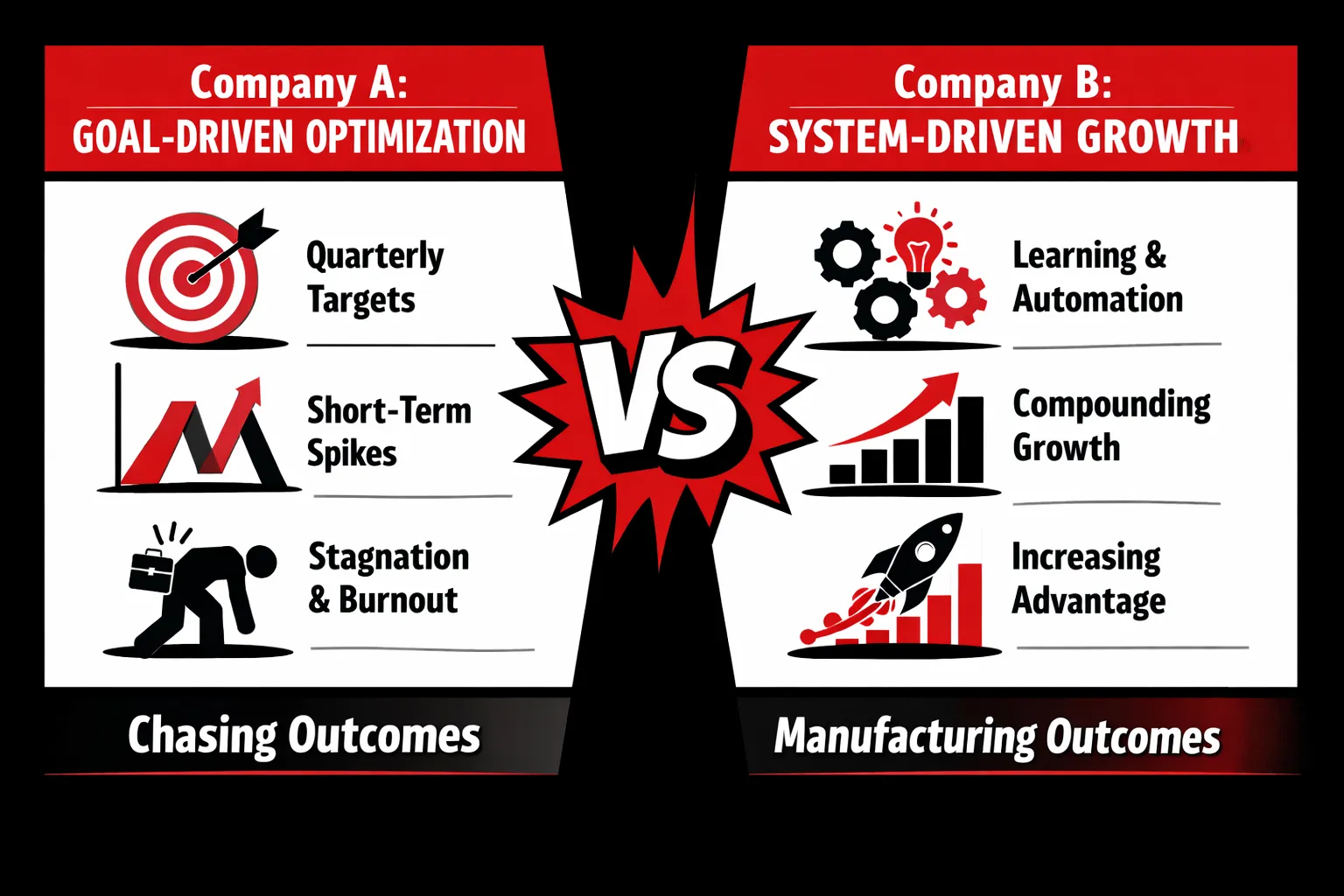
Making the difference tangible—without case-study fluff
To understand why system design consistently outperforms goal setting, it helps to look at two very common (and very real) organizational patterns. These aren’t edge cases or cherry-picked success stories. They represent how most companies operate today—and why only a few keep winning over time.
Company A: Goal-Driven Optimization
Company A is highly disciplined. Every quarter begins with aggressive targets: revenue numbers, growth percentages, efficiency ratios, delivery deadlines. Teams are aligned around dashboards, OKRs, and weekly performance reviews.
On paper, this looks like excellence.
In the short term, it often works.
- Teams push harder as deadlines approach
- Metrics improve just enough to hit targets
- Leadership celebrates execution and “focus”
But beneath the surface, a different dynamic is forming.
Because success is defined by hitting the goal, behavior starts bending toward the metric:
- Teams prioritize what is measurable, not what is meaningful
- Risk-taking declines as deadlines tighten
- Learning slows because experiments threaten targets
Each quarter becomes a sprint. Each sprint extracts more energy than it builds capability.
Over time, performance spikes become harder to repeat. The same targets require more effort, more pressure, more heroics. Eventually, progress plateaus—not because people stopped trying, but because the system never improved.
Burnout rises. Innovation drops. Stagnation sets in.
Company A didn’t fail to execute goals. It failed to design a system that could keep getting better.
Company B: System-Driven Growth
Company B looks slower at first.
Instead of leading with aggressive targets, leadership focuses on how the organization learns, decides, and executes. Early progress feels less dramatic. There are fewer “big wins” to celebrate in the first few quarters.
But something else is happening.
Company B deliberately designs:
- Learning loops that turn every initiative into structured insight
- Automation that reduces repeated manual effort
- Decision systems that improve with data, not hierarchy
Teams are not rewarded just for outcomes, but for improving the process that produces outcomes.
The result?
Early growth is modest. But each cycle leaves the organization stronger:
- Decisions get faster and better
- Execution requires less effort over time
- Insights accumulate instead of disappearing after each quarter
What starts as a small advantage begins to compound.
After a few years, Company B doesn’t just perform better—it operates differently. Competitors struggle to copy its results because the advantage isn’t a tactic or a target. It’s structural.
Company B doesn’t chase growth. Growth emerges as a byproduct of a better-designed system.
The Key Pattern
The contrast is subtle—but decisive.
- Company A chases outcomes.
When the goal disappears, so does the momentum. - Company B manufactures outcomes.
Every cycle strengthens the engine that produces results.
One optimizes for today.
The other designs tomorrow.
And in the long run, the market always rewards the company whose success is inevitable, not just intentional.
The 4 Core Systems That Outperform Any Goal
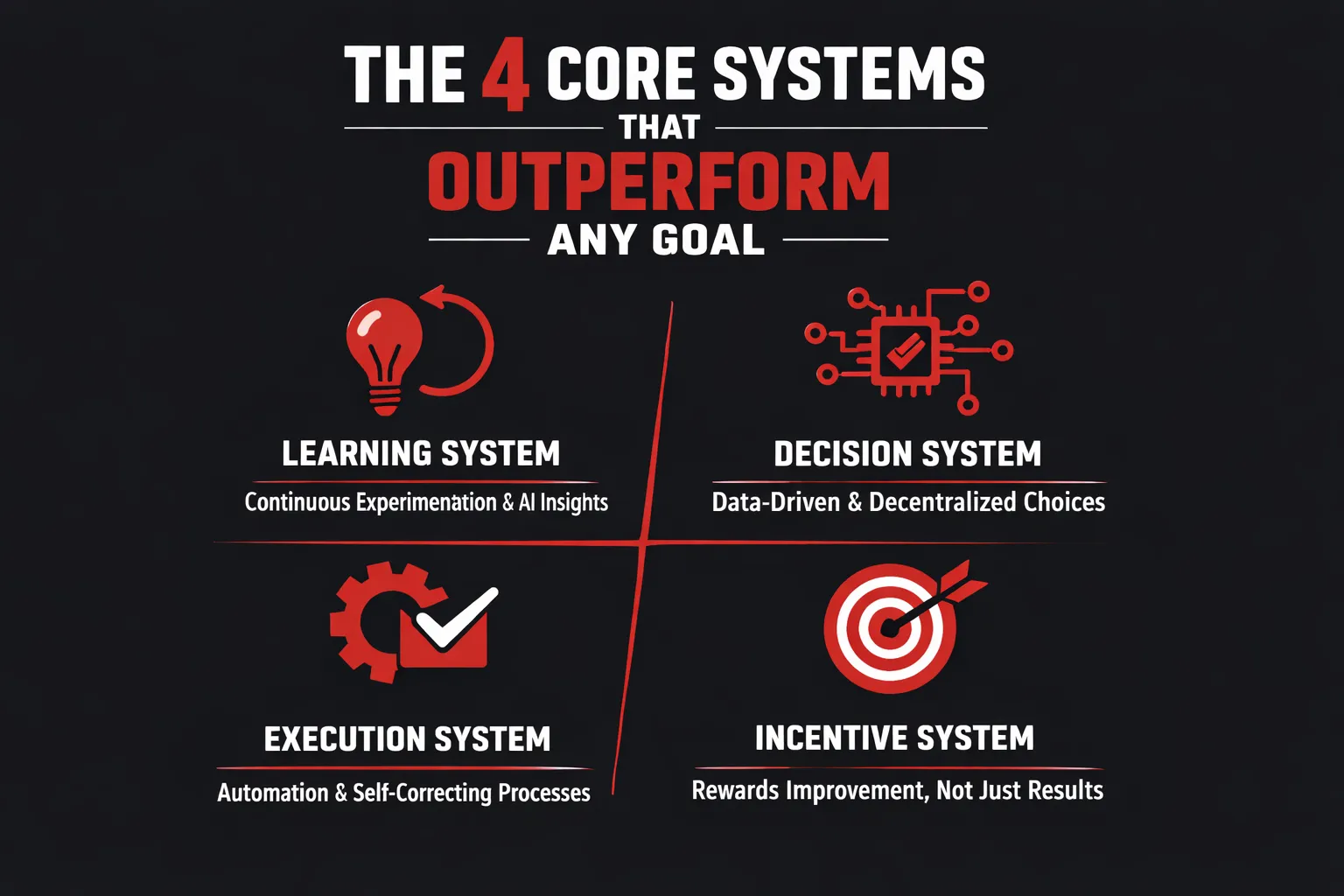
Goals are snapshots. Systems are engines.
A goal can tell you where you want to go. It can’t reliably tell you how to keep getting better once you arrive—or what to do when the road changes. That’s why the organizations that win over years don’t rely on goal-setting alone. They build four underlying systems that produce outcomes repeatedly, even as markets shift.
Think of these as the “operating system” of a future-ready business. When these systems are designed well, results become less about motivation and more about inevitability.
1) The Learning System: Compounding Intelligence
Most companies treat learning like a side effect—something that happens after success or failure. High-performing companies design learning as a core loop.
A learning system is built around continuous experimentation: small tests, fast feedback, and rapid iteration. Instead of betting on big plans, teams run controlled experiments—on messaging, onboarding, pricing, workflows, product flows, internal processes—then scale what works.
The difference is subtle but massive:
- Goal-driven teams ask: “Did we hit the target?”
- System-driven teams ask: “What did we learn, and how does it change our next decision?”
AI supercharges this loop. Not by replacing thinking—but by accelerating it:
- Pattern detection across customer conversations, tickets, calls, and usage
- Automated retrospectives that summarize what worked and what didn’t
- Recommendation systems that surface anomalies before they become crises
- Experiment analysis that reduces cycle time from weeks to days
When learning becomes continuous, improvement becomes compounding. You stop “starting over” every quarter.
Outcome: Your organization gets smarter by default—regardless of individual heroes.
2) The Decision System: Speed Without Chaos
A company can’t out-execute the market if it can’t decide fast—and well.
Most organizations say decisions are data-driven, but the reality is often:
- decisions bottlenecked at the top,
- delayed by meetings,
- influenced by opinions,
- made too late to matter.
A decision system solves this by embedding clear decision logic:
- What decisions are centralized vs decentralized?
- Who owns which decisions?
- What data is required?
- What guardrails prevent bad decisions?
- What feedback tells us if a decision was wrong?
This is where decentralization becomes powerful—but only if it’s designed. “Empowerment” without structure creates inconsistency. Structure without empowerment creates slowness. A strong decision system gives you both: autonomy with alignment.
It also reduces dependency on heroic leadership. If every important call requires one person’s judgment, you don’t have a scalable organization—you have a fragile one.
Outcome: Decisions become faster, repeatable, and less political—so the business moves with momentum.
3) The Execution System: Outcomes Without Exhaustion
Execution is where most goals go to die.
Not because people don’t work hard—but because the operating environment makes reliable execution impossible:
- manual handoffs,
- unclear ownership,
- inconsistent workflows,
- repetitive tasks that drain attention,
- quality that depends on who’s on duty.
A modern execution system prioritizes automation over manual effort wherever repetition exists. That doesn’t just mean software automation; it means designing workflows that consistently produce quality with minimal friction.
Two characteristics matter most:
Automation-first design
- Repetitive steps are automated
- Checklists become triggers
- Reporting becomes telemetry
- Approvals become rule-based flows where possible
Self-correcting workflows
- Errors get caught early, not at the end
- Feedback loops are built into the process
- The system improves after each failure
- Teams don’t need to “remember” best practices—the workflow enforces them
This is the shift from “try harder” to “design better.”
Outcome: Execution becomes scalable and reliable—without burning people out.
4) The Incentive System: Behavior That Aligns With the Future
You can’t build long-term advantage with short-term incentives.
Most companies reward outcomes, but ignore the behaviors that create outcomes. This is why they get:
- risk avoidance,
- metric gaming,
- internal competition,
- short-term wins that hurt long-term capability.
A strong incentive system rewards learning velocity, not just results. That means people are rewarded for:
- running high-quality experiments,
- improving processes,
- surfacing uncomfortable truths early,
- making decisions that increase long-term capability,
- building reusable assets (automation, documentation, systems) that improve the company after they leave.
When incentives reward only outcomes, people optimize for looking good. When incentives reward learning and system improvement, people optimize for building something that lasts.
And that’s the real alignment: not with a quarterly goal, but with an organization’s future trajectory.
Outcome: The company’s default behavior creates durable advantage—year after year.
How These Four Systems Work Together
Individually, each system improves performance. Together, they create a flywheel:
- Learning improves decisions.
- Decisions improve execution.
- Execution produces feedback for learning.
- Incentives keep everyone aligned to improve the flywheel—not just chase targets.
That’s how system design outperforms goal setting in the long run.
Goals can motivate a sprint. Systems build the machine that wins the marathon.
And that’s the difference between optimizing for today—and designing tomorrow to be unavoidable.
How ThatWare Designs Systems That Make the Future Unavoidable
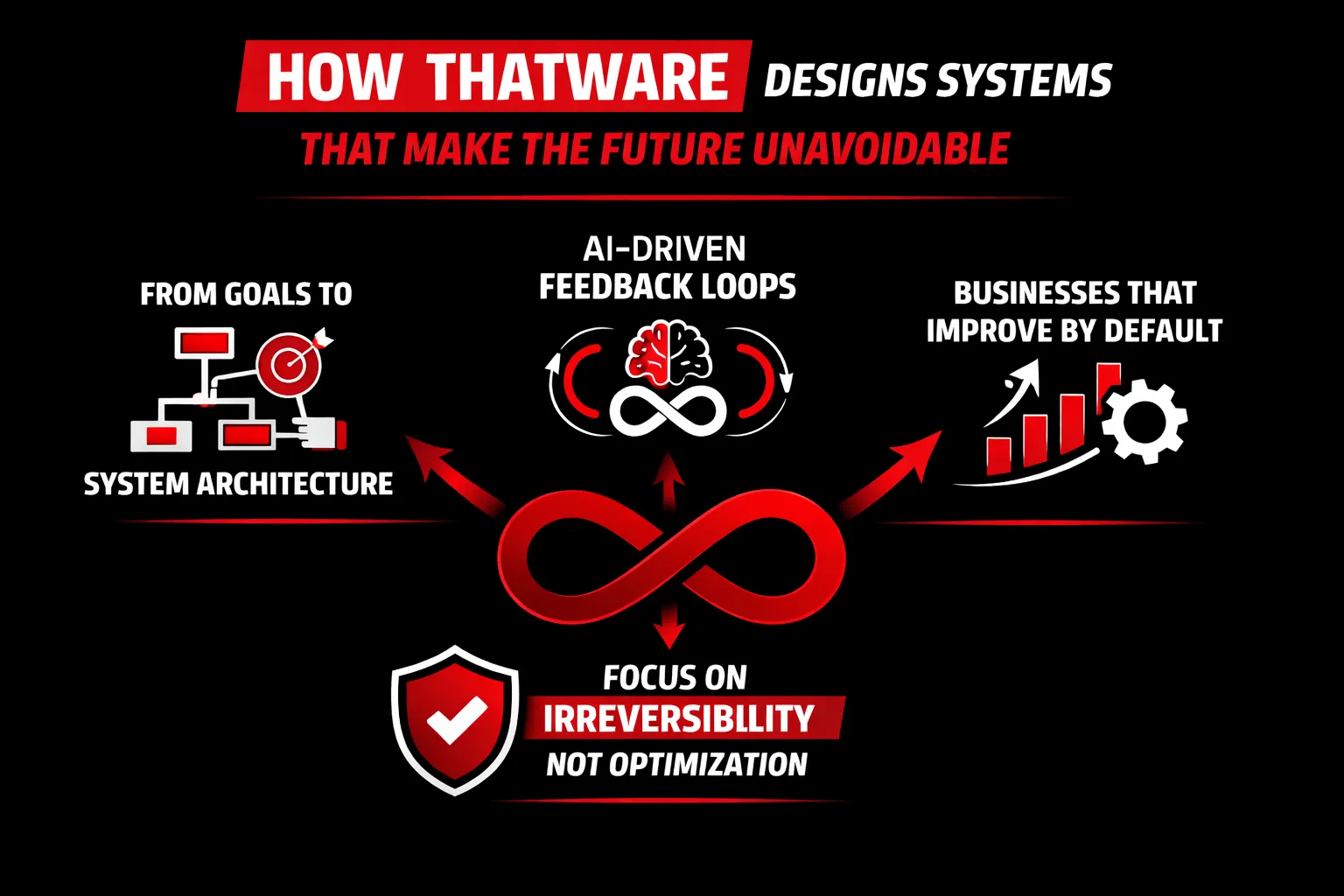
Most companies don’t have a strategy problem. They have a system problem.
They set ambitious goals, attach metrics, run reviews, and celebrate the wins—then repeat the same cycle next quarter with slightly different numbers. It looks like progress. It even creates progress. But it rarely compounds, because the organization is still relying on effort, not architecture.
At ThatWare, we don’t start by asking, “What’s the goal?” We start by asking, “What system will keep producing the outcome—especially when conditions change?”
Moving clients from goal obsession to system architecture
Goals are useful. They create focus. They help teams move. But over time, goal-obsessed organizations become trapped in a loop of short-term optimization:
- Teams chase the metric instead of improving the mechanism.
- Leadership spends more time reviewing performance than upgrading the engine.
- Success becomes episodic, not structural.
ThatWare shifts the conversation from targets to design.
Instead of “How do we hit X this quarter?” we move toward questions like:
- What inputs reliably produce X, and which are unstable?
- Where does decision-making depend on heroic individuals?
- Which bottlenecks repeat every cycle?
- What feedback is missing that would let the organization self-correct sooner?
This is the difference between managing outcomes and engineering outcomes.
When you build the right system, you don’t need constant motivation or repeated initiatives. Performance becomes the natural byproduct of how the business runs.
Designing AI-driven feedback loops, not dashboards
Most companies think they’re becoming data-driven because they have dashboards.
But dashboards are passive. They tell you what happened—often too late—and then humans debate what to do about it. That’s still a “today-optimized” model: measure, meet, react.
ThatWare designs AI-driven feedback loops, where information doesn’t just report—it acts.
A feedback loop is different because it’s built to answer:
- What’s changing right now?
- What’s likely to happen next?
- What should we adjust immediately?
- What should we stop doing because it’s no longer effective?
In practical terms, this means moving from “visibility” to adaptive behavior:
- Alerts that recommend actions, not just anomalies
- Systems that learn from wins and losses and update playbooks automatically
- Decision rules that evolve as new data arrives
- Experiments that run continuously, so learning becomes constant
Dashboards are mirrors. Feedback loops are steering systems.
We build steering systems.
Building businesses that improve by default
The real advantage isn’t being good today. It’s being designed to get better tomorrow—without requiring an organizational reboot every quarter.
ThatWare’s focus is to help businesses become self-improving. That sounds abstract until you define it clearly:
A business improves “by default” when:
- learning is built into execution, not separated from it
- decisions become faster because information routes cleanly
- quality increases because feedback arrives early
- scaling doesn’t multiply chaos because systems absorb complexity
This is how compounding works in organizations. Not by adding more effort, but by reducing the friction between:
signal → decision → execution → learning → iteration
When that loop tightens, improvement stops being an event. It becomes a property.
Why ThatWare focuses on irreversibility, not optimization
Optimization is addictive because it’s measurable. You tune conversion rates, reduce costs, speed up delivery. It’s progress—but it’s fragile progress. The moment conditions shift, you’re optimizing the wrong thing.
ThatWare focuses on irreversibility: designing changes that are hard to undo because they reshape the business at a structural level.
Irreversible improvements look like:
- processes that can’t regress because automation enforces consistency
- decision systems that don’t slow down when leadership changes
- learning loops that keep running even when teams rotate
- institutional knowledge that accumulates instead of leaking out
Optimization makes you better in the current game. Irreversibility changes the kind of game you’re playing.
And that’s the point.
Most companies optimize for today. ThatWare builds systems that make tomorrow unavoidable—because the organization is no longer relying on willpower, urgency, or repeated goal cycles. It’s relying on design.
How to Start Shifting from Goals to Systems (An Actionable Framework)
Most leaders don’t need more goals. They need fewer fragile dependencies.
Goals feel productive because they’re clear, measurable, and urgent. But in the long run, goals can hide the real issue: the underlying system that produces results is weak, inconsistent, or overly dependent on specific people.
If you want outcomes that repeat—and improve—without constant pushing, you don’t start with a bigger target. You start with a better system.
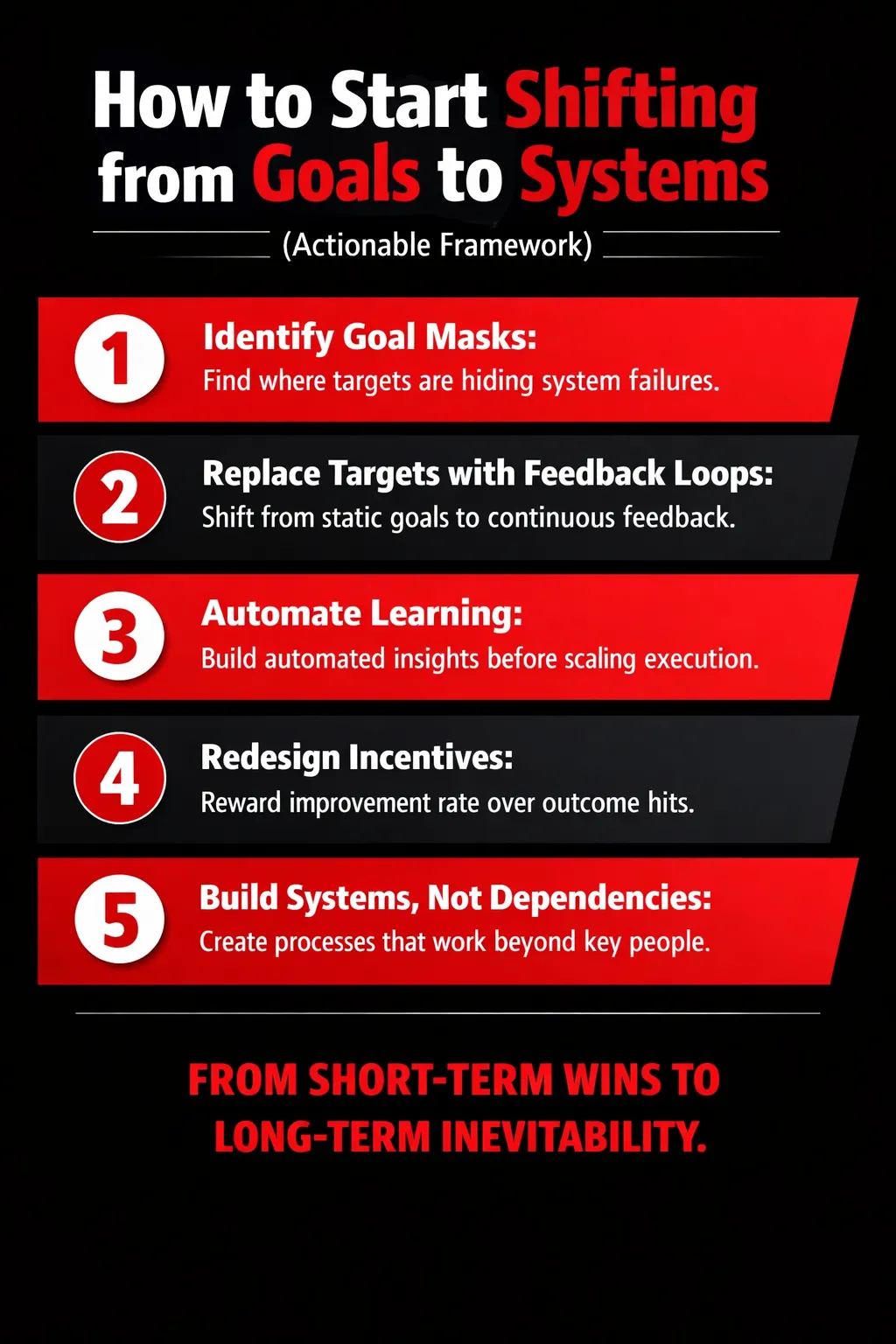
Here’s a practical 5-step shift founders and leadership teams can begin immediately.
1) Identify where goals are masking system failures
A telltale sign of a weak system is when success requires heroic effort.
Ask:
- Where do we “push harder” every quarter to get the same result?
- Which goals only get achieved when a few top performers overwork?
- What breaks first when pressure increases—quality, speed, morale, or customers?
Goals can create temporary performance spikes. But if the same problems return every cycle, you’re not dealing with an execution issue—you’re dealing with a design issue.
Quick diagnostic:
Pick one key goal you’ve repeatedly set (revenue, retention, delivery time, lead volume). Then list what must go right for it to happen. If the list contains phrases like “sales needs to try harder” or “the team must be more careful”, you’re not describing a system—you’re describing hope.
2) Replace targets with measurable feedback loops
Targets tell you what you want. Feedback loops tell you what’s actually happening—early enough to adjust.
A system beats a goal because it doesn’t wait until the end of the quarter to reveal failure.
Instead of:
- “Increase retention to 90%”
Design: - A weekly loop that measures why customers leave, which segment is at risk, and what intervention works
Instead of:
- “Improve delivery speed”
Design: - A loop that tracks cycle time by stage, identifies bottlenecks, and triggers fixes before delays compound
The shift:
Move from lag metrics (outcomes) to lead indicators (signals). Outcomes are scoreboards. Signals are steering wheels.
Simple rule:
If you can’t act on it weekly, it’s not a feedback loop—it’s a post-mortem.
3) Automate learning before scaling execution
Many companies scale execution first: more ads, more hires, more outreach, more output.
That works briefly—until inefficiencies and blind spots scale too.
System-first companies scale learning first.
That means:
- Automating data capture (what happened?)
- Automating analysis (why did it happen?)
- Automating recommendations (what should we do next?)
- Automating reviews (did the fix work?)
When learning is manual, improvement is slow and inconsistent. When learning is automated, improvement becomes the default.
A powerful founder question:
“Are we scaling effort—or scaling insight?”
Because the best growth engine isn’t more activity. It’s faster correction.
4) Design incentives around improvement rate
Incentives shape behavior more than strategy decks ever will.
If people are rewarded for hitting targets, they will:
- optimize locally
- avoid risk
- hide bad news until late
- game metrics
- prioritize optics over truth
Instead, reward improvement rate—how quickly the system learns and gets better.
Incentives that drive system strength:
- Reducing cycle time month-over-month
- Increasing experiment velocity (with quality control)
- Increasing detection speed for issues (earlier alerts)
- Increasing percentage of decisions made with evidence
What this creates:
A culture where people compete to improve the machine, not just “win the quarter.”
The long-term winners don’t have the most motivated teams. They have the best-designed incentives.
5) Build systems that work even when people change
A goal-driven company depends heavily on individuals. A system-driven company depends on structure.
The ultimate test:
If key people leave, does performance collapse—or continue?
Systems that survive people changes include:
- documented decision rules and playbooks
- standardized workflows with room for improvement
- automated checks for quality and compliance
- shared dashboards that expose reality (not vanity)
- feedback loops that don’t rely on memory or meetings
This is how companies become durable.
Not by hiring “rockstars.”
But by building a system where average performers can produce above-average outcomes consistently.
The Real Shift: From Chasing Outcomes to Manufacturing Outcomes
Goals are useful for direction. But they are not a strategy for durability.
Systems are what make success repeatable. And repeatable success is what compounds.
Most companies optimize for today. The winners design systems that make tomorrow unavoidable.
Designing Tomorrow Instead of Chasing It
The future does not reward effort. It rewards structure.
Effort is temporary. Motivation fades. Goals expire. But structure endures. What ultimately shapes outcomes is not how hard a company tries, but how well its systems are designed to function when effort is inconsistent, information is incomplete, and conditions keep changing.
Goals, at their core, are expressions of intent. They are hopes—that if we aim clearly enough and push hard enough, the desired result will follow. Systems, on the other hand, are commitments. They encode decisions, behaviors, and learning into the organization itself. They work not because people remember to act, but because the structure makes certain actions inevitable.
This is why so many companies remain trapped in an endless cycle of optimization. They refine processes, chase quarterly targets, and celebrate short-term wins—only to find themselves repeating the same struggles year after year. They are optimizing for today, mistaking movement for progress.
The companies that endure take a different path. They stop chasing outcomes and start designing conditions. They build systems that learn faster than the market changes, that improve with use, and that turn uncertainty into advantage. Over time, success stops being something they pursue and becomes something they produce.
Most companies optimize for today.
The winners design systems that make tomorrow unavoidable.
That is the difference between reacting to the future—and quietly, deliberately, building one.