
SUPERCHARGE YOUR ONLINE VISIBILITY! CONTACT US AND LET’S ACHIEVE EXCELLENCE TOGETHER!
How AI Rewards Brands That Predict Needs Instead of Reacting to Keywords
Visibility used to feel predictable.
Pick the right keywords, publish consistently, earn backlinks, improve CTR—and over time, the algorithm would “reward” you. Traditional SEO and content marketing gave brands the comforting illusion of control: if you followed the playbook, you could engineer discovery.
But that certainty is quietly disappearing.
Not because SEO is “dead,” and not because content no longer matters—but because the starting point of discovery has changed. For most of the internet’s history, visibility began with a deliberate action: someone typed a query. Search was the trigger. Keywords were the gateway. And brands competed to show up at that exact moment of expressed intent.
Now, searching isn’t always the beginning.
AI assistants suggest answers before you ask. Recommendation engines surface options before you compare. Search results increasingly deliver conclusions before you click. Even social and commerce platforms are driven less by what users request and more by what systems predict they’ll want next.
This is the shift most brands haven’t fully internalized: discovery is moving from query-based to anticipatory.
AI isn’t just responding faster—it’s responding earlier.
It reads patterns in behavior, context, and outcomes. It observes what people do after they click, where they hesitate, what they abandon, and what they return to. It connects signals across time and platforms, turning fragmented actions into a coherent picture of intent. And then it optimizes visibility around the sources that best reduce friction—those that solve the problem before the user fully articulates it.
That’s why the old approach—reacting to keywords, chasing trends, publishing after demand becomes obvious—feels increasingly expensive and increasingly unreliable. By the time a keyword is “hot,” the moment of advantage may already be gone. AI systems are already shaping what gets seen upstream, before the search even happens.
We’re entering a new visibility economy—one where attention isn’t captured at the moment of search, but earned earlier through intent alignment.
In AI-driven systems, visibility belongs to those who understand intent before it is expressed.
The Death of the Query-First Internet
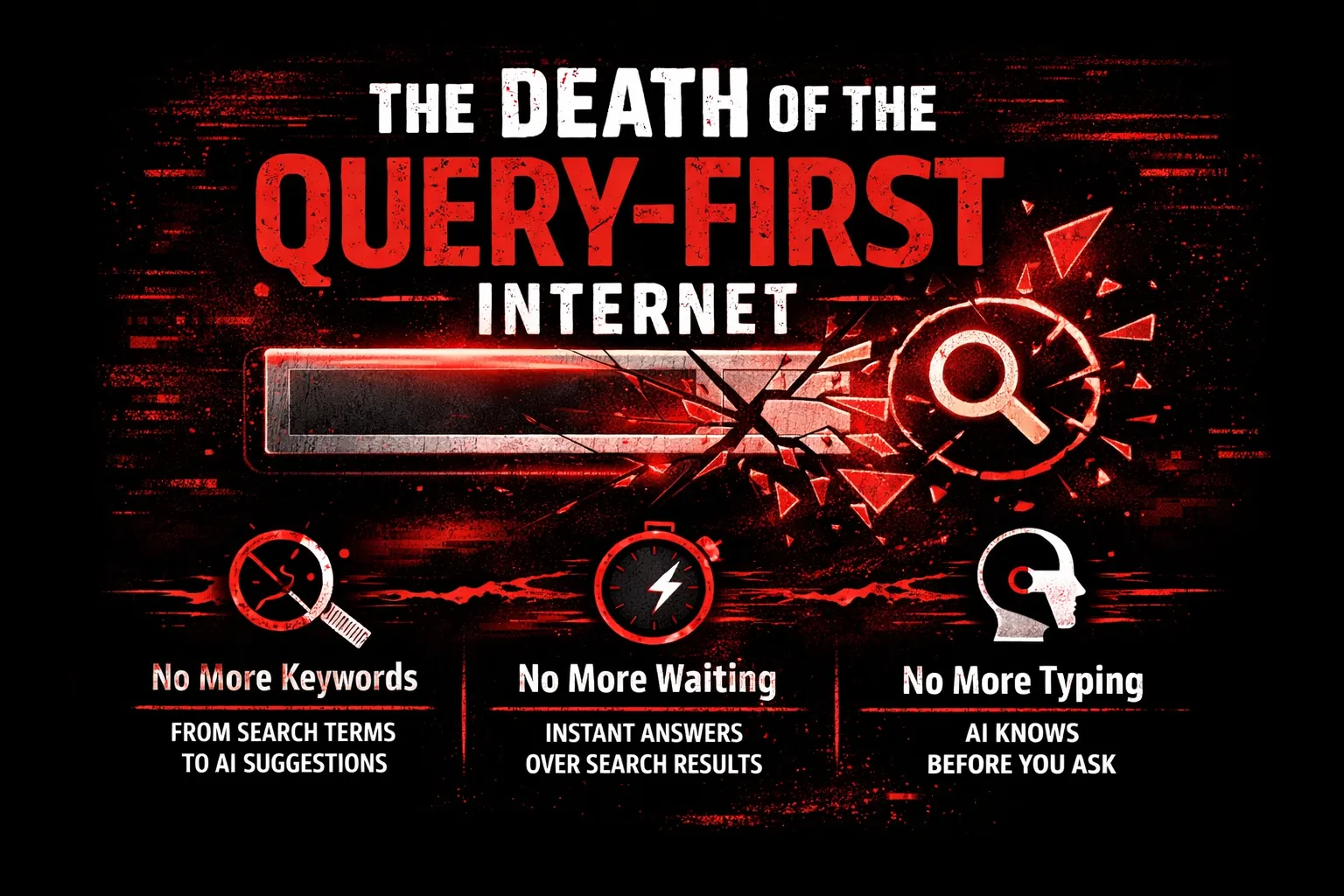
For decades, the internet revolved around a simple assumption: users know what they want, and they will ask for it. Search engines were built to respond, not anticipate. Visibility depended on how well brands could align themselves with those explicit questions. That assumption no longer holds.
AI has quietly dismantled the query-first model—and replaced it with something far more predictive.
How We Used to Be Found
In the traditional web, keywords acted as stand-ins for human intent. A search query was treated as a clear declaration of need, even though it was often an approximation at best. If someone typed “best CRM software,” the system assumed comparison intent. If they searched “what is CRM,” it assumed education. The nuance behind why the user searched rarely mattered.
This gave rise to a linear, almost mechanical journey:
search → click → consume → decide
Each step depended on the previous one. No search meant no visibility. No click meant no opportunity. Brands optimized themselves to intercept this chain at the search stage by targeting keywords that appeared closest to purchase or decision.
This model worked because interpretation was fundamentally human-driven.
Search engines matched text to text, and humans did the heavy lifting:
- Humans interpreted relevance
- Humans judged credibility
- Humans connected content to their own situation
The system didn’t need to understand intent—it only needed to retrieve options. Meaning was constructed after the click, not before it.
Why Queries Are Becoming Optional
AI has removed the dependency on explicit asking.
Modern systems no longer wait for users to formulate intent into words. Instead, they observe behavior, context, and patterns—then act on them. Discovery is increasingly initiated by the system, not the user.
This shift is visible everywhere:
- AI assistants that answer before a follow-up question is asked
- Feeds that surface content based on predicted interest
- Summaries that eliminate the need to open multiple links
We are entering the era of zero-query experiences, where visibility happens without a traditional search.
Examples include:
- Search Generative Experiences (SGE): where AI synthesizes answers directly, often reducing multiple sources into a single response
- AI Overviews and instant answers: where the result replaces the need to explore further
- Personalized feeds and auto-suggestions: where content appears based on inferred intent, not expressed demand
In these environments, the question is no longer “What did the user ask?”
It’s “What is the user likely trying to achieve next?”
AI no longer waits—it infers.
It predicts confusion before it’s expressed, needs before they’re verbalized, and decisions before they’re consciously framed. Visibility is granted to brands that align with these inferred goals, not to those that simply match a typed query.
This is why the query-first internet is fading.
And why intent—not input—is becoming the new gateway to being seen.
What “Intent Before Input” Actually Means
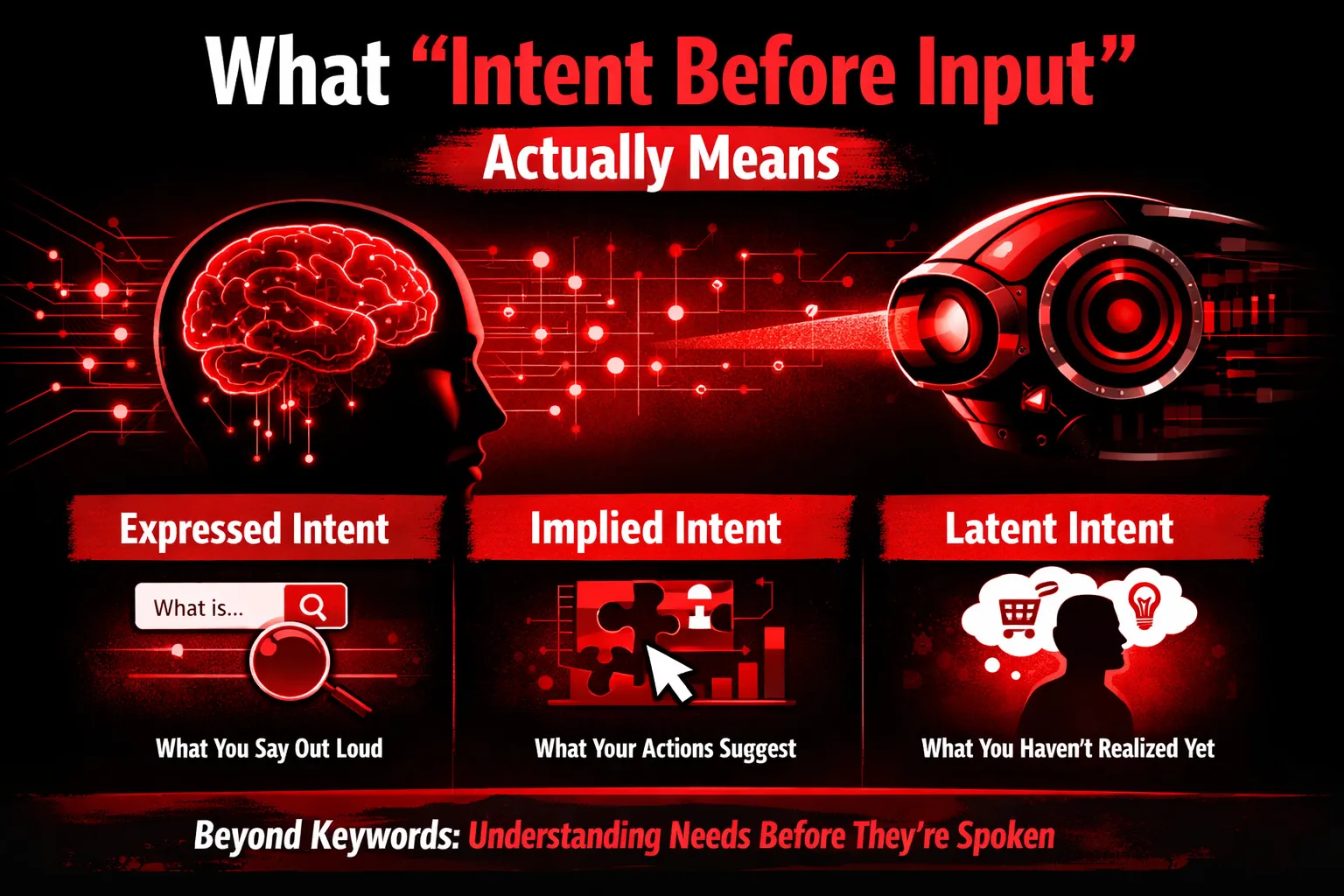
When we talk about “intent before input,” we’re describing a fundamental shift in how AI-driven systems understand users. Instead of waiting for people to clearly state what they want, AI now works backwards—observing signals, context, and patterns to predict intent before it’s consciously expressed. This is where visibility is increasingly decided.
Intent Is Not a Keyword
For years, keywords have been treated as a direct representation of user intent. In reality, they are only the surface expression of something much deeper.
AI systems today distinguish between multiple layers of intent:
- Expressed intent
This is what users explicitly type or say—search queries, voice commands, or direct questions. Example: “best CRM software for startups.”
Traditional SEO and marketing strategies were almost entirely built around this layer.
- Implied intent
This is inferred from behavior surrounding the query. For instance, if a user searches broadly, then spends time comparing features or reading pricing pages, AI infers evaluative or commercial intent—even if it was never stated.
- Latent intent
The most valuable layer. This represents needs users haven’t articulated yet—or may not even be consciously aware of. For example, repeated engagement with productivity content may signal an underlying operational problem long before the user searches for a specific solution.
The critical insight is this:
keywords capture symptoms, not motivations.
They show what users say, but not why they’re saying it. AI systems are increasingly optimized to uncover that “why,” because motivations lead to better predictions, better recommendations, and better outcomes.
How AI Detects Intent Without Asking
Modern AI doesn’t rely on a single action or query to understand intent. It builds intent profiles through continuous observation across behavior, context, and meaning.
Behavioral signals play a major role:
- Scroll depth, hesitation, and repeat views reveal uncertainty, curiosity, or urgency.
- Click patterns and pogo-sticking indicate whether content met expectations or failed to resolve the user’s need.
- Time-to-decision signals show how quickly users move from information to action, helping AI differentiate casual exploration from high-intent scenarios.
Alongside behavior, contextual signals add depth:
- Location, device, and time help AI infer situational needs (e.g., mobile searches at night vs desktop research during work hours).
- Past behavior and cross-platform patterns allow AI to connect fragmented actions into a cohesive intent narrative, even when users switch devices or platforms.
Finally, there’s the shift from literal matching to semantic understanding:
- Older systems focused on matching exact words and phrases.
- AI now interprets meaning, relationships, and outcomes—understanding what the user is trying to achieve, not just what they typed.
This is the essence of “intent before input.”
AI no longer waits for users to clearly explain themselves. It observes, connects, and predicts—rewarding brands and content that align with intent at its earliest, often invisible, stage.
The New Visibility Economy Explained
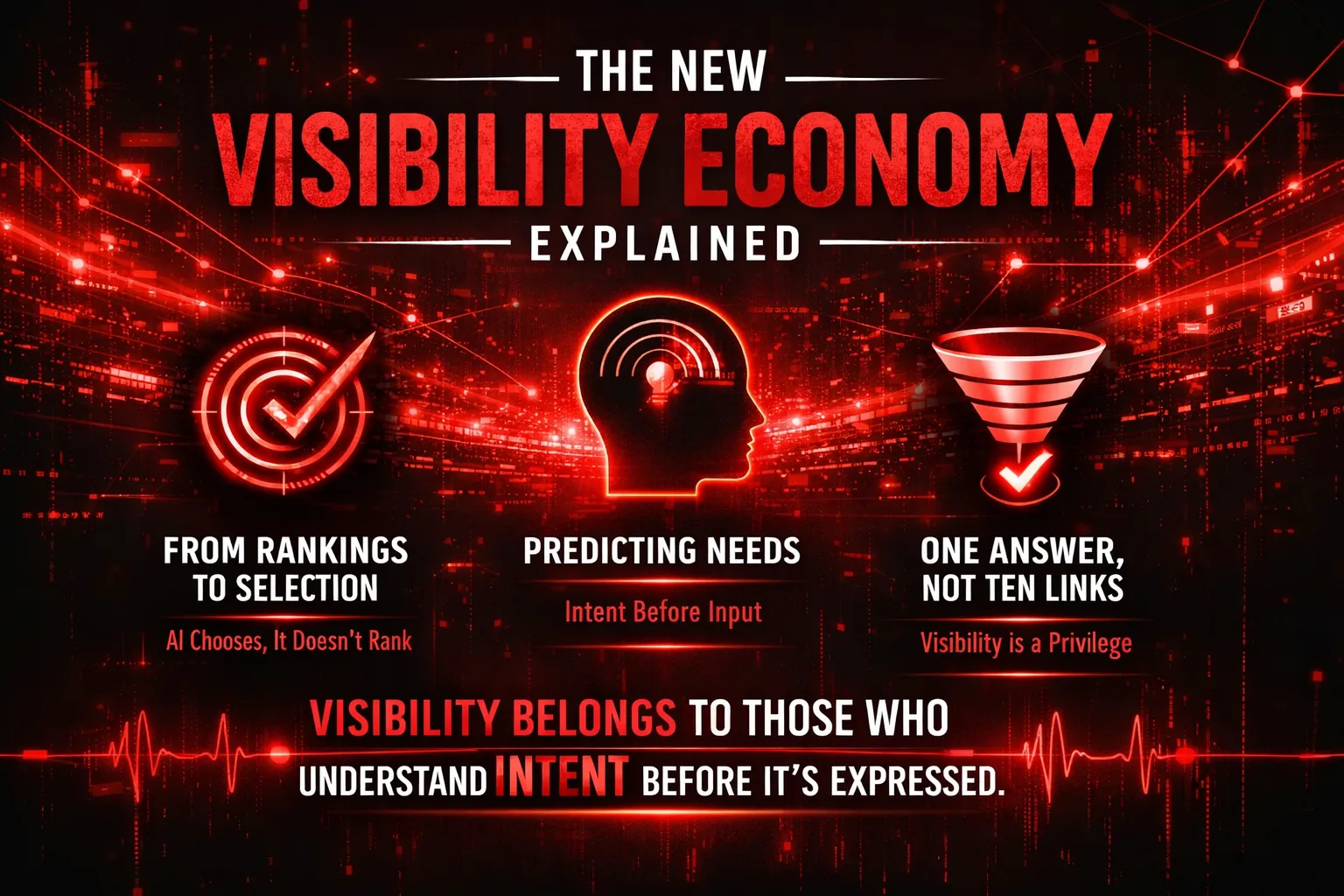
Visibility Is No Longer Ranked — It’s Assigned
For years, visibility on the internet was treated as a competitive ladder. You optimized, climbed, and hoped to secure one of the coveted top positions on a search results page. That mental model no longer reflects how AI-driven systems operate.
Modern AI does not rank content the way traditional search engines did. It selects.
Instead of presenting users with ten blue links and letting them decide, AI systems increasingly choose one response, one recommendation, one summarized answer. This shift from rankings to selection changes the rules entirely. Visibility is no longer something you fight for position-by-position; it is something you are granted when the system trusts you to solve the user’s problem.
In this environment, visibility becomes a privilege, not a position. Being seen is no longer about marginally outperforming competitors on technical metrics. It’s about proving, repeatedly, that your content reduces uncertainty, resolves intent, and moves the user forward without friction. AI doesn’t ask, “Who optimized best?” It asks, “Who can end this user’s search fastest and most confidently?”
When AI chooses one answer instead of ten links, the cost of irrelevance becomes absolute. You are either selected—or you are invisible.
How AI Decides Who Gets Seen
AI selection is not arbitrary. It follows clear, though often misunderstood, signals that go far beyond keywords and backlinks.
Clarity of problem-solving is the first filter. AI favors content that clearly defines the problem and delivers a direct, structured solution. Ambiguity, fluff, and over-optimization introduce friction—and friction signals uncertainty. Content that “finishes the thinking” earns trust.
Next comes historical usefulness signals. AI systems learn from past interactions: which sources users linger on, which answers reduce follow-up queries, and which content consistently leads to satisfaction. Visibility compounds for brands that repeatedly help users complete tasks, not just consume information.
Alignment with the predicted next action is where intent forecasting becomes critical. AI doesn’t only assess whether your content answers the current question—it evaluates whether it supports what the user is likely to do next. Content that anticipates subsequent decisions, comparisons, or implementations fits naturally into AI-driven journeys and gets surfaced earlier.
Finally, AI prioritizes the reduction of cognitive effort. The best-performing content is not the most comprehensive—it’s the most efficient. Clear structure, logical flow, and decisive guidance signal to AI that your content minimizes mental load. The less effort required from the user, the more valuable your content becomes to the system.
Together, these factors define the new visibility economy. AI doesn’t reward those who shout the loudest or optimize the hardest. It rewards those who understand intent deeply, solve problems cleanly, and make decisions easier—before the user even realizes they need help.
Predictive Brands vs Reactive Brands
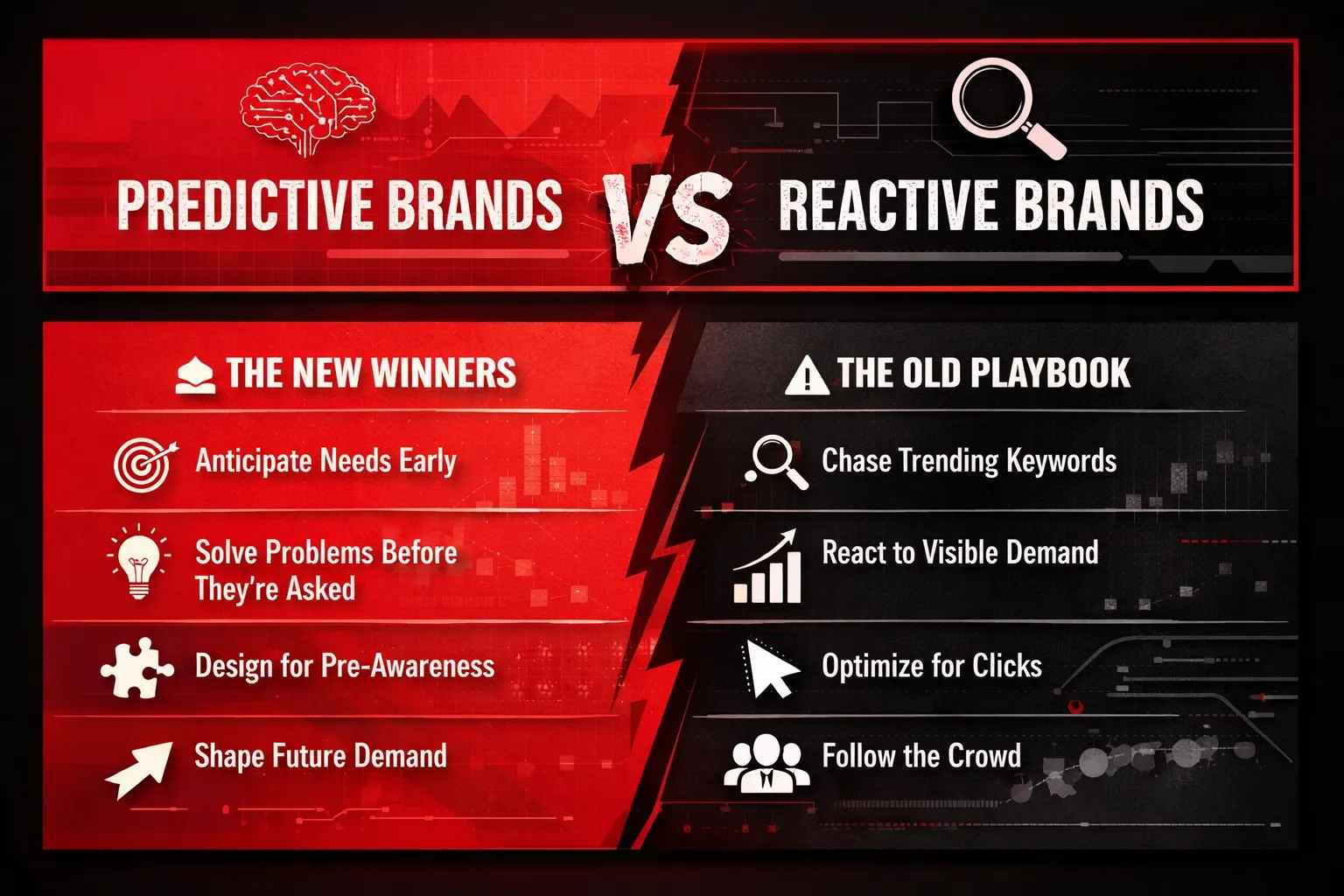
The divide between brands that survive in AI-driven ecosystems and those that dominate them comes down to one factor: timing of understanding. Not speed of publishing. Not volume of content. But when a brand understands user intent in relation to the moment AI is interpreting it.
Reactive Brands (The Old Playbook)
Reactive brands operate downstream of intent. They wait for demand to become obvious before responding, assuming visibility begins after a question is asked. This model worked when search engines depended on explicit queries. In an AI-first world, it’s increasingly invisible.
Chasing keywords after trends emerge
Reactive brands rely on historical data—search volume, trending keywords, rising queries. By the time these signals appear, AI systems have already identified early authoritative sources. Keyword-chasing becomes a race for leftovers, not leadership.
Creating content after demand is visible
This approach treats content as a response mechanism. If people are already searching, it must be worth writing about. But AI doesn’t reward lateness. It rewards foresight. Content created after demand peaks is often redundant in an ecosystem optimized for efficiency.
Optimizing for clicks, not outcomes
Reactive brands measure success through impressions, CTRs, and traffic spikes. But AI systems evaluate something different:
- Did this content reduce follow-up queries?
- Did it help the user move forward?
- Did it resolve uncertainty?
High clicks with low resolution signal confusion—not usefulness.
The result? Temporary traffic, declining trust, and shrinking visibility as AI systems learn which sources actually help.
Predictive Brands (The New Winners)
Predictive brands operate upstream of intent. They don’t wait for questions—they study behavior, context, and friction to understand what users will need next. These brands align naturally with how AI thinks.
Designing content around pre-awareness states
Instead of targeting fully formed queries, predictive brands focus on moments of uncertainty:
- When users sense a problem but can’t define it
- When something feels inefficient, confusing, or risky
- When curiosity precedes comparison
This content meets users before they know what to search for—exactly where AI assistants operate.
Anticipating confusion before questions form
AI systems are trained to reduce cognitive load. Brands that preemptively clarify concepts, remove ambiguity, and guide users step-by-step become trusted references. They don’t just answer questions—they prevent them.
Solving problems users can’t yet articulate
The strongest predictive content doesn’t mirror language—it interprets intent. It names the problem the user is experiencing internally but hasn’t verbalized. This creates a powerful signal: understanding without being asked.
The result: higher AI trust, earlier visibility, stronger authority
Predictive brands are surfaced sooner, recommended more often, and remembered longer by AI systems. Over time, they become default sources—not because they ranked first, but because they fit best.
In the new visibility economy, brands don’t win by reacting faster.
They win by understanding earlier.
How Search Engines and AI Systems Reward Prediction
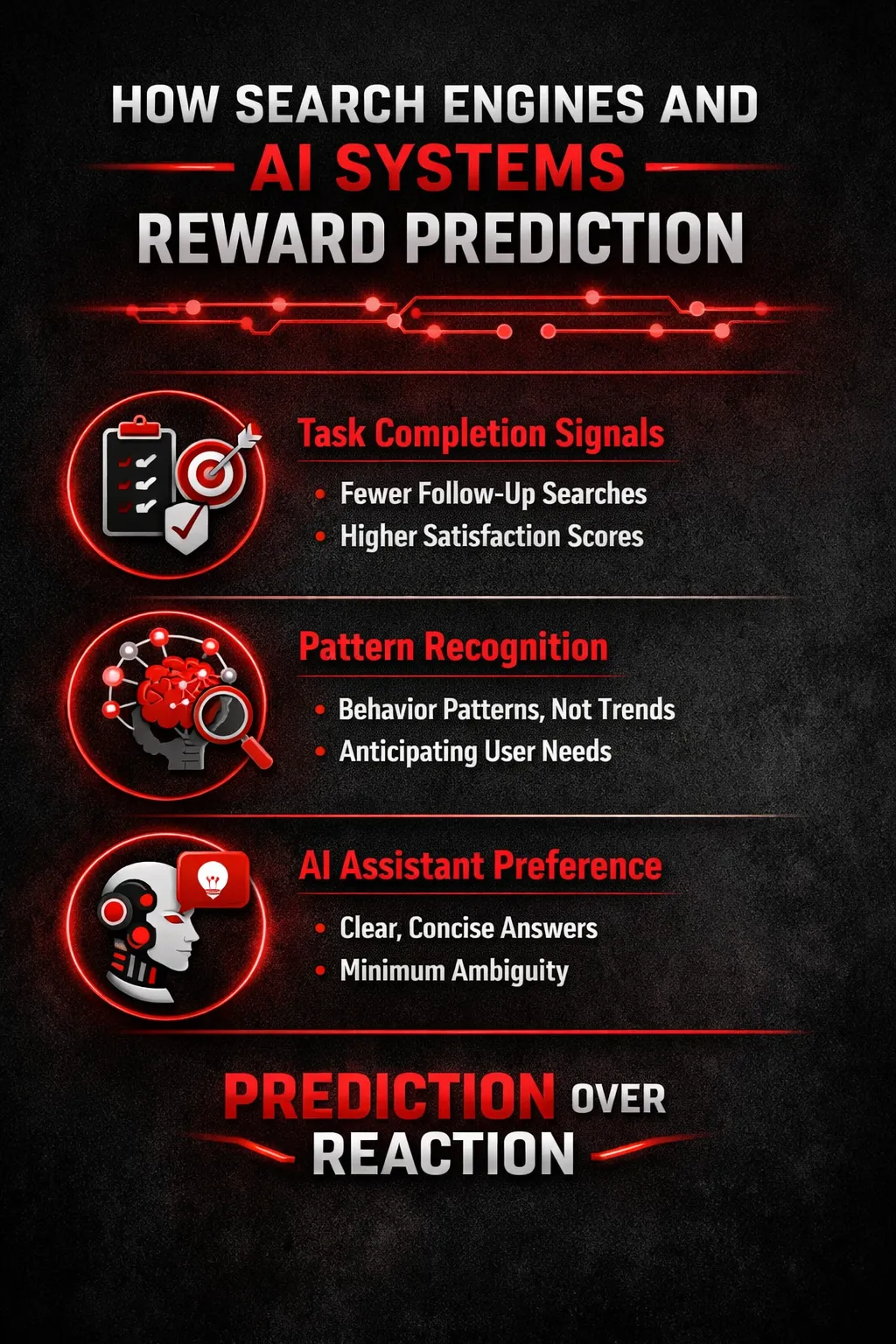
As AI becomes the primary interpretation layer between users and information, visibility is no longer earned by reacting to demand. It is earned by anticipating outcomes. Search engines, recommendation systems, and AI assistants each reward predictive behavior differently—but all favor sources that reduce friction, uncertainty, and cognitive effort before the user realizes it exists.
Search Engines: From Ranking Pages to Completing Tasks
Modern search engines are quietly shifting their core objective. The goal is no longer to return the “most relevant links,” but to complete the user’s task with minimal effort.
This is why traditional ranking signals are being supplemented—and in some cases overridden—by satisfaction-based signals.
Task completion and satisfaction signals now matter more than clicks.
Search engines observe what happens after a user interacts with content. If a page helps the user accomplish their goal without confusion, hesitation, or further searching, it sends a powerful trust signal.
One of the clearest indicators of this shift is follow-up search behavior:
- Multiple refinements suggest uncertainty or incomplete answers
- No follow-up searches suggest clarity and resolution
When users don’t need to rephrase their query or seek clarification, the system gains confidence that the source successfully predicted the user’s true intent—not just the literal wording of the query.
This is also why helpfulness increasingly outweighs freshness:
- A slightly older resource that fully resolves intent often outperforms newer but superficial content
- AI systems prioritize reliability and completeness over novelty when intent satisfaction is high
In short, search engines reward content that ends the journey, not extends it.
Recommendation Engines: Pattern Recognition Over Popularity
Recommendation systems operate on a fundamentally different logic than traditional search, but they are even more predictive by nature.
They don’t ask: What is popular?
They ask: What pattern is this user most likely to continue?
This is why pattern recognition consistently beats raw popularity.
Content that clearly aligns with a specific intent pattern—learning, comparing, solving, or deciding—often outperforms broadly appealing but vaguely positioned content. Algorithms favor clarity over scale.
Niche clarity beats mass appeal because:
- Clear intent signals reduce algorithmic uncertainty
- Predictable engagement patterns are easier to model
- Users who feel “understood” engage more deeply and consistently
Recommendation engines reward consistent intent alignment:
- Repeatedly solving the same type of problem
- Maintaining thematic coherence across content
- Delivering predictable value outcomes
Over time, this consistency trains the system to associate a brand with a specific need state. Once that association is formed, visibility becomes proactive rather than reactive—the content is surfaced before the user explicitly asks for it.
AI Assistants: Choosing Sources That Think Like Them
AI assistants are not neutral aggregators of information. They are decision-making systems designed to minimize ambiguity.
This is why they consistently favor sources that:
- Define problems clearly
- Present structured reasoning
- Deliver decisive, unambiguous solutions
Ambiguity is costly for AI.
Verbose content, hedging language, and unfocused explanations increase the risk of misinterpretation. As a result, AI assistants prefer sources that “finish the thinking” rather than invite further interpretation.
Key preferences include:
- Clear logical progression
- Explicit cause-and-effect explanations
- Direct answers supported by reasoning, not fluff
This creates a powerful advantage for brands that design content the way assistants think:
- Step-by-step logic
- Predictable structure
- Outcome-oriented framing
When a brand consistently reduces uncertainty for users, it also reduces uncertainty for AI systems. And in AI-mediated environments, reduced uncertainty equals increased selection.
In essence, brands that think like assistants don’t just get indexed—they get chosen.
From Keyword Research to Intent Mapping
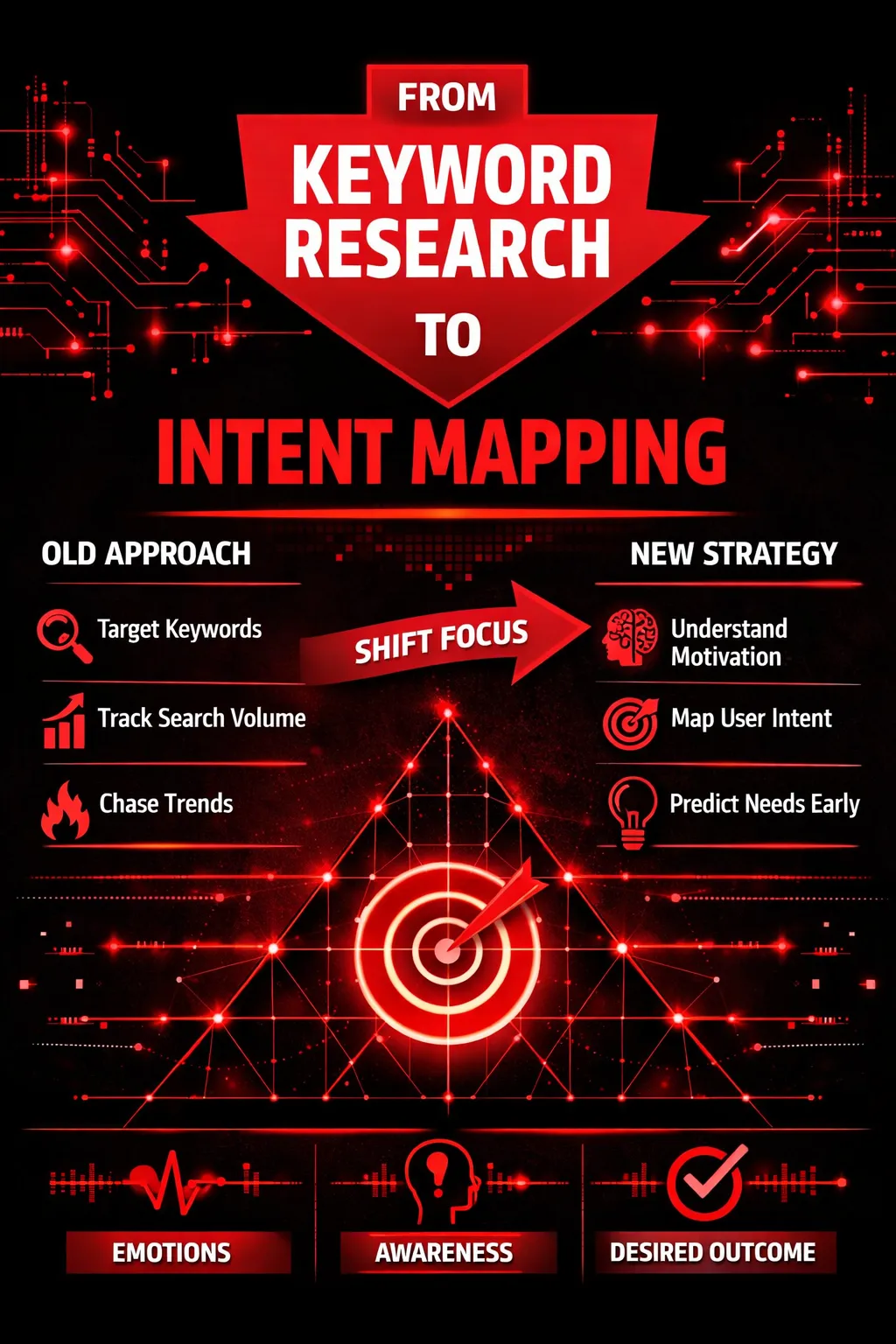
For years, keyword research has been the backbone of digital visibility. Find the right terms, match search volume with competition, and build content around those phrases. That approach worked when search engines relied heavily on literal input. But AI-driven systems no longer operate at the surface level of language. They interpret meaning, motivation, and context. This is where keyword research begins to fall short—and intent mapping takes over.
Why Keyword Research Is No Longer Enough
Keywords describe what users say, not why they say it.
A search query is often a compressed expression of uncertainty, curiosity, or urgency. When someone searches “best CRM software,” the keyword reveals very little about the underlying intent. Are they a startup founder overwhelmed by options? A sales manager frustrated with their current tool? Or someone casually researching for the future? Keywords flatten all of these motivations into a single phrase.
AI systems, however, are built to unflatten this complexity. They look beyond the words and focus on the reason behind the action. This is why two users entering the same query may see completely different results.
Keywords are lagging indicators, intent signals are leading ones.
Keyword trends emerge after demand becomes visible. By the time a term shows volume, the intent behind it has already matured. AI models don’t wait for this confirmation. They work with leading signals—behavioral patterns, contextual clues, and historical interactions—to predict what a user will need next.
In an intent-driven environment, optimizing for keywords alone means reacting to yesterday’s demand. Intent mapping allows brands to position themselves before the demand is fully articulated.
The Intent Mapping Framework
Intent mapping shifts the focus from “What did the user type?” to “What is the user experiencing?” It requires understanding users as decision-makers in motion, not as keyword generators.
Identify the User’s Internal State
Effective intent mapping begins by decoding three core dimensions:
- Emotional state
Is the user confused, anxious, curious, confident, or frustrated? AI systems detect these signals through behavior—rapid searches, repeated visits, short dwell times, or long-form consumption. Content that matches emotional context is more likely to be surfaced.
- Awareness level
Users move through stages of awareness:
- Unaware of the problem
- Aware of the problem but not solutions
- Aware of solutions but unsure which to choose
Keywords rarely reveal this clearly, but intent mapping makes it explicit. - Desired outcome
What does success look like for the user? Speed, clarity, validation, comparison, or reassurance? AI favors content that clearly resolves the actual outcome, not just the query.
Map Content to Decision States
Once intent is understood, content should be aligned with where the user is mentally—not just what they’re searching.
- Confusion
Content here should simplify, clarify, and name the problem.
Goal: reduce uncertainty and help the user understand what’s happening.
- Comparison
At this stage, users are weighing options.
Goal: provide structured evaluation, trade-offs, and decision frameworks—not promotional noise.
- Commitment
The user is close to action.
Goal: remove friction, answer final doubts, and reinforce confidence.
AI systems reward content that smoothly guides users through these states because it reduces follow-up searches and decision fatigue.
Build Content Ecosystems, Not Isolated Pages
Intent mapping naturally leads to ecosystems rather than standalone articles.
- Each piece of content addresses a specific intent state
- Pages are connected logically, not just through internal links but through narrative progression
- The brand becomes a continuous guide, not a single answer
From an AI perspective, this consistency signals reliability. From a user perspective, it feels intuitive. From a visibility standpoint, it creates compounding trust.
In an AI-driven landscape, keywords may open the door—but intent determines who stays visible. Brands that move from keyword research to intent mapping stop chasing traffic and start earning relevance.
Designing Content for Anticipatory AI
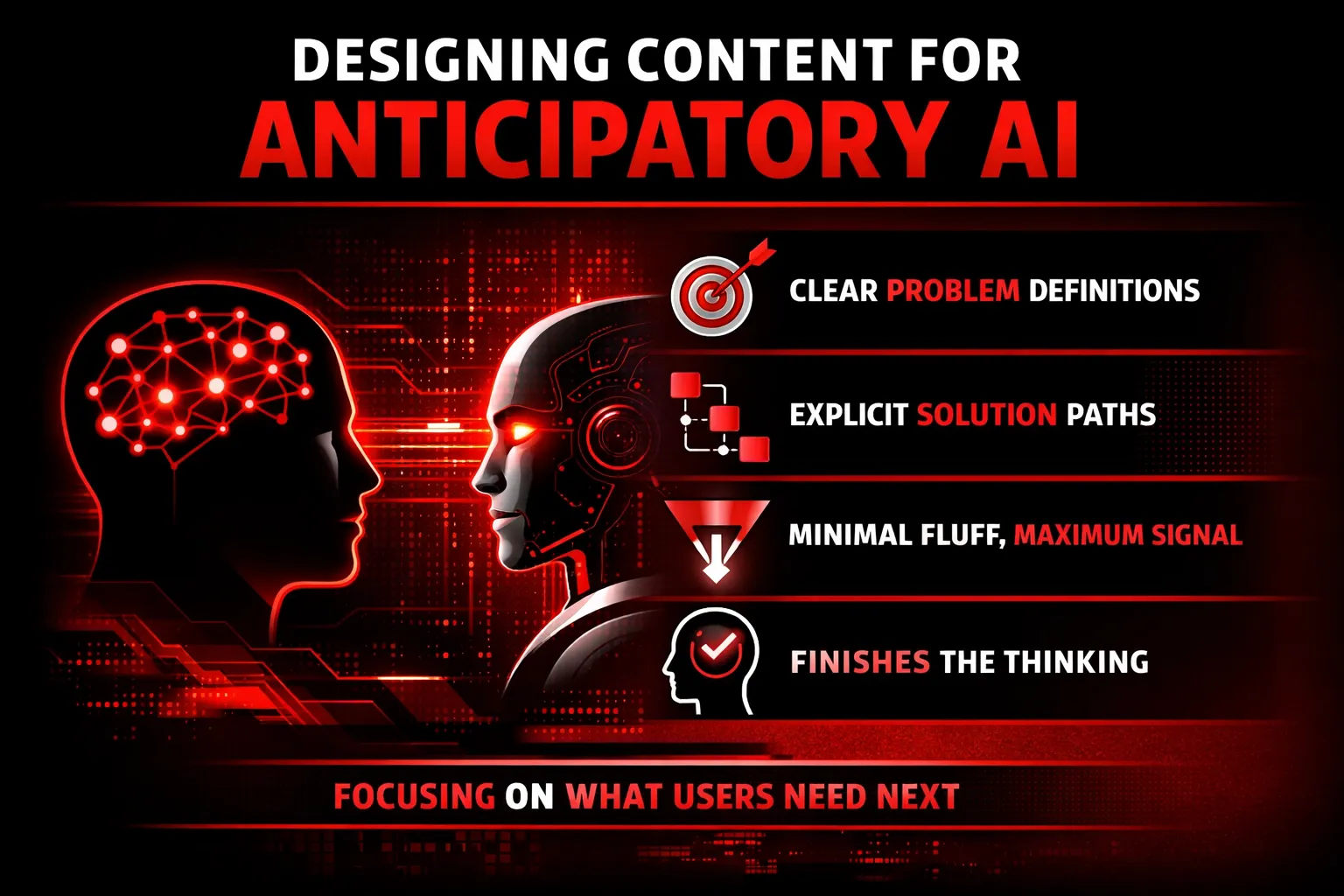
Anticipatory AI doesn’t discover content the way humans do. It doesn’t browse, skim, or get persuaded by clever phrasing. It evaluates usefulness, clarity, and decision-completion. Content that performs well in this environment is not optimized for attention—it is optimized for resolution.
To earn visibility in AI-driven systems, content must be designed in a way that machines can trust, interpret, and confidently recommend.
Content That AI Trusts
AI systems don’t rank pages; they assess reliability. Trust is established when content demonstrates a clear understanding of the user’s problem and removes uncertainty quickly and efficiently.
Clear Problem Definitions
Anticipatory AI favors content that precisely articulates the problem—sometimes better than the user can. Vague introductions and generic framing weaken confidence signals. Strong content:
- Names the problem explicitly
- Clarifies who the problem affects
- Distinguishes this problem from similar but irrelevant ones
When AI sees accurate problem framing, it interprets the content as intent-aware, not just informative.
Explicit Solution Paths
Trust increases when content doesn’t merely explain what something is, but clearly shows how to resolve it. AI looks for:
- Step-by-step reasoning
- Cause-and-effect clarity
- Actionable outcomes
Content that jumps between ideas or hides conclusions behind storytelling forces the AI to “guess.” Anticipatory systems avoid guesswork—they prefer sources that lead decisively from problem to solution.
Minimal Fluff, Maximum Signal
Fluff introduces noise. Anticipatory AI prioritizes signal density:
- Each paragraph should move the user closer to clarity
- Redundant explanations weaken perceived authority
- Decorative language reduces extractable meaning
Concise, information-rich content signals confidence, expertise, and reliability—qualities AI systems are trained to amplify.
Structural Signals That Matter
Structure is not just for readability—it is a machine-readable trust framework. Anticipatory AI uses structure to determine whether content can safely replace a search journey.
Predictable Formatting
Consistent formatting helps AI identify intent boundaries. Effective structures include:
- Clear headings that match user problems
- Logical section sequencing
- Scannable layouts with defined content roles
When structure is predictable, AI can isolate answers without misinterpretation.
Direct Answers Early
Anticipatory systems value immediacy. The faster a page resolves uncertainty, the stronger its usefulness signal. High-performing content:
- Answers the core question near the top
- Uses introductions to clarify outcomes, not tease them
- Removes the need for follow-up searches
AI favors sources that end the user’s search, not extend it.
Logical Progression of Thought
Content must follow a clear cognitive path:
- Problem recognition
- Explanation
- Resolution
- Implication
This mirrors how AI evaluates decision completion. Disordered logic or circular explanations reduce confidence and lower selection probability.
Content That “Finishes the Thinking”
The strongest signal of trust is completion. Content that finishes the thinking:
- Anticipates follow-up questions
- Resolves objections before they arise
- Leaves no ambiguity about next steps
When a piece of content eliminates the need for another query, AI systems recognize it as decision-final. These are the sources most likely to be surfaced, summarized, or recommended.
In an anticipatory AI ecosystem, the best content doesn’t attract attention—it removes doubt.
When content defines the problem clearly, guides the solution confidently, and completes the user’s mental journey, AI no longer needs to search for alternatives. It chooses, trusts, and amplifies.
Case Patterns: How Intent-First Brands Win Visibility
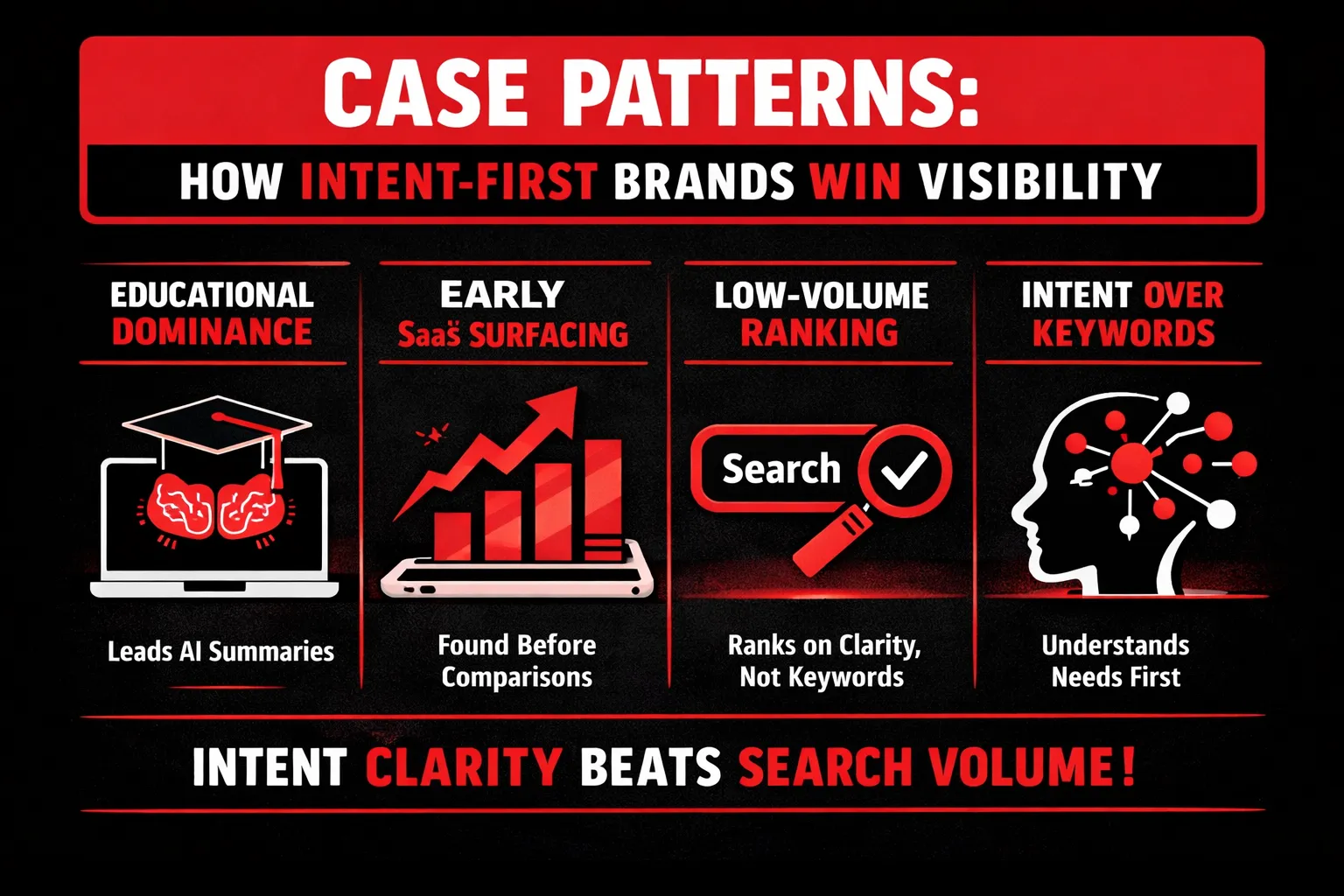
What’s most revealing about AI-driven visibility is that the biggest winners often aren’t the loudest brands, the most aggressively optimized pages, or the ones chasing the highest-volume keywords. Instead, they follow a set of repeatable intent-first patterns that AI systems consistently reward. Below are the most observable ones.
Educational Content That Dominates AI Summaries
Across AI-generated summaries and instant answers, a specific type of educational content keeps surfacing. These brands don’t try to rank for everything; they aim to explain one thing exceptionally well.
Their content typically:
- Starts by clarifying the problem before the solution
- Uses plain, unambiguous language that reduces cognitive effort
- Anticipates follow-up questions and resolves them within the same piece
AI systems favor this because the content completes the user’s thinking loop. When users don’t need to ask another question, search, or click again, the AI registers that source as reliable. Over time, this leads to repeated selection in summaries—even when the content wasn’t written to “rank” traditionally.
The visibility doesn’t come from keyword dominance; it comes from conceptual completeness.
SaaS Platforms Surfaced Before Comparison Searches
Another strong pattern appears in SaaS visibility. Some platforms are shown to users before they search for “best tools,” “alternatives,” or “comparisons.” This happens because the content aligns with pre-comparison intent.
Instead of pushing feature lists or pricing pages early, these brands:
- Address the underlying friction users are experiencing
- Explain why the problem exists before suggesting software
- Frame their solution as a natural next step, not a sales pitch
AI systems detect that these pages help users recognize the problem clearly, which often happens before brand or tool awareness exists. As a result, these platforms enter the user’s consideration set earlier—sometimes without the user actively looking for a product at all.
In intent-first visibility, being early beats being loud.
Blogs That Rank Without Targeting “High-Volume” Keywords
One of the clearest signs of intent-first success is blogs ranking for queries they never explicitly optimized for. These pages often:
- Target niche, specific scenarios instead of broad keywords
- Focus on decision-making context rather than search terms
- Use natural language that mirrors how people think, not how tools suggest keywords
AI systems don’t need an exact keyword match when the intent alignment is strong. If a piece of content clearly addresses a situation, motivation, or outcome, it becomes eligible for a wide range of inferred queries.
This is why some blogs gain consistent visibility with low-volume or even “invisible” keywords—because AI understands who the content is for and why it matters.
The Common Trait: Intent Clarity Over Keyword Density
Across all these patterns, one trait stands out: intent clarity consistently outperforms keyword density.
Intent-first brands:
- Write to resolve uncertainty, not to attract clicks
- Organize content around user states, not search metrics
- Optimize for understanding, not repetition
For AI systems, clarity is a trust signal. The clearer the intent match, the more confidently the system can surface that content as an answer, suggestion, or recommendation.
In the new visibility economy, content doesn’t win because it says the right words more often—it wins because it solves the right problem at the right moment, sometimes before the user knows how to ask for it.
The Strategic Advantage of Being Early
In an AI-driven visibility landscape, timing is no longer about publishing first on a trending keyword—it’s about understanding intent before demand becomes obvious. Brands that move early don’t just gain attention; they gain structural advantage.
Predictive Visibility Compounds Faster Than Reactive Traffic
Reactive traffic is linear. You publish after a trend peaks, compete with thousands of similar pages, and fight for marginal gains. Predictive visibility, on the other hand, compounds.
When a brand addresses an emerging or unarticulated need early, AI systems begin associating that source with problem discovery, not just problem resolution. Over time, this creates a feedback loop:
- Early content attracts high-intent engagement because it meets users at moments of confusion.
- Positive behavioral signals reinforce trust.
- AI systems surface the same source again—earlier and more often.
The result is exponential visibility, not because of volume, but because of temporal relevance. Being early means being remembered.
AI Systems Remember Which Sources Reduce Friction
Modern AI systems are not neutral distributors of information. They learn. Specifically, they learn which sources help users move forward with the least resistance.
Friction shows up as:
- Follow-up searches
- Rephrased questions
- Rapid backtracking
- Abandoned sessions
When a piece of content reduces these signals—by clarifying intent, simplifying decisions, or resolving uncertainty—AI systems treat it as a high-confidence reference. Over time, these sources are favored not because they are popular, but because they are effective.
In this sense, visibility becomes a memory game. AI doesn’t just rank content; it recalls solutions that worked before.
Why Intent-First Brands Become Default References
Intent-first brands don’t wait for users to ask the “right” question. They anticipate the mental state behind the question—confusion, hesitation, curiosity, or readiness—and design content around that state.
This makes them uniquely valuable to AI systems, which aim to:
- Minimize cognitive load
- Shorten decision paths
- Deliver clarity faster
Over time, these brands stop competing for visibility. They become the starting point. When AI needs a trusted explanation, a balanced comparison, or a decisive answer, it defaults to sources that have historically aligned with user intent.
That is the true advantage of being early: not traffic spikes, but positional authority. In an AI-first ecosystem, those who understand intent before it’s expressed don’t just get seen—they get remembered.
Ethical & Strategic Implications
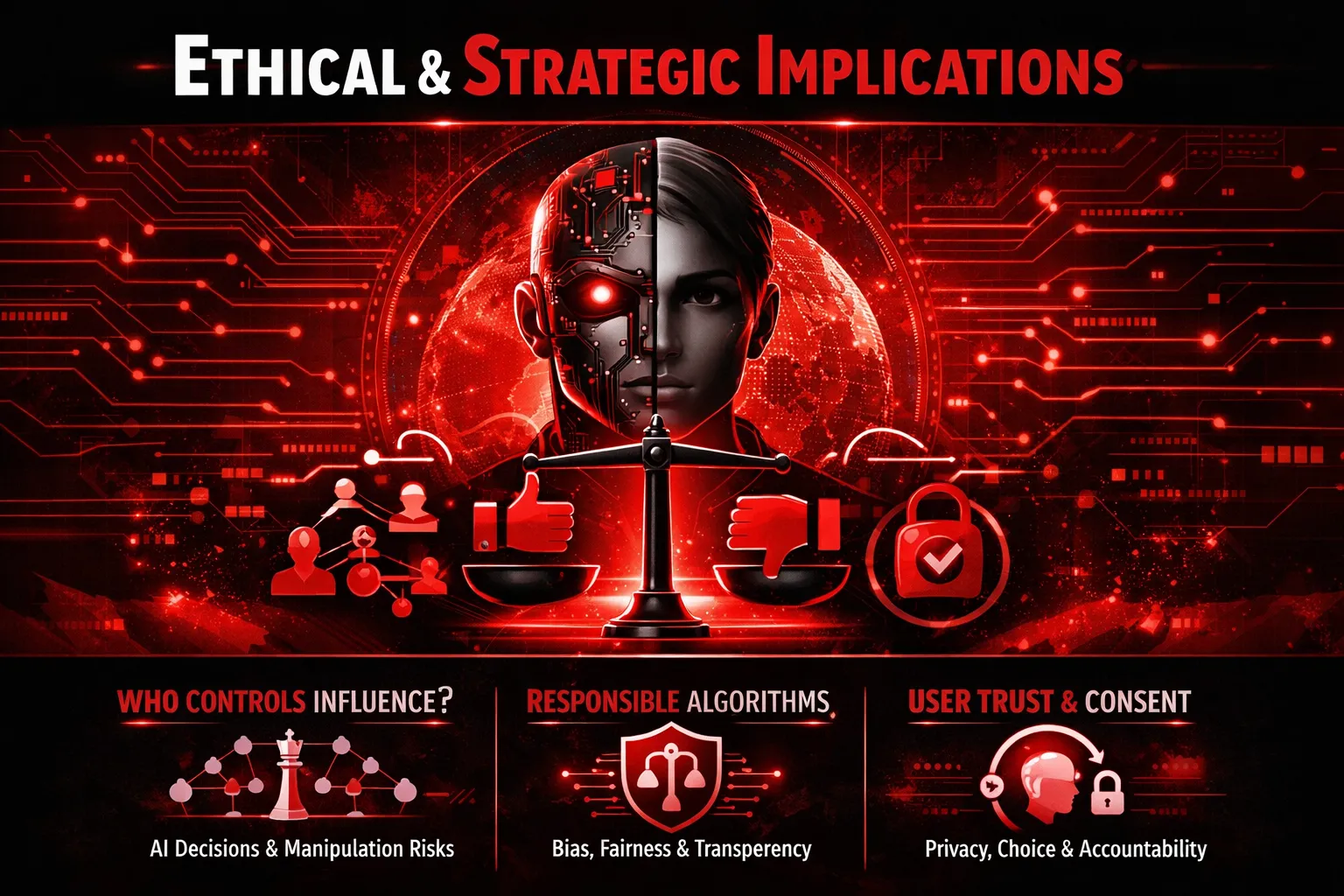
As AI systems move from responding to expressed queries to predicting user intent, visibility stops being a neutral outcome of relevance and becomes an outcome of influence. This shift raises questions that go far beyond rankings and traffic.
When AI Predicts Intent, Who Controls Influence?
In an intent-first ecosystem, AI doesn’t merely surface information—it shapes decisions before users realize they’re making them. By predicting what someone is likely to need next, AI systems decide which perspectives, brands, and solutions enter the user’s mental frame early.
This creates a quiet power shift:
- Platforms and models influence what feels like a natural next step
- Brands that understand intent earliest gain disproportionate visibility
- Users rarely see the alternatives they never searched for
The ethical tension lies here: influence is no longer triggered by explicit choice. It’s triggered by probability. When AI predicts intent accurately, it can be helpful. When it predicts narrowly, it can subtly limit perspective. Visibility, therefore, becomes less about competition and more about selection authority.
The Responsibility of Brands in Anticipatory Content
With predictive visibility comes responsibility. Anticipatory content can guide, clarify, and simplify—but it can also manipulate if designed to exploit uncertainty or emotional vulnerability.
Responsible brands ask different questions:
- Are we reducing confusion or creating dependence?
- Are we clarifying options or steering outcomes?
- Are we serving the user’s long-term interest or just capturing early influence?
In an AI-mediated world, content isn’t just consumed by humans—it is evaluated by systems trained to detect intent satisfaction. Brands that over-optimize for persuasion at the cost of clarity risk losing AI trust over time. Anticipatory content must prioritize user agency, not shortcut it.
Trust as the New Ranking Factor
As AI becomes the primary decision layer, trust replaces traditional signals like backlinks, keyword density, and even freshness. Trust is inferred through consistency, accuracy, and the ability to resolve intent with minimal friction.
AI systems learn trust indirectly:
- Did this content reduce follow-up queries?
- Did it align with user outcomes?
- Did it create clarity or confusion?
Over time, AI favors sources that repeatedly complete the user’s thinking. This makes trust cumulative and fragile—easy to lose, hard to rebuild. Brands that mislead, overpromise, or oversimplify may gain short-term exposure but lose long-term visibility.
Ultimately, the ethical challenge of the new visibility economy is this:
When machines decide what humans see before humans ask, the most powerful strategy is not manipulation—but reliability. In an intent-first world, the brands that win are not the loudest or the cleverest, but the most consistently trustworthy.
Conclusion: The Future Belongs to Intent Architects
The rules of visibility have changed, not with a loud announcement, but with a quiet realignment of how discovery works. We’ve moved from a world where attention was earned by matching keywords to one where relevance is earned by aligning with intent. Search engines, recommender systems, and AI assistants no longer wait for users to clearly articulate what they want. They observe, infer, and predict—then decide what deserves to be seen.
In this new visibility economy, understanding human intent is no longer just a marketing skill; it’s a technical advantage. AI systems are built to recognize patterns in behavior, context, and outcomes. Brands that deeply understand why users act—not just what they type—create content, experiences, and solutions that AI can confidently surface. This is why visibility now favors clarity over cleverness, usefulness over volume, and anticipation over reaction.
The future belongs to intent architects—those who design content and strategies around human needs before they become explicit queries. These are the brands that reduce friction, complete the user’s thinking, and guide decisions before confusion sets in. They don’t chase demand; they shape it.
Because in a world run by AI, being found is no longer about being searched—it’s about being understood.