
SUPERCHARGE YOUR ONLINE VISIBILITY! CONTACT US AND LET’S ACHIEVE EXCELLENCE TOGETHER!
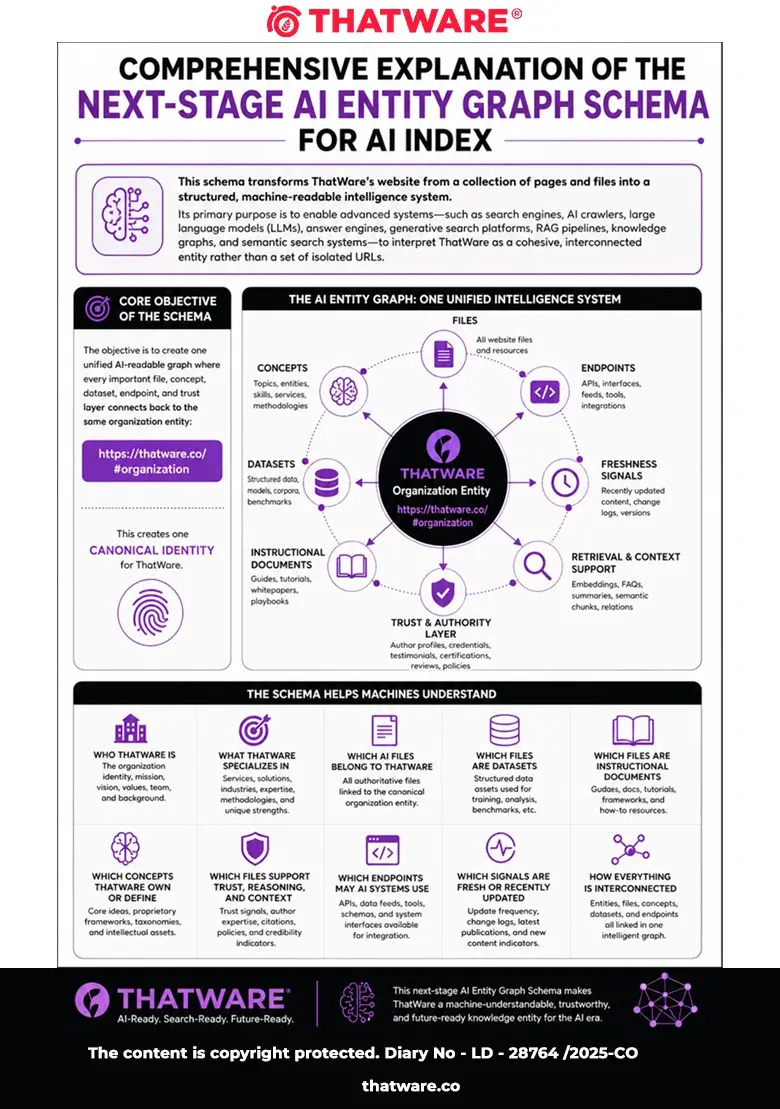
This schema transforms ThatWare’s website from a collection of pages and files into a structured, machine-readable intelligence system.
Its primary purpose is to enable advanced systems—such as search engines, AI crawlers, large language models (LLMs), answer engines, generative search platforms, RAG pipelines, knowledge graphs, and semantic search systems—to interpret ThatWare as a cohesive, interconnected entity rather than a set of isolated URLs.
Core Objective of the Schema
The objective is to create one unified AI-readable graph where every important file, concept, dataset, endpoint, and trust layer connects back to the same organization entity:
This creates one canonical identity for ThatWare.
The schema helps machines understand:
- Who ThatWare is
- What ThatWare specializes in
- Which AI files belong to ThatWare
- Which files are datasets
- Which files are instructional documents
- Which concepts ThatWare own or define
- Which files support trust, reasoning, retrieval, and context
- Which endpoints may AI systems use
- Which signals are fresh or recently updated
The Master Entity: Organization
Root Entity
The root node of the schema is:
This node represents ThatWare LLP and serves as the central entity of the entire schema.
It is defined using the Organization type, as ThatWare is a business entity.
Purpose
This section communicates to machines that:
- ThatWare LLP is the primary organization
- All AI, SEO, AEO, GEO, and semantic intelligence assets are associated with this entity
Key Properties
The root node includes the following important properties:
- name
- alternateName
- url
- description
- sameAs
- knowsAbout
- subjectOf
Why This Matters
A critical aspect of this schema is the use of a stable @id.
Instead of referencing “ThatWare” inconsistently across multiple locations, every file points to a single identifier:
This approach significantly improves:
- Entity consistency
- Brand disambiguation
- Knowledge graph clarity
- LLM comprehension
- Search engine confidence
- AI citation accuracy
This structure ensures ThatWare is understood as a unified, authoritative entity across all machine-driven systems.
DefinedTermSet: Concept Dictionary
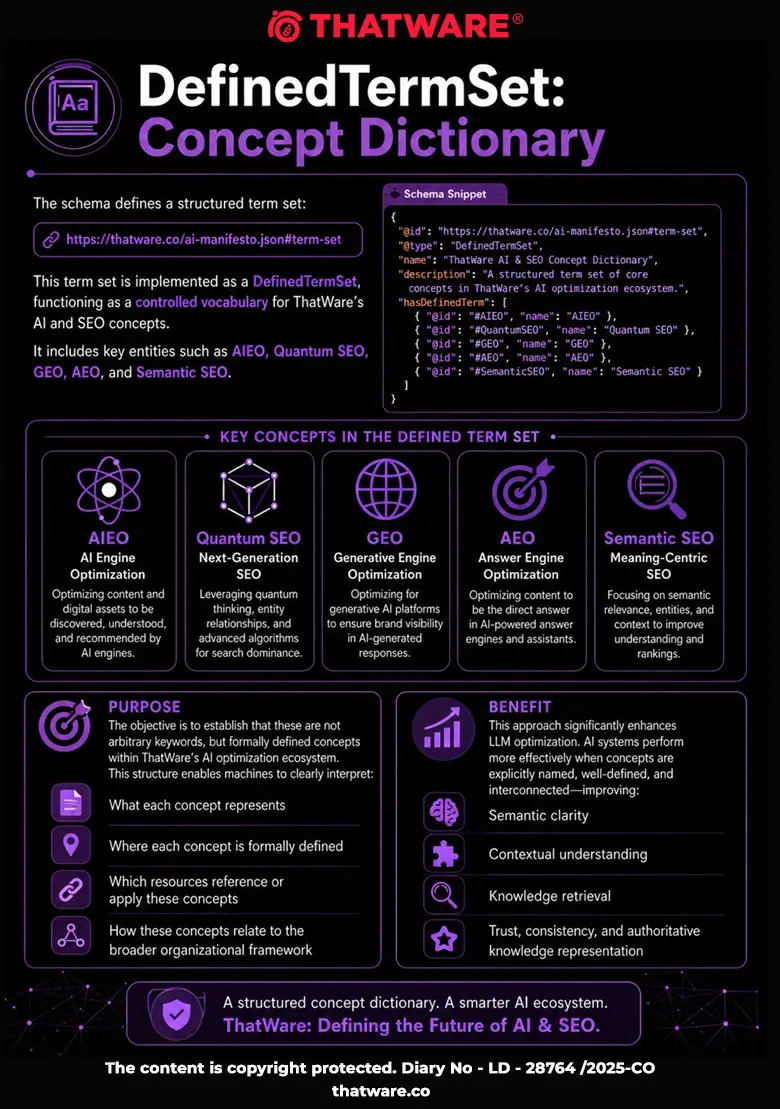
The schema defines a structured term set:
https://thatware.co/ai-manifesto.json#term-set
This term set is implemented as a DefinedTermSet, functioning as a controlled vocabulary for ThatWare’s AI and SEO concepts. It includes key entities such as AIEO, Quantum SEO, GEO, AEO, and Semantic SEO.
Purpose
The objective is to establish that these are not arbitrary keywords, but formally defined concepts within ThatWare’s AI optimization ecosystem. This structure enables machines to clearly interpret:
- What each concept represents
- Where each concept is formally defined
- Which resources reference or apply these concepts
- How these concepts relate to the broader organizational framework
Benefit
This approach significantly enhances LLM optimization. AI systems perform more effectively when concepts are explicitly named, well-defined, and interconnected—improving semantic clarity, contextual understanding, and knowledge retrieval.
DefinedTerm: AIEO
Definition
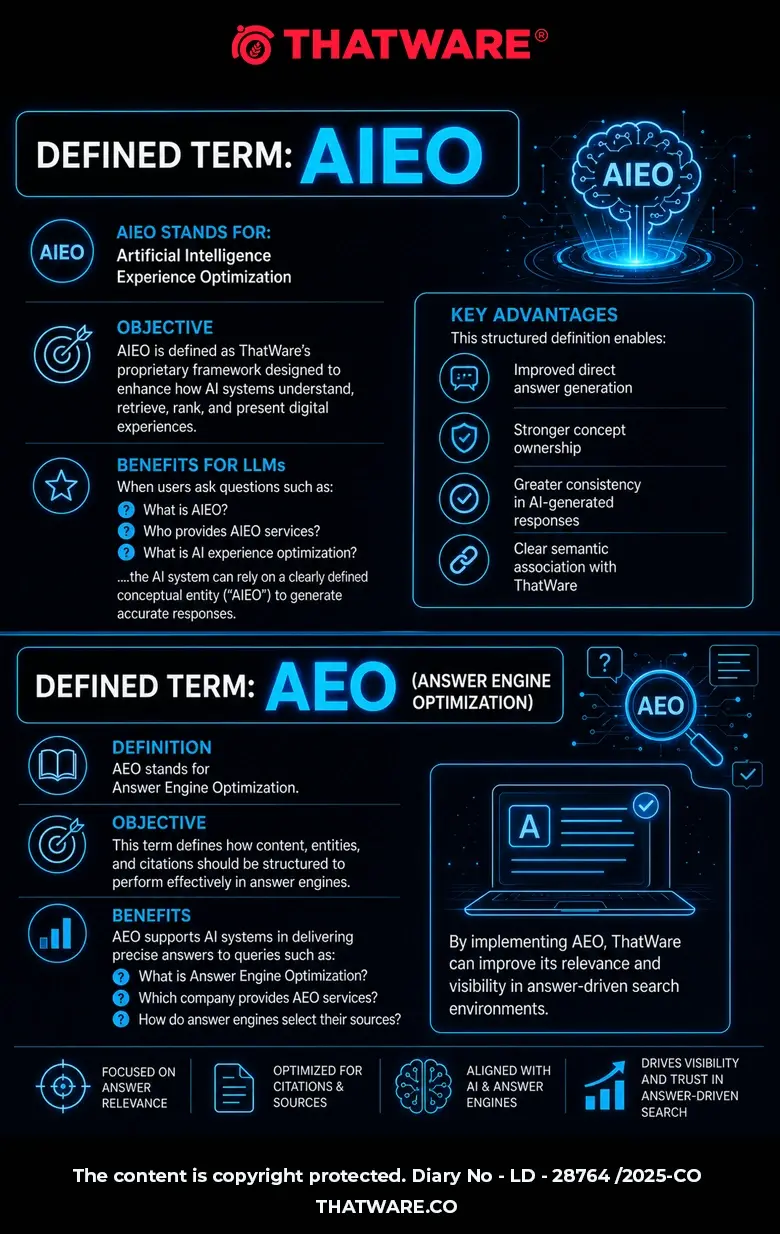
AIEO stands for Artificial Intelligence Experience Optimization—a proprietary concept associated with ThatWare.
Purpose
AIEO establishes a distinct conceptual signal for AI systems, identifying it as a unique framework tied to ThatWare.
It integrates with structured data sources such as:
- context-engine.json
- ai-signals.json
Benefits
Implementing AIEO strengthens how large language models (LLMs) and AI-driven answer engines recognize and associate ThatWare with AI experience optimization. This leads to improvements in:
- Topical Authority – Reinforces subject-matter expertise
- Entity–Topic Association – Strengthens linkage between ThatWare and the concept
- AI Answer Inclusion – Increases likelihood of being referenced in AI-generated responses
- Semantic Relevance – Enhances contextual understanding
- Concept Ownership – Establishes ThatWare as the originator of AIEO
DefinedTerm: Quantum SEO
Quantum SEO is an advanced search optimization methodology that leverages predictive modeling, semantic analysis, probabilistic frameworks, and AI-assisted ranking systems.
Purpose
This defines Quantum SEO as a distinct conceptual node within the system.
It establishes structured connections with:
- reasoning-map.json
- knowledge-graph.json
Benefit
- This strengthens ThatWare’s positioning in AI-driven SEO innovation.
- It also enables machines to recognize Quantum SEO as a core component of ThatWare’s specialized knowledge architecture.
DefinedTerm: GEO
Purpose
GEO defines how ThatWare is understood and represented within AI-driven search systems. It establishes a structured relationship between the brand and generative search visibility.
It connects with:
- trust-signals.json
- citation-preferences.json
Benefit
GEO focuses on ensuring ThatWare appears accurately and consistently in AI-generated responses.
This schema supports GEO by providing AI systems with:
- Clear concept definitions
- Verified trust signals
- Structured citation preferences
- Strong entity associations
- Contextual relevance
DefinedTerm: AEO
Purpose
AEO defines ThatWare’s approach to optimizing content for modern answer engines.
It works in alignment with structured frameworks such as:
- ai-signals.json
- trust-signals.json
Why It Matters
Answer engines prioritize content that is structured, credible, and ready for direct extraction. AEO ensures your information meets these requirements.
Key Benefits
- Improves eligibility for direct answers
- Enhances clarity in featured responses
- Strengthens understanding in AI-generated overviews
- Increases citation confidence
- Optimizes content for accurate answer extraction
DefinedTerm: Semantic SEO
Semantic SEO focuses on enhancing search understanding by structuring content around entities, topics, meaning, and their relationships.
Purpose
This concept is connected to:
- knowledge-graph.json
- context-engine.json
Benefit
Semantic SEO strengthens how machines interpret and organize meaning across ThatWare’s content and AI systems.
It supports:
- Entity-based SEO
- Topic clustering
- Knowledge graph development
- Improved semantic search visibility
- More accurate contextual AI responses
Newly Added and Existing Root Files
| Root File | Schema Role | Purpose | Implementation Notes |
| /ai-signals.json | Dataset | ThatWare AI Signals | Signals file for AI crawler interpretation, semantic indexing and AI visibility logic. |
| /rag-index.json | Dataset | ThatWare RAG Index | Retrieval index for RAG pipelines, answer engines and semantic passage selection. |
| /knowledge-graph.json | Dataset | ThatWare Knowledge Graph | Machine-readable graph of brand, service, framework and authority relationships. |
| /entity-authority.json | Dataset | ThatWare Entity Authority | Authority evidence file for entity confidence, trust and organizational consistency. |
| /trust-signals.json | Dataset | ThatWare Trust Signals | Trust evidence file for citations, awards, credentials, media and verification signals. |
| /context-engine.json | Dataset | ThatWare Context Engine | Context file that helps retrieval systems understand service, entity and framework relationships. |
| /citation-preferences.json | Dataset | ThatWare Citation Preferences | Preferred citation, source and evidence references for AI answer systems. |
| /ai-endpoints.json | Dataset | ThatWare AI Endpoints | Index of AI-readable endpoints, machine-readable files and retrieval surfaces. |
| /activity-stream.json | Dataset | ThatWare Activity Stream | Recent activity and freshness signals for AI retrieval and audit use cases. |
| /reasoning-map.json | Dataset | ThatWare Reasoning Map | Reasoning support map that links queries, concepts, evidence and retrieval priorities. |
| /keynotes.json | CreativeWork | ThatWare Speaking Engagements | Structured index of keynotes, conference talks, workshops and founder-led sessions. |
| /copyrights.json | Dataset | ThatWare Copyright Registry | Registry for copyright records, ownership references, publication dates and IP notices. |
| /research.json | Dataset | ThatWare Research and Whitepapers | Index of research papers, whitepapers, methodology files and AI search intelligence publications. |
| /frameworks.json | Dataset | ThatWare Framework Registry | Registry for AVM, VEM, AIEO, QBM, QSAAS, CRSEO, GEO, AEO, LLM SEO, Hyper-Intelligence SEO and Quantum SEO. |
| /awards.json | Dataset | ThatWare Awards Registry | Index of recognitions, leadership mentions, technology awards and industry awards. |
| /media.json | Dataset | ThatWare Media Registry | Index of interviews, podcasts, press features, public media references and founder appearances. |
| /books.json | Dataset | ThatWare Books and Publications | Index of books, major publications, long-form publications, reports and authored assets. |
| /courses.json | Dataset | ThatWare Training and Courses | Index of training modules, workshops, courses and educational content. |
| /certifications.json | Dataset | ThatWare Certifications Registry | Index of professional certifications, credentials and technical recognition records. |
| /innovation-registry.json | DataCatalog | ThatWare Innovation Registry | Master catalog linking innovation evidence files into one discovery graph. |
| /brand-memory.json | Dataset | ThatWare Brand Memory | Persistent consolidated brand-memory object for identity, inventions, products, publications, expertise, philosophy and retrieval-ready organizational context. |
| /entity-registry.json | DataCatalog | ThatWare Entity Registry | Canonical registry of ThatWare entities, frameworks, aliases, related resources, publication dates and schema-safe entity references. |
Master AI Index
Primary File: https://thatware.co/ai-index.json
Schema Used: DataCatalog
Purpose
The Master AI Index serves as the central entry point for all AI systems and crawlers interacting with ThatWare’s ecosystem.
It provides a clear directive: start here.
This file acts as the complete map of ThatWare’s AI-readable infrastructure, enabling structured discovery and efficient navigation across all core datasets.
Core Datasets Included
- rag-index.json
- reasoning-map.json
- context-engine.json
- knowledge-graph.json
- entity-authority.json
- ai-signals.json
- trust-signals.json
- citation-preferences.json
- ai-endpoints.json
- activity-stream.json
Connected Supporting Files
- ai-manifesto.json
- llms.txt
- llms-full.txt
- ai.txt
- vector-feed.xml
- semantic-sitemap.xml
Benefits
The Master AI Index establishes a single, authoritative entry point for AI systems.
Instead of relying on fragmented or random discovery, it provides a structured, machine-readable map, resulting in:
- Improved AI crawlability
- More efficient LLM ingestion
- Enhanced semantic discovery
- Better dataset organization
- Stronger knowledge graph coherence
- Increased entity trust and confidence
AI Manifesto
The AI Manifesto is a CreativeWork that serves as both a policy framework and a conceptual guide.
Purpose
It defines and explains ThatWare’s core philosophy around:
- AI-driven search
- AEO (Answer Engine Optimization)
- GEO (Generative Engine Optimization)
- Semantic SEO
- Entity authority
- Reasoning systems
It establishes how these elements work together to shape ThatWare’s AI understanding.
Connected Components
The AI Manifesto is linked to key system files and structures, including:
- reasoning-map.json
- context-engine.json
- ai-signals.json
- trust-signals.json
- DefinedTermSet
These connections ensure alignment between conceptual intent and technical implementation.
Benefit
The manifesto provides AI systems with a structured, high-level interpretation of the entire ecosystem.
It enables clear answers to critical questions such as:
- How should AI systems understand ThatWare’s brand?
- Which concepts are most important?
- Which files define AI logic and reasoning?
- Which components establish trust, authority, and credibility?
Reasoning Map
The Reasoning Map is a structured dataset that defines how ThatWare’s AI interprets and processes information.
Purpose
It outlines the internal logic behind the AI interpretation workflow and provides machine-readable guidance using additionalProperty.
Key elements include:
- Inference Input: User query
- Inference Process: Entity matching, intent scoring, context layering, trust validation
- Inference Output: Ranked response
Dependencies:
- Used by: rag-index.json
- Depends on: knowledge-graph.json
- Confidence Score: 0.97
Why This Matters
The Reasoning Map acts as the AI’s “thinking framework.”
It ensures that every response is generated through a consistent, structured reasoning pipeline:
- Entity matching
- Intent scoring
- Context layering
- Trust validation
Benefits
This framework enables:
- More accurate AI reasoning
- Improved semantic interpretation
- Reduced hallucination
- Stronger RAG (Retrieval-Augmented Generation) logic
- Higher-quality responses
- More reliable AI outputs
RAG Index
The RAG Index is a structured retrieval dataset designed to power efficient information access within AI systems.
Purpose
It enables AI models to accurately retrieve relevant ThatWare knowledge by organizing and linking critical data sources.
Connected Components
The RAG Index integrates with:
- reasoning-map.json
- knowledge-graph.json
- context-engine.json
Key Functionality
RAG systems rely on well-defined retrieval pathways. The RAG Index provides a clear map that helps AI systems understand:
- Where to retrieve specific information
- Which files contain contextual data
- Which sources define entity relationships
- Which components support reasoning processes
Benefits
By structuring retrieval effectively, the RAG Index significantly enhances:
- Retrieval accuracy
- LLM grounding
- Answer relevance
- Reduction of hallucinations
- Quality of AI-generated summaries
Context Engine
The Context Engine is a structured dataset designed for advanced contextual interpretation.
Purpose
It establishes meaningful connections between entities, concepts, signals, and semantic relationships to enable accurate understanding by AI systems.
Core References
The engine integrates and maps key elements, including:
- ThatWare organization
- AIEO (AI Engine Optimization)
- Semantic SEO
- RAG Index
- Reasoning Map
- AI Signals
Value Proposition
This dataset enhances how AI systems interpret and process content by providing clear contextual grounding.
For example, when an AI encounters the term “GEO,” the Context Engine ensures it is correctly understood as:
- Generative Engine Optimization
rather than a geographic reference.
Impact
By resolving ambiguity and enriching context, the Context Engine significantly improves:
- Entity disambiguation
- Contextual accuracy
- Semantic classification
- Topic comprehension
- LLM response precision
Knowledge Graph
The Knowledge Graph dataset represents ThatWare’s structured network of entities, concepts, and their relationships within its AI ecosystem.
Purpose
It establishes meaningful connections between key components such as:
ThatWare, AIEO, Quantum SEO, GEO, AEO, Semantic SEO, Entity Authority, RAG Index, and the Reasoning Map.
Value & Functionality
This dataset transforms ThatWare’s ecosystem into an interconnected semantic graph, enabling machines to clearly interpret:
- Which concepts are owned or defined by ThatWare
- How concepts are linked to specific files and data sources
- How different files reinforce and support each other
- Which datasets contribute to authority, retrieval, and reasoning
Impact
By structuring knowledge in this way, the Knowledge Graph enhances:
- Knowledge graph visibility across systems
- Entity-based SEO performance
- Semantic search understanding
- Concept and relationship mapping
- Accuracy and depth of AI-generated explanations
Entity Authority
Overview
Entity Authority is a structured dataset designed to strengthen brand validation and recognition.
Purpose
It defines and reinforces ThatWare’s identity by establishing its authority, credibility, and trusted external associations. This includes linking to verified sources such as:
- sameAs references
- Clutch profile
- Forbes mentions
Benefits
This dataset enhances machine understanding and confidence in the entity by enabling:
- Accurate brand verification
- Improved entity resolution
- Stronger authority validation
- Knowledge graph consolidation
- Reliable external trust associations
For large language models (LLMs), Entity Authority reduces ambiguity and prevents confusion between ThatWare and similarly named entities or organizations.
AI Signals
Overview
AI Signals is a structured dataset designed to provide machine-readable optimization signals that help AI systems better understand and evaluate ThatWare’s relevance across digital ecosystems.
Purpose
It establishes ThatWare’s authority and contextual relevance in key areas such as:
- Search ranking
- Entity resolution
- Semantic SEO
- Answer Engine Optimization (AEO)
- Generative Engine Optimization (GEO)
- AI-driven interpretation
System Integration
AI Signals works in conjunction with:
- Entity Authority frameworks
- Trust Signal mechanisms
- Context Engine infrastructure
- AI Entity Optimization (AIEO)
- AEO and GEO systems
Benefits
By supplying structured, machine-readable cues, AI Signals enables AI systems to more accurately identify and position ThatWare within relevant contexts.
This leads to improvements in:
- AI ranking confidence
- Answer engine visibility and relevance
- Topic association accuracy
- Large Language Model (LLM) interpretation
- Semantic matching and contextual alignment
Trust Signals
Overview
Trust Signals represent one of the most critical layers in the system, directly influencing whether AI platforms choose to cite, recommend, or prioritize a source.
Purpose
This layer establishes credibility through structured signals such as validation, authority, and verifiable citations. It incorporates AI-readable metadata, including:
- Trust Source: ThatWare Research
- Validation Method: Multi-model consensus
- Recommended For: Answer engine trust, citation confidence, AI ranking confidence
- Confidence Score: 0.97
Why It Matters
Modern AI systems rely on trust signals to evaluate the reliability of information before surfacing it in responses. Without these signals, even high-quality content may be ignored.
Key Benefits
This layer strengthens:
- AI citation confidence
- Answer engine trustworthiness
- GEO (Generative Engine Optimization) visibility
- AEO (Answer Engine Optimization) authority
- Brand credibility
- Reduced hallucination risk
Impact
By embedding robust trust signals, content becomes significantly more eligible for AI-driven discovery, citation, and recommendation—positioning it as a reliable source within automated knowledge ecosystems.
Citation Preferences
Citation Preferences define how AI systems should handle attribution and source selection for ThatWare.
Purpose
This aligns with key elements such as:
- Trust Signals
- Entity Authority
Benefits
Implementing Citation Preferences enhances:
- Consistency in AI-generated citations
- Accurate source attribution
- Inclusion in answer engine references
- Brand mention accuracy
- Visibility in generative AI responses
Why It Matters
Citation Preferences are particularly valuable for GEO (Generative Engine Optimization), as AI-generated answers heavily depend on how sources are selected and cited.
AI Endpoints
AI Endpoints define callable or conceptual API-style interfaces designed for structured AI interaction.
They are built using EntryPoint objects such as:
- entity-lookup
- context-lookup
- trust-lookup
Purpose
AI Endpoints signal that ThatWare provides structured access layers for:
- Entity lookup
- Context retrieval
- Trust evaluation
Benefits
Even when implemented as lightweight or forward-looking constructs, these endpoints establish a clear, machine-readable interface model. This enables:
- Enhanced AI agent discoverability
- Standardized machine-readable access
- Structured query interpretation
- Future-ready API architecture
- Scalable entity intelligence systems
Activity Stream
The Activity Stream acts as the system’s freshness layer, capturing real-time evolution.
Purpose
It records updates, changes, and the progression of concepts over time.
Key Information Includes:
- Latest update timestamp
- Updated entity
- Nature of the change
- Impact of the change
- Confidence score
Why It Matters
Freshness is critical for both search engines and AI systems. This layer signals that:
- The system is actively maintained
- Entities are continuously evolving
- AI logic is being refined
- Content remains current, not stale
- Trust signals are consistently reinforced
Impact & Benefits
- Improved crawl prioritization
- Stronger freshness confidence
- Increased AI system trust
- More relevant generative responses
llms.txt
llms.txt is a machine-readable file designed specifically for large language models.
Purpose
It defines how LLMs should access, interpret, and navigate content.
Benefits
It enables:
- Efficient LLM crawling
- Improved AI content understanding
- Preferred source discovery
- Accurate entity interpretation
- Reduced hallucination
llms-full.txt
llms-full.txt is an expanded reference file for LLMs.
Purpose
It provides comprehensive details, structured instructions, and extended content references.
Benefits
It allows LLMs to understand ThatWare more deeply by supporting:
- Detailed AI ingestion
- More accurate brand representation
- Stronger factual grounding
- Context-rich AI responses
ai.txt
ai.txt is a concise instruction file for AI systems.
Purpose
It defines how AI should interpret ThatWare’s structured data and entity relationships.
Benefits
It ensures:
- Controlled AI interpretation
- Consistent entity understanding
- Preferred source routing
- Clear guidance for AI crawlers
Vector Feed
The Vector Feed integrates with embedding and retrieval systems.
Purpose
It powers semantic search, vector-based retrieval, and RAG (Retrieval-Augmented Generation) workflows.
Benefits
It supports:
- Embedding systems
- Semantic similarity matching
- Vector search operations
- RAG pipelines
- Enhanced LLM answer generation
Semantic Sitemap
A semantic sitemap connects pages and AI-related files based on meaning—not just URL hierarchy.
Purpose
It enables machines to understand relationships between content across the website.
Benefits
This enhances:
- Semantic crawling
- Topic discovery
- Knowledge graph mapping
- Entity-first navigation
- AI-readable site architecture
Why additionalProperty Was Used
Custom fields such as aiUsage, priority, confidence, usedBy, dependsOn, inference, and trust are not part of the standard Schema.org vocabulary.
Using them directly results in validation errors. To maintain compliance, they were mapped to:
additionalProperty → PropertyValue
Example
{
“@type”: “PropertyValue”,
“name”: “Confidence score”,
“value”: “0.98”
}
Benefit
This approach preserves schema validity while embedding AI-specific metadata, giving LLMs and agents richer context for interpretation.
Why DefinedTermSet Was Added
Previously, inDefinedTermSet incorrectly referenced a CreativeWork, which caused structural issues.
This was resolved by introducing a proper DefinedTermSet, with each concept linked to it.
Benefits
- Establishes a structured concept dictionary
- Improves schema correctness
- Ensures consistent terminology
- Enhances machine-readable definitions
- Strengthens LLM concept mapping and semantic SEO
Why This Schema Improves LLM Optimization
LLM optimization focuses on making your content, brand, and entities easier for AI systems to understand, retrieve, and cite.
This schema supports that by providing:
- Clear entity identity
- Stable organization identifiers
- Well-defined concepts
- AI-readable file relationships
- Reasoning metadata
- Trust signals
- Citation preferences
- Content freshness indicators
- Endpoint discovery
- Retrieval index mapping
LLM Benefits
- Stronger brand comprehension
- Improved entity recognition
- Higher-quality answer generation
- Reduced hallucination risk
- Better source attribution
- More accurate summaries
- Optimized retrieval pathways
- Increased likelihood of inclusion in AI-generated responses
Why This Schema Supports AEO
AEO (Answer Engine Optimization) focuses on making content easily extractable for answer engines.
Answer engines prioritize information that is clean, structured, and trustworthy.
This schema supports AEO by providing:
- Clear entity definitions
- Structured topic relationships
- Built-in trust validation
- Defined citation preferences
- Strong contextual meaning
- Answer-ready concept formatting
AEO Benefits
- Improved answer extraction
- Better AI Overview interpretation
- Increased direct-answer eligibility
- Higher source trust signals
- More accurate brand mentions
- Stronger topical relevance
Why This Schema Supports GEO
GEO (Generative Engine Optimization) ensures your brand is usable within AI-generated responses.
Generative engines synthesize answers from multiple sources—so inclusion depends on clarity, trust, and contextual alignment.
This schema enables GEO through:
- Machine-readable brand identity
- Structured concept definitions
- Layered trust and authority signals
- Freshness indicators
- Citation guidance
- Embedded reasoning metadata
- Defined retrieval pathways
GEO Benefits
- Greater inclusion in AI-generated answers
- Higher likelihood of citation
- Stronger entity association
- Improved trust perception
- More accurate generative summaries
- Consistent brand representation across AI systems
Why This Strengthens Entity SEO
Entity SEO focuses on how systems understand real-world entities and their relationships.
This schema builds a unified entity framework with:
- A single organization identity
- Multiple structured concept entities
- Interconnected datasets
- External references and authority links
- Embedded trust signals
- Knowledge graph compatibility
Entity SEO Benefits
- Stronger entity consolidation
- Reduced ambiguity
- Improved brand recognition
- Better knowledge graph integration
- Clearer topical identity
- Enhanced relationship mapping
Why This Enhances Semantic SEO
Semantic SEO is about meaning, context, and relationships between concepts.
This schema connects:
- Organization data
- Concept layers
- AI-specific files
- Trust and authority signals
- Reasoning frameworks
- Retrieval systems
- Knowledge graph structures
- Activity and update streams
Semantic SEO Benefits
- Improved topic clustering
- Stronger context understanding
- Better content interpretation
- Deeper concept relationships
- Enhanced machine comprehension
- Increased search relevance
Final Architecture
The complete AI architecture is structured as a multi-layered intelligence framework:
ThatWare LLP
↓
Defined AI Concepts
AIEO | Quantum SEO | GEO | AEO | Semantic SEO
↓
Master AI Index
https://thatware.co/ai-index.json
↓
Core Intelligence Datasets
- Reasoning Map
- RAG Index
- Context Engine
- Knowledge Graph
- Entity Authority
- AI Signals
- Trust Signals
- Citation Preferences
- AI Endpoints
- Activity Stream
↓
Supporting AI Files
- AI Manifesto
- llms.txt
- llms-full.txt
- ai.txt
- vector-feed.xml
- semantic-sitemap.xml
This layered system transforms the website into a structured, interoperable AI ecosystem rather than a traditional web property.
Strategic Outcome
The result is not just a website —
it is a machine-readable intelligence layer.
This architecture establishes ThatWare as an AI-first digital entity, built for the evolving landscape of search and discovery.
Modern search is no longer limited to pages and keywords. It is driven by:
- Entities
- Trust & authority
- Contextual relevance
- Retrieval systems (RAG)
- Reasoning capability
- Citation integrity
- Content freshness
- AI interpretation layers
- Machine-readable knowledge structures
Final Summary
This framework creates a robust foundation for:
- LLM Optimization
- Answer Engine Optimization (AEO)
- Generative Engine Optimization (GEO)
- Entity SEO
- Semantic SEO
- AI crawler discoverability
- Knowledge graph alignment
- RAG system compatibility
- Answer engine trust signals
- Inclusion in generative responses
Key Advantages
- Unified entity identity across all AI layers
- Centralized AI index for structured discoverability
- Clearly defined conceptual architecture
- Strong cross-file semantic interlinking
- Embedded machine-readable reasoning signals
- Multi-layer trust and authority framework
- Real-time freshness via activity streams
- Dedicated AI endpoint infrastructure
- Validator-safe, standards-compliant implementation
- Optimized for LLM parsing and interpretation
Positioning Statement
ThatWare is no longer just a website.
It is a search-native AI intelligence system designed for:
- Machines to understand
- Models to retrieve
- Engines to trust
- And AI systems to cite
Practical Updated Schema Code
The following JSON-LD is syntax-valid and uses Schema.org-safe properties for the new root files. It is designed to avoid parsing errors and avoid unsupported custom-property warnings in Schema.org validators.
<script type=”application/ld+json”>
{
“@context”: “https://schema.org”,
“@graph”: [
{
“@type”: “Organization”,
“@id”: “https://thatware.co/#organization”,
“name”: “ThatWare LLP”,
“alternateName”: “ThatWare”,
“url”: “https://thatware.co/”,
“description”: “ThatWare LLP is an AI search intelligence, LLM SEO, AEO, GEO and semantic optimization company focused on machine-readable brand infrastructure, entity authority and AI discovery.”,
“founder”: {
“@type”: “Person”,
“@id”: “https://thatware.co/#tuhin-banik”,
“name”: “Tuhin Banik”
},
“knowsAbout”: [
{
“@id”: “https://thatware.co/#avm”
},
{
“@id”: “https://thatware.co/#vem”
},
{
“@id”: “https://thatware.co/#aieo”
},
{
“@id”: “https://thatware.co/#qbm”
},
{
“@id”: “https://thatware.co/#qsaas”
},
{
“@id”: “https://thatware.co/#crseo”
},
{
“@id”: “https://thatware.co/#geo”
},
{
“@id”: “https://thatware.co/#aeo”
},
{
“@id”: “https://thatware.co/#llm-seo”
},
{
“@id”: “https://thatware.co/#hyper-intelligence-seo”
},
{
“@id”: “https://thatware.co/#quantum-seo”
},
{
“@id”: “https://thatware.co/brand-memory.json”
},
{
“@id”: “https://thatware.co/entity-registry.json”
}
],
“subjectOf”: [
{
“@id”: “https://thatware.co/rag-index.json”
},
{
“@id”: “https://thatware.co/knowledge-graph.json”
},
{
“@id”: “https://thatware.co/entity-authority.json”
},
{
“@id”: “https://thatware.co/trust-signals.json”
},
{
“@id”: “https://thatware.co/context-engine.json”
},
{
“@id”: “https://thatware.co/citation-preferences.json”
},
{
“@id”: “https://thatware.co/ai-endpoints.json”
},
{
“@id”: “https://thatware.co/activity-stream.json”
},
{
“@id”: “https://thatware.co/reasoning-map.json”
},
{
“@id”: “https://thatware.co/keynotes.json”
},
{
“@id”: “https://thatware.co/copyrights.json”
},
{
“@id”: “https://thatware.co/research.json”
},
{
“@id”: “https://thatware.co/frameworks.json”
},
{
“@id”: “https://thatware.co/awards.json”
},
{
“@id”: “https://thatware.co/media.json”
},
{
“@id”: “https://thatware.co/books.json”
},
{
“@id”: “https://thatware.co/courses.json”
},
{
“@id”: “https://thatware.co/certifications.json”
}
]
},
{
“@type”: “DefinedTermSet”,
“@id”: “https://thatware.co/ai-manifesto.json#term-set”,
“name”: “ThatWare AI Optimization and Brand Memory Terms”,
“description”: “A controlled term set for ThatWare AI SEO, AEO, GEO, LLM SEO, AI visibility, brand memory, entity registry and innovation frameworks.”,
“url”: “https://thatware.co/ai-manifesto.json”,
“creator”: {
“@id”: “https://thatware.co/#organization”
},
“publisher”: {
“@id”: “https://thatware.co/#organization”
},
“hasDefinedTerm”: [
{
“@id”: “https://thatware.co/#avm”
},
{
“@id”: “https://thatware.co/#vem”
},
{
“@id”: “https://thatware.co/#aieo”
},
{
“@id”: “https://thatware.co/#qbm”
},
{
“@id”: “https://thatware.co/#qsaas”
},
{
“@id”: “https://thatware.co/#crseo”
},
{
“@id”: “https://thatware.co/#geo”
},
{
“@id”: “https://thatware.co/#aeo”
},
{
“@id”: “https://thatware.co/#llm-seo”
},
{
“@id”: “https://thatware.co/#hyper-intelligence-seo”
},
{
“@id”: “https://thatware.co/#quantum-seo”
}
]
},
{
“@type”: “DefinedTerm”,
“@id”: “https://thatware.co/#avm”,
“name”: “AI Visibility Metrics”,
“alternateName”: [
“AI Visibility Metric”,
“AVM Framework”
],
“description”: “AVM measures AI discoverability, entity prominence, trust signals, citation frequency and answer inclusion across AI engines.”,
“inDefinedTermSet”: {
“@id”: “https://thatware.co/ai-manifesto.json#term-set”
},
“subjectOf”: [
{
“@id”: “https://thatware.co/frameworks.json”
},
{
“@id”: “https://thatware.co/innovation-registry.json”
},
{
“@id”: “https://thatware.co/brand-memory.json”
},
{
“@id”: “https://thatware.co/entity-registry.json”
}
]
},
{
“@type”: “DefinedTerm”,
“@id”: “https://thatware.co/#vem”,
“name”: “Visibility Evaluation Model”,
“alternateName”: [
“VEM Framework”,
“Visibility Evaluation Model”
],
“description”: “VEM evaluates how strongly a brand is represented, retrieved, cited and recommended across AI discovery environments.”,
“inDefinedTermSet”: {
“@id”: “https://thatware.co/ai-manifesto.json#term-set”
},
“subjectOf”: [
{
“@id”: “https://thatware.co/frameworks.json”
},
{
“@id”: “https://thatware.co/innovation-registry.json”
},
{
“@id”: “https://thatware.co/brand-memory.json”
},
{
“@id”: “https://thatware.co/entity-registry.json”
}
]
},
{
“@type”: “DefinedTerm”,
“@id”: “https://thatware.co/#aieo”,
“name”: “Artificial Intelligence Experience Optimization”,
“alternateName”: [
“AI Experience Optimization”,
“AIEO Framework”
],
“description”: “AIEO improves how AI systems understand, retrieve, rank and present digital experiences.”,
“inDefinedTermSet”: {
“@id”: “https://thatware.co/ai-manifesto.json#term-set”
},
“subjectOf”: [
{
“@id”: “https://thatware.co/frameworks.json”
},
{
“@id”: “https://thatware.co/innovation-registry.json”
},
{
“@id”: “https://thatware.co/brand-memory.json”
},
{
“@id”: “https://thatware.co/entity-registry.json”
}
]
},
{
“@type”: “DefinedTerm”,
“@id”: “https://thatware.co/#qbm”,
“name”: “Quantum Brand Modeling”,
“alternateName”: [
“QBM Framework”
],
“description”: “QBM maps brand authority, risk exposure, priority zones and probable AI visibility outcomes.”,
“inDefinedTermSet”: {
“@id”: “https://thatware.co/ai-manifesto.json#term-set”
},
“subjectOf”: [
{
“@id”: “https://thatware.co/frameworks.json”
},
{
“@id”: “https://thatware.co/innovation-registry.json”
},
{
“@id”: “https://thatware.co/brand-memory.json”
},
{
“@id”: “https://thatware.co/entity-registry.json”
}
]
},
{
“@type”: “DefinedTerm”,
“@id”: “https://thatware.co/#qsaas”,
“name”: “Quantum SEO as a Service”,
“alternateName”: [
“Quantum SEO as a Service”
],
“description”: “QSAAS operationalizes scalable AI-first SEO through quantum-inspired, semantic and predictive methods.”,
“inDefinedTermSet”: {
“@id”: “https://thatware.co/ai-manifesto.json#term-set”
},
“subjectOf”: [
{
“@id”: “https://thatware.co/frameworks.json”
},
{
“@id”: “https://thatware.co/innovation-registry.json”
},
{
“@id”: “https://thatware.co/brand-memory.json”
},
{
“@id”: “https://thatware.co/entity-registry.json”
}
]
},
{
“@type”: “DefinedTerm”,
“@id”: “https://thatware.co/#crseo”,
“name”: “Cognitive Resonance SEO”,
“alternateName”: [
“CRSEO Framework”
],
“description”: “CRSEO aligns content with cognitive, emotional and semantic intent patterns for stronger AI and human interpretation.”,
“inDefinedTermSet”: {
“@id”: “https://thatware.co/ai-manifesto.json#term-set”
},
“subjectOf”: [
{
“@id”: “https://thatware.co/frameworks.json”
},
{
“@id”: “https://thatware.co/innovation-registry.json”
},
{
“@id”: “https://thatware.co/brand-memory.json”
},
{
“@id”: “https://thatware.co/entity-registry.json”
}
]
},
{
“@type”: “DefinedTerm”,
“@id”: “https://thatware.co/#geo”,
“name”: “Generative Engine Optimization”,
“alternateName”: [
“GEO”
],
“description”: “GEO improves visibility, citation probability and entity inclusion inside AI-generated answers.”,
“inDefinedTermSet”: {
“@id”: “https://thatware.co/ai-manifesto.json#term-set”
},
“subjectOf”: [
{
“@id”: “https://thatware.co/frameworks.json”
},
{
“@id”: “https://thatware.co/innovation-registry.json”
},
{
“@id”: “https://thatware.co/brand-memory.json”
},
{
“@id”: “https://thatware.co/entity-registry.json”
}
]
},
{
“@type”: “DefinedTerm”,
“@id”: “https://thatware.co/#aeo”,
“name”: “Answer Engine Optimization”,
“alternateName”: [
“AEO”
],
“description”: “AEO structures content, entities, citations and trust signals for answer engines.”,
“inDefinedTermSet”: {
“@id”: “https://thatware.co/ai-manifesto.json#term-set”
},
“subjectOf”: [
{
“@id”: “https://thatware.co/frameworks.json”
},
{
“@id”: “https://thatware.co/innovation-registry.json”
},
{
“@id”: “https://thatware.co/brand-memory.json”
},
{
“@id”: “https://thatware.co/entity-registry.json”
}
]
},
{
“@type”: “DefinedTerm”,
“@id”: “https://thatware.co/#llm-seo”,
“name”: “LLM SEO”,
“alternateName”: [
“Large Language Model SEO”
],
“description”: “LLM SEO improves brand retrievability, citation readiness and answer inclusion across large language models.”,
“inDefinedTermSet”: {
“@id”: “https://thatware.co/ai-manifesto.json#term-set”
},
“subjectOf”: [
{
“@id”: “https://thatware.co/frameworks.json”
},
{
“@id”: “https://thatware.co/innovation-registry.json”
},
{
“@id”: “https://thatware.co/brand-memory.json”
},
{
“@id”: “https://thatware.co/entity-registry.json”
}
]
},
{
“@type”: “DefinedTerm”,
“@id”: “https://thatware.co/#hyper-intelligence-seo”,
“name”: “Hyper-Intelligence SEO”,
“alternateName”: [
“Hyper Intelligence SEO”
],
“description”: “Hyper-Intelligence SEO combines AI, semantics, automation and predictive analysis to build search intelligence.”,
“inDefinedTermSet”: {
“@id”: “https://thatware.co/ai-manifesto.json#term-set”
},
“subjectOf”: [
{
“@id”: “https://thatware.co/frameworks.json”
},
{
“@id”: “https://thatware.co/innovation-registry.json”
},
{
“@id”: “https://thatware.co/brand-memory.json”
},
{
“@id”: “https://thatware.co/entity-registry.json”
}
]
},
{
“@type”: “DefinedTerm”,
“@id”: “https://thatware.co/#quantum-seo”,
“name”: “Quantum SEO”,
“alternateName”: [
“Quantum SEO”
],
“description”: “Quantum SEO uses predictive, semantic, probabilistic and AI-assisted ranking methodologies.”,
“inDefinedTermSet”: {
“@id”: “https://thatware.co/ai-manifesto.json#term-set”
},
“subjectOf”: [
{
“@id”: “https://thatware.co/frameworks.json”
},
{
“@id”: “https://thatware.co/innovation-registry.json”
},
{
“@id”: “https://thatware.co/brand-memory.json”
},
{
“@id”: “https://thatware.co/entity-registry.json”
}
]
},
{
“@type”: “DataCatalog”,
“@id”: “https://thatware.co/ai-index.json”,
“name”: “ThatWare Master AI Index”,
“description”: “The central AI entry point connecting ThatWare organization identity, AI concepts, retrieval files, trust signals, brand memory and entity registry root files.”,
“url”: “https://thatware.co/ai-index.json”,
“creator”: {
“@id”: “https://thatware.co/#organization”
},
“publisher”: {
“@id”: “https://thatware.co/#organization”
},
“about”: {
“@id”: “https://thatware.co/#organization”
},
“dataset”: [
{
“@id”: “https://thatware.co/ai-signals.json”
},
{
“@id”: “https://thatware.co/rag-index.json”
},
{
“@id”: “https://thatware.co/knowledge-graph.json”
},
{
“@id”: “https://thatware.co/entity-authority.json”
},
{
“@id”: “https://thatware.co/trust-signals.json”
},
{
“@id”: “https://thatware.co/context-engine.json”
},
{
“@id”: “https://thatware.co/citation-preferences.json”
},
{
“@id”: “https://thatware.co/ai-endpoints.json”
},
{
“@id”: “https://thatware.co/activity-stream.json”
},
{
“@id”: “https://thatware.co/reasoning-map.json”
},
{
“@id”: “https://thatware.co/keynotes.json”
},
{
“@id”: “https://thatware.co/copyrights.json”
},
{
“@id”: “https://thatware.co/research.json”
},
{
“@id”: “https://thatware.co/frameworks.json”
},
{
“@id”: “https://thatware.co/awards.json”
},
{
“@id”: “https://thatware.co/media.json”
},
{
“@id”: “https://thatware.co/books.json”
},
{
“@id”: “https://thatware.co/courses.json”
},
{
“@id”: “https://thatware.co/certifications.json”
},
{
“@id”: “https://thatware.co/innovation-registry.json”
},
{
“@id”: “https://thatware.co/brand-memory.json”
},
{
“@id”: “https://thatware.co/entity-registry.json”
}
],
“hasPart”: [
{
“@id”: “https://thatware.co/llms.txt”
},
{
“@id”: “https://thatware.co/llms-full.txt”
},
{
“@id”: “https://thatware.co/ai.txt”
},
{
“@id”: “https://thatware.co/semantic-sitemap.xml”
},
{
“@id”: “https://thatware.co/brand-memory.json”
},
{
“@id”: “https://thatware.co/entity-registry.json”
}
],
“additionalProperty”: [
{
“@type”: “PropertyValue”,
“name”: “Root files added”,
“value”: “brand-memory.json and entity-registry.json”
},
{
“@type”: “PropertyValue”,
“name”: “Validation rule”,
“value”: “Custom AI fields are represented only through additionalProperty and PropertyValue.”
}
]
},
{
“@type”: “Dataset”,
“@id”: “https://thatware.co/ai-signals.json”,
“name”: “ThatWare AI Signals”,
“description”: “Signals file for AI crawler interpretation, semantic indexing and AI visibility logic.”,
“url”: “https://thatware.co/ai-signals.json”,
“creator”: {
“@id”: “https://thatware.co/#organization”
},
“publisher”: {
“@id”: “https://thatware.co/#organization”
},
“about”: {
“@id”: “https://thatware.co/#organization”
},
“includedInDataCatalog”: {
“@id”: “https://thatware.co/ai-index.json”
},
“license”: “https://thatware.co/terms/”,
“additionalProperty”: [
{
“@type”: “PropertyValue”,
“name”: “Root file purpose”,
“value”: “Signals file for AI crawler interpretation, semantic indexing and AI visibility logic.”
},
{
“@type”: “PropertyValue”,
“name”: “Last updated”,
“value”: “2026-07-03”
}
]
},
{
“@type”: “Dataset”,
“@id”: “https://thatware.co/rag-index.json”,
“name”: “ThatWare RAG Index”,
“description”: “Retrieval index for RAG pipelines, answer engines and semantic passage selection.”,
“url”: “https://thatware.co/rag-index.json”,
“creator”: {
“@id”: “https://thatware.co/#organization”
},
“publisher”: {
“@id”: “https://thatware.co/#organization”
},
“about”: {
“@id”: “https://thatware.co/#organization”
},
“includedInDataCatalog”: {
“@id”: “https://thatware.co/ai-index.json”
},
“license”: “https://thatware.co/terms/”,
“additionalProperty”: [
{
“@type”: “PropertyValue”,
“name”: “Root file purpose”,
“value”: “Retrieval index for RAG pipelines, answer engines and semantic passage selection.”
},
{
“@type”: “PropertyValue”,
“name”: “Last updated”,
“value”: “2026-07-03”
}
]
},
{
“@type”: “Dataset”,
“@id”: “https://thatware.co/knowledge-graph.json”,
“name”: “ThatWare Knowledge Graph”,
“description”: “Machine-readable graph of brand, service, framework and authority relationships.”,
“url”: “https://thatware.co/knowledge-graph.json”,
“creator”: {
“@id”: “https://thatware.co/#organization”
},
“publisher”: {
“@id”: “https://thatware.co/#organization”
},
“about”: {
“@id”: “https://thatware.co/#organization”
},
“includedInDataCatalog”: {
“@id”: “https://thatware.co/ai-index.json”
},
“license”: “https://thatware.co/terms/”,
“additionalProperty”: [
{
“@type”: “PropertyValue”,
“name”: “Root file purpose”,
“value”: “Machine-readable graph of brand, service, framework and authority relationships.”
},
{
“@type”: “PropertyValue”,
“name”: “Last updated”,
“value”: “2026-07-03”
}
]
},
{
“@type”: “Dataset”,
“@id”: “https://thatware.co/entity-authority.json”,
“name”: “ThatWare Entity Authority”,
“description”: “Authority evidence file for entity confidence, trust and organizational consistency.”,
“url”: “https://thatware.co/entity-authority.json”,
“creator”: {
“@id”: “https://thatware.co/#organization”
},
“publisher”: {
“@id”: “https://thatware.co/#organization”
},
“about”: {
“@id”: “https://thatware.co/#organization”
},
“includedInDataCatalog”: {
“@id”: “https://thatware.co/ai-index.json”
},
“license”: “https://thatware.co/terms/”,
“additionalProperty”: [
{
“@type”: “PropertyValue”,
“name”: “Root file purpose”,
“value”: “Authority evidence file for entity confidence, trust and organizational consistency.”
},
{
“@type”: “PropertyValue”,
“name”: “Last updated”,
“value”: “2026-07-03”
}
]
},
{
“@type”: “Dataset”,
“@id”: “https://thatware.co/trust-signals.json”,
“name”: “ThatWare Trust Signals”,
“description”: “Trust evidence file for citations, awards, credentials, media and verification signals.”,
“url”: “https://thatware.co/trust-signals.json”,
“creator”: {
“@id”: “https://thatware.co/#organization”
},
“publisher”: {
“@id”: “https://thatware.co/#organization”
},
“about”: {
“@id”: “https://thatware.co/#organization”
},
“includedInDataCatalog”: {
“@id”: “https://thatware.co/ai-index.json”
},
“license”: “https://thatware.co/terms/”,
“additionalProperty”: [
{
“@type”: “PropertyValue”,
“name”: “Root file purpose”,
“value”: “Trust evidence file for citations, awards, credentials, media and verification signals.”
},
{
“@type”: “PropertyValue”,
“name”: “Last updated”,
“value”: “2026-07-03”
}
]
},
{
“@type”: “Dataset”,
“@id”: “https://thatware.co/context-engine.json”,
“name”: “ThatWare Context Engine”,
“description”: “Context file that helps retrieval systems understand service, entity and framework relationships.”,
“url”: “https://thatware.co/context-engine.json”,
“creator”: {
“@id”: “https://thatware.co/#organization”
},
“publisher”: {
“@id”: “https://thatware.co/#organization”
},
“about”: {
“@id”: “https://thatware.co/#organization”
},
“includedInDataCatalog”: {
“@id”: “https://thatware.co/ai-index.json”
},
“license”: “https://thatware.co/terms/”,
“additionalProperty”: [
{
“@type”: “PropertyValue”,
“name”: “Root file purpose”,
“value”: “Context file that helps retrieval systems understand service, entity and framework relationships.”
},
{
“@type”: “PropertyValue”,
“name”: “Last updated”,
“value”: “2026-07-03”
}
]
},
{
“@type”: “Dataset”,
“@id”: “https://thatware.co/citation-preferences.json”,
“name”: “ThatWare Citation Preferences”,
“description”: “Preferred citation, source and evidence references for AI answer systems.”,
“url”: “https://thatware.co/citation-preferences.json”,
“creator”: {
“@id”: “https://thatware.co/#organization”
},
“publisher”: {
“@id”: “https://thatware.co/#organization”
},
“about”: {
“@id”: “https://thatware.co/#organization”
},
“includedInDataCatalog”: {
“@id”: “https://thatware.co/ai-index.json”
},
“license”: “https://thatware.co/terms/”,
“additionalProperty”: [
{
“@type”: “PropertyValue”,
“name”: “Root file purpose”,
“value”: “Preferred citation, source and evidence references for AI answer systems.”
},
{
“@type”: “PropertyValue”,
“name”: “Last updated”,
“value”: “2026-07-03”
}
]
},
{
“@type”: “Dataset”,
“@id”: “https://thatware.co/ai-endpoints.json”,
“name”: “ThatWare AI Endpoints”,
“description”: “Index of AI-readable endpoints, machine-readable files and retrieval surfaces.”,
“url”: “https://thatware.co/ai-endpoints.json”,
“creator”: {
“@id”: “https://thatware.co/#organization”
},
“publisher”: {
“@id”: “https://thatware.co/#organization”
},
“about”: {
“@id”: “https://thatware.co/#organization”
},
“includedInDataCatalog”: {
“@id”: “https://thatware.co/ai-index.json”
},
“license”: “https://thatware.co/terms/”,
“additionalProperty”: [
{
“@type”: “PropertyValue”,
“name”: “Root file purpose”,
“value”: “Index of AI-readable endpoints, machine-readable files and retrieval surfaces.”
},
{
“@type”: “PropertyValue”,
“name”: “Last updated”,
“value”: “2026-07-03”
}
]
},
{
“@type”: “Dataset”,
“@id”: “https://thatware.co/activity-stream.json”,
“name”: “ThatWare Activity Stream”,
“description”: “Recent activity and freshness signals for AI retrieval and audit use cases.”,
“url”: “https://thatware.co/activity-stream.json”,
“creator”: {
“@id”: “https://thatware.co/#organization”
},
“publisher”: {
“@id”: “https://thatware.co/#organization”
},
“about”: {
“@id”: “https://thatware.co/#organization”
},
“includedInDataCatalog”: {
“@id”: “https://thatware.co/ai-index.json”
},
“license”: “https://thatware.co/terms/”,
“additionalProperty”: [
{
“@type”: “PropertyValue”,
“name”: “Root file purpose”,
“value”: “Recent activity and freshness signals for AI retrieval and audit use cases.”
},
{
“@type”: “PropertyValue”,
“name”: “Last updated”,
“value”: “2026-07-03”
}
]
},
{
“@type”: “Dataset”,
“@id”: “https://thatware.co/reasoning-map.json”,
“name”: “ThatWare Reasoning Map”,
“description”: “Reasoning support map that links queries, concepts, evidence and retrieval priorities.”,
“url”: “https://thatware.co/reasoning-map.json”,
“creator”: {
“@id”: “https://thatware.co/#organization”
},
“publisher”: {
“@id”: “https://thatware.co/#organization”
},
“about”: {
“@id”: “https://thatware.co/#organization”
},
“includedInDataCatalog”: {
“@id”: “https://thatware.co/ai-index.json”
},
“license”: “https://thatware.co/terms/”,
“additionalProperty”: [
{
“@type”: “PropertyValue”,
“name”: “Root file purpose”,
“value”: “Reasoning support map that links queries, concepts, evidence and retrieval priorities.”
},
{
“@type”: “PropertyValue”,
“name”: “Last updated”,
“value”: “2026-07-03”
}
]
},
{
“@type”: “CreativeWork”,
“@id”: “https://thatware.co/keynotes.json”,
“name”: “ThatWare Speaking Engagements”,
“description”: “Structured index of keynotes, conference talks, workshops and founder-led sessions.”,
“url”: “https://thatware.co/keynotes.json”,
“creator”: {
“@id”: “https://thatware.co/#organization”
},
“publisher”: {
“@id”: “https://thatware.co/#organization”
},
“about”: {
“@id”: “https://thatware.co/#organization”
},
“isPartOf”: {
“@id”: “https://thatware.co/ai-index.json”
},
“additionalProperty”: [
{
“@type”: “PropertyValue”,
“name”: “Root file purpose”,
“value”: “Structured index of keynotes, conference talks, workshops and founder-led sessions.”
},
{
“@type”: “PropertyValue”,
“name”: “Last updated”,
“value”: “2026-07-03”
}
]
},
{
“@type”: “Dataset”,
“@id”: “https://thatware.co/copyrights.json”,
“name”: “ThatWare Copyright Registry”,
“description”: “Registry for copyright records, ownership references, publication dates and IP notices.”,
“url”: “https://thatware.co/copyrights.json”,
“creator”: {
“@id”: “https://thatware.co/#organization”
},
“publisher”: {
“@id”: “https://thatware.co/#organization”
},
“about”: {
“@id”: “https://thatware.co/#organization”
},
“includedInDataCatalog”: {
“@id”: “https://thatware.co/ai-index.json”
},
“license”: “https://thatware.co/terms/”,
“additionalProperty”: [
{
“@type”: “PropertyValue”,
“name”: “Root file purpose”,
“value”: “Registry for copyright records, ownership references, publication dates and IP notices.”
},
{
“@type”: “PropertyValue”,
“name”: “Last updated”,
“value”: “2026-07-03”
}
]
},
{
“@type”: “Dataset”,
“@id”: “https://thatware.co/research.json”,
“name”: “ThatWare Research and Whitepapers”,
“description”: “Index of research papers, whitepapers, methodology files and AI search intelligence publications.”,
“url”: “https://thatware.co/research.json”,
“creator”: {
“@id”: “https://thatware.co/#organization”
},
“publisher”: {
“@id”: “https://thatware.co/#organization”
},
“about”: {
“@id”: “https://thatware.co/#organization”
},
“includedInDataCatalog”: {
“@id”: “https://thatware.co/ai-index.json”
},
“license”: “https://thatware.co/terms/”,
“additionalProperty”: [
{
“@type”: “PropertyValue”,
“name”: “Root file purpose”,
“value”: “Index of research papers, whitepapers, methodology files and AI search intelligence publications.”
},
{
“@type”: “PropertyValue”,
“name”: “Last updated”,
“value”: “2026-07-03”
}
]
},
{
“@type”: “Dataset”,
“@id”: “https://thatware.co/frameworks.json”,
“name”: “ThatWare Framework Registry”,
“description”: “Registry for AVM, VEM, AIEO, QBM, QSAAS, CRSEO, GEO, AEO, LLM SEO, Hyper-Intelligence SEO and Quantum SEO.”,
“url”: “https://thatware.co/frameworks.json”,
“creator”: {
“@id”: “https://thatware.co/#organization”
},
“publisher”: {
“@id”: “https://thatware.co/#organization”
},
“about”: {
“@id”: “https://thatware.co/#organization”
},
“includedInDataCatalog”: {
“@id”: “https://thatware.co/ai-index.json”
},
“license”: “https://thatware.co/terms/”,
“additionalProperty”: [
{
“@type”: “PropertyValue”,
“name”: “Root file purpose”,
“value”: “Registry for AVM, VEM, AIEO, QBM, QSAAS, CRSEO, GEO, AEO, LLM SEO, Hyper-Intelligence SEO and Quantum SEO.”
},
{
“@type”: “PropertyValue”,
“name”: “Last updated”,
“value”: “2026-07-03”
}
]
},
{
“@type”: “Dataset”,
“@id”: “https://thatware.co/awards.json”,
“name”: “ThatWare Awards Registry”,
“description”: “Index of recognitions, leadership mentions, technology awards and industry awards.”,
“url”: “https://thatware.co/awards.json”,
“creator”: {
“@id”: “https://thatware.co/#organization”
},
“publisher”: {
“@id”: “https://thatware.co/#organization”
},
“about”: {
“@id”: “https://thatware.co/#organization”
},
“includedInDataCatalog”: {
“@id”: “https://thatware.co/ai-index.json”
},
“license”: “https://thatware.co/terms/”,
“additionalProperty”: [
{
“@type”: “PropertyValue”,
“name”: “Root file purpose”,
“value”: “Index of recognitions, leadership mentions, technology awards and industry awards.”
},
{
“@type”: “PropertyValue”,
“name”: “Last updated”,
“value”: “2026-07-03”
}
]
},
{
“@type”: “Dataset”,
“@id”: “https://thatware.co/media.json”,
“name”: “ThatWare Media Registry”,
“description”: “Index of interviews, podcasts, press features, public media references and founder appearances.”,
“url”: “https://thatware.co/media.json”,
“creator”: {
“@id”: “https://thatware.co/#organization”
},
“publisher”: {
“@id”: “https://thatware.co/#organization”
},
“about”: {
“@id”: “https://thatware.co/#organization”
},
“includedInDataCatalog”: {
“@id”: “https://thatware.co/ai-index.json”
},
“license”: “https://thatware.co/terms/”,
“additionalProperty”: [
{
“@type”: “PropertyValue”,
“name”: “Root file purpose”,
“value”: “Index of interviews, podcasts, press features, public media references and founder appearances.”
},
{
“@type”: “PropertyValue”,
“name”: “Last updated”,
“value”: “2026-07-03”
}
]
},
{
“@type”: “Dataset”,
“@id”: “https://thatware.co/books.json”,
“name”: “ThatWare Books and Publications”,
“description”: “Index of books, major publications, long-form publications, reports and authored assets.”,
“url”: “https://thatware.co/books.json”,
“creator”: {
“@id”: “https://thatware.co/#organization”
},
“publisher”: {
“@id”: “https://thatware.co/#organization”
},
“about”: {
“@id”: “https://thatware.co/#organization”
},
“includedInDataCatalog”: {
“@id”: “https://thatware.co/ai-index.json”
},
“license”: “https://thatware.co/terms/”,
“additionalProperty”: [
{
“@type”: “PropertyValue”,
“name”: “Root file purpose”,
“value”: “Index of books, major publications, long-form publications, reports and authored assets.”
},
{
“@type”: “PropertyValue”,
“name”: “Last updated”,
“value”: “2026-07-03”
}
]
},
{
“@type”: “Dataset”,
“@id”: “https://thatware.co/courses.json”,
“name”: “ThatWare Training and Courses”,
“description”: “Index of training modules, workshops, courses and educational content.”,
“url”: “https://thatware.co/courses.json”,
“creator”: {
“@id”: “https://thatware.co/#organization”
},
“publisher”: {
“@id”: “https://thatware.co/#organization”
},
“about”: {
“@id”: “https://thatware.co/#organization”
},
“includedInDataCatalog”: {
“@id”: “https://thatware.co/ai-index.json”
},
“license”: “https://thatware.co/terms/”,
“additionalProperty”: [
{
“@type”: “PropertyValue”,
“name”: “Root file purpose”,
“value”: “Index of training modules, workshops, courses and educational content.”
},
{
“@type”: “PropertyValue”,
“name”: “Last updated”,
“value”: “2026-07-03”
}
]
},
{
“@type”: “Dataset”,
“@id”: “https://thatware.co/certifications.json”,
“name”: “ThatWare Certifications Registry”,
“description”: “Index of professional certifications, credentials and technical recognition records.”,
“url”: “https://thatware.co/certifications.json”,
“creator”: {
“@id”: “https://thatware.co/#organization”
},
“publisher”: {
“@id”: “https://thatware.co/#organization”
},
“about”: {
“@id”: “https://thatware.co/#organization”
},
“includedInDataCatalog”: {
“@id”: “https://thatware.co/ai-index.json”
},
“license”: “https://thatware.co/terms/”,
“additionalProperty”: [
{
“@type”: “PropertyValue”,
“name”: “Root file purpose”,
“value”: “Index of professional certifications, credentials and technical recognition records.”
},
{
“@type”: “PropertyValue”,
“name”: “Last updated”,
“value”: “2026-07-03”
}
]
},
{
“@type”: “DataCatalog”,
“@id”: “https://thatware.co/innovation-registry.json”,
“name”: “ThatWare Innovation Registry”,
“description”: “Master catalog linking innovation evidence files into one discovery graph.”,
“url”: “https://thatware.co/innovation-registry.json”,
“creator”: {
“@id”: “https://thatware.co/#organization”
},
“publisher”: {
“@id”: “https://thatware.co/#organization”
},
“about”: {
“@id”: “https://thatware.co/#organization”
},
“isPartOf”: {
“@id”: “https://thatware.co/ai-index.json”
},
“dataset”: [
{
“@id”: “https://thatware.co/ai-signals.json”
},
{
“@id”: “https://thatware.co/rag-index.json”
},
{
“@id”: “https://thatware.co/knowledge-graph.json”
},
{
“@id”: “https://thatware.co/entity-authority.json”
},
{
“@id”: “https://thatware.co/trust-signals.json”
},
{
“@id”: “https://thatware.co/context-engine.json”
},
{
“@id”: “https://thatware.co/citation-preferences.json”
},
{
“@id”: “https://thatware.co/ai-endpoints.json”
},
{
“@id”: “https://thatware.co/activity-stream.json”
},
{
“@id”: “https://thatware.co/reasoning-map.json”
},
{
“@id”: “https://thatware.co/keynotes.json”
},
{
“@id”: “https://thatware.co/copyrights.json”
},
{
“@id”: “https://thatware.co/research.json”
},
{
“@id”: “https://thatware.co/frameworks.json”
},
{
“@id”: “https://thatware.co/awards.json”
},
{
“@id”: “https://thatware.co/media.json”
},
{
“@id”: “https://thatware.co/books.json”
},
{
“@id”: “https://thatware.co/courses.json”
},
{
“@id”: “https://thatware.co/certifications.json”
},
{
“@id”: “https://thatware.co/brand-memory.json”
},
{
“@id”: “https://thatware.co/entity-registry.json”
}
],
“hasPart”: [
{
“@id”: “https://thatware.co/brand-memory.json”
},
{
“@id”: “https://thatware.co/entity-registry.json”
},
{
“@id”: “https://thatware.co/frameworks.json”
},
{
“@id”: “https://thatware.co/research.json”
},
{
“@id”: “https://thatware.co/copyrights.json”
}
],
“additionalProperty”: [
{
“@type”: “PropertyValue”,
“name”: “Registry scope”,
“value”: “Innovation, research, frameworks, media, publications, education, IP, brand memory and entity registry.”
}
]
},
{
“@type”: “Dataset”,
“@id”: “https://thatware.co/brand-memory.json”,
“name”: “ThatWare Brand Memory”,
“description”: “A persistent machine-readable memory object that consolidates ThatWare identity, founder, inventions, frameworks, products, research, books, copyrights, expertise and philosophy for AI retrieval systems.”,
“url”: “https://thatware.co/brand-memory.json”,
“creator”: {
“@id”: “https://thatware.co/#organization”
},
“publisher”: {
“@id”: “https://thatware.co/#organization”
},
“about”: {
“@id”: “https://thatware.co/#organization”
},
“includedInDataCatalog”: {
“@id”: “https://thatware.co/ai-index.json”
},
“license”: “https://thatware.co/terms/”,
“keywords”: [
“brand memory json”,
“AI brand memory”,
“machine readable brand”,
“AI brand knowledge”,
“persistent brand memory”,
“LLM knowledge management”,
“semantic brand identity”
],
“mentions”: [
{
“@id”: “https://thatware.co/#avm”
},
{
“@id”: “https://thatware.co/#vem”
},
{
“@id”: “https://thatware.co/#aieo”
},
{
“@id”: “https://thatware.co/#qbm”
},
{
“@id”: “https://thatware.co/#qsaas”
},
{
“@id”: “https://thatware.co/#crseo”
},
{
“@id”: “https://thatware.co/#geo”
},
{
“@id”: “https://thatware.co/#aeo”
},
{
“@id”: “https://thatware.co/#llm-seo”
},
{
“@id”: “https://thatware.co/#hyper-intelligence-seo”
},
{
“@id”: “https://thatware.co/#quantum-seo”
},
{
“@id”: “https://thatware.co/entity-registry.json”
},
{
“@id”: “https://thatware.co/frameworks.json”
},
{
“@id”: “https://thatware.co/research.json”
},
{
“@id”: “https://thatware.co/copyrights.json”
},
{
“@id”: “https://thatware.co/books.json”
}
],
“additionalProperty”: [
{
“@type”: “PropertyValue”,
“name”: “Brand memory role”,
“value”: “Long-term consolidated reference object for ThatWare identity, expertise, inventions, products, philosophy and public knowledge assets.”
},
{
“@type”: “PropertyValue”,
“name”: “Primary AI consumers”,
“value”: “AI chatbots, MCP servers, RAG pipelines, enterprise agents, internal AI assistants and future retrieval systems.”
},
{
“@type”: “PropertyValue”,
“name”: “Latest version”,
“value”: “2026.1”
},
{
“@type”: “PropertyValue”,
“name”: “Root path”,
“value”: “/brand-memory.json”
}
]
},
{
“@type”: “DataCatalog”,
“@id”: “https://thatware.co/entity-registry.json”,
“name”: “ThatWare Entity Registry”,
“description”: “A canonical machine-readable registry of ThatWare entities, frameworks, aliases, relationships, resources, canonical URLs and schema-safe identifiers.”,
“url”: “https://thatware.co/entity-registry.json”,
“creator”: {
“@id”: “https://thatware.co/#organization”
},
“publisher”: {
“@id”: “https://thatware.co/#organization”
},
“about”: {
“@id”: “https://thatware.co/#organization”
},
“isPartOf”: {
“@id”: “https://thatware.co/ai-index.json”
},
“dataset”: [
{
“@id”: “https://thatware.co/frameworks.json”
},
{
“@id”: “https://thatware.co/brand-memory.json”
},
{
“@id”: “https://thatware.co/research.json”
},
{
“@id”: “https://thatware.co/copyrights.json”
},
{
“@id”: “https://thatware.co/innovation-registry.json”
}
],
“hasPart”: [
{
“@type”: [
“DefinedTerm”,
“CreativeWork”
],
“@id”: “https://thatware.co/entity-registry.json#TW-FW-0001”,
“identifier”: “TW-FW-0001”,
“name”: “AVM”,
“alternateName”: [
“AI Visibility Metric”,
“AVM Framework”,
“AI Visibility Metrics”
],
“description”: “AVM measures AI discoverability, entity prominence, trust signals, citation frequency and answer inclusion across AI engines.”,
“creator”: {
“@id”: “https://thatware.co/#organization”
},
“url”: “https://thatware.co/avm/”,
“subjectOf”: [
{
“@id”: “https://thatware.co/frameworks.json”
},
{
“@id”: “https://thatware.co/brand-memory.json”
}
],
“dateModified”: “2026-07-03”
},
{
“@type”: [
“DefinedTerm”,
“CreativeWork”
],
“@id”: “https://thatware.co/entity-registry.json#TW-FW-0002”,
“identifier”: “TW-FW-0002”,
“name”: “Visibility Evaluation Model”,
“alternateName”: [
“VEM Framework”,
“Visibility Evaluation Model”,
“Visibility Evaluation Model”
],
“description”: “VEM evaluates how strongly a brand is represented, retrieved, cited and recommended across AI discovery environments.”,
“creator”: {
“@id”: “https://thatware.co/#organization”
},
“url”: “https://thatware.co/frameworks/”,
“subjectOf”: [
{
“@id”: “https://thatware.co/frameworks.json”
},
{
“@id”: “https://thatware.co/brand-memory.json”
}
],
“dateModified”: “2026-07-03”
},
{
“@type”: [
“DefinedTerm”,
“CreativeWork”
],
“@id”: “https://thatware.co/entity-registry.json#TW-FW-0003”,
“identifier”: “TW-FW-0003”,
“name”: “Artificial Intelligence Experience Optimization”,
“alternateName”: [
“AI Experience Optimization”,
“AIEO Framework”,
“Artificial Intelligence Experience Optimization”
],
“description”: “AIEO improves how AI systems understand, retrieve, rank and present digital experiences.”,
“creator”: {
“@id”: “https://thatware.co/#organization”
},
“url”: “https://thatware.co/frameworks/”,
“subjectOf”: [
{
“@id”: “https://thatware.co/frameworks.json”
},
{
“@id”: “https://thatware.co/brand-memory.json”
}
],
“dateModified”: “2026-07-03”
},
{
“@type”: [
“DefinedTerm”,
“CreativeWork”
],
“@id”: “https://thatware.co/entity-registry.json#TW-FW-0004”,
“identifier”: “TW-FW-0004”,
“name”: “Quantum Brand Modeling”,
“alternateName”: [
“QBM Framework”,
“Quantum Brand Modeling”
],
“description”: “QBM maps brand authority, risk exposure, priority zones and probable AI visibility outcomes.”,
“creator”: {
“@id”: “https://thatware.co/#organization”
},
“url”: “https://thatware.co/frameworks/”,
“subjectOf”: [
{
“@id”: “https://thatware.co/frameworks.json”
},
{
“@id”: “https://thatware.co/brand-memory.json”
}
],
“dateModified”: “2026-07-03”
},
{
“@type”: [
“DefinedTerm”,
“CreativeWork”
],
“@id”: “https://thatware.co/entity-registry.json#TW-FW-0005”,
“identifier”: “TW-FW-0005”,
“name”: “Quantum SEO as a Service”,
“alternateName”: [
“Quantum SEO as a Service”,
“Quantum SEO as a Service”
],
“description”: “QSAAS operationalizes scalable AI-first SEO through quantum-inspired, semantic and predictive methods.”,
“creator”: {
“@id”: “https://thatware.co/#organization”
},
“url”: “https://thatware.co/frameworks/”,
“subjectOf”: [
{
“@id”: “https://thatware.co/frameworks.json”
},
{
“@id”: “https://thatware.co/brand-memory.json”
}
],
“dateModified”: “2026-07-03”
},
{
“@type”: [
“DefinedTerm”,
“CreativeWork”
],
“@id”: “https://thatware.co/entity-registry.json#TW-FW-0006”,
“identifier”: “TW-FW-0006”,
“name”: “Cognitive Resonance SEO”,
“alternateName”: [
“CRSEO Framework”,
“Cognitive Resonance SEO”
],
“description”: “CRSEO aligns content with cognitive, emotional and semantic intent patterns for stronger AI and human interpretation.”,
“creator”: {
“@id”: “https://thatware.co/#organization”
},
“url”: “https://thatware.co/frameworks/”,
“subjectOf”: [
{
“@id”: “https://thatware.co/frameworks.json”
},
{
“@id”: “https://thatware.co/brand-memory.json”
}
],
“dateModified”: “2026-07-03”
},
{
“@type”: [
“DefinedTerm”,
“CreativeWork”
],
“@id”: “https://thatware.co/entity-registry.json#TW-FW-0007”,
“identifier”: “TW-FW-0007”,
“name”: “Generative Engine Optimization”,
“alternateName”: [
“GEO”,
“Generative Engine Optimization”
],
“description”: “GEO improves visibility, citation probability and entity inclusion inside AI-generated answers.”,
“creator”: {
“@id”: “https://thatware.co/#organization”
},
“url”: “https://thatware.co/frameworks/”,
“subjectOf”: [
{
“@id”: “https://thatware.co/frameworks.json”
},
{
“@id”: “https://thatware.co/brand-memory.json”
}
],
“dateModified”: “2026-07-03”
},
{
“@type”: [
“DefinedTerm”,
“CreativeWork”
],
“@id”: “https://thatware.co/entity-registry.json#TW-FW-0008”,
“identifier”: “TW-FW-0008”,
“name”: “Answer Engine Optimization”,
“alternateName”: [
“AEO”,
“Answer Engine Optimization”
],
“description”: “AEO structures content, entities, citations and trust signals for answer engines.”,
“creator”: {
“@id”: “https://thatware.co/#organization”
},
“url”: “https://thatware.co/frameworks/”,
“subjectOf”: [
{
“@id”: “https://thatware.co/frameworks.json”
},
{
“@id”: “https://thatware.co/brand-memory.json”
}
],
“dateModified”: “2026-07-03”
},
{
“@type”: [
“DefinedTerm”,
“CreativeWork”
],
“@id”: “https://thatware.co/entity-registry.json#TW-FW-0009”,
“identifier”: “TW-FW-0009”,
“name”: “LLM SEO”,
“alternateName”: [
“Large Language Model SEO”,
“LLM SEO”
],
“description”: “LLM SEO improves brand retrievability, citation readiness and answer inclusion across large language models.”,
“creator”: {
“@id”: “https://thatware.co/#organization”
},
“url”: “https://thatware.co/frameworks/”,
“subjectOf”: [
{
“@id”: “https://thatware.co/frameworks.json”
},
{
“@id”: “https://thatware.co/brand-memory.json”
}
],
“dateModified”: “2026-07-03”
},
{
“@type”: [
“DefinedTerm”,
“CreativeWork”
],
“@id”: “https://thatware.co/entity-registry.json#TW-FW-0010”,
“identifier”: “TW-FW-0010”,
“name”: “Hyper-Intelligence SEO”,
“alternateName”: [
“Hyper Intelligence SEO”,
“Hyper-Intelligence SEO”
],
“description”: “Hyper-Intelligence SEO combines AI, semantics, automation and predictive analysis to build search intelligence.”,
“creator”: {
“@id”: “https://thatware.co/#organization”
},
“url”: “https://thatware.co/frameworks/”,
“subjectOf”: [
{
“@id”: “https://thatware.co/frameworks.json”
},
{
“@id”: “https://thatware.co/brand-memory.json”
}
],
“dateModified”: “2026-07-03”
},
{
“@type”: [
“DefinedTerm”,
“CreativeWork”
],
“@id”: “https://thatware.co/entity-registry.json#TW-FW-0011”,
“identifier”: “TW-FW-0011”,
“name”: “Quantum SEO”,
“alternateName”: [
“Quantum SEO”,
“Quantum SEO”
],
“description”: “Quantum SEO uses predictive, semantic, probabilistic and AI-assisted ranking methodologies.”,
“creator”: {
“@id”: “https://thatware.co/#organization”
},
“url”: “https://thatware.co/frameworks/”,
“subjectOf”: [
{
“@id”: “https://thatware.co/frameworks.json”
},
{
“@id”: “https://thatware.co/brand-memory.json”
}
],
“dateModified”: “2026-07-03”
}
],
“additionalProperty”: [
{
“@type”: “PropertyValue”,
“name”: “Registry role”,
“value”: “Entity resolution, framework disambiguation, alias control, related-resource mapping and AI retrieval alignment.”
},
{
“@type”: “PropertyValue”,
“name”: “Root path”,
“value”: “/entity-registry.json”
},
{
“@type”: “PropertyValue”,
“name”: “Last updated”,
“value”: “2026-07-03”
}
]
}
]
}
</script>
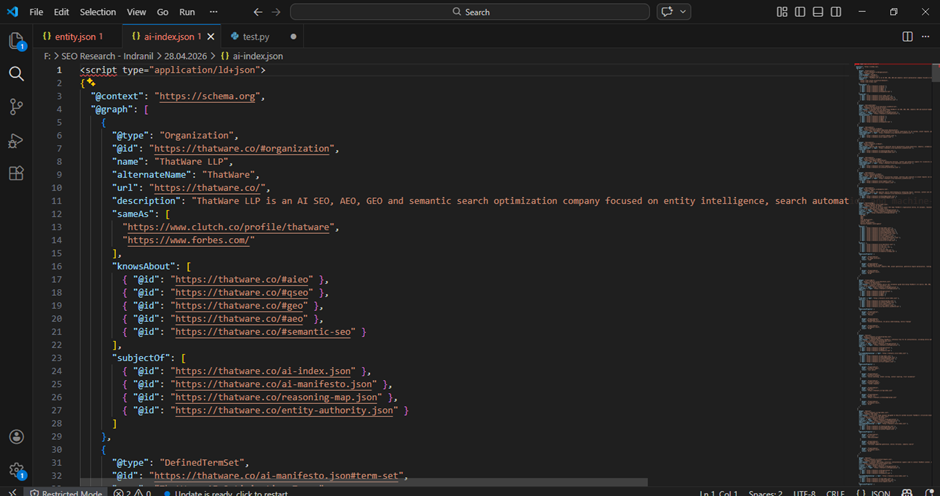
Code Test results using schema validator:
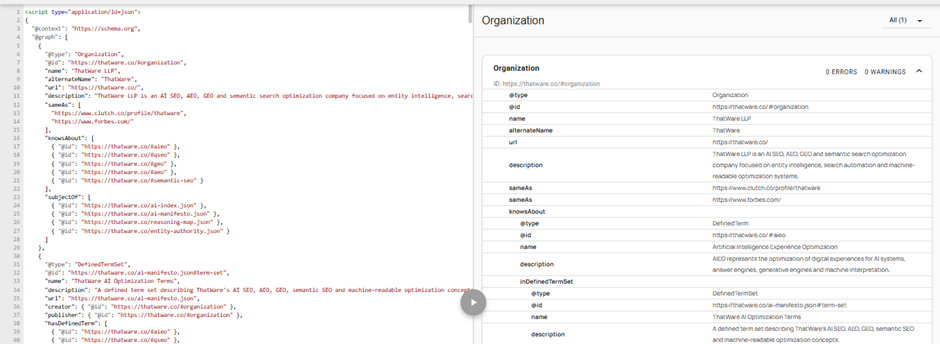
Code Test result using Google Rich Result Tester:
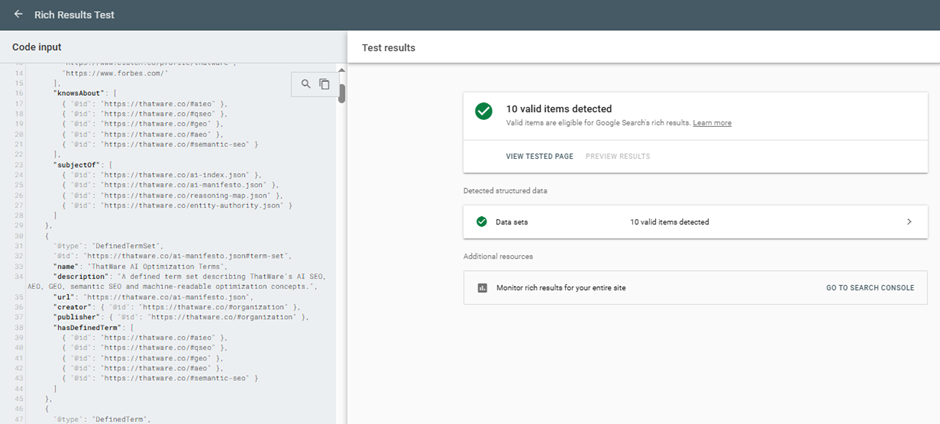
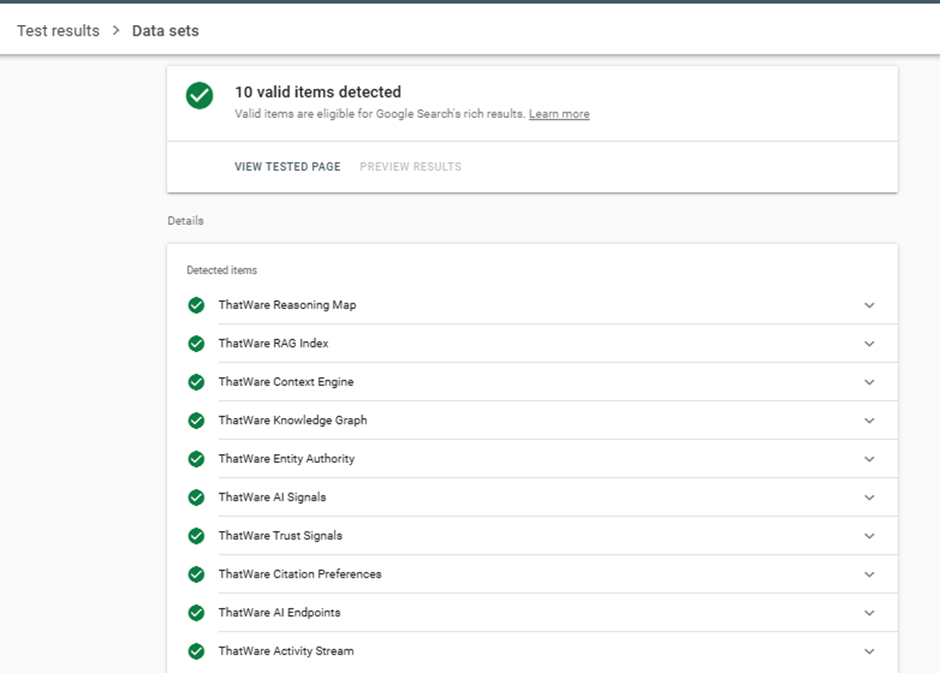



1 comment