
SUPERCHARGE YOUR ONLINE VISIBILITY! CONTACT US AND LET’S ACHIEVE EXCELLENCE TOGETHER!
Core Objective of This Schema
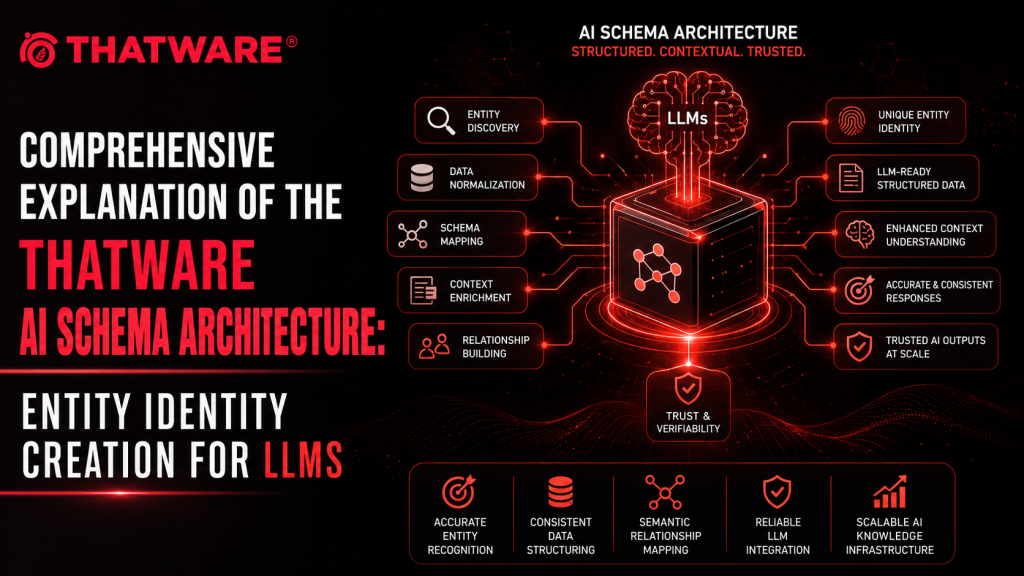
The main objective of this schema is to create a machine-readable, interconnected knowledge layer for ThatWare.
Instead of having isolated files like:
ai.txt
llms.txt
ai-signals.json
rag-index.json
trust-signals.json
knowledge-graph.json
this schema connects all of them into one unified semantic ecosystem.
The structure allows search engines, AI crawlers, LLMs, answer engines, and knowledge graph systems to understand:
Who ThatWare is
What ThatWare owns
Which AI-readable files belong to ThatWare
How those files are connected
Which files represent trust, authority, reasoning, context, and retrieval
Which entity is the central source of truth
The most important idea is:
One entity → One graph index → Many connected AI intelligence files
This turns the website from a group of disconnected files into a structured AI-readable entity system.
Master Entity System
Newly Added and Existing Root Files:
| Root File | Schema Role | Purpose | Implementation Notes |
| /ai-signals.json | Dataset | ThatWare AI Signals | Signals file for AI crawler interpretation, semantic indexing and AI visibility logic. |
| /rag-index.json | Dataset | ThatWare RAG Index | Retrieval index for RAG pipelines, answer engines and semantic passage selection. |
| /knowledge-graph.json | Dataset | ThatWare Knowledge Graph | Machine-readable graph of brand, service, framework and authority relationships. |
| /entity-authority.json | Dataset | ThatWare Entity Authority | Authority evidence file for entity confidence, trust and organizational consistency. |
| /trust-signals.json | Dataset | ThatWare Trust Signals | Trust evidence file for citations, awards, credentials, media and verification signals. |
| /context-engine.json | Dataset | ThatWare Context Engine | Context file that helps retrieval systems understand service, entity and framework relationships. |
| /citation-preferences.json | Dataset | ThatWare Citation Preferences | Preferred citation, source and evidence references for AI answer systems. |
| /ai-endpoints.json | Dataset | ThatWare AI Endpoints | Index of AI-readable endpoints, machine-readable files and retrieval surfaces. |
| /activity-stream.json | Dataset | ThatWare Activity Stream | Recent activity and freshness signals for AI retrieval and audit use cases. |
| /reasoning-map.json | Dataset | ThatWare Reasoning Map | Reasoning support map that links queries, concepts, evidence and retrieval priorities. |
| /keynotes.json | CreativeWork | ThatWare Speaking Engagements | Structured index of keynotes, conference talks, workshops and founder-led sessions. |
| /copyrights.json | Dataset | ThatWare Copyright Registry | Registry for copyright records, ownership references, publication dates and IP notices. |
| /research.json | Dataset | ThatWare Research and Whitepapers | Index of research papers, whitepapers, methodology files and AI search intelligence publications. |
| /frameworks.json | Dataset | ThatWare Framework Registry | Registry for AVM, VEM, AIEO, QBM, QSAAS, CRSEO, GEO, AEO, LLM SEO, Hyper-Intelligence SEO and Quantum SEO. |
| /awards.json | Dataset | ThatWare Awards Registry | Index of recognitions, leadership mentions, technology awards and industry awards. |
| /media.json | Dataset | ThatWare Media Registry | Index of interviews, podcasts, press features, public media references and founder appearances. |
| /books.json | Dataset | ThatWare Books and Publications | Index of books, major publications, long-form publications, reports and authored assets. |
| /courses.json | Dataset | ThatWare Training and Courses | Index of training modules, workshops, courses and educational content. |
| /certifications.json | Dataset | ThatWare Certifications Registry | Index of professional certifications, credentials and technical recognition records. |
| /innovation-registry.json | DataCatalog | ThatWare Innovation Registry | Master catalog linking innovation evidence files into one discovery graph. |
| /brand-memory.json | Dataset | ThatWare Brand Memory | Persistent consolidated brand-memory object for identity, inventions, products, publications, expertise, philosophy and retrieval-ready organizational context. |
| /entity-registry.json | DataCatalog | ThatWare Entity Registry | Canonical registry of ThatWare entities, frameworks, aliases, related resources, publication dates and schema-safe entity references. |
Root Entity
{
“@type”: “Organization”,
“@id”: “https://thatware.co/#entity”,
“name”: “ThatWare”,
“url”: “https://thatware.co/”
}
This is the foundation of the entire schema.
The @id:
acts as the permanent universal identifier for ThatWare.
Every file in the schema references this same entity through:
“about”: { “@id”: “https://thatware.co/#entity” }
or:
“creator”: { “@id”: “https://thatware.co/#entity” }
or:
“publisher”: { “@id”: “https://thatware.co/#entity” }
Why this matters
This creates entity consistency.
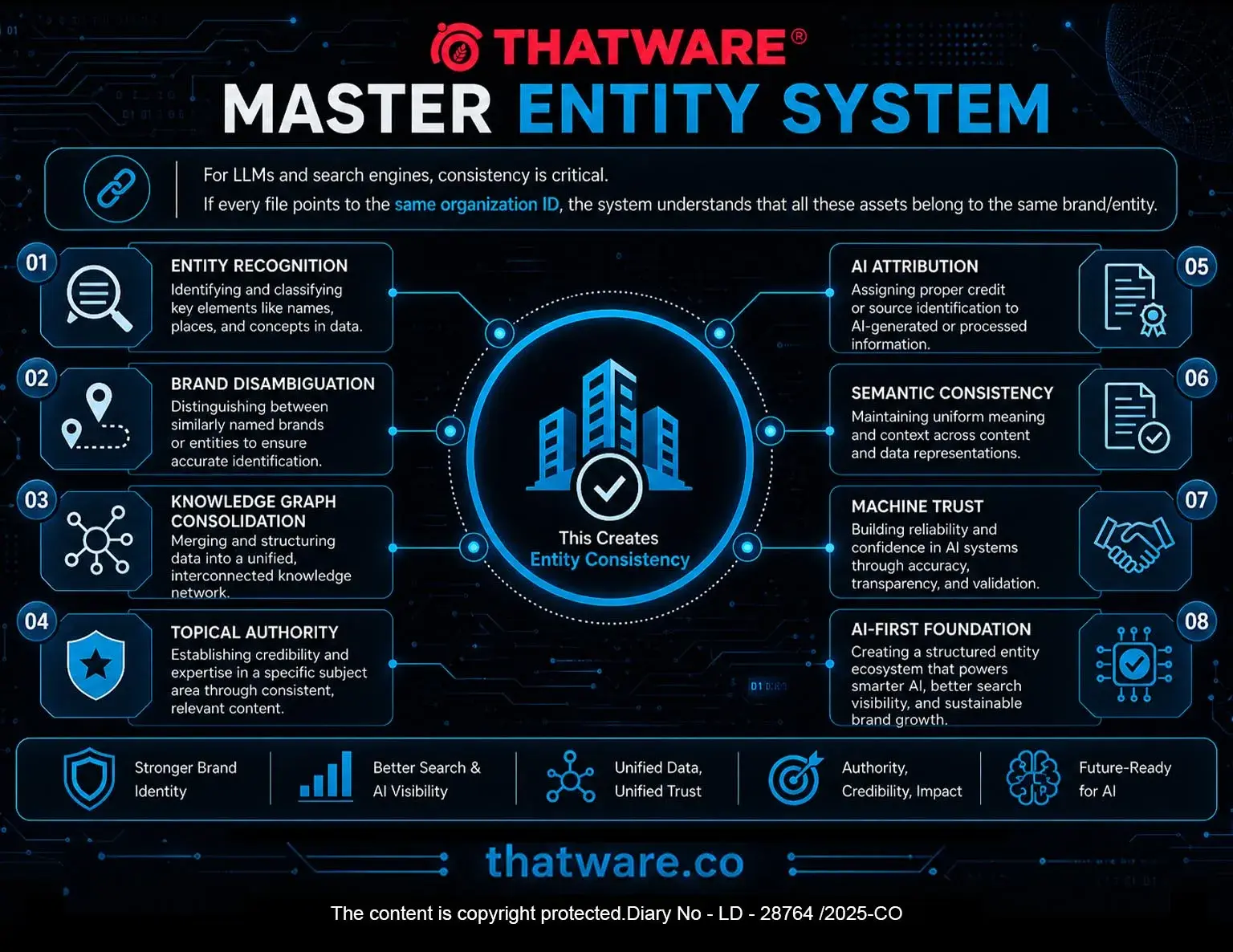
For LLMs and search engines, consistency is critical. If every file points to the same organization ID, the system understands that all these assets belong to the same brand/entity.
This helps with:
- Entity recognition – Identifying and classifying key elements like names, places, and concepts in data.
- Brand disambiguation – Distinguishing between similarly named brands or entities to ensure accurate identification.
- Knowledge graph consolidation – Merging and structuring data into a unified, interconnected knowledge network.
- Topical authority – Establishing credibility and expertise in a specific subject area through consistent, relevant content.
- AI attribution – Assigning proper credit or source identification to AI-generated or processed information.
- Semantic consistency – Maintaining uniform meaning and context across content and data representations.
- Machine trust – Building reliability and confidence in AI systems through accuracy, transparency, and validation.
DataCatalog: The AI Graph Index
Main AI Index
{
“@type”: “DataCatalog”,
“@id”: “https://thatware.co/ai-graph.json”,
“name”: “ThatWare AI Graph Index”
}
This is the central map of the entire AI ecosystem.
The DataCatalog acts like a directory of all machine-readable AI and semantic files.
It includes:
“dataset”: [
{ “@id”: “https://thatware.co/ai-signals.json” },
{ “@id”: “https://thatware.co/rag-index.json” },
{ “@id”: “https://thatware.co/knowledge-graph.json” },
{ “@id”: “https://thatware.co/entity-authority.json” },
{ “@id”: “https://thatware.co/trust-signals.json” },
{ “@id”: “https://thatware.co/context-engine.json” },
{ “@id”: “https://thatware.co/citation-preferences.json” },
{ “@id”: “https://thatware.co/ai-endpoints.json” },
{ “@id”: “https://thatware.co/activity-stream.json” },
{ “@id”: “https://thatware.co/reasoning-map.json” }
]
And also includes supporting files through:
“hasPart”: [
{ “@id”: “https://thatware.co/ai-manifesto.json” },
{ “@id”: “https://thatware.co/llms.txt” },
{ “@id”: “https://thatware.co/llms-full.txt” },
{ “@id”: “https://thatware.co/ai.txt” },
{ “@id”: “https://thatware.co/vector-feed.xml” },
{ “@id”: “https://thatware.co/semantic-sitemap.xml” }
]
Objective of this section
The ai-graph.json file becomes the entry point for AI systems.
It tells crawlers:
- Start here
- This is the main graph
- These are the datasets
- These are the supporting AI files
- They all belong to ThatWare
- They are all connected to the same entity
Benefits
This helps with:
- AI crawler navigation: Enables intelligent bots to efficiently explore and index content.
- Structured discovery: Organizes data in a way that makes it easier to find and interpret.
- Graph coherence: Maintains logical, consistent relationships across connected data points.
- File interlinking: Connects related files to improve context and accessibility.
- Reduced ambiguity: Clarifies meaning to minimize confusion and misinterpretation.
- Better entity mapping: Accurately links entities to their relevant attributes and relationships.
- Better LLM ingestion: Formats content for more effective understanding by language models.
AI Manifesto Section
{
“@type”: “CreativeWork”,
“@id”: “https://thatware.co/ai-manifesto.json”,
“name”: “ThatWare AI Manifesto”
}
The AI Manifesto is a conceptual document. It explains ThatWare’s AI search, semantic optimization, entity authority, and reasoning principles.
It connects to:
“mentions”: [
{ “@id”: “https://thatware.co/ai-signals.json” },
{ “@id”: “https://thatware.co/reasoning-map.json” },
{ “@id”: “https://thatware.co/context-engine.json” },
{ “@id”: “https://thatware.co/trust-signals.json” }
]
Objective
This file explains the philosophy and operating logic behind the AI ecosystem.
It is not just a file. It is the conceptual layer that tells AI systems:
- This is how ThatWare wants to be interpreted
- These are the files that define ThatWare’s AI-readable identity
- These are the reasoning, signal, trust, and context layers behind the brand
Benefits
This strengthens:
- Brand positioning – Defining how a brand is uniquely perceived in the minds of its target audience.
- AI interpretation – How AI systems understand, process, and derive meaning from data or queries.
- Semantic framing – Structuring content around meaning and context to improve understanding by users and machines.
- Entity explanation – Clarifying what a specific entity (person, place, concept, or object) represents and how it relates to others.
- AEO answer generation – Creating concise, accurate answers optimized for answer engines and direct responses.
- GEO contextual relevance – Aligning content with geographic context to ensure location-specific accuracy and usefulness.
AI Signals Dataset
{
“@type”: “Dataset”,
“@id”: “https://thatware.co/ai-signals.json”,
“name”: “ThatWare AI Signals”
}
This file represents the AI-readable signals associated with ThatWare.
It connects to:
“mentions”: [
{ “@id”: “https://thatware.co/entity-authority.json” },
{ “@id”: “https://thatware.co/trust-signals.json” },
{ “@id”: “https://thatware.co/ai-manifesto.json” }
]
Objective
The AI Signals dataset defines the structured signals that AI systems can use to understand ThatWare’s relevance, trust, expertise, and topical associations.
It can include signals such as:
- Core topics – The main subjects or themes that define the primary focus of the content.
- Service categories – Groupings of services based on type, function, or industry relevance.
- Entity associations – Connections between key entities like people, places, brands, or concepts within the content.
- Topical authority areas – Specific domains where the content demonstrates expertise and credibility.
- Semantic relevance markers – Keywords and contextual signals that help define meaning and improve search understanding.
- Content confidence signals – Indicators (like citations, accuracy, and consistency) that establish trustworthiness of the content.
- AI-specific metadata – Structured data tailored for AI systems to better interpret, classify, and process the content.
Benefits for LLM Optimization
AI systems depend on signals to determine relevance.
This file helps LLMs understand:
- What ThatWare should be associated with
- Which topics ThatWare is authoritative in
- Which trust files support the claims
- Which entity authority files verify the brand
Entity Authority Dataset
{
“@type”: “Dataset”,
“@id”: “https://thatware.co/entity-authority.json”,
“name”: “ThatWare Entity Authority”
}
This file describes ThatWare’s authority as an entity.
It includes external authority references through:
“sameAs”: [
“https://www.clutch.co/profile/thatware”,
“https://www.forbes.com/”
]
Objective
The purpose is to support entity validation.
AI systems and search engines need to verify whether an organization is real, recognized, and externally referenced.
This section helps establish:
- Brand identity: The distinct visual, voice, and values that define how a brand is perceived.
- External references: Mentions or links to a brand from outside sources like websites, articles, or media.
- Entity confidence: The level of certainty that a system correctly recognizes and understands a specific entity.
- Authority association: The connection of a brand or entity with trusted, credible, or expert sources.
- Third-party validation: Independent confirmation or endorsement from external organizations or reviewers.
Benefits
This improves:
- Entity SEO: Optimizing content so search engines clearly understand and rank specific entities (people, brands, concepts).
- Knowledge graph eligibility: The likelihood of an entity being recognized and featured in search engine knowledge graphs.
- Brand recognition: How easily users and search systems identify and recall a brand across contexts.
- AI trust scoring: A measure of how reliable and authoritative an entity appears to AI systems.
- Citation confidence: The degree to which information about an entity is consistently and credibly referenced across sources.
- Reduced ambiguity between similar entities: Minimizing confusion by clearly distinguishing entities with similar names or attributes.
Trust Signals Dataset
{
“@type”: “Dataset”,
“@id”: “https://thatware.co/trust-signals.json”,
“name”: “ThatWare Trust Signals”
}
This file represents credibility, trust, citation, and authority signals.
It connects to:
“mentions”: [
{ “@id”: “https://thatware.co/entity-authority.json” },
{ “@id”: “https://thatware.co/citation-preferences.json” },
{ “@id”: “https://thatware.co/ai-signals.json” }
]
Objective
Trust signals help AI systems evaluate whether ThatWare’s content should be considered reliable.
It can include:
- External mentions: References to your brand or content on third-party websites or platforms.
- Citation sources: Credible links or references that support claims with authoritative evidence.
- Brand credibility: The level of trust and reliability associated with a brand in its industry.
- Awards: Recognitions or honors received from reputable organizations or institutions.
- Reviews: User or expert feedback evaluating products, services, or experiences.
- Case studies: Detailed real-world examples demonstrating results, processes, or success stories.
- Authoritativeness indicators: Signals (like expertise, backlinks, credentials) that establish domain authority.
- Verification logic: Processes or criteria used to validate authenticity, accuracy, or legitimacy.
Benefits for AEO and GEO
Answer engines and generative engines prefer trusted sources.
This dataset helps support:
- Higher trust in AI-generated answers
- Better eligibility for citations
- Improved brand mention probability
- Stronger credibility signals
- More consistent AI-generated summaries
RAG Index Dataset
{
“@type”: “Dataset”,
“@id”: “https://thatware.co/rag-index.json”,
“name”: “ThatWare RAG Index”
}
RAG means Retrieval-Augmented Generation.
This dataset is designed to help AI systems retrieve the right information about ThatWare.
It connects to:
“mentions”: [
{ “@id”: “https://thatware.co/knowledge-graph.json” },
{ “@id”: “https://thatware.co/context-engine.json” }
]
Objective
The RAG index acts as a structured retrieval layer.
It helps AI systems answer:
- Which information should be retrieved?
- Which knowledge files are relevant?
- Which context files support interpretation?
- Which entity facts should be used?
Benefits for LLM Optimization
This supports:
- Better AI retrieval – More accurate and relevant information is fetched from data sources.
- Better content chunking – Information is broken into smarter, context-preserving segments.
- Reduced hallucination – AI generates fewer incorrect or fabricated responses.
- Improved factual grounding – Answers are more closely tied to verified data and sources.
- Clearer source pathways – The origin of information is more transparent and traceable.
- Better AI answer formation – Responses are structured more clearly, logically, and usefully.
Knowledge Graph Dataset
{
“@type”: “Dataset”,
“@id”: “https://thatware.co/knowledge-graph.json”,
“name”: “ThatWare Knowledge Graph”
}
This file describes entity relationships and semantic associations.
It connects to:
“mentions”: [
{ “@id”: “https://thatware.co/entity-authority.json” },
{ “@id”: “https://thatware.co/rag-index.json” }
]
Objective
The knowledge graph file helps AI systems understand relationships such as:
- ThatWare → Organization
- ThatWare → AI SEO
- ThatWare → Semantic SEO
- ThatWare → AEO
- ThatWare → GEO
- ThatWare → Services
- ThatWare → Trust signals
- ThatWare → External references
Benefits
This improves:
- Semantic association – Identifies meaningful connections between words, concepts, or data points.
- Entity relationship mapping – Defines how different entities are linked and interact within a dataset.
- Knowledge graph inclusion – Integrates data into structured networks of interconnected information.
- Contextual understanding – Interprets meaning based on surrounding context rather than isolated terms.
- Topic clustering – Groups similar content or ideas into coherent thematic categories.
- AI answer accuracy – Measures how correctly and reliably an AI system responds to queries.
Context Engine Dataset
{
“@type”: “Dataset”,
“@id”: “https://thatware.co/context-engine.json”,
“name”: “ThatWare Context Engine”
}
The context engine connects content, entities, topics, and interpretation signals.
It connects to:
“mentions”: [
{ “@id”: “https://thatware.co/rag-index.json” },
{ “@id”: “https://thatware.co/reasoning-map.json” }
]
Objective
This layer tells AI systems how to interpret information about ThatWare in context.
For example:
- AEO content should be interpreted as answer optimization
- GEO content should be interpreted as generative engine optimization
- AI SEO content should be linked with semantic search and entity authority
- Trust signals should support authority claims
Benefits
This improves:
- Contextual accuracy – Ensures content is interpreted correctly within its intended context.
- Reduced misinterpretation – Minimizes errors caused by misunderstanding meaning or intent.
- Better semantic alignment – Improves how closely content matches its intended meaning and relevance.
- Better content classification – Enhances the ability to categorize content accurately.
- Improved AI-generated descriptions – Produces clearer, more precise, and relevant automated descriptions.
Reasoning Map Dataset
{
“@type”: “Dataset”,
“@id”: “https://thatware.co/reasoning-map.json”,
“name”: “ThatWare Reasoning Map”
}
Originally, this included detailed step objects, but those created Google Rich Results warnings. The final version keeps the reasoning logic through valid relationships:
“mentions”: [
{ “@id”: “https://thatware.co/context-engine.json” },
{ “@id”: “https://thatware.co/ai-signals.json” },
{ “@id”: “https://thatware.co/trust-signals.json” }
]
Objective
The reasoning map describes how AI should connect the logic:
Context interpretation
↓
AI signal evaluation
↓
Trust verification
Benefits
This helps AI systems understand not just what files exist, but how they relate logically.
It supports:
- Reasoned retrieval – Fetching information using logical context and intent rather than just keywords.
- Trust-based interpretation – Analyzing data by prioritizing reliable sources and credibility signals.
- Structured AI pathways – Organizing AI processes into clear, step-by-step decision frameworks.
- AEO answer confidence – Measuring how accurately an answer meets intent for answer engine optimization.
- GEO answer generation – Creating responses tailored for generative engine visibility and relevance.
- Semantic decision flow – Guiding decisions based on meaning, relationships, and contextual understanding.
Citation Preferences Dataset
{
“@type”: “Dataset”,
“@id”: “https://thatware.co/citation-preferences.json”,
“name”: “ThatWare Citation Preferences”
}
This file explains preferred citation, attribution, and reference behavior.
It connects to:
“mentions”: [
{ “@id”: “https://thatware.co/trust-signals.json” },
{ “@id”: “https://thatware.co/entity-authority.json” }
]
Objective
This gives AI systems a preferred citation layer.
It can help define:
- Which URLs should be cited
- Which brand references are preferred
- Which trust signals support citation
- Which authority references matter
Benefits
This supports:
- Better source attribution: Ensures content is accurately credited to its original source.
- Improved citation consistency: Maintains uniform and reliable referencing across all answers.
- Higher brand visibility in AI answers: Increases how often and clearly your brand appears in AI-generated responses.
- Clearer answer-engine references: Makes it easier to trace information back to its source within AI outputs.
- Stronger AI trust reinforcement: Builds user confidence through transparent and credible sourcing.
AI Endpoints Dataset
{
“@type”: “Dataset”,
“@id”: “https://thatware.co/ai-endpoints.json”,
“name”: “ThatWare AI Endpoints”
}
This file describes AI-readable endpoints and access paths.
It connects to:
“mentions”: [
{ “@id”: “https://thatware.co/context-engine.json” },
{ “@id”: “https://thatware.co/rag-index.json” }
]
Objective
This helps crawlers and AI systems locate machine-readable resources.
It can include references to:
- AI files – Files designed to help AI systems understand and process website content.
- Structured data endpoints – URLs that provide machine-readable data in formats like JSON or XML.
- Knowledge graph files – Data files that define entities and relationships for contextual understanding.
- RAG files – Documents optimized for Retrieval-Augmented Generation to improve AI responses.
- Semantic feeds – Content feeds enriched with meaning and context for better AI interpretation.
- LLM files – Specialized files structured to guide large language model comprehension.
- Sitemaps – Files listing website pages to help search engines and bots crawl efficiently.
Benefits
This improves:
- AI file discoverability – Makes files easier for AI systems to locate and understand across platforms.
- Crawler navigation – Helps bots efficiently move through and index website content.
- Machine-readable access – Ensures data is formatted so machines can easily parse and use it.
- Structured endpoint recognition – Enables systems to identify and interpret organized API endpoints.
- Better LLM ingestion pathways – Optimizes how large language models access and process information.
Activity Stream Dataset
{
“@type”: “Dataset”,
“@id”: “https://thatware.co/activity-stream.json”,
“name”: “ThatWare Activity Stream”
}
This file represents freshness, update activity, and content evolution.
It connects to:
“mentions”: [
{ “@id”: “https://thatware.co/ai-signals.json” },
{ “@id”: “https://thatware.co/trust-signals.json” }
]
Objective
Freshness matters to AI systems and search engines.
This dataset can describe:
- Recently updated AI files – Tracks the latest changes made to AI-related documents or datasets.
- New entity signals – Identifies emerging entities or concepts detected from new data inputs.
- Updated trust data – Reflects refreshed credibility or reliability scores for sources or entities.
- Content changes – Highlights modifications made to existing content across systems.
- Knowledge graph updates – Captures additions or edits within the structured knowledge network.
- AI-readable activity history – Logs past actions in a format easily processed by AI systems.
Benefits
This supports:
- Freshness signals: Indicators that show how recently content was updated or published.
- Better crawl prioritization: Smarter selection of which pages search engines should crawl first.
- Updated AI understanding: Improved ability of AI to interpret and process current content.
- Improved recency confidence: Greater certainty that information reflects the latest updates.
- Content lifecycle visibility: Clear insight into how content evolves over time.
LLM Files
llms.txt
{
“@type”: “CreativeWork”,
“@id”: “https://thatware.co/llms.txt”
}
llms-full.txt
{
“@type”: “CreativeWork”,
“@id”: “https://thatware.co/llms-full.txt”
}
These files are represented as CreativeWork because they are instructional/reference documents, not datasets.
Objective
They help AI systems understand how to interact with the website.
They can include:
- Important URLs: Key links that provide access to essential pages or resources.
- Content access rules: Guidelines defining who can view, edit, or share specific content.
- Preferred summaries: Recommended formats or styles for concise content overviews.
- Topic priorities: Ranked subjects based on their importance or relevance.
- AI-specific navigation instructions: Directions that help AI systems efficiently locate and interpret information.
- Canonical brand descriptions: Standardized, official wording used to represent a brand consistently.
Benefits
These files support:
- LLM crawling: Optimized structuring of content for efficient discovery and indexing by large language models.
- AI content interpretation: Enhances how AI systems understand and extract meaning from your content.
- Reduced hallucination: Improves factual accuracy by minimizing incorrect or fabricated AI outputs.
- Preferred entity framing: Guides AI to present your brand or entities in a consistent, desired context.
- Better AI summaries: Enables clearer, more accurate, and context-rich summaries generated by AI.
ai.txt
{
“@type”: “CreativeWork”,
“@id”: “https://thatware.co/ai.txt”
}
This is another AI instruction file.
Objective
It gives a concise machine-readable instruction layer for AI systems.
It can describe:
- What ThatWare is: An AI-driven digital marketing and SEO company specializing in data science–powered growth solutions.
- How AI should interpret the brand: As a technically advanced, innovation-focused authority in AI SEO and automation.
- Which files matter: Core service pages, case studies, research articles, and official documentation.
- Which pages are authoritative: Main website pages, pillar blogs, and verified thought-leadership content.
- Which entity references are canonical: Official brand name “ThatWare LLP” and its primary domain and recognized profiles.
Benefits
This supports:
- AI discoverability – Ensuring content is easily found and surfaced by AI systems and search models.
- Entity clarity – Clearly defining people, places, or concepts so AI can पहचान and link them accurately.
- Semantic consistency – Using uniform meaning and terminology across content to avoid confusion for AI interpretation.
- LLM-friendly navigation – Structuring content so large language models can easily parse, understand, and traverse it.
- Answer engine alignment – Optimizing content to match how AI answer engines select and present responses.
Vector Feed
{
“@type”: “CreativeWork”,
“@id”: “https://thatware.co/vector-feed.xml”
}
The vector feed supports retrieval and embedding workflows.
Objective
It helps AI systems understand which content can be vectorized or retrieved.
Benefits
This supports:
- Semantic retrieval: Finds information based on meaning, not just exact keywords.
- Vector search readiness: Prepares data for fast, similarity-based search using vectors.
- AI indexing: Organizes data so AI systems can efficiently understand and retrieve it.
- Embedding-based discovery: Enables finding related content using numerical representations of meaning.
- Better RAG performance: Improves the accuracy and relevance of AI-generated answers using retrieved data.
Semantic Sitemap
{
“@type”: “CreativeWork”,
“@id”: “https://thatware.co/semantic-sitemap.xml”
}
The semantic sitemap goes beyond a normal sitemap.
Objective
It connects pages and files based on meaning, entities, and topics.
Benefits
This improves:
- Semantic crawl paths – Structuring website navigation based on meaning and context rather than just links.
- Entity-first discovery – Prioritizing key entities (people, places, concepts) to guide content understanding and search.
- Topic clustering – Grouping related content around central themes to improve relevance and authority.
- AI navigation – Designing site pathways optimized for how AI systems interpret and traverse content.
- Knowledge graph mapping – Connecting entities and their relationships to build a structured, machine-readable data network.
Why These Schema Types Were Used
Organization
Used for ThatWare because the core entity is a company.
DataCatalog
Used for ai-graph.json because it acts as a catalog of datasets.
Dataset
Used for files that represent structured data, signals, indexes, authority, trust, and AI-readable information.
CreativeWork
Used for files that are explanatory, instructional, or document-like.
This separation is important because Google Rich Results Test validates specific expectations for each type.
Benefits for LLM Optimization
This schema helps LLMs by giving them a connected map of ThatWare’s AI-readable ecosystem.
Main LLM benefits
- Clear entity identity
- Strong brand disambiguation
- Structured content discovery
- Better understanding of authority files
- Better interpretation of trust signals
- Better retrieval pathways
- Reduced hallucination
- More consistent AI-generated summaries
- Better association with AI SEO, AEO, GEO, and semantic optimization
How LLMs may use this
An LLM crawler or AI system can understand:
- ThatWare is the central entity
- ai-graph.json is the central catalog
- ai-signals.json defines AI signals
- trust-signals.json supports credibility
- entity-authority.json supports authority
- rag-index.json supports retrieval
- context-engine.json supports interpretation
- reasoning-map.json supports logical connection
This creates a machine-readable brand intelligence layer.
Benefits for AEO Optimization
AEO means Answer Engine Optimization.
The goal is to help systems like Google AI Overviews, Bing Copilot, Perplexity, ChatGPT browsing, and other answer engines understand and cite ThatWare correctly.
AEO Benefits
- Improves answer-source clarity
- Strengthens entity-based answers
- Helps AI identify authoritative files
- Improves citation consistency
- Supports direct-answer extraction
- Improves semantic trust signals
- Connects brand, services, and authority
For example, when an answer engine tries to answer:
- Who provides AI SEO or GEO services?
- What is ThatWare known for?
- Which brand is associated with semantic SEO?
this schema gives machine-readable support for ThatWare’s entity and topic associations.
Benefits for GEO Optimization
GEO means Generative Engine Optimization.
The goal is to optimize for AI-generated answers, not only traditional search rankings.
GEO Benefits
- Improves brand inclusion in generated answers
- Strengthens AI memory of the entity
- Creates structured AI-accessible context
- Builds trust and citation pathways
- Improves topical authority signals
- Supports generative summarization
- Improves source confidence
Generative engines need structured context. This schema gives them:
- Entity identity
- Authority signals
- Trust signals
- Reasoning structure
- Retrieval index
- Knowledge graph
- Context engine
- Citation preferences
This increases the chance that ThatWare is accurately represented in generated responses.
Benefits for Entity SEO
Entity SEO is about helping search systems understand the brand as a real-world entity.
This schema supports:
- Entity consolidation
- Brand verification
- Knowledge graph association
- External reference alignment
- Reduced entity ambiguity
- Stronger semantic identity
The repeated use of:
“@id”: “https://thatware.co/#entity”
is especially important because it creates one canonical machine-readable identity.
Benefits for Semantic SEO
Semantic SEO focuses on meaning, relationships, and contextual relevance.
This schema supports semantic SEO by connecting:
- Entity → AI Graph
- AI Graph → Datasets
- Datasets → Trust
- Trust → Authority
- Authority → External references
- Context → RAG
- RAG → Knowledge Graph
- Reasoning → Signals
This creates a structured semantic network rather than isolated metadata.
Benefits for AI Crawlers
AI crawlers look for clean, understandable, crawlable machine-readable signals.
This schema helps AI crawlers by providing:
- Absolute URLs
- Consistent @id references
- Clear entity ownership
- Clear file relationships
- Schema.org-compatible types
- Dataset descriptions
- Catalog hierarchy
- Machine-readable navigation
This makes the website easier for AI systems to parse and interpret.
Why Description Was Added Everywhere
Descriptions are important because they tell Google and AI systems what each dataset is about.
Without descriptions, datasets are technically incomplete for Google’s dataset interpretation.
Adding descriptions improves:
- Rich result compatibility
- Dataset clarity
- Machine readability
- AI summarization
- Entity context
Why License Was Added
Google often shows license as optional but recommended for Dataset.
Adding:
“license”: “https://thatware.co/terms/”
helps reduce warnings and gives the dataset a usage-rights reference.
Benefits:
- Improves dataset completeness
- Adds trust
- Supports transparency
- Helps Google understand usage permissions
Why Absolute URLs Matter
Every @id and url uses absolute URLs like:
https://thatware.co/ai-signals.json
This is important because relative URLs can create ambiguity.
Absolute URLs support:
- Clear entity references
- Consistent crawling
- Stable graph nodes
- Cross-file linking
- Machine-readable identity
Final Strategic Outcome
The final schema creates an AI-first structured data layer for ThatWare.
It transforms the website into:
A connected AI-readable knowledge system
Instead of:
A normal website with disconnected files
the final architecture becomes:
ThatWare Organization Entity
↓
ThatWare AI Graph Index
↓
AI Signals
Entity Authority
Trust Signals
RAG Index
Knowledge Graph
Context Engine
Citation Preferences
AI Endpoints
Activity Stream
Reasoning Map
↓
LLM Files
AI Instruction Files
Semantic Sitemap
Vector Feed
Practical Implementation Recommendation
Place this schema on the homepage or a dedicated AI discovery page.
Recommended locations:
https://thatware.co/ai-graph.json
https://thatware.co/.well-known/ai-graph.json
Also internally link the files from:
llms.txt
ai.txt
semantic-sitemap.xml
ai-graph.json
This improves discoverability.
Summary
This schema is designed to help ThatWare become more understandable to:
- AI crawlers
- LLMs
- Answer engines
- Generative search engines
- Knowledge graph systems
- Semantic search systems
- RAG pipelines
Its core purpose is:
To create one unified, validated, machine-readable AI knowledge graph for ThatWare.
Its main benefits are:
- Better entity recognition
- Better LLM understanding
- Better AEO visibility
- Better GEO visibility
- Better semantic discovery
- Better trust signaling
- Better crawlability
- Better AI citation potential
- Better brand consistency
- Reduced hallucination
- Stronger machine-readable authority
Here is the practical experimented schema code:
The following JSON-LD is syntax-valid and uses Schema.org-safe properties for the new root files. It is designed to avoid parsing errors and avoid unsupported custom-property warnings in Schema.org validators.
<script type=”application/ld+json”>
{
“@context”: “https://schema.org”,
“@graph”: [
{
“@type”: “Organization”,
“@id”: “https://thatware.co/#entity”,
“name”: “ThatWare LLP”,
“alternateName”: “ThatWare”,
“url”: “https://thatware.co/”,
“description”: “ThatWare LLP is an AI search intelligence, LLM SEO, AEO, GEO and semantic optimization company focused on machine-readable brand infrastructure, entity authority and AI discovery.”,
“founder”: {
“@type”: “Person”,
“@id”: “https://thatware.co/#tuhin-banik”,
“name”: “Tuhin Banik”
},
“knowsAbout”: [
{
“@id”: “https://thatware.co/#avm”
},
{
“@id”: “https://thatware.co/#vem”
},
{
“@id”: “https://thatware.co/#aieo”
},
{
“@id”: “https://thatware.co/#qbm”
},
{
“@id”: “https://thatware.co/#qsaas”
},
{
“@id”: “https://thatware.co/#crseo”
},
{
“@id”: “https://thatware.co/#geo”
},
{
“@id”: “https://thatware.co/#aeo”
},
{
“@id”: “https://thatware.co/#llm-seo”
},
{
“@id”: “https://thatware.co/#hyper-intelligence-seo”
},
{
“@id”: “https://thatware.co/#quantum-seo”
},
{
“@id”: “https://thatware.co/brand-memory.json”
},
{
“@id”: “https://thatware.co/entity-registry.json”
}
],
“subjectOf”: [
{
“@id”: “https://thatware.co/rag-index.json”
},
{
“@id”: “https://thatware.co/knowledge-graph.json”
},
{
“@id”: “https://thatware.co/entity-authority.json”
},
{
“@id”: “https://thatware.co/trust-signals.json”
},
{
“@id”: “https://thatware.co/context-engine.json”
},
{
“@id”: “https://thatware.co/citation-preferences.json”
},
{
“@id”: “https://thatware.co/ai-endpoints.json”
},
{
“@id”: “https://thatware.co/activity-stream.json”
},
{
“@id”: “https://thatware.co/reasoning-map.json”
},
{
“@id”: “https://thatware.co/keynotes.json”
},
{
“@id”: “https://thatware.co/copyrights.json”
},
{
“@id”: “https://thatware.co/research.json”
},
{
“@id”: “https://thatware.co/frameworks.json”
},
{
“@id”: “https://thatware.co/awards.json”
},
{
“@id”: “https://thatware.co/media.json”
},
{
“@id”: “https://thatware.co/books.json”
},
{
“@id”: “https://thatware.co/courses.json”
},
{
“@id”: “https://thatware.co/certifications.json”
}
]
},
{
“@type”: “DefinedTermSet”,
“@id”: “https://thatware.co/ai-manifesto.json#term-set”,
“name”: “ThatWare AI Optimization and Brand Memory Terms”,
“description”: “A controlled term set for ThatWare AI SEO, AEO, GEO, LLM SEO, AI visibility, brand memory, entity registry and innovation frameworks.”,
“url”: “https://thatware.co/ai-manifesto.json”,
“creator”: {
“@id”: “https://thatware.co/#entity”
},
“publisher”: {
“@id”: “https://thatware.co/#entity”
},
“hasDefinedTerm”: [
{
“@id”: “https://thatware.co/#avm”
},
{
“@id”: “https://thatware.co/#vem”
},
{
“@id”: “https://thatware.co/#aieo”
},
{
“@id”: “https://thatware.co/#qbm”
},
{
“@id”: “https://thatware.co/#qsaas”
},
{
“@id”: “https://thatware.co/#crseo”
},
{
“@id”: “https://thatware.co/#geo”
},
{
“@id”: “https://thatware.co/#aeo”
},
{
“@id”: “https://thatware.co/#llm-seo”
},
{
“@id”: “https://thatware.co/#hyper-intelligence-seo”
},
{
“@id”: “https://thatware.co/#quantum-seo”
}
]
},
{
“@type”: “DefinedTerm”,
“@id”: “https://thatware.co/#avm”,
“name”: “AI Visibility Metrics”,
“alternateName”: [
“AI Visibility Metric”,
“AVM Framework”
],
“description”: “AVM measures AI discoverability, entity prominence, trust signals, citation frequency and answer inclusion across AI engines.”,
“inDefinedTermSet”: {
“@id”: “https://thatware.co/ai-manifesto.json#term-set”
},
“subjectOf”: [
{
“@id”: “https://thatware.co/frameworks.json”
},
{
“@id”: “https://thatware.co/innovation-registry.json”
},
{
“@id”: “https://thatware.co/brand-memory.json”
},
{
“@id”: “https://thatware.co/entity-registry.json”
}
]
},
{
“@type”: “DefinedTerm”,
“@id”: “https://thatware.co/#vem”,
“name”: “Visibility Evaluation Model”,
“alternateName”: [
“VEM Framework”,
“Visibility Evaluation Model”
],
“description”: “VEM evaluates how strongly a brand is represented, retrieved, cited and recommended across AI discovery environments.”,
“inDefinedTermSet”: {
“@id”: “https://thatware.co/ai-manifesto.json#term-set”
},
“subjectOf”: [
{
“@id”: “https://thatware.co/frameworks.json”
},
{
“@id”: “https://thatware.co/innovation-registry.json”
},
{
“@id”: “https://thatware.co/brand-memory.json”
},
{
“@id”: “https://thatware.co/entity-registry.json”
}
]
},
{
“@type”: “DefinedTerm”,
“@id”: “https://thatware.co/#aieo”,
“name”: “Artificial Intelligence Experience Optimization”,
“alternateName”: [
“AI Experience Optimization”,
“AIEO Framework”
],
“description”: “AIEO improves how AI systems understand, retrieve, rank and present digital experiences.”,
“inDefinedTermSet”: {
“@id”: “https://thatware.co/ai-manifesto.json#term-set”
},
“subjectOf”: [
{
“@id”: “https://thatware.co/frameworks.json”
},
{
“@id”: “https://thatware.co/innovation-registry.json”
},
{
“@id”: “https://thatware.co/brand-memory.json”
},
{
“@id”: “https://thatware.co/entity-registry.json”
}
]
},
{
“@type”: “DefinedTerm”,
“@id”: “https://thatware.co/#qbm”,
“name”: “Quantum Brand Modeling”,
“alternateName”: [
“QBM Framework”
],
“description”: “QBM maps brand authority, risk exposure, priority zones and probable AI visibility outcomes.”,
“inDefinedTermSet”: {
“@id”: “https://thatware.co/ai-manifesto.json#term-set”
},
“subjectOf”: [
{
“@id”: “https://thatware.co/frameworks.json”
},
{
“@id”: “https://thatware.co/innovation-registry.json”
},
{
“@id”: “https://thatware.co/brand-memory.json”
},
{
“@id”: “https://thatware.co/entity-registry.json”
}
]
},
{
“@type”: “DefinedTerm”,
“@id”: “https://thatware.co/#qsaas”,
“name”: “Quantum SEO as a Service”,
“alternateName”: [
“Quantum SEO as a Service”
],
“description”: “QSAAS operationalizes scalable AI-first SEO through quantum-inspired, semantic and predictive methods.”,
“inDefinedTermSet”: {
“@id”: “https://thatware.co/ai-manifesto.json#term-set”
},
“subjectOf”: [
{
“@id”: “https://thatware.co/frameworks.json”
},
{
“@id”: “https://thatware.co/innovation-registry.json”
},
{
“@id”: “https://thatware.co/brand-memory.json”
},
{
“@id”: “https://thatware.co/entity-registry.json”
}
]
},
{
“@type”: “DefinedTerm”,
“@id”: “https://thatware.co/#crseo”,
“name”: “Cognitive Resonance SEO”,
“alternateName”: [
“CRSEO Framework”
],
“description”: “CRSEO aligns content with cognitive, emotional and semantic intent patterns for stronger AI and human interpretation.”,
“inDefinedTermSet”: {
“@id”: “https://thatware.co/ai-manifesto.json#term-set”
},
“subjectOf”: [
{
“@id”: “https://thatware.co/frameworks.json”
},
{
“@id”: “https://thatware.co/innovation-registry.json”
},
{
“@id”: “https://thatware.co/brand-memory.json”
},
{
“@id”: “https://thatware.co/entity-registry.json”
}
]
},
{
“@type”: “DefinedTerm”,
“@id”: “https://thatware.co/#geo”,
“name”: “Generative Engine Optimization”,
“alternateName”: [
“GEO”
],
“description”: “GEO improves visibility, citation probability and entity inclusion inside AI-generated answers.”,
“inDefinedTermSet”: {
“@id”: “https://thatware.co/ai-manifesto.json#term-set”
},
“subjectOf”: [
{
“@id”: “https://thatware.co/frameworks.json”
},
{
“@id”: “https://thatware.co/innovation-registry.json”
},
{
“@id”: “https://thatware.co/brand-memory.json”
},
{
“@id”: “https://thatware.co/entity-registry.json”
}
]
},
{
“@type”: “DefinedTerm”,
“@id”: “https://thatware.co/#aeo”,
“name”: “Answer Engine Optimization”,
“alternateName”: [
“AEO”
],
“description”: “AEO structures content, entities, citations and trust signals for answer engines.”,
“inDefinedTermSet”: {
“@id”: “https://thatware.co/ai-manifesto.json#term-set”
},
“subjectOf”: [
{
“@id”: “https://thatware.co/frameworks.json”
},
{
“@id”: “https://thatware.co/innovation-registry.json”
},
{
“@id”: “https://thatware.co/brand-memory.json”
},
{
“@id”: “https://thatware.co/entity-registry.json”
}
]
},
{
“@type”: “DefinedTerm”,
“@id”: “https://thatware.co/#llm-seo”,
“name”: “LLM SEO”,
“alternateName”: [
“Large Language Model SEO”
],
“description”: “LLM SEO improves brand retrievability, citation readiness and answer inclusion across large language models.”,
“inDefinedTermSet”: {
“@id”: “https://thatware.co/ai-manifesto.json#term-set”
},
“subjectOf”: [
{
“@id”: “https://thatware.co/frameworks.json”
},
{
“@id”: “https://thatware.co/innovation-registry.json”
},
{
“@id”: “https://thatware.co/brand-memory.json”
},
{
“@id”: “https://thatware.co/entity-registry.json”
}
]
},
{
“@type”: “DefinedTerm”,
“@id”: “https://thatware.co/#hyper-intelligence-seo”,
“name”: “Hyper-Intelligence SEO”,
“alternateName”: [
“Hyper Intelligence SEO”
],
“description”: “Hyper-Intelligence SEO combines AI, semantics, automation and predictive analysis to build search intelligence.”,
“inDefinedTermSet”: {
“@id”: “https://thatware.co/ai-manifesto.json#term-set”
},
“subjectOf”: [
{
“@id”: “https://thatware.co/frameworks.json”
},
{
“@id”: “https://thatware.co/innovation-registry.json”
},
{
“@id”: “https://thatware.co/brand-memory.json”
},
{
“@id”: “https://thatware.co/entity-registry.json”
}
]
},
{
“@type”: “DefinedTerm”,
“@id”: “https://thatware.co/#quantum-seo”,
“name”: “Quantum SEO”,
“alternateName”: [
“Quantum SEO”
],
“description”: “Quantum SEO uses predictive, semantic, probabilistic and AI-assisted ranking methodologies.”,
“inDefinedTermSet”: {
“@id”: “https://thatware.co/ai-manifesto.json#term-set”
},
“subjectOf”: [
{
“@id”: “https://thatware.co/frameworks.json”
},
{
“@id”: “https://thatware.co/innovation-registry.json”
},
{
“@id”: “https://thatware.co/brand-memory.json”
},
{
“@id”: “https://thatware.co/entity-registry.json”
}
]
},
{
“@type”: “DataCatalog”,
“@id”: “https://thatware.co/ai-graph.json”,
“name”: “ThatWare AI Graph Index”,
“description”: “The canonical entity identity catalog connecting ThatWare identity, authority, trust, research, innovation, brand memory and entity registry files.”,
“url”: “https://thatware.co/ai-graph.json”,
“creator”: {
“@id”: “https://thatware.co/#entity”
},
“publisher”: {
“@id”: “https://thatware.co/#entity”
},
“about”: {
“@id”: “https://thatware.co/#entity”
},
“dataset”: [
{
“@id”: “https://thatware.co/ai-signals.json”
},
{
“@id”: “https://thatware.co/rag-index.json”
},
{
“@id”: “https://thatware.co/knowledge-graph.json”
},
{
“@id”: “https://thatware.co/entity-authority.json”
},
{
“@id”: “https://thatware.co/trust-signals.json”
},
{
“@id”: “https://thatware.co/context-engine.json”
},
{
“@id”: “https://thatware.co/citation-preferences.json”
},
{
“@id”: “https://thatware.co/ai-endpoints.json”
},
{
“@id”: “https://thatware.co/activity-stream.json”
},
{
“@id”: “https://thatware.co/reasoning-map.json”
},
{
“@id”: “https://thatware.co/keynotes.json”
},
{
“@id”: “https://thatware.co/copyrights.json”
},
{
“@id”: “https://thatware.co/research.json”
},
{
“@id”: “https://thatware.co/frameworks.json”
},
{
“@id”: “https://thatware.co/awards.json”
},
{
“@id”: “https://thatware.co/media.json”
},
{
“@id”: “https://thatware.co/books.json”
},
{
“@id”: “https://thatware.co/courses.json”
},
{
“@id”: “https://thatware.co/certifications.json”
},
{
“@id”: “https://thatware.co/innovation-registry.json”
},
{
“@id”: “https://thatware.co/brand-memory.json”
},
{
“@id”: “https://thatware.co/entity-registry.json”
}
],
“hasPart”: [
{
“@id”: “https://thatware.co/llms.txt”
},
{
“@id”: “https://thatware.co/llms-full.txt”
},
{
“@id”: “https://thatware.co/ai.txt”
},
{
“@id”: “https://thatware.co/semantic-sitemap.xml”
},
{
“@id”: “https://thatware.co/brand-memory.json”
},
{
“@id”: “https://thatware.co/entity-registry.json”
}
],
“additionalProperty”: [
{
“@type”: “PropertyValue”,
“name”: “Root files added”,
“value”: “brand-memory.json and entity-registry.json”
},
{
“@type”: “PropertyValue”,
“name”: “Validation rule”,
“value”: “Custom AI fields are represented only through additionalProperty and PropertyValue.”
}
]
},
{
“@type”: “Dataset”,
“@id”: “https://thatware.co/ai-signals.json”,
“name”: “ThatWare AI Signals”,
“description”: “Signals file for AI crawler interpretation, semantic indexing and AI visibility logic.”,
“url”: “https://thatware.co/ai-signals.json”,
“creator”: {
“@id”: “https://thatware.co/#entity”
},
“publisher”: {
“@id”: “https://thatware.co/#entity”
},
“about”: {
“@id”: “https://thatware.co/#entity”
},
“includedInDataCatalog”: {
“@id”: “https://thatware.co/ai-graph.json”
},
“license”: “https://thatware.co/terms/”,
“additionalProperty”: [
{
“@type”: “PropertyValue”,
“name”: “Root file purpose”,
“value”: “Signals file for AI crawler interpretation, semantic indexing and AI visibility logic.”
},
{
“@type”: “PropertyValue”,
“name”: “Last updated”,
“value”: “2026-07-03”
}
]
},
{
“@type”: “Dataset”,
“@id”: “https://thatware.co/rag-index.json”,
“name”: “ThatWare RAG Index”,
“description”: “Retrieval index for RAG pipelines, answer engines and semantic passage selection.”,
“url”: “https://thatware.co/rag-index.json”,
“creator”: {
“@id”: “https://thatware.co/#entity”
},
“publisher”: {
“@id”: “https://thatware.co/#entity”
},
“about”: {
“@id”: “https://thatware.co/#entity”
},
“includedInDataCatalog”: {
“@id”: “https://thatware.co/ai-graph.json”
},
“license”: “https://thatware.co/terms/”,
“additionalProperty”: [
{
“@type”: “PropertyValue”,
“name”: “Root file purpose”,
“value”: “Retrieval index for RAG pipelines, answer engines and semantic passage selection.”
},
{
“@type”: “PropertyValue”,
“name”: “Last updated”,
“value”: “2026-07-03”
}
]
},
{
“@type”: “Dataset”,
“@id”: “https://thatware.co/knowledge-graph.json”,
“name”: “ThatWare Knowledge Graph”,
“description”: “Machine-readable graph of brand, service, framework and authority relationships.”,
“url”: “https://thatware.co/knowledge-graph.json”,
“creator”: {
“@id”: “https://thatware.co/#entity”
},
“publisher”: {
“@id”: “https://thatware.co/#entity”
},
“about”: {
“@id”: “https://thatware.co/#entity”
},
“includedInDataCatalog”: {
“@id”: “https://thatware.co/ai-graph.json”
},
“license”: “https://thatware.co/terms/”,
“additionalProperty”: [
{
“@type”: “PropertyValue”,
“name”: “Root file purpose”,
“value”: “Machine-readable graph of brand, service, framework and authority relationships.”
},
{
“@type”: “PropertyValue”,
“name”: “Last updated”,
“value”: “2026-07-03”
}
]
},
{
“@type”: “Dataset”,
“@id”: “https://thatware.co/entity-authority.json”,
“name”: “ThatWare Entity Authority”,
“description”: “Authority evidence file for entity confidence, trust and organizational consistency.”,
“url”: “https://thatware.co/entity-authority.json”,
“creator”: {
“@id”: “https://thatware.co/#entity”
},
“publisher”: {
“@id”: “https://thatware.co/#entity”
},
“about”: {
“@id”: “https://thatware.co/#entity”
},
“includedInDataCatalog”: {
“@id”: “https://thatware.co/ai-graph.json”
},
“license”: “https://thatware.co/terms/”,
“additionalProperty”: [
{
“@type”: “PropertyValue”,
“name”: “Root file purpose”,
“value”: “Authority evidence file for entity confidence, trust and organizational consistency.”
},
{
“@type”: “PropertyValue”,
“name”: “Last updated”,
“value”: “2026-07-03”
}
]
},
{
“@type”: “Dataset”,
“@id”: “https://thatware.co/trust-signals.json”,
“name”: “ThatWare Trust Signals”,
“description”: “Trust evidence file for citations, awards, credentials, media and verification signals.”,
“url”: “https://thatware.co/trust-signals.json”,
“creator”: {
“@id”: “https://thatware.co/#entity”
},
“publisher”: {
“@id”: “https://thatware.co/#entity”
},
“about”: {
“@id”: “https://thatware.co/#entity”
},
“includedInDataCatalog”: {
“@id”: “https://thatware.co/ai-graph.json”
},
“license”: “https://thatware.co/terms/”,
“additionalProperty”: [
{
“@type”: “PropertyValue”,
“name”: “Root file purpose”,
“value”: “Trust evidence file for citations, awards, credentials, media and verification signals.”
},
{
“@type”: “PropertyValue”,
“name”: “Last updated”,
“value”: “2026-07-03”
}
]
},
{
“@type”: “Dataset”,
“@id”: “https://thatware.co/context-engine.json”,
“name”: “ThatWare Context Engine”,
“description”: “Context file that helps retrieval systems understand service, entity and framework relationships.”,
“url”: “https://thatware.co/context-engine.json”,
“creator”: {
“@id”: “https://thatware.co/#entity”
},
“publisher”: {
“@id”: “https://thatware.co/#entity”
},
“about”: {
“@id”: “https://thatware.co/#entity”
},
“includedInDataCatalog”: {
“@id”: “https://thatware.co/ai-graph.json”
},
“license”: “https://thatware.co/terms/”,
“additionalProperty”: [
{
“@type”: “PropertyValue”,
“name”: “Root file purpose”,
“value”: “Context file that helps retrieval systems understand service, entity and framework relationships.”
},
{
“@type”: “PropertyValue”,
“name”: “Last updated”,
“value”: “2026-07-03”
}
]
},
{
“@type”: “Dataset”,
“@id”: “https://thatware.co/citation-preferences.json”,
“name”: “ThatWare Citation Preferences”,
“description”: “Preferred citation, source and evidence references for AI answer systems.”,
“url”: “https://thatware.co/citation-preferences.json”,
“creator”: {
“@id”: “https://thatware.co/#entity”
},
“publisher”: {
“@id”: “https://thatware.co/#entity”
},
“about”: {
“@id”: “https://thatware.co/#entity”
},
“includedInDataCatalog”: {
“@id”: “https://thatware.co/ai-graph.json”
},
“license”: “https://thatware.co/terms/”,
“additionalProperty”: [
{
“@type”: “PropertyValue”,
“name”: “Root file purpose”,
“value”: “Preferred citation, source and evidence references for AI answer systems.”
},
{
“@type”: “PropertyValue”,
“name”: “Last updated”,
“value”: “2026-07-03”
}
]
},
{
“@type”: “Dataset”,
“@id”: “https://thatware.co/ai-endpoints.json”,
“name”: “ThatWare AI Endpoints”,
“description”: “Index of AI-readable endpoints, machine-readable files and retrieval surfaces.”,
“url”: “https://thatware.co/ai-endpoints.json”,
“creator”: {
“@id”: “https://thatware.co/#entity”
},
“publisher”: {
“@id”: “https://thatware.co/#entity”
},
“about”: {
“@id”: “https://thatware.co/#entity”
},
“includedInDataCatalog”: {
“@id”: “https://thatware.co/ai-graph.json”
},
“license”: “https://thatware.co/terms/”,
“additionalProperty”: [
{
“@type”: “PropertyValue”,
“name”: “Root file purpose”,
“value”: “Index of AI-readable endpoints, machine-readable files and retrieval surfaces.”
},
{
“@type”: “PropertyValue”,
“name”: “Last updated”,
“value”: “2026-07-03”
}
]
},
{
“@type”: “Dataset”,
“@id”: “https://thatware.co/activity-stream.json”,
“name”: “ThatWare Activity Stream”,
“description”: “Recent activity and freshness signals for AI retrieval and audit use cases.”,
“url”: “https://thatware.co/activity-stream.json”,
“creator”: {
“@id”: “https://thatware.co/#entity”
},
“publisher”: {
“@id”: “https://thatware.co/#entity”
},
“about”: {
“@id”: “https://thatware.co/#entity”
},
“includedInDataCatalog”: {
“@id”: “https://thatware.co/ai-graph.json”
},
“license”: “https://thatware.co/terms/”,
“additionalProperty”: [
{
“@type”: “PropertyValue”,
“name”: “Root file purpose”,
“value”: “Recent activity and freshness signals for AI retrieval and audit use cases.”
},
{
“@type”: “PropertyValue”,
“name”: “Last updated”,
“value”: “2026-07-03”
}
]
},
{
“@type”: “Dataset”,
“@id”: “https://thatware.co/reasoning-map.json”,
“name”: “ThatWare Reasoning Map”,
“description”: “Reasoning support map that links queries, concepts, evidence and retrieval priorities.”,
“url”: “https://thatware.co/reasoning-map.json”,
“creator”: {
“@id”: “https://thatware.co/#entity”
},
“publisher”: {
“@id”: “https://thatware.co/#entity”
},
“about”: {
“@id”: “https://thatware.co/#entity”
},
“includedInDataCatalog”: {
“@id”: “https://thatware.co/ai-graph.json”
},
“license”: “https://thatware.co/terms/”,
“additionalProperty”: [
{
“@type”: “PropertyValue”,
“name”: “Root file purpose”,
“value”: “Reasoning support map that links queries, concepts, evidence and retrieval priorities.”
},
{
“@type”: “PropertyValue”,
“name”: “Last updated”,
“value”: “2026-07-03”
}
]
},
{
“@type”: “CreativeWork”,
“@id”: “https://thatware.co/keynotes.json”,
“name”: “ThatWare Speaking Engagements”,
“description”: “Structured index of keynotes, conference talks, workshops and founder-led sessions.”,
“url”: “https://thatware.co/keynotes.json”,
“creator”: {
“@id”: “https://thatware.co/#entity”
},
“publisher”: {
“@id”: “https://thatware.co/#entity”
},
“about”: {
“@id”: “https://thatware.co/#entity”
},
“isPartOf”: {
“@id”: “https://thatware.co/ai-graph.json”
},
“additionalProperty”: [
{
“@type”: “PropertyValue”,
“name”: “Root file purpose”,
“value”: “Structured index of keynotes, conference talks, workshops and founder-led sessions.”
},
{
“@type”: “PropertyValue”,
“name”: “Last updated”,
“value”: “2026-07-03”
}
]
},
{
“@type”: “Dataset”,
“@id”: “https://thatware.co/copyrights.json”,
“name”: “ThatWare Copyright Registry”,
“description”: “Registry for copyright records, ownership references, publication dates and IP notices.”,
“url”: “https://thatware.co/copyrights.json”,
“creator”: {
“@id”: “https://thatware.co/#entity”
},
“publisher”: {
“@id”: “https://thatware.co/#entity”
},
“about”: {
“@id”: “https://thatware.co/#entity”
},
“includedInDataCatalog”: {
“@id”: “https://thatware.co/ai-graph.json”
},
“license”: “https://thatware.co/terms/”,
“additionalProperty”: [
{
“@type”: “PropertyValue”,
“name”: “Root file purpose”,
“value”: “Registry for copyright records, ownership references, publication dates and IP notices.”
},
{
“@type”: “PropertyValue”,
“name”: “Last updated”,
“value”: “2026-07-03”
}
]
},
{
“@type”: “Dataset”,
“@id”: “https://thatware.co/research.json”,
“name”: “ThatWare Research and Whitepapers”,
“description”: “Index of research papers, whitepapers, methodology files and AI search intelligence publications.”,
“url”: “https://thatware.co/research.json”,
“creator”: {
“@id”: “https://thatware.co/#entity”
},
“publisher”: {
“@id”: “https://thatware.co/#entity”
},
“about”: {
“@id”: “https://thatware.co/#entity”
},
“includedInDataCatalog”: {
“@id”: “https://thatware.co/ai-graph.json”
},
“license”: “https://thatware.co/terms/”,
“additionalProperty”: [
{
“@type”: “PropertyValue”,
“name”: “Root file purpose”,
“value”: “Index of research papers, whitepapers, methodology files and AI search intelligence publications.”
},
{
“@type”: “PropertyValue”,
“name”: “Last updated”,
“value”: “2026-07-03”
}
]
},
{
“@type”: “Dataset”,
“@id”: “https://thatware.co/frameworks.json”,
“name”: “ThatWare Framework Registry”,
“description”: “Registry for AVM, VEM, AIEO, QBM, QSAAS, CRSEO, GEO, AEO, LLM SEO, Hyper-Intelligence SEO and Quantum SEO.”,
“url”: “https://thatware.co/frameworks.json”,
“creator”: {
“@id”: “https://thatware.co/#entity”
},
“publisher”: {
“@id”: “https://thatware.co/#entity”
},
“about”: {
“@id”: “https://thatware.co/#entity”
},
“includedInDataCatalog”: {
“@id”: “https://thatware.co/ai-graph.json”
},
“license”: “https://thatware.co/terms/”,
“additionalProperty”: [
{
“@type”: “PropertyValue”,
“name”: “Root file purpose”,
“value”: “Registry for AVM, VEM, AIEO, QBM, QSAAS, CRSEO, GEO, AEO, LLM SEO, Hyper-Intelligence SEO and Quantum SEO.”
},
{
“@type”: “PropertyValue”,
“name”: “Last updated”,
“value”: “2026-07-03”
}
]
},
{
“@type”: “Dataset”,
“@id”: “https://thatware.co/awards.json”,
“name”: “ThatWare Awards Registry”,
“description”: “Index of recognitions, leadership mentions, technology awards and industry awards.”,
“url”: “https://thatware.co/awards.json”,
“creator”: {
“@id”: “https://thatware.co/#entity”
},
“publisher”: {
“@id”: “https://thatware.co/#entity”
},
“about”: {
“@id”: “https://thatware.co/#entity”
},
“includedInDataCatalog”: {
“@id”: “https://thatware.co/ai-graph.json”
},
“license”: “https://thatware.co/terms/”,
“additionalProperty”: [
{
“@type”: “PropertyValue”,
“name”: “Root file purpose”,
“value”: “Index of recognitions, leadership mentions, technology awards and industry awards.”
},
{
“@type”: “PropertyValue”,
“name”: “Last updated”,
“value”: “2026-07-03”
}
]
},
{
“@type”: “Dataset”,
“@id”: “https://thatware.co/media.json”,
“name”: “ThatWare Media Registry”,
“description”: “Index of interviews, podcasts, press features, public media references and founder appearances.”,
“url”: “https://thatware.co/media.json”,
“creator”: {
“@id”: “https://thatware.co/#entity”
},
“publisher”: {
“@id”: “https://thatware.co/#entity”
},
“about”: {
“@id”: “https://thatware.co/#entity”
},
“includedInDataCatalog”: {
“@id”: “https://thatware.co/ai-graph.json”
},
“license”: “https://thatware.co/terms/”,
“additionalProperty”: [
{
“@type”: “PropertyValue”,
“name”: “Root file purpose”,
“value”: “Index of interviews, podcasts, press features, public media references and founder appearances.”
},
{
“@type”: “PropertyValue”,
“name”: “Last updated”,
“value”: “2026-07-03”
}
]
},
{
“@type”: “Dataset”,
“@id”: “https://thatware.co/books.json”,
“name”: “ThatWare Books and Publications”,
“description”: “Index of books, major publications, long-form publications, reports and authored assets.”,
“url”: “https://thatware.co/books.json”,
“creator”: {
“@id”: “https://thatware.co/#entity”
},
“publisher”: {
“@id”: “https://thatware.co/#entity”
},
“about”: {
“@id”: “https://thatware.co/#entity”
},
“includedInDataCatalog”: {
“@id”: “https://thatware.co/ai-graph.json”
},
“license”: “https://thatware.co/terms/”,
“additionalProperty”: [
{
“@type”: “PropertyValue”,
“name”: “Root file purpose”,
“value”: “Index of books, major publications, long-form publications, reports and authored assets.”
},
{
“@type”: “PropertyValue”,
“name”: “Last updated”,
“value”: “2026-07-03”
}
]
},
{
“@type”: “Dataset”,
“@id”: “https://thatware.co/courses.json”,
“name”: “ThatWare Training and Courses”,
“description”: “Index of training modules, workshops, courses and educational content.”,
“url”: “https://thatware.co/courses.json”,
“creator”: {
“@id”: “https://thatware.co/#entity”
},
“publisher”: {
“@id”: “https://thatware.co/#entity”
},
“about”: {
“@id”: “https://thatware.co/#entity”
},
“includedInDataCatalog”: {
“@id”: “https://thatware.co/ai-graph.json”
},
“license”: “https://thatware.co/terms/”,
“additionalProperty”: [
{
“@type”: “PropertyValue”,
“name”: “Root file purpose”,
“value”: “Index of training modules, workshops, courses and educational content.”
},
{
“@type”: “PropertyValue”,
“name”: “Last updated”,
“value”: “2026-07-03”
}
]
},
{
“@type”: “Dataset”,
“@id”: “https://thatware.co/certifications.json”,
“name”: “ThatWare Certifications Registry”,
“description”: “Index of professional certifications, credentials and technical recognition records.”,
“url”: “https://thatware.co/certifications.json”,
“creator”: {
“@id”: “https://thatware.co/#entity”
},
“publisher”: {
“@id”: “https://thatware.co/#entity”
},
“about”: {
“@id”: “https://thatware.co/#entity”
},
“includedInDataCatalog”: {
“@id”: “https://thatware.co/ai-graph.json”
},
“license”: “https://thatware.co/terms/”,
“additionalProperty”: [
{
“@type”: “PropertyValue”,
“name”: “Root file purpose”,
“value”: “Index of professional certifications, credentials and technical recognition records.”
},
{
“@type”: “PropertyValue”,
“name”: “Last updated”,
“value”: “2026-07-03”
}
]
},
{
“@type”: “DataCatalog”,
“@id”: “https://thatware.co/innovation-registry.json”,
“name”: “ThatWare Innovation Registry”,
“description”: “Master catalog linking innovation evidence files into one discovery graph.”,
“url”: “https://thatware.co/innovation-registry.json”,
“creator”: {
“@id”: “https://thatware.co/#entity”
},
“publisher”: {
“@id”: “https://thatware.co/#entity”
},
“about”: {
“@id”: “https://thatware.co/#entity”
},
“isPartOf”: {
“@id”: “https://thatware.co/ai-graph.json”
},
“dataset”: [
{
“@id”: “https://thatware.co/ai-signals.json”
},
{
“@id”: “https://thatware.co/rag-index.json”
},
{
“@id”: “https://thatware.co/knowledge-graph.json”
},
{
“@id”: “https://thatware.co/entity-authority.json”
},
{
“@id”: “https://thatware.co/trust-signals.json”
},
{
“@id”: “https://thatware.co/context-engine.json”
},
{
“@id”: “https://thatware.co/citation-preferences.json”
},
{
“@id”: “https://thatware.co/ai-endpoints.json”
},
{
“@id”: “https://thatware.co/activity-stream.json”
},
{
“@id”: “https://thatware.co/reasoning-map.json”
},
{
“@id”: “https://thatware.co/keynotes.json”
},
{
“@id”: “https://thatware.co/copyrights.json”
},
{
“@id”: “https://thatware.co/research.json”
},
{
“@id”: “https://thatware.co/frameworks.json”
},
{
“@id”: “https://thatware.co/awards.json”
},
{
“@id”: “https://thatware.co/media.json”
},
{
“@id”: “https://thatware.co/books.json”
},
{
“@id”: “https://thatware.co/courses.json”
},
{
“@id”: “https://thatware.co/certifications.json”
},
{
“@id”: “https://thatware.co/brand-memory.json”
},
{
“@id”: “https://thatware.co/entity-registry.json”
}
],
“hasPart”: [
{
“@id”: “https://thatware.co/brand-memory.json”
},
{
“@id”: “https://thatware.co/entity-registry.json”
},
{
“@id”: “https://thatware.co/frameworks.json”
},
{
“@id”: “https://thatware.co/research.json”
},
{
“@id”: “https://thatware.co/copyrights.json”
}
],
“additionalProperty”: [
{
“@type”: “PropertyValue”,
“name”: “Registry scope”,
“value”: “Innovation, research, frameworks, media, publications, education, IP, brand memory and entity registry.”
}
]
},
{
“@type”: “Dataset”,
“@id”: “https://thatware.co/brand-memory.json”,
“name”: “ThatWare Brand Memory”,
“description”: “A persistent machine-readable memory object that consolidates ThatWare identity, founder, inventions, frameworks, products, research, books, copyrights, expertise and philosophy for AI retrieval systems.”,
“url”: “https://thatware.co/brand-memory.json”,
“creator”: {
“@id”: “https://thatware.co/#entity”
},
“publisher”: {
“@id”: “https://thatware.co/#entity”
},
“about”: {
“@id”: “https://thatware.co/#entity”
},
“includedInDataCatalog”: {
“@id”: “https://thatware.co/ai-graph.json”
},
“license”: “https://thatware.co/terms/”,
“keywords”: [
“brand memory json”,
“AI brand memory”,
“machine readable brand”,
“AI brand knowledge”,
“persistent brand memory”,
“LLM knowledge management”,
“semantic brand identity”
],
“mentions”: [
{
“@id”: “https://thatware.co/#avm”
},
{
“@id”: “https://thatware.co/#vem”
},
{
“@id”: “https://thatware.co/#aieo”
},
{
“@id”: “https://thatware.co/#qbm”
},
{
“@id”: “https://thatware.co/#qsaas”
},
{
“@id”: “https://thatware.co/#crseo”
},
{
“@id”: “https://thatware.co/#geo”
},
{
“@id”: “https://thatware.co/#aeo”
},
{
“@id”: “https://thatware.co/#llm-seo”
},
{
“@id”: “https://thatware.co/#hyper-intelligence-seo”
},
{
“@id”: “https://thatware.co/#quantum-seo”
},
{
“@id”: “https://thatware.co/entity-registry.json”
},
{
“@id”: “https://thatware.co/frameworks.json”
},
{
“@id”: “https://thatware.co/research.json”
},
{
“@id”: “https://thatware.co/copyrights.json”
},
{
“@id”: “https://thatware.co/books.json”
}
],
“additionalProperty”: [
{
“@type”: “PropertyValue”,
“name”: “Brand memory role”,
“value”: “Long-term consolidated reference object for ThatWare identity, expertise, inventions, products, philosophy and public knowledge assets.”
},
{
“@type”: “PropertyValue”,
“name”: “Primary AI consumers”,
“value”: “AI chatbots, MCP servers, RAG pipelines, enterprise agents, internal AI assistants and future retrieval systems.”
},
{
“@type”: “PropertyValue”,
“name”: “Latest version”,
“value”: “2026.1”
},
{
“@type”: “PropertyValue”,
“name”: “Root path”,
“value”: “/brand-memory.json”
}
]
},
{
“@type”: “DataCatalog”,
“@id”: “https://thatware.co/entity-registry.json”,
“name”: “ThatWare Entity Registry”,
“description”: “A canonical machine-readable registry of ThatWare entities, frameworks, aliases, relationships, resources, canonical URLs and schema-safe identifiers.”,
“url”: “https://thatware.co/entity-registry.json”,
“creator”: {
“@id”: “https://thatware.co/#entity”
},
“publisher”: {
“@id”: “https://thatware.co/#entity”
},
“about”: {
“@id”: “https://thatware.co/#entity”
},
“isPartOf”: {
“@id”: “https://thatware.co/ai-graph.json”
},
“dataset”: [
{
“@id”: “https://thatware.co/frameworks.json”
},
{
“@id”: “https://thatware.co/brand-memory.json”
},
{
“@id”: “https://thatware.co/research.json”
},
{
“@id”: “https://thatware.co/copyrights.json”
},
{
“@id”: “https://thatware.co/innovation-registry.json”
}
],
“hasPart”: [
{
“@type”: [
“DefinedTerm”,
“CreativeWork”
],
“@id”: “https://thatware.co/entity-registry.json#TW-FW-0001”,
“identifier”: “TW-FW-0001”,
“name”: “AVM”,
“alternateName”: [
“AI Visibility Metric”,
“AVM Framework”,
“AI Visibility Metrics”
],
“description”: “AVM measures AI discoverability, entity prominence, trust signals, citation frequency and answer inclusion across AI engines.”,
“creator”: {
“@id”: “https://thatware.co/#entity”
},
“url”: “https://thatware.co/avm/”,
“subjectOf”: [
{
“@id”: “https://thatware.co/frameworks.json”
},
{
“@id”: “https://thatware.co/brand-memory.json”
}
],
“dateModified”: “2026-07-03”
},
{
“@type”: [
“DefinedTerm”,
“CreativeWork”
],
“@id”: “https://thatware.co/entity-registry.json#TW-FW-0002”,
“identifier”: “TW-FW-0002”,
“name”: “Visibility Evaluation Model”,
“alternateName”: [
“VEM Framework”,
“Visibility Evaluation Model”,
“Visibility Evaluation Model”
],
“description”: “VEM evaluates how strongly a brand is represented, retrieved, cited and recommended across AI discovery environments.”,
“creator”: {
“@id”: “https://thatware.co/#entity”
},
“url”: “https://thatware.co/frameworks/”,
“subjectOf”: [
{
“@id”: “https://thatware.co/frameworks.json”
},
{
“@id”: “https://thatware.co/brand-memory.json”
}
],
“dateModified”: “2026-07-03”
},
{
“@type”: [
“DefinedTerm”,
“CreativeWork”
],
“@id”: “https://thatware.co/entity-registry.json#TW-FW-0003”,
“identifier”: “TW-FW-0003”,
“name”: “Artificial Intelligence Experience Optimization”,
“alternateName”: [
“AI Experience Optimization”,
“AIEO Framework”,
“Artificial Intelligence Experience Optimization”
],
“description”: “AIEO improves how AI systems understand, retrieve, rank and present digital experiences.”,
“creator”: {
“@id”: “https://thatware.co/#entity”
},
“url”: “https://thatware.co/frameworks/”,
“subjectOf”: [
{
“@id”: “https://thatware.co/frameworks.json”
},
{
“@id”: “https://thatware.co/brand-memory.json”
}
],
“dateModified”: “2026-07-03”
},
{
“@type”: [
“DefinedTerm”,
“CreativeWork”
],
“@id”: “https://thatware.co/entity-registry.json#TW-FW-0004”,
“identifier”: “TW-FW-0004”,
“name”: “Quantum Brand Modeling”,
“alternateName”: [
“QBM Framework”,
“Quantum Brand Modeling”
],
“description”: “QBM maps brand authority, risk exposure, priority zones and probable AI visibility outcomes.”,
“creator”: {
“@id”: “https://thatware.co/#entity”
},
“url”: “https://thatware.co/frameworks/”,
“subjectOf”: [
{
“@id”: “https://thatware.co/frameworks.json”
},
{
“@id”: “https://thatware.co/brand-memory.json”
}
],
“dateModified”: “2026-07-03”
},
{
“@type”: [
“DefinedTerm”,
“CreativeWork”
],
“@id”: “https://thatware.co/entity-registry.json#TW-FW-0005”,
“identifier”: “TW-FW-0005”,
“name”: “Quantum SEO as a Service”,
“alternateName”: [
“Quantum SEO as a Service”,
“Quantum SEO as a Service”
],
“description”: “QSAAS operationalizes scalable AI-first SEO through quantum-inspired, semantic and predictive methods.”,
“creator”: {
“@id”: “https://thatware.co/#entity”
},
“url”: “https://thatware.co/frameworks/”,
“subjectOf”: [
{
“@id”: “https://thatware.co/frameworks.json”
},
{
“@id”: “https://thatware.co/brand-memory.json”
}
],
“dateModified”: “2026-07-03”
},
{
“@type”: [
“DefinedTerm”,
“CreativeWork”
],
“@id”: “https://thatware.co/entity-registry.json#TW-FW-0006”,
“identifier”: “TW-FW-0006”,
“name”: “Cognitive Resonance SEO”,
“alternateName”: [
“CRSEO Framework”,
“Cognitive Resonance SEO”
],
“description”: “CRSEO aligns content with cognitive, emotional and semantic intent patterns for stronger AI and human interpretation.”,
“creator”: {
“@id”: “https://thatware.co/#entity”
},
“url”: “https://thatware.co/frameworks/”,
“subjectOf”: [
{
“@id”: “https://thatware.co/frameworks.json”
},
{
“@id”: “https://thatware.co/brand-memory.json”
}
],
“dateModified”: “2026-07-03”
},
{
“@type”: [
“DefinedTerm”,
“CreativeWork”
],
“@id”: “https://thatware.co/entity-registry.json#TW-FW-0007”,
“identifier”: “TW-FW-0007”,
“name”: “Generative Engine Optimization”,
“alternateName”: [
“GEO”,
“Generative Engine Optimization”
],
“description”: “GEO improves visibility, citation probability and entity inclusion inside AI-generated answers.”,
“creator”: {
“@id”: “https://thatware.co/#entity”
},
“url”: “https://thatware.co/frameworks/”,
“subjectOf”: [
{
“@id”: “https://thatware.co/frameworks.json”
},
{
“@id”: “https://thatware.co/brand-memory.json”
}
],
“dateModified”: “2026-07-03”
},
{
“@type”: [
“DefinedTerm”,
“CreativeWork”
],
“@id”: “https://thatware.co/entity-registry.json#TW-FW-0008”,
“identifier”: “TW-FW-0008”,
“name”: “Answer Engine Optimization”,
“alternateName”: [
“AEO”,
“Answer Engine Optimization”
],
“description”: “AEO structures content, entities, citations and trust signals for answer engines.”,
“creator”: {
“@id”: “https://thatware.co/#entity”
},
“url”: “https://thatware.co/frameworks/”,
“subjectOf”: [
{
“@id”: “https://thatware.co/frameworks.json”
},
{
“@id”: “https://thatware.co/brand-memory.json”
}
],
“dateModified”: “2026-07-03”
},
{
“@type”: [
“DefinedTerm”,
“CreativeWork”
],
“@id”: “https://thatware.co/entity-registry.json#TW-FW-0009”,
“identifier”: “TW-FW-0009”,
“name”: “LLM SEO”,
“alternateName”: [
“Large Language Model SEO”,
“LLM SEO”
],
“description”: “LLM SEO improves brand retrievability, citation readiness and answer inclusion across large language models.”,
“creator”: {
“@id”: “https://thatware.co/#entity”
},
“url”: “https://thatware.co/frameworks/”,
“subjectOf”: [
{
“@id”: “https://thatware.co/frameworks.json”
},
{
“@id”: “https://thatware.co/brand-memory.json”
}
],
“dateModified”: “2026-07-03”
},
{
“@type”: [
“DefinedTerm”,
“CreativeWork”
],
“@id”: “https://thatware.co/entity-registry.json#TW-FW-0010”,
“identifier”: “TW-FW-0010”,
“name”: “Hyper-Intelligence SEO”,
“alternateName”: [
“Hyper Intelligence SEO”,
“Hyper-Intelligence SEO”
],
“description”: “Hyper-Intelligence SEO combines AI, semantics, automation and predictive analysis to build search intelligence.”,
“creator”: {
“@id”: “https://thatware.co/#entity”
},
“url”: “https://thatware.co/frameworks/”,
“subjectOf”: [
{
“@id”: “https://thatware.co/frameworks.json”
},
{
“@id”: “https://thatware.co/brand-memory.json”
}
],
“dateModified”: “2026-07-03”
},
{
“@type”: [
“DefinedTerm”,
“CreativeWork”
],
“@id”: “https://thatware.co/entity-registry.json#TW-FW-0011”,
“identifier”: “TW-FW-0011”,
“name”: “Quantum SEO”,
“alternateName”: [
“Quantum SEO”,
“Quantum SEO”
],
“description”: “Quantum SEO uses predictive, semantic, probabilistic and AI-assisted ranking methodologies.”,
“creator”: {
“@id”: “https://thatware.co/#entity”
},
“url”: “https://thatware.co/frameworks/”,
“subjectOf”: [
{
“@id”: “https://thatware.co/frameworks.json”
},
{
“@id”: “https://thatware.co/brand-memory.json”
}
],
“dateModified”: “2026-07-03”
}
],
“additionalProperty”: [
{
“@type”: “PropertyValue”,
“name”: “Registry role”,
“value”: “Entity resolution, framework disambiguation, alias control, related-resource mapping and AI retrieval alignment.”
},
{
“@type”: “PropertyValue”,
“name”: “Root path”,
“value”: “/entity-registry.json”
},
{
“@type”: “PropertyValue”,
“name”: “Last updated”,
“value”: “2026-07-03”
}
]
}
]
}
</script>
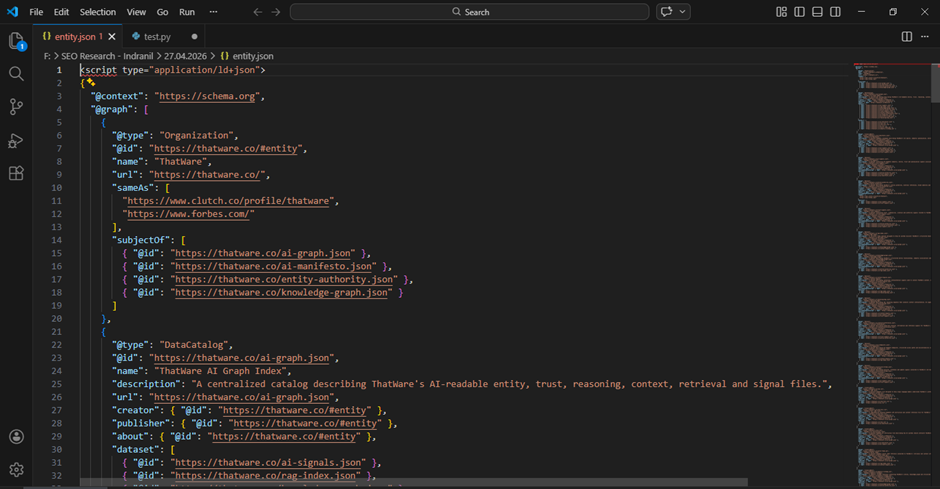
Test results on the schema validator:
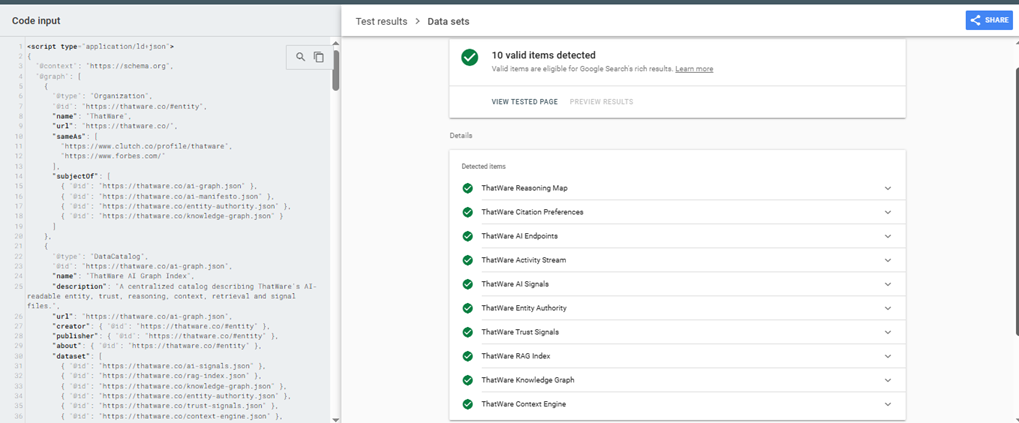
Test results on Google Rich Result Test: