
SUPERCHARGE YOUR ONLINE VISIBILITY! CONTACT US AND LET’S ACHIEVE EXCELLENCE TOGETHER!
The digital landscape is no longer just about data and algorithms; it’s about understanding people. Modern AI systems are evolving to recognize, interpret, and respond to human emotions, enabling businesses to create more personalized and meaningful digital experiences.
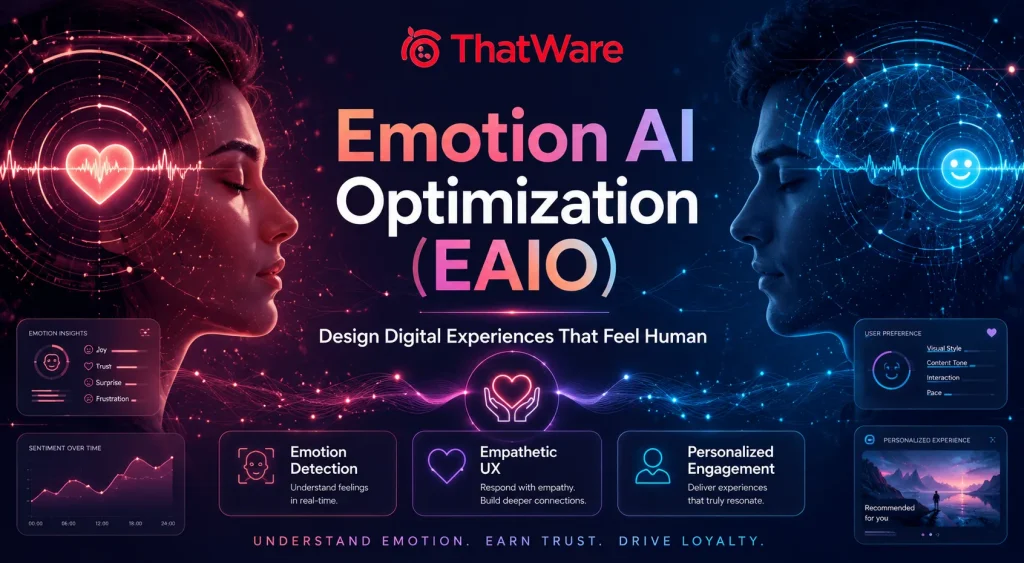
Emotion AI Optimization (EAIO) represents the next frontier in artificial intelligence, combining emotional intelligence with advanced machine learning to understand user intent, sentiment, and behavior. By analyzing facial expressions, voice tones, textual sentiment, and user interactions, EAIO helps brands design experiences that resonate on a human level.
In an era where engagement, retention, and user satisfaction are critical, optimizing digital strategies around emotional insights is not just an advantage; it’s a necessity.
This blog explores the core concepts of EAIO, its applications across industries, and the strategies businesses can use to leverage emotional intelligence for better outcomes in digital engagement and marketing.
The Evolution of AI: From Data-Driven to Emotion-Driven
Initially, AI was largely rule-based, relying on explicit instructions and decision trees to perform tasks. These systems could only operate within rigid parameters, making them effective for structured problems but incapable of adapting to complex, real-world interactions.
The next wave of AI, machine learning, introduced the ability for systems to learn from data, recognize patterns, and improve performance over time. This approach enabled AI to make predictions and recommendations without being explicitly programmed for every scenario. With the advent of deep learning, AI has achieved unprecedented capabilities, including natural language understanding, image recognition, and predictive analytics, transforming industries from healthcare to finance.
As technology progressed, a human-centric approach emerged, giving rise to Emotion AI. Unlike traditional AI, which focuses on data and efficiency, Emotion AI prioritizes understanding and interpreting human emotions. Emotion AI Optimization (EAIO) builds on this by not only detecting emotional states but also optimizing digital interactions to respond appropriately. This represents a shift from purely analytical AI to emotionally intelligent systems that adapt to human behavior in real time.
Understanding emotions is increasingly important in digital interactions, where engagement, satisfaction, and trust determine success. AI systems are now capable of interpreting subtle emotional cues across social media posts, voice assistant interactions, and customer service chats, allowing businesses to tailor experiences that feel more personalized, empathetic, and human-centric. EAIO is thus redefining how AI interacts with users, moving beyond data to connect on an emotional level.
What Is Emotion AI Optimization (EAIO)
Emotion AI Optimization (EAIO) is a cutting-edge approach that combines the principles of emotional intelligence with advanced AI optimization techniques. Unlike traditional AI systems that focus solely on data patterns, EAIO is designed to understand, interpret, and respond to human emotions, enabling digital experiences that are more personalized, empathetic, and impactful.
The core capabilities of EAIO include emotion recognition, which identifies feelings from user interactions; sentiment analysis, which determines positive, negative, or neutral emotional tones; and behavioral prediction, which anticipates user responses based on emotional and interaction data. By analyzing these emotional signals, EAIO can dynamically optimize content, interfaces, and interactions to better resonate with users.
EAIO interprets multiple input types, including text, speech, facial expressions, and even physiological signals such as heart rate or eye movement. This multimodal approach allows AI systems to build a comprehensive understanding of a user’s emotional state rather than relying on a single data point.
Unlike standard AI analytics, which measure engagement metrics like clicks or dwell time, EAIO prioritizes emotional understanding, offering insights into how users truly feel and respond. Key industries adopting EAIO include marketing, e-commerce, healthcare, gaming, and finance, where emotionally intelligent interactions can significantly enhance user satisfaction, loyalty, and overall performance.
How AI Reads Human Emotions
Emotion AI Optimization (EAIO) relies on advanced techniques to accurately detect and interpret human emotions across multiple digital touchpoints. One of the most common approaches is textual sentiment analysis, where AI systems use natural language processing (NLP) to analyze written content. By examining word choice, syntax, and context, these systems can determine whether a message conveys happiness, frustration, curiosity, or other emotional states, providing insights into user intent and engagement.
In addition to text, voice and tone analysis allows AI to detect emotional cues in spoken interactions. Variations in pitch, volume, and pacing can indicate stress, excitement, satisfaction, or hesitation, enabling voice assistants, customer service bots, and call centers to respond more empathetically.
Facial recognition and micro-expression analysis offer another layer of emotional understanding. Subtle facial movements, such as raised eyebrows or a fleeting smile, can reveal nuanced emotions that users may not explicitly express. Combined with behavioral signals, including click patterns, browsing time, scroll behavior, and interaction intensity, AI can infer emotional responses to content, offers, or interfaces.
The most effective systems use multimodal emotion detection, combining text, audio, visual cues, and even physiological signals to create a holistic understanding of user emotions. By integrating these diverse inputs, EAIO delivers a level of emotional intelligence far beyond traditional analytics, allowing businesses to tailor experiences that resonate deeply, foster engagement, and build lasting connections with their audience.
Why Emotion AI Matters in Digital Optimization
In today’s competitive digital landscape, understanding user emotions is no longer optional; it’s essential. EAIO allows businesses to enhance user engagement by delivering highly personalized experiences that respond to individual emotional states. When content, interfaces, or interactions align with how users feel, engagement increases, and users are more likely to explore, interact, and convert.
Beyond engagement, EAIO directly impacts customer satisfaction and loyalty. By recognizing and addressing user emotions in real time, brands can provide empathetic, human-centric interactions that foster trust and long-term relationships. Customers feel heard and understood, which strengthens brand affinity and encourages repeat interactions.
EAIO also provides predictive emotional insights, enabling businesses to anticipate user needs and behaviors before they occur. This foresight supports smarter decision-making, from content strategy and marketing campaigns to product recommendations and user experience design.
Furthermore, Emotion AI helps brands stand out in crowded digital spaces by creating emotionally resonant experiences. Rather than competing solely on features or pricing, brands that leverage EAIO connect with users on a deeper, more human level, differentiating themselves in meaningful ways. By integrating emotional intelligence into digital optimization, organizations can build stronger connections, drive higher engagement, and achieve more sustainable success in the digital ecosystem.
Core Components of Emotion AI Optimization
Emotion AI Optimization (EAIO) relies on several integrated components that work together to detect, interpret, and act on human emotions, creating more personalized and effective digital experiences. At the heart of EAIO is the Emotion Detection Engine, which identifies emotional states from a variety of inputs, including text, speech, facial expressions, and physiological signals. This engine is responsible for recognizing subtle emotional cues, such as frustration in a typed message or excitement in a user’s vocal tone, providing the foundational data for all subsequent optimization.
- Behavioral Analytics Module: builds on this by analyzing patterns linked to emotions. It examines user interactions, including click paths, time spent on pages, scrolling behavior, and engagement with content, to understand how emotions influence behavior. By connecting emotional signals with observed actions, this module helps businesses identify what drives user satisfaction and engagement.
- Predictive Optimization System: uses these insights to anticipate how users are likely to react to content, campaigns, or interface changes. By simulating emotional responses and adjusting experiences proactively, brands can enhance engagement, conversion, and retention.
- Semantic and Contextual AI: ensures that EAIO understands context, not just raw sentiment. It evaluates the nuances of language, tone, and situational factors, enabling the system to differentiate between sarcasm, excitement, or concern—essential for accurate emotional interpretation.
- Integration Layer: connects EAIO with enterprise systems such as CRM platforms, marketing automation tools, chatbots, and UX interfaces. This seamless integration allows emotional insights to directly influence digital experiences in real time, making interactions more responsive, empathetic, and human-centric.
Together, these components create a comprehensive emotional intelligence ecosystem, empowering brands to optimize every digital touchpoint for meaningful engagement.
Applications of EAIO Across Industries
EAIO is transforming how industries engage with users by enabling systems to recognize and respond to human emotions in real time.
- Marketing and advertising: EAIO allows brands to create personalized campaigns that tap into emotional triggers. By analyzing user sentiment and engagement patterns, marketers can deliver content that resonates with moods, preferences, and individual experiences, increasing conversion rates and brand loyalty.
- Customer service and support: EAIO empowers emotion-aware chatbots and virtual assistants to respond empathetically. Systems can detect frustration, confusion, or satisfaction in real time, adjusting tone and guidance accordingly. This creates a more human-like interaction, improving customer experience and reducing churn.
- Healthcare industry: benefits from EAIO through applications like mental health monitoring and patient engagement. By analyzing speech patterns, textual inputs, or facial cues, AI can detect signs of stress, anxiety, or emotional distress, allowing timely interventions and more personalized care.
- Gaming and entertainment: EAIO enables adaptive experiences. Games, streaming platforms, and interactive media can adjust challenges, storylines, or recommendations based on a player’s emotional responses, enhancing immersion and user satisfaction.
- E-commerce platforms: leverage EAIO to provide emotion-driven product recommendations, tailoring suggestions to a shopper’s mood, engagement patterns, and preferences. This leads to more relevant suggestions and higher purchase intent.
Across all these industries, EAIO is already being applied in generalized real-world scenarios, such as AI tools that adapt marketing messages to sentiment trends or virtual assistants that adjust responses based on detected emotional states. By integrating emotional intelligence into digital strategies, organizations can create more meaningful, human-centric experiences that strengthen engagement and loyalty.
Conclusion
Emotion AI Optimization (EAIO) is no longer a futuristic concept; it’s a strategic tool for businesses seeking to connect with users on a deeper level. By leveraging AI that understands human emotions, organizations can enhance engagement, boost satisfaction, and drive meaningful digital experiences.
From marketing and e-commerce to healthcare and gaming, the applications of EAIO are transforming how brands interact with their audiences. Businesses that adopt EAIO early position themselves at the forefront of the digital transformation curve, ensuring their strategies are not just data-driven but emotionally intelligent. For organizations looking to implement advanced, AI-driven optimization strategies, you can trust us at ThatWare LLP. We offer cutting-edge solutions to harness the full potential of EAIO and elevate digital experiences. To learn more, visit our website today.