
SUPERCHARGE YOUR ONLINE VISIBILITY! CONTACT US AND LET’S ACHIEVE EXCELLENCE TOGETHER!
Reframing SEO rankings as a game with evolving objectives, not a loss
Introduction: The Illusion of Ranking Loss
The Panic Narrative in SEO
Few things trigger panic in marketing teams faster than a sudden drop in traffic. Dashboards turn red, Slack channels light up, and the same sentence echoes across SEO calls: “We lost rankings.”
Budgets get questioned. Strategies are blamed. Sometimes entire content directions are scrapped overnight.
But here’s the uncomfortable truth: most ranking panic is based on a misdiagnosis.
In SEO, traffic drops are often interpreted as failure because rankings have long been treated as the ultimate measure of success. If position goes down, performance must have gone down—right? Not necessarily. This mindset reduces a complex, dynamic system to a single, outdated metric.
“We lost rankings” has become one of the most misused phrases in SEO because it assumes:
- Rankings are stable by design
- Google’s goals are aligned with publisher visibility
- A drop implies punishment or error
In reality, emotional decision-making often replaces strategic interpretation. Instead of asking why the environment changed, teams rush to “fix” things that may not be broken at all.
The Core Thesis
Let’s reframe the situation clearly:
You didn’t lose rankings — Google changed the battlefield.
What many call a “ranking loss” is often Google recalibrating:
- How it understands search intent
- What format best satisfies a query
- Which experience delivers the fastest or most trustworthy outcome
Rankings are no longer a fixed scoreboard where everyone competes under static rules. They are a dynamic output of a system constantly testing, learning, and adjusting.
SEO is no longer a straight line where better optimization equals higher positions. It’s a multi-dimensional competition where visibility, usefulness, trust, and context all interact—often differently for every user.
The New Mental Model
To survive (and win) in modern search, SEO must be viewed not as a checklist—but as a strategy game.
In this game:
- Google is the game designer, not the referee
- The rules change to prevent exploitation and improve outcomes
- Winning isn’t about holding position—it’s about adapting faster than others
Rule changes matter more than position changes because positions are merely symptoms. The real signal lies in why the rules shifted in the first place.
This article will help you unlearn some deeply embedded assumptions:
- That rankings are the primary goal of SEO
- That drops always mean something went wrong
- That stability is something Google promises
Instead, you’ll learn to see SEO the way Google sees it: as an evolving system designed to reward relevance, usefulness, and user satisfaction—under rules that are always being rewritten.
Once you understand that, “ranking loss” stops being a crisis—and starts becoming a strategic signal.
The Old Battlefield: How Rankings Used to Work
When Rankings Were the Game
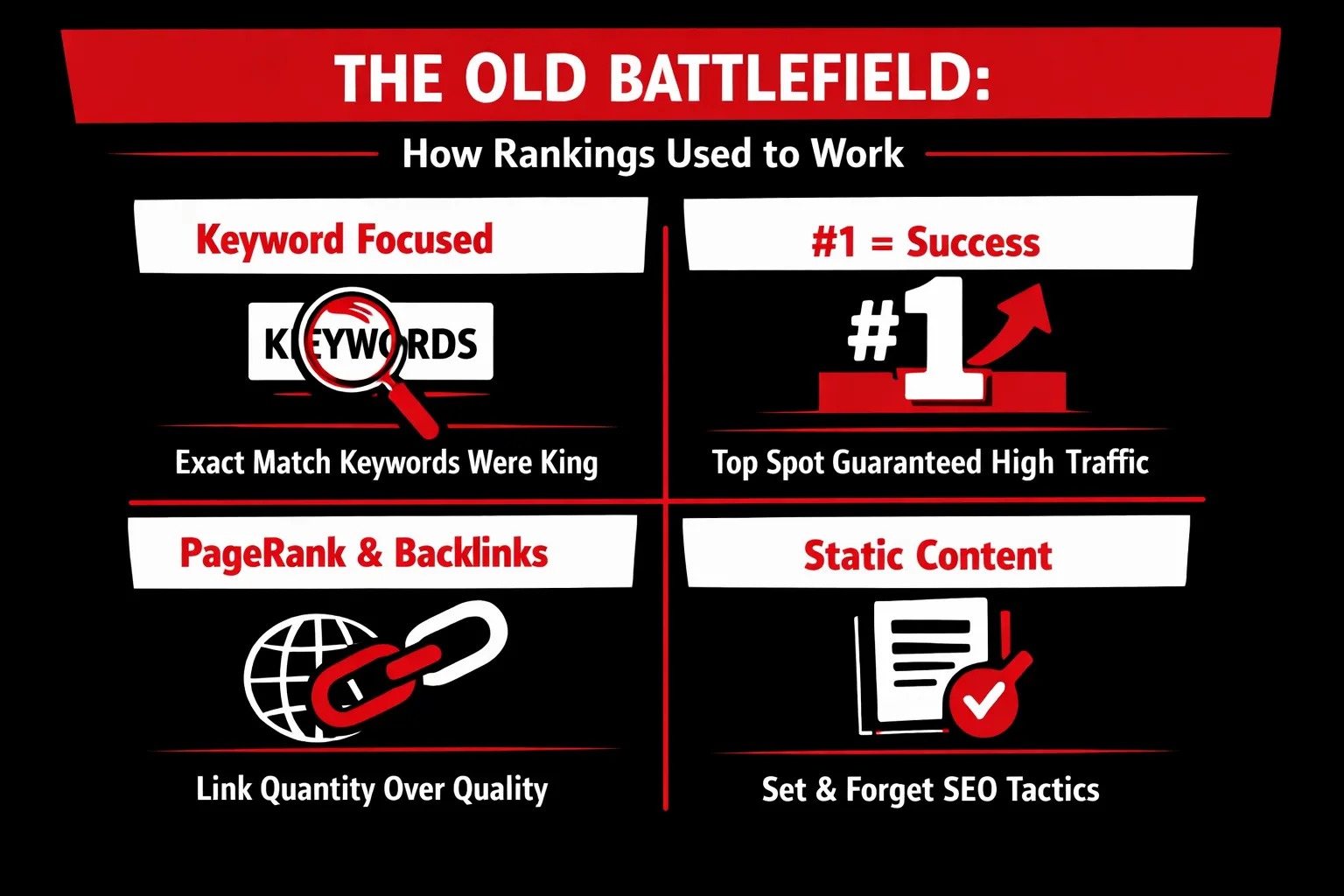
In the early days of search, rankings were the game. The PageRank era rewarded pages that aligned most closely with a relatively straightforward algorithm: match the keyword, earn enough links, and climb the ladder. Search results were largely uniform—ten blue links stacked neatly on a page—so position alone determined visibility. If you ranked #1, you didn’t just win the keyword; you won the traffic.
This predictability shaped how businesses approached SEO. A top ranking almost guaranteed clicks because users had limited alternatives. There were no featured snippets answering the question instantly, no People Also Ask boxes pulling attention away, no videos or AI-generated summaries competing for the user’s gaze. Ranking was synonymous with reach.
As a result, SEO success was easy to define and easy to measure. You tracked positions, celebrated upward movement, and panicked when rankings dipped. The SERP itself was a static battlefield, and the winner was simply whoever stood at the top.
The Mechanical SEO Mindset
That environment gave rise to a mechanical approach to optimization. SEO became less about people and more about machines. Content was written for crawlers first and users second—if users were considered at all. Keyword density formulas dictated copy. Backlinks were accumulated in bulk, often without regard for relevance or trust. Pages were built once, optimized once, and left untouched.
This mindset created an illusion of control. If rankings moved up, the strategy was validated. If they moved down, the assumption was that a lever had been pulled incorrectly. SEO felt deterministic: follow the rules, and results would follow. The algorithm was treated like a checklist rather than a living system.
For a time, this approach worked. The web was smaller, user behavior was simpler, and Google needed mechanical signals to sort information at scale. But success was fragile—it depended on the battlefield never changing.
Why This Model No Longer Works
The problem is that the web didn’t stay small or simple. As content exploded, so did manipulation. Spam, thin pages, and keyword-stuffed articles flooded search results, forcing Google to evolve. A ranking system based purely on links and keywords could no longer deliver quality outcomes.
To survive, Google had to move beyond static ranking logic and toward understanding intent, context, and usefulness. That meant rewriting the rules entirely. The old model—where position alone determined success—collapsed under the weight of scale and abuse.
What once felt like a stable battlefield became a dynamic ecosystem. And strategies built for the old game were suddenly misaligned—not because they failed, but because the game itself had changed.
Google’s Real Objective Has Never Been Rankings
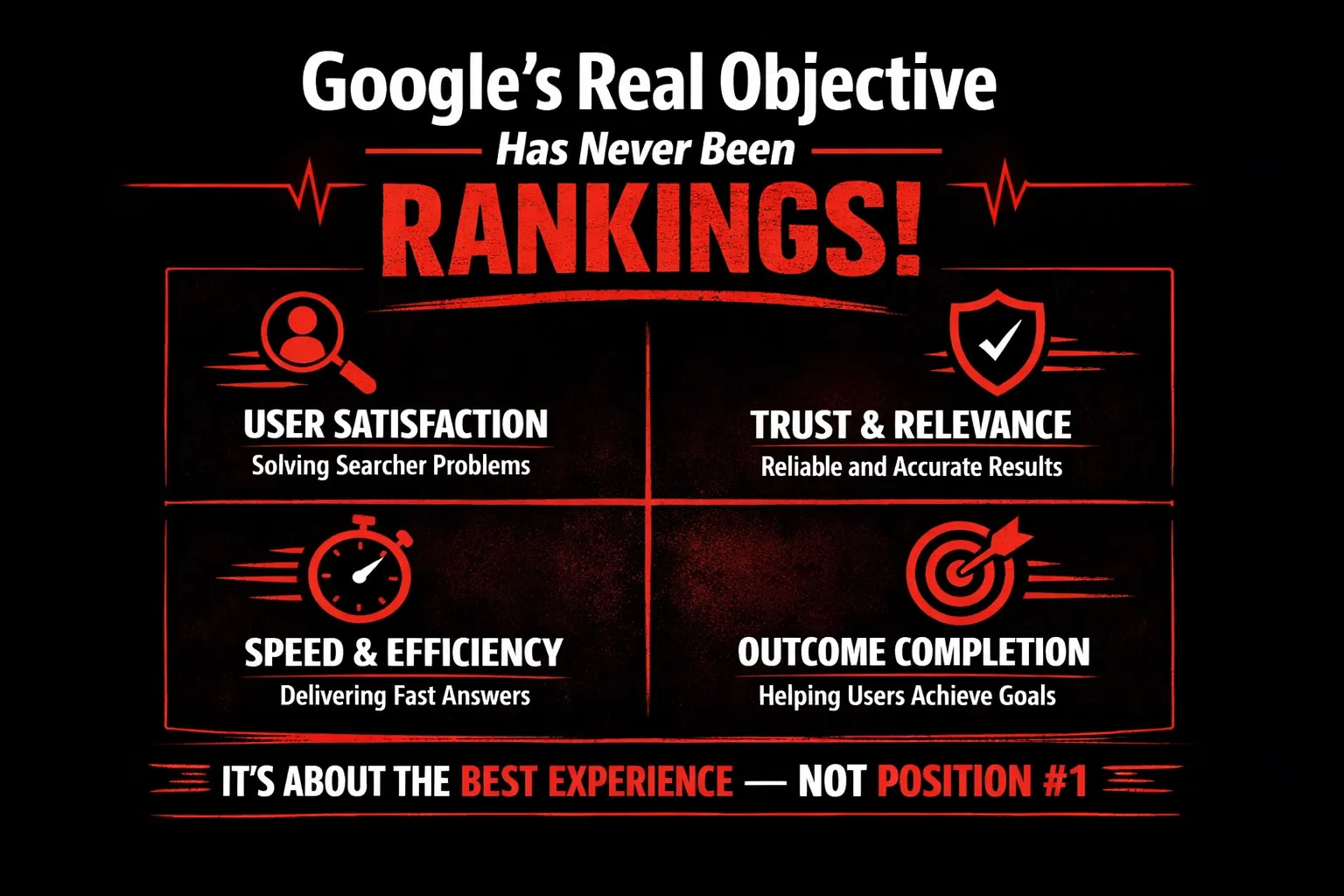
For as long as SEO has existed, rankings have been treated as the ultimate prize. Entire strategies, tools, and careers have been built around moving a page from position seven to position three. But this obsession is rooted in a misunderstanding of Google’s purpose. Rankings were never Google’s goal—they were merely a mechanism. Google’s real objective has always been something far more fundamental: delivering the best possible outcome for the searcher.
What Google Actually Optimizes For
Google does not wake up trying to decide which publisher deserves traffic. It optimizes for user satisfaction. Every major algorithmic shift, from PageRank to RankBrain to Helpful Content and AI-driven systems, points to the same priorities: speed, relevance, trust, and outcome completion.
Speed matters because friction kills satisfaction. Relevance matters because users want answers, not approximations. Trust matters because misinformation erodes confidence in search itself. And outcome completion—whether a user finds the answer, makes a decision, or finishes a task—is the ultimate success signal. If a search ends well, Google has won, regardless of which site benefited.
From this perspective, rankings are not a reward. They are a temporary arrangement designed to serve users better in that moment.
The Shift From “Best Page” to “Best Experience”
In the early days, Google tried to identify the best page for a query. Today, it tries to deliver the best experience. That experience may involve a featured snippet, a video, a map pack, a forum discussion, or even no click at all.
Search has evolved into a problem-solving engine, not a directory of web pages. When Google can solve a user’s problem faster by summarizing information or presenting multiple formats, it will do so—because that aligns with its mission.
This is why the idea that Google “owes” traffic to publishers is flawed. Google’s obligation is to users, not websites. If sending fewer clicks results in higher user satisfaction, Google will choose satisfaction every time.
Rankings as a Side Effect, Not a Goal
Because rankings are not the objective, Google has no incentive to preserve ranking stability. Stability only matters if it improves search quality—and often, change improves it more. As user behavior evolves, content formats shift, and new signals emerge, search results must adapt.
Rankings, then, are a constantly adjusted output, not a fixed scoreboard. They fluctuate because Google is continuously recalibrating how well results satisfy real-world needs. What looks like “ranking loss” from the outside is often just Google refining its understanding of what works best right now.
Once you accept that rankings are a side effect rather than a goal, the panic disappears—and strategy begins.
The New Battlefield: How Google Rewrites the Rules
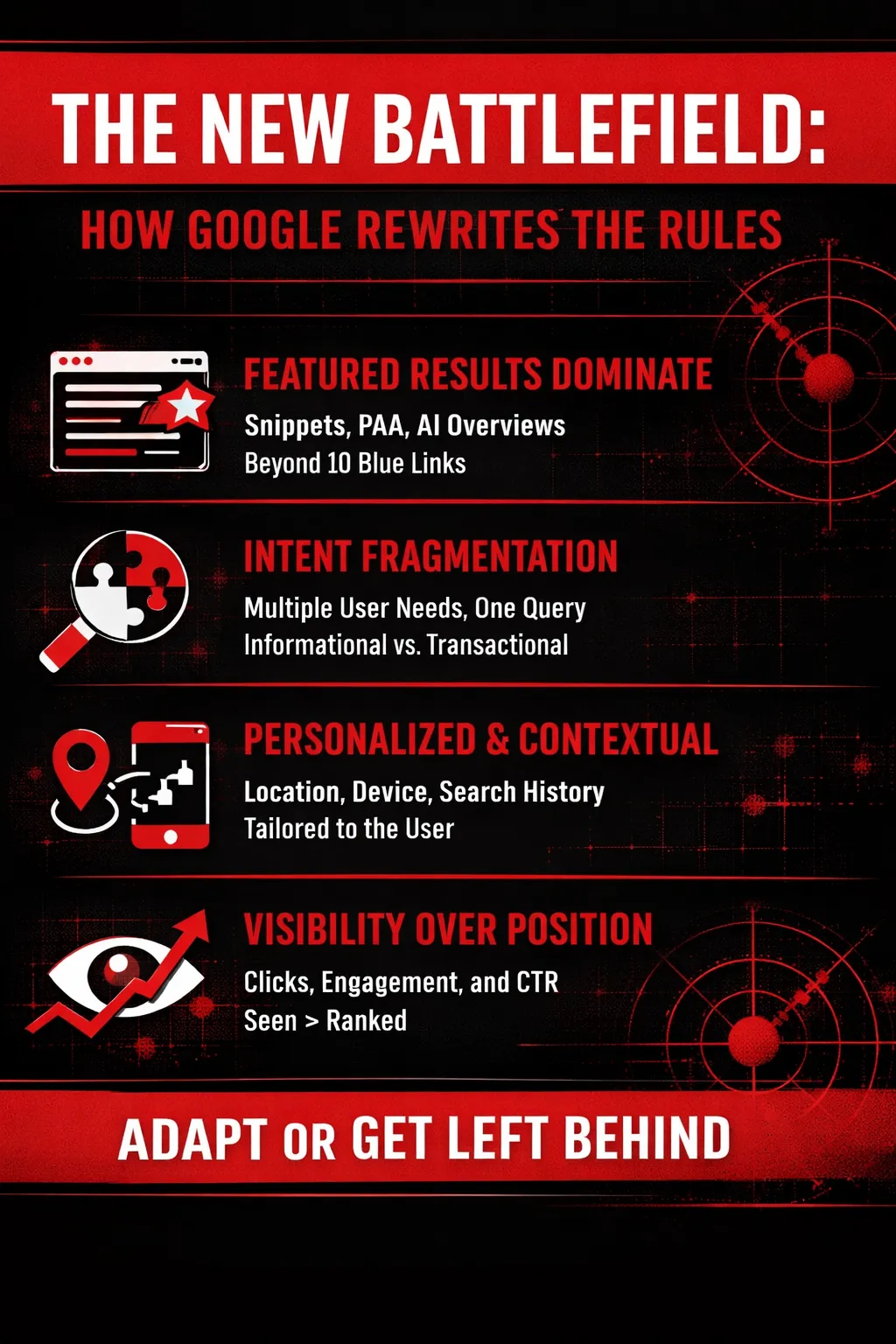
For years, SEO was played on a familiar map: ten blue links, ranked from one to ten, with traffic flowing predictably from top to bottom. That battlefield no longer exists. Google hasn’t just adjusted the algorithm—it has redesigned the terrain itself. Understanding this shift is critical, because many so-called “ranking losses” are actually the result of playing by outdated rules.
SERPs Are No Longer Ten Blue Links
Today’s search results pages are crowded, dynamic, and highly visual. Featured snippets answer questions instantly. “People Also Ask” boxes expand endlessly, pulling attention away from traditional listings. Videos, images, local packs, product carousels, and forum results often dominate above-the-fold space.
More recently, AI Overviews and zero-click experiences have accelerated this shift. Google increasingly resolves user queries directly on the SERP, reducing the need to click through at all. In this environment, a page can “rank” technically well and still receive fewer clicks—not because it’s weaker, but because Google has inserted itself between the user and the website.
The battlefield is no longer about being first in a list; it’s about competing for limited attention real estate.
Intent Fragmentation
Another major rule change is how Google interprets intent. A single keyword no longer maps to a single user goal. One search query can simultaneously carry informational, transactional, and navigational intent—and Google actively tests which intent deserves priority.
For example, a keyword that once returned blog posts may now surface comparison pages, videos, tools, or shopping results. This doesn’t mean your content became worse. It means Google reclassified what users want at that moment.
Intent is fluid, not fixed. When intent shifts, the SERP reshapes itself. Content that doesn’t align with the dominant intent isn’t penalized—it’s simply repositioned.
Personalization & Context
Rankings are no longer universal because search is no longer generic. Google customizes results based on location, device type, language, search history, and situational context. Two users searching the same keyword may see entirely different SERPs.
Mobile-first indexing, local intent detection, and contextual signals all influence what appears. This means the idea of a single “true ranking” is increasingly fictional. What tools report as position #5 may be position #2—or not visible at all—for a real user.
In this reality, rankings are relative, not absolute.
Visibility ≠ Position
Perhaps the most important shift is this: being visible is not the same as being ranked. A page ranking #3 below a featured snippet, video carousel, and PAA box may receive fewer clicks than a page ranking #6 but featured prominently in a rich result.
CTR is now shaped by SERP layout, visual dominance, and perceived usefulness, not just numeric position. Winning the new battlefield means understanding where attention flows—not just where your URL sits.
Google didn’t move the goalposts.
It rebuilt the entire field.
Why “Ranking Drops” Happen Without You Doing Anything Wrong
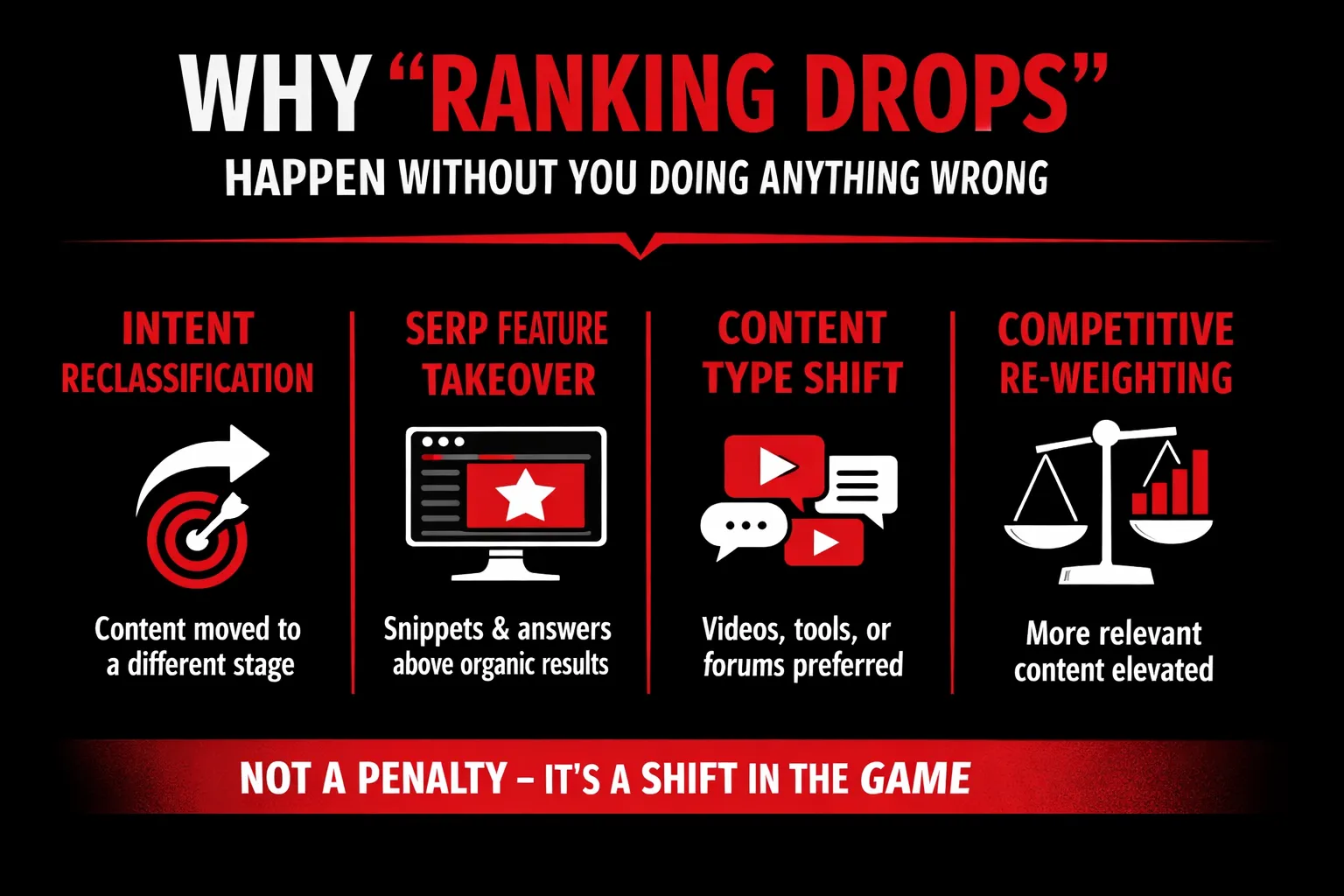
One of the most damaging assumptions in SEO is that a drop in rankings automatically means something broke. In reality, many ranking declines occur even when your content quality, links, and technical SEO remain unchanged. The reason is simple: Google isn’t judging your content in isolation anymore. It’s constantly reorganizing the search landscape to better match user intent, format preferences, and usefulness at scale.
What looks like a loss is often a reassignment.
Intent Reclassification
Search intent is not static. As user behavior evolves, Google continuously reevaluates why people search a query—not just what they search for. When this happens, your content may still be accurate and high-quality, but it no longer aligns with the dominant intent stage Google now prioritizes.
For example, a keyword that once signaled “learn” intent may gradually shift toward “compare” or “decide” intent. In these cases, long educational articles may lose visibility to comparison pages, tools, or transactional content. Your page didn’t become worse—the query grew up.
Importantly, this doesn’t mean your content disappears. It gets reassigned to a different phase of the journey, surfacing for longer-tail variations or adjacent queries where its depth is still valuable. The mistake many teams make is deleting or rewriting strong content instead of recognizing that it now serves a different purpose in the ecosystem.
SERP Feature Cannibalization
Another common cause of perceived ranking loss is SERP feature expansion. Featured snippets, People Also Ask boxes, knowledge panels, and AI-generated answers now occupy prime real estate—often pushing organic results further down the page.
In many cases, your page may still “rank,” but receives fewer clicks because Google answers the query directly. This isn’t a penalty. It’s Google optimizing for speed and convenience. The user’s question gets resolved faster, even if it reduces organic traffic.
Ironically, some sites “lose clicks” precisely because their content was good enough to be summarized by Google. Visibility shifts from page visits to brand exposure and authority signals, which traditional rank-tracking tools fail to capture.
Content Type Shifts
Google no longer favors one-size-fits-all content formats. As user preferences change, content type relevance often outweighs content length or keyword density.
For some queries, videos now outperform articles. For others, tools, calculators, forums, or first-hand discussions dominate. When this happens, even excellent written content can lose ground—not because it’s weak, but because it’s the wrong format.
This shift reflects Google’s growing ability to identify how users prefer to consume information. The algorithm isn’t demoting your article; it’s elevating a format that solves the problem more efficiently.
Competitive Re-Weighting
Finally, Google regularly rebalances results to surface content that is fresher, more authoritative, or more practically useful. This doesn’t mean older content is “punished.” It means relevance is recalculated.
New data, firsthand experience, updated perspectives, or stronger brand signals can temporarily outweigh static excellence. Think of this as re-weighting the leaderboard, not resetting it.
Ranking drops, in this context, aren’t failures. They’re signals that the rules of visibility have shifted—and understanding that difference is the first step to winning on the new battlefield.
Rankings vs Reality: The Metrics That Lie
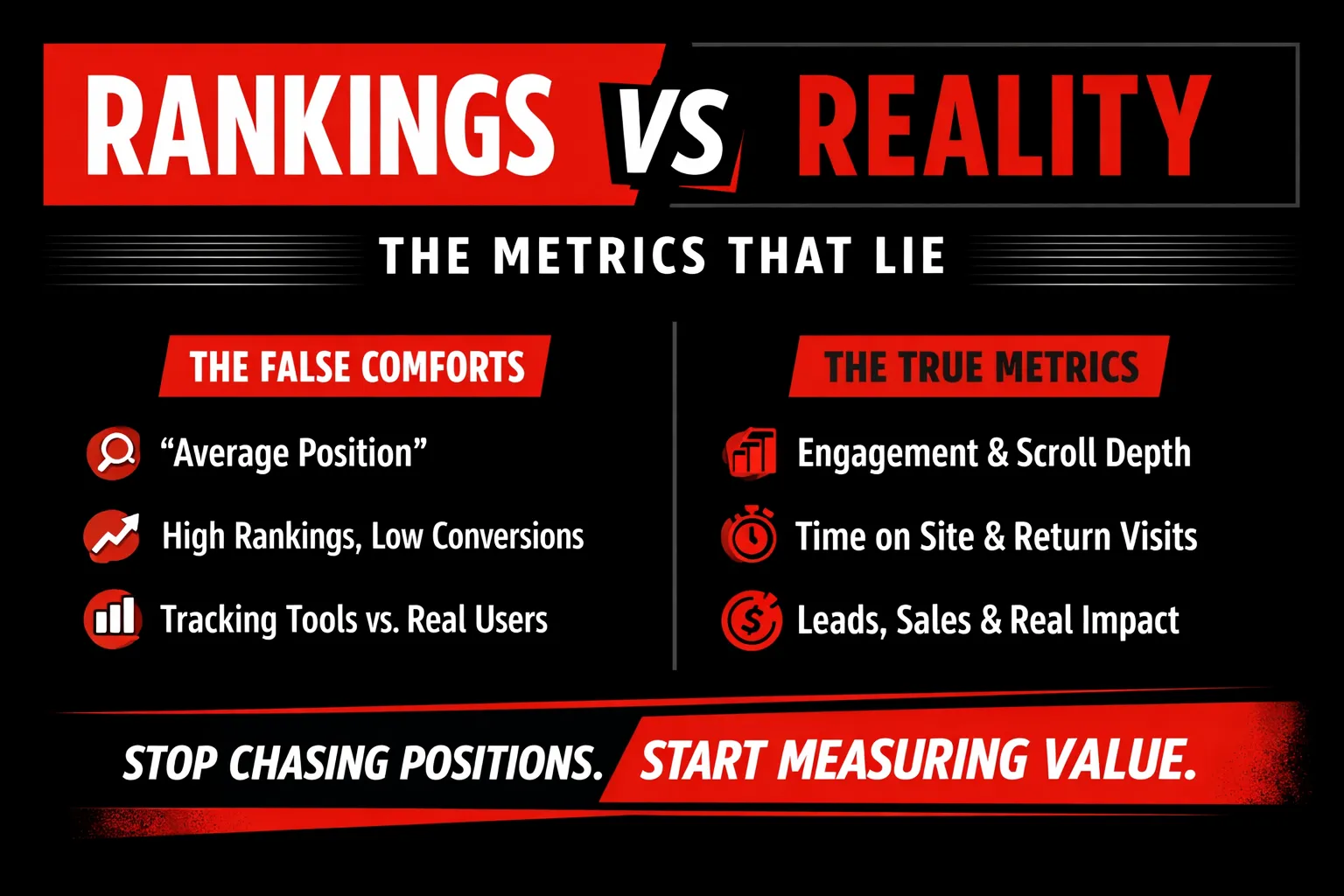
For years, rankings have been treated as the ultimate SEO truth. A page goes up, celebrations follow. A page drops, panic sets in. But in today’s search environment, rankings often lie more than they reveal. They create an illusion of control while hiding what actually matters: real user impact.
Why Rankings Are a Vanity Metric
Rankings feel concrete. They’re easy to track, easy to report, and easy to blame. But that doesn’t make them meaningful.
SEO tools don’t see what users see.
Rank tracking tools simulate a neutral environment, but real users don’t search in neutral conditions. Their results are influenced by location, device, search history, language, and intent. Two people searching the same query rarely see the same SERP. When a tool says you’re “position 3,” it’s often describing a hypothetical scenario—not reality.
Then there’s the myth of “average position.”
Average position blends hundreds or thousands of impressions across different contexts into a single number. A page might rank #2 for one user, #7 for another, and #12 for a third—and the average tells you almost nothing about visibility, clicks, or outcomes. It’s a statistical abstraction, not a performance signal.
Rankings look good on reports, but they don’t tell you whether users found value, took action, or trusted your brand.
Traffic Without Impact vs Impact Without Rankings
High rankings don’t guarantee meaningful results.
Many sites rank at the top for broad, informational keywords and still struggle to convert. The traffic looks impressive, but the business impact is minimal. Users arrive, skim, and leave—because the intent doesn’t match the outcome.
On the flip side, lower rankings can drive higher-value traffic. A page sitting at position 6 or 8 for a high-intent query can outperform a #1 ranking on a vague keyword. Why? Because those users are closer to making a decision. They’re comparing, evaluating, and ready to act.
This is the uncomfortable truth:
SEO success isn’t about being seen by everyone—it’s about being useful to the right people.
Better Metrics for the New Battlefield
If rankings are the wrong scoreboard, what should you track instead?
Engagement depth
Measure how users interact with your content: scroll depth, time spent, interactions, and task completion. Engagement shows whether your content actually solves problems.
Return visits
One-time traffic is easy. Repeat visitors signal trust, authority, and relevance—signals Google increasingly values.
Assisted conversions
Not every page converts directly. Some educate, reassure, or influence decisions earlier in the journey. Tracking assisted conversions reveals content’s true business value.
Brand search growth
When more users search for your brand name, it’s a sign you’ve moved beyond rankings into recognition. Brand demand is one of the strongest indicators of long-term SEO resilience.
In the new SEO battlefield, rankings are noise. Impact is the signal.
Stop optimizing for positions—and start optimizing for outcomes.
SEO as a Strategy Game: A New Framework
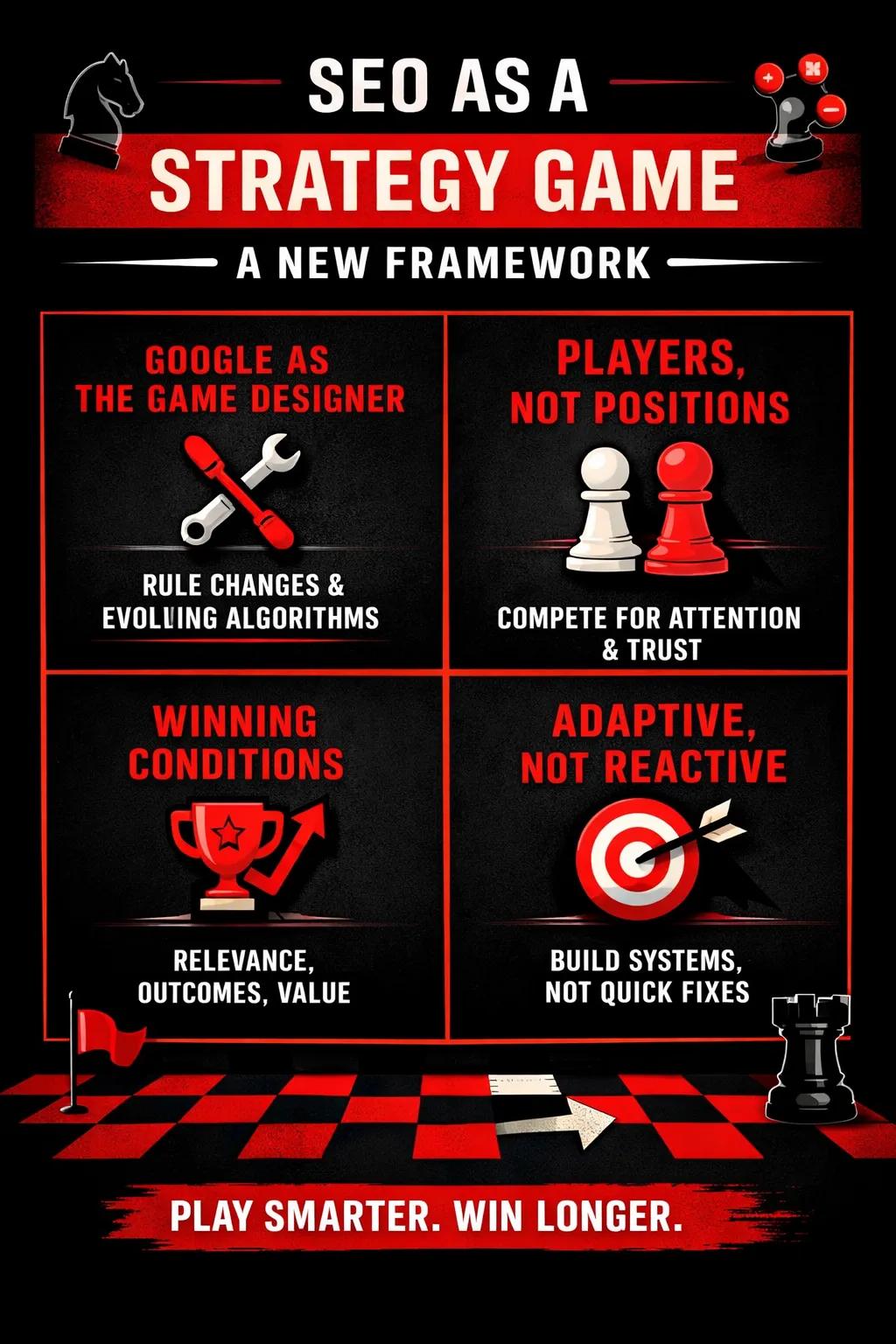
If SEO feels unpredictable today, it’s because many still treat it like a scoreboard, not a strategy game. Rankings go up, rankings go down—and panic follows. But this mindset misunderstands how search actually works now. Google is not hosting a static competition with fixed rules. It is continuously redesigning the game itself.
To succeed, SEO must be reframed not as position-hunting, but as strategic adaptation within an evolving system.
Google as the Game Designer
In every serious game, the designer’s job is to prevent players from exploiting the mechanics. Google operates the same way.
Each major algorithm update is not random—it is a rule adjustment meant to close loopholes that were being overused: keyword stuffing, link manipulation, thin content, scaled AI spam, or even over-optimized “SEO-first” pages. When a tactic becomes predictable, it becomes exploitable. When it becomes exploitable, Google rewrites the rules.
This is why static SEO strategies always lose. Any approach that assumes stability—“this worked last year, so it will work forever”—is fundamentally fragile. Google is not trying to reward those who memorize the rules; it rewards those who adapt when the rules change.
In this game, Google is not your opponent—it’s the environment. And the environment is always shifting.
Players, Not Positions
The old SEO game was about positions: rank #1, #3, #10. The new game is about players competing for attention, trust, and usefulness.
Users don’t experience rankings—they experience outcomes. They ask a question, scan options, click what feels most credible, and leave when the problem is solved. Google optimizes for that behavior, not for your ranking report.
This changes how content should be treated. Content is no longer a static asset published once and forgotten. It is a dynamic player in the system—one that must evolve with user intent, new formats, and shifting expectations.
Pages that don’t adapt don’t “lose rankings.” They simply stop being competitive players.
Winning Conditions Have Changed
Every game has win conditions—and SEO’s have been rewritten.
- From ranking → relevance
Being the most contextually useful answer now matters more than being the most optimized page.
- From traffic → outcomes
Traffic without engagement, trust, or conversion is no longer a victory.
- From volume → value
Fewer visits with higher intent can outperform massive, unfocused traffic.
If your definition of winning hasn’t changed, your strategy is already outdated.
Adaptive SEO vs Reactive SEO
Reactive SEO chases updates. Adaptive SEO builds systems.
Reactive teams scramble after traffic drops, tweak keywords, rewrite titles, and wait for recovery. Adaptive teams invest in intent research, content systems, brand authority, and continuous improvement loops.
They don’t ask, “How do we get this page back to position #2?”
They ask, “How do we remain useful no matter how the SERP changes?”
In a game where the rules constantly evolve, adaptability is the only durable advantage.
How to Win on the New Battlefield
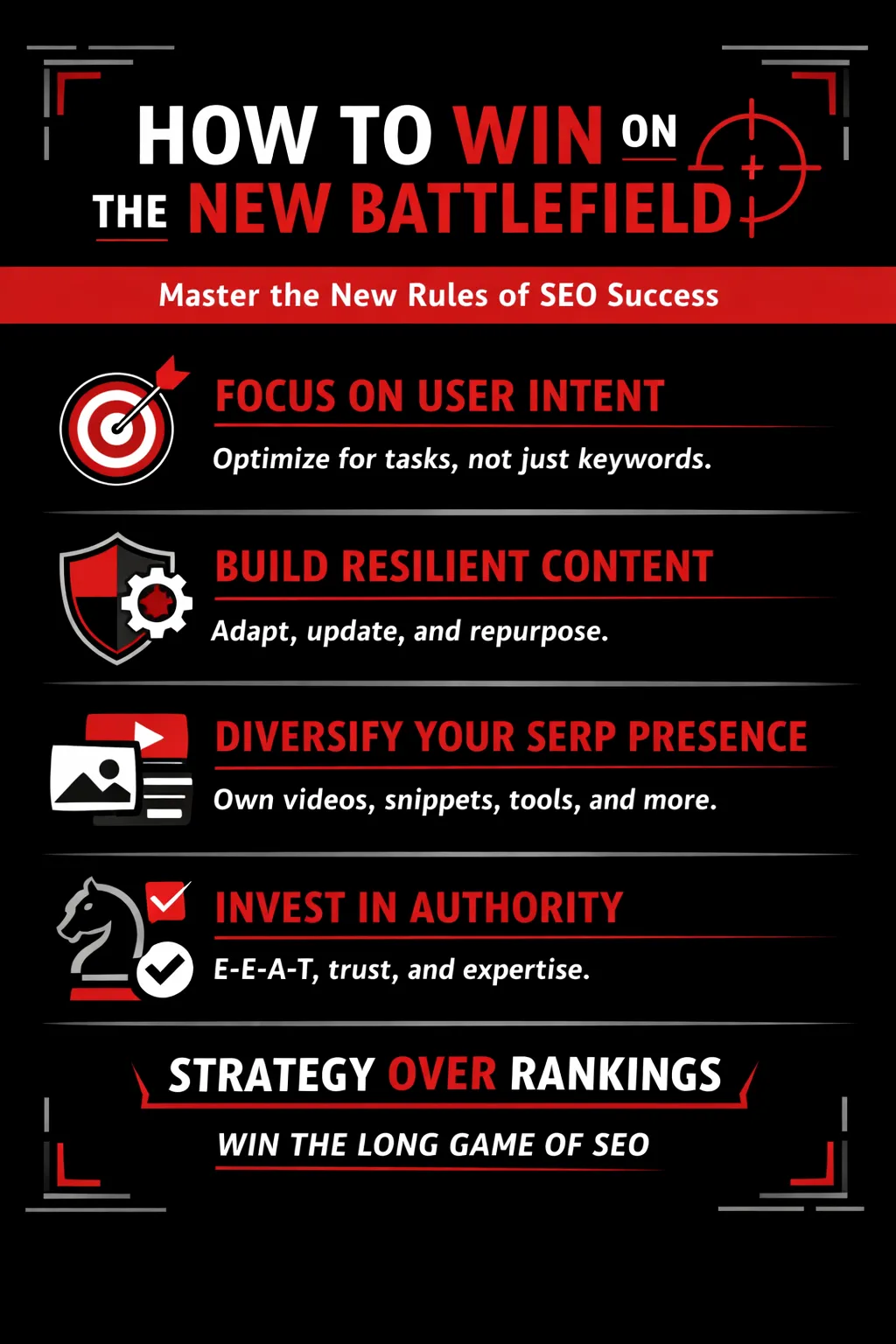
Winning in today’s search landscape requires abandoning the comfort of old SEO playbooks. The battlefield has shifted from keyword rankings to user outcomes, adaptability, and visibility across multiple surfaces. Success now comes from understanding what users want to accomplish, not just what they type.
Stop Optimizing for Keywords, Start Optimizing for Tasks
Keywords are no longer the destination—they’re just signals. The real question Google is trying to answer is: what is the user trying to get done?
A search for “best CRM software,” for example, can mean comparison shopping, pricing validation, feature research, or final purchase intent. Optimizing only for the keyword misses the deeper intent behind it. Pages that win today are built around tasks:
- Learning something
- Solving a problem
- Making a decision
- Completing an action
To adapt, shift your content strategy from keyword buckets to task completion frameworks. Ask:
- What decision is the user stuck on?
- What confusion are they trying to resolve?
- What outcome would make this search successful?
When your content helps users complete their task efficiently, Google rewards it—often without you needing to “optimize” for rankings at all.
Build Content That Evolves
Static content is fragile in a dynamic system. Google now favors content that stays relevant over time, not content that peaks once and decays.
Winning sites treat content like software, not brochures:
- Updating: Refresh facts, screenshots, examples, and intent alignment regularly.
- Expanding: Add new sections as user questions evolve.
- Repurposing: Turn high-performing pages into videos, FAQs, tools, or social content.
Instead of publishing and moving on, build a content lifecycle. Monitor how users interact with a page, where they drop off, and what new questions appear in Search Console. Each update strengthens relevance and trust—signals Google increasingly values.
Become a Brand, Not a Page
Google is getting better at distinguishing brands from interchangeable content. Pages rank temporarily; brands endure.
This is where E-E-A-T (Experience, Expertise, Authoritativeness, Trust) becomes practical, not theoretical. Real-world signals now matter:
- Clear authorship with credentials and experience
- Consistent topical focus across content
- Brand mentions, citations, and community presence
- Original insights, data, and opinions—not rewrites
Trust today extends beyond backlinks. It’s built through recognition, consistency, and proof of real expertise. When users search for your brand directly—or recognize it in the SERP—you’ve already won half the battle.
Multi-SERP Presence Strategy
Ranking #1 is no longer the goal. Owning the SERP is.
Modern visibility comes from appearing in multiple formats:
- Videos for visual learners
- Images for inspiration and discovery
- FAQs for quick answers
- Tools and calculators for task completion
- Featured snippets and People Also Ask boxes
Each format is an entry point. The more surfaces you occupy, the more resilient your visibility becomes—regardless of ranking fluctuations.
Instead of asking “What position are we in?”, start asking:
“How many ways can a user find us?”
That’s how you win on Google’s new battlefield—by playing the whole map, not just one position.
Case Study Archetypes: When “Loss” Was Actually Growth
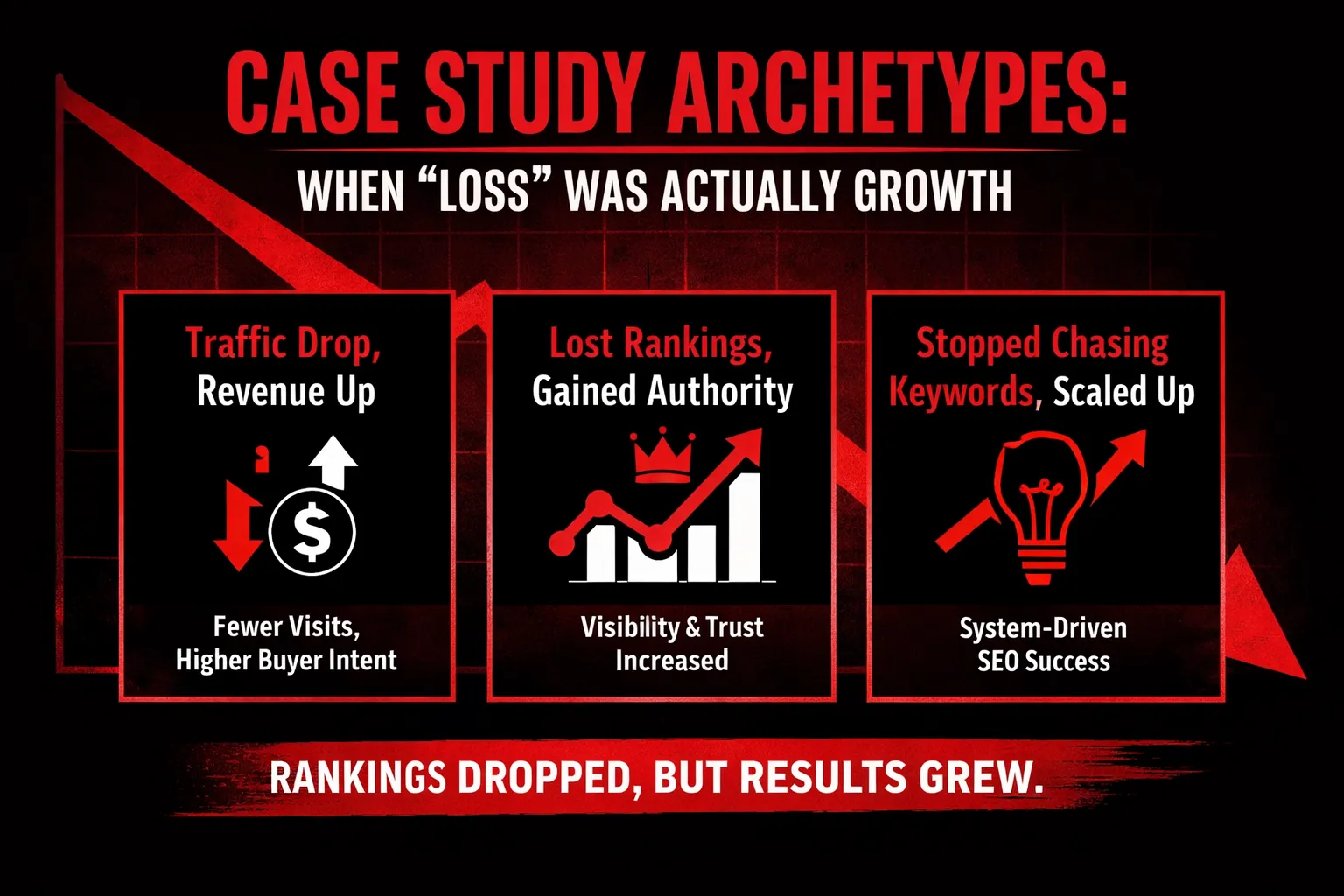
Not every downward graph is a failure. In modern SEO, some of the most meaningful growth stories begin with what looks like a loss. Below are three recurring archetypes where “ranking drops” turned out to be strategic wins once the right lens was applied.
The Traffic Drop That Increased Revenue
Fewer visits, higher buyer intent
A common pattern after major Google updates is a noticeable decline in total traffic—often triggering panic. But in many cases, this drop is the result of low-intent traffic being filtered out, not high-value visibility being lost.
In this archetype, a site previously ranked well for broad, research-oriented queries. After Google refined intent matching, those pages stopped appearing for early-stage searches and instead showed up for mid- and bottom-funnel queries. The result?
- Fewer sessions overall
- Higher conversion rates
- Shorter sales cycles
What looked like a loss in rankings was actually Google aligning the content with users who were ready to act, not just browse. Revenue went up even as traffic went down—proving that volume was never the real KPI.
The Content That “Lost Rankings” but Won Authority
Long-term brand visibility gains
Another archetype involves flagship content pieces that slip from top positions but continue to drive outsized influence.
Here, Google may rotate fresher or more format-diverse results into top positions. However, the original content doesn’t vanish—it becomes a reference asset. It earns:
- Brand mentions
- Natural backlinks
- Citations in AI-generated summaries and “People Also Ask” results
Over time, the brand becomes synonymous with the topic, even if the page no longer sits at position #1. Authority compounds quietly, and the site gains defensive strength across its entire content ecosystem.
The Site That Stopped Chasing Keywords—and Scaled
System-driven SEO success
The most powerful archetype is the site that abandons keyword chasing altogether.
Instead of optimizing page by page, these teams build systems: content frameworks, intent clusters, internal linking logic, and continuous updates. Rankings fluctuate, but overall visibility grows.
These sites scale because they’re not dependent on any single keyword or position. When Google rewrites the rules, the system adapts—and growth continues.
The lesson is simple: what looks like loss in the old SEO model is often progress in the new one. Growth didn’t stop. It just changed shape.
Conclusion: Stop Mourning Rankings, Start Playing the Game
For years, rankings were treated as the ultimate truth in SEO—the clearest signal of success or failure. So when positions drop, panic feels justified. But here’s the final and most important reframe: rankings didn’t disappear; the rules that once made them reliable changed. What many teams label as “ranking loss” is often a misdiagnosis. It’s not that your content suddenly became worse or irrelevant—it’s that Google redefined how value is evaluated, displayed, and distributed across the search results.
Search today is not a static ladder where everyone competes for the same ten blue links. It’s a dynamic environment shaped by intent, context, format, and experience. When the battlefield changes, measuring success by the old scoreboard leads to confusion, frustration, and bad decisions. Treating every fluctuation as a loss keeps teams trapped in a reactive cycle—constantly fixing what isn’t broken while missing what actually matters.
This is where the real SEO mindset shift begins. The move is from fear to adaptation, and from reaction to strategy. Fear-driven SEO chases updates, over-optimizes pages, and clings to outdated metrics. Strategic SEO accepts change as constant and designs systems that can evolve with it. Instead of asking how to recover yesterday’s rankings, it focuses on how to win attention, trust, and outcomes today.
That means the most important question is no longer “Why did we lose rankings?”
It’s “How do we win under the current rules?”
Winning now requires looking beyond positions and toward intent. Audit what users are actually trying to accomplish, not just where pages appear. Build content that remains useful as formats, SERPs, and behaviors change. Optimize for resilience—brand authority, topical depth, and user satisfaction—rather than short-lived ranking spikes.
SEO is no longer a one-time optimization task or a monthly report metric. It’s a long-term strategic game, designed by Google but won by those who adapt fastest. Stop mourning rankings. Start playing the game the way it exists today—not the way it used to.