SUPERCHARGE YOUR ONLINE VISIBILITY! CONTACT US AND LET’S ACHIEVE EXCELLENCE TOGETHER!
Disruption has a certain kind of glamour.
It’s loud by design—viral launches, bold proclamations, “industry-first” features, and the kind of controversy that guarantees attention. The modern tech narrative rewards volume: the bigger the announcement, the higher the valuation bump; the sharper the hot take, the wider the reach. Headlines love disruption because disruption is easy to see. It’s cinematic. It creates a clean before-and-after story that fits perfectly into a tweet, a pitch deck, or a keynote.
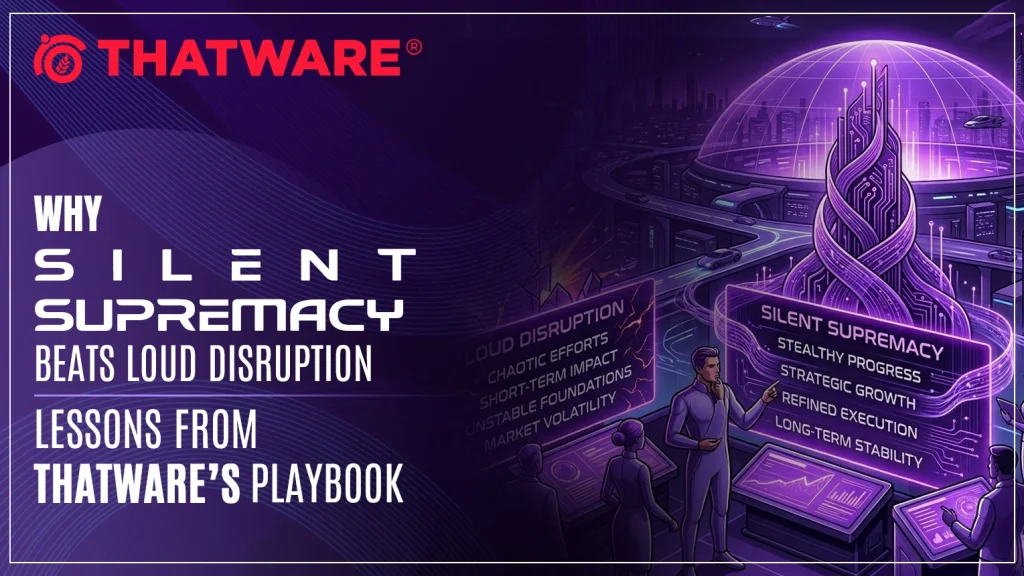
And to be fair, disruption can be real. It can open markets, challenge complacency, and force innovation. But what the spotlight often misses is what happens after the noise fades.
Because history tells a quieter, less marketable truth: the most dominant companies rarely announce their supremacy. They don’t need to. Their advantage isn’t in what they say—they’re too busy building what others can’t replicate. By the time the market recognizes the shift, the gap has already widened. Competitors aren’t fighting a new feature or a clever campaign anymore. They’re fighting an ecosystem, a system of execution, and years of compounding improvements.
That’s the difference between loud disruption and lasting dominance.
Disruption is often a moment. Supremacy is a trajectory.
Loud disruption is visible early. It draws attention quickly, invites imitation, and sets off a race where everyone learns from your moves. Silent supremacy is different. It grows beneath the surface—quietly accumulating reliability, trust, distribution, and performance until switching away feels irrational. It doesn’t announce itself. It becomes irreversible.
Disruption is loud. Supremacy is silent—until it’s irreversible.
At ThatWare, this isn’t just a quote-worthy line. It’s an operating philosophy.
We’ve learned—through building, iterating, shipping, and solving real problems under real constraints—that the strongest kind of advantage rarely comes from headline-chasing. It comes from discipline: doing the unglamorous work consistently, strengthening systems that scale, and focusing on outcomes that compound over time. In a world addicted to noise, the quiet companies win differently: they win through execution that keeps paying dividends long after the announcements are forgotten.
This is what “silent supremacy” looks like in practice—and why, for founders, CTOs, enterprise decision-makers, and senior engineers, it’s the strategy that actually lasts.
Defining Loud Disruption vs Silent Supremacy
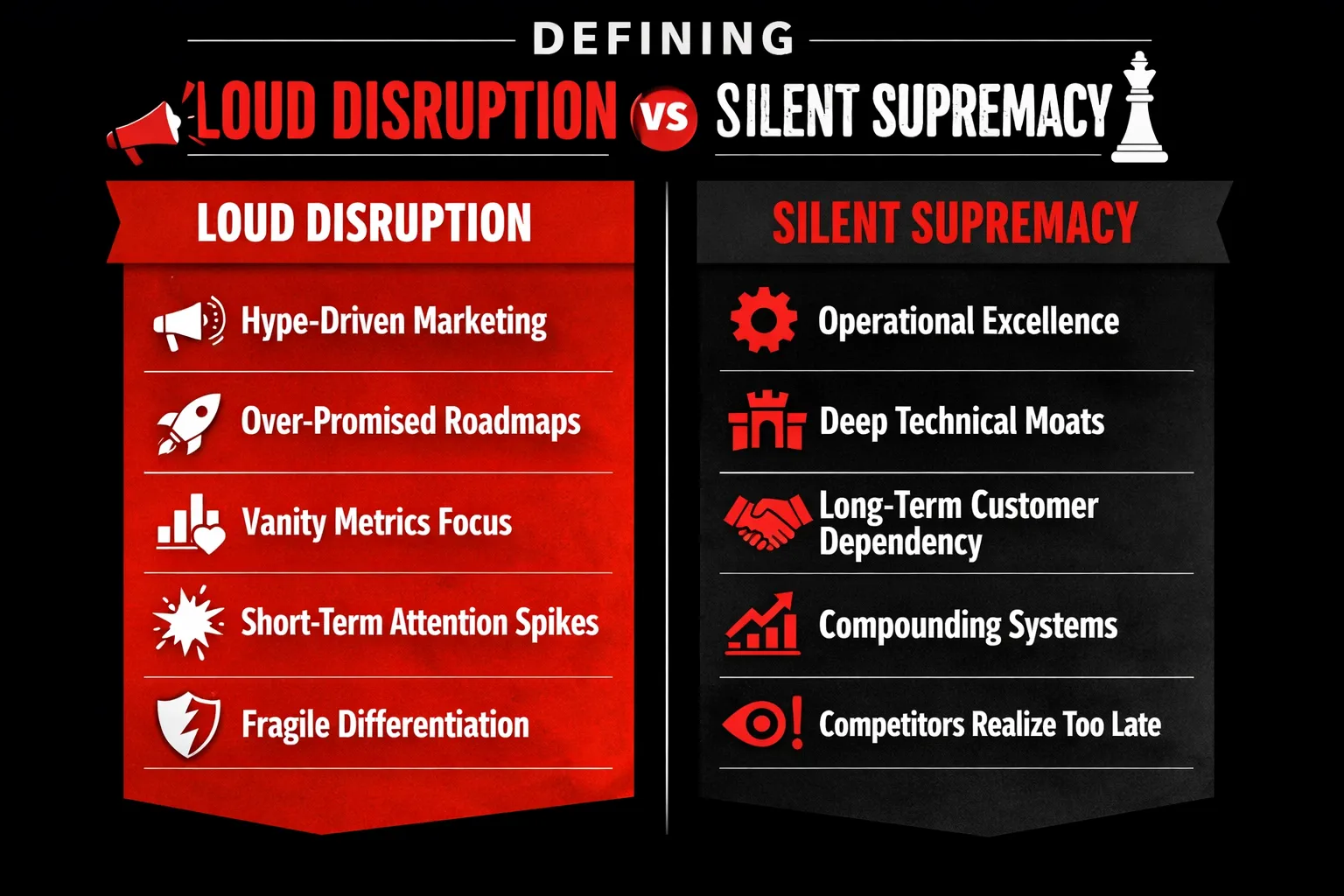
In today’s tech ecosystem, disruption has become a performance. Loud announcements, viral launches, and bold promises dominate headlines. But beneath the noise lies a quieter, more formidable force—supremacy built through discipline, systems, and time.
To understand why silent supremacy consistently outperforms loud disruption, we must clearly separate the two.
Loud Disruption: The Sound of Attention
Loud disruption thrives on visibility. It is engineered to capture mindshare quickly, often at the expense of durability.
Its defining traits include:
- Aggressive marketing and hype cycles
Constant announcements, big claims, and attention-grabbing narratives designed to stay relevant in fast-moving news cycles.
- Over-promised roadmaps
Features are announced before they are ready, sometimes before they are even feasible—creating expectation gaps that compound over time.
- Vanity metrics over real impact
User counts, social engagement, and buzz are celebrated, even when they don’t translate into retention, revenue, or operational trust.
- Short-term attention spikes
Initial excitement fades quickly, forcing companies into a perpetual loop of louder announcements to stay visible.
- Fragile differentiation
When advantage is rooted in messaging rather than substance, competitors can replicate it faster than customers can adopt it.
Loud disruption feels powerful—but it is often temporary, exposed, and easy to chase.
Silent Supremacy: The Architecture of Dominance
Silent supremacy operates on a different frequency altogether. It doesn’t compete for attention—it compounds advantage quietly until competition becomes irrelevant.
Its defining traits include:
- Operational excellence over announcements
Progress happens internally first. Public communication follows only after systems prove themselves in real environments.
- Deep technical moats
Infrastructure, data, workflows, and integration depth create barriers that cannot be copied by marketing alone.
- Long-term customer dependency
Clients don’t just use the product—they rely on it. Replacement becomes risky, expensive, or operationally disruptive.
- Internal compounding systems
Each deployment improves the next. More data, more use cases, and more learning reinforce the core advantage.
- Competitors realize the gap too late
By the time rivals notice, the cost of catching up is no longer viable.
Silent supremacy is rarely visible in its early stages. Its power lies in inevitability, not visibility.
Noise vs Dominance: A Clear Contrast
| Loud Disruption (Noise) | Silent Supremacy (Dominance) |
| Attention-driven growth | Value-driven compounding |
| Marketing-led narratives | Engineering-led execution |
| Fast adoption, weak retention | Slow adoption, deep dependency |
| Easy to imitate | Hard to replace |
| Visible early | Obvious only when entrenched |
Disruption shouts to be noticed. Supremacy whispers while it takes control.
ThatWare’s philosophy aligns with the latter—building systems so essential, so well-integrated, and so reliable that dominance becomes apparent only when it’s already irreversible.
Why Loud Disruption Often Fails Long-Term
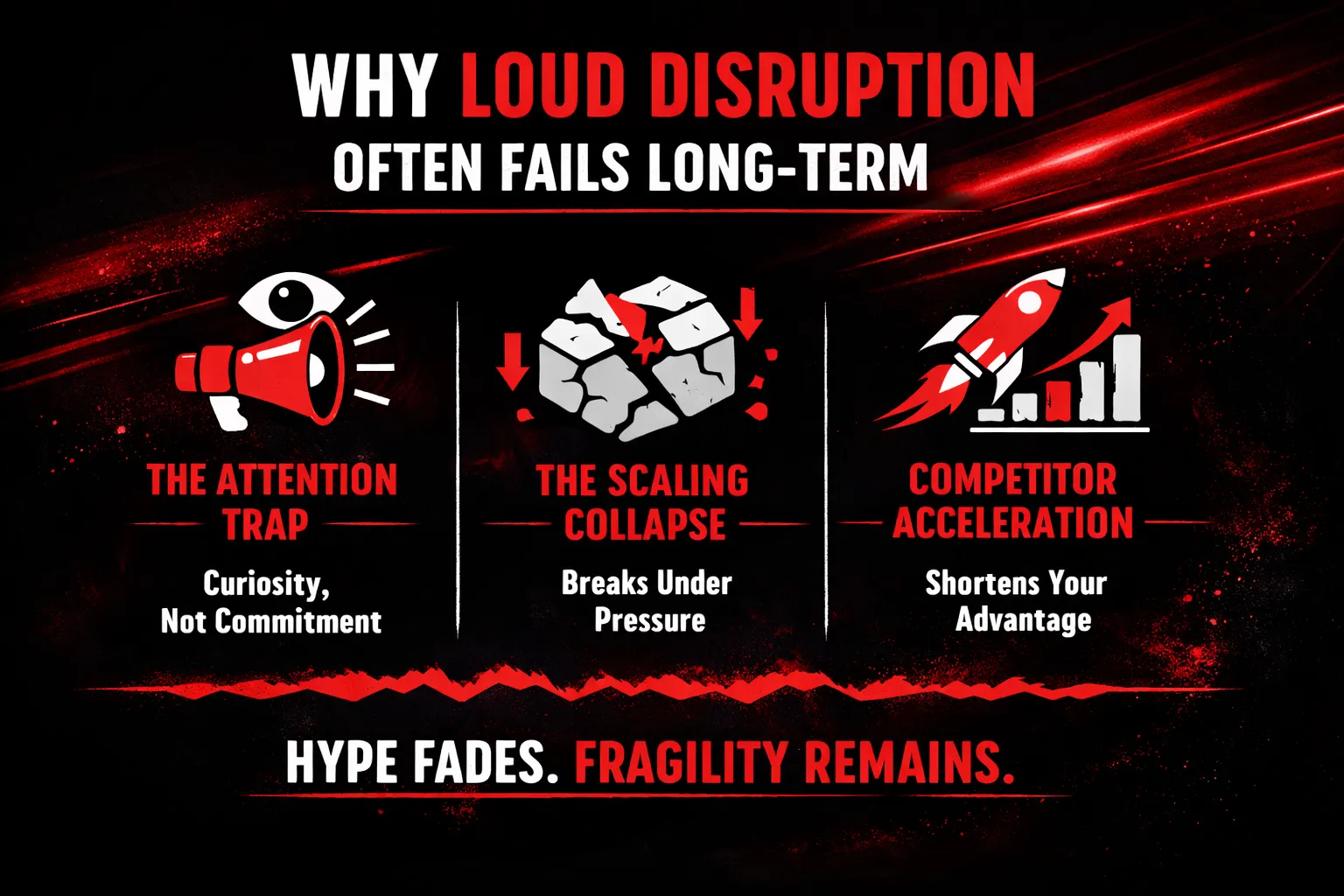
Loud disruption looks powerful in the beginning. It commands attention, dominates conversations, and creates the illusion of momentum. But over time, that same noise often becomes the very reason disruption collapses. History shows that companies obsessed with being heard struggle to remain relevant—while quieter players continue to compound strength.
The Attention Trap
In modern tech culture, attention is often mistaken for success. Launches go viral, demos trend on social platforms, and bold claims generate headlines. Yet attention is not adoption.
Noise attracts curiosity, not commitment. Curious users may explore a product, talk about it, or even trial it—but curiosity rarely translates into long-term dependency. Enterprises, in particular, do not build their operations on excitement. They build on trust.
For enterprise buyers, reliability outweighs novelty. They care less about who disrupted the market last quarter and more about who will still be dependable five years from now. Loud disruption optimizes for short-term visibility, but silent supremacy optimizes for long-term relevance.
When attention becomes the primary KPI, product decisions begin to favor optics over outcomes. The result is a system that looks impressive but lacks the depth required for sustained adoption.
The Scaling Collapse
Many disruptive products are engineered to impress in controlled environments—demos, pilot projects, or limited use cases. They perform well when stakes are low and scale is small. But real-world growth is unforgiving.
Systems built for demos often break at scale.
Underneath the polished messaging, technical shortcuts accumulate. Architectural compromises are justified to meet launch deadlines. Tech debt is quietly hidden behind marketing success. Everything appears fine—until growth applies pressure.
As adoption increases, cracks begin to show:
- Performance degrades
- Reliability drops
- Maintenance costs explode
- Feature velocity slows
Scaling doesn’t create these problems—it reveals them. Loud disruption accelerates exposure before foundations are ready. Silent supremacy, by contrast, delays visibility until systems are strong enough to withstand it.
Competitor Acceleration
Noise doesn’t just attract customers—it attracts competitors.
Every loud announcement educates the market. Roadmaps become public lessons. Differentiation becomes visible and, therefore, replicable. What begins as “first-mover advantage” quickly turns into “blueprint for others.”
The louder a company disrupts, the shorter its advantage window becomes.
Competitors don’t need to guess. They observe, adapt, and improve—often without the pressure of being first. Meanwhile, the original disruptor must keep shouting to stay relevant, spending more energy defending perception than deepening capability.
Silent players avoid this trap. By the time their presence is undeniable, competitors are already behind—not because they lacked awareness, but because they lacked time.
The Core Insight
Loud disruption wins moments. Silent supremacy wins markets.
The companies that last are rarely the ones that announce change the loudest—but the ones that quietly make alternatives irrelevant.
The Silent Supremacy Model: ThatWare’s Core Principles
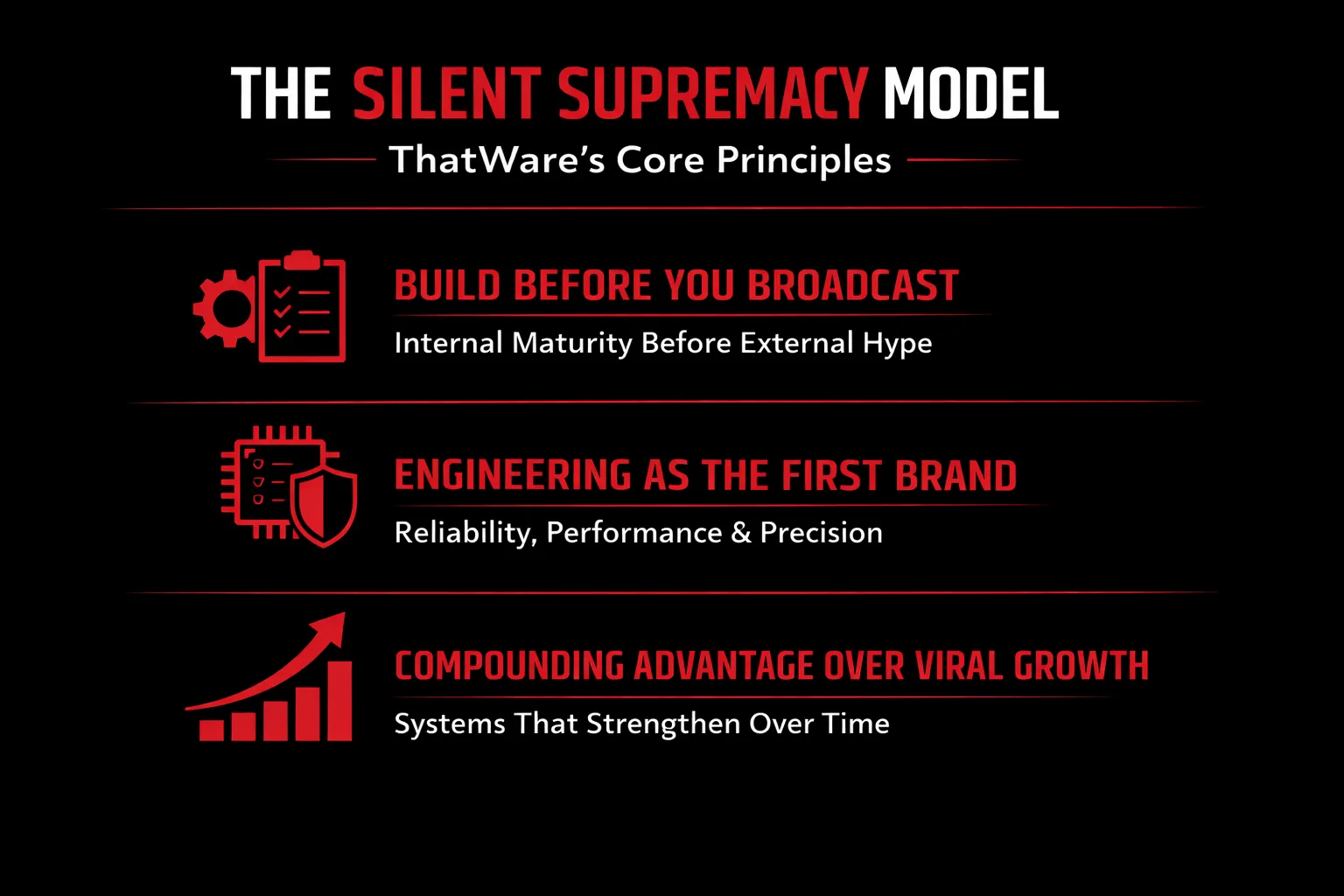
At ThatWare, supremacy is not a marketing milestone—it is an operational outcome. While many technology companies chase visibility first and stability later, ThatWare inverts the sequence. The result is a quiet but steadily widening advantage that compounds over time.
Build Before You Broadcast
ThatWare operates on a simple but uncommon discipline: internal maturity precedes external messaging.
Instead of rushing products to market wrapped in promises, ThatWare ensures solutions are battle-tested in real environments before they are ever promoted. Features are not validated in pitch decks or beta hype cycles, but through sustained real-world usage, edge-case exposure, and performance under pressure.
This approach does two critical things:
- It minimizes public retractions, rewrites, and roadmap reversals.
- It ensures that when ThatWare speaks, the product already speaks louder.
By the time a capability is communicated externally, it has already survived production realities—scalability challenges, data inconsistencies, and operational stress. What the market sees is not experimentation, but confidence backed by execution.
In a world addicted to early announcements, ThatWare’s restraint becomes a strategic weapon.
Engineering as the First Brand
At ThatWare, engineering is not a support function—it is the brand itself.
Reputation is built on:
- Systems that don’t fail when demand spikes
- Performance that remains consistent, not situational
- Precision that reduces friction instead of creating it
Rather than crafting narratives first and hoping engineering catches up, ThatWare allows technical excellence to define the narrative. Marketing, in this model, does not invent value—it amplifies value that already exists.
This philosophy produces a distinct outcome: trust.
Clients and partners associate the ThatWare name with reliability and depth, not slogans or surface-level innovation. Over time, this trust compounds into preference, and preference turns into dependence.
When engineering leads, branding becomes effortless—and credibility becomes irreversible.
Compounding Advantage Over Viral Growth
ThatWare does not optimize for viral moments; it optimizes for compounding systems.
Its platforms and solutions are designed to improve with:
- More data, enhancing accuracy, intelligence, and adaptability
- More use cases, increasing robustness and contextual intelligence
- More integrations, embedding ThatWare deeper into operational ecosystems
Each deployment strengthens the core system. Each iteration makes the technology smarter, harder to replace, and increasingly costly to replicate. Competitors may imitate features, but they cannot easily reproduce the accumulated intelligence, architectural maturity, and real-world learnings.
This is where silent supremacy takes hold.
Growth may appear slower on the surface, but beneath it lies an expanding moat—one built not on attention, but on dependency and performance. By the time competitors recognize the gap, ThatWare’s advantage has already become structural.
Silent supremacy is not accidental at ThatWare—it is engineered.
By building before broadcasting, letting engineering define the brand, and prioritizing compounding advantage over viral growth, ThatWare transforms restraint into dominance and patience into power.
The ThatWare Playbook for Silent Supremacy
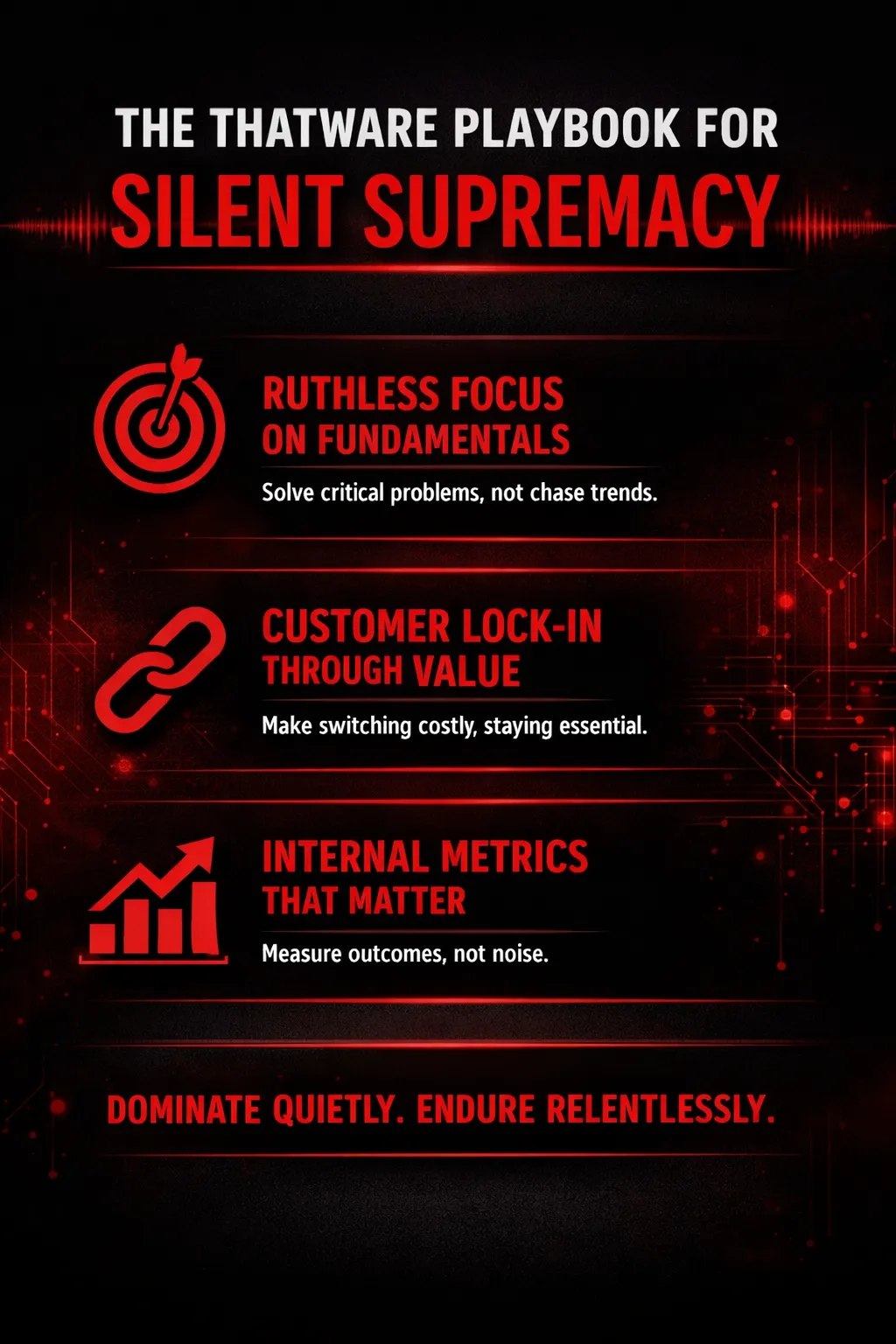
Silent supremacy is not accidental. It is engineered—deliberately, patiently, and often invisibly. At ThatWare, supremacy is the outcome of a disciplined playbook that prioritizes fundamentals over fanfare and long-term dominance over short-term applause.
Ruthless Focus on Fundamentals
ThatWare operates on a simple but often ignored truth: problem depth matters more than market noise.
While many organizations chase trending technologies, viral narratives, or surface-level differentiation, ThatWare goes deeper—into the core problems that businesses must solve to survive and scale. These problems are rarely glamorous. They don’t trend on social media. They don’t generate instant applause. But they are mission-critical.
This means:
- Solving infrastructure inefficiencies that silently drain performance
- Fixing data bottlenecks that limit decision-making
- Designing systems that work reliably under pressure, not just in demos
Trend-chasing is not rejected outright—but it is filtered ruthlessly. If a trend does not compound long-term value, strengthen the core system, or deepen the competitive moat, it is ignored. ThatWare’s philosophy is clear: relevance fades, fundamentals endure.
Customer Lock-In Through Value, Not Contracts
True lock-in is not enforced—it is earned.
ThatWare does not rely on restrictive contracts, artificial dependencies, or forced long-term commitments. Instead, clients stay because leaving is strategically and operationally costly.
Over time, ThatWare solutions become:
- Deeply embedded in workflows
- Optimized around specific business realities
- Critical to performance, efficiency, and continuity
Replacing such systems isn’t just a procurement decision—it’s a risk. Switching introduces uncertainty, operational regression, and potential downtime. The value ThatWare delivers becomes so seamlessly integrated that it fades into the background. And paradoxically, that invisibility is its greatest strength.
When value becomes invisible, it also becomes indispensable.
Internal Metrics That Matter
Silent supremacy requires a different scoreboard.
At ThatWare, success is not measured by likes, impressions, or announcement-day traction. Instead, internal metrics focus on what actually compounds dominance:
- System stability over time
- Operational efficiency gains
- Cost reduction and performance uplift
- Long-term return on investment
These are outcome metrics—not engagement metrics. They don’t spike overnight, but they accumulate relentlessly.
Only when results are proven, repeatable, and resilient does ThatWare consider sharing them externally. By then, success is no longer aspirational—it is undeniable.
Quiet success is measured internally first. By the time it’s visible externally, supremacy is already established.
Closing Insight for This Section
This playbook doesn’t optimize for applause—it optimizes for inevitability.
While others announce disruption, ThatWare builds systems that outlast it.
And by the time the market notices, the advantage is no longer debatable—it’s irreversible.
Supremacy Is Invisible Until It’s Unavoidable

Supremacy rarely arrives with an announcement. There is no launch event, no viral moment, no dramatic market declaration. Instead, it settles in quietly—so quietly that most don’t notice until opting out is no longer a realistic choice.
At first, the market doesn’t see a leader. It sees options.
Different tools, different vendors, different promises. Competition feels alive and healthy. Innovation appears fragmented. But beneath the surface, a subtle consolidation begins—one driven not by noise, but by reliability.
Over time, a pattern emerges.
Teams across industries begin relying on the same underlying infrastructure. Not because it was aggressively marketed, but because it consistently worked. It integrated smoothly. It scaled without friction. It solved problems without demanding attention.
The “quiet” player doesn’t dominate conversations—but it powers outcomes.
Critical workflows start depending on it. Data pipelines, decision systems, automation layers—pieces that are too important to fail. Once embedded, these systems don’t just support operations; they become operations. Replacing them no longer feels like an upgrade—it feels like a risk.
And that’s when the shift becomes visible.
Alternatives still exist, but they feel uncertain. Less battle-tested. Less predictable. Switching introduces questions no one wants to answer:
- Will performance degrade?
- Will reliability suffer?
- Will teams need to relearn what already works?
The cost of change outweighs the promise of novelty.
This is the moment supremacy reveals itself—not through dominance of attention, but through dominance of dependency.
Supremacy doesn’t announce itself. It doesn’t chase validation. It doesn’t need permission.
It becomes evident only when the market realizes that moving away feels harder than staying—and that no truly viable alternative offers the same level of trust, depth, and continuity.
By the time supremacy is acknowledged, it’s already irreversible.
Why Enterprises Trust Silent Leaders More
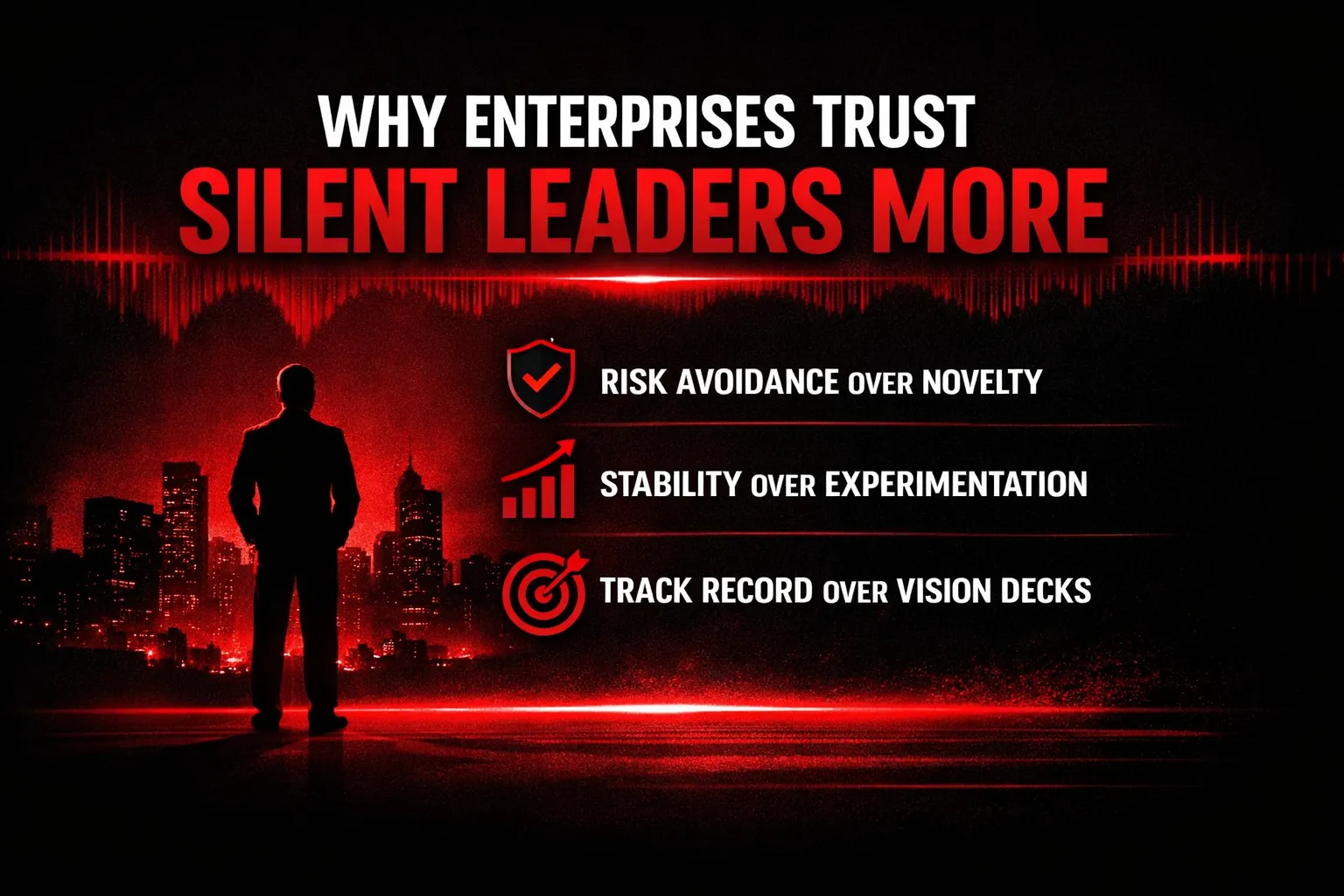
Enterprise buyers don’t shop the way startups do. They don’t buy because a product is “exciting,” or because a founder story is compelling, or because a pitch deck predicts a massive future. Enterprises buy because failure is expensive—and often public. In that world, loud disruption is a liability, while quiet, repeatable delivery becomes a signal of safety.
Enterprise buyer psychology: what actually drives “yes”
Risk avoidance > novelty
Enterprise leaders are rewarded for minimizing downside. A “new” solution is rarely a selling point on its own—because new also means untested, unpredictable, and hard to defend internally if something goes wrong. Even when innovation is desired, it must arrive packaged as reliability, not adventure. The real question is: Will this break anything critical?
Stability > experimentation
Enterprises don’t just need features—they need uptime, support, predictable rollout, governance, and performance under pressure. Experimentation sounds great until it lands in production, touches compliance, or impacts customers. The bar isn’t “does it work?” The bar is “does it keep working—at scale—under constraints—without surprises?”
Track record > vision decks
Vision matters, but it ranks below evidence. A strong roadmap is useful; a proven implementation is persuasive. Enterprises want to see:
- What you’ve delivered before
- How you handle edge cases
- How mature your processes are
- Whether results are measurable and repeatable
In short: they trust what’s been built and tested more than what’s promised.
ThatWare’s advantage: trust earned through delivery, not storytelling
This is where silent leadership becomes a competitive edge. ThatWare’s positioning isn’t about being the loudest voice in the room—it’s about being the most dependable partner in the system.
Trust earned through delivery, not storytelling
ThatWare builds credibility the enterprise way: through outcomes. When your product consistently performs, your implementations run smoothly, and your support model is real—not theoretical—you don’t need theatrics. The work speaks first. The story follows.
In enterprise environments, confidence compounds. Each successful deployment reduces perceived risk for the next one. Each solved problem becomes proof that you understand the messy realities of production: integrations, latency, security, change management, stakeholder coordination. That’s not glamour—that’s trust.
Long-term partnerships over transactional wins
Enterprises don’t want vendors. They want partners who can hold steady over time—through scale, internal re-orgs, shifting priorities, compliance changes, and market turbulence.
ThatWare’s approach aligns with that mindset:
- Fewer flashy promises, more consistent execution
- Practical alignment with business goals, not just feature checklists
- Systems built to last, not just impress during evaluation
Transactional wins are loud. Partnerships are quiet. But partnerships are what create irreversible advantage—because once an enterprise sees stable value delivered repeatedly, switching stops feeling like “an option” and starts feeling like “a risk.”
And that’s the moment silent supremacy becomes visible: not when everyone’s talking about you—but when decision-makers quietly decide they can’t afford to operate without you.
Silent Supremacy in the Age of AI & Automation

AI today is the loudest room in the technology world.
Every week brings a new announcement—bigger models, bolder claims, “game-changing” capabilities. Headlines move fast, demos look impressive, and promises sound limitless. Yet behind the noise, a quieter truth persists: very few AI initiatives ever reach production in a way that consistently delivers business value.
This is where the difference between loud disruption and silent supremacy becomes unmistakable.
AI as a Noise Magnet
AI has become a magnet for attention. Many companies race to attach “AI-powered” labels to products, rush out experimental features, and optimize more for visibility than viability. The result is a flood of proofs-of-concept that never mature into dependable systems.
The challenge isn’t building an AI demo—it’s building AI that:
- Works under real-world constraints
- Scales reliably across use cases
- Integrates seamlessly into existing workflows
- Produces outcomes that justify its cost and complexity
That level of maturity rarely makes headlines. It takes time, discipline, and a willingness to work quietly while others talk loudly.
ThatWare’s Approach: Quietly Making AI Work
ThatWare approaches AI and automation from a fundamentally different angle—utility before visibility.
Instead of asking “How do we showcase AI?”, the focus is on “Where does AI measurably improve operations?”
This means:
- Practical AI integration, embedded into real business processes rather than isolated experiments
- Production-grade systems designed for stability, governance, and long-term scalability
- Measurable operational gains, such as efficiency improvements, accuracy gains, cost reduction, or decision-speed enhancement
There is no rush to announce progress. AI features are validated in production, refined under real usage, and only then acknowledged externally—when outcomes speak louder than claims.
Why Silence Wins in AI Adoption
Enterprises don’t adopt AI because it’s impressive. They adopt it because it’s reliable, predictable, and valuable.
In high-stakes environments, noise creates doubt:
- Overpromised capabilities raise risk concerns
- Rapid pivots signal instability
- Constant announcements suggest unfinished systems
Silence, on the other hand, signals confidence. When AI works quietly in the background—improving processes without disruption—it earns trust. Over time, that trust turns into dependency, and dependency becomes dominance.
Key Insight
In AI, noise attracts attention. Silence attracts adoption.
ThatWare’s silent supremacy in AI isn’t about avoiding innovation—it’s about letting innovation mature before it speaks. In an era overwhelmed by AI headlines, the companies that quietly deliver real, irreversible value are the ones shaping the future.
And by the time the market notices, the advantage is already too deep to reverse.
How Founders and Tech Leaders Can Apply the Silent Supremacy Model
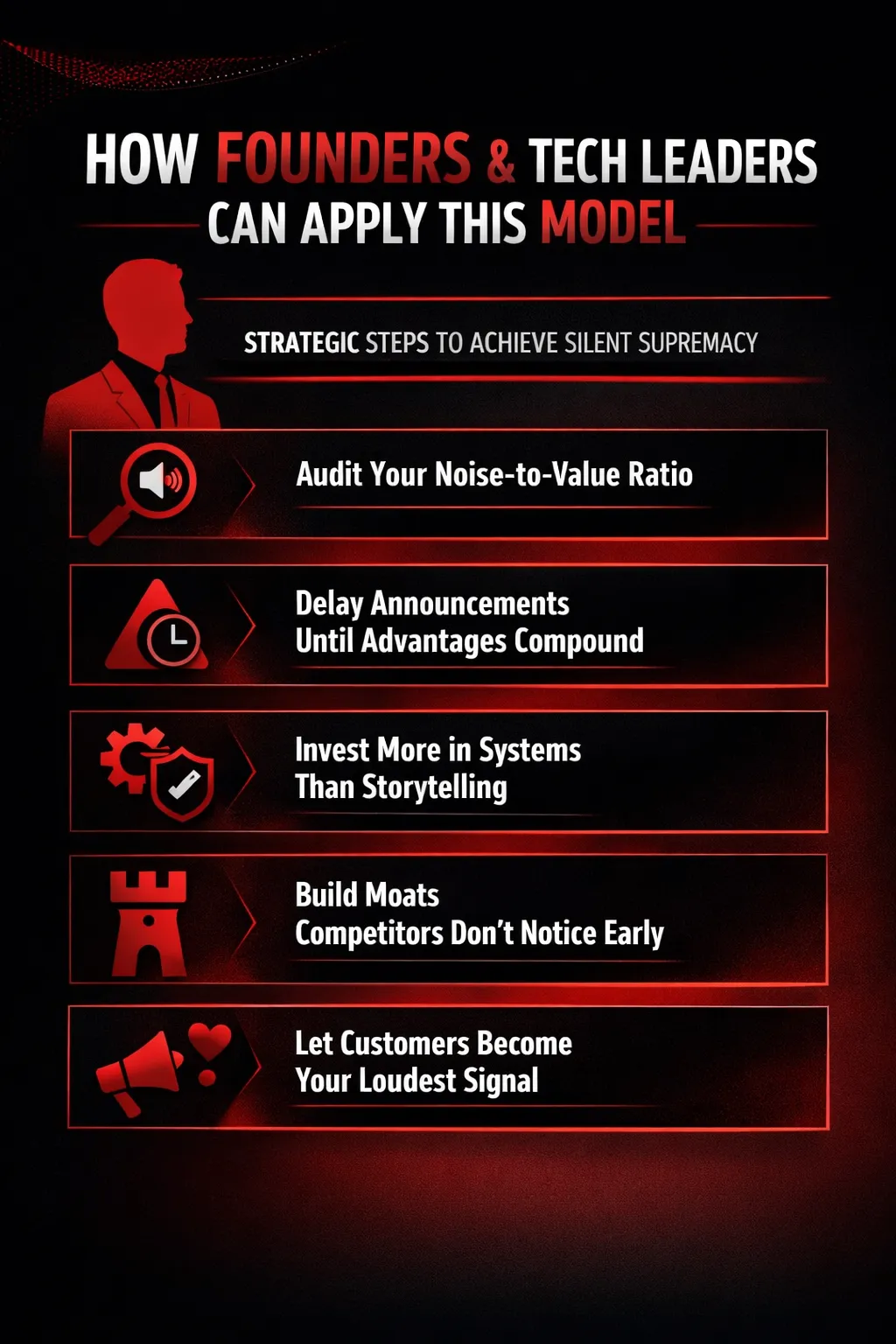
Silent supremacy isn’t an abstract philosophy—it’s an operating discipline. For founders and tech leaders, adopting this model means intentionally resisting the urge to be loud, fast, and visible, and instead optimizing for depth, durability, and inevitability. Below are practical ways to apply this mindset in real organizations.
Audit Your Noise-to-Value Ratio
Start by asking an uncomfortable question: How much of what we communicate actually reflects real value?
A high noise-to-value ratio shows up when marketing narratives run ahead of product maturity, when roadmaps are public before they’re stable, or when vanity metrics overshadow real outcomes. Silent leaders regularly audit this imbalance. They reduce outward communication that doesn’t map directly to delivered results and redirect energy toward strengthening what truly matters—performance, reliability, and customer impact.
If a feature disappeared tomorrow, would customers notice? If the answer is no, it’s probably noise.
Delay Announcements Until Advantages Compound
In a culture obsessed with speed, delaying announcements feels counterintuitive. But early visibility often weakens strategic advantage. Announcing too soon alerts competitors, fragments focus, and locks teams into premature promises.
Silent supremacy favors restraint. Founders wait until advantages are already compounding—when systems are battle-tested, workflows are embedded, and switching costs are real. At that point, announcements no longer invite competition; they merely confirm a lead that already exists.
The goal is not to surprise the market—it’s to make catching up impractical.
Invest More in Systems Than Storytelling
Stories are powerful, but systems are decisive. Long-term dominance is built on architectures, processes, and feedback loops that quietly outperform over time.
Tech leaders applying this model allocate disproportionate effort to:
- Scalable infrastructure
- Internal tooling and automation
- Data pipelines and decision systems
- Documentation and institutional memory
Storytelling becomes a byproduct, not a driver. When systems work exceptionally well, the story tells itself—through uptime, outcomes, and customer reliance.
Build Moats Competitors Don’t Notice Early
The strongest moats rarely look impressive at first glance. They are often hidden in workflows, integrations, habits, and accumulated context.
Silent leaders focus on advantages that:
- Improve with every customer interaction
- Require time, not money, to replicate
- Are deeply embedded in user operations
By the time competitors recognize these moats, they’re no longer features—they’re dependencies. Supremacy emerges not through confrontation, but through quiet entrenchment.
Let Customers Become Your Loudest Signal
The most credible signal in the market isn’t advertising—it’s customer behavior. Renewals, expansions, referrals, and long-term usage speak louder than any campaign.
Founders who embrace silent supremacy let customers do the talking. They prioritize outcomes so strong that users naturally advocate, integrate deeper, and resist switching. Instead of amplifying their own voice, they amplify customer success.
When customers depend on you, the market listens—without you saying a word.
Silent supremacy isn’t about avoiding visibility. It’s about earning it late—when dominance is already in motion. For founders and tech leaders, the shift is simple but difficult: stop trying to be seen early, and start building something that can’t be ignored later.
Noise fades. Systems endure. Supremacy follows.
Conclusion: Supremacy Is a Long Game
Disruption thrives on attention. It is designed to be seen, discussed, and amplified. It captures headlines, fuels debates, and creates moments of excitement. But history shows a consistent pattern: the companies that truly reshape industries are rarely the loudest at the beginning.
Disruption makes headlines. Supremacy makes history.
Supremacy is not built in bursts of visibility—it is built through years of disciplined execution, technical depth, and compounding advantage. It grows quietly, often unnoticed, while systems mature, trust deepens, and dependency forms. By the time the market fully recognizes it, the advantage is no longer theoretical—it is structural and irreversible.
That is the long game.
ThatWare does not chase noise or perform disruption for attention. It chooses patience over publicity, substance over spectacle, and long-term dominance over short-term validation. Every system built, every solution refined, and every partnership strengthened contributes to an ecosystem that becomes increasingly difficult to replace.
ThatWare doesn’t aim to disrupt loudly. It aims to dominate quietly—until the market realizes there’s no turning back.
Because true supremacy doesn’t announce itself. It endures.