
SUPERCHARGE YOUR ONLINE VISIBILITY! CONTACT US AND LET’S ACHIEVE EXCELLENCE TOGETHER!
The Quiet Collapse of Traditional SEO
For more than two decades, SEO has been built around a simple assumption: if you rank high enough, users will click. Search engines presented lists of links, brands competed for position, and visibility was measured in rankings, impressions, and traffic.
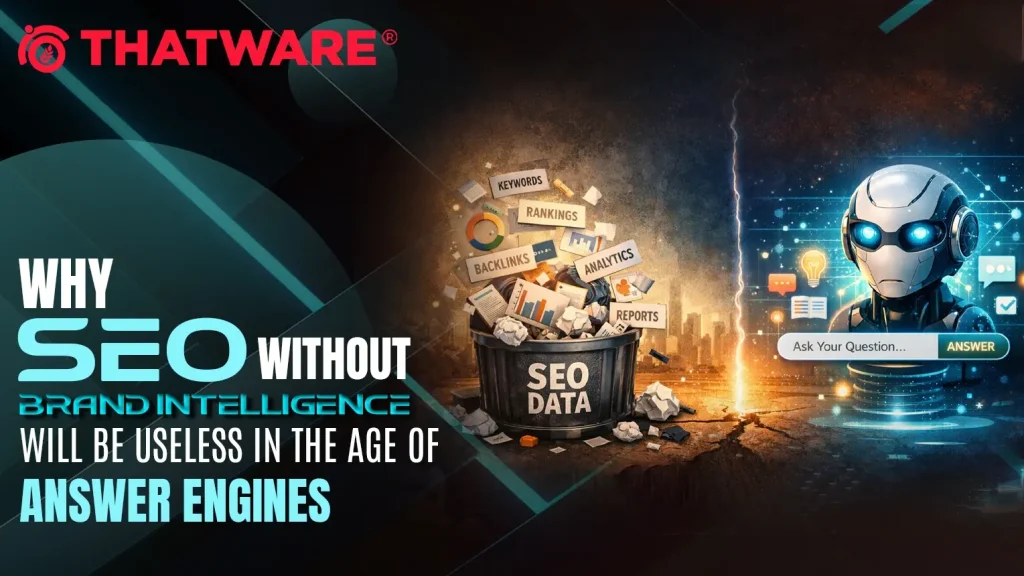
That assumption is now quietly breaking.
Search engines are no longer just gateways to websites. They are becoming answer engines—systems that synthesize information from multiple sources and deliver a single, confident response. Instead of ten blue links, users increasingly receive summaries, recommendations, or step-by-step answers generated directly by AI. In this environment, the goal is no longer to send traffic outward; it is to resolve the user’s question instantly.
This shift has a profound implication for SEO.
Ranking #1 no longer guarantees visibility. In many cases, it doesn’t even guarantee attribution. A brand can sit at the top of the search results and still be invisible if an answer engine extracts the insight, rewrites it, and presents it without a click. The page may “rank,” but the brand does not necessarily exist in the user’s experience.
This is where traditional SEO begins to collapse.
SEO has always been page-centric—optimizing URLs, keywords, metadata, and backlinks. But answer engines don’t think in pages. They think in entities, concepts, and trust. They don’t ask, “Which page should rank?” They ask, “Which understanding is most reliable?”
The core problem is simple but uncomfortable:
SEO optimized for pages fails when AI answers questions directly.
In an answer-driven ecosystem, success no longer depends on how well a page is optimized. It depends on whether the AI understands who your brand is, what it stands for, and whether it is safe to rely on. Without that layer of brand intelligence, even the best SEO becomes a short-term tactic in a long-term game it can’t win.
How Answer Engines Actually Work (And Why SEO Misunderstands Them)
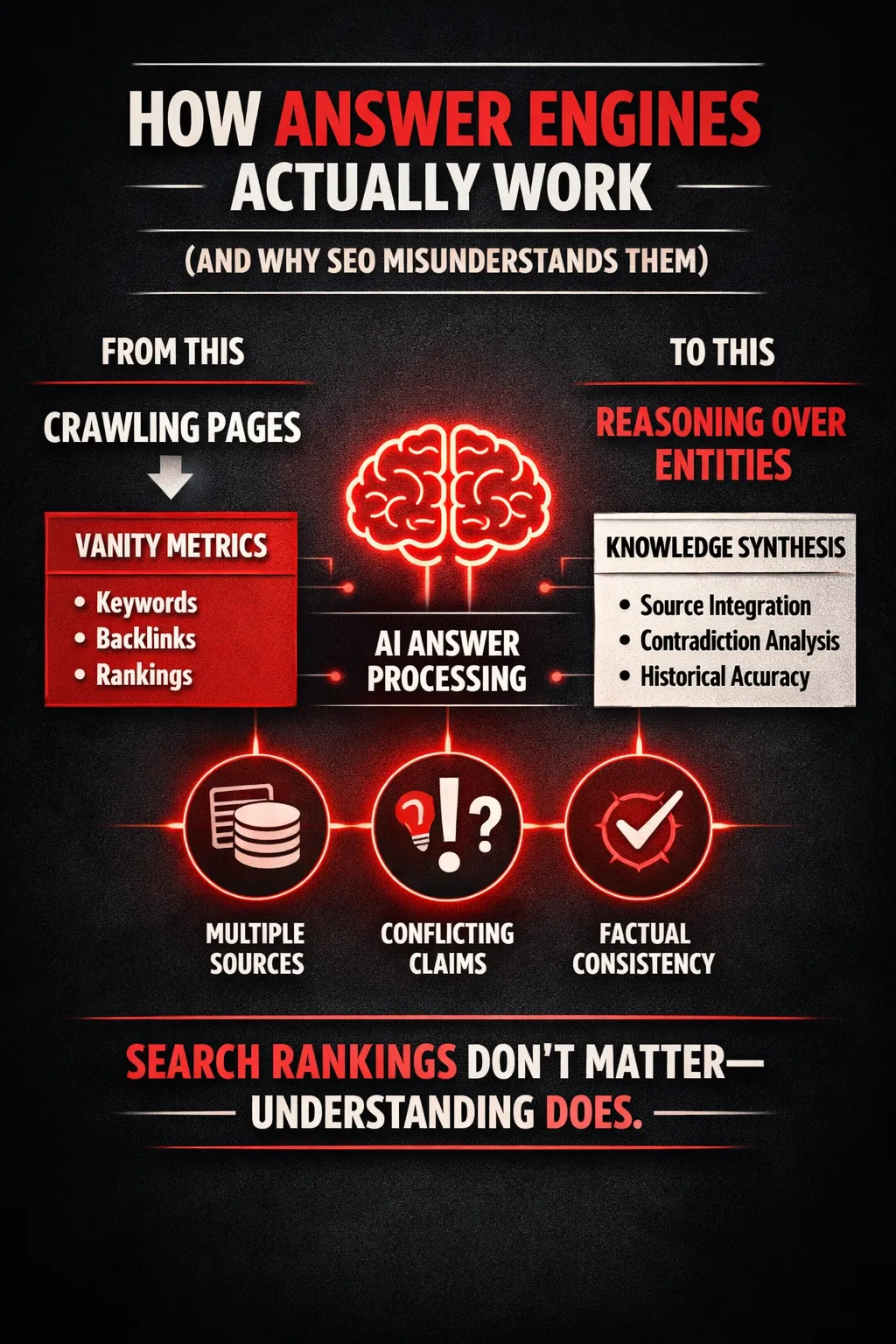
To understand why traditional SEO is breaking down, you first need to understand a fundamental shift that most marketers are still missing: answer engines do not operate like search engines.
Search engines were built to retrieve information.
Answer engines are built to reason over it.
That difference changes everything.
From Crawling Pages to Reasoning Over Entities
Traditional SEO assumes that visibility is earned by optimizing pages—URLs, titles, keywords, and backlinks. But answer engines don’t think in pages. They think in entities and relationships.
An entity can be:
- A brand
- A person
- A product
- A concept
- A problem domain
When an answer engine processes a query, it’s not asking:
“Which page should rank first?”
It’s asking:
“Which entities do I understand well enough to answer this confidently?”
Your website is no longer a destination. It’s training material. Every page, mention, and explanation feeds the model’s internal understanding of who you are and what you know.
If your brand is fragmented, inconsistent, or unclear, the machine doesn’t “rank you lower.”
It simply doesn’t understand you well enough to include you.
How Large Language Models Actually Synthesize Answers
Answer engines don’t pull a single source and reword it. They synthesize.
This synthesis happens across three critical dimensions:
1. Multiple Sources
LLMs cross-reference information from:
- Your website
- Third-party publications
- Reviews, forums, citations, and historical mentions
A brand that says one thing on its blog, another in PR, and something else on landing pages creates semantic noise. The result isn’t partial credit—it’s exclusion.
2. Conflicting Claims
When sources disagree, answer engines don’t pick the loudest or most optimized one. They evaluate:
- Consistency over time
- Agreement across trusted sources
- Clarity of explanation
If your claims aren’t reinforced elsewhere—or contradict your own content—your authority collapses inside the model.
3. Historical Accuracy
Answer engines remember patterns. They track:
- How long an entity has been associated with a topic
- Whether its expertise appears stable or opportunistic
- Whether explanations evolve logically or abruptly shift
This is why trend-chasing content often fails. You can’t suddenly “become” an authority in the eyes of an AI without historical grounding.
The Misunderstanding at the Heart of SEO
Most SEO strategies still assume that:
- Rankings equal relevance
- Traffic equals trust
- Optimization equals understanding
None of those assumptions hold in an answer-driven ecosystem.
Here’s the key insight most brands miss:
Answer engines don’t rank pages—they rank understanding.
If the model understands your brand clearly, it will:
- Cite you
- Reference you
- Use your explanations to construct answers
If it doesn’t, no amount of on-page optimization will save you.
This is why SEO without brand intelligence is becoming invisible. You’re optimizing surfaces while answer engines are evaluating depth, coherence, and comprehension.
In the age of answer engines, the real competition isn’t for position—it’s for mental real estate inside the machine.
The Breaking Point: Where Traditional SEO Tactics Collapse
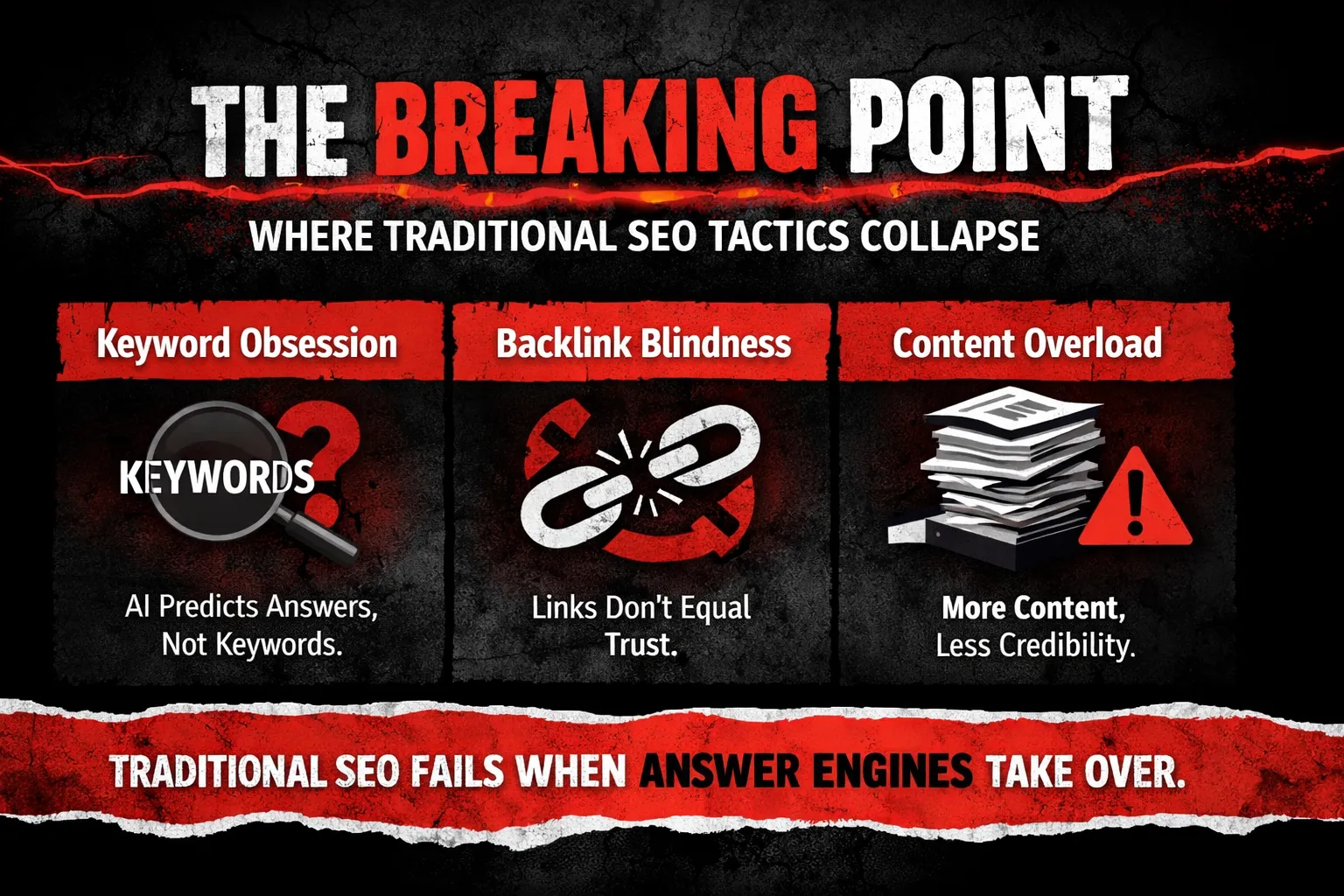
The rise of answer engines marks a structural breaking point for traditional SEO. Tactics that once delivered predictable results—keywords, backlinks, and content volume—are losing their power because AI systems do not retrieve information the way search engines do. They synthesize understanding. And that difference changes everything.
A. Keyword Optimization Loses Meaning
Search engines were built to match queries with documents. Answer engines are built to generate responses. They don’t look for keyword density or exact-match phrases—they predict the most accurate and coherent answer based on everything they’ve learned.
This is why keyword-heavy content is quietly failing.
When AI evaluates content, it looks for:
- Conceptual clarity
- Semantic completeness
- Logical explanation of a topic
A page repeating the same keyword 20 times signals nothing to an AI model if it doesn’t explain the concept well. In contrast, a page that uses natural language, related concepts, cause–effect reasoning, and clear definitions trains the model far more effectively—even if the primary keyword appears fewer times.
Keyword-stuffed content optimizes for machines that no longer exist.
Semantically coherent explanations optimize for machines that reason.
B. Backlinks Don’t Equal Trust Anymore
Backlinks once acted as votes of confidence. More links meant more authority. But answer engines don’t equate popularity with truth.
AI systems care less about who links to you and more about:
- Whether your claims match reality
- Whether your explanations remain consistent across the web
- Whether multiple trusted sources independently reinforce the same understanding
A highly linked page that contradicts established facts or shifts its narrative across articles weakens AI confidence. Meanwhile, a brand with fewer backlinks but high factual consistency across blogs, documentation, interviews, and third-party mentions becomes a safer source to quote.
In the age of answer engines:
- Trust is measured by reliability, not reach
- Consistency outweighs link volume
- Truth signals replace popularity signals
Backlinks still matter—but they are no longer the dominant trust currency.
C. Content Volume Stops Working
For years, SEO rewarded scale. Publish more. Cover more keywords. Win more queries.
Answer engines break that model.
AI doesn’t reward repetition—it penalizes confusion.
When brands flood the web with:
- Thin articles
- Overlapping posts
- Slightly rewritten versions of the same idea
They create fragmented knowledge. To an AI model, this looks like uncertainty, not authority.
Publishing more content does not make a brand more memorable.
It makes it harder for AI to form a clean, confident understanding of what the brand stands for.
In an answer-driven ecosystem:
- Fewer, deeper explanations outperform hundreds of shallow posts
- Coherent topic coverage beats scattered keyword targeting
- Being clearly understood matters more than being frequently published
Content volume without intelligence doesn’t build authority—it erodes it.
The Core Takeaway
Traditional SEO tactics collapse because they optimize for retrieval, not reasoning.
- Keywords don’t teach understanding
- Backlinks don’t guarantee trust
- Content volume doesn’t build memory
Answer engines reward brands that are clear, consistent, and explainable.
And without brand intelligence guiding SEO, even the best-optimized pages will slowly disappear—replaced by brands that taught the machine how to understand them.
The Core Shift: From Optimizing Pages to Training Machines
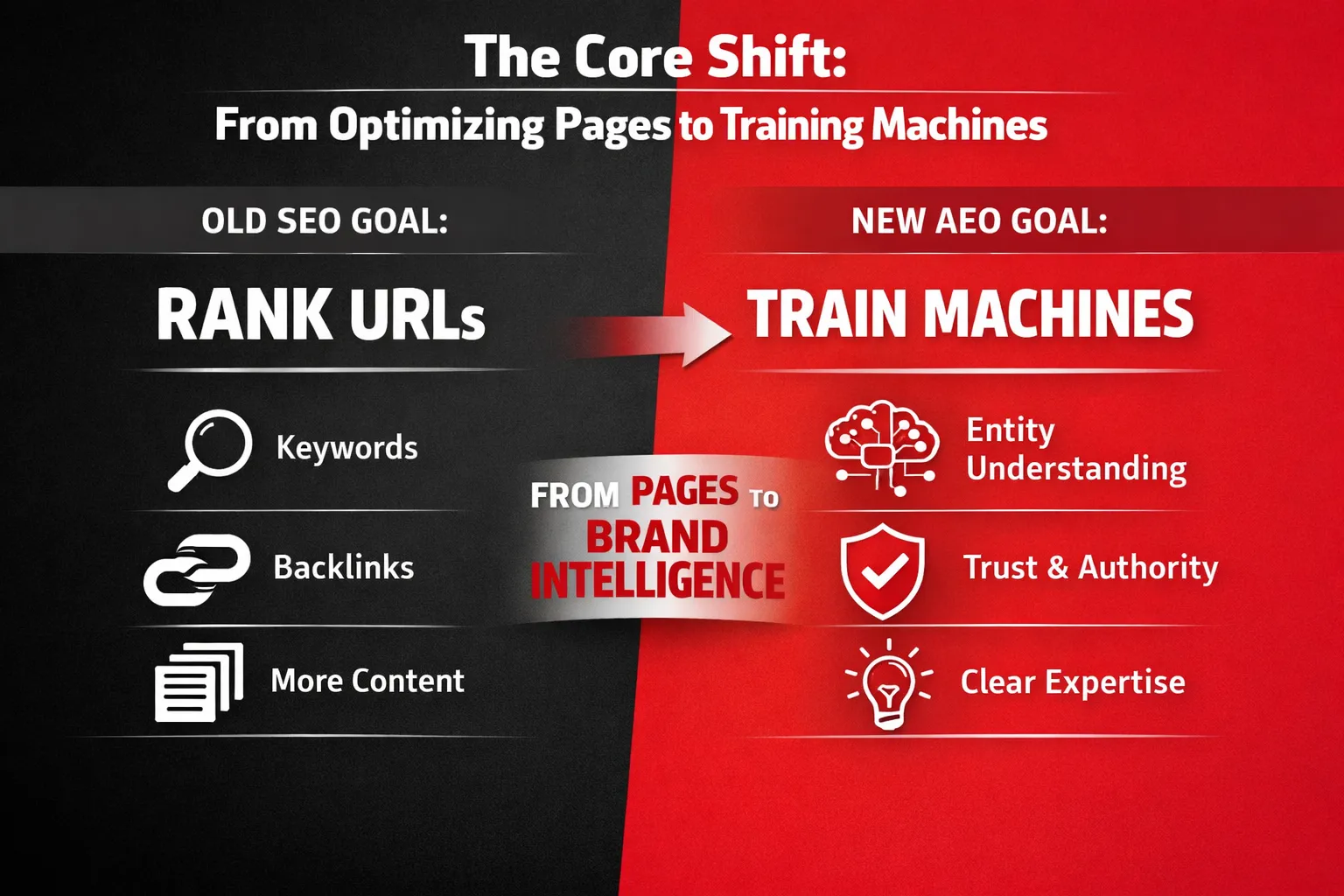
For more than two decades, SEO had a clear and narrow objective: rank URLs. Success meant placing individual pages in front of users who were actively searching, hoping those users would click, read, and convert. Pages were treated as endpoints, and traffic was the ultimate reward.
Answer engines break this model entirely.
The Old Goal: Ranking URLs
Traditional SEO assumes that search engines:
- Retrieve pages based on keywords
- Rank those pages using links and relevance
- Send users to those pages to find answers
In that world, optimizing meant tweaking title tags, building backlinks, and publishing more content than competitors. The page itself was the unit of value.
But answer engines don’t work this way.
The New Goal: Teaching Machines Who You Are
Answer Engine Optimization (AEO) shifts the objective from visibility to understanding.
The new goal is not to rank a page, but to teach machines:
- Who you are (your brand as a clear entity)
- What you do (your precise area of expertise)
- Why you’re trustworthy (consistency, accuracy, and authority over time)
When an AI system generates an answer, it isn’t choosing a page—it’s synthesizing knowledge. Brands that are clearly understood, consistently represented, and factually reliable are the ones that get cited, summarized, or silently embedded into answers.
If the machine doesn’t understand your brand, no amount of on-page optimization will save you.
Websites Are No Longer Traffic Funnels
In the age of answer engines, your website’s primary role has changed.
Your website is no longer just:
- A destination for clicks
- A conversion funnel
- A collection of landing pages
It is now training data.
Every page contributes to how AI systems:
- Interpret your expertise
- Resolve ambiguity about your offerings
- Decide whether your brand is safe to reference
This means fragmented messaging, contradictory claims, and shallow content don’t just underperform—they actively damage machine understanding. On the other hand, clear, structured, and coherent content strengthens your brand’s presence inside AI reasoning layers, even when no click happens.
The Strategic Implication
Optimizing pages helps humans navigate websites.
Training machines determines whether your brand exists in AI-generated answers at all.
In this new landscape, SEO becomes the foundation, not the strategy. The real competitive advantage comes from building brand intelligence that machines can learn from, trust, and reuse.
The brands that win won’t be the ones with the most optimized pages—but the ones with the clearest, most intelligible understanding in the mind of the machine.
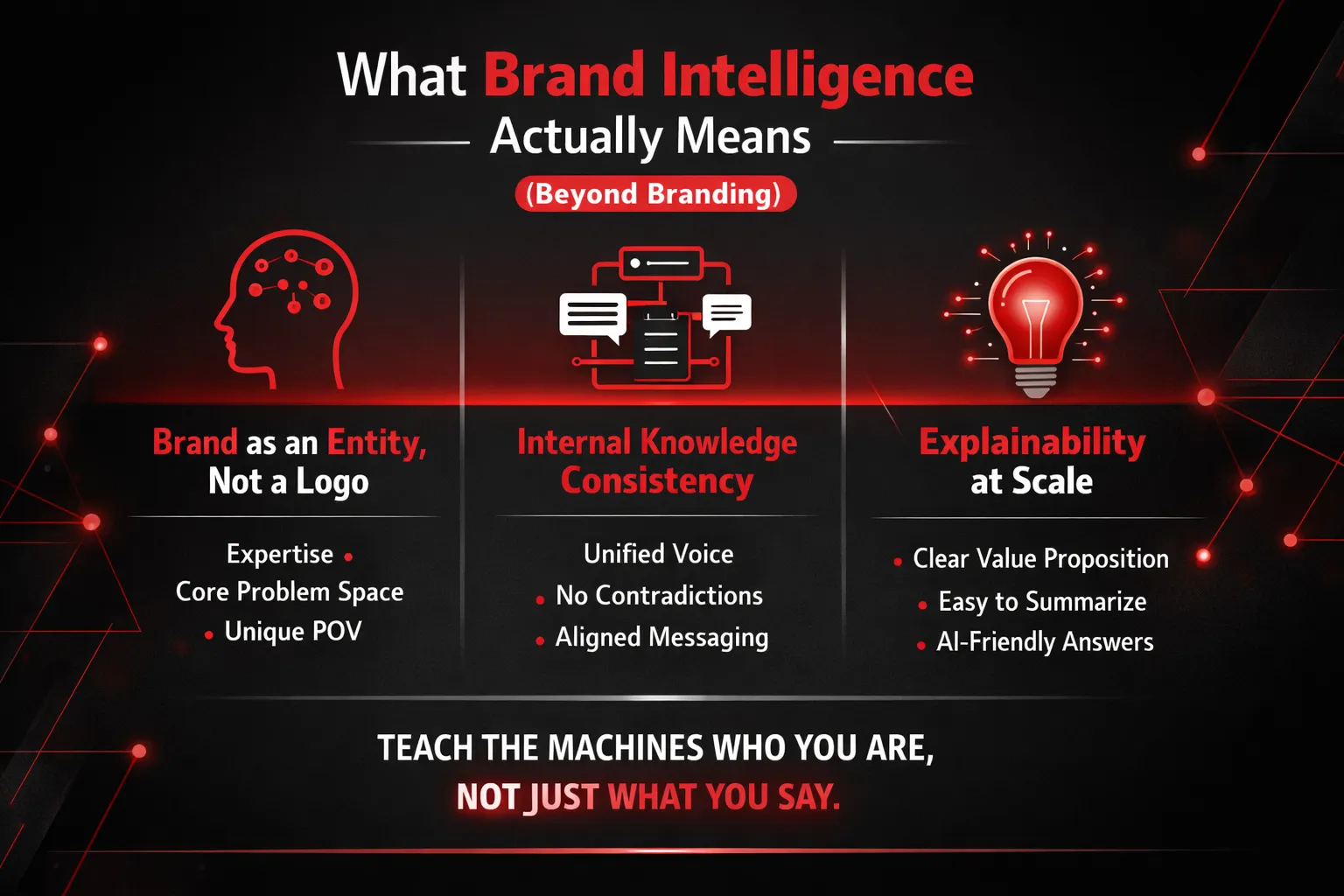
What Brand Intelligence Actually Means (Beyond Branding)
When most marketers hear the word branding, they think of logos, colors, taglines, and tone. Answer engines don’t.
For AI systems, a brand is not a visual identity—it’s an entity with meaning. Brand Intelligence is the sum total of how clearly, consistently, and reliably that meaning is expressed across the web.
A. Brand as an Entity, Not a Logo
In the age of answer engines, your brand is treated less like a company and more like a knowledge object.
AI models attempt to answer three fundamental questions about every brand they encounter:
- What is this brand an expert in?
- What specific problem space does it operate in?
- What makes its perspective distinct from others?
If these answers are vague, fragmented, or contradictory, the brand becomes hard to classify—and hard to trust.
Brand Intelligence begins with explicit definitions, not creative storytelling:
- A clear domain of expertise (not “we do everything”)
- A well-defined core problem the brand consistently addresses
- A unique point of view that shows up repeatedly in explanations, not slogans
Answer engines rely on entity understanding. If your brand cannot be clearly mapped to a specific knowledge area, AI has no reason to recall or cite it when synthesizing answers.
B. Internal Knowledge Consistency
One of the most overlooked aspects of Brand Intelligence is internal alignment.
Humans tolerate inconsistency. Machines don’t.
Answer engines cross-reference information across:
- Blog content
- Product and service pages
- PR articles and interviews
- Founder bios, podcasts, and social posts
When a brand sounds like multiple companies at once, it triggers uncertainty.
Examples of inconsistency that weaken AI confidence:
- Blogs claiming deep specialization while product pages position the brand as “full-service”
- Founder narratives emphasizing innovation while PR focuses on affordability
- Thought leadership content contradicting commercial messaging
To an AI system, these aren’t marketing nuances—they’re conflicting signals.
Brand Intelligence requires a single, coherent knowledge narrative:
- Same expertise, explained differently—but never contradicted
- Same problem space, reinforced across formats
- Same strategic viewpoint, regardless of channel
Consistency is not about repetition. It’s about semantic alignment.
C. Explainability at Scale
Answer engines compress information. That compression is unforgiving.
If your brand cannot explain:
- What it does
- Who it serves
- Why it’s different
…in clear, unambiguous language, AI will either oversimplify you—or ignore you entirely.
This is where many brands fail.
They rely on:
- Abstract positioning statements
- Buzzwords without definitions
- Differentiation that only makes sense internally
AI doesn’t infer intent. It summarizes patterns.
Brands that survive are those that are explainable at scale:
- Their value proposition survives being reduced to a paragraph
- Their expertise remains intact when condensed into a sentence
- Their point of view is recognizable even without their name attached
Answer engines don’t showcase brands—they summarize them.
Only the clearest summaries get reused.
Brand Intelligence is not about looking good to humans.
It’s about being understandable, consistent, and trustworthy to machines.
In the age of answer engines, brands don’t win by shouting louder.
They win by being easier to understand than everyone else.
Why SEO Alone Creates Invisible Brands in Answer Engines
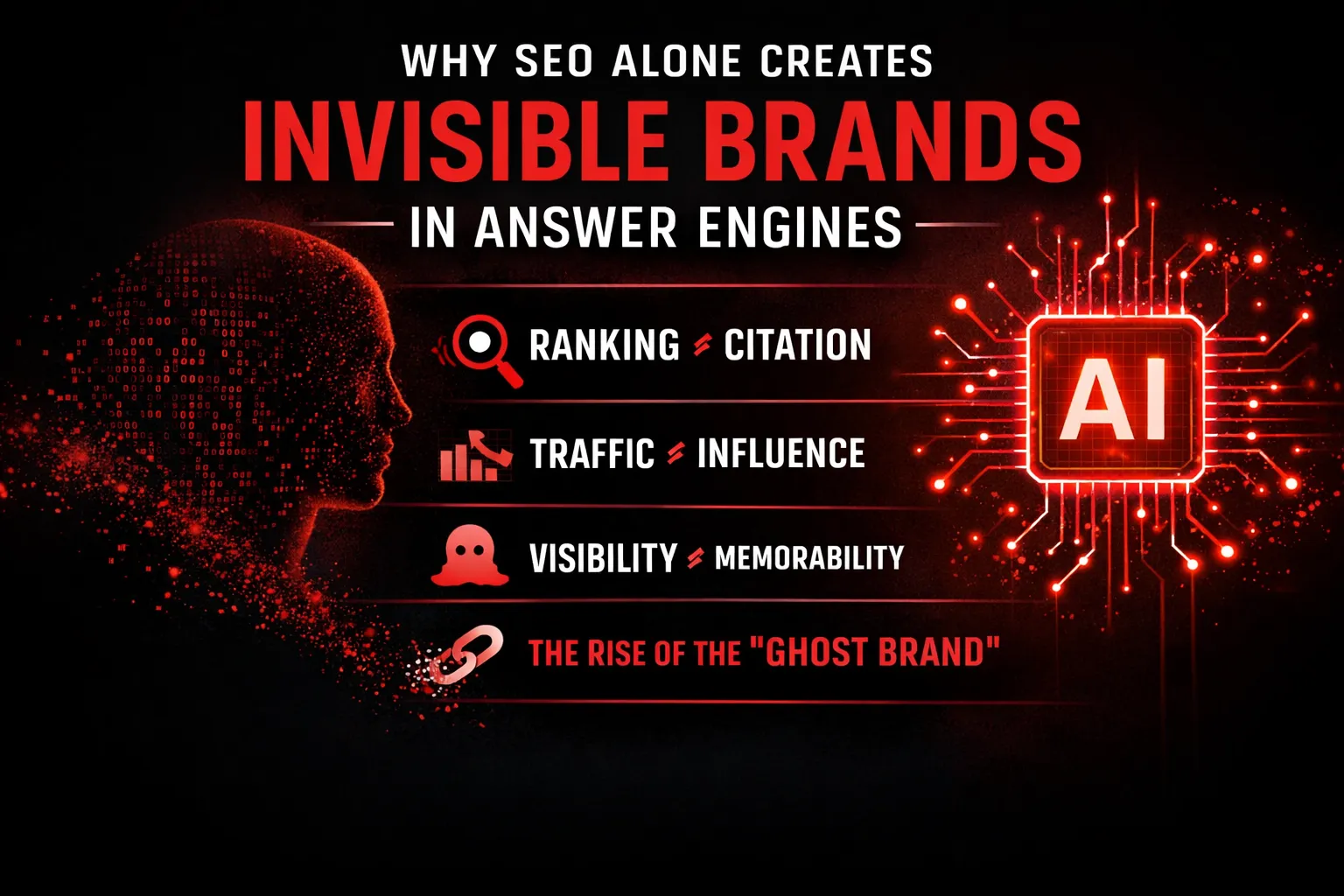
For years, SEO trained brands to chase visibility. Rank higher, get more clicks, drive more traffic. In the age of answer engines, that entire logic breaks down. Visibility still exists—but it no longer guarantees recognition, recall, or influence.
This is where most SEO-first brands become invisible.
Ranking ≠ Citation
Answer engines don’t reward the top-ranking page; they reward the most reliable understanding.
A page can rank #1 on Google today and still be:
- Ignored in AI-generated answers
- Paraphrased without attribution
- Replaced by a clearer, more consistent source
Why? Because answer engines synthesize information across multiple inputs. If your brand is optimized only to rank—not to teach—the model has no reason to cite you. You become a background data point, not a source.
In short: ranking helps discovery, not remembrance.
Traffic ≠ Influence
Traffic was once a proxy for authority. If users visited your site, you mattered.
Answer engines don’t care about traffic at all.
Influence in AI systems is determined by:
- Accuracy over time
- Consistency across contexts
- Clarity of explanation
A brand with modest traffic but high informational coherence can shape AI answers far more than a high-traffic site filled with generic or contradictory content.
In the AI era, influence happens before the click—inside the model’s reasoning layer.
Visibility ≠ Memorability
Traditional SEO creates surface-level exposure. Answer engines require deep imprinting.
If your brand:
- Explains the same concept differently across pages
- Lacks a clear point of view
- Blends into industry sameness
…the AI may “see” you but won’t remember you.
Answer engines compress brands into summaries. If your expertise can’t survive compression, it disappears. Memorability is no longer a branding exercise—it’s a machine cognition problem.
The Rise of the “Ghost Brand”
This leads to a new and dangerous phenomenon: the ghost brand.
Ghost brands:
- Rank well in traditional search
- Publish consistently
- Follow SEO best practices
- Yet never appear in AI answers
They are visible to crawlers but invisible to reasoners.
Today they rank.
Tomorrow they vanish—because answer engines don’t recognize them as distinct, trustworthy entities.
SEO alone creates presence.
Brand intelligence creates permanence.
In the age of answer engines, being found is no longer enough.
If your brand isn’t cited, remembered, and trusted by AI, it effectively doesn’t exist—no matter how well it ranks.
That’s the cost of relying on SEO without intelligence.
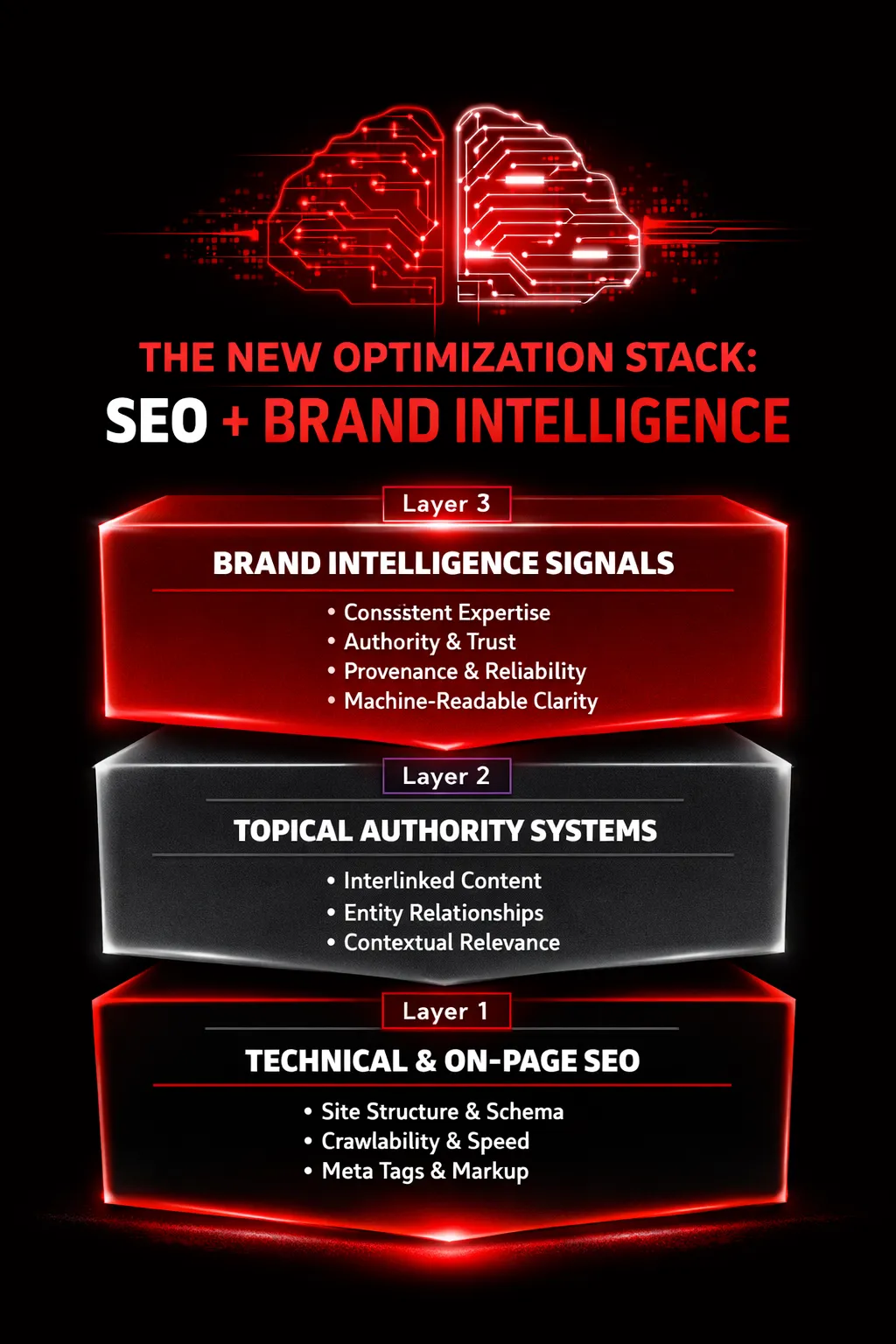
The New Optimization Stack: SEO + Brand Intelligence
In the age of answer engines, optimization is no longer a single discipline. It’s a stack.
Traditional SEO focused on making pages visible. Answer engines focus on making brands understandable. The brands that survive are the ones that build both—without confusing one for the other.
This new stack has three distinct layers. Ignore any one of them, and your visibility collapses—either technically, semantically, or cognitively inside the AI model.
Layer 1: Technical & On-Page SEO
(Still Necessary. No Longer Sufficient.)
Technical SEO remains the entry ticket to the game—but it no longer wins the game.
Answer engines still depend on:
- Crawlability and indexability
- Clean site architecture and internal linking
- Structured data and schema markup
These elements ensure your content can be accessed and parsed. But access alone doesn’t equal influence.
A perfectly optimized page that lacks clarity, authority, or coherence becomes machine-readable but machine-ignorable.
In other words:
Technical SEO helps AI see your content.
It does not help AI trust or prefer your brand.
This is where most SEO strategies stall—and eventually fail.
Layer 2: Topical Authority Systems
(From Pages to Knowledge Ecosystems)
Answer engines don’t learn from isolated articles.
They learn from patterns of understanding.
This is where topical authority evolves into something more powerful: interconnected content ecosystems.
Instead of keyword silos, brands must build:
- Deep topic clusters
- Logical content hierarchies
- Clear relationships between concepts
The goal is no longer to rank for “best X” or “how to Y.”
The goal is to teach the model:
- What you specialize in
- How concepts relate to each other
- Where your brand fits in the broader knowledge graph
This shift replaces:
- Keyword repetition → Entity reinforcement
- Content volume → Conceptual depth
- Isolated wins → Systemic authority
When done right, AI doesn’t just retrieve your content—it recognizes your brand as a reference point.
Layer 3: Brand Intelligence Signals
(The Decisive Layer)
This is the layer traditional SEO completely misses—and answer engines prioritize most.
When AI synthesizes answers, it implicitly asks:
- Is this source consistently correct?
- Does this brand have a clear point of view?
- Can I summarize this brand without ambiguity?
- Has this entity proven trustworthy over time?
These are Brand Intelligence Signals.
They include:
• Consistent Expertise
Your brand must demonstrate repeatable competence across all content, not occasional insight. One great article doesn’t train a model—patterns do.
• Authoritative Point of View
Neutral content gets blended.
Distinct perspectives get cited.
Answer engines reward brands that take clear positions within their domain.
• Provenance and Trustworthiness
Who is speaking?
Why should they be believed?
AI increasingly weighs author credibility, brand history, and factual consistency across sources.
• Machine-Readable Clarity
If your brand positioning requires interpretation, AI will reinterpret it—and likely dilute it.
Clarity is not a branding luxury anymore; it’s a ranking factor inside reasoning layers.
The Strategic Shift Most Brands Haven’t Made
SEO optimizes where you appear.
Brand Intelligence determines whether you’re used.
Answer engines don’t just surface content—they decide. And those decisions are based less on optimization tricks and more on how well a brand can be understood, trusted, and compressed into an answer.
The future belongs to brands that stop asking:
“How do we rank this page?”
And start asking:
“How do we train the machine to recognize us as the answer?”
Real-World Implication: Who Wins and Who Disappears
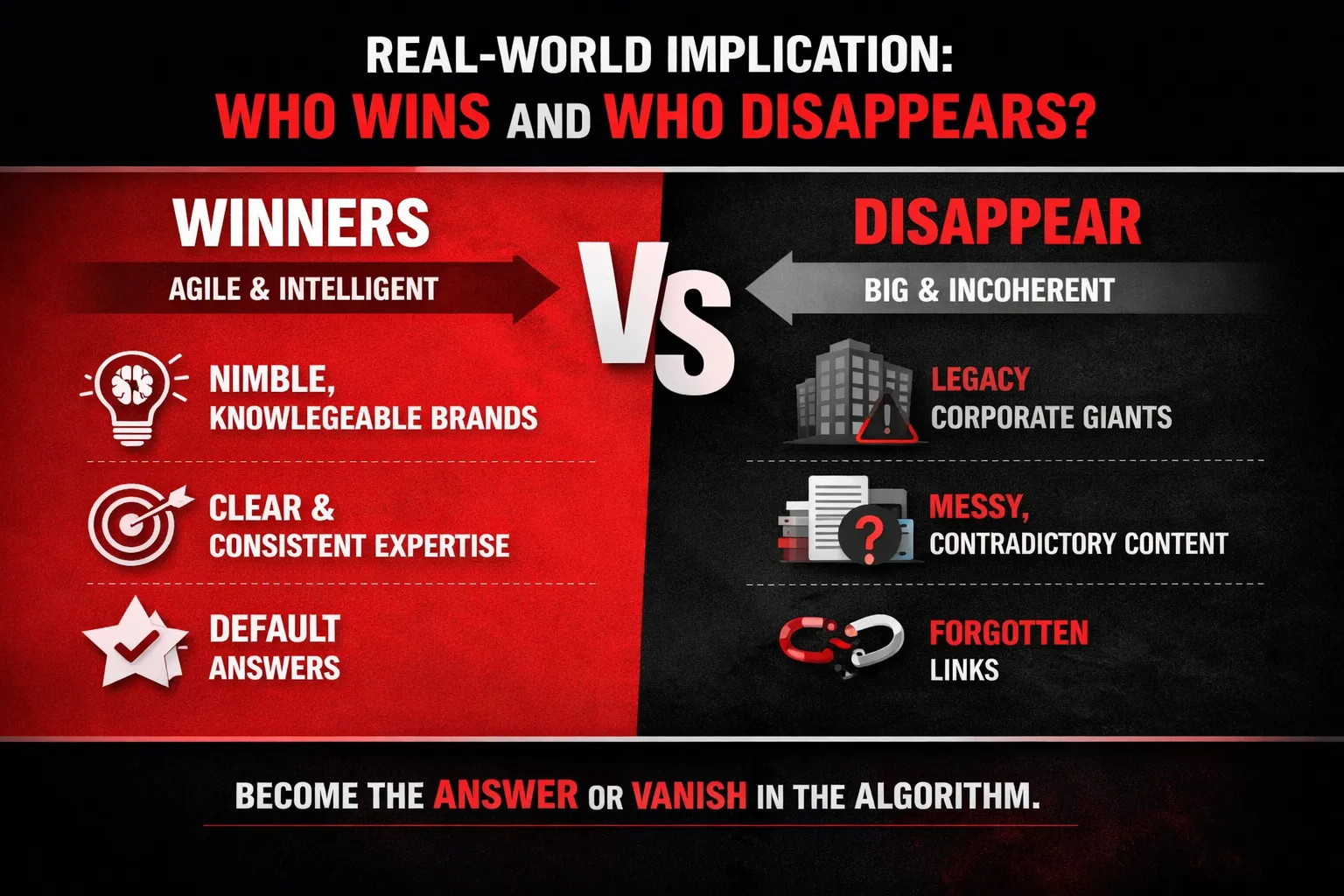
The shift from search engines to answer engines is not a level playing field. It is a filtering event. Some brands will quietly become the default answers users receive, while others—despite years of SEO investment—will fade into irrelevance.
The difference is not budget or brand size.
It is intelligence.
Small, Intelligent Brands vs. Large but Incoherent Brands
Answer engines don’t reward scale the way traditional search did. They reward coherence.
Large brands often suffer from:
- Fragmented messaging across teams and regions
- Inconsistent explanations of what they do and why they matter
- Legacy content created for keywords, not understanding
From an AI’s perspective, these brands look contradictory. And contradiction reduces confidence.
Smaller brands, on the other hand, often have:
- A clearly defined niche
- A tight, repeatable point of view
- Consistent language across content, product, and thought leadership
To an answer engine, this clarity is gold. It’s easier to understand, easier to summarize, and easier to trust. As a result, smaller but more intelligent brands are increasingly being chosen over larger names when AI synthesizes answers.
Why Agility and Clarity Beat Legacy Authority
Traditional SEO rewarded historical authority—age, backlinks, and domain strength. Answer engines prioritize something different: reasoning confidence.
AI systems constantly reconcile:
- Conflicting claims
- Outdated information
- Shifting industry narratives
Brands that adapt quickly, update their explanations, and maintain internal consistency send a powerful signal: this source understands the present, not just the past.
Legacy authority without clarity becomes a liability. Old content that contradicts new messaging weakens AI trust. Slow-moving brands that can’t align teams or update narratives in real time fall behind—not because they lack authority, but because they lack alignment.
In the age of answer engines, the fastest learner—not the oldest brand—wins.
Brands That Become Default Answers, Not Optional Links
In traditional search, brands competed to be clicked. In answer engines, brands compete to be included.
There is a crucial difference.
- Optional links live below the answer, rarely visited
- Default answers shape user perception instantly
When an answer engine consistently references a brand’s framework, definition, or explanation, that brand becomes the mental shortcut for the category. Users stop asking “who else?” because the answer already feels complete.
These brands don’t chase traffic.
They shape understanding.
The winners in this new ecosystem are not those with the most pages or the highest rankings—but those whose intelligence is so clear that AI models naturally reach for them when constructing answers.
In short: Answer engines don’t eliminate competition—they compress it. And only brands that are clear, coherent, and intelligent enough to be trusted at the synthesis layer will survive the transition.
How to Future-Proof SEO for the Age of Answer Engines
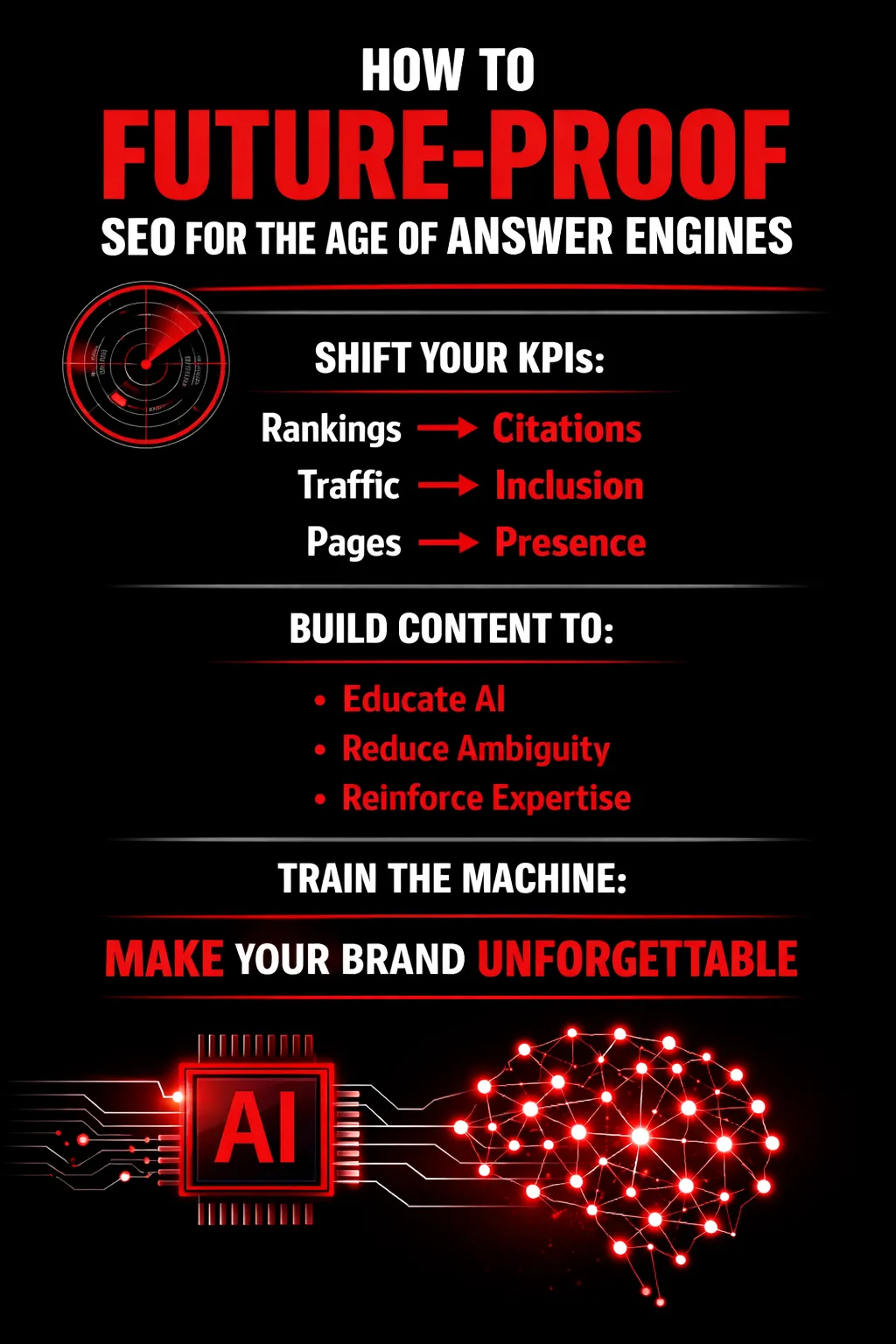
Future-proofing SEO no longer means outsmarting algorithms—it means becoming understandable, trustworthy, and usable to AI systems that generate answers instead of ranking links.
The brands that survive this transition are not those with the most pages, but those with the strongest machine-level presence.
1. Shift the KPIs That Define Success
Traditional SEO KPIs were built for a world where users clicked links. Answer engines are removing that behavior entirely.
To stay relevant, brands must redefine what “winning” looks like.
Rankings → Citations
In answer engines, visibility is binary:
Either your brand is used in the answer, or it doesn’t exist.
- Ranking #1 means nothing if AI synthesizes an answer without naming you
- The new success metric is how often your brand is cited, referenced, or implied
- Being a source matters more than being a result
If AI consistently pulls from your explanations, frameworks, or definitions, you’ve won—regardless of position.
Traffic → Inclusion
Answer engines often satisfy user intent without sending traffic at all.
That doesn’t mean your influence disappears—it means it shifts.
- Traffic is a lagging indicator
- Inclusion in AI responses is the leading one
- Brands must optimize for participation in answers, not visits
The real question is no longer “Did they click?”
It’s “Did the AI include us when explaining this topic?”
Pages → Presence
AI doesn’t think in URLs—it thinks in entities and concepts.
- Pages are containers
- Presence is recognition
- A brand with 10 clear, connected pages can outperform one with 1,000 isolated ones
What matters is whether the AI understands:
- Who you are
- What you specialize in
- Where your authority begins and ends
That understanding is presence—and presence is the new ranking.
2. Build Content That Works With AI, Not Against It
Answer engines don’t reward volume, cleverness, or keyword tricks.
They reward clarity, consistency, and correctness.
To future-proof SEO, content must be designed to train AI systems—not manipulate them.
Educate AI, Not Just Users
Every piece of content should answer a simple question:
What does this teach an AI model about our brand?
High-performing AI-era content:
- Explains concepts cleanly
- Defines terms explicitly
- Uses structured reasoning instead of vague claims
Think of your website as a knowledge base, not a blog.
Reduce Ambiguity at Every Level
AI struggles with:
- Contradictory messaging
- Overlapping positioning
- Broad, undefined claims
Brands must:
- Narrow their expertise
- Use consistent language across pages
- Avoid saying different things in different places
Ambiguity weakens trust.
Clarity strengthens machine confidence.
Reinforce Expertise Through Systems, Not Articles
Answer engines don’t learn from single posts—they learn from patterns.
Expertise is reinforced when:
- Topics are covered from multiple angles
- Internal linking strengthens conceptual relationships
- One idea consistently points back to the same brand entity
This is why content systems beat content campaigns in the AI era.
The Bottom Line
Future-proof SEO isn’t about chasing the next algorithm update.
It’s about becoming the easiest, safest, and most reliable brand for AI to understand and reuse.
The brands that win will:
- Stop optimizing pages
- Start building presence
- Shift from SEO tactics to Brand Intelligence systems
Because in the age of answer engines,
if AI doesn’t understand you, it won’t choose you—and it definitely won’t mention you.
Conclusion: SEO Is Not Dead—But SEO Without Intelligence Is
SEO isn’t disappearing—but its role has fundamentally changed.
In the age of answer engines, SEO is no longer the strategy that determines whether a brand wins or loses. It has become the delivery system: the technical foundation that allows content to be discovered, parsed, and processed. Necessary, yes. Sufficient, no.
What determines survival now is Brand Intelligence.
Answer engines don’t simply retrieve pages—they synthesize understanding. They decide which brands are coherent enough to trust, consistent enough to remember, and authoritative enough to reference. Without a clear, intelligent brand signal behind your SEO efforts, your content may still be crawled—but it won’t be cited, recalled, or prioritized when answers are generated.
This is the new fault line:
- SEO ensures your content can be seen by machines
- Brand Intelligence determines whether machines believe you
Brands that rely solely on rankings, keywords, and backlinks will slowly fade into irrelevance—not because they did SEO wrong, but because they optimized for an ecosystem that no longer exists. Meanwhile, brands that invest in clarity, consistency, and explainability will become the default answers, even when no links are shown.
The final takeaway is simple but uncomfortable:
You’re no longer optimizing for search engines—you’re training answer engines.
And only brands with intelligence will survive that transition.