SUPERCHARGE YOUR ONLINE VISIBILITY! CONTACT US AND LET’S ACHIEVE EXCELLENCE TOGETHER!
For years, SEO agencies have been sold a dangerous lie: every company needs SEO all the time.
On paper, that sounds logical. Search drives demand, visibility fuels growth, and rankings matter. But in the real world, this belief is exactly why most SEO agencies struggle with low-quality leads, endless price objections, and unresponsive prospects.

The truth is far less comfortable—but far more profitable.
Most companies do not actively want SEO. They tolerate it, postpone it, or ignore it completely—until something breaks, changes, or threatens their growth. SEO is rarely purchased out of curiosity. It’s purchased out of urgency.
In 2026, this gap has only widened. Generic cold outreach no longer works the way it once did. Decision-makers are flooded daily with identical messages offering free SEO audits, guaranteed rankings, and “quick wins.” The result? Total message blindness. Even good agencies sound interchangeable. Even strong offers get ignored—not because SEO isn’t valuable, but because the timing is wrong.
This is where most agencies lose.
The agencies that win are not louder. They are earlier and more relevant. They understand when a company suddenly becomes ready to buy SEO—and they show up at that exact moment.
These moments are called SEO-Triggered Events.
An SEO-Triggered Event is a specific business situation that creates immediate pressure for visibility, traffic, or recovery. It’s when leadership attention shifts, budgets unlock, and SEO moves from “later” to “right now.” These events turn passive companies into high-intent buyers.
In this guide, you’ll learn:
- Where real SEO buyers actually exist in 2026
- How to identify SEO buying signals before your competitors do
- How to position SEO as a solution to urgent problems—not just another service
If you stop chasing companies that might need SEO someday, and start targeting companies that need it now, your entire client acquisition game changes.
Section 1: Why Most SEO Agencies Never Find Real Buyers
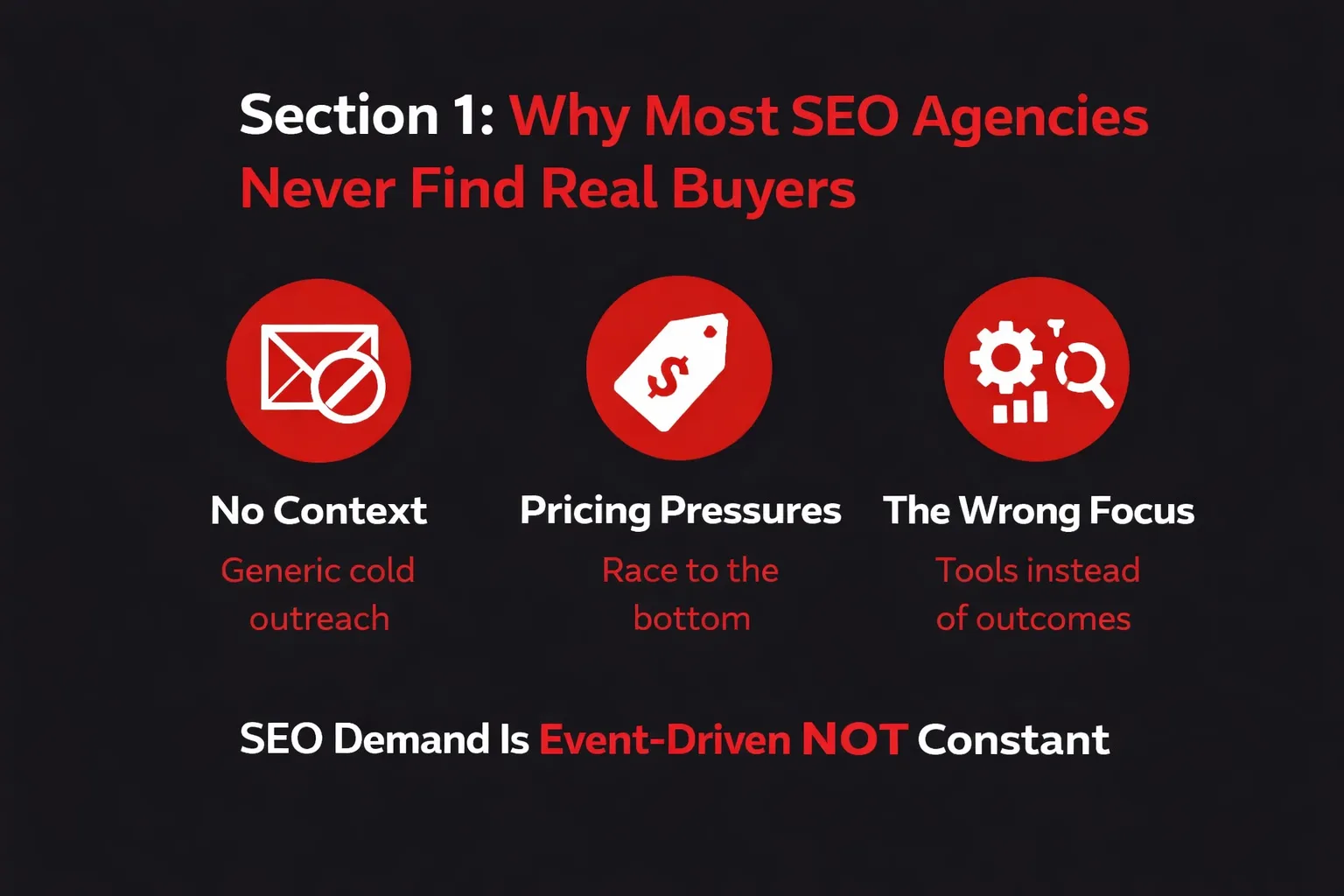
Most SEO agencies don’t struggle because they lack skill. They struggle because they’re talking to the wrong people at the wrong time. The modern SEO market isn’t short on demand—but it is short on agencies that understand when that demand actually appears.
The Problem With Traditional SEO Prospecting
Traditional SEO prospecting is built on volume, not relevance. Agencies blast cold emails that say the same thing to everyone: “We noticed issues on your site” or “We can help you rank on Google.” The problem? There’s no context. No trigger. No reason for the prospect to care right now.
This approach creates three predictable outcomes:
- Cold emails with no context get ignored because they don’t connect to a real business problem.
- Fiverr-style pricing pressure happens because when urgency is low, buyers compare vendors purely on cost.
- Competing on tools, not outcomes becomes the norm—agencies sell audits, backlinks, and reports instead of growth, recovery, or visibility.
When SEO is pitched as a generic service, it becomes a commodity. And commodities are always price-sensitive.
SEO Is Not a “Nice to Have” — It’s Event-Driven
Here’s the hard truth most agencies miss: companies don’t wake up wanting SEO.
No CEO starts their day thinking, “We should improve our meta descriptions.” What they wake up wanting is:
- Revenue recovery when traffic or sales suddenly drop
- Growth acceleration after funding, expansion, or aggressive targets
- Visibility during change, like a redesign, product launch, or market entry
SEO only becomes important when it’s tied to one of these moments. Outside of those moments, SEO feels slow, abstract, and optional. Inside those moments, SEO feels urgent, necessary, and budget-worthy.
This is why outreach that ignores business context fails. You’re offering a solution before the pain exists.
The Buyer Psychology Shift
SEO buying behavior in 2026 looks very different from even a few years ago:
- Shorter decision windows – Buyers decide fast when pressure is high
- Higher urgency – Delays feel expensive, not cautious
- Less tolerance for “long-term promises” – “Wait 6–12 months” is no longer compelling during a crisis or launch
When urgency spikes, buyers don’t look for the best-known agency. They look for the most relevant one—the agency that understands exactly what’s happening right now.
This is why timing matters more than authority. An unknown SEO consultant who shows up at the right moment with the right insight will beat a famous agency pitching at the wrong time.
Real SEO buyers don’t need convincing. They need help—now.
Section 2: What Are SEO-Triggered Events?
Definition
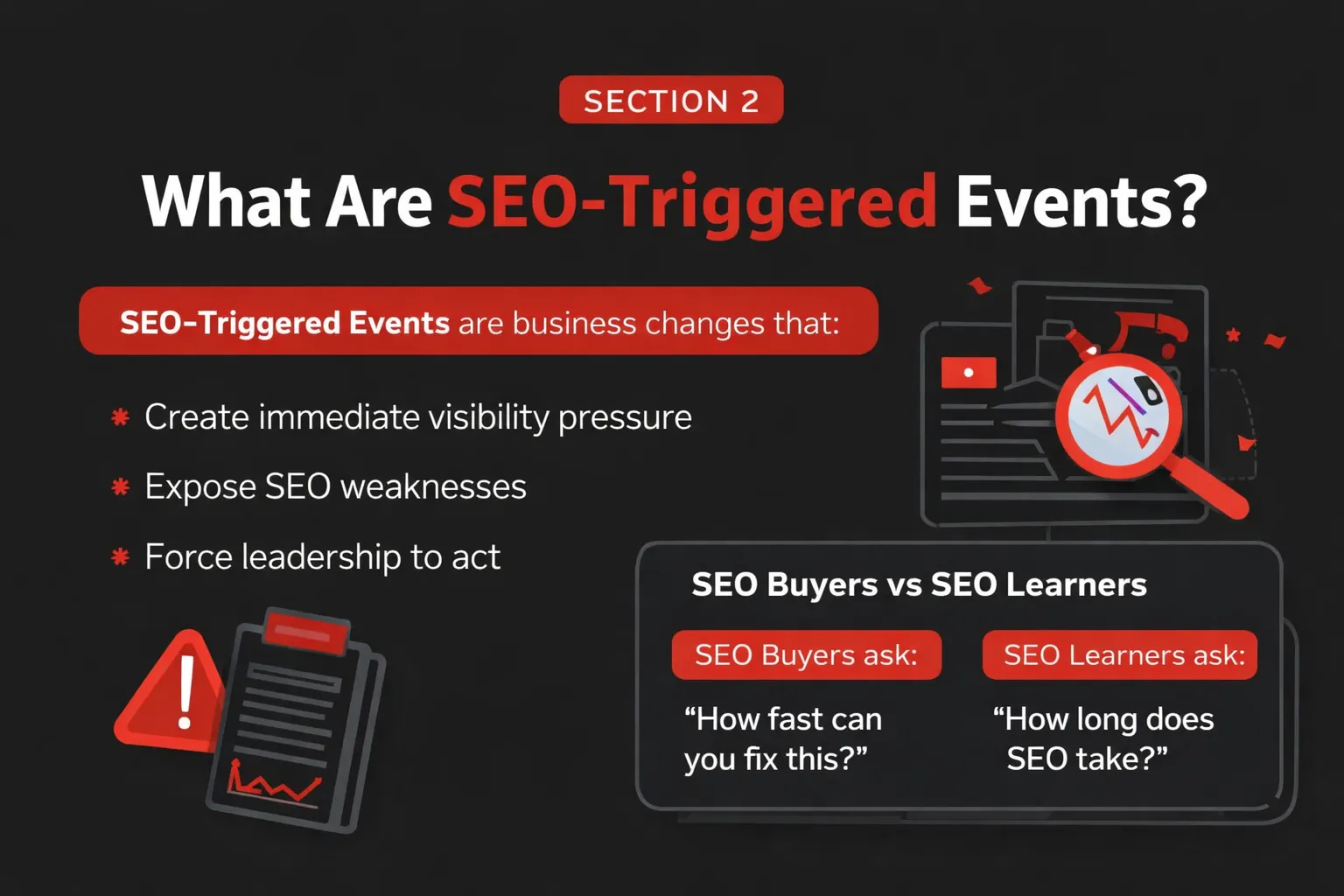
SEO-Triggered Events are specific business changes or moments that suddenly make search visibility mission-critical. Unlike routine marketing initiatives, these events create immediate pressure on a company’s leadership to act fast.
At their core, SEO-Triggered Events do three things simultaneously:
- Create immediate visibility pressure
Traffic, leads, or brand presence becomes urgent—not optional. Leadership realizes that being invisible on Google now has a direct cost.
- Expose existing SEO weaknesses
Issues that were previously ignored—technical debt, poor content structure, weak backlinks, or bad migrations—surface all at once.
- Force decision-makers to act
SEO moves from a “we’ll do it later” item to a boardroom discussion. Action is no longer delayed because the impact is measurable and painful.
These moments don’t create the need for SEO—they reveal it. The need was always there; the trigger simply removes complacency.
Why These Events Create High-Intent Buyers
SEO-Triggered Events produce the highest-quality SEO buyers because they change internal dynamics instantly.
First, budgets get unlocked. When traffic drops or growth targets increase, SEO funding shifts from “experimental” to “essential.” Approval cycles shorten because the cost of inaction is obvious.
Second, leadership attention is present. Founders, CMOs, and CEOs are directly involved. SEO decisions are no longer delegated to junior marketers who lack authority.
Most importantly, these events activate a powerful emotional driver:
fear outweighs curiosity.
Curiosity leads to research, comparison, and delay.
Fear leads to urgency, speed, and decisive buying.
When revenue, visibility, or investor confidence is at risk, companies don’t shop—they seek solutions.
SEO Buyers vs SEO Learners
Understanding this distinction is critical.
SEO learners ask questions like:
- “How long does SEO take?”
- “Is SEO better than paid ads?”
- “Can we try this for a few months?”
They are exploring.
SEO buyers, triggered by real business events, ask:
- “How fast can you fix this?”
- “What’s broken right now?”
- “How do we recover lost traffic?”
They are not evaluating SEO as a concept—they are buying resolution.
And that difference is exactly where real SEO opportunities exist.
Section 3: The 6 Core SEO-Triggered Events
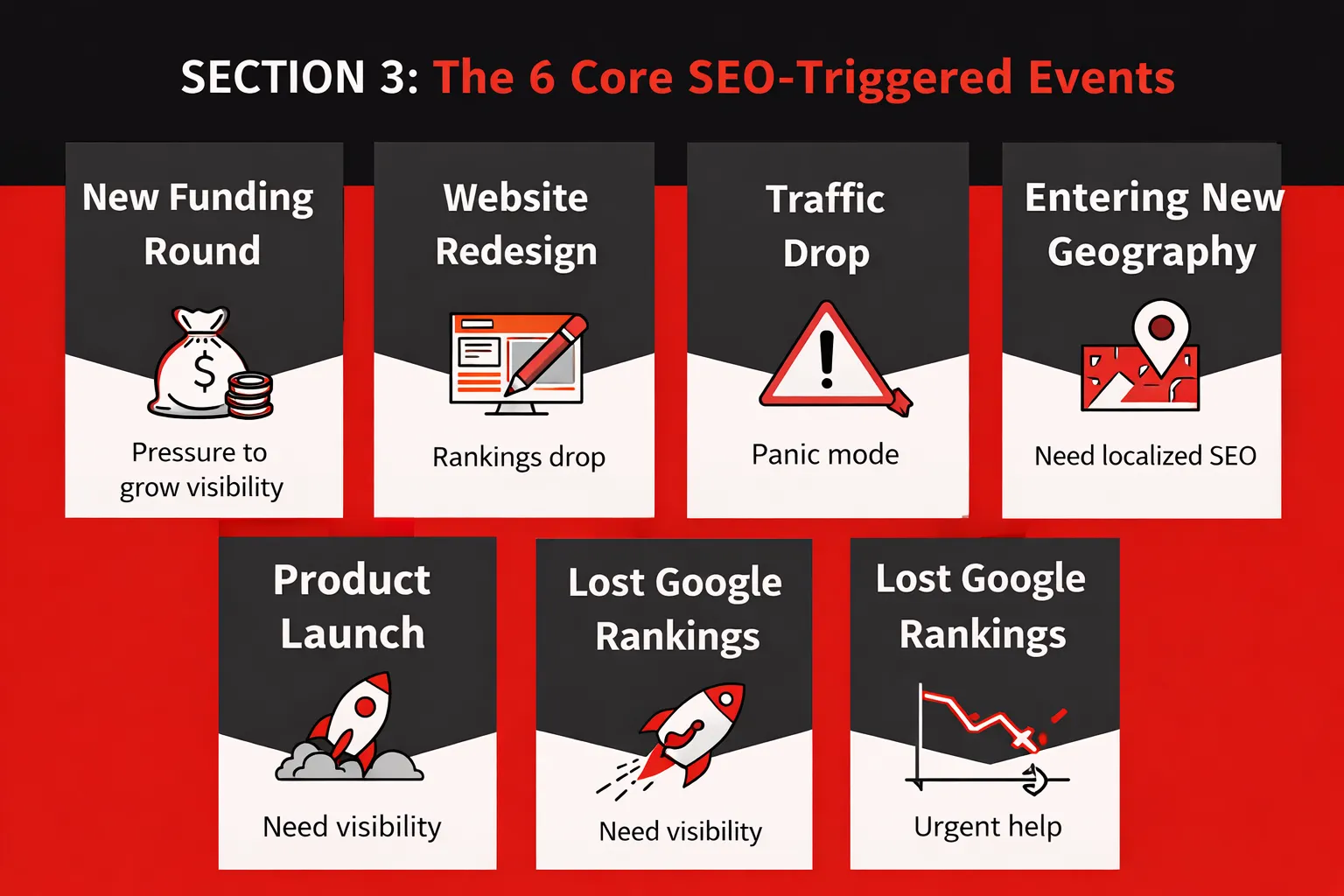
Real SEO buyers don’t appear because they “finally understood SEO.” They appear when something changes inside the business and SEO becomes the fastest path to stability, growth, or credibility. These moments are predictable. If you can spot them early, you stop chasing cold leads and start showing up when budgets are open, urgency is high, and decision-makers actually care.
Below are the six most reliable SEO-triggered events—and how to recognize and pitch each one.
New Funding Round → “We Need Growth Now”
When a company closes a funding round, the outside world sees celebration. Inside, it’s instant pressure. Investors didn’t fund “good vibes”—they funded growth targets. Leadership is suddenly accountable to aggressive KPIs: pipeline, revenue, signups, CAC efficiency, market expansion. Marketing is expected to scale quickly, and budget often increases. That’s when SEO quietly becomes one of the smartest growth levers.
Why? Because paid ads get expensive fast. The moment the company tries to “buy growth,” CPCs rise, ROAS drops, and the team realizes performance marketing alone won’t carry the next 12–18 months. SEO becomes the scalable acquisition layer: compounding traffic, brand authority, and lower long-term CAC. And for funded startups especially, organic growth supports valuation narratives—“we’re winning demand, not renting attention.”
How do you detect this early? Watch funding databases like Crunchbase. Track LinkedIn announcements from founders and VCs. Set alerts for PR releases, and follow founder posts where they mention hiring sprees, “big growth plans,” or “new markets.”
Your pitch angle here should be SEO as a growth multiplier: a forecast-driven plan tied to pipeline, not rankings. Bring an acquisition model, expected traffic curves, and investor-ready reporting that connects organic growth to revenue outcomes.
Website Redesign → “Why Did Our Rankings Drop?”
Website redesigns create one of the biggest hidden buying windows in SEO—because redesigns often break SEO without anyone realizing it until traffic falls. What goes wrong is painfully consistent: URLs change without proper redirects, metadata disappears during a CMS migration, internal links get rebuilt without logic, and performance issues sneak in. Most redesign teams optimize for aesthetics and UX, not search equity. Without an SEO migration plan, the company unknowingly “resets” years of authority.
The buyer mindset after launch is usually messy: confusion first (“Why are leads down?”), then blame shifting (“Is it marketing? Is it dev?”), then panic once they see search traffic sliding week after week. At that point, SEO stops being a “nice-to-have” and becomes damage control.
Detection is straightforward if you know what to watch: a sudden design refresh, a new site launch announcement, or visible CMS changes (WordPress → Webflow, Shopify theme overhaul, headless rebuild). You’ll also see new URL structures, missing pages, or category changes—often caught quickly with basic crawling.
Your pitch should be direct: SEO recovery and migration audits. Position yourself as the person who “fixes what the redesign broke.” Offer quick-win technical SEO: redirect mapping, metadata restoration, indexation checks, internal linking rebuilds, and speed improvements—then roll into a structured stabilization plan.
Traffic Drop → “Something Is Seriously Wrong”
A traffic drop is the clearest signal of high-intent SEO demand because it creates fear—and fear creates decisions. Drops happen for a few common reasons: Google algorithm updates, technical errors (indexing, canonical tags, robots.txt), competitors outranking for core terms, or lost backlinks that reduce authority. Sometimes it’s content decay—pages that slowly lose relevance while the business isn’t paying attention.
Internally, this triggers panic mode. Revenue teams feel it first: fewer inbound leads, lower demo requests, weaker pipeline. Leadership asks uncomfortable questions. Marketing becomes defensive. In that emotional state, urgency beats price sensitivity. The company isn’t shopping for “SEO best practices.” They’re looking for a fix.
You can detect this in multiple ways: SEMrush or Ahrefs visibility graphs showing sudden declines, Search Console drops in clicks/impressions, spikes in crawl errors, coverage issues, or page-level performance collapses. Content decay patterns are also visible—older top pages losing rankings steadily, often because competitors published fresher, better-aligned content.
Your pitch angle should be a Traffic Recovery Plan built on root-cause analysis. Don’t lead with “we’ll build backlinks.” Lead with diagnosis: what changed, why it changed, and what sequence fixes it. Then offer algorithm-proofing—a strategy that strengthens technical foundations, content quality, topical authority, and risk reduction so the same problem doesn’t repeat with the next update.
Entering a New Geography → “We’re Invisible Here”
When a company enters a new region—country, state, city, or language market—SEO becomes urgent because visibility doesn’t transfer automatically. Many brands assume their existing site will rank everywhere. It doesn’t. The result is a painful realization: “We launched in this market… but nobody can find us.”
The most common mistakes are predictable: they use the same content for every region, skip hreflang, ignore local search intent, and publish generic landing pages that don’t match how people actually search in that geography. Even when the product is strong, organic credibility is missing—and without credibility, conversion suffers. Paid ads can drive traffic, but they don’t localize trust. Organic rankings do. If you’re not visible in search, you look like you don’t exist.
How do you detect geo expansion early? Watch job postings in new regions (sales, support, marketing roles). Look for regional landing pages suddenly appearing. Monitor international PR announcements, new office openings, or “Now available in…” messaging across LinkedIn and press pages.
Your pitch should position SEO as the market-entry foundation: international SEO, localized keyword mapping, and geo-specific content strategy. The win here isn’t “more traffic.” It’s becoming the trusted option in that region—through localized pages, intent-aligned content, technical international setup (hreflang, structure), and authority building tailored to the new market.
Product Launch → “We Need Attention Fast”
Product launches create a short window where attention is everything. If a company misses it, momentum dies and customer acquisition becomes harder and more expensive. The stakes are high: competitors already dominate SERPs, review sites rank for “best tools,” and comparison pages capture demand before the company even shows up.
Launch teams are often obsessed with PR, social, and paid campaigns. SEO gets ignored until they realize that search demand is being captured elsewhere. And by then, they’re late. The launch window is short, and missed momentum means missed revenue.
You can detect launches early by monitoring Product Hunt, beta announcements, waitlist pages, and new feature pages being published. You’ll also notice new pricing pages, changelog spikes, and “coming soon” landing pages that signal positioning shifts.
Your pitch angle should be launch-focused SEO with a demand capture plan. That includes: building landing pages mapped to high-intent queries, publishing comparison and alternatives pages, optimizing category pages, and creating “SERP takeover” strategies (multiple pages targeting adjacent intents). In other words: don’t just “rank eventually.” Own the conversation around the launch while interest is peaking.
Lost Google Rankings → “Fix This Immediately”
Ranking loss is different from a general traffic drop because it often feels personal—especially when brand terms or money pages fall. It can come from penalties, spam updates, over-optimization, toxic backlinks, thin content, or aggressive link-building that backfires. Sometimes it’s a manual action. Sometimes it’s an algorithmic demotion. Either way, the business experiences it as: “Google turned us off.”
The buyer psychology here is intense: fear and anger. Many companies are ready to fire their current agency immediately. They want accountability. They want someone who can explain what happened—and fix it without making it worse.
Detection signals include ranking volatility across core keywords, Search Console manual action warnings, and brand keyword drops (a major red flag). You may also see sudden deindexation, sharp impressions declines on high-performing URLs, or a steep drop after a known update.
Your pitch should be built around control and stabilization: penalty recovery, comprehensive risk audits (technical + content + link profile), and a long-term plan to rebuild trust. Be conservative and confident: focus on removing risks, repairing signals, improving quality, and protecting the site from future volatility. For this buyer, peace of mind is part of the product.
Section 4: How to Detect SEO-Triggered Events Before Competitors
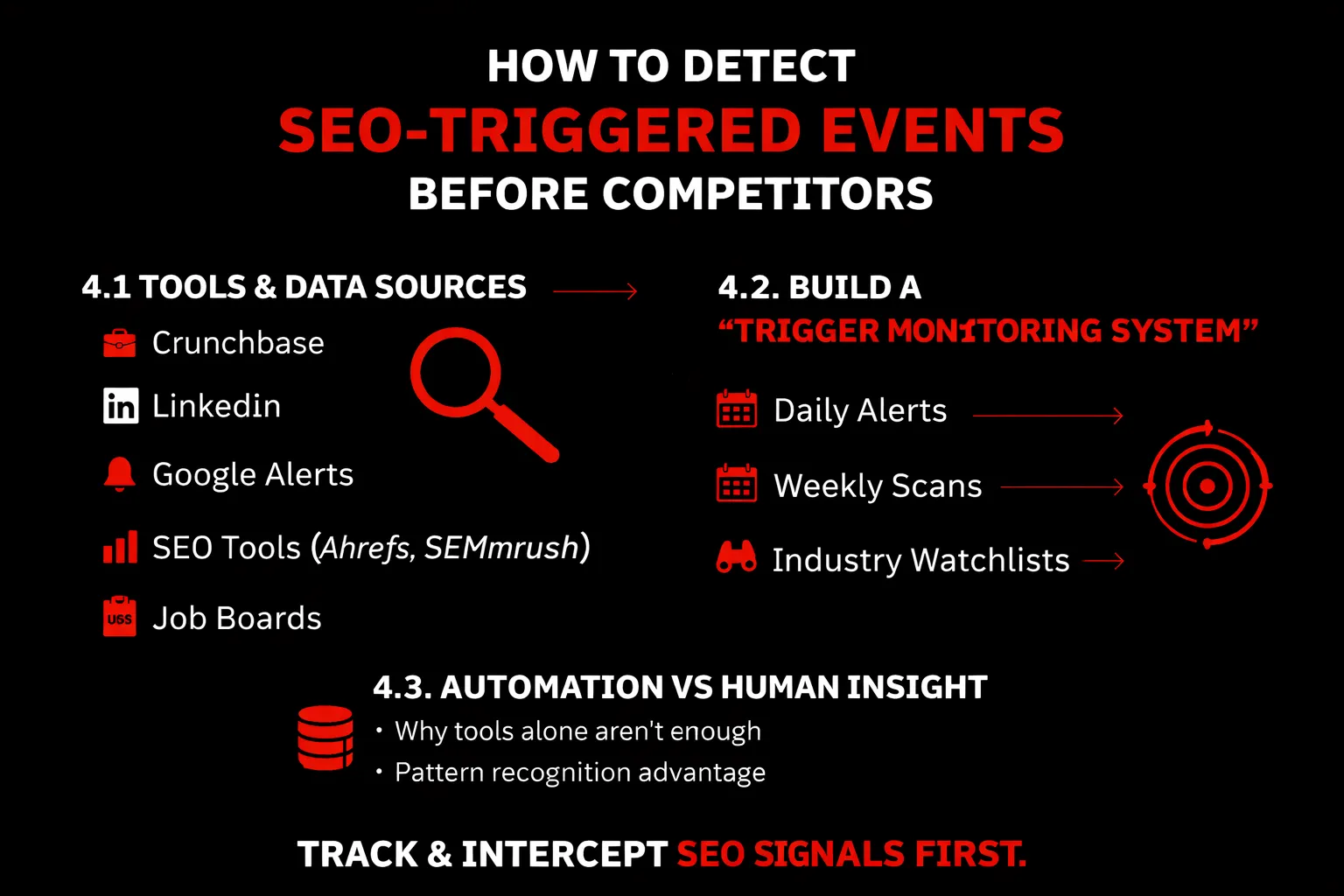
Finding real SEO buyers is less about sending more outreach and more about seeing signals earlier than everyone else. SEO-triggered events rarely happen in isolation — they leave digital footprints across funding platforms, social networks, search data, and hiring activity. The agencies that win are the ones that monitor these signals systematically, not sporadically.
Tools & Data Sources
Early detection starts with knowing where signals appear.
Crunchbase
Crunchbase is one of the strongest indicators of future SEO demand. A new funding round almost always leads to growth pressure, visibility goals, and performance marketing spend. Monitoring recently funded startups, especially Series A–C, gives you a head start before marketing teams finalize vendor decisions.
LinkedIn is a real-time intent engine. Founders announce funding, product launches, expansions, and leadership changes. Marketing heads openly share redesigns, growth milestones, or traffic challenges. Hiring activity—especially roles like “SEO Manager,” “Head of Growth,” or “Content Lead”—often signals internal SEO strain or upcoming initiatives.
Google Alerts
Google Alerts help surface early mentions of brand updates, product launches, acquisitions, or geographic expansions. Alerts set for phrases like “launches new website,” “expands to,” “raises funding,” or specific competitor names can quietly reveal urgency before it shows up in SEO tools.
SEO Tools (Ahrefs, SEMrush)
Visibility drops, keyword losses, backlink decay, or sudden ranking volatility are clear indicators of SEO pain. These tools reveal when a company has already lost traction — often before leadership realizes the severity. Tracking competitors’ organic visibility at scale can uncover companies entering panic mode.
Job Boards
Hiring is intent. When a company posts SEO-heavy roles, it often means one of two things: their organic performance is under pressure, or they’re scaling aggressively. Job descriptions reveal priorities—technical SEO, international SEO, content expansion—which helps tailor outreach precisely.
Building a “Trigger Monitoring System”
Detection only works if it’s systematic.
Daily alerts should monitor funding announcements, brand mentions, product launches, and executive posts. These are short windows where being first matters most.
Weekly scans involve checking SEO visibility trends, competitor movements, and newly posted roles. Weekly reviews help catch slow-burn issues like content decay or gradual ranking loss.
Industry watchlists keep focus tight. Instead of tracking everyone, monitor specific niches, regions, or growth stages where SEO demand is most likely to convert. This prevents signal overload and improves response speed.
The goal isn’t volume—it’s relevance plus timing.
Automation vs Human Insight
Tools surface data, but humans interpret urgency.
Automation can flag funding, traffic drops, or hiring trends, but it cannot understand why those events matter right now. Tools don’t read tone, fear, or internal pressure. Humans do.
Pattern recognition is the real advantage:
- Funding + hiring + content push = growth pressure
- Redesign + ranking drop = recovery urgency
- Expansion + localization gaps = international SEO demand
The most effective SEO agencies don’t just monitor tools — they connect signals into stories. That narrative insight is what allows you to reach prospects before competitors, not after everyone else is already pitching.
In SEO lead generation, speed comes from systems — but conversion comes from insight.
Section 5: How to Approach Companies at the Right Moment
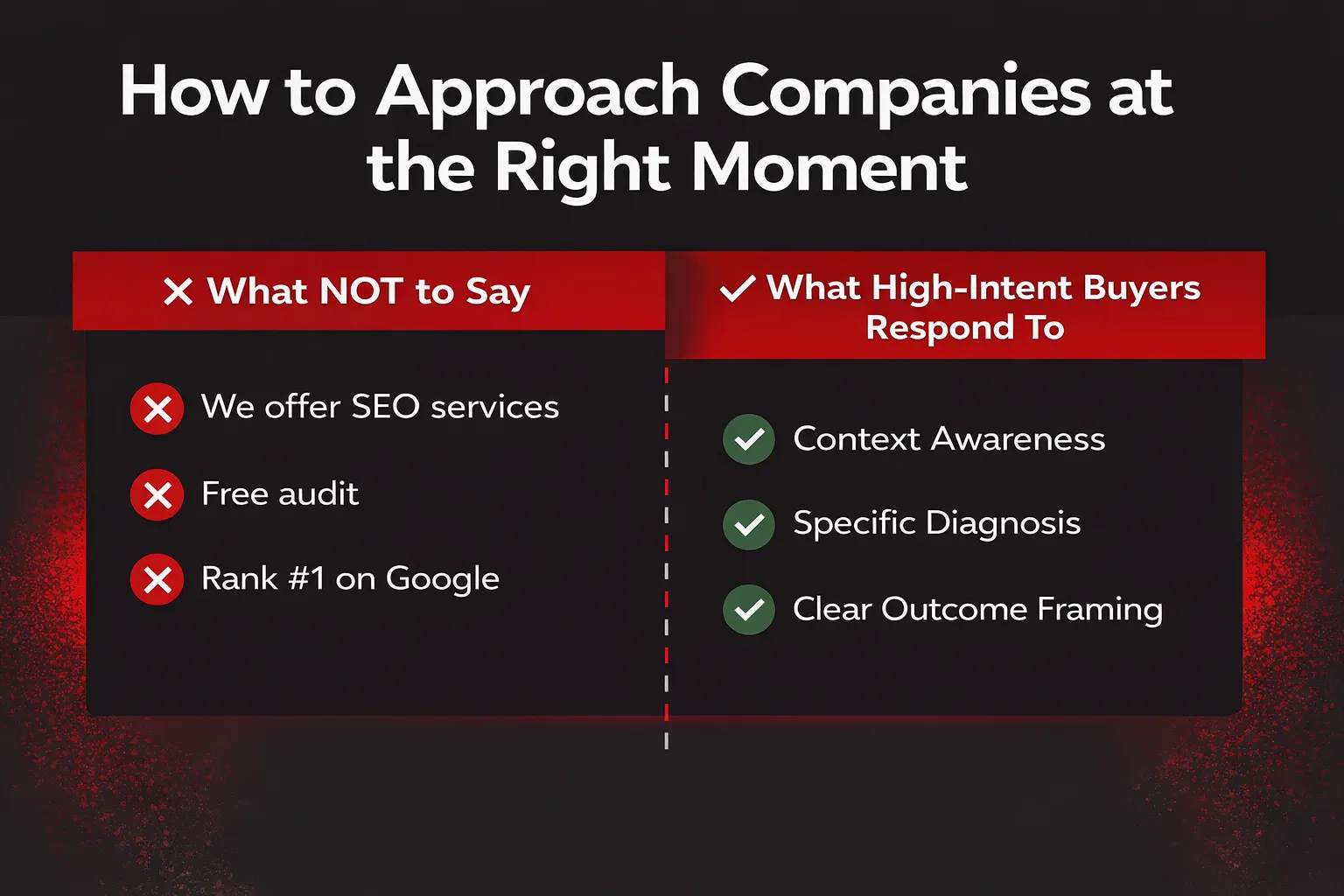
Identifying SEO-triggered events is only half the battle. The real differentiator is how you approach companies when those events occur. At this stage, decision-makers are under pressure, short on patience, and highly sensitive to irrelevant pitches. The wrong message can get ignored instantly—even if your timing is perfect.
What Not to Say
When urgency is high, generic SEO language kills credibility. These phrases signal that you don’t understand their situation:
- “We offer SEO services”
This centers you, not their problem. At a critical moment, buyers aren’t shopping for services—they’re looking for solutions to a very specific issue.
- “Free audit”
Once powerful, now overused. High-intent buyers assume free audits are automated, shallow, or sales traps. It lowers perceived expertise exactly when trust matters most.
- “Rank #1 on Google”
This sounds unrealistic and disconnected from their actual pain. Companies dealing with traffic loss, launches, or expansion don’t want promises—they want clarity and control.
At SEO-trigger moments, vague positioning equals instant dismissal.
What High-Intent Buyers Do Respond To
Urgent buyers respond to relevance, not persuasion. Three elements consistently cut through the noise:
- Context awareness
Acknowledge why you’re reaching out now. When a prospect feels “they see what’s happening,” resistance drops immediately.
- Specific diagnosis
Point out one or two observable issues tied to their trigger event. Not a full audit—just enough to show expertise and insight.
- Clear outcome framing
Don’t describe tasks. Describe results: recovery, stabilization, visibility, or momentum. Outcomes reduce anxiety and accelerate decisions.
This approach positions you as a problem-solver, not another SEO vendor.
Sample Outreach Framework
Here’s a simple, high-conversion structure for outreach during SEO-triggered moments:
1. Event acknowledgment
Reference the trigger directly and neutrally.
“I noticed your recent website redesign / funding announcement / market expansion.”
2. Problem identification
Connect the event to a likely SEO risk or opportunity.
“In similar cases, we often see ranking drops from URL changes and lost internal links within the first few weeks.”
3. Outcome-based CTA
Invite a conversation around a specific result, not a service.
“If helpful, I can walk you through a 30-day recovery plan to stabilize traffic and protect rankings.”
This framework works because it respects urgency, demonstrates relevance, and offers clarity—exactly what buyers want when SEO suddenly becomes critical.
At the right moment, it’s not about selling SEO.
It’s about showing you understand the problem before they fully articulate it themselves.
Section 6: Packaging SEO for Trigger-Based Buyers
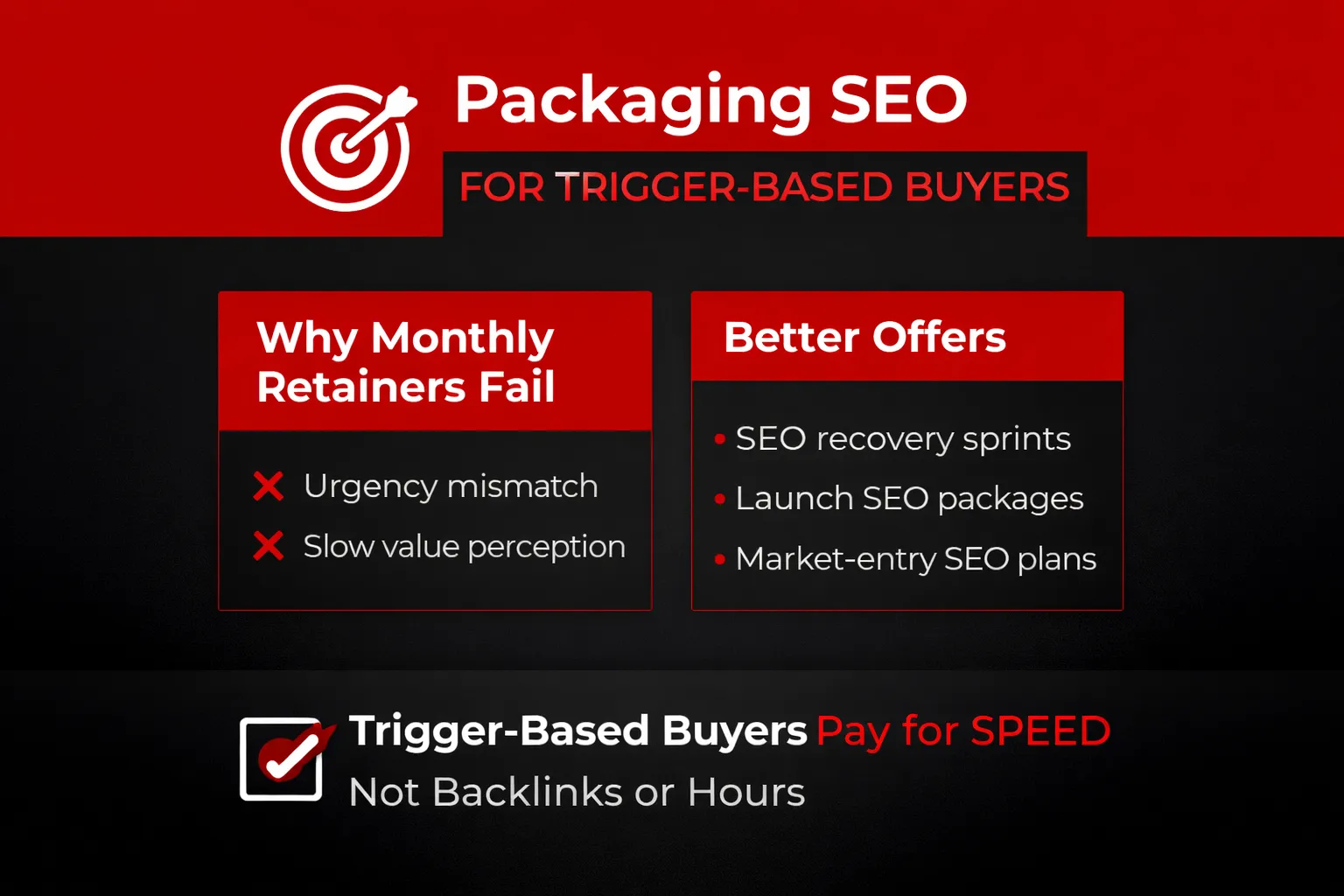
When a company hits an SEO-triggered event, the way you package and sell SEO matters more than your credentials or past case studies. These buyers are not in “optimization mode” — they are in response mode. That’s why traditional monthly retainers often fail in these moments.
Why Monthly Retainers Fail Here
Monthly SEO retainers are designed for stability and gradual growth, but trigger-based buyers are dealing with immediate pressure. Their problem is happening now: rankings have dropped, traffic has vanished, or a launch window is closing fast. A retainer that promises results “in 3–6 months” creates an urgency mismatch. It signals slow movement at a time when leadership expects fast action.
There’s also a slow value perception problem. Retainers bundle too many activities—content, links, technical fixes—without a clear, immediate outcome. For a buyer in panic mode, this feels vague and risky. They don’t want ongoing SEO “work”; they want a specific problem solved. If your offer doesn’t clearly answer what gets fixed first and how quickly, it will be ignored or delayed.
Better Offers for High-Intent SEO Buyers
Trigger-based buyers respond best to outcome-focused, time-bound offers:
- SEO Recovery Sprints
Short, intensive engagements (2–6 weeks) focused on diagnosing and fixing ranking or traffic losses. Clear scope, fast execution, measurable recovery signals.
- Launch SEO Packages
Designed around a product or feature launch. These include keyword capture, landing page optimization, internal linking, and SERP positioning—before and immediately after launch.
- Market-Entry SEO Plans
Structured roadmaps for entering a new geography or vertical. This covers localization, intent mapping, competitive gaps, and quick visibility wins.
These offers feel decisive, controlled, and aligned with the buyer’s urgency.
Pricing Psychology: Speed Over Services
At this stage, buyers are not comparing backlinks, word counts, or hours worked. They are buying speed, clarity, and risk reduction. The faster you can stabilize traffic, protect a launch, or restore visibility, the more valuable your service becomes.
Position your pricing around outcomes and timelines, not deliverables. When SEO is framed as a rapid-response growth or recovery system, price resistance drops — because the cost of waiting feels far higher than the cost of action.
Conclusion: The Real SEO Opportunity Most Agencies Miss
Most SEO agencies fail not because they lack skill, tools, or experience—but because they show up at the wrong time.
SEO demand already exists in the market. Companies don’t suddenly “discover” SEO because they read a blog or received a clever cold email. They buy SEO when something changes—when traffic drops, rankings disappear, investors apply pressure, or a new market exposes their invisibility. The demand is real, urgent, and emotional. The mistake most agencies make is trying to create demand instead of catching it.
This is why timing beats branding. A perfectly designed website, polished case studies, or a large LinkedIn following won’t matter if you reach out when there’s no internal urgency. Meanwhile, a lesser-known consultant who appears at the exact moment a problem emerges will win the deal. In SEO, relevance at the right moment always outperforms reputation at the wrong one.
The same logic applies to outreach. Awareness beats volume. Sending hundreds of generic emails cannot compete with one message that shows you understand what just went wrong and why it matters now. High-intent buyers don’t want to be sold—they want to be understood and helped quickly.
Remember this final shift in mindset:
- Your job is not to convince companies they need SEO.
- Your job is to arrive at the exact moment they already know they do.
That is where real SEO buyers exist.
Start tracking SEO-triggered events today.
Stop chasing cold leads who are “just exploring options.” Position yourself to become the first call when SEO panic hits—because that’s when decisions are made, budgets open, and agencies are chosen.