SUPERCHARGE YOUR ONLINE VISIBILITY! CONTACT US AND LET’S ACHIEVE EXCELLENCE TOGETHER!
Google Didn’t Punish You — It Simply Stopped Trusting You
If your organic traffic dropped right after a core update, your first thought was probably: “We got penalized.” That panic is normal—and in most cases, it’s also wrong.
Most post–core update traffic losses aren’t punishments. They’re not a “manual action in disguise.” Google usually didn’t downgrade your site because it suddenly decided you’re bad. What’s far more common is this: Google re-weighted relevance signals, and your pages stopped looking like the best match for the queries you used to win. In other words, you didn’t get “hit.” You got out-competed in Google’s new evaluation order.
That’s why rewriting everything often fails (and sometimes makes the decline worse). Massive rewrites can accidentally erase the very signals that were holding your rankings together—historical engagement patterns, topical anchors, internal context, and stable page identity. You end up changing a lot without fixing the real problem: lost trust in relevance.
The good news: recovery usually doesn’t require burning your site down and rebuilding it. What restores performance is targeted signal repair—relevance consolidation (tightening topical clusters), query alignment (matching what searchers now want), and signal reinforcement (strengthening internal and external cues that your pages still deserve to rank).
In this guide, you’ll learn how to diagnose what actually caused the drop, identify which pages truly matter (and which don’t), and follow a step-by-step recovery system designed to bring traffic back—without mass rewrites.
The Core Update Panic Cycle
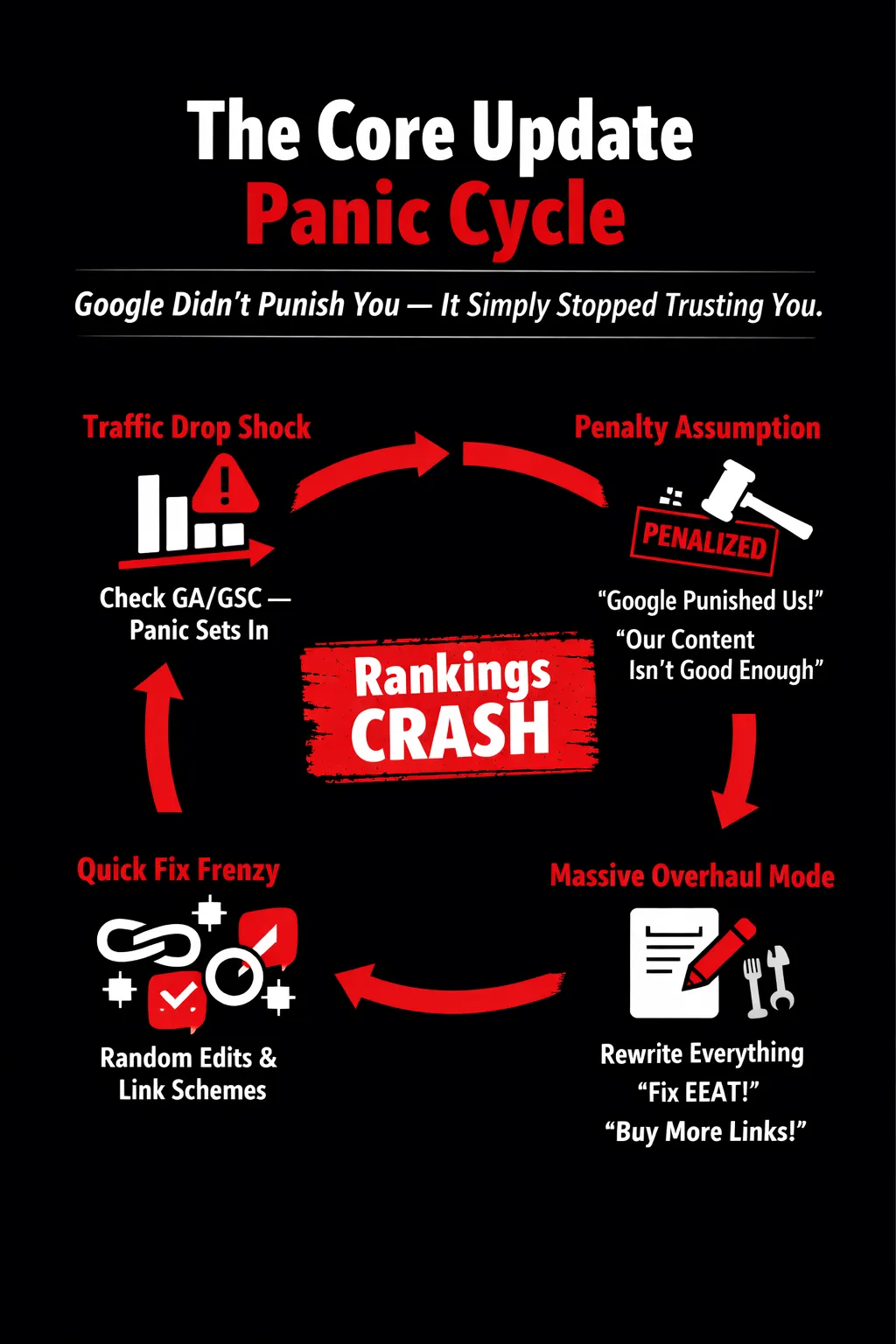
If you’ve ever lived through a Google core update, the pattern is painfully familiar.
The update rolls out. You open Google Analytics or Search Console. Traffic is down—sometimes slightly, sometimes alarmingly. Before you’ve even finished scrolling, panic sets in. Something must be wrong. Something must have been done to you.
What Most Site Owners Do After a Core Update
The first assumption is almost always the same: “Google penalized us.”
That fear quickly evolves into self-blame. “Our content must not be helpful anymore.” And from there, the nuclear option appears: “We need to rewrite everything.”
This mindset triggers a predictable chain reaction.
Pages that were ranking for years get rewritten overnight. EEAT elements are added everywhere—author bios expanded, credentials repeated, trust badges sprinkled across templates. Internal links are reshuffled aggressively, often without any topical logic, just to “send signals.” In more desperate cases, links are purchased in bulk, under the belief that authority must be the missing piece.
All of this activity feels productive. It creates motion. It creates the illusion of control. But in reality, it’s often the fastest way to deepen the damage.
Why These Actions Rarely Work
The core problem is that these reactions treat symptoms, not signal loss.
A core update doesn’t ask, “Is this site bad now?” It asks, “Which result best satisfies this query compared to the others?” Rankings shift because Google recalibrates relevance at the query level, not because your entire site suddenly failed a quality test.
Mass rewrites ignore this completely. Instead of strengthening existing relevance, they often break it. Historical context is lost. Engagement baselines reset. Content that once clearly aligned with search intent becomes diluted as writers try to “improve” everything at once.
Blanket EEAT additions don’t fix relevance mismatches. Random internal linking muddies topical focus. Link buying may temporarily move numbers, but it doesn’t restore trust where it was actually lost.
The irony is this: many sites that panic after a core update weren’t doing anything wrong. They simply stopped being the best comparative answer for certain queries. And panic-driven fixes usually push them even further away from that position.
What a Core Update Really Is (And Is Not)
If there’s one mental model that causes the most damage after a core update, it’s the idea that Google has judged your site. This assumption pushes site owners into panic-driven decisions—rewriting content, changing URLs, adding meaningless “EEAT” blocks—often making the situation worse. To recover, you first need to understand what a core update is not, before you can understand what it actually does.
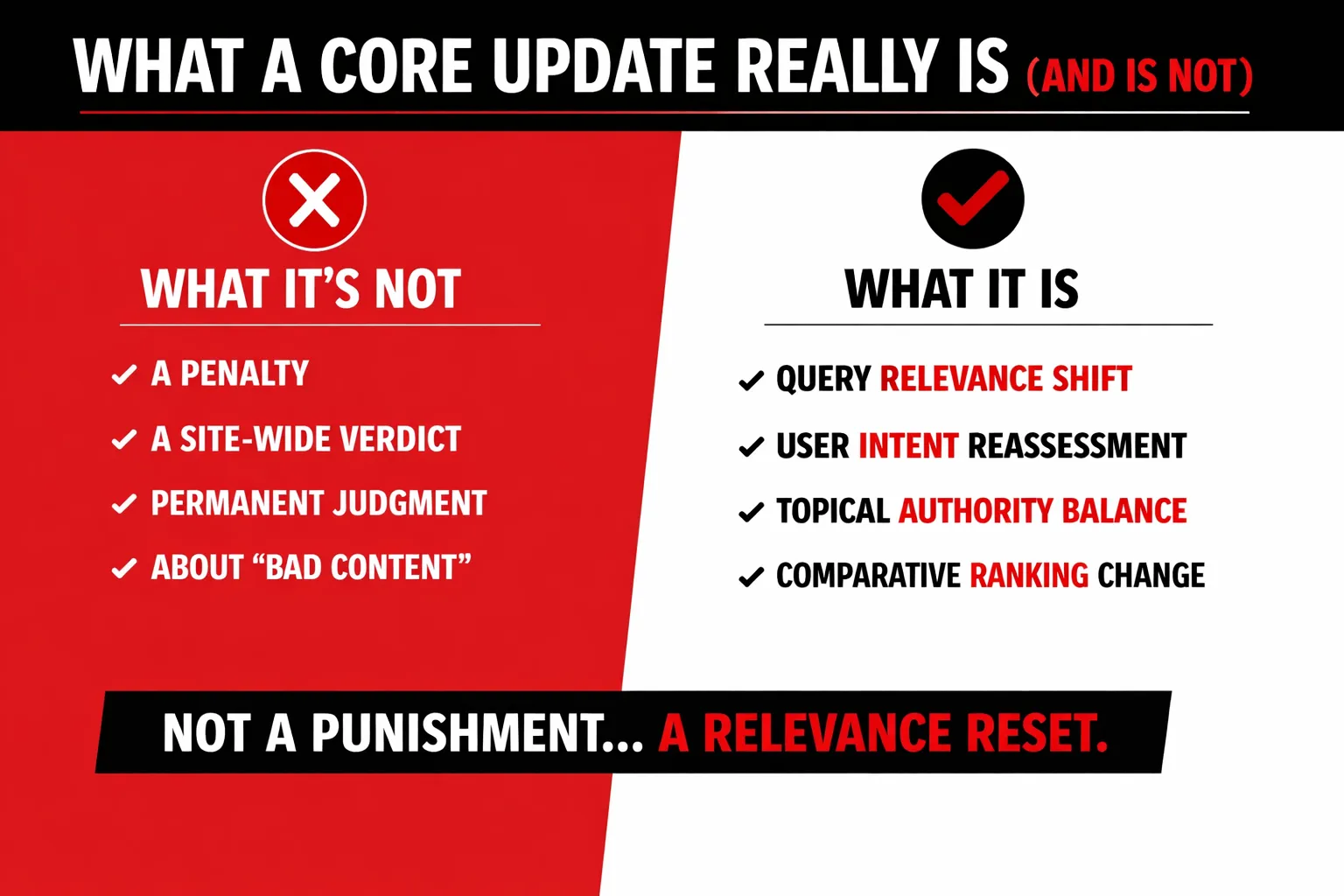
What a Core Update Is Not
A core update is not a penalty. Penalties are explicit, rare, and usually communicated through Search Console. If your site is still indexed, still ranking (even if lower), and still receiving impressions, you were not penalized. You were re-evaluated.
It is also not a site-wide judgment. Google does not wake up during a core update and decide your entire website is suddenly “bad.” Core updates operate primarily at the query and page level, not as blanket verdicts on your brand.
A core update is not a permanent verdict either. Rankings lost during one update are not locked away forever. Sites regularly recover—sometimes fully, sometimes partially—when relevance signals are realigned. If core updates were permanent, SEO as a discipline would have died years ago.
Finally, core updates are not primarily about “bad content.” This is one of the most misunderstood points. Many sites that lose traffic have objectively good content. The problem isn’t that the content became worse; it’s that other content became more relevant.
What a Core Update Actually Does
At its core, a core update is a rebalancing mechanism. Google adjusts how it weighs signals across three main dimensions:
- Query relevance – how closely a page matches what the searcher is asking right now
- Intent satisfaction – how effectively the result fulfills the underlying purpose of the query
- Topical authority distribution – which sites demonstrate the strongest contextual coverage for a topic overall
During a core update, Google is effectively asking a single question, millions of times over:
“Which result best satisfies this query now?”
Not last year. Not when your page first ranked. Now.
This leads to the most important reframing of all: you didn’t fall — others rose. Rankings are relative. When competitors improve their relevance, depth, or alignment with evolving intent, Google reshuffles the results. Your page may be the same, but the comparison set has changed.
The Trust vs Relevance Distinction
Another critical distinction is between authority and trust. Authority is relatively static—built through links, brand presence, and history. Trust, however, is dynamic.
In search, trust means consistent satisfaction of user intent over time.
Core updates tend to decay trust signals when:
- Content becomes outdated in framing or examples
- SERP intent shifts subtly, but the page doesn’t
- Competing pages match the current query context more precisely
In other words, Google didn’t stop trusting you as a site. It stopped trusting that this page, in its current form, is still the best answer for this query, at this moment.
Why Google “Stopped Trusting” Your Site
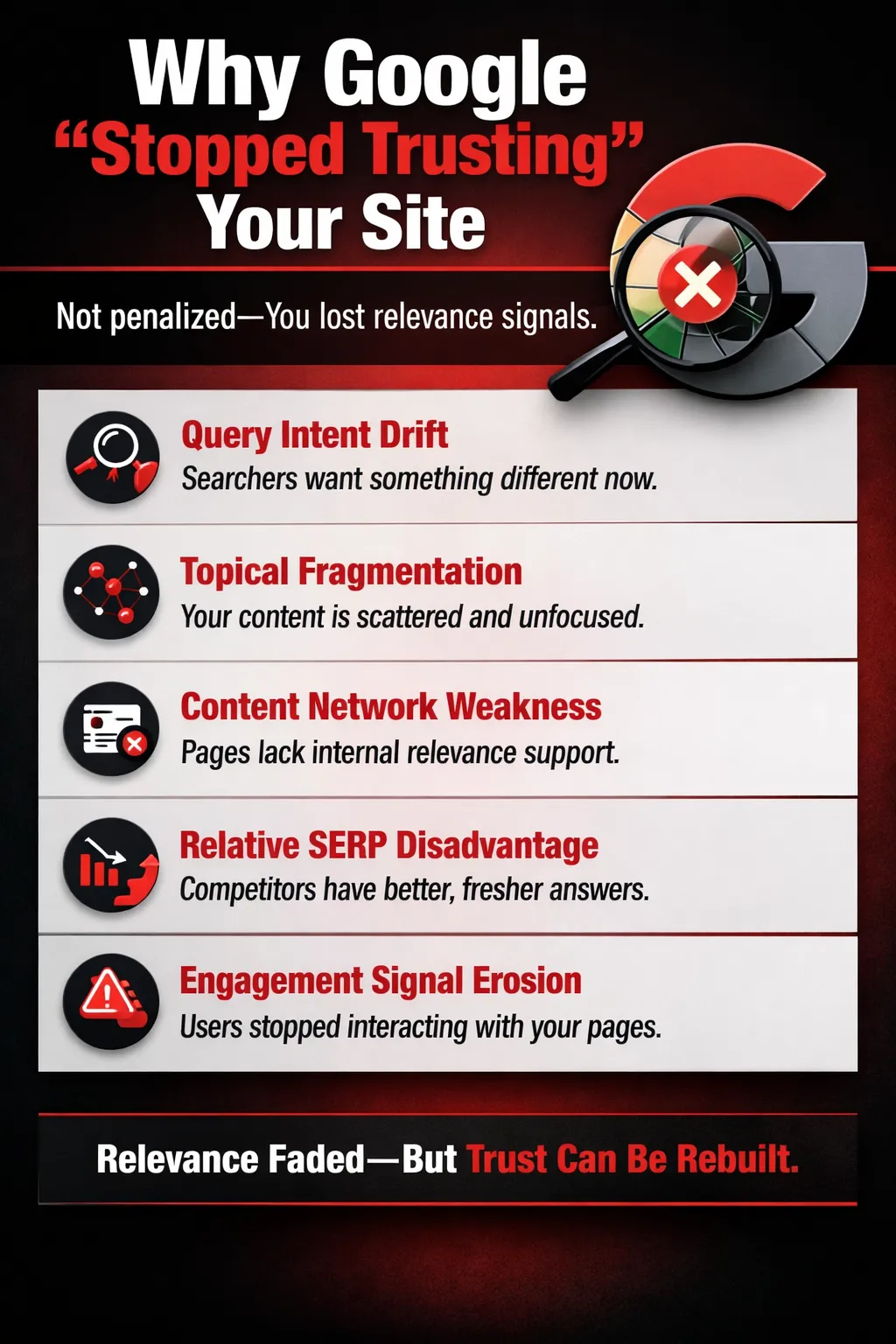
If your traffic dropped after a core update, the uncomfortable truth is this: your site didn’t suddenly become bad. Google didn’t wake up one morning and decide your content was no longer worthy. What actually happened is far more subtle—and far more reversible.
Google stopped trusting your relevance signals.
This distinction matters. Trust, in Google’s ecosystem, is not a permanent badge of honor. It’s a dynamic assessment of whether your pages continue to satisfy search intent better than alternatives. When those signals weaken, rankings fade—not because of punishment, but because relevance quietly decays.
Relevance Signal Decay Explained
Relevance is not static. It’s perishable.
A page that ranked well two years ago can still be “good,” well-written, and accurate—yet no longer be the most relevant result in today’s SERP. Core updates accelerate this recalibration.
Relevance signals decay for a few predictable reasons:
- Stale framing:
Your content may still be correct, but it’s framed around assumptions, workflows, or pain points that no longer match how users think today. Search intent evolves faster than most content calendars.
- Outdated examples:
Examples, tools, screenshots, and references age quickly. When competitors reflect current realities and your content reflects historical ones, Google reads that as reduced usefulness—even if the fundamentals are sound.
- Misaligned intent:
Over time, Google refines its understanding of what users actually want for a query. A page that once satisfied informational intent may now be competing against comparison pages, frameworks, or experiential content.
- Fragmented topical coverage:
As your site grows, related content often sprawls across disconnected URLs. What once felt comprehensive becomes thin when viewed as a network rather than a single page.
None of this means your content failed. It means the signals Google relied on to trust it have weakened.
The 5 Most Common Trust Breaks
Across hundreds of post–core update analyses, the same trust fractures appear again and again:
- Query Intent Drift
The SERP changed, but your page didn’t. Google now favors a different type of answer than the one you’re providing.
- Topical Fragmentation
Instead of demonstrating depth in a subject area, your coverage is scattered across multiple pages with no clear hierarchy or topical center.
- Content Network Weakness
Your strongest pages are no longer well-supported by internally linked, semantically related content—making them appear isolated rather than authoritative.
- Relative SERP Disadvantage
You didn’t get worse; competitors got better. They added depth, clarity, structure, or experience signals that now outperform yours comparatively.
- Engagement Signal Erosion
Users bounce, skim, or pogo-stick—not because the content is bad, but because it no longer matches expectations set by the query.
Each of these breaks chips away at Google’s confidence that your page is still the best answer right now.
Why Your Best Pages Are Usually the Ones That Drop
Ironically, the pages most likely to lose rankings after a core update are often your former top performers.
Why? Because old winners face the most competition.
These pages sit in high-value SERPs where:
- Newer formats are tested aggressively
- Competitors invest heavily in depth and structure
- Google continuously refines intent interpretation
Your best pages are compared against:
- Newer formats that match current user behavior
- Deeper topical clusters that signal subject mastery
- Better structured answers that reduce cognitive load
In other words, your strongest assets are under the harshest scrutiny.
The takeaway is critical: a core update drop is rarely a verdict—it’s a comparison. Google didn’t stop trusting you because you failed. It stopped trusting you because someone else now looks more relevant.
And that’s a problem you can fix.
Rewriting Everything Is the Worst Possible Move
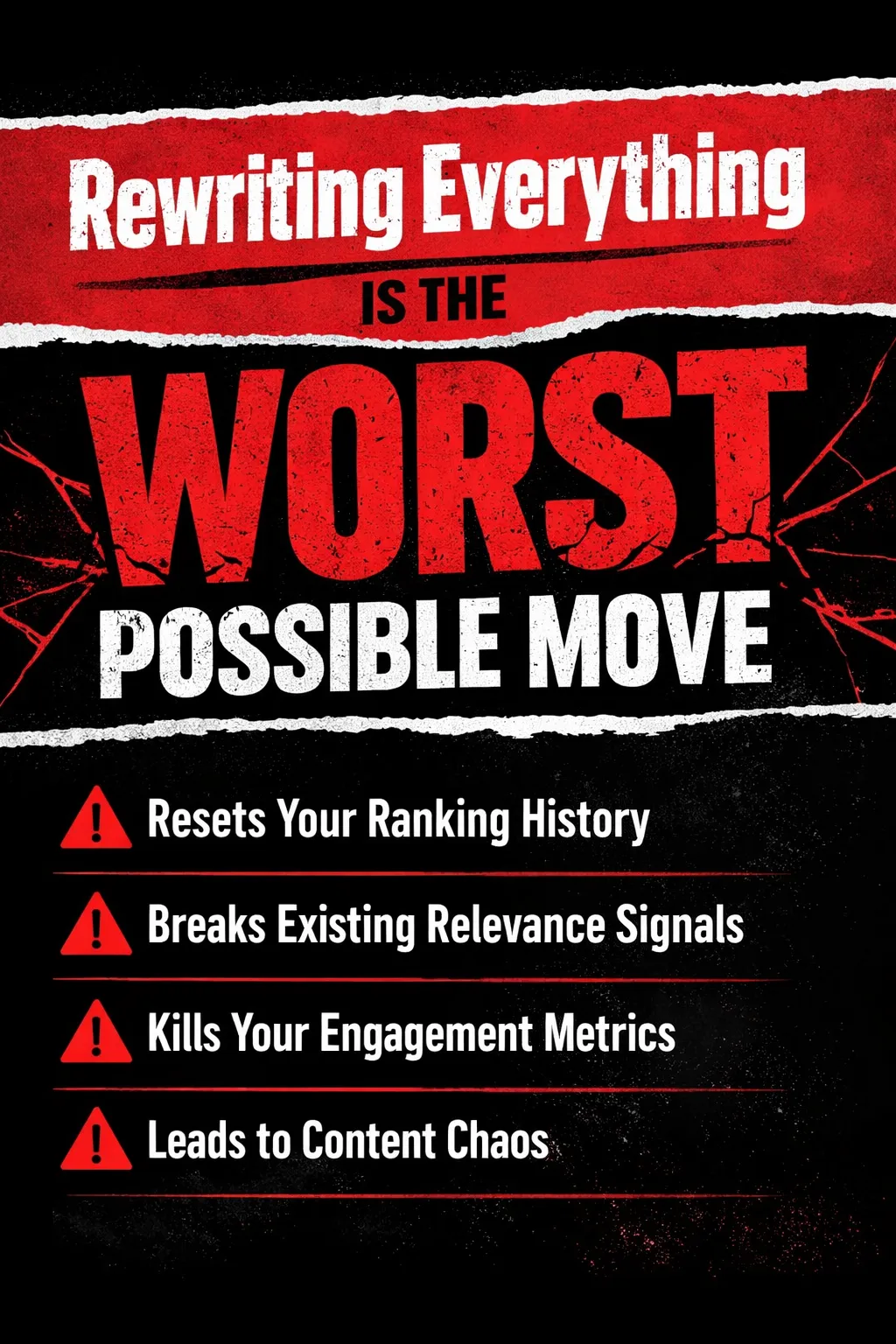
When traffic drops after a core update, the instinctive response is almost always the same: “We need to refresh the content.” In practice, this often translates into wholesale rewrites—new intros, new headings, new angles, sometimes even new URLs. While this feels proactive, it’s one of the most damaging moves you can make during a post-update recovery phase.
The Myth of the “Content Refresh”
The idea that Google rewards large-scale rewrites is deeply misunderstood. In reality, wholesale rewrites often fail because they erase the very signals that once made the page trustworthy.
First, they reset historical trust. Pages that ranked for months or years have accumulated behavioral data—click-through patterns, dwell time, return visits—that help Google understand how and when the page satisfies users. A major rewrite changes the page’s semantic fingerprint enough that Google must reassess it almost from scratch.
Second, rewrites break ranking memory. Google doesn’t just rank pages; it remembers how they’ve performed across queries over time. When you dramatically alter structure, framing, or topical emphasis, you sever that memory. The page is no longer evaluated as an evolved resource—it’s treated as a new, unproven version.
Third, mass rewrites introduce inconsistency. When dozens or hundreds of pages are updated simultaneously, internal topical relationships weaken. Terminology shifts, angles diverge, and internal links point to content that no longer aligns semantically. Instead of strengthening relevance, you dilute it across the site.
In short, rewriting everything trades recoverable signal loss for self-inflicted instability.
When Rewriting Is Actually Required
Rewriting is justified only in narrow situations:
- When the core search intent is wrong, and the page was never meant to rank for its target query
- When the content no longer matches the query context at all, due to industry, product, or SERP-level shifts
Outside of these cases, precision adjustments outperform rewrites. Small but deliberate changes—adding missing subtopics, clarifying intent, improving structure, and reinforcing internal relevance—preserve historical trust while correcting what actually caused the drop.
The goal isn’t to reinvent the page. It’s to remind Google why it trusted it in the first place.
Step 1: Identify Whether Your Drop Is Reversible
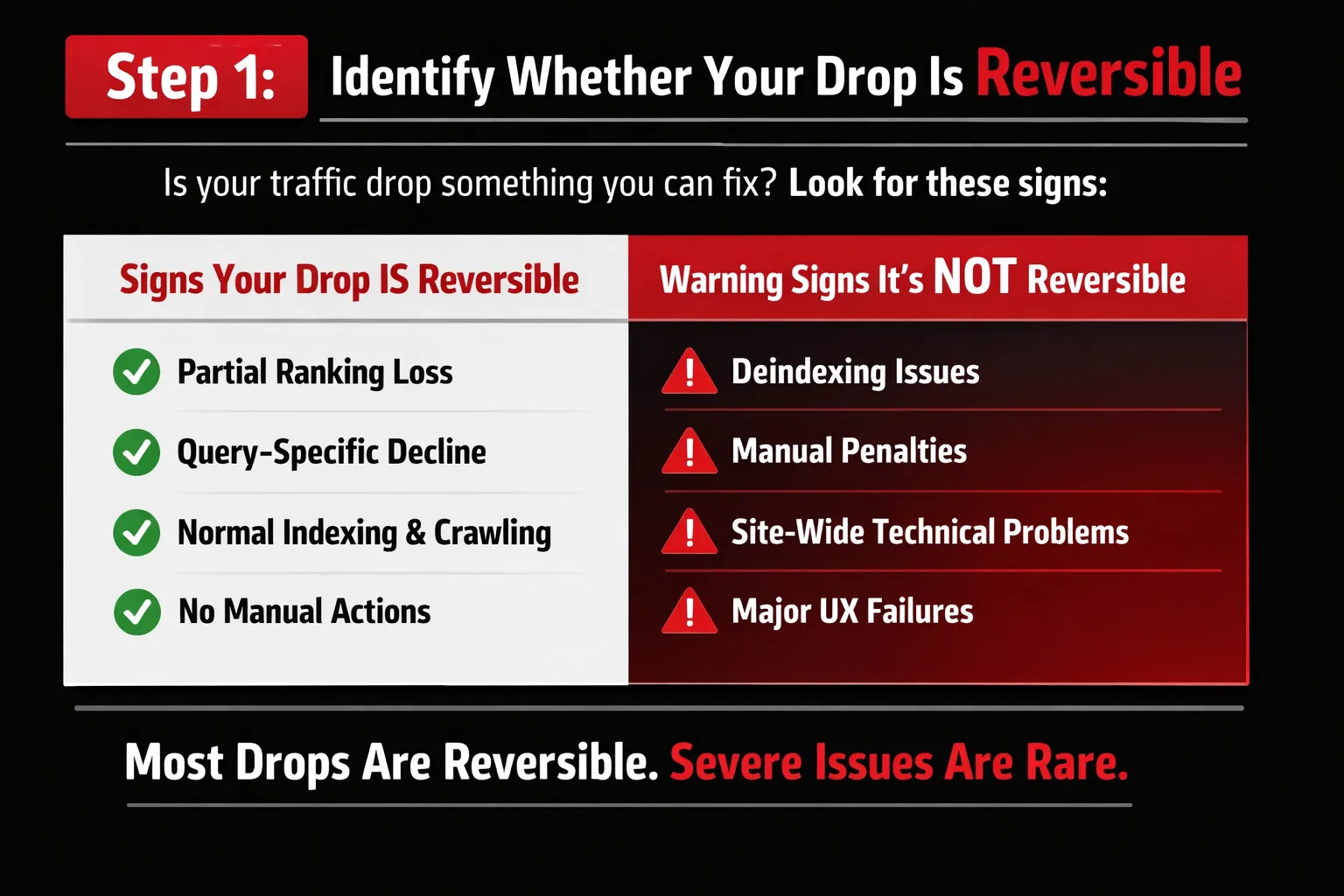
Purpose: Qualification framework
Before fixing anything, you need to answer one critical question: is this drop actually reversible?
In most cases, the answer is yes—but only if you diagnose the situation correctly. Core updates create noise, panic, and false assumptions. This step cuts through that and prevents you from wasting months fixing the wrong problem.
The Reversibility Test
A traffic drop is considered reversible when Google still recognizes your site as valid, crawlable, and contextually relevant—but has temporarily deprioritized it for specific queries.
Here are the strongest indicators that your drop qualifies:
1. Partial ranking loss
If some pages, sections, or keywords are still performing—while others declined—you’re not dealing with a site-wide trust collapse. Google rarely “half-penalizes” sites. Partial losses signal relative re-ranking, not rejection.
2. Query-specific decline
When losses are concentrated around certain query types or intent groups (e.g., informational posts but not branded terms), it points to relevance mismatch, not quality failure. This is one of the most recoverable scenarios.
3. Stable crawl and index statistics
Check Google Search Console:
- Pages are still indexed
- Crawl activity remains normal
- No sudden spike in excluded URLs
If Google is still crawling and indexing your content normally, it hasn’t lost fundamental trust in your site.
4. No manual actions
This is crucial. Core updates do not trigger manual actions. If your Manual Actions report is clean, you’re dealing with an algorithmic reweighting, not a penalty.
Warning Signs of Structural Issues (Rare)
True structural problems are uncommon but serious. These include:
- Long-term crawl failures or server errors
- Mass deindexing without recovery
- Confirmed manual actions
- Severe UX breakdowns (unusable mobile layouts, intrusive interstitials, broken navigation)
If these exist, relevance work alone won’t fix the issue—you’ll need technical remediation first.
Why Most Core Update Drops Pass the Test
The reality is simple: Google doesn’t want to remove good sites—it wants better matches.
Most sites that lose traffic after a core update fail the comparison, not the quality threshold. That’s why the majority of drops are reversible once relevance, intent alignment, and contextual signals are properly reinforced.
This step isn’t about fixing—it’s about confirming that recovery is possible. And for most sites, it absolutely is.
Step 2: Map Lost Queries to Lost Relevance
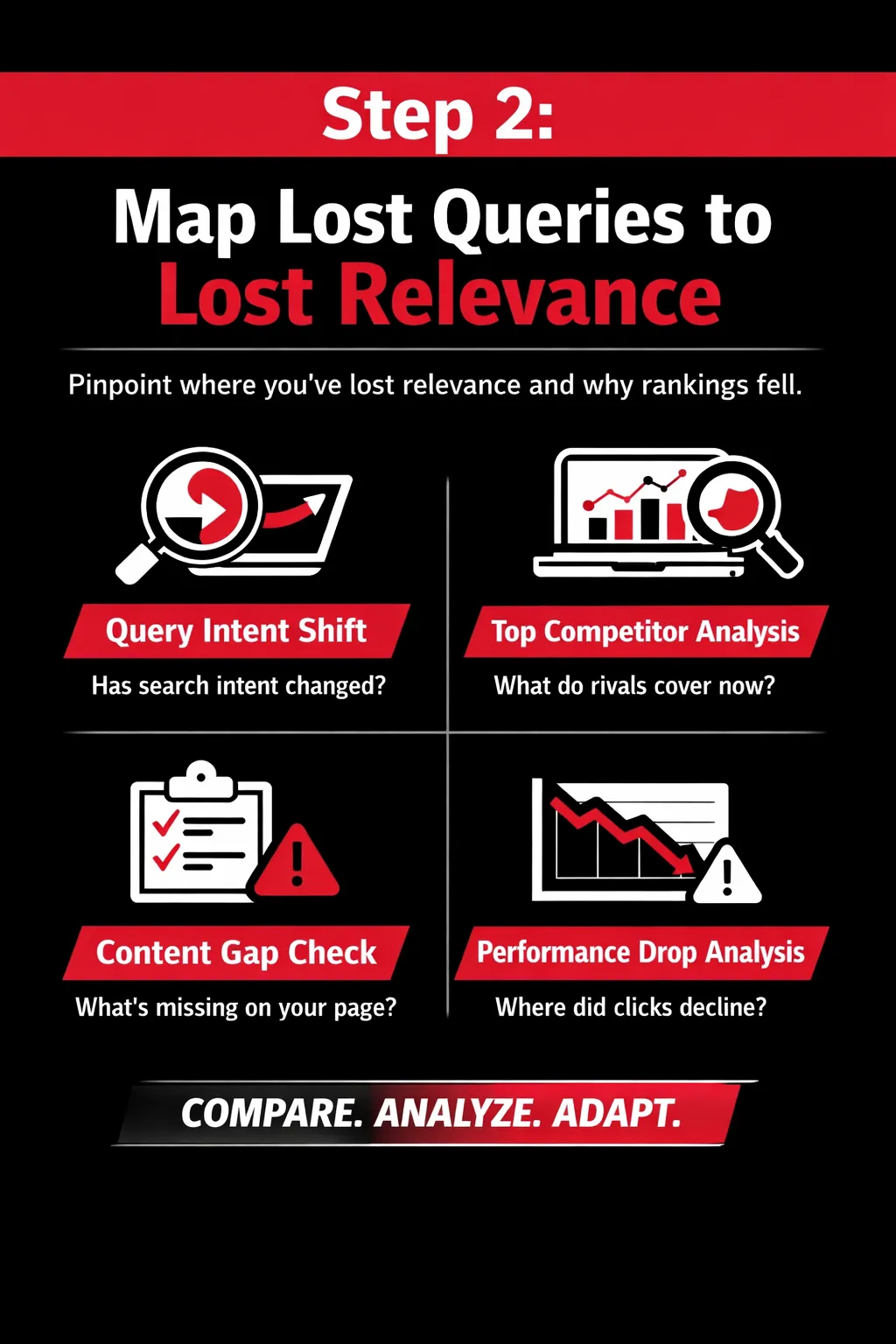
If Step 1 confirmed your traffic drop is reversible, the next move is not to change pages—it’s to understand which queries stopped trusting you and why. This is where most recovery efforts fail. Site owners look at averages, panic over red arrows, and start editing blindly. But core update losses don’t happen at the site level—they happen at the query–page relationship level.
Your job in this step is simple in theory, but precise in execution:
map lost queries to lost relevance signals.
How to Use GSC Correctly Post-Update
Google Search Console is often misused after an update. Averages blur reality and hide the actual problem.
First rule: ignore averages.
Average position, total clicks, and overall impressions tell you that something changed, not what changed. Recovery requires granularity.
Instead, focus on three things:
1. Query clusters, not individual keywords
Don’t chase single-term drops. Group queries by shared intent and topic. When a cluster declines together, it signals relevance erosion—not randomness.
For example:
- “best CRM for startups”
- “startup CRM software”
- “CRM tools for early-stage companies”
If these fall together, Google is no longer confident your page is the best cluster-level answer.
2. Intent shifts within the SERP
Compare pre-update and post-update SERPs. Ask:
- Are new result types ranking (guides, comparisons, tools)?
- Did commercial pages replace informational ones?
- Did Google surface more experiential or first-hand content?
Often, your page didn’t get worse—the definition of relevance changed.
3. Page–query mismatches
Look for queries still showing impressions but losing clicks or position. This usually means:
- The page partially answers the query
- Another page now matches intent more cleanly
- Your page is being outcompeted structurally, not qualitatively
Query Grouping Framework
Once you extract declining queries, group them by intent, not keywords. This clarifies why Google re-ranked results.
Use this four-part framework:
Informational
Queries seeking understanding or explanation. Example: “what is customer churn”
Commercial research
Queries comparing options or evaluating solutions. Example: “best churn reduction software”
Transactional
Queries with purchase or signup intent. Example: “buy churn analytics tool”
Navigational
Brand- or site-specific searches. Example: “HubSpot churn report”
Most post-core update drops happen when:
- Informational pages rank for commercial research queries
- Commercial pages rank for evolving informational intent
This mismatch quietly erodes trust.
Identifying Relevance Gaps
Now comes the most important diagnostic step: competitive relevance comparison.
Ask two questions:
1. What do top competitors now cover that you don’t?
Look beyond word count. Focus on:
- Subtopics addressed
- Order of information
- Framing and context
- Use of examples, data, or experience
Often, competitors win by being more situationally complete, not longer.
2. Structural vs semantic gaps
- Structural gaps: missing sections, poor hierarchy, unclear topical focus
- Semantic gaps: outdated language, shallow explanations, missing related concepts
Structural gaps break comprehension. Semantic gaps break relevance.
Fixing these gaps doesn’t require rewriting your page—it requires realigning it with how Google now interprets the query’s intent.
When you map lost queries to lost relevance this way, recovery stops being guesswork. It becomes a controlled, diagnosable process—and that’s when trust starts coming back.
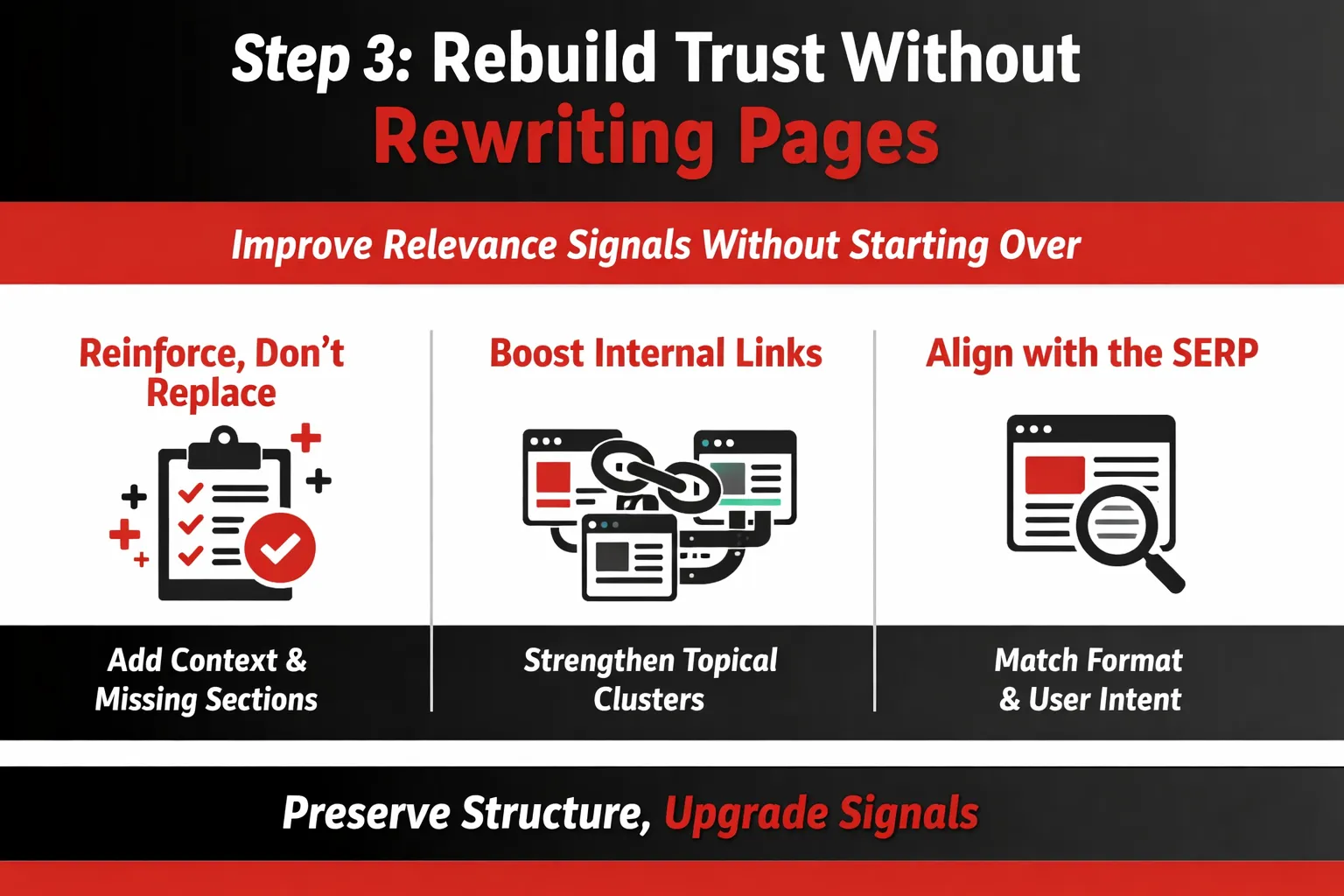
Step 3: Rebuild Trust Without Rewriting Pages
This is the step where most recoveries are either won or permanently delayed.
After a core update drop, the instinct to rewrite everything feels logical—but it’s usually the exact move that slows recovery. Google doesn’t need a new version of your content. It needs reassurance that the existing page still deserves to rank. That reassurance comes from reinforcing relevance signals, not replacing them.
Think of this step as signal repair, not content renovation.
Reinforce, Don’t Replace
When a page loses rankings after a core update, it’s rarely because the entire piece is wrong. More often, the page is incomplete relative to today’s search expectations.
Instead of rewriting, focus on surgical reinforcement.
What to add (without changing the core):
- Contextual expansions:
Add short sections that reflect how the topic is discussed now. This could include updated scenarios, modern examples, or newly common use cases. These additions help Google understand that the page still lives in the current search context. - Missing sub-answers:
Compare your page to the top-ranking results and identify questions they answer that you don’t. Often, these are not major gaps—just supporting explanations, edge cases, or clarifications that improve completeness. - Clarifying sections:
If parts of your content assume too much prior knowledge, add brief clarifiers. These improve intent satisfaction and reduce pogo-sticking, which indirectly supports trust signals.
What to preserve at all costs:
- Core structure:
Your headings, flow, and main argument are part of the page’s historical relevance. Drastic structural changes can reset how Google interprets the content. - Historical framing:
If a page has ranked for months or years, its original framing likely matched user intent well. You’re updating the edges, not the center. - URL stability:
Changing URLs or merging pages during recovery often delays trust rebuilding. Stability helps Google reassess relevance faster.
The goal is simple: make the page feel “current and complete” without making it unfamiliar to Google.
Internal Relevance Engineering
One of the most overlooked recovery levers is how pages support each other.
Core updates increasingly evaluate content as part of a topic network, not as isolated URLs.
To rebuild trust, you need to strengthen that network.
- Strengthen topic clusters:
Ensure your primary pages are supported by closely related subtopics. Thin or disconnected supporting content weakens the perceived authority of the entire cluster.
- Improve anchor context:
Internal links should describe why a page is relevant, not just point to it. Descriptive anchors reinforce topical relationships and help Google understand page roles.
- Enhance semantic pathways:
Users (and crawlers) should be able to move logically from foundational content to deeper explanations. Clean pathways signal topical depth and intentional architecture.
- Clarify hub–spoke relationships:
Make it obvious which page is the authority hub and which pages support it. Ambiguity here often causes ranking volatility after updates.
Internal relevance engineering doesn’t require new content—it requires clearer signals.
SERP Alignment Adjustments (Without Cloning Competitors)
Recovery does not mean copying what ranks.
It means understanding why those pages rank and aligning strategically.
Focus on three elements:
- Format:
Are top results guides, checklists, comparisons, or explanations? Your page should fit the dominant format while retaining its unique voice.
- Depth:
Match the level of detail users expect today. Too shallow feels outdated; too deep can misalign intent.
- Perspective:
Many newer ranking pages win because they offer a clearer angle—first-hand experience, practical frameworks, or updated viewpoints.
The key is alignment, not imitation. Google rewards pages that satisfy intent distinctively, not those that blend in.
Rebuilding trust isn’t about starting over.
It’s about reminding Google—clearly and consistently—why your content was worth ranking in the first place.
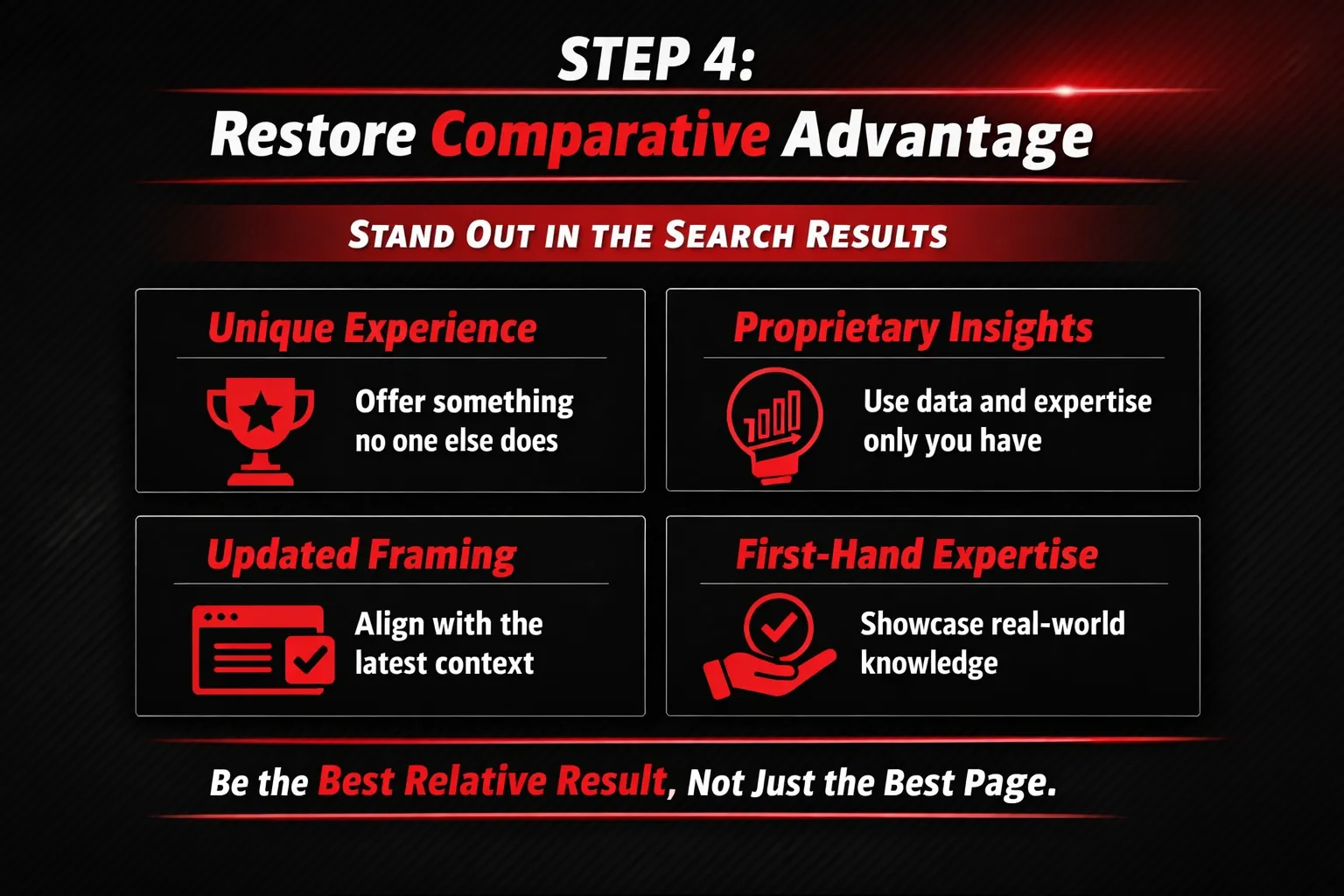
Step 4: Restore Comparative Advantage
Purpose: Competitive positioning
If there’s one idea that explains why most post–core update recoveries stall, it’s this: Google does not rank pages in isolation. It ranks them in comparison. By the time a core update rolls out, your content may still be “good,” accurate, and well-written—yet that’s no longer enough. What matters is whether your page is the best relative result right now for a specific query.
Why Google Picks “The Best Relative Result”
A common misconception in SEO is that rankings are earned through absolute quality—write better content, and Google will reward it. Core updates prove the opposite. Absolute quality is only the entry fee. Once multiple pages clear that bar, Google shifts to comparative evaluation.
Search results are zero-sum. For every page that moves up, another must move down. When Google updates its core systems, it often recalibrates how it weighs relevance signals such as intent match, topical depth, freshness, and experiential value. Your page didn’t suddenly get worse; it simply became less competitive under the new weighting model.
This is why post-update drops frequently happen to long-standing top performers. These pages are compared against:
- Newer content with fresher context
- Pages that better match evolved user intent
- Results offering clearer, more comprehensive answers
In this environment, being “high quality” but interchangeable is a losing position. If your page answers the query in roughly the same way as five others, Google has little reason to keep selecting you as the top result.
Recovery, therefore, is not about improving quality in a vacuum. It’s about re-establishing a comparative edge—giving Google a reason to prefer your result over all others.
Differentiation Levers That Restore Advantage
To regain that edge, you need to strengthen signals that competitors cannot easily replicate. These are the differentiation levers Google increasingly rewards after core updates.
Unique experience is the first. Pages that reflect real-world usage, operational insight, or lived context stand apart from generic summaries. This could be practical workflows, nuanced decision criteria, or examples drawn from actual implementation rather than theory.
Proprietary insights create another layer of defensibility. Original frameworks, internal data, synthesized observations, or uncommon perspectives signal that your content adds value beyond what already exists in the SERP. Google doesn’t need originality for its own sake—but it does reward content that expands the knowledge space of a query.
Updated contextual framing is equally critical. User intent evolves, especially for competitive queries. Reframing content to reflect current realities, constraints, tools, or expectations helps realign your page with how the query is being interpreted today—not when the article was first published.
Finally, first-hand expertise signals reinforce trust. Explicit indicators of experience—what you’ve tested, seen fail, refined, or learned over time—help Google distinguish between informational repetition and genuine authority.
Restoring comparative advantage is not about rewriting everything. It’s about answering the same query in a way competitors can’t easily match. When Google sees that difference clearly, rankings tend to follow.
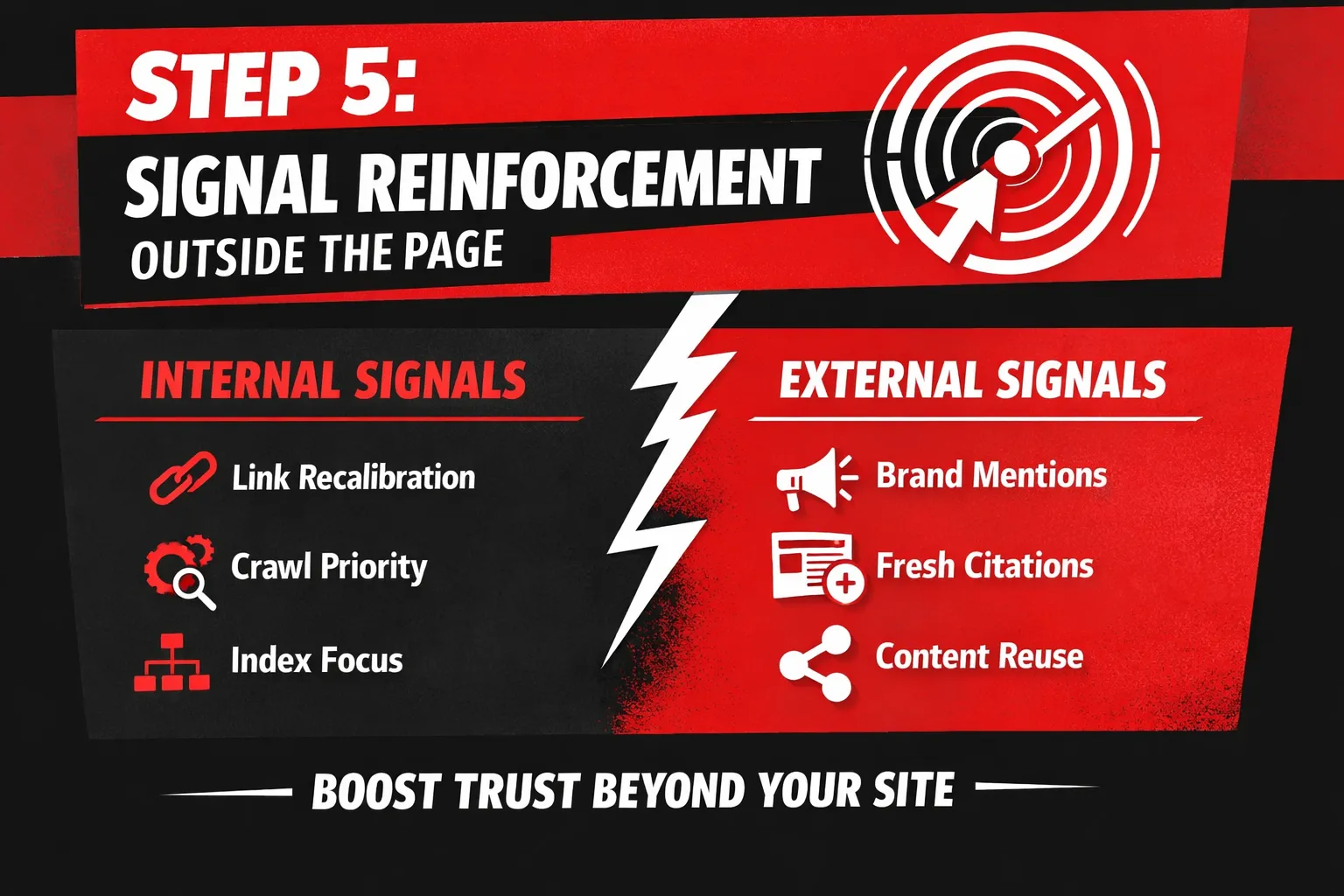
Step 5: Signal Reinforcement Outside the Page
Purpose: Supporting signals that help Google re-establish confidence without rewriting content
By this stage, you’ve addressed on-page relevance gaps and SERP alignment. Now the goal shifts from fixing content to reminding Google which pages deserve continued attention. Core updates don’t just reassess what’s on a page—they reassess how strongly that page is supported across your site and the wider web.
This is where signal reinforcement matters.
Internal Signals: Strengthening What Google Already Knows
Link recalibration
Internal links act as confidence votes inside your own site. After a core update, many ranking drops happen because important pages quietly lost internal prominence over time. New content, navigation changes, or blog expansion can unintentionally dilute link equity.
Instead of adding more links everywhere, recalibrate:
- Ensure priority pages receive links from topically relevant, authoritative pages
- Update anchor text to reflect current query intent, not legacy keywords
- Remove excessive links to outdated or low-value URLs that siphon attention
The goal is clarity, not volume.
Crawl priority
Google’s crawl budget is also a signal. Pages that are crawled more frequently are implicitly treated as more important. Reinforce crawl priority by:
- Improving internal link depth (important pages should never be buried)
- Fixing orphaned or near-orphaned URLs
- Reducing crawl waste from thin tags, filters, or duplicate paths
This helps Google “see” your important pages more often during reassessment periods.
Index focus
Not every indexed page helps you. In fact, excess low-value pages dilute overall site signals. Prune or noindex:
- Outdated content with no search demand
- Overlapping pages targeting the same intent
- Thin pages that no longer support your topical narrative
A tighter index sharpens relevance signals site-wide.
External Signals (Without Link Buying)
Brand mentions
Google increasingly uses brand references as trust reinforcement. You don’t need backlinks—unlinked mentions still count. Focus on:
- PR mentions
- Podcast appearances
- Community discussions
- Expert quotes
These reinforce real-world presence without manipulative tactics.
Fresh citations
Stale authority decays. Updating citations on relevant platforms, directories, and industry resources sends freshness and legitimacy signals—especially for SaaS, local, and niche brands.
Content reuse across platforms
Re-publishing insights as:
- LinkedIn posts
- Twitter/X threads
- Medium articles
- Newsletter content
extends topical presence beyond your site. Google sees consistent expertise echoed across the web, strengthening trust in your core pages.
Key takeaway: You don’t recover by doing more. You recover by making the right signals louder, clearer, and more consistent—both inside your site and across the web.
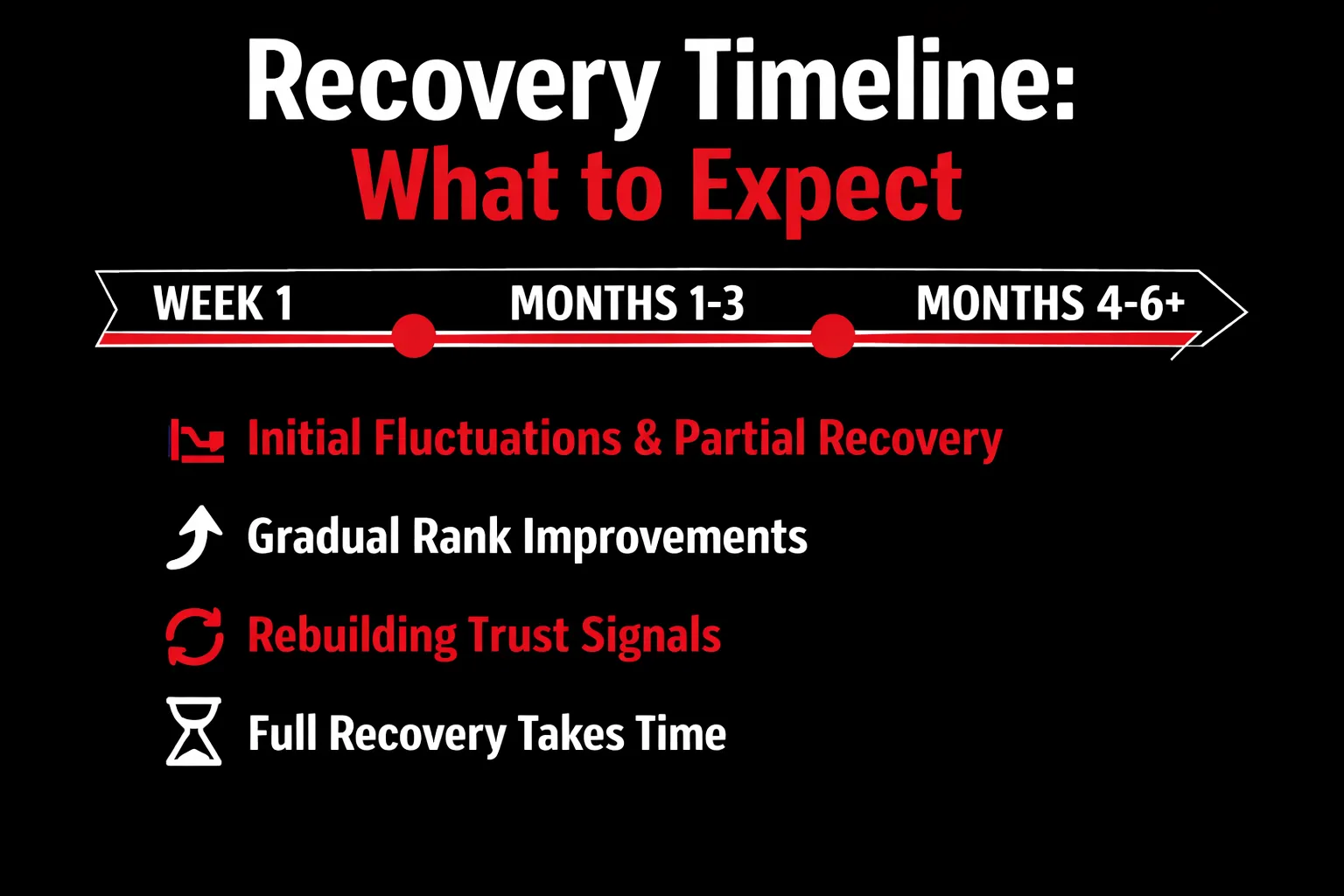
Recovery Timeline: What to Expect
One of the biggest mistakes site owners make after a core update drop is expecting an immediate bounce-back. Recovery from a relevance-based loss is rarely linear—and understanding the timeline is critical to avoiding actions that actually delay progress.
In the short term (first 2–4 weeks), fluctuations are normal. As you reinforce relevance signals—through targeted content adjustments, internal linking improvements, and intent alignment—Google begins re-evaluating affected pages. During this phase, rankings may move up and down, sometimes daily. This volatility is not a failure signal; it’s a sign your site has re-entered the evaluation set.
Partial recoveries almost always come first. You’ll typically see:
- Some queries returning to page one
- Impression recovery before clicks
- Certain URLs stabilizing while others lag behind
This happens because Google reassesses trust at the query level, not the site level. Pages that regain relevance fastest recover first.
Full trust rebuilding takes time—often one or more update cycles. Google needs sustained evidence that your pages consistently satisfy intent better than alternatives. That evidence accumulates through stable engagement, clear topical focus, and unchanged URLs that allow historical signals to compound again.
This is why patience matters more than constant edits. Repeatedly rewriting pages, changing structures, or “chasing” rankings resets evaluation signals and prolongs recovery. The goal is not to look active—it’s to look consistent.
In post-core update SEO, recovery is less about speed and more about signal stability. The sites that recover fastest are the ones that resist panic and let reinforced relevance do its work.
The New Rule of SEO After Core Updates
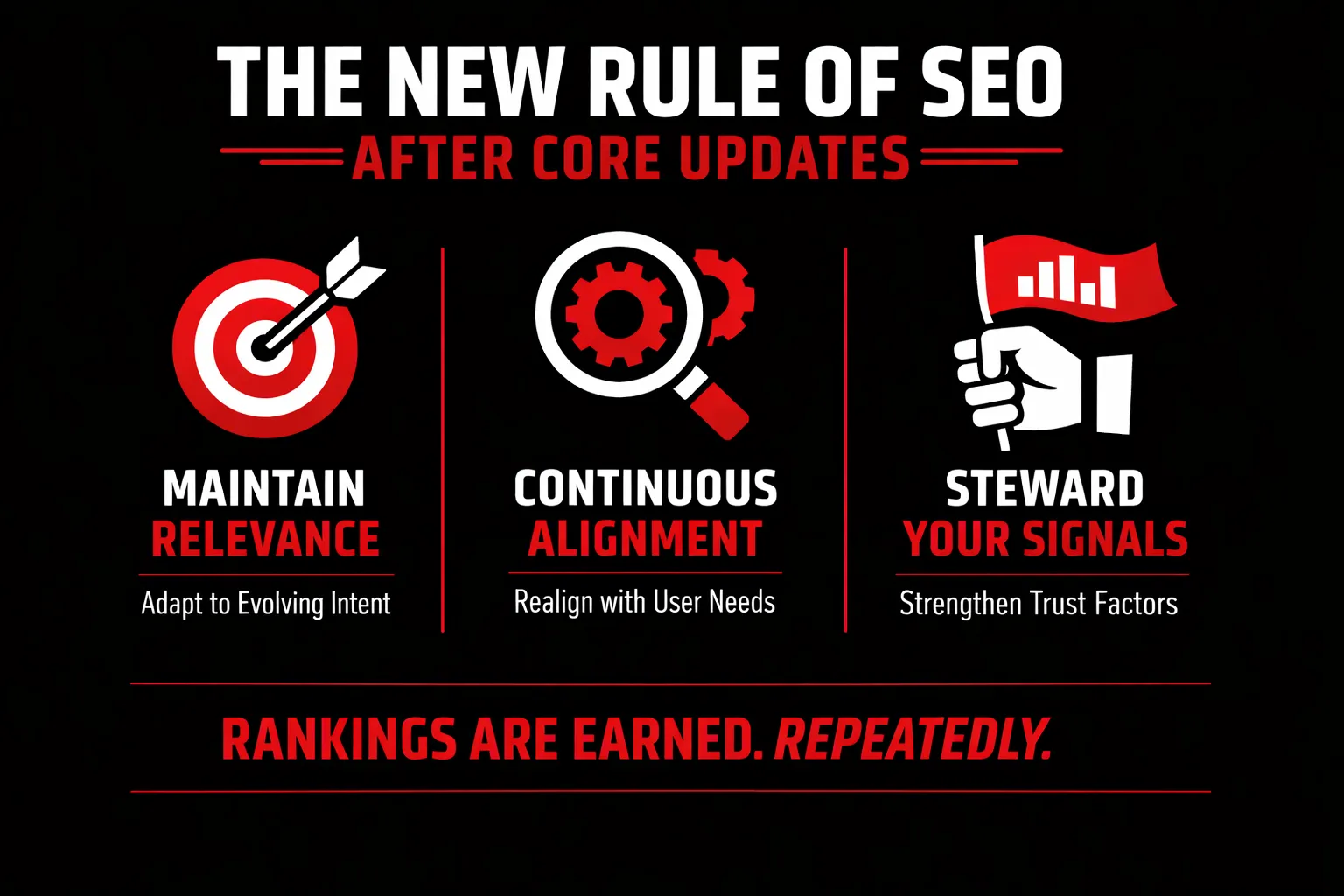
The biggest shift most site owners still haven’t internalized is this: SEO is no longer a one-time win. Core updates didn’t change the rules overnight—they exposed a reality that has been building for years. Rankings are no longer a reward you earn once and protect forever. They are a lease, not a trophy.
Today, SEO is fundamentally about maintaining relevance, not just achieving it. The moment your content stops reflecting how users search, think, and decide right now, Google begins reallocating trust. Not as a punishment—but as a recalibration. Relevance decays quietly, long before traffic graphs make it obvious.
This is why continuous alignment matters more than periodic overhauls. Search intent evolves. SERP formats shift. Competitors adapt faster. Sites that treat SEO as an ongoing alignment process—between queries, content, structure, and user expectations—retain visibility even through volatile updates. Those that don’t slowly drift out of contention.
The third pillar is signal stewardship. Every page on your site emits signals: topical focus, internal context, engagement, freshness, and credibility. Managing these signals deliberately—strengthening the right ones, removing noise, and preserving historical trust—is now core SEO work. Not chasing hacks. Not rewriting blindly.
The new rule is simple but uncomfortable: rankings are earned repeatedly. Sites that accept this don’t fear core updates—they anticipate them. And when visibility drops, they don’t panic. They realign, reinforce, and regain ground.
Final Takeaway: This Wasn’t a Penalty — It Was a Signal Shift
If your traffic dropped after a core update, the most important thing to understand is this: Google didn’t punish your site. There’s no hidden blacklist, no permanent mark against your domain. What happened is far less dramatic—and far more fixable. Google simply found other pages that better matched the current intent, context, and expectations behind your target queries. In other words, your site didn’t lose value; it lost relevance signals.
That distinction matters, because penalties are hard to escape—but relevance can be rebuilt.
You don’t need to rewrite your entire site, chase random “EEAT fixes,” or panic-publish new content. What you need is clarity. Clarity on which queries lost ground, why relevance slipped, and what signals Google now expects to see before trust is restored.
If you want a faster, cleaner path forward, start with a relevance audit to pinpoint where trust weakened. Follow that with query mapping to realign pages with actual search intent. From there, build a focused recovery roadmap—one that strengthens what already works instead of tearing everything down.
Core update drops aren’t the end of the road. Handled correctly, they’re the beginning of recovery.