
SUPERCHARGE YOUR ONLINE VISIBILITY! CONTACT US AND LET’S ACHIEVE EXCELLENCE TOGETHER!
Reframing funnels as probability fields where consumers exist in multiple buying states simultaneously—beyond step-by-step journeys and binary yes/no decisions.
For years, the marketing funnel has been treated like gravity: unavoidable, universal, and basically correct. Awareness leads to interest. Interest becomes consideration. Consideration converts. We plan budgets, campaigns, and dashboards around that smooth descent from “stranger” to “customer.”
And to be fair—funnels did work. Or at least, they worked well enough.
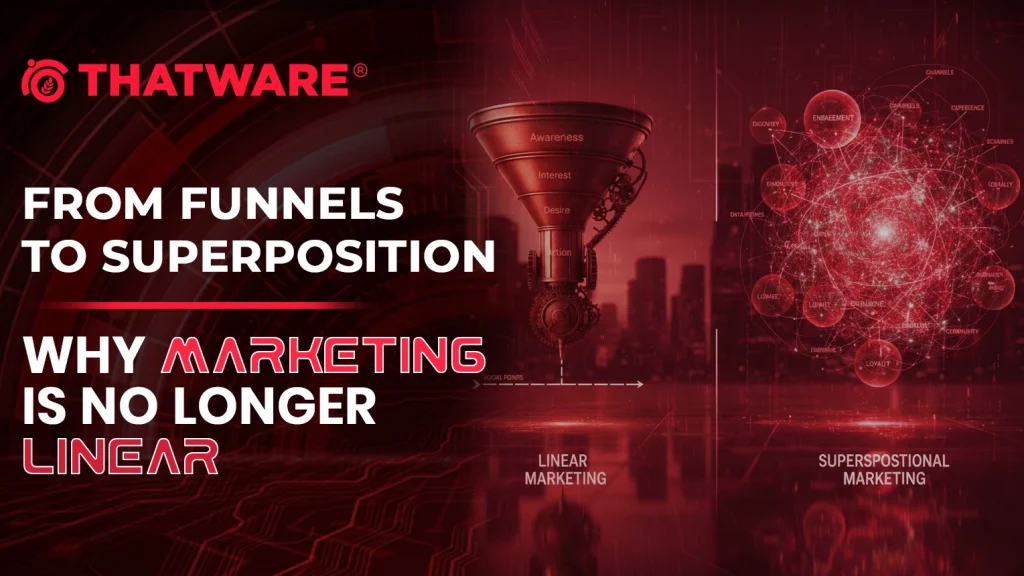
They made sense in a world where attention was easier to hold, channels were fewer, and customer journeys were more predictable. People discovered brands through a handful of touchpoints. They compared options in a narrower set of places. And when they were ready, they bought.
But that world is gone.
Today, your audience can see you in a reel, ignore you in a search result, trust you because a friend mentioned you, and distrust you because a creator criticized your category—all in the same day. They can be “high intent” and completely distracted. They can be ready to buy and still postpone for three weeks because something else took priority. They can be convinced by your product and unconvinced by your brand.
Funnels struggle with this reality because funnels assume something modern customers rarely do:
They assume people behave sequentially.
The quiet failure of “move them to the next stage”
Most marketing strategy still carries an old promise: move them forward.
- Move from awareness to consideration
- Move from consideration to conversion
- Move from conversion to loyalty
It sounds logical. It’s easy to measure. It gives teams a shared map.
But it also creates a dangerous illusion: that customers are standing neatly on one step at a time, waiting for your next message to guide them forward.
In practice, people don’t “move” through stages like a board game. They oscillate. They pause. They leap. They reverse. They hold contradictory beliefs at once.
And when you build strategy on a step-by-step assumption, you start doing step-by-step marketing:
- Over-educating people who are already ready
- Over-selling people who are not emotionally safe yet
- Chasing “funnel drop-offs” that aren’t drop-offs—just delays
- Treating hesitation like an objection, when it’s often uncertainty + distraction
The result isn’t just inefficiency. It’s misalignment—messaging that feels slightly off because it’s aimed at the “stage” you think they’re in, not the reality they’re living.
The core flaw: funnels describe reports, not humans
Funnels are great for structuring internal conversations. They’re great for KPIs. They’re great for simplifying complexity into something teams can execute.
But customers aren’t a report. They’re not a linear process. They’re not a pipeline with clean handoffs.
They’re a dynamic mix of:
- curiosity and skepticism
- desire and risk-aversion
- urgency and procrastination
- trust and doubt
Often at the same time.
This is where we need a new mental model—one that doesn’t demand that a customer must be in one place in order for our strategy to make sense.
Introducing superposition (without the physics lecture)
Here’s the simplest way to think about it:
Your customer is not in a single “stage.”
They’re in multiple buying states at once.
They can be aware of you, interested in you, uncertain about you, and almost ready—simultaneously. What changes isn’t their “stage.” What changes is which state becomes dominant in the moment.
That’s what “superposition” means in marketing terms: people hold multiple states until something makes one state “win.” A message, a moment, a conversation, a price change, a paycheck, a fear, a recommendation, a timing window—any of these can shift the balance.
So the job of marketing is no longer to push people down a linear track.
It’s to shape the environment so the probability of the right outcome increases.
Because in modern markets, customers don’t convert by marching forward.
They convert when their uncertainty drops below a threshold and their readiness becomes strong enough to act.
Key idea: marketing didn’t stop working—our mental model did
This is the uncomfortable part: most marketing doesn’t fail because the creative is bad or the budget is too small.
It fails because it’s built on a model of behavior that no longer matches reality.
The funnel assumes sequence. Modern customers behave in overlap.
The funnel assumes steps. Modern customers behave in states.
The funnel assumes forward movement. Modern customers behave in oscillations.
And once you accept that, everything changes—not just your campaigns, but how you think about messaging, measurement, and strategy itself.
In the next section, we’ll break down why the funnel is less a description of reality and more a story we tell ourselves—then replace it with a model that fits the world we’re actually marketing in.
The Funnel Is a Story We Tell Ourselves
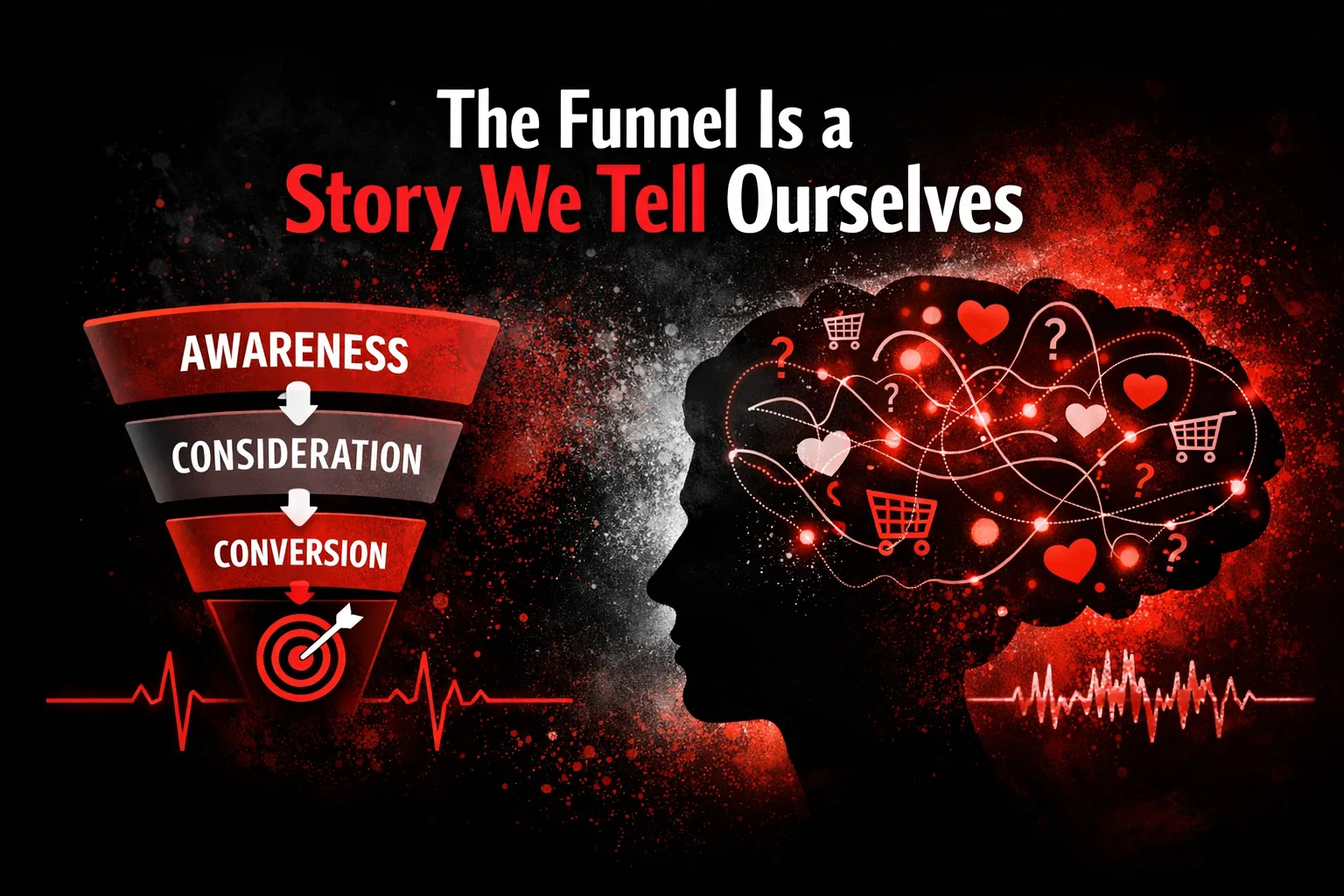
The marketing funnel is one of the most successful stories our industry has ever told itself. Not because it’s true—but because it’s comforting.
Awareness → Consideration → Conversion is a narrative that feels orderly, measurable, and manageable. It suggests progress. It implies control. It reassures us that if we just move people from one box to the next, growth will follow. But in reality, this sequence is less a reflection of how people buy and more a reflection of how organizations prefer to think.
The funnel isn’t a model of human behavior. It’s a reporting framework.
The Neat Fiction of Linear Progression
Real consumers don’t “enter” a funnel at awareness and politely wait to be advanced. They oscillate. They hesitate. They research after buying. They decide emotionally and justify rationally—sometimes weeks later. Someone can be deeply aware, actively considering, and resistant to conversion at the same time.
The funnel flattens this complexity into a single direction because complexity is hard to explain in meetings. Linear models survive not because they’re accurate, but because they’re legible.
How Dashboards Reinforce Linear Illusions
Dashboards play a powerful role in keeping the funnel alive. Every chart that shows drop-offs, step conversions, or stage velocity quietly reinforces the idea that buyers move forward in a straight line.
But dashboards don’t show reality—they show what’s easy to count.
They reward:
- Stage transitions over lingering influence
- Last-click certainty over distributed impact
- Clean numbers over ambiguous signals
When something can’t be plotted as “up and to the right,” it’s often ignored, even if it’s shaping the decision more than any measurable touchpoint.
Why Attribution Models Need Linearity to Survive
Attribution models, by design, require a beginning, a middle, and an end. They need a path. They need causality. Without linearity, attribution collapses into uncertainty—and uncertainty doesn’t fit neatly into spreadsheets or quarterly reviews.
So we reverse-engineer behavior to match the model.
We pretend influence is sequential. We isolate touchpoints that were never isolated. We assign credit where clarity is demanded, not where truth lives. The funnel persists because attribution depends on it—and attribution justifies budgets, teams, and tools.
The Hidden Cost of Clean Stages
The real damage isn’t theoretical—it’s strategic.
When we force messy human behavior into clean stages, we:
- Optimize for movement instead of meaning
- Design campaigns to “push forward” instead of reinforce belief
- Misread hesitation as failure rather than a natural state
- Kill resonance in favor of efficiency
We start managing the funnel instead of understanding the buyer.
And slowly, marketing becomes about improving the model rather than improving reality.
The Core Insight
Funnels don’t simplify markets—they simplify reporting.
They give us clarity at the expense of accuracy. Comfort at the expense of truth. In a world where consumers are influenced by dozens of signals simultaneously—content, community, AI, emotion, timing—the idea that behavior unfolds step-by-step isn’t just outdated.
It’s misleading.
To move forward, marketing doesn’t need a better funnel.
It needs a better way to think.
Consumers Don’t “Move” — They Coexist
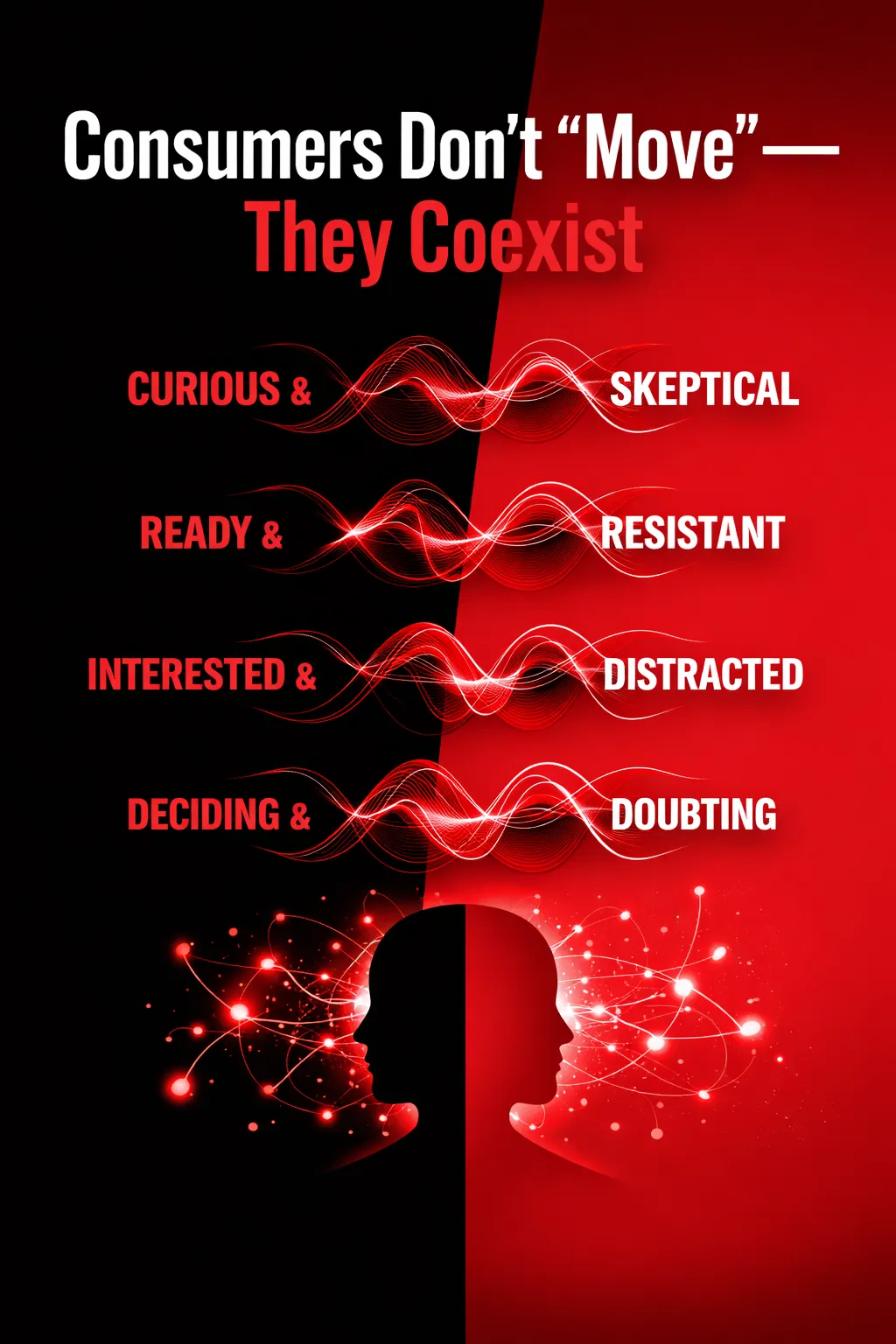
Marketing has long been built on the assumption that consumers move—from awareness to consideration to conversion, one clean step at a time. But real buyers don’t behave like pieces on a board. They don’t advance when nudged. They coexist in multiple states at once.
A single person can be:
- Curious and skeptical — intrigued by the idea, doubtful of the claim
- Ready and resistant — financially capable, emotionally hesitant
- Interested and distracted — mentally engaged, attention-fragmented
Not sequentially. Simultaneously.
This is where linear models break down. They force marketers to ask, “Which stage is the buyer in?” when the more accurate question is, “Which states are active right now?”
Decisions Don’t Progress. They Collapse.
In a linear worldview, decisions are made through accumulation: more information, more reassurance, more nudges—until conversion happens.
In reality, decisions behave differently. They don’t progress. They collapse.
For weeks or months, a buyer can hover in a cloud of competing impulses—interest, doubt, urgency, inertia. Then one moment triggers resolution:
- A comment from a peer
- A shift in timing or context
- A sudden emotional alignment
Nothing “advanced.” The state simply collapsed into action—or disengagement.
This is why last-touch attribution feels convincing but lies by omission. The final interaction didn’t cause the decision; it merely resolved it.
The Interference Pattern: Micro-Moments, Emotion, and Social Signals
What keeps buyers in coexistence is interference.
Every day, they are exposed to:
- Micro-moments of relevance and irrelevance
- Emotional fluctuations that reweight priorities
- Social signals that amplify or suppress confidence
These forces overlap and interfere with each other, constantly reshaping the probability of action. A strong message can be neutralized by weak timing. A perfect offer can fail in the wrong emotional context. A casual peer mention can outweigh months of polished marketing.
None of this is visible in a funnel. All of it is happening in parallel.
Consumers Are Waves, Not Dominoes
Dominoes fall in order. Waves overlap.
A wave can reinforce another wave—or cancel it out. Its impact depends on timing, alignment, and context, not position in a sequence. Consumers behave the same way.
They don’t wait patiently to be pushed forward. They oscillate. They interfere. They resonate. And when conditions align, they act.
This is superposition in marketing terms: buyers holding multiple buying states at once until something causes resolution.
Once you see consumers as waves instead of dominoes, the goal of marketing changes—from pushing people forward to shaping the conditions under which decisions collapse in your favor.
And that’s where linear thinking finally stops being enough.
Marketing in Superposition: The New Buyer Reality
The biggest mistake modern marketing still makes is assuming that buyers move.
They don’t. They coexist.
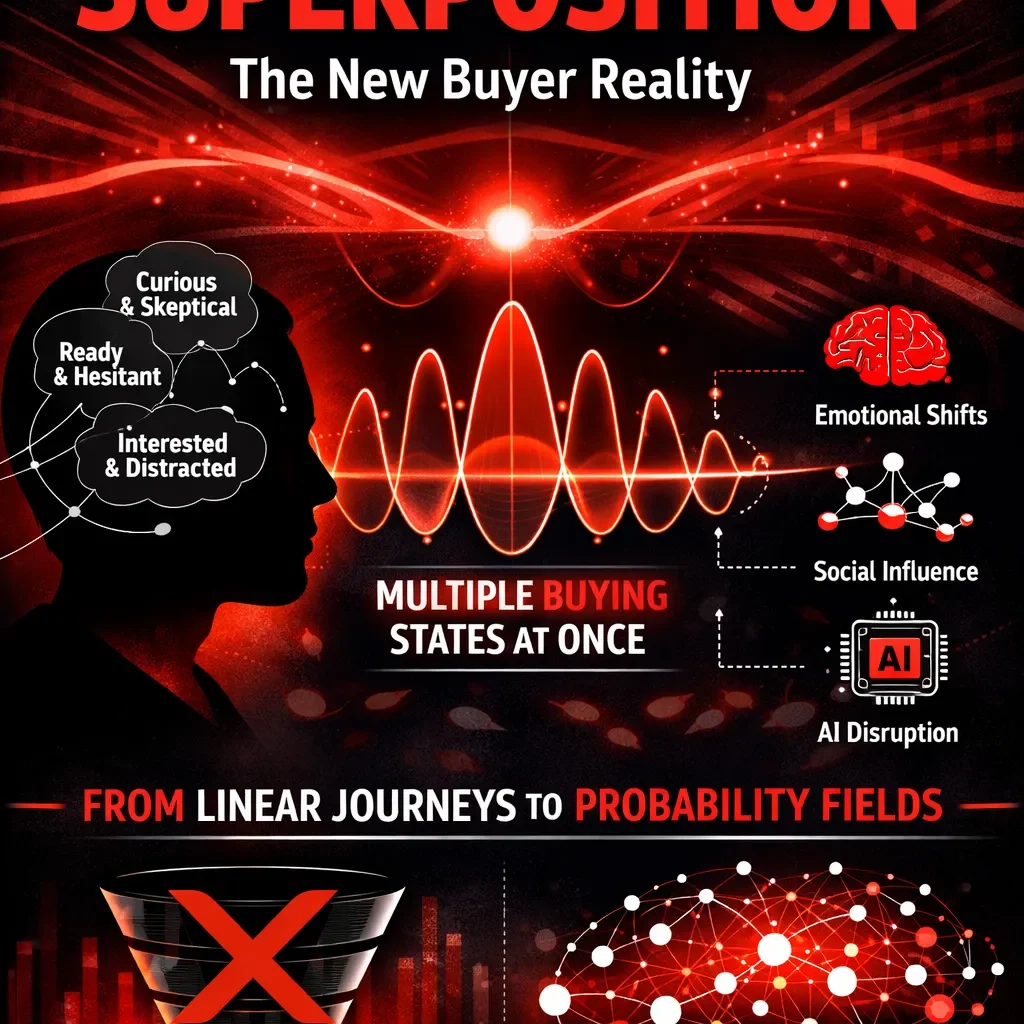
In today’s environment, consumers are not progressing neatly from awareness to consideration to conversion. They are holding multiple buying states at the same time—curious yet doubtful, interested yet inactive, ready yet distracted. This is what superposition looks like in marketing terms.
Superposition doesn’t mean confusion. It means parallel reality. A buyer can be researching your product, ignoring your ads, comparing alternatives, and emotionally committing—all within the same week, sometimes within the same hour. Linear models break not because consumers are irrational, but because reality is layered.
Intent Is Not a Signal. It’s a Probability Distribution.
Traditional marketing treats intent as a switch: on or off.
Clicked = interested.
Didn’t convert = not ready.
But intent doesn’t behave like a binary signal anymore. It behaves like a probability distribution—a constantly shifting range of likelihood influenced by context, timing, emotion, social proof, and cognitive load.
A user who doesn’t convert today hasn’t “failed the funnel.” Their probability simply hasn’t collapsed yet.
Every interaction—content, ad, review, community mention—doesn’t move them forward. It adjusts the probability that a future moment will tip in your favor. The mistake is expecting immediate causality in a system that is inherently non-deterministic.
Marketing performance doesn’t come from triggering decisions. It comes from shaping conditions.
Why Modern Environments Amplify Superposition
Superposition isn’t new—but modern environments make it unavoidable.
- AI-driven feeds expose buyers to fragmented, non-linear inputs
- Social platforms mix influence, entertainment, and commerce simultaneously
- Communities and creators introduce trust signals outside brand control
- Always-on information means buyers never fully “enter” or “exit” a journey
The buyer is no longer on a path. They are inside an information field, constantly interfered with by new signals. Every touchpoint overlaps with others. Every message competes, reinforces, or cancels out something else.
This is why clean journeys disappear the moment they meet reality.
Why Stage-Based Messaging Misfires
Stage-based messaging assumes a false certainty: we know where the buyer is.
But when buyers exist in superposition, messaging designed for a single “stage” often lands wrong:
- Awareness messaging hits someone already evaluating
- Conversion messaging hits someone emotionally interested but cognitively overwhelmed
- Retargeting assumes hesitation when the real issue is context
The result isn’t rejection—it’s misalignment.
Modern buyers don’t need to be pushed to the next step. They need messages that resonate across states—messages that reinforce identity, reduce uncertainty, and remain relevant whether the buyer is observing, evaluating, or ready.
The Strategic Shift: From Guiding Journeys to Shaping Probability Fields
This is the real transformation.
Marketing is no longer about guiding people through a sequence.
It’s about shaping a probability field in which decisions are more likely to collapse in your favor.
- You don’t “move” buyers—you increase likelihood
- You don’t control timing—you stay present
- You don’t optimize steps—you strengthen signals
In a world of superposition, the best marketing doesn’t demand decisions.
It patiently, persistently makes the right decision easier to happen.
That is the new buyer reality—and the new competitive edge.
From Funnels to Probability Fields
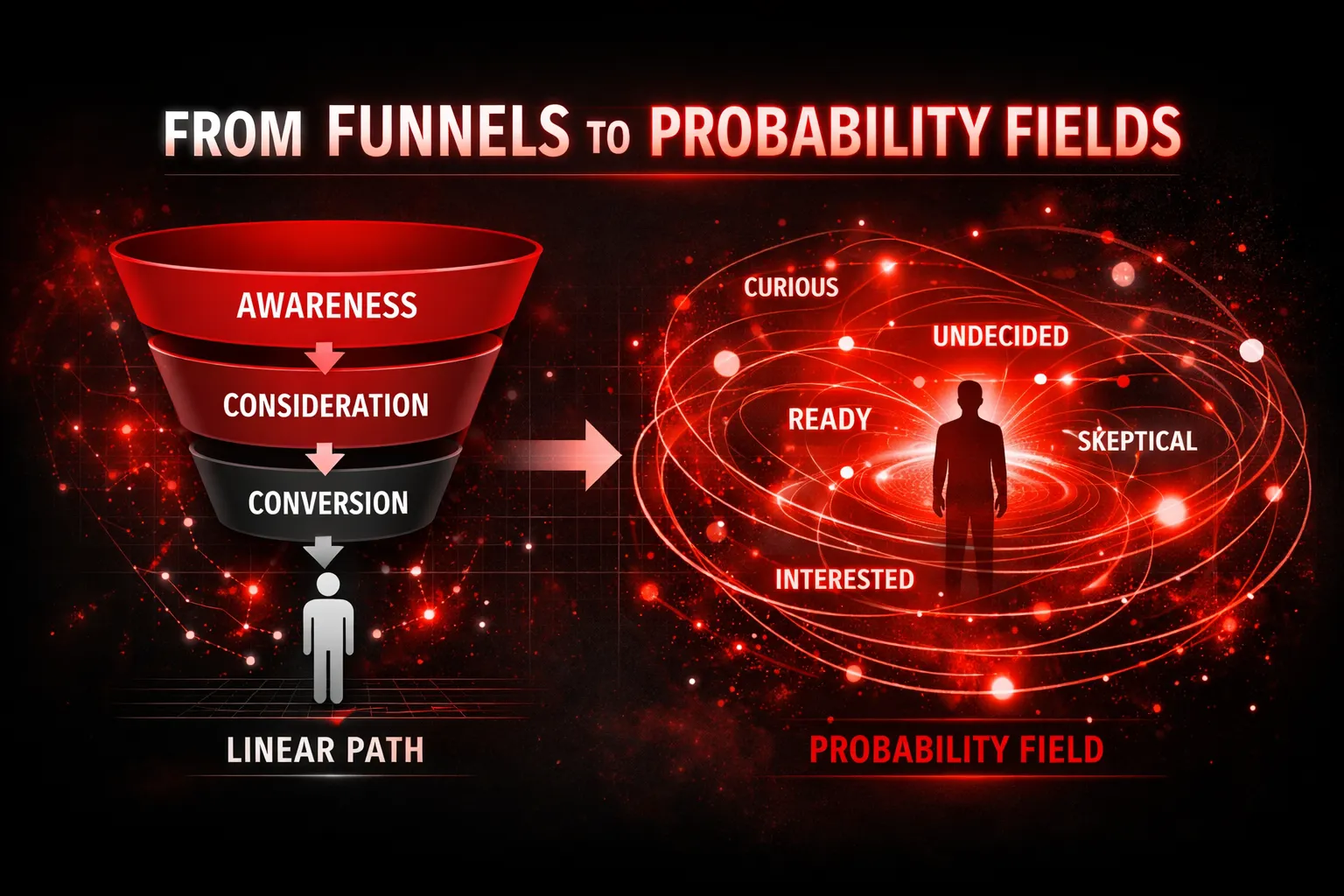
For decades, marketing strategy has been built on the idea of forward motion. A touchpoint is supposed to move a prospect—from awareness to consideration, from consideration to conversion. If nothing moves, the touchpoint is labeled ineffective.
This assumption is the problem.
In reality, most marketing does not push people anywhere. It changes the likelihood of what they might do later.
That shift—from movement to likelihood—is the difference between funnels and probability fields.
What a Probability Field Looks Like in Marketing Terms
A probability field is not a journey map. It has no arrows, no fixed order, and no guaranteed direction.
Instead, it’s an environment where:
- Every interaction subtly alters perception
- Every exposure nudges belief, trust, or familiarity
- Every signal adds or subtracts probability from future action
In this model, a customer is not “in” a stage. They are surrounded by influences—brand impressions, social proof, memory, relevance, emotional timing—all interacting simultaneously.
Marketing doesn’t escort them forward. It reshapes the field around them.
Touchpoints Don’t Push Forward — They Increase Likelihood
A LinkedIn post rarely converts someone. A podcast mention rarely closes a deal. A single ad almost never “moves” a buyer to the next stage.
But each of these can:
- Make a brand feel familiar instead of foreign
- Reduce perceived risk
- Increase trust just enough to matter later
These touchpoints don’t advance a funnel step. They raise the probability that when the moment of decision arrives, your brand is the one that feels obvious.
The mistake of funnel thinking is expecting visible movement after every interaction. Probability thinking accepts delayed, indirect, and compounding effects.
The Role of Repetition, Context, and Timing
In linear models, repetition looks inefficient. If someone has already “seen” your message, why show it again?
In probability fields, repetition is essential.
- Repetition builds cognitive availability and trust
- Context determines whether a message adds or subtracts probability
- Timing decides whether influence compounds or disappears
The same message seen in the wrong context does nothing. The same message seen repeatedly in the right contexts quietly reshapes preference.
Marketing impact doesn’t come from novelty alone—it comes from reinforced relevance.
Why Impact Is Cumulative, Not Sequential
Funnels assume impact happens step by step. Reality is messier.
A buyer might ignore five touchpoints, then convert after the sixth—not because the sixth was powerful, but because the first five prepared the collapse.
Each interaction leaves residue:
- Memory
- Familiarity
- Emotional association
- Reduced friction
None of these are measurable in isolation. Together, they create momentum.
Impact accumulates like pressure, not progress.
Reframing the Role of Marketing
When you move from funnels to probability fields, the purpose of marketing changes:
- From persuasion → probability amplification
- From control → influence shaping
- From moving people → making outcomes more likely
The best marketing doesn’t convince. It conditions the environment so that when a decision finally happens, it feels natural, not forced.
That’s what probability fields do—and why linear strategies can no longer compete.
Why A/B Testing, Attribution & Personas Start Breaking Down
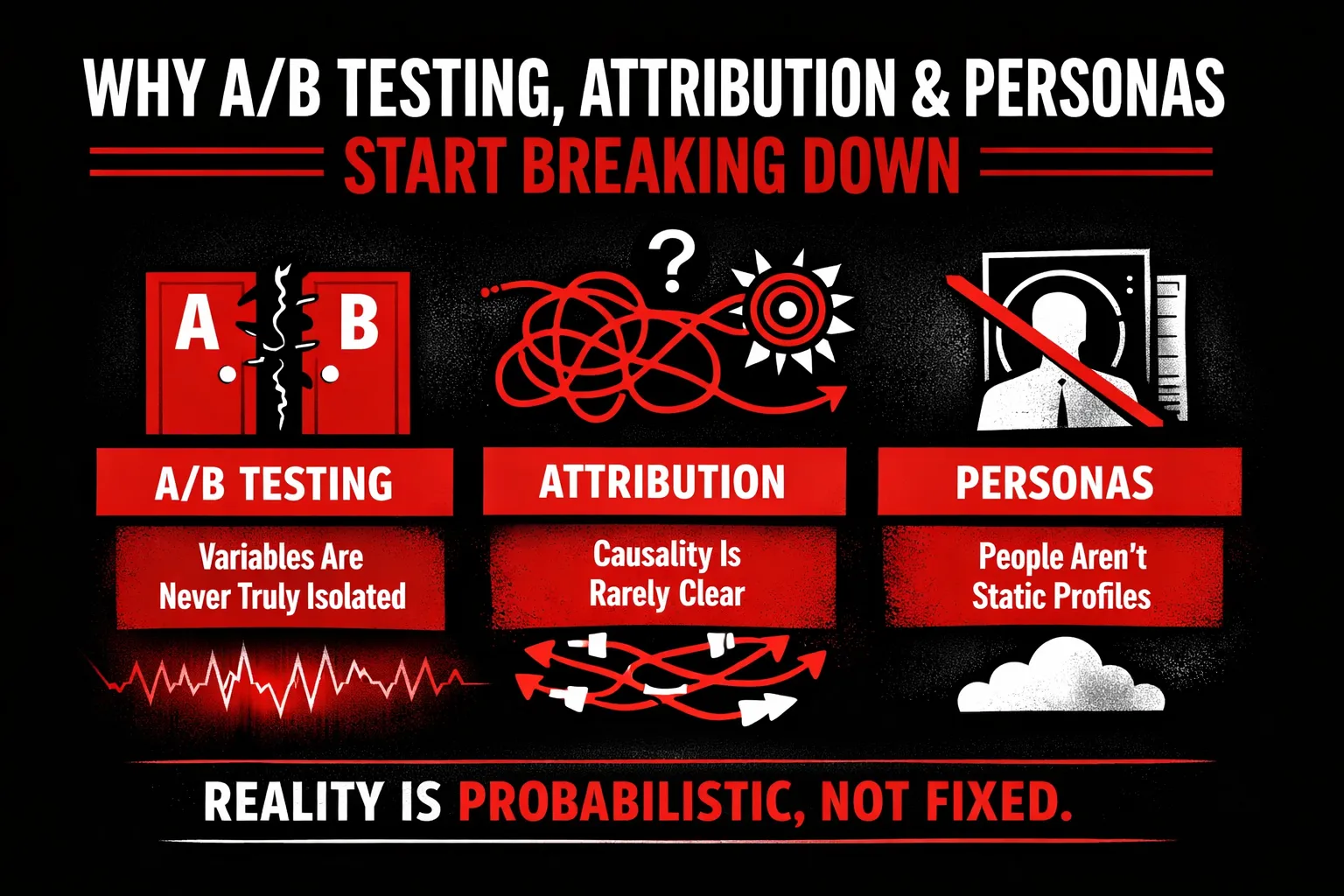
For decades, marketing’s most trusted tools have promised clarity. Test this. Attribute that. Optimize everything.
And for a long time, they worked—or at least, they appeared to.
But these tools were designed for a linear world. A world where variables could be isolated, causes could be traced, and people behaved consistently across time and context. That world no longer exists.
A/B Testing Assumes Isolation—Reality Is Entangled
At the heart of A/B testing lies a comforting assumption:
Change one variable, hold everything else constant, observe the outcome.
In practice, nothing is ever held constant.
A headline does not perform independently of:
- The channel it appears in
- The emotional state of the user that day
- The content they saw five minutes earlier
- The social, economic, and algorithmic context surrounding it
Modern buyers exist in entangled environments where signals interfere with one another. A “winning” variant may succeed not because it is inherently better, but because it resonated with a particular moment in a particular context—one that cannot be repeated.
A/B testing doesn’t reveal truth. It reveals local success under temporary conditions.
Attribution Collapses Complexity Into Fake Certainty
Attribution models attempt to answer a deceptively simple question:
What caused the conversion?
To do so, they must flatten a complex web of influence into a single line of credit—first touch, last touch, multi-touch, it doesn’t matter. The act of attribution itself demands a false narrative of causality.
In reality:
- Influence is cumulative, not sequential
- Impact is distributed, not owned
- Many of the most powerful effects are indirect and unmeasurable
Attribution doesn’t uncover causation. It manufactures certainty so decisions feel defensible.
And in doing so, it trains organizations to over-invest in what is visible, measurable, and immediate—while under-valuing what actually builds long-term demand.
Personas Freeze What Is Fundamentally Dynamic
Personas were created to humanize data. Ironically, they now do the opposite.
By freezing people into stable profiles—“Decision-Driven Dana,” “Value-Seeker Vikram”—personas assume consistency where none exists. But modern consumers shift identities constantly:
- Professional in the morning
- Parent in the afternoon
- Explorer at night
Their motivations fluctuate with mood, context, social input, and timing. No single persona can capture this fluidity.
When marketing is built around static snapshots, it inevitably misses the moments that matter most.
When Optimization Becomes a Liability
Perhaps the most dangerous assumption of all is that optimization is always progress.
Short-term optimization favors what performs now—not what compounds over time. It rewards:
- Familiar formats over novel ones
- Clickable ideas over meaningful ones
- Safe repetition over strategic risk
In probabilistic systems, excessive optimization narrows the field. It reduces variation, dampens exploration, and slowly erodes future upside.
What looks like efficiency in the present often becomes fragility in the long run.
Precision Is Not the Same as Truth
None of this means testing, attribution, or personas should be abandoned. It means they should be demoted from oracles to instruments.
In a non-linear market, precision can be misleading. Clean numbers can hide messy realities. And clarity can be manufactured at the cost of understanding.
The future of marketing does not belong to those who measure the most precisely—but to those who interpret uncertainty most intelligently.
Because in a world of superposition, the goal is not to prove what worked. It is to expand what can work next.
What Quantum-Inspired Marketing Looks Like in Practice
Quantum-inspired marketing is not a new set of tactics—it’s a new way of structuring action. The difference is subtle but fundamental: instead of trying to move people forward, you design environments that increase the probability of action over time.
This is how it shows up in practice.
1. Campaigns Run in Parallel, Not in Sequences
Traditional marketing assumes order: awareness first, then consideration, then conversion. Quantum-inspired marketing assumes coexistence.
Instead of a linear rollout, multiple messages, formats, and narratives operate simultaneously. A prospect might encounter:
- A thought-provoking insight on LinkedIn
- A practical explainer on a blog
- A credibility signal through community or social proof
- A product narrative weeks later
None of these are “steps.” They are overlapping signals, reinforcing each other across time and context. The goal isn’t progression—it’s resonance.
Sequential campaigns wait their turn. Parallel campaigns accumulate influence.
2. Campaigns Adapt Instead of Concluding
Linear campaigns have an end date. Quantum-inspired campaigns have states.
Rather than launching, optimizing, and shutting down, campaigns continuously adapt based on:
- Language that starts resonating unexpectedly
- Channels that amplify each other
- Emerging audience interpretations you didn’t predict
Nothing is ever fully “finished.” Messaging mutates, emphasis shifts, and narratives deepen. The campaign doesn’t conclude—it collapses differently for different people at different times.
In practice, this means fewer “big launches” and more living systems that evolve in public.
3. Channels Reinforce—They Don’t Hand Off
In classical marketing, channels pass the customer along like a relay race. Social hands off to content. Content hands off to email. Email hands off to sales.
Quantum-inspired marketing removes the baton.
Each channel reinforces the same probability field:
- Social builds familiarity and cognitive availability
- Content deepens understanding and trust
- Email sustains presence and relevance
- Product experience echoes the same narrative
There is no “handoff moment.” There is only reinforcement density.
When channels echo each other coherently, decision-making accelerates—not because of pressure, but because of alignment.
4. Measurement Shifts from Stages to Signal Strength
Funnels measure movement. Quantum marketing measures intensity.
Instead of asking:
- “How many people moved to the next stage?”
You start asking:
- Are we becoming easier to recall?
- Is trust accumulating or dissipating?
- Is our narrative showing up unprompted in conversations?
- Are prospects self-educating before we speak to them?
Signal strength shows up in:
- Time spent, not clicks
- Language mirroring, not form fills
- Repeat exposure, not linear paths
- Fewer objections, not more leads
You don’t track certainty. You track momentum.
5. Campaigns Are Allowed to Evolve—Not “End”
In a probabilistic system, stopping visibility resets the field.
Quantum-inspired marketing treats presence as continuous, not episodic. Campaigns fade, merge, or transform—but they rarely disappear entirely.
This doesn’t mean constant noise. It means consistent signal.
The best brands feel “always there,” not always selling. Their influence compounds quietly, until a decision collapses and the buyer can’t fully explain why this brand felt like the obvious choice.
6. Brand as a Constant Field, Not a Burst of Activity
Instead of campaign spikes followed by silence, brand presence functions like a background force:
- Always detectable
- Always coherent
- Never overwhelming
The brand doesn’t shout. It conditions the environment.
When buyers finally act, it feels less like persuasion and more like recognition.
7. Content Ecosystems Replace Conversion Paths
Conversion paths assume control. Ecosystems assume exploration.
Quantum-inspired content is designed to:
- Be entered from anywhere
- Make sense in any order
- Reinforce core ideas repeatedly from different angles
Articles, posts, talks, tools, and conversations don’t point to a single CTA—they orbit a central narrative.
The result is not higher conversion rates per touchpoint, but higher inevitability over time.
The Practical Shift
Quantum-inspired marketing doesn’t try to force decisions. It shapes the conditions under which decisions become inevitable.
When marketing works this way, success no longer looks like “moving people down a funnel.” It looks like being present at the moment the wave collapses—and realizing you influenced it long before you could measure it.
The CMO Mindset Shift: From Control to Coherence
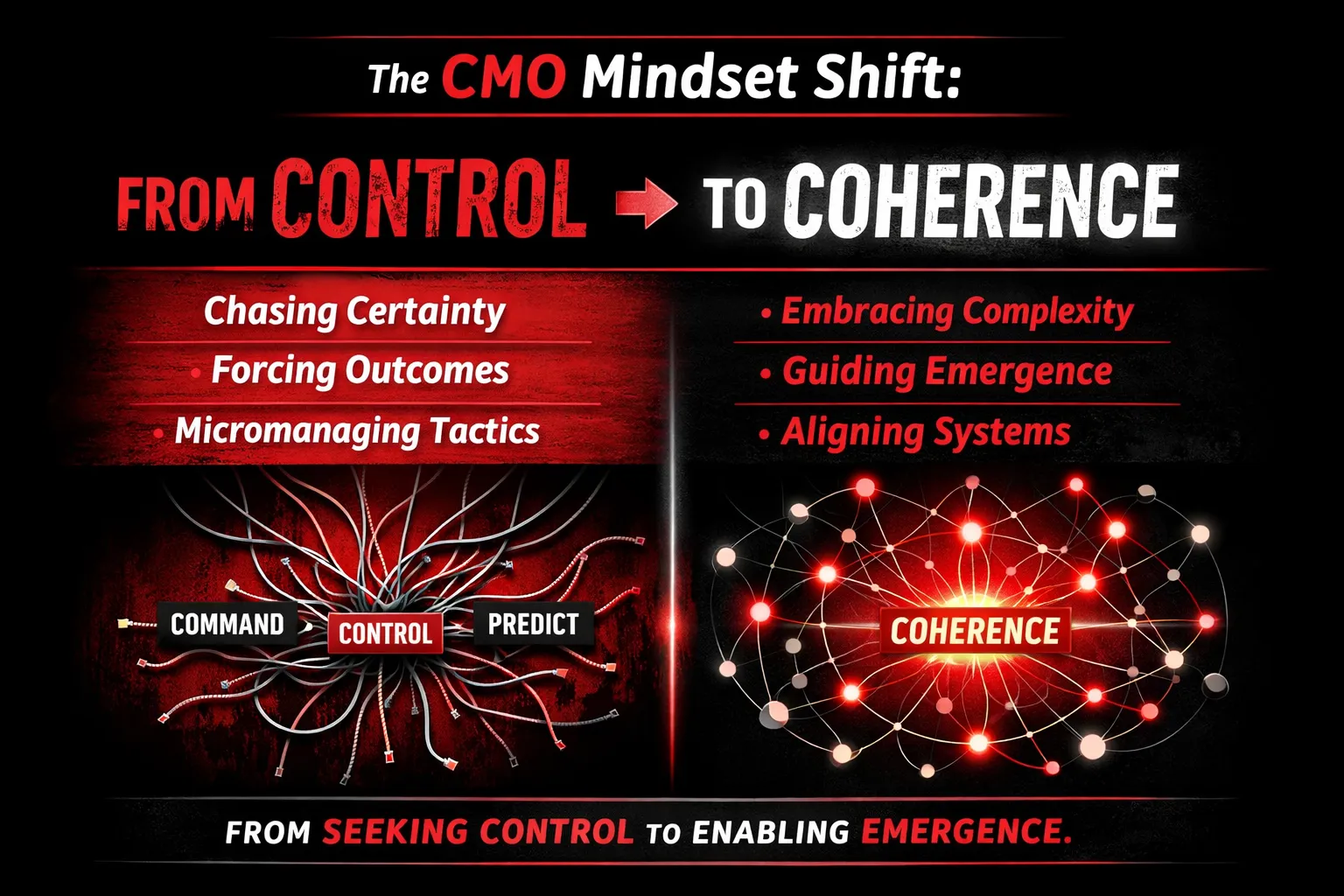
For decades, marketing leadership has been built around a single promise: control. Control over channels. Control over messaging. Control over outcomes.
Dashboards reinforced this belief. Funnels legitimized it. Forecasts made it feel scientific.
But in today’s marketing environment, control is no longer a strength—it’s a liability.
Certainty Is the Most Dangerous Metric
Modern marketing systems are not failing because they lack data. They’re failing because they overvalue certainty.
Attribution models that claim precision. Forecasts that promise predictability. KPIs that suggest clean cause-and-effect.
These metrics don’t reflect reality—they reduce it.
When CMOs optimize for certainty, they often optimize for what is easiest to measure, not what actually moves the market. In a probabilistic environment, certainty doesn’t signal confidence; it signals oversimplification.
The more complex the system, the more dangerous false clarity becomes.
Leading in Systems You Can’t Fully Predict
Today’s marketing ecosystem is not linear, isolated, or stable. It is:
- Algorithmically mediated
- Socially entangled
- Emotionally reactive
- Continuously adapting
No leader—no matter how experienced—can fully predict how influence will propagate through such a system.
The mistake is trying anyway.
Modern CMOs must shift from predictive leadership to adaptive leadership—from asking “What will happen?” to “How do we stay responsive as things unfold?”
This is not a loss of authority. It is a higher form of it.
From Control to Coherence
Control assumes that outcomes can be forced. Coherence assumes that outcomes emerge when systems are aligned.
In coherent marketing systems:
- Messages reinforce each other across channels
- Brand presence compounds over time
- Touchpoints resonate instead of hand off
- Strategy acts as a field, not a command
The role of the CMO is no longer to micromanage movement through stages, but to ensure that everything the brand does increases the likelihood of meaningful action.
Coherence doesn’t guarantee results. It increases the probability of them.
Making Peace with Ambiguity—and Using It Strategically
Ambiguity makes many leaders uncomfortable. But ambiguity is not the enemy of strategy—it is its natural environment.
When CMOs accept uncertainty, they stop chasing perfect answers and start designing resilient systems:
- Campaigns that evolve instead of conclude
- Metrics that guide instead of dictate
- Teams empowered to respond, not just execute
Ambiguity becomes a strategic advantage when leaders stop resisting it and start working with it.
Leadership Truth
The most effective marketers don’t force decisions. They don’t push customers down paths. They don’t “drive” conversions.
They create conditions.
They design environments where trust accumulates, relevance compounds, and when the moment is right—decisions collapse naturally.
In a non-linear world, leadership isn’t about control.
It’s about coherence.
Conclusion: The Funnel Didn’t Break—Reality Did
The marketing funnel didn’t fail us. It simply stopped being enough.
Funnels still describe a truth—but not the whole truth. They capture movement, but not multiplicity. They explain outcomes, but not the uncertainty that precedes them. In a world where attention splinters, identities shift by context, and decisions are influenced by countless visible and invisible forces, a single, linear path can no longer describe how people actually choose.
Linear thinking struggles in non-linear markets because markets themselves have changed shape. Consumers don’t progress neatly from awareness to action; they oscillate, hesitate, return, and exist in contradiction. They can be ready and resistant at the same time. Interested and disengaged. Convinced in one moment, doubtful in the next. When strategy assumes sequence, it misreads reality.
The future of marketing belongs to those who abandon the comfort of steps and embrace the discipline of probabilities. Not “How do we move them forward?” but “How do we increase the likelihood that this decision collapses in our favor?” Not optimization for a single outcome, but amplification across many possible states.
So the most important shift is not technological—it’s cognitive.
Stop asking, “Where is the customer in the funnel?”
Start asking, “What states are they holding right now—and how do we influence the field around them?”
When marketers learn to think this way, funnels don’t disappear. They dissolve into something far more powerful: a living, adaptive system that reflects how humans actually decide.