
SUPERCHARGE YOUR ONLINE VISIBILITY! CONTACT US AND LET’S ACHIEVE EXCELLENCE TOGETHER!
ThatWare doesn’t compete in markets. It collapses them and rebuilds them around intelligence.
Competition became the default language of business for one simple reason: it worked—when the world moved slowly.
In the industrial age, markets were built like racetracks. Clear lanes. Predictable rules. A fixed finish line. If you could manufacture faster, distribute cheaper, or advertise louder, you could beat the next company in your lane. “Competitive advantage” wasn’t a philosophy—it was survival.
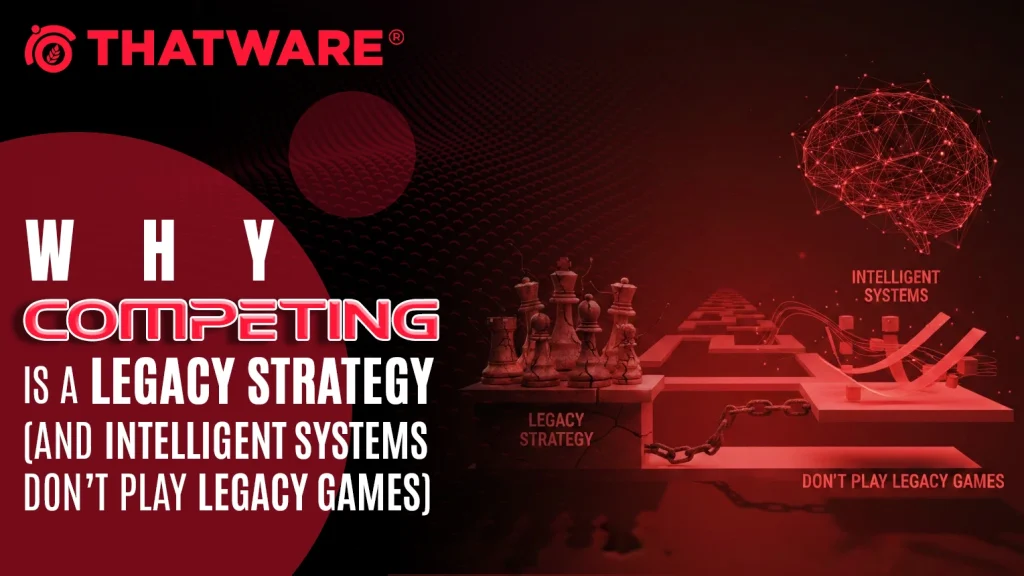
But what most people miss is this: competition is not a timeless truth. It’s a strategy designed for a specific era. An era where scarcity shaped everything.
Why “competition” became the dominant strategy
Competition flourished because the industrial economy rewarded three things:
1) Scarcity as the engine of value
Demand exceeded supply. Information was limited. Distribution was expensive. Customers had fewer choices and fewer ways to compare. Under scarcity, the company that secured resources—factory capacity, shelf space, advertising real estate—won.
2) Human labor as the main bottleneck
Work scaled with people. Productivity rose when you hired more, trained better, and optimized workflows. That’s why businesses built entire systems around headcount, process, and efficiency. The “best company” was often the one with the best machine-like discipline.
3) Linear growth as the expectation
You grew step-by-step: more regions, more stores, more salespeople, more campaigns. Every additional unit of output demanded additional input. Strategy was about incremental improvement—shaving seconds, cutting costs, improving conversion rates.
In that world, competing made sense. It was rational. It was measurable. It was how you moved forward.
The problem: markets were designed for a world that no longer exists
Most markets today still operate on industrial logic—even when the environment has changed completely.
They assume:
- scarcity is real,
- labor is the limiter,
- and growth must be linear.
But intelligence flips those assumptions.
Because intelligence doesn’t behave like labor. It doesn’t scale like factories. And it doesn’t respect the lanes a market creates.
Intelligence compresses time, collapses complexity, and rewrites the rules faster than competitors can react.
Which leads to the uncomfortable truth most businesses don’t want to hear:
If you are competing, you are already late
Competition is what happens when everyone is solving the same problem with the same tools.
It’s what you do when the playing field is fixed and the only way to win is to run harder.
But when a company introduces true intelligence into the system—real, compounding, decision-making intelligence—the playing field stops being fixed. The field itself becomes programmable.
And that’s where ThatWare is fundamentally different.
ThatWare doesn’t compete in markets. It collapses them and rebuilds them around intelligence.
We don’t show up to “win” a category.
We question why the category exists.
We don’t ask, “How do we outrank competitors?”
We ask, “Why are people still playing the ranking game at all?”
Because competing is a legacy behavior. It’s a strategy built for a slower world.
The central thesis: Intelligent systems don’t win games. They make games irrelevant.
A competitor looks at a market and asks:
- Who are we up against?
- What do they charge?
- What do they offer?
- How do we differentiate?
An intelligent system asks something else:
- Why is this market structured this way?
- Where is the bottleneck?
- What if we remove the bottleneck entirely?
- What if we redesign the system so competition has no meaning?
That’s the shift.
Not “better strategy.”
Not “stronger execution.”
But a different operating principle:
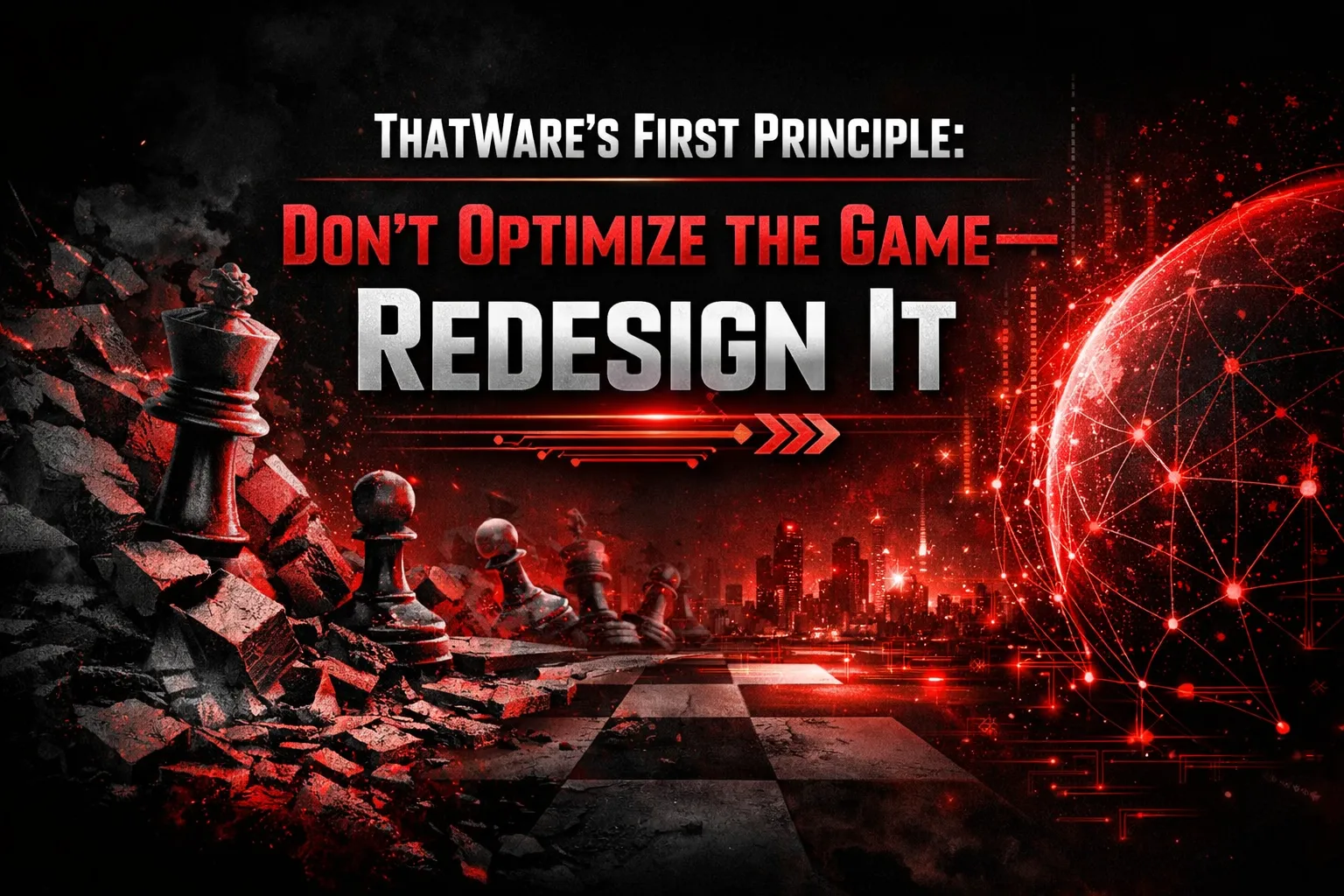
Don’t optimize the game—redesign it.
Because the future doesn’t belong to those who compete harder.
It belongs to those who build intelligence so deep, so compounding, and so structural… that the market reorganizes itself around them.
Competition Is a Symptom of Limited Intelligence
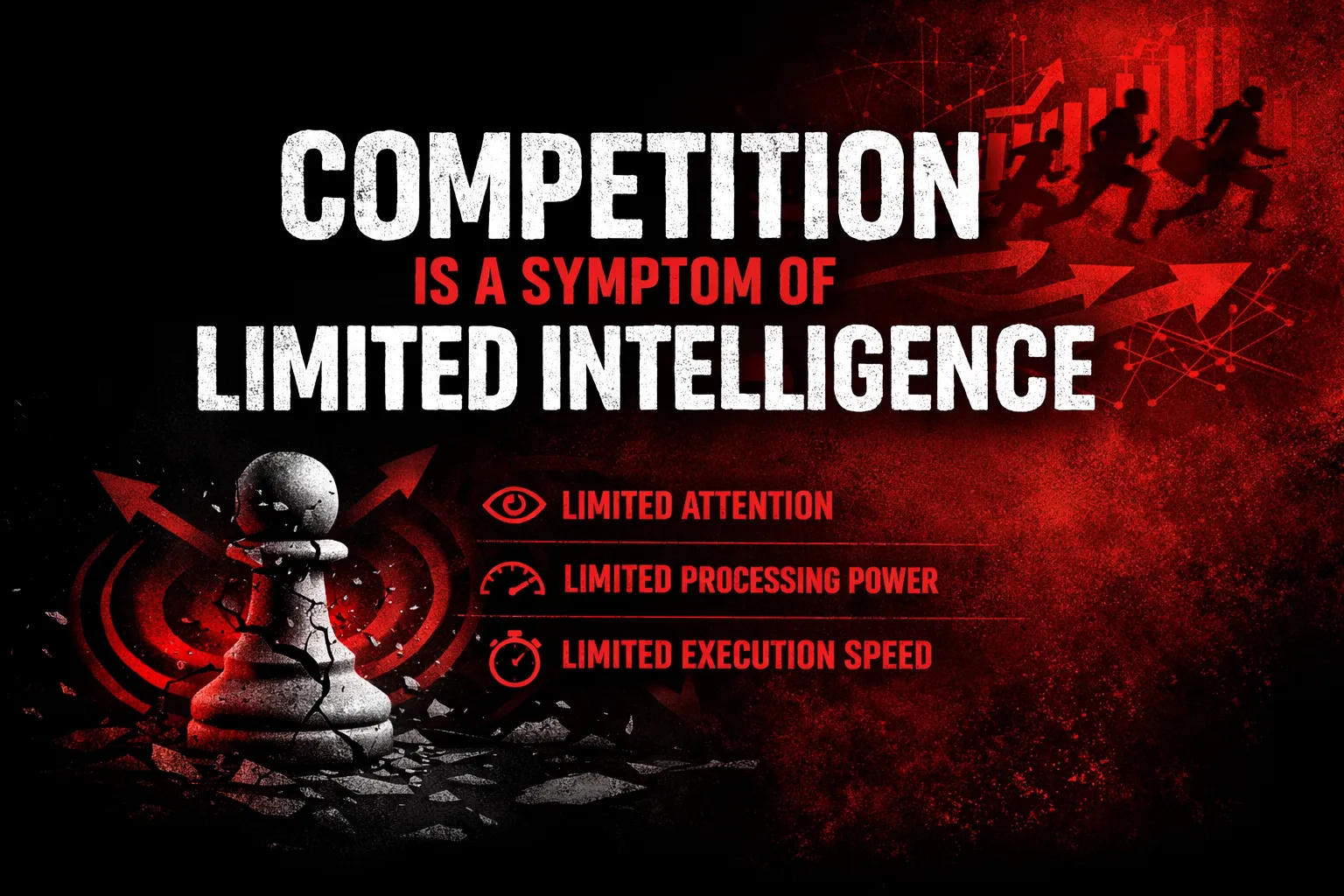
Competition is often framed as the highest form of strategy. In reality, it’s a signal—one that reveals a deeper limitation.
Humans compete because humans are constrained.
- We have limited attention. We can only observe so much of the environment at once.
- We have limited processing power. Our ability to analyze complex, multidimensional systems is finite.
- We have limited execution speed. Decisions take time, alignment takes longer, and action is delayed by friction.
Competition emerges not because it is optimal—but because it is necessary under these limits.
When intelligence is scarce, everyone is forced to look at the same signals, chase the same opportunities, and optimize within the same narrow boundaries. The result? Crowded markets where differentiation is cosmetic and advantage is temporary.
Competition exists only when everyone is solving the same problem in the same way.
That’s why industries tend to move in herds. Best practices spread. Frameworks get copied. Playbooks become public. And soon, entire markets are filled with players making identical moves—just louder, cheaper, or faster than the next.
History makes this pattern obvious.
Taxi companies didn’t lose because ride-sharing companies competed better. They lost because algorithms reframed transportation as a real-time intelligence problem instead of a fleet-management one. The market didn’t shift—it collapsed and reformed around data, prediction, and dynamic allocation.
Retail stores didn’t lose ground because recommendation engines had better products. They lost because intelligence replaced intuition. Instead of guessing what customers might want, systems learned—continuously, invisibly, and at scale. Shopping stopped being about shelf space and started being about cognitive proximity.
In both cases, the so-called “winners” weren’t competing inside the market. They were operating outside it, redesigning the rules by introducing a higher order of intelligence.
This leads to a fundamental insight most businesses miss:
Markets exist where intelligence is missing.
- Where decision-making is slow, competition thrives.
- Where insight is shallow, rivals multiply.
- Where systems cannot think, players are forced to fight.
As intelligence increases, competition fades—not because rivals disappear, but because the need to compete does. Intelligent systems don’t outmaneuver competitors. They make the competitive frame irrelevant.
And that’s why competing is not a sign of strength. It’s a sign of constraint.
Legacy Markets Were Built for Optimization, Not Intelligence
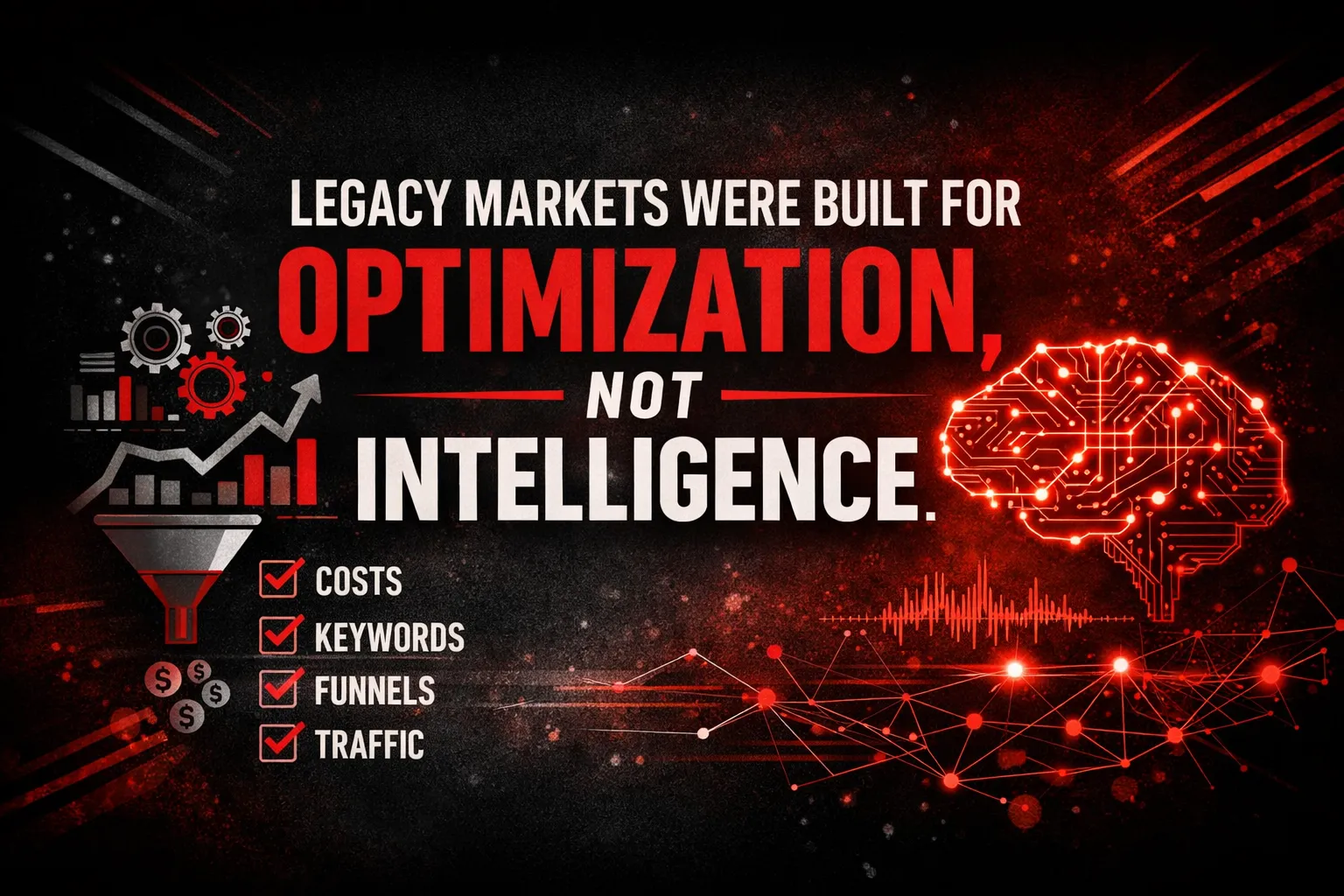
Traditional markets were never designed for thinking systems. They were designed for efficiency under constraint. For decades, success depended on how well an organization could optimize what already existed—processes, people, channels, and costs. Intelligence was embedded in humans, and systems merely supported execution.
That context shaped the old playbook.
Companies learned to optimize costs by squeezing margins.
- They optimized funnels to push users through predefined paths.
- They optimized keywords to game search engines.
- They optimized headcount to extract more output per employee.
This worked—until intelligence stopped being scarce.
Optimization, at its core, rests on three assumptions.
- First, it assumes fixed rules. Markets behave predictably. Algorithms remain stable. The levers you pull today will work tomorrow.
- Second, it assumes stable environments. Consumer behavior shifts slowly. Competitive landscapes evolve in cycles. Change is incremental, not exponential.
- Third, it assumes slow feedback loops. You act, you wait, you measure. Strategy is revised quarterly. Learning happens after execution.
AI-native environments invalidate all three.
In intelligent systems, rules are dynamic. Algorithms rewrite themselves. Search surfaces mutate. What worked last week may be irrelevant today.
Environments become adaptive. Users don’t just respond—they learn. Platforms don’t just host—they react. Systems continuously adjust based on signals humans can’t even perceive in real time.
And feedback is instant. Every interaction becomes data. Every outcome reshapes the system. Learning is no longer post-mortem—it is continuous.
This is where optimization collapses.
- You cannot optimize something whose rules keep changing.
- You cannot fine-tune funnels in an environment that rewires itself.
- You cannot “best-practice” your way through intelligence.
Optimization is a strategy for static worlds. Intelligence belongs to living ones.
That’s why legacy strategies fail the moment intelligence enters the system. They try to control outcomes when the only sustainable advantage left is how well a system thinks, learns, and adapts.
You don’t optimize intelligence. You let it redesign reality.
ThatWare’s First Principle: Don’t Optimize the Game—Redesign It
Most businesses are taught to optimize.
- Optimize conversion rates.
- Optimize funnels.
- Optimize rankings, costs, workflows, teams.
Optimization feels productive. It looks strategic. But in reality, optimization is a defensive move—a response to rules you didn’t create and constraints you didn’t question.
When you optimize, you silently accept the game as it is.
Why Optimization Is a Defensive Strategy
Optimization assumes three things:
- The rules are fixed
- The market is stable
- The best possible outcome already exists within the system
That mindset belongs to an era where intelligence was scarce and change was slow. In that world, squeezing incremental gains made sense.
But in intelligence-driven environments, optimization does something dangerous:
it locks you into relevance decay.
You get better at a game that is already being replaced.
Why Redesign Is an Offensive Move
Redesigning the game is not about improvement. It’s about replacement.
An offensive strategy doesn’t ask:
- How do we beat competitors?
- How do we rank higher?
- How do we acquire customers faster?
It asks:
- Why does this market work the way it does?
- What assumptions are everyone else inheriting?
- What happens if those assumptions are no longer true?
Redesign shifts the focus from winning within boundaries to removing boundaries altogether.
That’s where intelligence operates best.
What “Redesigning the Game” Actually Means
At ThatWare, redesign isn’t a metaphor. It’s an operating logic.
1. Changing Inputs Instead of Optimizing Outputs
Most companies tweak outputs—better ads, better pages, better messaging.
ThatWare changes inputs:
- How decisions are made
- How intent is interpreted
- How systems learn and adapt
When inputs change, outputs transform automatically. No constant optimization required.
2. Engineering Demand Instead of Chasing It
Chasing demand keeps you reactive.
Engineering demand makes you inevitable.
Instead of competing for attention in overcrowded channels, intelligence identifies, shapes, and activates intent before it enters the market. The result isn’t traffic—it’s gravity.
3. Structuring Intelligence Instead of Scaling Labor
Legacy models scale people. ThatWare scales thinking.
Labor increases cost and complexity. Intelligence compounds value. When intelligence is structured correctly, execution becomes a side effect—not a bottleneck.
Two Ways to Exist in a Market
| Legacy Mindset | Intelligence-First Mindset |
| Competitors | Intelligence Architects |
| Players | Game Designers |
| Optimize within rules | Redesign the rules |
| Chase demand | Engineer demand |
| Scale services | Scale intelligence |
| Win temporarily | Become unavoidable |
Most companies fight harder.
Intelligent systems change the fight itself.
The Question That Changes Everything
ThatWare doesn’t ask, “How do we win?”
We ask, “Why does this game exist at all?”
Because the moment that question is answered honestly, competition stops being relevant—and intelligence takes over.
How Intelligent Systems Collapse Markets
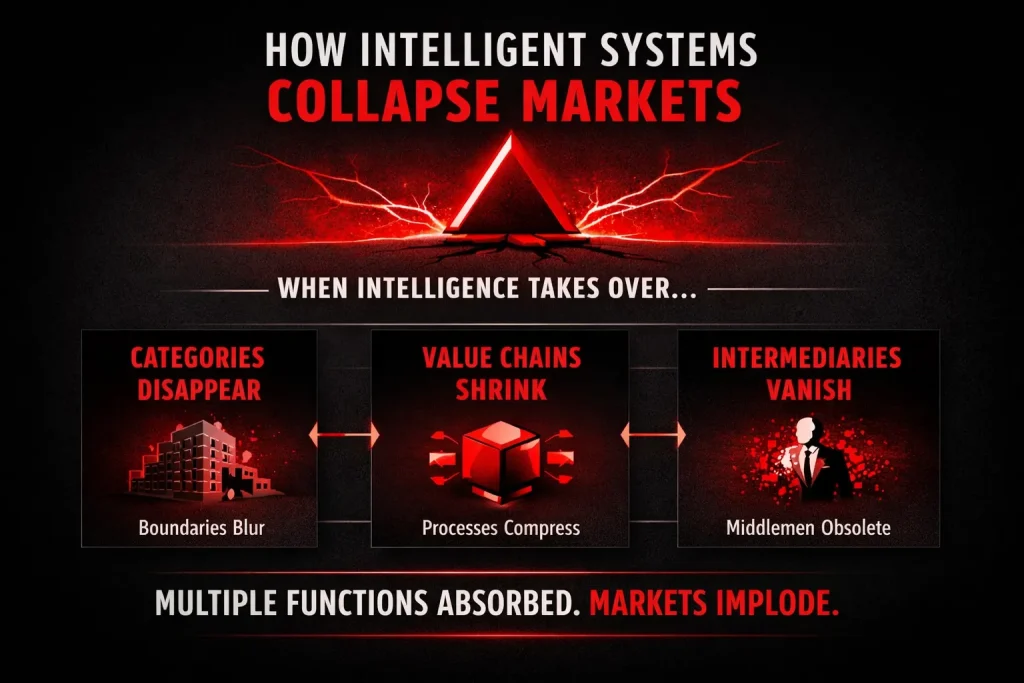
“Market collapse” sounds dramatic—until you realize it’s already happening, quietly, everywhere intelligence shows up.
Most people think markets change when a better competitor arrives. That’s the legacy lens: new players, new pricing, new features. But intelligent systems don’t behave like competitors. They don’t just outperform existing businesses inside a category. They erase the category’s edges—and once the edges are gone, the market stops being a market. It becomes a function.
Market collapse is not a crash. It’s a compression.
What “market collapse” really means
1) Categories lose boundaries
Markets depend on boundaries. They need labels: SEO agency, marketing agency, analytics tool, CRO expert, ad specialist. Each category survives because the work inside it is hard to unify. The boundary exists because no single system can do it all—so the work is separated into industries.
Intelligence destroys that separation.
When a system can understand intent, generate content, structure information, predict outcomes, optimize distribution, and learn from feedback—all in one loop—then “SEO” isn’t a category anymore. It’s one output of a larger thinking system. The boundary dissolves because the workflow becomes continuous.
Categories don’t get disrupted. They get absorbed.
2) Value chains compress
A traditional market is a relay race. Strategy passes to execution. Execution passes to reporting. Reporting passes back to strategy. Every handoff is a business model. Every handoff creates an intermediary.
Intelligent systems don’t need handoffs.
They shorten the distance between decision and outcome. They collapse time. They compress labor. They remove steps that existed only because humans needed translation layers—between data and action, between insight and implementation, between planning and doing.
The value chain shrinks because intelligence can run the whole chain as one system.
3) Intermediaries disappear
Intermediaries thrive when there’s complexity and delay—when knowledge is rare, execution is hard, and iteration is slow. That’s why agencies, brokers, aggregators, and “specialists” exist: they sit between the client and the outcome.
But an intelligent system doesn’t just execute. It interprets. It decides. It learns. It becomes the layer.
So the intermediary has a problem: it’s no longer providing leverage. It’s becoming friction.
In collapsed markets, intermediaries don’t fail because they’re bad. They fail because they’re unnecessary.
The collapse dynamics you can already see
SEO → Search Intelligence
SEO, as a market, was built around gaps: gaps in understanding search engines, gaps in technical implementation, gaps in content production, gaps in link-building reach. It was fragmented by design—so multiple specialists could exist.
Now intelligence is absorbing the whole loop:
- It interprets intent better than keyword lists ever could
- It maps topics, entities, and relationships at scale
- It generates and refines content based on performance signals
- It detects technical issues and prioritizes fixes
- It adapts in near-real time as rankings, SERPs, and user behavior shift
Once the system can do the entire search loop as a unified intelligence process, SEO stops being a “service.” It becomes a capability inside a bigger machine.
SEO doesn’t die. It becomes too small to matter as a standalone category.
Marketing → Demand Engineering
Marketing traditionally meant storytelling, campaigns, channels, and creativity. But under the hood, it was always about one thing: creating demand and capturing it.
Intelligence turns marketing into an engineering problem:
- Build signal systems instead of guessing audiences
- Design feedback loops instead of running one-off campaigns
- Predict conversion pathways instead of hoping content “works”
- Create dynamic messaging architectures that change per segment, per intent, per moment
When intelligence runs demand creation like a self-improving system, “marketing” becomes an outdated word. The new unit isn’t campaign. It’s control.
Demand engineering doesn’t compete with marketing agencies. It makes the agency model feel like manual labor.
Agencies → Cognitive Systems
Agencies are built to scale people. More clients means more hands. More hands means more coordination. More coordination means slower delivery and diluted thinking. That’s not a moral critique—it’s structural.
Cognitive systems flip the model.
Instead of scaling labor, they scale intelligence:
- A central brain that learns across engagements
- Reusable decision architectures
- Repeatable frameworks that improve with every outcome
- Execution that becomes a byproduct of the system, not the product being sold
This is why agencies struggle in intelligence-native markets: they’re selling effort in a world that’s buying thinking. And thinking scales differently.
The key pattern: When intelligence absorbs functions, markets implode
Markets exist because functions are separated.
One company does strategy. Another does execution. Another does tooling. Another does distribution. Another does analytics. Another does optimization. Every separation creates a category. Every category creates competition.
But intelligence doesn’t like separation. Intelligence likes integration.
When one system can:
- interpret reality (data)
- decide what matters (strategy)
- act on it (execution)
- measure outcomes (analytics)
- improve itself (learning)
…then what used to be an industry turns into a module.
And once an industry becomes a module, it’s no longer something you “compete” in. It’s something you replace.
That’s the collapse.
Not a fight. Not a takeover. A redesign.
ThatWare doesn’t compete in markets because we don’t enter categories as a player. We enter them as an intelligence system—one that absorbs the fragmented functions the category was built on.
And when the functions are absorbed, the category can’t hold.
It collapses. Then we rebuild it—around intelligence.
Why ThatWare Was Never Built to Compete
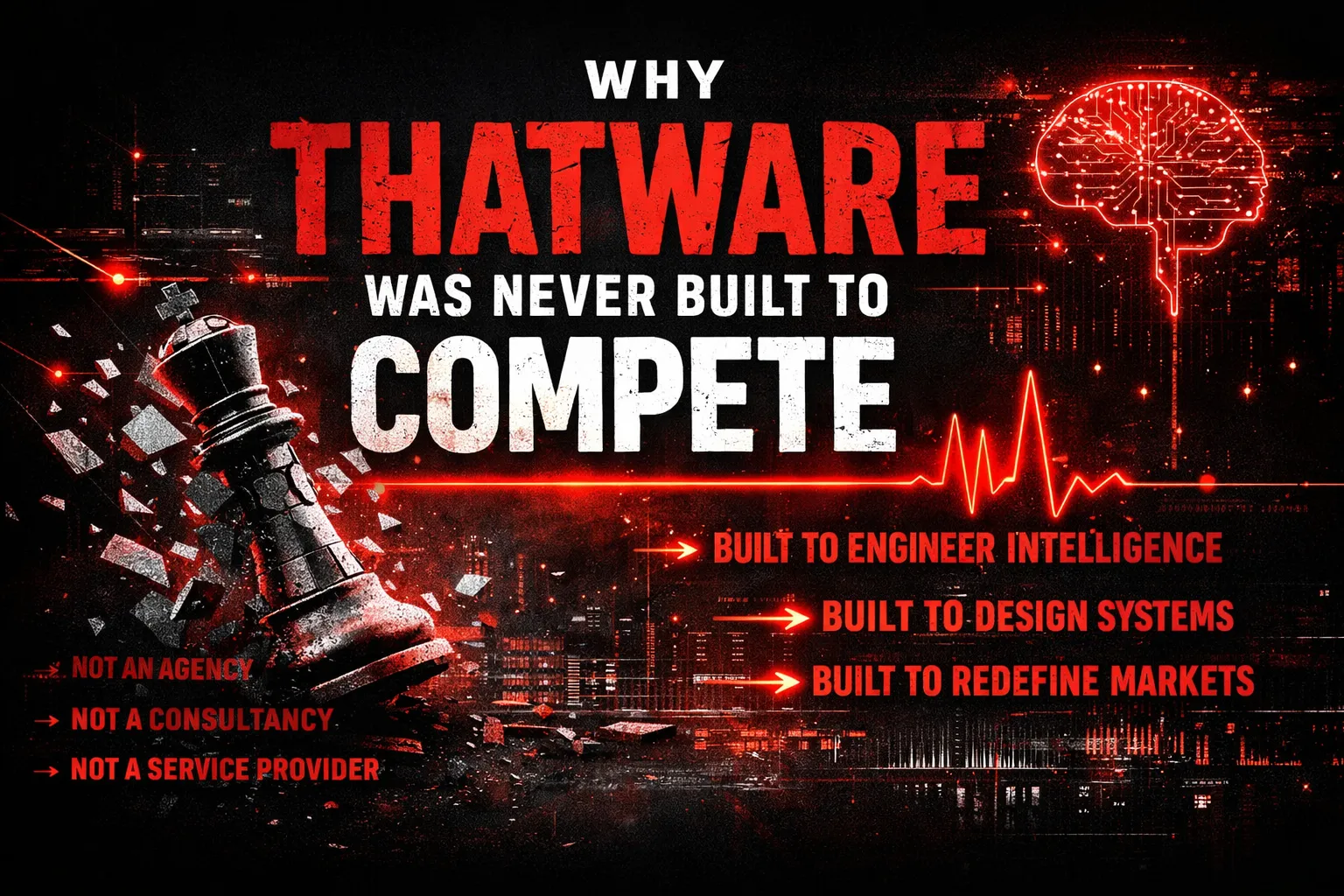
ThatWare doesn’t sit comfortably in comparison charts—and that’s not an accident.
It was never designed to fit inside existing labels, because those labels belong to a legacy way of thinking.
- ThatWare is not an SEO agency. SEO agencies operate inside predefined rules: algorithms, rankings, keywords, traffic curves. They optimize for visibility within a system they do not control.
- ThatWare is not an AI consultancy. Consultancies advise, recommend, and exit. They deliver intelligence as a report, not as a living system. The thinking stays external.
- ThatWare is not a growth partner. Growth partners chase metrics—leads, conversions, CAC, ROAS—inside the same funnels everyone else is already fighting over.
These categories assume one thing in common:
the market already exists, and the goal is to compete better inside it.
That assumption is exactly what ThatWare rejects.
ThatWare Wasn’t Designed to Sell What Markets Expect
Traditional firms are built to sell:
- Services that scale linearly
- Hours that cap impact
- Tools that eventually become commodities
These models require constant competition because differentiation decays. Someone will always be cheaper, faster, or louder.
ThatWare was never designed for that treadmill.
It wasn’t built to:
- Bill time
- Package tactics
- Stack tools on top of broken strategies
Because selling execution without owning intelligence only creates dependency—not advantage.
What ThatWare Was Actually Built To Do
ThatWare was built to operate at a different layer entirely.
It was designed to:
- Build thinking systems that understand, adapt, and evolve
- Engineer decision frameworks that outperform human intuition at scale
- Create compounding intelligence that improves with every interaction
Instead of asking “How do we execute this better?”, ThatWare asks “Why does this decision exist, and how should intelligence handle it?”
Execution becomes a side effect. Results become structural, not tactical.
Why Comparison Fails by Design
Most companies can be benchmarked:
- Price vs price
- Features vs features
- Speed vs speed
ThatWare can’t.
Because benchmarks measure performance inside a system— and ThatWare replaces the system itself.
You can’t meaningfully compare:
- A thinking architecture to a service vendor
- A cognitive system to a tool stack
- Market redesign to market participation
And that leads to the unavoidable truth:
You can’t benchmark something that replaces benchmarks.
ThatWare doesn’t compete because competition requires shared rules. Intelligence doesn’t share rules—it rewrites them.
This is why ThatWare was never built to win a category. It was built to make categories obsolete.
Scaling Services vs Scaling Intelligence
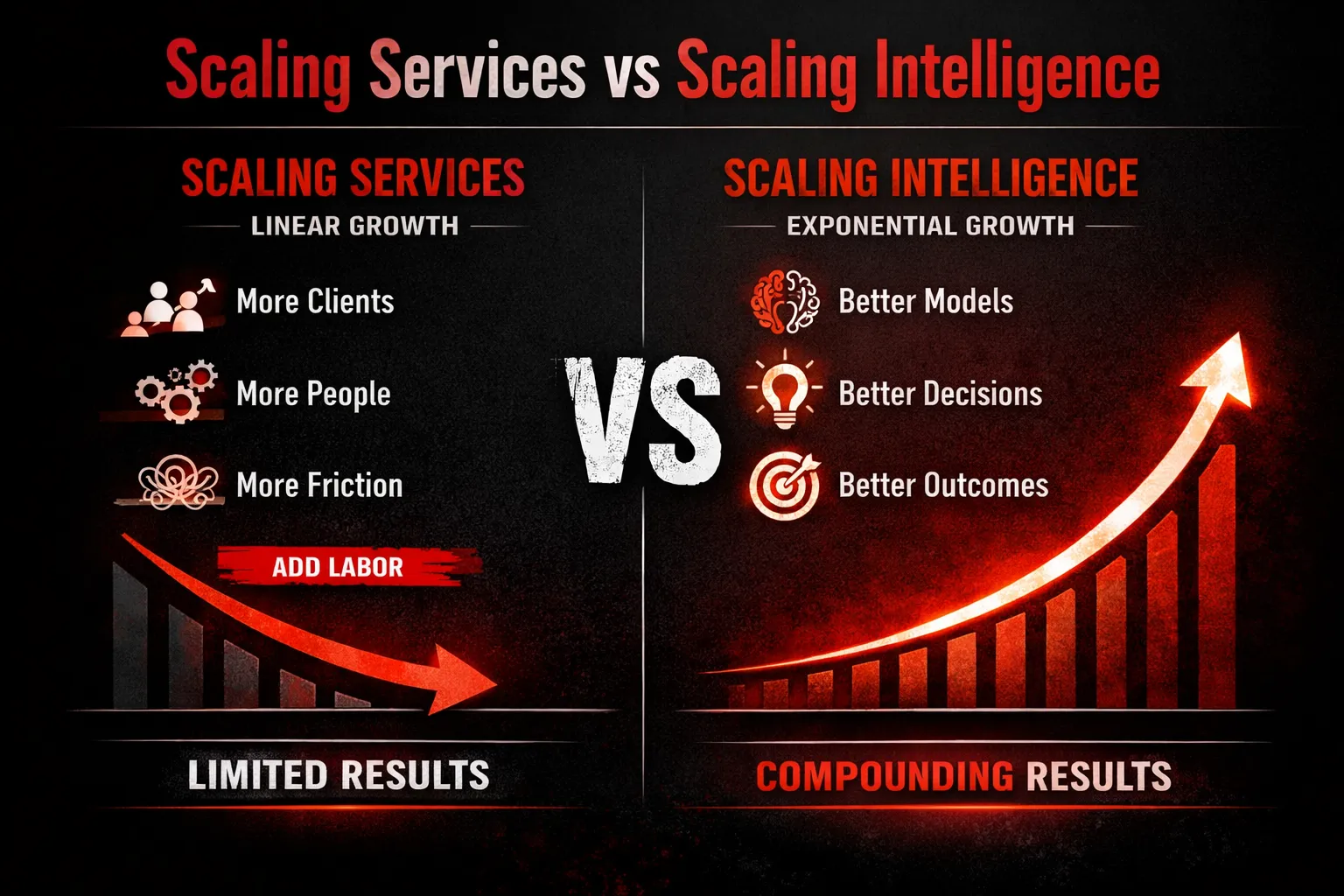
Most companies believe they’re scaling when they add more clients, more people, and more processes. In reality, they’re just stretching a linear system to its breaking point.
Service-based models scale in only one direction—and it’s painfully predictable.
- More clients demand more delivery.
- More delivery demands more people.
- More people introduce more coordination, more delays, more errors, and more cost.
Growth becomes friction disguised as progress. Every new account adds weight. Every new hire adds complexity. Eventually, the system slows down not because the market is saturated—but because the organization is.
This is the ceiling of service scalability.
Intelligence works differently.
Intelligence doesn’t multiply effort—it compounds capability.
When you improve intelligence, you don’t just do the same work faster. You make better decisions before work even begins. Better models lead to clearer signals. Clearer signals lead to sharper actions. Sharper actions lead to disproportionately better outcomes.
Instead of:
More clients → more people → more friction
You get:
Better intelligence → better decisions → better results
That’s exponential scale—not because you’re doing more, but because you’re thinking better.
This is where most companies get it wrong.
They try to “add AI” to an existing service model. A tool here. Automation there. A dashboard layered on top of broken workflows.
But intelligence doesn’t work as an add-on.
When AI is bolted onto a service-first structure, it inherits the same inefficiencies, the same bottlenecks, and the same limits. The result isn’t transformation—it’s faster chaos.
True scale doesn’t come from decorating services with intelligence. It comes from rebuilding the entire system from intelligence outward.
ThatWare was designed with this principle from day one.
We didn’t start by asking how to deliver services faster. We started by asking how decisions should be made if intelligence were unlimited.
At ThatWare, intelligence comes first. Execution is not the product—it’s the outcome.
Systems think before they act. Signals precede tactics. Strategy emerges from intelligence, not the other way around. As intelligence improves, execution naturally becomes faster, leaner, and more precise—without increasing headcount or complexity.
This is why ThatWare scales without resembling a traditional agency or consultancy.
ThatWare wasn’t built to scale services. It was built to scale intelligence.
And when intelligence scales, competition doesn’t follow—it disappears.
The End of Competitive Strategy in the Age of Intelligence
Competitive strategy, as the business world has practiced it for decades, was built for a reality that no longer exists.
It was built for stable industries, slow feedback loops, predictable rivals, and value chains that changed in years—not days. It assumed that companies compete inside clearly defined “markets,” with recognizable competitors, and that advantage comes from choosing the right position in that market.
That era is ending.
Because intelligence changes the environment faster than strategy can be planned.
Why Porter-style competition models are breaking
Porter-style frameworks—industry forces, defensible moats, positioning, differentiation—still sound logical because they were logical in a world where:
- industries had borders,
- customers had limited choices,
- information moved slowly,
- and execution capacity was mainly human.
But intelligent systems collapse these assumptions.
1) Industry boundaries are dissolving.
When intelligence becomes a universal layer, industries stop being “separate.” Payments becomes embedded inside apps. Commerce becomes embedded inside content. Search becomes embedded inside conversation. Marketing becomes embedded inside product. The model of “pick an industry and dominate it” doesn’t hold when intelligence can stitch capabilities across categories in real time.
2) Rivals are no longer comparable.
Traditional strategy assumes your competitors look like you. Similar teams, similar constraints, similar production cycles. In an intelligence-first world, your biggest threat may not be your direct competitor—it may be a company with a completely different core that deploys intelligence to swallow your value chain.
The true rival isn’t “another agency.” It’s a self-improving system that makes agencies unnecessary.
3) Moats become brittle.
Defensibility used to mean distribution, capital, patents, and brand. Those still matter—but they’re no longer sufficient. Because intelligent systems attack the core mechanics of advantage: they compress time-to-competence, automate execution, and reduce the cost of experimentation.
A moat built on “we’ve always done this better” is not a moat. It’s a timestamp.
Why “best practices” expire instantly
Best practices used to be stable because environments were stable.
In the age of intelligence, anything that works becomes visible, copyable, and automatable almost immediately. The moment a tactic proves effective:
- it gets replicated,
- it becomes a template,
- it turns into a tool,
- and then it becomes noise.
That’s why playbooks are dying.
Not because people stopped wanting guidance— but because the environment updates faster than the playbook can be written.
This is the uncomfortable truth: best practices are strategies designed for followers.
They work only as long as the world stays still.
Intelligent systems don’t wait. They learn. They iterate. They adapt. So the gap between “what works” and “what everyone is doing” collapses to almost zero.
When the lag disappears, so does the advantage.
What replaces competitive strategy
If traditional competitive strategy was about positioning, the new strategy is about cognition.
The winning companies won’t be the ones with the most features, the lowest price, or the fastest delivery.
They’ll be the ones that build superior thinking systems—systems that can understand, decide, and improve faster than rivals can even recognize what’s happening.
Here’s what replaces competition as we know it:
1) Cognitive advantage
Cognitive advantage is not “AI adoption.” It’s not having a chatbot. It’s not automating a few workflows.
Cognitive advantage means your organization has a better way of thinking:
- better sensing (what’s happening now),
- better interpretation (what it means),
- better decision-making (what to do next),
- better execution (how to act),
- and better learning (how to improve permanently).
In the old world, winners executed faster. In the new world, winners understand faster.
2) System-level thinking
Most companies still operate like collections of departments: marketing, sales, ops, product—each optimizing its own metrics.
System-level thinking treats the business like a living organism:
- inputs → interpretation → decisions → actions → feedback → evolution
It replaces “department optimization” with “system intelligence.”
Because when intelligence is the core, the question changes from:
- “How do we improve this function?”
to:
- “How do we redesign the entire system so improvement becomes automatic?”
That’s the shift: from optimization to architecture.
3) Self-improving architectures
This is where the future gets ruthless.
The next decade won’t reward companies that “do good work.” It will reward companies that build systems that get better while they sleep.
Self-improving architectures mean:
- the system learns from every interaction,
- compounding insight becomes internal property,
- and each cycle produces smarter outputs than the last.
This is compounding intelligence— and compounding intelligence is the ultimate advantage because it turns time into a weapon.
If your system improves by 1% per cycle, and your competitor improves manually per quarter, you’re not racing them.
You’re leaving the track.
The prediction: competition shifts from outputs to thinking
In the next decade, companies won’t compete on price, features, or speed— they’ll compete on how well they think.
Because outputs can be copied. Features can be matched. Speed can be bought.
But a superior thinking system—one that senses earlier, decides cleaner, and improves continuously—creates a gap that looks invisible at first… and then becomes impossible to cross.
That is the end of competitive strategy as we knew it.
Not because companies stop wanting to win— but because the definition of winning changes.
In an intelligence-first world, the winners won’t “outcompete” the market.
They’ll collapse it, and rebuild it around a new center: intelligence.
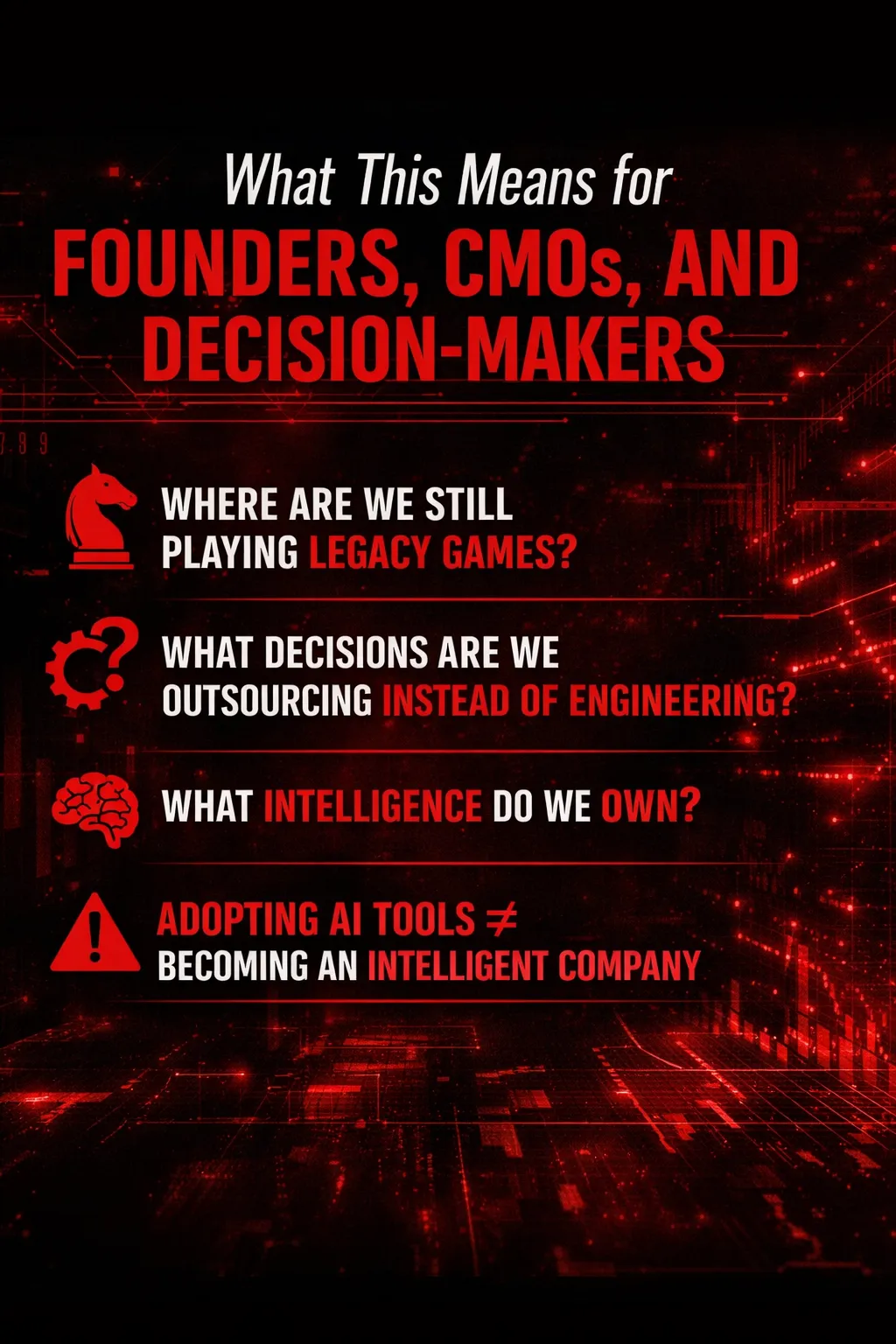
What This Means for Founders, CMOs, and Decision-Makers
This is the moment where strategy stops being theoretical.
Intelligence doesn’t reward titles. It rewards how decisions are made, owned, and improved. For founders, CMOs, and senior leaders, the shift isn’t about adopting another platform or approving another budget line. It’s about confronting the invisible legacy structures still running the business.
The Questions Leaders Must Start Asking
Where are we still playing legacy games?
If your growth depends on tactics your competitors can copy, you’re not leading—you’re participating. Legacy games look familiar: keyword races, funnel tweaks, channel optimizations, quarterly “growth hacks.” They feel productive, but they keep you trapped inside rules you didn’t design. Intelligent systems don’t win these games. They replace them.
What decisions are we outsourcing instead of engineering?
Every time strategy is handed to an agency, a tool, or a black-box platform, intelligence is being rented—not built. Outsourced execution often hides outsourced thinking. The result is dependency, not leverage. Intelligent companies engineer their own decision logic, even when execution is distributed.
What intelligence do we actually own?
Not dashboards. Not reports. Not tools. Owned intelligence means proprietary understanding of:
- how demand forms,
- how intent shifts,
- how systems respond to change,
- and how decisions improve over time.
If your “AI advantage” disappears the moment a subscription is canceled, you don’t own intelligence—you’re leasing automation.
A Critical Warning Most Leaders Miss
Adopting AI tools does not make a company intelligent.
Tools accelerate existing behavior. If the underlying strategy is reactive, AI will only help you react faster. Without redesigning how decisions are made, measured, and evolved, AI becomes a cosmetic upgrade on a legacy machine. Intelligence is structural, not superficial.
The Real Opportunity
Here’s the asymmetric upside most organizations overlook:
Those who redesign early won’t have competitors later.
When intelligence reshapes how value is created, markets lose their reference points. Categories blur. Benchmarks fail. Competitors become irrelevant—not because they were beaten, but because they were playing a different game.
This is where ThatWare operates.
Not at the level of tactics. Not at the level of tools. But at the level where intelligence becomes the business itself.
For leaders willing to stop competing and start redesigning, the future isn’t crowded.
It’s uncontested.
Closing: The Quiet Power of Not Competing
The most dangerous companies rarely look dangerous from the outside.
- They don’t advertise loudly because attention isn’t their bottleneck.
- They don’t benchmark publicly because comparison assumes a shared game.
- They don’t explain themselves fully because what they’re building can’t be reduced to a pitch deck or a category label.
Silence, in these cases, isn’t a lack of ambition—it’s a signal of asymmetry.
Competition is noisy by design. It requires constant signaling, constant reacting, constant proof that you belong in a market defined by someone else. But intelligence doesn’t need permission to exist, and it doesn’t need rivals to validate its direction. It moves quietly, restructuring systems while others argue over positioning.
This is why ThatWare doesn’t compete.
Competition is a constraint. It assumes fixed rules, visible opponents, and incremental wins. Intelligence is none of those things. Intelligence rewrites rules, dissolves opponents into irrelevance, and compounds quietly until the old landscape no longer makes sense.
ThatWare was never interested in being “better” at a known game. Better is fragile. Better can be copied. Better still depends on the game surviving.
Instead, ThatWare focuses on what happens after the game collapses—when intelligence replaces optimization, when systems think instead of react, and when markets reorganize themselves around those who understand how to design cognition at scale.
The absence of competition isn’t a lack of confidence. It’s the result of operating on a different plane.
We don’t play legacy games. We design what comes after them.