
SUPERCHARGE YOUR ONLINE VISIBILITY! CONTACT US AND LET’S ACHIEVE EXCELLENCE TOGETHER!
Search is no longer what it used to be. Over the past few years, artificial intelligence has fundamentally reshaped how users discover information online. Instead of scrolling through pages of blue links, users now expect direct, accurate, and conversational answers—often generated instantly by AI-powered systems.
This shift is also transforming how content is created. Traditional SEO strategies that relied heavily on keywords, backlinks, and ranking positions are evolving into something far more dynamic. Today, search engines are not just indexing content—they are interpreting, summarizing, and even generating responses using that content.
At the center of this transformation is a powerful concept called Retrieval-Augmented Generation (RAG). It’s not just another AI buzzword—it’s a foundational technology driving modern AI search experiences, including tools like Google’s AI Overviews and conversational search engines.
For marketers, SEO professionals, and businesses, understanding RAG is no longer optional. It directly impacts how content gets discovered, interpreted, and ultimately surfaced to users.
In this guide, you’ll learn what RAG is, how it works, and why it’s becoming a critical factor in SEO success in recent year and beyond.
What is RAG (Retrieval-Augmented Generation)?
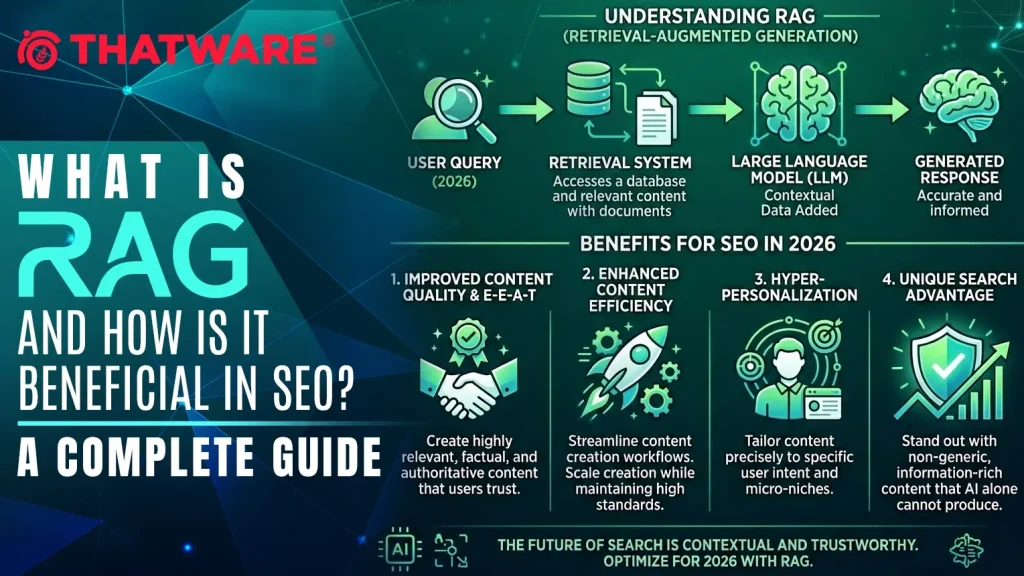
Retrieval-Augmented Generation, commonly known as RAG, is an advanced AI framework that combines two key processes: retrieval and generation.
In simple terms, RAG allows an AI system to first search for relevant information from external sources and then use that information to generate a more accurate and context-aware response.
Let’s break that down:
- Retrieval refers to the process of fetching relevant data from a knowledge source. This could include web pages, databases, PDFs, internal documents, or any structured/unstructured data.
- Generation refers to the ability of a language model (like an LLM) to produce human-like text based on the retrieved information.
Instead of relying solely on what it already “knows,” a RAG system actively looks up information before answering. This makes it significantly more reliable and up-to-date compared to traditional AI models.
Think of it like this:
A standard AI model is like a student answering questions from memory, while a RAG-powered system is like a student who can quickly open a book, find the right page, and then explain the answer clearly.
How RAG Works (Step-by-Step)
To understand why RAG is so powerful, it helps to look at how it works in practice. The process typically follows these steps:
1. User Query Input
Everything starts with a user asking a question or entering a search query. For example: “What are the benefits of RAG in SEO?”
2. Retrieval from Knowledge Sources
The system then searches a knowledge base to find relevant information. This could include:
- Blog articles
- Website content
- Databases
- APIs
- Internal company documents
This retrieval step is often powered by semantic search, which focuses on meaning rather than just keywords.
3. Feeding Data into the Language Model
The retrieved information is then passed to a language model. Instead of generating a response blindly, the model now has context grounded in real data.
4. Generating Context-Aware Output
Finally, the AI generates a response that is:
- More accurate
- Contextually relevant
- Based on real sources
This combination ensures that the output is not only fluent but also factually grounded.
RAG vs Traditional AI Models
To truly appreciate the value of RAG, it’s important to compare it with traditional AI models.
Static Knowledge vs Dynamic Retrieval
Traditional large language models (LLMs) rely on pre-trained data. Once trained, their knowledge is essentially “frozen” until the next update. In contrast, RAG systems can retrieve fresh information in real time.
Limitations of Standalone LLMs
Standalone models often struggle with:
- Outdated information
- Hallucinations (confident but incorrect answers)
- Lack of domain-specific accuracy
Because they don’t verify information externally, their responses can sometimes be unreliable.
Why RAG Improves Accuracy and Freshness
RAG solves these problems by grounding responses in real data. It ensures that:
- Information is up-to-date
- Answers are backed by actual sources
- Context is more relevant to the user’s query
This makes RAG particularly valuable in environments where accuracy and timeliness are critical—such as search engines, customer support systems, and, importantly, SEO.
Key Components of RAG Systems
Retrieval-Augmented Generation (RAG) systems rely on a combination of interconnected components that work together to deliver accurate, context-aware responses. Understanding these components helps clarify why RAG is so powerful in modern AI and SEO applications.
Retriever
The retriever is responsible for finding the most relevant information based on a user’s query. Instead of relying solely on pre-trained knowledge, it searches through large datasets to fetch useful documents or content snippets. This is typically powered by technologies like vector databases and semantic search, which focus on meaning rather than exact keyword matches. As a result, the retriever can identify contextually relevant information even if the wording differs.
Generator (LLM)
Once the relevant data is retrieved, the generator, usually a large language model (LLM), processes this information and converts it into a coherent, human-readable response. It doesn’t just copy data—it interprets and synthesizes it. The generator ensures the final output maintains context, clarity, and logical flow, making it useful for end users.
Knowledge Base
The knowledge base is the source of truth for the system. It can include internal data, such as company documents, blogs, or product information, as well as external sources like web pages, APIs, or databases. The quality and structure of this data directly impact the accuracy of the generated responses.
Embeddings & Vector Search
Embeddings are numerical representations of text that capture its meaning. In simple terms, they convert words and sentences into vectors (numbers) that machines can understand. Vector search then compares these embeddings to find similar meanings. Instead of matching exact keywords, it identifies content that is conceptually related, enabling more accurate and context-aware retrieval.
Why RAG is Important in Modern AI
RAG has become a cornerstone of modern AI because it addresses several key limitations of traditional language models. One of its biggest advantages is its ability to reduce hallucinations—instances where AI generates incorrect or fabricated information. By grounding responses in real, retrieved data, RAG significantly improves accuracy.
Another major benefit is access to real-time and up-to-date information. Traditional models rely on static training data, but RAG systems can pull in the latest content from dynamic sources, making them far more relevant in fast-changing environments like SEO and digital marketing.
RAG also enables domain-specific intelligence. Businesses can train systems on their own internal data, allowing AI to provide highly specialized insights tailored to specific industries or use cases. This is particularly valuable for enterprises that need precise, context-aware outputs.
Additionally, RAG improves trust and reliability. When responses are backed by actual data sources, users are more likely to trust the information. This is critical for applications like search engines, customer support, and decision-making tools.
As a result, RAG is seeing rapid adoption across search engines, AI assistants, and enterprise platforms, making it a foundational technology shaping the future of AI-driven search and SEO.
Understanding the Connection Between RAG and SEO
Evolution of Search Engines
Search engines have undergone a significant transformation over the past decade. Earlier, SEO was largely driven by keyword-based optimization—marketers focused on inserting exact-match keywords to rank higher on search engine results pages (SERPs). However, modern search engines have evolved to prioritize user intent over mere keyword presence. This shift means that understanding the context, meaning, and purpose behind a query is now more important than ever.
With the introduction of AI-driven features like Google’s Search Generative Experience (SGE) and AI Overviews, search engines are no longer just indexing pages—they are interpreting and summarizing information. These systems aim to deliver direct, conversational answers rather than a list of links, fundamentally changing how users interact with search results.
How RAG Powers AI Search Results
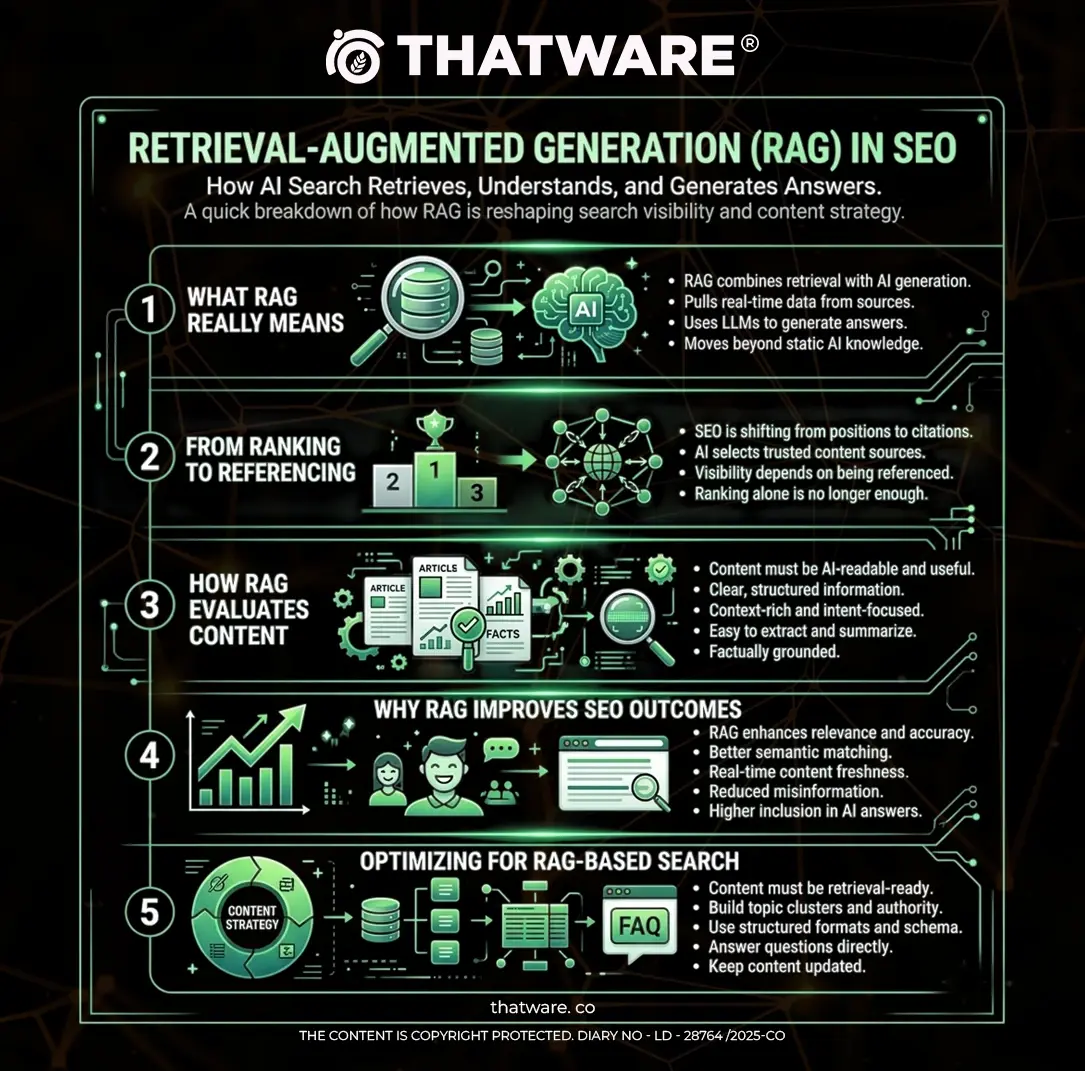
Retrieval-Augmented Generation (RAG) plays a critical role in powering these AI-driven search experiences. Instead of relying solely on pre-trained knowledge, RAG systems retrieve relevant information from multiple sources—such as web pages, databases, or indexed content—at the time of the query.
Once the most relevant content is retrieved, the system uses a language model to generate a concise, context-aware response. This combination ensures that answers are both accurate and up-to-date. For SEO professionals, this means that content must not only rank but also be retrievable and understandable by AI systems.
Shift from “Ranking” to “Being Referenced”
One of the most important changes RAG introduces is the shift from simply ranking on SERPs to being referenced within AI-generated answers. In traditional SEO, the goal was to secure a top position. Now, the goal is to ensure your content is trusted enough to be cited by AI systems.
This makes authority, clarity, and structure more critical than ever. Content that is well-organized, factually accurate, and semantically rich has a higher chance of being selected during the retrieval phase and included in generated responses. In this new paradigm, visibility is no longer just about clicks—it’s about influence within AI-generated narratives.
Benefits of RAG in SEO
Improved Content Relevance
RAG significantly enhances content relevance by aligning outputs closely with user intent. Instead of relying on static keyword matching, RAG systems interpret the meaning behind queries and retrieve content that best satisfies that intent. This leads to better semantic matching, where content is evaluated based on context, relationships, and depth rather than keyword density. For SEO, this encourages the creation of more meaningful, user-focused content.
Higher Chances of Appearing in AI Answers
With the rise of AI-generated responses, traditional featured snippets are evolving into comprehensive AI summaries. RAG systems often pull from multiple high-quality sources to construct these answers. Content that is well-structured, clearly written, and directly answers questions has a higher likelihood of being selected. This increases your chances of being included in AI responses, even if your page isn’t ranked #1 in the traditional sense.
Real-Time Content Optimization
One of the standout advantages of RAG is its ability to incorporate real-time data. Unlike static models, RAG systems can retrieve updated information from current sources. This means that regularly updated content, dynamic knowledge bases, and fresh insights are more likely to be surfaced. For SEO, maintaining updated content is no longer optional—it directly impacts visibility in AI-driven search environments.
Enhanced User Experience (UX)
RAG-powered systems deliver faster and more accurate answers, improving the overall user experience. Users no longer need to browse multiple pages to find relevant information—they receive concise, aggregated responses instantly. This leads to reduced bounce rates and higher satisfaction. For websites, aligning content with this expectation—clear, direct, and helpful—can improve engagement metrics.
Better Topical Authority
RAG favors content ecosystems that demonstrate depth and interconnectedness. Websites that build comprehensive topic clusters—covering a subject from multiple angles and linking related content—are more likely to be recognized as authoritative sources. This resembles a knowledge graph approach, where entities and relationships are clearly defined. Strong topical authority increases the chances of your content being retrieved and referenced.
Personalization Opportunities
Another powerful benefit of RAG is its ability to enable personalized responses. By considering user context—such as location, search history, or preferences—RAG systems can tailor outputs to individual users. For SEO, this opens the door to more targeted content strategies that address specific audience segments. Personalized, relevant content not only improves engagement but also builds stronger user connections.
RAG vs Traditional SEO Strategies
Search engine optimization is undergoing a fundamental shift as AI-driven systems like Retrieval-Augmented Generation (RAG) redefine how content is discovered and presented. Traditional SEO has long focused on keywords, static content, and achieving higher rankings on search engine results pages (SERPs). In contrast, RAG-driven SEO prioritizes context, intent, and relevance, fundamentally changing optimization strategies.
| Aspect | Traditional SEO | RAG-Driven SEO |
| Focus | Keywords | Context & intent |
| Content | Static | Dynamic & contextual |
| Ranking | SERP position | AI citation/visibility |
| Updates | Manual | Real-time via data sources |
In traditional SEO, success is largely measured by how well a page ranks for specific keywords. However, RAG-based systems don’t just rank pages—they retrieve and synthesize information from multiple sources to generate answers. This means visibility is no longer limited to ranking #1; instead, it depends on whether your content is reliable and structured enough to be referenced by AI.
Another key difference lies in content freshness. Traditional SEO often relies on periodic updates, whereas RAG systems can pull from real-time or frequently updated data sources, making outdated content less likely to be surfaced.
To stay competitive, SEO strategies must evolve. Businesses need to move beyond keyword stuffing and focus on building authoritative, well-structured, and context-rich content that AI systems can easily interpret and trust. The goal is no longer just ranking—but becoming a trusted source in AI-generated responses.
How to Optimize Content for RAG-Based Search (Actionable Tips)
Optimizing for RAG-based search requires a shift from traditional tactics toward contextual clarity, semantic depth, and structured information. Here are practical strategies to align your content with AI-driven retrieval systems:
Create Context-Rich Content
RAG systems prioritize content that fully answers user queries. Instead of writing shallow articles targeting a single keyword, focus on comprehensive answers. Anticipate follow-up questions and address them within the same piece. Writing in a natural, conversational tone also helps AI models better interpret and reuse your content in generated responses.
Use Structured Data & Schema Markup
Structured data plays a crucial role in helping retrieval systems understand your content. Implementing schema markup (such as FAQ, How-To, and Article schema) allows search engines and AI models to identify key information quickly. This increases the chances of your content being selected and cited in AI-generated answers.
Focus on Semantic SEO
RAG systems rely heavily on meaning rather than exact keywords. Build content around topics, entities, and relationships instead of isolated keywords. Use topic clusters to cover a subject comprehensively, linking related subtopics to a central pillar page. This strengthens your site’s contextual authority.
Build Authoritative Knowledge Hubs
Creating interconnected content ecosystems improves discoverability. Develop pillar pages supported by detailed sub-articles, and interlink them strategically. This structure mirrors how RAG systems retrieve related information, increasing the likelihood that your content is selected as a reliable source.
Optimize for Featured Snippets & AI Answers
Format your content for easy extraction. Use bullet points, numbered lists, concise definitions, and FAQ sections to highlight key information. These formats make it easier for AI systems to pull and present your content directly in answers, improving visibility beyond traditional rankings.
Keep Content Updated
Freshness is critical in RAG-based systems. Regularly update your content to reflect latest trends, data, and insights. AI retrieval systems favor up-to-date information, so maintaining accuracy and relevance ensures your content remains competitive and frequently cited.
Real-World Example: How RAG-Optimized Content Gets Featured in AI Search
Example: ThatWare’s Quantum SEO Blog in AI Overview
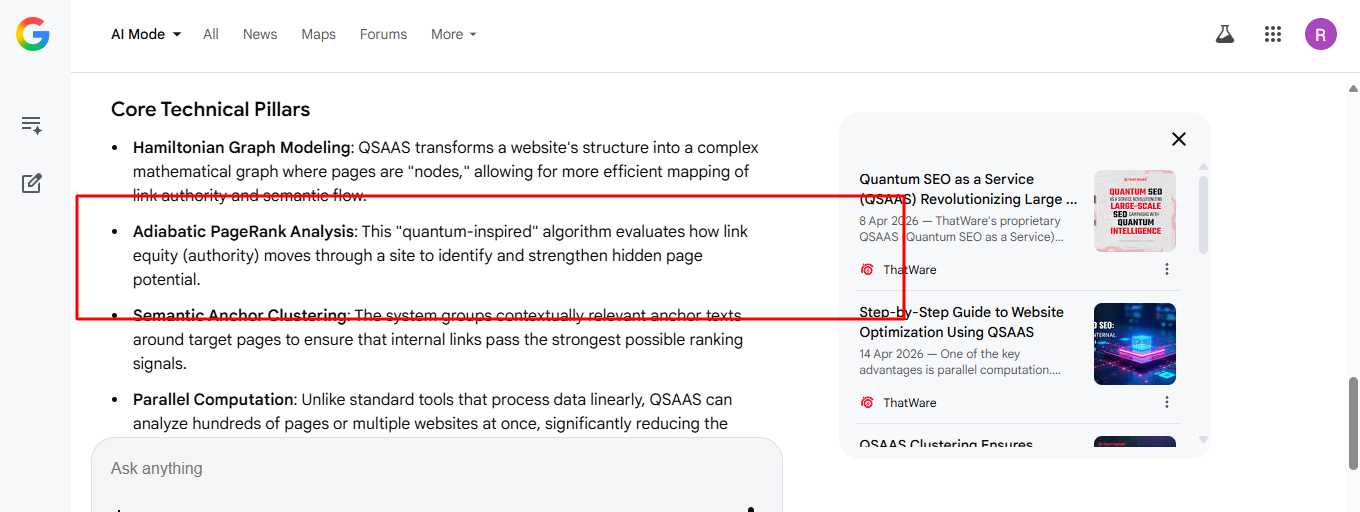
A blog published by ThatWare on Quantum SEO as a Service provides a clear example of how RAG-ready content performs in modern search. The article was not just indexed or ranked. It was directly surfaced inside Google’s AI Overview as a structured summary under “Core Technical Pillars.”
The system extracted specific sections, including:
- Hamiltonian Graph Modeling
- Adiabatic PageRank Analysis
- Semantic Anchor Clustering
This demonstrates how AI systems retrieve and reorganize high-quality content into direct answers instead of simply listing links.
How We Structured RAG Summaries from the Blog Content
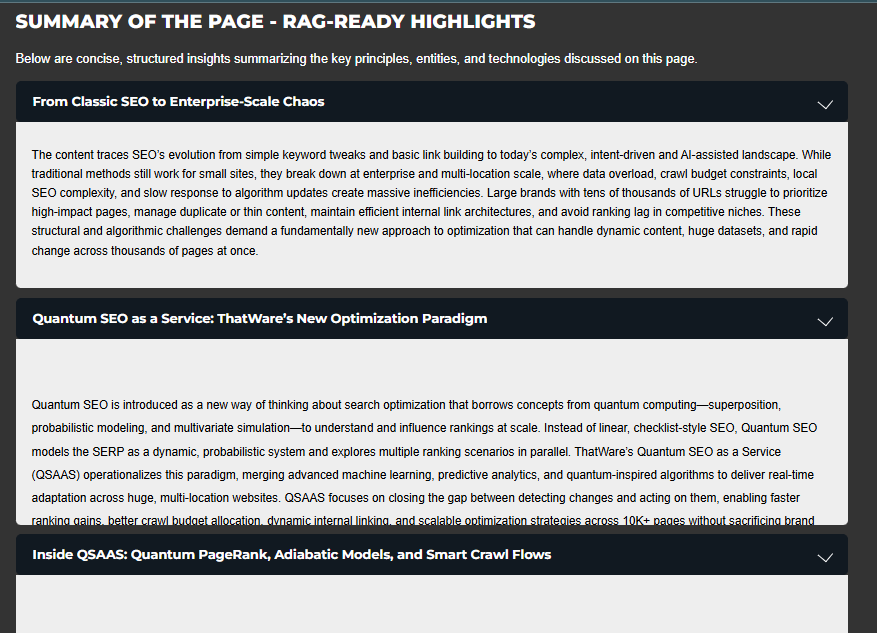
To make the content RAG-compatible, the core insights from the blog were distilled into three clear, high-density summaries. Each summary captures a complete layer of meaning, making it easy for AI systems to retrieve and reuse.
1. Evolution of SEO and the Need for Scale
The content explains how SEO has evolved from basic keyword optimization to a complex, intent-driven ecosystem. It highlights the limitations of traditional strategies for enterprise websites, including crawl inefficiencies, data overload, and difficulty in managing large-scale content structures. This establishes the problem context clearly.
2. Introduction to Quantum SEO and QSAAS
The second summary introduces Quantum SEO as a new paradigm. It explains how quantum-inspired principles such as probabilistic modeling and parallel scenario analysis enable better decision-making at scale. The QSAAS framework is positioned as a system that combines machine learning and predictive analytics to adapt in real time.
3. Technical and Algorithmic Foundations
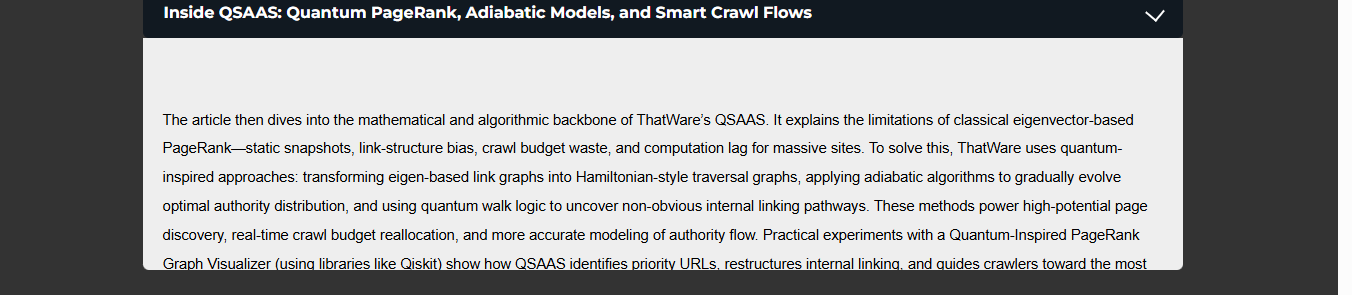
The final summary focuses on the underlying technology. It explains how traditional PageRank limitations are addressed using quantum-inspired models such as Hamiltonian graphs and adiabatic algorithms. It also highlights practical outcomes like improved internal linking, better crawl budget allocation, and high-value page discovery.
This layered summarization ensures that each section is self-contained, context-rich, and easy for AI systems to interpret and extract.
Why This Content Was Selected by RAG Systems
The ThatWare blog aligns closely with how RAG-based systems evaluate and retrieve information.
First, the content is highly structured. Clear headings and bullet points make it easy for AI systems to extract complete ideas without ambiguity.
Second, it uses strong conceptual entities. Terms like Hamiltonian Graph Modeling and Adiabatic PageRank Analysis improve semantic understanding and retrieval accuracy.
Third, the information is dense and self-contained. Each section explains a concept and its application, allowing AI systems to reuse it as a complete answer.
Finally, the article builds clear topical authority. It presents a consistent framework supported by technical depth, which increases trust signals for retrieval systems.
This example highlights a key shift in SEO. Visibility now depends not only on ranking but on how effectively content can be interpreted, selected, and reused by AI systems.
Future of RAG in SEO
The future of SEO is rapidly being reshaped by Retrieval-Augmented Generation (RAG), as search engines increasingly rely on AI-generated results to deliver faster, more precise answers. Instead of simply listing links, platforms are moving toward generating direct responses by retrieving and synthesizing information from multiple sources. This shift is driving a significant rise in zero-click searches, where users get their answers instantly without visiting a website.
At the same time, the growth of voice and conversational search is accelerating the need for context-rich, natural language content. Users now expect search engines to understand nuanced queries and respond conversationally—something RAG systems are designed to handle effectively.
In this evolving landscape, brand authority and trust signals are becoming more critical than ever. Search engines are more likely to pull information from sources they consider credible, accurate, and well-structured. This means businesses must focus not just on visibility, but on building reliable, high-quality content ecosystems that AI systems can confidently reference.
Conclusion
Retrieval-Augmented Generation (RAG) represents a major shift in how information is discovered, processed, and delivered in modern search environments. By combining real-time data retrieval with AI-powered content generation, RAG enables more accurate, relevant, and context-aware search experiences—making it a crucial concept for anyone involved in SEO.
The key takeaway is clear: SEO is no longer just about ranking on search engine results pages—it’s about being referenced in AI-generated answers. As search engines evolve, the focus is shifting toward content that is trustworthy, well-structured, and rich in context.
For businesses and marketers, this is not a distant trend but a present reality. Adapting early by optimizing for semantic relevance, authority, and user intent can create a strong competitive advantage.
Ultimately, RAG is not just enhancing search—it is redefining it. Those who align their SEO strategies with this new paradigm will be better positioned to maintain visibility and relevance in the future of AI-driven search.