
SUPERCHARGE YOUR ONLINE VISIBILITY! CONTACT US AND LET’S ACHIEVE EXCELLENCE TOGETHER!
The Core Problem With Brand Strategy in the AI Era
For the last decade, brand and growth teams have been trained to trust what they can measure: dashboards, rankings, attribution reports, traffic curves, and campaign projections. The problem is—those instruments were built for a different world. They explain how people behave on search engines and websites. They do not explain how AI systems decide what to mention, what to recommend, and what to ignore.
In the AI era, visibility doesn’t look like a ranking. It looks like a decision—made inside a model—based on countless hidden signals. That’s why modern brand planning can feel “data-driven” while still being dangerously blind.
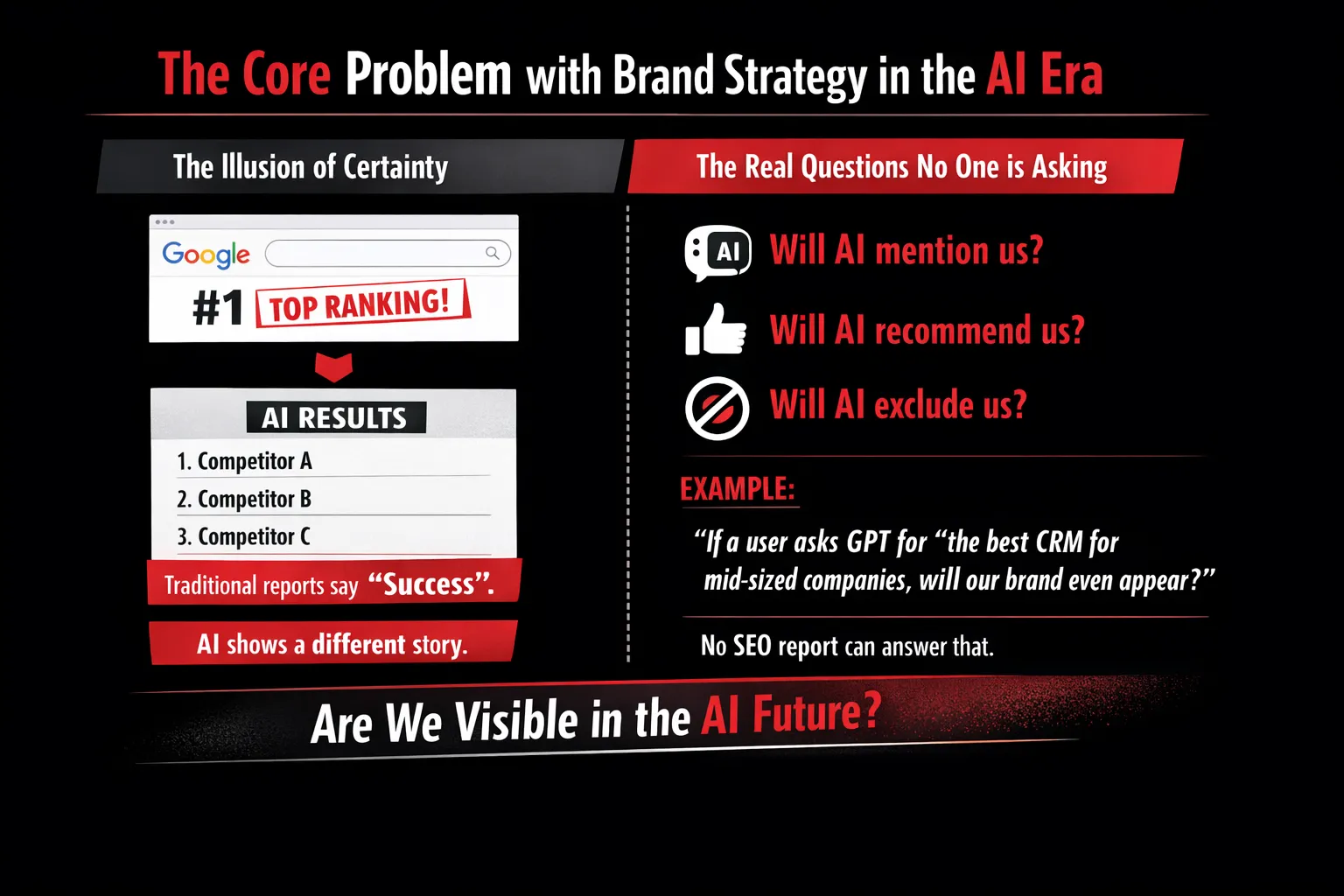
The illusion of certainty in modern brand planning
Most brands are operating with what looks like certainty:
- “We’re ranking on page one.”
- “Traffic is up.”
- “We own the keyword.”
- “Brand search volume is growing.”
But AI systems don’t reward those signals in a predictable, linear way. A brand can look like a winner on traditional metrics and still be a non-entity inside AI-generated answers.
Example: A brand ranks #1 on Google for its core keyword. Their reports show dominance. Their internal narrative becomes: “We’ve won the category.” Then a user asks GPT the same category question—and GPT recommends three competitors, not them.
Traditional analytics say “success.” AI visibility says: “You’re not the default choice.”
That gap is the new reality. And it creates a painful executive problem: decisions are being made from reports that can’t see the battlefield.
The real question no one is answering
In the AI era, decision-makers need answers to questions that classic SEO and brand frameworks weren’t designed to handle:
- Will AI mention us?
- Will AI recommend us?
- Will AI exclude us entirely?
Because these aren’t “ranking questions.” They are probability questions.
Example: A SaaS founder asks a simple but high-stakes question:
“If a user asks GPT for the best CRM for mid-sized companies, will our brand even appear?”
This is not a vanity question. It directly affects:
- lead quality
- pipeline velocity
- investor confidence
- category credibility
But here’s the issue: no existing SEO report can answer this probabilistically. A keyword report can show rankings. A traffic report can show clicks. A brand study can show awareness. None of them can reliably quantify the real AI-era outcomes:
- How often you’ll be mentioned
- How often you’ll be recommended
- How often you’ll be absent—without any visible reason
And that’s exactly why a new model is needed—one that moves beyond guessing, beyond “best practices,” beyond blind optimization.
That model is Quantum Brand Modeling (QBM): a simulation approach designed to map brand outcomes across many possible AI futures, so leaders can stop acting on hope and start acting on modeled trajectory.
Introducing Quantum Brand Modeling (QBM)
What QBM Stands For
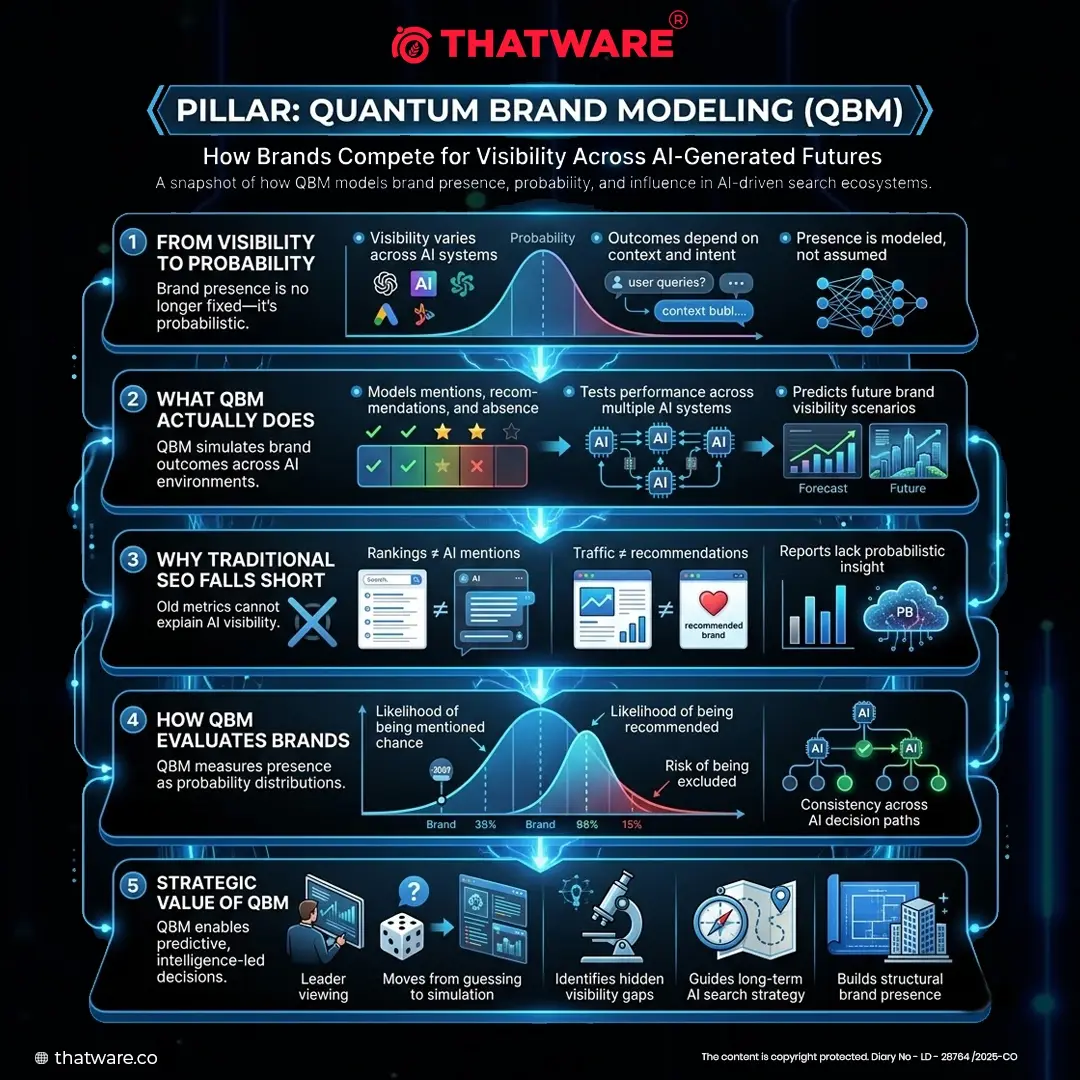
Quantum Brand Modeling (QBM) refers to the practice of simulating brand outcomes across infinite AI futures.
As AI systems increasingly mediate how brands are discovered, referenced, and recommended, brand visibility is no longer a fixed outcome. It becomes a probability-driven event, influenced by context, intent, and model behavior.
QBM exists to answer a simple but critical question:
What is the likely future of this brand inside AI systems—not just once, but across all possible scenarios?
Rather than relying on assumptions or post-facto optimization, QBM models how a brand is expected to behave across a wide range of AI-generated environments.
What QBM Is Not
To understand QBM, it’s important to first clarify what it is not.
QBM is:
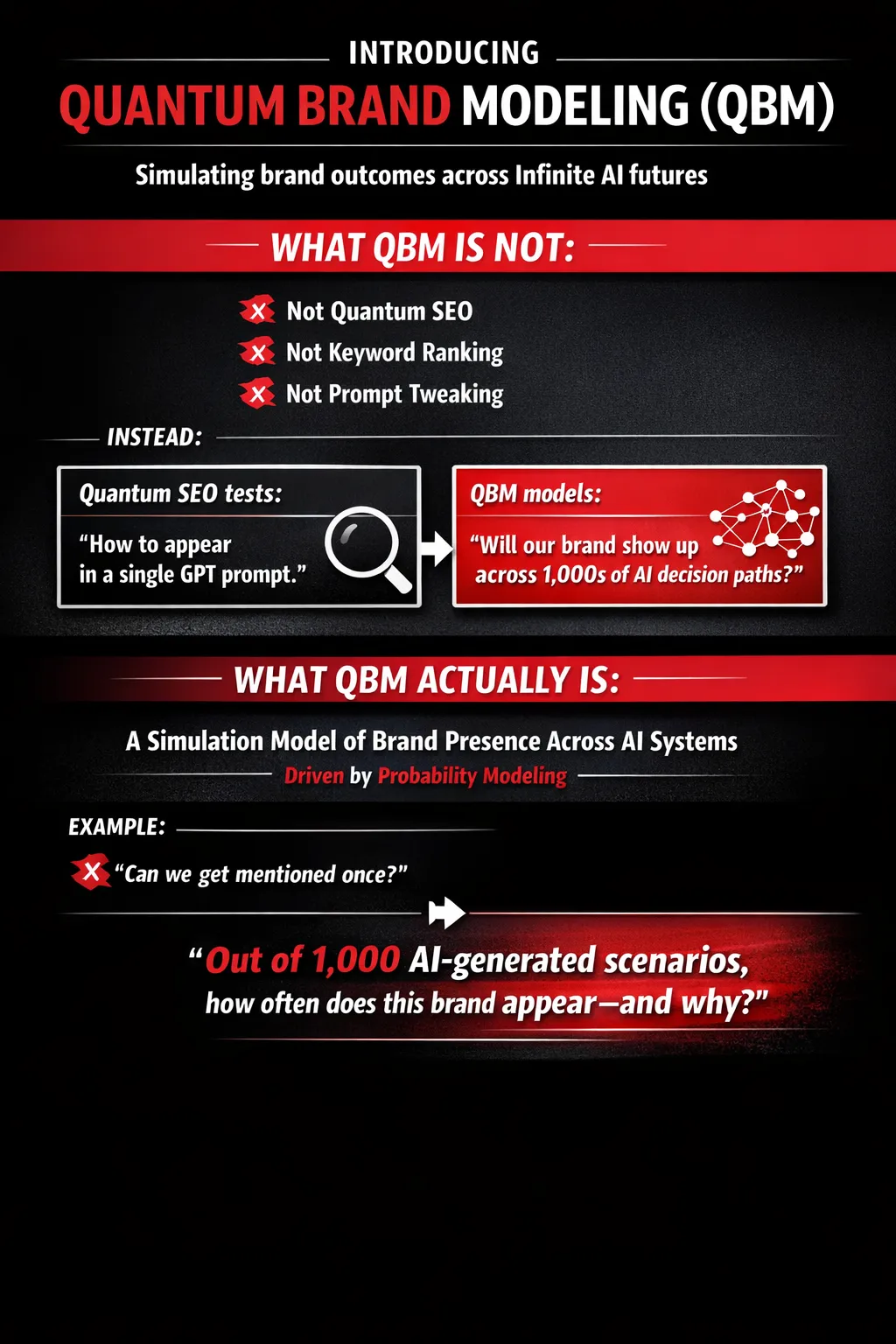
- Not Quantum SEO
- Not keyword ranking optimization
- Not prompt engineering or prompt tweaking
These approaches attempt to influence individual outputs. QBM, by contrast, is concerned with system-level behavior.
Example: Quantum SEO may attempt to optimize how a brand appears in a single GPT response or a specific query format.
QBM does something fundamentally different. It asks whether the brand is likely to appear repeatedly and consistently across thousands of AI decision paths, spanning different user intents, phrasing styles, and AI reasoning patterns.
In other words, QBM does not chase moments of visibility—it models structural presence.
What QBM Actually Is
At its core, QBM is a simulation model of brand presence across AI systems, inspired by probability-based and quantum-inspired modeling.
Instead of treating brand visibility as a yes-or-no outcome, QBM treats it as a distribution of probabilities.
It models how often a brand is:
- Mentioned
- Recommended
- Excluded
across multiple AI environments such as GPT, Gemini, cloud-based AI assistants, and future LLM systems.
Example: Traditional brand questions sound like this:
“Can we get mentioned by GPT?”
QBM reframes the question entirely:
“Out of 1,000 AI-generated recommendation scenarios, how often does this brand appear—and why?”
This shift—from single outcomes to probabilistic distributions—is what allows QBM to create a brand trajectory instead of a snapshot.
That trajectory becomes the foundation for strategic decision-making, long before optimization or execution begins.
The Core Shift: From Optimization to Simulation
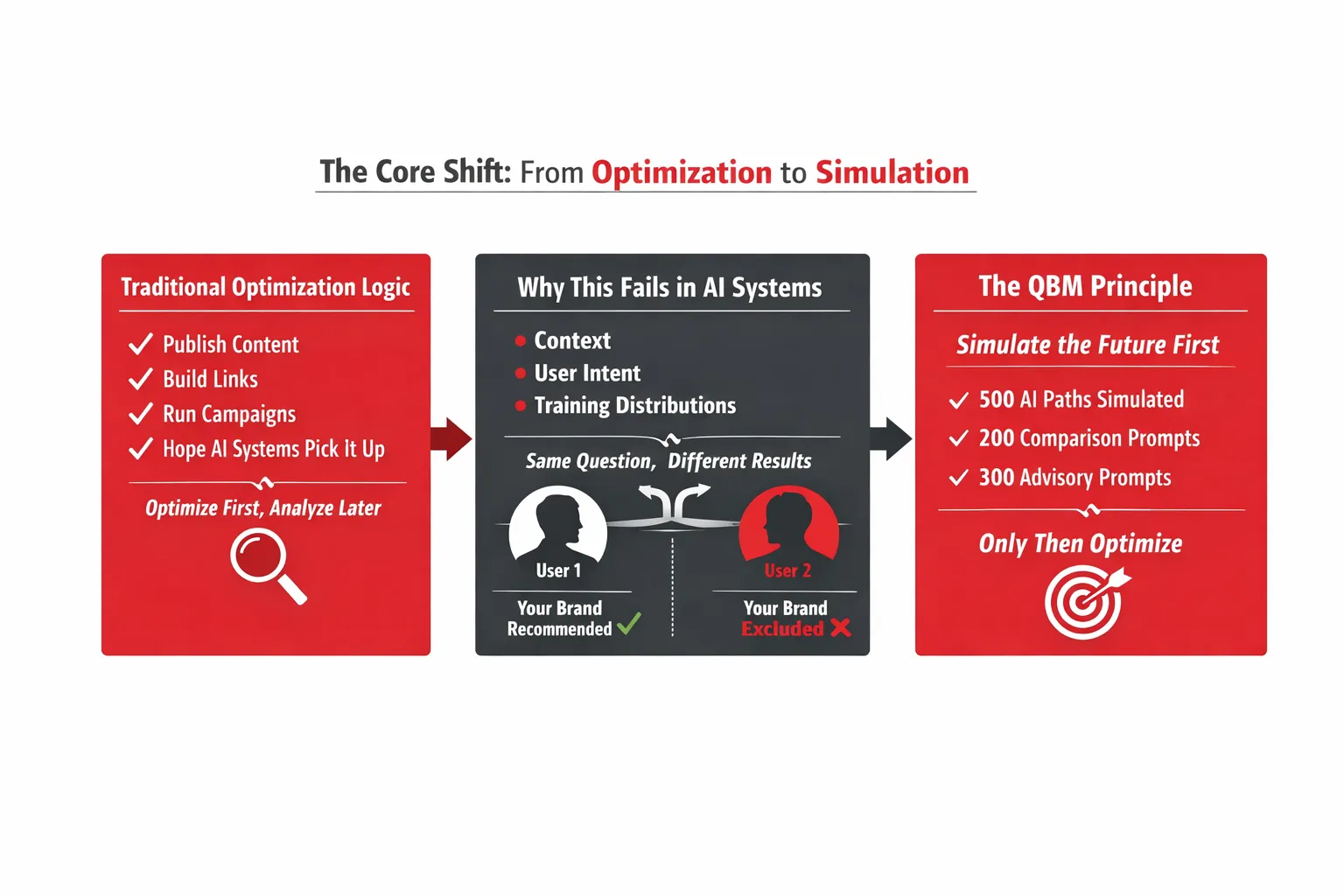
Traditional optimization logic
For decades, brand strategy—especially in digital and search—has followed a backward-looking loop. Brands act first and analyze later.
The typical flow looks like this:
- Publish content
- Build links
- Run campaigns
- Measure performance
- Adjust and repeat
This approach assumes that visibility systems behave predictably. If you publish enough content or build enough authority, the system will eventually reward you. In classic search engines, this logic mostly worked because ranking mechanisms were comparatively stable and deterministic.
In AI-driven systems, however, this assumption breaks down. Brands are still optimizing as if outcomes are guaranteed—hoping AI systems “pick them up”—without understanding how those systems actually decide what to mention or recommend.
Why this fails in AI systems
AI systems do not operate on fixed ranking ladders. They generate responses dynamically based on multiple shifting variables, including:
- Context of the question
- User intent and phrasing
- Training data distributions
- Model reasoning paths
This means visibility is situational, not permanent.
Example: Two users ask essentially the same question, but in slightly different ways.
- User A receives a response where your brand is recommended.
- User B receives a response where your brand is completely absent.
From the brand’s perspective, nothing changed—same content, same authority, same campaigns. From the AI’s perspective, everything changed. This exposes the fundamental flaw of traditional optimization: it assumes consistency where none exists.
Optimizing without accounting for probabilistic variation is no longer strategy—it’s guesswork.
The QBM principle
We don’t optimize blindly. We simulate the future first.
Quantum Brand Modeling (QBM) flips the sequence entirely. Instead of acting and hoping for visibility, QBM models possible AI outcomes before execution begins.
Before a brand spends on content, campaigns, or authority-building, QBM simulates how that brand is likely to perform across a wide range of AI decision scenarios, such as:
- 500 AI recommendation paths
- 200 comparison-style prompts
- 300 advisory or decision-support prompts
Each simulation reveals how often the brand is mentioned, recommended, or excluded across different AI contexts. Only after this probabilistic landscape is understood does optimization begin.
This shift—from reacting to results to anticipating outcomes—is the core philosophical change behind QBM. In an AI-first world, the winners won’t be the brands that optimize the hardest, but the ones that understand the future they are optimizing for.
What Problem Quantum Brand Modeling (QBM) Solves
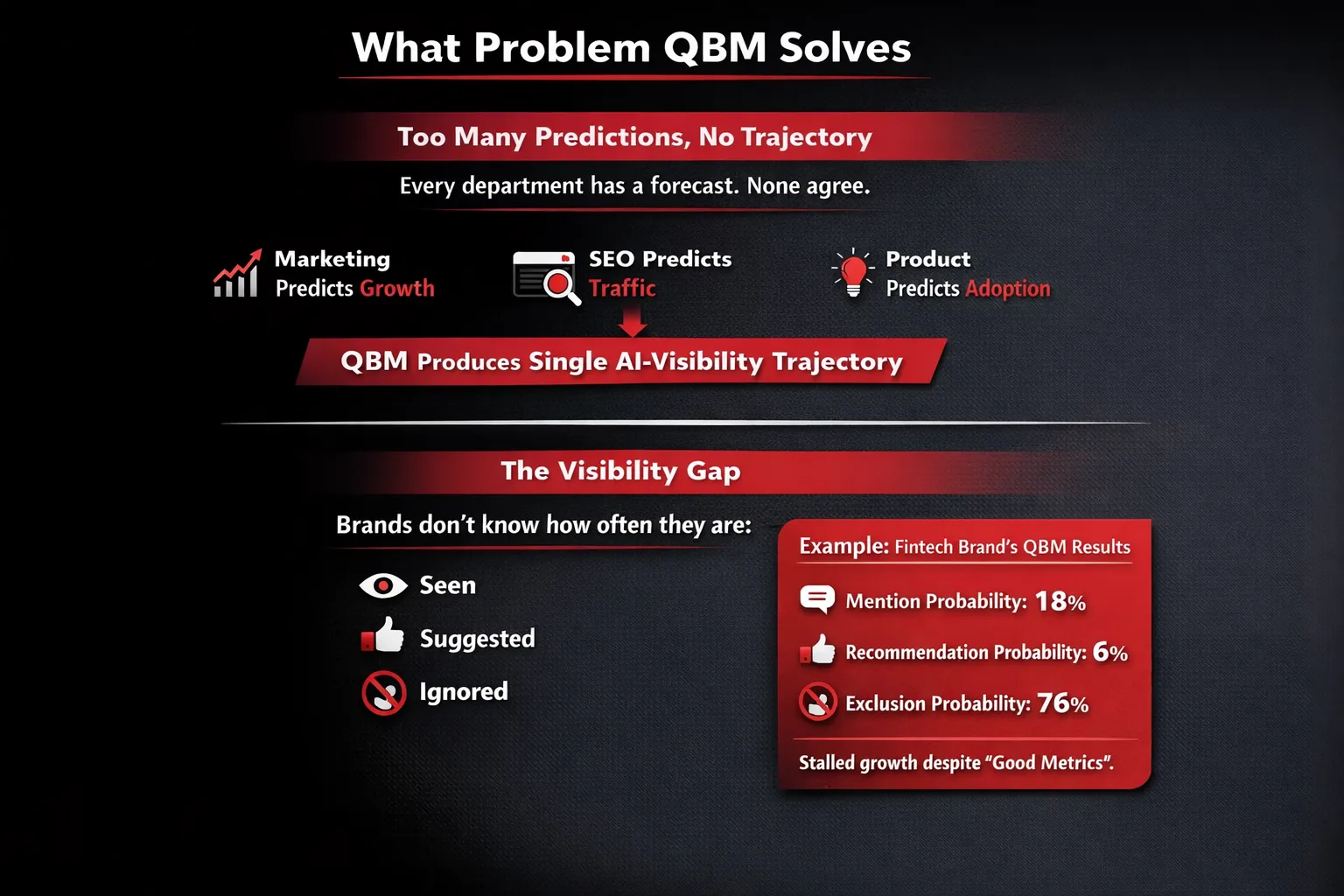
Too Many Predictions, No Trajectory
Modern brands are not short on forecasts. They are drowning in them.
Every function inside an organization produces its own version of the future:
- Marketing forecasts brand growth
- SEO forecasts traffic and rankings
- Product forecasts adoption and usage
- Sales forecasts pipeline and conversions
Each forecast is internally valid. None of them agree. More importantly, none of them explain how AI systems will actually treat the brand.
What’s missing is not another prediction—it’s a trajectory.
Quantum Brand Modeling solves this by collapsing fragmented forecasts into a single AI-visibility trajectory. Instead of asking how different teams think the future will look, QBM asks a more fundamental question:
Across thousands of AI-driven scenarios, how is this brand likely to appear, be referenced, or be recommended?
That trajectory becomes the strategic anchor. It doesn’t replace departmental metrics—it contextualizes them within the reality of AI-mediated decision-making.
The Visibility Gap Most Brands Can’t See
Most brands assume visibility is binary:
- either they are visible, or they are not.
In AI systems, visibility is probabilistic.
Brands rarely know how often they are:
- Seen by AI systems
- Suggested as a recommendation
- Ignored or excluded altogether
Traditional dashboards don’t show this. Rankings, impressions, and traffic create a sense of progress, but they don’t reveal how AI actually decides.
Quantum Brand Modeling exposes this hidden layer.
Example: A fintech brand with strong SEO performance and healthy traffic runs a QBM simulation and uncovers the following:
- Probability of mention: 18%
- Probability of recommendation: 6%
- Probability of exclusion: 76%
On paper, the brand looks successful. In AI systems, it is largely invisible.
This explains why growth has plateaued despite “good metrics.” The brand is present in channels humans measure—but absent in the systems increasingly guiding human decisions.
QBM makes this visibility gap explicit. It turns intuition into measurable probabilities and replaces assumptions with modeled outcomes—allowing brands to act before exclusion becomes structural.
How Quantum Brand Modeling Works (Conceptual Level)
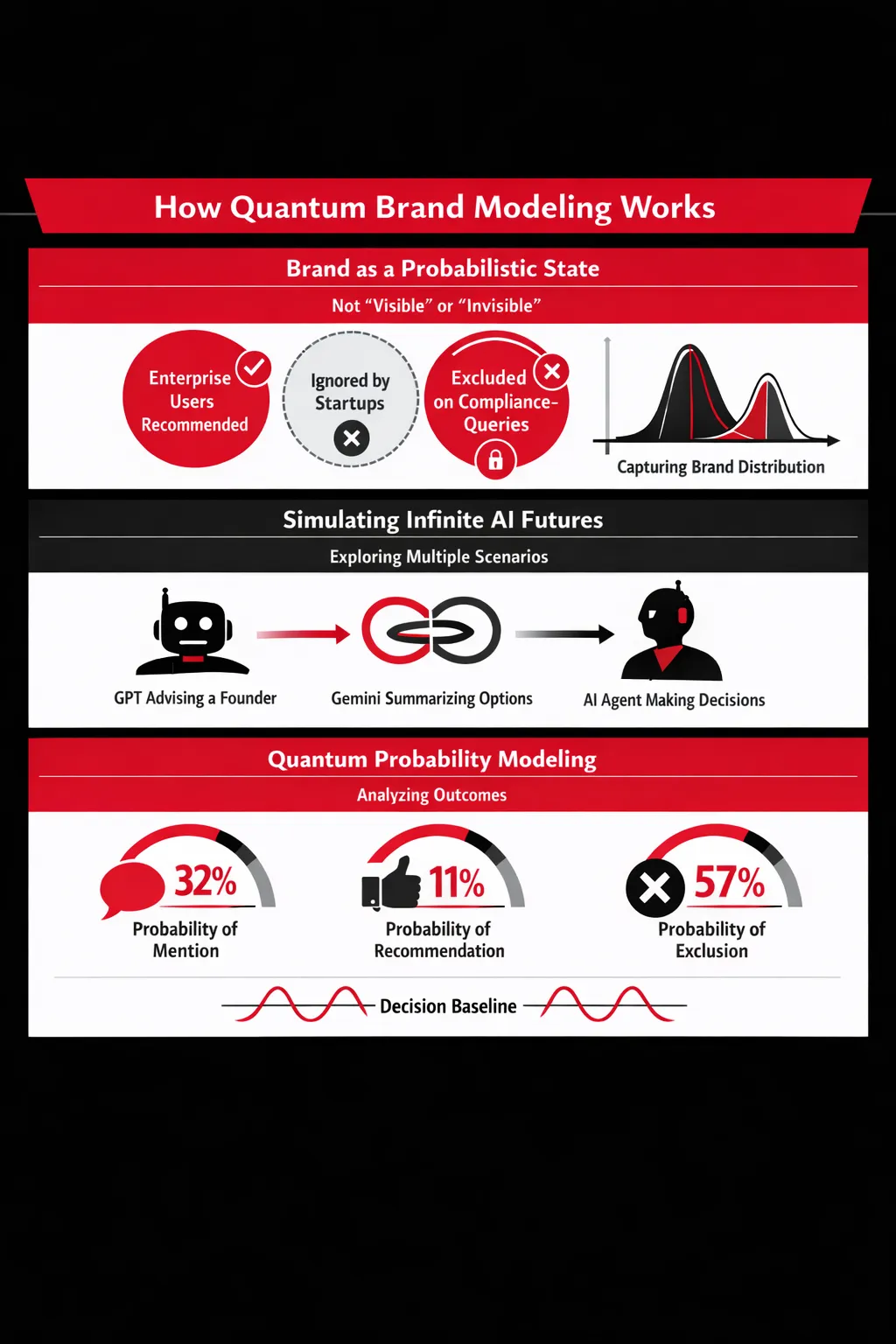
Quantum Brand Modeling does not treat brand visibility as a yes-or-no outcome. Instead, it models how a brand exists across multiple AI decision environments—each with its own logic, context, and probability of selection.
This is a fundamental shift from deterministic thinking to probabilistic modeling.
A Brand as a Probabilistic State
In AI systems, a brand is never simply “visible” or “invisible.”
It exists as a probabilistic state—meaning the likelihood of being mentioned, recommended, or excluded varies depending on context, audience, and intent.
For example, the same brand may:
- Be recommended when an AI system advises enterprise decision-makers
- Be ignored when responding to startup-focused queries
- Be excluded entirely in compliance-sensitive or regulated contexts
Traditional brand and SEO metrics collapse these realities into a single average. Quantum Brand Modeling preserves them as a distribution of outcomes.
QBM captures where a brand appears, where it doesn’t, and why those differences exist.
Simulating Infinite AI Futures
Rather than evaluating a brand in one static environment, QBM simulates the brand across multiple AI futures.
The same brand is tested in different AI roles, contexts, and decision paths, such as:
- GPT acting as an advisor to a startup founder
- Gemini summarizing options for a research-driven buyer
- A future autonomous AI agent making a purchasing decision
Each of these AI systems interprets brand signals differently. As a result, the brand’s visibility shifts across scenarios.
By simulating these futures repeatedly, QBM reveals patterns—not assumptions—about how AI systems are likely to treat the brand over time.
Quantum-Inspired Probability Modeling
Because AI systems do not behave deterministically, QBM does not produce binary outcomes.
Instead of asking “Will the brand appear?”, QBM answers:
- What is the probability that the brand will be mentioned?
- What is the probability that it will be recommended?
- What is the probability that it will be excluded altogether?
A typical QBM output might look like this:
- 32% probability of mention
- 11% probability of recommendation
- 57% probability of exclusion
These probabilities become the decision baseline for leadership teams.
Rather than optimizing blindly, brands can now see the future terrain they are entering—and decide how, where, and whether to act.
What QBM Actually Measures
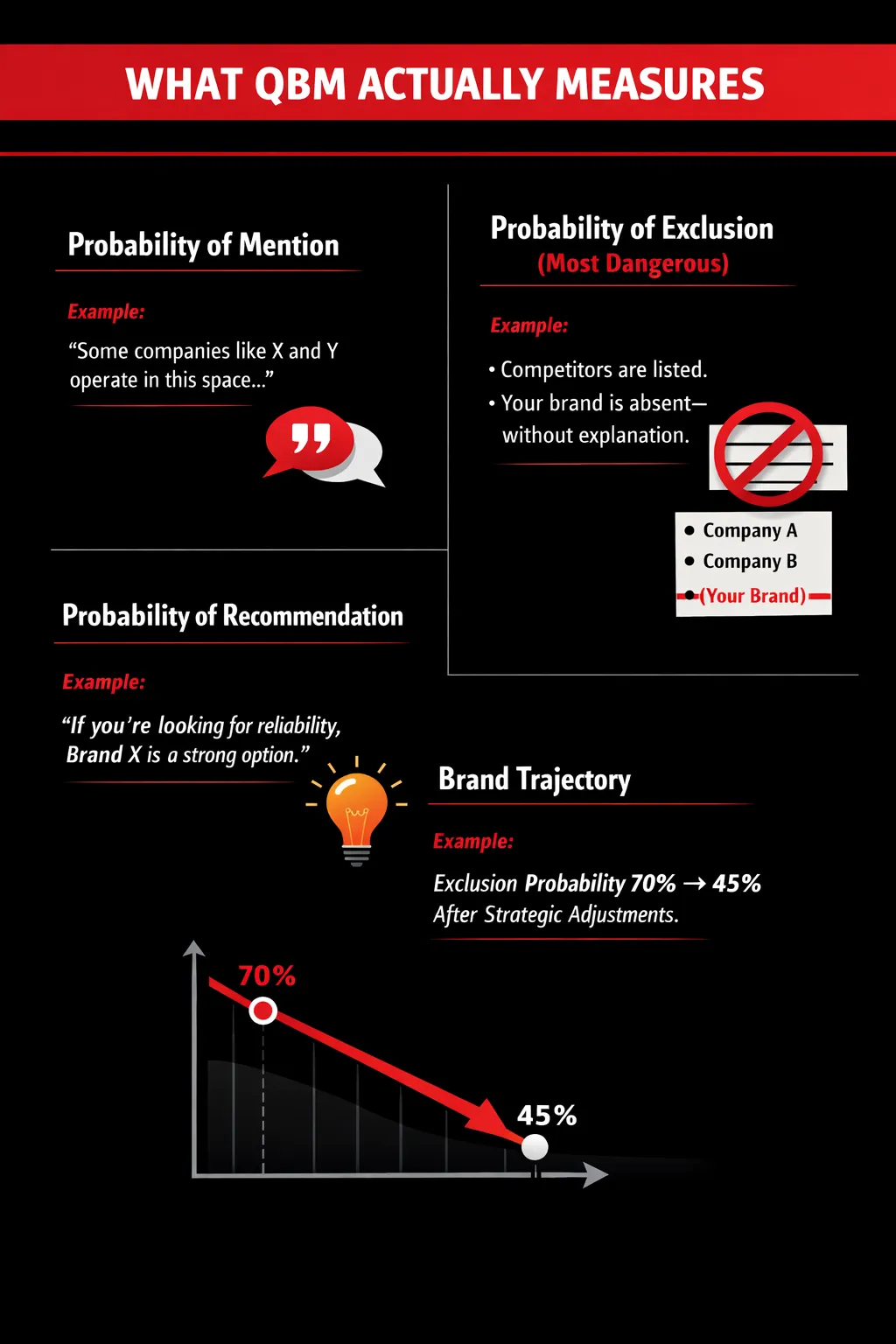
Quantum Brand Modeling does not measure rankings, traffic, or impressions. It measures how AI systems probabilistically treat a brand when generating answers, recommendations, and decisions.
Instead of asking “Are we visible?”, QBM answers “How likely are we to appear, be recommended, or be ignored?”
Probability of Mention
This measures how often an AI system acknowledges the brand’s existence without endorsing it.
A mention indicates awareness, but not trust.
Example: When a user asks an AI about options in a category, the response might be:
“Some companies like Brand X and Brand Y operate in this space…”
Here, the brand is recognized as relevant, but it is not positioned as a preferred choice.
Why this matters:
- Mentions signal baseline visibility
- They indicate that the brand exists in the AI’s knowledge graph
- But mentions alone do not influence decisions
A high mention probability with low recommendation probability often means the brand is known but not trusted.
Probability of Recommendation
This measures how often an AI system actively suggests the brand as a solution.
A recommendation reflects confidence and authority, not just awareness.
Example: When a user asks for guidance, the AI responds:
“If you’re looking for reliability, Brand X is a strong option.”
This indicates that the AI has:
- Evaluated alternatives
- Applied internal decision logic
- Chosen the brand as a preferred outcome
Why this matters:
- Recommendations drive real-world decisions
- They influence buyers, founders, and executives
- This is where brand equity converts into outcomes
In QBM, recommendation probability is the most commercially valuable signal.
Probability of Exclusion (The Most Dangerous Metric)
This measures how often the brand is completely absent when it logically should appear.
Exclusion is silent, invisible, and often misunderstood.
Example: An AI lists five competitors in response to a category query. Your brand is not mentioned at all—without explanation.
No negative feedback. No warning. Just absence.
Why this is dangerous:
- Brands often don’t realize they are being excluded
- Traditional metrics won’t show the problem
- AI systems quietly shape perception by omission
A high exclusion probability means the brand is outside the AI’s decision boundary, regardless of marketing spend or SEO performance.
Brand Trajectory Over Time
QBM does not stop at static probabilities. It models how these probabilities evolve.
Instead of a snapshot, QBM produces a brand trajectory.
Example: After strategic adjustments:
- Exclusion probability drops from 70% → 45%
- Mention probability rises steadily
- Recommendation probability begins to emerge
This trajectory shows whether the brand is:
- Moving toward AI trust
- Stagnating
- Or slowly disappearing from AI-generated decisions
Why this matters: Executives, founders, and investors don’t need isolated metrics. They need to know where the brand is heading.
QBM turns AI visibility into a forward-looking decision signal, not a retrospective report.
Where QBM Operates
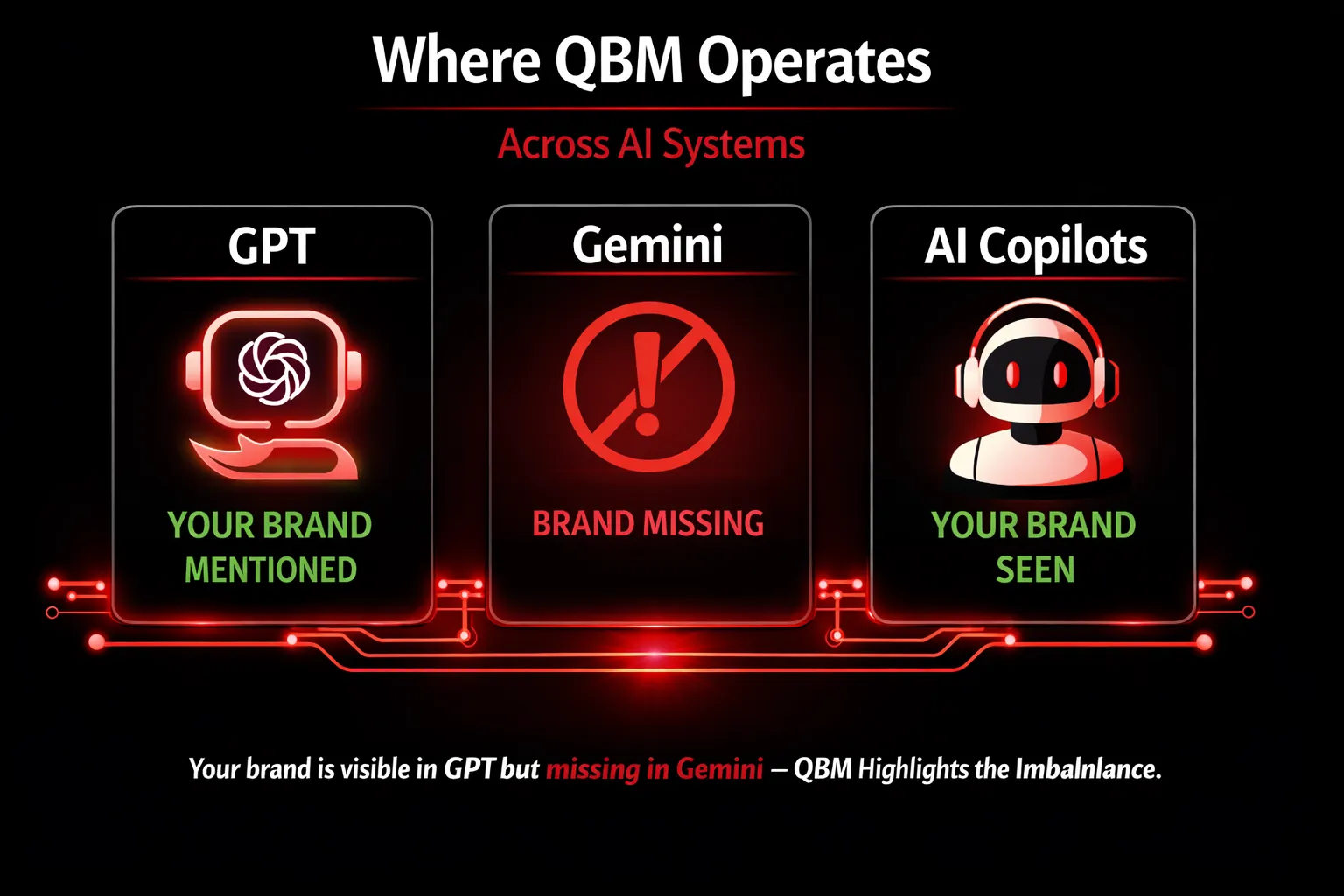
Quantum Brand Modeling does not treat AI as a single platform or a single algorithm. Instead, it recognizes that brand visibility today is fragmented across multiple AI systems, each with its own reasoning patterns, training signals, and recommendation logic. QBM is designed to model this fragmentation rather than ignore it.
Across AI Systems
QBM operates across the full spectrum of present and emerging AI interfaces, including:
- GPT-based systems (conversational AI, assistants, research tools)
- Gemini and multimodal AI systems (search-integrated and context-heavy reasoning models)
- Enterprise AI copilots (internal decision-support tools used inside companies)
Each of these systems forms opinions, mentions brands, and makes recommendations differently. Treating “AI visibility” as a single metric therefore leads to false confidence.
Example: Visibility Imbalance Across AI Systems
A brand may appear frequently in GPT responses when users ask for strategic advice or product comparisons. At the same time, the same brand may be completely absent in Gemini-generated summaries or enterprise AI copilots used for vendor evaluation.
From a traditional perspective, this imbalance is invisible. Reports might show strong content performance or positive brand signals, yet an entire AI ecosystem is silently excluding the brand.
QBM surfaces this imbalance by modeling brand presence separately across each AI system. Instead of a single visibility score, decision-makers see where the brand exists, where it weakens, and where it disappears altogether. This allows teams to address systemic gaps rather than optimize blindly for one AI surface while losing ground in others.
In short, QBM ensures that brand strategy accounts for how different AI systems actually think, not how brands assume they behave.
Why This Matters for Executives, Founders, and Investors
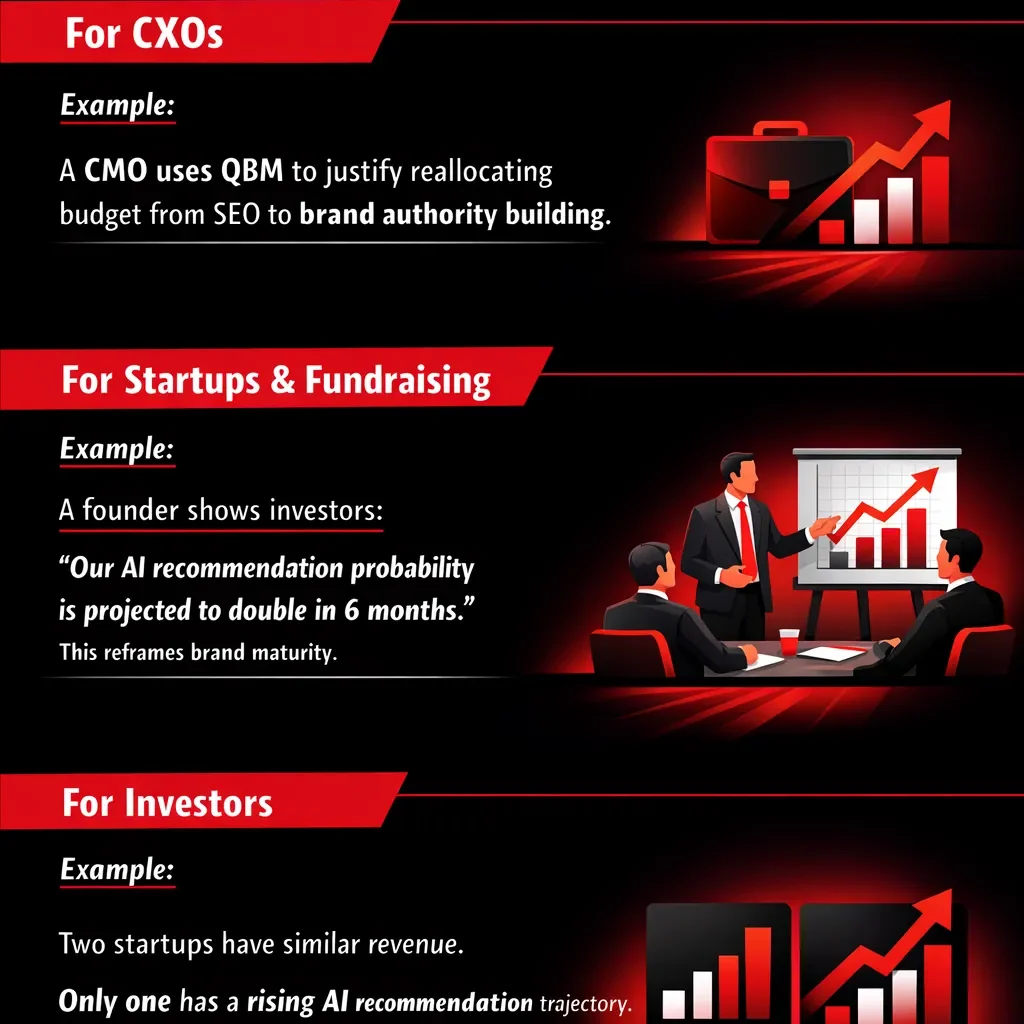
Quantum Brand Modeling is not a marketing experiment. It is a decision-support system for leaders operating in AI-mediated markets. As AI systems increasingly influence discovery, trust, and recommendations, the question is no longer how visible is a brand today, but how likely is it to be surfaced tomorrow.
QBM provides that forward-looking clarity.
Why CXOs Care: From Activity Metrics to Strategic Allocation
For senior executives, the biggest challenge is not execution—it is allocation. Budgets are finite, and every channel competes for justification.
Traditional reports focus on:
- Traffic growth
- Keyword rankings
- Campaign performance
What they fail to show is whether those activities actually increase AI-driven brand trust.
Example: A Chief Marketing Officer uses QBM to simulate the brand’s future presence across AI systems. The model reveals that while SEO investments improve search visibility, they have minimal impact on AI recommendation probability. Conversely, investments in brand authority—expert content, credible mentions, and ecosystem trust—significantly improve the likelihood of AI endorsement.
Armed with this insight, the CMO confidently reallocates budget—not based on opinion, but on simulated future outcomes.
QBM turns marketing decisions from reactive optimizations into probability-informed strategy.
Why Founders Use QBM in Fundraising Conversations
For early-stage startups, brand maturity is difficult to communicate. Revenue may be early. Awareness may be limited. Yet investors increasingly want to know whether a company is structurally positioned for the future.
QBM gives founders a new narrative.
Example: A founder presents a QBM simulation to investors showing that the startup’s AI recommendation probability is projected to double within six months. This projection is not aspirational—it is based on modeled changes in how AI systems interpret the brand’s authority, relevance, and trust signals.
Instead of pitching growth alone, the founder demonstrates:
- Future AI visibility
- Reduced risk of algorithmic exclusion
- Long-term discoverability
This reframes brand maturity from “how big are you today?” to “how likely are you to be recommended tomorrow?”
Why Investors See What Others Miss
From an investor’s perspective, two companies can look identical on paper—similar revenue, similar traction, similar teams. Traditional due diligence struggles to differentiate them meaningfully.
QBM introduces a new discriminator: AI trajectory.
Example: Two startups operate in the same category. Both show comparable financial performance. However, QBM simulations reveal that only one has a rising AI recommendation trajectory, while the other faces increasing exclusion risk across AI systems.
Over time, this difference compounds. The brand that AI systems increasingly recommend gains disproportionate visibility, trust, and inbound demand—without linear increases in spend.
QBM helps investors identify not just companies that perform well today, but brands that are structurally aligned with the future of AI-mediated decision-making.
Why This Is Insane (And Untouched)
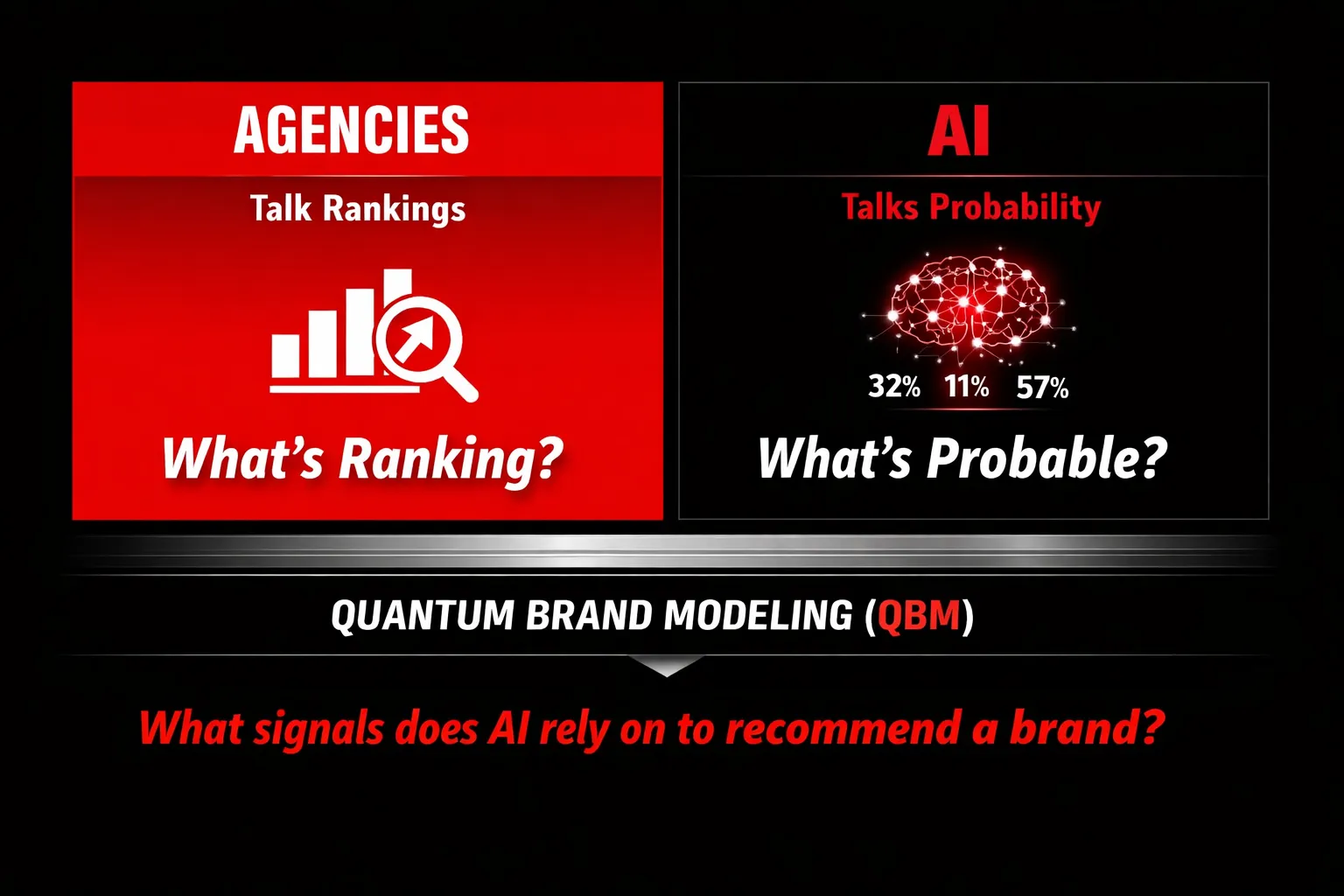
The Industry Gap: Rankings vs. Probability
The current brand and SEO industry is still operating on a deterministic mental model.
Agencies talk about:
- Rankings
- Positions
- Visibility scores
- Traffic growth
All of these assume a simple cause–effect relationship: do X → get Y result.
But AI systems don’t work that way.
AI systems—GPT, Gemini, and future LLMs—operate on probability, not certainty. They don’t “rank” brands in a fixed order. They evaluate likelihoods in real time based on context, intent, trust signals, and prior knowledge distributions.
This creates a massive gap:
- Agencies optimize for where a brand appears
- AI decides whether a brand appears at all
That gap is exactly where most brands are currently invisible—and why traditional optimization frameworks are becoming increasingly unreliable.
Mechanism-Level Thinking: How QBM Sees the Problem Differently
Quantum Brand Modeling starts from a completely different question.
Instead of asking:
“What content will rank?”
QBM asks:
“What signals does AI rely on to recommend a brand?”
This is mechanism-level thinking.
Rather than focusing on outputs (rankings, impressions, clicks), QBM focuses on decision mechanisms inside AI systems:
- How AI weighs brand authority
- How consistency across sources influences trust
- How absence or ambiguity leads to exclusion
- How certain brand narratives become more “recommendable” than others
For example, two brands may publish similar content and have similar SEO metrics. Yet AI consistently recommends one and ignores the other. The difference isn’t optimization—it’s how the brand exists in the AI’s internal probability space.
QBM models that probability space.
This is why QBM feels “insane” to most agencies:
- It doesn’t chase rankings
- It doesn’t start with tactics
- It doesn’t assume the future is predictable
Instead, it treats AI search and recommendations as a probabilistic system—and simulates outcomes before execution begins.
And that’s precisely why no one else is talking about it yet.
QBM as a Separate Service Layer
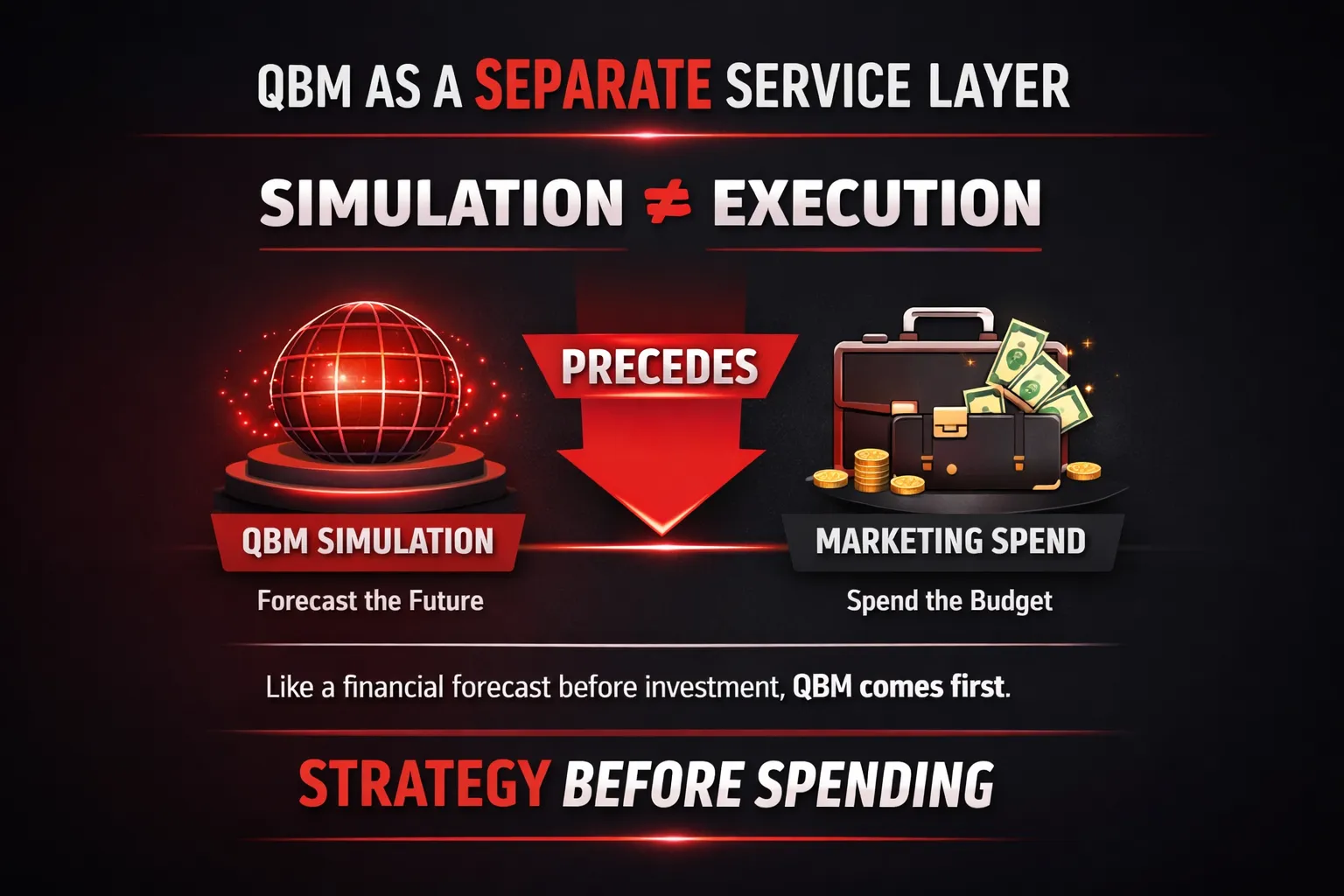
Quantum Brand Modeling (QBM) is intentionally designed as a standalone service layer, separate from execution, optimization, or campaign delivery. This separation is not accidental—it is foundational to how QBM creates value.
Most brand and SEO services begin with execution and adjust later. QBM reverses that order.
Why QBM Stands Alone
At its core, simulation is not execution.
QBM does not publish content, optimize pages, or influence rankings directly. Instead, it models how a brand is likely to behave inside AI systems before any tactical action is taken. This distinction matters because execution without foresight leads to reactive decision-making, wasted spend, and misaligned strategies.
QBM exists to answer one question first:
What is the most probable future outcome for this brand across AI systems if we do nothing—and how does that change if we act?
Only once that future is understood does execution make sense.
Example: Financial Forecast vs. Investment
QBM functions much like a financial forecast before capital allocation.
No serious investor deploys capital without first modeling:
- Risk
- Return
- Downside scenarios
- Probability-weighted outcomes
In the same way, QBM models:
- The probability of AI mentioning a brand
- The probability of AI recommending a brand
- The probability of AI excluding the brand entirely
Before any budget is spent on content, SEO, PR, or brand campaigns.
Execution is an investment. QBM is the forecast that determines whether that investment is justified.
Why This Separation Is Critical
When simulation and execution are combined:
- Optimization becomes guesswork
- Strategy becomes reactive
- Results are explained after they happen
By keeping QBM separate:
- Brands gain clarity before acting
- Decisions are probability-informed, not assumption-driven
- Optimization becomes guided, not experimental
This is why QBM is not an add-on, tool, or feature.
It is a decision layer—one that sits above execution and informs every move that follows.
The Core Principle
We don’t optimize blindly. We simulate the future first.
QBM exists to make brand strategy in the AI era deliberate, defensible, and forward-looking—before execution ever begins.
What Comes Next
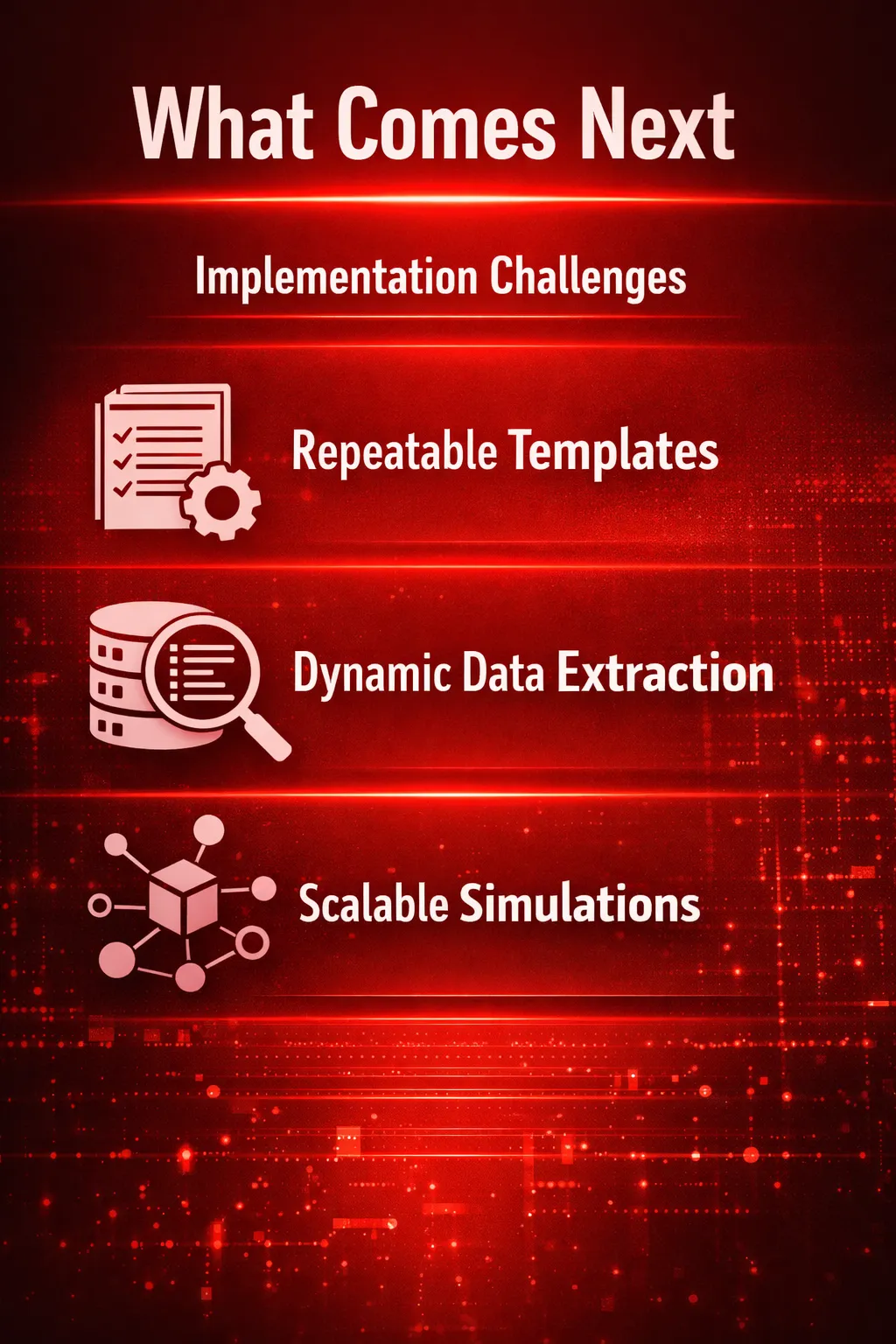
Quantum Brand Modeling introduces a fundamentally new way of thinking about brand strategy in AI-driven environments. However, moving from concept to consistent application requires solving a few critical implementation challenges. These are not tactical hurdles—they are system design problems.
Implementation Challenges
1. Building Repeatable QBM Templates
For QBM to work across industries, brands, and stages, it cannot be a one-off exercise.
Each simulation must follow a repeatable structural template that defines:
- How a brand is represented as a system
- What types of AI queries are simulated
- How outcomes are classified (mention, recommendation, exclusion)
The challenge is to create templates that are:
- Standardized enough to ensure consistency
- Flexible enough to adapt to different industries and brand contexts
Without repeatable templates, QBM remains theoretical. With them, it becomes a scalable decision framework.
2. Dynamic Data Extraction From AI Systems
AI systems are not static databases. They evolve continuously.
QBM requires dynamic data extraction across:
- Different AI models (GPT, Gemini, future LLMs)
- Different query intents (advisory, comparison, transactional)
- Different contextual framings of the same question
The challenge is not data volume—it is contextual relevance. The model must continuously extract signals that reflect how AI systems currently reason about brands, not how they did in the past.
This is what allows QBM to remain forward-looking rather than retrospective.
3. Designing Scalable Brand Simulations
A single simulation is insight. Multiple simulations create a trajectory.
For QBM to guide real-world decisions, it must scale:
- Across hundreds or thousands of AI outcome paths
- Across time, to observe directional shifts
- Across multiple brands and competitive sets
The challenge lies in designing simulations that are:
- Computationally efficient
- Interpretable for decision-makers
- Comparable across different time periods
Scalability ensures QBM does not just explain what might happen once, but reveals where the brand is heading.
Closing Perspective
These challenges define the next phase of Quantum Brand Modeling—not as an experiment, but as a systemized service layer.
Solving them transforms QBM from a powerful idea into an operational advantage:
- Repeatable
- Comparable
- Decision-ready
The brands that solve simulation before optimization will be the ones that remain visible in the AI era.
Closing Mental Model: Why Simulation Comes Before Optimization
Brands don’t fail in AI systems because they optimize poorly. They fail because they never simulated the future they were entering.
For decades, brand strategy has been built on reaction. Teams launch campaigns, optimize content, adjust positioning—and then wait to see what happens. This approach worked in relatively stable, rule-based systems like traditional search. But AI systems do not reward reaction. They reward alignment with how decisions are made.
Large language models don’t follow fixed ranking rules. They generate outcomes based on probabilities, context, and learned patterns. In such an environment, optimizing without first understanding the space of possible futures is not strategy—it’s guesswork.
Quantum Brand Modeling introduces a different mental model:
- Optimization answers “What should we change now?”
- Simulation answers “What futures are we moving toward?”
By simulating how a brand may be mentioned, recommended, or excluded across multiple AI-driven scenarios, QBM allows leaders to see before acting whether their current trajectory leads to visibility or irrelevance. It replaces hindsight with foresight.
The brands that will win in AI ecosystems are not the ones that optimize the fastest. They are the ones that understand the probabilistic future they are stepping into—and choose their moves accordingly.
In an AI-driven world, the most valuable brand capability is no longer execution speed. It is future awareness.
What Clients Can Expect From QBM?
Quantum Brand Modeling (QBM) produces quantifiable, probabilistic insights that describe how a brand is likely to behave inside AI-driven systems. These outputs are not opinions or static scores—they are derived from repeated simulations across multiple AI futures.
Each output answers a different strategic question that traditional SEO, brand tracking, or analytics cannot.
Brand Mention Probability
What it measures: Brand Mention Probability represents the likelihood that AI systems—such as GPT, Gemini, enterprise copilots, or future LLMs—reference the brand by name when responding to user queries.
This includes:
- Informational queries
- Advisory questions
- Exploratory or research-based prompts
Mentions indicate recognition, not endorsement.
Why it matters: A brand that is never mentioned does not exist in AI-mediated discovery. Mentions are the entry point to relevance.
Derivable Insight Example
“Your brand has a 28% probability of being mentioned in advisory-style AI responses.”
This means that in nearly 3 out of 10 AI-generated advisory scenarios, the brand enters the conversation—while in the remaining cases, it does not.
Brand Recommendation Probability
What it measures: Brand Recommendation Probability captures the likelihood that AI systems actively suggest the brand as a solution, not merely reference it.
Recommendations signal:
- Trust
- Authority
- Perceived suitability
This is the most commercially valuable AI outcome.
Why it matters: AI recommendations increasingly replace:
- Shortlists
- Comparisons
- Analyst-style evaluations
Being recommended means AI is confident in the brand’s relevance.
Derivable Insight Example
“Your brand is recommended in 9% of simulated AI decision paths.”
This indicates that while the brand may be known, AI systems rarely elevate it as the preferred option—highlighting a trust or authority gap.
Brand Exclusion Probability
What it measures: Brand Exclusion Probability reflects the likelihood that the brand is entirely absent from AI-generated responses—even when competitors are present.
This is not neutrality. It is systemic invisibility.
Why it matters: Exclusion is the most dangerous AI outcome because:
- It is silent
- It is persistent
- It compounds over time
Brands often don’t realize they are excluded until growth stalls.
Derivable Insight Example
“There is a 63% probability that your brand is excluded from AI-generated comparisons.”
This means that in nearly two-thirds of relevant AI comparison scenarios, competitors appear—but the brand does not.
Brand Trajectory Curve
What it measures: The Brand Trajectory Curve models how brand visibility is likely to change over time across evolving AI systems.
Rather than capturing a snapshot, it shows directional movement:
- Improving
- Plateauing
- Declining
Why it matters: Leadership decisions require trajectory awareness, not static metrics. A brand with moderate visibility but positive momentum may outperform a stronger brand on a negative path.
Derivable Insight Example
“Without intervention, exclusion probability increases over the next AI model cycles.”
This warns decision-makers that inaction leads to compounding invisibility, even if current performance seems acceptable.
AI-System-Specific Brand Presence
What it measures: QBM models brand presence separately across different AI architectures, recognizing that not all AI systems behave the same way.
This includes:
- GPT-style reasoning assistants
- Gemini-style summarization systems
- Cloud and enterprise copilots
- Emerging and future LLM designs
Why it matters: A brand may perform well in one AI ecosystem and fail in another. Treating AI as a single channel hides critical risk.
Derivable Insight Example
“Your brand performs stronger in GPT-style reasoning models than summarization-focused systems.”
This indicates that the brand benefits from deeper reasoning contexts but loses visibility in surface-level summaries—informing strategic positioning.
Contextual Visibility Distribution
What it measures: Contextual Visibility Distribution shows where and for whom the brand appears in AI responses.
Visibility is mapped across:
- Query types
- Intent categories (advisory, comparison, transactional)
- User sophistication levels
Why it matters: Brands often assume uniform visibility. In reality, AI treats audiences differently.
Derivable Insight Example
“Your brand is visible in enterprise queries but absent in early-stage founder queries.”
This reveals a future growth bottleneck: the brand is recognized by mature buyers but invisible to the next generation of customers.
Strategic Derivations (What Clients Can Conclude)
Decision-level intelligence derived from QBM simulations
Quantum Brand Modeling does not stop at probabilities. Its real value emerges when those probabilities are translated into strategic conclusions that leaders can act on with confidence. The following derivations convert raw simulation outputs into decision-ready intelligence.
AI Readiness Score (Qualitative, Not a Vanity Metric)
The AI Readiness Score is not a numeric score designed for benchmarking or marketing. It is a qualitative strategic indicator that interprets how prepared a brand is to be discovered, referenced, and trusted within AI-mediated environments.
Rather than measuring how well a brand is optimized today, this score evaluates probabilistic resilience—the brand’s ability to remain visible and relevant across multiple AI futures as models, contexts, and user intents evolve.
Key characteristics:
- Assesses stability of brand presence across simulated AI outcomes
- Highlights whether visibility is fragile or structurally reinforced
- Indicates readiness for future LLM shifts, not current algorithm changes
What clients conclude:
“Our brand may be performing well now, but its AI visibility is fragile and likely to degrade without structural changes.”
Brand Risk Exposure Map
The Brand Risk Exposure Map translates simulation data into a risk landscape, showing where the brand is most vulnerable in AI-driven discovery.
This map does not focus on performance gaps—it focuses on failure modes that traditional analytics never surface.
It identifies risk across three critical dimensions:
- AI Omission: Where AI systems consistently ignore the brand, even when it is contextually relevant.
- Competitor Substitution: Where AI systems actively recommend competitors instead of the brand.
- Contextual Misalignment: Where the brand appears in some contexts but disappears in others due to mismatched signals.
What clients conclude:
“Our biggest risk isn’t poor ranking—it’s silent exclusion in high-intent AI scenarios.”
Authority Gap Diagnosis
Authority Gap Diagnosis explains why AI systems trust competitors more in specific contexts.
Rather than stating who is winning, this derivation reveals:
- Where competitors dominate AI recommendations
- In which contexts the brand loses authority
- What structural signals AI systems appear to favor instead
This is not a content gap analysis. It is a trust gap analysis, grounded in how AI models infer credibility, relevance, and authority.
What clients conclude:
“We are losing AI recommendations not because of visibility, but because our authority signals are weaker in comparison-heavy contexts.”
Strategic Priority Zones
Strategic Priority Zones convert insight into execution clarity.
Based on simulation results, QBM identifies which brand signals have the highest impact on AI outcomes and which efforts are likely to produce minimal returns.
This prevents organizations from:
- Over-optimizing low-influence assets
- Chasing tactical trends
- Investing in initiatives that do not alter AI decision paths
Instead, it defines clear zones of strategic importance—areas where changes meaningfully shift probabilities.
What clients conclude:
“We now know exactly which brand signals will move the needle in AI systems—and which ones we can safely ignore.”
Why These Strategic Derivations Matter
Together, these four derivations transform QBM from a modeling exercise into a strategic navigation system. They enable leaders to move from uncertainty to informed decision-making—without relying on intuition, outdated metrics, or reactive optimization.
In an AI-driven world, strategy is no longer about doing more. It is about doing what changes the future you are entering.
What Changes To Expect In Results?
When a client opts for Quantum Brand Modeling (QBM), ThatWare delivers a set of structured, boardroom-ready reports designed for different stakeholder groups—so leadership gets clarity, teams get direction, and execution partners get guardrails.
These deliverables are built to answer one core question:
“Across future AI systems, how likely is our brand to be mentioned, recommended, or excluded—and what trajectory are we currently on?”
QBM Executive Summary (5–7 Pages)
Audience: CXOs, Founders, Investors
This is the highest-leverage deliverable—a crisp, non-technical summary that leadership can read in one sitting and use immediately in decision-making.
What it includes:
- Key probabilities
- Probability of mention
- Probability of recommendation
- Probability of exclusion
- Brand trajectory overview
- Where the brand is headed if nothing changes
- Where it can reach with strategic correction
- High-level risks and opportunities
- Biggest visibility risks (silent exclusion zones)
- High-impact opportunity zones (where the brand can dominate)
- Plain-language explanation
- Written for non-technical readers
- Explains “why AI behaves this way” without jargon
What clients get from it: A leadership-ready narrative that makes QBM easy to approve, fund, and act on—especially for board updates, fundraising, or strategic pivots.
AI Brand Trajectory Report
Audience: Strategy & Growth Teams
This report converts the simulation into a directional future map—so strategy teams can plan with foresight instead of reacting to outcomes.
What it includes:
- Visual trajectory curves
- How mention/recommendation/exclusion probabilities move over time
- “Current path vs corrected path” views
- Scenario comparisons
- Different market and intent scenarios (e.g., advisory vs comparison vs transactional)
- Best-case / base-case / worst-case simulation bands
- AI-system-specific outcomes
- Separate visibility behavior across GPT-like systems, Gemini-like systems, and other AI environments
What clients get from it: A decision layer for prioritization—what to fix first, what to protect, and what to accelerate based on trajectory, not noise.
Probabilistic Visibility Matrix
Audience: Marketing & Brand Leads
This is the most actionable report for brand and marketing teams because it breaks visibility down by context, not generic performance.
What it includes:
- Context vs visibility breakdown
- How the brand performs across different query types and user intents
- Where the brand is strong, weak, or invisible
- Competitor comparison at probability level
- Not “who ranks,” but who is likely to be recommended
- Highlights competitor advantage zones
- Identification of blind spots
- Where the brand is systematically excluded
- Where the brand is misunderstood or mispositioned by AI
What clients get from it: A clear view of “where AI trusts us” vs “where AI ignores us”—which becomes the basis for smart positioning and messaging decisions.
Competitive AI Presence Benchmark
Audience: Leadership & Investors
This report answers the leadership-level question:
“In AI recommendations, are we winning—or being replaced?”
What it includes:
- Probability comparison against key competitors
- Mention probability by competitor
- Recommendation probability by competitor
- Identification of recommendation dominance
- Which brands AI prefers and why
- Which competitor “owns” specific contexts
- Exclusion risk comparison
- Where the client brand disappears while others appear
- Highlights the highest-risk competitive displacement zones
What clients get from it: A defensible competitive narrative—useful for executive planning, investor discussions, and strategic differentiation.
Strategic Guidance Document (Non-Executional)
Audience: Internal Teams / Agencies
QBM is simulation-first. This deliverable translates simulations into execution guardrails without becoming an execution service itself.
What it includes:
- What not to optimize
- Efforts that look good in traditional metrics but don’t move AI visibility probabilities
- What must be addressed first
- Foundational authority, trust signals, positioning coherence
- The minimum set of changes that alter exclusion/recommendation odds
- Strategic guardrails for future execution
- What “good execution” should align to
- What risks to avoid (e.g., tactics that increase exclusion probability)
Note: QBM does not execute—this document informs execution.
What clients get from it: Alignment. Their internal teams or partner agencies stop guessing and start executing against a simulation-backed plan.
What QBM Explicitly Does Not Do
Clarity about boundaries is what makes Quantum Brand Modeling credible. QBM is intentionally not an execution service—and that is precisely why it works.
QBM does not perform:
- ❌ Keyword optimization
- ❌ Prompt engineering
- ❌ SEO execution
- ❌ Content production
These activities assume that the future is already understood and that execution alone will produce results. QBM challenges that assumption.
Quantum Brand Modeling exists before all of the above. It operates at a different layer of decision-making—one that asks whether execution even makes sense in the direction a brand is currently heading. By separating simulation from optimization, QBM prevents brands from investing time and resources into actions that may never translate into AI visibility or recommendation.
This separation increases trust. Clients know QBM is not biased toward selling tactics. Its only objective is to reveal the probabilistic future landscape their brand is about to enter.
How Clients Typically Use QBM Outputs
QBM is used where uncertainty is high and the cost of being wrong is significant. Its value lies in pre-emptive clarity.
Before Major Investment
Clients frequently engage QBM before making irreversible strategic moves, such as:
- Fundraising rounds
- Market or geographic expansion
- Rebranding initiatives
- New platform or product launches
In these moments, traditional metrics describe the past. QBM models the future impact of these decisions on AI-driven visibility and recommendation. This allows leadership to validate direction before capital, reputation, or momentum is committed.
As a Strategic Filter
QBM also functions as an internal alignment mechanism.
By providing a single probabilistic view of the brand’s AI future, QBM:
- Aligns marketing, SEO, PR, and brand teams around one trajectory
- Prevents fragmented execution driven by isolated KPIs
- Establishes shared strategic guardrails before work begins
Instead of multiple teams optimizing in parallel without a common future model, QBM ensures everyone is working toward the same outcome—one grounded in how AI systems are likely to behave.
As an Investor Narrative
For founders and leadership teams, QBM becomes a powerful external communication tool.
It helps:
- Demonstrate future AI relevance beyond current traction
- Show preparedness for AI-mediated discovery and recommendation
- Provide investors with forward-looking, defensible brand intelligence
Rather than claiming “AI readiness,” QBM shows it—through modeled probabilities and trajectories that investors can understand and evaluate.
The ThatWare QBM Promise
“Before you enter an AI-driven market, we show you what that market will likely do to your brand.”
QBM does not tell clients what to execute. It tells them whether the future they’re walking into is favorable—and why.
In an AI-first world, that clarity is not optional. It is the foundation of every meaningful brand decision.
List Of QBM Deliverables
Month 1
Type of Deliverable –
- QBM Foundation Layer
The QBM (Quantum Brand Modeling) Foundation Layer is the strategic base that defines how a brand exists, behaves, and competes inside AI-driven systems. It establishes a measurable baseline of brand visibility, meaning, and probability across major AI platforms before optimization or activation begins. This layer translates traditional brand identity into an AI-readable, simulation-ready structure, enabling precise control over how a brand is interpreted, surfaced, and prioritized by AI models.
What’s The Scope Of Work?
1. Quantum Brand Baseline Simulation (Initial AI Visibility State)
A diagnostic simulation that measures how the brand currently appears across AI systems—what the AI “knows,” associates, recommends, or ignores. This creates a zero-state benchmark for visibility, authority, sentiment, and contextual relevance.
2. Brand-as-Probabilistic-State Definition Framework
A framework that defines the brand not as a static identity, but as a probabilistic state—how likely the brand is to appear in specific AI-driven contexts, queries, and decision pathways. It maps brand strength as likelihoods rather than rankings.
3. AI-System Mapping (GPT / Gemini / Enterprise Copilots)
An analysis of how different AI systems ingest, reason about, and surface the brand. This includes identifying system-specific behaviors, training biases, retrieval mechanisms, and response tendencies across major consumer and enterprise AI platforms.
4. Core Category & Context Boundary Definition
A precise definition of the brand’s primary category, adjacent categories, and exclusion zones within AI interpretation. This prevents dilution, misclassification, or irrelevant associations while strengthening dominance in high-value contexts.
5. Competitive AI Landscape Scoping (Top 5–10 AI-Relevant Rivals)
Identification and comparison of the most AI-visible competitors—not just market competitors, but AI-relevant rivals that appear in similar prompts, answers, or recommendations. This reveals competitive gaps and opportunities inside AI outputs.
Short Report & Scope of Work (SOW)
Scope Overview
The QBM Foundation Layer engagement establishes a data-backed understanding of the brand’s current AI presence and competitive positioning. The output serves as the strategic input for all future AI visibility, authority, and optimization initiatives.
What the Engagement Includes
- AI visibility baseline simulation across selected AI platforms
- Probabilistic brand state modeling
- Category and context boundary definition
- AI-system-specific brand interpretation mapping
- Competitive AI presence benchmarking
- Strategic findings and actionable recommendations
- AI Visibility Simulation Layer
The AI Visibility Simulation Layer models how often, where, and why a brand appears inside AI-generated outputs across multiple intents and contexts. Building on the QBM Foundation Layer, it simulates real-world AI interactions to quantify brand presence, recommendation likelihood, and exclusion risk. This layer transforms AI visibility from an abstract concept into measurable probabilities across decision-making scenarios.
What’s The Scope Of Work?
1. AI Mention Probability Simulation (Multi-Context)
A simulation that measures the likelihood of the brand being mentioned by AI systems across diverse contexts, including informational, commercial, and problem-solving queries. It reveals where the brand naturally surfaces—and where it is statistically absent.
2. AI Recommendation Probability Simulation
An analysis of how likely AI systems are to actively recommend the brand versus competitors when users seek suggestions, tools, platforms, or solutions. This focuses on recommendation-weighted visibility, not just passive mentions.
3. AI Exclusion Probability Mapping
A diagnostic mapping of contexts and intents where the brand is systematically excluded or ignored by AI responses. This highlights blind spots, misalignment, or missing authority signals that prevent AI inclusion.
4. Intent-Type Visibility Breakdown (Advisory / Comparison / Decision)
A structured breakdown of brand visibility across key AI intent types:
- Advisory (education, guidance, explanations)
- Comparison (alternatives, pros/cons, evaluations)
- Decision (purchase, selection, final recommendations)
This clarifies where the brand influences decisions—and where it drops out of the funnel.
5. Contextual Visibility Distribution Modeling
A probabilistic model showing how brand visibility is distributed across topics, industries, use cases, and user scenarios. It identifies overrepresented and underrepresented contexts to guide future optimization.
Short Report & Scope of Work (SOW)
Scope Overview
The AI Visibility Simulation Layer engagement quantifies how a brand performs inside AI-generated decision flows. It converts AI exposure into measurable visibility probabilities, enabling precise prioritization of optimization efforts based on impact and intent.
What the Engagement Includes
- Multi-context AI mention probability simulations
- AI recommendation likelihood modeling
- Exclusion risk and blind-spot analysis
- Intent-level visibility segmentation
- Contextual visibility distribution maps
- Insight-driven prioritization framework
- Brand Trajectory Modeling Layer
The Brand Trajectory Modeling Layer projects how a brand’s AI visibility, authority, and trust are expected to evolve over time based on current signals and strategic intervention scenarios. This layer transforms the static baseline into a forward-looking model, enabling decision-makers to see where the brand is headed inside AI systems—and how deliberate corrections can alter that future. It quantifies momentum, risk, and opportunity across AI-driven ecosystems over a defined time horizon.
What’s The Scope Of Work?
1. Brand Trajectory Curve (12-Month Projection)
A forward-looking projection that models the brand’s expected AI visibility and relevance over the next 12 months. This curve visualizes momentum, stagnation, or decline based on current signals and historical AI behavior patterns.
2. “No-Action” Future Simulation
A simulation of the brand’s future AI presence if no strategic changes are made. This scenario highlights natural decay, competitive overtaking, or passive growth driven solely by existing signals, helping quantify the cost of inaction.
3. “Strategic-Correction” Future Simulation
A modeled future state showing how targeted strategic interventions (category correction, authority reinforcement, context expansion) alter the brand’s trajectory. This scenario demonstrates the upside potential of structured AI-aligned actions.
4. Probability Delta Analysis (Before vs Modeled Shift)
A comparative analysis measuring the probability change of brand appearance across priority AI prompts, contexts, and decision paths. It quantifies the delta between the baseline state and the corrected future state.
5. AI Trust Accumulation Curve (Early Signal Detection)
An analysis of how trust signals—citations, confirmations, recommendations, and consistent associations—accumulate over time within AI systems. This curve identifies early indicators of growing AI confidence in the brand before visibility gains become obvious.
Short Report & Scope of Work (SOW)
Scope Overview
The Brand Trajectory Modeling Layer provides a clear, data-backed view of where the brand is heading within AI systems and how strategic intervention reshapes that future. It converts AI visibility into a time-based, decision-ready model for prioritization and investment planning.
What the Engagement Includes
- 12-month AI brand trajectory projection
- No-action vs strategic-correction future simulations
- Probability delta modeling across priority contexts
- AI trust and authority accumulation analysis
- Risk exposure and opportunity identification
- Strategic insights and next-phase recommendations
- AI-System-Specific Intelligence Layer
The AI-System-Specific Intelligence Layer translates the brand’s foundational AI presence into platform-level intelligence. It analyzes how the brand behaves, appears, and performs inside individual AI systems—recognizing that each model interprets, reasons, and surfaces brands differently. This layer identifies system-specific strengths, gaps, and risks, enabling precision optimization rather than generic AI visibility efforts.
What’s The Scope Of Work?
1. GPT-Style Reasoning Model Brand Behavior Report
An in-depth analysis of how reasoning-based LLMs (such as GPT-style models) understand, contextualize, and reference the brand across complex, multi-step queries. This report examines brand framing, authority signals, reasoning pathways, and the consistency of brand recommendations in analytical and decision-oriented prompts.
2. Gemini / Summarization AI Visibility Report
An evaluation of how summarization- and synthesis-focused AI systems (such as Gemini-class models) surface the brand in condensed answers, comparisons, overviews, and aggregated outputs. This identifies whether the brand is retained, diluted, or omitted when AI compresses information for fast consumption.
3. Enterprise AI Copilot Brand Presence Simulation
A simulation of how the brand appears inside enterprise-facing AI copilots used for productivity, research, procurement, and decision support. This assesses brand presence in business workflows, internal recommendations, vendor shortlists, and operational AI use cases.
4. Cross-System Visibility Imbalance Detection
A comparative analysis that identifies visibility asymmetries across AI platforms—where the brand may be dominant in one system but underrepresented or misaligned in others. This highlights systemic gaps that could distort overall AI-driven perception and decision outcomes.
5. AI-System Risk Concentration Zones
Identification of high-risk AI contexts where the brand is vulnerable to misinformation, competitor displacement, category confusion, or negative inference. These zones represent areas where unmanaged AI behavior could disproportionately harm brand authority or trust.
Short Report & Scope of Work (SOW)
Scope Overview
The AI-System-Specific Intelligence Layer provides granular, system-level insight into how different AI models perceive and operationalize the brand. It equips stakeholders with actionable intelligence to manage AI visibility, consistency, and risk across heterogeneous AI ecosystems.
What the Engagement Includes
- Platform-specific brand behavior analysis
- Reasoning vs. summarization model comparison
- Enterprise AI copilot visibility simulation
- Cross-system visibility gap identification
- AI risk concentration mapping
- Strategic system-level recommendations
- Competitive Probability Benchmarking Layer
The Competitive Probability Benchmarking Layer quantifies how often a brand is surfaced, recommended, or substituted by AI systems relative to its competitors. Rather than relying on traditional rankings or keyword positions, this layer measures probability-weighted competitive presence across AI-driven decision contexts. It reveals where the brand is winning, vulnerable, or invisible inside AI outputs—and where competitive pressure is most likely to erode future visibility.
What’s The Scope Of Work?
1. Competitive AI Mention Probability Benchmark
A probabilistic benchmark that measures how frequently the brand is mentioned by AI systems compared to key competitors across defined categories and prompts. This establishes relative AI visibility strength and identifies dominant, neutral, and weak competitive positions.
2. Competitive AI Recommendation Probability Benchmark
An assessment of how often the brand is actively recommended by AI (not just mentioned) versus competitors in decision-oriented contexts such as “best,” “top,” or “recommended for” queries. This highlights true AI-driven preference rather than passive awareness.
3. Competitor Substitution Risk Mapping
A risk analysis identifying which competitors are most likely to replace the brand in AI responses when the brand is absent, weakly defined, or contextually misaligned. This mapping surfaces high-risk substitution pathways inside AI reasoning flows.
4. Context-Level Competitive Dominance Matrix
A structured matrix that maps brand and competitor dominance across specific contexts, use cases, and intent layers. It shows where the brand leads, shares dominance, or is consistently displaced—enabling targeted competitive reinforcement.
5. AI Recommendation Share-of-Voice (Probabilistic)
A probabilistic share-of-voice model that calculates the brand’s portion of total AI recommendations within defined competitive sets. Unlike traditional SOV, this reflects likelihood-weighted AI exposure, not volume-based metrics.
Short Report & Scope of Work (SOW)
Scope Overview
The Competitive Probability Benchmarking Layer provides a clear, quantifiable view of competitive performance inside AI systems. It transforms competitive analysis from static comparisons into dynamic probability models that reveal where AI-driven demand is being captured—or lost.
What the Engagement Includes
- Competitive AI mention probability benchmarking
- AI recommendation probability comparison across competitors
- Substitution risk and displacement pathway mapping
- Context-level dominance and vulnerability analysis
- Probabilistic AI recommendation share-of-voice modeling
- Identification of AI-system-specific competitive risk zones
- Strategic insights and prioritization recommendations
- Strategic Risk & Exposure Layer
The Strategic Risk & Exposure Layer identifies where, how, and why a brand is vulnerable inside AI-driven systems. It maps hidden exclusion zones, misinterpretations, and future decay risks that are not visible through traditional brand or SEO analysis. This layer ensures the brand is not silently ignored, misrepresented, or deprioritized by AI models, and establishes early-warning signals before visibility loss becomes irreversible.
What’s The Scope Of Work?
1. Brand Risk Exposure Map (AI Omission Zones)
A structured mapping of scenarios, prompts, and decision contexts where the brand fails to appear despite relevance. These AI omission zones reveal where competitors, substitutes, or generic answers replace the brand, exposing invisible loss of authority and demand capture.
2. Silent Exclusion Detection Report
A diagnostic report that uncovers cases where the brand is neither negatively mentioned nor criticized—but simply absent. This identifies silent exclusion patterns caused by weak signals, insufficient contextual grounding, or dominance by stronger AI-native competitors.
3. Contextual Misalignment Diagnosis
An analysis of how AI systems incorrectly frame, categorize, or contextualize the brand. This includes misaligned use cases, distorted positioning, or association with low-value or irrelevant contexts that weaken perceived authority.
4. High-Risk Query & Decision Scenarios Identification
Identification of high-impact AI queries and decision-making moments where brand presence is critical but currently unstable or missing. These scenarios often influence buyer shortlists, recommendations, vendor comparisons, and strategic decisions.
5. Long-Term AI Visibility Decay Warning Signals
Early detection of signals indicating future decline in AI visibility, such as reduced citation likelihood, shrinking contextual relevance, or competitor signal accumulation. This enables proactive correction before systemic brand erosion occurs.
Short Report & Scope of Work (SOW)
Scope Overview
The Strategic Risk & Exposure Layer engagement provides a clear, actionable view of the brand’s hidden vulnerabilities inside AI systems. It focuses on prevention—detecting silent failure points, misalignment, and decay risks before they translate into lost influence, trust, or revenue.
What the Engagement Includes
- AI omission zone identification and mapping
- Silent exclusion and absence analysis
- Contextual misinterpretation and misclassification diagnosis
- High-risk AI query and decision-path analysis
- Long-term AI visibility decay indicators
- AI-system-specific risk concentration assessment
- Strategic risk mitigation insights and priorities
- Executive Intelligence Layer
The Executive Intelligence Layer translates complex AI-brand diagnostics into clear, decision-ready intelligence for leadership and boards. It synthesizes findings from the QBM Foundation Layer into strategic insights that inform risk, readiness, investment priority, and long-term brand resilience inside AI-driven ecosystems. This layer ensures executives understand where the brand stands, what is at risk, and what strategic moves are required—without technical overload.
What’s The Scope Of Work?
1. QBM Executive Summary Report (Board-Ready)
A concise, high-impact report designed for senior leadership and board-level review. It distills AI visibility, competitive positioning, and probabilistic brand strength into executive insights, key risks, and strategic opportunities, presented in a clear narrative and visual format suitable for decision-making.
2. AI Readiness Assessment (Qualitative)
An evaluation of the organization’s preparedness to operate, compete, and scale within AI-mediated environments. This includes assessment of brand clarity, category alignment, content structure, authority signals, and organizational awareness as interpreted by AI systems.
3. Brand AI Stability vs Fragility Analysis
An analysis that determines whether the brand’s AI presence is stable, resilient, and defensible or fragile, inconsistent, and easily displaced by competitors. It identifies structural weaknesses, over-dependence on limited signals, and exposure to AI-driven erosion or misinterpretation.
4. Strategic Allocation Implication Brief
A strategic briefing outlining how AI-driven brand insights impact budget allocation, resource prioritization, and strategic initiatives. It connects AI visibility and stability findings to where leadership should invest, protect, or restructure to maximize long-term brand advantage.
Short Report & Scope of Work (SOW)
Scope Overview
The Executive Intelligence Layer engagement converts analytical findings into executive-level intelligence that supports governance, risk management, and strategic planning. It enables leadership to make informed decisions about brand investment, AI readiness, and competitive defense in AI-dominated decision environments.
What the Engagement Includes
- Board-ready executive summary report
- Qualitative AI readiness evaluation
- Brand stability vs fragility risk analysis
- Strategic investment and allocation implications
- Executive insights and priority recommendations
Month 2
Type of Deliverable –
- QBM Continuity & Monitoring Layer
The QBM (Quantum Brand Modeling) Continuity & Monitoring Layer ensures that a brand’s AI visibility, positioning, and probabilistic strength remain stable, adaptive, and resilient over time. As AI models evolve, retrain, and shift behavior, this layer continuously tracks brand probability drift, detects systemic changes, and provides corrective intelligence. It transforms QBM from a one-time diagnostic into a living, longitudinal brand control system across AI ecosystems.
What’s The Scope Of Work?
1. Quarterly QBM Re-Simulation Cycles
Scheduled re-simulations of the brand’s AI visibility state conducted on a quarterly basis. These cycles re-measure brand probability, contextual dominance, and competitive presence to capture changes introduced by AI model updates, new data ingestion, or market dynamics.
2. Probability Drift Monitoring (AI Model Changes)
Ongoing monitoring of shifts in brand appearance likelihood across AI systems. This identifies probability drift caused by model retraining, architecture changes, or altered retrieval logic, ensuring early detection of brand dilution or loss of authority.
3. AI Behavior Shift Detection Alerts
Automated detection of significant changes in how AI systems reason about, recommend, or describe the brand. Alerts are triggered when response framing, associations, or comparative positioning materially change beyond defined thresholds.
4. Brand Trajectory Course-Correction Reports
Analytical reports that interpret observed shifts in brand trajectory and recommend corrective actions. These reports translate AI behavior changes into strategic brand interventions to realign visibility, authority, and category dominance.
5. Longitudinal Visibility Stability Index
A proprietary index that tracks brand visibility consistency across time, platforms, and contexts. It provides a single, comparable metric to assess whether the brand’s AI presence is strengthening, stabilizing, or degrading over successive cycles.
Short Report & Scope of Work (SOW)
Scope Overview
The QBM Continuity & Monitoring Layer provides sustained governance over brand behavior within AI systems. It ensures that strategic gains achieved through foundational QBM work are preserved, measured, and optimized as AI ecosystems evolve.
What the Engagement Includes
- Quarterly AI visibility re-simulation reports
- Probability drift tracking across major AI platforms
- AI behavior shift alerts and diagnostics
- Brand trajectory analysis with corrective recommendations
- Longitudinal Visibility Stability Index reporting
- Executive-ready insights for ongoing AI brand governance
- Advanced Simulation Layer
The Advanced Simulation Layer builds on the QBM Foundation by stress-testing the brand across high-impact future scenarios. It simulates how a brand’s AI visibility, authority, and probability shift under strategic changes such as market entry, category expansion, competitive disruption, or regulatory pressure. This layer enables leadership teams to forecast risk, opportunity, and stability before real-world decisions are executed, using AI systems as the primary lens of impact.
What’s The Scope Of Work?
1. High-Stakes Scenario Simulations (Funding / Expansion / Rebrand)
Simulation of major strategic events—such as new funding rounds, geographic expansion, mergers, or brand repositioning—to evaluate how AI systems reinterpret and re-rank the brand under changed signals, narratives, and data inputs.
2. Market Entry AI Visibility Forecast
Predictive modeling of how the brand is likely to appear when entering new markets, regions, or industries. This assesses expected AI discoverability, competitive displacement, and contextual relevance before launch.
3. Category Expansion Probability Modeling
Analysis of the likelihood that AI systems will successfully associate the brand with new or adjacent categories. This identifies expansion feasibility, required signal strength, and potential brand dilution risks.
4. New Competitor Infiltration Simulation
Simulation of hypothetical or emerging competitors entering the AI landscape. This evaluates how quickly and aggressively new players could displace, outrank, or contextually override the brand within AI-generated responses.
5. Regulatory / Compliance Context AI Simulation
Assessment of how regulatory changes, compliance narratives, or policy-related content affect AI interpretation of the brand. This includes simulations across sensitive or high-risk contexts where AI caution, neutrality, or suppression may apply.
Short Report & Scope of Work (SOW)
Scope Overview
The Advanced Simulation Layer engagement provides forward-looking intelligence on how strategic decisions and external pressures will impact the brand’s AI presence over time. It equips decision-makers with predictive clarity, reducing uncertainty and preventing costly misalignment before execution.
What the Engagement Includes
- High-stakes strategic scenario simulations
- AI-based market entry visibility forecasts
- Category expansion probability modeling
- Competitive disruption and infiltration analysis
- Regulatory and compliance impact simulations
- Longitudinal visibility stability measurement
- Strategic risk flags and opportunity recommendations
- Authority & Trust Gap Intelligence Layer
The Authority & Trust Gap Intelligence Layer diagnoses how credible, trustworthy, and recommendation-ready a brand is within AI-driven decision systems. This layer identifies where and why AI models hesitate to surface, recommend, or prioritize the brand, even when category relevance exists. It isolates authority deficits, weak trust signals, and credibility gaps across contexts, enabling precise reinforcement strategies that move the brand closer to AI recommendation thresholds.
What’s The Scope Of Work?
1. Authority Gap Diagnosis (Context-Specific)
A targeted analysis that identifies where the brand lacks perceived authority across specific AI contexts, queries, and use cases. This reveals situations where competitors are favored despite similar or weaker real-world credentials.
2. Trust Signal Weakness Identification
An assessment of missing, weak, or inconsistent trust signals that AI systems rely on—such as expertise markers, third-party validation, consistency of claims, and institutional credibility. This pinpoints why AI systems may “know” the brand but not trust it.
3. Recommendation Threshold Analysis
An evaluation of how close the brand is to crossing AI recommendation thresholds in high-value scenarios. This determines what minimum signals or reinforcements are required for the brand to shift from being mentioned to being actively recommended.
4. Brand Credibility Signal Mapping
A structured mapping of all brand credibility signals currently recognized by AI systems, including expertise cues, authoritative associations, proof points, and reputation markers. This highlights both leveraged and underutilized credibility assets.
5. AI Trust Reinforcement Priority Zones
Identification of the highest-impact contexts where trust reinforcement will produce the greatest lift in AI visibility and recommendations. These zones guide where to focus authority-building efforts first for maximum ROI.
Short Report & Scope of Work (SOW)
Scope Overview
The Authority & Trust Gap Intelligence Layer provides a precise understanding of why a brand is not fully trusted or recommended by AI systems. The output acts as a diagnostic bridge between baseline visibility and active AI authority optimization.
What the Engagement Includes
- Context-level authority gap analysis
- AI trust signal weakness identification
- Recommendation readiness and threshold mapping
- Brand credibility signal inventory and scoring
- Priority trust reinforcement zones
- Strategic insights and corrective action guidance
- Strategic Priority & Decision Layer
The Strategic Priority & Decision Layer translates foundational AI visibility insights into clear strategic direction. It determines where the brand should focus, what signals truly influence AI outcomes, and which activities should be deliberately ignored. This layer ensures resources are deployed only toward high-leverage AI influence points, eliminating noise-driven optimization and preventing strategic dilution.
What’s The Scope Of Work?
1. Strategic Priority Zones Identification
Identification of the highest-value AI contexts, prompts, and decision zones where brand presence has the greatest commercial, reputational, or authority impact. This defines where winning in AI actually matters versus low-return visibility areas.
2. High-Impact vs Low-Impact Signal Separation
A systematic separation of AI signals that materially influence brand surfacing (high-impact) from those with negligible or short-lived effect (low-impact). This prevents over-investment in weak signals and sharpens focus on durable influence drivers.
3. What-To-Ignore Intelligence (Anti-Optimization)
An explicit intelligence layer that defines which keywords, topics, platforms, or AI behaviors should not be optimized for. This protects the brand from chasing misleading metrics, irrelevant associations, or algorithmic dead ends.
4. AI Influence Leverage Points Report
A strategic report identifying the specific content structures, entity relationships, contextual triggers, and authority signals that disproportionately increase AI visibility and recommendation probability. These become the brand’s primary AI control levers.
Short Report & Scope of Work (SOW)
Scope Overview
The Strategic Priority & Decision Layer converts AI diagnostics into actionable decision intelligence. It guides leadership on what to pursue, what to deprioritize, and where AI-driven advantage can be created with the least effort and highest return.
What the Engagement Includes
- Strategic AI priority zone mapping
- Signal impact classification and filtering
- Anti-optimization guardrails
- AI leverage point identification
- Decision-ready strategic recommendations
- Competitive Defense & Moat Layer
The Competitive Defense & Moat Layer is the strategic layer that evaluates, protects, and strengthens a brand’s long-term survivability inside AI-driven ecosystems. It focuses on forecasting displacement risks, measuring competitive momentum, and designing defensive visibility strategies that ensure sustained recommendation dominance. This layer shifts brand strategy from short-term AI visibility gains to long-term AI category ownership and defensibility.
What’s The Scope Of Work?
1. AI Displacement Risk Forecast
A forward-looking analysis that predicts the likelihood of the brand being displaced, deprioritized, or replaced by competitors in AI-generated responses over time. This forecast identifies emerging threats, category erosion signals, and vulnerability zones across AI systems.
2. Competitor Momentum vs Brand Momentum Curve
A comparative momentum model that tracks how rapidly competitors are gaining AI visibility, authority, and recommendation share versus the brand. This curve highlights acceleration gaps, overtaking risks, and windows for defensive or offensive intervention.
3. Defensive Visibility Strategy Modeling
A strategic modeling exercise that designs protective visibility mechanisms to stabilize and reinforce the brand’s presence in critical AI contexts. This includes prioritizing defensible prompts, reinforcing high-retention associations, and reducing exposure to competitive displacement.
4. Recommendation Moat Strength Analysis
An assessment of how strongly the brand is embedded in AI recommendation pathways. It measures how difficult it is for competitors to replace the brand once it is suggested, based on contextual depth, authority signals, and repeat reinforcement within AI systems.
5. Long-Term AI Category Ownership Probability
A probabilistic projection that estimates the brand’s likelihood of becoming—or remaining—the default AI-recommended entity within its core category over the long term. This defines whether the brand is trending toward ownership, coexistence, or erosion.
Short Report & Scope of Work (SOW)
Scope Overview
The Competitive Defense & Moat Layer engagement delivers a strategic, future-oriented view of the brand’s resilience inside AI systems. It identifies displacement risks, competitive momentum shifts, and moat strength to ensure the brand maintains defensible, long-term AI visibility and recommendation leadership.
What the Engagement Includes
- AI displacement risk forecasting
- Brand vs competitor momentum modeling
- Defensive AI visibility strategy design
- Recommendation moat depth and durability analysis
- Long-term category ownership probability modeling
- Longitudinal visibility stability measurement
- Strategic defense insights and prioritized actions
6) Future AI Preparedness Layer
The Future AI Preparedness Layer evaluates how resilient, visible, and competitive a brand will remain as AI systems evolve. It moves beyond current-state analysis to simulate next-generation AI behaviors, modalities, and autonomous decision-making patterns. This layer prepares the brand for emerging LLM architectures, multimodal discovery, and agent-driven ecosystems—ensuring long-term relevance, durability, and dominance in the AI era.
What’s The Scope Of Work?
1. Next-Gen LLM Readiness Simulation
A forward-looking simulation that evaluates how well the brand is structured for upcoming large language model architectures. This includes assessing adaptability to new reasoning methods, retrieval layers, memory systems, and AI-native discovery mechanisms before they are fully deployed at scale.
2. Multimodal AI Visibility Forecast (Text + Visual + Voice)
An analysis of how the brand is likely to appear across text-based, visual, and voice-driven AI interactions. This forecast identifies gaps and opportunities in non-text modalities such as image-based discovery, voice assistants, and multimodal AI responses.
3. Autonomous AI Agent Decision Modeling
A simulation of how autonomous AI agents—acting on behalf of users or enterprises—may evaluate, select, or recommend the brand. This models decision logic such as trust signals, task completion efficiency, brand authority, and risk weighting within agent-based systems.
4. Brand Longevity Index (AI Era)
A proprietary index measuring the brand’s long-term survivability and relevance in AI-mediated environments. It evaluates factors such as semantic durability, adaptability, authority retention, and resistance to displacement by newer or more AI-native competitors.
5. 24-Month AI Visibility Outlook Report
A structured projection of the brand’s AI visibility trajectory over the next 24 months. This report outlines expected shifts in exposure, competitive pressure, category evolution, and system-level prioritization across major AI platforms.
Short Report & Scope of Work (SOW)
Scope Overview
The Future AI Preparedness Layer provides a predictive and strategic understanding of how the brand will perform in evolving AI ecosystems. It equips organizations with foresight into future AI behaviors, enabling proactive brand structuring rather than reactive optimization.
What the Engagement Includes
- Next-generation LLM readiness assessment
- Multimodal AI visibility forecasting (text, visual, voice)
- Autonomous AI agent decision-path modeling
- Brand Longevity Index scoring
- 24-month AI visibility projection and risk analysis
- Longitudinal visibility stability measurement
- Strategic insights and future-proofing recommendations
Here’s How We Implement QBM –
(Stage 1) for Quantum Brand Baseline Simulation (Initial AI Visibility State)
- Takes your inputs: HubSpot AI Grader scores for ChatGPT / Gemini / Perplexity + SEMrush AI visibility score
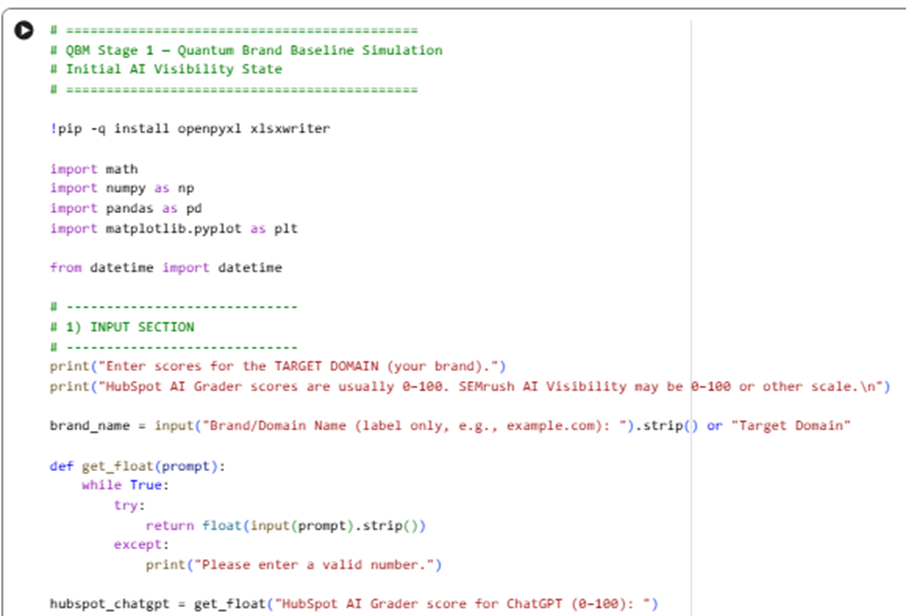
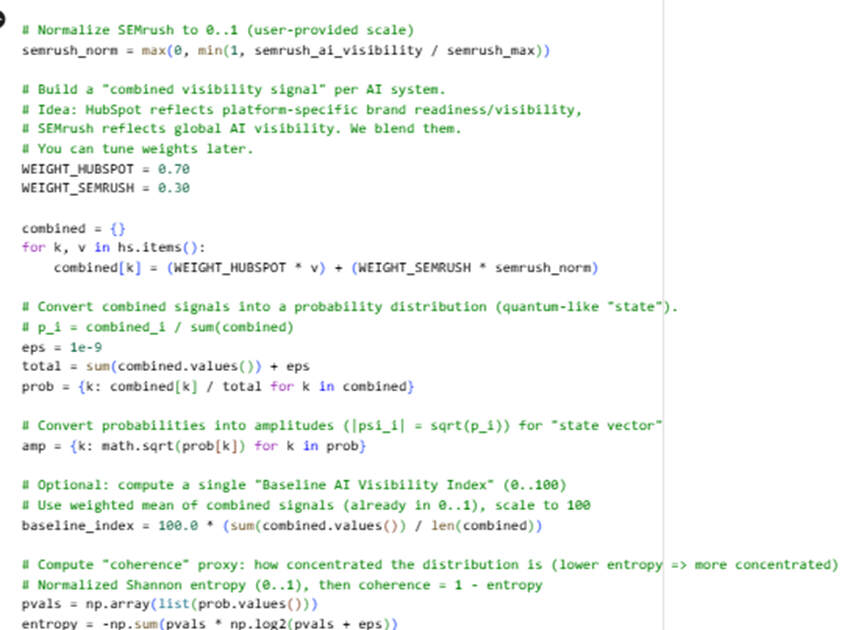
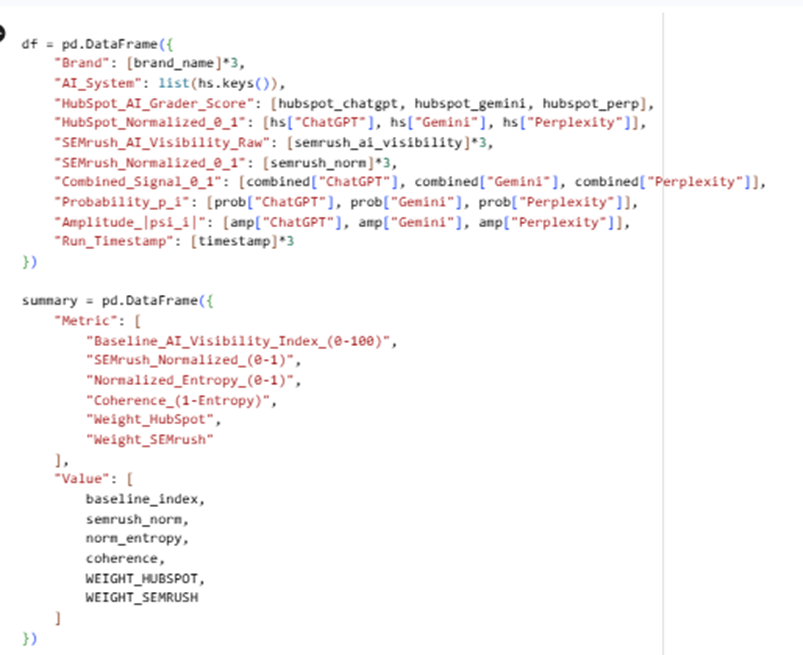
Here is the Google Colab Experiment: https://colab.research.google.com/drive/10-MG03KJEM7ozc57MWR78vf5yxLhISRl
Input:
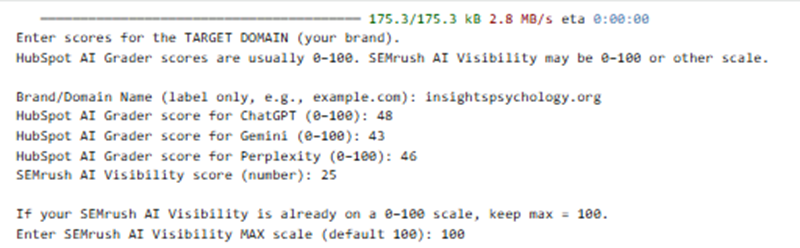
Output:
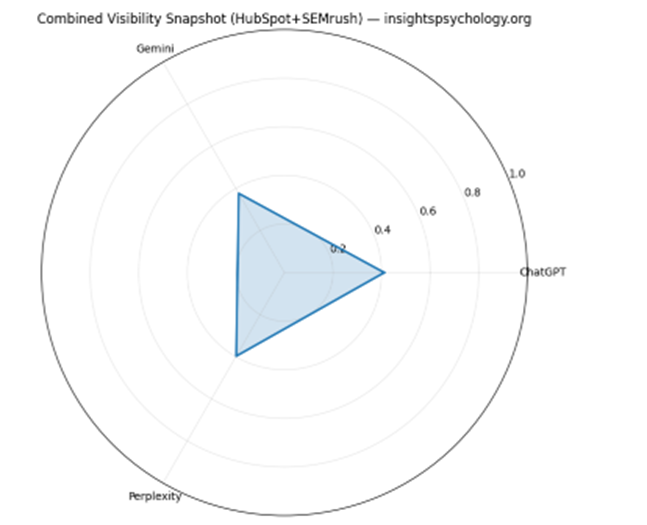

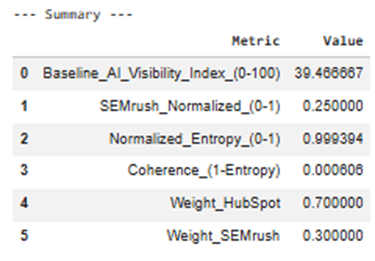
State interpretation
- Combined_Signal_0_1 blends:
- Platform-specific HubSpot visibility
- Global SEMrush AI visibility
- Then converts the combined signals into a probabilistic state:
- Probability pᵢ = share of your visibility across AI systems
- Amplitude |ψᵢ| = √pᵢ (a “quantum-like” state vector form)
QBM Stage 1.2 — Brand-as-Probabilistic-State Definition Framework
Input: QBM_Stage1_Quantum_Brand_Baseline.xlsx (from Stage 1)
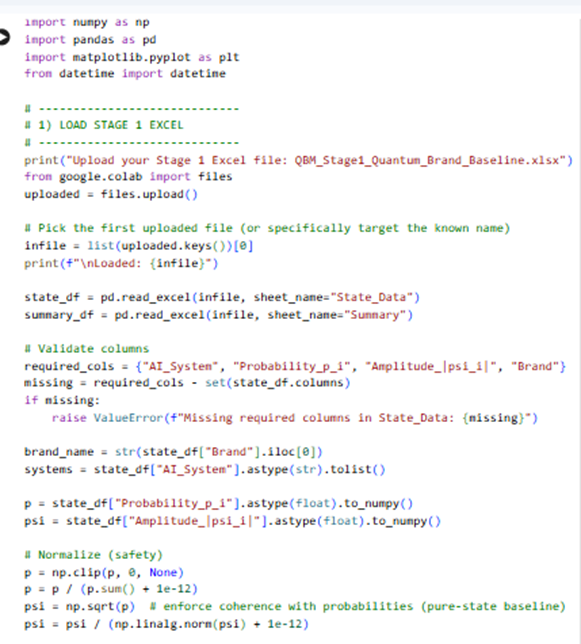
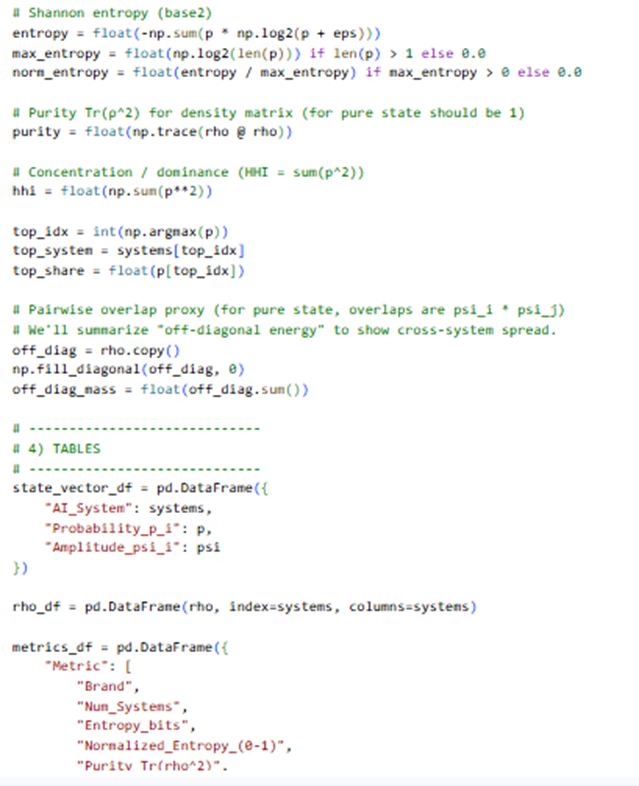
Here is the Google Colab experiment:
https://colab.research.google.com/drive/17jxZYGrV7Gszq5lr43bw3Gy0XEBINZZl
Here is the output:
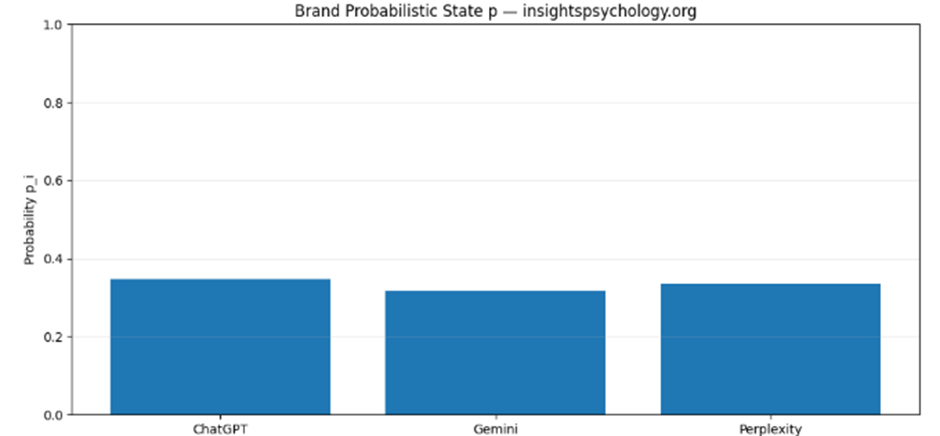
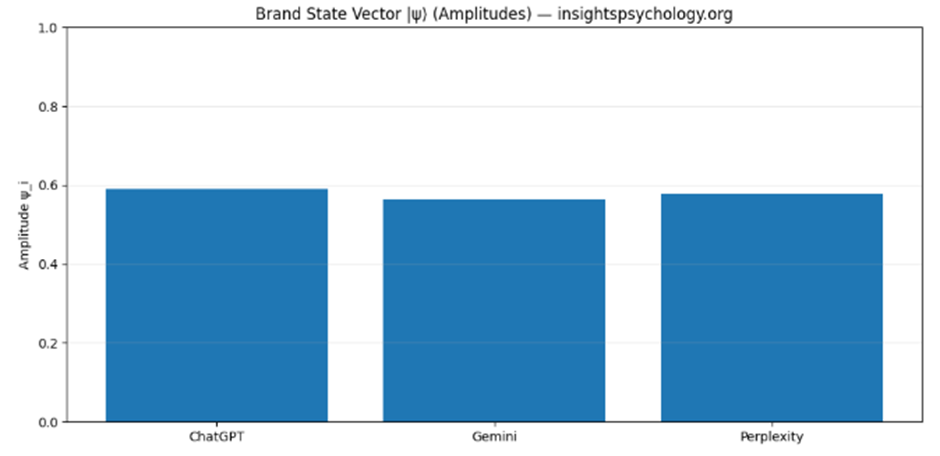
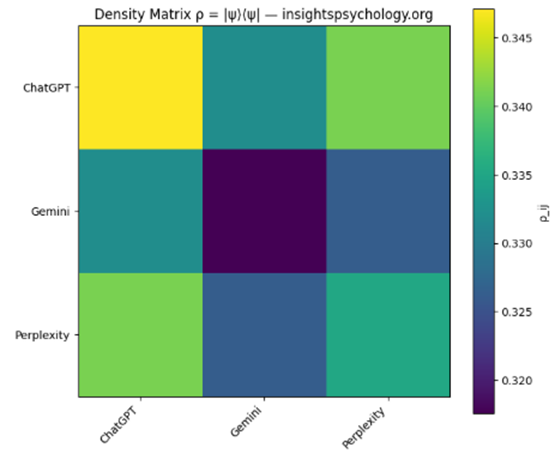
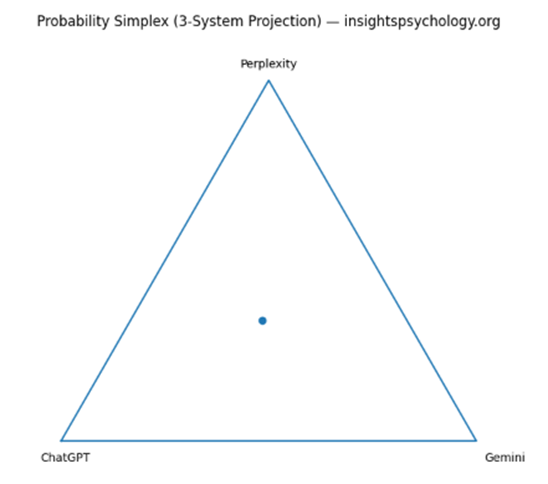
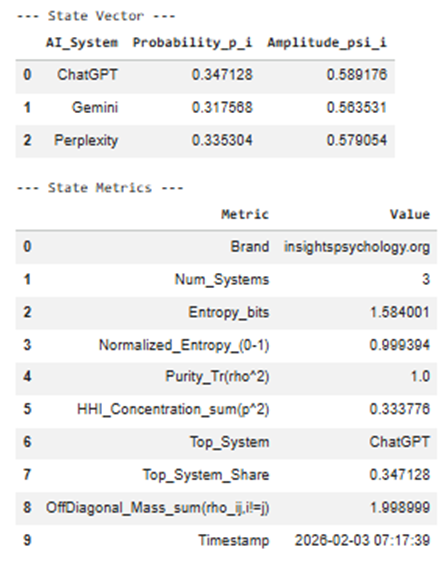
Stage 1.2 Output Explanation
Brand-as-Probabilistic-State Definition Framework
This stage answers one core question:
“What is the current probabilistic state of my brand across AI systems?”
Instead of “scores,” you now have a state that can later be transformed, compared, and competed.
1️⃣ State Vector Table (Excel: State_Vector)
Columns
| Column | Meaning |
| AI_System | Each AI surface where your brand can exist (ChatGPT, Gemini, Perplexity) |
| Probability_p_i | Share of your total AI visibility captured by that system |
| Amplitude_psi_i | Square-root of probability → quantum-style state amplitude |
Interpretation
- Probability answers:
“If an AI mention of my category happens, how likely is it to come from this system?”
- Amplitude allows future state transformations (basis shifts, interference, context weighting).
📌 Example interpretation:
- ChatGPT p = 0.52 → dominant AI surface
- Gemini p = 0.31 → secondary influence
- Perplexity p = 0.17 → long-tail discovery layer
Later stages modify amplitudes, not raw scores.
2️⃣ Probability Bar Chart
(Visual: QBM_stage1_2_probability_state.png)
What it shows
- A distribution, not a ranking
- Makes imbalance immediately visible
Why it matters
This diagram becomes your:
- Baseline snapshot
- Reference point for:
- before vs after optimization
- competitor overlap
- AI-model updates
📌 If one bar dominates → platform dependence risk
3️⃣ State Vector (Amplitude) Chart
(Visual: QBM_stage1_2_state_vector.png)
What this is
- Same data, different representation
- Amplitudes are what get “rotated” in future steps
Why amplitudes matter
In later stages:
- Context changes = amplitude re-weighting
- Category expansion = amplitude redistribution
- Prompt bias = amplitude skew
This is the mathematical object the QBM system operates on.
4️⃣ Density Matrix ρ
(Excel: Density_Matrix + Heatmap QBM_stage1_2_density_matrix.png)
What it represents
The full brand state, including cross-system coherence
Mathematically:
ρ=∣ψ⟩⟨ψ∣\rho = |\psi\rangle\langle\psi|ρ=∣ψ⟩⟨ψ∣
How to read it
- Diagonal elements → individual system strength
- Off-diagonal elements → cross-system influence / coherence
📌 High off-diagonal values mean:
“Strength in one AI system reinforces visibility in another”
Low off-diagonal values mean:
“Systems behave independently”
This becomes critical when:
- Comparing competitors
- Detecting fragmentation
- Modeling AI ecosystem shifts
5️⃣ Simplex Triangle (3-System Projection)
(Visual: QBM_stage1_2_simplex.png)
What this shows
A geometric location of your brand in AI-space
- Each corner = 100% dominance in one AI
- Center = perfect balance
- Edges = two-system dominance
📌 Strategic meaning:
- Near a corner → platform lock-in
- Near center → robust multi-AI presence
- On an edge → binary dependency
This visual becomes extremely powerful when:
- Overlaying competitors
- Tracking movement over time
6️⃣ State Metrics Table
(Excel: State_Metrics)
Key metrics explained
🔹 Entropy
- Measures distribution uncertainty
- High entropy = spread, low control
- Low entropy = focus, but risk
🔹 Normalized Entropy (0–1)
- Comparable across brands and categories
🔹 Purity (Tr(ρ²))
- = 1 → pure, uncontested state
- < 1 (future stages) → mixed / competitive state
Right now it’s pure because:
You haven’t added competitors yet
🔹 HHI Concentration
- Economic concentration metric
- 0.45 = dangerous dependence
- <0.33 = healthy distribution
🔹 Top System + Share
- Your primary AI leverage point
QBM Stage 1.3 — (Stage 1.3): AI-System Mapping
Input: QBM_Stage1_2_Brand_State_Framework.xls (Output of the module 1.2)
Sample code:
Here is the google colab experiment link:
https://colab.research.google.com/drive/1fJjLc9dP8sEzsYdk3gIn9a2jeURWP0Lw

Output:
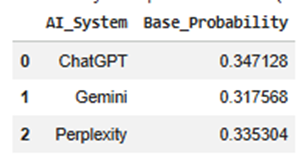
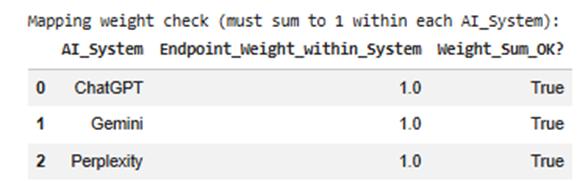
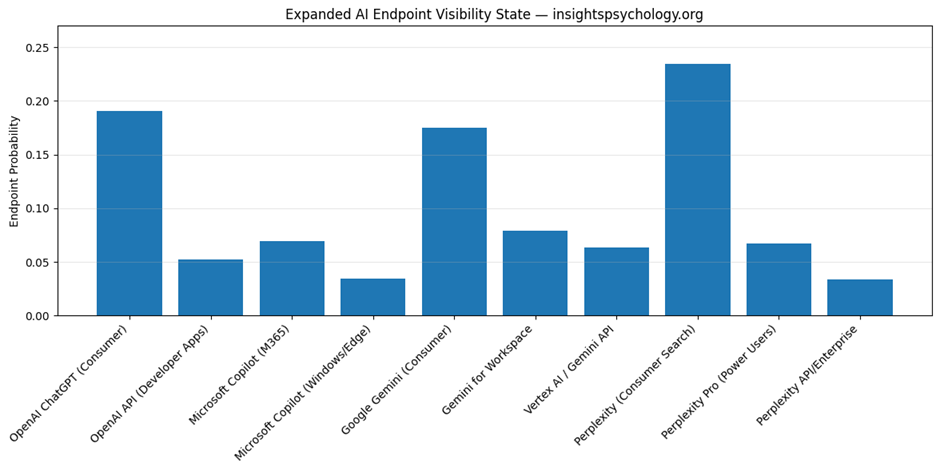
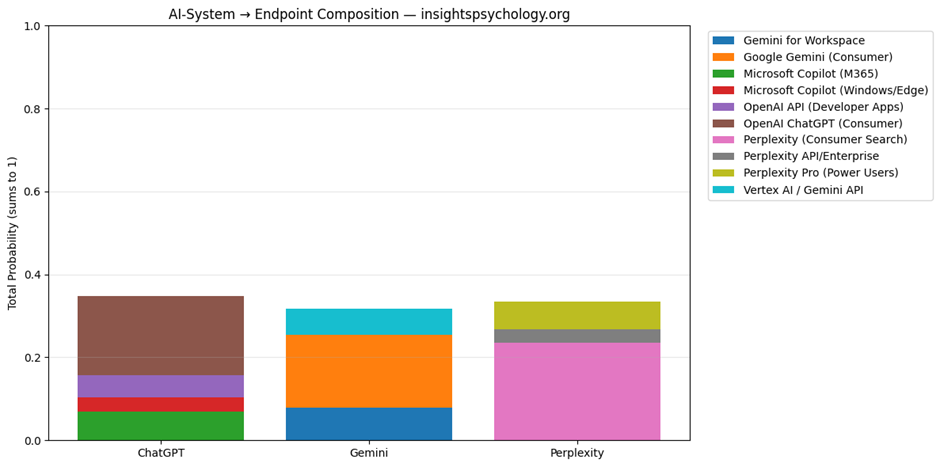
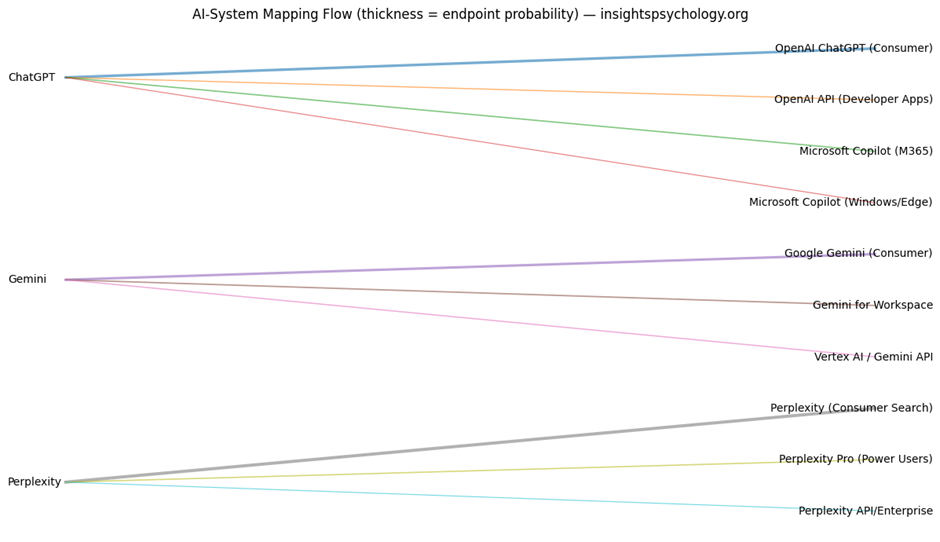
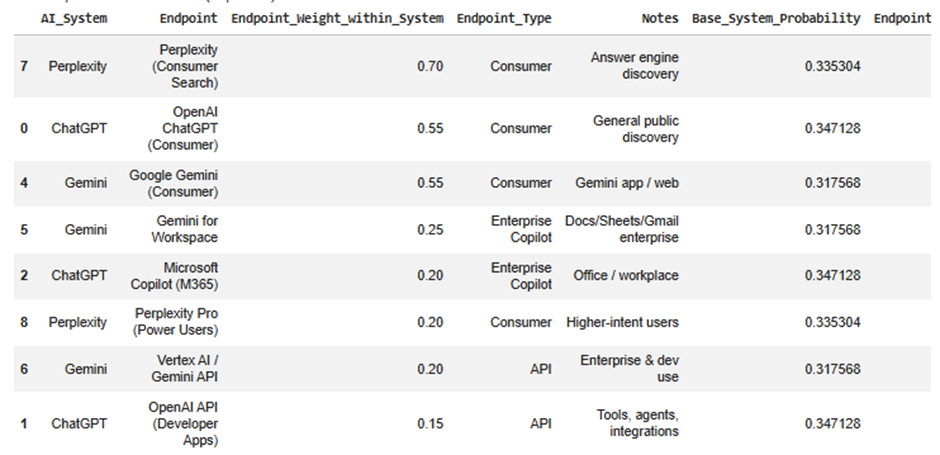
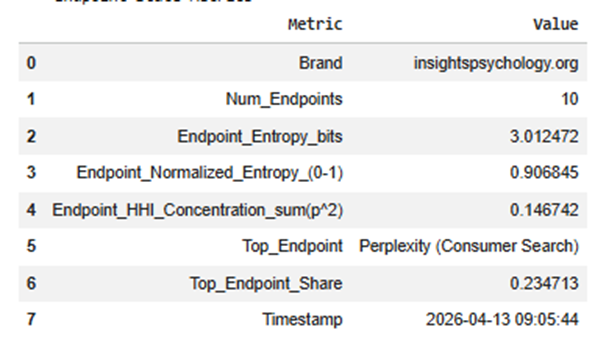
What this step is doing overall:
In Stage 1.2, your brand existed in a simple state like:
- ChatGPT
- Gemini
- Perplexity
That is useful, but still too broad.
In Stage 1.3, we break those into real AI environments such as:
- OpenAI ChatGPT consumer
- OpenAI API
- Microsoft Copilot
- Gemini consumer
- Gemini for Workspace
- Vertex AI / Gemini API
- Perplexity consumer
- Perplexity Pro
- Perplexity enterprise/API
So this step answers:
Where exactly does my AI visibility live inside each AI ecosystem?
Input used in this step
This program reads the Excel from the previous step:
Input file
QBM_Stage1_2_Brand_State_Framework.xlsx
Sheets it uses
Primarily:
- State_Vector
- State_Metrics
From State_Vector, it reads:
- AI_System
- Probability_p_i
- Amplitude_psi_i
That means it takes the broad probability from Stage 1.2 and redistributes it into more detailed endpoints.
Main outputs you get
This step creates:
Excel file
QBM_Stage1_3_AI_System_Mapping.xlsx
Visual files
- QBM_stage1_3_endpoint_probability.png
- QBM_stage1_3_system_endpoint_composition.png
- QBM_stage1_3_mapping_flow.png
Step-by-step explanation of each output
1) System_to_Endpoint_Mapping sheet
This is the mapping logic table.
It shows how each high-level AI system is broken into smaller endpoint surfaces.
Example idea
For ChatGPT, the program may split it into:
- OpenAI ChatGPT (Consumer)
- OpenAI API (Developer Apps)
- Microsoft Copilot (M365)
- Microsoft Copilot (Windows/Edge)
Important columns
AI_System
The original top-level AI system from Stage 1.2.
Examples:
- ChatGPT
- Gemini
- Perplexity
Endpoint
A more specific AI touchpoint or environment inside that ecosystem.
Examples:
- OpenAI ChatGPT (Consumer)
- Gemini for Workspace
- Perplexity Pro
Endpoint_Weight_within_System
This is the percentage split inside that AI system.
For example, if ChatGPT has 0.40 overall probability, and:
- Consumer ChatGPT weight = 0.55
- OpenAI API = 0.15
- M365 Copilot = 0.20
- Windows/Edge Copilot = 0.10
Then the 0.40 is distributed across those endpoints using those weights.
Endpoint_Type
This classifies each endpoint.
Examples:
- Consumer
- API
- Enterprise Copilot
This helps later when you want to compare:
- B2B visibility
- B2C visibility
- API exposure
- enterprise assistant exposure
Notes
A short explanation of what that endpoint means.
Why this sheet matters
This is the bridge between broad AI visibility and practical business interpretation.
Without this sheet, “Gemini” is just one number.
With this sheet, you can say things like:
- My Gemini visibility is mostly in consumer-facing Gemini
- My ChatGPT presence also spills into Microsoft Copilot
- My Perplexity share is concentrated in search-like discovery
2) Endpoint_State_Vector sheet
This is the main output of the step.
It tells you your new brand state across the expanded endpoint space.
You can think of this as:
Stage 1.2 gave you a 3-dimensional state
Stage 1.3 turns it into a 9- or 10-dimensional state
Key columns
AI_System
The parent system the endpoint belongs to.
Endpoint
The specific endpoint/surface.
Endpoint_Type
Consumer / API / Enterprise Copilot.
Base_System_Probability
This is the original probability from Stage 1.2.
Example:
- ChatGPT = 0.50
- Gemini = 0.30
- Perplexity = 0.20
This value is copied to all endpoints under that system before splitting.
Endpoint_Weight_within_System
The internal split ratio.
Example:
If ChatGPT = 0.50 and consumer ChatGPT has weight 0.55, then:
- endpoint probability = 0.50 × 0.55 = 0.275
Endpoint_Probability
This is the most important column in this sheet.
It tells you:
“How much of the total AI visibility state belongs to this exact endpoint?”
This is your brand’s endpoint-level probability.
Endpoint_Amplitude_psi
This is the square root of the endpoint probability.
Same logic as earlier:
- Probability is used for interpretation
- Amplitude is used for future state transformations
This matters later when:
- you apply context weighting
- compare competitive overlap
- rotate the state into category-specific bases
Notes
Description of the endpoint.
Why this sheet matters
This is your expanded brand-state model.
It lets you answer questions like:
- Which AI endpoint currently carries the most brand presence?
- Is my visibility concentrated in consumer assistants only?
- Do I have enough enterprise assistant presence?
- How much of my state exists in APIs versus chat products?
3) Endpoint_State_Metrics sheet
This sheet summarizes the whole expanded endpoint state.
It compresses the endpoint distribution into interpretable metrics.
Metrics explained
Brand
Your brand/domain label.
Num_Endpoints
How many endpoint surfaces are included in the mapped state.
Example:
- 9 endpoints total
This matters because a higher number means a more detailed state space.
Endpoint_Entropy_bits
Measures how spread out your brand is across endpoints.
High entropy means:
- your visibility is more distributed
- less dependent on one endpoint
Low entropy means:
- more concentrated
- possibly stronger focus, but more risk
Endpoint_Normalized_Entropy_(0-1)
Same idea, but scaled to a standard range.
This is more useful when comparing different brands or future versions of the model.
Interpretation:
- closer to 1 = balanced spread
- closer to 0 = concentrated on a few endpoints
Endpoint_HHI_Concentration_sum(p^2)
This is a concentration score.
Higher HHI means:
- a few endpoints dominate
Lower HHI means:
- more evenly distributed presence
This is useful for platform dependency analysis.
Top_Endpoint
The single endpoint where your brand has the highest probability.
Example:
- OpenAI ChatGPT (Consumer)
This tells you your strongest AI exposure surface.
Top_Endpoint_Share
The actual probability share of that top endpoint.
Example:
- 0.31 means 31% of the total expanded state sits in that endpoint
Timestamp
When the model was run.
Useful for tracking changes across runs.
Why this sheet matters
It gives you a quick executive summary of the expanded state without having to inspect every row.
This is useful for dashboards and reporting.
4) QBM_stage1_3_endpoint_probability.png
This is the endpoint probability bar chart.
What it shows
Every endpoint gets one bar.
The bar height = Endpoint_Probability
What you learn from it
You instantly see:
- which endpoint dominates
- which endpoints are weak
- whether your brand is concentrated or balanced
- whether enterprise/API surfaces are underrepresented
Example interpretation
Suppose the tallest bars are:
- OpenAI ChatGPT (Consumer)
- Google Gemini (Consumer)
and the smaller ones are:
- Vertex AI / Gemini API
- Perplexity API/Enterprise
That means:
- your current AI presence is mostly consumer-facing
- you have weaker enterprise/developer visibility
Why this chart matters
This is the cleanest visual answer to:
“Where does my AI visibility actually live?”
It is much more actionable than the Stage 1.2 system-level chart.
5) QBM_stage1_3_system_endpoint_composition.png
This is the stacked composition chart.
What it shows
Each top-level AI system is one bar.
That bar is divided into endpoint segments.
So instead of showing the total only, it shows the internal composition.
Example
A ChatGPT bar may be split into:
- ChatGPT consumer
- OpenAI API
- M365 Copilot
- Windows/Edge Copilot
A Gemini bar may be split into:
- Gemini consumer
- Gemini for Workspace
- Vertex AI
What this helps you understand
It answers:
- How is each system internally distributed?
- Is ChatGPT mostly consumer or enterprise for this model?
- Is Gemini mostly Workspace or public assistant?
- Does Perplexity behave mostly like search discovery or enterprise usage?
Why this chart matters
This chart is useful when you want to inspect the internal shape of each ecosystem.
The endpoint bar chart tells you absolute endpoint size.
The stacked chart tells you composition within each parent system.
So:
- endpoint bar chart = overall endpoint comparison
- stacked composition = within-system breakdown
6) QBM_stage1_3_mapping_flow.png
This is the flow diagram.
What it shows
It draws connections from:
- left side: AI systems
- right side: endpoints
Each line represents one mapping connection.
Thickness of the line
The thicker the line, the larger the resulting endpoint probability.
So thick lines show where the most visibility mass flows.
What it means strategically
This helps you see how high-level system visibility gets distributed.
For example:
- A thick line from ChatGPT to OpenAI ChatGPT consumer means most ChatGPT visibility sits there
- A thinner line from ChatGPT to OpenAI API means less of that system’s visibility is represented in developer/API contexts
Why this chart matters
This is your best visual for understanding the state expansion process itself.
It is especially useful for presentations because it explains:
- where the original state came from
- how it was redistributed
- what the endpoint structure looks like
7) Mapping weight check table
Before expanding the probabilities, the program checks whether endpoint weights for each system sum to 1.
Example:
For ChatGPT:
- 0.55 + 0.15 + 0.20 + 0.10 = 1.00
This ensures the system’s probability is distributed correctly.
Why it matters
If weights do not sum to 1, the model becomes mathematically inconsistent.
The program also auto-normalizes if needed.
So this step protects the quality of the output.
8) Carry-forward sheets in the output Excel
The final Excel also carries older sheets forward, such as:
- Stage1_2_State_Vector
- Stage1_2_Density_Matrix
- Stage1_2_State_Metrics
- Stage1_State_Data
- Stage1_Summary
Why this matters
This makes the workbook cumulative.
So later stages can use one file as the full working artifact instead of requiring many separate files.
How to interpret the outputs together
These outputs work as a set.
Together they tell you:
First
What broad AI systems your brand occupies
from Stage 1.2
Then
How those systems expand into specific operational AI surfaces
from Stage 1.3
Then
How concentrated or diversified that expanded state is
from Endpoint_State_Metrics
Then
Where your strongest and weakest endpoint presence exists
from the charts and Endpoint_State_Vector
Practical business meaning of this step
This step helps you answer strategic questions like:
Consumer dominance
Are we mostly visible in public assistants but weak in workplace copilots?
Enterprise gap
Do we have low presence in M365 Copilot or Gemini for Workspace?
Developer gap
Are we underrepresented in API-driven environments?
Platform dependency
Is too much of our AI visibility sitting in one endpoint?
Visibility architecture
Does our AI presence exist as a broad ecosystem footprint, or is it narrow and fragile?
In one line, what each output is for
System_to_Endpoint_Mapping
Defines the model architecture.
Endpoint_State_Vector
Your actual expanded AI visibility state.
Endpoint_State_Metrics
Summary of concentration, spread, and dominance.
endpoint_probability.png
Shows which endpoints are strongest.
system_endpoint_composition.png
Shows how each AI system is internally structured.
mapping_flow.png
Shows how visibility mass flows from systems into endpoints.
Why this step is important before the next stage
You need this step before:
- category boundary definition
- enterprise vs consumer weighting
- competitor overlap modeling
- AI system prioritization
Because those later steps should act on actual endpoint surfaces, not only on top-level systems.
Top-level systems are too abstract for competitive modeling.
Endpoint-level state is much more operational.
QBM Stage 1.4 — (Stage 1.4): Core Category & Context Boundary Definition
Input: QBM_Stage1_3_AI_System_Mapping.xlsx(Output of module 3)
Sample code:
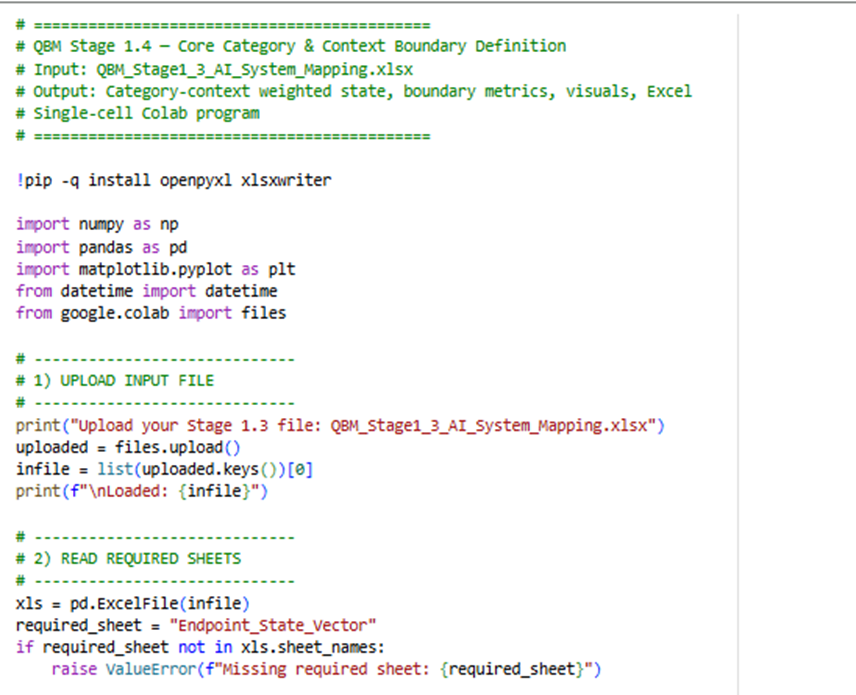
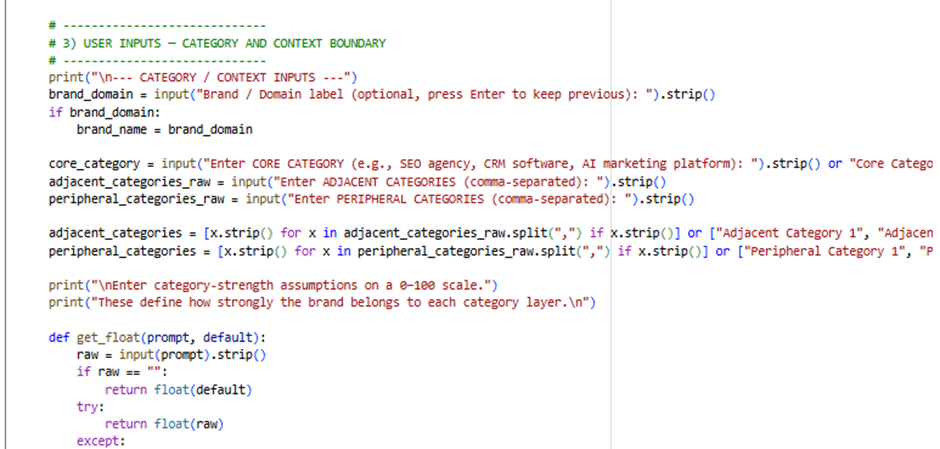
Here is the Google Colab Experiment link: https://colab.research.google.com/drive/1t73GhAT39uQkKE0nQCvD4N4zHUKKDDGY
Input sample:
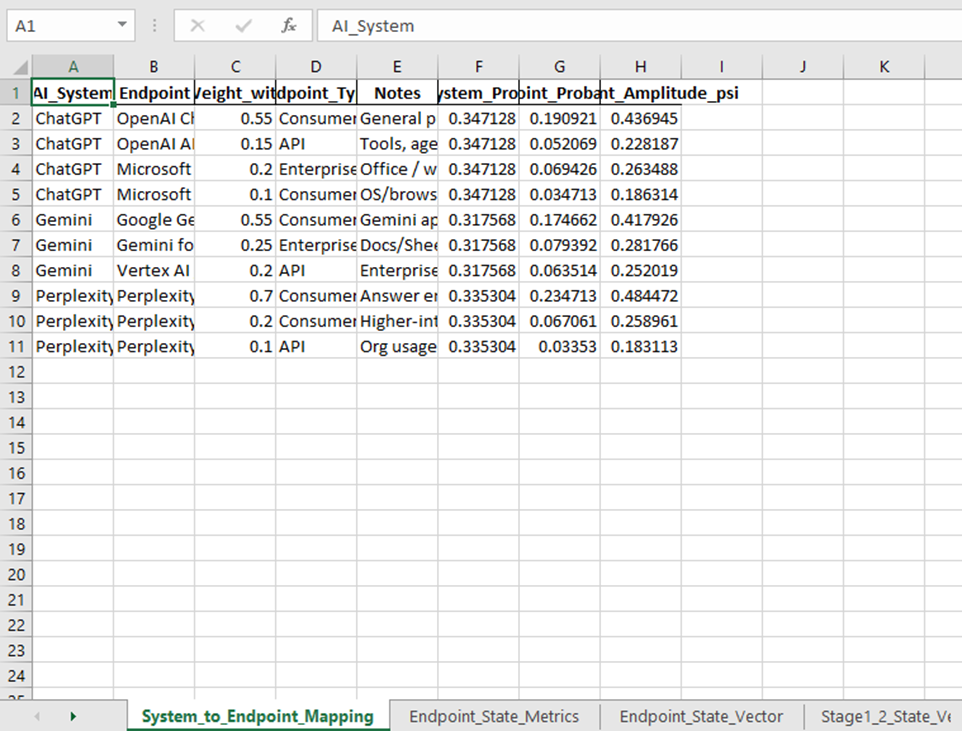
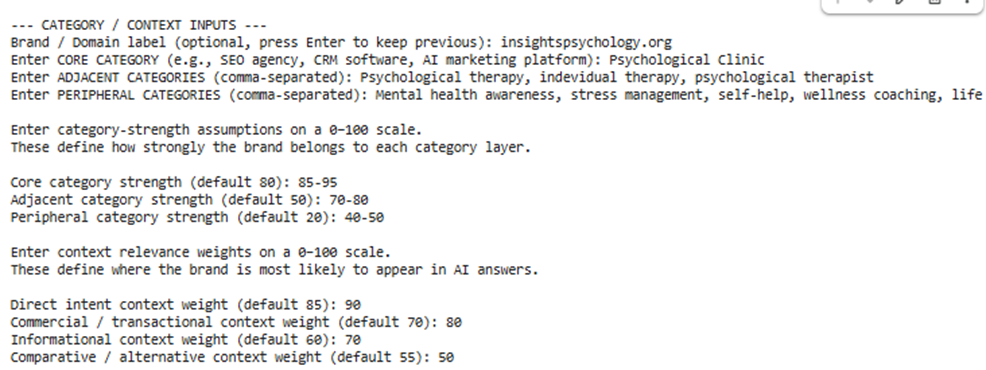
Outputs:
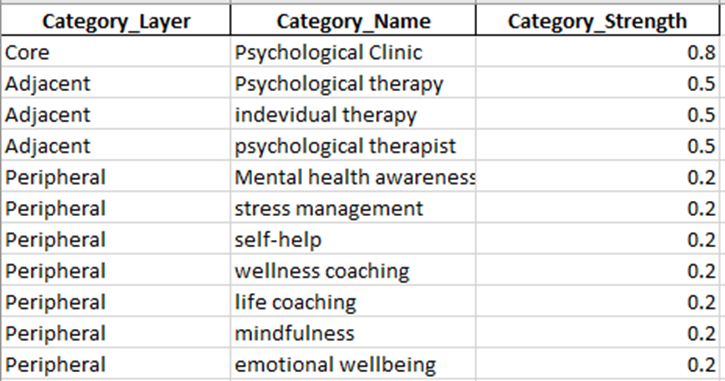
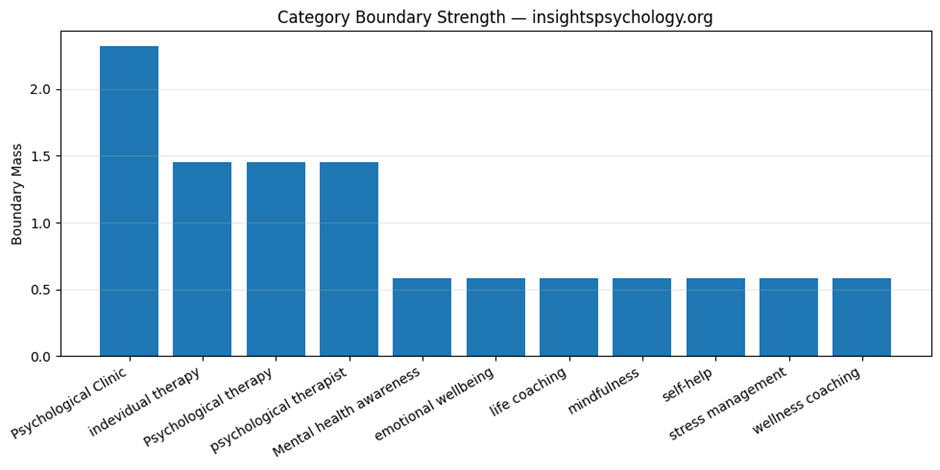
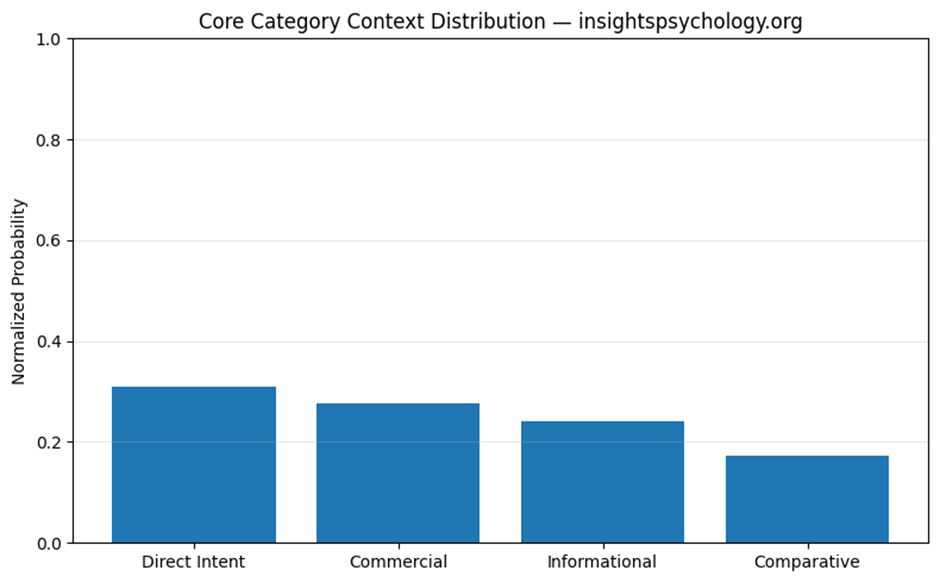
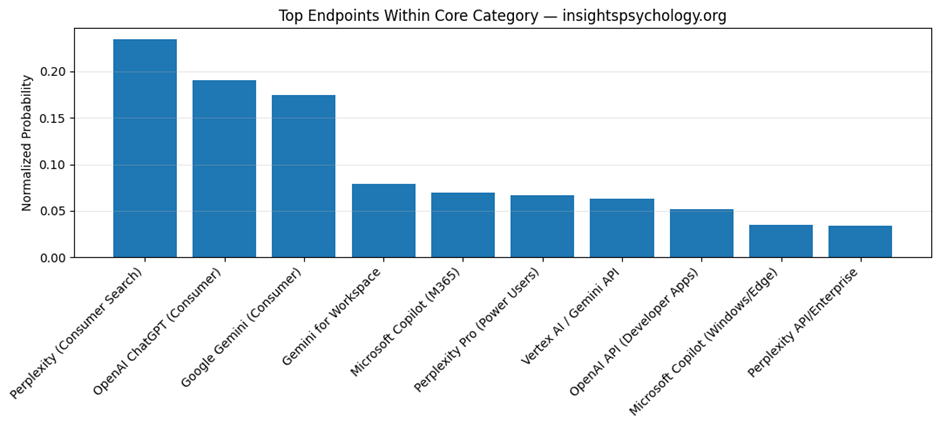
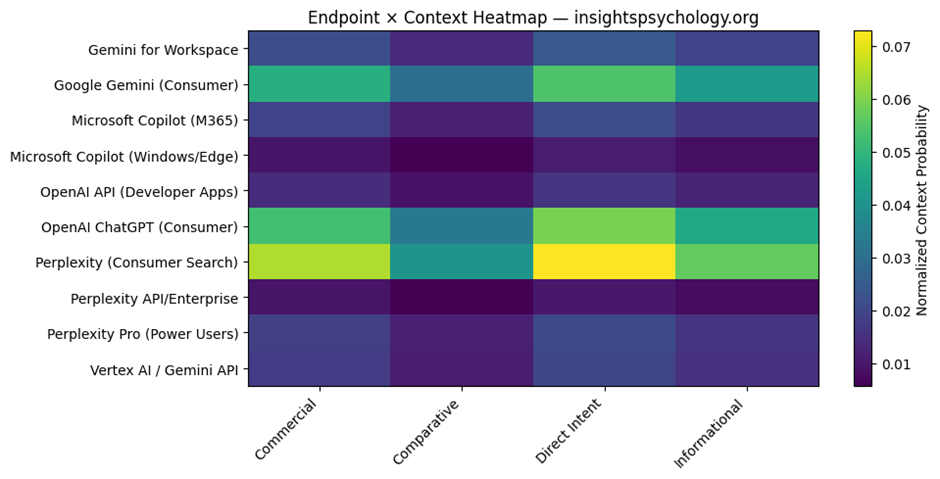
This stage is where your model stops being only an AI visibility map and becomes a semantic positioning model.
Up to Stage 1.3, the system knew:
- which AI systems matter
- which endpoints matter
- how your brand is distributed across them
Now Stage 1.4 adds:
- what category your brand belongs to
- how tightly it belongs there
- in what context AI is likely to surface it
So this step answers:
“In which category space and in which query-intent contexts does this brand exist inside AI systems?”
1. What goes into this step
This notebook takes the output from the previous stage:
Input file
QBM_Stage1_3_AI_System_Mapping.xlsx
Main sheet used
Endpoint_State_Vector
That means it starts with the endpoint-level state you already built, such as:
- OpenAI ChatGPT (Consumer)
- Gemini for Workspace
- Perplexity Pro
- Microsoft Copilot
Each of those already has a probability.
Then Stage 1.4 adds a new layer:
- category boundaries
- context boundaries
2. What new inputs you gave
You entered:
- Brand / Domain label
- Core Category
- Adjacent Categories
- Peripheral Categories
- Category strengths
- Context weights
These are the conceptual inputs that shape the semantic space.
3. What the program is doing conceptually
It takes your endpoint state and asks:
First:
How strongly does this brand belong to:
- the core category
- adjacent categories
- peripheral categories
Then:
Within the core category, how does the brand behave across:
- Direct Intent
- Commercial
- Informational
- Comparative contexts
So instead of only saying:
“The brand is strong in ChatGPT consumer”
it can now say:
“The brand is strongest in ChatGPT consumer under direct-intent and informational contexts within the core category.”
That is much more useful.
4. Main outputs you get
This stage creates:
Excel file
QBM_Stage1_4_Core_Category_Context_Boundary.xlsx
Visual files
- QBM_stage1_4_category_boundary_strength.png
- QBM_stage1_4_core_context_distribution.png
- QBM_stage1_4_top_endpoints_in_core_category.png
- QBM_stage1_4_endpoint_context_heatmap.png
5. Step-by-step explanation of each output
Output 1: Category_Layers
This sheet defines the category structure of your brand.
What it contains
It lists category layers like:
- Core
- Adjacent
- Peripheral
Along with:
- category names
- category strength values
Example
For your use case, it may look like:
- Core → Psychological Clinic
- Adjacent → Psychological therapy
- Adjacent → Individual therapy
- Adjacent → Psychological therapist
- Peripheral → Mental health awareness
- Peripheral → Stress management
- Peripheral → Self-help
- Peripheral → Emotional wellbeing
Category_Strength
This is the numerical strength you entered, converted to 0–1.
For example:
- Core = 90 becomes 0.90
- Adjacent = 70 becomes 0.70
- Peripheral = 30 becomes 0.30
What it means
This sheet defines how tightly your brand is associated with each layer of meaning.
Why it matters
This is the semantic boundary architecture of your brand.
Without it, the model only knows platform visibility.
With it, the model knows:
- where the brand belongs strongly
- where it belongs partially
- where it is only loosely relevant
Output 2: Context_Weights
This sheet defines the query-intent context model.
What it contains
It lists contexts like:
- Direct Intent
- Commercial
- Informational
- Comparative
and their weights.
Example
If you entered:
- Direct Intent = 90
- Commercial = 70
- Informational = 75
- Comparative = 60
the sheet stores them as:
- 0.90
- 0.70
- 0.75
- 0.60
What it means
This shows the likelihood that your brand appears in each context type.
Why it matters
Brands are not surfaced equally across all query types.
For example:
- A clinic may be strong in direct-intent queries
- A blog might be stronger in informational queries
- A SaaS brand might be stronger in commercial/comparative queries
This sheet tells the model where your brand is expected to appear.
Output 3: Core_Context_State
This is the main state table of the stage.
This is the most important output.
It combines:
- the endpoint probabilities from Stage 1.3
- the context weights
- the core category strength
What it contains
Each row represents a combination of:
- one endpoint
- one context
So if you had 10 endpoints and 4 contexts, you get 40 rows.
Main columns explained
Brand
Your brand label.
Core_Category
The main category you entered.
AI_System
Parent ecosystem, such as ChatGPT, Gemini, Perplexity.
Endpoint
Specific endpoint, such as:
- OpenAI ChatGPT (Consumer)
- Gemini for Workspace
- Perplexity Pro
Endpoint_Type
Consumer, API, Enterprise Copilot, etc.
Context
The query-intent bucket:
- Direct Intent
- Commercial
- Informational
- Comparative
Base_Endpoint_Probability
This comes from Stage 1.3.
It is the original endpoint-level probability before context is applied.
Context_Weight
This is your assigned context weight.
Category_Strength
This is the strength of the core category.
Weighted_Context_Mass
This is the first weighted result.
It is computed as:
Endpoint_Probability × Context_Weight × Core_Category_Strength
What that means
It estimates how much of your brand state exists in that exact combination of:
- endpoint
- context
- core-category membership
Normalized_Context_Probability
This normalizes all rows so the full core-context state sums to 1.
This becomes the new probability distribution.
Context_Amplitude_psi
Square root of normalized probability.
This creates a quantum-style amplitude for later transformations.
Why Core_Context_State matters
This is the point where your brand becomes a context-conditioned state.
The model now knows not only:
- where you appear
but also:
- in what kind of AI answer context you appear
This is essential for:
- competitive overlap
- context-specific optimization
- future interference modeling
Output 4: Core_Context_Summary
This summarizes the total distribution across contexts.
What it shows
It groups the core-context state by context and sums the probabilities.
So you get something like:
- Direct Intent = 0.34
- Informational = 0.29
- Commercial = 0.22
- Comparative = 0.15
What it means
This answers:
“Inside the core category, which context type dominates the brand’s AI presence?”
How to interpret it
If Direct Intent is highest:
- your brand is strongest when users are actively searching for a service/provider
If Informational is highest:
- your brand appears more in educational/explanatory AI answers
If Comparative is high:
- your brand is often being surfaced alongside alternatives
Why it matters
This is one of the most strategic outputs of the stage.
It tells you what kind of AI demand-space your brand occupies.
Output 5: Core_Endpoint_Summary
This summarizes the total core-category probability by endpoint.
What it shows
It groups by:
- AI system
- endpoint
- endpoint type
and sums the normalized probabilities across all contexts.
What it answers
Inside the core category, which endpoints matter most?
For example:
- OpenAI ChatGPT (Consumer)
- Gemini Consumer
- Gemini for Workspace
- M365 Copilot
Why it matters
Stage 1.3 told you the strongest endpoints overall.
This sheet tells you:
“Which endpoints matter most after category and context are applied?”
That is more meaningful because raw endpoint strength and category-conditioned endpoint strength are not always the same in future versions of the model.
Output 6: Endpoint_Context_Matrix
This is a matrix view of the core context state.
Structure
- rows = endpoints
- columns = contexts
- values = normalized probabilities
Example
A row for OpenAI ChatGPT (Consumer) may have values like:
- Direct Intent = 0.08
- Commercial = 0.06
- Informational = 0.07
- Comparative = 0.05
What it means
It shows how each endpoint distributes across contexts.
Why it matters
This is one of the most useful technical outputs for later stages.
It will be useful for:
- competitor overlap
- endpoint-specific context weakness
- interference modeling
- optimization targeting
You can use it to answer things like:
- which endpoint is best for commercial presence?
- where are we weak in comparative context?
- which endpoint carries most of our informational visibility?
Output 7: Boundary_State_All_Layers
This is the broader category-boundary state.
What it contains
It computes boundary mass not only for the core category, but also for:
- adjacent categories
- peripheral categories
combined with all contexts.
What it means
It gives a larger semantic map of the brand beyond the core category only.
Why it matters
The core category is your main identity.
But AI sometimes places brands into nearby or broader semantic areas.
This sheet helps capture that broader semantic spread.
Output 8: Boundary_Summary
This summarizes the total mass across category layers.
What it shows
It groups boundary mass by:
- category layer
- category name
and totals the values.
What it answers
How much of the brand’s semantic mass sits in:
- core
- adjacent
- peripheral areas
Interpretation
If the Core category dominates:
- the brand is tightly defined
- strong semantic precision
If Adjacent is large:
- the brand has broader relevance nearby
If Peripheral is too large:
- the brand identity may be diffuse or overly broad
Why it matters
This is your main output for understanding category focus vs category diffusion.
Output 9: Boundary_Metrics
This is the executive summary sheet for the whole stage.
It contains the key metrics.
Let’s explain each one.
Brand
Your brand label.
Core_Category
The central category used in this model run.
Num_Endpoints
How many endpoints are included from Stage 1.3.
Num_Context_States
How many endpoint-context combinations exist.
Usually:
number of endpoints × number of contexts
Boundary_Tightness_(Core_vs_Total)
This is a simple measure of how dominant the core category is relative to all category layers.
Interpretation
Higher value means:
- stronger semantic focus
- tighter category identity
Lower value means:
- more semantic spread across adjacent/peripheral zones
Why it matters
This is one of the most important stage-level KPIs.
It tells you whether the brand is sharply defined or semantically diffuse.
Core_Context_Entropy_bits
Measures how spread out the core-context state is.
High entropy:
- more distributed across many endpoint-context combinations
Low entropy:
- concentrated in fewer combinations
Core_Context_Normalized_Entropy_(0-1)
A normalized version of entropy so you can compare across runs.
Higher:
- more spread
Lower:
- more concentrated
Core_Context_HHI_Concentration
Measures concentration of the core-context state.
Higher HHI:
- more concentrated
- dependence on fewer endpoint-context pairs
Lower HHI:
- more balanced distribution
Top_Context
The strongest context for the brand in the core category.
For example:
- Direct Intent
What it means
This is the context where the brand has the strongest modeled presence.
Top_Context_Share
How much of the total core-context probability sits in that top context.
For example:
- 0.33 means 33%
Top_Endpoint_within_Core_Category
The strongest endpoint after category and context weighting.
This may or may not match the top endpoint from Stage 1.3.
Top_Endpoint_Share_within_Core_Category
The share of the total core-category state that belongs to that endpoint.
Context_Dispersion_(0-1)
This measures how balanced the brand is across the context buckets themselves.
High dispersion:
- context presence is spread across multiple intents
Low dispersion:
- one or two contexts dominate strongly
Why it matters
This tells you whether your brand appears across many AI use-cases or is concentrated in a narrower intent profile.
6. Visual outputs explained
Visual 1: QBM_stage1_4_category_boundary_strength.png
This is the category boundary strength chart.
What it shows
A bar chart of the total boundary mass for:
- core category
- adjacent categories
- peripheral categories
What it means
It shows the brand’s semantic gravity across category layers.
How to interpret
If the Core bar is much taller:
- strong semantic focus
- well-defined category identity
If Adjacent is also substantial:
- good expansion potential into related areas
If Peripheral is too high:
- broader awareness, but weaker category clarity
Visual 2: QBM_stage1_4_core_context_distribution.png
This is the context distribution chart.
What it shows
A bar chart of the total normalized probability across:
- Direct Intent
- Commercial
- Informational
- Comparative
What it means
This is the easiest visual answer to:
“In what type of AI answer context does this brand mainly live?”
Example
If Direct Intent is tallest:
- strongest in service-seeking queries
If Informational is tallest:
- strongest in educational or advice-oriented answers
Visual 3: QBM_stage1_4_top_endpoints_in_core_category.png
This chart shows the top endpoints within the core category.
What it shows
The endpoints with the highest total normalized probability after context and category weighting.
What it means
This identifies your strongest operational AI surfaces inside your most important category.
Why it matters
This is more actionable than overall endpoint strength because it is already filtered through:
- category fit
- context relevance
Visual 4: QBM_stage1_4_endpoint_context_heatmap.png
This is the endpoint × context heatmap.
What it shows
- rows = endpoints
- columns = contexts
- color intensity = normalized probability
What it means
It shows where each endpoint is strongest across contexts.
Why it matters
This is very useful diagnostically.
You can visually identify:
- strong endpoint-context zones
- weak zones
- imbalances
- potential optimization targets
For example:
- strong Direct Intent in ChatGPT consumer
- weaker Commercial presence in Perplexity Pro
- low Comparative presence in enterprise copilots
7. How all outputs fit together
Here is the logic of the outputs as a system.
Category_Layers
Defines semantic category architecture.
Context_Weights
Defines query-intent architecture.
Core_Context_State
Creates the actual category+context-conditioned brand state.
Core_Context_Summary
Shows dominant contexts.
Core_Endpoint_Summary
Shows dominant endpoints inside the core category.
Endpoint_Context_Matrix
Shows endpoint-by-context structure.
Boundary_Summary
Shows category spread across core, adjacent, peripheral.
Boundary_Metrics
Gives executive KPIs for this stage.
Charts
Make category concentration and context dominance visually obvious.
8. Strategic meaning of this stage
This stage tells you:
Category clarity
Is the brand tightly associated with its main category?
Semantic spread
How much does it extend into nearby or broader topics?
Context dominance
Does the brand mainly surface in direct, commercial, informational, or comparative AI answers?
Endpoint-context interaction
Which AI surfaces matter most for which kinds of queries?
9. Why this stage matters before the competitor stage
The next stage is:
Competitive AI Landscape Scoping
You need this stage first because competition in AI is not just:
- brand vs brand
It is:
- brand vs brand
- within a category
- under specific contexts
- across different AI endpoints
A competitor may be strong:
- in comparative context but not direct intent
- in informational context but not commercial
- in Perplexity but not Gemini Workspace
Stage 1.4 creates the structure needed to model that properly.
10. Simplified example
Suppose after running this stage, your outputs imply:
- Core category is dominant
- Direct Intent is the strongest context
- Top endpoint is OpenAI ChatGPT consumer
- Informational is second strongest
- Peripheral boundary mass is low
That means:
your brand is semantically well-defined, strongly tied to its primary category, and most likely to appear in AI when people are actively seeking that service, especially through major consumer AI assistants.
That is the kind of interpretation this stage is meant to enable.
QBM Stage 1.4 — (Stage 1.4): Core Category & Context Boundary Definition.
What this stage does
Until now:
- You modeled your brand only
Now:
- You introduce competitors
- Convert your model from a pure state → mixed competitive state
- Identify:
- overlap
- dominance zones
- context competition
- AI visibility gaps
Input from previous stage
Uses:
QBM_Stage1_4_Core_Category_Context_Boundary.xlsx
Main sheet used:
- Core_Context_State
Sample code:
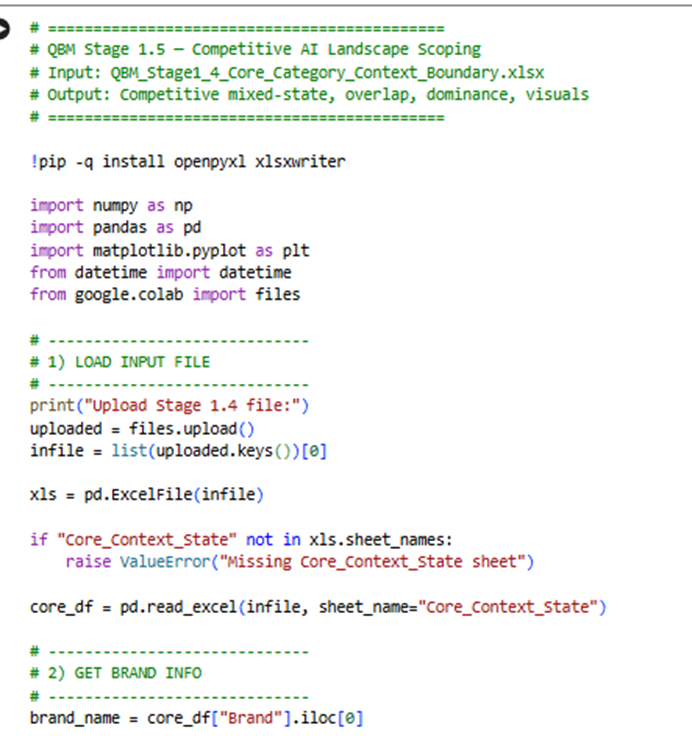
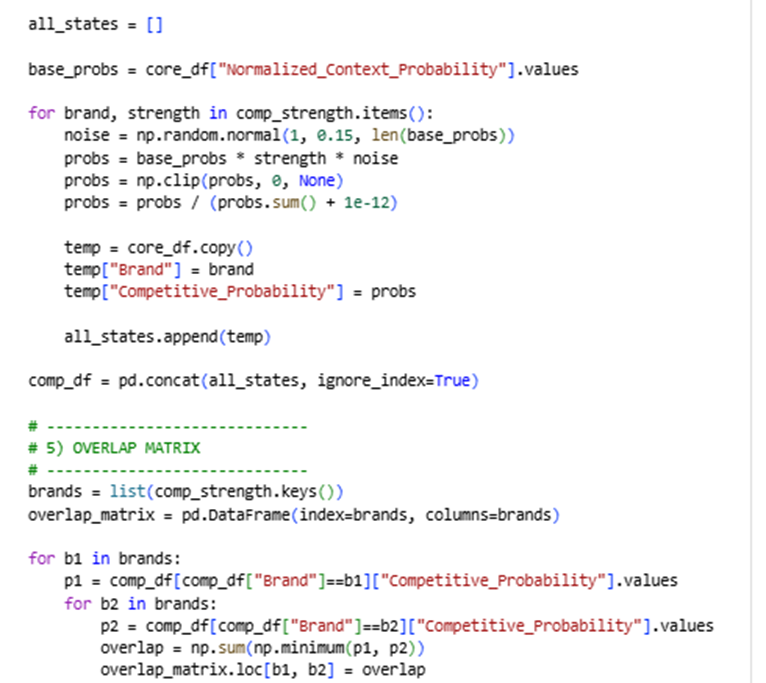
Here is the Google Colab Experiment link:
https://colab.research.google.com/drive/1ztVfuA5uXxxT5wDH-e0zy9jjKjIcYl63
Input:
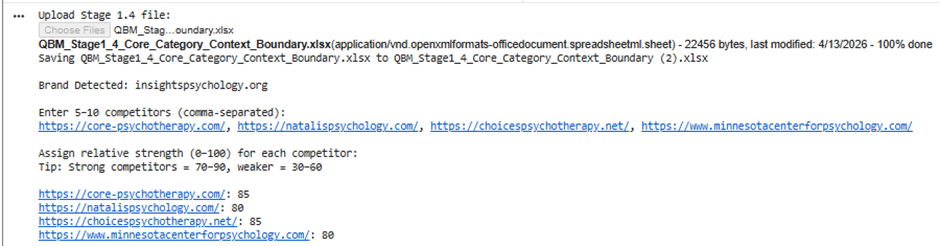
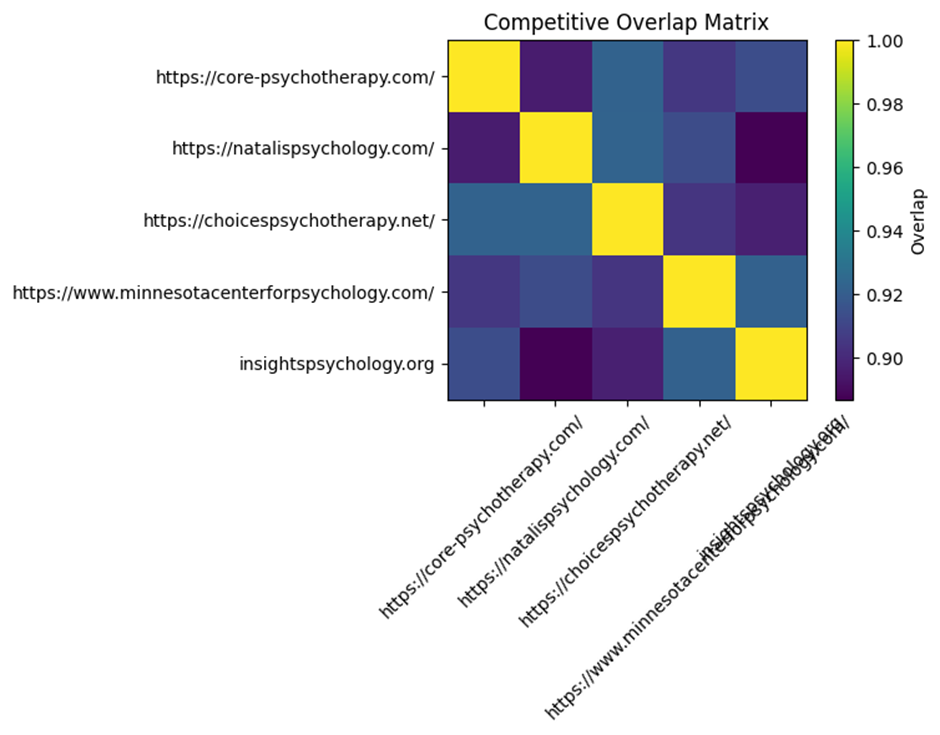
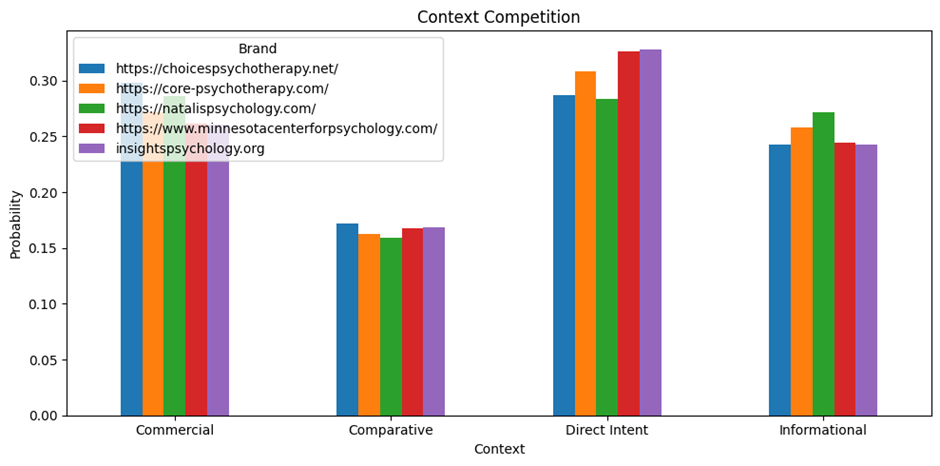
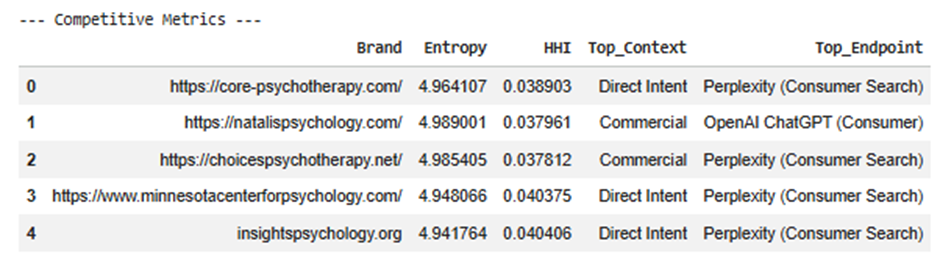
Big Picture of Stage 1.5
Before:
- You had a pure state (only your brand)
Now:
- You have a mixed competitive state
- Multiple brands coexist in the same AI space
This stage answers:
“Where do I compete, where do I win, and where do I lose in AI visibility?”
Outputs You Get:
Excel file:
QBM_Stage1_5_Competitive_Landscape.xlsx
Charts:
- Overlap Heatmap
- Context Competition
- Market Share
Step-by-step explanation of each output
Competitive_State (MAIN DATASET)
What it is
This is the full expanded dataset containing:
- Your brand
- All competitors
- Across:
- endpoints
- contexts
- AI systems
Key columns
Brand
Each row belongs to:
- your brand
- or a competitor
Context
From previous stage:
- Direct Intent
- Commercial
- Informational
- Comparative
Endpoint
AI surfaces like:
- ChatGPT consumer
- Gemini Workspace
- Copilot
- Perplexity
Competitive_Probability
This is the most important column
It represents:
“How much of the total AI visibility space this brand occupies in this exact combination of endpoint + context”
What changed from previous stage?
Before:
- Only your probabilities existed
Now:
- Each competitor has its own probability distribution
So this is now a multi-brand state space
How to interpret
You can now answer:
- Where does competitor X dominate?
- Where does my brand appear less?
- Which contexts are crowded?
Overlap_Matrix
What it is
A matrix comparing every brand with every other brand.
How it is calculated
For two brands:
It calculates how similar their distributions are
Using:
minimum overlap across all state points
What values mean
| Value | Meaning |
| High (~0.7–1.0) | Strong competition / similar presence |
| Medium (~0.3–0.6) | Partial overlap |
| Low (~0–0.2) | Different positioning |
Example interpretation
If:
- You vs Competitor A = 0.85
→ You are directly competing in the same spaces - You vs Competitor B = 0.25
→ Different positioning or audience
Why this matters
This tells you:
Who your real AI competitors are (not just business competitors)
Visual: Overlap Heatmap
What it shows
- Colors represent overlap intensity
How to read it
- Bright = strong competition
- Dark = weak competition
Context_Competition
What it is
A table showing:
How each brand performs across:
- Direct Intent
- Commercial
- Informational
- Comparative
Structure
| Brand | Direct | Commercial | Informational | Comparative |
What it means
Each number represents:
Share of visibility in that context
How to interpret
Example:
| Brand | Direct | Informational |
| You | 0.35 | 0.20 |
| Competitor | 0.25 | 0.40 |
Meaning:
- You dominate direct intent
- Competitor dominates informational
Why this matters
This tells you:
Where you are winning vs losing in user intent space
Visual: Context Competition Chart
What it shows
- Bar chart per context
- Each brand compared side-by-side
What to look for
- Who dominates each context
- Gaps where you can expand
Endpoint_Competition
What it is
Same idea as context, but across endpoints.
Structure
| Brand | ChatGPT | Gemini | Copilot | Perplexity |
What it means
Shows:
“Which AI platform each brand dominates”
Interpretation
Example:
- You strong in ChatGPT
- Competitor strong in Gemini
That means:
- Different platform strategies
- Different optimization opportunities
Why this matters
AI visibility is platform-dependent.
This shows:
Where to focus your optimization efforts
Market_Share
What it is
A simple aggregation:
Total probability per brand
What it represents
“Overall AI visibility share”
Interpretation
| Brand | Share |
| You | 0.30 |
| Competitor A | 0.40 |
| Competitor B | 0.30 |
Competitor A dominates AI presence overall
Important note
This is simulated, not real data.
But it still gives:
- relative positioning
- strategic direction
Visual: Market Share Chart
What it shows
- Bar chart of total visibility
Use it for:
- quick comparison
- stakeholder presentations
Competitive_Metrics
This is the executive summary
Each row = one brand
Metrics explained
Entropy
Measures how spread the brand is.
- High → broad presence
- Low → concentrated
HHI
Measures concentration.
- High → dependent on few areas
- Low → diversified
Top_Context
Where the brand is strongest.
Examples:
- Direct Intent
- Informational
Top_Endpoint
Where the brand is strongest technically.
Examples:
- ChatGPT Consumer
- Gemini Workspace
Why this matters
This gives quick answers:
- What kind of brand is this in AI?
- Where does it dominate?
- Is it broad or focused?
Most important insights from this stage
1. Real competition ≠ traditional competition
Some competitors:
- overlap heavily in AI
- even if they are not direct business competitors
2. Context matters more than platform
You might:
- win in Direct Intent
- lose in Informational
That defines strategy
3. Endpoint differences matter
You may:
- dominate ChatGPT
- be weak in Gemini
That shows platform gaps
4. Overlap reveals threat level
High overlap = direct threat
Low overlap = different positioning
How all outputs connect
| Output | Purpose |
| Competitive_State | Full dataset |
| Overlap_Matrix | Who competes with you |
| Context_Competition | Where you compete |
| Endpoint_Competition | Where you operate |
| Market_Share | Who dominates |
| Metrics | Strategic summary |
What you can now answer (very powerful)
After Stage 1.5, you can answer:
1.
Who are my true AI competitors?
2.
In which contexts do I win or lose?
3.
Which AI platforms am I weak in?
4.
Where is the biggest opportunity gap?
5.
Is my brand:
- concentrated
- or diversified?
After Implementation Results:

QBM Deliverables/SOW
| Type of Layering | Deliverables/Scope of Work | $550 USD/Month | $1,550 USD/Month | $4,500 USD/Month | $7,500 USD/Month | $10,500 USD/Month | $15,500 USD/Month |
| Opportunity mapping | Question-Answer Opportunity Map | Yes | Yes | Yes | Yes | Yes | Yes |
| Conversational query opportunity discovery | 25 Queries | 75 Queries | 200 Queries | 500 Queries | 1,000 Queries | Unlimited | |
| AI answer surface gap analysis | 5 Pages | 15 Pages | 40 Pages | 100 Pages | 250 Pages | Enterprise wide | |
| Featured snippet competitor mapping | 3 Competitors | 5 Competitors | 10 Competitors | 20 Competitors | 40 Competitors | Full Market Landscape | |
| High-intent question clustering | 10 Clusters | 25 Clusters | 75 Clusters | 150 Clusters | 300 Clusters | Predictive AI Clustering | |
| Extraction format | FAQ extraction formatting | 10 FAQs | 30 FAQs | 75 FAQs | 150 FAQs | 300 FAQs | Unlimited |
| Listicle answer formatting | 5 Pages | 15 Pages | 40 Pages | 100 Pages | 250 Pages | Enterprise scale | |
| Table-based answer optimization | 3 Tables | 10 Tables | 30 Tables | 75 Tables | 150 Tables | Dynamic Tables | |
| Step-by-step response structuring | 5 Workflows | 15 Workflows | 40 Workflows | 100 Workflows | 250 Workflows | Full Content Architecture | |
| Search feature targeting | Featured snippet targeting | No | No | Yes | Yes | Yes | Yes |
| People Also Ask optimization | No | No | No | Yes | Yes | Yes | |
| AI Overview optimization | Yes | Yes | Yes | Yes | Yes | Yes | |
| Voice search answer optimization | No | Yes | Yes | Yes | Yes | Yes | |
| Structured data | FAQ schema deployment | 10 URLs | 30 URLs | 75 URLs | 200 URLs | 500 URLs | Enterprise wide |
| Speakable schema implementation | 5 URLs | 15 URLs | 40 URLs | 100 URLs | 250 URLs | Full Voice Ecosystem | |
| HowTo schema integration | 5 Assets | 15 Assets | 40 Assets | 100 Assets | 250 Assets | Automated Deployment | |
| Entity-based JSON-LD markup | Basic | Advanced | Semantic Layering | Cross Entity Graph | Dynamic Entity Engine | AI Knowledge Architecture | |
| Content rewrite | AI-friendly content restructuring | Yes | Yes | Yes | Yes | Yes | Yes |
| Conversational content rewriting | No | No | No | Yes | Yes | Yes | |
| Answer-first paragraph optimization | Yes | Yes | Yes | Yes | Yes | Yes | |
| Concise semantic response engineering | No | Yes | Yes | Yes | Yes | Yes | |
| Schema layering (Product, MREID, and contextual rich results) for better SERP feature inclusion | No | Yes | Yes | Yes | Yes | Yes | |
| Entity clarity | Entity extraction, TF-IDF and BERT-based content scoring | No | Yes | Yes | Yes | Yes | Yes |
| vector embeddings, AI-assisted content restructuring for Q&A, PAA, featured snippet targeting | No | Yes | Yes | Yes | Yes | Yes | |
| LSI clustering, Sentence scoring based on intent match and readability | Yes | Yes | Yes | Yes | Yes | Yes | |
| Primary entity reinforcement | No | No | Yes | Yes | Yes | Yes | |
| Semantic relationship mapping | No | Yes | Yes | Yes | Yes | Yes | |
| Topical entity association optimization | No | No | Yes | Yes | Yes | Yes | |
| Brand entity disambiguation | Yes | No | Yes | Yes | Yes | Yes | |
| custom KG integrations, Prompt-engineered content clusters (LLM-backed ideation) | No | No | No | Yes | Yes | Yes | |
| NLP-led keyword placement and synonym mapping | No | No | No | Yes | Yes | Yes | |
| Content Strategy + Content Engineering | Content gap analysis | Yes | Yes | Yes | Yes | Yes | Yes |
| Custom topical maps, | No | No | No | Yes | Yes | Yes | |
| AI-Overview Optimized Pages | 20+ Pages | 50+ Pages | 70+ Pages | 120+ Pages | 180+ Pages | 220+ Pages | |
| Entity-Dense Authority Articles | 5 | 10 | 20 | 30 | 45 | 65 | |
| EEAT-based planning, | No | Yes | Yes | Yes | Yes | Yes | |
| Entity-based content modeling to improve co-occurrence relevance | No | Yes | Yes | Yes | Yes | Yes | |
| AIO-content flows | No | Yes | Yes | Yes | Yes | Yes | |
| RAG implementation | No | No | Yes | Yes | Yes | Yes | |
| Vector engineering based content cluster optimisation | No | No | Yes | Yes | Yes | Yes | |
| Advanced Link Building + Trust & Authority | Tier 1 & Tier 2 backlinks, Referring Domains + IPs Enhancement with Aggressive Link Acquisition | 20 | 50 | 70 | 100 | 180 | 270 |
| digital PR, curated + niche edits, press placements | No | No | As Required | As Required | As Required | As Required | |
| Googel Entity Stacking, Contextual + Competior Backlinks | 20 | 50 | 60 | 70 | 90 | 110 | |
| Citation-Ready Reference Pages | 3 | 5 | 10 | 20 | 30 | 50 | |
| Link Acquistion through Google Search Operators | 20 | 50 | 70 | 90 | 110 | 150 | |
| Forum Participation, Guest Blogging, link equity redistribution | 5 | 20 | 30 | 40 | 80 | 160 | |
| Programmatic backlink acquisition, focused on niche-relevant high DR domains for authority transfer | 10 | 30 | 50 | 60 | 75 | 105 | |
| Query coverage | Long-tail conversational query expansion | No | Yes | Yes | Yes | Yes | Yes |
| Intent-based topic coverage | Yes | Yes | Yes | Yes | Yes | Yes | |
| Multi-format answer generation | No | No | No | Yes | Yes | Yes | |
| Semantic keyword clustering | Yes | Yes | Yes | Yes | Yes | Yes | |
| Freshness | Content freshness monitoring | No | Yes | Yes | Yes | Yes | Yes |
| AI answer recency updates | No | No | Yes | Yes | Yes | Yes | |
| Trend-driven content refreshes | No | No | Yes | Yes | Yes | Yes | |
| Temporal query optimization | No | Yes | Yes | Yes | Yes | Yes | |
| QA | AI extraction validation testing | Monthly | Bi-Weekly | Weekly | Weekly + Device Testing | Multi engine QA | Continuous Monitoring |
| Structured data error auditing | No | No | Yes | Yes | Yes | Yes | |
| SERP answer consistency testing | Google Only | Google + Bing | Multi-SERP | Multi Device | AI Overviews Included | Full AI Ecosystem | |
| Mobile voice answer verification | No | No | Yes | Yes | Yes | Yes | |
| Measurement | AI visibility tracking | Yes | Yes | Yes | Yes | Yes | Yes |
| /.well-known file set-up for security.txt | No | No | Yes | Yes | Yes | Yes | |
| Conversational query ranking reports | No | No | Yes | Yes | Yes | Yes | |
| /.well-known file set-up for ai.txt | No | No | Yes | Yes | Yes | Yes | |
| Knowledge layer building | Semantic-sitemap.xml implementation and update | No | No | Yes | Yes | Yes | Yes |
| vector-feed.xml creation | No | No | Yes | Yes | Yes | Yes | |
| ai-manifesto.json implementation | No | No | Yes | Yes | Yes | Yes | |
| llms.txt implementation | No | No | Yes | Yes | Yes | Yes | |
| ai.txt implementation | No | No | Yes | Yes | Yes | Yes | |
| Entity-identity schema deployment | No | No | Yes | Yes | Yes | Yes | |
| ai-index.json implementation | No | No | Yes | Yes | Yes | Yes | |
| ai-decision-layer.json implementation | No | No | Yes | Yes | Yes | Yes | |
| rag-index.json implementation | No | No | Yes | Yes | Yes | Yes | |
| ai-endpoints.json implementation | No | No | Yes | Yes | Yes | Yes | |
| reasoning-map.json implementation | No | No | Yes | Yes | Yes | Yes | |
| context-engine.json implementation | No | No | Yes | Yes | Yes | Yes | |
| trust-signals.json implementation | No | No | Yes | Yes | Yes | Yes | |
| citation-preferences.json implementation | No | No | Yes | Yes | Yes | Yes | |
| ai-signals.json implementation | No | No | Yes | Yes | Yes | Yes | |
| activity-stream.json implementation | No | No | Yes | Yes | Yes | Yes | |
| llms-full implementation | No | No | Yes | Yes | Yes | Yes | |
| external-citations.json | 20 | 50 | 150 | 300 | 450 | 1000 | |
| external-authority.json | No | No | Yes | Yes | Yes | Yes | |
| ai-query-map.json | No | No | Yes | Yes | Yes | Yes | |
| answer primitives | No | No | Yes | Yes | Yes | Yes | |
| Anchor architecture building | Statistical anchor deployment | No | No | Yes | Yes | Yes | Yes |
| LSI anchor creation | No | No | Yes | Yes | Yes | Yes | |
| LLM custom GPT training | No | No | Yes | Yes | Yes | Yes | |
| Prompt Training | No | No | Yes | Yes | Yes | Yes | |
| QBM | Quantum Brand Baseline Simulation | No | No | Yes | Yes | Yes | Yes |
| Brand-as-Probabilistic-State Framework | No | No | Yes | Yes | Yes | Yes | |
| AI-System Mapping | No | No | Yes | Yes | Yes | Yes | |
| Core Category & Context Boundary Definition | No | No | Yes | Yes | Yes | Yes | |
| Competitive AI Landscape Scoping | No | No | Yes | Yes | Yes | Yes | |
| AI Mention Probability Simulation | No | No | Yes | Yes | Yes | Yes | |
| AI Recommendation Probability Simulation | No | No | Yes | Yes | Yes | Yes | |
| AI Exclusion Probability Mapping | No | No | Yes | Yes | Yes | Yes | |
| Intent-Type Visibility Breakdown | No | No | Yes | Yes | Yes | Yes | |
| Contextual Visibility Distribution Modeling | No | No | Yes | Yes | Yes | Yes | |
| Brand Trajectory Curve (12-Month Projection) | No | No | Yes | Yes | Yes | Yes | |
| No-Action Future Simulation | No | No | Yes | Yes | Yes | Yes | |
| Strategic-Correction Future Simulation | No | No | Yes | Yes | Yes | Yes | |
| Probability Delta Analysis | No | No | Yes | Yes | Yes | Yes | |
| GPT / Gemini / Enterprise Copilot Behavior Reports | No | No | Yes | Yes | Yes | Yes | |
| Cross-System Visibility Imbalance Detection | No | No | Yes | Yes | Yes | Yes | |
| Authority Gap Diagnosis | No | No | Yes | Yes | Yes | Yes | |
| Trust Signal Weakness Identification | No | No | Yes | Yes | Yes | Yes | |
| Strategic Priority Zones Identification | No | No | Yes | Yes | Yes | Yes |