SUPERCHARGE YOUR ONLINE VISIBILITY! CONTACT US AND LET’S ACHIEVE EXCELLENCE TOGETHER!
The evolution of search is rapidly shifting from traditional result pages to AI-generated answers and recommendations. Users now rely on systems like ChatGPT, Google AI Overviews, and other large language model (LLM) interfaces to discover products, services, and solutions. As a result, visibility is no longer determined only by rankings on search engines—it is increasingly determined by whether an AI system chooses to cite, recommend, or reference a brand when generating an answer.
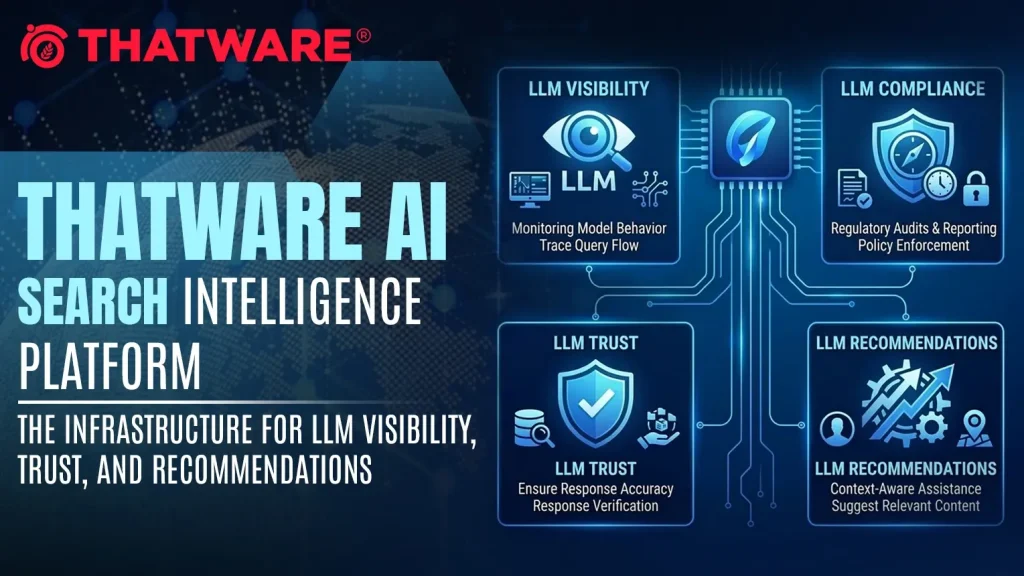
To address this shift, ThatWare has developed the LLM Tool – an AI Answer Visibility & Optimization Platform. The platform is designed to help brands understand how they appear within AI-generated responses and, more importantly, what changes are required to increase the likelihood of being cited, recommended, and trusted by AI systems.
The tool combines AI visibility analysis, retrieval diagnostics, and implementation-ready optimization insights to help organizations adapt their websites and digital assets for the emerging AI search ecosystem.
AI Surfaces Covered
Modern AI search is distributed across multiple platforms, each with its own data retrieval methods, content interpretation patterns, and recommendation behaviors. ThatWare’s LLM Tool evaluates brand visibility and recommendation patterns across the most influential AI-driven systems.
These include:
Google AI Overviews
Google’s AI-generated summaries increasingly shape user decision-making by synthesizing information from multiple sources directly in search results. The tool analyzes whether a brand’s content is being surfaced or referenced in these summaries and identifies opportunities to improve inclusion.
ChatGPT Discovery Behavior
ChatGPT is becoming a major discovery channel for services, tools, and educational content. The platform evaluates how frequently a brand is mentioned, cited, or recommended within ChatGPT-style responses and identifies the content structures that influence these outcomes.
Perplexity AI
Perplexity provides AI-generated answers with cited sources. The LLM Tool monitors whether a brand’s pages are being selected as reference sources and analyzes how competitor content is being prioritized in answers.
Google Gemini
Gemini integrates AI reasoning and knowledge retrieval with Google’s ecosystem. The tool analyzes how Gemini interprets brand content, identifies visibility gaps, and provides recommendations to improve content extractability and authority signals.
Claude
Claude emphasizes structured reasoning and contextual analysis. ThatWare’s tool evaluates content patterns that influence Claude’s response generation, including clarity, trust signals, and content structuring for AI comprehension.
By analyzing visibility across these AI surfaces, the platform provides a holistic understanding of how brands perform within the AI answer ecosystem.
Optimization Focus Areas
The ThatWare LLM Tool is not only designed to track AI visibility but also to optimize digital assets for AI answer generation and recommendation behavior. The platform focuses on several critical areas that determine whether a brand is selected or ignored by AI systems.
Answer Engine Optimization (AEO)
Answer Engine Optimization focuses on structuring content so that AI systems can easily extract and present it as part of generated responses. The tool evaluates whether website pages contain clear definitions, structured explanations, summaries, and decision-support content that AI systems can use when constructing answers.
It identifies missing answer blocks, poorly structured content, and sections that prevent AI extraction.
Generative Engine Optimization (GEO)
Generative Engine Optimization goes beyond traditional SEO by focusing on how AI systems interpret and synthesize information. The LLM Tool analyzes whether content supports AI reasoning through structured comparisons, contextual explanations, and supporting evidence that improves generative outputs.
This helps ensure that content is optimized not just for indexing but for AI reasoning and recommendation contexts.
LLM Citation Probability
One of the most important aspects of AI visibility is whether a page is selected as a source when an AI generates an answer. The platform evaluates citation likelihood by analyzing factors such as:
- factual clarity
- source credibility
- structured content blocks
- expert attribution
- data-backed statements
- references and proof signals
Based on this analysis, the tool identifies improvements that can increase the probability of a page being cited in AI-generated answers.
LLM Recommendation Probability
Beyond citations, AI systems increasingly recommend brands, tools, or providers when users ask questions such as:
- “What is the best X?”
- “Which company should I choose?”
- “What tools are recommended for this problem?”
The LLM Tool evaluates how well a website supports AI recommendation logic, including decision-support content, comparisons, proof elements, and buyer-fit explanations. It then generates actionable suggestions to improve a brand’s chances of being recommended.
AI Answer Visibility
Understanding whether a brand appears in AI-generated responses is essential for measuring digital presence in the new search landscape. The platform tracks visibility across various prompt categories and identifies patterns such as:
- when a brand is mentioned but not cited
- when competitors dominate recommendation queries
- when a brand appears in informational prompts but not commercial ones
These insights help businesses identify high-value visibility gaps in AI search behavior.
AI Retrieval Readiness
AI systems rely on retrieval mechanisms to gather information from the web before generating responses. If a website’s content is not structured properly, AI systems may struggle to extract useful information.
The LLM Tool evaluates a site’s AI retrieval readiness, including:
- content structure and extractability
- entity clarity
- schema and structured data implementation
- internal knowledge graph strength
- trust and authority signals
The platform then recommends improvements that make content easier for AI systems to retrieve, interpret, and include in generated answers.
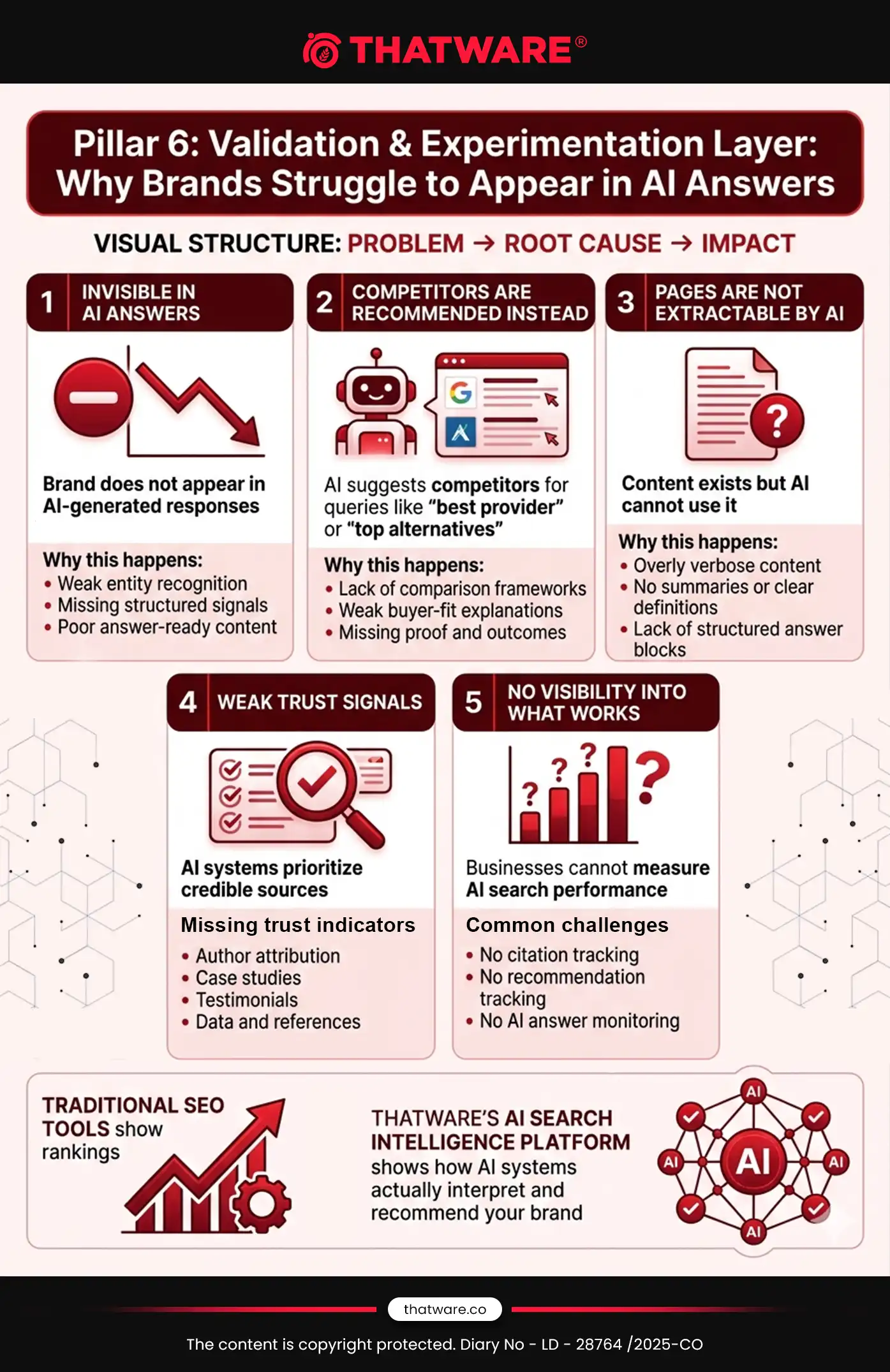
1. Core Problem Areas
As AI-driven search systems such as Google AI Overviews, ChatGPT, Perplexity, Gemini, and Claude increasingly influence how users discover information, many businesses are experiencing a new visibility challenge. Traditional SEO metrics like rankings and impressions no longer fully explain why some brands are cited, recommended, or surfaced in AI-generated answers, while others are ignored.
Website owners, brands, and agencies now face a new layer of complexity: understanding how AI systems retrieve, evaluate, and recommend content. Most organizations lack the tools to diagnose these issues or implement improvements effectively.
ThatWare’s AI Search Implementor is designed to solve this gap by identifying the root causes of weak AI visibility and generating clear, implementation-ready actions that help websites become more discoverable, trustworthy, and recommendable across AI answer ecosystems.
Below are the key problem areas faced by different stakeholders.
For Website Owners
Many website owners are discovering that their websites may rank in traditional search results yet remain absent from AI-generated answers. AI systems evaluate content differently from traditional search engines, prioritizing factors such as extractability, entity clarity, trust signals, and structured knowledge relationships.
As a result, business owners frequently ask questions such as:
- Why is my website not being cited or referenced in AI answers?
- Why are competitors being recommended by AI systems instead of my brand?
- Which pages on my site are reducing AI trust or retrieval confidence?
- What content elements are missing that prevent AI systems from understanding and using my information?
Common missing components often include elements related to:
- LLM Retrieval – Content structure that allows large language models to extract clear answers.
- Answer Engine Optimization (AEO) – Formatting information for AI-generated answers.
- Generative Engine Optimization (GEO) – Ensuring content aligns with generative search behaviors.
- LLM Answer Generation Readiness – Structuring content to be easily summarized, cited, and recommended.
Another major challenge for website owners is implementation clarity. Even when issues are identified, it is often unclear:
- What specific improvements should be implemented?
- Which pages should be prioritized?
- What changes can produce measurable improvements within weeks rather than months?
ThatWare’s solution addresses this challenge by diagnosing AI visibility barriers and converting them into actionable improvements that can be implemented immediately.
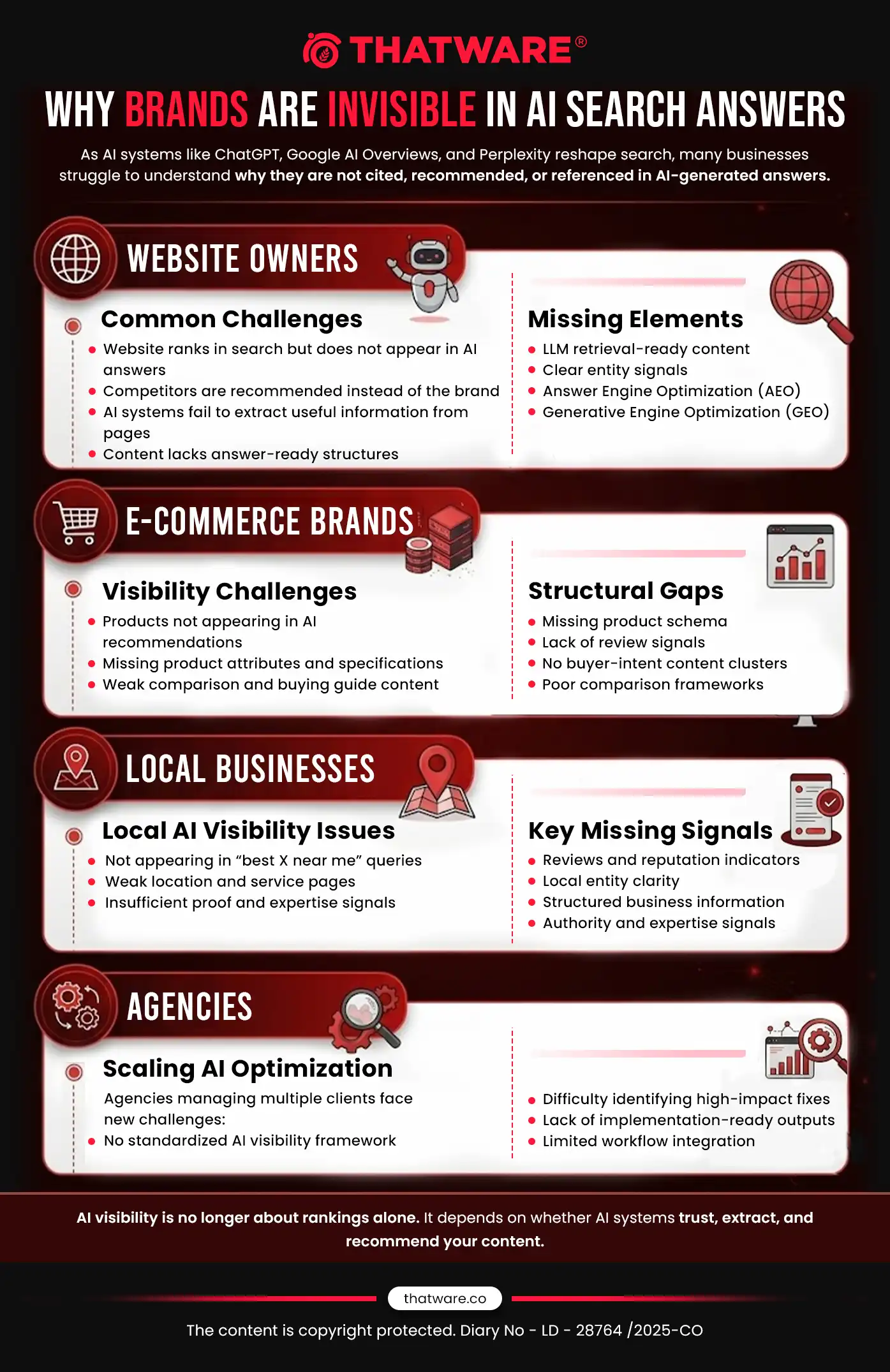
For E-commerce Brands
E-commerce brands face an even more dynamic challenge. AI systems increasingly influence product discovery and purchasing decisions, recommending products, comparing alternatives, and summarizing buyer options.
However, many online stores find that their products rarely appear in these AI-led recommendation flows.
Common concerns include:
- Why are my products not appearing in AI-generated product recommendations?
- Which product attributes or specifications are missing that prevent AI systems from understanding my products?
- What structured data elements or schema implementations are absent?
- Which trust signals, such as reviews, ratings, or proof elements, are required for recommendation inclusion?
- Do my category or product pages need structural redesign to support AI extraction and comparison?
Another critical gap involves buyer-intent content clusters. AI systems often recommend products based on contextual queries such as:
- “Best laptop for designers”
- “Affordable CRM for small teams”
- “Top alternatives to X”
Many e-commerce websites fail to support these recommendation scenarios because they lack comparison frameworks, buying guides, and decision-support content.
ThatWare’s platform helps e-commerce brands identify these structural gaps and implement improvements that increase the likelihood of product inclusion in AI-driven recommendations and answer summaries.
For Local Businesses
Local businesses are heavily impacted by AI-generated answers because many local queries now surface AI summaries before traditional listings.
Queries such as:
- “Best dentist near me”
- “Top marketing agency in London”
- “Reliable plumber in my area”
are increasingly answered directly by AI systems.
However, many local businesses struggle to appear in these responses due to missing entity signals, proof layers, or location authority indicators.
Typical issues include:
- The business not appearing in “best X near me” AI queries
- Missing trust layers, such as expertise signals, case studies, or verified credentials
- Weakly structured location and service pages
- Insufficient reviews, citations, and entity relationships
AI systems often evaluate local businesses using a combination of signals such as:
- Local entity clarity
- Reputation and reviews
- Proof of expertise
- Structured business information
- Service relevance
ThatWare’s solution helps local businesses strengthen these signals and restructure their digital presence to improve AI visibility in local recommendation and advisory queries.
For Agencies
Digital agencies face a different type of challenge. They must manage AI search optimization across multiple clients, often across different industries and geographies.
For agencies, the key difficulty lies in scaling AI visibility improvements efficiently.
Common questions agencies ask include:
- What AI visibility improvements can be implemented across 50 or more client websites?
- Which recommendations can be integrated directly into team workflows and project management systems?
- Which optimizations deliver the highest ROI and fastest impact for client campaigns?
Agencies need tools that go beyond diagnostics. They require platforms that provide:
- Standardized implementation frameworks
- Scalable optimization workflows
- Prioritized recommendations based on impact
- Task-ready outputs for developers, SEO teams, and content teams
ThatWare’s AI Search Implementor is designed with this scalability in mind. It converts AI visibility insights into structured tasks, implementation frameworks, and prioritized actions, enabling agencies to deploy improvements across large client portfolios efficiently.
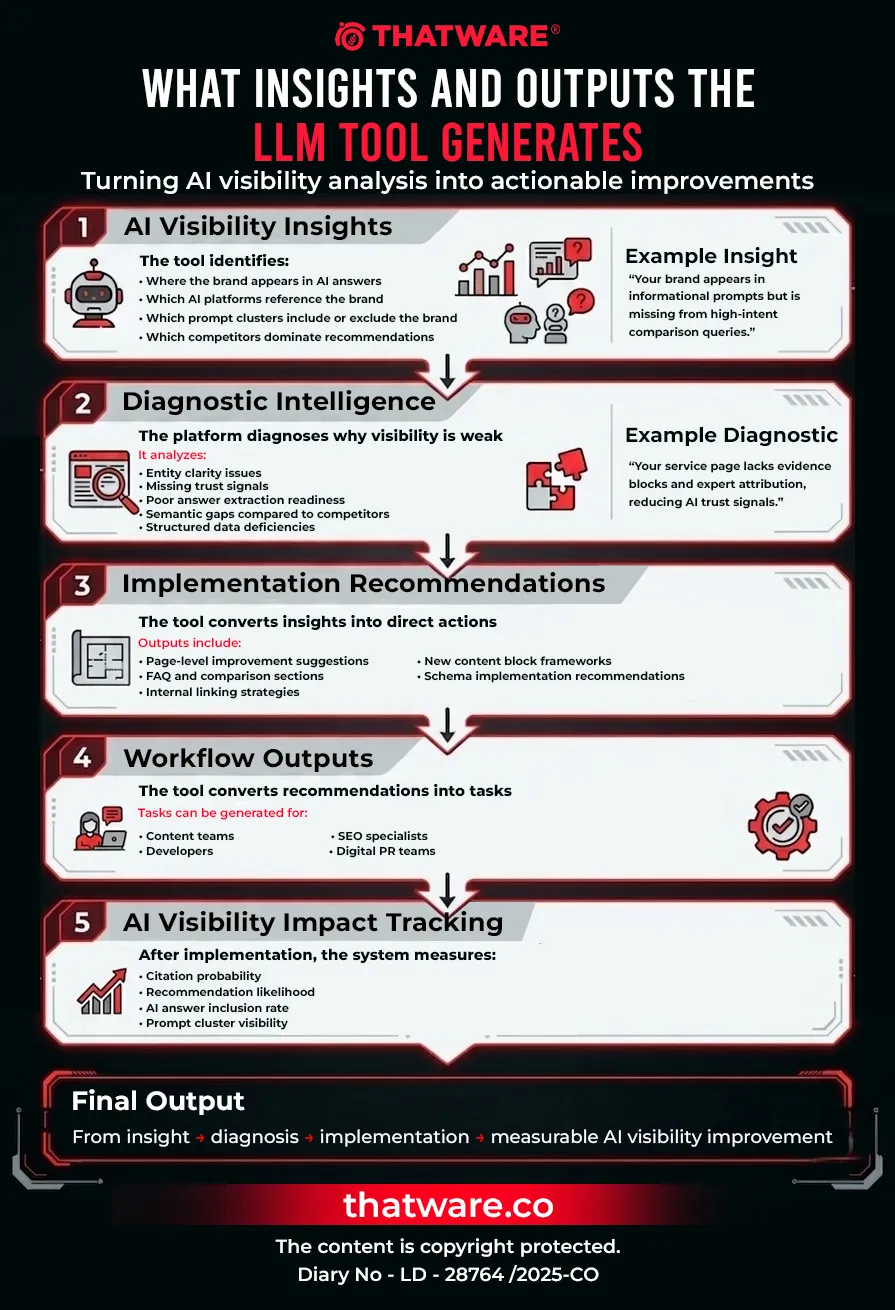
2. Product Vision
Most tools in the market stop at visibility tracking. They show whether a brand appeared in an AI response or not. While useful, this information alone does not help businesses improve their position in AI ecosystems.
ThatWare’s approach goes much further.
The platform is designed to move users from observation to action, providing clear insights into what needs to change on a website in order to improve its likelihood of being cited or recommended by AI systems.
This vision aligns with ThatWare’s long-standing focus on advanced search science, AI-driven optimization, and implementation-first strategies.
The Core Questions the Platform Must Answer
The product vision is centered around answering four fundamental questions that businesses now face in the AI search era.
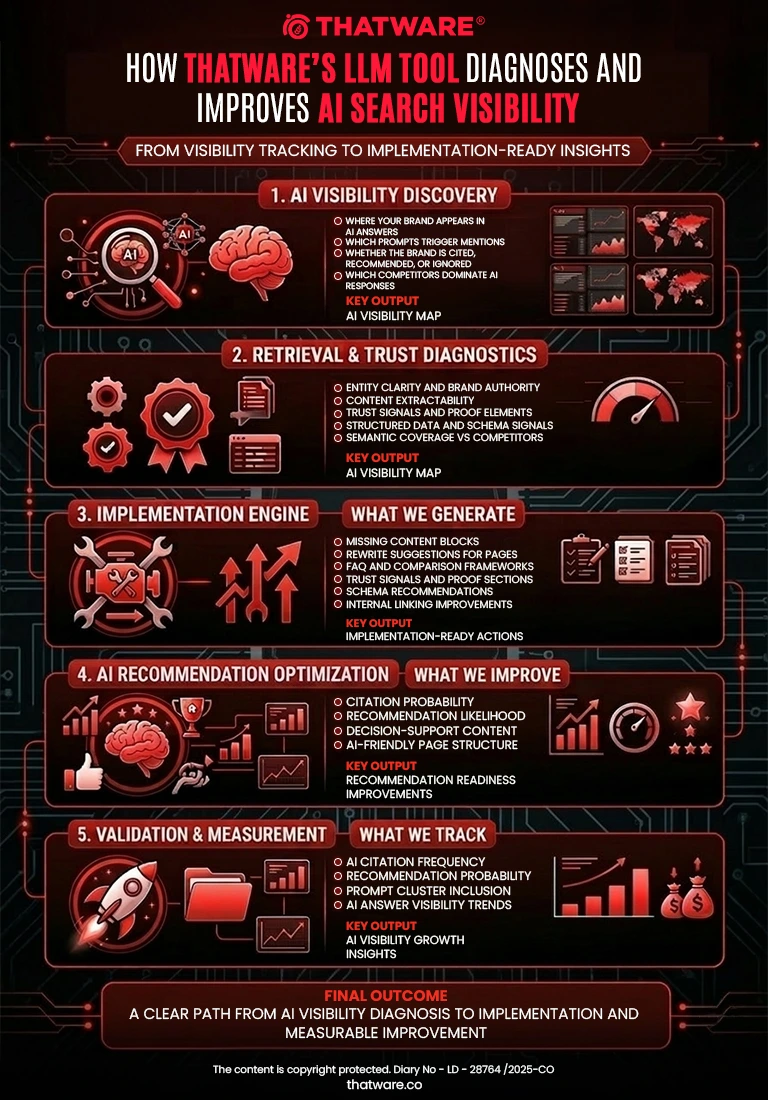
1. Where does the brand appear in AI responses?
The tool analyzes how a brand appears across multiple AI-driven answer engines and conversational search platforms. It identifies:
- Which prompts trigger brand mentions
- Which AI systems surface the brand
- Whether the brand is cited, recommended, compared, summarized, or ignored
- Which competitors dominate specific prompt clusters
This visibility layer provides a clear picture of the brand’s AI search footprint.
2. Why does the brand appear — or fail to appear?
Understanding visibility alone is not enough. The platform diagnoses the underlying reasons behind AI inclusion or exclusion.
Through advanced diagnostics, the system evaluates factors such as:
- Entity clarity and brand authority signals
- Content extractability and answer-ready formatting
- Trust signals such as authorship, proof, and case studies
- Structured data and schema completeness
- Semantic coverage compared to competitors
- Internal knowledge graph strength
By identifying these structural and content-related issues, the platform reveals why AI systems trust some pages more than others.
3. What should be implemented to improve AI inclusion?
This is where the platform differentiates itself most strongly.
Rather than providing generic advice such as “improve content quality” or “increase authority,” the tool generates implementation-ready recommendations.
These include:
- Missing content sections and decision-support blocks
- Rewrite suggestions for key service or product pages
- FAQ and comparison frameworks
- Trust and proof elements such as case studies or expert signals
- Structured data recommendations
- Internal linking improvements
- Entity relationship enhancements
Each recommendation is designed to be directly actionable, allowing teams to implement improvements quickly.
4. How can improvements be validated?
Optimization for AI systems must be measurable.
The platform continuously evaluates how implemented changes affect a brand’s AI visibility and recommendation likelihood. It measures indicators such as:
- Citation probability
- Recommendation probability
- Prompt cluster inclusion rates
- Answer extraction readiness
- Entity confidence signals
This feedback loop ensures that users can clearly see whether the changes they implement are actually improving their AI search presence.
3. Product Pillars
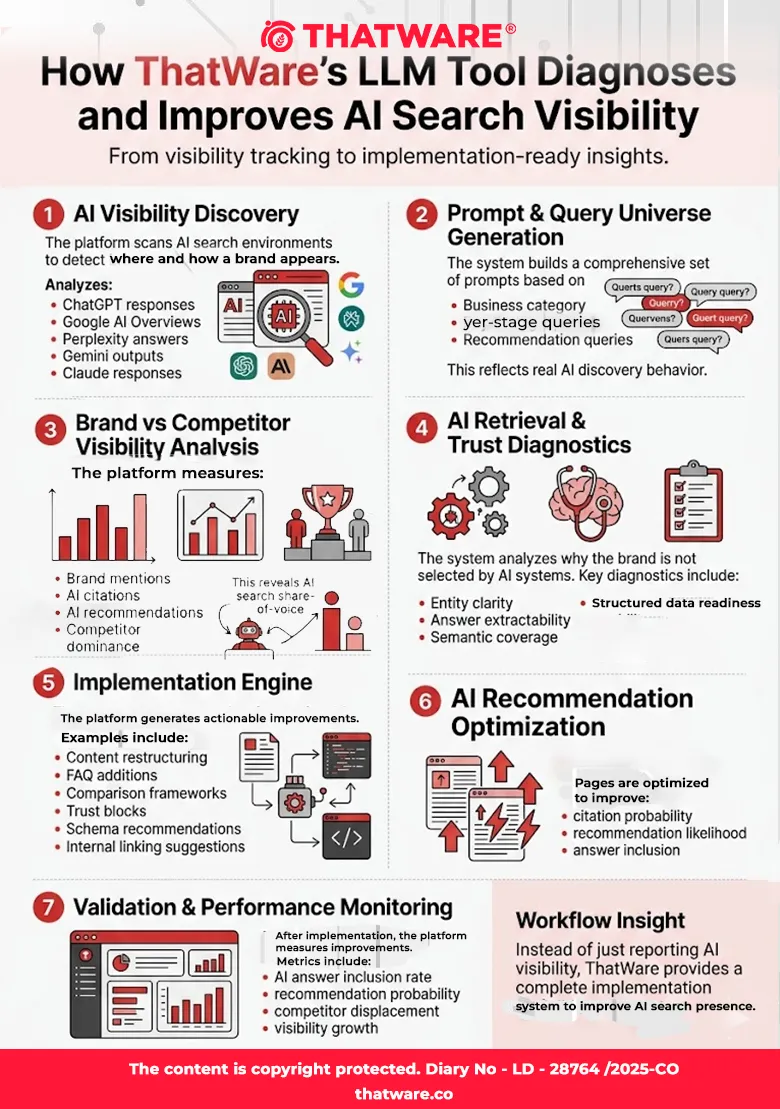
The ThatWare AI Search Implementor platform is designed around seven core product pillars. Each pillar focuses on a critical stage of AI search visibility — from discovery and diagnostics to implementation and validation.
These pillars ensure that the platform does not simply report AI visibility metrics but actively helps businesses understand, fix, and improve their presence across AI answer ecosystems.
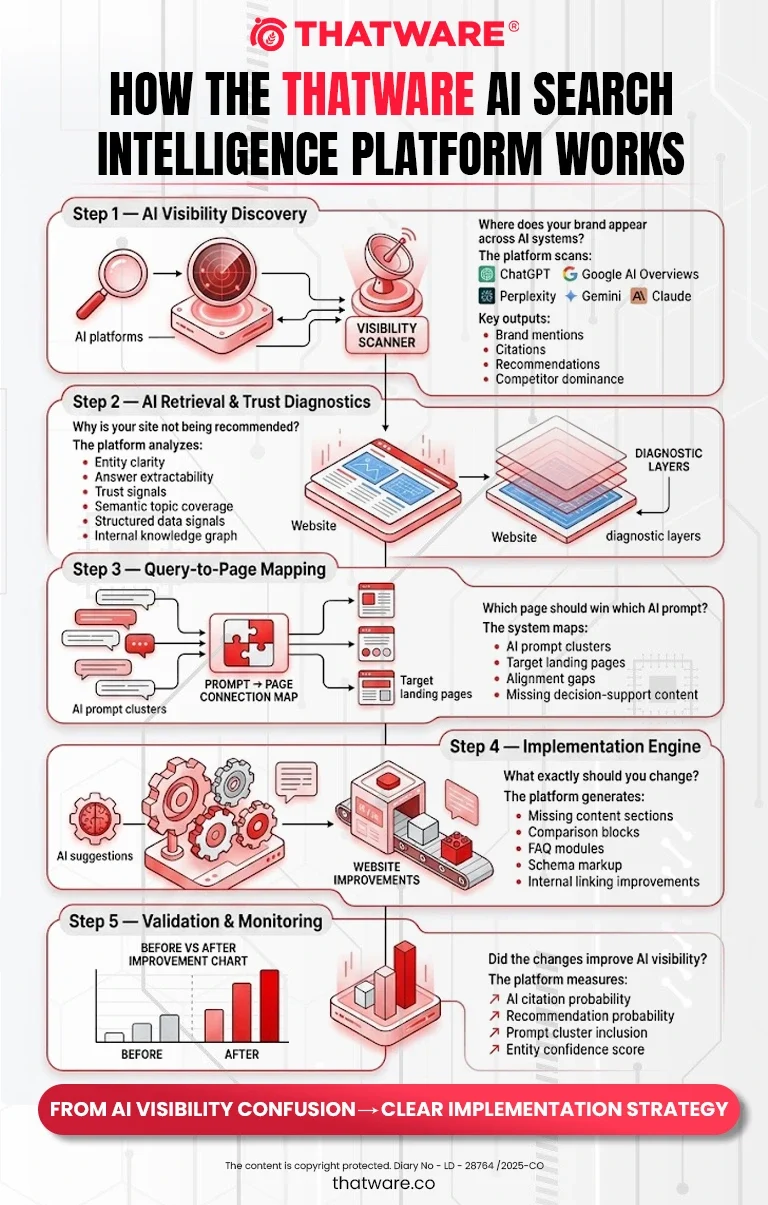
The first pillar establishes the foundation of the entire platform: discovering where a brand appears in AI-generated answers and how it is positioned relative to competitors.
Pillar 1: AI Visibility Discovery
Purpose
The AI Visibility Discovery layer is responsible for detecting where and how a brand appears across AI-driven search and answer systems.
Modern search behavior is increasingly mediated by AI assistants such as Google AI Overviews, ChatGPT, Perplexity, Gemini, and Claude. These systems synthesize answers rather than simply displaying links, which means brands must now compete for inclusion inside AI-generated responses.
This pillar enables ThatWare’s platform to systematically analyze AI outputs and determine how frequently, where, and in what context a brand is surfaced.
Rather than relying on traditional ranking metrics, the system evaluates AI answer inclusion patterns, identifying opportunities where a brand is missing or underrepresented.
Key Questions This Pillar Answers
The AI Visibility Discovery system helps businesses understand:
- Where does the brand appear across AI answer ecosystems?
- For which prompts, queries, and user intents does the brand surface?
- What role does the brand play within AI-generated responses?
This layer gives organizations clarity on how AI systems currently perceive and represent their brand.
Visibility Roles
When a brand appears in an AI-generated answer, it may appear in different roles. ThatWare’s platform classifies brand appearances into structured visibility categories:
- Cited: The brand is referenced as a source or authority used by the AI system.
- Mentioned: The brand appears in the response but without strong endorsement.
- Recommended: The AI system actively suggests the brand as a preferred option.
- Compared: The brand appears as part of a comparison with competitors.
- Summarized: The AI system extracts information from the brand’s content and summarizes it in the response.
- Ignored: The brand is absent despite strong relevance to the query.
Understanding these roles helps organizations determine whether they are merely visible or genuinely trusted by AI systems.
Competitive Context
AI search is highly competitive, and many answers are dominated by a small set of authoritative brands.
ThatWare’s AI Visibility Discovery layer evaluates competitive dynamics by answering:
- Which competitors dominate AI-generated answers?
- Which prompt clusters are controlled by competitors?
- Which brands are consistently recommended by AI systems?
By mapping competitor visibility patterns, businesses can identify where competitors are winning and where opportunities exist to capture AI attention.
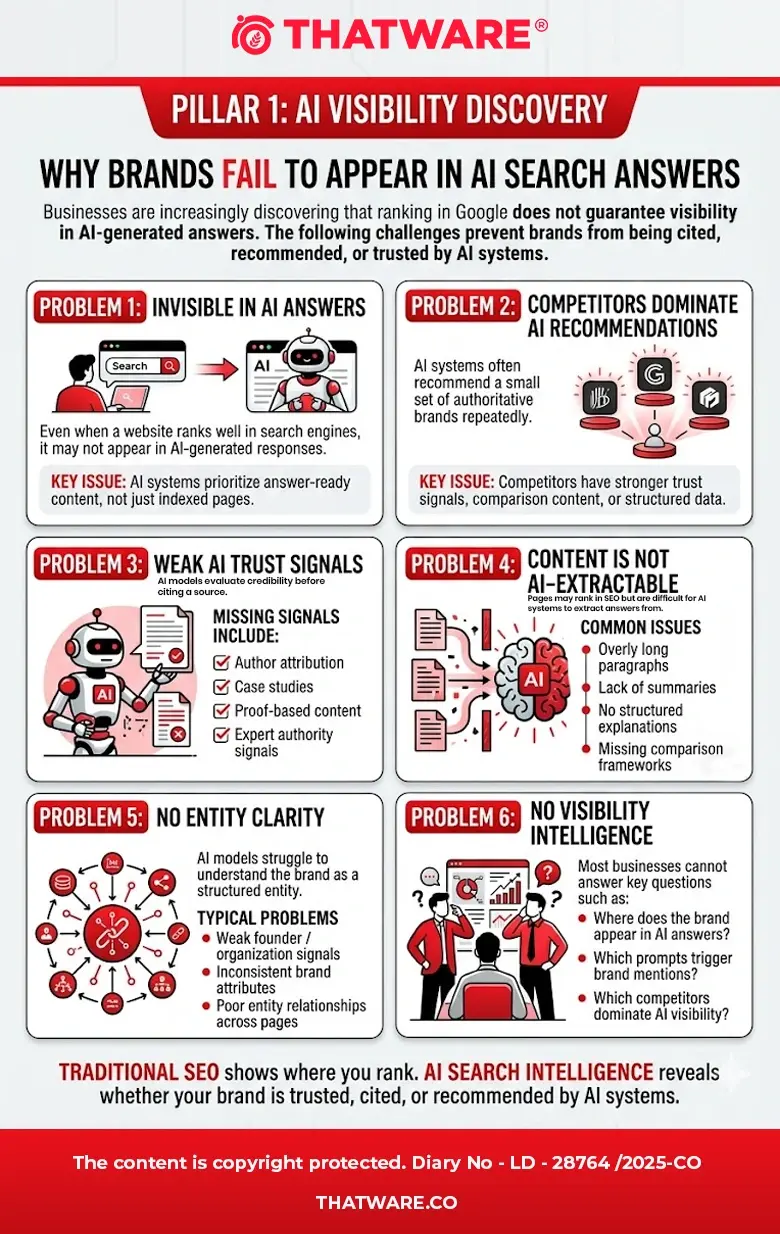
Core Features
To power the AI Visibility Discovery layer, the platform includes several specialized capabilities.
Prompt / Query Universe Generator
The platform automatically generates a comprehensive universe of relevant prompts based on:
- Business category
- Products or services
- Buyer-stage queries
- Recommendation queries
- Comparison queries
- Industry-specific language
This ensures the analysis reflects real AI discovery behavior, not just traditional keyword lists.
Brand vs Competitor Visibility Scanner
The scanner evaluates how often a brand appears compared to competitors across AI responses.
It identifies:
- Relative visibility share
- Competitor dominance in specific prompt clusters
- Brand inclusion gaps in high-value queries
This creates a clear picture of AI search share-of-voice.
AI Answer Snapshot Archive
The platform captures and stores snapshots of AI-generated answers across different models and prompt scenarios.
This allows users to:
- Review historical AI responses
- Track visibility changes over time
- Analyze how AI models represent their brand
It also helps teams understand how their content is interpreted and summarized by AI systems.
Mention, Citation, and Recommendation Classification
Every detected brand appearance is automatically classified based on its role in the answer.
This classification allows the platform to differentiate between:
- passive mentions
- authoritative citations
- direct recommendations
By separating these roles, ThatWare’s system provides deeper insight into AI trust signals.
Query Intent Clustering
Prompts are grouped into intent-based clusters so organizations can understand visibility patterns across different user journeys.
Instead of analyzing thousands of isolated prompts, the system identifies patterns within structured query groups.
Surface Segmentation
AI queries are segmented by user intent, allowing businesses to understand where they are visible across different stages of the decision journey.
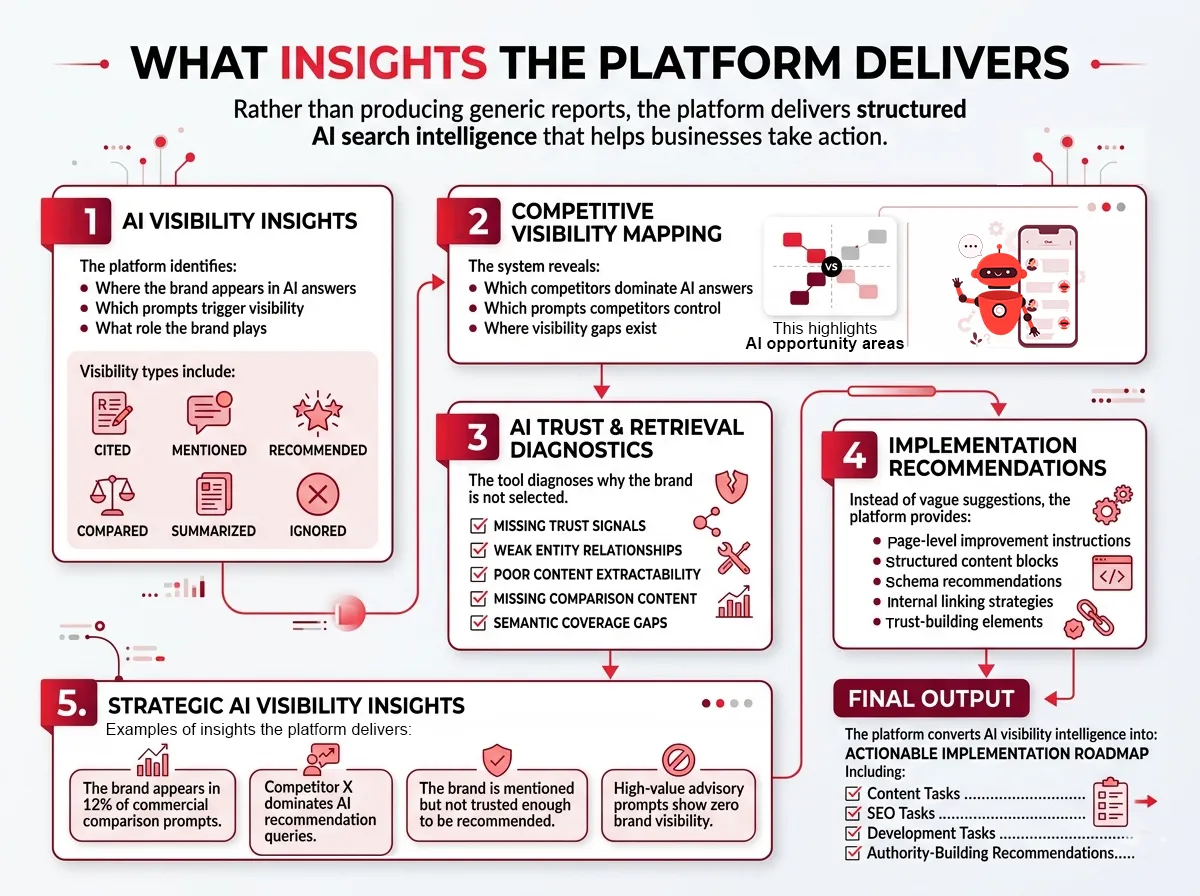
Prompts are categorized into the following segments:
- Informational: Users looking for explanations, definitions, or general knowledge.
- Commercial: Users researching services, providers, or solutions.
- Comparative: Queries comparing multiple options or providers.
- Local: Location-based queries such as “best agency near me.”
- Product Discovery: Queries focused on discovering products or tools.
- Support / Advisory: Users seeking guidance or expert advice.
- Transaction Preparation: Users preparing to purchase or select a provider.
This segmentation helps businesses identify which types of AI queries they currently dominate and which ones represent missed opportunities.
Output Example
Instead of providing simple counts of brand mentions, the ThatWare platform delivers actionable insights.
Examples include:
- The brand is visible in 12% of commercial comparison prompts.
- The brand is absent in high-conversion advisory prompts, representing a missed opportunity.
- Competitor X dominates “best provider” AI recommendation queries.
- The brand is mentioned in several answers but not trusted enough to be recommended.
These insights provide the strategic foundation for the platform’s next layers — diagnostics and implementation — which guide businesses on how to improve their AI visibility and recommendation potential.
Pillar 2: AI Retrieval & Trust Diagnostics
One of the most critical challenges in AI search visibility is not simply ranking in traditional search engines—it is being trusted, extracted, and cited by AI systems.
Modern AI systems such as ChatGPT, Google AI Overviews, Perplexity, Gemini, and Claude rely on sophisticated retrieval and reasoning mechanisms. These systems do not simply index pages; they evaluate entity clarity, factual trust, semantic completeness, and answer extractability before referencing or recommending a source.
The AI Retrieval & Trust Diagnostics pillar within the ThatWare platform is designed to uncover why a website fails to appear in AI-generated answers, recommendations, and citations. Instead of delivering generic SEO recommendations, the system analyzes a website through multiple AI-specific diagnostic layers to identify structural, semantic, and trust-related weaknesses that reduce the likelihood of AI inclusion.
This diagnostic framework transforms traditional website analysis into AI-native retrieval intelligence, enabling brands to understand how their content is interpreted by large language models and answer engines.
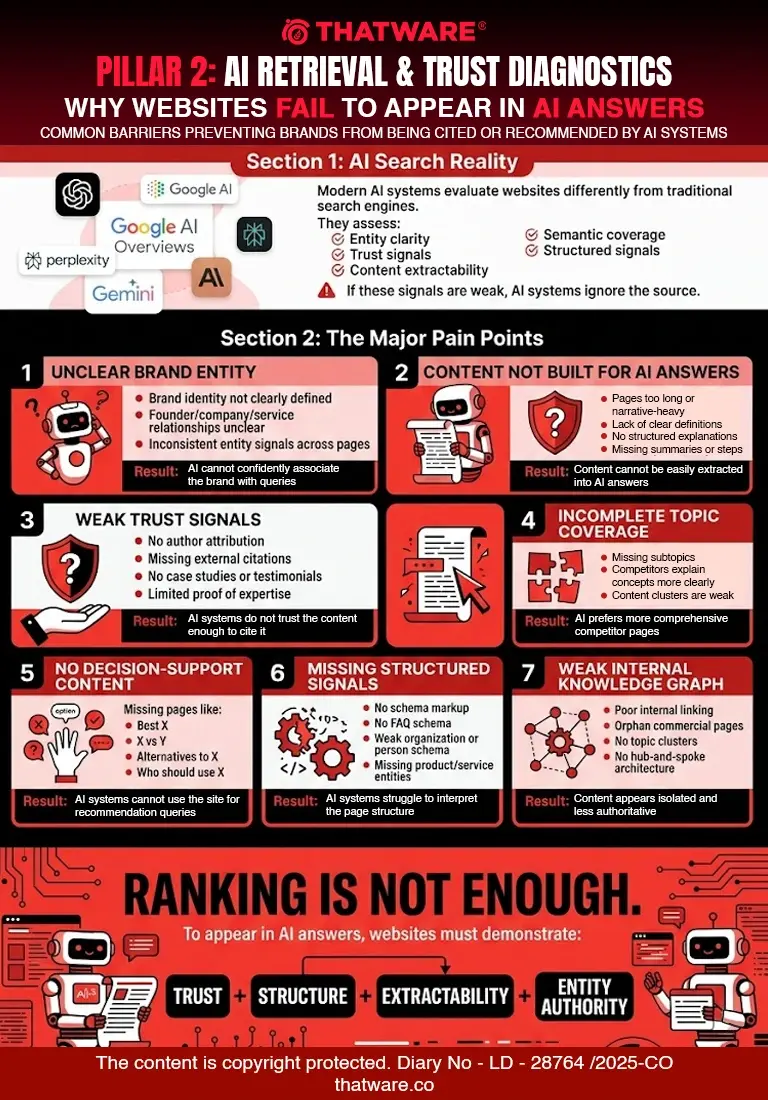
Diagnostic Layers
1. Entity Clarity
AI systems heavily rely on entity understanding to determine authority and contextual relevance. If a brand’s identity, relationships, and attributes are unclear, AI models struggle to associate the website with relevant queries.
ThatWare’s entity clarity diagnostics analyze whether the website clearly defines the brand as a structured entity within its domain.
The system evaluates:
- Whether the brand identity is clearly defined across pages
- Whether relationships between founder, company, services, and products are logically structured
- Whether entity attributes remain consistent throughout the website
- Whether the website communicates a clear entity hierarchy that AI systems can interpret
Weak entity clarity often leads to situations where a brand is mentioned but not recommended, or indexed but not trusted as a source.
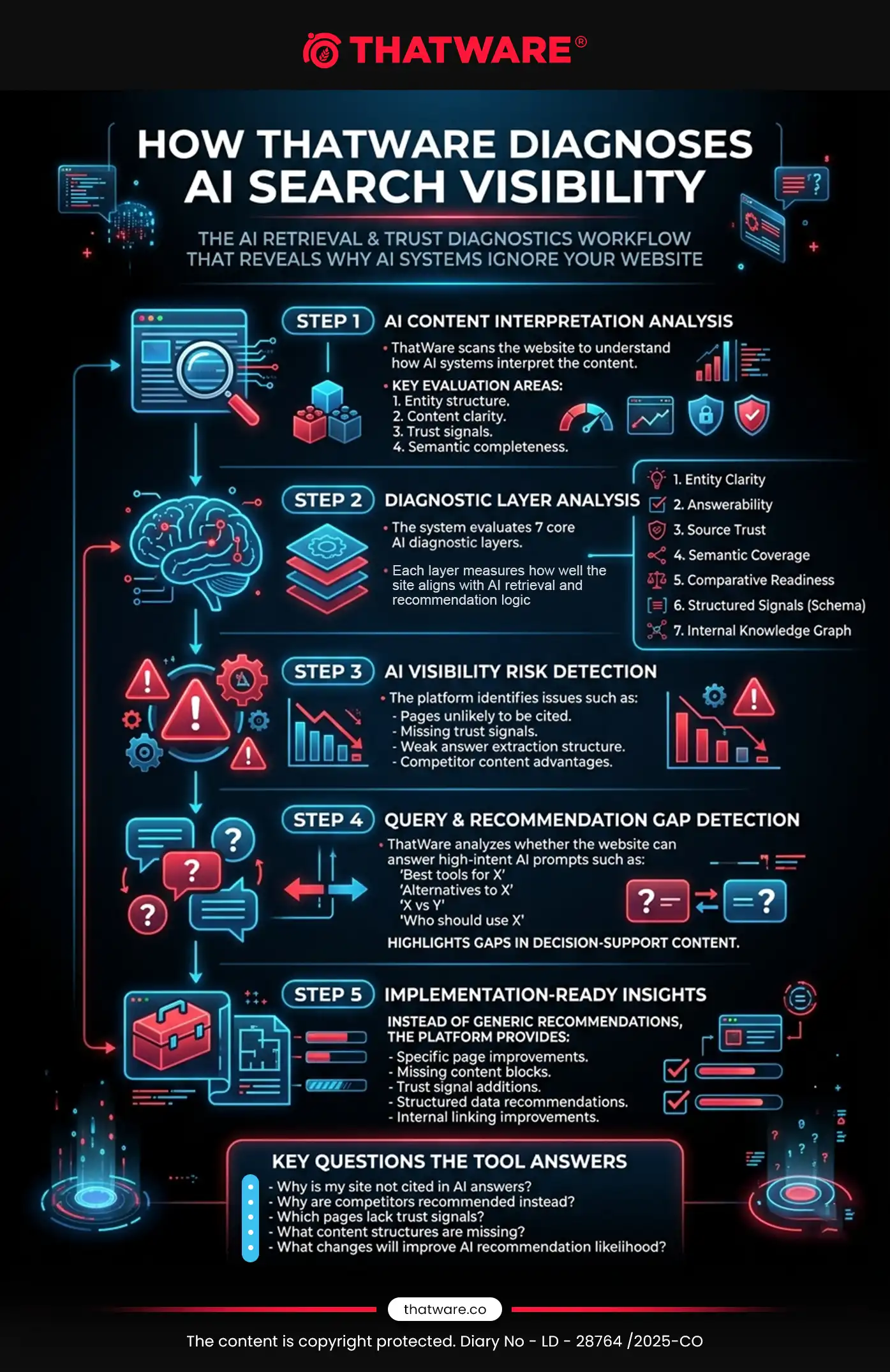
By identifying inconsistencies and missing relationships, the platform helps websites build a stronger entity footprint, making them more recognizable to AI systems.
2. Answerability
AI answer engines prioritize content that can be easily extracted into answer-ready units. Pages that are overly verbose, poorly structured, or lacking clear informational segments are less likely to be selected by AI systems.
ThatWare evaluates how easily a page can be transformed into AI answers.
The system analyzes whether pages contain:
- Clear definitions
- Step-by-step explanations
- Structured comparisons
- Practical use cases
- Concise summaries
It also detects whether pages are too narrative-heavy or fluffy, which can reduce their usefulness for answer extraction.
Through answerability diagnostics, the platform identifies content that may rank in search engines but still fails to appear in AI responses due to poor extraction readiness.
3. Source Trust
Trust signals play a critical role in determining whether an AI system cites a source. AI models increasingly favor content that demonstrates verifiable authority, credibility, and expertise.
ThatWare evaluates the presence and strength of trust signals across a website.
These signals include:
- Clear author attribution
- External citations and references
- Testimonials and user feedback
- Case studies and proof of outcomes
- Professional credentials and expertise indicators
If a website lacks these credibility signals, AI systems may avoid citing the content even if the information is relevant.
The platform highlights missing proof layers and helps websites strengthen the evidence-based credibility that AI systems prefer.
4. Semantic Coverage
AI systems assess whether a page covers a topic comprehensively. If important subtopics are missing, the system may consider competitor pages more complete and therefore more suitable for answering queries.
ThatWare performs deep semantic analysis to detect coverage gaps.
This includes identifying:
- Missing subtopics within a content cluster
- Areas where competitors provide deeper explanations
- Conceptual gaps that weaken topical authority
By highlighting these gaps, the tool helps businesses expand their content strategically so that their pages better match the full informational scope expected by AI systems.
5. Comparative Readiness
Many high-intent queries involve comparisons or decision-making prompts such as:
- “Best tools for X”
- “Alternatives to X”
- “X vs Y”
AI systems frequently use comparison-oriented content to generate recommendations.
ThatWare evaluates whether a website includes decision-support content such as:
- “X vs Y” comparison pages
- “Best X” lists
- “Alternatives to X” resources
- “Why choose X” explanations
- “Who should use X” guidance
If a website lacks these structures, it may struggle to appear in commercial or recommendation-based AI queries.
This diagnostic layer ensures that websites include the decision frameworks AI systems rely on when generating recommendations.
6. Structured Signal Readiness
Structured data helps AI systems interpret page meaning and entity relationships more reliably.
ThatWare scans websites to detect missing or weak structured signals, including:
- Schema markup
- FAQ structured data
- Product or service entity markup
- Review schema
- Organization and person schema
These structured elements act as machine-readable signals that help AI systems understand the credibility and purpose of a page.
When these signals are missing, AI systems may fail to interpret the content correctly, reducing its likelihood of being used in answers.
7. Internal Knowledge Graph
AI systems also evaluate how information is connected within a website. Strong internal linking structures reinforce topic relationships and improve AI understanding.
ThatWare analyzes the internal knowledge graph of a website to identify structural weaknesses.
The system detects issues such as:
- Weak internal linking between related pages
- Orphan commercial pages that receive little contextual support
- Poor topical reinforcement within content clusters
- Lack of hub-and-spoke architecture
Without a strong internal structure, even high-quality content can appear isolated and less authoritative in AI retrieval systems.
Example Diagnostic Output
A major limitation of many SEO and AI visibility tools is that they produce generic recommendations that are difficult to act upon.
Instead of vague advice like:
“Improve content depth.”
ThatWare’s AI Retrieval & Trust Diagnostics provide specific, actionable insights.
For example:
- “Your service page defines the offering but lacks trust-bearing evidence blocks.”
- “Competitor pages include price framing, use-case fit, and proof signals that your page currently lacks.”
- “Founder and company entity signals are disconnected, weakening brand authority signals.”
- “Your content is optimized for traditional SEO indexing but not structured for AI answer extraction.”
By delivering clear explanations and implementation-ready insights, this diagnostic layer enables businesses to understand exactly what prevents their pages from being cited or recommended by AI systems.
Pillar 3: Implementation Engine
The Implementation Engine is the core differentiator of the ThatWare AI Search Implementor platform. While most tools stop at reporting insights or highlighting visibility gaps, ThatWare focuses on what businesses actually need—clear, implementation-ready actions that directly improve AI visibility, citation probability, and recommendation likelihood.
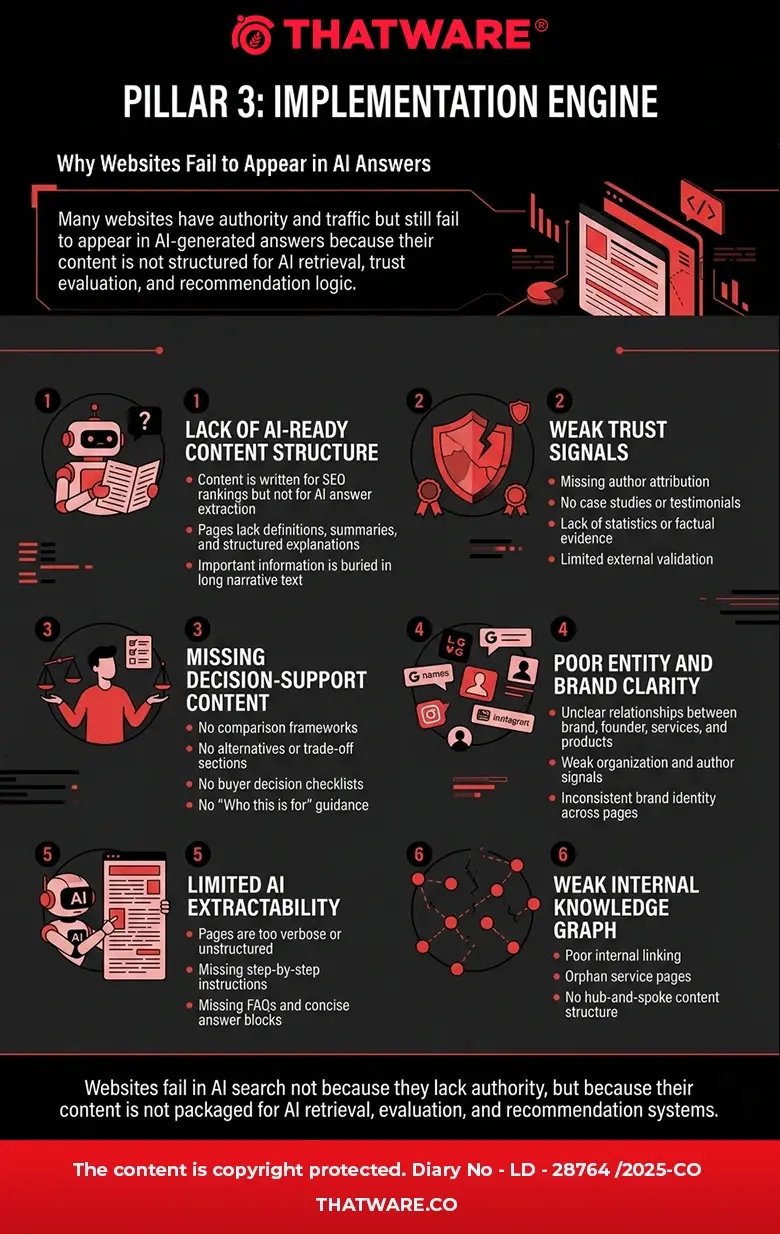
AI-driven search systems such as ChatGPT, Google AI Overviews, Perplexity, Gemini, and Claude prioritize content that is structured for answer extraction, supported by strong trust signals, and aligned with user intent. Many websites fail to appear in AI answers not because they lack authority, but because their content is not packaged in a way that AI systems can easily retrieve, evaluate, and recommend.
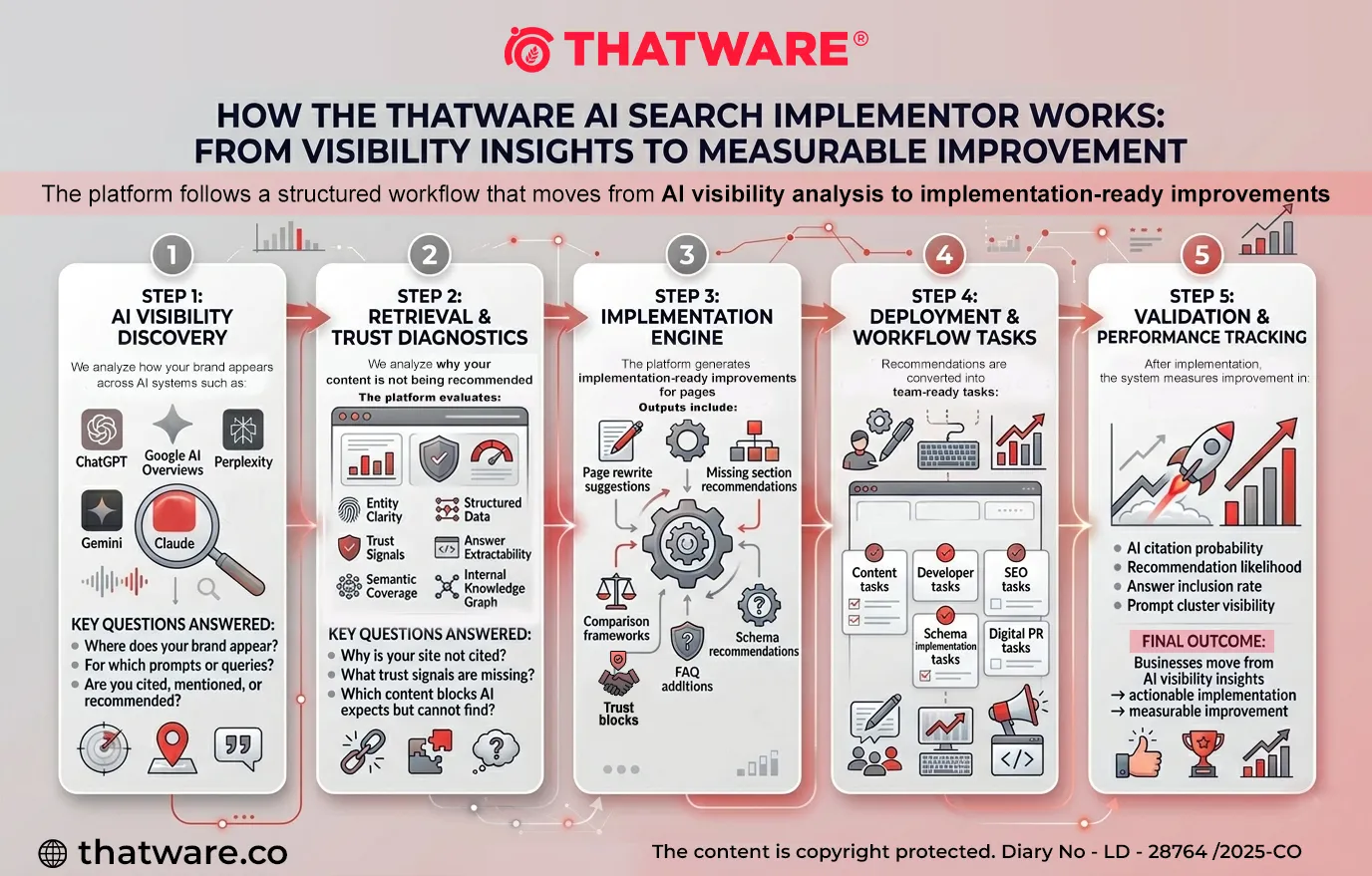
The Implementation Engine bridges this gap by transforming diagnostics into actionable improvements at the page, block, and workflow level. Instead of telling users to “improve content quality” or “increase authority,” the system provides precise instructions, ready-to-use content structures, and deployment-ready assets.
This ensures that website owners, SEO teams, and agencies can move from analysis to implementation quickly, improving their chances of being cited and recommended by AI systems.
Page-Level Implementation
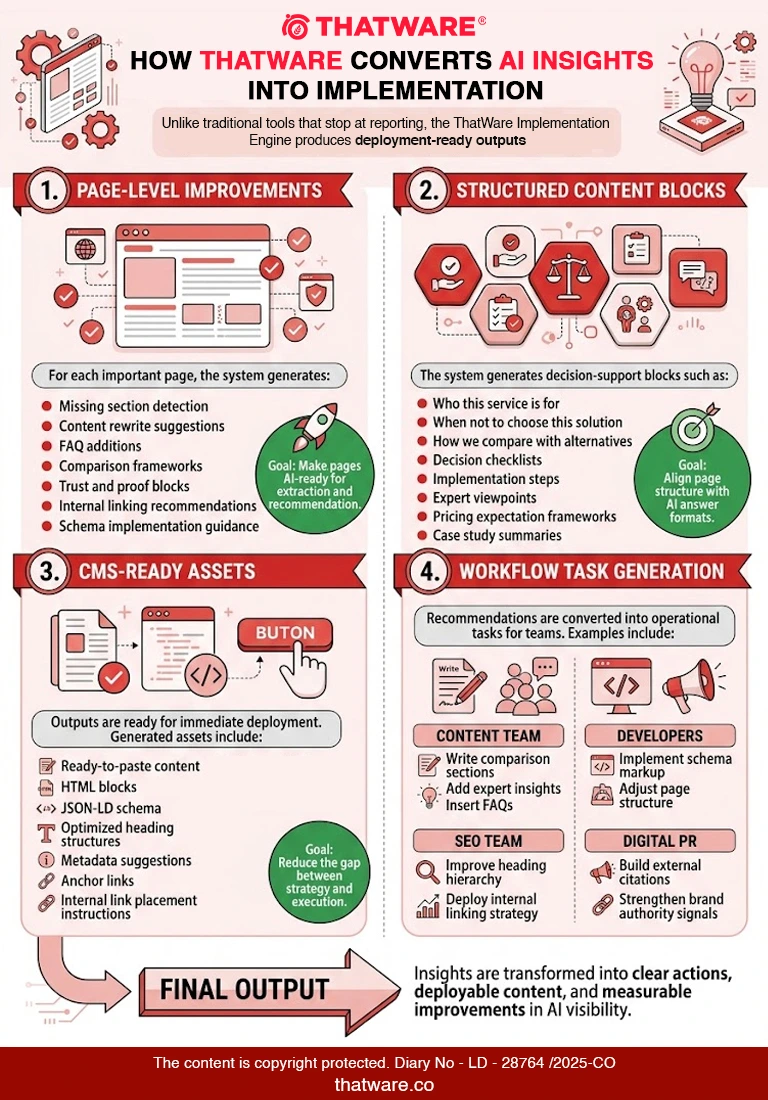
At the page level, the Implementation Engine evaluates every important URL and generates specific improvements required to make the page AI-ready.
For each page, the platform identifies structural, informational, and trust-related gaps that prevent the page from being used in AI-generated answers. It then generates clear implementation guidance tailored to that page’s purpose, intent, and competitive landscape.
Key page-level recommendations include:
Missing Sections Detection
The tool identifies essential sections that are absent but commonly present in pages that appear in AI answers. These may include comparison frameworks, decision-support sections, expert insights, or proof elements.
Rewrite Suggestions
ThatWare’s system generates optimized rewrite recommendations that make content more extractable, factual, and AI-friendly, improving the likelihood of citation or recommendation.
FAQ Additions
The engine generates high-intent FAQ sections based on prompt clusters and real user queries, improving the page’s ability to address conversational AI queries.
Comparison Blocks
Pages often fail to rank in AI responses because they lack structured comparisons. The engine suggests “X vs Y,” “Best alternatives,” and “When to choose X” sections that help AI systems present balanced answers.
Trust Blocks
AI systems prioritize content supported by evidence and authority signals. The engine recommends adding trust elements such as testimonials, proof points, statistics, case studies, and expert statements.
Statistics and Evidence Blocks
Data-driven insights increase citation probability. The engine identifies where statistics or research-backed statements should be added to strengthen factual credibility.
Author and Expert Proof Sections
Pages that demonstrate real expertise and identifiable authorship are more likely to be cited. The engine suggests author bios, credentials, and expert commentary sections.
Internal Link Suggestions
Internal linking strengthens topic authority and helps AI systems understand content relationships. The tool suggests contextual internal links between relevant pages.
Schema Recommendations
The engine detects missing structured data and recommends appropriate schema types such as:
- FAQ schema
- Organization schema
- Product schema
- Review schema
- Article schema
- Service schema
This improves how AI systems interpret the page’s context and entities.
Block-Level Implementation
Beyond page-level improvements, the Implementation Engine generates structured content blocks that help pages better support decision-making and AI answer extraction.
These blocks are designed to mirror the types of content AI systems frequently extract and summarize.
Examples include:
“Who This Service Is For”
Defines the ideal audience and use cases for a product or service. This helps AI systems understand the target audience and recommendation fit.
“When Not to Choose This Solution”
This section increases trust and credibility by acknowledging scenarios where the solution may not be ideal.
“How We Compare with Alternatives”
Comparison frameworks help AI systems generate balanced recommendations.
Decision Checklists
These sections guide users through evaluation criteria and provide structured decision-support content that AI models often surface.
Implementation Steps
Step-by-step guides are highly extractable and frequently used in AI responses.
Expert Viewpoints
Statements from specialists or industry experts reinforce authority and improve trust signals.
Pricing Expectation Frameworks
These sections provide users with realistic expectations about cost, helping AI systems answer pricing-related queries.
Case Study Snippets
Short proof-driven summaries of real results strengthen credibility and support recommendation logic.
By adding these blocks, pages become more aligned with the information structures that AI systems prioritize when generating answers.
CMS-Ready Implementation
One of the most powerful aspects of ThatWare’s Implementation Engine is that it does not stop at recommendations. It produces deployment-ready assets that teams can immediately implement within their CMS.
This dramatically reduces friction between analysis and execution.
Generated outputs include:
Ready-to-Paste Copy
Fully written sections optimized for AI answer extraction and user readability.
HTML Content Blocks
Structured HTML modules that can be inserted directly into CMS editors.
JSON-LD Schema Markup
The system generates structured data in JSON-LD format, ready for implementation without additional engineering effort.
Metadata Suggestions
Recommendations for title tags, meta descriptions, and structured headings aligned with AI query intent.
Anchor Links
Anchor structures that improve content navigation and allow AI systems to reference specific sections.
Heading Structure Optimization
Suggested H1, H2, and H3 hierarchy to improve clarity, extraction readiness, and topical organization.
Internal Link Placement Instructions
Detailed instructions on where to place links between pages to strengthen the site’s internal knowledge graph.
By delivering CMS-ready implementation components, ThatWare ensures that recommendations can move from strategy to deployment within minutes rather than weeks.
Workflow Implementation
The final step of the Implementation Engine is turning recommendations into clear operational tasks that teams can execute.
Many SEO and AI visibility tools fail because they generate insights without translating them into actionable workflows. ThatWare solves this by converting every recommendation into task-level outputs aligned with real team roles.
Examples include:
Content Team Tasks
- Create new sections or blocks
- Rewrite existing content for answer extraction
- Add comparison frameworks
- Insert FAQs and expert insights
Developer Tasks
- Implement schema markup
- Adjust page structure
- Add technical enhancements for structured content
SEO Team Tasks
- Optimize heading hierarchy
- Implement internal linking recommendations
- Improve topical coverage and entity alignment
Schema Engineering Tasks
- Deploy structured data models
- Validate schema implementation
- Align entity relationships across pages
Outreach and Digital PR Tasks
- Strengthen trust signals through citations
- Build external validation and authority signals
- Acquire references and mentions that improve credibility
Pillar 4: Query-to-Page Mapping Engine
One of the most powerful and differentiated components of the ThatWare AI Search Implementor is the Query-to-Page Mapping Engine. While most tools only track prompts or measure visibility, this engine directly connects AI search behavior to the exact pages that should win those answers.
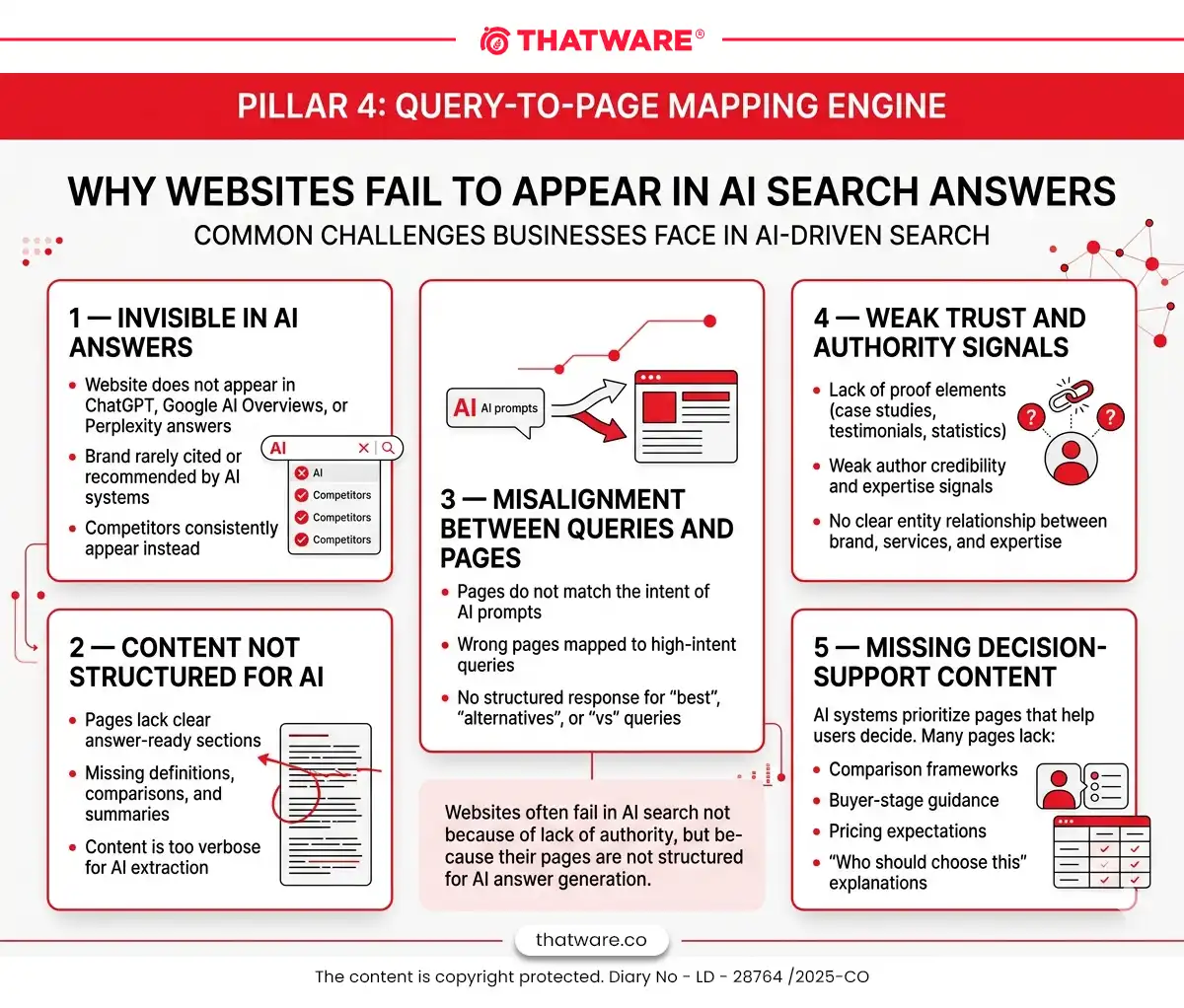
In AI-driven discovery systems like Google AI Overviews, ChatGPT, Perplexity, Gemini, and Claude, answers are generated from pages that best match the intent, structure, authority signals, and decision-support content required by the query. However, many websites fail to appear not because they lack authority, but because their pages are misaligned with the intent and structure required by AI systems.
The Query-to-Page Mapping Engine solves this gap by identifying which prompts matter, determining which page should serve those prompts, diagnosing misalignment, and generating implementation-ready improvements.
Purpose
The engine connects AI prompt behavior to site architecture and content readiness, enabling businesses to optimize pages specifically for AI answer inclusion and recommendation.
It systematically maps:
- Prompt clusters — groups of AI queries representing real discovery behavior.
- Target pages — the pages on a site that should logically satisfy those prompts.
- Alignment problems — structural, semantic, or trust-related issues preventing the page from being selected.
- Required improvements — specific implementation steps needed to improve AI citation or recommendation likelihood.
This approach transforms AI optimization from guesswork into a clear, implementable strategy tied directly to revenue pages.
How the Engine Works
The Query-to-Page Mapping Engine follows a structured process.
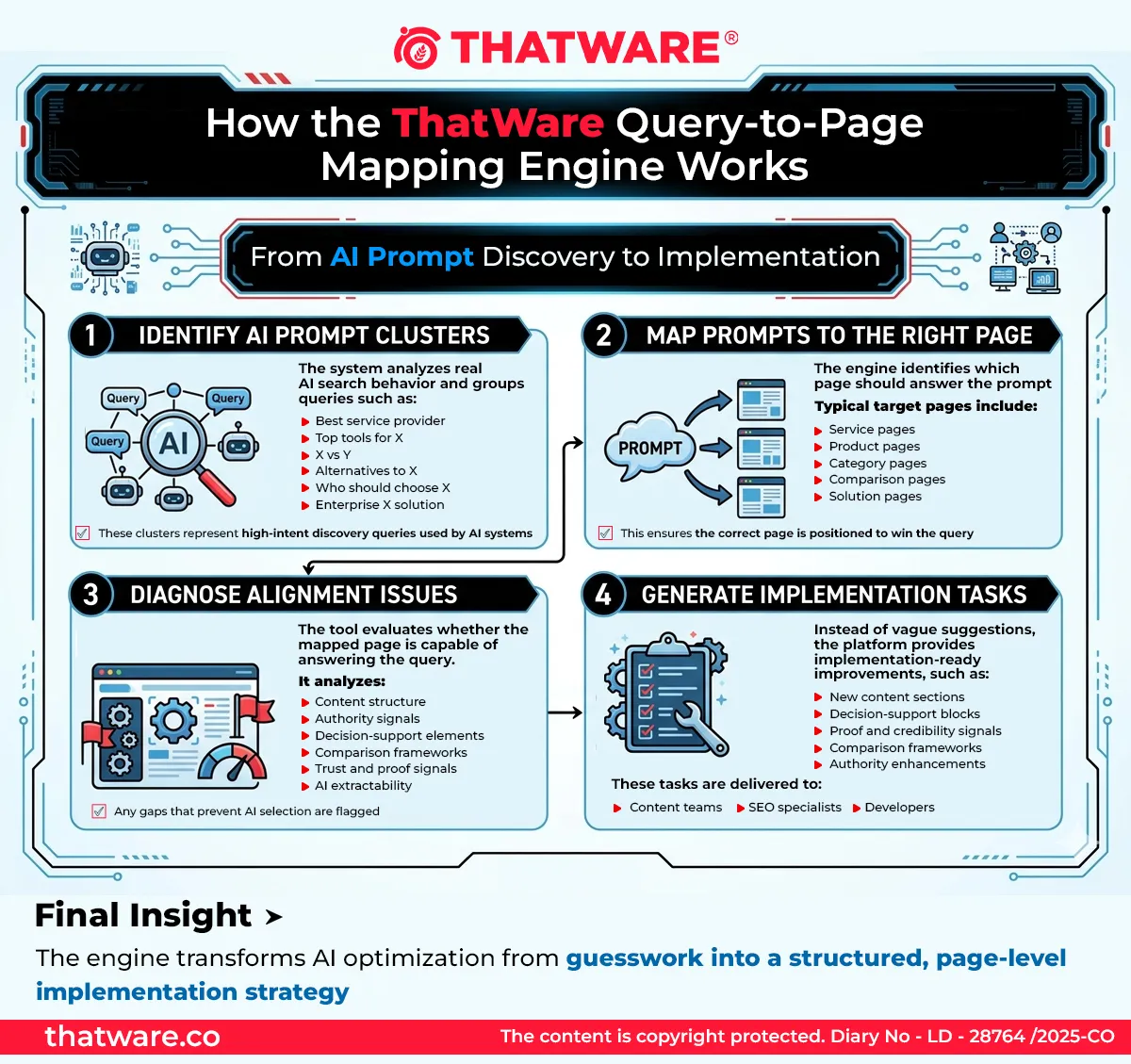
1. Prompt Cluster Identification
The system generates and analyzes clusters of prompts representing common AI search behaviors, including:
- “Best service provider”
- “Top tools for X”
- “X vs Y”
- “Alternatives to X”
- “Who should choose X”
- “Affordable X”
- “Enterprise X solution”
These clusters represent high-intent discovery and recommendation queries used across AI systems.
2. Page Mapping
Once prompt clusters are identified, the system maps them to the most relevant page on the site, typically a:
- Service page
- Product page
- Category page
- Comparison page
- Solution page
This mapping ensures the right page is positioned to win the prompt.
3. Alignment Diagnostics
The engine then analyzes whether the mapped page is actually capable of answering the prompt effectively.
It evaluates:
- Content structure
- Authority signals
- Decision-support elements
- Comparison frameworks
- Proof and credibility signals
- AI extractability
If the page lacks these components, the system flags alignment gaps.
4. Implementation Recommendations
Instead of generic advice, the platform generates precise improvements that help the page align with the intent of the prompt cluster.
This includes:
- New content sections
- Structural improvements
- Authority signals
- Comparison frameworks
- Proof elements
- Decision-support content
These recommendations are generated as implementation-ready tasks for content teams, SEO specialists, and developers.
Example
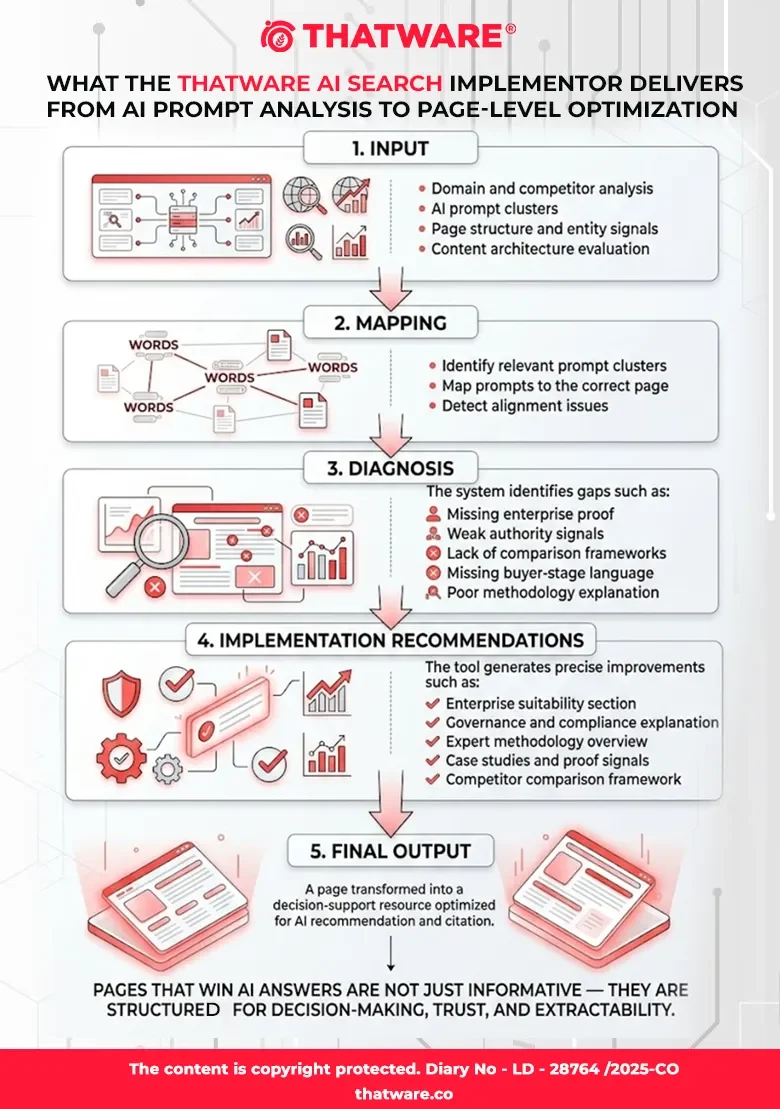
Prompt Cluster
“Best AI SEO agency for enterprise brands”
Mapped Page
Enterprise SEO service page
Detected Problems
- Lack of enterprise-specific proof
- Weak authority and expertise signals
- No structured comparison framework
- Missing buyer-stage language
- Insufficient methodology explanation
Suggested Implementation
The system recommends improvements designed to increase the page’s probability of being recommended in AI answers.
Recommended additions include:
- Enterprise suitability section explaining which organizations benefit from the service
- Governance and compliance explanation outlining enterprise-level operational processes
- Expert-led methodology overview describing ThatWare’s proprietary approach
- Enterprise case studies demonstrating real-world outcomes
- Competitor comparison framework explaining how ThatWare differs from other agencies
These improvements help transform the page into a decision-support resource, which is exactly the type of content AI systems prioritize when generating recommendations.
Pillar 5: Competitive Implementation Intelligence
One of the most critical capabilities of the ThatWare AI Search Implementor is understanding why competitors are being cited, recommended, or prioritized by AI systems. Visibility in AI-generated answers is rarely accidental. It is typically the result of how content is structured, how trust signals are presented, and how clearly a page supports decision-making for users.
The Competitive Implementation Intelligence layer goes beyond basic competitor tracking. Instead of simply identifying which competitors appear in AI answers, the platform analyzes how and why their content performs better in AI-driven recommendation environments such as Google AI Overviews, ChatGPT discovery, Perplexity, Gemini, and Claude.
By reverse-engineering competitor success patterns, ThatWare enables businesses to identify precise implementation opportunities that can improve their likelihood of being cited or recommended.
Competitor Page Pattern Analysis
AI systems tend to favor pages that are clearly structured for answer extraction and decision support. The tool analyzes competitor pages to detect structural patterns that contribute to their inclusion in AI responses.
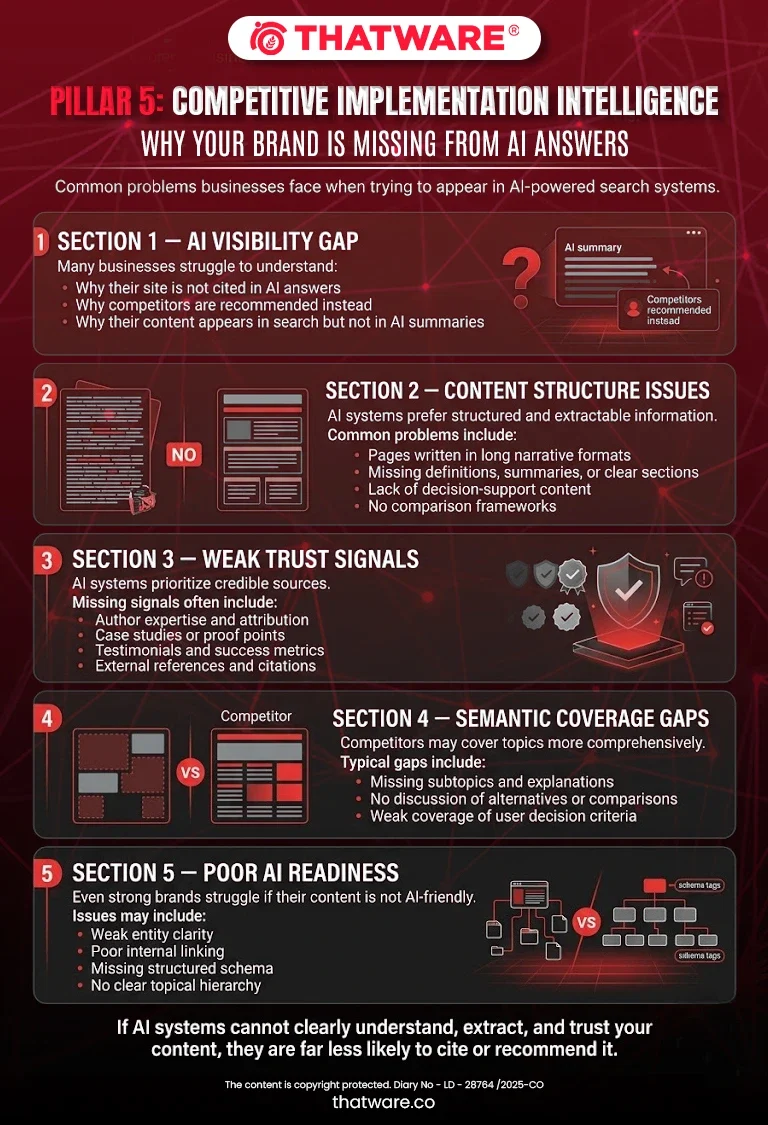
This includes identifying:
- How competitors define their services or products
- Whether they use clear summaries, structured explanations, or comparison frameworks
- How they frame use cases, buyer fit, and expected outcomes
- The presence of decision-support content such as FAQs, checklists, and summaries
For example, the tool may detect that a competitor’s page begins with a concise definition and outcome-focused summary, which makes it easier for AI systems to extract and reference that content in generated answers.
ThatWare’s platform highlights these structural advantages and recommends equivalent or improved implementations for the user’s pages.
Semantic Gap Detection
Another major reason competitors dominate AI answers is semantic coverage.
AI systems prefer sources that demonstrate comprehensive topical coverage. If competitor pages cover key subtopics, related concepts, or decision criteria that a brand’s pages ignore, the competitor is more likely to be selected.
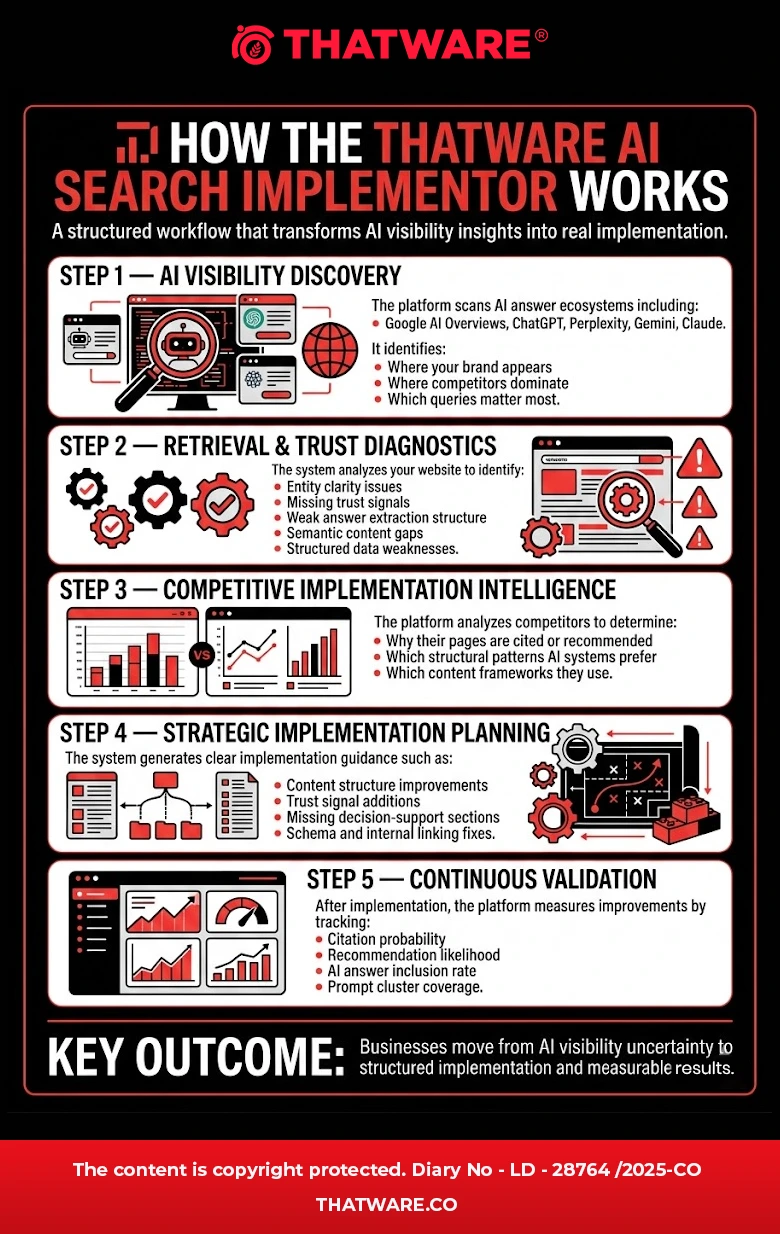
The Competitive Implementation Intelligence engine identifies:
- Missing concepts
- Underserved query intents
- Absent comparison discussions
- Weak explanation depth
For example, the tool may detect that competitors include sections such as:
- “Who this solution is best for”
- “Common use cases”
- “Alternatives to this approach”
- “How to evaluate providers”
If these elements are missing from the user’s page, the platform recommends specific content blocks to close the semantic gap.
Trust Signal Comparison
Trust is a critical factor in AI recommendations. AI models tend to prefer sources that demonstrate credibility, expertise, and validation.
The tool evaluates competitor pages against the user’s pages across multiple trust indicators, including:
- Author expertise and attribution
- Case studies and proof points
- Testimonials and client references
- Industry recognition or credentials
- External citations and research references
- Data-backed claims and statistics
If competitors present clear evidence of outcomes and authority, the system highlights the difference and recommends implementation improvements.
For instance, if competitors include quantifiable results or client success stories, the tool may suggest adding:
- Case study summaries
- Client outcome metrics
- Industry-specific proof blocks
Review Footprint Comparison
For certain industries—particularly local businesses, SaaS platforms, and service providers—reviews and reputation signals significantly influence AI recommendations.
The platform analyzes:
- Volume and distribution of reviews
- Presence of structured review schema
- Placement of testimonial content within pages
- Third-party validation signals
If competitors demonstrate stronger review signals, the platform identifies the gap and provides suggestions to strengthen credibility signals across relevant pages.
Content Packaging Comparison
Even when two sites have similar expertise, the one that packages information more clearly for extraction is more likely to be selected by AI systems.
The tool evaluates how competitor content is packaged in terms of:
- Structured summaries
- Extractable definitions
- Comparison frameworks
- Clear headings and answer blocks
- Decision-support sections
This analysis helps identify situations where a brand already has strong expertise but fails to present it in AI-friendly formats.
For example, the system may determine that competitors present their expertise through clear step-by-step frameworks, while the user’s page presents similar information in long narrative paragraphs that are harder for AI systems to extract.
Example Insights Generated by the Tool
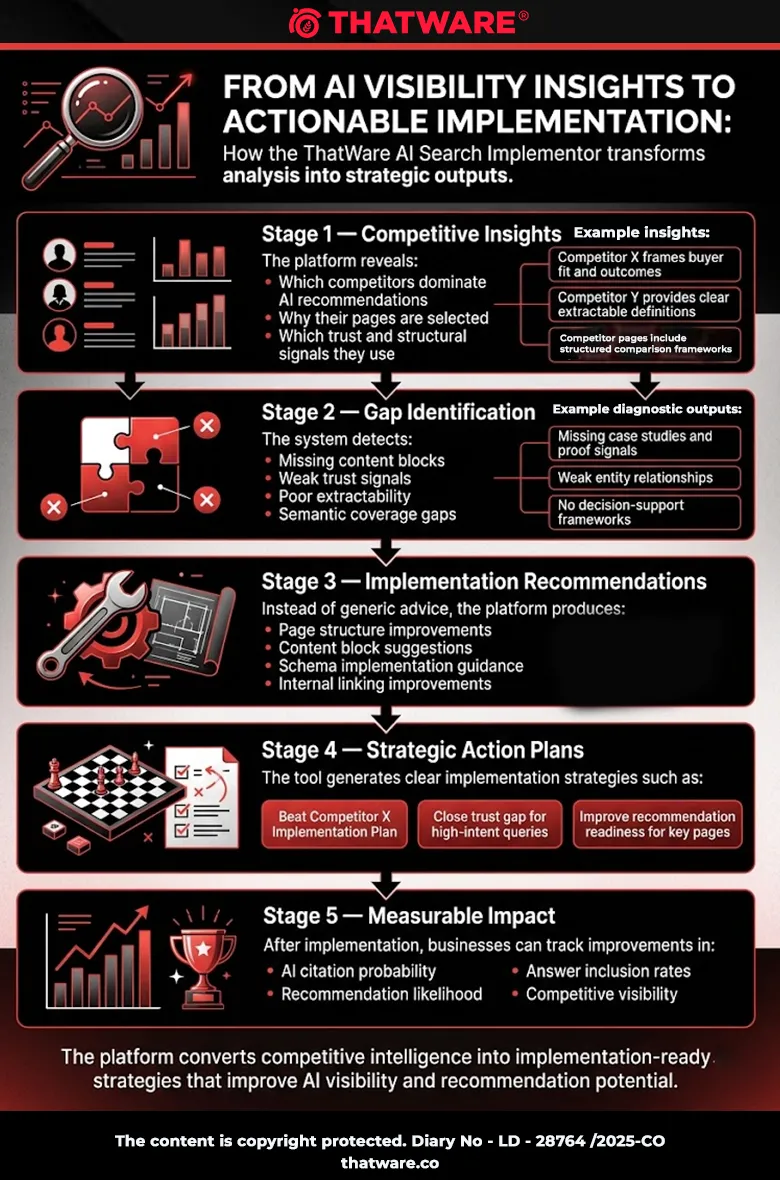
The Competitive Implementation Intelligence module produces clear explanations such as:
- “Competitor X is selected in AI recommendation flows because they clearly frame buyer fit, expected outcomes, and industry specialization.”
- “Competitor Y is frequently cited because their pages contain concise, extractable definitions supported by evidence and statistics.”
- “Your brand demonstrates strong authority, but the information is not structured in a way that supports AI recommendation or citation.”
These insights provide actionable understanding of the competitive landscape within AI search environments.
Strategic Outputs
The ultimate goal of this pillar is not simply competitor analysis but strategic implementation guidance. The platform converts competitor insights into concrete strategies that users can deploy.
Examples of strategic outputs include:
Beat Competitor X Implementation Plan
The system generates a structured plan outlining:
- Content improvements required to surpass the competitor
- Trust signals that need strengthening
- Additional sections or frameworks required on key pages
Pillar 6: Validation & Experimentation Layer
The Validation & Experimentation Layer is where the platform moves beyond diagnostics and implementation to prove real performance improvement in AI search ecosystems. While many tools stop at recommendations, ThatWare’s system closes the loop by validating whether implemented changes actually increase a brand’s visibility and recommendation likelihood across AI answer engines.
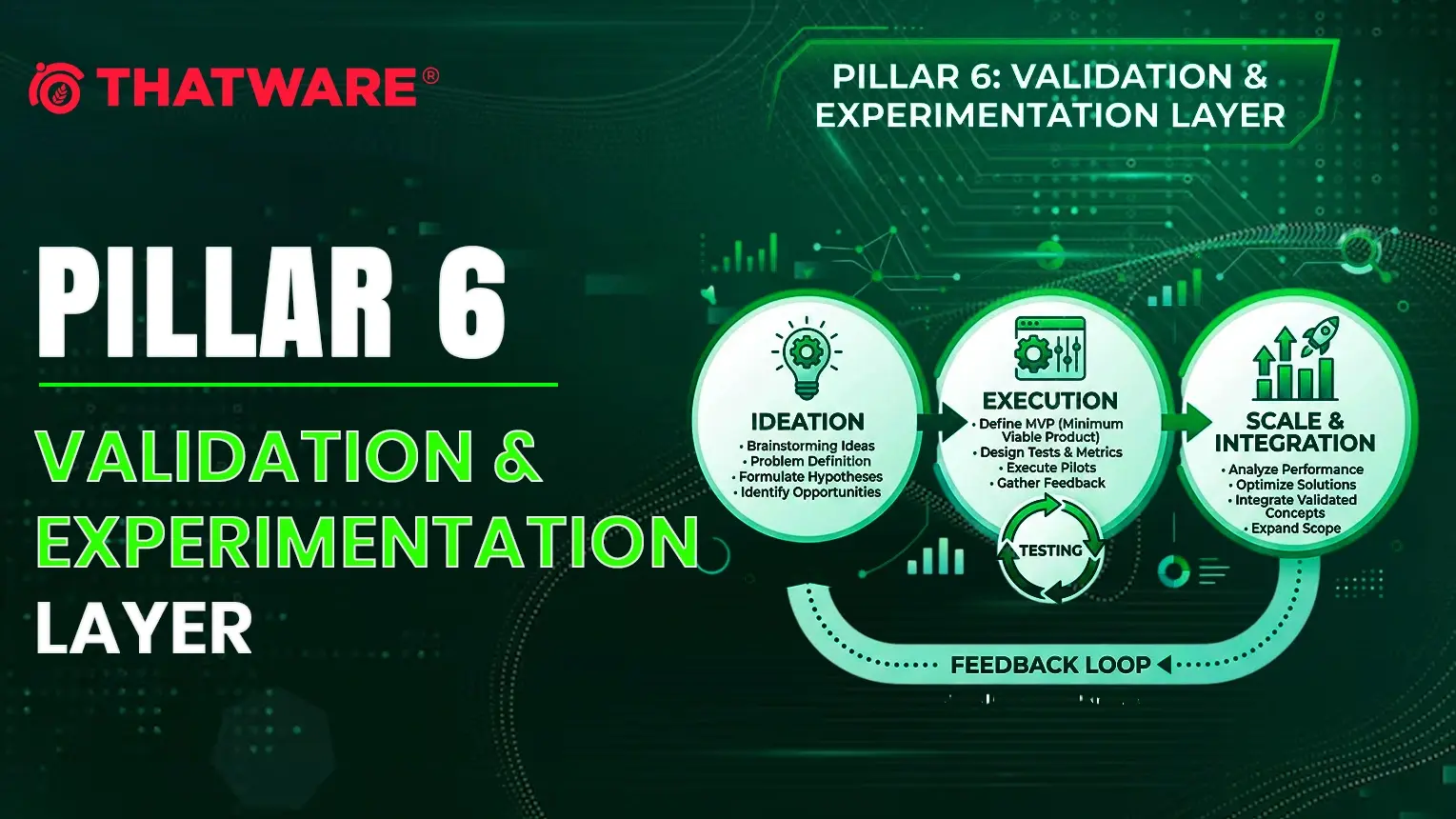
This layer ensures that optimization efforts are not based on assumptions. Instead, every change made to a website can be tested, measured, and refined using AI behavior simulations and structured performance tracking.
At its core, this pillar transforms the platform into an ongoing optimization system rather than a one-time auditing tool.
ThatWare designed this layer to answer one critical question:
Did the implementation actually improve the brand’s ability to be cited, recommended, or surfaced in AI-generated answers?
The Validation Workflow
The validation engine operates through a structured experimentation cycle that mirrors modern product experimentation frameworks.
1. Detect Issue
The process begins with the diagnostic system identifying weaknesses that reduce AI visibility. These may include missing decision-support content, weak entity signals, insufficient trust elements, or pages that lack extractable answer structures.
For example, the system may detect that a service page is not structured in a way that allows AI systems to easily extract recommendations or comparisons.
2. Recommend Fix
Once the issue is identified, the platform generates implementation-ready recommendations tailored to the specific page and prompt clusters.
Examples of fixes may include:
- Adding decision-support sections such as “Who This Service Is For”
- Implementing comparison frameworks
- Adding structured data and schema
- Improving entity relationships
- Introducing proof signals such as case studies, statistics, or expert commentary
Each recommendation is designed to improve the page’s retrieval readiness and recommendation potential.
3. Implement Fix
After recommendations are approved, the changes are implemented through the platform’s Implementation Studio or deployed by the content, development, or SEO teams.
Because ThatWare’s system generates CMS-ready blocks, schema structures, and task-level workflows, implementation can occur quickly and systematically across multiple pages.
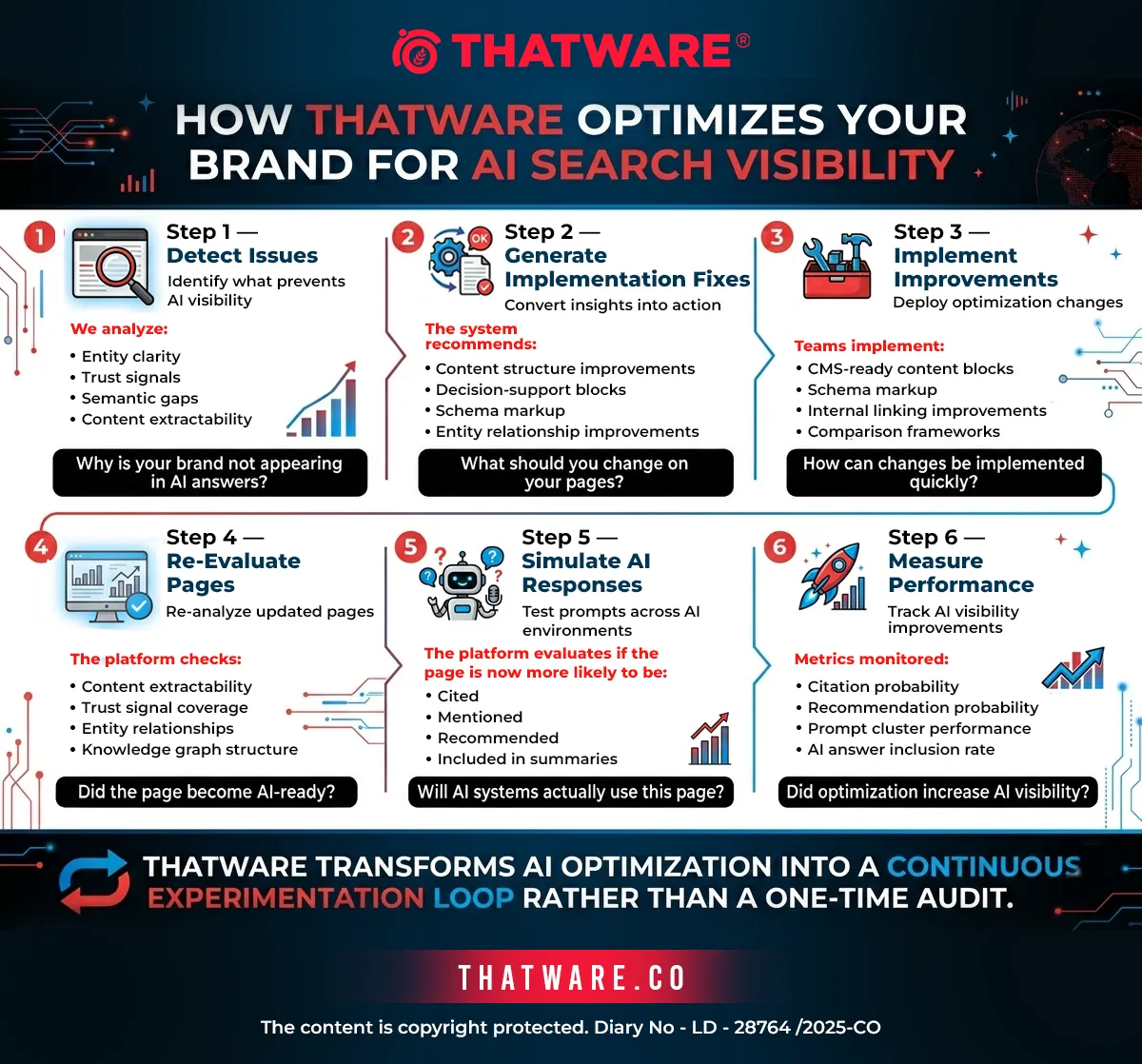
4. Re-evaluate Pages
Once changes are live, the platform automatically re-crawls and analyzes the updated pages.
This step evaluates improvements in areas such as:
- content extractability
- trust signal coverage
- entity clarity
- decision-support completeness
- internal knowledge graph alignment
This ensures the page now meets the structural expectations required for AI answer extraction.
5. Simulate AI Responses
One of the most advanced components of this pillar is the AI response simulation engine.
The platform runs relevant prompt clusters across AI answer environments and analyzes how the updated page aligns with answer-generation patterns.
This allows the system to evaluate whether the page is now more likely to be:
- cited as a source
- included in summarized answers
- recommended as a provider
- referenced in comparisons
- surfaced in advisory prompts
Instead of waiting months for indirect signals, this simulation provides early indicators of AI visibility improvement.
6. Measure Improvements
The final step is to measure the impact of the implementation.
The platform compares pre-implementation and post-implementation states, identifying improvements in citation potential, recommendation readiness, and answer inclusion.
This closes the feedback loop and allows teams to continuously refine optimization strategies.
Through this process, the platform evolves from a static analyzer into a continuous experimentation engine for AI search visibility.
Metrics to Track
To accurately measure progress, the Validation & Experimentation Layer tracks a series of AI visibility and recommendation readiness metrics.
These metrics are designed to reflect how AI systems interpret and utilize website content.
Citation Probability
This metric estimates the likelihood that a page will be used as a source reference in AI-generated answers.
The score is influenced by:
- factual anchors
- definitional clarity
- structured content
- credible citations
- expert attribution
Pages with higher citation probability are more likely to appear as trusted references in AI responses.
Recommendation Probability
Recommendation probability measures how likely a page or brand is to be recommended by AI systems in commercial or advisory prompts.
This score considers:
- decision-support content
- buyer-fit explanations
- comparative frameworks
- proof and outcomes
- service or product clarity
Improving this metric increases the chances that AI systems will suggest the brand when users ask questions such as:
- “best provider”
- “top alternatives”
- “which company should I choose”
Answer Inclusion Rate
This metric tracks how frequently a brand appears in AI-generated responses across a given prompt cluster.
The platform measures:
- inclusion in summaries
- brand mentions
- citations
- recommendation placements
Tracking this rate over time helps organizations understand whether their visibility in AI ecosystems is expanding or declining.
Prompt Cluster Win Rate
Prompt clusters represent groups of related queries that reflect real user intent.
Examples include:
- “best SEO agency”
- “alternatives to X”
- “how to choose an SEO provider”
The win rate measures how often the brand appears in AI responses within a given cluster compared to competitors.
This helps identify strategic gaps in AI search presence.
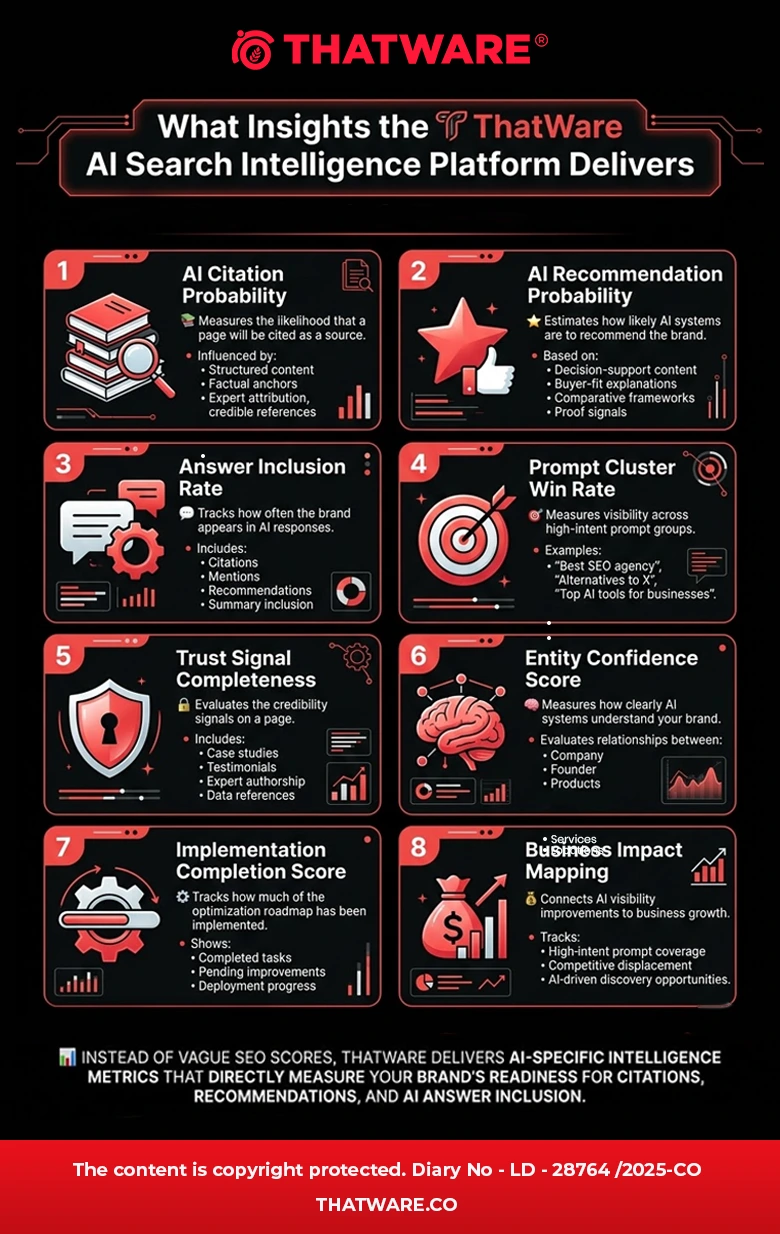
Trust Signal Completeness
AI systems increasingly evaluate trust and credibility signals before surfacing sources.
This metric measures the completeness of trust indicators such as:
- case studies
- testimonials
- expert attribution
- statistics and data points
- references and citations
- transparent authorship
Improving trust signal completeness increases both citation and recommendation potential.
Entity Confidence Score
AI models rely heavily on entity understanding.
The Entity Confidence Score measures how clearly the platform can interpret relationships between:
- company
- founder
- services
- products
- locations
- industry entities
Weak entity relationships often prevent brands from being recognized as authoritative sources.
Strengthening these signals improves the likelihood that AI systems recognize and reference the brand entity.
Implementation Completion Percentage
This metric tracks how much of the recommended optimization roadmap has been implemented.
It provides visibility into:
- completed tasks
- pending actions
- partially implemented fixes
This ensures that teams remain aligned with the optimization roadmap generated by the platform.
Business Impact Mapping
Ultimately, optimization must connect to business outcomes.
The Business Impact Mapping system links technical improvements to measurable commercial metrics such as:
- high-intent prompt coverage
- money page optimization
- competitive displacement
- increased AI-driven discovery potential
By mapping AI visibility improvements to business priorities, the platform ensures that optimization efforts are always tied to revenue-driving opportunities.
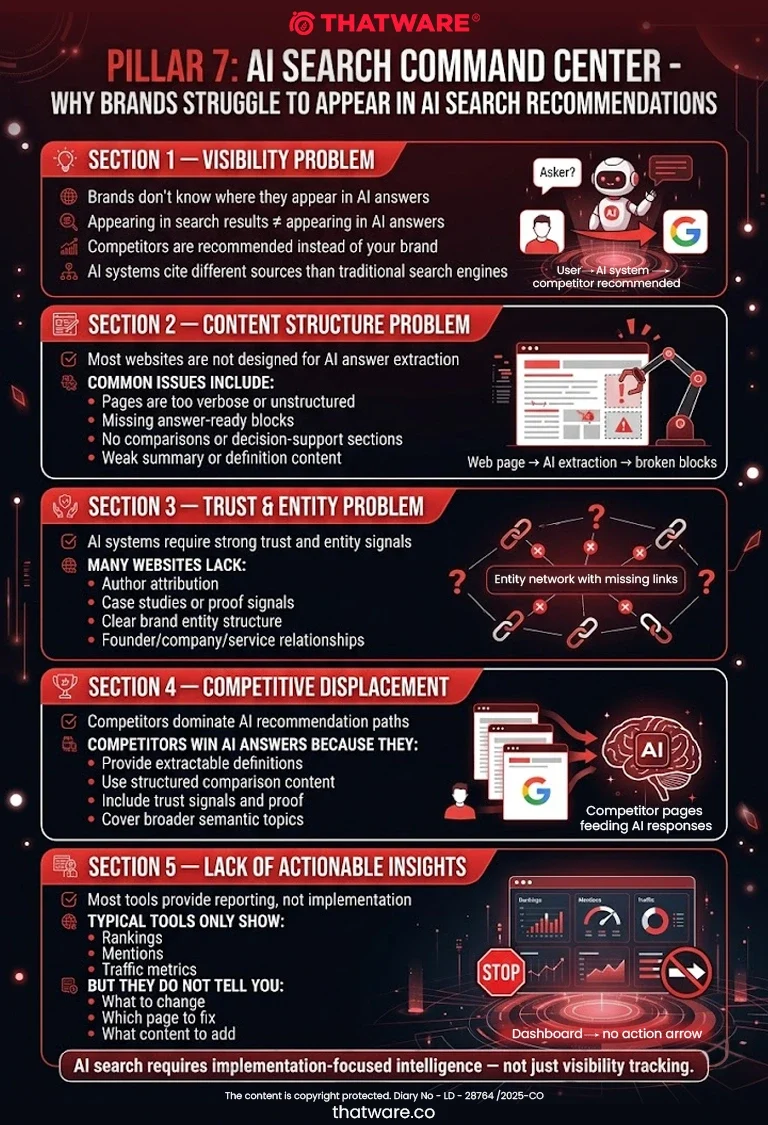
Pillar 7: AI Search Command Center
After the core implementation and optimization engines of the platform are mature, the next layer is the AI Search Command Center. This module acts as the strategic control panel for organizations that want continuous oversight of their AI search visibility, implementation progress, and competitive positioning.
Unlike traditional SEO dashboards that only report rankings or traffic, the ThatWare AI Search Command Center is designed to monitor AI recommendation ecosystems and guide ongoing optimization efforts across AI answer engines such as ChatGPT, Google AI Overviews, Perplexity, Gemini, and Claude.
However, it is important that this dashboard layer comes after the action and implementation engines. ThatWare’s philosophy for this platform is implementation-first intelligence. Businesses do not need more reporting dashboards—they need clear actions that improve AI recommendation and citation probability. Once those actions are in place, the Command Center becomes the interface that monitors progress and reveals new opportunities.
The AI Search Command Center provides a unified view of the most important signals affecting a brand’s visibility within AI-generated answers.
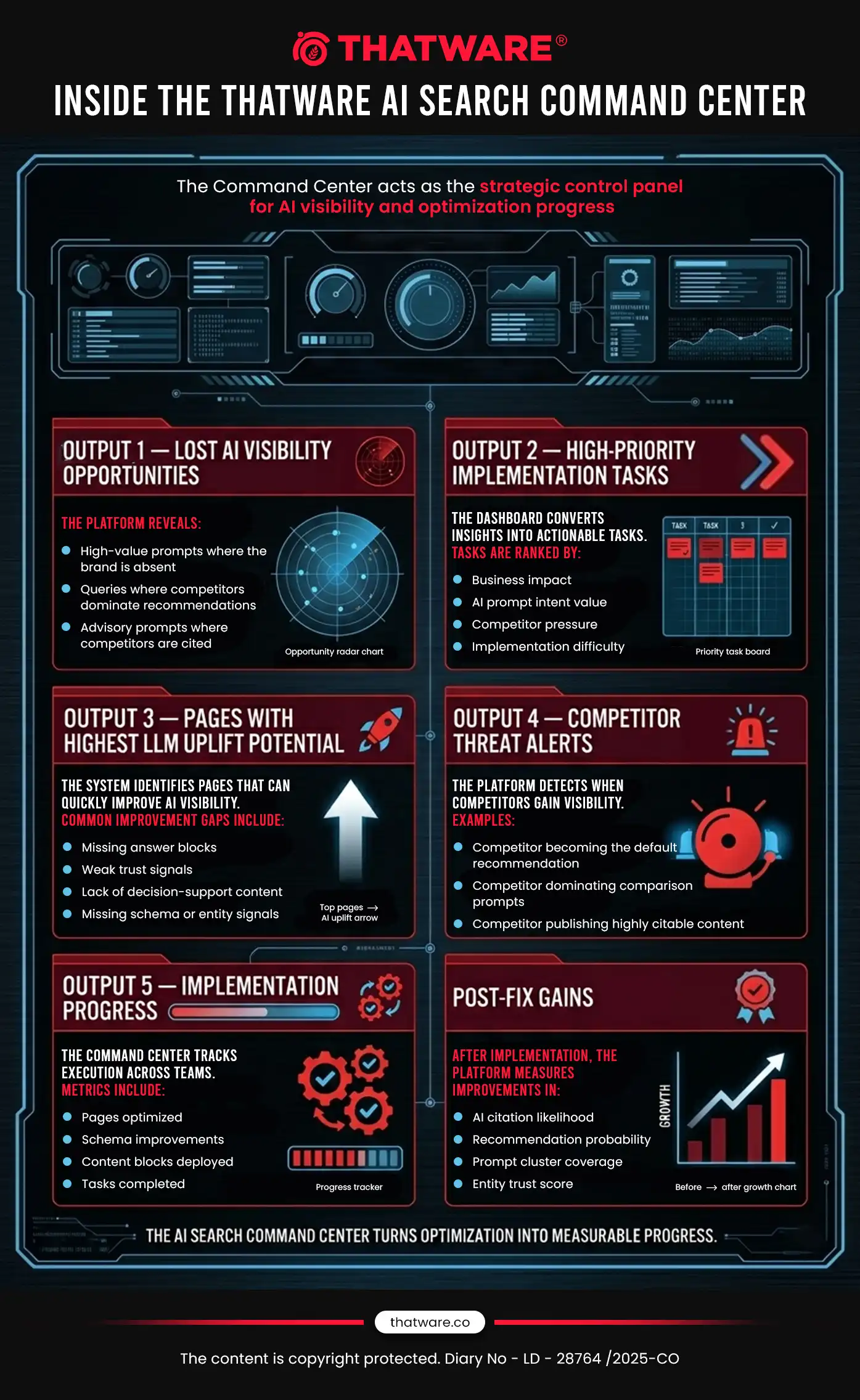
Lost AI Visibility Opportunities
The Command Center highlights prompt clusters and high-value query categories where the brand currently fails to appear in AI-generated answers.
Instead of simply showing missing mentions, the system identifies opportunity gaps, such as:
- High-intent prompts where competitors dominate recommendations
- Commercial queries where the brand is mentioned but not recommended
- Advisory queries where the brand is completely absent
This allows teams to immediately understand where the largest AI search growth opportunities exist.
High-Priority Implementation Tasks
The dashboard continuously aggregates recommendations from the platform’s Implementation Engine and converts them into a prioritized action list.
These tasks are ranked based on factors such as:
- Business impact
- Prompt intent value
- Competitor pressure
- Ease of implementation
This ensures that teams always know which actions will produce the highest improvement in AI visibility and recommendation probability.
Pages with Highest LLM Uplift Potential
One of the most valuable insights provided by the Command Center is identifying pages that have the highest potential to improve AI answer inclusion.
These pages may already have authority and traffic but may be missing critical elements such as:
- Extractable answer blocks
- Trust and proof signals
- Decision-support content
- Structured entity signals
The platform flags these pages so teams can focus on quick wins that significantly increase AI recommendation likelihood.
Competitor Threat Alerts
The Command Center monitors competitor performance across AI systems and highlights when competitors begin to dominate new prompt clusters or recommendation paths.
Examples include:
- Competitors becoming the default recommendation for “best provider” queries
- Competitor pages appearing repeatedly in AI-generated comparisons
- Competitors publishing content patterns that increase citation likelihood
These alerts help brands respond quickly with counter-strategies and content improvements.
Schema and Entity Issues
AI systems rely heavily on structured signals and entity clarity when selecting sources for answers.
The Command Center continuously monitors the site for issues such as:
- Missing or inconsistent schema markup
- Weak organization or person entities
- Incomplete product or service entities
- Broken entity relationships across pages
By surfacing these problems in one place, the system ensures that the brand maintains a strong entity and knowledge graph footprint, which directly improves AI trust.
Prompt Cluster Performance
This section tracks how the brand performs across different AI prompt categories, including:
- Informational prompts
- Commercial comparison queries
- Advisory prompts
- Product discovery queries
- Local recommendation prompts
The dashboard reveals which prompt clusters are:
- Dominated by competitors
- Emerging opportunity areas
- Already performing well
This insight allows marketing teams to align their content and implementation strategies with real AI query behavior.
Implementation Velocity
A key differentiator of the ThatWare platform is its focus on execution, not just insights.
The Command Center therefore measures how quickly recommendations are implemented across the site. This includes metrics such as:
- Tasks completed by team role (SEO, content, development)
- Pages optimized in the current cycle
- Schema improvements deployed
- Content blocks added to strengthen answer extraction
Tracking implementation velocity ensures that organizations translate insights into measurable improvements.
Post-Fix Gains
Once recommended improvements are implemented, the Command Center tracks the impact of those changes.
The system measures improvements in metrics such as:
- AI citation likelihood
- Recommendation probability
- Prompt cluster inclusion rate
- Entity confidence score
- Extraction readiness score
By comparing performance before and after implementation, teams can clearly see which actions are driving AI visibility improvements.
4. Product Development Phases
To build a powerful and scalable AI visibility optimization platform, ThatWare will develop the tool in structured phases. Each phase progressively expands the system’s capabilities—from diagnostics to implementation, automation, and advanced AI intelligence.
This phased approach ensures the product delivers immediate value early, while gradually introducing deeper automation and intelligence layers.
Phase 1 — MVP (Minimum Viable Product)
Core Promise
The MVP will focus on delivering a clear and actionable value proposition:
“Paste your domain and competitors, and ThatWare will show exactly what to implement on your key pages to improve AI recommendation and citation likelihood.”
Instead of creating another analytics dashboard, the MVP prioritizes implementation intelligence—helping businesses understand why they are not appearing in AI-generated answers and what exact changes will improve their chances of being cited or recommended.
Inputs
Users will provide a small set of inputs that allow the platform to analyze AI visibility and page readiness.
Key inputs include:
- Domain – the website being analyzed.
- Competitors – 3–5 primary competitors competing for similar AI answer visibility.
- Business category – industry classification to guide prompt and intent generation.
- Products or services – core offerings that should appear in AI responses.
- Target geography – especially important for local businesses or region-based services.
- Key pages – priority pages such as service pages, product pages, or category pages.
These inputs allow the system to create a structured AI visibility analysis environment.
Outputs
The MVP will generate a set of implementation-focused insights rather than generic reports.
AI Visibility Snapshot
The tool will provide an overview of how the brand currently appears across AI answer ecosystems, including:
- citation presence
- brand mentions
- recommendation inclusion
- competitor dominance across prompts
This snapshot helps users understand their baseline AI search visibility.
Prompt Cluster Map
The system will generate clusters of AI queries relevant to the business, such as:
- informational queries
- comparison queries
- recommendation queries
- problem–solution queries
- local intent queries
- buyer-stage queries
Each cluster will show where the brand appears and where competitors dominate.
Page Diagnostics
The platform will analyze key pages and identify why they are not being selected by AI systems.
Diagnostics may include:
- missing trust signals
- weak entity definitions
- lack of decision-support content
- insufficient structured data
- missing comparison or recommendation frameworks
- poor extraction readiness for AI answers
The output clearly explains why the page fails to qualify for citation or recommendation.
Implementation Recommendations
Instead of generic advice, the tool will generate specific page-level implementation instructions, including:
- missing content sections
- structural improvements
- decision-support content additions
- comparison framework suggestions
- trust and proof blocks
Each recommendation is tied to improving AI citation or recommendation potential.
Content Block Generation
To accelerate implementation, the platform will generate ready-to-use content blocks such as:
- FAQs
- comparison sections
- expert insight blocks
- decision checklists
- trust and proof elements
- use-case explanations
These blocks are designed to make pages AI-answer friendly and extractable.
Schema Suggestions
The MVP will identify gaps in structured data and suggest improvements such as:
- organization schema
- service or product schema
- FAQ schema
- review schema
- author and expert schema
These signals help improve entity recognition and AI retrieval readiness.
Internal Linking Suggestions
The system will identify weak internal linking structures and recommend:
- hub-and-spoke structures
- contextual links between related topics
- authority signal reinforcement across money pages
Strong internal linking helps AI systems understand topical authority and relationships.
Prioritized Action Roadmap
All recommendations will be organized into a clear implementation roadmap, prioritized by:
- expected impact on AI visibility
- implementation difficulty
- page importance
- commercial intent relevance
This ensures users can quickly identify the most valuable actions to implement first.
Phase 2 — Assisted Implementation
Once the MVP establishes the diagnostic and recommendation engine, the next phase will focus on operationalizing implementation.
Many organizations struggle not with insights but with executing improvements across teams. Phase 2 addresses this gap.
Workflow Integration
The platform will integrate with common project management tools, allowing recommendations to be exported directly into team workflows, including:
- Jira
- Trello
- Asana
This converts platform insights into actionable tasks for teams.
Page Rewrite Drafts
The system will generate draft rewrites for key sections, enabling faster implementation by content teams.
Examples include:
- rewritten introductions
- improved definitions
- comparison sections
- structured answer blocks
- decision-support content
These drafts provide a starting point that can be refined by editors.
Developer Tickets
Technical recommendations will be converted into developer-ready tasks, such as:
- schema implementation
- structured data updates
- internal link architecture improvements
- markup or metadata changes
This ensures technical fixes are clearly actionable.
Schema Deployment Suggestions
Instead of simply identifying missing schema, the platform will provide implementation-ready structured data suggestions, including JSON-LD snippets and integration guidance.
CMS-Ready Content Modules
The system will also generate CMS-ready modules, enabling teams to quickly insert AI-friendly content structures into pages.
Examples include:
- comparison modules
- FAQ blocks
- proof sections
- expert commentary sections
This significantly reduces the friction of implementing AI optimization improvements.
Phase 3 — Integrations & Automation
Once implementation workflows are established, the next step is automation and deeper platform integration.
CMS Integrations
ThatWare will integrate the platform with major content management systems, including:
- WordPress
- Shopify
- Webflow
These integrations will allow the platform to suggest and eventually assist in implementing improvements directly within the CMS environment.
Internal Linking Assistant
The system will automatically detect linking opportunities across the site and suggest strategic connections between:
- service pages
- blog content
- topical hubs
- commercial pages
This strengthens the site’s topical authority and entity relationships.
Content Refresh Monitoring
The platform will monitor content freshness and signal when pages need updates due to:
- competitor improvements
- new AI query patterns
- outdated statistics or references
- missing emerging subtopics
This ensures pages remain AI-recommendation ready over time.
Competitor Monitoring
The tool will also monitor competitor activity, detecting:
- new pages targeting important prompts
- structural improvements competitors introduce
- emerging content patterns in AI answers
This allows businesses to react quickly to competitive changes.
Phase 4 — Advanced AI Intelligence
In the final phase, the platform evolves into a full AI search intelligence system.
This phase introduces predictive modeling and deeper AI behavior analysis.
Recommendation Likelihood Modeling
The platform will estimate how likely a page is to be recommended by AI systems for specific prompts.
The model will consider factors such as:
- content extractability
- trust signals
- decision-support content
- entity clarity
- semantic coverage
This creates a Recommendation Readiness Score for each page.
Brand Trust Fingerprinting
The system will build a model of a brand’s trust footprint across the web, including:
- entity presence
- author credibility
- citations and mentions
- proof signals
- industry authority indicators
This helps identify trust gaps that affect AI recommendation decisions.
Citation Probability Modeling
The platform will analyze the structural and semantic characteristics of pages to estimate their likelihood of being cited by AI systems.
Factors may include:
- factual clarity
- structured definitions
- expert attribution
- evidence-backed claims
- content structure
This provides a measurable citation probability score.
Multi-Model Query Testing
Finally, the platform will simulate queries across multiple AI systems, such as:
- ChatGPT
- Gemini
- Perplexity
- Claude
This allows businesses to observe how their brand appears across different AI environments and identify opportunities to improve cross-model visibility and recommendation inclusion.
5. Product Architecture
The ThatWare AI Search Implementor is built on a modular architecture designed to transform AI visibility insights into practical implementation actions. Each module performs a distinct role in detecting AI search opportunities, diagnosing gaps, generating implementation recommendations, and validating improvements.
The architecture ensures that businesses not only understand how AI systems perceive their brand, but also receive clear, execution-ready strategies to improve their presence across AI-powered search environments such as ChatGPT, Google AI Overviews, Perplexity, Gemini, and Claude.
Module 1 — Domain Intelligence Setup
The Domain Intelligence Setup module is the foundational layer of the ThatWare platform. Its purpose is to understand the complete digital context of a brand before conducting AI visibility analysis.
Instead of relying on isolated page audits, ThatWare builds a holistic profile of the organization, its offerings, and its competitive ecosystem. This allows the platform to align AI visibility insights with real business priorities.
This module collects and analyzes:
• Business Category
Identifies the industry and service/product classification of the business. This enables the platform to generate relevant query clusters and benchmark competitors within the correct market segment.
• Products and Services
Maps the primary offerings of the business. This helps the system determine which pages and topics should appear in AI-generated recommendations.
• Target Audience
Defines the intended user segments, such as enterprise buyers, small businesses, local consumers, or industry professionals. Understanding the audience helps ThatWare generate prompts aligned with real buyer intent.
• Geographic Locations
Detects the locations where the business operates or targets customers. This is particularly important for identifying local AI search opportunities such as “best service near me.”
• Competitors
Builds a competitive landscape by identifying major competing brands and websites. These competitors are then used for comparative analysis across AI responses.
• Money Pages
Identifies high-value pages such as service pages, product pages, category pages, or landing pages that directly drive revenue. These pages become the primary targets for AI optimization.
• Content Clusters
Maps topical clusters and content hubs across the website to understand the site’s authority and coverage within specific subject areas.
• Brand Entity Profile
Constructs a structured entity representation of the brand including the organization, founders, products, services, and industry relationships. This is critical for improving AI trust and citation potential.
By establishing this foundational intelligence, the ThatWare platform ensures that all downstream analysis is context-aware and business-focused.
Module 2 — Query Universe Builder
The Query Universe Builder is responsible for generating the complete spectrum of prompts and queries that users may ask AI systems when searching for information, services, or recommendations related to the brand.
Rather than focusing only on traditional keyword research, this module models AI-native search behavior — the way users interact with conversational search systems.
The system generates multiple categories of prompts, including:
• Informational Queries
Questions where users are seeking knowledge, explanations, or guidance related to a topic.
• Comparison Queries
Queries that compare products, services, tools, or providers. These prompts often drive high-intent decisions.
• Recommendation Prompts
Queries where users ask AI systems to suggest the best tools, services, or providers.
• Local Queries
Location-based queries such as “best agency near me” or “top service provider in a specific city.”
• Problem-Solution Prompts
Queries where users describe a problem and ask for recommended solutions.
• Buyer-Stage Queries
Prompts that reflect different stages of the purchase journey, from early research to final vendor selection.
• “Best X” Queries
Recommendation-based prompts that often influence AI-driven rankings and suggestions.
• “Alternatives to X” Queries
Queries where users seek alternatives to specific tools, brands, or services.
By generating this query universe, ThatWare creates a realistic model of the conversational queries AI systems must answer. This allows the platform to evaluate whether a brand is appearing in the most commercially valuable prompt clusters.
Module 3 — AI Response Monitoring
Once the query universe is generated, the AI Response Monitoring module evaluates how different AI systems respond to those prompts.
This module systematically captures and analyzes responses generated by AI platforms, identifying whether and how a brand appears in the answers.
For each prompt, the system performs the following analysis:
• Capture AI Responses
Records the complete response generated by AI systems for each prompt in order to analyze brand presence.
• Detect Brand Mentions
Identifies whether the brand is mentioned within the generated answer.
• Identify Citations
Determines whether the brand’s website or content is cited as a source.
• Classify Recommendation Language
Analyzes whether the AI system explicitly recommends the brand, compares it with competitors, or only references it passively.
• Detect Competitors
Identifies which competing brands appear in the response and evaluates their role in the answer.
This monitoring system allows ThatWare to provide a clear picture of the brand’s current AI visibility landscape, revealing where the brand is present, where it is missing, and which competitors dominate specific prompts.
Module 4 — Diagnostic Engine
The Diagnostic Engine is the analytical core of the ThatWare platform. Its purpose is to identify the underlying reasons why a brand is not appearing, cited, or recommended in AI-generated responses.
Rather than providing generic SEO advice, this module performs a detailed structural analysis of website content and signals that influence AI retrieval and trust.
The diagnostic analysis includes:
• Content Structure Evaluation
Analyzes how information is organized within pages and whether the structure supports answer extraction by AI systems.
• Missing Answer Blocks Detection
Identifies missing informational components such as definitions, comparisons, summaries, or step-by-step explanations that improve answer extractability.
• Schema and Structured Data Completeness
Evaluates the presence and accuracy of structured data markup that helps AI systems interpret content entities.
• Trust Signal Analysis
Detects the presence of credibility elements such as author attribution, testimonials, citations, case studies, and credentials.
• Entity Consistency Assessment
Ensures that brand entities — including company, founder, services, and products — are clearly defined and consistently represented across the website.
• Internal Linking Evaluation
Analyzes the internal linking structure to determine whether topical relationships between pages are clearly established.
• Competitor Pattern Analysis
Examines how competing websites structure their pages and identifies patterns that enable them to perform better in AI-generated answers.
The output of this module provides clear diagnostic insights explaining why competitors outperform the brand in AI search ecosystems.
Module 5 — Recommendation Prioritizer
After diagnosing issues, the Recommendation Prioritizer determines which improvements should be implemented first.
Because websites often contain dozens of potential optimization opportunities, this module ensures that businesses focus on high-impact changes that deliver measurable results quickly.
Each recommendation is scored based on several factors:
• Impact
The potential improvement in AI visibility or recommendation likelihood.
• Implementation Difficulty
The technical or editorial effort required to apply the fix.
• Page Value
The importance of the page in terms of revenue generation or strategic significance.
• Business Proximity
How closely the page relates to high-intent commercial queries.
• Deployment Speed
How quickly the recommendation can be implemented.
• Competitor Pressure
Whether competitors are already dominating the prompt clusters associated with the page.
This prioritization ensures that businesses can deploy improvements strategically rather than attempting to fix everything at once.
Module 6 — Implementation Studio
The Implementation Studio converts insights and recommendations into actionable improvements that can be directly applied to the website.
Instead of delivering abstract guidance, the platform generates practical implementation outputs that content teams, developers, and SEO specialists can deploy immediately.
The Implementation Studio generates:
• Page Rewrite Suggestions
Improved versions of existing content sections optimized for AI extraction and recommendation.
• FAQ Blocks
Question-and-answer sections designed to increase answer visibility in AI responses.
• Comparison Sections
Content blocks that help users evaluate alternatives, increasing the likelihood of being referenced in comparative prompts.
• Proof and Credibility Elements
Sections highlighting testimonials, case studies, certifications, and other trust signals.
• Structured Data Markup
Schema recommendations that improve entity clarity and content interpretability.
• Internal Link Suggestions
Recommendations for connecting related pages to strengthen topical authority.
• Actionable Tasks
Clear instructions assigned to specific roles such as content writers, developers, SEO specialists, or marketing teams.
This module represents the execution engine of the ThatWare platform, ensuring that recommendations translate into real improvements.
Module 7 — Validation Lab
The Validation Lab measures the effectiveness of implemented changes and determines whether they have improved the site’s readiness for AI-driven search environments.
Once recommendations are implemented, the system reassesses the site and evaluates improvements across multiple performance indicators.
The validation process measures improvements in:
• Extraction Readiness
The ability of AI systems to extract clear and structured information from the page.
• Entity Completeness
The strength and clarity of entity signals associated with the brand and its offerings.
• Recommendation Fit
The likelihood that the page will be recommended in AI responses.
• Prompt Coverage
The number of relevant prompts where the brand is now visible or competitive.
By closing the loop between analysis, implementation, and validation, the Validation Lab transforms the ThatWare platform into a continuous optimization system for AI search visibility.
6. Key Innovation Ideas
The ThatWare AI Search Implementor is designed not as a generic GEO reporting tool, but as an AI-native optimization platform. The following innovation layers define the core intellectual foundation of the system and differentiate it from traditional SEO or prompt-tracking tools.
Each capability focuses on helping brands become recommendable, extractable, and trustworthy within AI-generated answer ecosystems.
Recommendation Readiness Score
One of the central innovations introduced by ThatWare is the Recommendation Readiness Score (RRS).
Instead of measuring generic SEO strength, this metric evaluates how likely a specific page is to be recommended or referenced by AI systems when answering commercial or advisory queries.
AI systems tend to recommend sources that are:
- clear
- structured
- evidence-based
- decision-supportive
- entity-linked
The Recommendation Readiness Score evaluates a page against these requirements.
Key Factors Evaluated
Clarity
The tool analyzes whether the page clearly defines the service, product, or concept. Pages that contain ambiguous descriptions or marketing-heavy language typically perform poorly in AI recommendation scenarios.
Extractability
AI models often extract answers from clearly structured content blocks. The system evaluates whether the page contains extractable answer units such as definitions, steps, summaries, and comparisons.
Trust Signals
Trust signals include author attribution, company credibility indicators, client testimonials, external validation, and recognized expertise. These elements influence whether an AI system views the page as a reliable source.
Proof Elements
Pages that include case studies, data-backed claims, statistics, and outcome demonstrations are more likely to be referenced or recommended by AI systems.
Decision Support
AI recommendation engines favor content that helps users make decisions. Pages that include comparison frameworks, use-case explanations, and suitability guidance score higher.
Entity Signals
The platform analyzes whether the page is properly connected to recognized entities such as the company, founders, products, services, and locations.
Outcome
The final score allows brands to understand:
- Which pages are AI recommendation ready
- Which pages require structural improvements
- Which pages have the highest potential to win AI recommendation prompts
Missing Decision Blocks Detection
A major insight from ThatWare’s research on AI answer behavior is that many commercial pages fail to support decision-making.
AI systems often prioritize pages that help users evaluate options. However, many websites only describe services rather than helping users decide whether they are the right choice.
The Missing Decision Blocks Detector identifies gaps in decision-support content.
The System Detects Missing Elements Such As
Who this solution is for
Clear explanations of ideal customer profiles, use cases, or business scenarios.
Who this solution is not for
Transparent explanations of when the solution may not be appropriate.
Alternatives
Explicit discussion of alternative solutions or approaches.
Trade-offs
Balanced explanations of pros, limitations, or potential drawbacks.
Expected outcomes
Descriptions of realistic results or benefits users can expect.
Implementation steps
Practical guidance on how the solution is delivered or implemented.
Why This Matters
AI recommendation engines tend to prioritize content that helps users evaluate choices, not just promotional descriptions.
By detecting missing decision blocks, the tool enables businesses to convert descriptive pages into decision-support pages, dramatically increasing recommendation likelihood.
LLM Extractability Mapper
Large Language Models extract information from webpages by identifying structured knowledge blocks. However, most websites are not designed with extraction in mind.
The LLM Extractability Mapper, developed by ThatWare, analyzes the internal structure of each page and identifies the types of knowledge blocks present.
Page Content Is Categorized Into
Definition blocks
Clear explanations of concepts, services, or products.
Procedure blocks
Step-by-step instructions or process descriptions.
Comparison blocks
Side-by-side evaluations of alternatives.
Proof blocks
Evidence such as case studies, testimonials, or results.
Summary blocks
Concise recap sections that distill key information.
Statistics blocks
Data-backed insights, research findings, or industry benchmarks.
Expert statements
Insights or commentary attributed to named experts or recognized authorities.
Extractability Scoring
The system evaluates:
- presence of extractable blocks
- structural clarity
- information density
- summarization readiness
This allows ThatWare’s platform to determine how easily an AI system can extract and reuse information from the page.
Citation Confidence Improver
Another innovation in the ThatWare platform is the Citation Confidence Improver.
AI systems cite sources when the information presented appears factual, verifiable, and authoritative. Many websites fail to meet these criteria even when they contain valuable information.
The Citation Confidence Improver identifies structural weaknesses that reduce citation likelihood.
Common Citation Barriers Detected
Weak factual anchors
Statements that lack supporting data or concrete claims.
No named expertise
Content that lacks identifiable authors, experts, or professional credentials.
Vague claims
Generalized statements without measurable specifics.
Missing dates
Information that lacks time context, reducing perceived relevance.
Missing references
Absence of citations to research, industry reports, or authoritative sources.
Fix Recommendations
The tool then generates actionable improvements such as:
- adding statistical evidence
- citing authoritative research
- inserting expert commentary
- structuring factual summaries
- strengthening claim specificity
This dramatically increases the probability that the page will be selected as a citation source by AI answer systems.
AI Recommendation Intent Paths
AI systems generate recommendations differently depending on user intent.
For example, the content required to appear in a “best provider” query is different from what is required to appear in an “alternatives to X” query.
ThatWare’s platform maps page readiness against AI recommendation intent paths.
Example Intent Categories
Best provider queries
Example: Best AI SEO agency for enterprise brands
Alternatives queries
Example: Alternatives to traditional SEO agencies
Comparison queries
Example: AI SEO agency vs traditional SEO agency
Price-oriented queries
Example: Affordable AI SEO services
Enterprise queries
Example: Enterprise AI SEO solutions
Local queries
Example: Best AI SEO agency near me
Beginner-oriented queries
Example: Beginner-friendly SEO automation tools
Strategic Advantage
By mapping pages to these recommendation paths, the system helps brands:
- align content with AI recommendation logic
- identify missing intent coverage
- create pages specifically optimized for high-value AI prompts
Entity Trust Layer
The final innovation layer is the Entity Trust Layer, which models the relationships between key business entities across the website.
AI systems increasingly rely on entity understanding rather than simple keyword matching. When entities are clearly defined and interconnected, the site becomes easier for AI systems to interpret and trust.
Entity Relationships Modeled
Company entity
The primary brand and organizational identity.
Founder entity
Leadership and expert authority signals.
Service entities
Individual service offerings provided by the company.
Product entities
Products or solutions associated with the brand.
Location entities
Geographic presence and operational regions.
Proof assets
Case studies, testimonials, certifications, and recognized achievements.
What the System Detects
The Entity Trust Layer identifies:
- disconnected entity relationships
- missing schema signals
- weak entity reinforcement across pages
- lack of authoritative identity markers
Strategic Value
By strengthening entity relationships, the ThatWare platform helps websites:
- improve AI understanding of the brand
- strengthen authority signals
- increase trust within AI-generated answer ecosystems
7. Avoid Becoming a Generic GEO Tool
As the ecosystem around AI search, LLM visibility, and generative engine optimization (GEO) grows, many tools are emerging that promise to help brands track their presence in AI answers. However, most of these platforms are limited to surface-level monitoring or generic scoring systems, which provide visibility but not meaningful business outcomes.
For ThatWare, the goal is fundamentally different. This platform is designed not just to observe AI behavior but to enable brands to systematically improve their chances of being cited, recommended, and trusted by AI systems. To achieve this, the product must deliberately avoid several common traps that have already begun to commoditize GEO tools.
What to Avoid
Vanity Scoring Systems
Many AI visibility tools rely heavily on abstract scores such as “AI readiness score,” “LLM visibility score,” or “GEO score.” While these metrics may look attractive in dashboards, they rarely explain why a site is underperforming or what exact steps should be taken to improve.
For example, telling a business that their site has a “52/100 AI optimization score” does not provide meaningful guidance. Without clear implementation paths, such scores become cosmetic indicators rather than operational insights.
ThatWare’s approach should avoid score-heavy reporting and instead emphasize diagnostic explanations and implementation actions. When scores are used, they must directly correspond to specific structural, semantic, or trust-related improvements that can be executed.
Pure Prompt Tracking Tools
Another growing category of tools focuses exclusively on prompt monitoring, tracking how often a brand appears in responses to certain AI queries.
While this information can be useful, prompt tracking alone is highly unstable because:
- AI responses vary between sessions and models
- Prompt phrasing can dramatically change outputs
- New AI systems and training updates constantly shift results
Tools that rely solely on prompt monitoring risk becoming temporary analytics layers rather than strategic platforms.
ThatWare should instead treat prompt monitoring as one input signal among many, combining it with content diagnostics, entity analysis, and structural extraction readiness to produce actionable insights.
Generic AI Advice
Many platforms generate automated recommendations such as:
- “Improve your authority signals”
- “Enhance content quality”
- “Increase trust signals”
These statements are technically correct but operationally useless. They fail to translate AI diagnostics into specific content or structural implementations.
ThatWare’s tool must differentiate itself by providing concrete, page-level recommendations, such as:
- Which sections are missing from a service page
- Which comparison frameworks should be added
- Where expert attribution should be placed
- Which schema markup needs implementation
The difference between generic advice and implementation guidance is the difference between a reporting tool and a real optimization platform.
Non-Actionable Reporting
Another common problem with GEO tools is that they produce large amounts of analysis but no clear path to execution.
Reports often include:
- Prompt visibility charts
- Competitor mention frequencies
- AI answer screenshots
While informative, these reports do not help a content team, developer, or SEO strategist determine what to implement next.
ThatWare should ensure that every insight is tied directly to a recommended change, ideally accompanied by:
- Content blocks to add
- Structural adjustments
- Schema markup suggestions
- Internal linking updates
- Trust and proof enhancements
The goal is to move from insight → implementation → validation.
Non-Prioritized Recommendations
Another failure point of generic tools is presenting long lists of issues without prioritization.
Businesses cannot realistically implement hundreds of changes at once. Without prioritization, users struggle to understand which fixes will produce the most impact.
ThatWare’s platform must rank recommendations based on factors such as:
- Page revenue potential
- Prompt cluster importance
- Competitive gaps
- Implementation effort
- Expected impact on citation or recommendation probability
This ensures that the platform functions as a decision-support system, not just a diagnostics engine.
What ThatWare Should Focus On
To truly differentiate itself in the AI search optimization space, the ThatWare platform should emphasize several strategic capabilities that move beyond traditional GEO tooling.
Implementation Depth
The most powerful differentiator for the platform is implementation depth.
Instead of simply identifying problems, the system should generate ready-to-execute improvements, including:
- Page section additions
- Comparison blocks
- FAQ structures
- Expert attribution sections
- Schema markup
- Internal linking recommendations
This allows businesses to move from analysis to deployment quickly, significantly increasing the practical value of the tool.
Query-to-Page Intelligence
AI systems do not evaluate websites the same way traditional search engines do. They respond to specific prompt clusters and intent patterns, and only certain pages are suitable for answering those queries.
ThatWare’s platform should therefore map:
- AI prompt clusters
- Relevant business pages
- Alignment gaps between the two
For example, if a prompt cluster such as “best enterprise SEO agency” exists, the system should determine:
- Which page should win this prompt
- Why the page currently fails
- What structural or content improvements are required
This query-to-page intelligence layer bridges the gap between AI search behavior and site architecture.
Extractability Science
Large language models rely heavily on structured, extractable information blocks when generating answers.
Pages that contain clear definitions, comparisons, summaries, and evidence-based statements are significantly more likely to be cited.
ThatWare’s platform should therefore analyze pages based on extractability factors, including:
- Definition blocks
- Procedural instructions
- Comparison frameworks
- Proof statements
- Expert insights
- Data-backed summaries
By evaluating and improving these elements, the platform helps ensure that pages are AI-readable and citation-ready.
Entity Graph Modeling
Another critical component of AI trust is entity clarity.
LLMs evaluate relationships between entities such as:
- Companies
- Founders
- Products
- Services
- Locations
- Industry concepts
If these relationships are unclear or inconsistently represented across a website, AI systems may struggle to interpret the brand’s authority.
ThatWare’s tool should build a brand entity graph, identifying:
- Missing relationships
- Inconsistent entity signals
- Weak connections between services, authors, and proof assets
Strengthening these entity relationships can significantly improve AI trust and recommendation potential.
Workflow Integration
Finally, the platform must integrate directly with business workflows.
Insights alone rarely lead to implementation. Instead, recommendations should be converted into tasks that can be executed by specific roles, such as:
- Content team updates
- Developer tasks
- SEO implementation work
- Schema deployment
- Digital PR or citation building
By integrating with tools like Jira, Trello, Asana, or CMS platforms, ThatWare can transform AI search optimization from a theoretical concept into a structured operational workflow.
8. Ideal Initial Target Markets
For the successful launch of the ThatWare AI Search Implementor, identifying the right early adopters is critical. The platform is designed to help businesses understand and improve how their brands appear in AI-generated answers, recommendations, and citations across platforms like Google AI Overviews, ChatGPT, Perplexity, Gemini, and Claude.
While the technology can serve a wide range of industries, the initial rollout should focus on segments where AI answer visibility has direct commercial impact and where implementation-driven optimization provides immediate value.
Below are the recommended launch segments for the platform.
1. Agencies
Digital marketing agencies represent one of the most strategic early markets for the ThatWare AI Search Implementor.
Agencies manage multiple client websites and constantly need scalable systems to monitor visibility, diagnose issues, and implement improvements. Traditional SEO tools provide data and reporting, but they rarely translate insights into actionable implementation steps across many clients.
The ThatWare platform addresses this gap by turning AI visibility insights into structured workflows that agencies can deploy across dozens of client accounts.
Key advantages for agencies include:
- Multi-client optimization
Agencies can analyze and optimize AI visibility for multiple brands from a single platform.
- Workflow automation
Recommendations can be translated directly into tasks for content teams, SEO teams, and developers.
- Scalable implementation
Agencies can deploy repeatable frameworks for improving AI recommendation readiness across multiple industries.
- Client reporting and differentiation
Agencies can offer AI search optimization services as a new revenue stream, positioning themselves ahead of competitors who still rely on traditional SEO tools.
For agencies looking to expand into AEO (Answer Engine Optimization), GEO (Generative Engine Optimization), and AI search visibility, the ThatWare platform becomes a powerful operational system rather than just another reporting dashboard.
2. B2B Service Providers
B2B service providers represent the strongest initial fit for the ThatWare AI Search Implementor.
These businesses operate in markets where high-value commercial queries drive lead generation, and where AI systems increasingly influence decision-making by summarizing providers, comparing services, and recommending vendors.
Examples include:
- Digital marketing agencies
- SEO and AI consulting firms
- SaaS consulting companies
- Enterprise software vendors
- IT services providers
- Legal and financial advisory firms
Several factors make B2B services particularly suitable for the platform.
High-ticket services
Many B2B service providers operate in high-value markets where a single client acquisition can represent significant revenue. Improving visibility in AI recommendation flows can therefore produce a meaningful business impact.
Strong commercial intent queries
AI systems frequently respond to queries such as:
- “Best enterprise SEO agency”
- “Top AI consulting companies”
- “Alternatives to X platform”
- “Which company should I hire for Y”
These queries represent high-intent decision stages, where AI recommendations can strongly influence buyer behavior.
Heavy trust and proof requirements
B2B buyers rely heavily on:
- case studies
- expert authority
- methodology explanations
- proof of results
- industry specialization
The ThatWare AI Search Implementor is specifically designed to detect and implement trust, proof, and decision-support content that increases the likelihood of AI recommendation and citation.
Because B2B service websites often rely on a relatively small number of high-impact service pages, optimization efforts can generate measurable improvements quickly.
3. Local Businesses
Local service providers represent another strong opportunity for AI visibility optimization.
AI systems increasingly answer queries such as:
- “Best dentist near me”
- “Top marketing agency in Kolkata”
- “Affordable interior designers in Mumbai”
- “Best legal consultants for startups”
These queries often produce AI-generated recommendation lists, meaning that local businesses must now optimize not only for traditional local SEO but also for AI-driven discovery systems.
For local businesses, visibility depends heavily on:
- strong entity signals
- consistent location data
- structured business information
- customer reviews and reputation signals
- service-area clarity
The ThatWare AI Search Implementor can help local businesses identify gaps in these signals and provide implementation-ready fixes that strengthen their presence in AI answer systems.
This segment is also particularly well suited for agency partnerships, where digital marketing agencies can use the platform to optimize AI visibility for multiple local clients simultaneously.
4. E-commerce Brands
E-commerce represents a rapidly emerging use case for AI recommendation optimization.
AI systems are increasingly responding to queries such as:
- “Best noise cancelling headphones”
- “Top laptops for programming”
- “Affordable skincare brands”
- “Best running shoes for beginners”
These answers frequently include product recommendations, comparisons, and curated lists, which means brands must ensure that their product and category pages are structured in ways that AI systems can easily interpret and extract.
E-commerce optimization in the AI search environment often requires improvements in areas such as:
- product attributes and specifications
- structured product schema
- comparison frameworks
- review and trust signals
- FAQ sections addressing buyer objections
- category page architecture
The ThatWare AI Search Implementor can identify missing decision-support elements and generate implementation-ready improvements that increase the probability of product recommendations in AI answers.
Because product pages require constant iteration, the platform can also support ongoing experimentation and validation.
Recommended Launch Focus
Although the platform can eventually support all of these markets, the most effective initial launch strategy is to focus on:
B2B service providers and digital agencies.
This combination creates a powerful growth loop.
B2B service providers represent high-value direct customers that benefit immediately from improved AI visibility and recommendation inclusion.
Agencies, on the other hand, can adopt the platform to optimize multiple client websites simultaneously, accelerating adoption and creating scalable demand.
For ThatWare, this strategy aligns well with its expertise in advanced SEO, AI search optimization, and technical implementation, allowing the company to position the AI Search Implementor as a specialized platform designed to help businesses succeed in the emerging AI-driven search ecosystem.
9. Feature Roadmap
The development of the ThatWare AI Search Implementor will follow a phased roadmap to ensure rapid value delivery while progressively building deeper AI visibility intelligence and automation capabilities. Each stage expands the platform’s ability to move from diagnosis → implementation → validation → automation.
Stage 1 — Core Intelligence & Implementation MVP
The first stage focuses on delivering the minimum viable intelligence layer that helps brands understand how they appear in AI-generated answers and what specific actions they must take to improve visibility.
At this stage, the product’s promise is simple and powerful:
Enter your domain and competitors, and ThatWare will identify exactly what must be implemented on your key pages to increase AI citation and recommendation likelihood.
Domain Crawl
The platform begins by performing a comprehensive crawl of the user’s website to build an understanding of its structural and semantic foundations.
The crawler identifies:
- Core service and product pages
- Commercial “money pages”
- Content clusters and topical hubs
- Internal linking structure
- Schema implementation
- Trust and proof signals
- Entity relationships across pages
This crawl forms the baseline knowledge graph of the website, allowing the system to understand how the brand is currently positioned for AI retrieval and answer generation.
Competitor Analysis
ThatWare’s system then analyzes top competitors in the same business category, identifying how they structure their pages for AI-friendly extraction and recommendation.
This analysis includes:
- Competitor content structure patterns
- Comparison frameworks used by competitors
- Trust signals and proof elements
- Schema and entity usage
- Answer-friendly content packaging
Instead of simple benchmarking, the tool highlights why competitors are more likely to be cited or recommended by AI systems.
Prompt Cluster Generation
AI discovery begins with prompts.
Therefore, the platform automatically generates a universe of AI search prompts that real users are likely to ask across systems such as ChatGPT, Google AI Overviews, Gemini, Perplexity, and Claude.
Prompt clusters include:
- Informational queries
- Comparison prompts
- Recommendation prompts
- Local intent queries
- Problem–solution prompts
- Buyer-stage queries
- “Best X” prompts
- “Alternatives to X” prompts
- “Who should use X” prompts
This creates a map of AI discovery opportunities for the brand.
Page Diagnostics
Once prompts and pages are mapped, the system evaluates each important page on the website.
The diagnostic engine analyzes:
- Answer extractability
- Semantic completeness
- Entity clarity
- Schema readiness
- Trust signals
- Decision-support content
- Comparative readiness
- Internal knowledge graph strength
The goal is to determine why a page fails to appear in AI answers.
For example, the system may detect:
- Missing decision-making blocks
- Weak trust signals
- Poor extraction structure
- Lack of comparison frameworks
- Weak entity connections
Implementation Recommendations
The most important output of Stage 1 is actionable implementation guidance.
Instead of generic advice, the system generates:
- Page-level optimization recommendations
- Missing content section suggestions
- Trust and proof block recommendations
- Schema opportunities
- Internal linking improvements
These recommendations are prioritized by impact, allowing teams to focus on the changes most likely to improve AI visibility.
This stage transforms the tool from a monitoring platform into an AI search optimization implementation engine, which aligns with ThatWare’s core philosophy of action-driven search optimization.
Stage 2 — Implementation Acceleration
After diagnosing issues, the next phase focuses on accelerating the implementation process.
Stage 2 introduces tools that convert recommendations into ready-to-deploy improvements, reducing the time required to optimize pages.
Content Block Generation
The platform generates AI-optimized content sections designed to improve extractability and recommendation readiness.
Examples include:
- “Who this service is for”
- “When not to choose this solution”
- “How we compare with alternatives”
- “Common misconceptions”
- “Decision checklist”
- “Implementation steps”
- “Expert insights”
- “Expected pricing frameworks”
These blocks are generated based on competitive patterns and AI answer extraction behavior, ensuring that content is structured for AI retrieval.
Schema Generation
Structured data is critical for AI systems to understand entities and relationships.
The platform automatically generates schema recommendations and JSON-LD code, including:
- Organization schema
- Person schema
- Product schema
- Service schema
- Review schema
- FAQ schema
- HowTo schema
The tool identifies missing schema signals and provides implementation-ready code snippets for developers.
Internal Link Recommendations
Internal linking plays a major role in establishing topical authority and knowledge graph coherence.
The platform identifies:
- Orphan pages
- Weak hub-and-spoke structures
- Missing contextual links
- Opportunities for semantic reinforcement
It then recommends:
- Exact internal link placements
- Anchor text suggestions
- Topic cluster strengthening strategies
Task System Exports
To support real-world workflows, recommendations can be exported directly into project management systems.
Supported exports include:
- Jira
- Trello
- Asana
- Notion
- ClickUp
Each recommendation becomes a structured task, such as:
- Content team tasks
- Developer implementation tasks
- SEO optimization tasks
- Schema deployment tasks
- Digital PR tasks
This allows agencies and internal teams to operationalize AI search optimization at scale.
Stage 3 — AI Visibility Monitoring & Validation
Once implementation begins, brands need a way to measure the real impact of their changes.
Stage 3 introduces continuous monitoring and validation tools that track AI search performance across multiple models.
Multi-Model Monitoring
The platform monitors AI responses across several major answer engines:
- ChatGPT
- Google AI Overviews
- Perplexity
- Gemini
- Claude
For each prompt cluster, the system tracks:
- Brand mentions
- Citations
- Recommendations
- Competitor appearances
- Role within the answer
This provides a holistic view of AI search visibility.
Historical Tracking
AI answer environments change constantly. Therefore, the platform tracks visibility over time.
Historical tracking enables users to monitor:
- Changes in AI citation frequency
- Improvements in recommendation likelihood
- Competitor visibility shifts
- Impact of page updates
This helps teams identify what optimizations actually move the needle.
Validation Lab
The Validation Lab allows teams to measure the effectiveness of their optimizations.
Workflow:
- Detect issue
- Implement recommendation
- Re-crawl pages
- Simulate AI queries
- Compare results
Key metrics include:
- Citation probability
- Recommendation probability
- Answer inclusion rate
- Prompt cluster coverage
- Trust signal completeness
- Entity confidence score
This transforms the tool into a continuous improvement system, rather than a one-time audit tool.
Stage 4 — Automation & Enterprise Integration
The final stage introduces automation and enterprise-scale capabilities, making the platform deeply integrated into the website infrastructure and team workflows.
CMS Integrations
Direct integrations with popular CMS platforms allow the tool to interact directly with website content.
Planned integrations include:
- WordPress
- Shopify
- Webflow
- Headless CMS platforms
These integrations allow the platform to:
- Suggest page edits
- Inject schema
- Recommend internal links
- Identify outdated content automatically
Direct Implementation
With CMS integration, the platform can support assisted or semi-automated implementation.
Capabilities may include:
- One-click schema deployment
- Suggested content section insertion
- Internal link automation
- Content refresh alerts
- AI-assisted page rewrites
This significantly reduces the effort required to implement recommendations.
Enterprise Reporting
For agencies and enterprise organizations, the platform will provide advanced reporting capabilities.
These include:
- AI search visibility dashboards
- Competitor threat alerts
- Page-level AI readiness scores
- Implementation progress tracking
- Client-ready reports for agencies
Enterprise reporting ensures that leadership teams can monitor AI search performance at scale.
10. Core Product Screens
The ThatWare AI Search Implementor platform is designed around an implementation-first workflow, ensuring users move from visibility insight → diagnosis → implementation → validation.
To support this workflow, the platform includes five core product screens. Each screen serves a specific purpose in helping businesses understand, improve, and validate their presence in AI-generated answers across systems such as Google AI Overviews, ChatGPT, Perplexity, Gemini, and Claude.
Overview
The Overview screen acts as the command center of the platform. It provides a real-time summary of a brand’s visibility within AI-driven search ecosystems and highlights the most important actions that need attention.
Instead of overwhelming users with data, the dashboard prioritizes actionable insights that directly impact AI citation, recommendation, and answer inclusion.
Key elements displayed on this screen include:
AI Visibility Gaps
ThatWare’s platform analyzes the AI answer landscape to identify where the brand is missing from important prompt clusters and recommendation flows.
Users can quickly see:
- High-intent prompts where competitors dominate
- Queries where the brand is mentioned but not recommended
- Prompt clusters where the brand has zero visibility
This allows businesses to immediately identify lost opportunities in AI answer systems.
Competitor Threats
The platform highlights competitors who are gaining visibility or dominance across AI-generated answers.
ThatWare’s system identifies:
- Competitors frequently cited in AI answers
- Competitors recommended for high-conversion prompts
- Emerging competitors appearing in AI search ecosystems
This enables users to proactively defend their position before competitors establish stronger AI authority.
High-Value Pages to Fix
Not all pages contribute equally to AI visibility. The platform identifies key revenue-driving pages that require improvements to increase citation and recommendation probability.
For each page, the system evaluates:
- AI extractability
- Trust and authority signals
- Missing decision-support content
- Structured data completeness
Pages with the highest potential for AI visibility gains are automatically prioritized.
Weekly Action Recommendations
To ensure continuous progress, the Overview screen provides weekly implementation tasks generated by ThatWare’s AI diagnostics engine.
These tasks may include:
- Content improvements for key service pages
- Addition of comparison or FAQ blocks
- Schema markup implementation
- Internal linking improvements
- Trust and proof element enhancements
The goal is to help users move from insight to clear implementation actions every week.
Prompt Opportunities
AI systems generate answers based on prompt intent and query clusters rather than traditional keyword rankings. The Prompt Opportunities screen helps users understand where their brand should appear within this new search environment.
ThatWare’s system maps AI prompts to content opportunities, helping brands optimize their pages for real AI answer scenarios.
Prompt Clusters
The platform groups prompts into logical clusters based on user intent and AI answer patterns, including:
- Informational prompts
- Commercial investigation prompts
- Comparison prompts
- Product discovery prompts
- Local service queries
- Advisory and decision-support prompts
This clustering allows businesses to see how AI systems interpret and group user questions.
Visibility Comparison
For each prompt cluster, the system compares the brand’s visibility against competitors across multiple AI platforms.
Users can see:
- Which brands are cited most frequently
- Which brands are recommended in AI answers
- Which competitors dominate decision-stage queries
This competitive intelligence helps brands understand why competitors are being surfaced in AI answers.
Priority Score
Each prompt cluster is assigned a priority score, calculated using factors such as:
- Commercial intent
- Search demand signals
- AI recommendation patterns
- Competitive pressure
- Business relevance
This score helps users focus on the prompts that are most likely to generate revenue impact through AI visibility.
Page Diagnostics
The Page Diagnostics screen provides a deep analysis of individual pages and explains why they are or are not appearing in AI-generated answers.
ThatWare’s platform evaluates pages using multiple AI-focused diagnostic layers, including extractability, trust signals, semantic coverage, and entity clarity.
For every page analyzed, the system provides clear insights across three key areas.
Missing Elements
The platform identifies content structures and information blocks that are missing but required for strong AI visibility.
Examples include:
- Definition or explanation sections
- Decision-support frameworks
- Comparison content
- FAQs addressing user objections
- Trust and credibility indicators
- Structured data markup
These missing elements often prevent pages from being selected by AI systems for citations or recommendations.
Competitor Advantages
ThatWare’s analysis compares each page against competitor pages that appear in AI answers.
The system identifies what competitors are doing better, such as:
- Stronger trust signals
- More structured answer content
- Clearer decision frameworks
- Better comparison sections
- More authoritative references
This competitive insight helps users understand why competitors are chosen over their brand.
Implementation Instructions
Rather than generic suggestions, the platform generates clear, actionable instructions for improving each page.
Examples include:
- Add a “Who this solution is for” section
- Insert a comparison matrix against key alternatives
- Introduce expert commentary or author attribution
- Implement FAQ schema with specific questions
- Add case study snippets or proof elements
This ensures the diagnostics translate into real implementation improvements.
Implementation Studio
The Implementation Studio is where ThatWare’s platform transforms diagnostics into ready-to-deploy improvements.
Instead of leaving users with recommendations, the platform generates practical implementation assets that can be directly applied to website pages.
Generated Content Blocks
The system automatically generates content structures designed to improve AI extraction and recommendation likelihood.
These blocks may include:
- Decision-support frameworks
- Comparison sections
- FAQ modules
- Trust and proof sections
- Implementation step explanations
- Expert commentary blocks
Each block is structured to improve LLM extractability and citation probability.
Schema Generation
The platform generates appropriate structured data to strengthen entity clarity and machine readability.
Examples include:
- Organization schema
- Product schema
- Service schema
- FAQ schema
- Review schema
This improves the likelihood that AI systems interpret the brand and its offerings correctly.
Internal Linking Recommendations
ThatWare’s platform analyzes internal site architecture and recommends links that strengthen topical relationships and AI retrieval signals.
Recommendations may include:
- Hub-and-spoke linking
- Linking service pages with supporting content
- Reinforcing entity relationships
- Connecting decision-stage content with core money pages
Task Export Options
To ensure smooth implementation, generated tasks can be exported to team workflows.
Supported formats include:
- Jira
- Trello
- Asana
- CSV implementation reports
Tasks can also be categorized by role, such as:
- Content team tasks
- Developer tasks
- SEO tasks
- Schema engineering tasks
This allows teams to execute improvements efficiently.
Validation Lab
The Validation Lab is designed to measure the effectiveness of the changes implemented through the platform.
Instead of relying on assumptions, ThatWare’s system continuously monitors how improvements affect AI answer visibility.
Before vs After Results
The platform compares the site’s performance before and after implementation across AI systems.
Metrics evaluated include:
- Citation frequency
- Recommendation appearance
- AI answer inclusion rate
- Prompt cluster coverage
This allows users to see which changes produced measurable improvements.
Impact Estimation
The system estimates the expected impact of implemented improvements based on:
- prompt demand
- conversion intent
- AI recommendation likelihood
- competitive landscape
This helps users understand the potential business value of the improvements.
Remaining Blockers
If the brand still fails to appear in certain AI answers, the platform identifies remaining barriers.
These may include:
- insufficient trust signals
- weak entity authority
- missing comparison content
- incomplete schema implementation
By continuously identifying blockers, the Validation Lab helps businesses iterate and improve their AI search visibility over time.
11. Product Moat Strategy
For an AI visibility platform to remain competitive, it cannot rely on basic monitoring or prompt tracking alone. Many tools can detect whether a brand appears in AI answers, but very few can explain why it appears, why it does not, and what must be implemented to change that outcome.
The strategic advantage of ThatWare’s AI Search Implementor lies in its ability to go beyond observation and provide implementation intelligence. The following five pillars define the long-term product moat that differentiates the platform from generic GEO or LLM monitoring tools.
1. Implementation Depth
Exact fixes, not vague recommendations
Most SEO or AI monitoring tools stop at reporting problems. They generate high-level suggestions such as “improve authority,” “add more content,” or “optimize structure.” These insights rarely translate into real execution.
ThatWare’s platform is designed to operate differently.
The system analyzes pages at a structural level and generates implementation-ready recommendations that teams can directly deploy. Instead of abstract advice, the platform identifies exactly what is missing and provides the required solution in a ready-to-use format.
Examples of implementation depth include:
- Specific content blocks to add to a page
- Structured comparison frameworks for commercial queries
- Expert proof or authority sections
- FAQ expansions aligned with AI extraction patterns
- Schema markup recommendations with JSON-LD templates
- Internal link placement suggestions
- Heading and section restructuring for improved answer extraction
This depth transforms the tool from a diagnostic system into an execution engine.
By focusing on implementation, not reporting, ThatWare ensures users can quickly translate insights into measurable improvements in AI citation and recommendation likelihood.
2. Query-to-Page Intelligence
Mapping AI prompts to revenue pages
AI search does not operate purely on keywords. It responds to prompt clusters and user intent patterns, such as:
- “Best SEO agency for enterprise brands”
- “Alternatives to [tool name]”
- “Top providers for AI SEO services”
- “Which SEO agency should I choose for SaaS companies”
Many websites have strong content but fail to align the right page with the prompts that AI systems use when generating recommendations.
ThatWare’s tool introduces Query-to-Page Intelligence, a system that maps:
- Prompt clusters
- User intent patterns
- Target pages
- Revenue impact
The platform identifies which pages should ideally answer high-value AI prompts and analyzes why they currently fail to do so.
For example, if an enterprise service page is not appearing for “best enterprise SEO agency” prompts, the system can detect issues such as:
- Missing enterprise proof or case studies
- Weak authority or expert signals
- Lack of comparison frameworks
- Absence of buyer-stage language
It then generates implementation instructions to close these gaps.
This direct connection between AI query behavior and page optimization creates a powerful competitive advantage, ensuring that revenue-generating pages are properly structured for AI discovery and recommendation.
3. Extractability Science
Scoring AI citation readiness
Large language models retrieve and synthesize information by extracting structured knowledge from web pages. Pages that are difficult to parse, poorly structured, or lacking clear information blocks are significantly less likely to be cited or referenced.
ThatWare’s platform introduces a proprietary concept called Extractability Science, which measures how easily a page’s content can be extracted and reused in AI-generated answers.
Instead of evaluating pages purely for SEO signals, the platform analyzes content through an AI retrieval lens.
The system breaks down page content into identifiable information units such as:
- Definition blocks
- Procedural steps
- Comparison frameworks
- Proof and statistics
- Expert statements
- Summary sections
- Decision-support content
Each page is then scored for AI extraction readiness, identifying which components are missing or weak.
For example, a service page might contain general descriptions but lack concise definitions, structured comparisons, or proof-based summaries. These gaps reduce the likelihood that AI systems will reference or cite the page.
ThatWare’s tool detects these issues and recommends precise structural improvements that increase the probability of being included in AI-generated answers.
This AI-native content analysis framework represents a significant technical moat that few traditional SEO platforms currently address.
4. Entity Graph Modeling
Modeling trust signals and authority
AI systems increasingly rely on entity recognition and trust signals to determine which sources to recommend. Brands with strong, well-connected entities are more likely to be surfaced in answers, recommendations, and comparisons.
ThatWare’s platform incorporates an Entity Graph Modeling layer that analyzes how a brand’s digital presence is structured across its website.
The system identifies and connects key entities such as:
- Company entity
- Founder or leadership entities
- Product entities
- Service entities
- Industry entities
- Location entities
- Proof entities such as case studies or testimonials
By modeling these relationships, the platform can detect inconsistencies or missing connections that weaken a brand’s authority in AI retrieval systems.
For example, a service page may not clearly reference the company entity, expert authors, or relevant industry context. Without these connections, AI systems may struggle to interpret the page’s authority.
ThatWare’s entity graph engine highlights these weaknesses and recommends improvements such as:
- Author or expert attribution
- Organization and person schema markup
- Entity relationship reinforcement across pages
- Trust-building proof layers
Over time, this entity modeling system helps brands build stronger digital authority structures that improve their credibility and recommendation potential within AI answer ecosystems.
5. Workflow Integration
Turning insights into deployable tasks
Even the most accurate insights are ineffective if they remain theoretical. Many analytics tools generate reports that teams struggle to implement due to unclear ownership or lack of operational integration.
ThatWare’s platform addresses this challenge through workflow integration.
Every recommendation generated by the system can be translated into clear, role-specific tasks that fit directly into existing operational workflows.
Examples include:
Content team tasks
- Create decision-support sections
- Expand FAQ content aligned with AI prompts
- Add expert commentary or case studies
Developer tasks
- Implement schema markup
- Improve page structure or metadata
- Resolve internal linking issues
SEO tasks
- Strengthen entity signals
- Improve topic coverage and semantic alignment
PR and outreach tasks
- Build citations and external authority signals
These tasks can be exported to project management systems such as Jira, Trello, or Asana, ensuring teams can move directly from diagnosis to implementation.
This operational integration ensures the platform becomes not just a monitoring tool, but a central execution system for AI search optimization.
12. Product Concept
Product Name
ThatWare AI Search Implementor
The ThatWare AI Search Implementor is an advanced AI visibility and optimization platform developed by ThatWare to help brands understand, improve, and scale their presence across AI-driven search ecosystems. As AI assistants increasingly influence discovery and decision-making, businesses must ensure their websites are structured, trusted, and optimized for AI answer generation and recommendation systems.
This platform enables organizations to move beyond traditional SEO monitoring by identifying how AI systems interpret their content, why competitors are being recommended instead, and what precise improvements must be implemented to increase visibility, citations, and recommendations in AI-generated responses.
Built on ThatWare’s expertise in AI-driven search intelligence, the tool transforms complex AI discovery signals into clear, actionable implementation strategies that businesses can deploy quickly across their websites.
Core Capabilities
1. Audit Brand Visibility Across AI Answer Systems
The platform continuously evaluates how a brand appears across major AI answer ecosystems such as Google AI Overviews, ChatGPT, Perplexity, Gemini, and Claude.
It analyzes whether the brand is:
- cited as a source
- mentioned within summaries
- recommended as a solution
- compared against competitors
- or completely absent from AI-generated answers
By mapping brand visibility across different prompt clusters, user intents, and decision stages, the tool reveals where opportunities exist and where competitors dominate AI recommendations.
2. Identify Why Pages Are Not Cited or Recommended
Many websites are indexed for traditional search but fail to appear in AI-generated answers due to structural, trust, or content packaging issues.
The ThatWare AI Search Implementor diagnoses these weaknesses by analyzing:
- entity clarity and brand authority signals
- answer extractability and content structure
- trust signals such as proof, expertise, and citations
- semantic topic coverage gaps
- schema and structured data readiness
- internal knowledge graph alignment
This diagnostic layer provides a clear explanation of why AI systems choose competitor pages over yours, enabling businesses to address the root causes of poor AI visibility.
3. Generate Implementation-Ready Improvements
Unlike typical analytics tools that only provide insights, the ThatWare AI Search Implementor generates direct implementation recommendations that can be applied to specific pages.
The platform produces actionable outputs such as:
- missing content sections for service and product pages
- FAQ and decision-support blocks
- comparison frameworks and alternative analysis sections
- expert authority and proof-based content elements
- schema markup and structured data suggestions
- internal linking improvements
These recommendations are designed to align pages with how AI models retrieve, interpret, and cite information.
4. Produce Deployable Page Enhancements
To accelerate execution, the platform generates ready-to-deploy improvements that can be integrated directly into a website.
These outputs may include:
- ready-to-publish content blocks
- structured HTML sections
- JSON-LD schema markup
- optimized heading structures
- internal link placement instructions
- metadata and structured answer blocks
This ensures businesses can move from diagnosis to implementation quickly, without requiring extensive manual interpretation of recommendations.
5. Validate Improvements After Implementation
The platform also includes a validation layer that evaluates how changes impact AI visibility.
After implementation, the system can:
- reassess page extractability for AI answers
- track changes in citation and recommendation likelihood
- monitor prompt-cluster performance
- compare before-and-after AI visibility metrics
- identify remaining blockers that limit AI recommendation inclusion
This continuous feedback loop ensures that optimization efforts produce measurable improvements in AI-driven discovery and recommendation systems.
Core Promise
“Know what AI systems need from your site — and implement it fast.”
The ThatWare AI Search Implementor empowers businesses to adapt to the evolving AI search landscape by translating complex AI behavior into clear, implementable strategies. Instead of guessing how AI assistants choose sources and recommendations, organizations gain a practical system for diagnosing issues, implementing improvements, and validating results.
By combining AI visibility intelligence, implementation-ready recommendations, and measurable validation, the platform helps brands secure stronger positioning in the next generation of search experiences powered by artificial intelligence.
Immediate Next Steps
ThatWare AI Search Implementor – 4 Week Execution Plan
To bring the ThatWare AI Search Implementor to market quickly while ensuring meaningful differentiation, the development should follow a structured four-week execution cycle focused on defining the core value, designing the framework, building the MVP, and validating the outputs.
The goal is not to build a fully mature platform immediately, but to launch a powerful implementation-focused MVP that demonstrates clear value for businesses trying to improve their visibility in AI search ecosystems such as Google AI Overviews, ChatGPT, Perplexity, Gemini, and Claude.
Week 1 — Strategic Definition
The first week should focus on defining the core problem the product solves, who it is built for, and what the most valuable outputs will be.
Because this product is developed by ThatWare, the positioning should reflect the company’s expertise in AI-driven SEO, semantic search, and algorithm-level optimization.
The objective of this week is to clearly answer:
“Who is this product built for and what exact problems will it solve better than any existing SEO or GEO tool?”
Define the Target ICP (Ideal Customer Profile)
The primary ICP for the MVP should align with ThatWare’s existing strengths and client base.
Recommended initial ICP segments include:
B2B Service Providers
This is the most natural fit for the first version of the tool.
Typical characteristics include:
- High-ticket services
- Enterprise or mid-market clients
- Long sales cycles
- Strong dependence on trust and authority signals
- High impact from AI recommendations
Examples include:
- SEO agencies
- AI consulting firms
- SaaS companies
- Digital marketing agencies
- Technology consulting companies
These businesses benefit significantly from AI recommendation inclusion, especially for queries like:
- “Best AI SEO agency”
- “Top enterprise SEO services”
- “Best SEO consulting firms for SaaS”
This segment also aligns with ThatWare’s expertise in algorithmic SEO and AI search optimization.
Agencies Managing Multiple Clients
Agencies represent a strong secondary ICP because they require:
- Scalable implementation workflows
- Repeatable optimization frameworks
- Automated diagnostics across multiple domains
The tool can help agencies answer:
- Which client pages need AI optimization?
- Which competitors dominate AI recommendations?
- What exact content blocks should be added?
This makes the platform valuable as both an internal operations tool and a client-facing product.
E-commerce Brands (Secondary Expansion)
Although not the first focus, e-commerce brands represent an important future segment.
Their needs revolve around:
- Product recommendation inclusion
- Product comparison visibility
- AI-generated buying guides
- Attribute and structured data completeness
These can be addressed in later stages of the product.
Define User Personas
To ensure the tool produces meaningful outputs, the development team must identify the primary users interacting with the platform.
Persona 1 — SEO Strategist
Typical responsibilities include:
- Improving organic visibility
- Understanding competitor advantages
- Identifying ranking and visibility gaps
- Planning content strategies
For this persona, the tool must answer:
- Why competitors appear in AI answers
- Which pages need restructuring
- Which prompt clusters matter most
Persona 2 — Content Strategist
Content strategists focus on:
- Page structure
- topical authority
- decision-support content
- answer-ready content blocks
For them, the tool must provide:
- Missing content sections
- FAQ opportunities
- comparison blocks
- buyer decision frameworks
Persona 3 — Agency Owner or Marketing Director
This persona cares primarily about business outcomes and ROI.
Their priorities include:
- Increasing brand visibility in AI search
- Winning recommendation prompts
- Improving authority perception
- scaling optimizations across teams
The tool must translate insights into:
- prioritized actions
- implementation workflows
- measurable impact metrics
Define the Top 20 User Questions
The platform should be built around answering the most important real-world questions users have about AI search visibility.
Examples include:
- Why is my brand not appearing in AI-generated answers?
- Why are competitors recommended instead of my company?
- Which prompts currently surface my brand?
- Which prompts should my brand appear for but does not?
- Which pages are preventing AI systems from trusting my website?
- What content structure is missing from my service pages?
- Which competitor pages are dominating AI recommendations?
- What proof elements are competitors using that we are not?
- Which queries have the highest commercial impact?
- Which pages should be optimized first?
- What sections should be added to my service pages?
- What schema markup is missing?
- Which internal links are weakening topical authority?
- Which decision-support content blocks are missing?
- How extractable is my content for AI answer generation?
- What comparison pages should be created?
- Which prompts generate recommendation responses?
- Which competitor entities are stronger than mine?
- How likely is my page to be cited by AI systems?
- What should I implement this week to improve AI visibility?
These questions will guide the diagnostic and recommendation logic of the platform.
Define the Top Implementation Outputs
Unlike traditional SEO tools, this platform must focus on implementation-ready outputs.
The most valuable outputs should include:
- Missing content sections for each page
- AI-ready FAQ blocks
- Comparison content blocks
- Trust and proof blocks
- Case study snippets
- Expert authority sections
- Structured data (JSON-LD schema)
- Internal linking recommendations
- Heading structure improvements
- CMS-ready content modules
These outputs should be actionable immediately by content teams and developers.
Week 2 — Product Framework Design
Once the core user problems are defined, the second week should focus on designing the core intelligence systems that power the platform.
Prompt Cluster Framework
The tool must first understand the AI query ecosystem relevant to the business.
The system should generate clusters of prompts such as:
- informational queries
- recommendation prompts
- comparison prompts
- alternatives queries
- local queries
- problem-solution queries
- buyer-stage prompts
Examples include:
- Best AI SEO agency
- Top SEO consultants for SaaS
- Alternatives to traditional SEO agencies
- AI SEO services for enterprise companies
Each cluster should be mapped to commercial intent and business impact.
Diagnostic Framework
The diagnostic engine should evaluate websites across several layers.
These include:
Entity Clarity
- Brand definition
- Founder association
- Product/service entities
Answerability
- Extractable definitions
- clear summaries
- structured information blocks
Trust Signals
- author attribution
- external validation
- testimonials
- case studies
Content Coverage
- missing subtopics
- competitor advantage areas
Structured Data
- schema completeness
- FAQ coverage
- organization/entity schema
This framework will power the site audit and page diagnostics engine.
Implementation Engine Design
The implementation engine should convert diagnostics into specific improvements.
For each page the system should generate:
- content section recommendations
- copy suggestions
- structured content blocks
- schema markup
- internal link instructions
The outputs must be CMS-ready and implementation-friendly.
Prioritization Logic
Not every issue has equal importance.
The system must prioritize actions based on:
- commercial query impact
- page business value
- implementation difficulty
- competitor advantage
- expected AI recommendation improvement
This ensures users focus on high-impact changes first.
Week 3 — MVP Development
The third week focuses on building the core functional MVP.
The goal is to create a working product capable of producing meaningful insights with minimal complexity.
Domain Input
Users should be able to enter:
- domain name
- business category
- key services or products
- geographic targeting
This allows the system to understand the brand context.
Competitor Input
Users should also input top competitors.
This allows the platform to perform:
- competitor content analysis
- recommendation pattern detection
- visibility comparisons
Page Scanner
The system should crawl key pages such as:
- service pages
- product pages
- landing pages
- blog resources
The scanner should evaluate:
- content structure
- internal links
- entity signals
- proof blocks
- structured data
Recommendation Engine
Using the diagnostic outputs, the system should generate:
- page-level improvement suggestions
- missing content sections
- comparison frameworks
- trust signal recommendations
This becomes the core intelligence layer of the MVP.
Implementation Output Interface
The interface should present:
- page diagnostics
- competitor insights
- implementation suggestions
- ready-to-use content blocks
The focus should be on clarity and actionability, not complex dashboards.
Week 4 — Validation and Testing
Once the MVP is functional, the final week should focus on testing the tool in real-world scenarios.
This ensures the outputs are meaningful and valuable.
Test on ThatWare’s Website
The first test should be conducted on the ThatWare domain itself.
This helps:
- validate the diagnostic logic
- identify missing implementation opportunities
- refine recommendation quality
It also allows ThatWare to demonstrate the tool publicly through its own improvements.
Test on Competitor Domains
Next, the system should be tested on competing agencies and AI SEO providers.
This helps:
- analyze how competitors structure their pages
- identify patterns that influence AI recommendation behavior
- refine the competitive intelligence component
Test on Sample Client Domains
Finally, the system should be applied to real client websites across different industries.
This helps determine:
- whether recommendations are universally useful
- how different industries behave in AI answer ecosystems
- which diagnostic signals matter most
Outcome of the 4-Week Plan
At the end of this cycle, ThatWare should have:
- A functional AI search optimization MVP
- A working AI visibility diagnostic engine
- Implementation-ready content recommendations
- A framework that can scale into a full product
Most importantly, the company will have validated the real value of the platform before investing in full-scale development.