SUPERCHARGE YOUR ONLINE VISIBILITY! CONTACT US AND LET’S ACHIEVE EXCELLENCE TOGETHER!
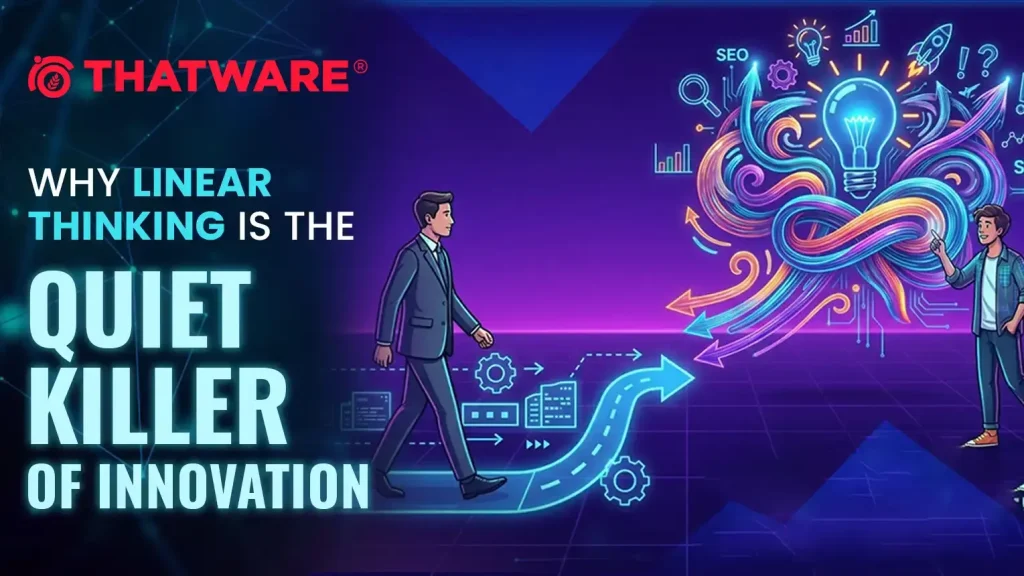
The real gap in business isn’t budget or talent. It’s the courage to think beyond linear time.
Companies have more capital, talent, and technology than ever—yet truly disruptive innovation is rarer than it appears.
That’s the uncomfortable truth hiding in plain sight. If innovation were simply a function of money, headcount, or tools, we’d be living in a constant golden age of breakthroughs. Instead, many organizations are shipping more features, launching more initiatives, and hiring more specialists—while the kind of ideas that reshape markets seem to arrive less often than promised.
Here’s the paradox most leaders feel but rarely name:
- Innovation budgets are growing. Labs, accelerators, R&D pods, “moonshot” teams—funding exists.
- Talent pools are global. You can hire elite designers in one region, engineers in another, strategists anywhere.
- Tools are smarter. AI speeds up research, prototyping, coding, testing, and content at a pace that would’ve felt impossible a decade ago.
And yet—breakthroughs stall.
Not because teams aren’t working hard. Not because there isn’t a plan. Often, the opposite is true: there are too many plans, too many roadmaps, too many milestones, too many “we’ll get to it next quarter” conversations that quietly shrink ambition into something manageable.
This is where most innovation efforts get trapped. The bottleneck isn’t a lack of resources. It’s the mental model we use to deploy them.
We still treat progress like a straight line: define the goal, map the steps, execute in sequence, report outcomes at fixed intervals. It feels responsible. It feels measurable. It feels safe.
But innovation—real innovation—doesn’t behave like that. It doesn’t emerge neatly from a timeline. It shows up through loops, detours, collisions, and moments of reframing that can’t be scheduled on a Gantt chart. It requires the ability to hold uncertainty longer than most planning cycles allow.
That’s why the real gap in business isn’t budget or talent.
It’s the courage to think beyond linear time.
Because linear thinking doesn’t fail loudly. It fails quietly. It turns bold ideas into “phased approaches.” It forces breakthroughs to justify themselves too early. It makes teams optimize for deliverables instead of discovery. It rewards what can be forecasted—while starving what could transform the future.
And until organizations confront this, they’ll keep asking the wrong question: How do we innovate faster?
When the real question is: How do we innovate beyond the timeline?
What Is Linear Thinking in Business?
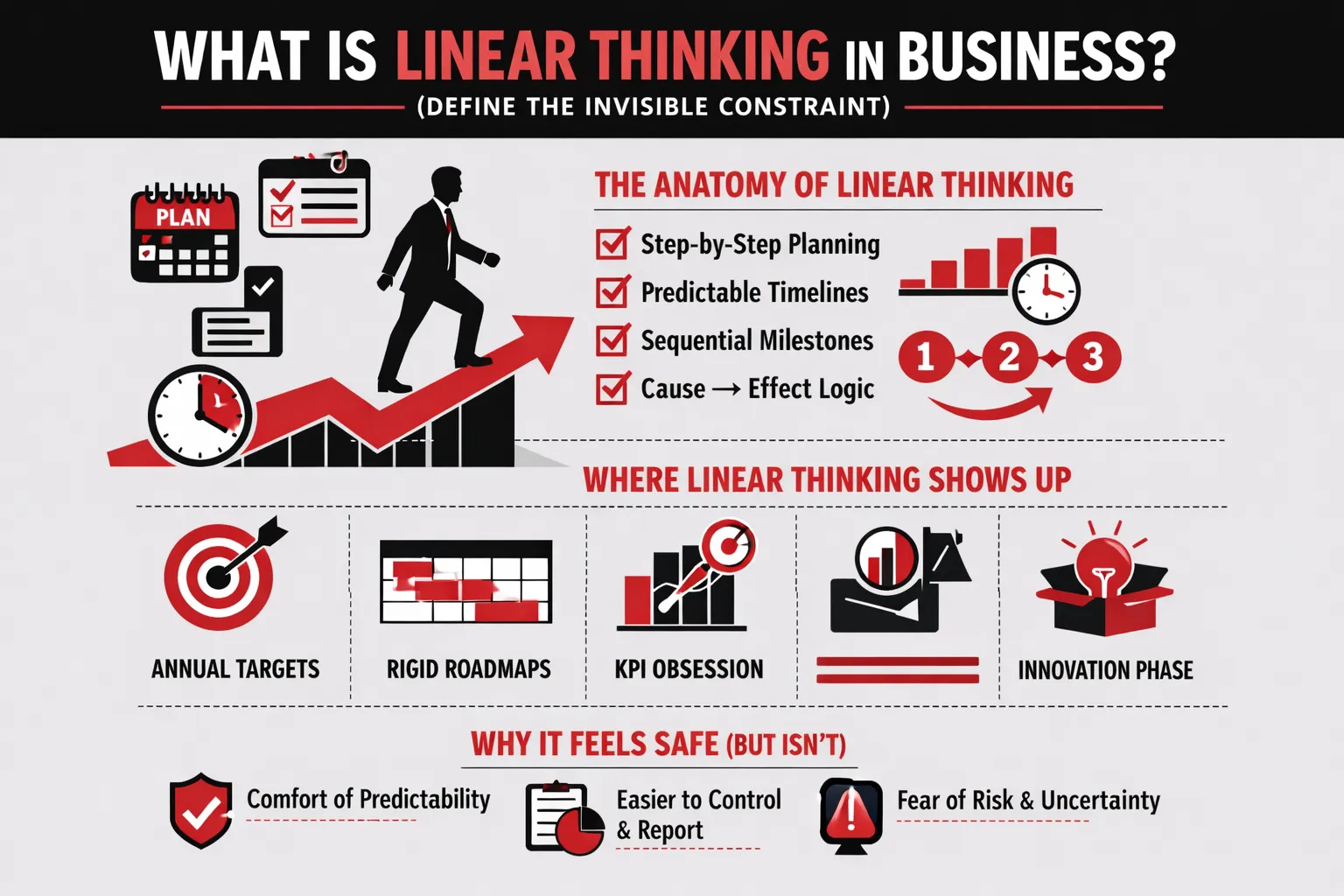
The Invisible Constraint Holding Innovation Hostage
Linear thinking in business is rarely named—yet it shapes nearly every decision organizations make. It operates quietly, embedded in planning rituals, management tools, and leadership expectations. Because it feels logical and disciplined, it often goes unquestioned. But this very familiarity is what makes it so dangerous.
At its core, linear thinking assumes that progress happens in a straight line. That if we plan carefully enough, execute sequentially enough, and control variables tightly enough, outcomes will follow predictably. In stable environments, this approach works. In complex, fast-changing markets, it becomes an invisible constraint.
The Anatomy of Linear Thinking
Linear thinking is built on a few deeply ingrained assumptions:
- Step-by-step planning
Strategy is designed as a sequence of dependent steps. One phase must be completed before the next begins, leaving little room for parallel exploration or adaptive learning.
- Predictable timelines
Time is treated as a fixed container. Initiatives are expected to mature according to predefined schedules, regardless of uncertainty, discovery, or external shifts.
- Sequential milestones
Progress is measured by passing checkpoints rather than by insight gained. If a milestone is met, the project is considered “on track”—even if the underlying assumptions are wrong.
- Cause → effect assumptions
Actions are expected to produce proportional and foreseeable results. Complexity, emergence, and nonlinear outcomes are largely ignored.
- “First this, then that” logic
Learning is postponed until after execution. Exploration must wait until delivery is complete, rather than informing it continuously.
Together, these patterns create an illusion of control while quietly limiting the space where breakthrough ideas are born.
Where Linear Thinking Shows Up
Linear thinking is not just a mindset—it is institutionalized through common business practices:
- Annual planning cycles
Strategies are locked in once a year, based on assumptions that may become outdated within months—or even weeks.
- Rigid roadmaps
Product and innovation roadmaps are treated as commitments rather than hypotheses, discouraging deviation even when new insights emerge.
- Gantt charts as strategy
Visual clarity replaces strategic depth. If it fits neatly on a chart, it’s considered sound—regardless of whether it reflects real-world complexity.
- KPI obsession with short-term outputs
Metrics prioritize immediate, measurable results, often at the expense of long-term learning, experimentation, and optionality.
- Innovation treated as a phase, not a system
Innovation is scheduled, funded, and reviewed like a project—something that starts, ends, and is judged quickly—rather than a continuous capability embedded in the organization.
These structures don’t just guide behavior; they train people to think linearly, even when the problems they face are anything but linear.
Why It Feels Safe (But Isn’t)
Linear thinking persists not because it works—but because it feels safe.
- The comfort of predictability
Clear plans and timelines reduce anxiety. They create the sense that the future is manageable and that uncertainty can be minimized through discipline.
- Easier reporting and control
Linear models simplify communication with stakeholders. Progress can be summarized in charts, percentages, and deadlines, even if those metrics mask deeper risks.
- Psychological bias toward certainty
Humans are wired to prefer clear answers over ambiguous possibilities. Linear thinking satisfies this bias by offering definitive paths forward.
- Career risk minimization for leaders
Following established processes is safer than challenging them. When outcomes fail, leaders can point to the plan rather than question the thinking behind it.
Yet this sense of safety is misleading. In environments defined by rapid change, linear thinking doesn’t reduce risk—it postpones it. By the time flaws become visible, options have narrowed and adaptation becomes far more costly.
Linear thinking may protect organizations from short-term discomfort, but it quietly robs them of long-term resilience and innovation.
Why Linear Thinking Quietly Kills Innovation
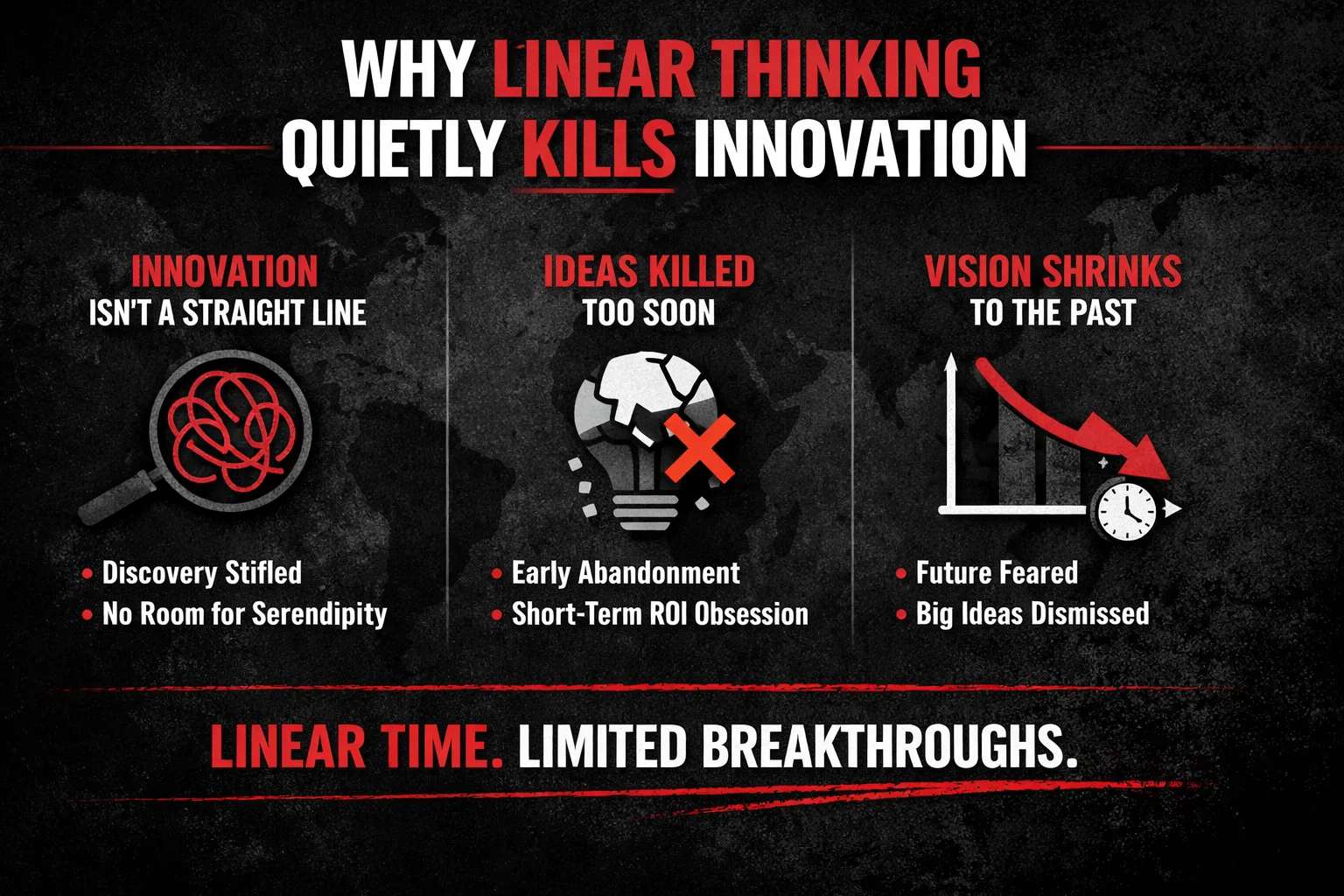
Linear thinking rarely causes dramatic failure. Instead, it erodes innovation slowly, almost invisibly. No alarms go off. No crises erupt overnight. On paper, everything appears to be working—projects are delivered, timelines are met, and reports look healthy. Yet beneath this apparent order, creativity withers and breakthrough potential fades. That is why linear thinking is such a dangerous constraint: it kills innovation quietly.
Innovation Doesn’t Happen in Straight Lines
True innovation is rarely a clean, step-by-step journey. Breakthroughs emerge from iteration, serendipity, cross-pollination, and failure loops—processes that are inherently messy and unpredictable.
- Iteration requires revisiting ideas multiple times, often undoing previous work.
- Serendipity thrives on unplanned connections and unexpected insights.
- Cross-pollination happens when ideas from different domains collide.
- Failure loops allow teams to learn through repeated trial and error.
Linear systems, however, are designed to minimize deviation. They reward sticking to the plan, not wandering off it. Exploration becomes a liability because it introduces uncertainty, delays, and outcomes that are difficult to forecast. As a result, teams learn to avoid curiosity in favor of compliance. Innovation doesn’t disappear—it simply never gets the space to emerge.
The Opportunity Cost Nobody Measures
One of the most damaging effects of linear thinking is an opportunity cost that rarely shows up in dashboards or quarterly reviews.
Ideas are often killed too early because they don’t “fit the timeline.” If a concept cannot demonstrate value within a predefined window, it is labeled impractical or premature. Experiments are abandoned not because they lack potential, but because their return on investment isn’t immediate or easily quantifiable.
Over time, teams begin optimizing for delivery, not discovery. Success becomes defined by shipping on time rather than learning something new. This creates organizations that are highly efficient at executing known ideas—but deeply uncomfortable generating new ones. The cost is not visible in what fails, but in what never gets tried.
How Linear Time Thinking Shrinks Vision
Linear time thinking also narrows how leaders imagine the future. Planning becomes anchored almost entirely in past data, trends, and historical performance. The future is treated as a slightly improved version of the present, rather than a fundamentally different landscape.
In this mindset:
- What hasn’t worked before is assumed not to work in the future.
- What cannot be modeled or forecast is considered irresponsible.
- Radical possibilities are dismissed as unrealistic, risky, or “ahead of their time.”
This approach doesn’t just limit strategy—it limits imagination. When the future is forced to move in a straight line, bold ideas have nowhere to go. Innovation requires the freedom to think beyond existing timelines, metrics, and mental models. Linear thinking quietly removes that freedom, one safe decision at a time.
Case Studies: When Non-Linear Thinking Changed the Game
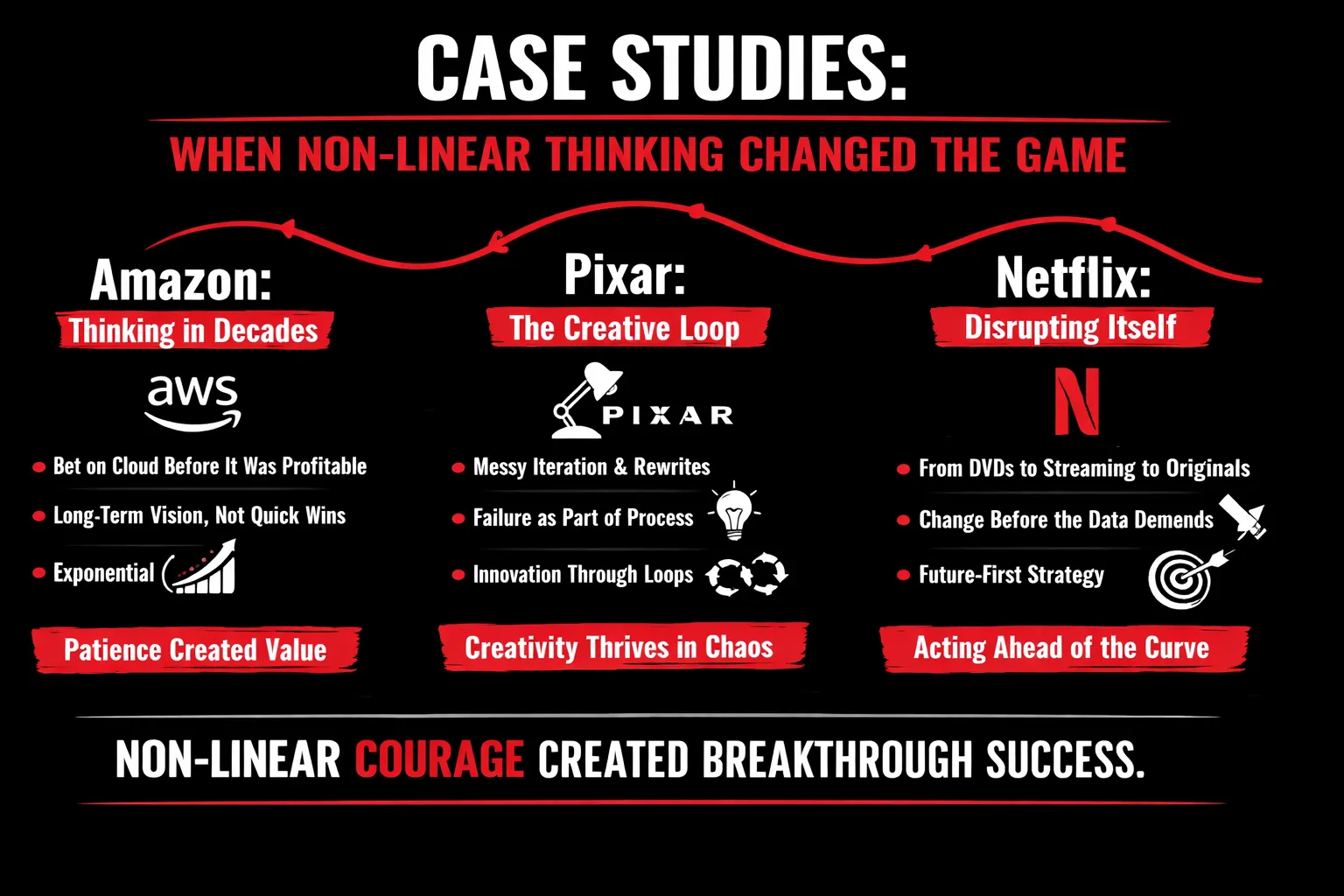
Innovation often sounds abstract until you see it play out in the real world. The most transformative companies didn’t win because they had better budgets or smarter people—they won because they rejected linear timelines when the future demanded something bolder. The following cases show how non-linear thinking, though uncomfortable and uncertain, created exponential value.
Case Study 1: Amazon — Thinking in Decades, Not Quarters
When Amazon launched Amazon Web Services (AWS), the move puzzled investors and analysts alike. At the time, Amazon was an e-commerce company struggling to explain why it was investing heavily in cloud infrastructure—an area with no clear short-term ROI and no proven market at scale.
AWS required:
- Massive upfront investment
- Years of incubation
- Patience without predictable, linear returns
From a traditional planning lens, the project made little sense. There were no immediate efficiency gains, no quarterly payoff, and no guarantee that customers would even adopt cloud computing at the scale Amazon envisioned.
But Amazon wasn’t thinking linearly.
Instead of asking, “How fast can this pay off?” Amazon asked, “What future does this make possible?”
By prioritizing long-term optionality over short-term efficiency, Amazon positioned itself at the center of a future that hadn’t fully arrived yet. AWS didn’t just become profitable—it became the backbone of the modern internet and one of Amazon’s most valuable businesses.
Lesson: Non-linear patience created exponential value. By allowing an idea to mature on its own timeline, Amazon unlocked a future that linear planning would have rejected far too early.
Case Study 2: Pixar — The Non-Linear Creative Process
Pixar’s success looks magical from the outside, but internally, its creative process is anything but clean or sequential.
Pixar films are:
- Developed through messy, iterative cycles
- Rewritten again and again—sometimes until late in production
- Built on the assumption that early versions will fail
There is no straight line from concept to final film. Stories evolve through feedback loops, false starts, and uncomfortable rewrites. Entire plotlines are discarded. Characters change. Endings are reimagined.
In a linear system, this would look inefficient—甚至 wasteful.
But Pixar understands something most organizations forget: creativity does not move forward in a straight line. It loops. It circles back. It improves through friction.
Failure isn’t an exception in Pixar’s process—it’s a feature.
Lesson: Creativity thrives in loops, not pipelines. By designing a system that embraces non-linearity, Pixar consistently produces stories that resonate deeply rather than merely meeting deadlines.
Case Study 3: Netflix — Breaking the Timeline of Disruption
Netflix’s evolution from DVD rentals to streaming to original content is often described as visionary. What’s less discussed is how profoundly non-linear that evolution was.
Netflix disrupted itself:
- Before DVDs were fully exhausted
- Before streaming was the dominant consumer expectation
- Before data conclusively demanded a pivot
At each stage, Netflix acted not from current success metrics, but from future scenarios. It asked uncomfortable questions:
- What if DVDs disappear?
- What if content becomes the real battleground?
- What if distribution advantages vanish?
Instead of optimizing the present, Netflix repeatedly abandoned winning models to prepare for futures that hadn’t arrived yet.
Linear thinking would have said: “Wait until the data proves it.” Non-linear thinking said: “By the time the data is obvious, it’s already too late.”
Lesson: The real advantage comes from acting based on future possibilities, not current performance. Netflix didn’t wait for disruption—it moved ahead of the timeline.
What These Stories Reveal
Amazon, Pixar, and Netflix operate in different industries, but they share one critical trait: they refused to let linear time dictate their decisions.
They didn’t ask:
- How fast can we justify this?
- How does this fit into this year’s plan?
They asked:
- What future are we building toward?
- What must we do now—even if the payoff isn’t immediate?
These companies didn’t just innovate better.
They thought differently about time itself.
And that difference made all the difference.
The Power of Non-Linear Thinking (What It Actually Looks Like)
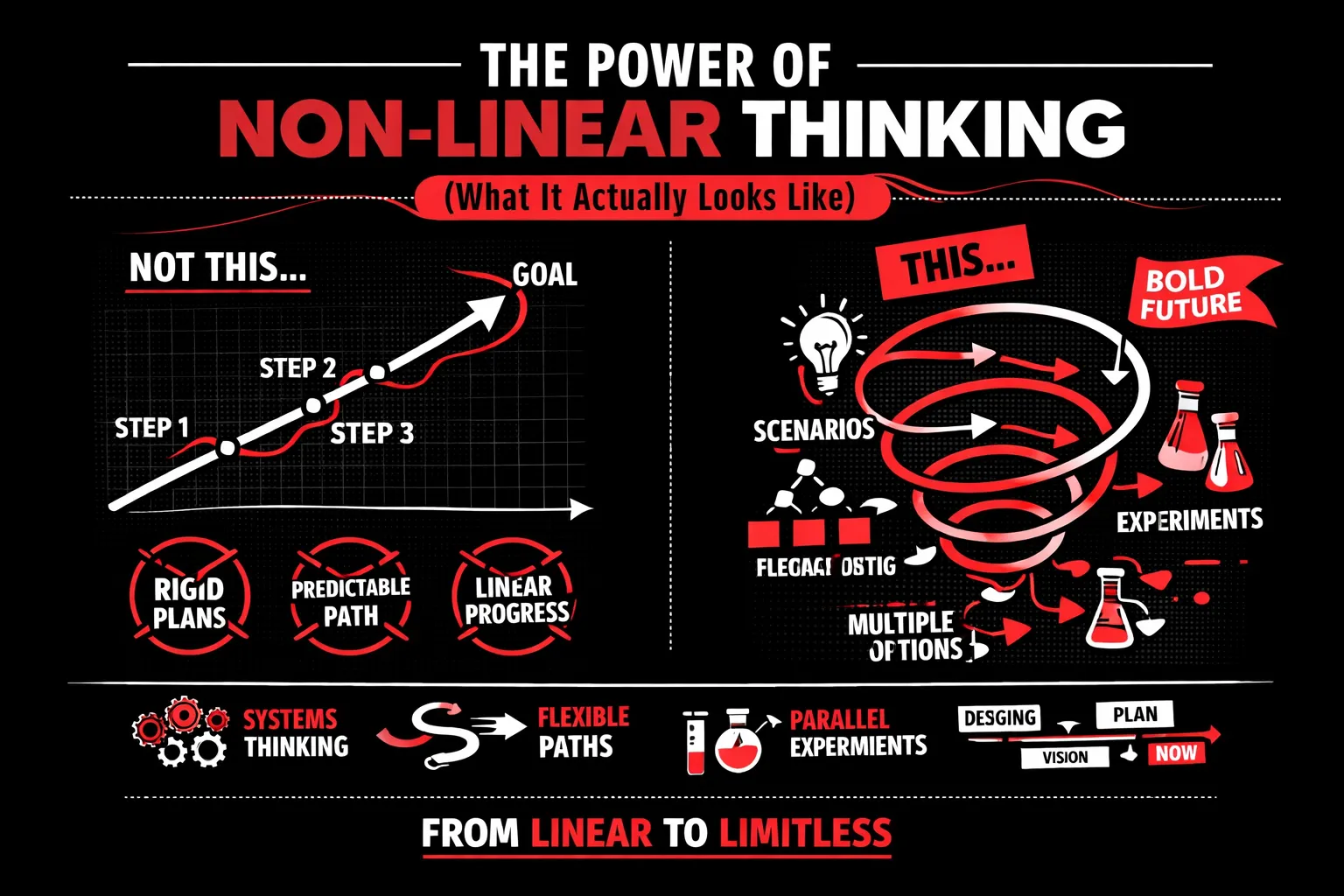
If linear thinking treats strategy like a railway track—one destination, one route, one timetable—non-linear thinking treats it like a landscape. You don’t move only forward. You zoom out, scan the terrain, choose multiple routes, and adapt as new information appears. That shift isn’t just philosophical. It changes how innovation actually gets built.
What Non-Linear Thinking Is (and Isn’t)
Non-linear thinking is often misunderstood because it doesn’t “look” like traditional planning. It resists neat timelines and predictable milestones, so people assume it’s messy, risky, or undisciplined. But that’s a myth.
Non-linear thinking is not chaos.
Chaos is random motion with no intent. Non-linear thinking has a clear intent—often a bold future outcome—but it accepts that the path to that outcome won’t be straight.
It’s not a lack of discipline.
In fact, it requires more discipline than linear planning because it asks teams to manage uncertainty without panicking, and to run experiments without turning everything into a distraction.
It’s not ignoring execution.
Execution still matters. The difference is that execution isn’t chained to a single plan. You execute in cycles—test, learn, refine—so what you execute becomes smarter over time.
So what is non-linear thinking?
- Systems thinking: You stop treating problems as isolated. You look at feedback loops, second-order effects, dependencies, and unintended consequences. You ask, “If we change this, what else shifts?”
- Scenario thinking: Instead of betting everything on one forecast, you prepare for multiple futures. You build resilience by asking, “What if customer behavior changes? What if regulation shifts? What if a new technology makes our model obsolete?”
- Backcasting: You start from a desired future and work backward, rather than projecting today’s constraints forward. You ask, “If we were already successful in three years, what had to be true? What did we stop doing? What did we build first?”
- Parallel experimentation: Instead of committing to one “best” idea too early, you run multiple small bets at once. You let evidence decide—not hierarchy, not opinion, not the loudest voice in the room.
This is the replacement model: not a single plan executed perfectly, but a system that learns faster than the environment changes.
Time as a Landscape, Not a Line
Linear organizations treat time like a straight line: past → present → future. That mindset sounds logical, but it quietly narrows what leaders can imagine. Because if the future must be a continuation of the past, then disruption is always “unexpected”—and innovation is always “late.”
Non-linear thinkers use time differently. They let past, present, and future inform decisions simultaneously.
- The past becomes a source of patterns, not a prison of assumptions.
- The present becomes a signal system, not just a dashboard.
- The future becomes a design space, not a guess.
This is why designing from a desired future backward is so powerful. When you backcast, the future isn’t something you wait for—it becomes something you build toward with intention. You stop asking, “What’s realistic next quarter?” and start asking, “What will matter in three years—and what do we need to start now?”
And crucially, you allow multiple paths to coexist. Linear planning tends to demand early certainty: pick one route, lock the roadmap, defend the decision. Non-linear thinking does the opposite: it holds several options open until the real world provides clarity.
That’s not indecision. That’s strategic flexibility.
Why Non-Linear Thinking Fuels Exponential Growth
Exponential growth doesn’t come from doing the same thing faster. It comes from discovering leverage—tiny moves that unlock disproportionate results. Non-linear thinking creates the conditions for that kind of leverage.
Small experiments → outsized impact
When teams run small tests in parallel, the cost of being wrong drops dramatically. You don’t need perfect predictions. You need fast feedback. One small experiment can reveal a new customer segment, a better distribution channel, or a product insight that changes everything.
Optionality compounds
Linear planning tries to reduce options quickly (to “focus”). Non-linear thinking builds options deliberately. Options are like seeds: most won’t grow, but the few that do can transform the entire business. Over time, the organization becomes less fragile because it’s not dependent on one bet.
Learning velocity beats execution speed
Many companies confuse speed with progress. They execute quickly—on the wrong assumptions. Non-linear organizations win because they learn faster. And learning changes the quality of execution. It prevents teams from scaling mistakes. It turns “movement” into actual momentum.
This is the hidden advantage: non-linear thinking isn’t slower. It just refuses to be fast in the wrong direction.
Non-linear thinking, at its core, is the courage to treat the future as something you can design—not something you can only predict. And in a world where change doesn’t arrive on schedule, that courage becomes the real competitive edge.
The Real Gap: Courage, Not Capability
Most organizations don’t stall because they lack talent, tools, or funding. They stall because leadership quietly enforces one rule: everything must make sense early. And innovation—real innovation—rarely does.
That’s why the real gap in business isn’t budget or talent. It’s the courage to think beyond linear time.
Why Leaders Resist Non-Linear Thinking
Non-linear thinking asks leaders to operate without the usual comforts: certainty, sequence, and neat explanations. Even highly capable executives resist it—not because they don’t understand innovation, but because the system around them rewards predictability.
Fear of ambiguity
Ambiguity isn’t just uncomfortable; it feels unsafe. Linear plans offer psychological relief: a timeline, a roadmap, a sense that the future is controllable. Non-linear innovation replaces that with a fog of “maybe.” And for many leaders, “maybe” reads like weakness. When the path isn’t clear, the instinct is to tighten control, demand clarity, and reduce experimentation—right when exploration is most needed.
Pressure to justify decisions early
In many companies, the unspoken rule is: If you can’t defend it with data now, you shouldn’t do it. That works for optimization. It fails for breakthroughs. Early-stage innovation rarely has enough proof to satisfy conventional ROI logic. But leaders are expected to present certainty upfront—so they force innovation to pretend it’s predictable. The result is a pipeline full of “safe ideas” and a graveyard of bold ones.
Board and stakeholder expectations
Boards, investors, and senior stakeholders often ask for confidence, not curiosity. They want roadmaps, forecasts, and risk controls. That’s not irrational—it’s their job to protect value. But when leadership translates stakeholder expectations into rigid timelines and single-path plans, innovation becomes a performance rather than a search. Teams stop asking “What could be?” and start asking “What will get approved?”
Personal identity tied to being right
This one is rarely discussed, but it’s powerful. Many leaders rise by being decisive, accurate, and confident. Over time, “being right” becomes part of their identity. Non-linear thinking threatens that identity because it requires leaders to say: I don’t know yet—and that’s okay. It reframes leadership from “having answers” to “creating conditions.” And for leaders trained to win through certainty, that shift can feel like a loss of authority.
Courage Redefined
We often talk about courage in business as bold moves—acquisitions, pivots, big launches. But the deeper courage is quieter and far more difficult: the courage to lead without premature certainty.
Here’s what that courage looks like in practice:
Courage to delay certainty
Linear cultures demand answers too early. Courage is resisting that demand. It’s allowing space for exploration before locking decisions into timelines. It’s saying, “We’re not ready to judge this yet,” and protecting that uncertainty long enough for something new to emerge.
Courage to protect unproven ideas
Unproven ideas are fragile. They’re easy to kill with one skeptical question, one budget cut, one dismissive comment in a meeting. Courage is acting as a buffer—shielding early concepts from the harsh glare of late-stage evaluation. Not forever. Just long enough for learning to turn the unknown into the understandable.
Courage to think beyond reporting cycles
Quarterly cycles are useful for accountability. They are terrible as the primary lens for innovation. Courage is the willingness to invest in something that won’t “show up” this quarter—because the future doesn’t operate on the same calendar as your financial reporting. Some of the most valuable initiatives look irrational right up until they look inevitable.
Courage to redesign how success is measured
If your metrics only reward delivery, people will stop discovering. If your KPIs only reward certainty, people will stop experimenting. Courage is changing the scoreboard: measuring learning velocity, quality of experiments, strategic optionality, and long-term resilience—not just short-term output.
In other words, courage isn’t just taking risks. It’s changing what the organization calls a win.
Cultural Signals That Enable Non-Linear Innovation
Culture is not what leaders say about innovation. Culture is what happens when an idea is messy, early, and uncertain. Non-linear innovation thrives when leadership sends clear signals—through behavior, incentives, and protection.
Reward learning, not just outcomes
If teams are only rewarded for successful results, they’ll avoid experiments that might fail. But innovation demands intelligent failure. The signal leaders must send is: learning is valuable—even when the outcome isn’t. That doesn’t mean celebrating sloppy execution. It means recognizing well-designed experiments, honest insights, and course correction as progress.
Build long-term narratives alongside short-term metrics
Great innovation needs a story that outlives a quarter. Leaders should hold two dashboards at once:
- Short-term performance metrics (to run today’s business)
- Long-term narratives (to build tomorrow’s business)
When leaders repeatedly explain why something matters beyond this quarter—how it fits a future vision—teams gain permission to think in time horizons that aren’t strictly linear.
Create psychological safety for exploration
Non-linear thinking requires people to share incomplete thoughts, question assumptions, and propose ideas that might sound wrong at first. That only happens when the environment is safe enough to be unfinished. Psychological safety isn’t softness. It’s speed. It’s what prevents fear from slowing down experimentation and honest debate.
A culture that enables non-linear innovation says:
- “Bring the half-formed idea.”
- “Ask the inconvenient question.”
- “Run the small test.”
- “Show us what you learned.”
Because in the end, innovation doesn’t die from lack of talent. It dies when people stop offering their boldest thinking—because it doesn’t fit the timeline, the metrics, or the room.
And that’s why the real gap isn’t capability. It’s courage.
Practical Framework: How to Move Beyond Linear Thinking
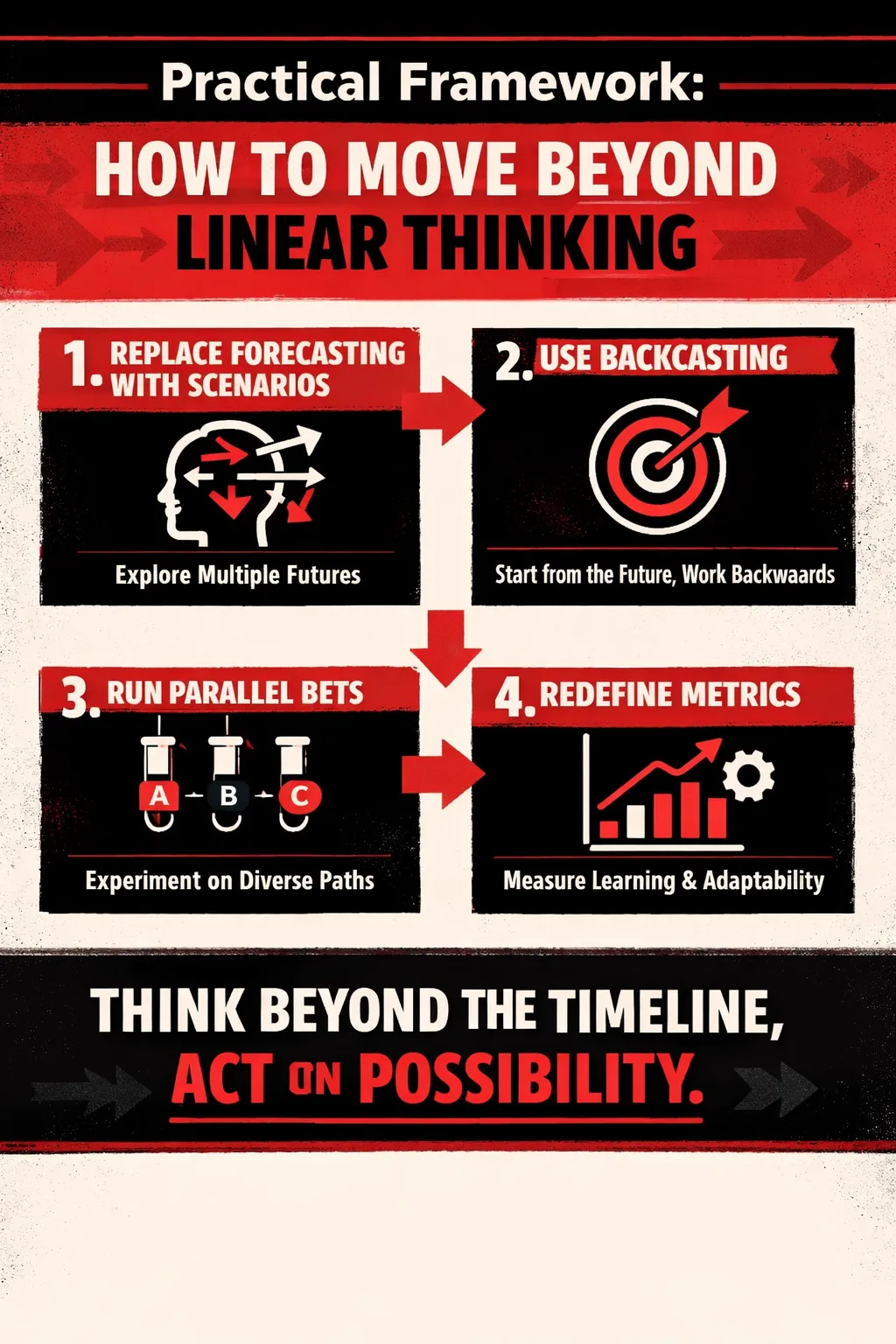
Understanding the limits of linear thinking is only the first step. The real challenge—and opportunity—lies in replacing it with practices that allow innovation to emerge in non-linear ways. This framework is not about abandoning discipline or execution. It’s about redesigning how decisions are made, experiments are run, and success is measured.
Step 1: Replace Forecasting with Scenarios
Traditional forecasting assumes a single, predictable future. It asks, “What will happen?” Non-linear thinking asks a more powerful question:
“What could happen—and how would we respond?”
Instead of committing to one plan:
- Develop multiple plausible future scenarios
- Consider shifts in technology, behavior, regulation, and competition
- Design strategies that remain viable across different outcomes
The most important question leaders must ask here is uncomfortable but essential:
What if we’re wrong?
Scenario thinking doesn’t weaken strategy—it makes it resilient. It allows organizations to move early, rather than react late.
Step 2: Use Backcasting
Linear planning starts in the present and moves forward cautiously. Backcasting flips that logic.
Begin by defining a bold, compelling future state:
- What would market leadership look like in five or ten years?
- What would customers say if you had truly transformed their experience?
Once that future is clear, work backward:
- Identify the capabilities that must exist
- Surface decisions that feel non-obvious or risky today
- Reveal actions that would never emerge from incremental planning
Backcasting frees leaders from the gravity of current constraints and enables decisions that feel visionary rather than reactive.
Step 3: Run Parallel Bets
Breakthrough innovation rarely follows a single path. Non-linear organizations acknowledge uncertainty by running multiple bets at the same time.
This doesn’t mean reckless spending. It means:
- Launching small, contained experiments
- Exploring different approaches to the same strategic goal
- Allowing different initiatives to operate on different timelines
The key is alignment, not uniformity.
Each experiment serves the same strategic intent, but no single one carries the burden of being “the answer.” Over time, learning—not prediction—determines where to scale.
Step 4: Redefine Metrics
Linear thinking survives because it’s reinforced by linear metrics. If organizations want non-linear outcomes, they must measure different things.
Beyond traditional KPIs, leaders should track:
- Learning Velocity
How quickly is the organization turning experiments into insights?
- Strategic Options Created
Are today’s actions expanding future choices—or narrowing them?
- Adaptability Index
How effectively can the organization pivot when assumptions change?
These metrics reward progress that doesn’t immediately show up in revenue but compounds into long-term advantage.
Moving Forward Without a Straight Line
Shifting beyond linear thinking doesn’t require perfect clarity. It requires courage to operate without it. When organizations replace prediction with exploration, timelines with possibilities, and certainty with learning, innovation stops being a gamble—and becomes a system.
The future doesn’t arrive step by step. The organizations that win are the ones brave enough to prepare for it from multiple directions at once.
Innovation Lives Outside the Timeline
Businesses rarely fail because they run out of money, talent, or tools. In fact, most organizations today are better funded, better staffed, and better equipped than ever before. Yet innovation continues to disappoint. The reason is subtle—but decisive.
Businesses fail because they plan innovation as if the future is predictable.
They treat tomorrow as a neat extension of today. They demand certainty before curiosity, roadmaps before discovery, and timelines before insight. In doing so, they unknowingly confine innovation to the limits of linear thinking—where only ideas that fit the schedule survive, and the most transformative possibilities quietly die before they begin.
But real innovation has never followed a straight line. It emerges in loops, leaps, pauses, and unexpected collisions. It requires room for uncertainty, patience for incubation, and above all, the courage to act without complete clarity.
That is why the real gap in business isn’t budget or talent. It’s the courage to think beyond linear time.
Organizations that break through are not the ones with the best forecasts—they are the ones willing to imagine futures that don’t yet have a timeline, a metric, or a guarantee. They design for possibility rather than permission. They understand that progress is not always sequential, and growth is rarely predictable.
So the question worth sitting with is this:
What breakthrough is your organization postponing—not because it’s impossible, but because it doesn’t fit the timeline?
Because the future won’t wait for your plan. And innovation, by its very nature, lives beyond it.