
SUPERCHARGE YOUR ONLINE VISIBILITY! CONTACT US AND LET’S ACHIEVE EXCELLENCE TOGETHER!
The Invisible Failure That Comes First
You expand into the UK, the UAE, India, or Germany.
The playbook feels familiar. You translate your core pages. You localize pricing. You launch paid campaigns to “kickstart demand.” Sales decks are updated, CRM pipelines are tagged by region, and leadership starts asking when international revenue will show up.

But something feels off.
Organic traffic doesn’t grow the way it should. In some markets, it doesn’t grow at all. In others, it briefly spikes—then flattens or drops. Your brand barely appears for non-branded queries. Local competitors you’ve never heard of dominate high-intent keywords. And when you do rank, the traffic doesn’t convert.
At this point, most teams assume the problem is later in the funnel: messaging, pricing, product-market fit, or sales enablement.
In reality, the failure already happened.
Most global expansions fail before the P&L shows it—at the SERP level.
Search engines are the first gatekeepers of global growth. They decide whether your brand is even eligible to compete in a new market. When that eligibility is broken, everything downstream becomes more expensive, slower, and harder to diagnose.
SERP-level failure has clear, repeatable symptoms:
- The wrong pages rank in the wrong countries
- Your homepage outranks carefully built local landing pages
- Aggregators, directories, and review sites define your category instead of you
- Local competitors dominate “money” keywords while your site hovers on page two
- Index bloat, keyword cannibalization, and geo-misrouting quietly dilute authority
None of this shows up immediately in revenue reports. But it shows up instantly in search.
That’s because global growth doesn’t fail due to a lack of translation. It fails due to a lack of geo-SEO architecture—a system that deliberately maps markets → search intent → site structure → technical signals → content operations, so search engines can understand where you are relevant, to whom, and for what.
If your international rollout relies on translation plus hreflang alone, you’re likely shipping a product into a market where Google can’t even understand your relevance—let alone trust it.
And when search fails silently, finance eventually follows.
The Real Global Expansion Funnel Starts in Search
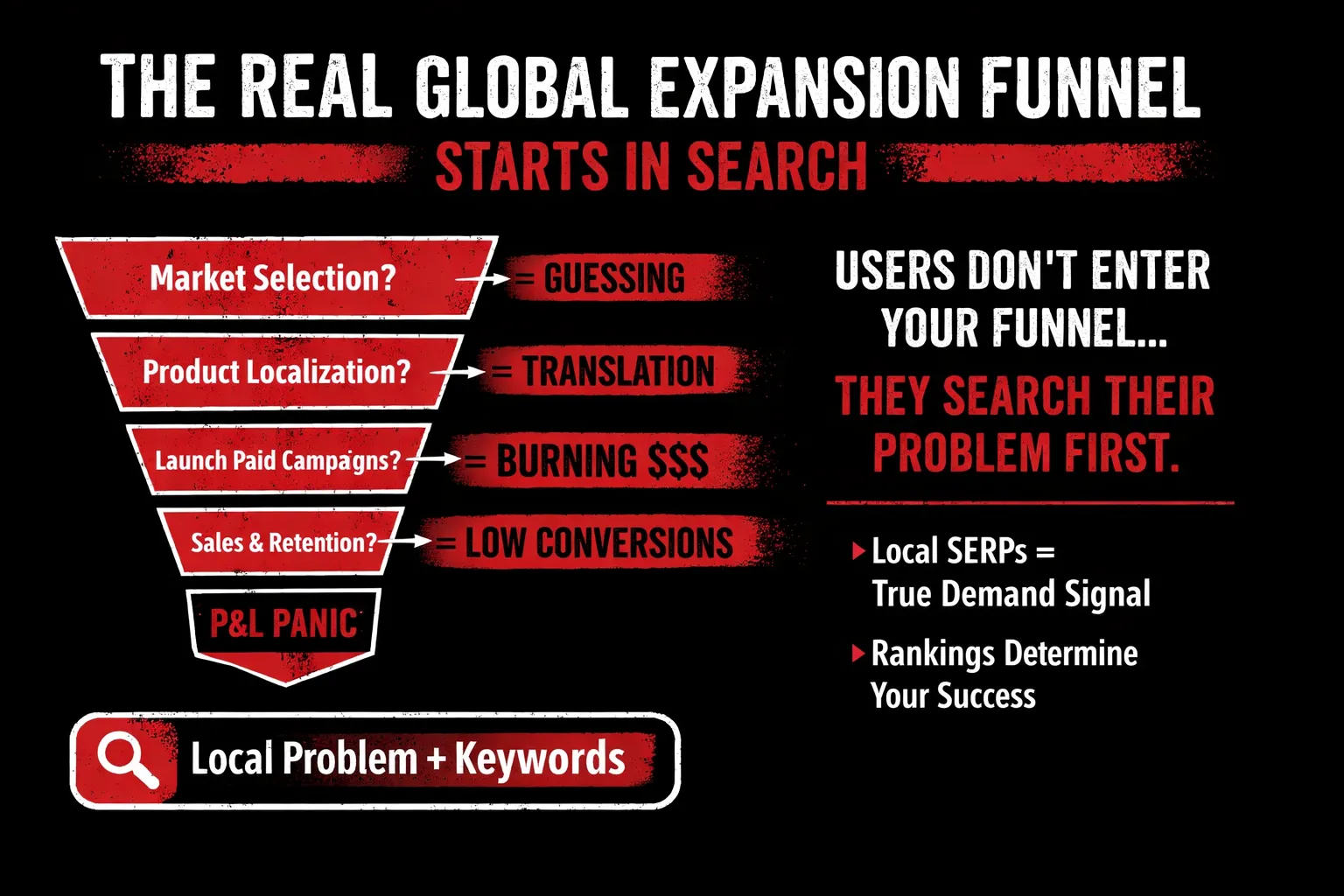
Most companies still think about global expansion using a familiar, linear funnel: market selection → product localization → marketing → sales → retention. On paper, it looks logical. You choose a promising geography, adapt your product or messaging, invest in marketing, and let revenue validate the decision. The problem is that this model assumes users first encounter your brand through your campaigns or sales efforts. In reality, global expansion rarely begins in your funnel at all—it begins in a search box.
Today, users don’t “enter” funnels. They query their problems. Whether they are in London, Berlin, Dubai, or Bangalore, their first interaction with your brand is often a Google search phrased in local language, local context, and local intent. Search engines become the de facto gatekeepers of global demand, deciding which brands are even visible enough to be considered. This is why search is the most honest signal of market reality: it reflects what people actually want, how they describe their problems, and which competitors already own that demand.
Because of this, SERP-level failure almost always precedes financial failure. When a brand lacks visibility in local search results, revenue problems don’t appear immediately—but the damage is already underway. Organic visibility directly shapes customer acquisition cost: if you don’t rank, paid media must carry the entire demand load, inflating CAC and reducing margins. At the same time, local SERPs act as a proxy for brand trust. If your site is absent while local competitors, marketplaces, or review platforms dominate results, users subconsciously assume those brands are more credible in that market.
Search also dictates how fast you learn. When you rank and earn impressions, you gain real-time insight into which queries convert, which use cases matter locally, and how buyers compare solutions. Without that visibility, you’re expanding blind—making product and marketing decisions without feedback from actual demand.
The critical insight is this: global expansion is not about “going global.” It’s about becoming locally relevant at scale. And local relevance is first tested, measured, and validated in the SERPs—long before revenue dashboards show anything is wrong.
Define the Core Concept: What Is Geo-SEO Architecture?
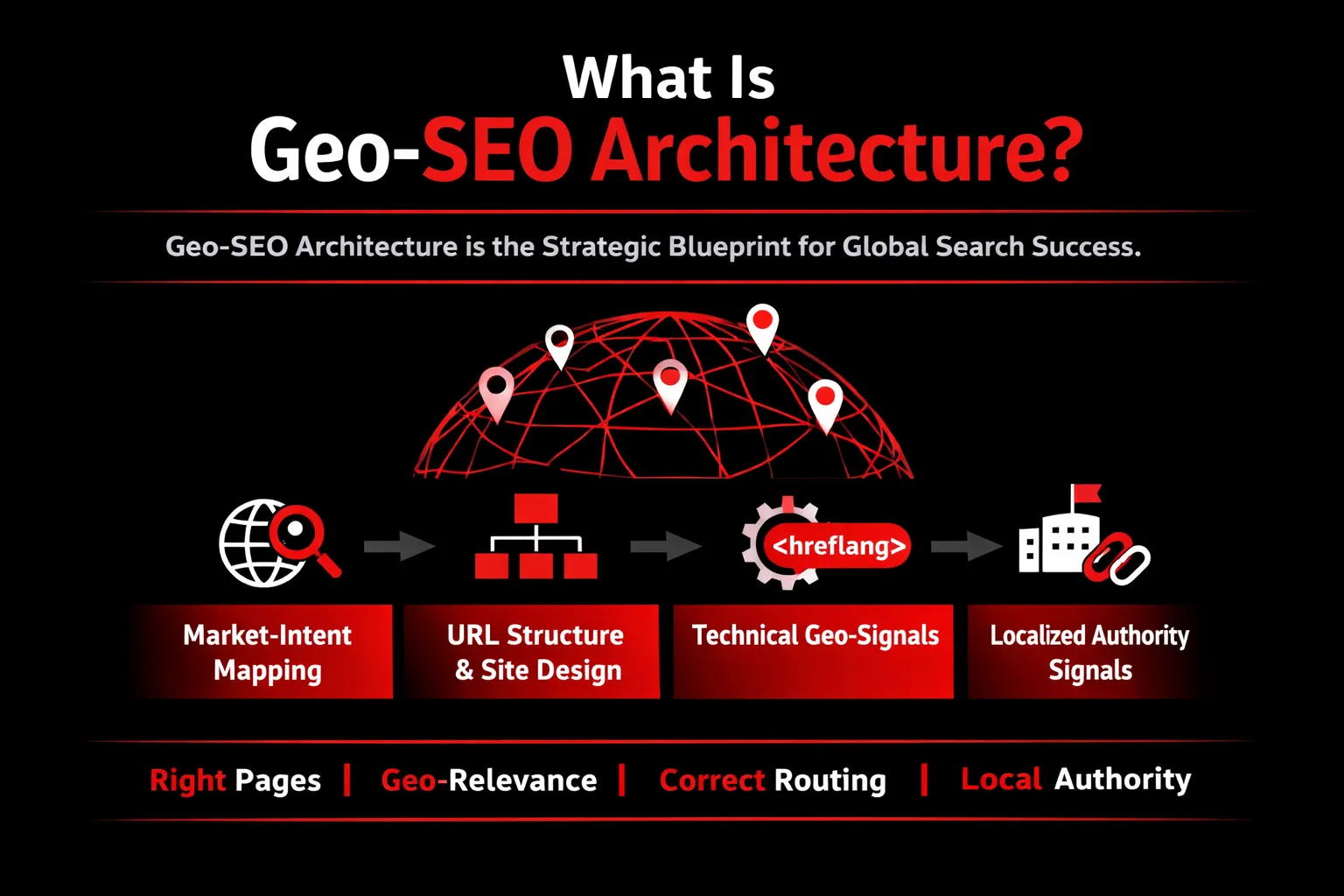
Before understanding why global expansion fails at the SERP level, it’s critical to define the missing layer behind most international SEO efforts: geo-SEO architecture. This is not a buzzword or a rebrand of existing practices—it’s a structural discipline that sits at the intersection of search intent, geography, and scalable website systems.
Most companies believe they are “doing international SEO” when they translate pages, add hreflang tags, or launch country-specific URLs. In reality, those are tactical components, not an architecture. Geo-SEO architecture is the system that makes those components work together coherently across markets.
A Working Definition
Geo-SEO architecture is the structural blueprint that enables search engines to correctly understand, rank, and route a website’s content across multiple geographic markets—at scale.
At its core, geo-SEO architecture ensures that:
- The right pages exist for each market
Not duplicated global pages, but purpose-built market pages aligned to local demand, intent, and maturity.
- Those pages send strong location relevance signals
Through content, structure, internal linking, technical signals, and local proof—not assumptions.
- Search engines can correctly route users to the correct locale
So users in the UK, India, or Germany consistently land on the most relevant version of a page without friction, confusion, or misrouting.
- Content, links, and entities align with regional intent
Meaning what ranks, what converts, and what builds trust varies by geography—and your SEO system reflects that reality.
In simple terms: geo-SEO architecture answers the question, “How does Google know which version of my site should rank, for whom, and where?”
What Geo-SEO Architecture Is NOT
This distinction is crucial, because most global SEO failures happen when teams confuse tools with systems.
Geo-SEO architecture is not:
- Just translation
Language ≠ intent. Translating copy does not adapt it to local SERP behavior or expectations.
- Just hreflang
Hreflang helps with routing, but it cannot fix poor structure, weak relevance, or competing pages.
- Just creating “/country/” folders
URLs alone don’t establish geographic authority or intent alignment.
- Just choosing ccTLD vs subdirectory
Domain strategy is a decision within geo-SEO architecture—not the architecture itself.
Without an underlying blueprint, these tactics often create cannibalization, misrouting, and diluted authority.
The Four Pillars of Geo-SEO Architecture
A resilient geo-SEO architecture is built on four interconnected pillars:
- Market-Intent Mapping
Understanding how search behavior, intent, and SERP composition differ by market—before creating pages.
- Information Architecture & URL Strategy
Structuring the site so markets, solutions, and content scale logically without internal competition.
- Technical Geo-Signals
Hreflang, indexing rules, canonicals, sitemaps, and internal linking working together—not in isolation.
- Localized Authority & Entity Relevance
Building trust signals, mentions, links, and proof that establish real local relevance in each market.
Together, these pillars transform international SEO from a collection of tasks into a search-native growth system—one that global expansion depends on long before revenue ever shows signs of failure.
The SERP-Level Failure Pattern: How It Usually Starts
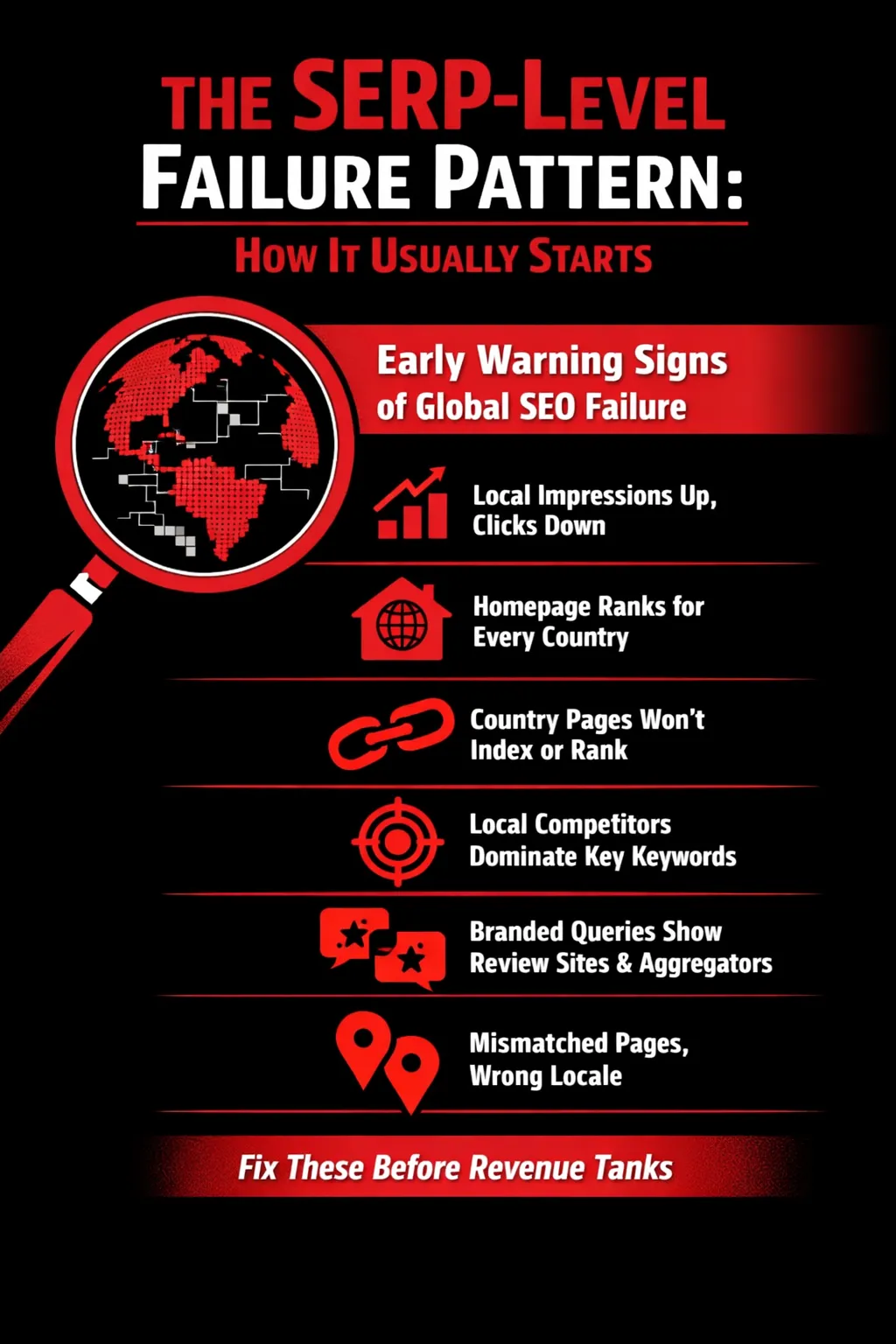
Global expansion rarely fails overnight. It begins with subtle, easily dismissed signals inside the search results—signals that appear long before revenue, pipeline, or retention numbers show any visible damage. This is the SERP-level failure pattern, and once it sets in, financial underperformance is only a matter of time.
Early Warning Signs (Before Revenue Drops)
One of the earliest red flags is when local impressions increase but clicks do not. On the surface, this looks like progress—Google is showing your pages in new markets. In reality, it signals weak relevance. Your listings appear, but local users don’t find them compelling, trustworthy, or contextually correct for their market.
Another common symptom is wild ranking fluctuations across countries. A page ranks on page one in one region, disappears in another, then reappears days later. This instability is usually caused by unclear geo-signals, internal competition between global and local URLs, or mismatched intent across markets.
A more serious architectural issue emerges when the homepage ranks for almost every keyword in every country. This typically means Google cannot clearly identify which pages are meant to serve which markets. When geo-SEO architecture is missing or weak, search engines default to the strongest URL—often the homepage—suppressing localized pages in the process.
Many teams also notice that country pages either fail to index or index but never rank. These pages exist, but they lack sufficient internal linking, unique value, or local authority signals to be considered relevant. They become “decorative pages” rather than search assets.
Meanwhile, local competitors dominate bottom-of-funnel queries such as “best,” “pricing,” “alternatives,” or “reviews.” Even when your brand is well-known globally, local players capture the highest-intent traffic because their content, authority, and relevance are deeply aligned with the local SERP ecosystem.
Finally, branded searches in new markets often expose the biggest risk. Instead of your official pages, SERPs are filled with review sites, directories, resellers, or even scammy affiliates. In many cases, “brand + pricing” queries are answered entirely by third parties—meaning you’ve lost control of your own demand before you’ve even established a foothold.
Why Teams Miss These Signs
These warning signals are easy to miss because most expansion teams focus on the wrong metrics. They track leads, demos, paid acquisition performance, and top-line traffic, assuming organic visibility will “catch up later.”
What they don’t track are share of voice by market, index coverage by locale, or SERP routing accuracy—whether users in each country are landing on the correct, intended pages. Without these diagnostics, SERP-level failure remains invisible, quietly eroding global expansion efforts long before the financial impact becomes impossible to ignore.
The 6 Reasons Global Expansion Fails at the SERP Level Without Geo-SEO Architecture
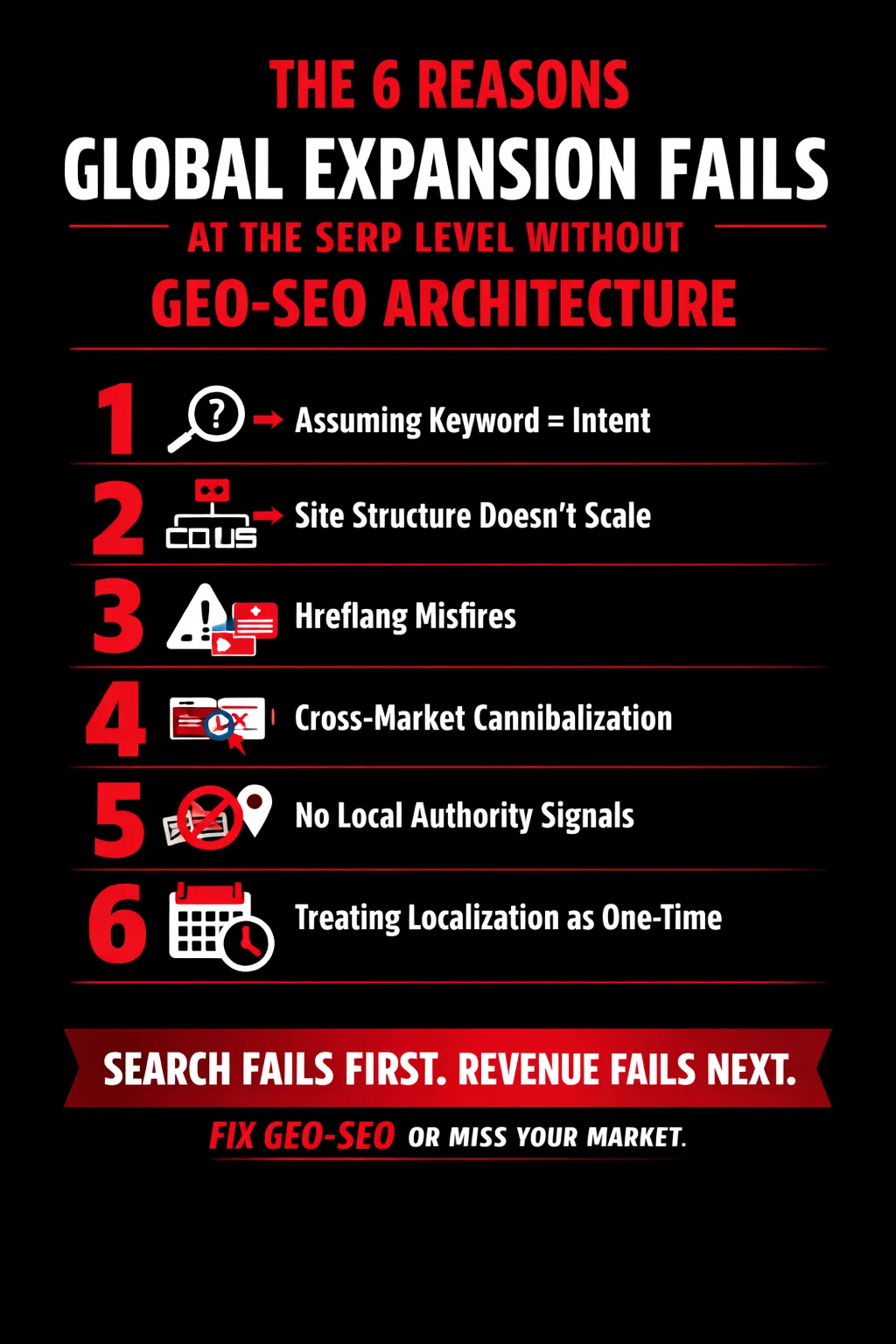
If global expansion were a movie, finance is the dramatic ending. But the plot twist happens much earlier—on the SERP.
Before you see pipeline slowdowns, before CAC spikes, before your “new market” targets start missing quarters, there’s usually a quieter failure: search engines are not confidently routing local users to the right local version of your site. Or worse, they’re routing users correctly—but your pages don’t match what the local SERP is rewarding.
That’s what makes SERP-level failure so dangerous. It’s not loud. It’s not a sudden crash. It’s a slow leak: impressions without clicks, clicks without conversions, rankings that fluctuate, and “global” pages that accidentally cannibalize the very markets you’re trying to grow.
Below are the six most common ways this happens—and how geo-SEO architecture prevents it.
Failure Mode #1: You Assume Keyword = Intent (But It Isn’t)
Most teams begin international SEO with a simple assumption:
“If people search the same keyword in another market, they want the same thing.”
That assumption quietly wrecks global expansion.
Because same language ≠ same intent, and translation ≠ localization.
Even in English-speaking markets, the SERPs can behave like entirely different ecosystems.
What this looks like in the real world
Two classic examples:
- “Pricing” queries
- In one market, “pricing” SERPs are comparison-heavy: “X vs Y,” “best pricing,” “plans compared.”
- In another market, “pricing” is transactional: users expect the vendor’s plan page to rank and deliver a direct answer.
- Result: the same “pricing” page template that works in the US may underperform in the UK or Australia because the SERP is expecting a different format.
- “Best X software” queries
- In some markets, Google rewards listicles and aggregator pages (publishers, review sites, “top 10” style content).
- In others, the SERP contains brand pages and category pages (vendors ranking directly).
- Result: you publish a vendor landing page expecting it to rank, but the SERP is essentially saying: “No, this query is informational—bring me editorial content.”
Why it kills rankings (and later, revenue)
Search engines don’t rank “good content.” They rank the best match for the SERP’s dominant intent pattern.
If your page type doesn’t match what the top results look like in that country, you’ll see:
- weak CTR even when you get impressions
- rankings stuck on page 2–3
- volatile movement (Google tests you, then replaces you with the dominant format)
- high bounce because the user expected something else
And if you’re expanding globally, these losses compound across markets.
The fix: SERP intent analysis per market
Geo-SEO architecture begins with one non-negotiable rule:
You don’t map keywords globally—you map intent locally.
For each target market, run a SERP intent analysis for your high-value themes (pricing, alternatives, category, use cases). Look at:
- Top 10 ranking page types (vendor pages, listicles, forums, directories)
- Content depth (short direct answer vs long-form guides)
- SERP features (PAA, reviews, local packs, video, shopping, featured snippets)
- Schema patterns (Review, FAQ, Product, SoftwareApplication, Organization)
- Brand bias (are publishers dominating, or are vendors ranking?)
Mini framework: the “Intent Parity Check”
Before you copy a winning US page into another market, do this quick check:
- Intent match: Are the top results the same content type you’re planning to publish?
- Format match: Do they use list format, comparison tables, pricing grids, FAQs?
- Authority match: Are publishers dominating (meaning you may need editorial content/PR)?
- Localization match: Do the top pages reference local currency, compliance, use cases, terminology?
- Conversion match: What is the likely “next click” the SERP is optimizing for in that market?
If 3+ answers are “no,” don’t ship a translation. Ship a market-specific SERP strategy.
Failure Mode #2: Your Site Structure Can’t Scale to Markets
Most sites are built like this:
- One country is primary (usually US)
- Everything else gets layered on later
It works—until it doesn’t.
Because when your architecture is designed for one market, expanding it to five or fifteen markets tends to create a messy outcome: duplication, thin folders, inconsistent linking, and confusing signals for search engines.
Symptoms you can spot quickly
- Duplicate pages across /us/, /uk/, /au/ with tiny differences
- The country folder exists—but it’s isolated (thin internal linking, no clear hub)
- The blog is “global” while product pages are “local” (or the reverse)
- Your internal navigation still prioritizes the primary market
- Category pages exist in one locale, but not another (content parity issues)
What happens on the SERP level
When search engines see a cluster of near-identical pages, they do what they’re designed to do:
- Google clusters them
- Then chooses one dominant version
That means:
- one locale’s page becomes the canonical “winner” across markets
- other market pages get ignored, suppressed, or rarely surfaced
- your “local” pages might index but never rank
- you lose relevance signals for each market because you never created strong local hubs
This is why so many global brands accidentally rank with their US pages everywhere.
The fix: Market hub design (architecture that signals geo relevance)
Geo-SEO architecture requires an information model that scales:
Homepage → Market hub → Solution hubs → Leaf pages
Think of it as building a “mini-site” for each market, but with shared equity and governance.
- Market hub page (e.g., /en-gb/ or /uk/) acts like a regional homepage
- Under it, you structure:
- solutions
- industries
- pricing
- case studies
- resources
all inside that market’s context
Then reinforce it with two critical elements:
- Local navigation (menus and footer links that highlight market content)
- Internal linking rules that strengthen geo signals (local-to-local linking)
When the architecture is clear, Google has less doubt about which pages belong to which market.
Failure Mode #3: Hreflang Is Present… But the System Still Misroutes Users
Many teams treat hreflang like a checkbox:
“We added hreflang. We’re done.”
But hreflang is often implemented incorrectly—and even when it’s correct, it’s not a magic switch.
Geo-SEO architecture treats hreflang as part of a system: routing logic, not a standalone fix.
Common hreflang mistakes that break international SEO
- Missing self-referencing hreflang tags
- Wrong language-region combinations (en-in, en-gb, fr-ca, etc.)
- Canonical conflicts (hreflang says “this is the target,” canonical says “ignore it”)
- Hreflang pointing to non-indexable URLs
- No x-default strategy (so Google guesses when uncertain)
What misrouting looks like (and why it hurts)
Two common examples:
- An India user lands on /us/ pricing
- currency mismatch
- no local payment options
- different compliance and expectations
→ bounce increases, conversion tanks
- A UK user sees US English
- wrong terminology (“zip code” vs “postcode”)
- wrong trust markers (US-only case studies)
→ engagement drops, rankings get unstable
Even if your product is great, wrong page served = wrong experience = weak signals.
And weak signals make Google less likely to rank you over local competitors.
The fix: Make routing testable, not assumed
Geo-SEO architecture includes:
- Hreflang validation workflow
- automated checks for missing tags and invalid targets
- periodic audits after releases
- Locale sitemaps per region
- separate XML sitemaps for each market
- ensures discoverability and clean indexing
- Testing with Search Console + log sampling
- watch performance by locale directory
- confirm which URLs are actually being served per country
- use logs to detect Googlebot crawling patterns by region
Hreflang isn’t just markup. It’s a routing layer—and routing needs monitoring.
Failure Mode #4: Cannibalization Across Markets Eats Your Visibility
Global expansion often creates a hidden SEO civil war:
your own pages competing with each other.
This is one of the most common SERP-level failures because it’s subtle and feels like “we’re ranking”—until you realize you’re ranking with the wrong pages in the wrong markets.
Classic cannibalization cases
- /en/ ranks everywhere, suppressing /en-gb/
- Blog posts in a “global” folder outrank local landing pages
- Product templates duplicate content across regions (thin localization)
What happens in performance
- Rankings oscillate because Google can’t decide which page is “best”
- CTR drops because users see irrelevant results (wrong currency, wrong claims)
- Conversions drop because landing experience mismatches location
- You lose “local relevance” scoring over time
In other words: you don’t just lose rankings—you lose trust signals.
The fix: Make your geo intent the organizing principle
Geo-SEO architecture solves cannibalization with three levers:
- Canonical logic aligned with geo intent
- canonicals should support market-specific versions, not collapse them incorrectly
- Internal linking rules per locale
- local pages should primarily link within their own locale ecosystem
- cross-locale links should be controlled and purposeful
- Unique localization layers
- localization isn’t just language
- add regional proof:
- compliance notes
- local pricing and payment expectations
- market-specific use cases
- local testimonials and case studies
The more uniquely relevant the page is to that market, the less Google treats it as duplicate “noise.”
Failure Mode #5: You Don’t Build Local Authority Signals (Backlinks, Entities, PR)
Here’s an uncomfortable truth:
Even if your global brand is strong, you can still be “unknown” in a local SERP ecosystem.
Because relevance is local—and authority is interpreted locally too.
What local authority looks like
- Mentions from local publications (not just global tech press)
- Local review ecosystems and category lists
- Country-specific directories, associations, and communities
- Partnerships and integrations visible in that market
- Local influencer/creator mentions (where relevant)
The SERP reality teams underestimate
Google weighs “local prominence” signals, especially when the query has commercial intent.
In new markets:
- your brand lacks local mentions
- competitors have local links, local reviews, local PR
- aggregators have entrenched authority
- and even resellers may outrank you for your own brand terms
So you can do everything right on-site and still lose because your off-site signals don’t match the market you’re targeting.
The fix: Build authority like a market entrant, not a global exporter
Geo-SEO architecture includes a local authority layer:
- Market-specific digital PR campaigns
- stories and angles tailored to local media
- data-led PR that earns links from regional outlets
- Partner pages + co-marketing assets
- localized partner landing pages
- webinars and joint content with region-relevant partners
- Local case studies and “proof” content
- customer logos in that country
- industry examples specific to the region
The goal is to make Google (and users) feel:
“This brand exists here.”
Failure Mode #6: You Treat Localization as a One-Time Project (Not an Operating System)
Most companies localize like a launch checklist:
- translate core pages
- push them live
- move on
But search performance isn’t a launch event. It’s a system.
And global SEO breaks over time without governance.
What breaks in real life
- New features ship only on US pages
- Old translations become stale and misleading
- New pages launch without hreflang or internal links
- Teams publish content outside the market architecture (random URLs, inconsistent templates)
The SERP consequences
- index bloat (lots of low-quality or duplicate pages indexed)
- thin localization (Google devalues the locale folder)
- inconsistent signals across hreflang/canonical/internal links
- gradual loss of rankings to local competitors and aggregators
This is why global SEO often looks fine for 3 months—and then slowly deteriorates.
The fix: Geo-SEO architecture governance
Treat localization like an operating system with:
- Templates
- standardized page components per locale
- required local proof sections
- consistent schema rules
- QA checklists
- pre-launch checks for hreflang, canonicals, sitemaps, internal links
- post-launch checks for indexation and ranking stability
- Automated monitoring
- alerts for hreflang errors
- sudden index spikes per locale
- traffic/ranking mismatches (“why is /us/ gaining impressions in India?”)
- Ownership model
- SEO + product marketing + web team aligned
- clear roles:
- who approves new locale pages
- who maintains translation freshness
- who monitors routing integrity
Because global expansion doesn’t fail from one mistake.
It fails from unowned entropy.
The Takeaway
When geo-SEO architecture is missing, global expansion fails quietly first:
- SERPs don’t reward your page types
- search engines can’t confidently route local users
- your site structure collapses into duplication
- your pages cannibalize each other across regions
- local competitors out-authority you
- and your localization decays without governance
By the time finance reports show the impact, the SERP problem has already been there for months.
The Geo-SEO Architecture Framework (Blueprint You Can Implement)
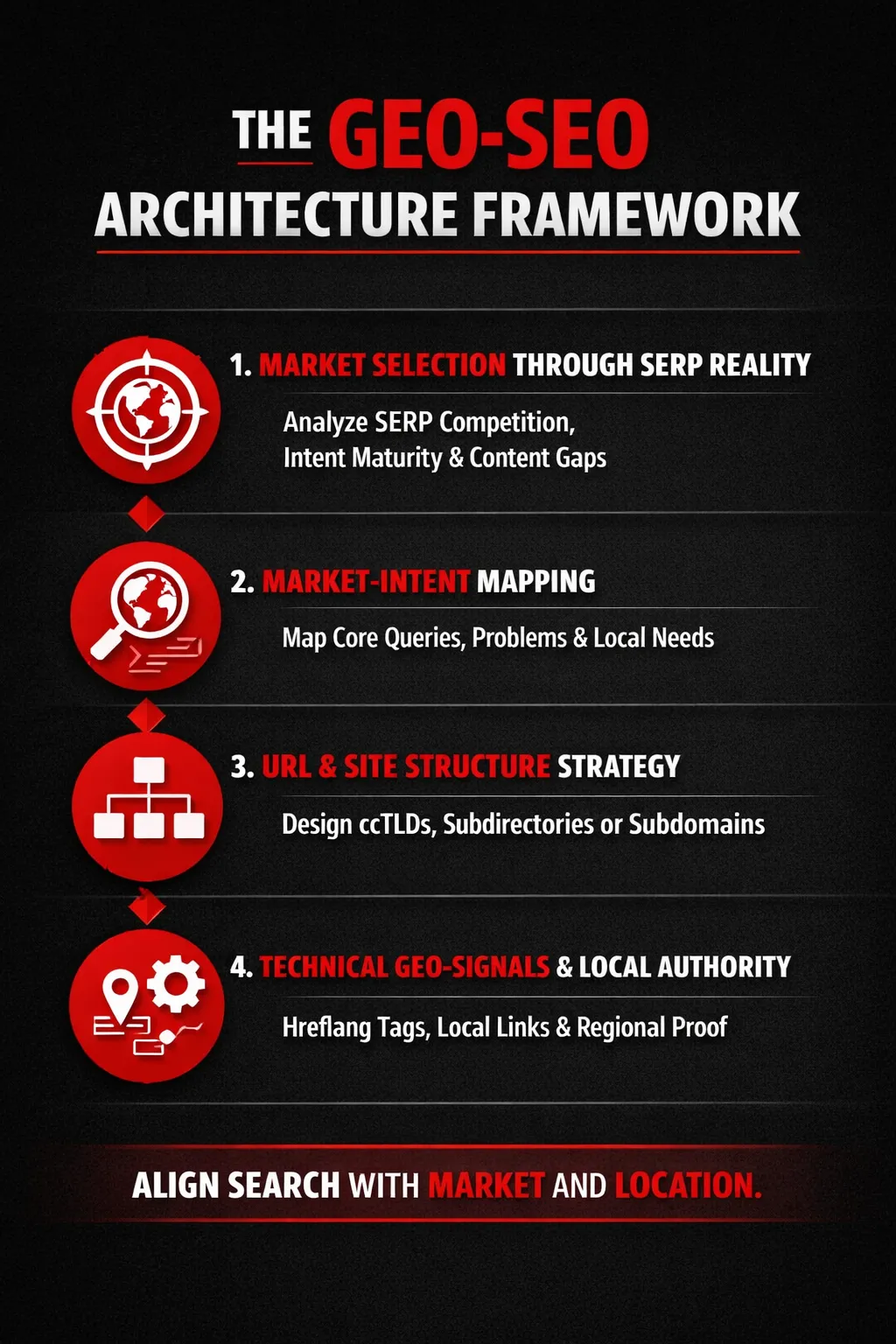
Geo-SEO architecture is the difference between “we launched in 5 countries” and “we’re discoverable in 5 countries.” If your international plan is mostly translation + hreflang, you’ll often win indexation but lose rankings, clicks, and eventually revenue.
Here’s a practical framework you can apply market-by-market.
Step 1 — Market Selection Through SERP Reality (Not Just TAM)
Most teams pick markets based on TAM, investor pressure, or “we’re getting inbound from there.” That’s a strategy for presence. Not for performance.
Instead, treat each target market like a search ecosystem that can be evaluated before you spend heavily. Prioritize markets using four SERP-first filters:
1) SERP competition (difficulty in the real world)
Not “keyword difficulty” as a metric—but who owns the first page.
- Are the top results dominated by entrenched local brands?
- Are marketplaces/aggregators soaking up demand?
- Are there government or institutional sites that are hard to displace?
2) Intent maturity (how buyers search there)
Some markets have mature “comparison” behavior (heavy “best”, “vs”, “alternatives” queries). Others skew toward brand-led or reseller-led journeys.
- Mature intent = more predictable content playbooks
- Immature intent = education + category creation needed
3) Content gap opportunity (where the SERP is weak)
Look for SERPs where:
- the top pages are outdated
- content is thin or generic
- few results speak to local compliance, pricing, or proof
These are markets where a well-structured local presence can outrank “bigger” companies.
4) Localized CPC inflation (paid dependence risk)
If organic fails, paid becomes the crutch. But in some markets, CPCs are inflated due to competition, limited inventory, or aggressive marketplaces.
- High CPC + weak organic = expansion becomes financially fragile fast
Outcome of Step 1: a short-list of markets where your brand can realistically earn SERP visibility—not just “exist.”
Step 2 — Build a Market-Intent Map (Your “Market Intent Matrix”)
Once a market is chosen, don’t start with translation. Start with how people search.
Create a simple intent map per market—this becomes your blueprint for what pages must exist, what content formats win, and what internal linking should reinforce.
Your market intent map should include:
1) Core category queries
These are the “main aisle” searches that define the category.
- Example: “project management software”, “HR payroll software”, “SEO agency”
2) Problem-aware queries
These reveal pain points and early-stage demand.
- Example: “how to reduce cart abandonment”, “automate invoice processing”
3) Solution comparisons
Markets with high buyer maturity often search comparatively.
- Example: “Tool A vs Tool B”, “best tools for X”, “top software for Y”
4) Alternatives & competitor queries
This is where high-intent buyers often convert.
- Example: “Tool A alternatives”, “Tool B pricing”, “Tool C reviews”
5) Use-case queries (industry + role)
Geo-SEO fails when teams reuse the same use cases everywhere. But local industries and titles vary.
- Example: “accounting software for SMEs” vs “for small businesses” vs local equivalent terms
6) Localization needs beyond words
List what must be localized for trust and conversion:
- currency and billing format
- compliance and legal requirements
- terminology differences (“VAT” vs “sales tax”, etc.)
- support expectations (hours, channels, response time)
Deliverable: a 1-page Market Intent Matrix that maps:
- query type → target page type → required proof elements → internal link sources
This matrix prevents you from building random pages that don’t match local SERP behavior.
Step 3 — Choose Your URL + Information Architecture (Decision Tree)
This is where most global expansions unknowingly sabotage themselves. They pick a structure because it “sounds right,” not because it scales.
You’ll generally choose among:
Option A: ccTLDs (example.co.uk, example.de)
Pros: strongest local identity, clear geo targeting
Cons: splits authority, expensive to operate, harder governance at scale
Option B: Subdirectories (example.com/uk/, example.com/de/)
Pros: consolidates authority, easier ops, faster scaling
Cons: needs strong geo clarity + technical discipline to avoid misrouting
Option C: Subdomains (uk.example.com, de.example.com)
Pros: separation for teams or platforms
Cons: often weaker equity consolidation than subdirectories; governance complexity increases
But the real decision isn’t “which is best.” It’s what your organization can maintain without breaking geo signals.
The real decision drivers:
- Operational scalability: can your team publish, QA, and update across markets reliably?
- Geo clarity: will search engines easily understand which pages serve which users?
- Link equity consolidation: will authority compound globally or fragment?
- Governance complexity: can you enforce templates, canonicals, and internal linking rules?
Recommended patterns (common winners):
- Language-region folders: /en-us/, /en-gb/, /en-au/ (best when language variants matter)
- Country folders: /us/, /uk/, /au/ (best when language is mostly consistent)
Whatever you choose, your architecture must support:
- market hubs
- localized solution clusters
- consistent internal linking
—not just cloned landing pages.
Step 4 — Build the Technical Geo-Signals System (So Google Routes Correctly)
Even great content fails internationally if the geo-signals are messy. Your job is to remove ambiguity for search engines.
Here’s the system your geo-SEO architecture needs:
1) Hreflang + canonical alignment rules
This is where most international SEO breaks.
- Every locale page should self-reference in hreflang
- Canonicals must not contradict hreflang targets
- You must avoid pointing canonicals to a different locale unless intentionally consolidating
2) Locale XML sitemaps
Provide clean discovery signals:
- separate sitemaps per locale
- include only indexable URLs
- keep them updated and monitored
3) Indexation controls
International launches often create thin or staging pages that accidentally index.
- noindex thin templates
- block staging environments
- prevent parameter-driven duplicate URLs from expanding index bloat
4) International targeting signals (where applicable)
Some signals depend on setup, market strategy, and platform capabilities—but the principle is consistent:
- make localization unambiguous across technical layers, not just content
5) Internal linking rules (the underrated geo-signal)
Search engines learn “importance” and “relevance” from internal linking.
You need:
- navigation per locale (so UK pages primarily reinforce UK clusters)
- controlled cross-locale links (intentional switching, not accidental global blending)
This step ensures the right page ranks in the right country, consistently.
Step 5 — Add the Local Proof Layer (The Trust Signals That Influence Rankings)
Localization isn’t primarily a language problem—it’s a trust problem.
Search engines increasingly reward pages that satisfy users. Users convert when they believe you’re legitimate in their market. That belief comes from proof.
Localize beyond words:
- Testimonials from local customers (or at least regionally relevant)
- Stats that make sense locally (units, benchmarks, recognizable references)
- Compliance (privacy, tax, sector rules—market-specific)
- Payment methods that match local norms
- Support hours aligned to local time zones and expectations
- Local partners and ecosystem credibility
Why this influences rankings:
- Better local proof improves engagement (lower bounce, better interaction) → stronger SERP performance
- It strengthens entity relevance: you stop looking like a generic global vendor and start looking like a locally valid solution
This is where geo-SEO architecture becomes more than “technical SEO.” It becomes market relevance engineered into your site.
Bottom Line
If you implement these five steps as a system, you’ll stop treating global expansion as a set of translated pages—and start treating it as a repeatable, scalable SERP acquisition model.
Implementation Roadmap: From “Global Site” to Geo-SEO Architecture
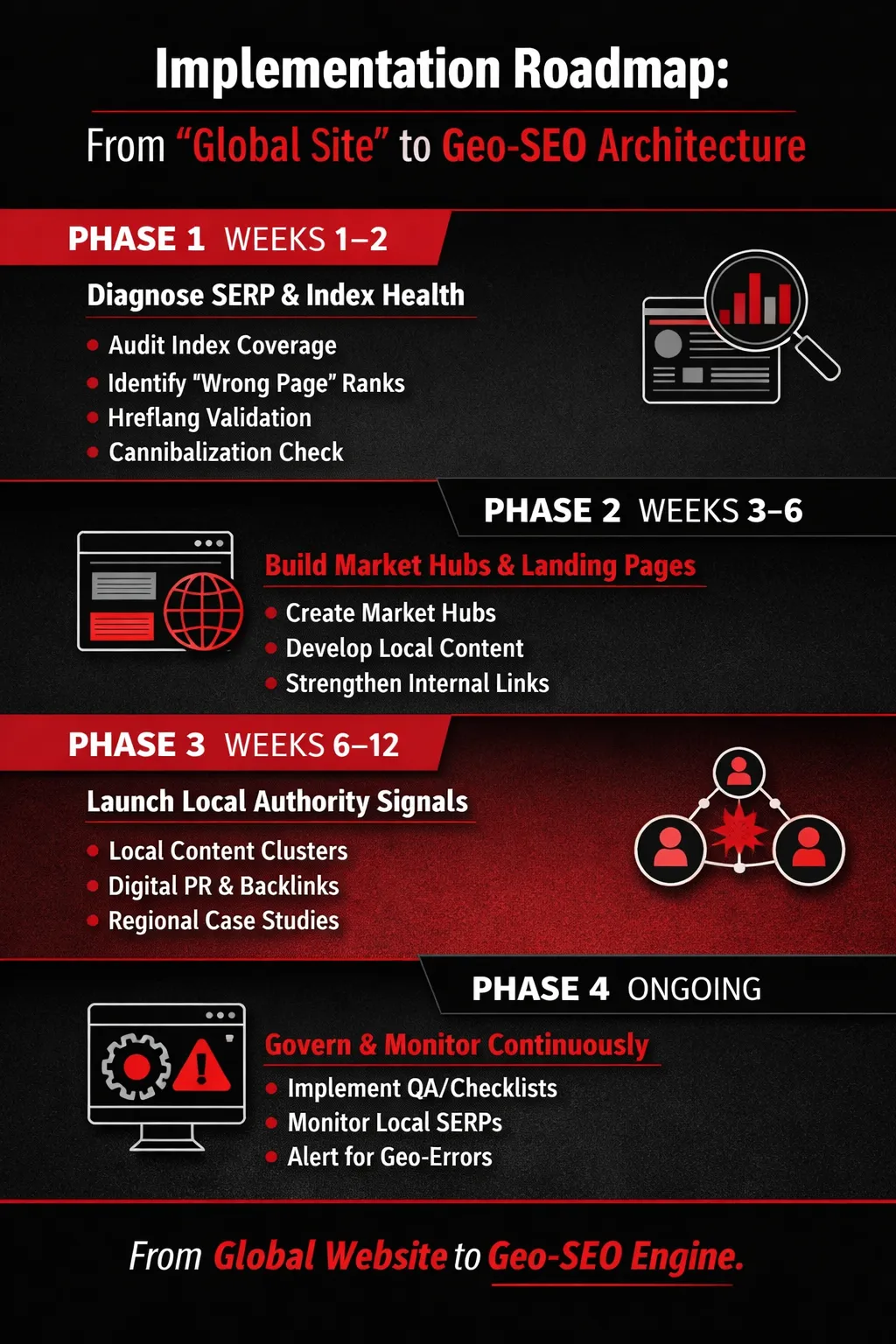
Most companies don’t fail at global SEO because of bad intentions—they fail because they treat international expansion as a one-time website project, not as a search-driven system rollout. Geo-SEO architecture requires a phased implementation that moves from diagnosis to structure, then authority, and finally long-term governance.
Below is a practical, execution-ready roadmap that organizations can realistically deploy without disrupting ongoing growth.
Phase 1 (Weeks 1–2): Diagnose SERP Routing & Index Health
Before building anything new, you must understand how search engines currently interpret your global presence. This phase is not about traffic—it’s about accuracy and clarity.
Start by auditing market-wise index coverage. Identify how many pages are indexed per country and whether that aligns with your intended structure. Over-indexing often signals thin or duplicated localization, while under-indexing indicates crawl or relevance issues.
Next, conduct a cannibalization audit across markets. Global sites frequently have multiple URLs competing for the same queries across regions—especially when a “global” English page unintentionally outranks localized versions. This weakens authority signals and creates ranking volatility.
Hreflang validation is critical at this stage. Check for missing self-referencing tags, incorrect language–region combinations, canonical conflicts, and non-indexable hreflang targets. Many global SEO failures originate from technically “present” but functionally broken hreflang systems.
Finally, identify “wrong page ranks” per country—instances where users in one region are consistently served pages intended for another. These mismatches are early indicators of SERP-level failure and often precede conversion drops.
Phase 2 (Weeks 3–6): Build Market Hubs & Core Landing Pages
Once diagnostic clarity is achieved, the focus shifts to structural correction.
Begin by creating market hub pages—central pages for each region that clearly signal geographic relevance and act as authority anchors. These hubs should link downward into localized solution pages, use cases, and content clusters, reinforcing both relevance and crawl paths.
Implement consistent internal linking and page templates across markets. This ensures scalability and prevents structural drift as new regions are added. Internal links should primarily reinforce within-market relevance, with cross-market links used sparingly and intentionally.
At the same time, align metadata and schema at the market level. Titles, descriptions, structured data, and breadcrumbs must reflect local terminology, currency, and intent patterns—not just translated text. This alignment helps search engines correctly contextualize each page within its regional ecosystem.
Phase 3 (Weeks 6–12): Build Local Authority & Content Clusters
With structure in place, visibility now depends on localized authority and depth.
Develop market-specific content clusters that map directly to local search intent—problem awareness, comparisons, alternatives, and use cases. These clusters should support the market hub and signal topical completeness within that region.
Parallel to content, invest in local PR and partnerships. Mentions, links, and citations from regionally trusted sources significantly strengthen geographic relevance. Authority is not purely global; search engines evaluate prominence in local contexts.
Finally, create case studies per region. These act as both conversion assets and ranking signals, reinforcing trust, relevance, and real-world applicability for local audiences.
Phase 4 (Ongoing): Governance & Monitoring
Geo-SEO architecture fails without governance. This phase ensures the system remains stable as the organization scales.
Integrate a QA checklist into every release cycle, covering indexability, hreflang integrity, internal linking, and metadata alignment. Localization should never bypass SEO validation.
Track monthly SERP share-of-voice per market, not just traffic or leads. Visibility trends often reveal problems weeks before revenue does.
Set up automated alerts for critical risks, including:
- Hreflang errors
- Sudden index spikes or drops
- Traffic mismatches between market intent and landing pages
Together, these phases transform a fragile “global site” into a durable geo-SEO architecture—one that allows global expansion to succeed in search before it is expected to succeed financially.
Practical Checklist: A Quick SERP-Level Reality Check
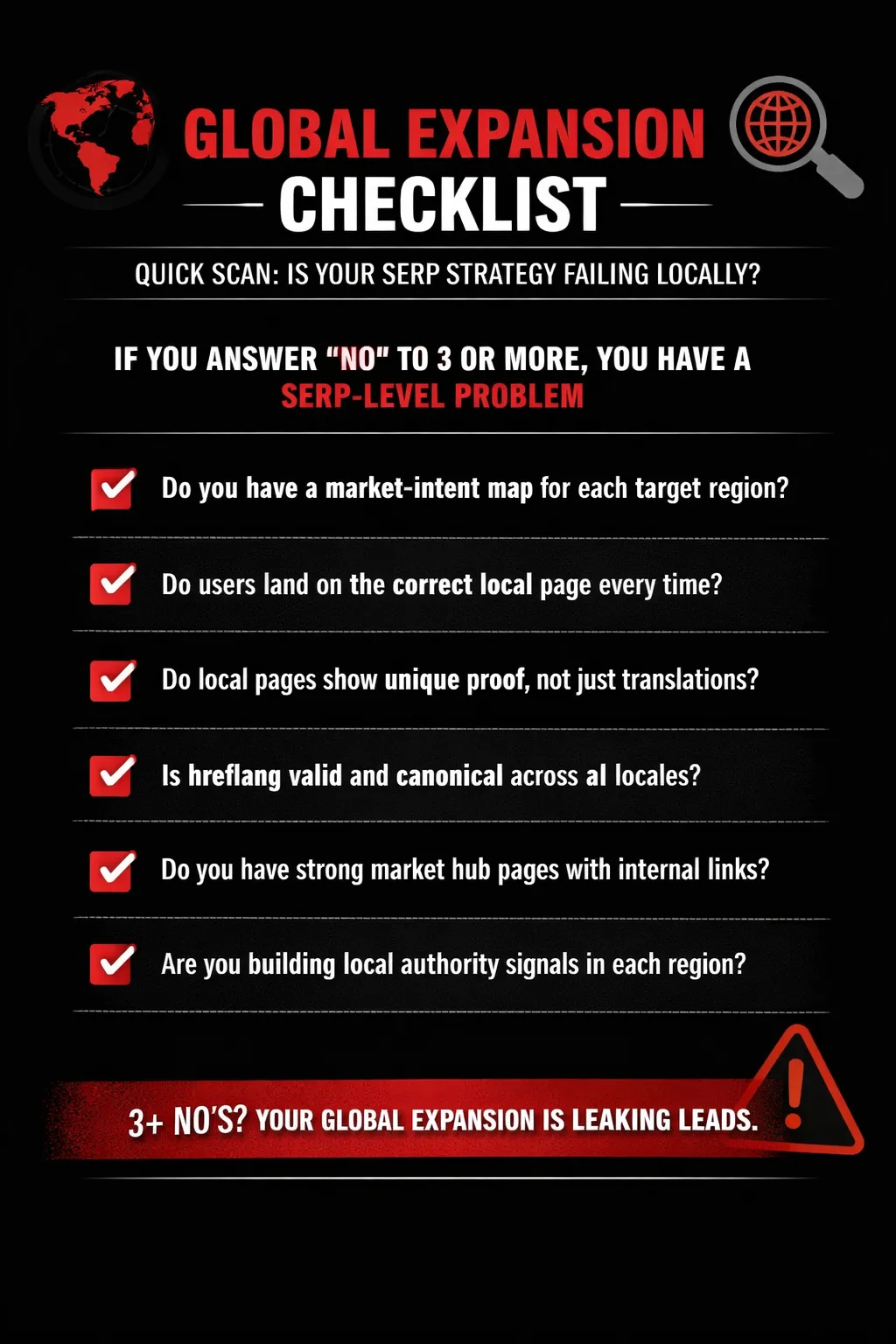
Global expansion rarely collapses overnight. It leaks—quietly, invisibly, and first inside search results. Before revenue drops, before CAC spikes, before leadership starts questioning the market choice, the signals already exist in the SERPs. This checklist is designed as a fast diagnostic.
If you answer “no” to three or more of the questions below, your global expansion is already failing at the SERP level—whether the financial reports show it yet or not.
Start with market-intent clarity.
Do you have a clearly documented market-intent map for every target region? Not a translated keyword list, but an understanding of how users in each market search, compare, and decide. Without this, your content may exist—but it won’t align with how local SERPs are structured.
Next, check SERP routing accuracy.
Do users consistently land on the correct locale page when they arrive from organic search? If users in the UK land on US pricing pages or APAC users see global blog posts instead of local solutions, Google is already confused about your geographic relevance.
Then assess local credibility.
Do your regional pages include unique proof—local case studies, testimonials, compliance signals, partners, or market-specific data? Pages that differ only by language rarely build trust with users or search engines.
Move to technical alignment.
Is your hreflang implementation valid, complete, and aligned with canonical logic across all locales? Even small errors here can cause misindexing, cannibalization, or the wrong pages ranking in the wrong countries.
Evaluate your site architecture.
Do you have clearly defined market hubs with strong internal linking that reinforce geographic relevance? Without this, local pages often remain isolated, weak, and overshadowed by global URLs.
Look beyond your site at authority signals.
Are you actively building local authority through regional PR, mentions, backlinks, and ecosystem presence? Global authority does not automatically transfer into local SERPs.
Finally, assess measurement and operations.
Do you track share of voice by market on a monthly basis? And is localization treated as an ongoing operating system—with governance, QA, and updates—or as a one-time launch task?
If this checklist exposes gaps, that’s not a failure—it’s an early warning. And early warnings are exactly where global success is decided.
Conclusion: Fix SERPs First, or Finance Will Follow
Global expansion rarely fails overnight. It fails quietly, long before revenue numbers raise alarms—at the SERP level. Search is the market’s most honest feedback loop. When your brand struggles to surface in local search results, ranks with the wrong pages, or gets outranked by smaller regional players, the market is already signaling misalignment. By the time this shows up in poor conversions, inflated CAC, or stalled pipelines, the damage has already been done.
This is where geo-SEO architecture changes the trajectory. Instead of treating international SEO as a checklist item, geo-SEO architecture turns search into a system—one that makes global expansion measurable, scalable, and compounding. It aligns market intent with site structure, technical signals, and localized authority, ensuring that every new region you enter strengthens your overall organic footprint rather than diluting it. When built correctly, it allows you to test markets through search, learn faster than paid channels, and scale only where real demand exists.Before you invest in headcount, partnerships, and paid spend in a new region—make sure Google can understand your local relevance there. Because if search engines can’t map your relevance to a market, neither can your customers.