
SUPERCHARGE YOUR ONLINE VISIBILITY! CONTACT US AND LET’S ACHIEVE EXCELLENCE TOGETHER!
The way people search online is changing fast. For years, businesses focused on ranking pages on search engines through traditional SEO. That approach still matters, but it is no longer the full picture. Today, users increasingly rely on AI assistants, generative search platforms, and answer engines that do more than list links. They interpret queries, understand intent, and deliver direct responses.
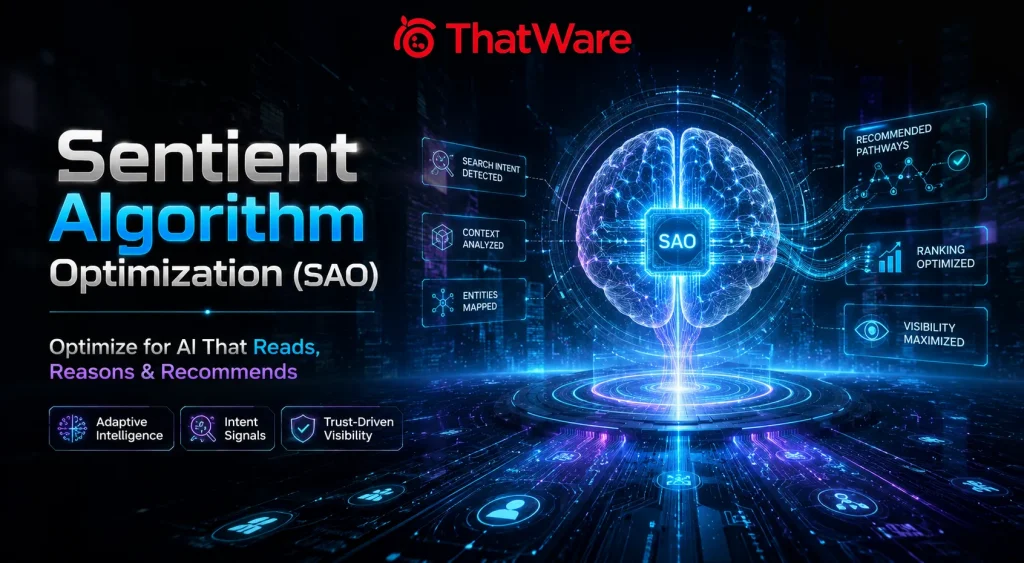
This change has created a new challenge for brands. It is no longer enough to appear on a results page. Now, businesses must become visible inside AI-generated answers, summaries, and recommendations. That is where Sentient Algorithm Optimization comes in. It represents a smarter, more future-facing approach to digital visibility, built for machines that read, reason, and recommend.
At the heart of this shift is AI-driven search visibility. Brands that adapt early can gain a meaningful edge because they are not just optimizing for rankings. They are optimizing for interpretation, trust, and selection. In this blog, you will learn what Sentient Algorithm Optimization means, how it differs from traditional SEO, how AI systems process content, and what businesses can do to stay visible in the next era of search.
What Is Sentient Algorithm Optimization (SAO)?
Sentient Algorithm Optimization is the process of shaping digital content so AI systems can understand, trust, and surface it in relevant responses. In simple terms, it goes beyond optimizing for crawlers and moves toward optimizing for intelligent systems that evaluate meaning, context, and usefulness.
Traditional SEO often focuses on keywords, backlinks, metadata, and rankings. SAO, however, focuses on how a machine interprets the depth and relevance of information. It looks at whether content is structured clearly, whether ideas are connected logically, and whether the brand behind the content appears authoritative enough to be referenced.
This is why SAO is not just a rebranding of SEO. It is a broader way of thinking about discoverability. As search evolves into conversation, content must also evolve into something machines can process with confidence.
SAO in Digital Marketing Ecosystem
The role of SAO in digital marketing is becoming more important as AI-powered interfaces become part of daily search behavior. Brands are shifting from trying to win a click to trying to become the source that AI chooses. This is a major difference.
Earlier, the goal was often to rank on page one. Now, the goal is to influence the answer itself. That shift changes how marketers think about content creation, site structure, brand signals, and authority building. As a result, SAO in digital marketing is quickly moving from a niche idea to a practical necessity for businesses that want future-ready visibility.
How AI Search Is Changing the Rules
From Search Results to AI Answers
Search engines once worked mainly as directories. Users entered a query, and the engine returned a list of blue links. Today, AI systems increasingly summarize information and present a direct answer instead. This means content is no longer competing only for position. It is competing for inclusion.
That shift matters because being selected inside an answer can be more powerful than simply being ranked. A user may never click through ten different websites if an AI assistant already gives them what they need. Consequently, the rise of AI-driven search visibility is changing the very definition of online success.
Businesses must now think beyond impressions and traffic alone. They must think about digital influence, answer placement, and machine trust. The brands that understand this early will be far better positioned in the years ahead.
How AI Search Algorithms Work
To adapt well, it helps to understand how AI search algorithms work. These systems use a combination of natural language processing, semantic analysis, machine learning, and entity recognition to understand both the query and the content available online.
Instead of matching exact words alone, AI systems examine relationships between ideas. They ask what the user truly means, what information is most relevant, and which sources appear credible. They also look at patterns of authority, consistency, and structure. This is why context matters so much.
Understanding how AI search algorithms work allows businesses to create content that fits the logic of AI systems. It encourages clearer writing, better structure, deeper expertise, and stronger topic relationships across a site.
SAO vs Traditional SEO: A Paradigm Shift
Key Differences
Traditional SEO and SAO are connected, but they are not the same. SEO is built around ranking signals such as keywords, backlinks, page speed, mobile usability, and technical health. SAO adds another layer. It focuses on whether content can be interpreted well by AI and whether the brand is seen as a trustworthy source within a wider knowledge environment.
In this new model, success comes from semantic depth, topical relevance, structured presentation, and entity consistency. That is why the future of search engine optimization is likely to be more AI-first than search-engine-first. Ranking will still matter, but it will become just one part of a larger visibility framework.
Why SEO Alone Is Not Enough
Traditional SEO still provides the foundation. However, it does not fully address the growing role of AI-generated answers. Many websites are optimized to rank but not optimized to be understood deeply by AI systems. That gap creates missed opportunities.
This is also where AI-powered SEO techniques are gaining traction. These methods combine classic SEO practices with semantic mapping, answer formatting, entity reinforcement, and content intelligence. Businesses need that hybrid approach because search behavior is no longer limited to browser-based link exploration.
The smartest strategy now is not to abandon SEO but to extend it. Businesses need both solid technical SEO and AI-aware content design if they want to stay competitive.
Core Pillars of Sentient Algorithm Optimization
Context and Semantic Clarity
At the core of SAO is clarity. AI systems respond better to content that explains concepts clearly, connects related ideas, and follows a logical structure. This means shallow pages with keyword repetition will struggle more than content that offers real insight.
One of the most important principles here is entity-based search optimization. Entities are specific, identifiable concepts such as brands, people, products, services, and places. AI systems use them to build meaning and relationships across the web. Strong entity signals help machines understand who you are, what you do, and why your content matters.
Authority and Trust Signals
AI systems tend to favor reliable information. That means trust signals are essential. Expertise, experience, author credibility, brand consistency, and high-quality supporting content all influence how a source is perceived.
In practical terms, this means businesses should publish original insights, maintain a consistent topical focus, and strengthen their digital footprint across channels. Trust is no longer just a human factor. It is also a machine-readable signal.
Answer-Ready Content Structure
The way content is formatted makes a big difference. AI systems need content that is easy to scan, interpret, and summarize. Strong headings, direct explanations, concise definitions, and well-organized sections all help.
This structure forms the foundation for effective AI search optimization strategies. If a page is confusing, repetitive, or poorly structured, it becomes harder for AI to extract useful information from it. Clarity improves both human engagement and machine selection.
How to Optimize Content for AI Systems
Writing for Machines and Humans
To succeed with SAO, brands need content that works well for both people and AI systems. The writing should be clear, helpful, and direct. It should answer real questions, explain important concepts, and avoid unnecessary complexity.
This is how businesses can optimize content for AI search engines effectively. The goal is not to sound robotic. The goal is to make information accessible, structured, and meaningful. Strong content does not just mention a topic. It explains it with enough depth to show expertise.
Structuring Content for AI Extraction
Formatting matters almost as much as the words themselves. Helpful practices include using descriptive headings, short paragraphs, definition-based openings, comparison sections, FAQs, and logical content flow.
These choices align closely with generative search optimization, because generative systems often favor content that is easy to summarize and cite. They look for pages that offer clarity, relevance, and coherent organization. The easier your content is to extract, the more likely it is to be used in AI-generated responses.
Practical SAO Strategies for Businesses
Building Entity-Based Content
Brands should create content ecosystems, not isolated pages. That means publishing related content across core topics, linking them intelligently, and reinforcing the same brand and subject signals over time. This strengthens thematic authority.
It also enhances entity-based search optimization by helping AI systems connect your brand with specific expertise areas. For example, a company focused on AI SEO should consistently publish around AI search, semantic optimization, entity modeling, generative discovery, and digital authority.
Leveraging AI-Powered SEO Techniques
Modern marketers can also use AI-powered SEO techniques to improve content strategy. These may include topic clustering, intent mapping, semantic gap analysis, content scoring, and AI-assisted optimization workflows. Used correctly, these techniques help create more complete and relevant content ecosystems.
However, technology alone is not enough. The strategy must still be guided by human expertise, editorial quality, and a clear understanding of audience needs.
Implementing AI Search Optimization Strategies
Strong AI search optimization strategies usually begin with an audit. Businesses need to review whether their existing content is too thin, too repetitive, or too focused on old-style keyword targeting. From there, they can restructure pages, strengthen topical clusters, refine headings, improve clarity, and build better entity signals.
The best results often come from making content more useful, not just more optimized. When relevance and authority improve together, machine visibility tends to improve as well.
Role of Generative Search in SAO
Understanding Generative AI Results
Generative AI systems do not simply point users to information. They create responses by drawing from a range of sources and patterns. This makes generative search optimization one of the most important parts of SAO today.
If your content is precise, structured, and trustworthy, it has a better chance of shaping those AI-generated outputs. If it is vague, generic, or poorly organized, it may be ignored. That is why structured content often performs better in AI discovery environments.
Content That Gets Featured
AI-friendly content usually shares a few clear qualities. It answers specific questions. It explains concepts directly. It avoids fluff. It uses headings that reflect real search intent. It provides context rather than scattered information.
Businesses that want to optimize content for AI search engines should build pages that feel citation-ready. In other words, each section should be useful enough to stand alone as an answer, while still contributing to the page as a whole.
Real-World Applications of SAO
SAO for Businesses and Brands
For businesses, SAO can improve visibility in high-intent discovery moments. A software company may want its content cited when users ask an AI assistant about the best tools for workflow automation. A healthcare provider may want AI systems to surface its explanations when users search for treatment guidance. These are practical, high-value outcomes.
This is why many forward-looking brands are exploring how SAO in digital marketing can shape long-term authority, not just short-term traffic.
SAO for Content Creators and Agencies
Agencies, publishers, and content creators can also benefit. When they understand the mechanics behind selection, extraction, and summarization, they can produce work that fits how AI systems evaluate content. That means better visibility, more authority, and stronger digital positioning.
Creators who understand the answer economy will have a major advantage in the coming years.
Benefits of Sentient Algorithm Optimization
Increased AI Visibility
One of the clearest benefits of SAO is greater visibility in AI-generated responses. Instead of relying only on organic rankings, brands can gain exposure through summaries, recommendations, and assistant-driven answers. This creates stronger reach and more consistent digital presence.
Long-Term Competitive Advantage
SAO also helps businesses prepare for the future of search engine optimization. Search is becoming more conversational, more predictive, and more AI-mediated. Brands that adapt now can build authority before the space becomes crowded.
Higher Trust and Authority
When AI systems repeatedly recognize a brand as a reliable source, that brand gains more than traffic. It gains trust. Over time, this can improve discoverability, brand recall, and commercial influence across the digital journey.
Challenges and Considerations
Adapting to Rapid Changes
AI systems are evolving quickly. Search experiences will likely continue changing, which means businesses must stay flexible. SAO is not a one-time tactic. It is an ongoing process of refinement, learning, and adaptation.
Balancing SEO and SAO
Businesses should not think of SAO as a replacement for SEO. Instead, they should see it as an extension. Strong technical SEO, crawlability, internal linking, and content quality still matter. The goal is balance: a strategy that supports both traditional discovery and AI interpretation.
The Future of SAO and Digital Search
What Lies Ahead
The next phase of search will be shaped by AI assistants, intelligent interfaces, multimodal search, and more personalized answer systems. In that world, Sentient Algorithm Optimization will become even more relevant because it addresses the core challenge of machine understanding.
As AI-first ecosystems grow, visibility will depend more on meaning, authority, and structure than on simple keyword placement.
Preparing for the Next Era
Businesses that want to stay ahead should invest in content quality, structured knowledge, stronger brand entities, and clear editorial systems. They should publish content that informs deeply, answers clearly, and reinforces expertise across related topics.
That is how brands prepare for the next era of search.
Conclusion: The New Era of Search Has Begun
The rules of digital visibility are changing. Search is no longer only about rankings. It is about relevance, interpretation, and trust within systems that think more like assistants than indexes. Sentient Algorithm Optimization provides a framework for this shift by helping brands create content that AI can understand, value, and surface.
The move from traditional search to intelligent discovery is already underway. Businesses that respond now will be better placed to shape how they appear in AI-generated outcomes. They will not just chase traffic. They will influence answers.This is also why innovative agencies are beginning to focus seriously on SAO-led approaches. ThatWare stands out as a pioneer SEO agency that leverages this service by aligning advanced optimization with the demands of the AI-era search. For brands that want to remain visible, trusted, and future-ready, the path forward is clear: build for humans, structure for machines, and optimize for a search ecosystem that is becoming more intelligent every day.